

Sample Category Title
Bank of Canada Business Outlook Survey: Businesses Upbeat ahead of Omicron
The Bank of Canada Business Outlook Survey (BOS) reported elevated optimism among Canadian businesses in the fourth quarter of 2021. The BOS indicator, a statistical summary of survey results, was 5.99 in 2021Q4, up from 4.56 in the third quarter. Businesses expected foreign and domestic demand to strengthen, boosting future sales. That said, the survey was taken before the impact of Omicron was fully felt across the country, suggesting an upside bias in survey responses.
- Interestingly, today's report noted that capacity pressures are lifting the overall BOS indicator. In fact, since the beginning of 2021, they have explained most of the increase in the indicator. In the past, capacity constraints were reflective of strong demand, but in the current context, it represents both strong demand and supply disruptions.
Indeed, prior to the Omicron shock, strong demand and growing capacity constraints were leading firms to signal increased investment intentions. According to the BOS, "positive investment intentions are broad-based across sectors and regions". Some firms were planning on proceeding with plans that were delayed by the pandemic. In addition, "intense labour shortages and difficulties attracting and retaining workers" were leading to some businesses to increase expenditure on digital technologies and automation.
On the topic of labour shortages, the BOS reported that four in 10 firms see labour shortages as holding back sales. As a result, some companies said it may take longer than previously anticipated to fully recover. According to firms, there were three main factors contributing to labour market tightness: strong labour demand, structural impediments such as aging population and technological changes requiring new skills, and increased worker preference for remote work and flexible working hours.
In terms of labour demand, intentions to hire in the next 12 months rose and remain widespread across industries. Three-quarters of businesses reported that employment levels were back to pre-pandemic norms, and many are hiring to meet higher domestic and foreign demand. This has put upward pressure on wages, with 57% of respondents stating they intend to raise wages at a faster rate over the next year.
Firms expect to pass on higher wages, as well as higher input prices stemming from supply constraints, to Canadians, with many expecting to do so over the next six months. Given that, two-thirds of businesses anticipate consumer price inflation will be above 3% for next two years. In a special question included in this BOS, most companies said they expected inflationary pressures to "dissipate over time, with inflation returning close to target in one to three years."
Key Implications
Today's BOS results were a bit outdated as the survey was taken before Omicron burst onto the scene. Indeed, from October to early-December, businesses were fairly upbeat as COVID cases were relatively low and the economy continued to make solid gains. This boosted investment intentions and left some firms ready to restart investment plans that were shelved due to the pandemic.
Omicron, however, has upended the economic landscape captured in the Business Outlook Survey. With cases skyrocketing and provinces renewing public health restrictions, spending plans could again be shifted to the backburner as businesses wait out this wave of the pandemic, repeating their behaviour during previous waves. As a result, advances in non-residential could be muted in the near-term, keeping expenditure below pre-pandemic levels in the fourth quarter of last year and the first quarter of 2021.
BOS results are likely to be a key input in the Bank's next monetary policy announcement later this month. Last quarter's survey reported that businesses see price pressures receding over the medium term. This will alleviate some of the Bank's concerns around an upward shift in inflation expectations. However, the BOS also reported a tight labour market and rising wage pressures, which could keep inflation elevated for longer. The Bank will have to weigh these risks alongside the Omicron impact as it charts the next steps for monetary policy.
AUDUSD’s Bearing in Question as Gradual Ascent Struggles
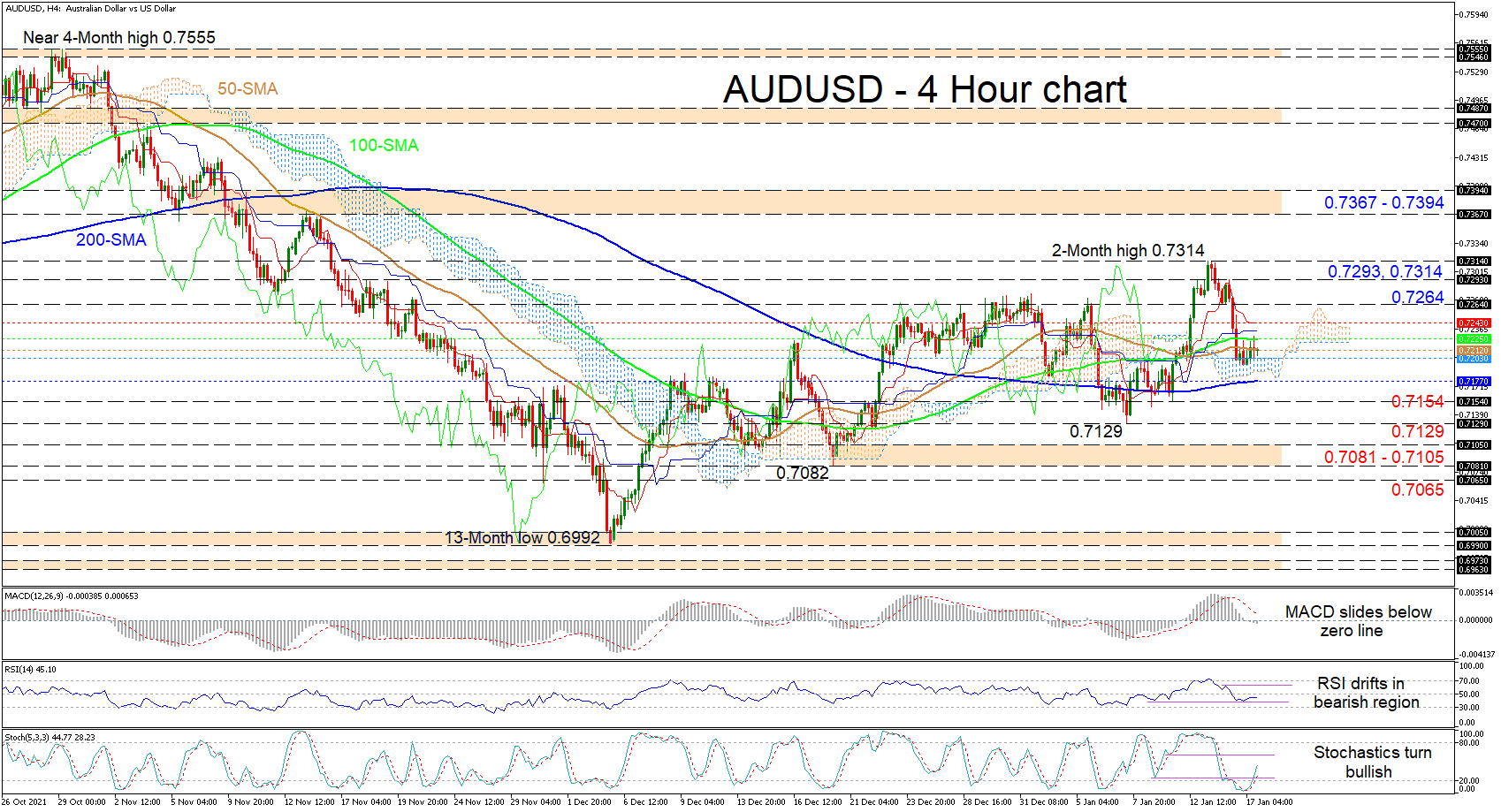
AUDUSD turns somewhat neutral as the pair’s improvements have failed to take flight for around one-and-a-half-months now. Currently, the simple moving averages (SMAs) are not implying a specific trend is in place, while the Ichimoku lines are also indicating weak and unclear directional forces in the pair.
The short-term oscillators are reflecting conflicting signals in momentum, indicating the indecision in the pair to develop a decisive trend. The MACD is below its red trigger line and has glided beneath the zero mark, while the stochastic lines are powering above the 20 level, promoting positive price action. That said, the RSI is hovering in the bearish territory, sponsoring no real change in momentum.
To the upside, an immediate zone of resistance from the 50-period SMA at 0.7212 until the red Tenkan-sen line at 0.7243 could impede the pair from recouping its latest losses. However, should buyers manage to overstep this congested obstacle zone, they may then meet the nearby 0.7264 barrier before jumping toward the neighbouring highs of 0.7293 and 0.7314. Should the bulls revive the hike north, they may eye the 0.7367-0.7394 resistance border extending back to November 2021.
Alternatively, downward forces face an instant support zone existing between the Ichimoku cloud’s lower band at 0.7203 and the 200-period SMA at 0.7177. In the event the 200-period SMA fails to provide buyers with traction, the price could slip towards the 0.7154 and 0.7129 recent troughs. Retreating further, the bears could then tackle the 0.7081-0.7105 support band ahead of the 0.7065 barrier, the last two defences before a clear drop toward the 13-month low of 0.6992.
Summarizing, AUDUSD is just about sustaining its neutral-to-bullish tone above the 200-period SMA and the 0.7129 trough. A price decline stretching beneath the 0.7082 low could trigger negative concerns in the pair.
Sunset Market Commentary
Markets
The absence of US traders in observance of Martin Luther King Day took the sting out of today’s EMU trading action. Especially since the main dish was served during Asian trading hours with monthly Chinese activity data and quarterly GDP figures. Data pointed in the direction of further waning growth momentum. The PBOC anticipated the numbers by unexpectedly cutting key policy rates for the first time since April 2020 (7d reverse repo and 1y lending facility) by 10 bps to respectively 2.1% and 2.85%. It prompted an outperformance of main Chinese equity indices (+1-1.5%). Main European benchmarks enjoyed the risk rally and currently gain 0.5% to 0.7%. EUR/USD fluctuates in low 1.14 area. German Bunds continue to trade near Friday’s sell-off lows. Daily changes range between +0.5 bps and +1.1 bp across the curve. The German 10y yield thus remains near the recovery high of -0.02%. The technical picture in the EU 10y swap rate looks even better. It broke the 2021 recovery high (0.33%) early January to bump into 0.40% resistance (50% retracement on 2018-2019) decline. A correction lower didn’t go below resistance-turned-support at 0.33% with the key swap gauge back at 0.40%. A break higher paves the way to 62% retracement on that 2018-2019 decline at 0.59%. This week’s key event from a European point of view could for once be the normally dull Minutes of the ECB meeting, published on Thursday. Recall US markets’ reaction after the release of the December Minutes. The ECB back then decided to put PEPP to bed after March 2022 and to temporarily bump APP in Q2 (€40bn/month) and Q3 (€30bn/month). We assume Lagarde used her finest negotiations skills to craft this deal and markets will be interested in more hawkish floated alternatives in line of rapidly evolving market developments.
The Kingdom of Belgium intends to launch a new 10y benchmark (OLO 94 June2032). The Belgian debt agency for this year projects a €48.28bn gross financing requirement. This covers a €18.34bn deficit (net financing), €27.59bn maturing debt and €1.84bn of planned buy-backs. Gross borrowing is up 10% compared to last year. The substantially higher debt redemptions compensate for a 25% lower cash deficit. In 2023, these redemptions should decline to €21.6bn. The bulk of the funding will be raised through OLO’s for an amount of €41.20bn (up to 3 planned syndications). EMTN & Schuldscheine programmes (€3bn) and an increase in short-term debt fill the remaining gap. Belgium will no longer fund via (SURE) EU loans.
News Headlines
Norwegian Exports in 2021 hit a record high value of NOK 1377.8 bn, raising the amount of total exports by about 77% compared to 2020. This strong export performance resulted in a record trade surplus of NOK 531bn for the year. The rise was mainly driven by higher energy prices. The value of natural gas exports more than quadrupled to NOK 478.8 bn. Revenues of oil exports reached the highest level since 2008 (NOK 349.6 bn). However, the strong Norwegian export performance was visible as well in mainland exports which also hit an all-time record (+22% from 2020). This was due to strong exports in oil related products, metals and energy, but fish exports also hit an all-time high. The Norwegian krone remains well bid with EUR/NOK returning below 10. The Norwegian central bank raised its policy rate from 0.25% to 0.50% in December. It meets again on Thursday but a next hike is only expected at the March 24 policy meeting when a new monetary policy report will be available.
December Polish inflation earlier this month printed at 0.9% m/m and 8.6% y/y. Today, the National Bank of Poland published its monthly analysis of the drivers for (core) inflation. Core inflation net of food and energy prices rose further by 0.4% M/M and 5.3% Y/Y (from 4.7% in November). The core number excluding the most volatile items still accelerated 0.7% M/M and 6.7% Y/Y. Last week, the Polish government announced a series of measures including VAT cuts on selected products for six months starting February 1 to cap price rises for Polish citizens. The zloty today extended gains. EUR/PLN is trading near 4.52, the strongest level for the zloty since September last year.
Canada’s Manufacturing Sector Recovery Continued in November
Canada's manufacturing sales increased 2.6% (month/month) in November, following a 4.6% increase in October. The outturn was still solid after accounting for price effects, with manufacturing shipment volumes up 1.9% on the month.
The increase in nominal sales spanned 18 of the 21 industries. The transportation equipment industry (+4.9%) led the overall increase. Despite the improvement, sales levels in the motor vehicle sub-industry remained relatively depressed. Sales of primary metals (+5.8%), petroleum and coal products (+3.7%), non-metallic mineral products (+10.4%), chemicals (+2.5%), wood products (+3.2%), and food (+1.3%) were also strong.
Inventories increased 1.2% on the month, and the inventory-sales ratio edged down to 1.60 (from 1.62 in October). Forward looking indicators were positive, with new orders up 3% and unfilled orders up 0.4%.
The B.C. floods were reported to have impacted 28.1% of manufacturers (through transportation delays and raw material shortages). Statistics Canada estimated an impact of $372.1 million on sales in November.
Key Implications
Canada's manufacturing sector recovery continued into November, despite severe flooding in B.C. November saw a second consecutive monthly increase in sales and broad-based strength across most of the sub-industries. Combined with other economic indicators, this release corroborates the view that the Canadian economy enjoyed a solid fourth quarter.
The outlook for Canada's manufacturing sector in the coming months is mixed. Forward looking indicators (new orders) were positive, and Canada's PMI reading alongside the ISM manufacturing index point to continued resilience in sentiment and demand. However, this strength comes against lingering global supply chain disruptions. Responses from today's Business Outlook Survey from the Bank of Canada should help shed more light on the outlook for overall business investment and the manufacturing sector.
CAD Firm after Manufacturing Sales, Trading Generally Subdued
Canadian Dollar is trading as the strongest one for today, and remains firm after stronger than expected manufacturing sales data. Dollar is currently following, with help by rebound against Yen. Sterling is also slightly weaker, following Yen. Other currencies are mixed for now. Overall, trading is rather subdued with US on holiday.
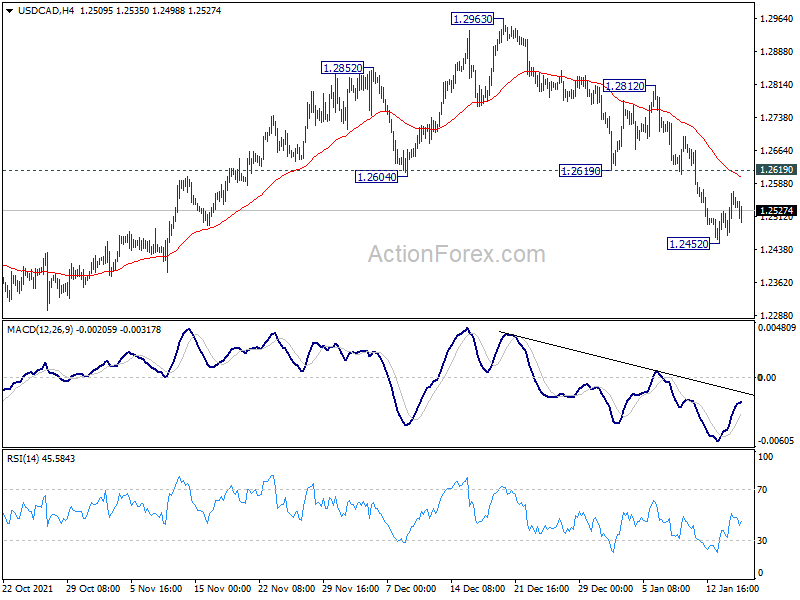
Technically, while Canadian Dollar is firm, it's currently still engaging in consolidation against Dollar. Further decline is expected with 1.2619 resistance intact. Break of 1.2452 will resume the fall from 1.2963 to 1.2286 and even further to 1.2005. However, if WTI oil reverses recent rally after being rejected by 85.92 high, a setback in Canadian Dollar could be triggered. That, if happens, could push USD/CAD through 1.2619 for a stronger rebound.
In Europe at the time of writing, FTSE is up 0.77%. DAX is up 0.39%. CAC is up 0.66%. Germany is up 0.0153 at -0.030. Earlier in Asia, Nikkei rose 0.74%. Hong Kong HSI dropped -0.68%. China Shanghai SSE rose 0.58%. Singapore Strait Times rose 0.18%. Japan 10-year JGB yield dropped -0.0046 to 0.146.
Canada manufacturing sales rose 2.6% mom in Nov, supply chains impacts continued
Canada manufacturing sales rose 2.6% mom to CAD 63.1B in November, above expectation of 1.7% mom. Sales increased in 18 of 21 industries, led by the primary metal, petroleum and coal product, non-metallic mineral, and food product industries.
Statistics Canada said, "despite the gains observed for November, supply chain issues continued to impact manufacturing production in many industries including transportation, chemical, and food. Moreover, floods in British Columbia further exacerbated the situation."
China GDP grew 4.0% yoy in Q4, weak retail sales
China GDP grew 4.0% yoy in Q4, much faster than expectation of 3.3% yoy. On a quarterly basis, GDP grew 1.6% qoq, above expectation of 1.1% qoq. For 2021 as a whole, GDP grew 8.1%, slightly above expectation of 8.1%.
In December, industrial production rose 4.3% yoy, above expectation of 3.6%. Retail sales rose 1.7% yoy, below expectation of 3.7% yoy. Fixed asset investment rose 4.9% ytd yoy, slightly above expectation of 4.8%.
The National Bureau of Statistics said, "we must be aware that the external environment is more complicated and uncertain, and the domestic economy is under the triple pressure of demand contraction, supply shock and weakening expectations."
Also from China, steel production dropped for the first time in six years in 2021, down -3% from 1.065B tonnes to 1.03B tonnes. Birth rate dropped to a record low of 7.52 births per 1000 people in 2021, down from 2020's 8.52 births per 1000 people.
China's rate cut failed to lift HSI
China's rate cuts were not enough to lift investor sentiment in the region. PBoC lowered its one-year medium-term lending facility rate by 10bps to 2.85%. The seven-day reverse repurchase rate was also cut by 10bps to 2.1%. They're the first rate cut since April 2020.
Also, the PBoC injected more liquidity by offering 700 billion yuan of MLF loans, exceeding the 500 billion yuan maturing, and added 100 billion yuan with seven-day reverse repurchase agreements, more than the 10 billion yuan due.
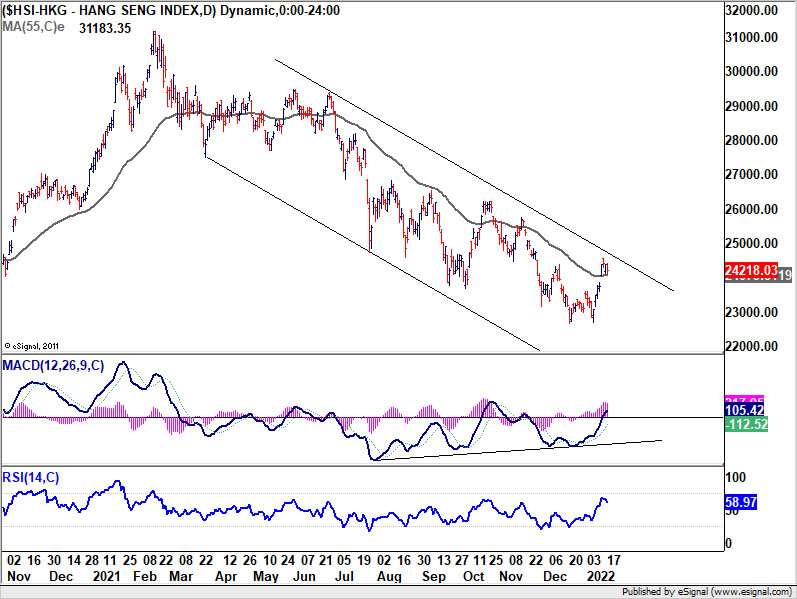
Hong Kong HSI closed down -165 pts or -0.68% at 24218.03. Downside momentum has been diminishing since mid December. Yet there is no clear sign of bullish reversal. HSI is still inside medium term falling channel. Another fall remains in favor to extend the down trend from 31183.35 through 22665.25 low.
GBP/USD Daily Outlook
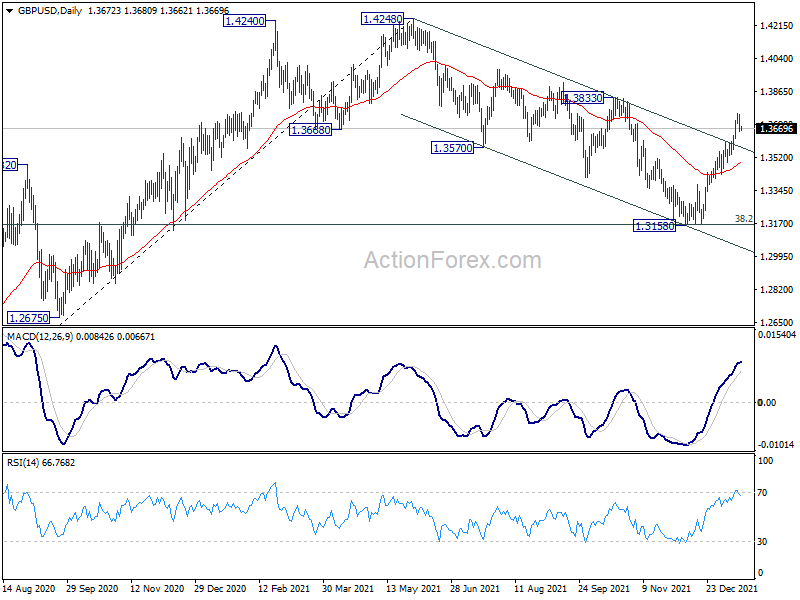
Daily Pivots: (S1) 1.3642; (P) 1.3692; (R1) 1.3732; More...
Intraday bias in GBP/USD remains neutral for consolidation below 1.3748 temporary top. Downside of retreat should be contained by 1.3489 support to bring another rally. As noted before, corrective fall from 1.4282 should have completed with three waves down to 1.3158, after hitting 1.3164 medium term fibonacci level. Above 1.3748 will target 1.3833 first. Sustained break of 1.3833 will pave the way back to retest 1.4248 high.
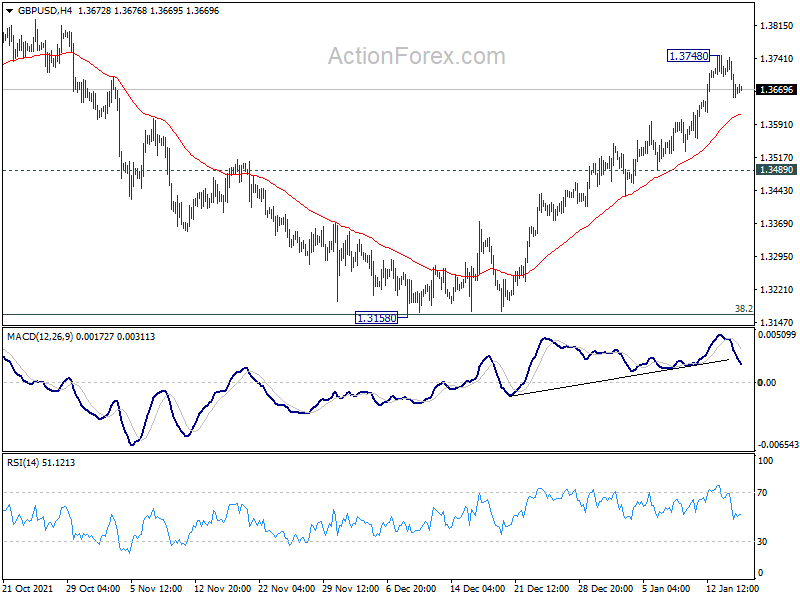
In the bigger picture, strong support was seen from 38.2% retracement of 1.1409 to 1.4248 at 1.3164. The development suggests that up trend from 1.1409 (2020 low) is still in progress. On resumption, next target will be 38.2% retracement of 2.1161 to 1.1409 at 1.5134. Nevertheless sustained break of 1.3164 will argue that whole rise from 1.1409 has completed and bring deeper fall to 61.8% retracement at 1.2493.
Economic Indicators Update
| GMT | Ccy | Events | Actual | Forecast | Previous | Revised |
|---|---|---|---|---|---|---|
| 23:50 | JPY | Machinery Orders M/M Nov | 3.40% | 1.40% | 3.80% | |
| 00:01 | GBP | Rightmove House Price Index M/M Jan | 0.30% | -0.70% | ||
| 02:00 | CNY | GDP Y/Y Q4 | 4.00% | 3.30% | 4.90% | |
| 02:00 | CNY | Retail Sales Y/Y Dec | 1.70% | 3.70% | 3.90% | |
| 02:00 | CNY | Industrial Production Y/Y Dec | 4.30% | 3.60% | 3.80% | |
| 02:00 | CNY | Fixed Asset Investment YTD Y/Y Dec | 4.90% | 4.80% | 5.20% | |
| 04:30 | JPY | Tertiary Industry Index M/M Nov | 0.40% | 1.10% | 1.50% | 1.90% |
| 13:30 | CAD | Manufacturing Sales M/M Nov | 2.60% | 1.70% | 4.30% | |
| 15:30 | CAD | BoC Business Outlook Survey |
Canada manufacturing sales rose 2.6% mom in Nov, supply chains impacts continued
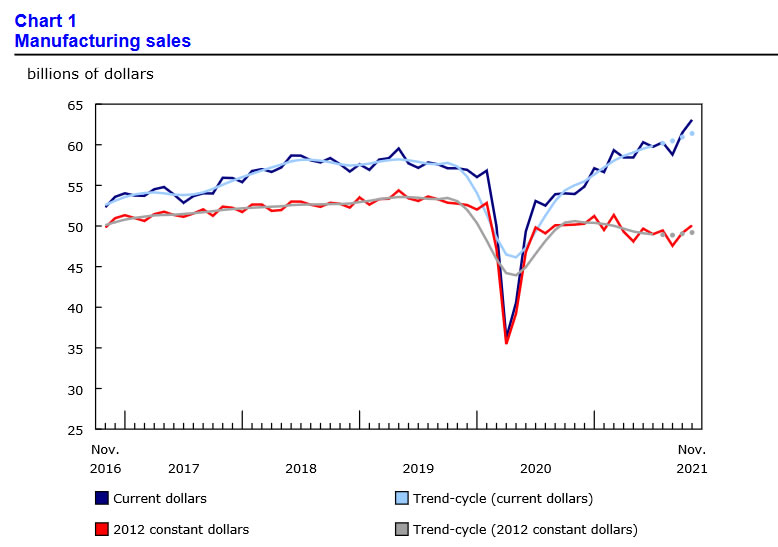
Canada manufacturing sales rose 2.6% mom to CAD 63.1B in November, above expectation of 1.7% mom. Sales increased in 18 of 21 industries, led by the primary metal, petroleum and coal product, non-metallic mineral, and food product industries.
Statistics Canada said, "despite the gains observed for November, supply chain issues continued to impact manufacturing production in many industries including transportation, chemical, and food. Moreover, floods in British Columbia further exacerbated the situation."
CAD Edges Higher ahead of BoC Survey
The Canadian dollar has started the week with gains and could break below the symbolic 1.25 level during the day. US markets are closed for Martin Luther King Day, so I expect a quiet North American session. Later in the day, Canada releases Manufacturing Sales and the BoC Business Outlook Survey.
Just four weeks ago, the US dollar was sizzling and USD/CAD was pressing close to the 1.30 level. The greenback has faltered since then, and USD/CAD dipped below the 1.25 line last week and seems poised to test this level again. Investors remain in a risk-on mood, which has buoyed the risk-sensitive Canadian dollar. The markets have shrugged off releases which could have dampened risk sentiment, such as weak US nonfarm payrolls and retail sales reports, CPI release of 7% and a more hawkish Federal Reserve. Risk appetite can quickly change directions, but in the meantime the mood is bullish, and that should translate into further gains for the Canadian dollar.
Markets yawn after US retail sales slide
Last week wrapped up with US Retail Sales for December and the numbers were dismal. The headline release came in at -2.3% and Core Retail Sales wasn’t much better, with a decline of -1.9%. The weak numbers supported the argument for delaying tightening, so the US dollar may have escaped a bullet as investor reaction was muted.
Why did the markets shrug off such a poor consumer spending report? One reason could be that due to chronic delivery bottlenecks, consumers opted to do their Christmas shopping in November, so the December numbers should not be construed as indicative of weaker consumer spending. The markets also ignored the UoM Consumer Sentiment index for December, which was weaker than expected. The headline print of 68.8 missed the estimate of 70 and was below the 70.6 recorded in December. Still, with inflation continuing to surge, the Fed will stay in a hawkish mood even with some weak consumer readings.
USD/CAD Technical
-
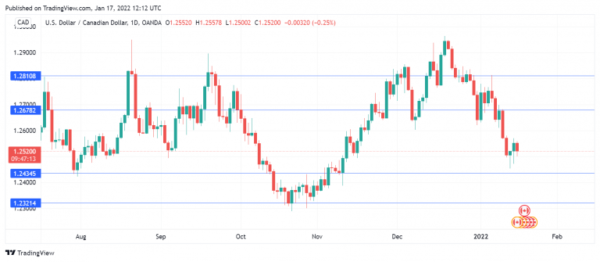
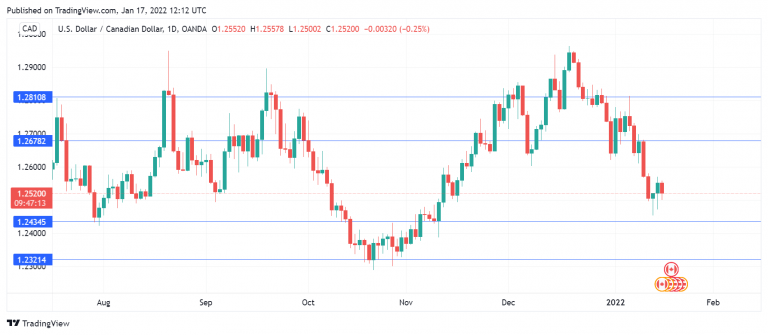
- USD/CAD is testing support at 1.2513. Below, there is support at 1.2396
- There is resistance at 1.2762 and 1.2879
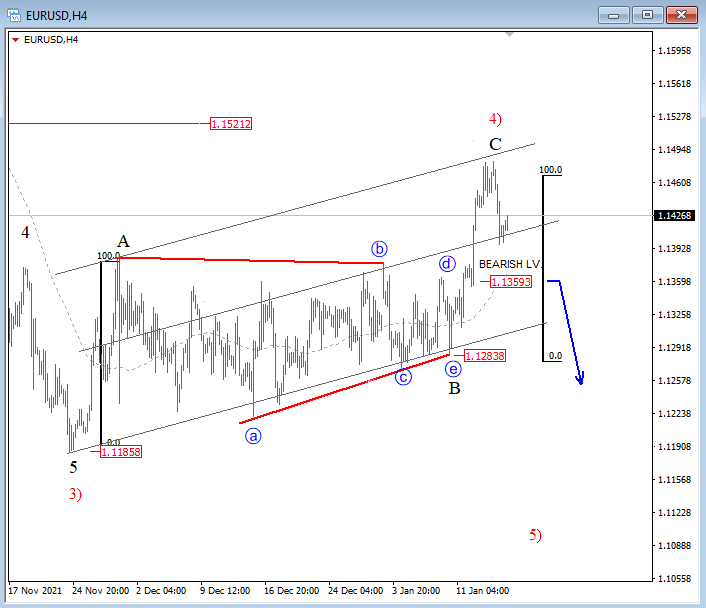
EUR/USD Seems Under Pressure Below 1.1359: Elliott Wave Analysis
EURUSD came higher last week after US CPI figure. Pair moved to the upper side of a corrective channel line, to around 1.1490 where bulls slowed down, so it can be an interesting reversal coming this week, back to bearish mode, especially if 1.1359 is broken on a 4h chart. We think this breakdown would likely make a room for a fifth wave down.
EUR/USD 4h Elliott Wave analysis
China’s rate cut failed to lift HSI
China's rate cuts were not enough to lift investor sentiment in the region. PBoC lowered its one-year medium-term lending facility rate by 10bps to 2.85%. The seven-day reverse repurchase rate was also cut by 10bps to 2.1%. They're the first rate cut since April 2020.
Also, the PBoC injected more liquidity by offering 700 billion yuan of MLF loans, exceeding the 500 billion yuan maturing, and added 100 billion yuan with seven-day reverse repurchase agreements, more than the 10 billion yuan due.
Hong Kong HSI closed down -165 pts or -0.68% at 24218.03. Downside momentum has been diminishing since mid December. Yet there is no clear sign of bullish reversal. HSI is still inside medium term falling channel. Another fall remains in favor to extend the down trend from 31183.35 through 22665.25 low.