Sample Category Title
EUR/USD Seeks Support
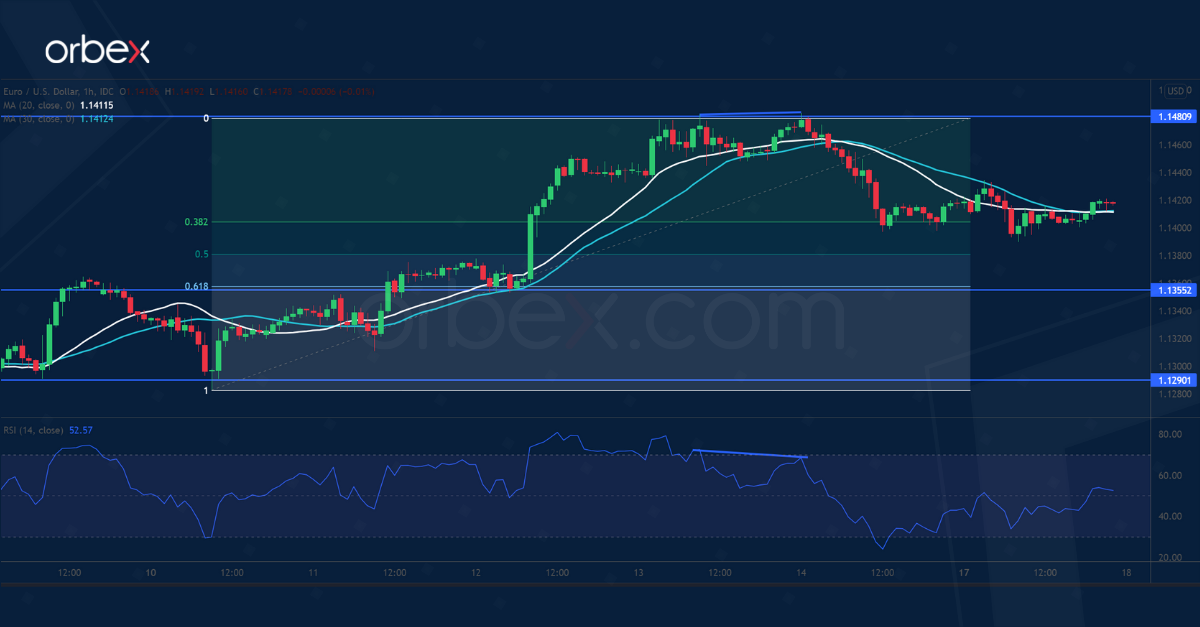
The euro retreated as short-term traders took profit. After a six-week-long consolidation, the euro soared above the supply area at 1.1380 and forced the bears to cover in mass.
As the dust settles, a bearish RSI divergence showed a lack of follow-up momentum. The current pullback is heading towards the origin of the breakout near 1.1355 which coincides with the 61.8% Fibonacci retracement level.
A rebound and then a close above 1.1480 would lead to a bullish reversal towards the daily resistance at 1.1600.
Daily Technical Analysis
EUR/USD
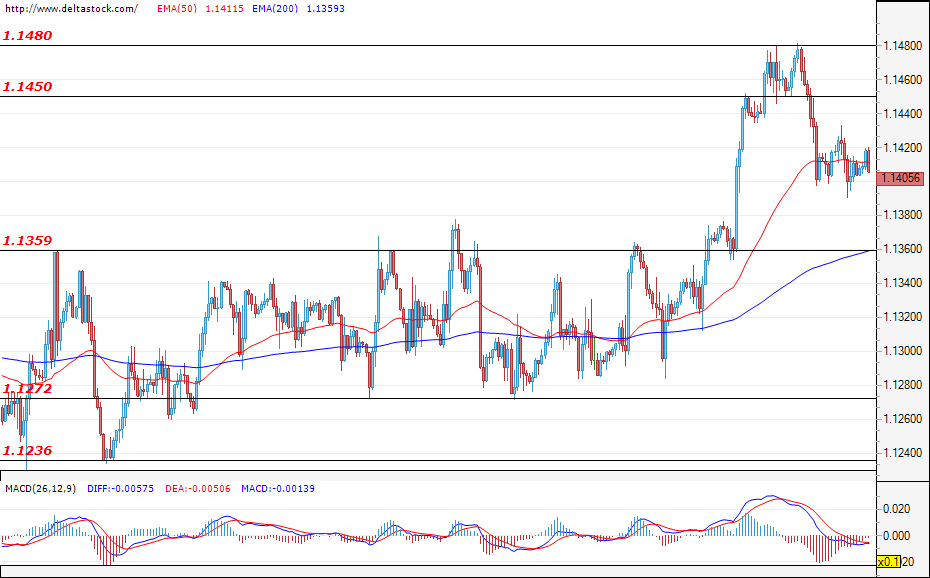
The bears established themselves on the market and, during the last trading session from the previous week, the currency pair underwent a sell-off, which almost completely erased the previously won positions. At the time of writing, the pair is consolidating at around 1.1400. The formation of a range within 1.1360 - 1.1450 is not ruled out due to the lack of significant economic events, except for the announcement of the consumer price index data for the euro area (Thursday; 10:00 GMT), after which the currency pair may head in a more defined direction.
USD/JPY
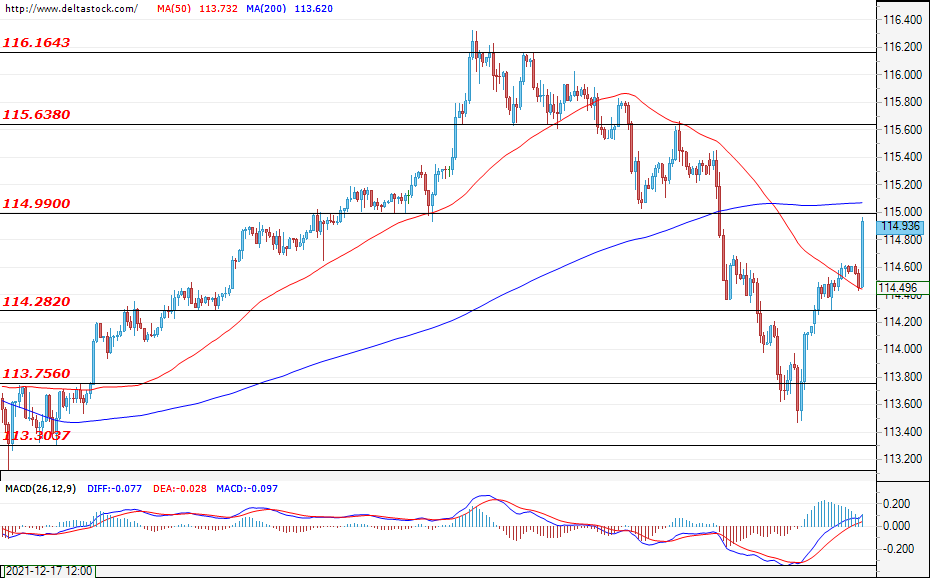
The U.S. dollar continues to appreciate against the Japanese yen and the announcement of the interest rate decision by the central Bank of Japan (today; 02:45 GMT) has certainly helped in that regard. At the time of writing, the currency pair is facing a test of the 115.00 resistance zone. A successful breach of this level could give the bulls the necessary momentum needed for an attack on the next significant level at 115.63. On the other hand, if the bears manage to limit the appreciation below the current resistance, then it is quite possible that we will witness a consolidation below 115.00. A formation of a short-term range between 114.30 - 115.00 is also not excluded.
GBP/USD
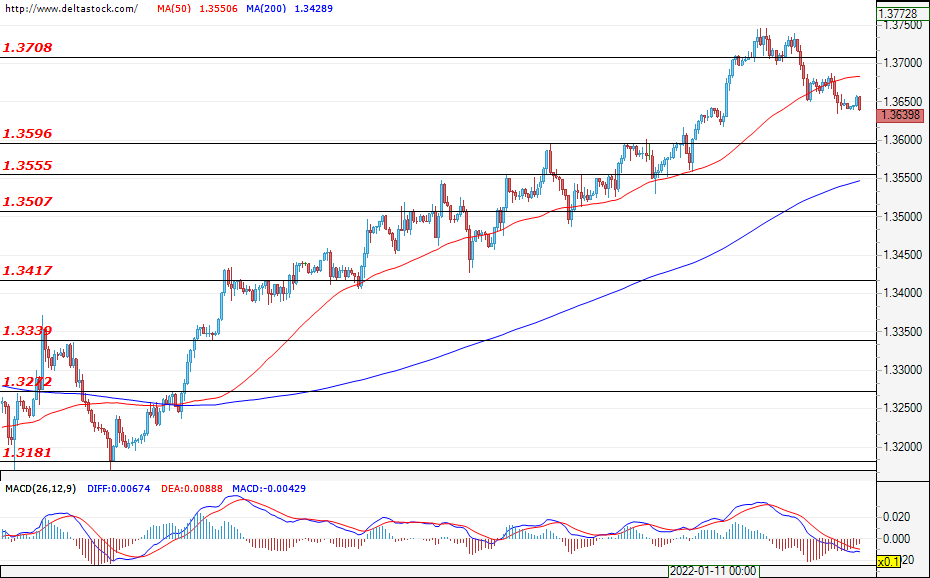
The depreciation of the British pound against the U.S. dollar began in the last trading session of the past week and it seems that the bears are rushing for a test of the first important support at around 1.3590. A successful breach of the mentioned zone could deepen the sell-off, while a breach of the support level at around 1.3200 that is coming from the higher time frames could lead to the continuation of the downward trend.
EUGERMANY40
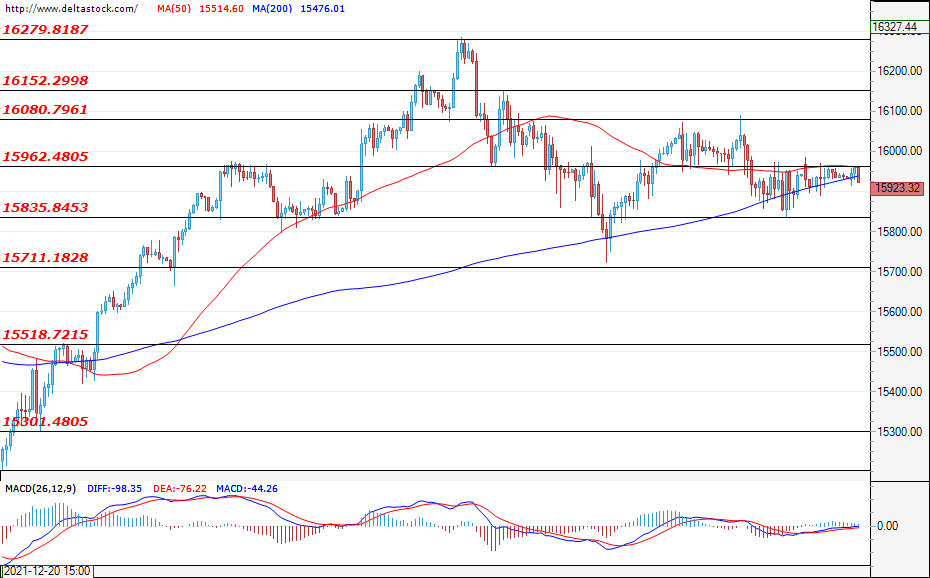
The situation with the German index remains unchanged for the time being, as neither the bulls nor the bears have so far managed to prevail. The most probable scenario is for a formation of a range movement within 15700 - 16152. A breach of any of the mentioned boundaries could predetermine the future movement of the index. From the higher time frames it is clear that the index is again finding itself stuck in a range between the not-so-close-levels of 15000 and 16300. In the long run, a breach of the lower level may be a prerequisite for a trend reversal.
US30
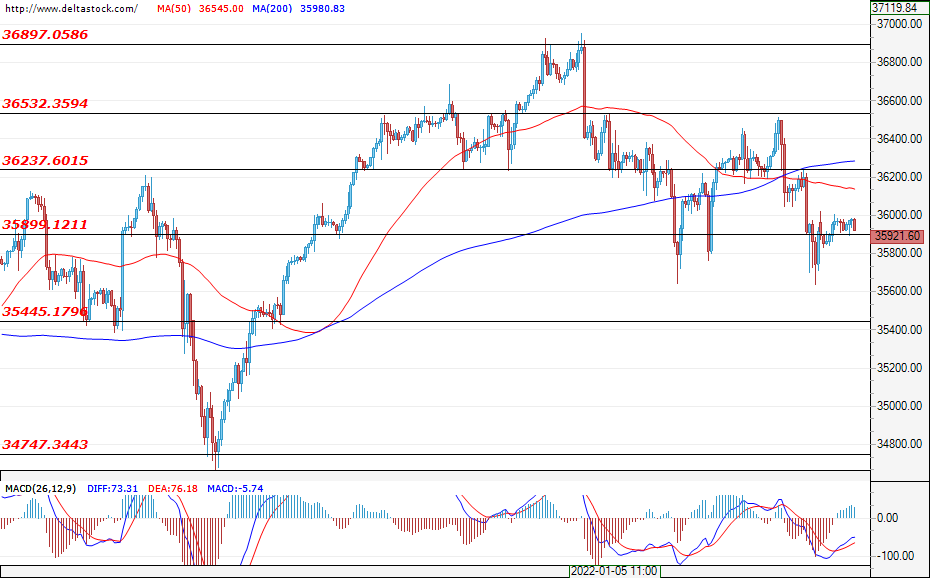
At the time of writing, the U.S. blue-chip stock index is consolidating around the support level at 35900 after the bears failed to overcome the support level at around 35600. Sentiments remain neutral for the time being, and only a breach of 35445 in a downward direction, or a breach of 36532 in the upward direction, could prevent the formation of a range and would define a clearer path for the index.
BoJ Kuroda: We are not debating an interest rate hike
In the post meeting press conference, BoJ Governor Haruhiko Kuroda said, "consumer inflation is likely to stay around 1% through the end of the BoJ's projection period. As such, there is no need to modify the BoJ's monetary easing."
"We are not debating an interest rate hike ... As shown in the report, we're not yet in a situation where inflation is steadily accelerating toward the BoJ's goal. The median forecast of board members is for inflation around 1%. Under such conditions, we are absolutely not thinking about raising rates or modifying our easy monetary policy," he said.
"If achievement of 2% inflation comes into sight, the BoJ's board will likely debate an exit strategy and communicate its intention to markets. That in itself won't be that difficult. The problem is that unfortunately, we haven't see inflation hit 2%. It's premature to debate an exit strategy," he added.
Bank of Japan Didn’t Alter Policy Parameters
Markets
Markets took a slow start to the trading week yesterday as US investors were absent due to the Martin Luther King holiday. On other major developed markets, the news flow was thin. European equities drew some comfort from China easing policy. European indices closed with gains of about 0.50-%0.75%. The by default trend on European interest rate markets also remains north even without guidance from the other side of the Atlantic. German yields rose between 2.2 bps (2y) and 1.3 bps (30-y). The 10y German yields again came with reach of the 0.02% top/the psychological barrier of 0.0%. The dollar gained modestly with the DXY closing at 95.26 and EUR/USD at 1.1408.
This morning the Bank of Japan left its policy unchanged, but changed its assessment on inflation (cf infra). Still any speculation on a policy change is probably premature. Japanese yields are little changed. USD/JPY immediately after the decision jumped from the 114.50 area to the 115 area, suggesting that markets were positioned for a more hawkish guidance. Outside Japan, a sharp rise in US yields as trading resumes after the MLK holiday is catching the eye. Fed-governors are no longer allowed to give guidance on policy as they are in the blackout period ahead of next week’s policy meeting. It doesn’t prevent markets from anticipating bolder Fed action. The US 2-y yield jumps north of 1.0% (currently 1.05%), the highest since end February 2020. The 10-y yield surpasses the 1.80% cycle top (currently 1.84%). The rise in yields is causing some, albeit mostly modest losses on Asian equity markets. China is the exception to the rule (CSI 300 + 0.7%) as markets ponder chances for further PBOC stimulus. Even so, the yuan (USDNCY 6.3425) is holding strong after touching a new cycle top overnight.
Later today, German ZEW economic sentiment is expected to improve slightly from 29.9 to 32.0. In the US, the Empire Manufacturing is expected to ease from 31.9 to 25, but this is still a lofty level. We don’t expect today’s data to change the debate on policy normalization. Key question is whether US investors will join bond sell-off in Asia. Markets now discount four 25 bps hikes starting in March and some investors are debating chances of a 50 bps hike at the start. The broader trend might propel the German 10-y yield in positive territory. Other question is whether the dollar will profit from markets further frontloading policy normalization. At least this morning, USD gains are again modest even as equities indices point to losses at the European open. In the UK, labour market data this morning were close to expectations (3M November employment softer than expected at 60k; unemployment rate dropped to 4.2% and wages rising 4.2% as expected). In a first reaction EUR/GBP is holding in the 0.8355 area.
New Headlines
The Bank of Japan didn’t alter policy parameters that include bond buying, a -0.10% main rate and a 0% 10y yield target. It did, however, for the first time since 2014 change the balance of inflation risks from mainly to the downside to balanced, meaning the BoJ sees equal risks for prices to overshoot target. The move came after Reuters, citing sources, reported last week that the BoJ is debating how to start communicating on a possible rate hike, even if inflation remains sub-target. The latter is still the case in the updated forecasts, which, although lifted, show inflation well below 2% (1.1% in FY 2022 and 2023). Growth in FY21 (to April) was revised downwardly from 3.4% to 2.8% but is seen at 3.8% in FY2022 (from 2.9%) on Omicron delaying the recovery. The Japanese yen lost ground with some investors perhaps expecting more having the Reuters article in mind. USD/JPY trades at 114.82.
During yesterday’s Eurogroup meeting, a number of euro area finance ministers raised the issue of inflation (5% in December). They warned that it is affecting purchasing power and thus economic growth. The Eurogroup President Donohoe in a press conference later said high inflation will indeed last longer than initially expected but added he was convinced that price pressures will begin to moderate later in the year as supply chains continue to improve and effects from forced accumulation of savings due to the lockdowns start moderating. The Eurogroup also discussed corporate vulnerability and structural developments after the pandemic, the draft recommendation on economic policy for 2022 and the banking union.
UK payroll rose 184k in Dec, unemployment rate dropped to 4.1% in Nov
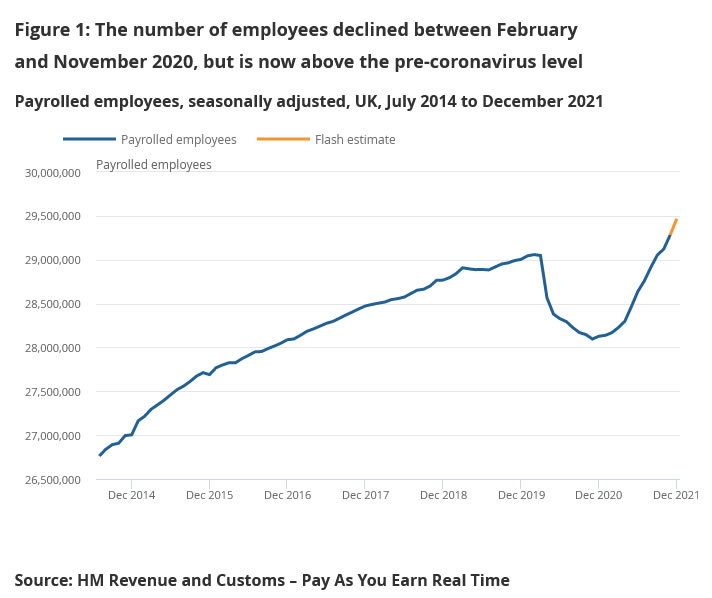
UK payrolled employees rose 184k to 29.5m in December. The number was up 409k on pre-pandemic level back in February 2020. All region are now above pre-coronavirus levels.
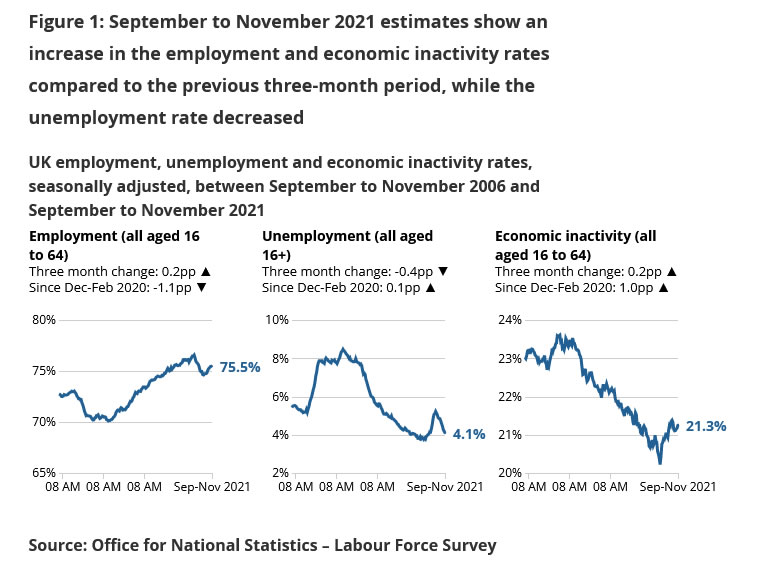
For September to November period, comparing to the prior quarter, employment rate rose 0.2% to 75.5%. Unemployment rate dropped -0.4% to 4.1%. Economic inactivity rate rose 0.2% to 21.3%.
Average earnings including bonus rose 4.2% 3moy while average earnings excluding bonuses rose 3.8% 3moy.
Crude Oil Prices Soar as Demand and Supply Imbalance Continues
The price of crude oil held steady close to a seven-year high as investors remained optimistic about the rising demand. Brent rose to $86.71, meaning that it has jumped by 10% this year. WTI, the American benchmark, rose to $84.78, which is 12% above where it started the year at. Some analysts believe that oil prices will rise to about $100 this year considering that demand is expected to rise at a faster pace than supplies. Therefore, there are concerns that rising oil prices will lead to higher inflation. Worse, the ongoing tensions between Russia and Western countries has led to higher natural gas prices also.
US futures rose slightly on Monday as the country’s market remained closed for the Martin Luther King holiday. Futures tied to the Dow Jones, S&P 500, and Nasdaq 100 index rose by about 0.15%. The same performance happened in Europe, where the DAX and CAC 40 indices turned higher. The biggest catalyst for these indices will be the latest corporate earnings. Some of the top companies that will publish their results today are Charles Schwab, Goldman Sachs, PNC Financial, Bank of New York, Interactive Brokers, and JB Hunt, among others.
The British pound declined slightly ahead of the important economic data from the United Kingdom. The Office of National Statistics (ONS) will publish the latest UK employment numbers. Economists polled by Reuters expect the data to show that the country’s unemployment rate declined to 4.1% in November while the number of claimant counts declined by over 38k in December. These numbers will come a few days after the ONS published strong GDP and manufacturing and industrial production data. On Wednesday, the UK will deliver the latest consumer inflation data.
GBPUSD
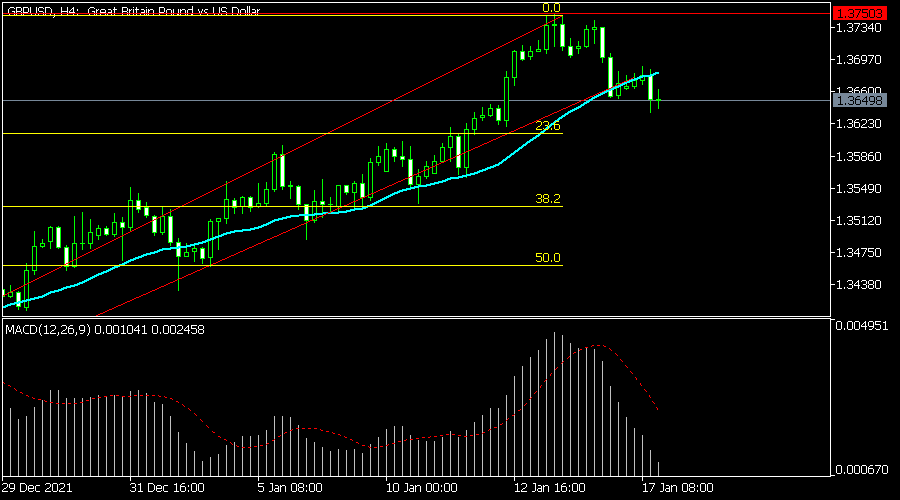
The GBPUSD pair continue falling in the overnight session ahead of important economic data from the UK. It is trading at 1.3645, which was a few pips below this year’s high of 1.3750. It managed to move below the ascending trendline shown in red. Most importantly, it declined below the 25-day moving average while the MACD has formed a bearish crossover pattern. Therefore, the pair will likely keep falling as bears target the 23.6% retracement level at 1.3600.
EURUSD
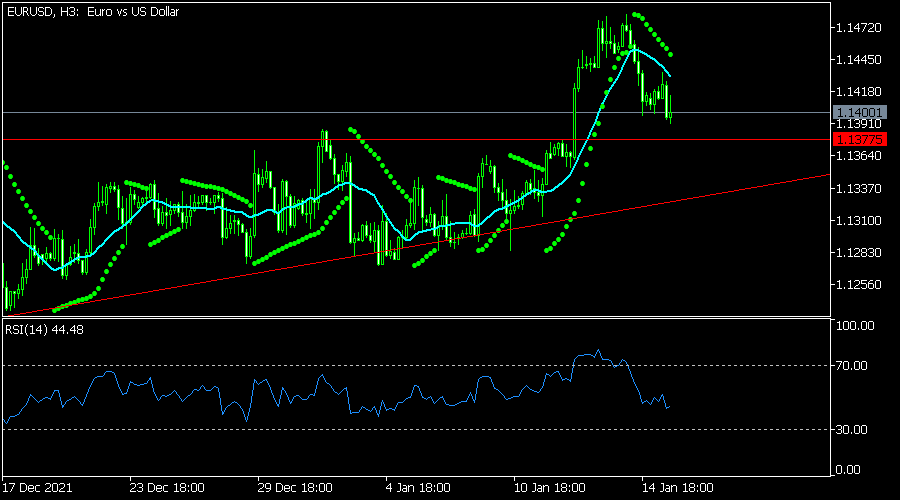
The EURUSD pair also turned lower as US dollar strength accelerated. On the three-hour chart, the pair moved below the 25-day moving average. It is slightly above the key support level at 1.1377, which it struggled moving above earlier this month. It also moved slightly below the dots of the parabolic SAR. Therefore, the pair will likely keep falling as bears target the support at 1.1377.
XBRUSD
The XBRUSD bullish trend accelerated as investors predicted the rising demand. The pair is trading at 85.47, which was the highest level since November last year. It moved above the 25-day and 50-day moving averages. The Relative Strength Index (RSI) continued rising and is now approaching its overbought level. The MACD has also kept rising. Therefore, the pair will likely keep rising as bulls target the key resistance at 90.

Oil Reaches the Highest Level Since 2014
Market movers today
On the data front we look for German ZEW for January, which could very well slip further due to the triple headwinds from COVID, eroding real income and supply side bottlenecks.
UK releases employment report where focus is on wage growth.
In Sweden, the Riksbank arranges an open forum on the relation between the inflation target and wage formation, where representatives from the labour union, employers union, researchers and, from the Riksbank, Per Jansson will participate. This is a very interesting and relevant topic, also for the financial markets, given the upcoming wage negotiations. Separately, Stefan Ingves is scheduled for a panel discussion on digital currencies, where he will probably not touch upon issues related to monetary policy.
This afternoon the US releases the first regional business survey for January with the Empire index.
The 60 second overview
Markets: After a quiet start to the week with US bond and equity markets closed yesterday this morning we have seen a renewed upward pressure on global yields driven by the USD curve. Most prominently the 2Y US Treasury yield has moved above 1% for the first time during the COVID-19 crisis as markets adjust to a base case of four 25bp rate hikes from the Fed this year. The big developed market equity indices are trading in red this morning with technology heavy indices such as the Nasdaq underperforming peers.
Oil price: While negative risk appetite and a stronger USD tends to be negative for commodities, this morning we have seen the Brent crude oil price move above USD 87/bbl. This is the highest level since 2014. Restricted global supply, renewed optimism on the mildness of Omicron and recent geopolitical tensions have been the primary drivers for the move higher in oil in recent weeks. Our base remains that the oil price will stabilise and eventually move lower later this year on a stronger USD, OPEC+ normalising supply and on the global economic policy tightening weighing on demand.
Steady Bank of Japan: As expected, there were no changes to the Bank of Japan policies this morning. They did, however, change the risk assessment on the outlook for prices from "skewed to the downside" to "balanced" for the first time since 2014 and revised up their inflation forecast to 1.1% for the fiscal year 2022 from 0.9%. We see no signs of discussions of a rate hike before the 2% inflation target is reached, as rumoured on Friday, something that could however also be addressed at the press conference (post the deadline of this report). With at least some of the risk of early tightening removed, JPY weakened somewhat around the time the BoJ decision was announced.
Equities: Equities started the week on a higher note in a relatively quiet session as US was closed for Martin Luther King Day. Some of the health care and tech stocks that have been lagging in the first two weeks of 2022 got a lift as US bond market also was closed yesterday. Asian markets are lower this morning just as US and Europe futures are pointing lower led by growth stocks.
Fixed income: There has been a modest rise in European bond yields on the back of the rising US yields, the curves flattened modestly between 10Y and 30Y and steepened modestly between 2Y and 10Y.
FX: It has been a quiet start to the week in FX markets with moves limited to less than 1 historical standard deviation across majors. Overnight the USD has rebounded with US markets returning from holiday while NZD, AUD and NOK have posted losses just shy of 0.5% vs the greenback.
Credit: Yesterday we saw continued modest widening in the synthetic indices, with iTraxx main some 0.6bp wider to 52.7bp and Xover 2.1bp wider to 259.2bp. The primary markets remain wide open exemplified by Heimstaden Bostad doing a two-trance EUR benchmark deal with a combined size of EUR1.2bn.
Energy Stocks Show Off as Oil Extends Rally
It was quiet session yesterday as the US stock and bond markets remained closed for bank holiday, while the European equities kicked off the week mostly in the positive, especially with the FTSE 100 leading gains in Europe thanks to the rising oil prices.
US crude advanced to the $85pb mark having gained close to 12% just since the start of the year. Supply struggles in some important oil producer countries like Angola, Nigeria and Libya, combined with exceptionally high natural gas prices continue pressuring crude prices higher. Meanwhile, the fact that the Covid-19 pandemic is now being labelled ‘endemic’ throws light to the end of the tunnel and gets the reopening-investors’ hopes up that the restrictions will soon be lifted, leaving the world economy with plenty of more room to recover.
So, the news is good for oil and energy stocks, whereas the steep and sustained rally in prices paves the way toward the $86pb, October and 7-year high, then to the $90pb.
In this respect, the reopening-focused FTSE 100 is now surfing on the positive energy vibe and is finally back to its pre-pandemic levels. The British energy stocks gained near 2.50% yesterday, although the banks were in the red due to the warnings that the rising inflation would eat into their profits even in an appetizing environment of higher interest rates.
Chicken & egg
And equities, especially the cyclical sectors, are the best place to seek a solid hedge against inflation, as they are partly responsible for the rising consumer prices.
Gold?
Rising inflation indirectly weakens the gold’s capacity of hedging against inflation, as it makes it a costly hedge due to the rising real yields. And the higher the inflation, the more aggressive the Fed hawks, and the steeper the rise in inflation.
The yellow metal is hovering a touch above its 50, 100 and 200-DMA zone, between the $1795 and $1810 band and could find it hard to sprint too high from here, as I also believe that the upside potential is somewhat seen capped by the $2000 mark, which also gives cold feet to those who seek safety in unnavigated waters, which makes the concept of safety a bit less safe, probably.
In the FX, well we all have been quite destabilized seeing the US dollar tank, while the expectation was a shiny, glorious year for the dollar. But the abnormally elevated level of long speculative positions is likely responsible for the latest dollar crash. The fundamentals remain supportive of a strong US dollar against most major peers, as the rifts open between an increasingly hawkish Fed and the others.
BoJ: A dream come true
The Bank of Japan raised its price outlook at today’s meeting, but the Japanese officials are rather happy that the global inflationary pressures will finally pull Japan out of a decades-long deflationary cycle. This is almost a dream coming true for Japan, which also means that the BoJ has no rush towards the easy-money policy exit.
The USDJPY should safely continue trending higher, even though the historical data shows that the USDJPY tends to move lower in periods of Fed tightening due to a broad ‘buy the rumour, sell the fact’ behaviour that flips the price action and leads to a softer dollar versus the yen when the tightening actually starts. But for now, the USDJPY is preparing an attempt toward the 116-118 region, with a solid positive trailing 100-dma support, that is near the 113 mark.
GBP/JPY Daily Outlook
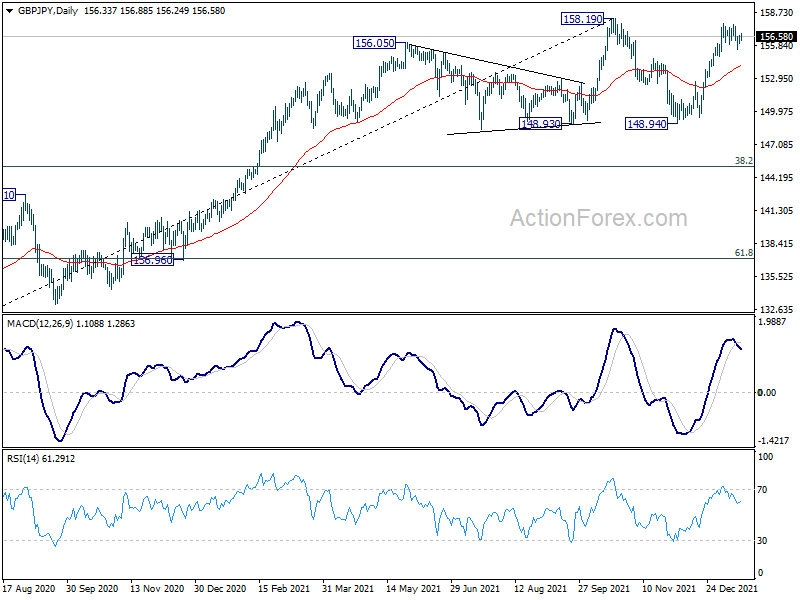
Daily Pivots: (S1) 156.07; (P) 156.39; (R1) 156.70; More...
GBP/JPY is staying in consolidation from 157.74 and intraday bias remains neutral. Overall, further rise is still expected with 154.86 support intact. On the upside, decisive break of 158.19 high will resume larger up trend to 167.93 long term fibonacci level. On the downside, below 154.86 minor support will turn intraday bias back to the downside for deeper pull back.
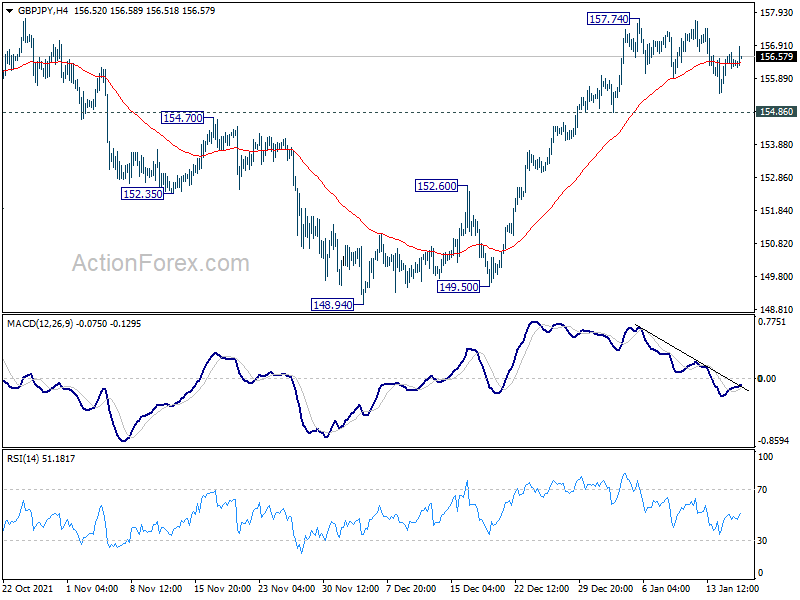
In the bigger picture, strong rebound from 148.93 key structural support retains medium term bullishness. Firm break of 158.19 high will resume whole up trend from 123.94 (2020 low), to 61.8% retracement of 195.86 to 122.75 at 167.93. Nevertheless, firm break of 148.93 will bring deeper correction to 38.2% retracement of 123.94 to 158.19 at 145.10, and possibly further lower, as a correction to up trend from 123.94 at least.
EUR/JPY Daily Outlook
Daily Pivots: (S1) 130.41; (P) 130.62; (R1) 130.92; More....
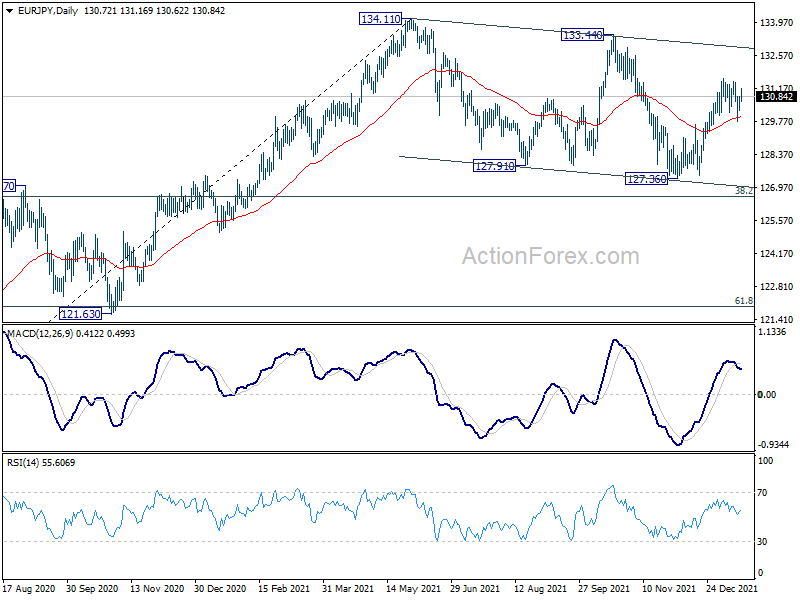
EUR/JPY is staying in consolidation form 131.59 and intraday bias remains neutral first. On the upside, break of 131.59 resistance will reaffirm the bullish case that consolidation from 134.11 could have completed with three waves down to 127.36, ahead of 126.58 medium term fibonacci level. Further rally would then be seen to retest 133.44/134.11 resistance zone. On the downside break of 129.59 minor support will argue that rebound from 127.36 has completed and turn bias back to the downside for this support.
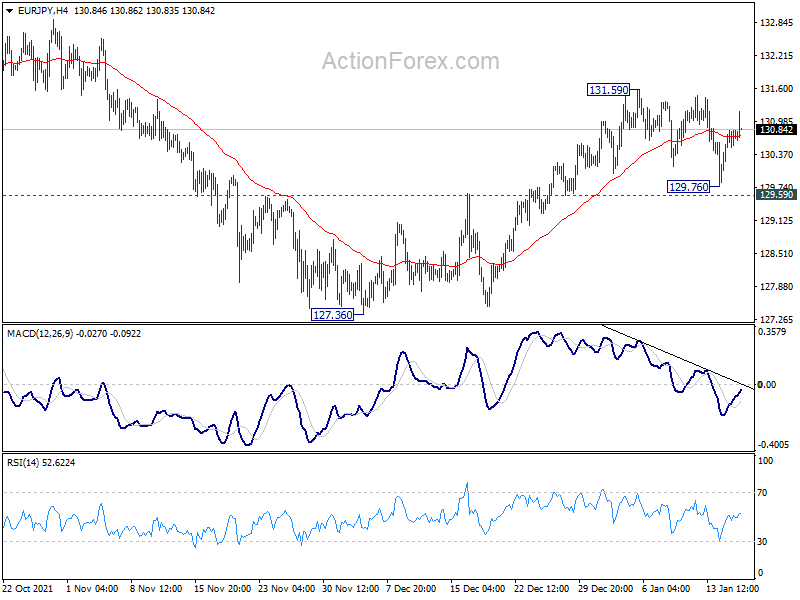
In the bigger picture, as long as 38.2% retracement of 114.42 (2020 low) to 134.11 at 126.58 holds, up trend from 114.42 is still in favor to continue. Break of 134.11 will target long term resistance at 137.49 (2018 high). However, sustained break of 126.58 will raise the chance of medium term bearish reversal. In this case, deeper decline would be seen to 61.8% retracement at 121.94, and possibly below.