Sample Category Title
Fed: End of Money Printing Brrrrr – (At Least) Four 25bp Rate Hikes this Year and QT in September
Key takeaways
At the upcoming January meeting, we expect the Fed to indicate that the first rate hike is likely in March if the economy develops in line with expectations, supported by the tight labour market and still very high inflation.
It is one of the interim meetings without updated projections or dots.
We have changed our Fed call now expecting four 25bp rate hikes this year (in March, June, September and December, up from three previously) and still four rate hikes in 2023. We expect the Fed to start reducing the balance sheet from September.
Given the combination of a strong economy and high underlying inflation, we see risks as skewed towards more, not less, tightening. If this scenario plays out, the Fed is likely to hike 25bp at each meeting, not skipping interim meetings.
Fixed Income: We have lifted our target to 2.25% for 10Y UST.
WTI Futures Breach 7-Year High, Uptrend Intact
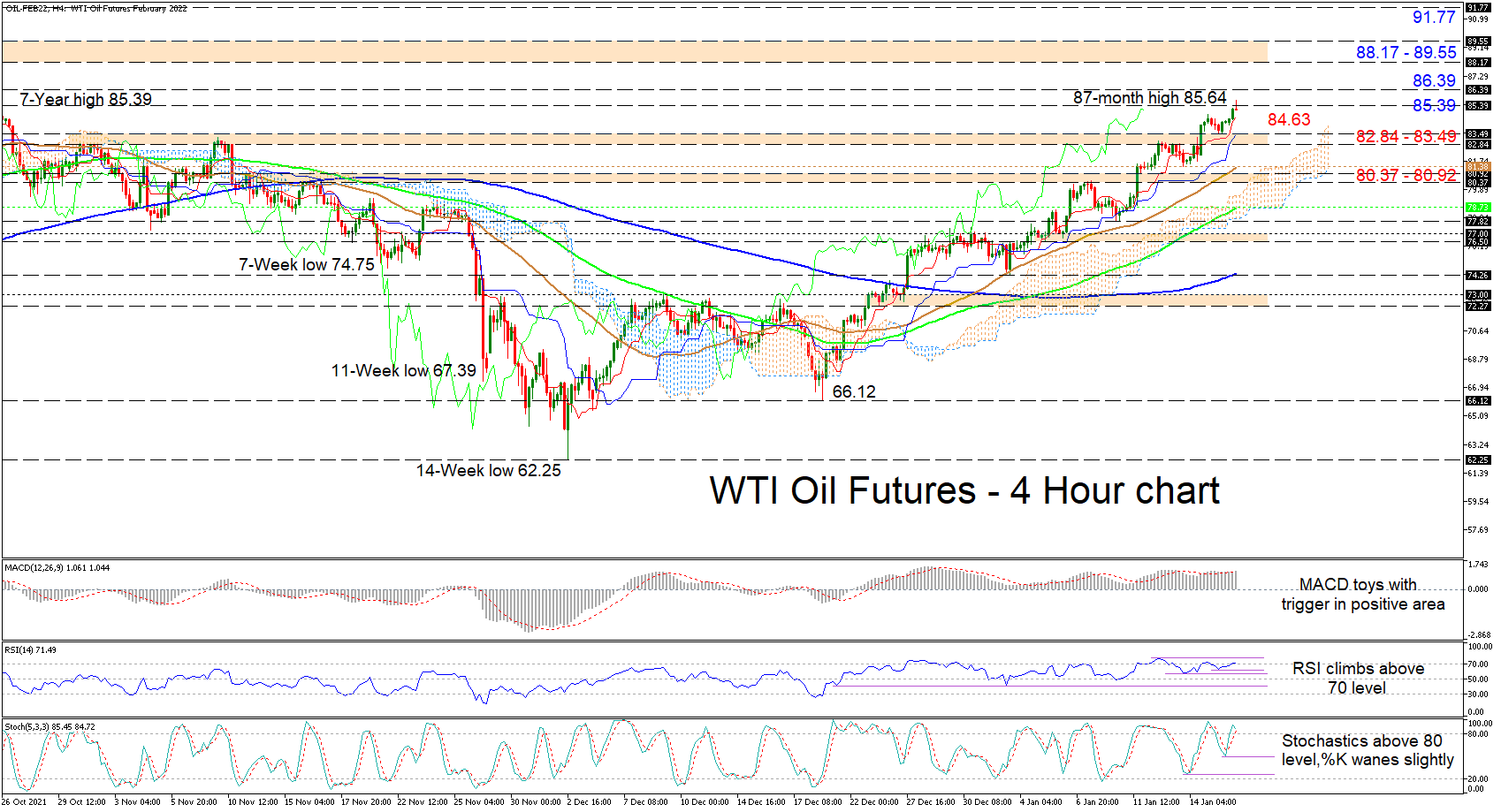
WTI oil futures are struggling to some extent to boost the one-month uptrend, which began from the 66.12 level, even after ticking slightly above the 7-year high of 85.39. That said, a price close north of the 7-year high would be the fuel required to reinforce upside momentum. Furthermore, the climbing simple moving averages (SMAs) are nurturing the positive structure.
The rising Ichimoku lines are implying that bullish forces remain robust, while the short-term oscillators are promoting a positive preference in the commodity. The MACD, some distance north of the zero mark, has nudged back above its relatively flattened red trigger line, while the RSI is improving over its 70 level. The stochastic oscillator is on the bullish camp and the current dip in the %K line is reflecting buyers’ efforts to overcome the 7-year high.
In the positive scenario, a definitive price close north of the 7-year high of 85.39 could bring the 86.39 resistance barrier into play. If the price advances further, resistance may show face between the 88.17-89.55 region, which formed over September and November 2014. Overcoming this boundary too, the price could then propel for the 91.77 high, identified in the early part of October 2014.
If the 7-year high curbs improvements, downside friction may emanate from the red Tenkan-sen line at 84.63 and the nearby 82.84-83.49 support border. If a stronger price pullback unfolds, the price may then target the 50-period SMA at 81.38, adjacent to the Ichimoku cloud’s upper surface and the 80.37-80.92 obstacle. Sinking further, traders’ attention may then shift toward the 100-period SMA at 78.73, overlapping the cloud’s lower band.
Summarizing, WTI oil futures are sustaining a bullish bias above the 82.84-83.49 support band and the SMAs. For negative tendencies to spark concerns about the latest uptrend, the price would need to slide beneath the cloud.
USDCAD Marks Yet More Lower Highs as Bearish Forces Linger
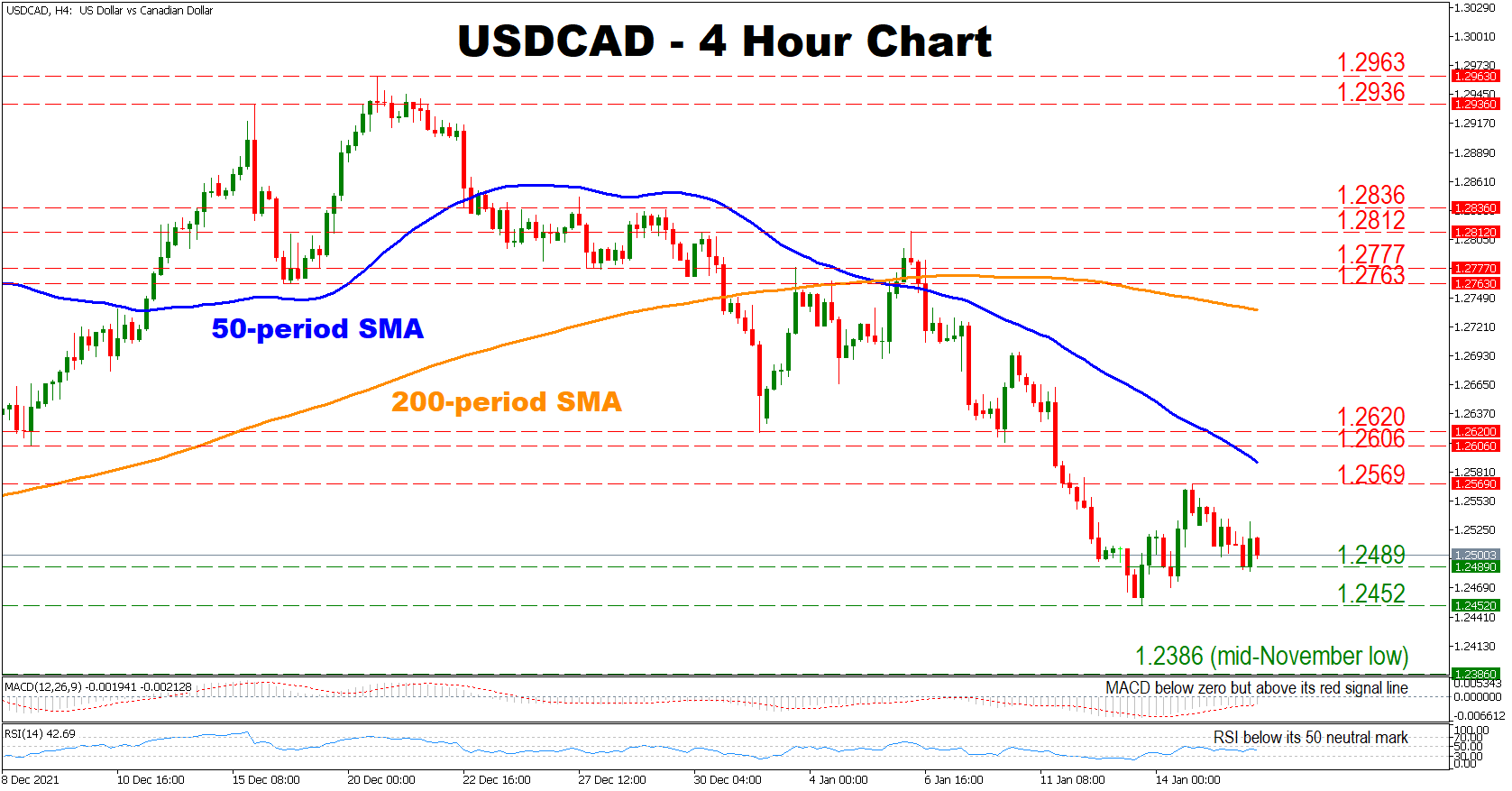
USDCAD has marked yet more lower highs and lower lows due to lingering negative forces. Moreover, the pair is also trading well below its 50- and 200-period simple moving average (SMA), and has recently completed a ‘death cross’ where the 50-period SMA has crossed below the 200-period SMA, increasing fears of a sustained bearish outlook.
Short-term momentum indicators are supporting a mixed picture as the RSI is located below its 50 neutral mark. However, despite the MACD being below zero, it is found above its red signal line, indicating that the negative bias might be fading.
Should the bears remain in charge, initial support might be found at the 1.2489 hurdle. A decisive move below this point could send the price to test the 1.2452 level. A break below the latter could increase selling pressures, shifting sellers attention towards the mid-November low at 1.2386.
On the flip side, should buyers regain control, initial resistance might be found at the 1.2569 barrier before shifting their attention towards the 50-period SMA currently at 1.2596. Crossing above the latter, the pair could test the congested region which includes the 1.2606 and the 1.2620 obstacles. A break above that area could induce further buying activity, opening the door towards the 200-period SMA currently at 1.2738.
In brief, the overall outlook for the bear is bearish. For sentiment to change, sellers would need to break above the 50-period SMA.
Stocks Roll Over, Dollar Steady, Oil Storms Higher
- Markets fully price in four Fed rate hikes for this year, lifting yields
- Stocks under pressure, dollar recovers, gold surprisingly resilient
- Oil hits new highs, yen retreats after BoJ does nothing
Fed worries hit stocks
It has been a stormy couple of weeks for financial markets, with almost every asset class getting rocked by expectations that the Fed will need to normalize monetary policy more aggressively to cool inflation. The US labor market is so tight that wage growth has started to fire up, igniting worries of a wage-price spiral and by extension leading market participants to fully price in four rate increases for this year.
This has propelled US Treasury yields much higher, and when the bond market begins to rumble, it feels like an earthquake for assets such as equities. This is especially true for the riskiest corners of the stock market, for example companies without consistent cash flows whose valuation can change dramatically if interest rates move higher.
As such, global equity markets are a sea of red on Tuesday, feeling the heat of higher rates as the yield on 10-year Treasury bonds continues to ascend beyond pre-pandemic levels. The tech-heavy Nasdaq is leading the way lower, with futures pointing to losses of around 1.5% when US markets open today after a long weekend.
Currencies cautious, but oil defies the gloom
This sense of caution has spilled over into the FX arena as well. The US dollar is naturally outperforming, enjoying the perks of widening rate differentials between America and the rest of the world. Meanwhile, commodity-linked currencies like the Australian dollar are trading heavy.
The yen has been unable to capitalize on the gloomy mood and is under pressure instead, suffering a double whammy from rising foreign yields and the Bank of Japan’s reluctance to provide any signals that policy normalization is on the cards.
But oil prices apparently didn’t get the memo. Despite all the risk aversion, crude prices briefly touched new seven-year highs today, drawing power from renewed tensions in the Middle East and a rosier outlook for demand amid hopes that Omicron could be the beginning of the end for the pandemic.
Loonie in focus, gold holds its ground
With oil prices roaring back, the Canadian dollar has staged a powerful rally in recent weeks, turbocharged by expectations that the Bank of Canada will raise rates next week to counter inflationary pressures. The economy has improved at such a dramatic pace that markets are currently pricing in an 80% probability for a hike this month, in defiance of the BoC’s latest guidance that April is the earliest possible date.
However, that seems like a bridge too far considering that wage growth is not impressive and that many provinces recently reintroduced tough restrictions to fight Omicron. Hence, the risk-to-reward profile for the loonie heading into next week's decision doesn't seem very attractive. The picture will become clearer tomorrow with the release of the nation's latest inflation data.
Finally, gold prices have shown remarkable resilience in the face of ‘bad news’ lately. Even though both nominal and real US yields have stormed higher, bullion has remained unfazed within a narrow range, which is an achievement in itself. If intensifying speculation for Fed rate hikes and soaring yields are not enough to sink gold, most of the negativity might be priced in already.
Germany ZEW surged to 51.7, economic outlook improved considerably
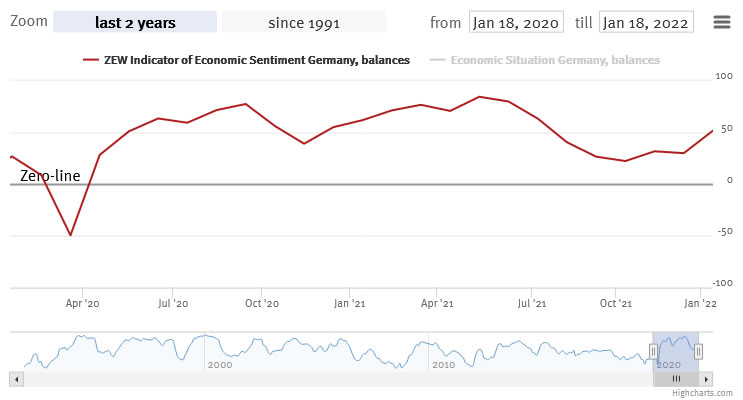
Germany ZEW Economic Sentiment rose sharply from 29.9 to 51.7 in January, well above expectation of 32.7. Current Situation index deteriorated from -7.4 to -10.2, missed expectation of -7.5.
Eurozone ZEW Economic Sentiment jumped from 26.8 to 49.4, well above expectation of 29.2. Current Situation index dropped -3.9 pts to -6.2.
ZEW President Achim Wambach said: "The economic outlook has improved considerably with the start of the new year. The majority of financial market experts assume that economic growth will pick up in the coming six months. It is likely that the phase of economic weakness from the fourth quarter of 2021 will soon be overcome.
"The main reason for this is the assumption that the incidence of COVID-19 cases will fall significantly by early summer. The more positive economic expectations include the consumer-related and export-oriented sectors and thus a large part of the German economy."
GBPUSD Turns South after Reaching 200-Day SMA
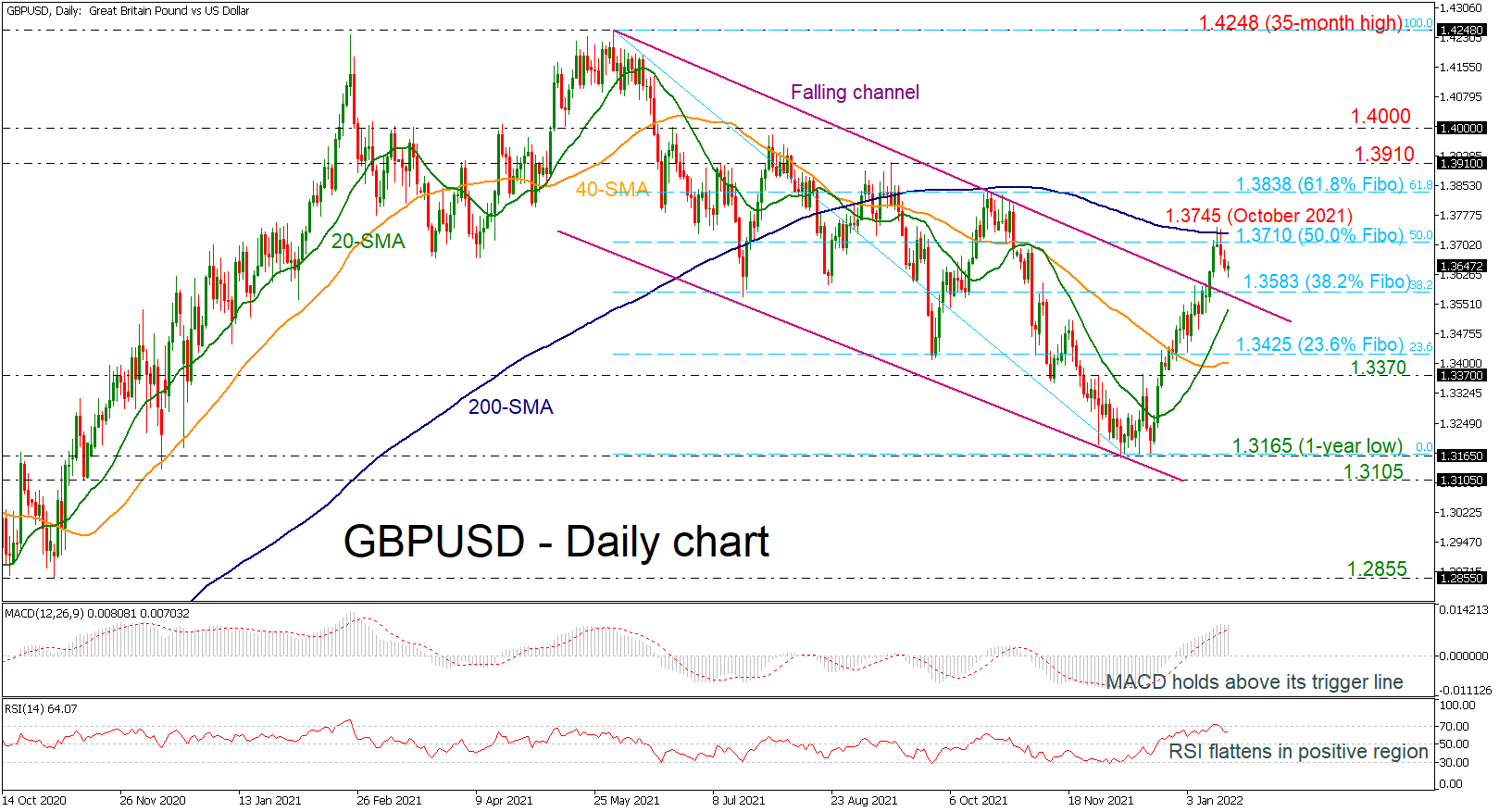
GBPUSD is reversing following the advance to the 1.3745 level, which represents a nearly three-month high. Although the price declined following the touch of the 200-day simple moving average (SMA), it remains above the long-term declining channel. The MACD oscillator is still holding above its trigger line in the positive region with weak momentum, while the RSI is flattening above the neutral threshold of 50.
If the pair continues to fall, immediate support might be found near the 38.2% Fibonacci retracement level of the decline from 1.4248 to 1.3165 at 1.3583, before meeting the 20-day SMA at 1.3535. If selling pressure remains, traders may consider the 23.6% Fibonacci level of 1.3425, which is located above the inside swing high of 1.3370 and the one-year low of 1.3165.
In the alternative scenario, a rally above recent highs could take the currency to the 61.8% Fibonacci level of 1.3838 and then to the 1.3910 barrier. Even higher, the psychological number of 1.4000 may put an end to bullish moves.
All in all, GBPUSD has largely maintained a bullish bias since the bounce from 1.3165, although the recent bearish days may portend a negative correction.
EURJPY Bounces Off 2-Week Low But More Upside is Needed
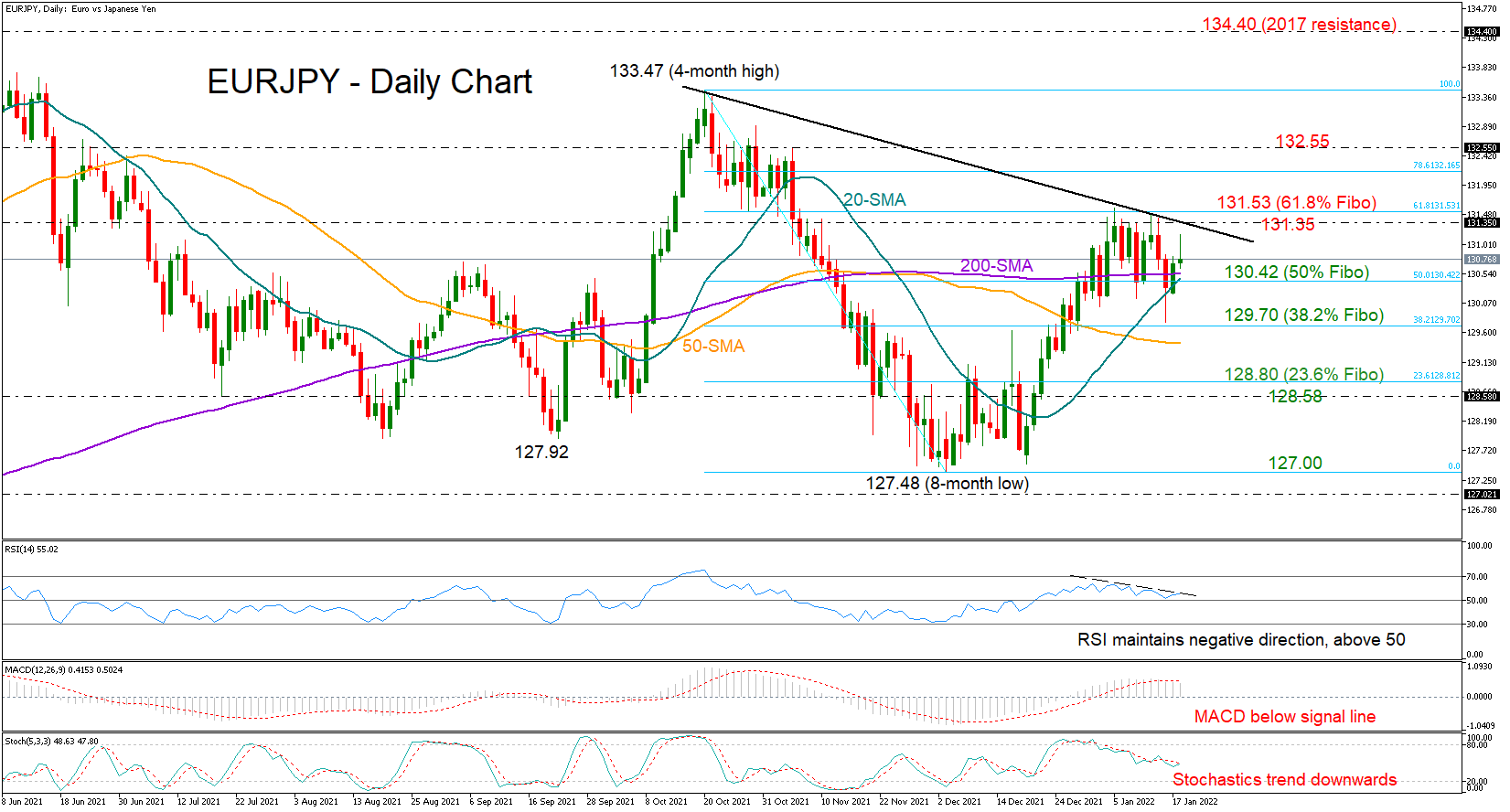
EURJPY has quickly recovered Friday’s drop to a two-week low of 129.77, bouncing back above its simple moving averages (SMAs) and the 50% Fibonacci level of the October-November downfall.
Despite the positive correction, downside risks continue to linger in the background as the RSI and the Stochastics are preserving a downward direction below their December peaks, while the MACD is still hovering below its red signal line.
Negative risks could dwindle if the pair extends its rebound sustainably above the short-term resistance trendline at 131.36, and more importantly, beyond the 61.8% Fibonacci of 131.53. If that turns out to be the case, the price could pick up fresh momentum to meet the 132.00 psychological mark, while higher, the bulls will need to claim the tough 132.55 barrier to access the four-month high of 133.47.
Otherwise, a decisive close below the 20-day SMA and the 50% Fibonacci of 130.42 could generate additional bearish actions towards the 38.2% Fibonacci of 129.70. Deeper and beneath the 50-day SMA, the door would open for the 23.6% Fibonacci of 128.80, a break of which could send the pair straight to the 127.48 bottom.
In summary, EURJPY has not escaped the bearish play despite the latest upturn. For that to happen, the bulls will need to successfully claim the 131.35 – 131.53 restrictive region.
Markets Wary of Oil and Bond Yield Highs, as Focus Shifts to Corporate Earnings
Asian shares were a mixed bag on Tuesday due to the absence of cues from Wall Street following a national holiday in the United States. But European and U.S. equity futures are flashing red amid a jump in Treasury yields, as investors brace for the Federal Reserve to raise interest rates four times this year to tame inflation. Brent crude ventured to its highest level since 2014 due to geopolitical tensions in the Middle East, while gold struggled for direction above $1810. In the currency arena, king dollar pushed higher while the yen weakened this morning after the Bank of Japan concluded a two-day policy meeting with no major changes.
This will certainly be a big week for financial markets as investors juggle the various themes influencing global sentiment. Equity markets will look to company results for some direction as the fourth-quarter earnings season gets into full swing. Reports from the US banks who have so far reported paint a mixed picture with JP Morgan Chase, a financial bellwether, closing down more than six per cent on Friday after the bank said rising costs would curtail profits in 2022 even as it posted record full-year earnings. Heavyweights such as Goldman Sachs and Bank of America, as well as Netflix among many others will be under the spotlight this week.
The burning question on the minds of investors could be what impact rising inflation and the emergence of the Omicron variant will have on final quarter earnings. Should we witness another mixed or disappointing week of results, this could sap more confidence from stock market bulls, especially when considering that the broader S&P500 index is already down over 2% so far this year.
A wild week ahead for the Pound?
The British pound could be injected with volatility this week due to the series of key economic reports and potential political drama at Westminster.
Market expectations already remain elevated over the Bank of England raising interest rates next month, with traders pricing in around an 91% chance of a 25bp rate hike. The argument for higher rates may be reinforced this week if the pending data meets or exceeds forecasts.
On the political front, Prime Minister Boris Johnson remains under pressure to resign over ‘partygate’. Given how it has been reported that as many as 30 letters of no confidence in Boris Johnson have been submitted by Tory MPs, things are bound to get heated. A total of 54 letters of no confidence would have to be submitted to Sir Graham Brady, chairman of the 1922 Committee of backbench MPs, for a vote to be held.
Looking at the technical picture, GBPUSD remains bullish on the daily charts. However, there seems to be resistance around the 200-day Simple Moving Average at 1.3734. A decline towards 1.3600 could be on the cards after such a strong run since the December lows, before bulls snatch back momentum for a push towards 1.3700 and 1.3830.
Commodity spotlight – Oil
Brent crude marched into Tuesday’s session, with prices climbing to fresh seven-year highs as geopolitical tensions bubbled in the Middle East. Iran-backed Yemini fighters claimed to have launched drone strikes on the United Arab Emirates, the third-biggest OPEC producer. Brent is up almost 2% this week and has appreciated close to 13% since the start of 2022. Prices are above $87.70 this morning, with bulls eyeing $88 and $90 as upside targets.
Commodity spotlight - Gold
Gold could be flung into the firing line this week if the dollar regains its mojo and Treasury yields rally. The precious metal has displayed resilience in recent sessions and even took advantage of a softer dollar to push back above $1810.
However, given gold’s zero-yielding nature, the path ahead could be bumpy and perilous for the precious metal as interest rate rises become a reality. Although other factors such as inflation risks and Omicron uncertainty may support gold bugs, the pressure is piling up on gold.
Looking at the technical picture, prices remain within a choppy range. A breakdown below $1810 could open the doors towards $1800, 1786, and $1770. Should $1810 prove to be reliable support, bulls may eye $1831 and $1845.
GER 40 Goes Sideways
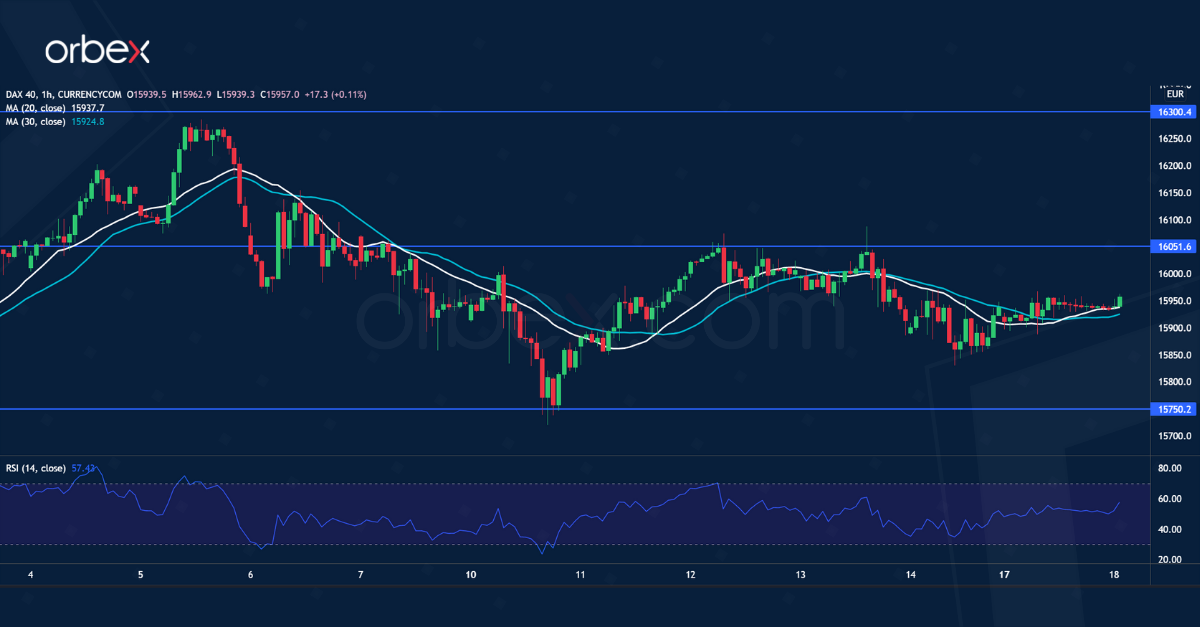
The Dax 40 consolidates as the eurozone’s finance ministers meet. The double top at the all-time high (16300) is a strong resistance to crack.
A break below 15860 has prompted some buyers to exit and reassess the situation. The current consolidation is a sign of market indecision in the short term.
A rise above the psychological level of 16000 has so far struggled to boost buyers’ confidence. This may only happen if the index reclaims 16050. On the downside, a fall below 15750 would send the price to 15500.
EUR/CAD Tests Major Floor
The Canadian dollar inched higher supported by rising oil prices.
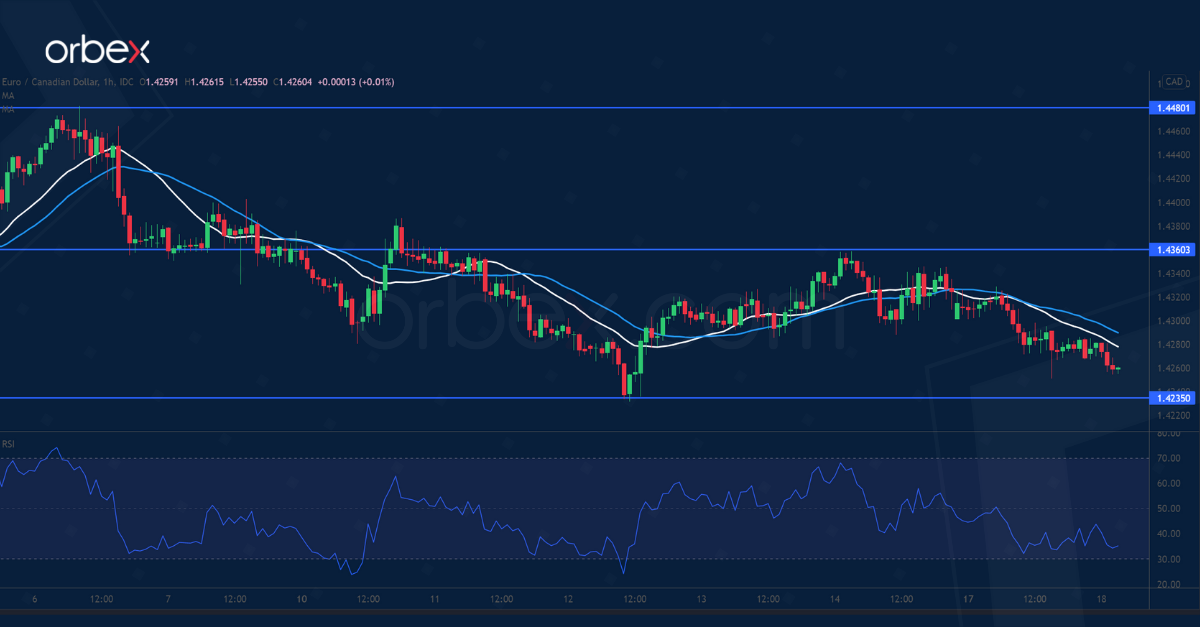
The pair has given up all gains from the December rally above the daily resistance at 1.4550. Sentiment is struggling to turn things around.
The RSI’s double bottom in the oversold area attracted some buying interest over the critical support at 1.4235. The bulls will need to push above 1.4360 before they could pull in enough bids for a reversal.
Otherwise, a bearish breakout could trigger a sell-off towards 1.4100.