Sample Category Title
Dollar Surges on Rising Yield, Yen Dips after BoJ
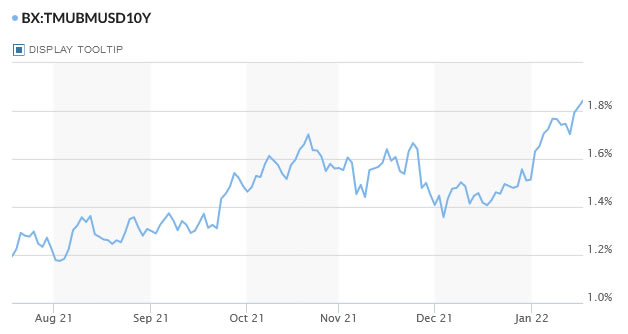
Dollar is making a strong come back in Asian session today, as 10-year yield powers up to 1.85 level. Yen is under some selling pressure after BoJ stood pat as expected, and delivered little surprise other than upgrades in inflation forecasts. But Aussie and Kiwi are currently the weakest one. Canadian Dollar, on the other hand, in the second strongest, with WTI crude oil extending recent rise to 85 handle. European majors are mixed with Sterling having a slight upper hand.
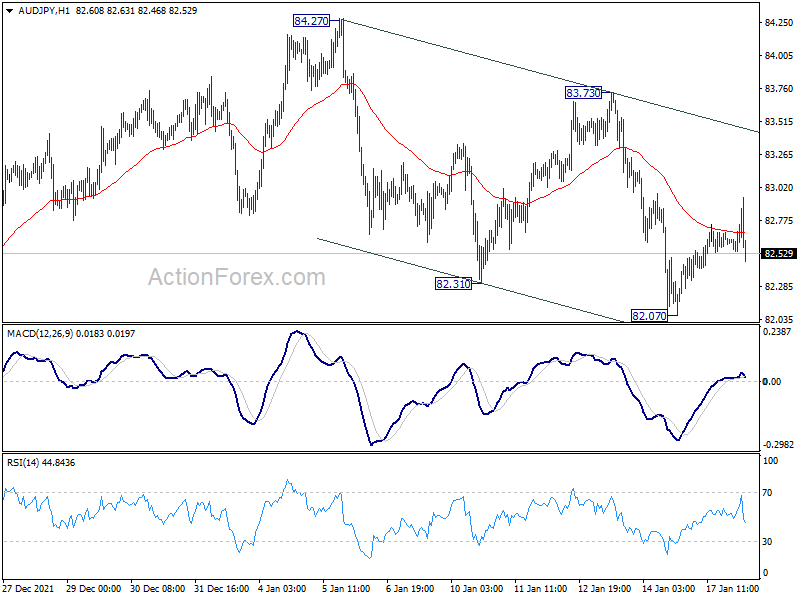
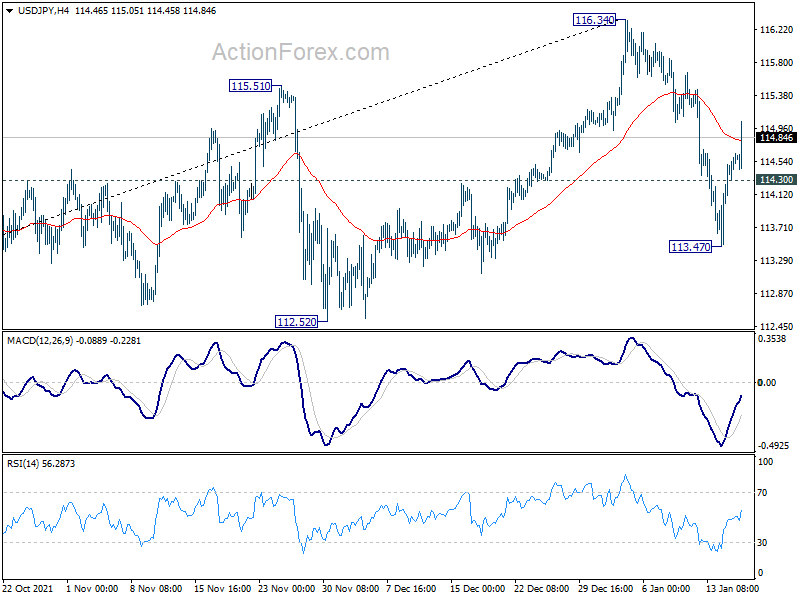
Technically, Yen crosses are displaying a mixed picture. AUD/JPY and NZD/JPY look rather weak after initial post-BoJ spike. EUR/JPY and GBP/JPY also lack momentum to get through 131.39 and 157.74 resistance levels respectively. While USD/JPY's rebound from 113.47 accelerated, we're not expecting a break of 116.34 high soon. So, it looks like Yen crosses are to be avoided for now.
In Asia, at the time of writing, Nikkei is up 0.45%. Hong Kong HSI is down -0.14%. China Shanghai SSE is up 0.94%. Singapore Strait Times is up 0.22%. Japan 10-year JGB yield is up 0.0051 at 0.151. US 10-year yield is up 0.051 at 1.843.
BoJ stands pat, upgrades 2022, 2023 inflation forecasts
BoJ left monetary policy unchanged. Under the yield curve control, short-term policy interest rate is held unchanged at -0.1%. BoJ will also buy a "necessary amount" of JGB bonds to keep 10-year yield at around 0%.
BoJ maintained the pledge to continue with QQE with yield curve control, "aiming to achieve the price stability target of 2 percent, as long as it is necessary for maintaining that target in a stable manner". It will also continue expanding the monetary base "until the year-on-year rate of increase in the observed consumer price index (CPI, all items less fresh food) exceeds 2 percent and stays above the target in a stable manner."
In the new economic projections, comparing to October forecasts:
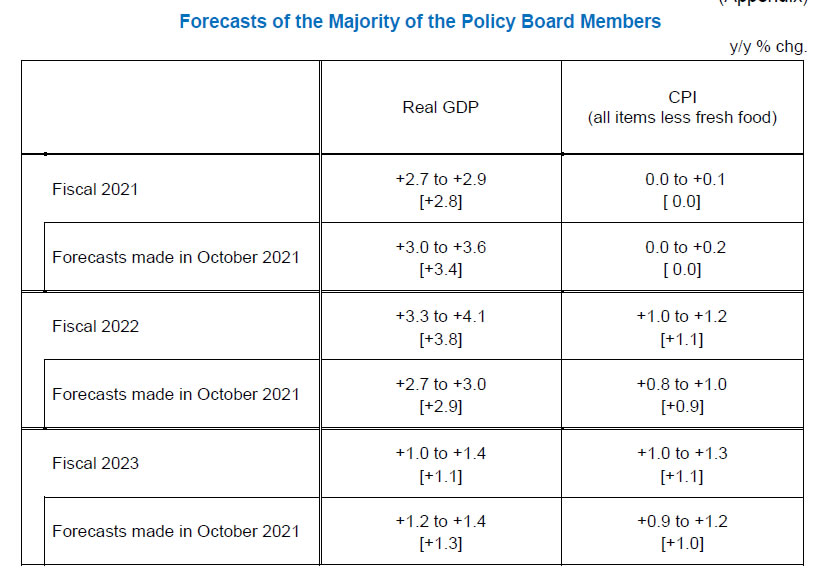
- Fiscal 2021 real GDP growth downgraded from 3.4% to 2.8%.
- Fiscal 2022 real GDP growth upgraded from 2.9% to 3.8%
- Fiscal 2023 real GDP growth downgraded from 1.3% to 1.1%.
- Fiscal 2021 core CPI unchanged at 0.0%.
- Fiscal 2022 core CPI upgraded from 0.9% to 1.1%.
- Fiscal 2023 core CPI upgraded from 1.0% to 1.1%.
Downbeat New Zealand business confidence, strong inflation pressures
In the The latest NZIER Quarterly Survey of Business Opinion, a net 34.4% of New Zealand businesses expect a deterioration in general economic conditions over the coming months, much worse than prior quarter's 11.1%. Trading activity for the next three months dropped slightly from 8.7 to 8.3.
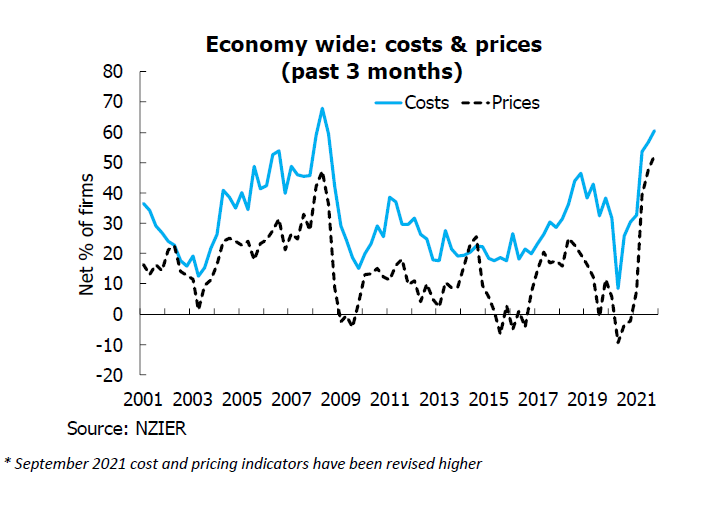
Regarding inflation, a net 61% reported increased costs in Q4, highest since 2008. A net 65% expect further increase in prices in the next quarter. NZIER said, "these results point to inflation pressures in the New Zealand economy remaining strong over the coming year."
Looking ahead
UK employment data will be a focus in European session while Germany ZEW economic sentiment is another. Swiss will release PPI while Italy will release trade balance. Later in the day, Canada housing starts, US Empire state manufacturing and NAHB housing index will be featured.
USD/JPY Daily Outlook
Daily Pivots: (S1) 114.29; (P) 114.47; (R1) 114.79; More...
USD/JPY's rebound from 113.47 accelerated higher today. While further rise cannot be ruled out, we're not expecting a break of 116.34 for now. Instead, the corrective pattern from there should extend with another falling leg. On the downside, break of 114.30 minor support will turn bias to the downside for 113.47. Break there will target 112.52 structural support.
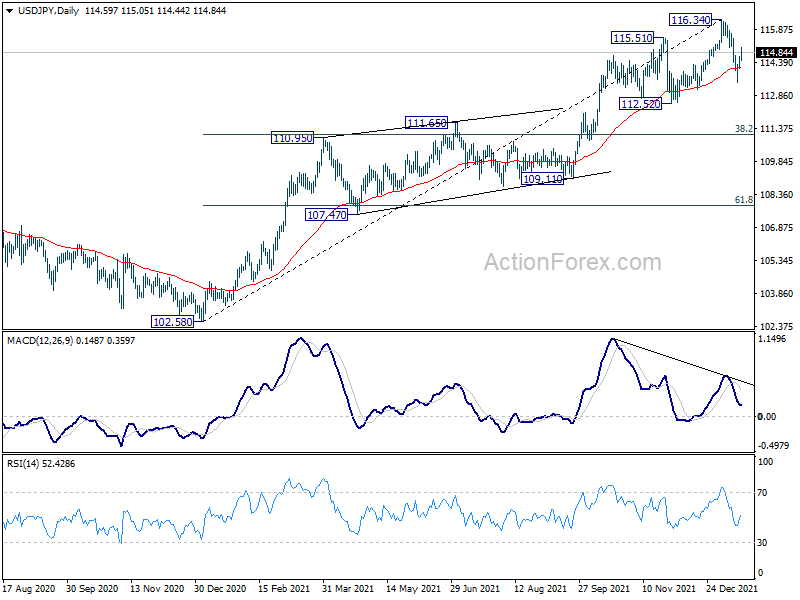
In the bigger picture, no change in the view that rise from 102.58 is the third leg of the up trend from 101.18 (2020 low). Such rally should target a test on 118.65 (2016 high). Sustained break there will pave the way to 120.85 (2015 high) and raise the chance of long term up trend resumption. However, firm break of 112.52 support will dampen this bullish case and we'll assess the outlook based on subsequent price actions later.
Economic Indicators Update
| GMT | Ccy | Events | Actual | Forecast | Previous | Revised |
|---|---|---|---|---|---|---|
| 21:00 | NZD | NZIER Business Confidence Q4 | -28 | -11 | ||
| 03:00 | JPY | BoJ Rate Decision | -0.10% | -0.10% | -0.10% | |
| 04:30 | JPY | Industrial Production M/M Nov F | 7.00% | 7.20% | 7.20% | |
| 07:00 | GBP | ILO Unemployment Rate (3M) Nov | 4.20% | 4.20% | ||
| 07:00 | GBP | Average Earnings Including Bonus 3M/Y Nov | 4.20% | 4.90% | ||
| 07:00 | GBP | Average Earnings Excluding Bonus 3M/Y Nov | 3.80% | 4.30% | ||
| 07:00 | GBP | Claimant Count Change Dec | -38.6K | -49.8K | ||
| 07:30 | CHF | Producer and Import Prices M/M Dec | 0.40% | 0.50% | ||
| 07:30 | CHF | Producer and Import Prices Y/Y Dec | 5.80% | |||
| 09:00 | EUR | Italy Trade Balance (EUR) Nov | 4.23B | 3.89B | ||
| 10:00 | EUR | Germany ZEW Economic Sentiment Jan | 32.7 | 29.9 | ||
| 10:00 | EUR | Germany ZEW Current Situation Jan | -7.5 | -7.4 | ||
| 10:00 | EUR | Eurozone ZEW Economic Sentiment Jan | 29.2 | 26.8 | ||
| 13:15 | CAD | Housing Starts Dec | 234K | 301K | ||
| 13:30 | USD | Empire State Manufacturing Index Jan | 28 | 31.9 | ||
| 15:00 | USD | NAHB Housing Market Index Jan | 84 | 84 |
BoJ stands pat, upgrades 2022, 2023 inflation forecasts
BoJ left monetary policy unchanged. Under the yield curve control, short-term policy interest rate is held unchanged at -0.1%. BoJ will also buy a "necessary amount" of JGB bonds to keep 10-year yield at around 0%.
BoJ maintained the pledge to continue with QQE with yield curve control, "aiming to achieve the price stability target of 2 percent, as long as it is necessary for maintaining that target in a stable manner". It will also continue expanding the monetary base "until the year-on-year rate of increase in the observed consumer price index (CPI, all items less fresh food) exceeds 2 percent and stays above the target in a stable manner."
In the new economic projections, comparing to October forecasts:
- Fiscal 2021 real GDP growth downgraded from 3.4% to 2.8%.
- Fiscal 2022 real GDP growth upgraded from 2.9% to 3.8%
- Fiscal 2023 real GDP growth downgraded from 1.3% to 1.1%.
- Fiscal 2021 core CPI unchanged at 0.0%.
- Fiscal 2022 core CPI upgraded from 0.9% to 1.1%.
- Fiscal 2023 core CPI upgraded from 1.0% to 1.1%.
Downbeat New Zealand business confidence, strong inflation pressures
In the The latest NZIER Quarterly Survey of Business Opinion, a net 34.4% of New Zealand businesses expect a deterioration in general economic conditions over the coming months, much worse than prior quarter's 11.1%. Trading activity for the next three months dropped slightly from 8.7 to 8.3.
Regarding inflation, a net 61% reported increased costs in Q4, highest since 2008. A net 65% expect further increase in prices in the next quarter. NZIER said, "these results point to inflation pressures in the New Zealand economy remaining strong over the coming year."
GBP/USD Corrects Lower, UK Employment Report Next
Key Highlights
- GBP/USD rallied after it broke the 1.3500 resistance zone.
- A crucial bullish trend line is forming with support near 1.3610 on the 4-hours chart.
- EUR/USD corrected lower from the 1.1480 resistance zone.
- The UK ILO Unemployment rate could remain at 4.2% in Nov 2021 (3M).
GBP/USD Technical Analysis
This past week, the British Pound started a major increase after it cleared the 1.3500 resistance against the US Dollar. GBP/USD rallied above 1.3550 to move into a positive zone.
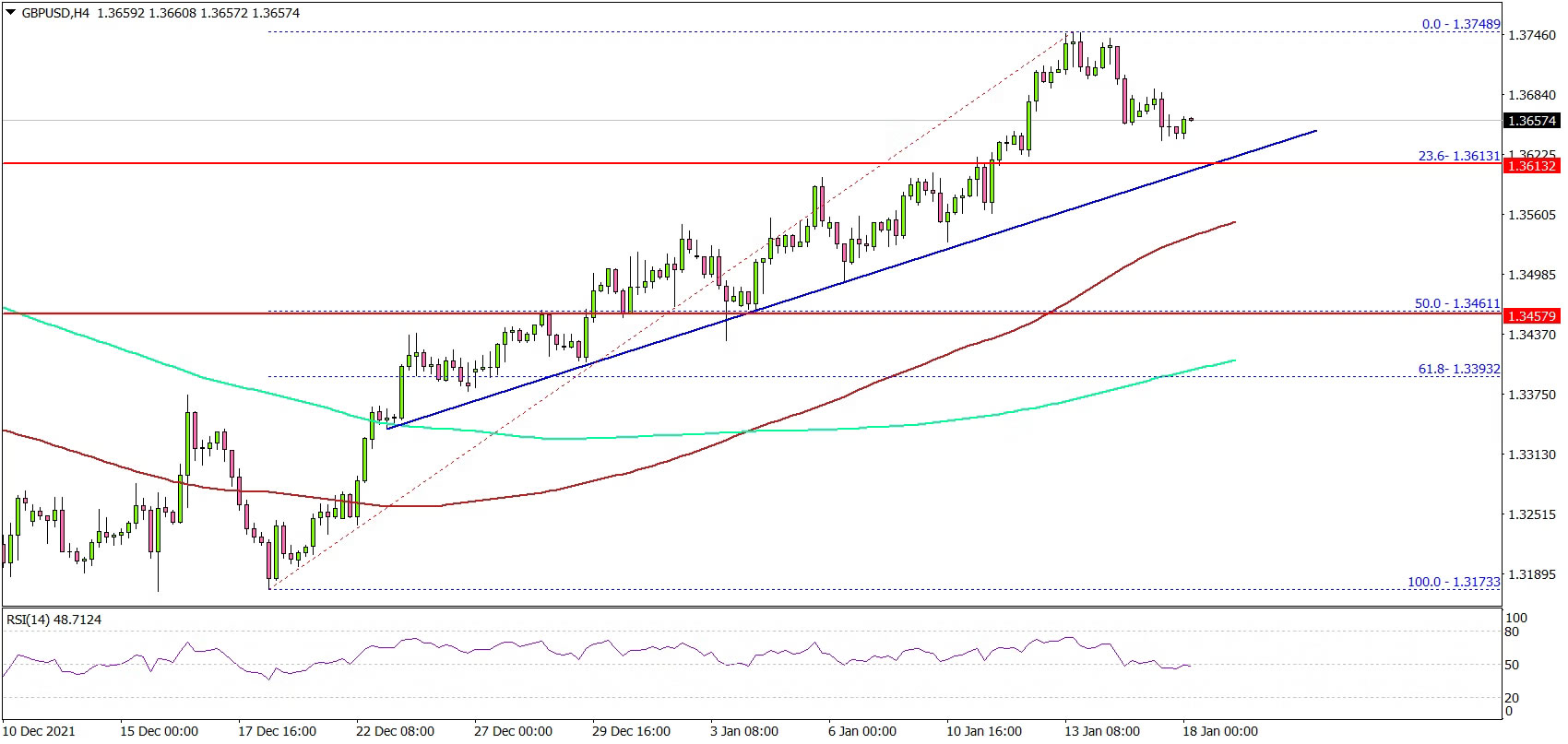
Looking at the 4-hours chart, the pair even gained pace above the 1.3650 level. There was a close above the 1.3600 level, the 100 simple moving average (red, 4-hours), and the 200 simple moving average (green, 4-hours).
The pair climbed above the 1.3700 level and traded as high as 1.3748. It is now correcting gains below 1.3700. It is now approaching the 23.6% Fib retracement level of the upward move from the 1.3173 low to 1.3748 high.
On the downside, an immediate support is near the 1.3620 level. There is also a crucial bullish trend line forming with support near 1.3610 on the same chart.
If there is a downside break, the pair could test the 1.3460 support. It is near the 50% Fib retracement level of the upward move from the 1.3173 low to 1.3748 high.
On the upside, the pair is facing resistance near 1.3700 level. The next major resistance is near the 1.3750 level, above which the pair could test 1.3880. Any more gains could send GBP/USD towards 1.4000.
Looking at EUR/USD, the pair gained strength above the 1.1450 level, but it faced sellers near 1.1480 and started a downside correction.
Economic Releases
- UK Claimant Count Change for Dec 2021 – Forecast -20K, versus -49.8K previous.
- UK ILO Unemployment Rate for Nov 2021 (3M) – Forecast 4.2%, versus 4.2% previous.
- German ZEW Business Economic Sentiment Index for Jan 2022 – Forecast 32.7, versus 29.9 previous.
3 Forex Pairs to Trade Right Now
The year started only a couple of weeks ago, but we already have a lot of fascinating movements in various trading instruments. To help you in trading, we choose several forex pairs that may surprise you and plunge greatly in a short period.
GBP/JPY
Japanese Yen is a haven asset, that’s no doubt. As a result, the currency strengthened amid omicron spread as investors have been trying to locate their funds in the most stable currencies, usually the Yen and Swiss Frank. As a result, the currency gained almost 2000 points against the GBP over the last week, but now we see bearish figures both technically and fundamentally.
From the fundamental side, Japan has around 0.5% inflation rate. It is much higher than a year ago (Japan is one of the countries with deflation, which means that the Yen tends to become more expensive with time). Nevertheless, 0.5% in Japan is hard to compare with almost 7% in the US or 5% in the EU. As a result, the Bank of Japan will likely keep its dovish tones. Add this to hawkish tones from other countries’ central banks, and you will get the idea. Fundamentally, without rates hikes, JPY looks weaker against other currencies.
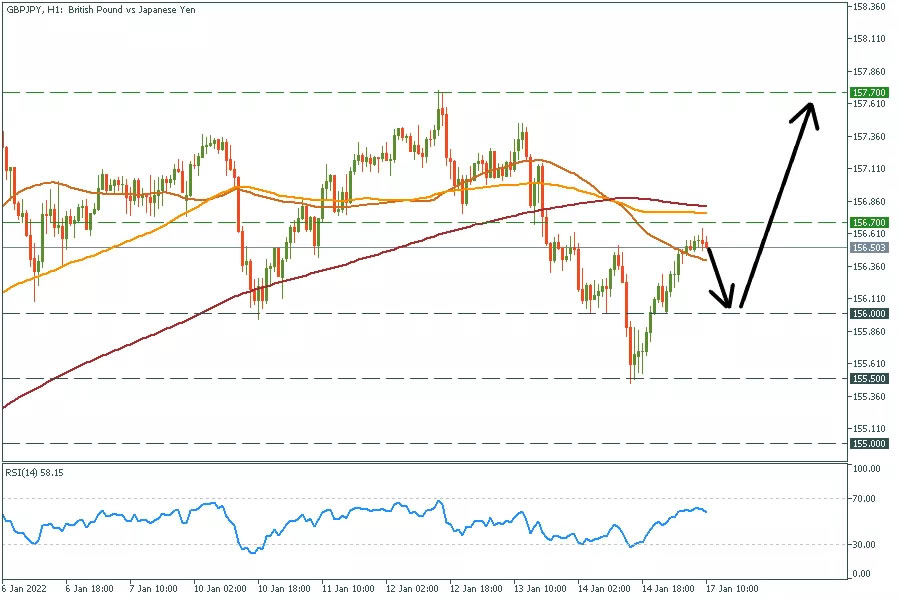
Technically we have an unfinished inversed head&shoulders pattern in GBP/JPY. It is a reversal pattern. Thus, we expect the GBP to rise against the Yen and reach 157.7 in the short term.
GBP/JPY H1 chart
Resistance: 156.70; 157.70
Support: 156.00; 155.50; 155.00
GBP/USD
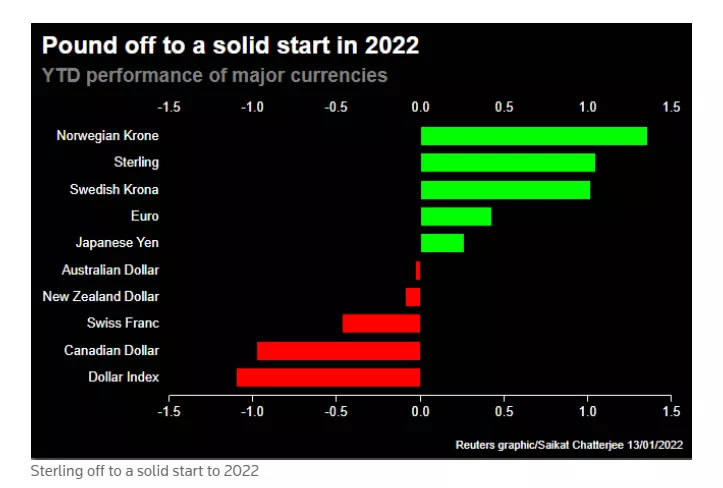
Not only is the Yen weak, but British Pound is solid this year. The currency shows incredible performance against other currencies year-to-date, and amid the weak dollar, we expect a surge in the GBP/USD.
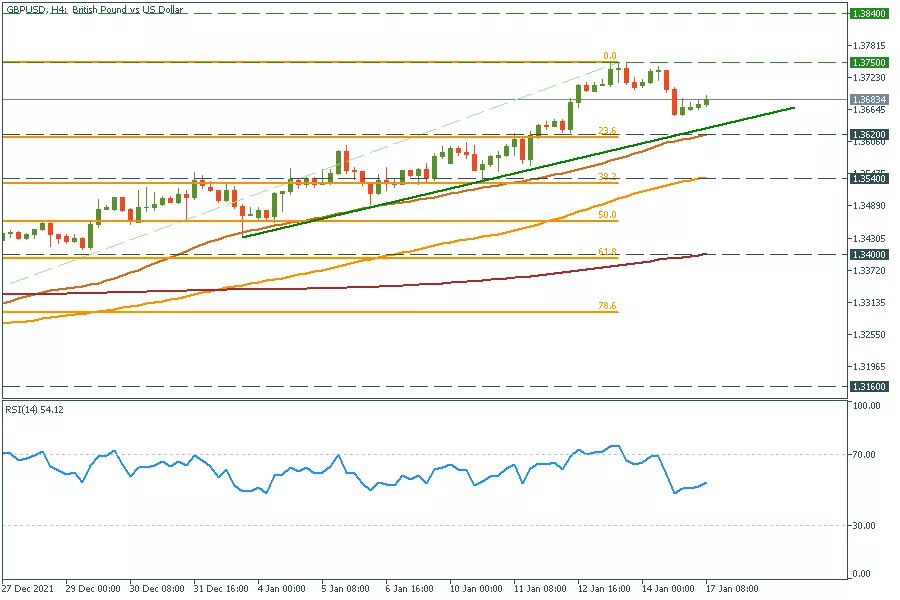
The rally in the pair needs some consolidation. However, technically we have no sell signals except for the RSI divergence. Thus, 1.3620 is a perfect place to put your buy orders.
GBP/USD H4 chart
Resistance: 1.3750; 1.3840
Support: 1.3620; 1.3540; 1.3400; 1.3160
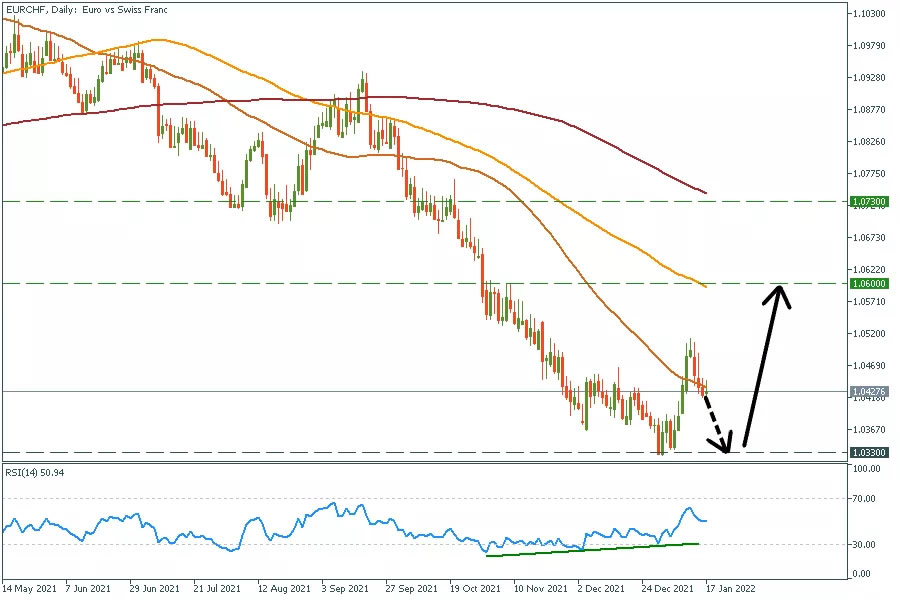
EUR/CHF
First, it is better to wait for ZEW economic sentiment on January 18, 12:00 GMT+2. This index represents the view of institutional investors and analysts on the current economic conditions. Thus, it will help the pair to determine the direction more accurately.
Despite the upcoming news, the Swiss Franc is another haven asset and tends to be weaker amid hawkish tones from the ECB. Technically we see multiple divergences on the RSI and a breakthrough of the 50-daily MA from below. The pair is now at its lowest from 2015. Thus, 1.0330 is the most solid resistance over there. We may see a double bottom reversal pattern and further bullish movement to at least 1.0600.
Resistance: 1.0600; 1.0730
Support: 1.0330
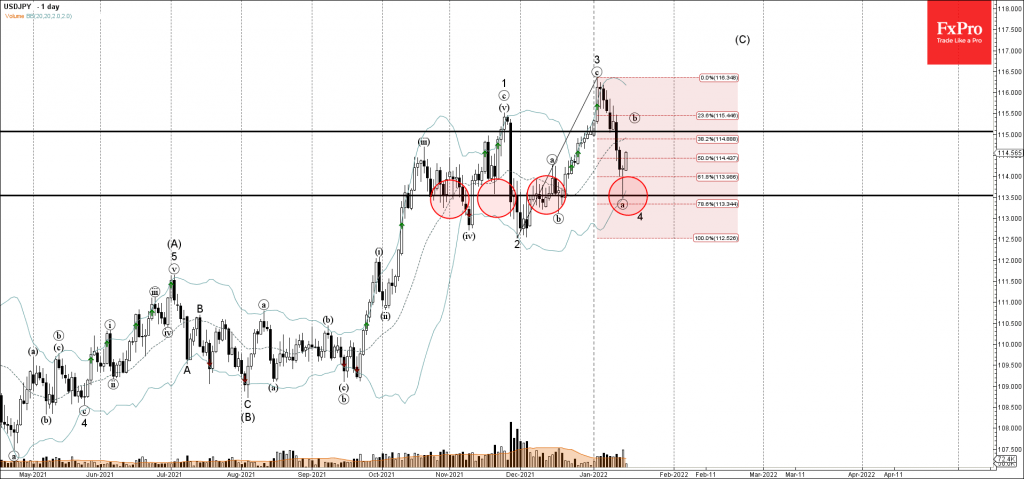
USDJPY Wave Analysis
- USDJPY reversed from support level 113.50
- Likely to rise to resistance level 115.00
USDJPY currency pair recently reversed up with the clearly formed daily Hammer from the support level 113.50 (which has been reversing the price from October), intersecting with the lower daily Bollinger Band.
The upward reversal from the support level 113.50 started the active short-term correction (b).
USDJPY currency pair can be expected to rise further toward the next resistance level 115.00 (target price for the completion of the active short-term correction (b).).
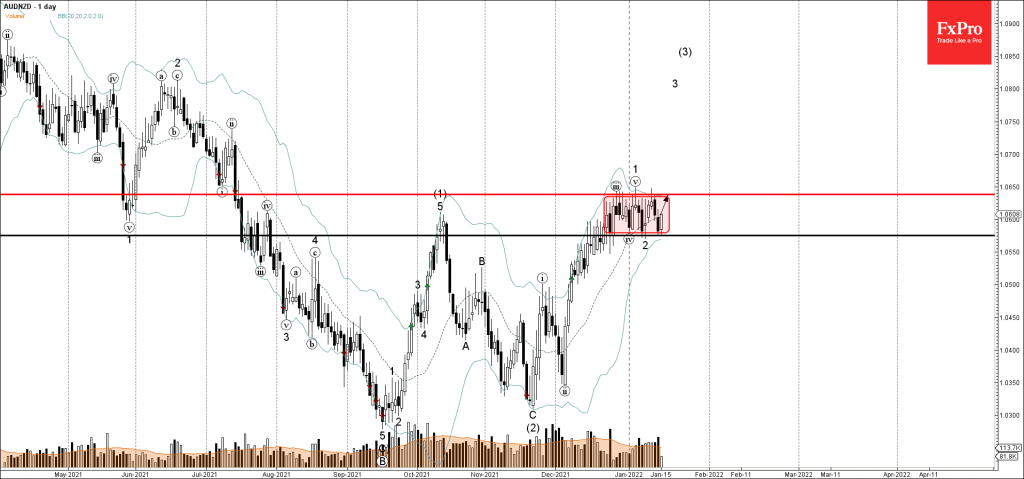
AUDNZD Wave Analysis
- AUDNZD reversed from support level 1.0575
- Likely to rise to resistance level 1.0640
AUDNZD currency pair recently reversed up from the key support level 1.0575 (low of the sideways price range, which has been reversing the price from the start of December), intersecting with the lower daily Bollinger Band.
The upward reversal from the support level 1.0575 continues the active impulse waves 3 and (3).
AUDNZD currency pair can be expected to rise further toward the next resistance level 1.0640 (top of this sideways price range).
Cryptomarket Changing Landscape
The Cryptocurrency Fear and Greed Index has been cruising between 21-23 for the past seven days – in the extreme fear territory, finding itself in the middle of that range on Monday.
Meanwhile, the value of all coins tracked by CoinMarketCap fell 0.5% in the last 24 hours to $2.05 trillion. By and large, a sideways range, $2.0-$2.1 trillion, has also been prevalent here for the past seven days, marking a lull in bull and bear fighting. It remains to be seen whether this signifies fatigue from the past months’ turbulent moves or preparations for a new strong momentum.
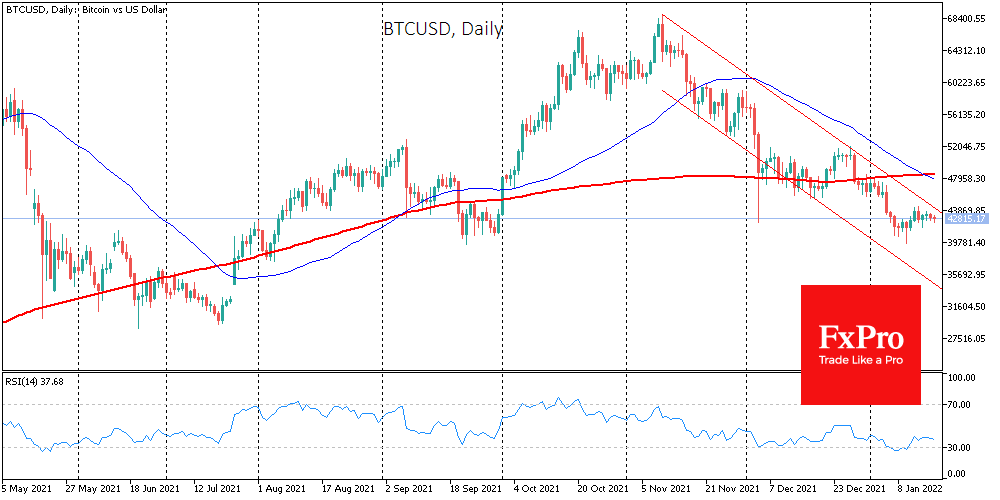
The local victory is on the bears’ side, dominating the top coins now, where losses range from -0.8% for Bitcoin to -5.7% for Polkadot over the last 24 hours.
Bitcoin failed to build on last week’s upside momentum and is back in the $41-42K consolidation area, approaching it from above. A decline from these levels in the coming days will be a development of the downtrend since November, reversing the BTCUSD from the upper boundary of the downtrend channel.
A bearish scenario suggests a dip towards $31K by the end of this week to close the July gap. But the door for such a decline will only open after the bulls surrender the $40K level they managed to hold in September and earlier in January.
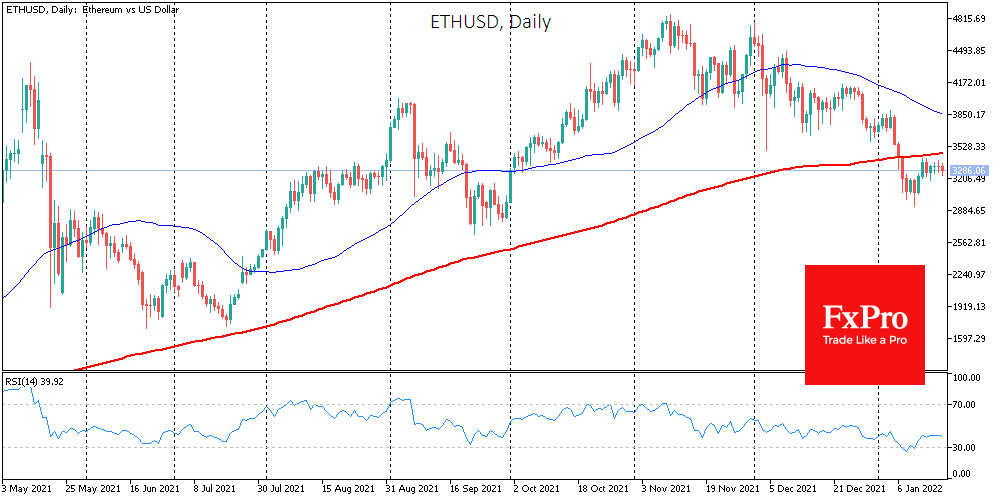
Ether has also encountered a sell-off in its attempts to rise above $3.3K. The 200-day moving average level is now acting as significant resistance.
Bitcoin and Ether, which have a combined capitalisation of almost 60% of all cryptocurrencies, show worryingly negative dynamics. At the same time, their share has been declining since late last year. We are seeing either a shift in investor attitudes towards the sector leaders or certain inertia of altcoins compared to the flagships.
Right now, it seems that crypto enthusiasts are not at all opposed to the changing landscape. However, as is often the case in nature, such changes rarely go smoothly.
Could Canadian Inflation Power Loonie’s Rally?
The Canadian dollar could face fresh volatility when December’s CPI inflation data come out on Tuesday at 12:30 GMT. Forecasts point to another pickup and investors are highly confident that the central bank could raise interest rates as soon as this month, though such a policy decision may not be straight-forward.
CPI inflation estimates
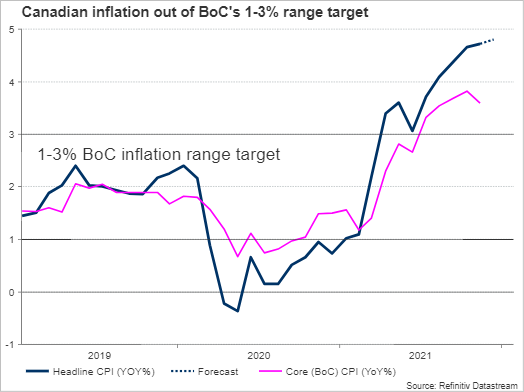
Canadian inflation is expected to have declined by 0.1% on a monthly basis in December, and while a deceleration would be somewhat a relief to the central bank at a time when pandemic risks continue to weigh on economic growth, a decline during the Christmas month has been a common phenomenon at least the past four years, making the headline and core CPI measures more meaningful to watch.
The headline CPI is expected to inch up to 4.8% year-on-year, marking a fresh two-decade high, after stabilizing around 4.7% in the preceding month. Investors will also closely look for similar upturns in the core measures, which exclude volatile energy and food prices, to figure out whether price pressures could become broadly irreversible without the central bank’s intervention.
A January rate hike?
Notably, investors have set aside omicron fears, shrugging off the renewed round of mild restrictions in Ontario and Quebec during the past week, with the 10-year government bond yield surging closer to November’s peak on Monday. On top of that, analysts are strongly pricing in a 25-basis points rate hike with a probability of 75% during next week’s policy meeting. Four more could be delivered according to rate futures by the end of the year to drive the benchmark interest rate up to 1.75%. But despite the rate optimism, the central bank has been out of the spotlight since its previous policy meeting, providing little direction about whether it could hike its borrowing costs as soon as this week.
Having ended quantitative easing, policymakers acknowledged the inflation risk during their previous gathering in December, messaging that if the omicron variant “proves to be less of a health concern than initially feared” and should the labor market remain on solid footing, “there might be some room to reduce monetary support”.
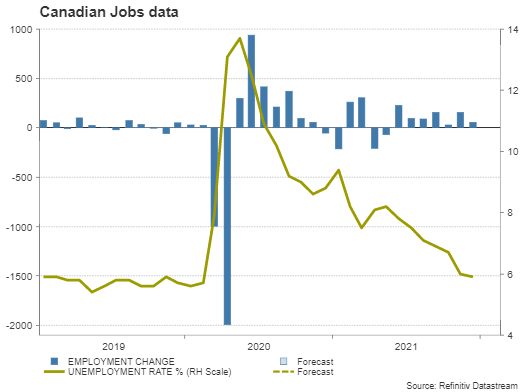
The unemployment rate registered another decline since then, almost approaching its pre-pandemic levels, while business surveys reflected resilience in demand. Hence, perhaps another uptick in inflation would be enough to put the rate campaign into action next week, taking into consideration that the CPI inflation rate would be even larger if it included rising house prices. It is also noteworthy that the government has enabled applications for subsidies to businesses and workers recently, potentially minimising any downturns in business operations and consumer spending.
A rate increase next week would put the BoC ahead of the Fed in the tightening cycle, but the pandemic and inflation risks could still hang around. Therefore, the central bank would probably require more data evidence before hiking rates, making a spring decision a safer choice. Besides, it’s the BoC which tends to follow the Fed and not the opposite, making a negative surprise likely next week.
USD/CAD
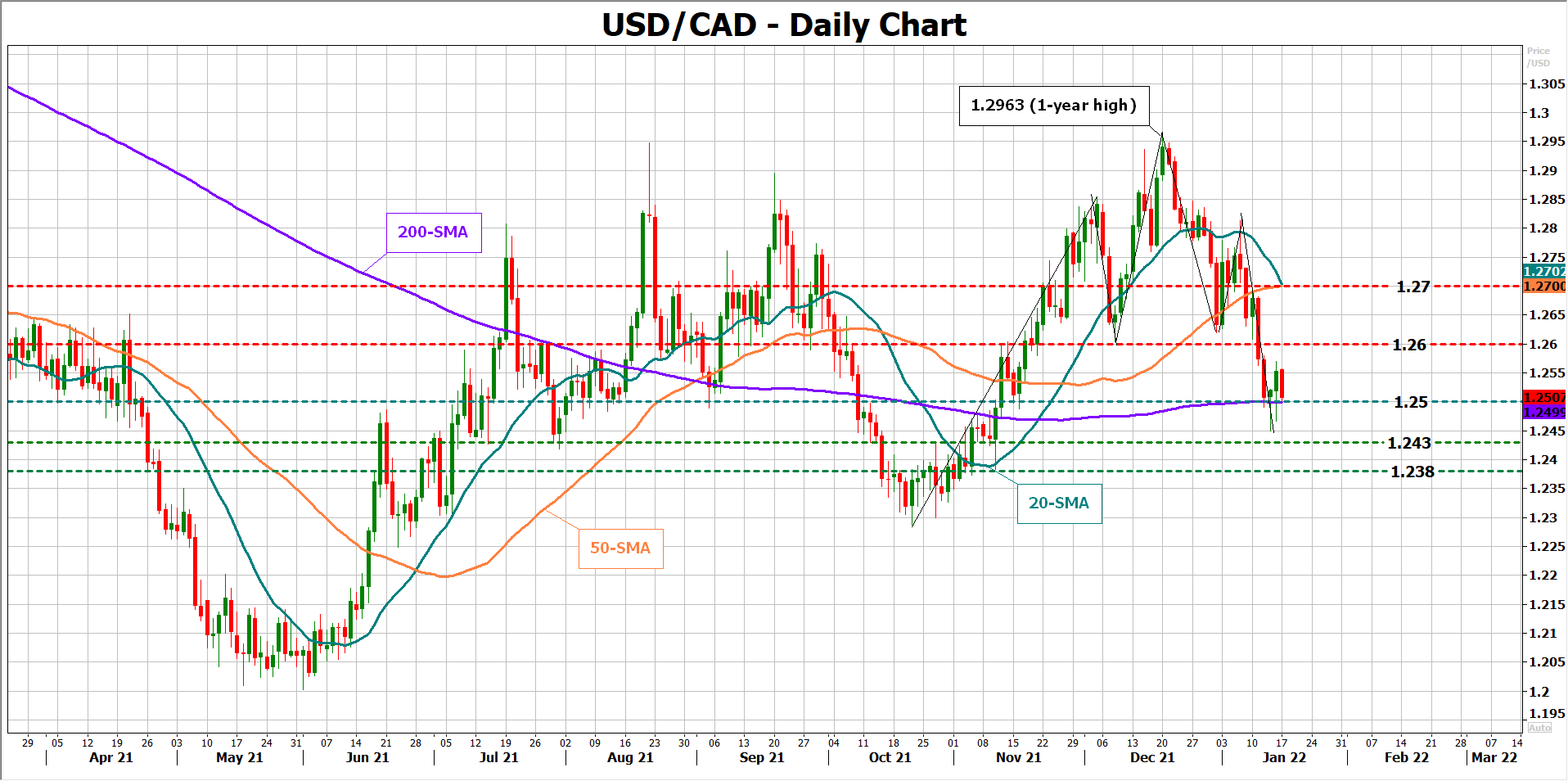
Nevertheless, stronger-than-expected CPI figures could bode well for the Canadian dollar amid the high rate hike expectations, likely putting dollar/loonie back in a downtrend below the 1.2500 level, with the 1.2430 – 1.2380 territory coming next into view.
Alternatively, weaker-than-expected inflation prints could play down a January rate hike scenario, sending the pair closer to 1.2600, where the neckline of the head and shoulder bearish pattern is positioned. Any close higher would snap the negative trend pattern, bringing the key 1.2700 mark under examination.
BoC’s Q4 Business Outlook Survey Showed Intensifying Inflation Pressure
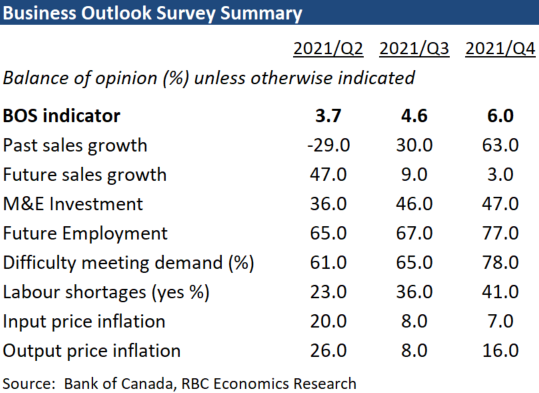
- Business capacity pressures intensified in Q4.
- Wage and inflation pressures continued to build.
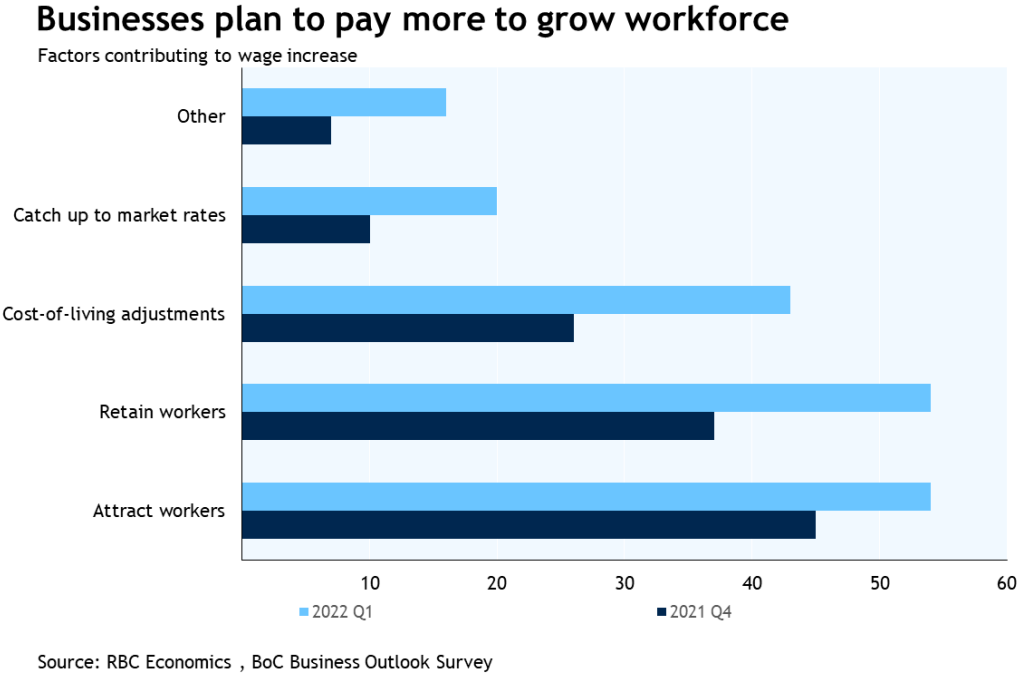
- Businesses plan to hire more, and to pay higher wages to do so
- Survey conducted pre-Omicron, but pressure growing on Bank of Canada to hike rates soon
The Bank of Canada's Q4 Business Outlook Survey was conducted largely before the spread of the new Omicron variant accelerated sharply in December. But business capacity pressures were also rapidly accelerating late last year. The pace of expected future sales growth remained high, although the pace was little changed versus a quarter earlier. But ability-to-produce to fill incoming orders looks clearly to have been a larger problem than any shortfall in orders. Almost 80% of businesses reported they would have difficulty meeting an unexpected increase in Demand. Plans to invest are widespread, with the net share of firms planning to buy more machinery and equipment over the next 12 months hitting a record high. The net balance of firms planning to hire workers hit a record 77%, and businesses expect that very tight labour markets (the unemployment rate was back below 6% in December) means they will have to pay more to accomplish that goal. A net 71% of businesses expect to have to pay higher wages - mostly to retain and attract new workers. Two-thirds of businesses expect the annual rate of inflation to be above the top-end of the Bank of Canada's 1%-3% target range over the next two year, up from 45% in the Q3 survey.
The rapid spread of the Omicron variant and large numbers of workers required to self-isolate are likely only adding to labour shortages in the near-term. The economic impact of the latest virus wave will very likely push unemployment back up in January, but disruptions will also likely be short-lived given the exceptionally rapid initial virus spread and accelerated roll-out of booster shots. Government supports will once again help to keep a floor under household and business incomes. As a result, we don't expect the Omicron variant to delay Bank of Canada rate hikes. Our forecast assumes the first increase in the overnight rate will come in April, although capacity/inflation/wage pressures in today's BOS data would argue that the first increase could come at any time, including in the next policy decision later this month.