

Sample Category Title
Sunset Market Commentary
Markets
December US retail sales were today’s main dish. The headline figure declined by 1.9% M/M which was significantly below near flat consensus. Core sales dropped by 2.3% on a monthly basis and the control group, seen as a proxy to calculate consumption in GDP, even fell by 3.1% M/M. Numbers are based on absolute dollar levels of purchases, suggesting somewhat weaker underlying picture given that US inflation is running at 7% Y/Y. The monthly setback is obviously related to the surging omicron-variant of the Covid-virus which kept people at home and might therefore be more of a one-off rather than a structural change in a strong spending pattern. Combined data for Q4 point to a 8.7% Q/Qa increase for headline retail sales and 5.9% Q/Qa for the control group. The retail sales failed to disturb sluggish intraday trading dynamics as US markets head into the long weekend. They close on Monday for MLK Day.
European stock markets opened around 1% weaker in a catch-up move with yesterday’s WS performance. Intraday dynamics didn’t deteriorate further with opening levels currently still on the charts. The dollar slightly recovers from this week’s beating, but moves don’t drag that far. Technical breaks in EUR/USD, DXY and USD/JPY aren’t overturned. The Japanese yen even continues outperforming the dollar in the run-up to next week’s BoJ meeting. Earlier rumours of an upgraded expected inflation trajectory were this morning followed by unconfirmed talk that the central bank would even contemplate a rate hike (next year) even if inflation is still below the central bank’s 2% target. In Bank of Japan space, such news is huge as it strikes with their multidecade easy monetary policy. US Treasuries trade choppy. US yields add 2.6 bps to 3.4 bps in a daily perspective with the belly of the curve outperforming the wings. The German yield curve bear steepens with yields rising by 0.9 bps (2-yr) to 2.2 bps (30-yr). 10-yr yield spread changes vs Germany are virtually unchanged with Greece (-3 bps) outperforming.
Next week’s eco calendar includes key UK eco data with labour market report, inflation numbers and retail sales. They are unlikely to derail the Bank of England from raising policy rates a second time in February. EMU and US eco calendars won’t inspire. Other features to watch are Chinese Q4 GDP numbers on Monday and central bank meetings in Norway and Turkey. News Headlines
Hungarian inflation rose 0.3% m/m to a higher-than-expected 7.4% y/y in December. The price increases were broadly based. Food registered the biggest month-on-month rise (+1.5% m/m), followed by restaurants & hotels (0.8%) and furnishings (0.7%). Inflation should moderate to 7% in January but the outcome is prone to statistical distortion. The new CPI weightings this year reflect consumption structure of 2020 which saw relative bigger spending in food and tradeable goods, two of the biggest contributors to today’s inflation. KBC Economics expects the Hungarian central bank to continue its tightening cycle via the one-week deposit rate by the end of January. The rate could reach a peak of 5%, up from 4% currently. Hungary’s forint underperforms peers today. EUR/HUF trades around 356.19. Just yesterday, the forint touched the strongest level since mid-September at 350.88.
In his first interview with a foreign news agency, Turkish new FM Nebati said inflation will peak months earlier and at a much lower rate than many predict today. He said the top priority in recent weeks was to stem the lira’s decline. While EUR/TRY (15.50 today) indeed stabilized in the weeks, it did so at a historically still-high (low in lira-terms) level. Nebati believes the effect of earlier lira declines will feed into the January inflation figure after which a natural decline over 2022 should kick in. With the lira issue now resolved, he said, focus turns to inflation. The government will continue to support the economy but with selective measures. Regarding monetary policy, Nebati suggested the CBRT will stick to the sidelines for a month or three to assess the impact of the earlier rate cuts.
The Return of Interest Rate Anxiety
A late sell-off in the US on Thursday is weighing heavily on sentiment around the globe with Asia ending the week on a negative note and Europe heading for a similar finish.
Tech was once again hit the hardest as interest rate anxiety kicked in. The rebound looked premature and yesterday showed investors don't have the stomach for a sustainable rebound yet. I have no doubt the dip buyers will be tempted back in soon enough but we could see a little more pain before that happens.
The Nasdaq is looking a little vulnerable, to put it mildly. The failure at 16,000 followed by the severity of the sell-off is an awful combination and it suddenly looks very weak on approach to a big support level.
A test of 15,000 looks very likely at this stage and not only would this represent a 10% correction from the highs, most of which has come in the last 10 days, but a break would take the index below the 200-day simple moving average for the first time since the start of the pandemic. That would be quite the negative signal.
Of course, earnings season may have arrived just in time and some knockout tech earnings may be enough to tempt the dip buyers back in. Not that they typically require much. But given the level of interest rate anxiety in the markets right now and the sensitivity of tech stocks to it, it wouldn't hurt.
UK GDP surpasses pre-pandemic peak
Growth in the UK was much stronger than expected in November, taking GDP above the January 2020 level for the first time since the pandemic hit. Consumer-facing services were a big driver of the outperformance, which is encouraging given the relative restrain we've seen during the recovery. However, behaviour is likely to have been more restrained in December as a result of omicron, not to mention earlier than normal Christmas spending, which should drag at the end of the year and early this. Still, a very promising report, even if the bump in the pound was relatively short-lived.
Investors seemingly not concerned by weak US Retail Sales report
The US retail sales report was rather disappointing in December, perhaps a sign of consumers being more restrained as a result of omicron, not to mention early Christmas prep in anticipation of supply issues. Markets seem a little directionless after the release, which could be a sign that investors don't know how to take the data. A strong report would have been positive for the economy but also feed into the argument for faster tightening, which is not being particularly well received at the moment. A few weak reports may, on the other hand, encourage caution from policymakers.
European energy crisis deepens, while oil continues higher
Oil prices are higher again on Friday, continuing to trade around the highest levels seen in more than seven years. We could potentially be seeing some signs of exhaustion in the rally, with momentum indicators easing despite price continuing higher, but we're not seeing it to any significant degree. Perhaps we'll see more signs in the coming sessions but it's hard to say with any conviction that prices won't just continue to rally in the near term.
The energy crisis is also deepening in Europe, raising the possibility of outages this winter as already depleted reserves continue to be drawn upon. Friction with Russia over Ukraine, not to mention the Nord Stream 2 pipeline, make the prospect of emergency supplies unlikely any time soon. And further outages at nuclear reactors in France are just compounding the problem. European leaders will be praying for warmer weather over the coming months.
Gold showing incredible resilience
Gold is a little lower at the end of the week, once again running low on momentum as it approaches what has become a major technical resistance level around $1,833. Higher yields are at least partially responsible for the wind coming out of gold's sails, although once again it's showing considerable resilience given the reaction we've seen elsewhere.
If it can break $1,833, it will be a very bullish signal for gold, especially coming at a time when investors are pricing in more aggressive tightening from central banks. It seems to be relatively immune to higher yields, perhaps generating favour from its inflation hedge reputation. Are traders sending a signal that four hikes and balance sheet reduction this year won't be enough to get to grips with inflation? Or shielding against potential declines in stock markets?
Bitcoin not feeling the love
Bitcoin isn't feeling the love that's coming gold's way at the moment, despite the claim of it being gold 2.0. The cryptocurrency looks to be far more aligned with high-risk assets and is coming under pressure once more as interest rate fear spreads throughout the market. Bitcoin ran into resistance a little shy of the December support zone and could see $40,000 come under pressure once more. This level is likely to be heavily protected so it will take a big push to break that support. If we do see a close below, it could get a lot more painful for cryptos.
U.S. Retail Sales Pulled Back in December, Capping off a Strong Year
Retail sales declined for the first time in five months, falling 1.9% m/m in December, well below the consensus estimate for a modest decline of 0.1%. November's reading was also revised down to +0.2% m/m from 0.3% m/m reported earlier.
Supply-chain disruptions continue to weigh motor vehicles and parts, where sales posted a decline of 0.4% m/m. The November reading, however, was revised up to 0.2% m/m from -0.1% m/m reported earlier.
Excluding autos, retail sales were down by 2.3% m/m. Sales at gasoline stations declined by 0.7%, partially reflecting a decline in energy prices in December.
Sales in the "control group", which exclude the most volatile components and are used in calculating personal consumption expenditures (and GDP), were down by 3.1% m/m. November's gain was also revised down (to -0.5% m/m from the advance reading of -0.1% m/m).
- Non-store retailers (-8.7% m/m) accounted for the majority of the decline in the control group, followed by department stores (-1.5% m/m), Most other holiday-sensitive categories were down, including food service & drinking places (-0.8% m/m).
- It wasn't all bad news: sales at miscellaneous stores retailers, building materials retailers and health & personal care stores were up by 1.8%, 0.9% and 0.5% m/m, respectively.
Key Implications
The report came in much weaker than expected, and from a lower base as November sales were revised down. The decline suggests that consumers, faced with rising prices, are normalizing their spending. This may also be the result of shoppers front-loading their purchases in the wake of supply chain challenges and reports of holiday shortages.
Still, 2021 exits the stage with record retail sales performance: 19.4% growth from December to December. The outsized gain can be attributed to multiple factors, including two rounds of fiscal stimulus, solid income recovery, and, less positively, accelerating price growth. The award for the most valuable player this season goes to auto sales, which accounted for nearly five percentage points of the gain – much of that due to higher prices.
Looking to the year ahead, retail trade is will slow from its record pace. The near-term outlook is clouded by the Omicron-related disruptions. While January usually suffers from the post-holiday spending fatigue, retail sales may get a boost as consumers shift preferences towards goods in their spending basket this month.
EUR/USD Mid-Day Outlook
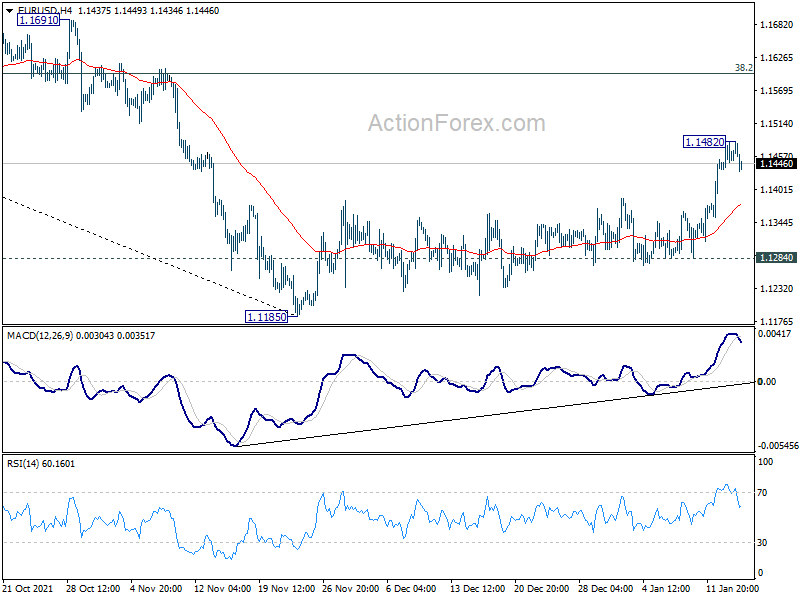
Daily Pivots: (S1) 1.1433; (P) 1.1458; (R1) 1.1479; More...
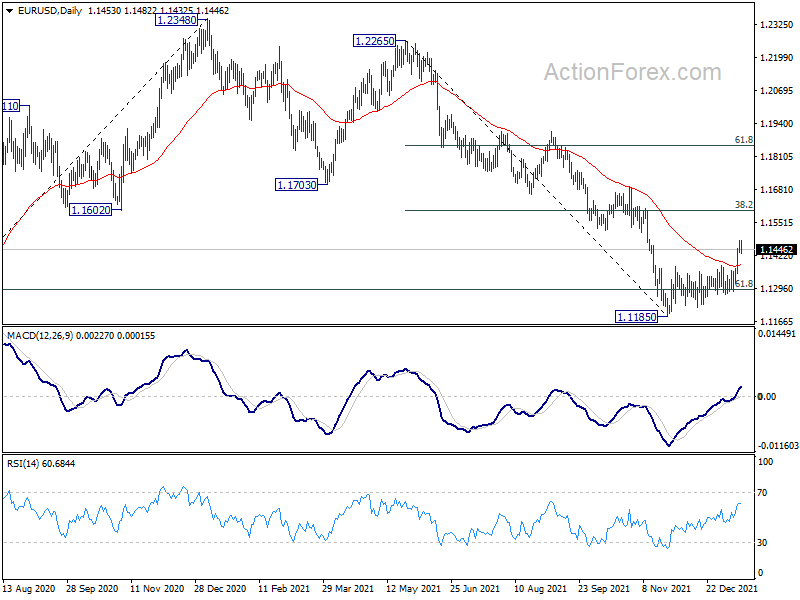
Intraday bias in EUR/USD is turned neutral for some consolidation below 1.1482 temporary top. While further rally cannot be ruled out, upside should be limited by 38.2% retracement of 1.2265 to 1.1185 at 1.1598 to finish the corrective rise from 1.1185. On the downside, below 1.1284 support will bring retest of 1.1185 low. However, sustained break of 1.1598 will argue that the trend is reversing already.
In the bigger picture, there are various ways of interpreting the fall from 1.2348 (2021 high). It could be a correction to rise from 1.0635 (2020 low), the fourth leg of a sideway pattern from 1.0339 (2017 low), or resuming long term down trend. In any case, outlook will now stay bearish as long as 1.1703 support turned resistance holds. Sustained break of 61.8% retracement of 1.0635 to 1.2348 at 1.1289 would pave the way back to 1.0635.
GBP/USD Mid-Day Outlook
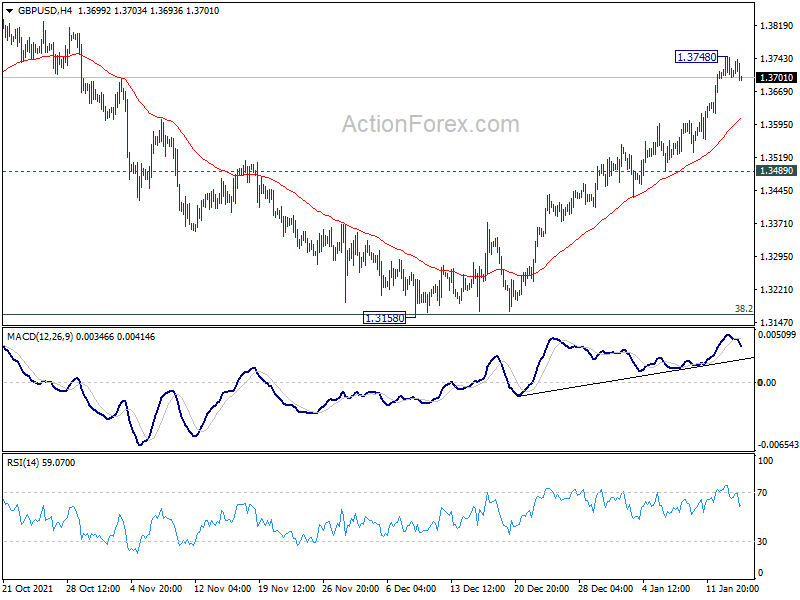
Daily Pivots: (S1) 1.3690; (P) 1.3720; (R1) 1.3738; More...
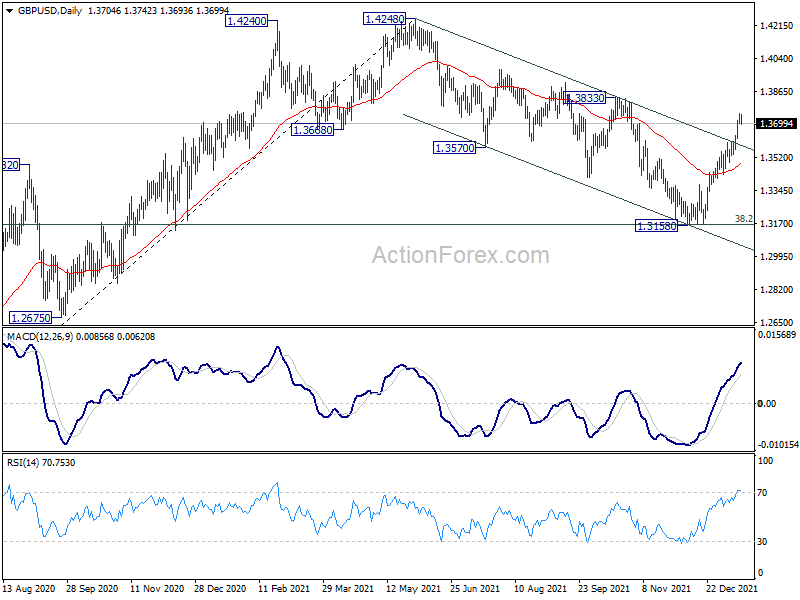
Intraday bias in GBP/USD is turned neutral first for some consolidation below 1.3748 temporary top. But downside of retreat should be contained above 1.3489 support to bring another rally. As noted before, corrective fall from 1.4282 should have completed with three waves down to 1.3158, after hitting 1.3164 medium term fibonacci level. Above 1.3748 will target 1.3833 first. Sustained break of 1.3833 will pave the way back to retest 1.4248 high.
In the bigger picture, strong support was seen from 38.2% retracement of 1.1409 to 1.4248 at 1.3164. The development suggests that up trend from 1.1409 (2020 low) is still in progress. On resumption, next target will be 38.2% retracement of 2.1161 to 1.1409 at 1.5134. Nevertheless sustained break of 1.3164 will argue that whole rise from 1.1409 has completed and bring deeper fall to 61.8% retracement at 1.2493.
USD/CHF Mid-Day Outlook
Daily Pivots: (S1) 0.9087; (P) 0.9118; (R1) 0.9143; More....
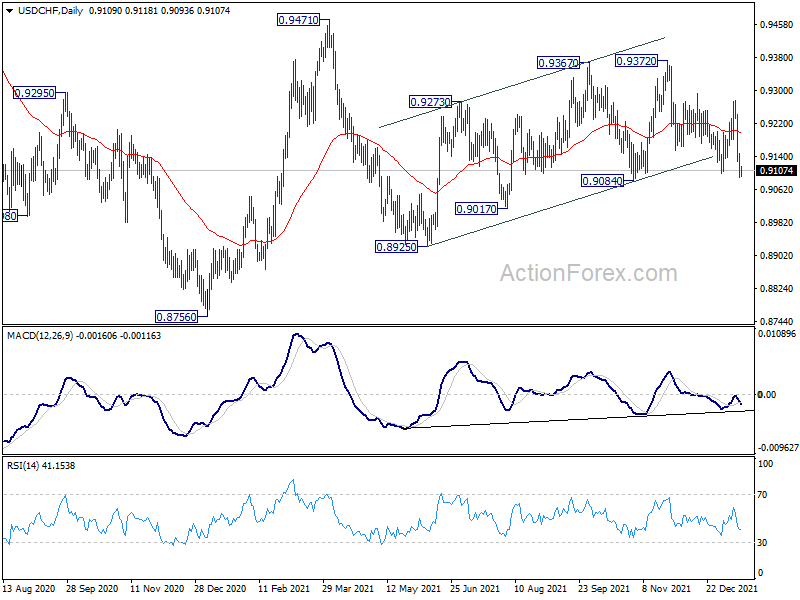
Intraday bias in USD/CHF stays on the downside for the moment. On the downside, firm break of 0.9084/0.9101 support zone will argue that choppy rise from 0.8925 has completed. Fall from 0.9471 might be ready to resuming. Further decline would be seen back to 0.8925 support first. On the upside, above 0.9147 minor resistance will turn intraday bias neutral first.
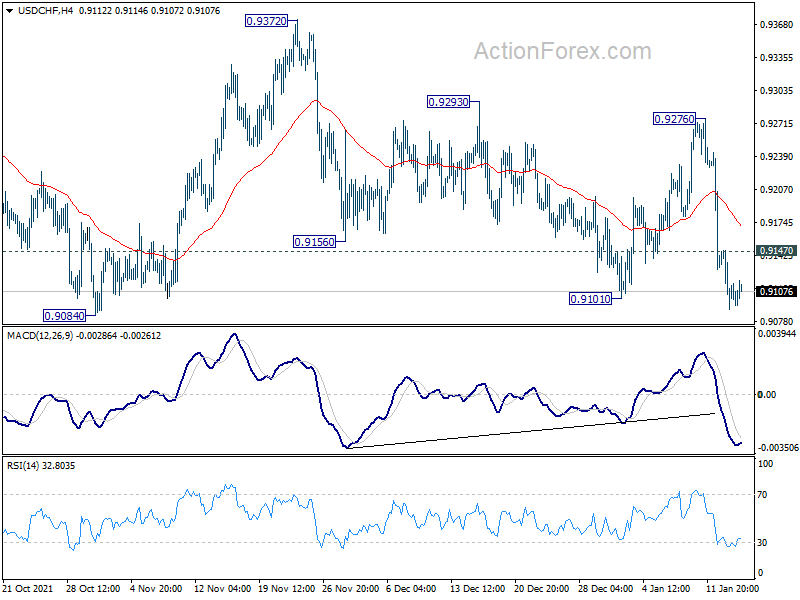
In the bigger picture, the corrective structure of the rebound from 0.8925 argues that fall from 0.9471 is not complete yet. It could either be the second leg of pattern from 0.8756 (2021 low), or resuming larger down trend from 1.0237 (2018 high). We'd pay attention to the downside momentum and assess the odds later. But for now, medium term outlook will be neutral at best as long as 0.9471 resistance holds.
Stocks Dive after Terrible US Retail Sales, Yen Powers Up
Overall risk sentiment turns sour again following terrible US retail sales data. DOW futures reverse early gains and turn deep red, pointing to a much lower open. Yen is powering up following risk-off sentiment while Aussie is now leading commodity currencies lower. At the same time, Dollar is turning mixed. But for the week, the greenback is still the worst performing while Yen looks set to secure its position as the top gainer.
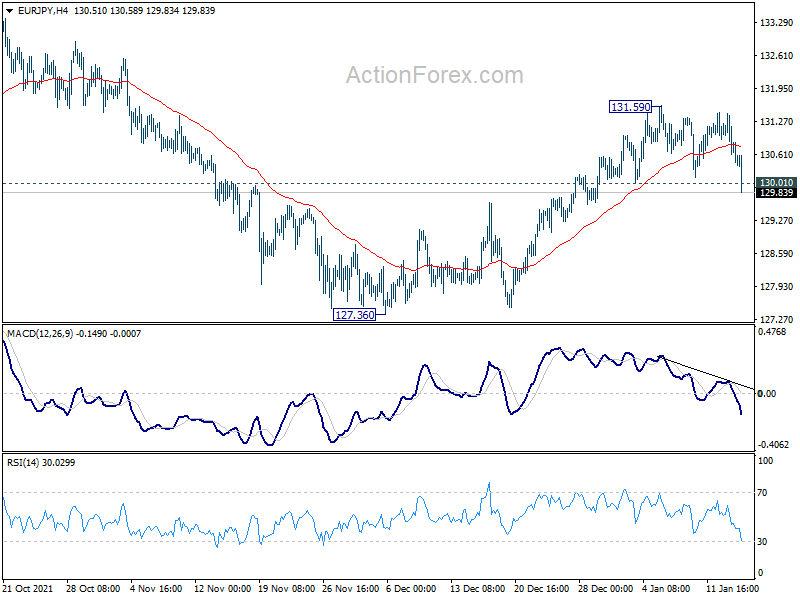
Technically, EUR/JPY's break of 130.01 support how argues that rise from 127.36 is finished at 131.59. The whole corrective pattern from 134.11 is going to extend with another falling leg. We'll see if GBP/JPY would follow, and align with the outlook, by breaking through 154.85 support.
In Europe, at the time of writing, FTSE is down -0.50%. DAX is down -1.08%. CAC is down -0.96%. Germany 10-year yield is up 0.0041 at -0.084. Earlier in Asia, Nikkei dropped -1.28%. Hong Kong HSI dropped -0.19%. China Shanghai SSE dropped -0.96%. Singapore Strait Times rose 0.76%. Japan 10-year JGB yield rose 0.0192 to 0.151.
US retail sales dropped -1.9% mom in Dec, ex-auto sales down -2.3% mom
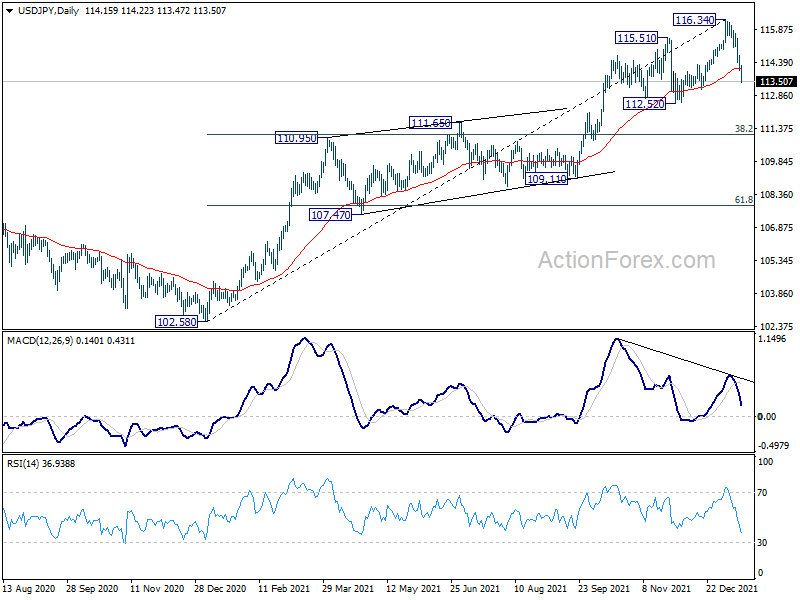
US retail sales dropped -1.9% mom to USD 626.8B in December, much worse than expectation of 0.0%. Ex-auto sales dropped -2.3% mom, below expectation of 0.2% mom. Ex-gasoline sales dropped -2.0% mom. Ex-auto, ex-gasoline sales dropped -2.5% mom.
Total sales for the 12 months of 2021 were up 19.3% from 2020. Total sales for the October 2021 through December 2021 period were up 17.1% from the same period a year ago.
ECB Lagarde: Monetary accommodation is still needed for inflation to settle at 2%
In a speech, ECB President Christine Lagarde said the "rapid reopening" of the economy has led to steep rises in fuel prices, gas and electricity and price hikes in durable goods and some services. These factors are "weighing on growth in the near term". Higher energy prices are "cutting into household incomes and denting confidence". Supply bottlenecks are leading to "shortages in the manufacturing sector.
"That is why, at our last Governing Council meeting, we recalibrated our policy measures, allowing for a step-by-step reduction in the pace of our net asset purchases," she added.
However, Lagarde also noted, "at the same time, we concluded that monetary accommodation is still needed for inflation to settle at 2% over the medium term."
Eurozone exports rose 14.4% yoy in Nov, imports rose 32.0% yoy
Eurozone exports of goods rose 14.4% yoy, to EUR 225.1B in November. Imports rose 32.0% yoy to EUR 226.6B. Trade deficit came in at EUR -1.5B. Intra-Eurozone trade rose 22.1% yoy to EUR 204.3B.
On seasonally adjusted bases, extra-Eurozone exports rose 3.0% mom to EUR 213.2B. Imports rose 4.5% mom to EUR 214.5B. Trade balance turned into EUR -1.3B deficit. Intra-Eurozone trade rose from EUR 192.2B to EUR 193.9B.
UK GDP grew 0.9% mom in Nov, back above pre-pandemic level
UK GDP rose strongly by 0.9% mom in November, well above expectation 0.4% mom. Looking at some details, services grew 0.7%, production rose 1.0% mom, and production increased 3.5% mom.
Monthly GDP was back above pre-COVID level in February 2020, for the first time, by 0.7%. Also, if there are no other data revision, Q4 GDP should either reach or surpass its pre-coronavirus level in Q4 2019, provided monthly December GDP does not fall by more than -0.2% mom.
Also released, industrial production rose 1.0% mom, 0.1% yoy versus expectation of 0.2% mom, 0.5% yoy. Manufacturing rose 1.1% mom, 0.4% yoy, versus expectation of 0.2% mom, -0.3% yoy. Index of services rose 1.3% 3mo3m, versus expectation of 0.5%. Goods trade deficit narrowed slightly to GBP -11.3B, versus expectation of GBP -14.2B.
USD/JPY Mid-Day Outlook
Daily Pivots: (S1) 113.88; (P) 114.29; (R1) 114.59; More...
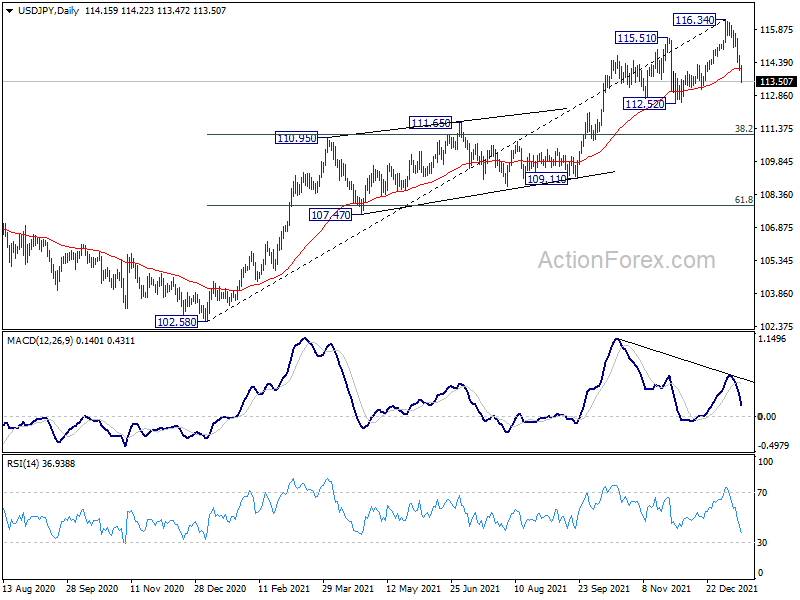
USD/JPY's fall from 116.34 is still in progress and intraday bias stays on the downside for 112.52 support. Considering bearish divergence condition in in daily MACD, break of 112.52 will confirm that it's already in correction to the up trend from 102.58. Deeper decline would be seen to 38.2% retracement of 102.58 to 116.34 at 111.08. On the upside, above 114.22 minor resistance will turn intraday bias neutral first.
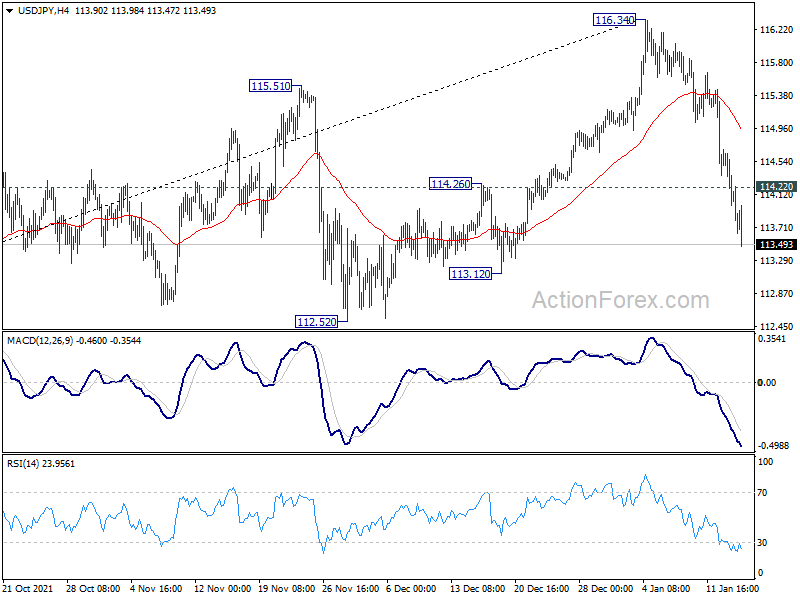
In the bigger picture, no change in the view that rise from 102.58 is the third leg of the up trend from 101.18 (2020 low). Such rally should target a test on 118.65 (2016 high). Sustained break there will pave the way to 120.85 (2015 high) and raise the chance of long term up trend resumption. However, firm break of 112.52 support will dampen this bullish case and we'll assess the outlook based on subsequent price actions later.
Economic Indicators Update
| GMT | Ccy | Events | Actual | Forecast | Previous | Revised |
|---|---|---|---|---|---|---|
| 23:50 | JPY | PPI Y/Y Dec | 8.50% | 8.80% | 9.00% | 9.20% |
| 02:00 | CNY | Trade Balance (USD) Dec | 94.5B | 73.4B | 71.7B | |
| 02:00 | CNY | Exports (USD) Y/Y Dec | 20.90% | 22% | ||
| 02:00 | CNY | Imports (USD) Y/Y Dec | 19.50% | 31.40% | 31.70% | |
| 02:00 | CNY | Trade Balance (CNY) Dec | 604.69B | 451B | 461B | |
| 02:00 | CNY | Exports (CNY) Y/Y Dec | 17.30% | 16.60% | ||
| 02:00 | CNY | Imports (CNY) Y/Y Dec | 16.00% | 26.00% | ||
| 07:00 | GBP | GDP M/M Nov | 0.90% | 0.40% | 0.10% | 0.20% |
| 07:00 | GBP | Manufacturing Production M/M Nov | 1.10% | 0.20% | 0.00% | 0.10% |
| 07:00 | GBP | Manufacturing Production Y/Y Nov | 0.40% | -0.30% | 1.30% | 1.10% |
| 07:00 | GBP | Industrial Production M/M Nov | 1.00% | 0.20% | -0.60% | -0.50% |
| 07:00 | GBP | Industrial Production Y/Y Nov | 0.10% | 0.50% | 1.40% | 0.20% |
| 07:00 | GBP | Index of Services 3M/3M Nov | 1.30% | 0.50% | 1.10% | 1.20% |
| 07:00 | GBP | Goods Trade Balance (GBP) Nov | -11.3B | -14.2B | -13.9B | -11.8B |
| 10:00 | EUR | Eurozone Trade Balance (EUR) Nov | -1.3B | 1.6B | 2.4B | 1.8B |
| 13:30 | USD | Retail Sales M/M Dec | -1.90% | 0.00% | 0.30% | |
| 13:30 | USD | Retail Sales ex Autos M/M Dec | -2.30% | 0.20% | 0.30% | |
| 13:30 | USD | Import Price Index M/M Dec | -0.20% | 0.30% | 0.70% | |
| 14:15 | USD | Industrial Production M/M Dec | 0.40% | 0.50% | ||
| 14:15 | USD | Capacity Utilization Dec | 76.90% | 76.80% | ||
| 15:00 | USD | Michigan Consumer Sentiment Index Jan P | 70.6 | 70.6 | ||
| 15:00 | USD | Business Inventories Nov | 1.00% | 1.20% |
USD/JPY Mid-Day Outlook
Daily Pivots: (S1) 113.88; (P) 114.29; (R1) 114.59; More...
USD/JPY's fall from 116.34 is still in progress and intraday bias stays on the downside for 112.52 support. Considering bearish divergence condition in in daily MACD, break of 112.52 will confirm that it's already in correction to the up trend from 102.58. Deeper decline would be seen to 38.2% retracement of 102.58 to 116.34 at 111.08. On the upside, above 114.22 minor resistance will turn intraday bias neutral first.
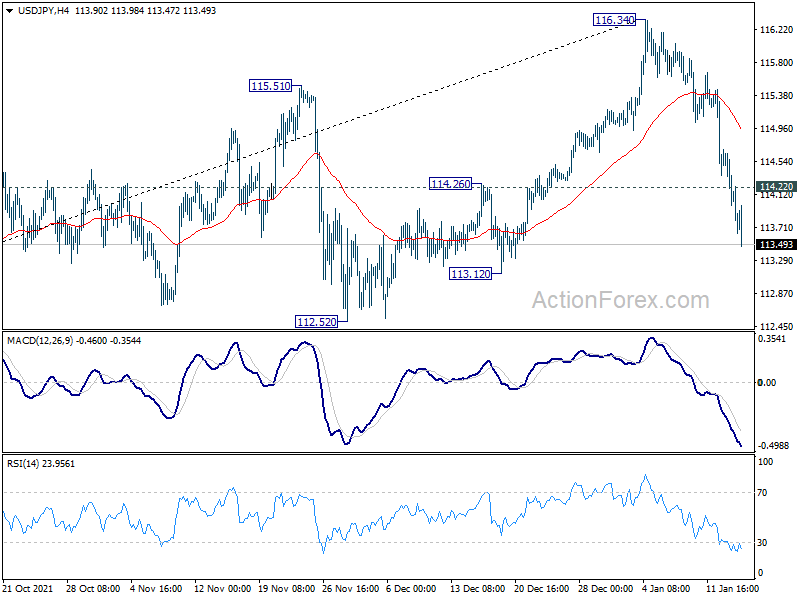
In the bigger picture, no change in the view that rise from 102.58 is the third leg of the up trend from 101.18 (2020 low). Such rally should target a test on 118.65 (2016 high). Sustained break there will pave the way to 120.85 (2015 high) and raise the chance of long term up trend resumption. However, firm break of 112.52 support will dampen this bullish case and we'll assess the outlook based on subsequent price actions later.
US retail sales dropped -1.9% mom in Dec, ex-auto sales down -2.3% mom
US retail sales dropped -1.9% mom to USD 626.8B in December, much worse than expectation of 0.0%. Ex-auto sales dropped -2.3% mom, below expectation of 0.2% mom. Ex-gasoline sales dropped -2.0% mom. Ex-auto, ex-gasoline sales dropped -2.5% mom.
Total sales for the 12 months of 2021 were up 19.3% from 2020. Total sales for the October 2021 through December 2021 period were up 17.1% from the same period a year ago.
ECB Lagarde: Monetary accommodation is still needed for inflation to settle at 2%
In a speech, ECB President Christine Lagarde said the "rapid reopening" of the economy has led to steep rises in fuel prices, gas and electricity and price hikes in durable goods and some services. These factors are "weighing on growth in the near term". Higher energy prices are "cutting into household incomes and denting confidence". Supply bottlenecks are leading to "shortages in the manufacturing sector.
"That is why, at our last Governing Council meeting, we recalibrated our policy measures, allowing for a step-by-step reduction in the pace of our net asset purchases," she added.
However, Lagarde also noted, "at the same time, we concluded that monetary accommodation is still needed for inflation to settle at 2% over the medium term."