Sample Category Title
XAG/USD Tests Major Resistance
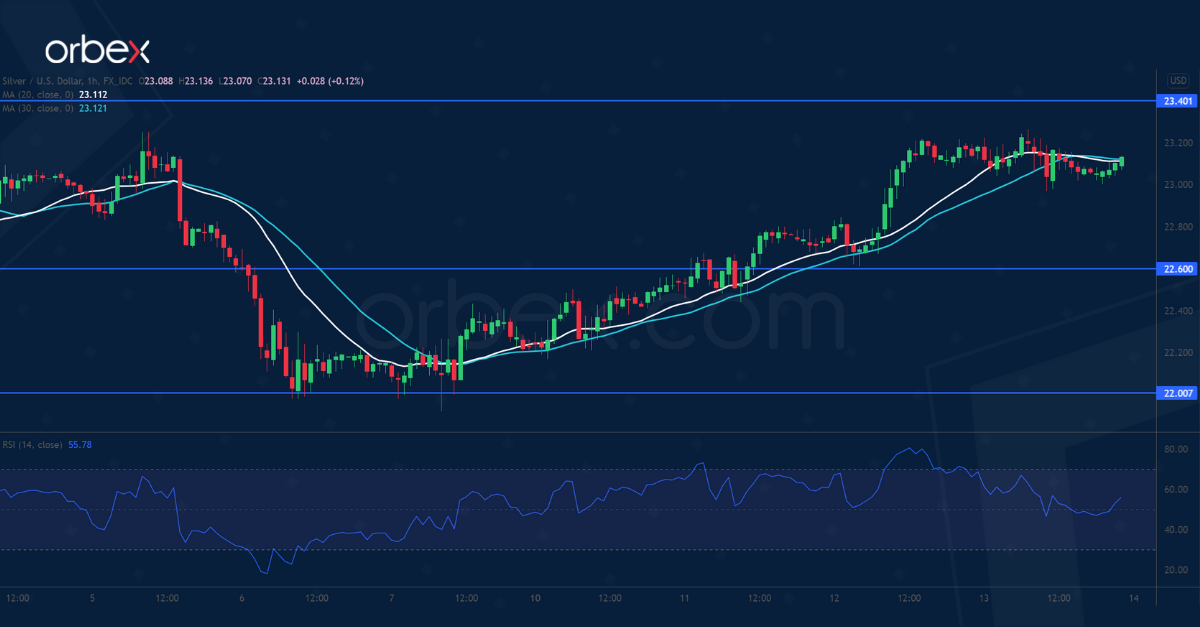
Silver extends its recovery on the back of a weak US dollar. The metal saw support at the psychological level of 22.00.
A break above the resistance at 22.80 and then an acceleration to the upside indicates strong buying interest. An overbought RSI has temporarily held the rally back.
The bulls are testing the daily resistance at 23.40. A breakout could shake sellers out and trigger a reversal above 24.00. On the downside, buyers could be lurking around 22.60 in case of a pullback.
EUR/GBP Stuck in Bearish Trend
The euro rose after ECB Vice President Luis de Guindos said the inflation spike may last longer than projected.
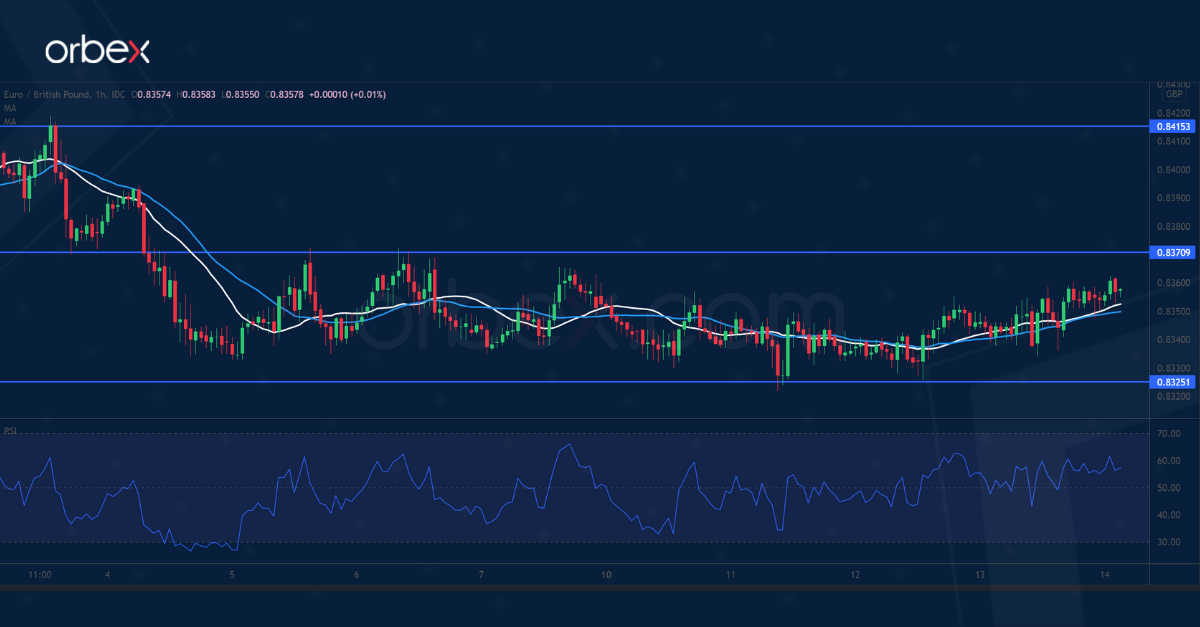
Nonetheless, the bearish sentiment still prevails after the pair failed to hold on to 0.8370. The former support has now turned into a resistance. The current consolidation could be a distribution phase and a drop below 0.8325 could send the price to February 2020's lows near 0.8290.
On the upside, the bulls have the challenging task of lifting offers around 0.8370 and then 0.8415 before they could attract more followers.
US 100 Revisits Major Support
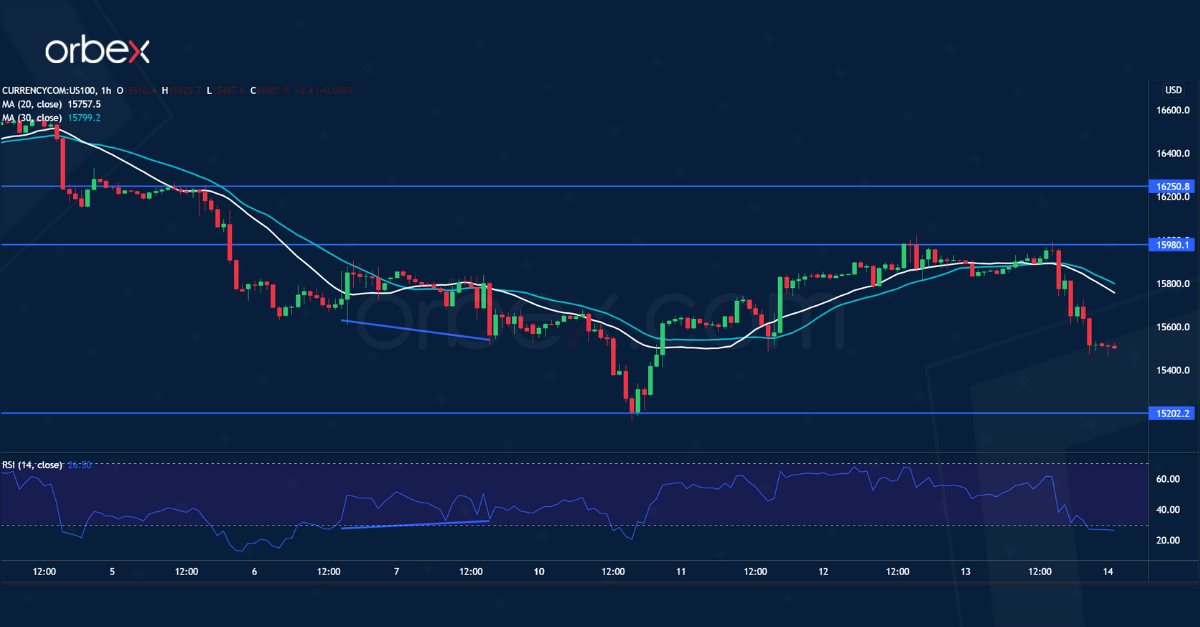
The Nasdaq 100 faltered after an unexpected rise in US initial jobless claims. The tech index bounced off the demand zone around 15200 which used to be a resistance on the daily chart.
A bullish divergence revealed a slowdown in the sell-off momentum. The latest break above 15820 prompted some sellers to cover but came under pressure at 15980.
After intraday traders took profit, 15200 is a critical support to keep the rebound relevant. A deeper correction would send the price to 14900.
UK GDP grew 0.9% mom in Nov, back above pre-pandemic level
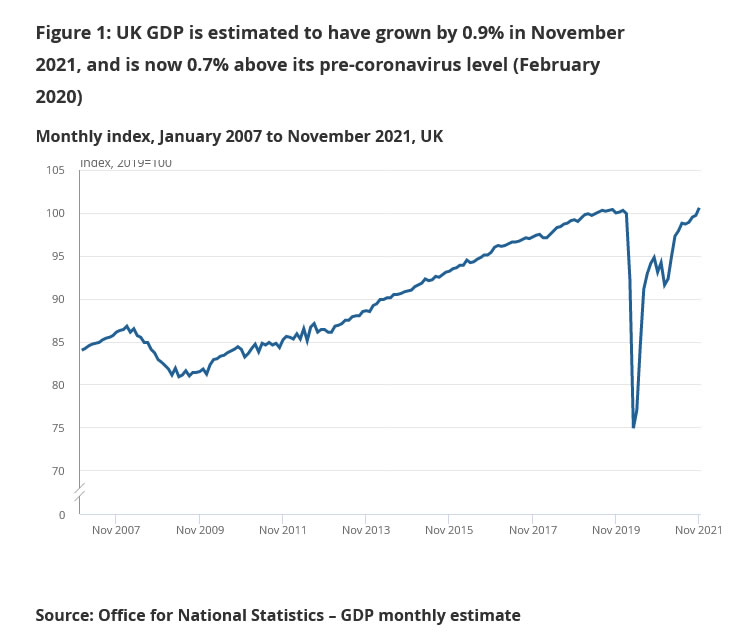
UK GDP rose strongly by 0.9% mom in November, well above expectation 0.4% mom. Looking at some details, services grew 0.7%, production rose 1.0% mom, and production increased 3.5% mom.
Monthly GDP was back above pre-COVID level in February 2020, for the first time, by 0.7%. Also, if there are no other data revision, Q4 GDP should either reach or surpass its pre-coronavirus level in Q4 2019, provided monthly December GDP does not fall by more than -0.2% mom.
Also released, industrial production rose 1.0% mom, 0.1% yoy versus expectation of 0.2% mom, 0.5% yoy. Manufacturing rose 1.1% mom, 0.4% yoy, versus expectation of 0.2% mom, -0.3% yoy. Index of services rose 1.3% 3mo3m, versus expectation of 0.5%. Goods trade deficit narrowed slightly to GBP -11.3B, versus expectation of GBP -14.2B.
Sunrise Market Commentary
Markets
US equities suffered a violent sell-off yesterday. Investors especially targeted the Nasdaq (-2.51%). The tech-heavy stock index is sensitive to (expectations of) higher rates. This is probably what drove Thursday's move. In her Fed chair nomination appearance before the Senate, Brainard held a particular focus on inflation and became the latest governor to advocate a March rate hike. Being one of the biggest monetary doves within the committee, that marks a big shift. She said inflation is expected closer to 2.5% end this year but admitted these projections should be taken with caution. Fed's Waller later said three rate hikes is still a good baseline for this year though added that if inflation stays high it could be four or even five. He currently doesn't favour a 50 bps hike in March but the word is officially out. Waller said shrinking the balance sheet could start by summer. US bond yields stuck to their ST downward momentum, perhaps helped by further easing PPI figures suggesting supply-side inflationary pressures may have peaked. The curve flattened with changes ranging between -2.6 and -4.5 bps. German yields eased 1.2 bps (2y) to 4.7 bps (30y). ECB VP de Guindos warned inflation may not be as transitory as earlier thought. His comments were largely ignored though. EUR/USD closed a tad higher, just south of 1.146 resistance, mainly on continued yet marginal dollar weakness. DXY held below 95. The Japanese yen and Swiss France outperformed. Sterling eased but EUR/GBP remains trapped near recent 2-year lows (0.835/6).
A Japanese shocker. Reuters reported the central bank is debating how to start communicating on a possible interest rate hike. While not imminent, that may come even before inflation reaches its 2% target. Japanese bond yields increase 1-1.6 bps across the curve with the short to medium segment trading near or at the highest level since the introduction of negative rates in early 2016. In other central bank news, South Korea hiked for a third time (see headline below). Asian-Pacific stocks drop with both Japan and SK underperforming. The dollar is under pressure on FX markets, JPY and NOK take the lead. Core bonds retreated from yesterday's rally.
US retail sales and U. of Michigan consumer sentiment put Joe Sixpack in the spotlights. Brainard yesterday said they are "hearing from working families" about inflation. It may indeed have affected spending and confidence. Combined with some cautiousness ahead of the long US weekend (Martin L. King Day), we don't expect the current upward yield move in Asian dealings to go very far. The US 10y does find support relatively soon at 1.70%. For the German 10y support lies at -0.10%/-0.117%. EUR/USD's technical have improved a bit today as well by currently capping 1.146. A close above 1.1495 would be a nice plus for the currency pair.
New Headlines
The Bank of Korea conducted its second consecutive 25 bps rate hike this morning – the third since August – raising the policy rate to 1.25%, matching the pre-pandemic level from Q4 2019. BoK governor Lee Ju-yeol said that inflationary pressures will be much larger than earlier expected (a considerable amount of time over 3%) while uncertainties surrounding the pandemic are unlikely to derail the domestic economic recovery. BoK Lee thinks of monetary policy as still being accommodative, adding that another hike wouldn't amount to tightening. Lee's term as governors ends after the Feb 24 policy meeting. South Korean FM Hong Nam-Ki announced an extra budget (to be funded by debt issuance) ahead of the BoK meeting, also giving more leeway for additional monetary policy tightening. The Korean won didn't really profit from today's decision with USD/KRW stable near 1187.
EU justice commissioner Reynders told the FT that the EC will demand from Poland to pay €69mn in accumulated daily fines since early November. If Warsaw doesn't comply, the EU intends to withhold more than €100mn from EU payments to Poland to cover those unpaid running fines (+interest) imposed by the EU's Court of Justice. Separately, the EC is also moving to withhold around €50mn of fines with regard to another legal dispute involving Poland and the Czech Republic. The latter complained about illegal Polish operations at a lignite mine. The zloty yesterday lost some ground against a strong euro, but EUR/PLN remains near the recent lows at 4.54.
US Dollar Index Moves Sideways ahead of US Retail Sales Data
US stocks wavered on Thursday ahead of the earnings season that kicks off today. The Dow Jones rose by over 100 points while the tech-heavy Nasdaq 100 index declined by about 80 points. The key companies that will publish their results today are Wells Fargo, Blackrock, Citigroup, JP Morgan, and First Republic. Analysts believe that most of these companies will publish strong results. For example, the median estimate is that JP Morgan’s revenue jumped to $29 billion while Citi and Blackrock had over $17 billion and $5 billion, respectively.
The US dollar moved sideways as investors reacted to the latest initial jobless claims and producer inflation data from the US. Data by the statistics agency showed that the headline producer price index (PPI) data declined from 9.8% in November to 9.7% in December. This decline was weaker than the median estimate of 9.9%. The core CPI, which excludes the volatile food and energy prices, rose from 7.9% to 8.3%, respectively. These numbers came a day after numbers revealed that consumer inflation rose to the highest level since 1982. Later today, the US will publish the latest retail sales numbers.
The British pound held steady against the US dollar ahead of the upcoming data dump from the UK. The Office of National Statistics (ONS) will publish the first GDP numbers of the year. Economists will be looking at the trends in the UK economy in the final months of 2021. The ONS will also publish the latest industrial and manufacturing production numbers from the UK. Economists polled by Reuters expect the data to show that manufacturing production declined from 1.3% in October to -0.3% in November. They also expect that industrial production declined to 0.5% because of fears over covid-19.
GBPUSD
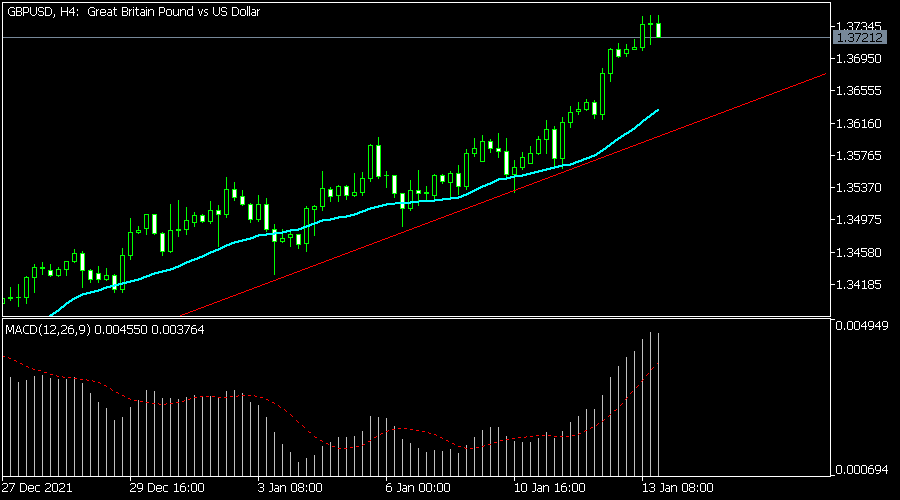
The GBPUSD pair has been in a strong bullish trend in the past few weeks. It is trading at a multi-month high of 1.3731, which is substantially higher than the December low of 1.3170. On the four-hour chart, the pair has moved above the 25-day and 50-day moving averages and the ascending red trendline. Oscillators like the Relative Strength Index (RSI) and the Stochastic have also been rising. Therefore, the pair will likely keep rising later today.
EURUSD
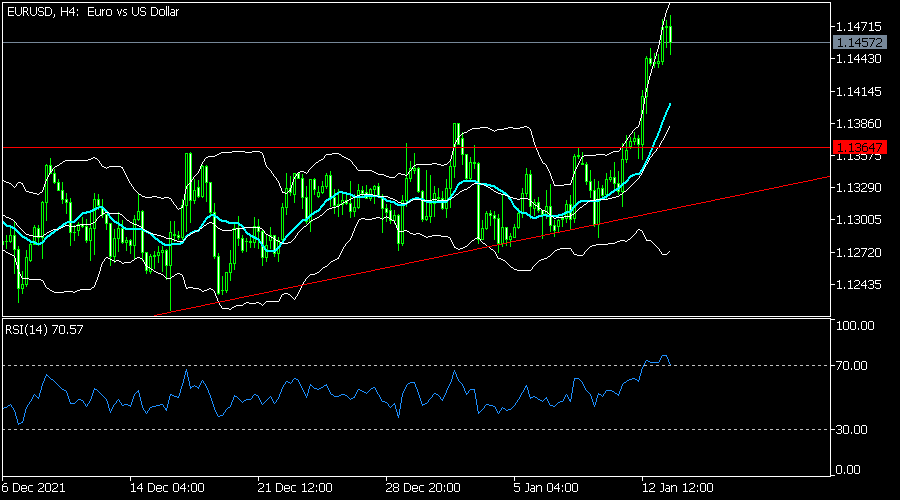
The EURUSD pair retreated slightly in the overnight session. The pair is trading at 1.1450, which is slightly lower than Thursday’s high of 1.1480. The pair is slightly below the key resistance at 1.1500, which is the 61.8% Fibonacci retracement level. It is also slightly below the upper side of the Bollinger Bands. Therefore, the pair will likely resume the bullish trend as bulls target the key resistance at 1.1500.
EURCHF
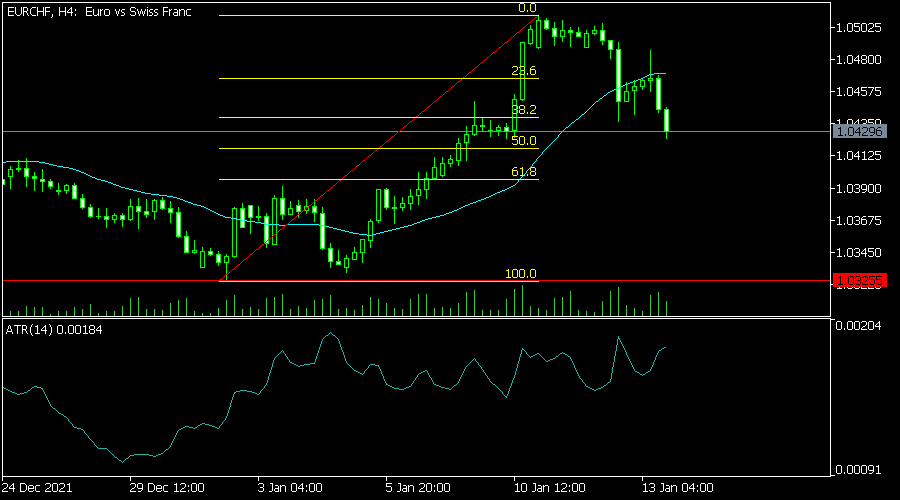
The EURCHF pair declined to a low of 1.0430, which was the lowest level since January 10. This price is below this year’s high of 1.0512. It moved below the 25-day and 50-day moving averages. It is also between the 50% and 38.2% Fibonacci retracement levels. Therefore, the pair will likely keep falling as bears target the key support at 1.0400.
Will Earnings Reverse the Fed-Induced Pessimism?
Optimism about a less dovish speech from the Federal Reserve (Fed) Chair Jerome Powell and a ‘not higher than expected inflation print earlier this week remained rather short-lived, as other FOMC officials didn’t beat about the bush and hinted at an imminent rate hike in the US.
Rate-sensitive Nasdaq fell the most among the major US indices, as losses in the Dow Jones, which is believed to be better equipped to cope with higher rates remained limited.
The US 2-year yield consolidates a touch above the 0.90% mark, and no matter how aggressive the hawkish Fed pricing has been, the yield will likely advance above the 1% soon, and we will see more flattening across the curve.
In the FX, one would’ve expected the US dollar to recover on the back of a series of hawkish comments from the Fed officials, but the dollar index continued to move lower. It looks like the dollar bulls are out of breath and the bearish trend could further develop despite the clear hawkish shift in Fed expectations. The DXY is now preparing to test an important support band between 94 and 94.60, including the 100-DMA, and the major 38.2% Fibonacci retracement on May – December rally. Moving below the 94 mark should hint at a medium-term bearish reversal in the dollar index.
Investor attention shifts from macro data to corporate earnings as a couple of big banks are due to release their Q4 earnings today, including JP Morgan, Wells Fargo, BlackRock and Citigroup. There is no doubt that financials will benefit from a rising interest rate environment. Banks already outperformed the S&P500 last year and the trend is expected to continue throughout this year. And of course, the earlier and steeper rate expectations are a boon for the bank earnings expectations. But, expectations on bank earnings got quite high, which means that they now must live up to these strong expectations to keep the rally going. Therefore, if we see anything less than amazing in the big bank results, the wind could rapidly change direction. So, the risk is, even shiny results could result in price pullbacks.
On the other hand, good earnings are the only thing that could clear investors’ heads from the Fed-induced bearish thoughts.
Monetary Policy Tightening Focus
Market movers today
Today is the last day that the Fed can send any signals ahead of the January meeting, as the blackout period starts tomorrow. With the Fed signalling increasing support for a March rate hike and the beginning of quantitative tightening later this year, we are not sure we will hear any significant new signals from the Fed today.
This morning, we receive UK monthly GDP for November. We expect the indicator to show that the recovery continued.
In Sweden, we expect December headline CPIF and core CPIF excl. Energy to print 1.3 % mom/4.2 % yoy and 0.5 % mom/1.8 % yoy respectively. This is in line with market consensus. While the former is way above Riksbank's forecast (due to soaring electricity prices) the latter is just slightly higher. The Riksbank Governor Ingves will also speak about the economy, however, we don't expect any new signals.
In the US, retail sales, industrial production and preliminary consumer confidence from the University of Michigan are due out in the afternoon.
The next steps in the conflict between Russia and the West will be in focus after the two sides ended talks this week without a breakthrough. This morning we published a note outlining the economic and financial market implications of the different outcomes of the conflict, see Research Russia - Expect serious market disruptions if a war breaks out.
The 60 second overview
Markets: The clear theme in markets remains the adjustment to higher global yields as monetary policy makers begin tightening liquidity conditions. In equity markets duration sensitive growth stocks have taken a hit and yesterday the technology heavy Nasdaq lost 2.5%. So far this year the rotation into value-sectors has kept overall risk appetite afloat, yet this morning we also see some of the value-outperforming indices and futures trading in red. The rise in commodity prices is also taking a breather and the USD continues to trade on the back foot.
Fed: FOMC board members continue to talk up expectations for monetary policy tightening as we head into the blackout period that starts tomorrow. Over the last 24 hours we have heard calls for policy normalisation likely starting in March from Brainard, Harker, Evans and Waller. Interestingly, Waller - who has been one of the first to verbally guide markets in a more hawkish direction - even mentioned the potential for five hikes this year albeit he stated that three hikes this year is still a "good baseline". Waller also stated that he does not favour a 50bp hike at the meeting in March and that quantitative tightening could start this summer.
Bank of Korea: Tighter global monetary conditions remain a key theme for 2022 and this morning Bank of Korea hiked policy rates for the third time since August. That brings the key policy rate to 1.25% - the same levels as prior to the COVID-19 crisis. At the press conference Governor Lee reiterated that policy remains accommodative and that policy like has to be tightened further in 2022.
Bank of Japan: This morning a news story from Reuters get attention as its sources from the Japanese central bank report that the central bank is brainstorming how to signal interest rate hikes to markets before inflation hits 2% - albeit likely not before 2023. The story report that the swift move from the Fed, the weakening the pressure on the JPY and general public discontent with rising living costs are the primary drivers behind talks of an exit plan.
Russia-West talks: Diplomatic optimism has faded fast after the Russian foreign minister said that Russia and the West remain far apart in talks about Ukraine and NATO's role in Eastern European countries. The Russian side went as long as saying that if they don't hear a constructive response from the West within a reasonable timeframe then Russia will have to act to eliminate threats to its national security. White House national security advisor Sullivan says that the threat of a Russian invasion of Ukraine is "high" and there are no dates set for any more talks. Recent events has left RUB as the clear underperformer in FX space with USD/RUB rising 2.5% in yesterday's session.
Equities: Sector performance reversed again on Thursday. Growth lagged value, with tech and health care among the losers. Valuation was key, fundamentals secondary; most evident in the semi space that sold off despite Q4 earnings beats. S&P 500 -1.4%, Nasdaq -2.5%, Dow -0.5%, and Russell 2000 -0.8%. Asian markets are following the move lower this morning, while US futures have stabilized.
FX: FX markets calmed down yesterday after big moves seen on Wednesday. JPY and CHF gained vis-à-vis CAD and NOK, but overall no moves stuck out. EUR/USD still trades above 1.14, while EUR/NOK rebounded towards 10.00.
Credit: Synthetic indices continued their widening trend yesterday. The negative mood was due to a combination of higher focus on geopolitical risks in relation to Russia and still high primary activity. This was partly balanced by slightly lower rates. Overall iTraxx Main widened 1.1bp to 51.2bp while Xover drifted some 4.9bp to 253.9bp. The secondary liquidity in cash space was very low, but on screen indications IG cash widened 0.9bp while HY widened 0.2bp.
Nordic macro
In Sweden, December inflation figures will be relased. We expect headline CPIF and core CPIF excl. Energy to print 1.3 % mom/4.2 % yoy and 0.5 % mom/1.8 % yoy respectively. This is in line with market consensus. While the former is way above Riksbank's forecast (due to soaring electricity prices) the latter is just slightly higher. Looking forward, January electricity prices have so far dropped some 30 %, hence, there will most likely be a partial correction at the start of this year.
GBP/JPY Daily Outlook
Daily Pivots: (S1) 156.07; (P) 156.76; (R1) 157.21; More...
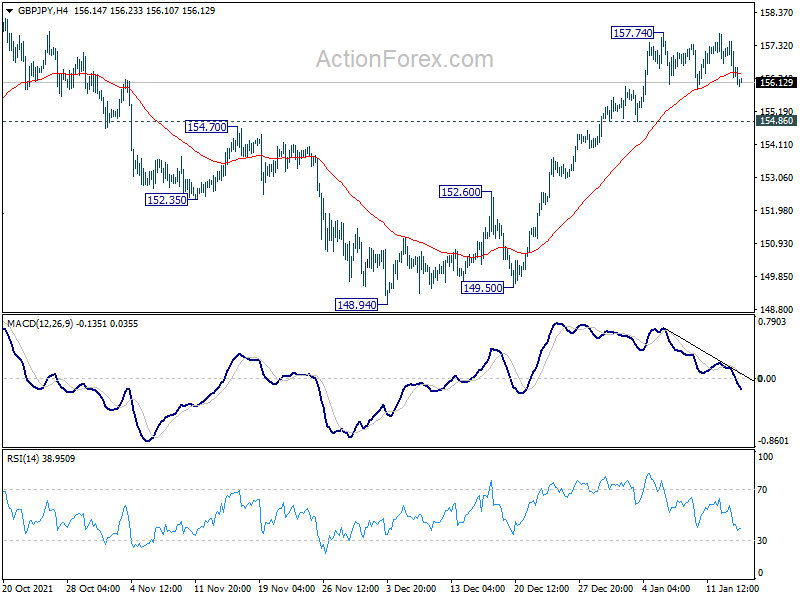
Intraday bias in GBP/JPY remains neutral for consolidation below 157.74. Further rally is expected with 154.86 support intact. On the upside, decisive break of 158.19 high will resume larger up trend to 167.93 long term fibonacci level. On the downside, below 154.86 minor support will turn intraday bias back to the downside for deeper pull back.
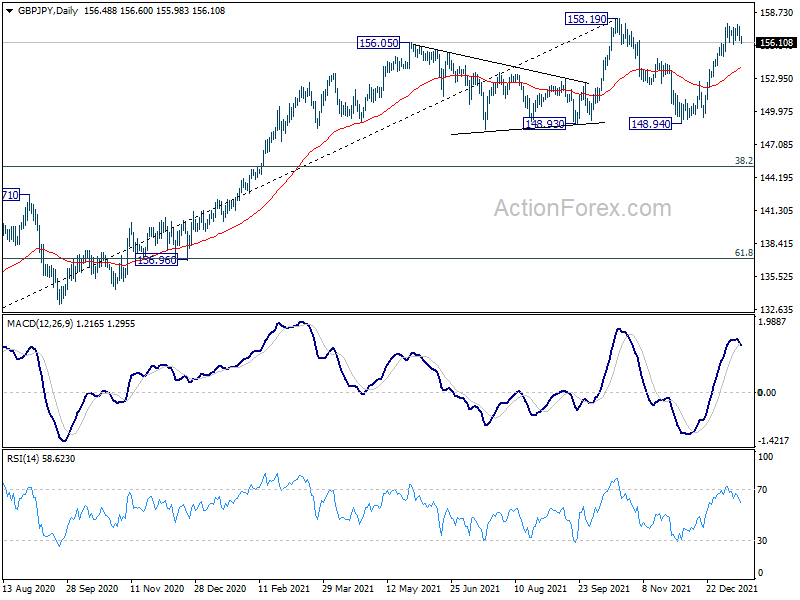
In the bigger picture, strong rebound from 148.93 key structural support retains medium term bullishness. Firm break of 158.19 high will resume whole up trend from 123.94 (2020 low), to 61.8% retracement of 195.86 to 122.75 at 167.93. Nevertheless, firm break of 148.93 will bring deeper correction to 38.2% retracement of 123.94 to 158.19 at 145.10, and possibly further lower, as a correction to up trend from 123.94 at least.
EUR/JPY Daily Outlook
Daily Pivots: (S1) 130.45; (P) 130.94; (R1) 131.27; More....
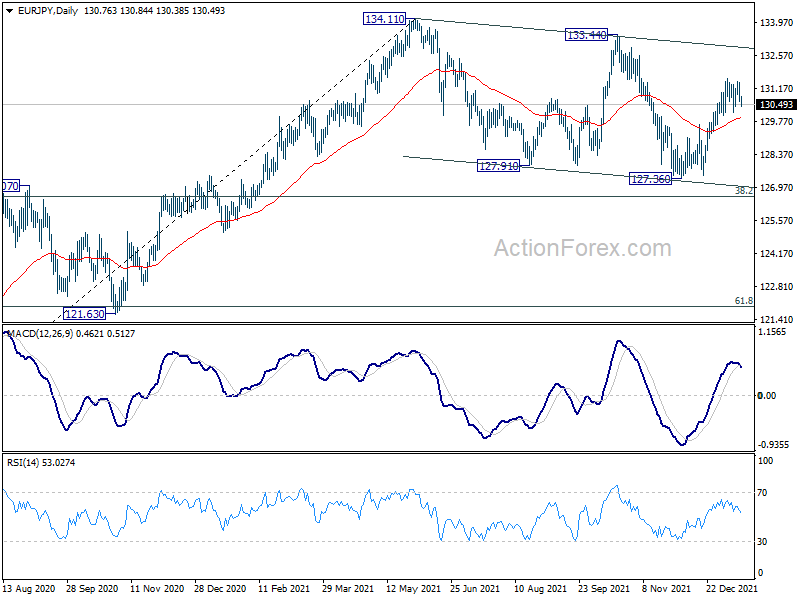
Intraday bias in EUR/JPY remains neutral as consolidation from 131.59 is still extending. Further rise is expected with 130.01 support intact. Whole consolidation from 134.11 could have completed with three waves down to 127.36, ahead of 126.58 medium term fibonacci level. Break of 131.59 will target a test on 133.44/134.11 resistance zone. On the downside, break of 130.01 minor support will turn bias bias to the downside for retesting 127.36 low instead.
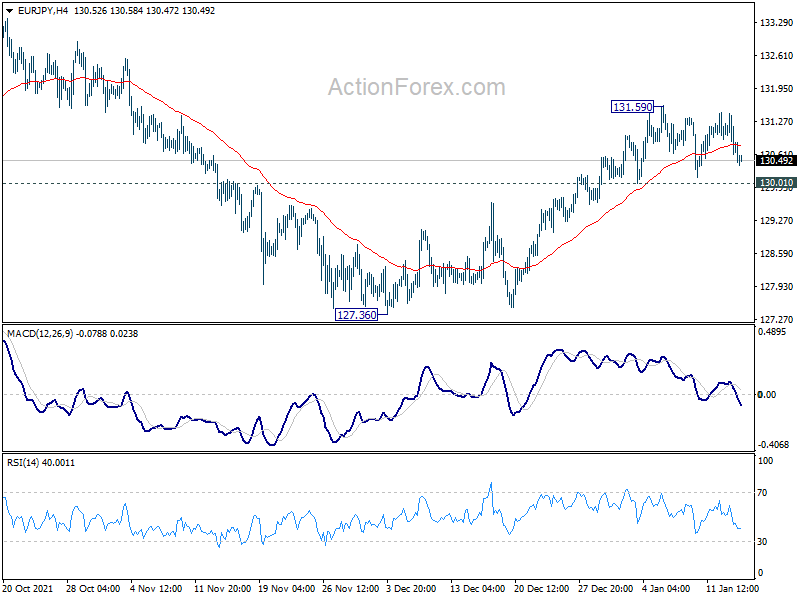
In the bigger picture, as long as 38.2% retracement of 114.42 (2020 low) to 134.11 at 126.58 holds, up trend from 114.42 is still in favor to continue. Break of 134.11 will target long term resistance at 137.49 (2018 high). However, sustained break of 126.58 will raise the chance of medium term bearish reversal. In this case, deeper decline would be seen to 61.8% retracement at 121.94, and possibly below.