Sample Category Title
Sunset Market Commentary
Markets
The (anti-)inflation hype that dominated markets and Fed speak at the start of the year finally took a breather after yesterday’s US CPI (7.0%) printing at the highest level in almost 40 years. Fed governors recently came to a consensus that runaway inflation and a tight labour market ask for an interest rate lift-off at the March meeting. Three rate hikes this year is a minimum, more is likely, as is an early reduction of the Fed balance sheet. However, yesterday’s post-CPI reaction indicated that this scenario is discounted. ‘New news’ is needed for markets to further ride the policy normalization trade. Today’s data didn’t provide that. US PPI inflation printed close to expectations (final demand at 9.7% Y/Y from 9.8%). US jobless claims even surprised on the soft side of expectations rising from 207 000 to 230 000. The new corona spike might be in play but statistical issues probably also complicate a correct interpretation. The releases had no big impact, but allowed yesterday’s correction to continue. Aside from a thin news flow, technical considerations also continued hampering further directional price action on core interest rate markets. US yields are losing about 1-2 bps across the curve. The US 10-y yield (1.73%) eases slightly further off the key 1.80%/1.77% resistance area. The German 10-y yield (-0.07%) also lacks impetus to try to leave negative territory. ECB’s de Guindos admitted that inflation might not be as transitory as earlier thought. He considers the development in energy prices to be key for inflation. However, he still sees no second round effects in term of wage pressures. So, for now, he doesn’t draw any ‘hawkish’ conclusions on monetary policy yet. The German yields curve (temporarily) returned to ‘standard habits’, bull flattening with yields declining between 0.6 bp (2-y) and 3.0 bps (30-y). European equities mostly trade with gains of less than 0.5%. US indices open marginally stronger. Brent oil is holding within reach of the $85 p/b level.
Despite no high profile news, the dollar endures further post-CPI follow-through losses. Persistent high (absolute and relative) inflation and the Fed mainly frontloading policy tightening rather than guiding on a higher rate path further down the road apparently made USD bulls conclude that enough is discounted for now. DXY is testing the 94.70 area (from 95.00). USD/JPY is changing hands in the 114.25 area. EUR/USD also joins the broader dollar setback trading near 1.147. The dollar decline not only supported the likes of the euro and the yen. Yesterday’s reversal of softer yields and a weaker dollar also aborted a tentative weakening trend of the Swiss franc. EUR/CHF early this week touched the 1.05 barrier, but currently again trades at 1.044. In the Nordic region, the Swedish crown, after a strong performance by its Norwegian neighbor, tries to regain some ground and is testing the EUR/SEK 10.21 resistance area.News Headlines
European bond sales are breaking records. In the current, not even full, week, companies, supranationals and sovereign issuers already hit the market for a total of about €93 bn according to Bloomberg calculations. The previous weekly record dates back to early January, when some €92 bn was issued in the week to January 10. Issuers are locking in still very favourable financing conditions quickly as inflation, the Fed’s tightening intentions as well as the ECB set to start winding down bond purchases are causing uncertainty about yields going forward.
Working-day adjusted Czech retail sales surged 11.7% y/y in November. The huge increase was to a large extent driven by the low comparison base due to Covid (sales) restrictions end 2020. Monthly retail sales dynamics in fact showed a decline in retail turnover of 1%. The base effect is especially visible in the sharp rise of eg. non-food (ie coming from non-essential stores) goods (+20.8% y/y). Sales in online shops only rose a modest 0.6% y/y as they were a substitution for physical shops during the lockdown. The Czech koruna is losing the most since end November against the euro today though the move is rooted in overall fragile risk sentiment. EUR/CZK trades at 24.43, up from 24.31 yesterday.
Earnings to Bring Normality
It's been a rollercoaster start to the year and as we head into earnings season, it's hard to say exactly where investors stand.
Blocking out the January noise is one thing but it's made far more complicated by omicron, inflation, and the rapid evolution of monetary policy. Yesterday's reaction to the inflation data was a case in point. The data mostly exceeded expectations, albeit marginally, while headline inflation was a near 40-year high of 7%. And yet the response was broadly positive.
I get that traders were perhaps fearing the worst and, as I've referenced before, it does feel like markets are at peak fear on US monetary policy which could make relief rallies more likely. But there is also underlying anxiety in the markets that could make for some volatile price action for the foreseeable future.
Perhaps earnings season will bring some welcome normality to the markets after a period of fear, relief, and speculation. The fourth quarter is expected to have been another strong quarter, although the emergence of omicron will likely have had an impact during the critical holiday period for many companies. Of course, as we've seen throughout the pandemic, that will likely have been to the benefit of others.
And while earnings season will provide a distraction, it is happening against an uncertain backdrop for interest rates and inflation which will keep investors on their toes. It does seem that investors are on the edge of what they will tolerate and it won't take much to push them over the edge. Which will be fine if we are near the peak of inflation, as many expect.
The data today looks a mixed bag on the face of it, with jobless claims coming in a little higher than expected, which may be down to seasonal adjustments. The overall trend remains positive and continues to point to a tight labor market. The PPI data on the other hand will be welcomed, with the headline number slipping to 0.2% month on month. Perhaps a sign of supply-side pressures finally starting to abate which will come as a relief after inflation hit a near-40 year high last month.
Sterling solid as pressure mounts on Boris
It seems impossible to ignore the political soap opera currently taking place in the UK, with Prime Minister Boris Johnson once again in the public firing line after finally admitting to attending an office party in May 2020.
In other circumstances, uncertainty around the top job in the country could bring pressure in the markets but the pound is performing very well. Perhaps that's a reflection of the controversy that forever surrounds Boris, and we're all therefore numb to it, or a sign of the environment we're in that the PM being a resignation risk is further down the list when compared with inflation, interest rates, omicron, energy prices etc.
Oil remains bullish near highs
Oil prices are easing again today after moving back towards seven-year highs in recent weeks. It was given an additional bump yesterday following the release of the EIA data which showed a larger draw than expected. But with crude already trading near its peak, it maybe didn't carry the same momentum it otherwise would.
The fundamentals continue to look bullish for gold. Temporary disruptions in Kazakhstan and Libya are close to being resolved, with the latter taking a little longer to get fully back online. But OPEC being unable to hit output targets at a time when demand remains strong is ultimately keeping prices elevated and will continue to do so.
A big test for gold
Gold is off a little today but the price remains elevated with key resistance in sight. The yellow metal has remained well supported in recent weeks even as yields around the world continue to rise in anticipation of aggressive tightening from central banks.
It could be argued that the bullish case for gold is its reputation as an inflation hedge, especially given central banks' recent record for recognizing how severe the situation is. But with inflation likely nearing its peak, that may not last. That said, fear around Fed tightening may also be peaking which could support gold in the short-term and a break through $1,833 could signal further upside to come.
Can Bitcoin break key resistance?
Bitcoin is enjoying some relief along with other risk assets and has recaptured $44,000, only a few days after briefly dipping below $40,000. That swift 10% rebound is nothing by bitcoin standards and if it can break $45,500, we could see another sharp move higher as belief starts to grow that the worst of the rout is behind it. It looks like a fragile rebound at the moment but a break of that resistance could change that.
Dollar Speeds Down a Slippery Slope; Stocks Steady
Dollar extends inflation decline; initial jobless claims tick higher
The latest CPI inflation report out of the United States was not a big surprise on Wednesday. Despite a minor pickup in the core measure, the annual headline gauge came in line with expectations at 7.0% - the highest since 1982.
However, investors sold the dollar as three rate hikes by the Fed are already fully priced in to launch potentially after bond tapering ends in March, while a fourth one also seems likely in policymakers’ mind according to the Philadelphia's Fed president.
Hence, the path of monetary tightening is seen largely set for 2022 and there could be a little deviation in forward guidance– at least for now – given the risk of recession if the Fed slams on the brakes even harder at a time when the fast-spreading Omicron variant is forcing a huge number of workers to isolate themselves, and inflation is putting pressure on business returns and consumer pockets. In other words, the Fed is expected to hold the ship steady unless inflation grows further to extreme levels, while seeking to avoid any significant damage in consumption habits.
Investors may hear more from the Fed when Governor Lael Brainard appears in Congress for a hearing regarding her nomination as deputy chair today at 14:00 GMT. Fed policymakers Charles Evans and Thomas Barkin will also be on the wires today.
In market action, global bond yields continued to consolidate weekly gains. Having crossed below a supportive trendline, dollar/yen is marking another negative day near the 50-day moving average at 114.25, shrugging off a slight increase in US initial jobless claims. The number of people applying for unemployment benefits ticked up to 230k in the week ending January 8 compared to 200k expected and 207k registered during the preceding week.
European currencies in bullish party
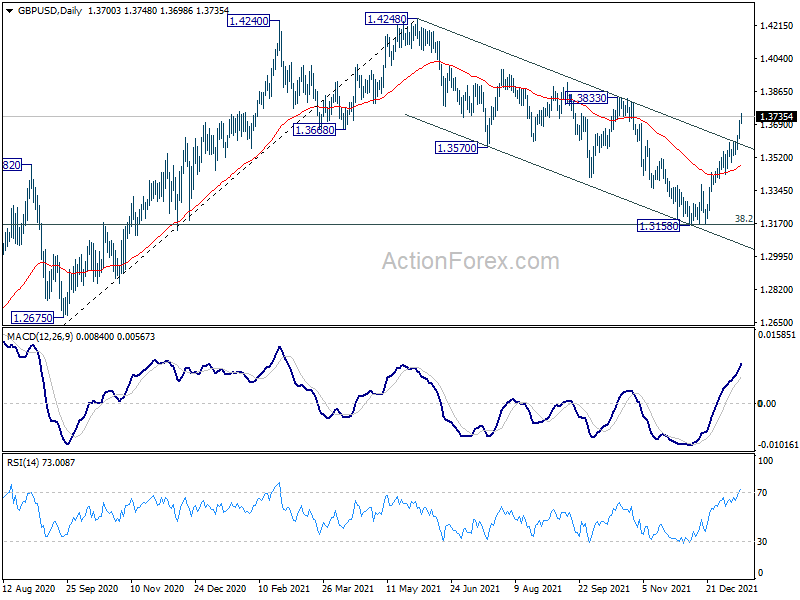
On the other hand, pound/dollar has furiously advanced to a three-month high after exiting the seven-month-old bearish channel. Of note, the pair is currently seeking a close above the 200-day simple moving average at 1.3740.
Likewise, the downturn in the greenback helped the euro advance above a tough descending trendline and climb to a two-month high of 1.1477 today. With the ECB lagging the BoE, the British pound could prove more resilient than the euro, something also reflected by the persisting decline in euro/pound. Yet, how long the ECB could stay underwater remains to be seen. Note that investors are gradually becoming positive that a 0.10 bps rate hike might occur during the last quarter of the year. Speaking at a Reuter's event in New York, ECB’s Vice President Luis de Guindos almost embraced that scenario, acknowledging that inflation could exceed projections this year and omicron may not derail economic growth.
Stocks neutral, commodities in focus
Meanwhile in stock markets, the pan-European STOXX 600 was oscillating between gains and losses, with shares in utilities and financial stocks balancing declines in healthcare and consumer cyclicals.
Wall Street is poised to open neutral too. The earnings season will formally kick off on Friday, with big US banks reporting financial results for Q4, but results from Delta airlines could provide some direction on the outlook for the pandemic-stricken aviation today.
Commodity prices will also be in the spotlight in the coming sessions. WTI crude is facing some resistance around $83.00/barrel, but is not far below October’s 7-year high. Natural gas futures and copper prices also staged an impressive rally on Wednesday before calm returned to the markets.
In metals, despite the latest pickup, gold is still capped below the key $1,830/ounce resistance. Given its quiet response to monetary developments over the past two months, it would be interesting to see whether the precious metal can regain its shine this year or further lose its appeal.
AUD/USD Outlook: Break above Thick Daily Cloud and Weekly Bullish Engulfing Signal Further Advance
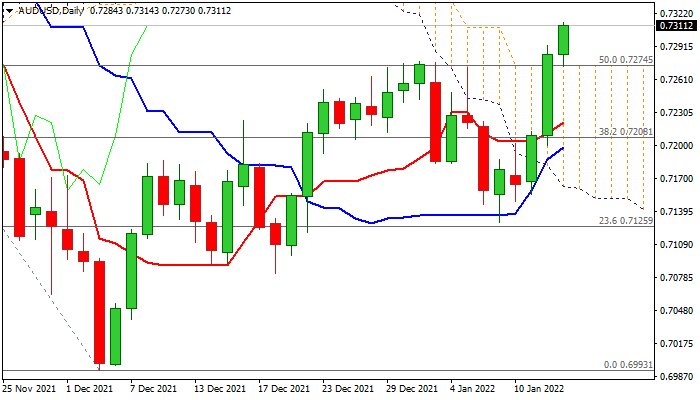
Aussie holds firmly in green for the third straight day, lifted by weaker US dollar, after more cautious than expected tone from Fed chief Powell disappointed investors.
Bulls probe above 0.73 level following Wednesday’s 1.04% acceleration, boosted by bullish signal, generated on close above the top of thick daily cloud (0.7274, also 50% retracement of 0.7555/ 0.6993 descend).
Bullish daily techs support the advance, with Wednesday’s close above previous recovery peak (0.7277) posted on Dec 31, signaling higher low at 0.7129 (Jan 7) and continuation of recovery from 0.6993 (2021 low, posted on Dec 3).
Bullseye targets at 0.7340/80 (Fibo 61.8% of 0.7555/0.6993 / Fibo 38.2% of 0.8007/0.6993) with extension towards 200DMA (0.7425)not ruled out, as formation of bullish engulfing pattern on the weekly chart adds to positive signals. Cloud top now offers solid support which is expected to hold and keep bulls intact.
Res: 0.7340; 0.7380; 0.7400; 0.7425.
Sup: 0.7286; 0.7274; 0.7232; 0.7208.
EUR/USD Mid-Day Outlook
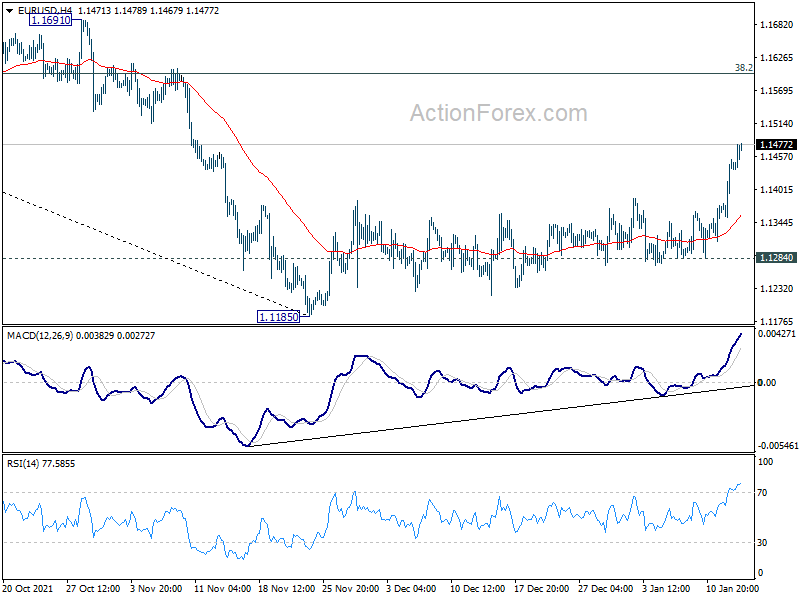
Daily Pivots: (S1) 1.1379; (P) 1.1416; (R1) 1.1477; More...
EUR/USD's rebound from 1.1185 is still in progress and intraday bias stays on the upside. Further rise would target 38.2% retracement of 1.2265 to 1.1185 at 1.1598. As we're tentatively treating is as a corrective move, we'd look for strong resistance from 1.1598 to bring down trend resumption. On the downside, below 1.1284 support will bring retest of 1.1185 low. However, sustained break of 1.1598 will argue that the trend is reversing already.
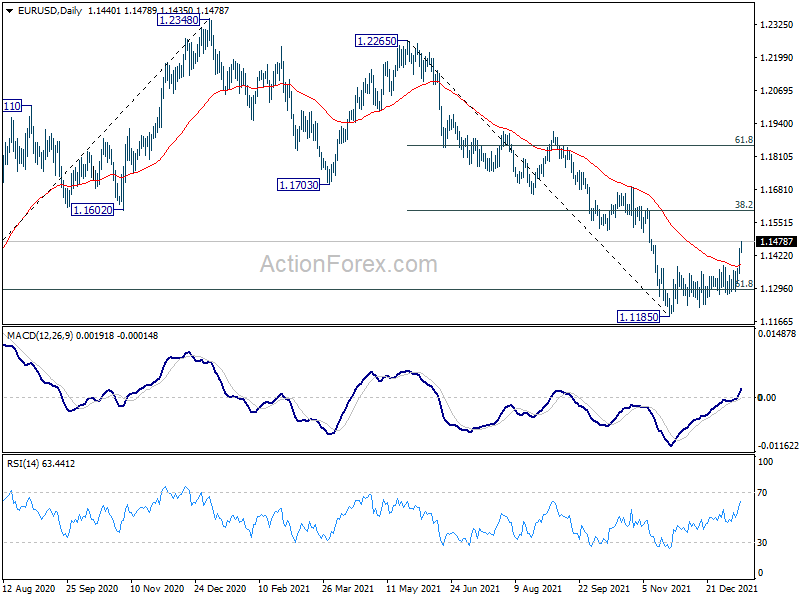
In the bigger picture, there are various ways of interpreting the fall from 1.2348 (2021 high). It could be a correction to rise from 1.0635 (2020 low), the fourth leg of a sideway pattern from 1.0339 (2017 low), or resuming long term down trend. In any case, outlook will now stay bearish as long as 1.1703 support turned resistance holds. Sustained break of 61.8% retracement of 1.0635 to 1.2348 at 1.1289 would pave the way back to 1.0635.
USD/CHF Mid-Day Outlook
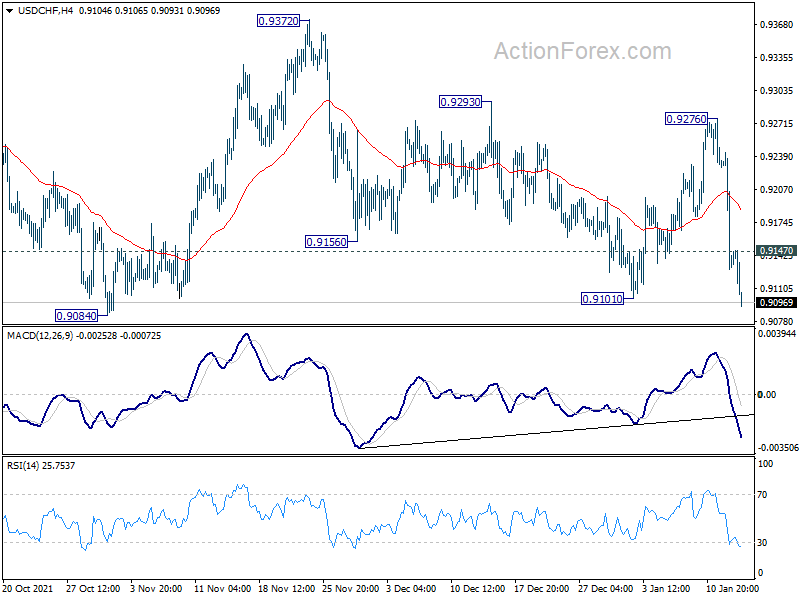
Daily Pivots: (S1) 0.9101; (P) 0.9172; (R1) 0.9215; More....
Intraday bias in USD/CHF remains on the downside for the moment. Firm break of 0.9084/0.9101 support zone will argue that choppy rise from 0.8925 has completed. Fall from 0.9471 might be ready to resuming. Further decline would be seen back to 0.8925 support first. On the upside, above 0.9147 minor resistance will turn intraday bias neutral first.
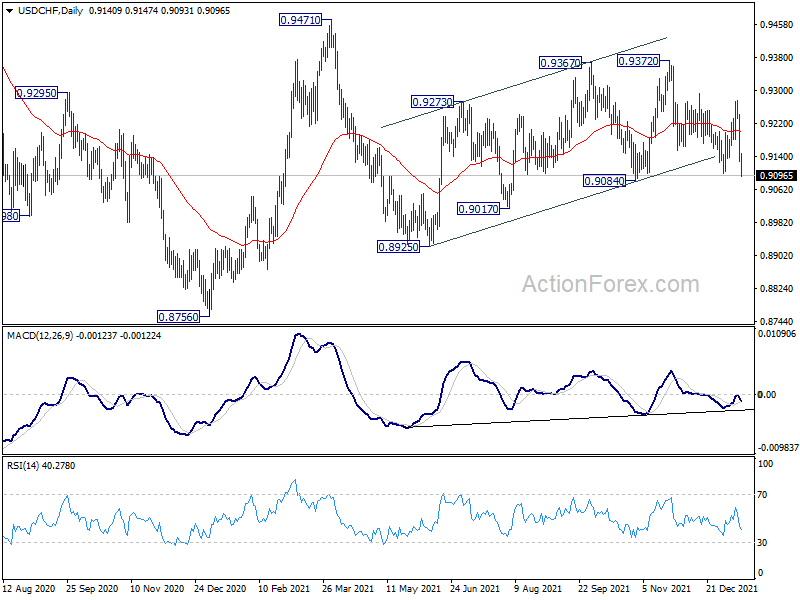
In the bigger picture, the corrective structure of the rebound from 0.8925 argues that fall from 0.9471 is not complete yet. It could either be the second leg of pattern from 0.8756 (2021 low), or resuming larger down trend from 1.0237 (2018 high). We'd pay attention to the downside momentum and assess the odds later. But for now, medium term outlook will be neutral at best as long as 0.9471 resistance holds.
USD/JPY Mid-Day Outlook
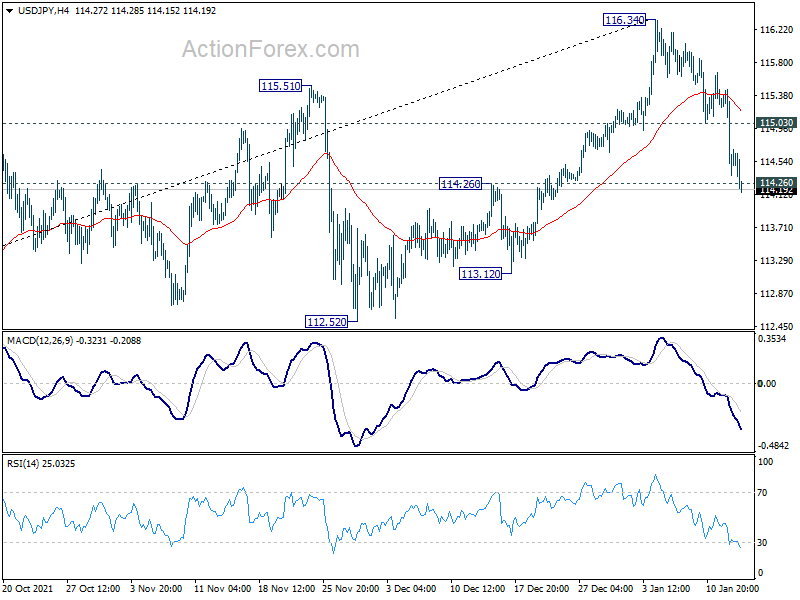
Daily Pivots: (S1) 114.19; (P) 114.83; (R1) 115.28; More...
USD/JPY's break of 114.26 resistance turned support now argues that rise from 112.52 is already finished. Intraday bias is on the downside for 112.52 support. Also, considering bearish divergence condition in in daily MACD, break of 112.52 will confirm that it's already in correction to the up trend from 102.58. Deeper fall would be seen to 38.2% retracement of 102.58 to 116.34 at 111.08. On the upside, above 115.03 will turn bias back to the upside for retesting 116.34 high instead.
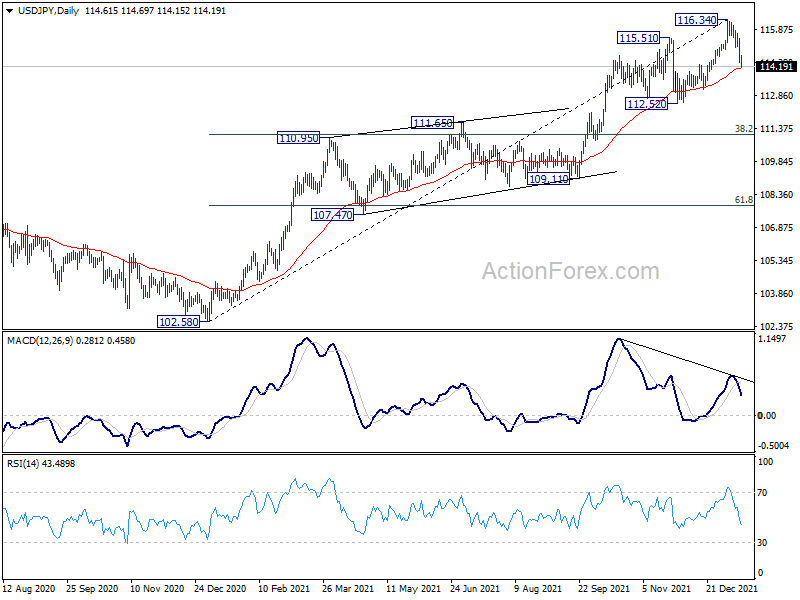
In the bigger picture, no change in the view that rise from 102.58 is the third leg of the up trend from 101.18 (2020 low). Such rally should target a test on 118.65 (2016 high). Sustained break there will pave the way to 120.85 (2015 high) and raise the chance of long term up trend resumption. For now, this will remain the favored case as long as 112.52 support holds, in case of deep pull back.
New Zealand Dollar Extends Gains
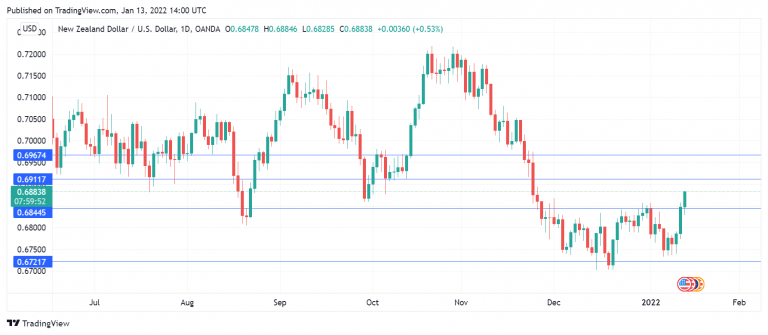
The New Zealand dollar has posted gains for a third straight day. Early in the North American session, NZD/USD is trading at 0.6886, up 0.56% on the day. The currency is on a tear, rising 1.62% so far this week.
Strong risk sentiment boosts New Zealand dollar
There was plenty of anticipation ahead of the US CPI release on Wednesday, and the headline reading did not disappoint, coming in at 7%, which matched the estimate. Still, the sizzling read did not dampen the positive mood in the markets, perhaps because investors were relieved that US inflation wasn’t even higher.
The US dollar can’t seem to buy a break. First, nonfarm payrolls came in at 199 thousand, well short of the consensus of 425 thousand. This was followed by a 7% CPI release, which was even higher than the previous reading of 6.8%. Both of these events should have given the US dollar a boost, but investors remain supportive of the other major currencies. Fed Chair Jerome Powell’s testimony on the Hill was considered less than hawkish, even though Powell assured lawmakers that the Fed would raise rates as much as needed in order to contain inflation.
In short, the markets do not seem concerned by the hawkish pivot from the Fed as it moves towards a normalization of policy. Still, the US dollar could rebound rather quickly under the right conditions, such as inflation moving even higher or Omicron causing more economic damage than anticipated.
The New Zealand dollar also received a boost from New Zealand Building Consents, which rose 0.6% in November after two consecutive declines. This indicates strong demand in the housing sector, despite the disruptions from Covid-19.
NZD/USD Technical
- NZD/USD is putting pressure on resistance at 0.6912. Next, there is resistance at 0.6967
- 0.6844 is providing support. Below, there is support at 0.6721
GBP/USD Mid-Day Outlook
Daily Pivots: (S1) 1.3646; (P) 1.3680; (R1) 1.3737; More...
GBP/USD's rise from 1.3158 is in progress and hits as high as 1.3746 so far. Intraday bias remains on the upside for 1.3833 resistance first. As noted before, corrective fall from 1.4282 should have completed with three waves down to 1.3158, after hitting 1.3164 medium term fibonacci level. Sustained break of 1.3833 will pave the way back to retest 1.4248 high. On the downside, below 1.3619 minor support will turn intraday bias neutral first. But further rise will remain in favor as long as 55 day EMA (now at 1.3479) holds.
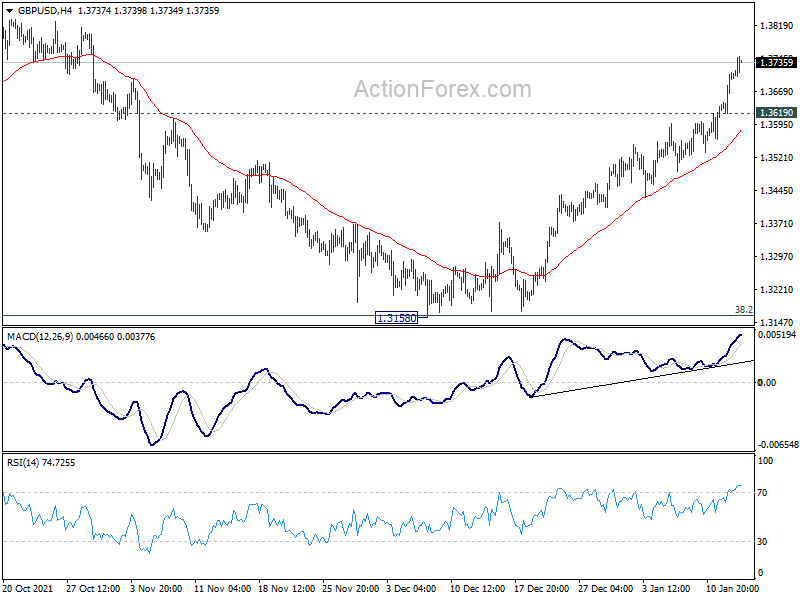
In the bigger picture, strong support was seen from 38.2% retracement of 1.1409 to 1.4248 at 1.3164. The development suggests that up trend from 1.1409 (2020 low) is still in progress. On resumption, next target will be 38.2% retracement of 2.1161 to 1.1409 at 1.5134. Nevertheless sustained break of 1.3164 will argue that whole rise from 1.1409 has completed and bring deeper fall to 61.8% retracement at 1.2493.