Sample Category Title
Yen Rebounding on Weaker Risk Sentiment, Dollar Still Very Weak
Yen trades broadly higher in Asian session, following broad based weakness in the stock markets. Nevertheless, mild risk-off sentiment is providing no support to Dollar, nor the hawkish comments from Fed officials. Dollar remains the worst performing one for the week, followed by Swiss Franc. Yen is now the strongest, followed by Aussie and Kiwi. The economic calendar is active today with UK GDP and US retail sales, which could be market moving.
Technically, as Yen appears to be picking up buying, we'll pay some attention to its pairs. In particular, break of 130.01 minor support in EUR/JPY, and 154.86 minor support in GBP/JPY, will argue that the near term rebound in them are over. We could then see Yen crosses accelerating downward in general, with USD/JPY being dragged further towards 112.52 structural support.
In Asia, at the time of writing, Nikkei is down -1.76%. Hong Kong HSI is down -0.99%. China Shanghai SSE is down -0.59%. Singapore Strait Times is up 0.37%. Japan 10-year yield is up 0.0190 at 0.150. Overnight, DOW dropped -0.49%. S&P 500 dropped -1.42%. NASDAQ dropped -2.51%. 10-year yield dropped -0.014 to 1.711.
Fed Waller: Three rate hikes still a good baseline
Fed Governor Christopher Waller told Bloomberg TV, "three hikes is still a good baseline; we will have to wait and see what inflation looks like in the second half of the year."
If inflation continues to be high, the case will be made for four, maybe five, hikes," he said, but added that if inflation abated -- as many forecasters including him expect it will -- "then you could actually pause and not even go the full three."
"We can start to let the balance sheet run off earlier and that will take some pressure of longer-end rates and also lead to a tightening in policy," Waller added.
Fed Daly: Lift off in March is a quite reasonable thing
In a Reuters interview, San Francisco Fed President Mary Daly said, "lifting off in March when you have an unemployment rate of 3.9%, and an inflation rate that's north of our price stability goal of average 2% inflation, to me seems a quite reasonable thing." But she didn't offer her prediction on the number of rate hike needed this year.
Daly also said even with the rate hikes, "we are not bridling the economy and starting to restrain it." Rate would remain well below the "neutral" level of 2.50%. Meanwhile, once Fed has raised rates once or twice, she said, it should start shrinking the balance sheet as a "predictable" manner.
Fed Harker: Four hikes is not out of question
An a CNBC interview, Philadelphia Fed President Patrick Harker said "we do need to take action on inflation. It is more persistent than we thought a while ago. I've been off the 'transitory' team for a while now". "Three [hikes] is what I've penciled in, but four is not out of the question in my mind," he said.
But Harker preferred a slower approach regarding balance sheet run-off. He thinks the Fed should wait until it raises rates "for sake of argument 100 basis points," or four hikes, before starting the wind down the asset purchases. "I don't want to do that all at once. I think that's just the wrong way to go," he said. "Let's do them in stages."
Fed Evans: The committee strongly expecting two, three, four rate increases this year
Chicago Fed President Charles Evans said, "I readily admit – I have to be humble about this – I did not expect the inflation rates that we're seeing and they have lasted longer than I expected. And because they have lasted longer, I know that we need to take action more quickly than I would have guessed last year."
"We need to be adjusting monetary policy to something close to neutral," he said. "The committee very strongly is expecting two, three, four rate increases this year. We'll see how it plays out."
Fed Barkin: More aggressive normalization needed if inflation remain elevated and broad-based
Richmond Fed Bank President Thomas Barkin said yesterday, "the closer that inflation comes back to target levels, the easier it will be to normalize rates at a measured pace,"
"But were inflation to remain elevated and broad-based, we would need to take on normalization more aggressively, as we have successfully done in the past," he added.
Barkin also said labor shortage is a "long lasting phenomenon", with "baby boomers retiring" and "immigration slowing". Officials may need to accept that labor force participation is "stagnant".
On the data front
Japan PPI rose 8.5% yoy in December, below expectation of 8.8% yoy. China trade surplus widened to USD 94.5B in December, above expectation of USD 73.4B.
UK GDP and production will be the main focus in European session, together with trade balance. Eurozone will also release trade balance.
Later in the day, US will release retail sales, import price, industrial production, U of Michigan sentiment and business inventories.
USD/JPY Daily Outlook
Daily Pivots: (S1) 113.88; (P) 114.29; (R1) 114.59; More...
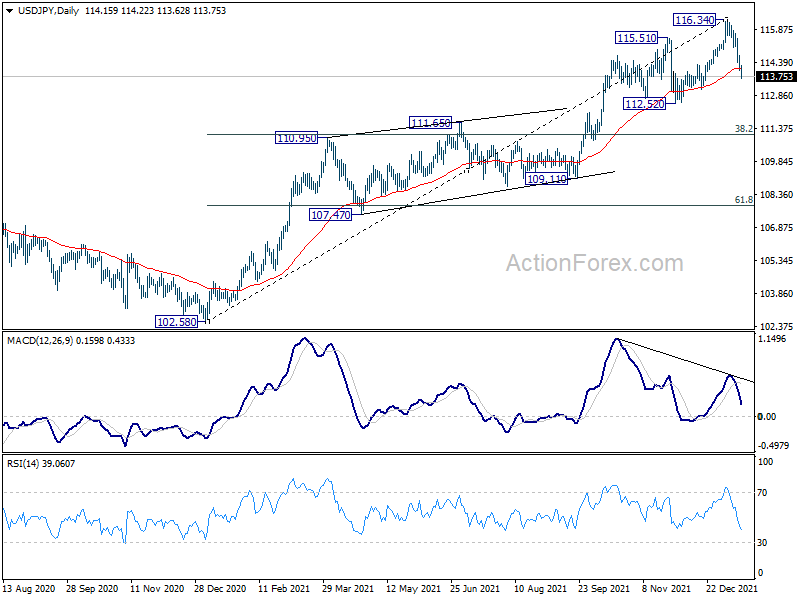
Intraday bias in USD/JPY remains on the downside as fall form 116.34 is accelerating towards 112.52 support. considering bearish divergence condition in in daily MACD, break of 112.52 will confirm that it's already in correction to the up trend from 102.58. Deeper fall would be seen to 38.2% retracement of 102.58 to 116.34 at 111.08. on the upside, above 114.37 minor resistance will turn intraday bias neutral first.
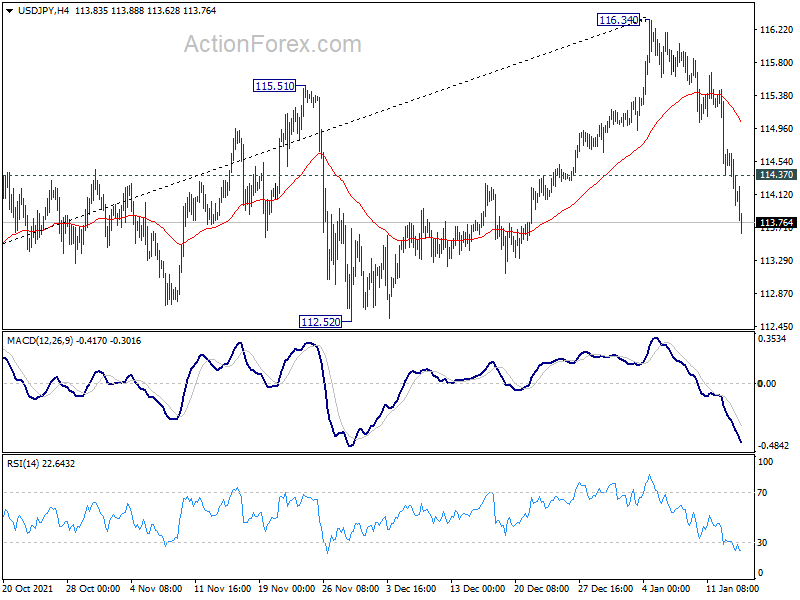
In the bigger picture, no change in the view that rise from 102.58 is the third leg of the up trend from 101.18 (2020 low). Such rally should target a test on 118.65 (2016 high). Sustained break there will pave the way to 120.85 (2015 high) and raise the chance of long term up trend resumption. However, firm break of 112.52 support will dampen this bullish case and we'll assess the outlook based on subsequent price actions later.
Economic Indicators Update
| GMT | Ccy | Events | Actual | Forecast | Previous | Revised |
|---|---|---|---|---|---|---|
| 23:50 | JPY | PPI Y/Y Dec | 8.50% | 8.80% | 9.00% | 9.20% |
| 02:00 | CNY | Trade Balance (USD) Dec | 94.5B | 73.4B | 71.7B | |
| 02:00 | CNY | Exports (USD) Y/Y Dec | 20.90% | 22% | ||
| 02:00 | CNY | Imports (USD) Y/Y Dec | 19.50% | 31.40% | 31.70% | |
| 02:00 | CNY | Trade Balance (CNY) Dec | 604.69B | 451B | 461B | |
| 02:00 | CNY | Exports (CNY) Y/Y Dec | 17.30% | 16.60% | ||
| 02:00 | CNY | Imports (CNY) Y/Y Dec | 16.00% | 26.00% | ||
| 07:00 | GBP | GDP M/M Nov | 0.40% | 0.10% | ||
| 07:00 | GBP | Manufacturing Production M/M Nov | 0.20% | 0.00% | ||
| 07:00 | GBP | Manufacturing Production Y/Y Nov | -0.30% | 1.30% | ||
| 07:00 | GBP | Industrial Production M/M Nov | 0.20% | -0.60% | ||
| 07:00 | GBP | Industrial Production Y/Y Nov | 0.50% | 1.40% | ||
| 07:00 | GBP | Index of Services 3M/3M Nov | 0.50% | 1.10% | ||
| 07:00 | GBP | Goods Trade Balance (GBP) Nov | -14.2B | -13.9B | ||
| 10:00 | EUR | Eurozone Trade Balance (EUR) Nov | 1.6B | 2.4B | ||
| 13:30 | USD | Retail Sales M/M Dec | 0.00% | 0.30% | ||
| 13:30 | USD | Retail Sales ex Autos M/M Dec | 0.20% | 0.30% | ||
| 13:30 | USD | Import Price Index M/M Dec | 0.30% | 0.70% | ||
| 14:15 | USD | Industrial Production M/M Dec | 0.40% | 0.50% | ||
| 14:15 | USD | Capacity Utilization Dec | 76.90% | 76.80% | ||
| 15:00 | USD | Michigan Consumer Sentiment Index Jan P | 70.6 | 70.6 | ||
| 15:00 | USD | Business Inventories Nov | 1.00% | 1.20% |
USD/JPY Starts Fresh Decrease, Key Support at 113.20
Key Highlights
- USD/JPY started a fresh decline from well above 116.00.
- It broke a major bullish trend line with support near 115.60 on the 4-hours chart.
- EUR/USD surged above 1.1400, and GBP/USD rallied above the 1.3700.
- The US Initial Jobless Claims increased to 230K in the week ending Jan 08, 2022.
USD/JPY Technical Analysis
This past week, the US Dollar struggled to clear the 116.40 resistance against the Japanese Yen. USD/JPY started a major decline from the 116.34 high and declined below 116.00.
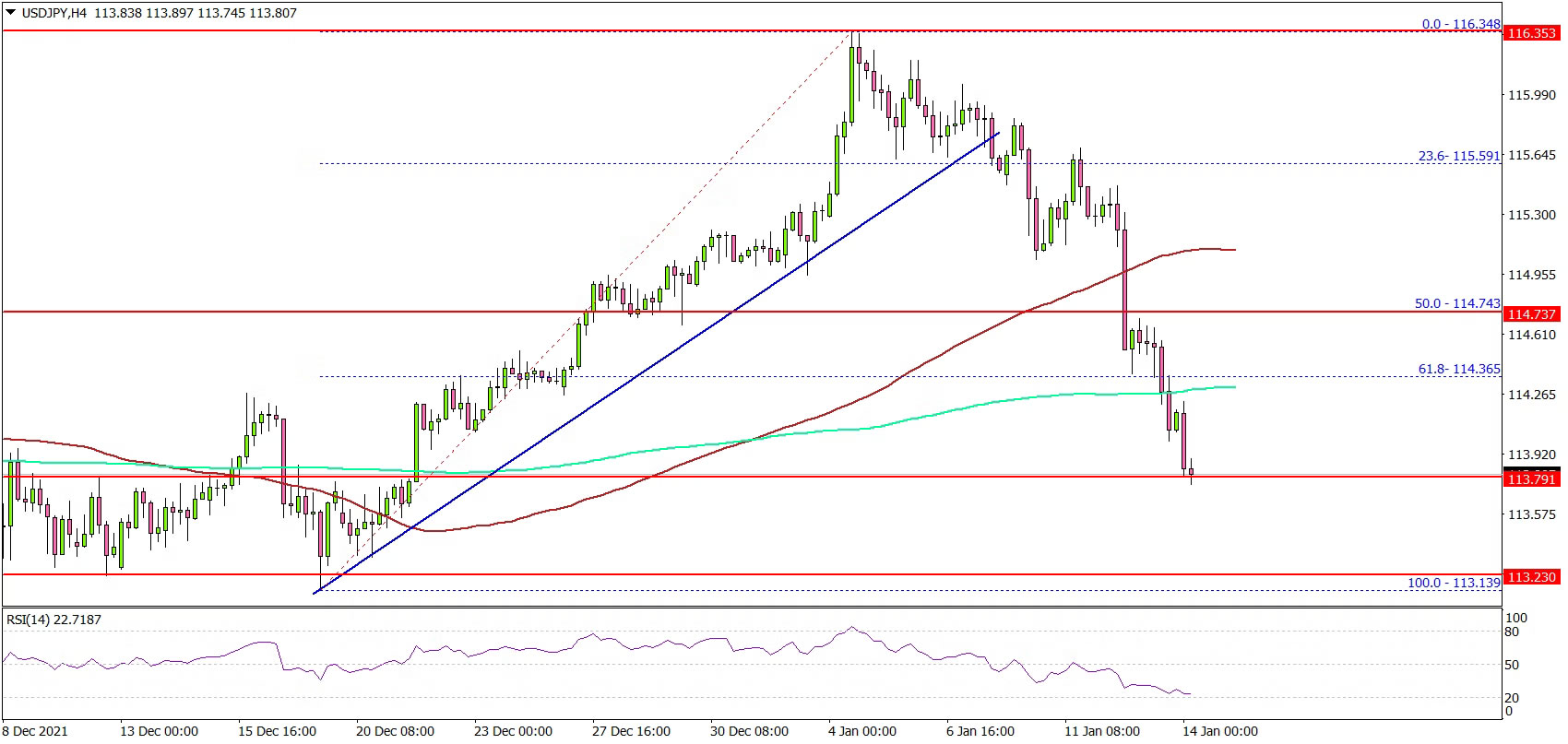
Looking at the 4-hours chart, the pair traded below the key 115.60 support zone. There was a break below a major bullish trend line with support near 115.60 on the same chart.
The pair settled below the 115.20 and the 100 simple moving average (red, 4-hours). There was a break below the 50% Fib retracement level of the upward move from the 113.13 low to 116.34 high.
It even traded below 114.50 and the 200 simple moving average (green, 4-hours). On the downside, an immediate support is near the 113.85 level. It is close to the 76.4% Fib retracement level of the upward move from the 113.13 low to 116.34 high.
The main support is forming near the 113.50 level, below which the pair could drop to 113.00. On the upside, the pair is facing resistance near 114.50 level. The next major resistance is near the 115.00 level, above which the pair could test 115.80.
Looking at EUR/USD, the pair started a major increase after there was a clear move above the 1.1380 and 1.1400 resistance levels. Besides, GBP/USD rallied above the 1.3650 and 1.3700 resistance levels.
Economic Releases
- UK Industrial Production for Nov 2021 (MoM) - Forecast +0.2%, versus -0.6% previous.
- UK Manufacturing Production for Nov 2021 (MoM) - Forecast +0.2%, versus 0% previous.
- US Retail Sales for Dec 2021 (MoM) – Forecast 0%, versus +0.3% previous.
- US Industrial Production for Dec 2021 (MoM) – Forecast +0.4%, versus +0.5% previous.
Fed Waller: Three rate hikes still a good baseline
Fed Governor Christopher Waller told Bloomberg TV, "three hikes is still a good baseline; we will have to wait and see what inflation looks like in the second half of the year."
If inflation continues to be high, the case will be made for four, maybe five, hikes," he said, but added that if inflation abated -- as many forecasters including him expect it will -- "then you could actually pause and not even go the full three."
"We can start to let the balance sheet run off earlier and that will take some pressure of longer-end rates and also lead to a tightening in policy," Waller added.
Fed Daly: Lift off in March is a quite reasonable thing
In a Reuters interview, San Francisco Fed President Mary Daly said, "lifting off in March when you have an unemployment rate of 3.9%, and an inflation rate that's north of our price stability goal of average 2% inflation, to me seems a quite reasonable thing." But she didn't offer her prediction on the number of rate hike needed this year.
Daly also said even with the rate hikes, "we are not bridling the economy and starting to restrain it." Rate would remain well below the "neutral" level of 2.50%. Meanwhile, once Fed has raised rates once or twice, she said, it should start shrinking the balance sheet as a "predictable" manner.
Fed Harker: Four hikes is not out of question
An a CNBC interview, Philadelphia Fed President Patrick Harker said "we do need to take action on inflation. It is more persistent than we thought a while ago. I've been off the 'transitory' team for a while now". "Three [hikes] is what I've penciled in, but four is not out of the question in my mind," he said.
But Harker preferred a slower approach regarding balance sheet run-off. He thinks the Fed should wait until it raises rates "for sake of argument 100 basis points," or four hikes, before starting the wind down the asset purchases. "I don't want to do that all at once. I think that's just the wrong way to go," he said. "Let's do them in stages."
Fed Evans: The committee strongly expecting two, three, four rate increases this year
Chicago Fed President Charles Evans said, "I readily admit – I have to be humble about this – I did not expect the inflation rates that we're seeing and they have lasted longer than I expected. And because they have lasted longer, I know that we need to take action more quickly than I would have guessed last year."
"We need to be adjusting monetary policy to something close to neutral," he said. "The committee very strongly is expecting two, three, four rate increases this year. We'll see how it plays out."
Fed Barkin: More aggressive normalization needed if inflation remain elevated and broad-based
Richmond Fed Bank President Thomas Barkin said yesterday, "the closer that inflation comes back to target levels, the easier it will be to normalize rates at a measured pace,"
"But were inflation to remain elevated and broad-based, we would need to take on normalization more aggressively, as we have successfully done in the past," he added.
Barkin also said labor shortage is a "long lasting phenomenon", with "baby boomers retiring" and "immigration slowing". Officials may need to accept that labor force participation is "stagnant".
DXY: What is Going on with the Dollar?
Inflation is a hot topic and will likely dominate the agenda for most of the year. Yet despite rising to 7.0%, the highest print since the 80s, the CPI measure of inflation failed to have the sort of impact you would expect from the dollar. The greenback fell across the board on Wednesday, before extending its declines in the first half of today’s session, as the PPI measure of inflation also had not impact.
Coming hot on the heels of that 7% rise in consumer inflation, today we found out that producer prices also remained very high. The PPI measure of inflation was stronger-than-expected on the core front (8.3% y/y vs. 8.0% eyed), but slightly weaker on the headline front (9.7% y/y vs. 9.8% expected). The slight weakness on the headline PPI number was due to the 6% drop in the index for gasoline. However, with WTI climbing above $82, this component of the PPI is likely to have risen back.
So, price pressures show no signs of abating, and with the Fed turning even more hawkish, why isn’t the dollar rising?
While there are a few good reasons behind the dollar’s performance, as I will discuss below, the greenback is unlikely to remain in protracted bear trend for too long. I reckon it could recover sooner rather than later.
Foreign investors are likely to be reducing their equity holdings in the US, possibly favouring Europe, where the markets are likely to remain supported on the back of the ECB’s ongoing support and the potential for a strong economic recovery. Buying stocks in Europe means there is demand for euros, pounds and francs etc.
Additionally, there is a real risk that high levels of inflation could hurt consumer demand, which could weigh on economic activity, especially with omicron spreading like wildfires. This is tun may mean the Fed will slow down or pause its hiking later this year.
Still, the above consideration may only have limited impact on the dollar. I wouldn’t bet against the greenback making a comeback, especially with many major currency pairs having reached key technical levels, with the EUR/USD being a spitting distance away from the 1.15 handle.
The dollar index itself has reached the upper end of THIS critical zone between 94.50 to 94.65:
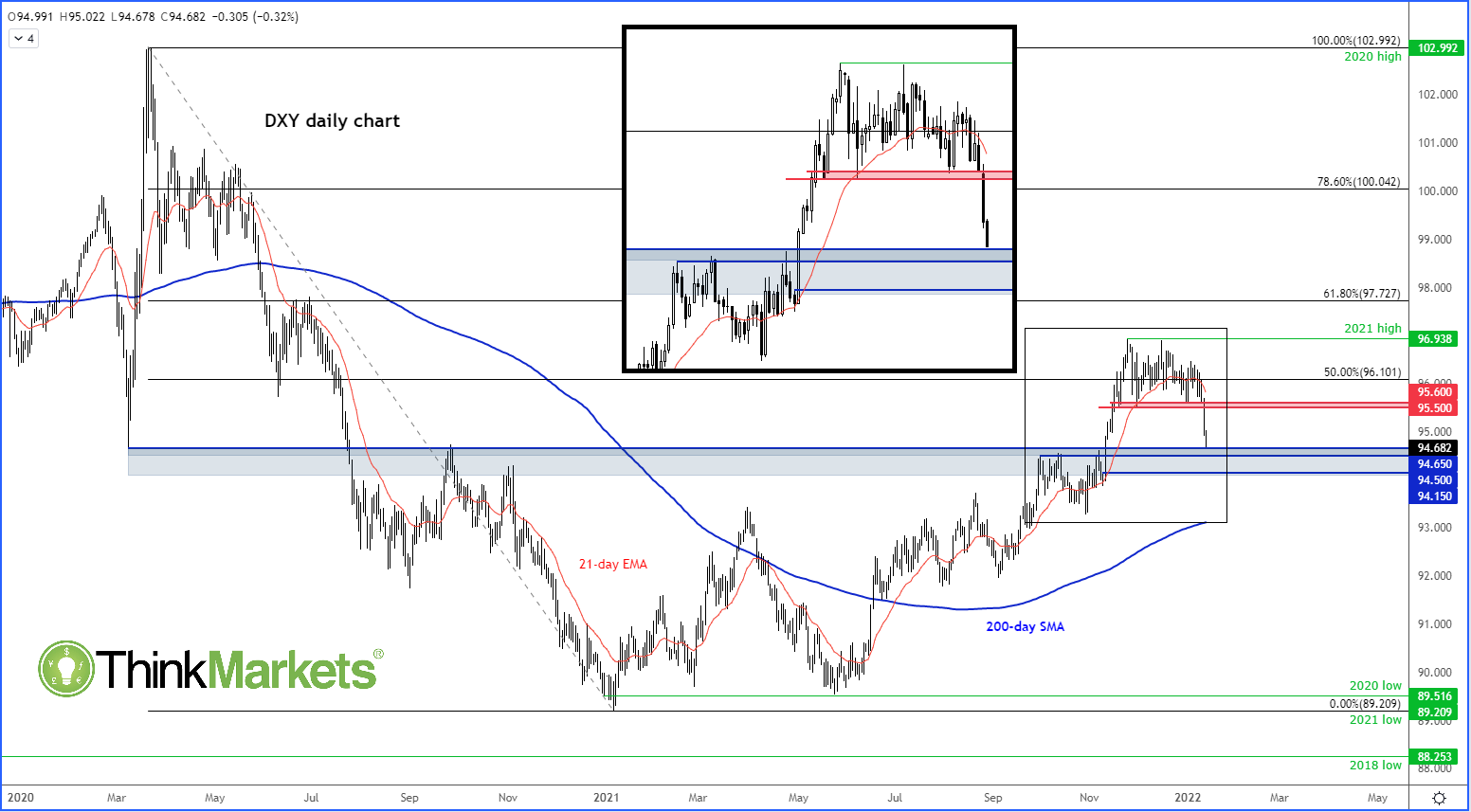
Source: ThinkMarkets and TradingView.com
As the chart shows, this area was previously resistance and the base of the last breakout. Will it now turn into a major support or demand zone? Traders should wait for signs of a bottom pattern to emerge here before potentially looking for any long dollar trades. For what it is worth, I reckon we will get at least a short-term bounce from around here.
USDJPY Wave Analysis
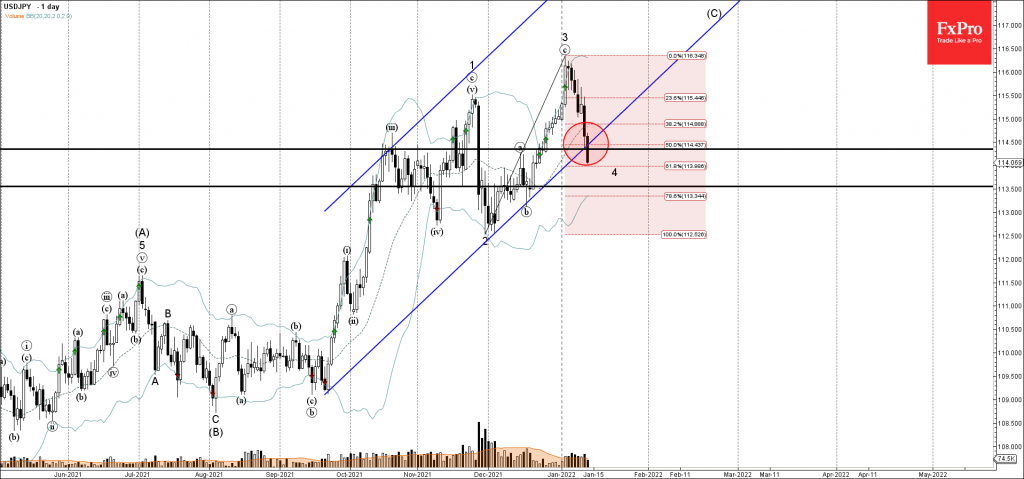
- USDJPY broke daily up channel
- Likely to fall to support level 113.50
USDJPY currency pair recently broke the key support level 114.50, intersecting with the daily up channel from November and the 50% Fibonacci correction of the upward impulse 3.
The breakout of the support level 114.50 accelerated the active short-term correction 4 from the start of this year.
USDJPY currency pair can be expected to fall further toward the next support level 113.50.
Gold Wave Analysis
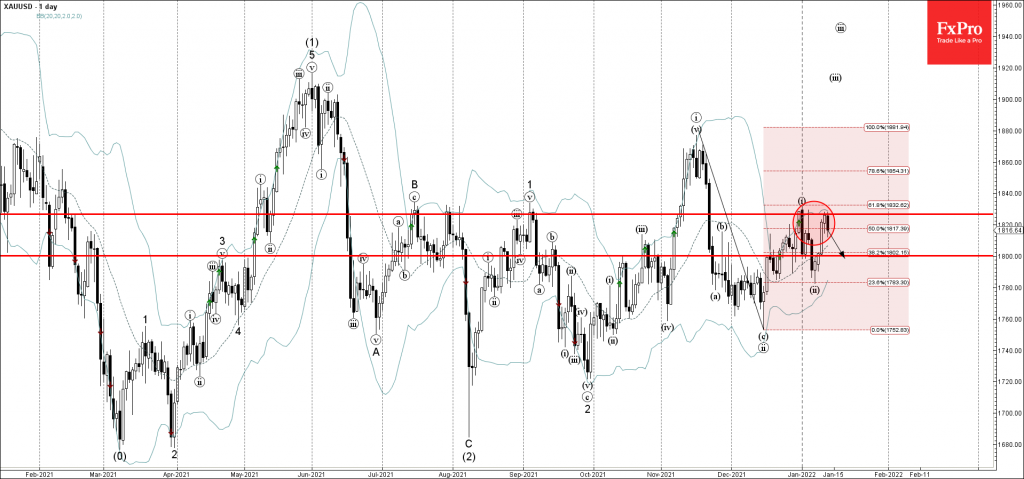
- Gold reversed from resistance level 1826.71
- Likely to fall to support level 1800.00
Gold recently reversed down from the pivotal resistance level 1826.71, intersecting with the daily upper daily Bollinger Band and the 61.8% Fibonacci correction of the downward correction (ii) from November.
The downward reversal from the resistance level 1826.71 stopped the previous impulse waves (iii) and 3.
Gold can be expected to fall further toward the next round support level 1800.00 (which has been reversing the pair from November).