

Sample Category Title
Asia Struggling for Conviction
The conflicting hodgepodge of US employment data released on Friday night hasn’t given Asia much in the way of themes to hang their hats on today, complicated by a Japanese holiday reducing liquidity. An underlying theme of caution still permeates the region, but it is a very mixed picture in equity markets across the region, while currency markets look like they are stuck in the mud, going nowhere fast.
On Friday, the US Non-Farm Payrolls disappointed, adding only 199,000 jobs. The back months were revised up by 141,000 jobs, making a total of 340,000 jobs with some optimistic maths and interpretation, but that is well short of the forecast of between 400,000 and 500,000 jobs. On the other hand, the Labour Force Participation Rate fell once again to 61.90% and official Unemployment fell to 3.90%. Average Hourly Earnings rose MoM rose by 0.60%, and by 4.70% YoY, both well above forecast.
So, the challenge in the US appears to be finding workers to fill jobs, not that there are not enough jobs out there. The JOLTS data amply illustrated that earlier in the week. Headline number aside, there was more than enough to keep the inflation vigilantes awake at night, particularly hourly earnings data. A mid-year lift-off from the Fed remains on track and although the future inflation break evens are universally saying the Fed will succeed in bringing inflation back to 2.0% in the medium term, in the here and now of 2022, a different reality rules.
US equities once again headed south, and US longer-dated yields once again headed North. The playbook failed in currency markets though. Risk sentiment barometers like Australian and New Zealand Dollars held steady, and the Canadian Dollar rallied. Likewise emerging market currencies said “whatever,” and major currencies actually rallied, pushing the dollar index notably lower. That helped gold rally slightly, while oil held steady.
I will circle back to currencies later on, but in Asia today, the piecemeal price action across asset classes on Friday has led to some confused price action in Asian markets today, notably equities. Part of this can be laid at the door of omicron, with Asia refusing to buy into the rich-country Western narrative that it is milder and will have a lower net impact than delta. Much of that “data,” of course, is based on heavily RNA-vaccinated countries, something much of Asia hasn’t had access to.
The evolving situation in Australia and India, with skyrocketing caseloads, won’t give much comfort. Nor will an outbreak in Tianjin in Mainland China, a gateway city to Beijing. China already has widening restrictions on other cities. Hong Kong appears to have had a community outbreak as well. Australia, Taiwan, and Japan have all heightened virus restrictions to differing degrees over the weekend as well. China is especially concerning, with the Mainland and Hong Kong behind a Covid-zero wall, but with low vaccination rates in Hong Kong itself, and the Mainland apparently vaccinated with traditional vaccines, which don’t appear to work against omicron. The odds of a China growth shock because of omicron and Covid-zero are steadily rising by the day.
Elsewhere, China property developers are back in the spotlight as well. Evergrande faces a deadline today to persuade onshore noteholders to not force Evergrande to buy them back by executing puts. Shimao, who defaulted on a loan last week, has allegedly put all its residential and commercial projects up for sale. Finally, Modern Land, yet another troubled and defaulting developer, saw its shares start trading in Hong Kong today after a 2 ½ month suspension. Its stock fell 40% intraday after news emerged of early repayment demands on some of its senior notes. The downside risks continue to accumulate for China despite much research saying buy-the-dip/undervalued of late.
Inflation data from the US and China will dominate the economic calendar this week. China releases its CPI data on Wednesday morning while Wednesday evening sees US December CPI released. At this stage, the risks are tilted towards the downside for China’s data, and higher for the US data. The monetary divergence could see the US rally, not just against the Yuan, but also Asian FX and AUD and NZD. We also have US 3 and 10-year notes, and a 30-year bond auction this week, along with some heavyweight European debt auctions. With US yields rising, and 10-year German bunds approaching 0.0%, the bid to cover ratios are worth monitoring this week. Weak covers won’t be good for equities.
Finally, the Bank of Korea policy decision could get interesting on Friday if USD/KRW continues to hold above 1200.00, or we get a soft-China/firm-US CPI divergence mid-week, which causes another bout of Asian currency weakness.
Asian equities diverge
Friday’s US data dump saw the interest rate hawks win the day, thanks to both the participation and unemployment rate tumbling lower. That saw US equities retreat once again, although a soft Non-Farm headline print took the edge of the negativity. The S&P 500 fell 0.41% with the tech-heavy Nasdaq bearing the bearish brunt once again, falling by 0.96%. The Dow Jones outperformed relatively, almost unchanged at down 0.02%. The perception that value-centric Dow Jones and Russell 2000 companies will be a better inflation hedge continues to rule markets. In Asia the trend continues, Dow futures are unchanged, S&P 500 futures are 0.10% lower, while Nasdaq futures have fallen by 0.35%.
In Asia, we are seeing some divergence, complicated by omicron nerves in Australia, Japan, and China and India. Japan is closed today, but we can assume that if the Nasdaq is lower tonight, the Nikkei will drop like a stone tomorrow. The tech-heavy South Korean Kospi is 1.10% lower. Mainland China sees the Shanghai Composite and CSI 300 0.25% higher, and I suspect some “smoothing” by authorities is happening. Hong Kong has jumped higher by 0.85%, led by Mainland healthcare stocks.
Singapore is 0.75% higher today in what looks like an inflation defensive play with the gains being led by the three local mega-banks. Taipei is just 0.10% higher, while Jakarta is up 0.25% and Kuala Lumpur has gained just 0.15%. Manila is 1.45% higher, and Bangkok is down 0.10%. A weak New York session and omicron cases spiralling into space see Australian markets lower today, but only marginally so thanks to the banking and resource heavyweight backstop. The All Ordinaries and ASX 200 are down just 0.10%, having recovered earlier losses.
The more value-centric European markets are unlikely to suffer the technology ill-winds of the US or the virus nerves of Asia, and I would expect them to open modestly lower today. Of far more interest to Europe, this week will be the government debt auctions and the 10-year bund. If that moves above 0.0%, European equities could take fright, as the only region of the world more addicted to central bank money than Europe, is Japan.
The US Dollar retreats
Perhaps the most surprising move post the US Non-Farm Payrolls, came from the US Dollar, which staged a sharp retreat versus major currencies, even as US yields rose. The dollar index slumped 0.52% to 95.74, before recovering to 95.90 in Asia today. I am at a loss to explain the move lower, in all honesty, I am doubtful that international investors selling US equities alone, could be responsible for it. In the bigger picture, the dollar index is mid-range at 95.90, and as previously stated, I am waiting for 95.50 or 96.50 to break to signal the US Dollar’s next directional move.
EUR/USD and GBP/USD were the main winners of US Dollar weakness on Friday, both gaining around 0.50% to 1.1360 and 1.3590. GBP/USD remains steady and has resistance just above 1.3600 which will signal a further rally to 1.3800 if broken. EUR/USD’s rally looks unconvincing and only a close above 1.1400 will lessen the bearish outlook. Risks are still skewed towards a retest of 1.1200, especially if German Bund yields stop rising. USD/JPY remains a bid on dips from 115.50 to 115.00 as long as US yields remain at these levels, targeting 118.00 initially.
AUD/USD and NZD/USD have added 0.20% today to their modest Friday gains, trading at 0.7195 and 0.6770 respectively. Both continue to be bounced around on RORO (risk-on, risk-off) sentiment swings, but ultimately, are range-trading right now. Key levels for AUD/USD and NZD/USD are 0.7150 and 0.7300, and 0.6700 and 0.6850 for Kiwi. USD/CAD fell 0.65% to 1.2640 on Friday, where it remains in Asia. The CAD strength is surprising, and I suspect the rally in oil and industrial metals is providing a back-stop. USD/CAD has support at 1.2600 and resistance at 1.2700.
Asian currencies remain mostly towards the weaker side of their recent range versus the US Dollar, the exception being the Indian Rupee which seems to be receiving hot money flows once again as the China outlook darkens. USD/KRW remains above 1200.00, USD/PHP at 51.40, USD/IDR at 14,400.00, USD/MYR at 4.2040, and USD/THB at 33.700. USD/CNY and USD/CNH look poised to retest 6.3800 shortly, which would put downward pressure on regional FX. The key directional driver this week will be the US CPI data with high CPI prints lifting Fed hiking expectations and pressuring Asian FX.
Oil ignores US jobs data
Oil prices were almost unchanged on Friday, with Brent crude and WTI maintaining their gains even as headline US jobs data came in soft. Brent crude edged 0.20% lower to $81.80, and WTI fell 1.0% to $78.85 a barrel. In Asia, prices have risen slightly with Brent crude trading at $81.90, and WTI at $79.00 a barrel.
Despite prices easing slightly on Friday, oil continues to hold onto almost all its gains from the start of December. That was despite two OPEC+ meetings where production was increased. Part of the answer lies with OPEC+ itself, where overall compliance with production targets by members has been well over 100% for the last six months. The importance of this cannot be emphasised enough as it implies that OPEC+ itself has very little readily available swing production. Assuming that omicron passes and that the global recovery and international travel continue to recover, the supply/demand dynamics for oil will continue to swing towards higher demand and constrained supply. It would not surprise me in the least if Brent crude and WTI rose to near $100 a barrel in the coming months.
In the nearer term, Brent crude has support at $79.60 and the 100-day moving average (DMA) at $78.15 a barrel, with well-denoted resistance now at $83.00 a barrel. A rally through $83.00 signalling a retest of $86.00. WTI has support at $78.50 and $77.50 a barrel, with resistance at $80.50 and 82.00 a barrel.
Gold remains unexciting
A lower US Dollar on Friday gave gold some solace, rising 0.30% to $1796.60 as it remains side-lined in range trading. Gold remains vulnerable to US Dollar strength, and I have no doubt that any meaningful rally will continue to be unwound aggressively at the first sign of trouble.
Gold has edged lower to $1793.70 an ounce in Asia with no momentum apparent either way. Gold has resistance at $1810.00 and $1830.00 an ounce. Support lies at $1785.00, followed by $1780.00 and $1760.00 an ounce. The downside continues to look the more vulnerable and I believe gold will trade in a roughly $1775.00 to $1815.00 range this week.
EUR/USD Daily Outlook
Daily Pivots: (S1) 1.1312; (P) 1.1338; (R1) 1.1387; More...
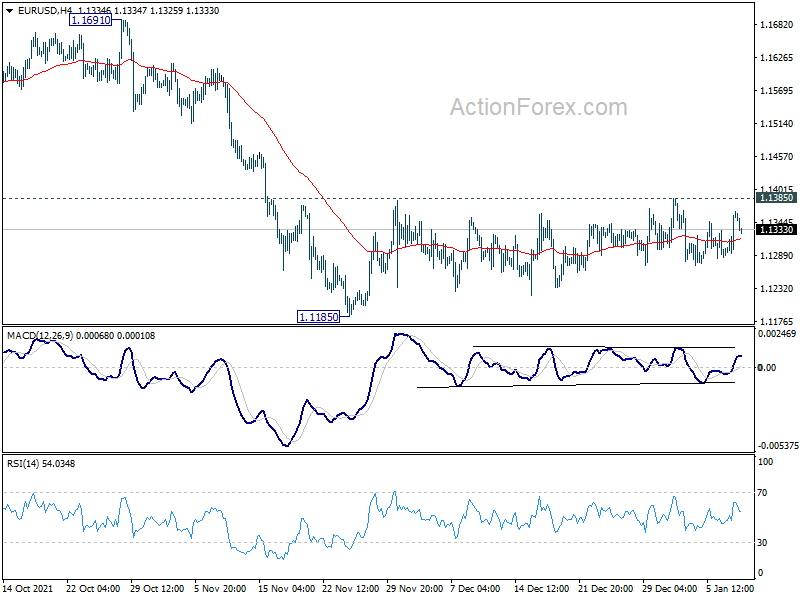
Range trading continues in EUR/USD and intraday bias remains neutral first. On the upside, sustained trading above 55 day EMA (now at 1.1385) will bring stronger rise back to 1.1663 support turned resistance. On the downside, break of 1.1185 will resume larger decline from 1.2348. Next target is 161.8% projection of 1.2265 to 1.1663 from 1.1908 at 1.0934.
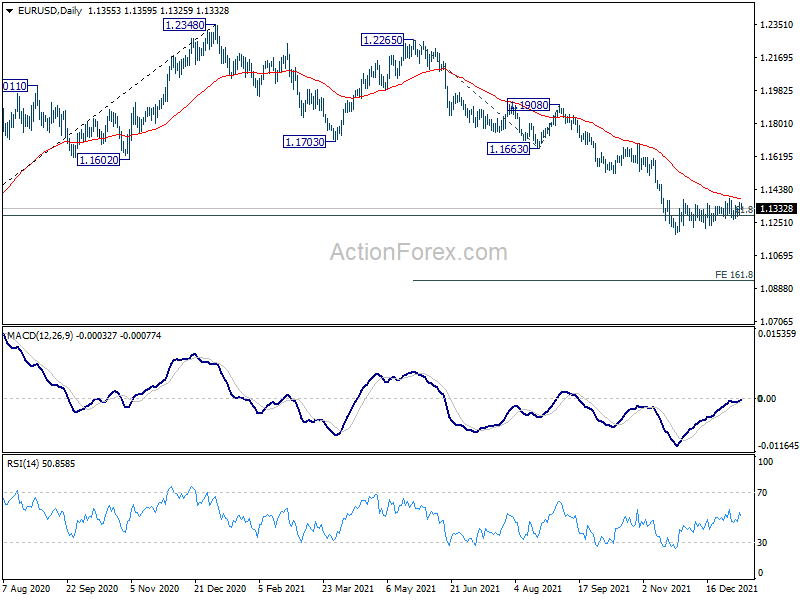
In the bigger picture, there are various ways of interpreting the fall from 1.2348 (2021 high). It could be a correction to rise from 1.0635 (2020 low), the fourth leg of a sideway pattern from 1.0339 (2017 low), or resuming long term down trend. In any case, outlook will now stay bearish as long as 1.1703 support turned resistance holds. Sustained break of 61.8% retracement of 1.0635 to 1.2348 at 1.1289 would pave the way back to 1.0635.
GBP/USD Daily Outlook
Daily Pivots: (S1) 1.3546; (P) 1.3572; (R1) 1.3617; More...
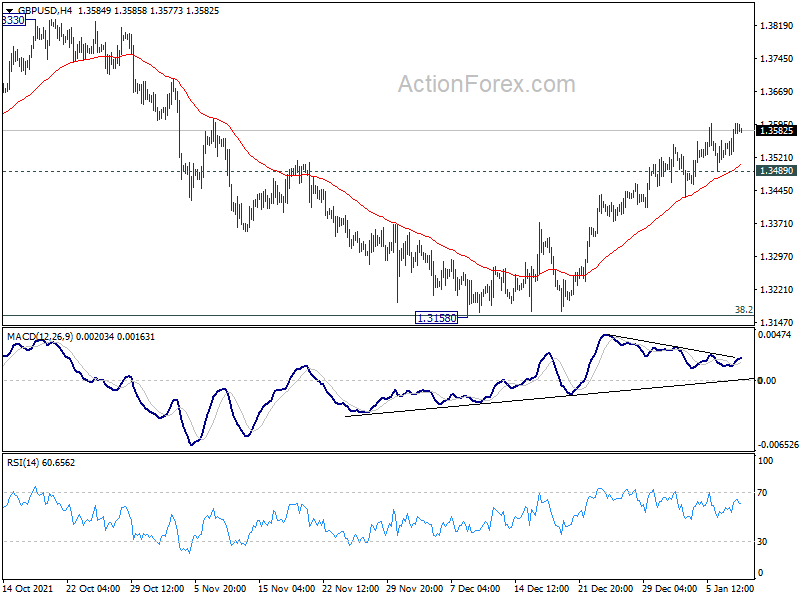
Intraday bias in GBP/USD remains on the upside at this point. Corrective fall from 1.4248 could have completed with three waves down to 1.3158, after hitting 1.3164 medium term fibonacci level. Sustained trading above 1.3570 will pave the way to 1.3833 resistance next. On the downside, though, break of 1.3489 minor support will mix up the outlook and turn intraday bias neutral first.
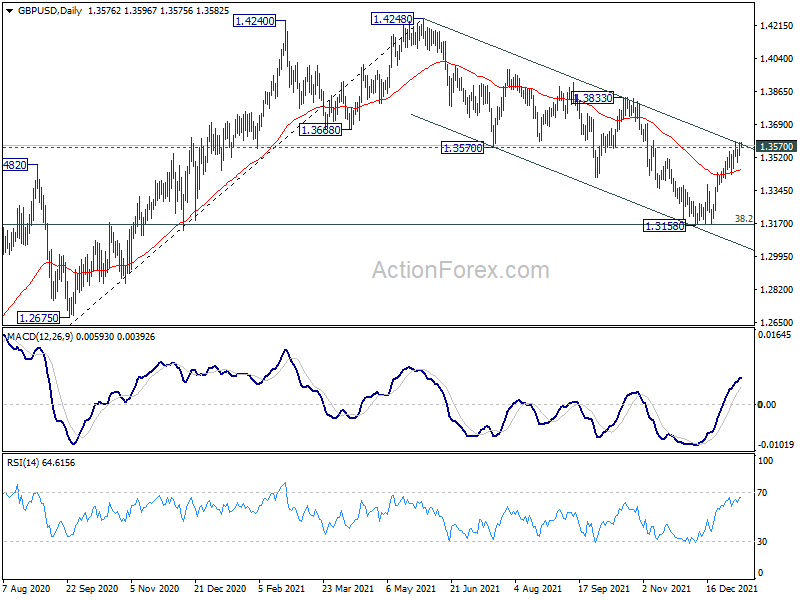
In the bigger picture, strong support was seen from 38.2% retracement of 1.1409 to 1.4248 at 1.3164. The development suggests that up trend from 1.1409 (2020 low) is still in progress. On resumption, next target will be 38.2% retracement of 2.1161 to 1.1409 at 1.5134. Nevertheless sustained break of 1.3164 will argue that whole rise from 1.1409 has completed and bring deeper fall to 61.8% retracement at 1.2493.
USD/CHF Daily Outlook
Daily Pivots: (S1) 0.9167; (P) 0.9200; (R1) 0.9217; More....
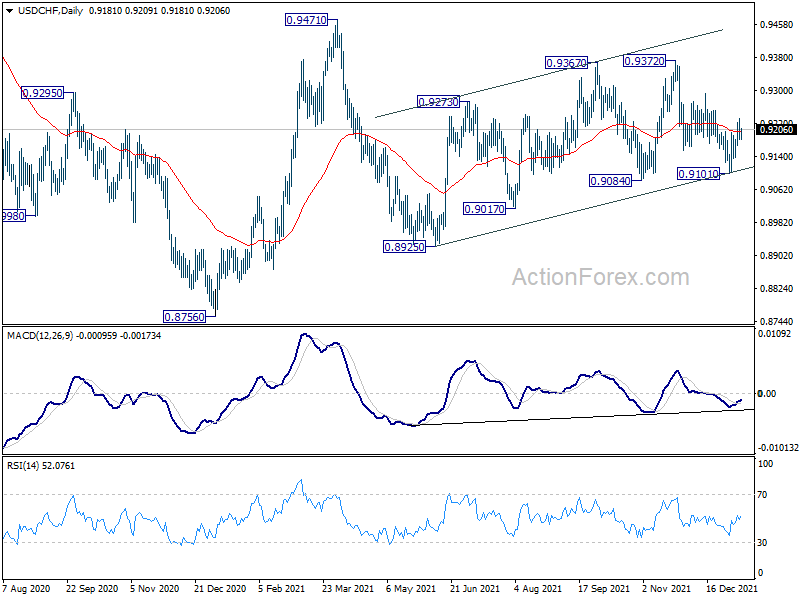
Intraday bias in USD/CHF remains neutral at this point. As long as 0.9084 support holds, choppy rise from 0.8925 could still extend higher. Above 0.9213 will target 0.9293 and then 0.9372. However, break of 0.9101 will resume the fall from 0.9372 instead.
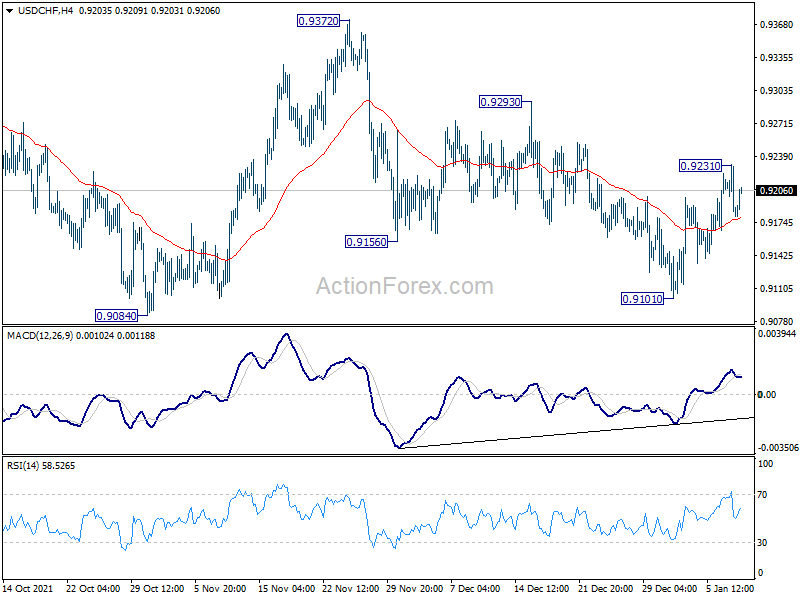
In the bigger picture, the corrective structure of the rebound from 0.8925 argues that fall from 0.9471 is not complete yet. It could either be the second leg of pattern from 0.8756 (2021 low), or resuming larger down trend from 1.0237 (2018 high). We'd pay attention to the downside momentum and assess the odds later. But for now, medium term outlook will be neutral at best as long as 0.9471 resistance holds.
USD/JPY Daily Outlook
Daily Pivots: (S1) 115.39; (P) 115.71; (R1) 115.89; More...
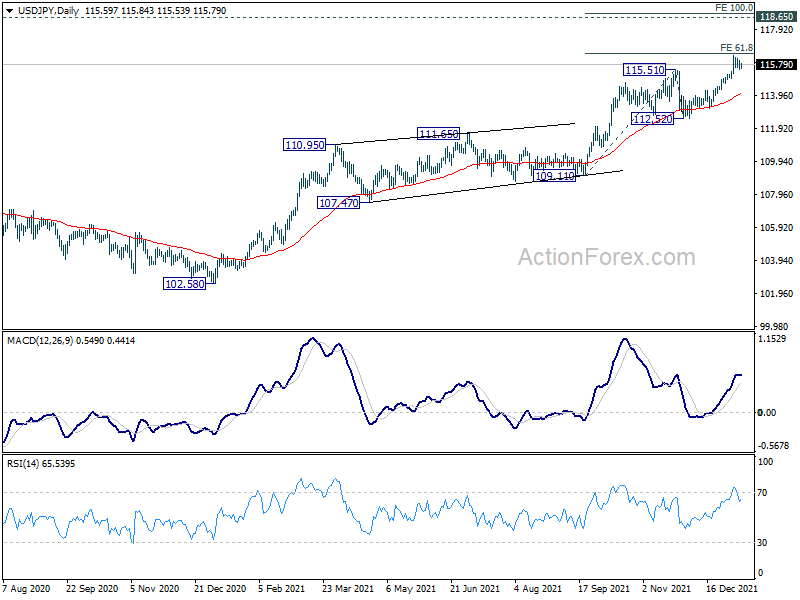
Intraday bias in USD/JPY remains neutral for consolidation below 116.34 temporary top. Downside of retreat should be contained well well above 114.26 resistance turned support to bring rally resumption. On the upside, firm break of 61.8% projection of 109.11 to 115.51 from 112.52 at 116.47 will pave the way to 100% projection at 118.90, which is close to 118.65 long term resistance.
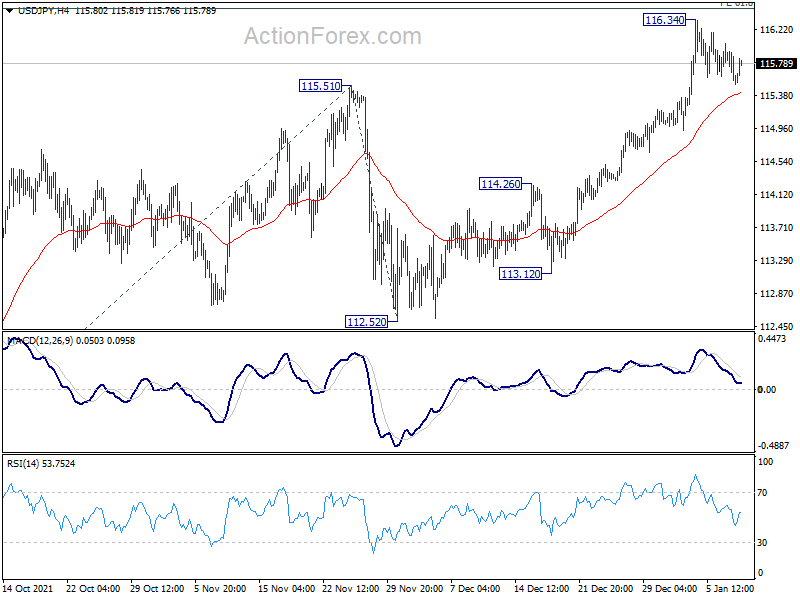
In the bigger picture, no change in the view that rise from 102.58 is the third leg of the up trend from 101.18 (2020 low). Such rally should target a test on 118.65 (2016 high). Sustained break there will pave the way to 120.85 (2015 high) and raise the chance of long term up trend resumption. For now, this will remain the favored case as long as 112.52 support holds, in case of deep pull back.
USD/CAD Daily Outlook
Daily Pivots: (S1) 1.2607; (P) 1.2669; (R1) 1.2706; More...
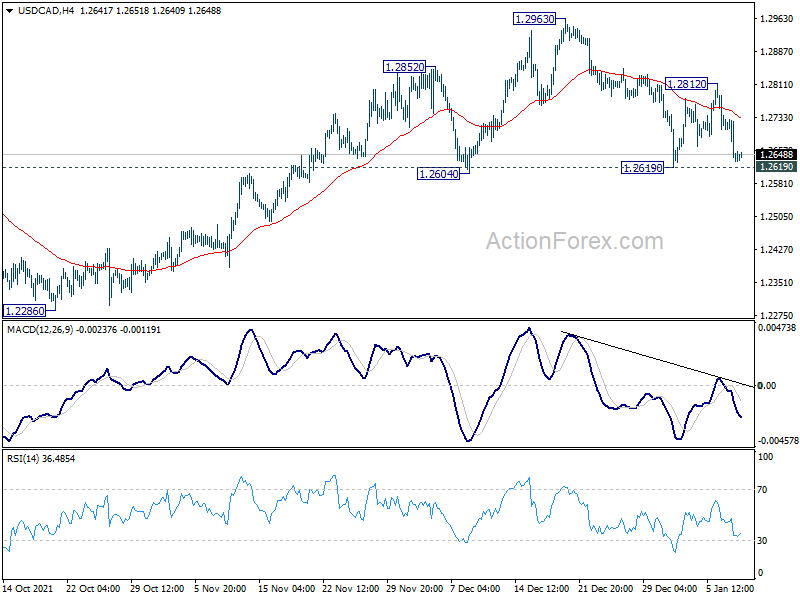
Intraday bias in USD/CAD remains neutral at this point. On the downside, firm break of 1.2619 support will complete a head and should top pattern (ls: 1.2852, h: 1.2963, rs: 1.2812). That would also argue that whole pattern from 1.2005 has completed with three waves to 1.2963. Intraday bias will be back to the downside for 1.2286 support, and possibly further to 1.2005 low. On the upside, though, break of 1.2812 minor resistance will retain near term bullishness, and target 1.2963 and then 1.3022 fibonacci level.
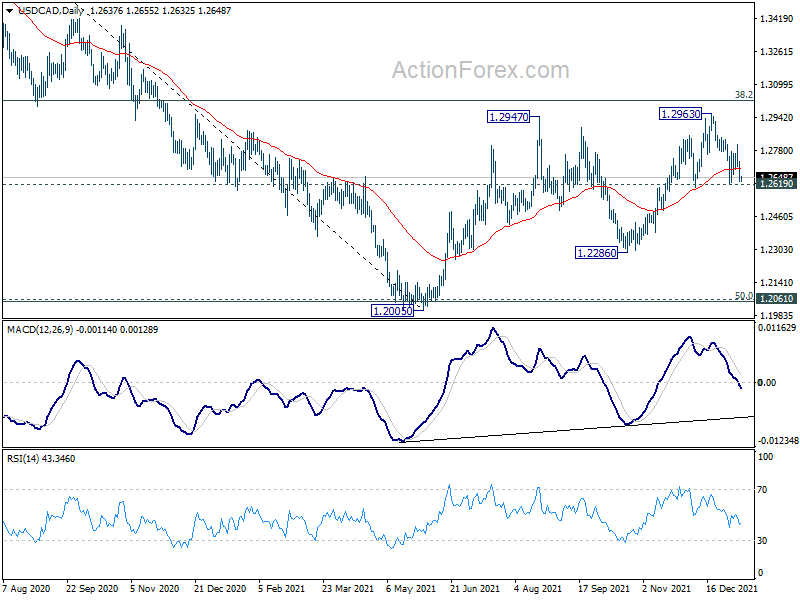
In the bigger picture, focus will be on 38.2% retracement of 1.4667 (2020 high) to 1.2005 (2021 low) at 1.3022. Sustained break there should confirm that the down trend from 1.4667 has completed after defending 1.2061 long term cluster support. Further rise would then be seen towards 61.8% retracement at 1.3650. On the downside, however, break of 1.2286 will turn focus back to 1.2005 low again.
AUD/USD Daily Report
Daily Pivots: (S1) 0.7145; (P) 0.7167; (R1) 0.7203; More...
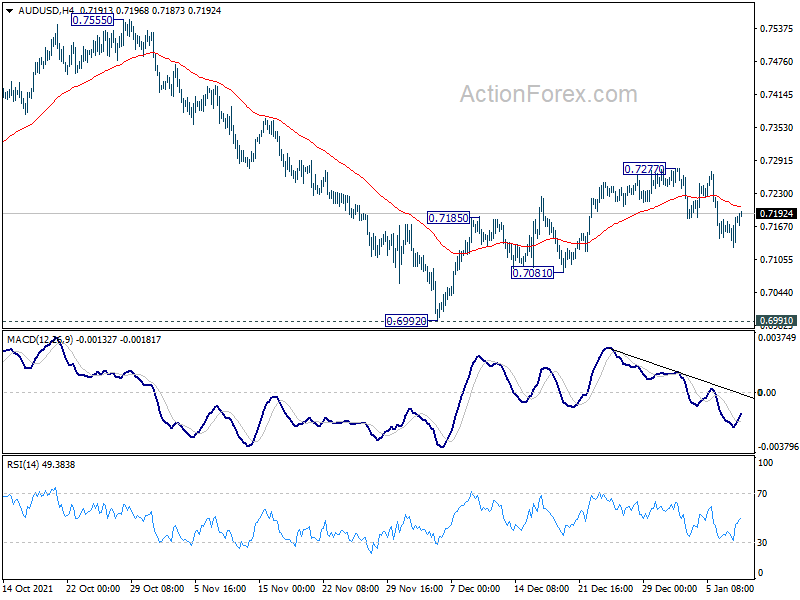
AUD/USD recovers mildly today but stays in range of 0.7081/7277. Intraday bias remains neutral for the moment. On the downside, break of 0.7081 support will indicate that corrective rebound from 0.6992 has completed with three waves up to 0.7277, after hitting 55 day EMA. Intraday bias will be back on the downside for retesting 0.6991/2 key support zone. Firm break there will resume larger down trend from 0.8006. On the upside, though, break of 0.7277 will turn bias to the upside to resume the rebound.
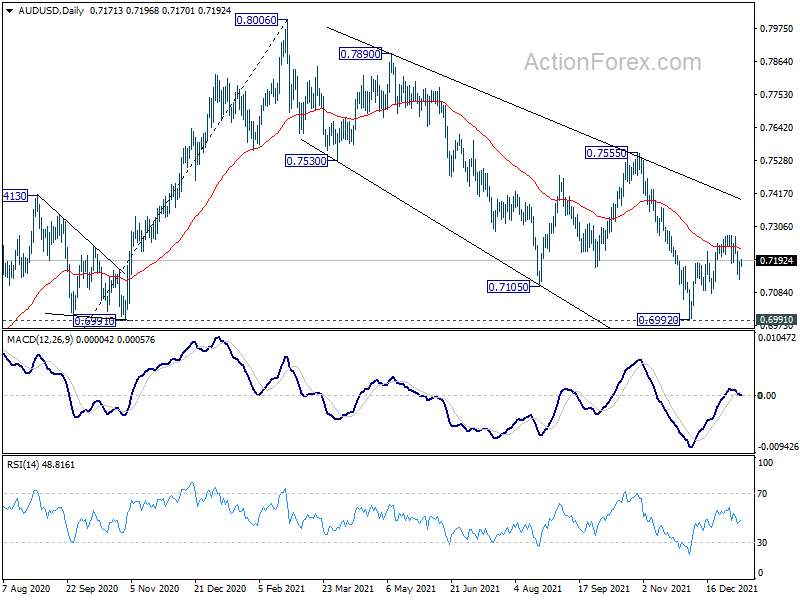
In the bigger picture, strong rebound from 0.6991 key structural support will retain medium term bullishness. That is, whole up trend from 0.5506 is still in progress. Firm break of 0.7555 resistance will target 0.8006 high and above. However, sustained break of 0.6991 will argue that the whole up trend from 0.5506 might be finished at 0.8006, after rejection by 0.8135 long term resistance. Deeper decline would then be seen back to 61.8% retracement of 0.5506 to 0.8006 at 0.6461.
Euro Softens in Quiet Trading, Aussie Ticking Up
Euro turns softer in a quiet Asian session together with Swiss Franc, but Yen is even weaker. On the other hand, Aussie is ticking up slightly together with Loonie and Dollar. Overall, trading is rather subdued with major Asian stock indexes treading water in tight range, and Japan is on holiday. Focuses will turn to Fed chair Jerome Powell's testimony, and US inflation data later in the week, which should bring the markets back to life.
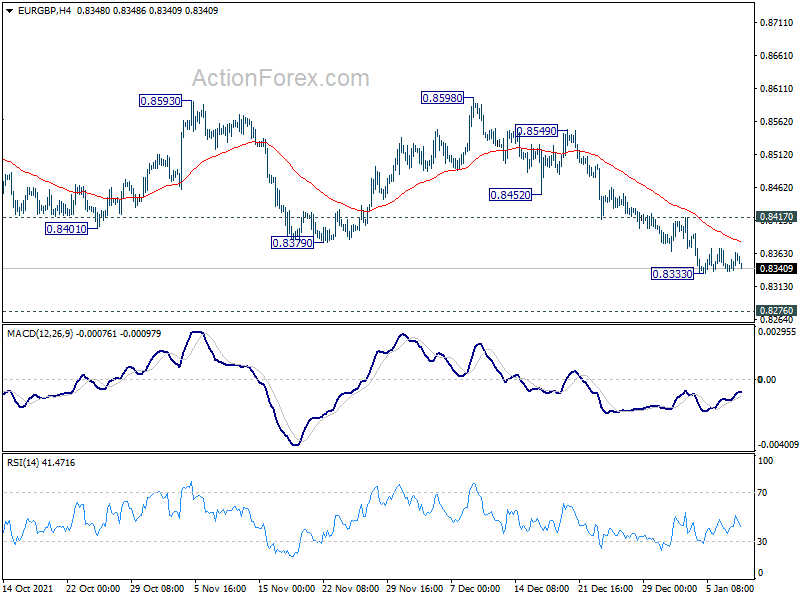
Technically, we'll keep an eye on Sterling. EUR/GBP is staying bearish, and it looks ready to resume the medium term down trend through 0.8333 temporary low any time. GBP/JPY is also still on track to retest 158.19 resistance, and resume larger up trend. Meanwhile, if GBP/USD could build up more momentum above 1.3570 support turned resistance, that would solidify the case of near term bullish reversal for 1.3833 resistance next.
In Asia, at the time of writing, Hong Kong HSI is up 0.71%. China Shanghai SSE is up 0.21%. Singapore Strait Times is up 0.78%. Japan is on holiday.
IMF Blog: Faster Fed hike could rattle financial markets
In an blog post, senior IMF officials said the continued to expect "robust US growth". Inflation will "likely moderate" late this year as supply disruptions ease and fiscal contraction weighs on demand. Fed's indication that it would raise interest rate more quickly "did not cause a substantial market reassessment of the economic outlook".
"Should policy rates rise and inflation moderate as expected, history shows that the effects for emerging markets are likely benign if tightening is gradual, well telegraphed, and in response to a strengthening recovery," the post noted.
However, "broad-based US wage inflation or sustained supply bottlenecks could boost prices more than anticipated and fuel expectations for more rapid inflation".
"Faster Fed rate increases in response could rattle financial markets and tighten financial conditions globally. These developments could come with a slowing of US demand and trade and may lead to capital outflows and currency depreciation in emerging markets."
ECB Schnabel: Rising energy prices may require a departure from a looking through policy
ECB Executive Board member Isabel Schnabel warned in a speech on Saturday, "monetary policy, for its part, cannot afford to look through energy price increases if they pose a risk to medium-term price stability."
"This could be the case if prospects of persistently rising energy prices contribute to a deanchoring of inflation expectations, or if underlying price pressures threaten to lift inflation above our 2% target as rising carbon prices and the associated shifts in economic activity boost rather than suppress growth, employment and aggregate demand over the medium term."
WTI oil back below 80 as Kazakhstan normalizes production
Oil prices dip mildly in Asian session as Kazakhstan's largest oil venture Tengizchevroil is gradually normalizing production. Some contractors had disrupted train lines in support of protests in the country last week.
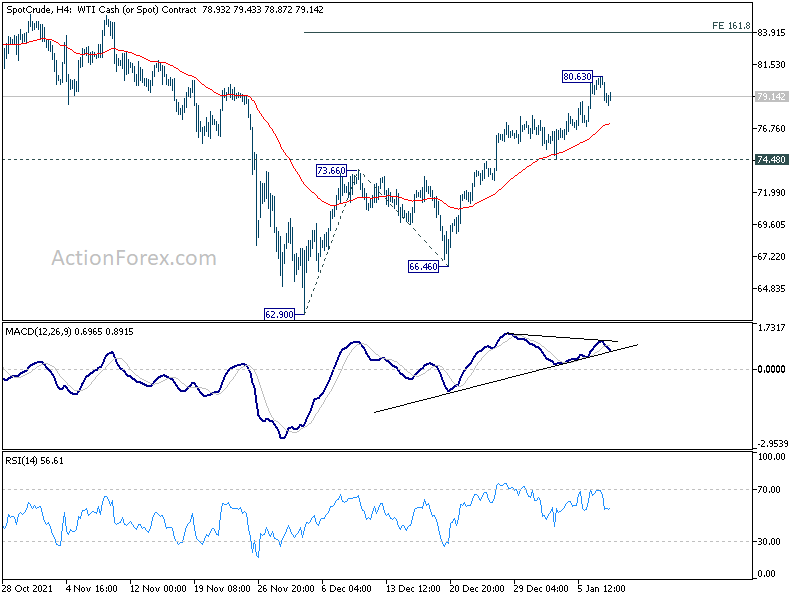
WTI crude oil hit as high as 80.63 last week but fails to sustain above 80 handle so far. Some consolidations could be seen first, but further rally is expected as long as 74.48 support holds. Rally from 62.90 should target 161.8% projection of 62.90 to 73.66 from 66.46 at 83.86, which is close to 85.92 high.
For now, we're not expecting a break of 85.92 yet. We'd expect at least one more down leg before the corrective pattern from there completes. Hence, we'd look for topping between 83.86/85.92.
Fed Powell testimony and US inflation to move the markets
Fed Chair Jerome Powell's testimony before Senate Banking committee will be a main focus of the week. Powell would likely be asked about his views on March rate hike, as well as the timing of off-loading the balance sheet. Additionally, CPI and PPI from the US would be equally market moving while retail sales will be featured. Elsewhere, a batch of data from China, UK and Australia will also catch some attention.
Here are some highlights for the week:
- Monday: Australia MI inflation gauge, building approvals; Eurozone Sentix investor confidence, unemployment rate.
- Tuesday: Australia retail sales, trade balance; Japan leading indicators; Fed chair Powell's testimony.
- Wednesday: Japan banking lending, current account, Eco watchers sentiment; China CPI, PPI; Eurozone industrial production; US CPI, Fed's Beige Book.
- Thursday: New Zealand building permits; Japan M2; ECB monthly bulletin; US PPI, jobless claims.
- Friday: China trade balance; Japan PPI; UK GDP, production, trade balance; Eurozone balance; US retail sales, import prices, industrial production, U of Michigan sentiment.
AUD/USD Daily Report
Daily Pivots: (S1) 0.7145; (P) 0.7167; (R1) 0.7203; More...
AUD/USD recovers mildly today but stays in range of 0.7081/7277. Intraday bias remains neutral for the moment. On the downside, break of 0.7081 support will indicate that corrective rebound from 0.6992 has completed with three waves up to 0.7277, after hitting 55 day EMA. Intraday bias will be back on the downside for retesting 0.6991/2 key support zone. Firm break there will resume larger down trend from 0.8006. On the upside, though, break of 0.7277 will turn bias to the upside to resume the rebound.
In the bigger picture, strong rebound from 0.6991 key structural support will retain medium term bullishness. That is, whole up trend from 0.5506 is still in progress. Firm break of 0.7555 resistance will target 0.8006 high and above. However, sustained break of 0.6991 will argue that the whole up trend from 0.5506 might be finished at 0.8006, after rejection by 0.8135 long term resistance. Deeper decline would then be seen back to 61.8% retracement of 0.5506 to 0.8006 at 0.6461.
Economic Indicators Update
| GMT | Ccy | Events | Actual | Forecast | Previous | Revised |
|---|---|---|---|---|---|---|
| 00:00 | AUD | TD Securities Inflation M/M Dec | 0.20% | 0.30% | ||
| 00:30 | AUD | Building Permits M/M Nov | 3.60% | 3.20% | -12.90% | |
| 09:30 | EUR | Eurozone Sentix Investor Confidence Jan | 12 | 13.5 | ||
| 10:00 | EUR | Eurozone Unemployment Rate Nov | 7.20% | 7.30% | ||
| 15:00 | USD | Wholesale Inventories Nov F | 1.20% | 1.20% |
IMF Blog: Faster Fed hike could rattle financial markets
In an blog post, senior IMF officials said the continued to expect "robust US growth". Inflation will "likely moderate" late this year as supply disruptions ease and fiscal contraction weighs on demand. Fed's indication that it would raise interest rate more quickly "did not cause a substantial market reassessment of the economic outlook".
"Should policy rates rise and inflation moderate as expected, history shows that the effects for emerging markets are likely benign if tightening is gradual, well telegraphed, and in response to a strengthening recovery," the post noted.
However, "broad-based US wage inflation or sustained supply bottlenecks could boost prices more than anticipated and fuel expectations for more rapid inflation".
"Faster Fed rate increases in response could rattle financial markets and tighten financial conditions globally. These developments could come with a slowing of US demand and trade and may lead to capital outflows and currency depreciation in emerging markets."
WTI oil back below 80 as Kazakhstan normalizes production
Oil prices dip mildly in Asian session as Kazakhstan's largest oil venture Tengizchevroil is gradually normalizing production. Some contractors had disrupted train lines in support of protests in the country last week.
WTI crude oil hit as high as 80.63 last week but fails to sustain above 80 handle so far. Some consolidations could be seen first, but further rally is expected as long as 74.48 support holds. Rally from 62.90 should target 161.8% projection of 62.90 to 73.66 from 66.46 at 83.86, which is close to 85.92 high.
For now, we're not expecting a break of 85.92 yet. We'd expect at least one more down leg before the corrective pattern from there completes. Hence, we'd look for topping between 83.86/85.92.