

Sample Category Title
Daily Technical Analysis
EUR/USD
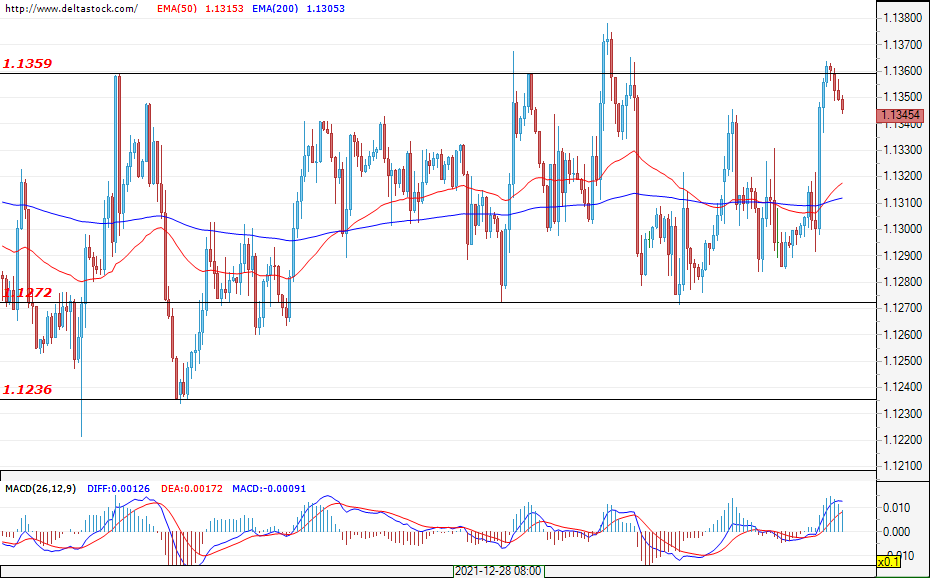
Current level - 1.1345
The pair is still in the range-bound movement that began in late November and it seems that neither party is ready to take the initiative. On the higher time frames, the trend is in a decline and this may continue to be the case after the consolidation. Such a prolonged compression implies the accumulation of large trading volumes and a strong directional movement. The current expectations are in favour of the bears, but if the 1.1360 resistance is breached in the short term, it is possible that the EUR/USD could move towards 1.1510. This would attract more liquidity for the bears and create better market entry levels. Their goal will then be to breach the support within the 1.1180-1.1236 zone and continue further down towards 1.1000. The seasonal data supports the movement towards 1.1510, and the macro environment with rising U.S. interest rates suggests a strong dollar that supports bearish scenarios. A change in the trend can be expected if prices remain above 1.1600. In the early hours of today, the bulls are again experiencing difficulties at around 1.1360 and it is possible for the consolidation to continue. The first daily support the bulls can expect at around 1.1320, followed by the more solid one at 1.1272. The market is clearly expecting a catalyst, which might become the inflation data for the United States coming out on Wednesday at 13:30 GMT. Other events that may increase trading activity are the data on unemployment in the euro area (today; 10:00 GMT), as well as the Congress hearing of Jerome Powell on Tuesday at 15:00 GMT.
USD/JPY
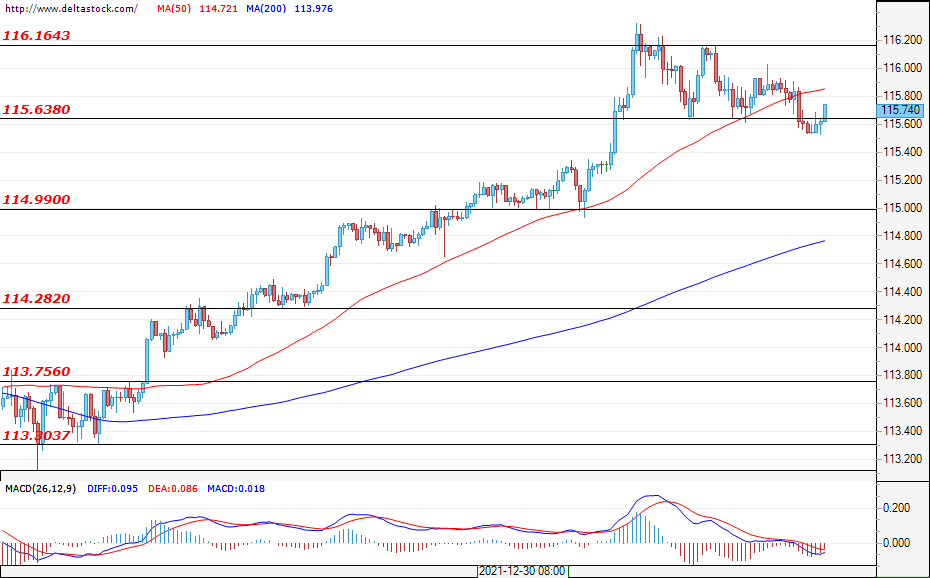
Current level - 115.74
Last week, the uptrend entered a pullback and formed support at around 115.63. After the false breach of the zone, the upward momentum is expected to resume and the resistance at 116.16 is to be overtaken. In such a scenario, the target for the bulls would be the level at around 117.80. If the resistance at 116.16 is not violated, then it is likely for the market to enter a range phase. Possible bands for such a range could be the support at 114.30 and the resistance at 116.16.
GBP/USD
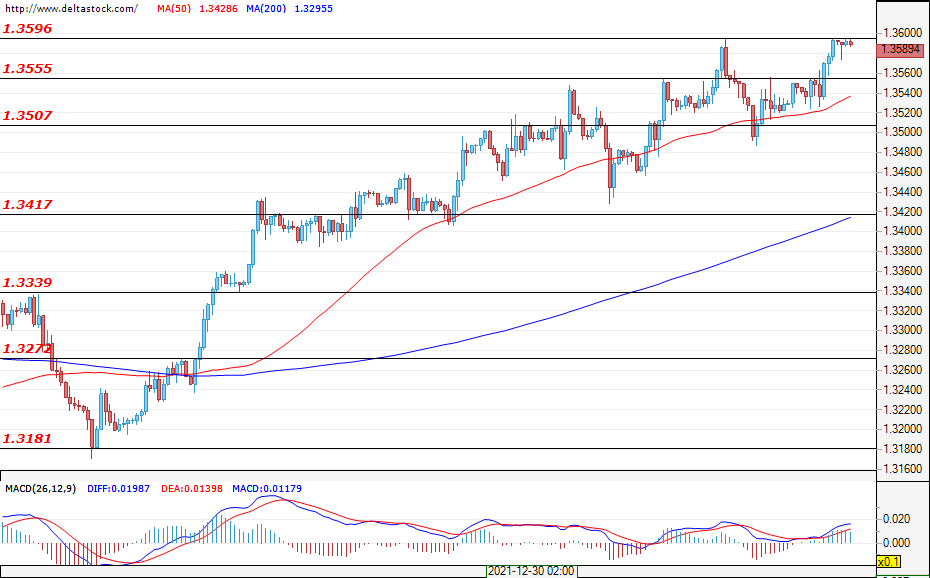
Current level - 1.3589
The gains of the sterling do not seem sustainable and bullish impulses are currently being followed by deep retracements. Looking at the higher time frames, the mood still looks bearish, and the area at around 1.3600 looks attractive to sellers. The market is expected to enter a range phase, after which it could roll over into a downtrend. These expectations would change if the resistance at 1.3800 is breached. The first support for the bulls is the level of 1.3555, followed by that of 1.3507, and the main one lies at 1.3417. First resistances are 1.3600 and 1.3700.
EUGERMANY40
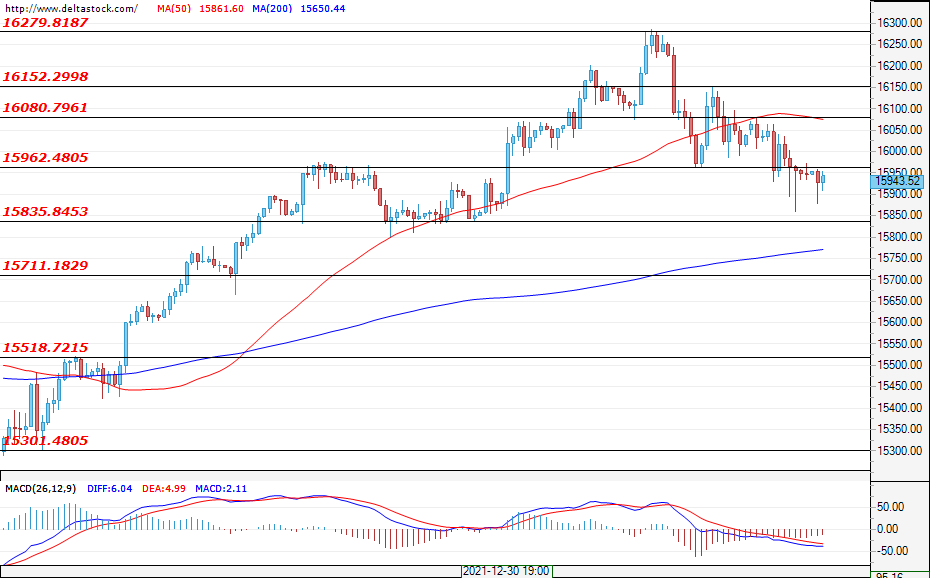
Current level - 15943
The first week of the year was extremely volatile for the German index and, after nearly reaching the record highs of around 16297, it sold out massively. The declines were not unexpected and are currently limited to a technical retracement. The area around 15835 provided solid support and sell offers were rejected above this level. Expectations remain positive, at least until the integrity of the 15835 zone is compromised. The first resistances for the bulls are 15960, 16080 and 16150. The seasonal data supports the bullish scenario and it is possible for buyers to once again attack the high of 16280.
USD30
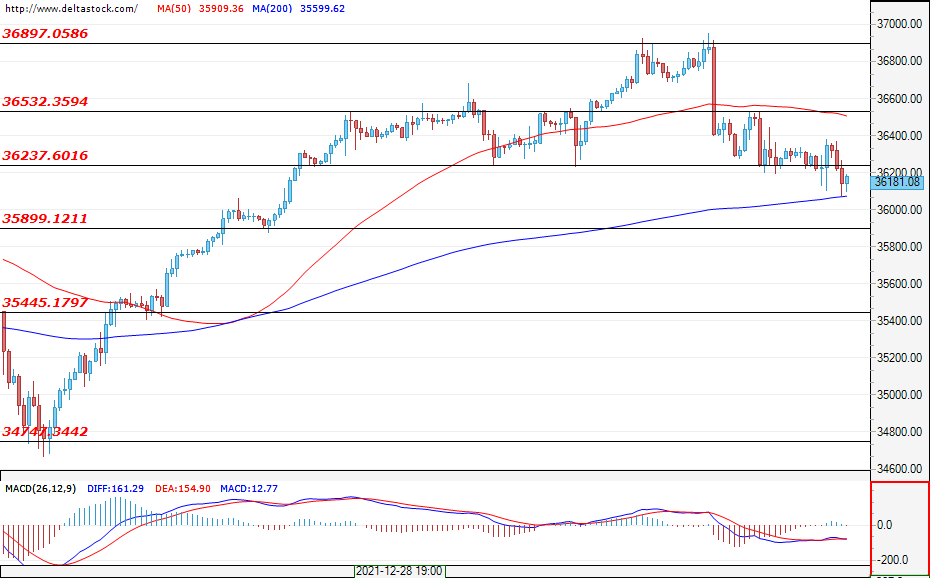
Current level - 36181
The Fed meeting minutes turned the week around for the U.S. markets and they were aggressively sold out after previously reaching new record highs. As a result, the breach of the key zone at 36237 is likely to be fake. If prices return above this level, then a renewal of the bullish momentum can be expected. The first resistance for the bulls is 36530, and the next one is the area around the record values at 36900. If the sell-off continues this week, the first support zones for the bulls would be 35900 and 35445.
EURUSD Rises as Bets of Tighter Fed Remain
The EURUSD pair soared to the highest level since January 3 as investors reacted to mixed US non-farm payrolls (NFP) data. Data published on Friday revealed that the American economy added just 199k jobs in December. That was significantly lower than the 422k analysts were expecting. The numbers also mean that the economy is yet to fill 3.2 million jobs that were lost during the pandemic. On the positive side, the unemployment rate declined to 3.9% while wages rose. Therefore, analysts expect that the Federal Reserve will maintain its hawkish stance in the coming meetings.
US futures wavered as investors started to refocus on the upcoming earnings season. The official season will start on Friday when big bank like Citigroup, JP Morgan, and Wells Fargo will publish their fourth-quarter results. Analysts expect that these banks will deliver record earnings and guidance thanks to hopes that the Fed will hike interest rates. Stocks have been under pressure in the first week of the year, with high-growth tech stocks seeing more weakness because of fears of the hawkish Fed. A bond sell-off has also happened, pushing the 10-year yield to the highest level since 2020.
The economic calendar will be muted today, with no major economic data scheduled. Therefore, investors will focus on the performance of key areas of the market. For example, the sell-off of cryptocurrencies continued during the weekend. Bitcoin declined to $41,000 while Ethereum is slightly above the key support at $3,000. Additionally, investors will position for a busy week, where the US will publish the latest inflation data and several Fed officials will talk.
EURUSD
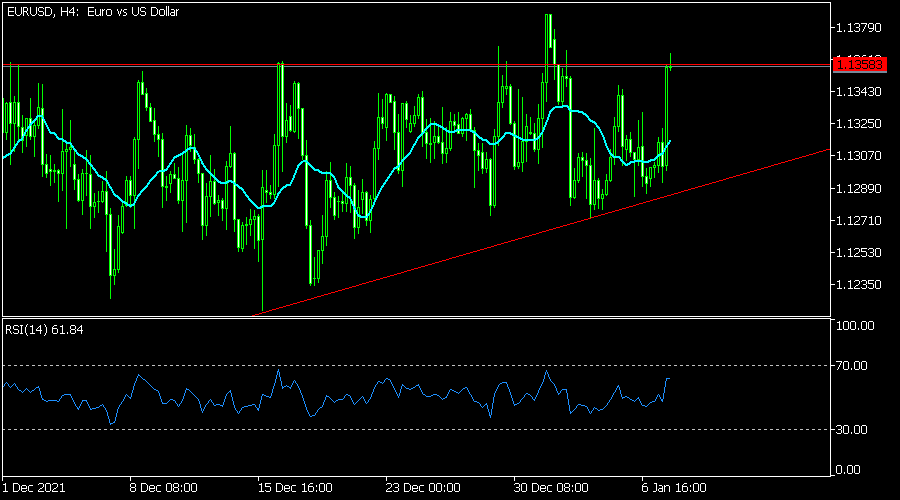
The EURUSD pair rose sharply after the latest American jobs numbers. It is trading at 1.1360, which is a few points above last week’s low at 1.1270. The pair is along a key resistance level, which it has struggled moving above before. It is also slightly above the 25-day and 50-day moving averages. A closer look also shows that it has formed a bearish flag pattern. Therefore, the pair will likely have a pullback later today.
XAUUSD
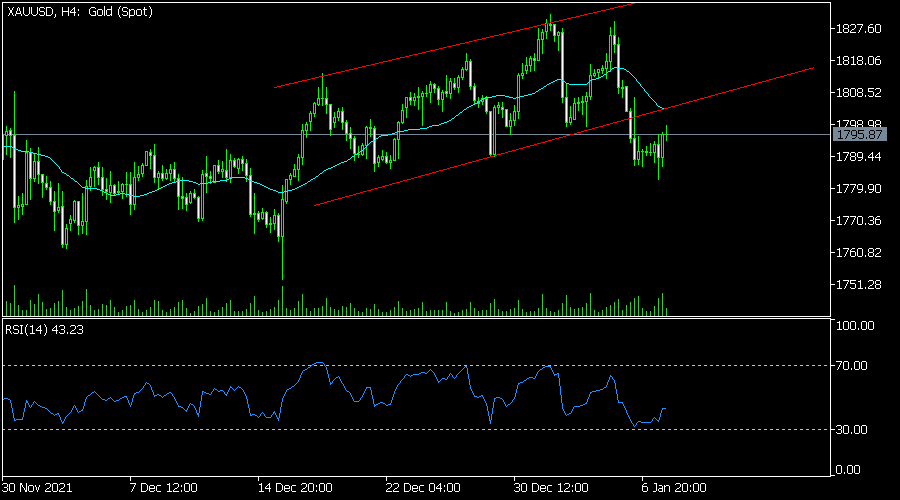
The XAUUSD pair held steady on Monday morning as the US dollar declined. It is trading at 1,795, which is slightly above last week’s low at 1,781. It is also slightly below the 25-day moving average while the Relative Strength Index (RSI) has tilted upwards. The price is also slightly below the ascending channel shown in red. Therefore, there is a likelihood that it will resume the bearish trend as investors wait for the upcoming inflation data.
USDCAD
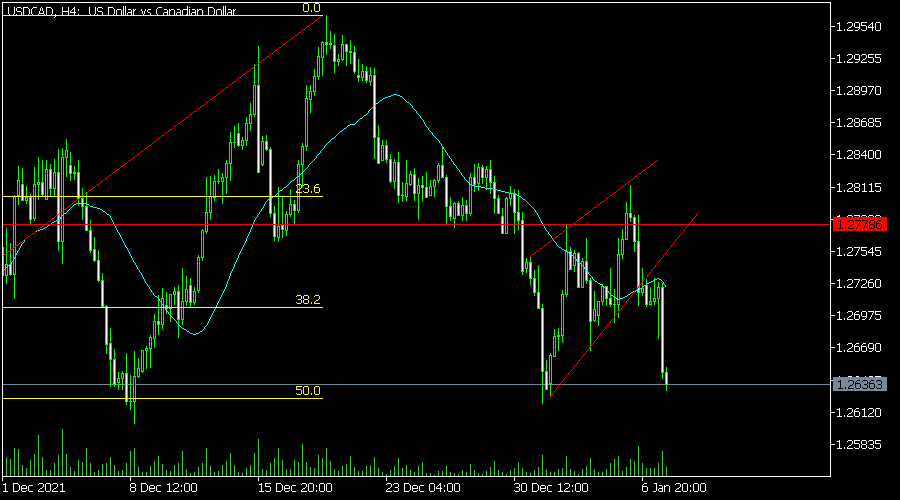
The USDCAD pair declined sharply after the latest US and Canadian jobs numbers. It declined to a low of 1.2636, which was the lowest level since Monday. It managed to move below the lower side of the ascending channel shown in red. Also, it is along the 50% Fibonacci retracement level and below the 25-day moving averages. Therefore, the pair will likely keep falling in the near term.
Stock Markets Trade Mixed
Markets
Friday’s trading session revolved around US payrolls and EMU inflation. The former showed below-consensus job creation but faster-than-expected wage increases (0.6% m/m). Armed with the separate, strong household survey (unemployment rate fell to 3.9%), markets concluded it’s enough to justify the Fed’s accelerated normalization pace. Wall Street’s choppy trading ended up with losses. The Nasdaq (-0.96%) underperformed. US bond yields rose 3 bps (5y) to 4.1 bps (10y). The 5y trades north of 1.5% for the first time since January 2020. The 10y tested resistance at 1.77% but didn’t confirm the technical break going into the weekend. Inflation in the eurozone unexpectedly rose from 4.9% to a record high of 5% but left few traces on markets. German yields rose 0.6 to 2.1 bps across the curve in a move inspired by the US post-payrolls. The German 10y yield closed at a new recovery high of -0.04%. Peripheral spreads widened a basis point or two. Greece hugely underperformed (+11 bps; anticipating supply?). The dollar once again failed to capitalize on UST underperformance. EUR/USD even jumped off 1.129 support to finish at 1.136. USD/JPY closed below 116. EUR/GBP copy pasted moves in EUR/USD. It gained marginally to end the week at 0.836. That said, the pair is still trading near a two-year low. Cable (GBP/USD) tested the 1.36 big figure.
Asian Pacific trading is so quiet you can hear a pin drop. Japanese markets are closed for Coming-of-age Day. Other stock markets trade mixed, lacking guidance. We do retain an interview by ECB Schnabel (see headline below) over the weekend. Core bonds open the week with new losses, building on the existing trends and suggesting a higher open for both US and German yields. It may set the tone for the remainder of the day given the empty economic calendar. The latter only gets moderately interesting this week with the US in focus. CPI (expected at 7%+ y/y) and the Fed’s Beige Book are due on Wednesday. Retail sales and consumer confidence (U. of Michigan) are up for release this Friday. In the meantime we’re watching two key rate levels: 1.77% for the US 10y and the (symbolic) 0% for the German variant. The USD is retracing some of it’s counterintuitive steps on Friday and strengthens vs most major peers. With the euro at the same time in a soft spot, EUR/USD eases to 1.133, confirming the weeks-long gridlock in the low 1.13 area. The UK receives an industrial update later this week but we doubt it will force a breakthrough in EUR/GBP. Sterling currently already discounts a 83% chance for a February back-to-back rate hike. The 0.8277 December ’19 low in any case is an important EUR/GBP support zone.
News headlines
The International Monetary Fund (IMF) published a blog post warning emerging economies to prepare for Fed policy tightening. The threat is especially there in case broad-base US wage inflation or sustained supply bottlenecks boost prices more than expected, triggering faster Fed rate increases and tighter global financial conditions. Such developments could come with a slowing of US demand and trade and may lead to capital outflows and currency depreciation in emerging markets. The IMF offers some policy advice especially for emerging markets with high public and private debt, FX exposures and lower current account balances. The tone of the message is clear: act now on inflation, strengthen policy frameworks and reduce vulnerabilities or risk having to face greater economic/financial turbulence later on.
ECB governing council member Schnabel warned that the greening of the economy poses measurable upside risks to the central bank’s baseline inflation projection over the medium term. She turns the argument around saying that there are instances in which central banks will need to break with the prevailing consensus that monetary policy should look through rising energy prices so as to secure price stability. Fossil fuel prices will not only stay elevated but might even keep on rising if the world steps up its fight against climate change in order to meet the goals of the Paris climate change. Scenarios which would trigger a faster ECB response are one where higher energy prices filter through in elevated inflation expectations and a create wage-price spiral and one where policies to tackle climate change (eg carbon tax and compensation measures) increase inflationary pressures.
GBP/JPY Daily Outlook
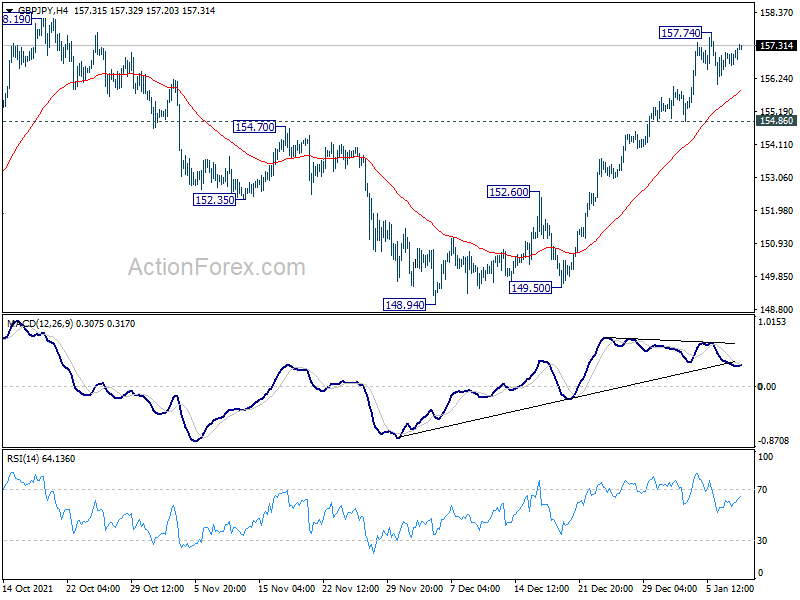
Daily Pivots: (S1) 156.81; (P) 157.00; (R1) 157.26; More...
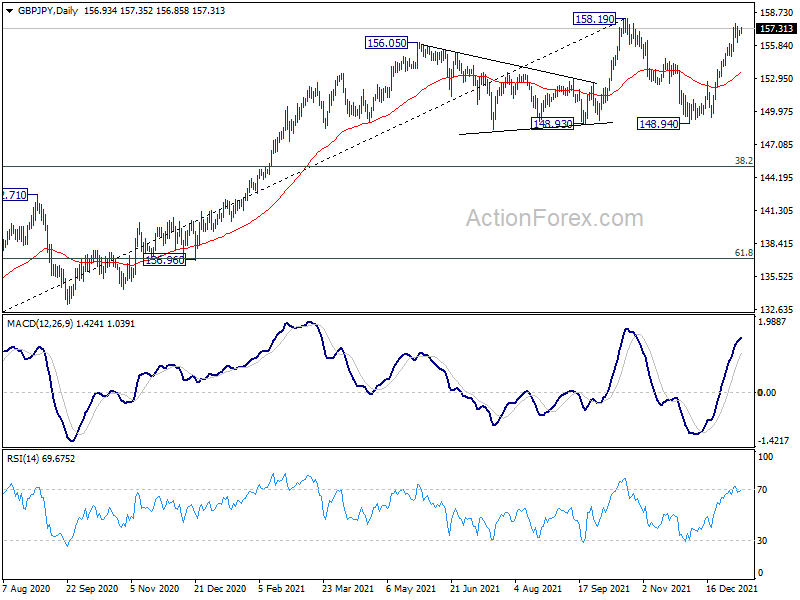
Intraday bias in GBP/JPY remains neutral as consolidation from 157.74 continues. Further rise is expected as long as 154.86 support holds. Decisive break of 158.19 high will resume larger up trend to 167.93 long term fibonacci level. On the downside, below 154.86 minor support will turn intraday bias back to the downside for deeper pull back.
In the bigger picture, strong rebound from 148.93 key structural support retains medium term bullishness. Firm break of 158.19 high will resume whole up trend from 123.94 (2020 low), to 61.8% retracement of 195.86 to 122.75 at 167.93. Nevertheless, firm break of 148.93 will bring deeper correction to 38.2% retracement of 123.94 to 158.19 at 145.10, and possibly further lower, as a correction to up trend from 123.94 at least.
EUR/JPY Daily Outlook
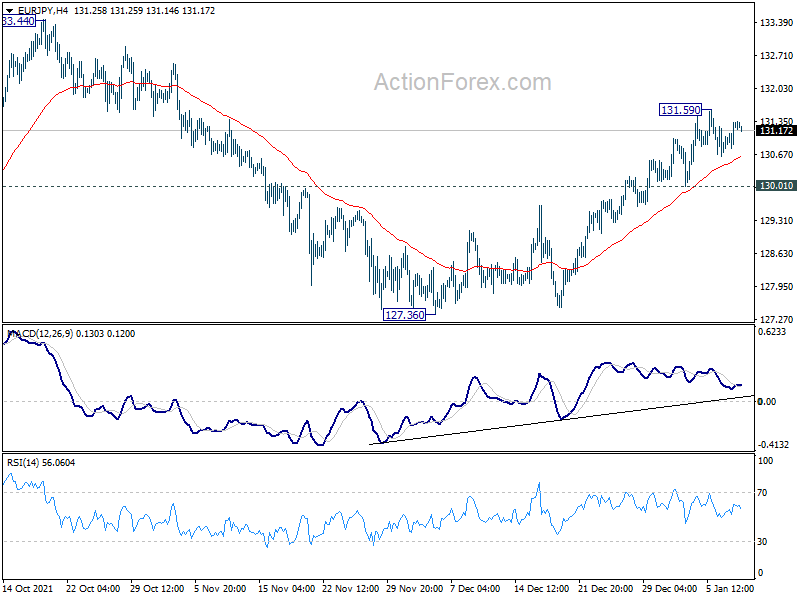
Daily Pivots: (S1) 130.94; (P) 131.15; (R1) 131.47; More....
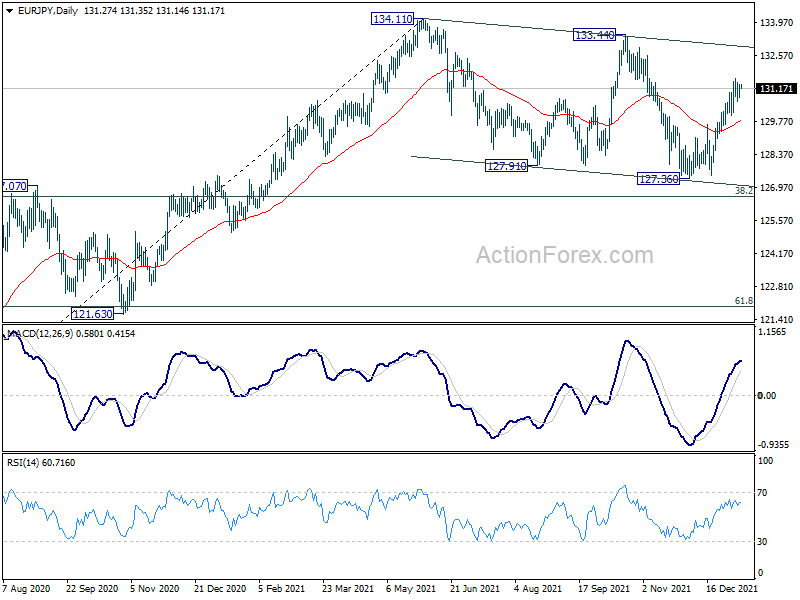
Intraday bias in EUR/JPY remains neutral for consolidation below 131.59 temporary top. But further rally is expected as long as 130.01 support holds. Whole consolidation from 134.11 could have completed with three waves down to 127.36, ahead of 126.58 medium term fibonacci level. Break of 131.59 will target a test on 133.44/134.11 resistance zone. On the downside, break of 130.01 minor support will turn bias bias to the downside for retesting 127.36 low instead.
In the bigger picture, as long as 38.2% retracement of 114.42 (2020 low) to 134.11 at 126.58 holds, up trend from 114.42 is still in favor to continue. Break of 134.11 will target long term resistance at 137.49 (2018 high). However, sustained break of 126.58 will raise the chance of medium term bearish reversal. In this case, deeper decline would be seen to 61.8% retracement at 121.94, and possibly below.
EUR/GBP Daily Outlook
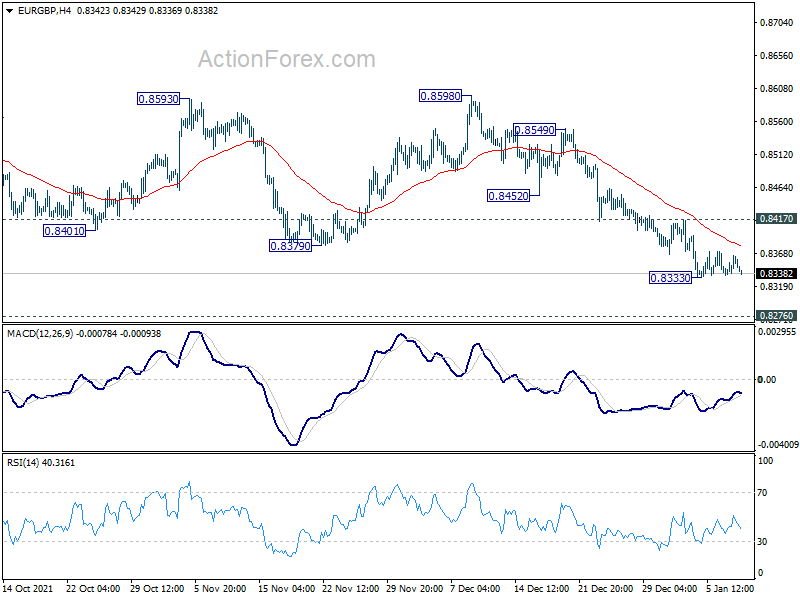
Daily Pivots: (S1) 0.8341; (P) 0.8354; (R1) 0.8370; More...
Intraday bias in EUR/GBP remains neutral and some more consolidation could be seen. But outlook will stay bearish as long as 0.8417 resistance holds. Break of 0.8333 will resume larger down trend for 0.8276 key long term support. On the upside, above 0.8417 minor resistance will turn bias back to the upside for stronger rebound.
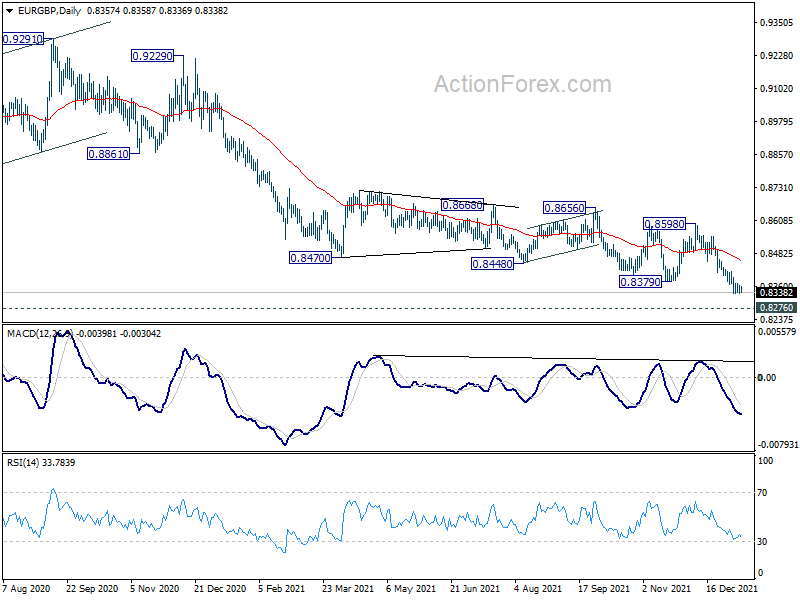
In the bigger picture, price actions from 0.9499 (2020 high) are still seen as developing into a corrective pattern. Deeper fall could be seen as long as 0.8598 resistance holds, towards long term support at 0.8276. We'd look for bottoming signal around there to bring reversal. Meanwhile, firm break of 0.8598 will now be an early sign of medium term bottoming and bring stronger rebound. However, sustained break of 0.8276 will argue that the long term trend has reversed.
EUR/AUD Daily Outlook
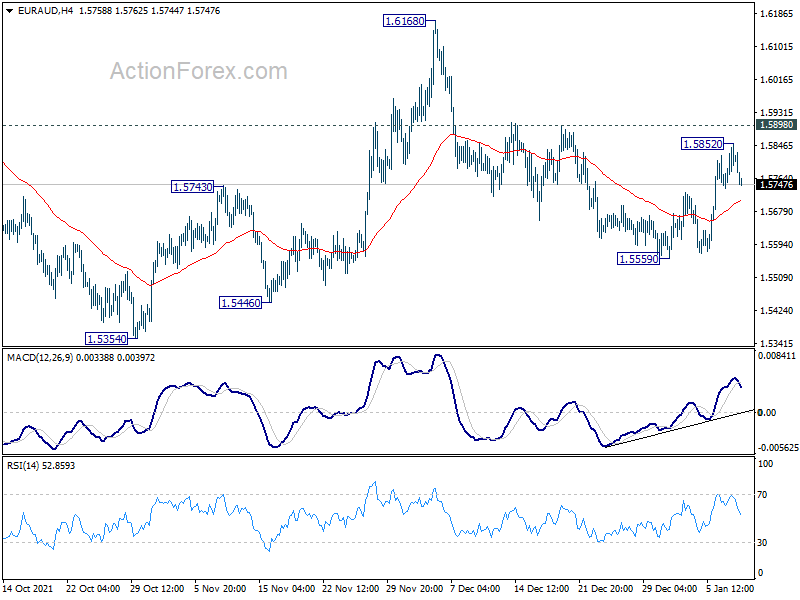
Daily Pivots: (S1) 1.5755; (P) 1.5804; (R1) 1.5868; More...
Intraday bias in EUR/AUD remains neutral first. On the downside, break of 1.5559 will resume the fall from 1.6168 to retest 1.5250/5354 support zone. On the upside, however, break of 1.5898 will argue that pull back form 1.6168 has completed. Intraday bias will be back to the upside for 1.6168 resistance.
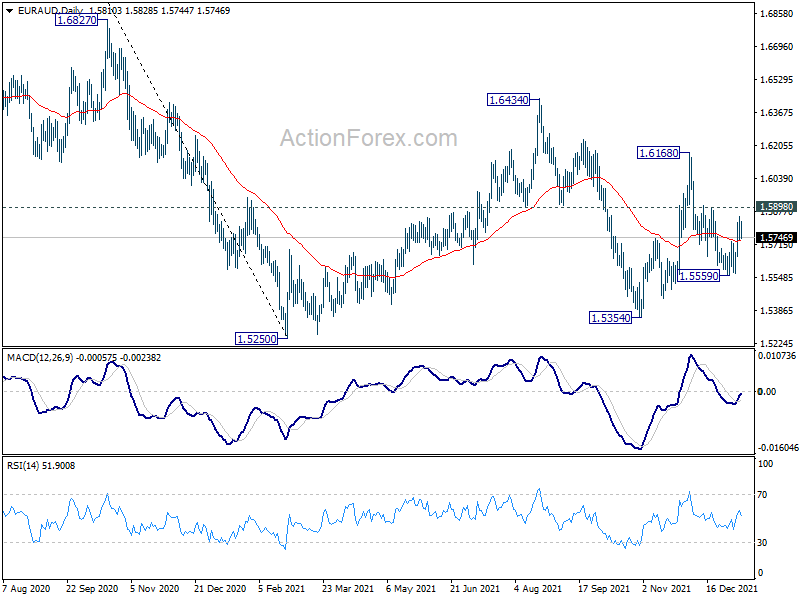
In the bigger picture, rise from 1.5354 is seen as the third leg of the corrective pattern from 1.5250 low. Further rise cannot be ruled out, but even in that case, strong resistance should be seen at 38.2% retracement of 1.9799 to 1.5250 at 1.6988. Larger down trend from 1.9799 is in favor to extend through 1.5250 at a later stage.
EUR/CHF Daily Outlook
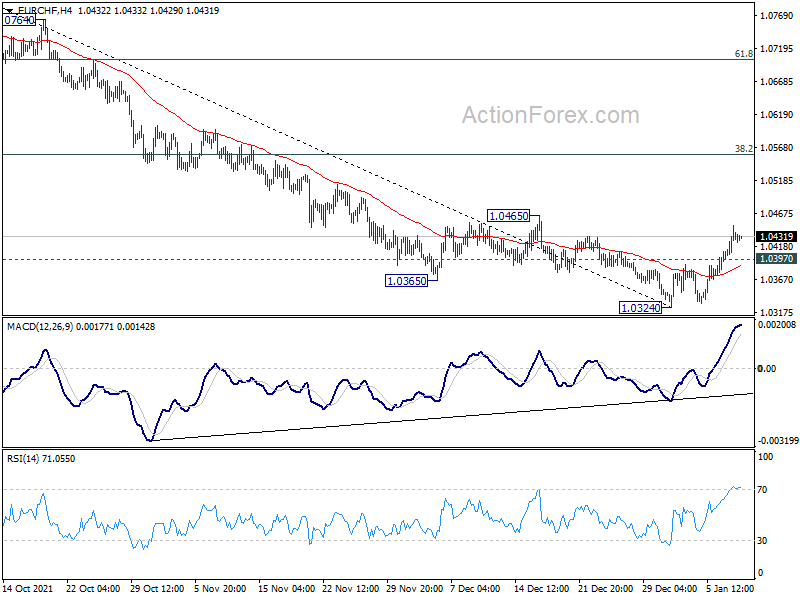
Daily Pivots: (S1) 1.0409; (P) 1.0430; (R1) 1.0455; More....
Intraday bias in EUR/CHF remains on the upside at this point. Rebound from 1.0324 short term bottom would target 55 day EMA (now at 1.0472). Sustained break there will target 38.2% retracement of 1.0936 to 1.0324 at 1.0558. On the downside, below 1.0397 minor support will bring retest of 1.0324 low instead.
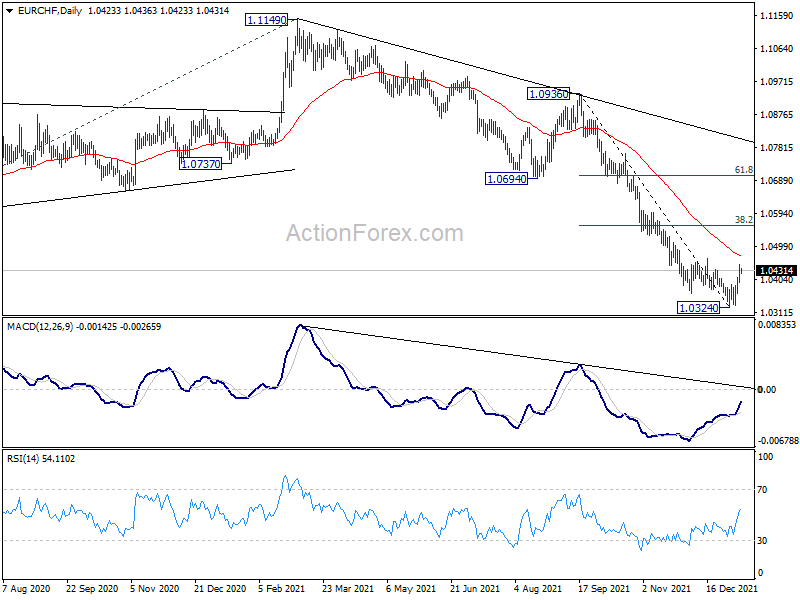
In the bigger picture, long term down trend from 1.2004 (2018 high) is now extending. Next target is 61.8% projection of 1.2004 to 1.0505 to 1.1149 at 1.0223. On the upside, break of 1.0505 support turned resistance is needed to be the first sign of medium term bottoming. Otherwise, outlook will remain bearish even in case of rebound.
US Jobs Boosts Fed Hawks, EZ Inflation Doesn’t Boost ECB Hawks
Market sentiment is mixed following the unnerving jobs data revealed in the US last Friday. Much lower-than-expected NFP print, and higher wages has been an explosive cocktail for the Federal Reserve (Fed) hawks, as not only the soft NFP data couldn’t get the Fed doves moving, but the improved unemployment rate and the rising wages boosted the Fed hawks. There is now a stronger case for the first rate hike to happen as early as in March in the US.
The US 2-year yield hit the 0.90% mark, and the US 10-year yield advanced to 1.80%.
So, the first week of 2022 hasn’t been as glorious as the first trading hours suggested it would be. The S&P500 made its worst start to the year since 2016, and Nasdaq got smashed by 4.5%. The sentiment of uncertainty could well continue into Wednesday’s US inflation data, which may reveal a further advance to the 7% mark in December, from 6.8% printed a month earlier. The persistent rise in consumer inflation could further boost the Fed hawks, bring them to price a steeper normalization path, and more importantly fuel the expectation that the Fed should rapidly reduce the size of its balance sheet to avoid flattening the yield curve while fighting back inflation. As a result, there is plenty of hawkishness yet to be priced in the asset prices, and that could cause a bit more selling across the markets this week, especially in growth stocks which should feel the pinch of higher interest rates compared with the value names.
There is one hope though: the latest earnings season will kick off this week, and higher rate prospects have certainly not interfered with the corporate performances just yet. Therefore, strong corporate results could reverse the Fed-induced moodiness, and help improve investor appetite, at least on the index level.
European inflation is high and sticky, as well
High inflation is shaping the Fed expectations for 2022, but the same is oddly not true for Europe. The data released on Friday revealed that inflation in Europe hit the 5% mark, versus a slight retreat to 4.7% penciled in by analysts. Higher energy and food prices were mostly responsible for the rising inflation and the headline figure is now well above the ECB’s 2% target. Inflation in Europe is becoming a big sticky problem as well, but the European officials prefer turning a blind eye on the problem. So normally, such inflation read should’ve fed into a stronger euro appetite long ago, but Lagarde’s stubbornness is holding back the ECB hawks, and the euro bulls contained for now. For how long?
Oil
Kazakhstan is now moving towards suppressing the rebellion in the country helped by Russians. China said it would help restoring order if needed as well. Crude oil kicks off the week on a flat-to-negative note. Appetite above $80pb hasn’t been strong, but any price pullback is expected to meet a strong support as the OPEC production remains below target due to supply constraints in many oil producer countries, and that spare capacity is set to soften the bears’ hands in the short, medium run. Solid support is seen near the $75pb, 50 and 100-DMA.
More High Inflation Prints, Now to the Scandies
Market movers today
Today, focus is on Scandi data releases with Danish and Norwegian CPI inflation prints and the monthly Swedish GDP indicator due out, see in the Nordic macro section below.
In the euro area, Sentix Investor Confidence and unemployment data are due out.
In the euro area this week, there will be focus on whether Mario Draghi's plans to run in Italy's Presidential election and whether Macron is finally launching his official re-election bid in France. We will also focus on the sharp rise in new omicron cases and developments in energy prices.
Later this week, we will also be looking out for US CPI figures on Wednesday and monthly GDP data out of the UK on Friday.
The 60 second overview
US labour market: We got a mixed jobs report on Friday with weak jobs growth but high wage growth. Labour demand is high but it is difficult for employment to increase significantly when the labour force remains subdued due to Covid. We think the report strengthens the case for tighter monetary policy. The labour market is quite tight and there are likely long-lasting damages to it.
Inflation: Euro area headline inflation posted a new record in December with a slight uptick to 5.0% in December as particularly food prices added further to the huge energy contribution. Core inflation also increased but from a mom perspective core price momentum remains fairly muted.
Equities: Massive sector rotation last week, with banks outperforming tech by 15 percentage points. Such sharp rotation has not been seen in a week since March 2021. While high value stocks felt the pain from rising yields multiple times last year, this time the rotation also spread into long duration stocks, such as real estate, which has not been the case as much earlier this year. Valuation has been the key theme, while the segregation between defensive and cyclicals has played a less crucial role. The rotation lingered on Friday, with energy and banks gaining 1.5%, while tech and consumer discretionary sold off 1-2%. S&P 500 closed down -0.4% (-2% for the week), Nasdaq -1% (a massive -8% for the week), Dow unchanged and Russell 2000 -1.2%. Asian markets are turning a corner this morning, trading slightly higher. US futures are following, led by Nasdaq as investors wish to buy the dip.
FI: Friday's price action will be remembered for the stronger-than-expected wage growth in the US labour market report. A mostly sideways trading session until the release was followed by a sell-off of almost 7bp in the 10y treasuries, before some retracement which left the 10y UST at 1.76% (+4bp on the day). Bunds ended 2bp higher and with the issuance of the new DBR Feb32, we are close to flirting with the 0% level of Bunds for the first time in almost 3 years. Markets did not react to the high euro area inflation prints.
FX: EUR/USD touched the 1.135 level and GBP/USD rallied towards 1.36 as broad USD took a hit following a mixed bag of news on the US jobs market. EUR/SEK dropped below 10.30 and EUR/NOK held steady close to 10.05 on Friday.
Credit: There was a slight risk-off tone in credit on Friday with iTraxx Xover closing 1bp wider and Main 0.6bp wider. HY bonds were unchanged and IG 0.5bp wider. While the primary market kicked 2022 off last week, public holidays kept overall issuance subdued, and hence we expect activity to pick up this week.
Nordic macro
Today in Sweden, a number of growth indicators for November are released. So far, hours worked and real net good exports have been released, both showing a slight decline over the month. Coming up is production, consumption and the overall GDP indicator. As the surge in the Omicron virus was not widespread at this point we expect further gains in all these, suggesting adding to Q4 GDP.
In Norway, core inflation seems to have bottomed out after falling sharply since the summer. We expect it edged up from 1.3% y/y in November to 1.4% y/y in December. In the coming months, the risk is to the upside, as the strong growth in commodity and energy prices and freight costs will probably also push up consumer prices, but we expect this effect to be most evident in the January figures.
In Denmark, we get December CPI inflation and we expect it was unchanged at 3.4%. On the one hand, electricity prices have kept climbing higher, but on the other hand we have seen a significant decline in fuel prices following the plunge in oil prices in late November. We got some signs of a pick-up in the underlying price pressure in November as businesses have been screaming for labour and supplies. It will be very interesting to see if these signs are reaffirmed. The increasingly tight labour market indicates core inflation should pick up.