Sample Category Title
Elliott Wave Forecast for Bitcoin (BTCUSD) – Don’t Miss the Buyers Zone
Hello traders. As our members know, we’ve been long in BTCUSD . The crypto has made a solid rally toward new all-time highs, gaining more than 20% since our entry on the June 22nd. In this technical article, we are going to present short term Elliott Wave forecast of Bitcoin.
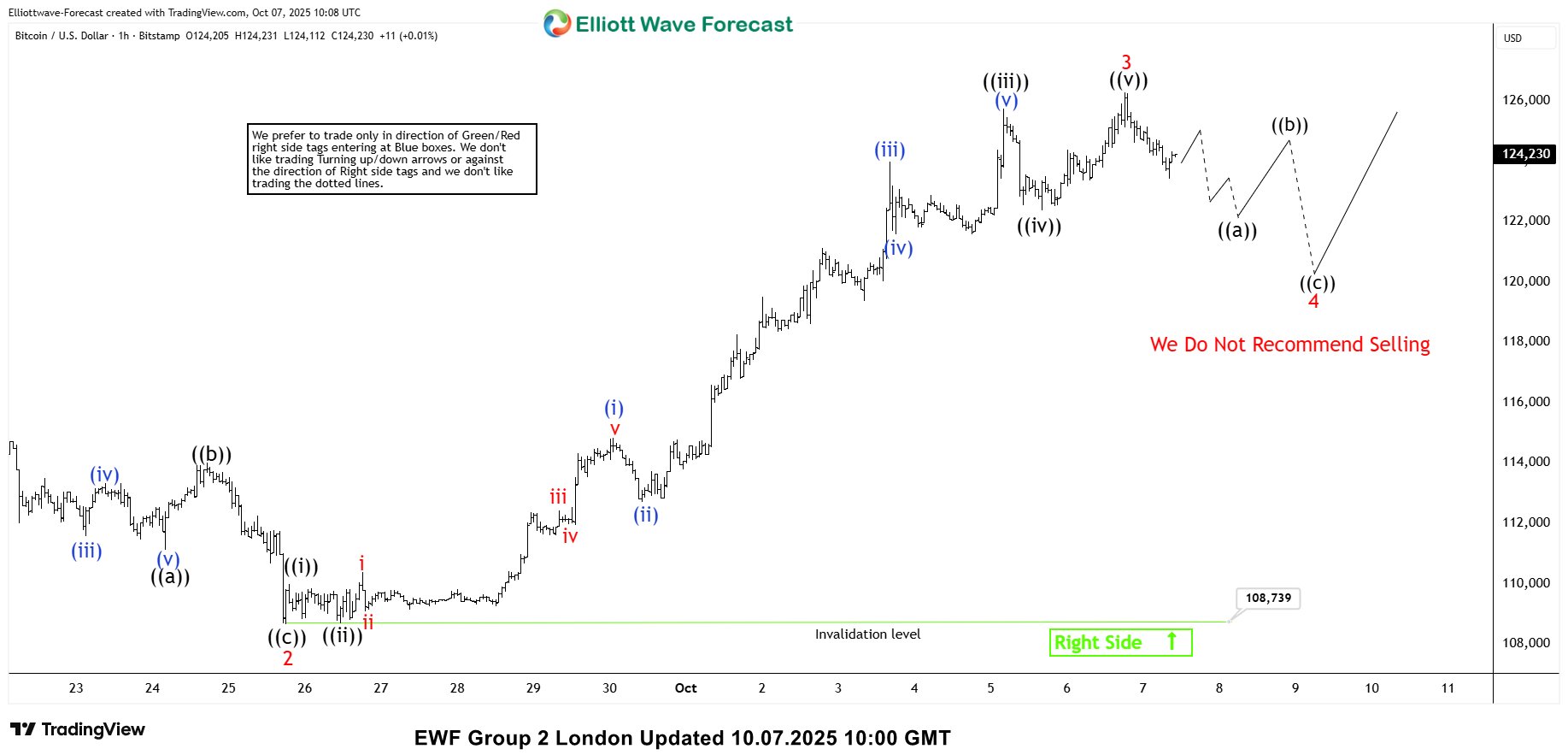
BTCUSD Elliott Wave 1 Hour Chart 10.07.2025
The current view suggests that Bitcoin is undergoing a correction against the 108,739 low. The cycle from that low unfolded in a clear 5-wave structure, completing at 126,237. While below this high, we expect to see a 3-wave pullback in wave 4 red before the next rally resumes.
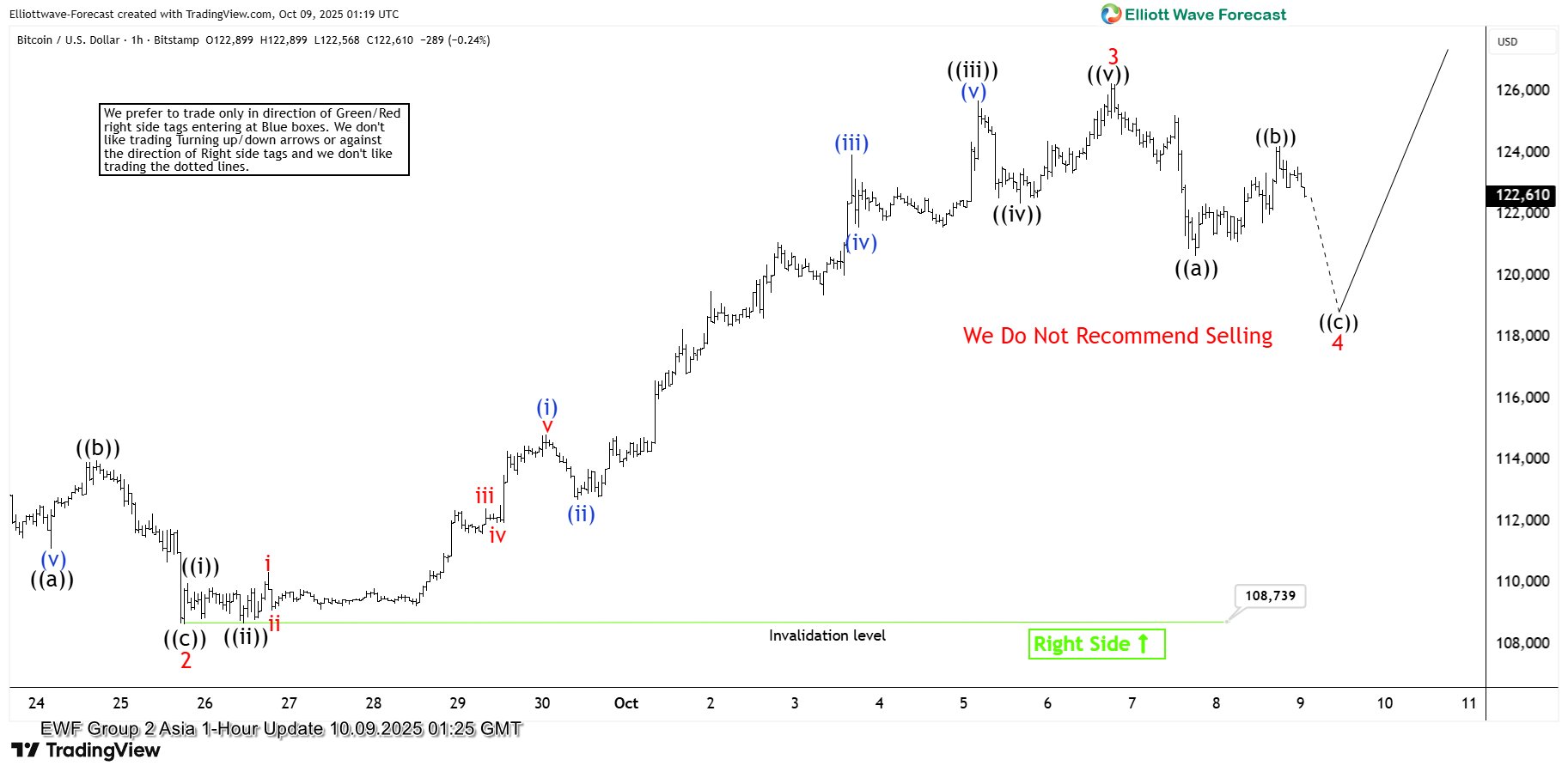
BTCUSD Elliott Wave 1 Hour Chart 10.09.2025
The pullback unfolded in 5 waves down from the peak, which is considered the first ((a)) leg of a potential Zigzag pattern. This was followed by a 3-wave bounce in the ((b)) leg. While below 124,203, we consider wave ((b)) complete and are now calling for a move lower in wave ((c)), targeting the 118,681–115,250 area (buying zone). In this area, we expect buyers to appear for either a further rally or at least a 3-wave bounce.
How Investors and Traders Can Gauge US Labor Market amid BLS Shutdown
The US government shutdown, which began at midnight on October 6, shows no sign of ending soon — and many now expect it could at least become the second-longest in US history.
Despite six Democratic attempts to pass a funding bill, the Senate has repeatedly rejected proposals to reopen the government.
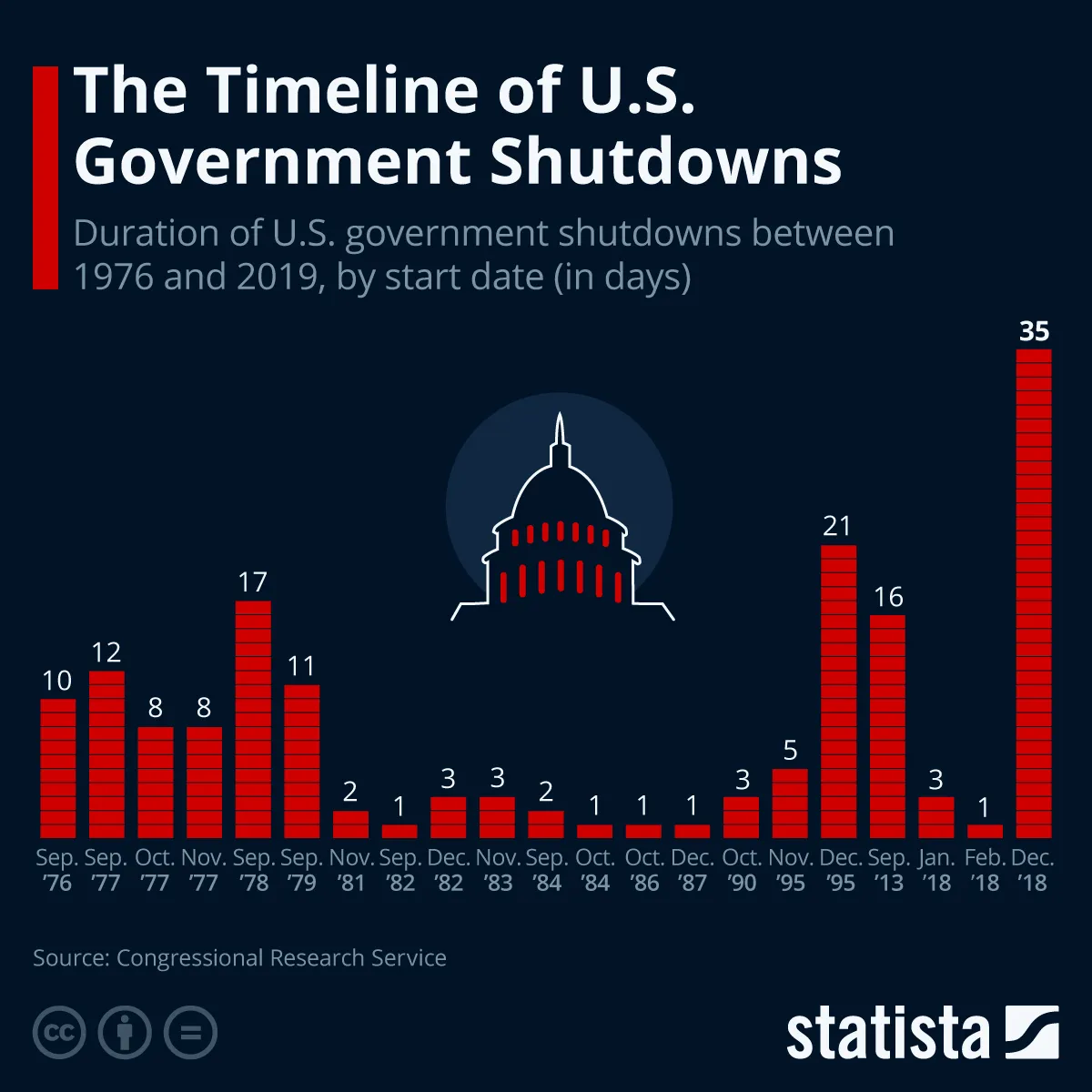
Length of the different US Government shutdowns – Source: Statista - Reposting of the graph published in our October 2 Market Wrap
The current shutdown has been ongoing for nine days already – The length of it already surpasses 14 of the previous ones, with some lasting only one day, like during the 1980s.
There are, however, faint hopes for a resolution, with growing pressure from agencies, unions, and private-sector partners potentially pushing lawmakers to reach a deal in the coming weeks.
Because of the ongoing shutdown, even Marco Rubio, one of the US top diplomats, will not be able to attend the Paris meeting about the future for Gaza, as peace in the Middle East comes closer.
For now, the impact on economic visibility is clear. With most “non-essential” government functions halted, the Bureau of Labor Statistics (BLS) — responsible for the Non-Farm Payrolls (NFP) and Weekly Jobless Claims — is temporarily closed.
This leaves traders and analysts without two of the most critical labor market indicators.
So, where can investors look to fill the data gap and gauge the health of US employment while the shutdown persists? Let's discover this just below.
Private data makes a comeback
Private surveys provide valuable insight into the US labor market.
While they typically move markets less than official BLS data, they’re now attracting increased attention amid the government shutdown.
The most widely followed — and most market-moving — is the ADP Private Employment Report, which recently showed a decline of 32,000 jobs. It is getting more attention, particularly as it provides a seemingly more precise picture (when looking at the huge revisions from BLS data in 2025).
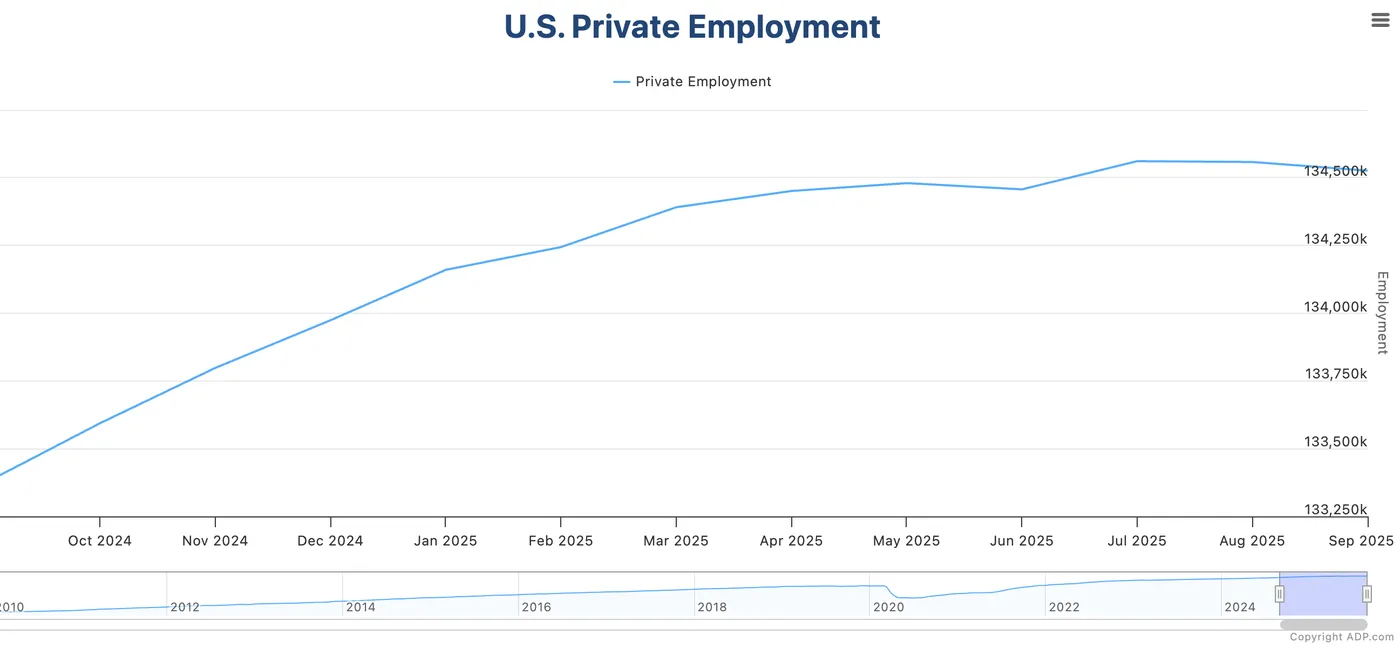
ADP Private Employment in the past 12 months, starting to plateau – Source: ADP Employment
Other indicators help to fill the gap: the Challenger Job-Cut Report offers a monthly look at layoffs, while the Gallup Job Creation Index (released quarterly, so not very timely) gives a sentiment-based measure of hiring conditions.
The ISM Manufacturing and Services PMIs also include employment sub-indexes, offering additional clues about job trends across sectors.
Even private institutions have stepped up their data releases — for instance, a Bank of America survey showed slower job growth and rising claims despite steady wage gains, and Carlyle Group estimated that the US added just 17,000 jobs in September.
While the ADP report remains the benchmark among these alternatives, this period could see new private datasets gain prominence — especially those that prove more consistent or predictive of official labor trends once BLS operations resume.
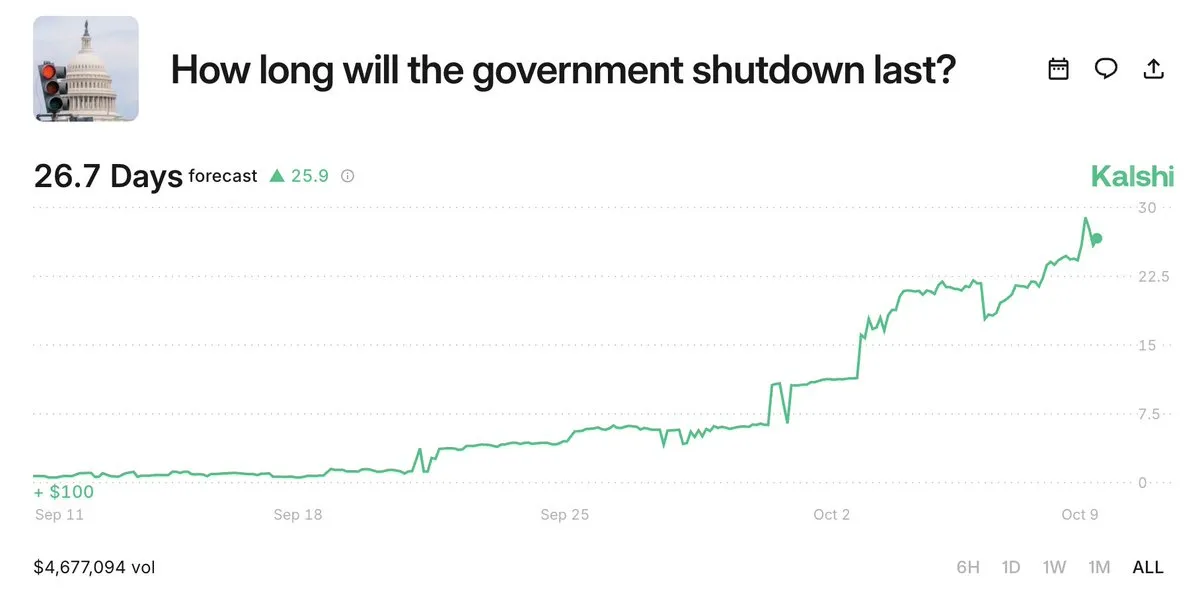
Prediction-Markets Shutdown length expectations, October 9, 2025 – Source: Kalshi
Public data also isn't done yet
Public data isn’t totally absent when assessing the US labor market — a few key Federal Reserve surveys continue operating even during the shutdown.
These surveys offer timely snapshots of employment trends across various districts, providing indirect but valuable clues about hiring and job stability.
The New York Fed’s Empire State Manufacturing Survey (the most market-moving) and the Philadelphia Fed’s Manufacturing Business Outlook Survey ask firms whether employment and work hours are rising or falling, giving an early read on hiring momentum in the Eastern US.
The Richmond Fed runs manufacturing and service sector surveys, where companies report payroll changes and labor availability.
Further west, the Kansas City Fed’s Tenth District surveys and the Dallas Fed’s Texas Manufacturing and Service Outlooks measure shifts in employment and wages through monthly questionnaires sent to local businesses.
Though these regional reports vary in scope, their employment sub-indices tend to move consistently with national labor data, making them valid proxies until the Bureau of Labor Statistics resumes regular publication.
Individual Fed regional presidents tend to mention these studies when they appear, which helps them assess their own decision-making during FOMC meetings.
Too Long, Didn't read – What data releases should I focus on as a trader
Private Surveys:
- ADP Private Employment (released monthly)
- Challenger Job Layoffs
- Employment Sub-Indexes from the ISM PMI data
- Bank surveys like those offered from the Bank of America
Public Surveys, mostly from the Federal Reserve
- New York Fed’s Empire State Manufacturing Survey
- Richmond Fed's Manufacturing Survey
Markets don't seem to care too much about the shutdown, at least for now
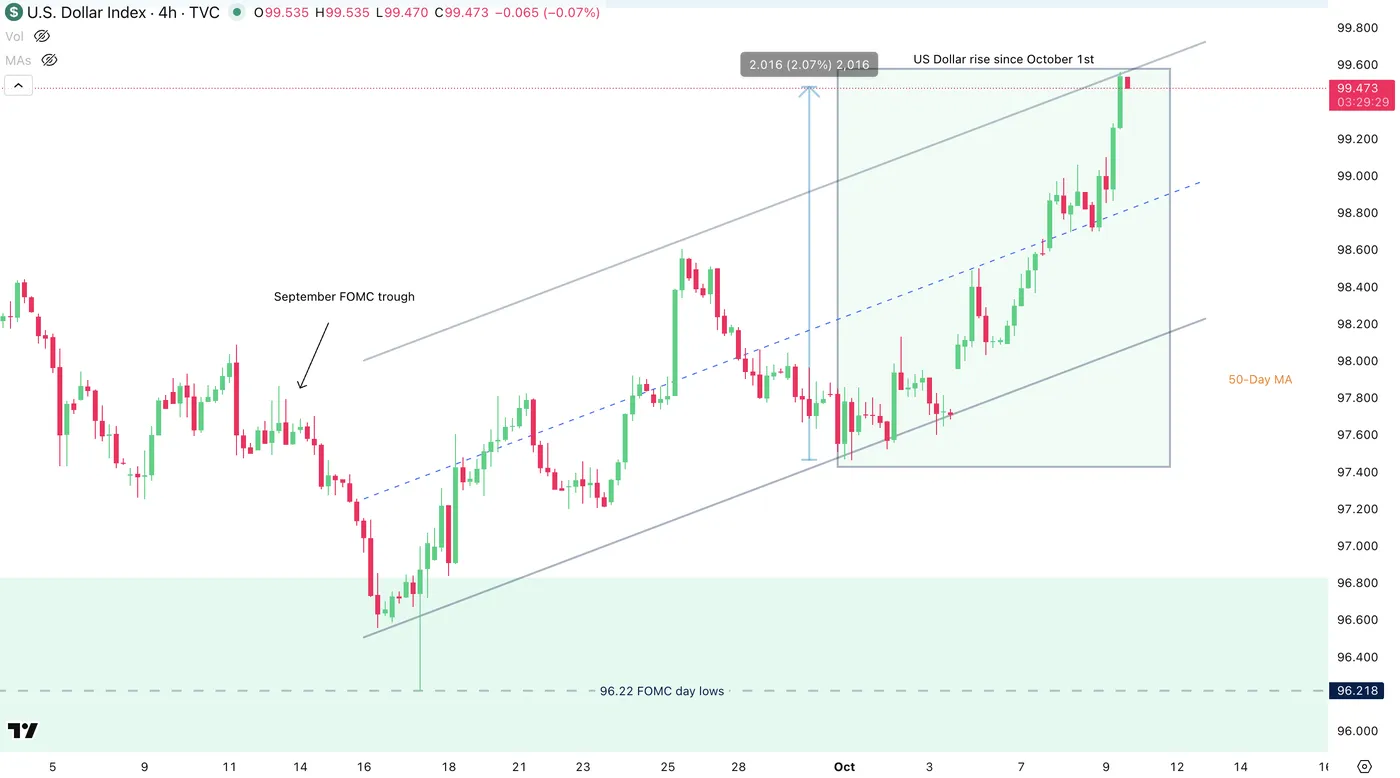
US Dollar Index (DXY) 4H Chart, October 9, 2025 – Source: TradingView
The US Dollar is up 2% since October 1st, not showing the slightest care.
Even legendary traders and Hedge Fund managers like Citadel's Ken Griffin repeat that the shutdown will have no material impact for Markets.
Still, Markets start to react when nobody seems to care anymore, so keep your eyes open.
Safe Trades!
An Unusual Pattern Emerges in NZD/USD After 50 bps Cut
The New Zealand Dollar has been under heavy pressure in recent weeks, weighed down by a string of disappointing economic data, including a sharp GDP contraction that surprised markets and pushed the RBNZ toward a more dovish stance.
But markets often move in unexpected ways.
Despite the policy decision being split between a 25 bps and 50 bps cut, and the RBNZ ultimately choosing the larger move, NZD/USD didn’t tumble as far as expected.
In fact, buyers stepped in, bringing the pair back to nearly unchanged levels by the close of yesterday's session.
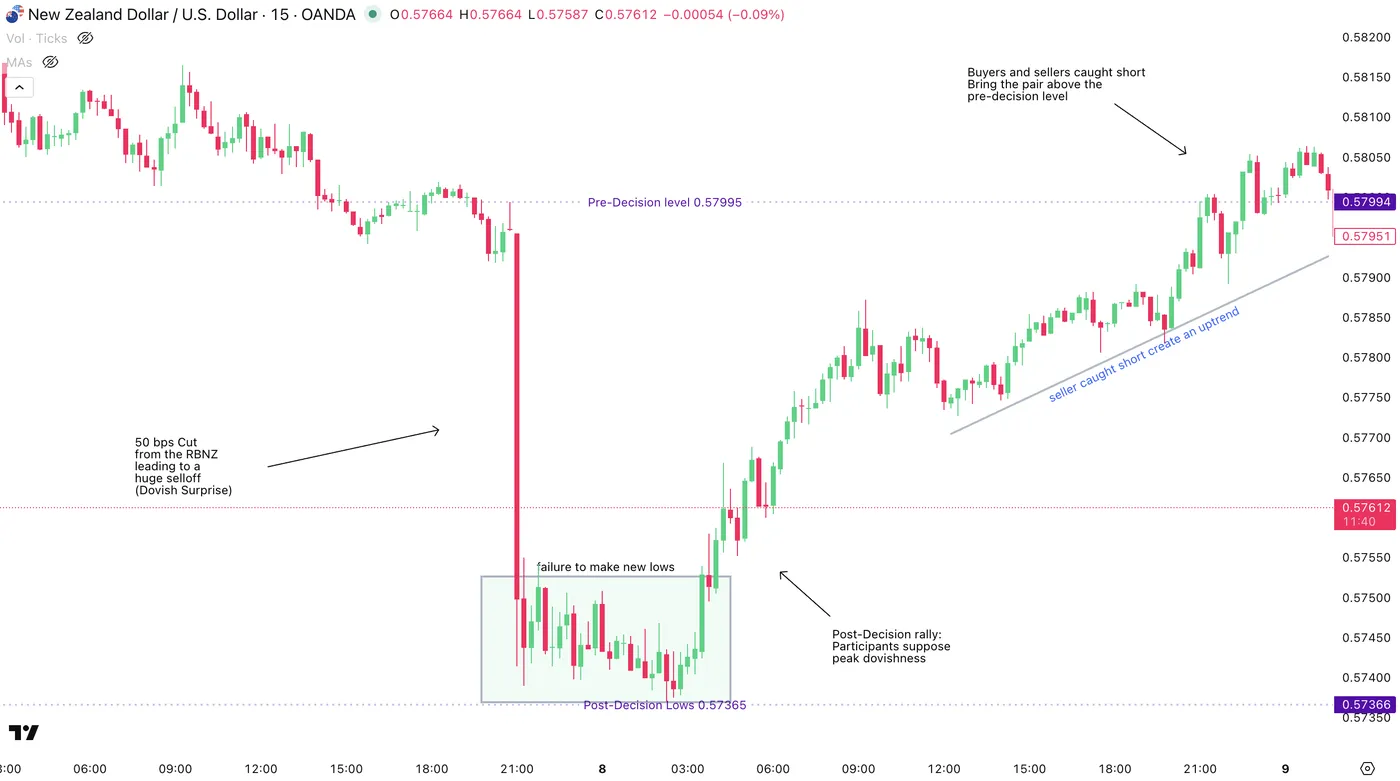
NZD/USD Intraday 15m Chart – October 9, 2025 – Source: TradingView
So, what explains this counterintuitive reaction?
Markets are forward-looking — a larger cut today reduces the need for aggressive easing later, prompting traders to reassess what might have been peak dovishness.
In other words, Participants assess that the RBNZ will have less to do from here.
A look at the following Rate pricing for the RBNZ
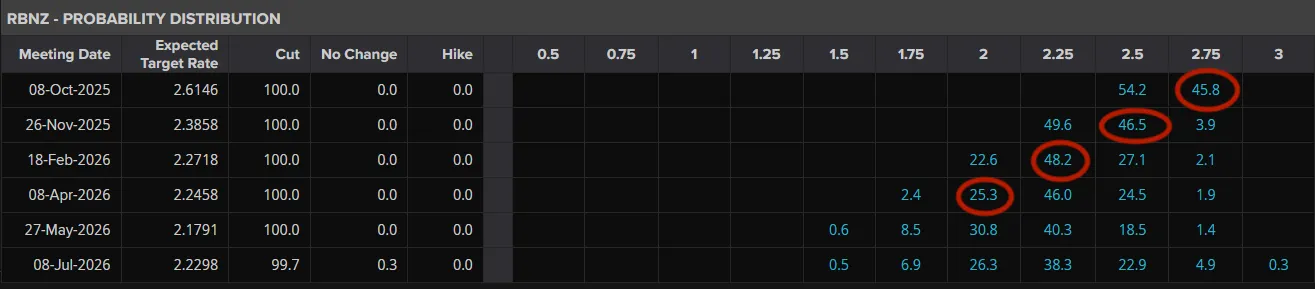
Pre-RBNZ Rate Cut pricing – October 7, 2025 – Source: LSEG
A 25 bps cut would have led to a longer rate cut path: A 2% Neutral Rate would have been reached in April 2026, taking the New Zealand economy longer to recover.
The red circles follow a 25 bps, slower rate cut path.
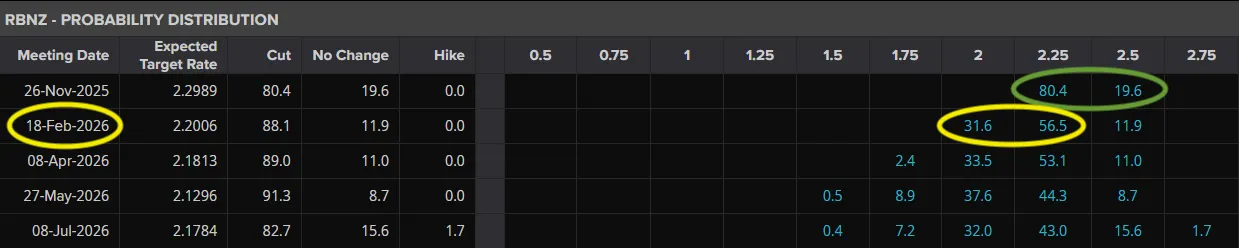
Post-50 bps cut RBNZ Pricing – October 9, 2025 – Source: LSEG
The new pricing shows that the cut cycle is priced to end in February 2026 – Hence, faster recovery for the New Zealand economy.
Sellers now aim to test yesterday's lows to see if the yearly bottom has been found after failing yesterday.
We’ll now look at NZD/USD key levels to see where is the current bottom and if a new one could then emerge.
NZD/USD 2H Chart and levels
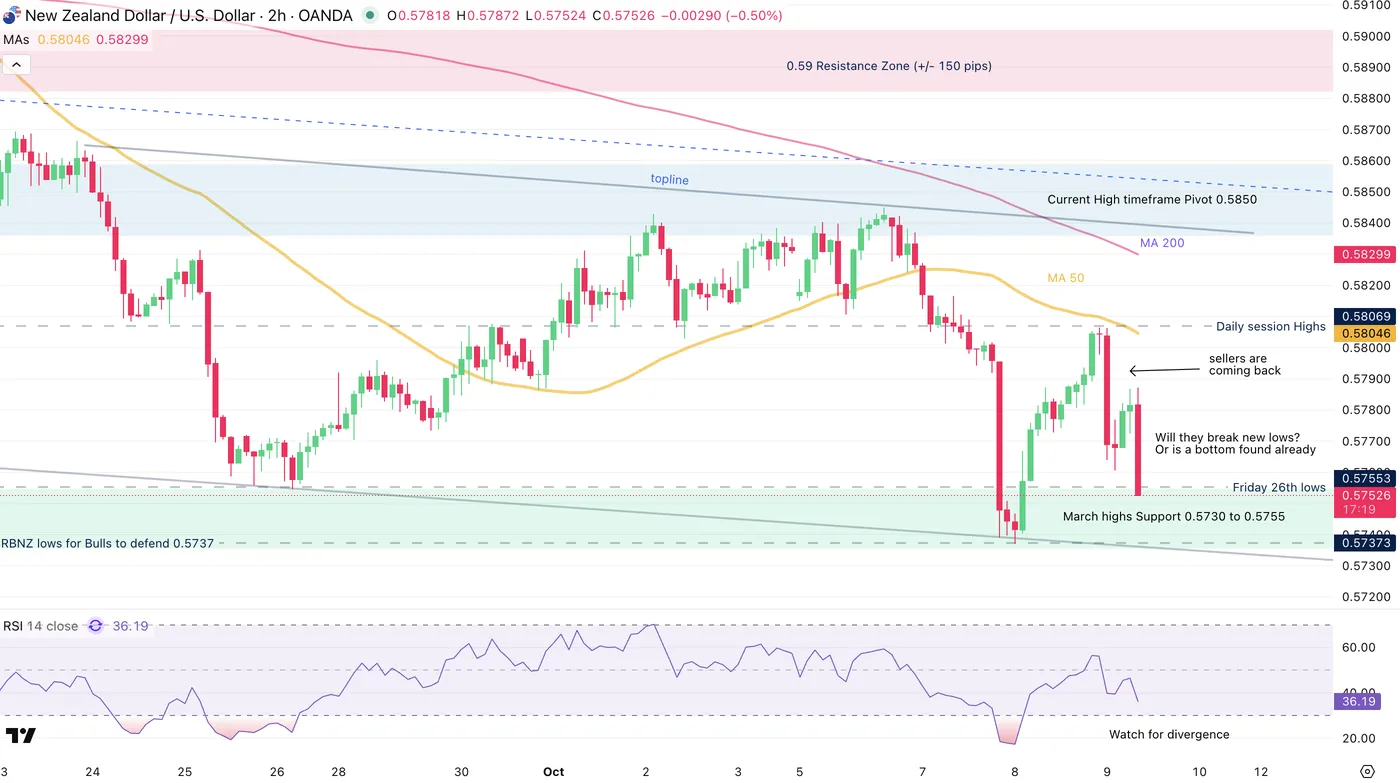
NZD/USD 2H Chart, October 9, 2025 – Source: TradingView
Amid a US Dollar rebound, sellers have found a place to sell the pair after re-testing the 4H 50-period Moving Average.
Will the pair reach new lows, or has a bottom been found after the Jumbo rate cut?
This marks key breakout points to follow for the pair:
A break above the daily highs (0.58070) should confirm the intermediate bottom.
A downside break would imply further weakness in the NZD is expected.
Levels to keep on your NZD/USD charts:
Support Levels:
- March highs Support and Channel lows 0.5730 to 0.5755
- Yesterday lows for Bulls to defend 0.5737
- 0.5650 March Lows Support
- 0.56 Psychological Level
Resistance Levels:
- Session highs and breakout level: 0.58070
- Current High timeframe Pivot 0.5850, topline and MA 200
- 0.59 Main Resistance Zone (+/- 150 pips)
Safe Trades!
Dow Jones Technical Outlook: Dow Tests Key Confluence Level. Is Another 500 + Point Slide Incoming?
The Dow Jones Index is on the back foot today continuing its bearish trend this week which started with Monday's retreat from the recent highs.
The lack of US data due to the US government shutdown has left markets with few catalysts to look forward to. A host of Federal Reserve policymakers including Fed Chair Powell have also done little to inspire any volatility this week.
Looking at the current Fear and Greed index, and it is hovering in neutral territory as well.
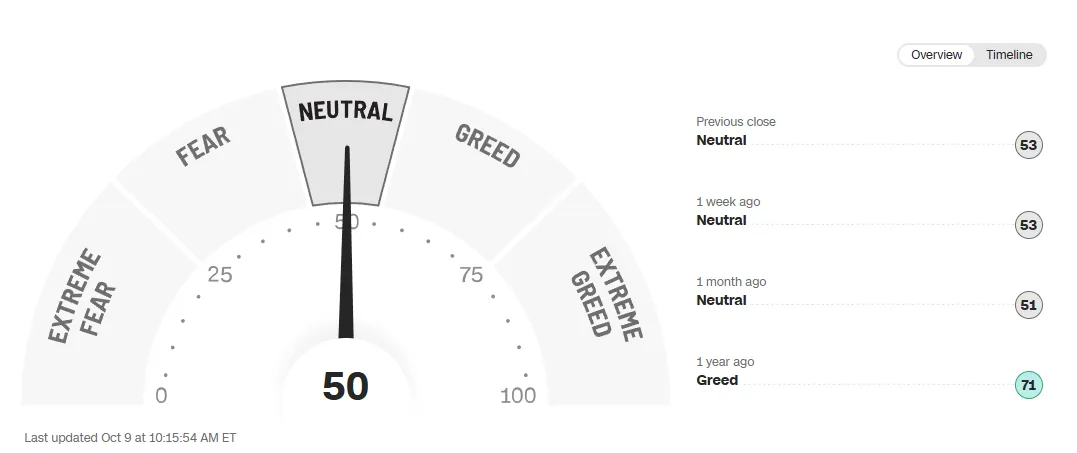
Source: FinancialJuice
Given the current malaise we are seeing in US stocks this week and with the lack of US data releases the technicals and chart patterns that develop tend to be more reliable. Let us take a look at what the Dow Jones chart and technicals are telling us.
Technical Outlook - Dow Jones, S&P 500
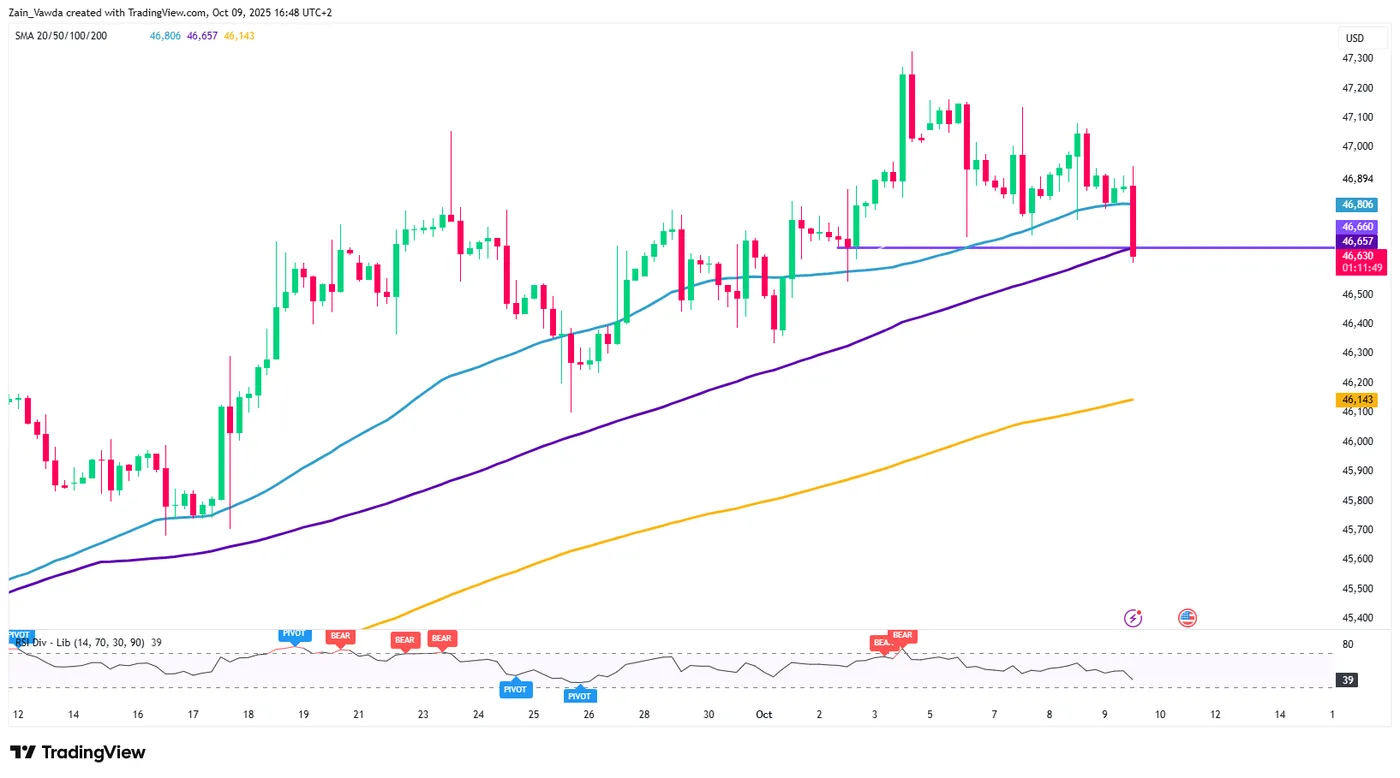
From a technical standpoint, the Dow Jones Index on the four-hour chart below has been printing lower highs and lower lows since Friday October 3.
The period-14 RSI has also crossed below the 50 neutral level hinting at a shift in momentum from bulls to bears.
As things stand, price is at a key confluence level around the 46660 mark which was the swing low on October 2 and holds the 100-day MA.
A break of this level could lead the Dow Jones index to decline some 500 points to test the 200-day MA which rests at 46143 with a move beyond that opening up a retest of the psychological 45000.
If the Dow finds support at this confluence level, immediate resistance rests at 46900 before the swing highs at 47050 and 47160 come into focus.
Dow Jones Four-Hour Chart, July 16, 2025
Source: TradingView (click to enlarge)
If the Dow does drop, the move may not be a big one. History suggests the current bull market may still have room to run despite Wall Street's impressive performance over the last few years. Let us take a look.
History Suggests Bull Market May Have More Upside Potential
The current upward trend, or "bull market," in the U.S. stock market is nearly three years old, but historical patterns suggest it might only be halfway through its lifespan.
This bull market officially began on October 12, 2022, when the S&P 500 index hit its lowest point after a period of interest rate hikes by the Federal Reserve. Since then, the index has been soaring, recently hitting a series of record highs, driven primarily by a massive surge in large technology stocks. The S&P 500 is up almost 90% since its 2022 low.
However, this gain is still less than the historical average increase of over 170% for past bull markets, which have typically lasted about five years. Interestingly, the market's performance over the past year (its third year) has been very strong, with a gain of over 15%, marking the strongest third-year performance of any bull market since 1957.
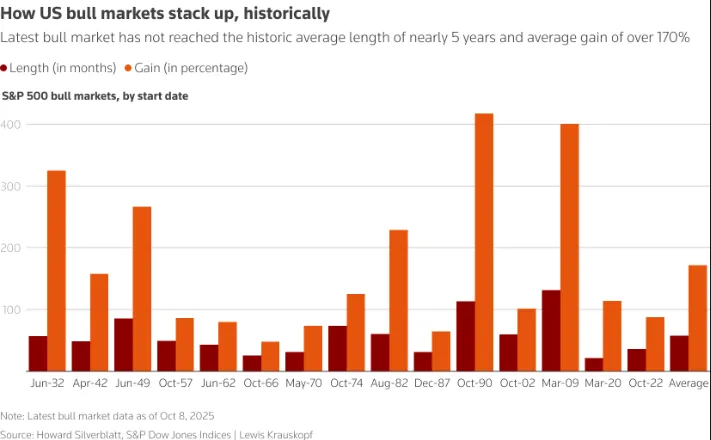
Source: LSEG
Despite the overall strong performance, the market's gains have been very concentrated. While the standard S&P 500 is up nearly 90%, the equal-weight S&P 500 (which shows the performance of the average stock, not just the biggest ones) has only risen 49%. This difference shows that only the largest "megacap" stocks are truly driving the headline index higher.
Some investors are now hopeful that when the Federal Reserve begins to cut interest rates, it will broaden the rally and allow smaller, average stocks to finally catch up.
Now of course this is looking at the S&P 500 but one cannot ignore the knock on impact it has on Wall Street as a whole. The correlation between the S&P500, Nasdaq 100 and the DOw Jones index during the current bull run have been there for all to see. This leaves me thinking that even if there is a lag, the Dow will also benefit from further gains should this bull rally extend for another two years.
Fed’s Williams sees lower rates this year, tariff impact on inflation as limited
New York Fed President John Williams said in an interview with The New York Times that he still expects interest rates to be lower by year-end, but emphasized that the pace and extent of easing will depend on incoming data.
When asked about the possibility of two additional 25bps reductions, Williams said that would depend on whether inflation and employment evolve broadly in line with his outlook. He expects inflation to "move up a bit to around near 3%" and unemployment to edge slightly higher, in which case “policy should evolve the way we expect.”
But he warned against complacency, noting that it would be “very damaging to the economy and the Fed’s credibility” if inflation were allowed to rise well above 2% without action.
Williams downplayed fears that President Donald Trump’s tariffs were fueling persistent inflation. He estimated the measures have lifted the price level by only 0.25 to 0.5 percentage point, adding that “underlying inflation seems to be moving gradually lower toward 2%.” He also said there were no signs of second-round effects, suggesting tariffs are having limited spillovers on broader price dynamics.
At the same time, Williams pointed to rising downside risks to employment, which he said were offsetting some of the upside risk to inflation.
Sunset Market Commentary
Markets
Investors on both sides of the Atlantic are facing a deep eco radio silence these days. The Minutes of the September Fed meeting yesterday indicated that a large majority of governors subscribed chair Powell assessement that downside risks to the labour market warranted a scaling back monetary restriction. However, the document showed little guidance on the timing/pace of additional steps on which governors had highly divergent views. With the policy rate still above neutral, markets for now have little reason to change their positioning, pricing about two additional steps 25 bps cuts end October and in December. NY Fed President Williams puts himself on the dovish side, indicating he will support lower rates this year of the economic evolves as expected (including inflation moving up to around 3% and the unemployment rate inching up beyond its current level of 4.3%). Even so, markets understand that even his (influential) position is only one ‘dot’ in a highly dispersed map. US yields today are ‘raising’ between about 1.5-2.5 bps across the curve. The focus now turns to this evening’s $22 bln 30-y Treasury action. Yesterday’s 10-y sale only met mediocre buying interest. How much will the fiscal stability topic still affects the 30-y sale? EMU/German yields also are holding very tight ranges (0.5 -2 bp higher). The Minutes of the September ECB policy meeting as expected indicated little reason for the bank to react to short-term deviations (cf infra). Even France today isn’t able to provide some directional bias. Outgoing Prime Minister Lecornu yesterday informed President Macron that a basis of lawmakers is prepared to provide a ‘platform of stability’ to help fabricating a 2026 budget. Even so, it currently is far from clear who will be prepared/able to finalized this Herculean task. (French) bonds at least don’t aggressively front run on a positive outcome yet. The 10-y spread of French bonds over swap still trades near 84 bps, compared to peak levels of near 88/90 earlier this week. European equity markets show no clear trend (Eurostoxx unchanged, CAC40 +0.4%). US indices open mixed/little changed.
In FX markets, the dollar remains the ‘by-default’ outperformer, but also here the ‘conviction’ of the move is fading a bit. DXY surpassed 99, but struggles to hold on. Over the previous days, the dollar mainly profited from (political) uncertainty haunting the euro and the yen. EUR/USD, despite current calm on/in France, is still fighting an uphill battle (currently 1.161). A break below 1.1574 brings the 1.1392 August low on the radar. With respect the yen, we have to impression that the decline at least might slow. The pair still touched an new ST peak north of 153. However, the question gradually looms how far the yen can weaken before the BOJ will be ‘forced‘ to still raise its policy rate, whatever the ‘guidance’ from a new government.
News & Views
Portugal’s 2026 budget bill has stronger growth penciled in as well as a small surplus for the fourth consecutive year. The center-right minority government expects the economy to grow at a 2.3% clip next year, compared to an anticipated 2% in 2025. The projected budget surplus of 0.1% comes even as Portugal plans tax cuts for companies and families, allowing the public debt ratio fall further from a peak of more than 134% in 2020 to 90.2% this year and 87.8% in 2026. The bill marks once more the stark and growing contrast between the southern European periphery (remember PIGS) that used to underperform the semi-core. The likes of France and Belgium are currently facing a daunting budget task with the former not even having a stable government in place to take up the gauntlet.
"The current level of interest rates should be seen as sufficiently robust in managing shocks, in view of two-sided inflation risks and taking into account a broad range of possible scenarios.” The conclusion in the ECB’s meeting minutes was a pretty straightforward one. "Several" thought inflation was at risk of undershooting the bank's 2% target and a "few" feared for the opposite to happen. But with ECB’s Lagarde in recent comments noting that the range of risk around the inflation was narrowing, there is little reason to expect much changes to the policy rate short-term. The ECB acknowledged, however, that the current situation was likely to change materially at some point, but it it’s difficult to know when and in which direction. That makes waiting for more information the best option for the time being. ECB policymakers agreed that their June forecast was largely materializing, resulting in a rates status quo at 2% and more or less unchanged September projections.
EUR/USD Mid-Day Outlook
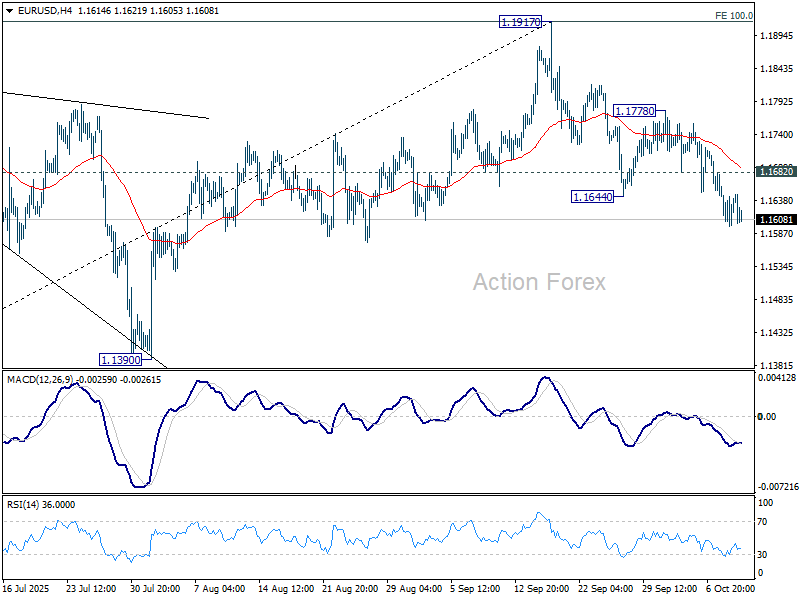
Daily Pivots: (S1) 1.1598; (P) 1.1631; (R1) 1.1662; More...
Intraday bias in EUR/USD remains on the downside for the moment. Fall from 1.1917 is in progress and deeper decline should be seen to 1.1390 support, or even further to 38.2% retracement of 1.0176 to 1.1917 at 1.1252. On the upside, above 1.1682 minor resistance will turn intraday bias neutral first. But risk will stay on the downside as long as 1.1778 resistance holds, in case of recovery.
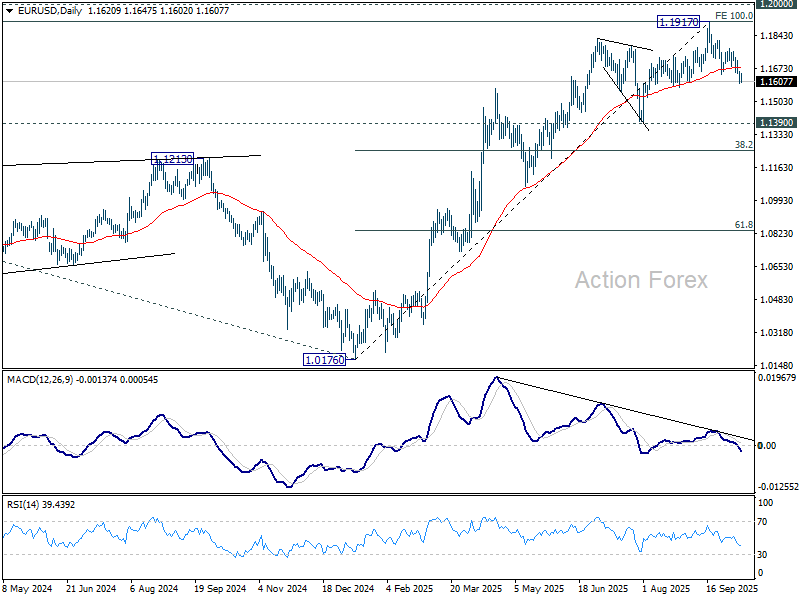
In the bigger picture, rise from 1.0176 (2025 low) is seen as the third leg of the pattern from 0.9534 (2022 low). 100% projection of 0.9534 to 1.1274 from 1.0176 at 1.1916 was already met. For now, further rally will remain in favor as long as 1.1390 support holds, and firm break of 1.2000 psychological level will carry larger bullish implications. However, firm break of 1.1390 will suggest that rise from 1.0176 has already completed and bring deeper fall to 55 W EMA (now at 1.1265) and below.
GBP/USD Mid-Day Outlook
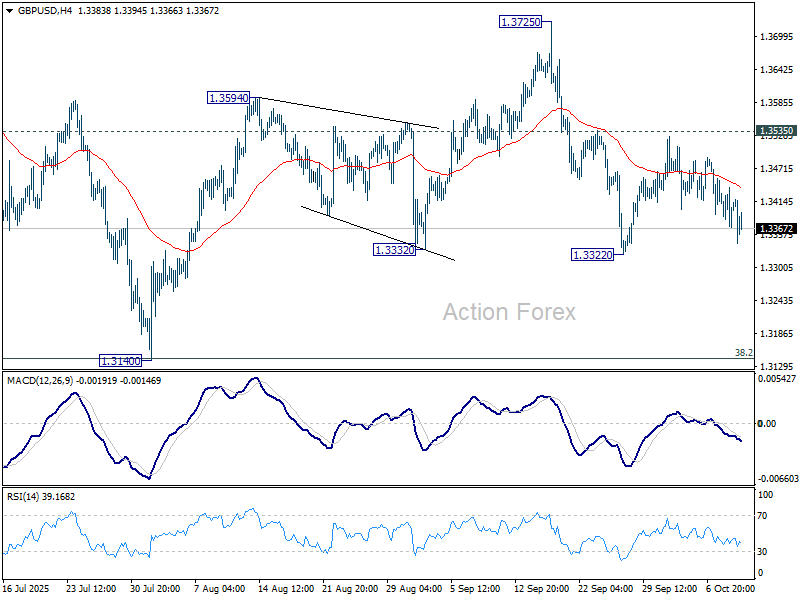
Daily Pivots: (S1) 1.3369; (P) 1.3407; (R1) 1.3442; More...
GBP/USD is still bounded in range above 1.3322 and intraday bias remains neutral. With 1.3535 resistance intact, further decline is mildly in favor. On the downside, break of 1.3322 will resume the fall from 1.3725 to 1.3140 support. On the upside, though, firm break of 1.3535 will argue that pullback from 1.3725 has already completed, and bring stronger rise to retest 1.3725/87 key resistance zone.
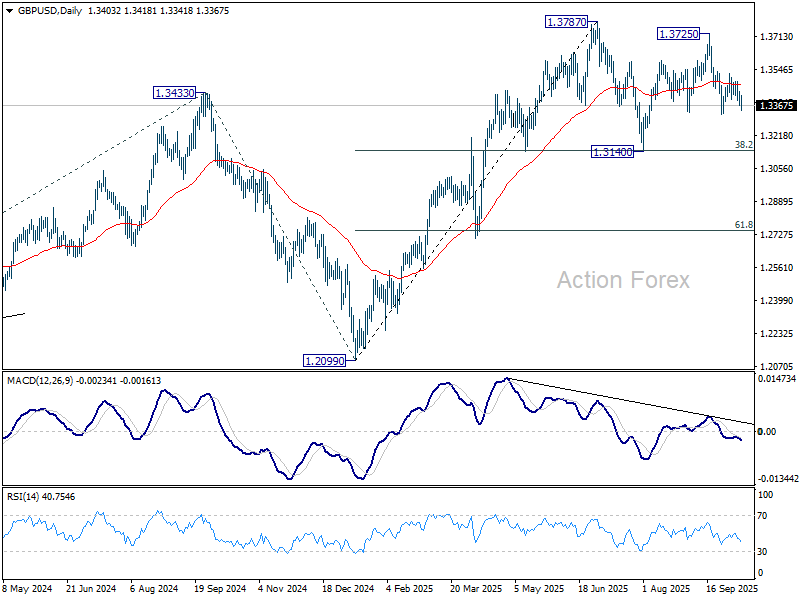
In the bigger picture, rise from 1.0351 (2022 low) is still seen as a corrective move. Further rally could be seen to 61.8% projection of 1.0351 to 1.3433 (2024 high) from 1.2099 (2025 low) at 1.4004. But strong resistance could be seen from 1.4248 (2021 high) to limit upside. Sustained break of 55 W EMA (now at 1.3176) will argue that a medium term top has already formed and bring deeper fall back to 1.2099.
USD/CHF Mid-Day Outlook
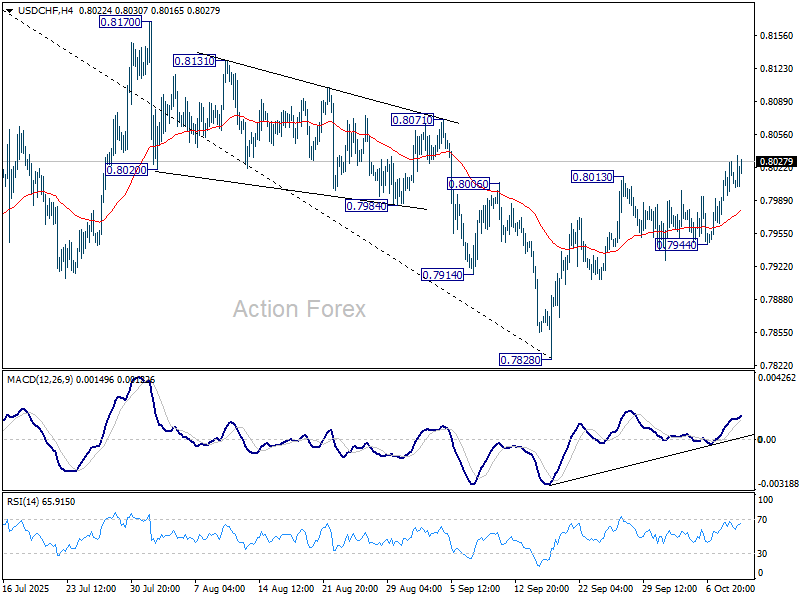
Daily Pivots: (S1) 0.7988; (P) 0.8008; (R1) 0.8040; More…
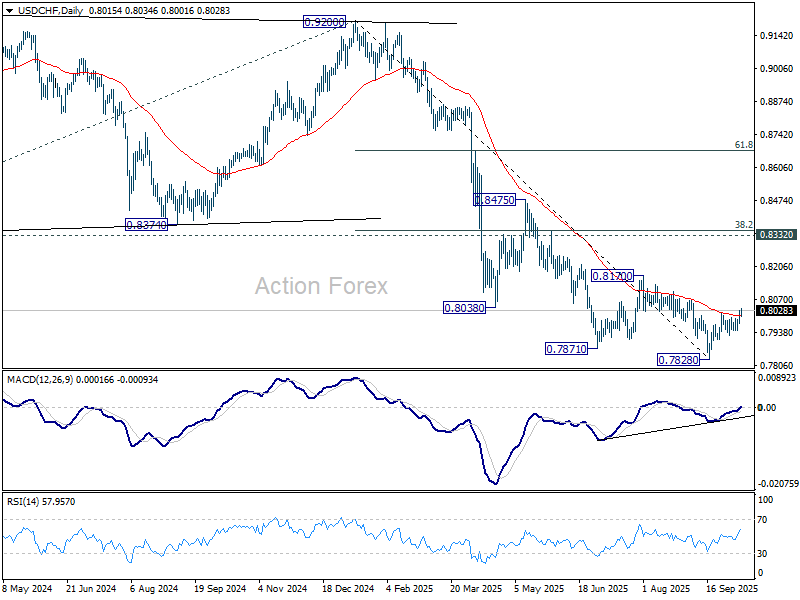
USD/CHF's rise from 0.7828 is still in progress and intraday bias stays on the upside. Sustained trading above 55 D EMA (now at 0.8004) will suggest that rise from 0.7828 is already correcting whole fall from 0.9200. Further rally should the be seen to 0.8170 resistance and possibly above. For now, risk will stay on the upside as long as 0.7944 support holds, in case of retreat.
In the bigger picture, long term down trend from 1.0342 (2017 high) is still in progress. Next target is 100% projection of 1.0146 (2022 high) to 0.8332 from 0.9200 at 0.7382. In any case, outlook will stay bearish as long as 0.8332 support turned resistance holds (2023 low).