

Sample Category Title
EURUSD Selloff Deepens as Yearly Highs Fade from View
The Euro had been on a strong run this year, and only a few events could stop its uptrend in the first half of 2025.
Between new infrastructure deals, unification behind the Ukrainian cause, and the constant mess-ups from the Trump Administration, EUR/USD had many reasons go higher.
But Markets are forward-looking, and all these factors have been priced in, with sellers now heavily grabbing control of the price action: The latest EU-US Deal is considered disadvantageous for the EU, and this is turning into a sell-the-fact trade.
The pair's end-June rally has not seen any retracement, and the ongoing selloff is about to make this final up-move to the 1.1830 highs vanish.
The question is: Is the ongoing rally in the US Dollar strong enough to keep pushing the pair down further?
Let’s take a look at the technical patterns moving EUR/USD.
EUR/USD Technical Analysis
EUR/USD Daily Chart
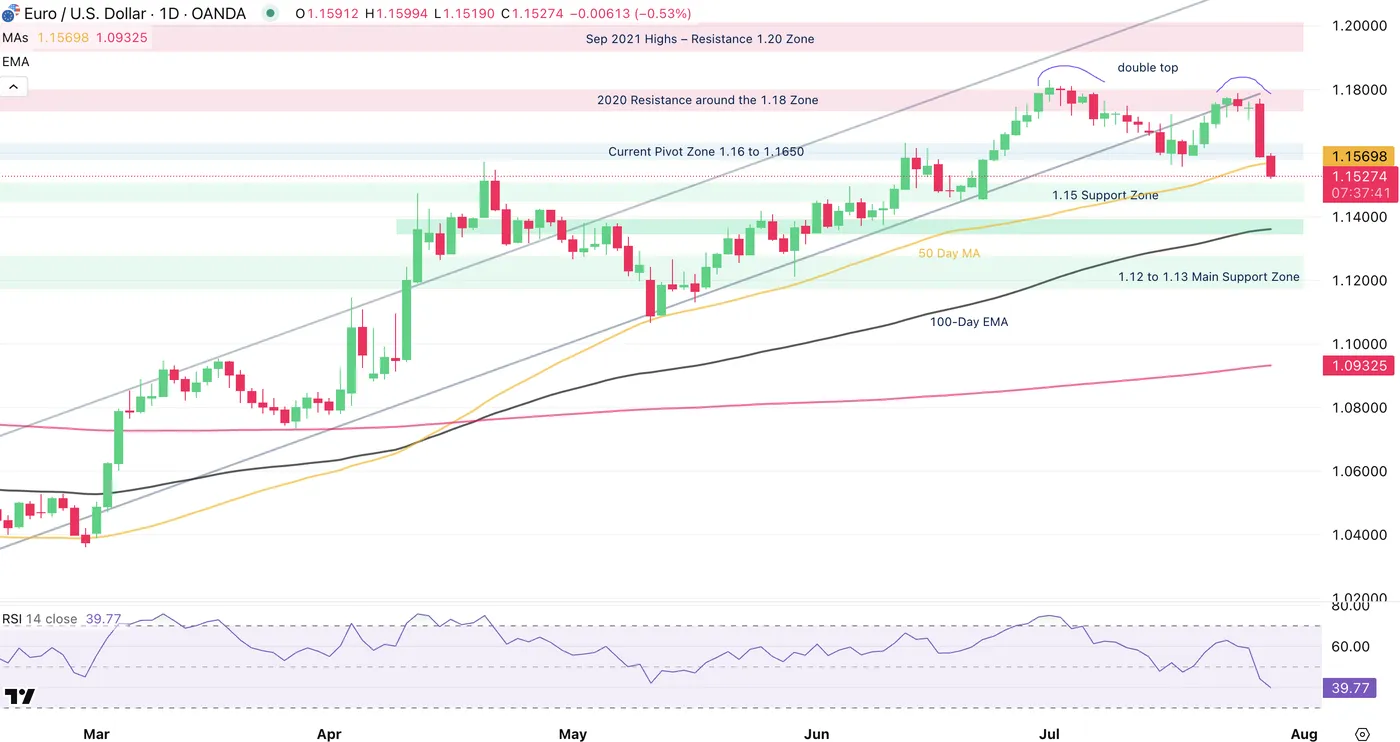
EUR/USD Daily Chart, July 29, 2025 – Source: TradingView
The Pound had led major currencies in the ongoing sell-offs for US Dollar buybacks.
In our most recent US Dollar analysis, we pointed to the formation of a double top. Over the past two sessions, markets haven’t taken it lightly—we are now about three handles lower from the past week's highs.
A daily close right at the Current Pivot Zone 1.16 to 1.1650 after a 1.30% correction in yesterday’s session was followed by another strong selling candle, now breaching below the 50-Day Moving Average.
Daily RSI momentum is now becoming bearish as the sellers bring the pair around the 1.15 Main support Zone.
Let’s take a closer look.
EUR/USD 4H Chart
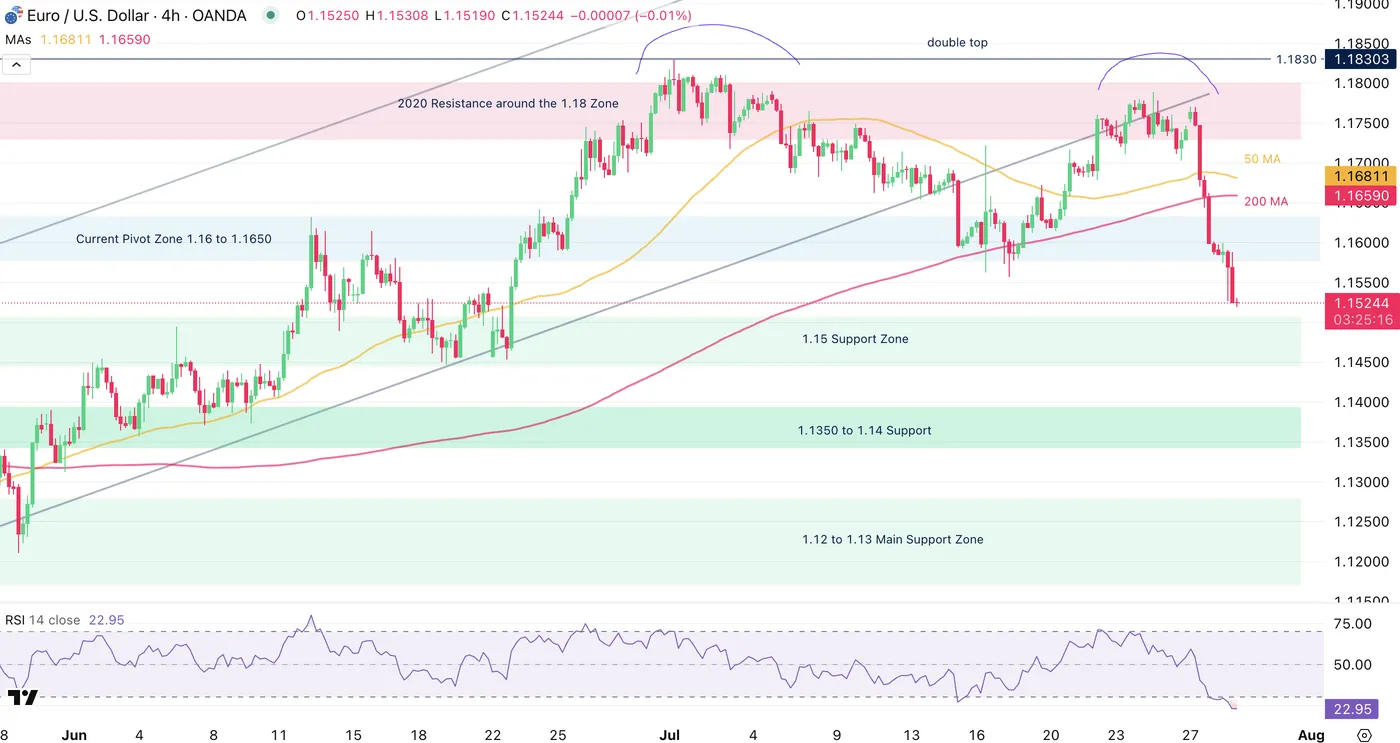
EUR/USD 4H Chart, July 29, 2025 – Source: TradingView
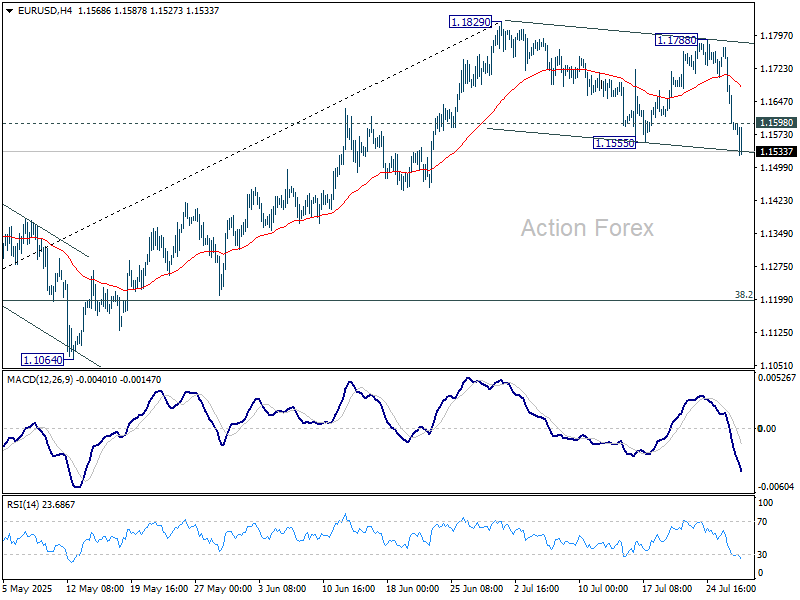
Sellers have had full control since the weekly open, sending the pair in a 2.12% correction.
The ongoing selloff is forming a tight bear channel, and with candles closing at their extremes, momentum is strong. Some mean reversion is currently trying to take place as the 4H RSI is turning oversold.
The 1.15 Support Zone is located just below the psychological level, so reactions as prices arrive in this region will be essential to track – any consolidation in the zone would be considered more bearish than an actual retracement higher but the idea right now is to keep an eye on the ongoing move.
Levels of interest to place on your charts:
Support Levels:
- 1.15 Support Zone (encompassing - 300 pips)
- 1.1350 to 1.14 Support in confluence with the 100-Day EMA
- 1.12 to 1.13 Main Support Zone
Resistance Levels:
- Current Pivot Zone 1.16 to 1.1650
- 1.1660 MA 50 and 200 Confluence
- 2020 Resistance around the 1.18 Zone
- 1.1830 2025 Highs
EUR/USD 1H Chart
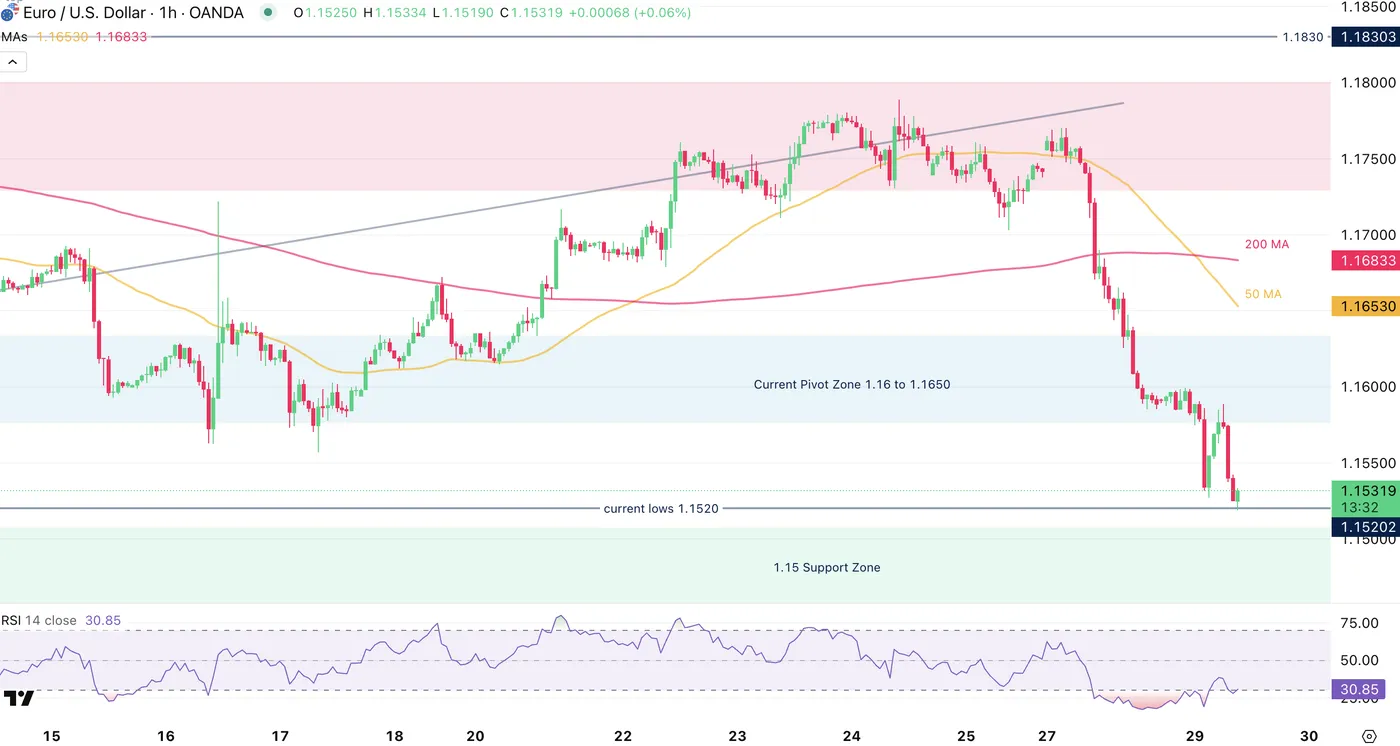
EUR/USD 1H Chart, July 29, 2025 – Source: TradingView
Markets are awaiting to see what happens to the US Dollar after the JOLTS report coming up in about 10 minutes – In the meantime, the selling seems to be slowing down after touching the 1.1520 lows.
Any strong close below warrants a further continuation towards the bottom of the support zone (between 1.1470 to 1.1450).
Reversals on a weaker USD would point to the Pivot Zone – Also consider the 1H MA 50 currently at 1.1650 and catching up to the prices fastly amid this flash-selloff.
Safe Trades!
Sunset Market Commentary
Markets
EUR/USD weakness continues to prevail in the wake of the trade agreement with the US, be it in choppy trading. The common currency wiped out early losses in the European session only to stack them up again in early US dealings. A buy-the-rumour, sell-the-fact correction was nevertheless inbound after failing to move beyond the July high end last week amid rumours of an imminent deal. All of the EUR/USD dips since March of this year were seen as good entry points and we think this time is no different. For the time being though, we wouldn’t row against the tide and let the downleg run its course. That’s particularly so given the high risk of a technical break lower below the 1.1578 neckline of a double top formation. The level is cracking right now and could, in case of a confirmed break, pave the way for a return to 1.1431 initially with 1.1214/1.1184 then popping up as the next reference. Aside from euro weakness, we’re spotting dollar strength as well going into the first releases (JOLTS, Conference Board consumer confidence, cfr infra) of a busy economic calendar this week. The IMF supported the upleg with an upward revision to US growth for this year to 1.9% from 1.8% estimated in April and to 2% (from 1.7%) in 2026. The fund cited lower than expected tariff rates for the move, though warned they still pose a risk for the US (as well as global) economy. DXY takes out the mid-July high to trade north of 99 for the first time since end June. The 99.63/100 barrier serves as the next resistance. The IMF’s updated forecasts for the euro area entail a 1% growth this year (+0.2 ppts) but partially due to a jump in frontloaded Irish pharmaceutical exports to the US. It kept the 2026 estimate unchanged at 1.2%. Global growth expectations were lifted to 3% from 2.8% and 3.1% from 3% for 2025 and 2026 respectively. Rates markets trade pretty quiet with some minor Bund underperformance vs Treasuries. German yields eke out 1.5 bp at the front and middle section of the curve. It’s worth noting that the ultralong end (30-yr) remains near the 14-year highs. US rates are down between 2.8-4.4 bps in a bull flattening move.
US JOLTS job openings in June came in at 7.43 mln, pretty close to the 7.5 mln expected but lower than May’s 7.77 mln. The quits rate – a gauge of confidence in finding a new job after voluntarily quitting one – stabilized at 2%. July consumer confidence measured by the Conference Board meanwhile improved from an upwardly revised 95.2 to 97.2. The present situation was considered slightly worse than the upwardly revised print for June. The expectations component rose from 69.9 to 74.4, the highest since February this year. The US dollar and yields react stoic.
News & Views
The Belgian economy grew by 0.2% q/q in the second quarter of 2025, the National Bank of Belgium’s initial estimate showed today. That’s halve the pace of the first quarter. The year-on-year growth rate stood at 1%, easing from 1.1% in Q1 and maintaining the +/- 1% growth pace in place since 2024. This flash estimate has no expenditure details yet. Instead, the value added approach reveals a 0.1% q/q contraction in the industrial sector while both the construction and services sectors saw positive activity growth of 0.2%.
• Hungary’s economy ministry slashed its growth estimates for this year and the next. GDP may now grow a meagre 1% this year vs an already earlier reduced 2.5% from the initial 3.4% estimate. Economy minister Nagy said the economy may have stagnated in Q2 following a contraction in the first quarter and added that it may grow significantly less than forecast in the second half of the year. Expectations for 2026 were lowered to 3.1% from 4.1%. The struggling economy going into election year 2026 prompted several ad hoc government interventions, including price caps to tame inflation and a series of stimulus measures. The former fail to keep price pressures really in check with inflation remaining above the central bank’s target in June (4.6%), so offering little relief for consumers, but instead weighing on business confidence. The latter put additional strain on already weak public finances. Nagy nevertheless still believes it can reach its earlier upwardly revised 4.1% deficit target for this year. The Hungarian forint weakened abruptly and sharply after the new government estimates. EUR/HUF is testing the 400 barrier again.
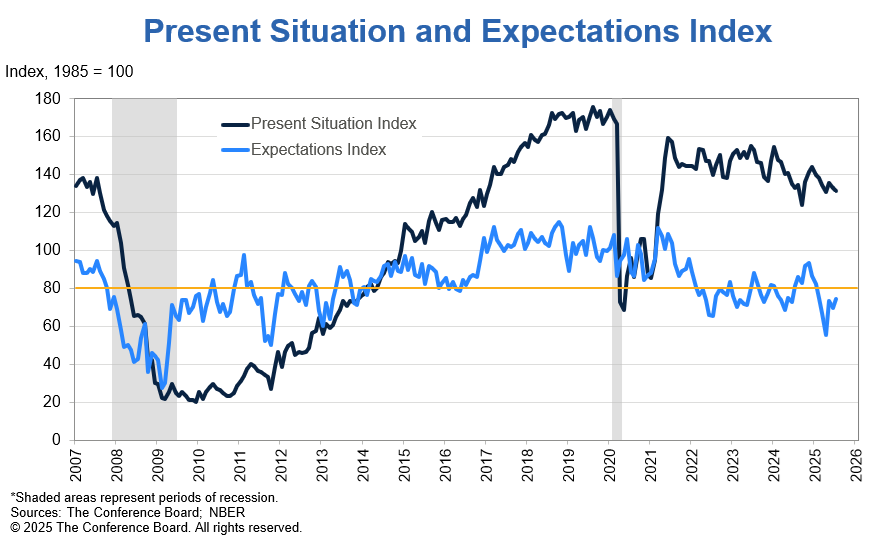
US consumer confidence rises to 97.2, but recession signal persists
US Conference Board Consumer Confidence rose from 93.0 to 97.2 in July, beating expectations of 95.9. Expectations Index climbed 4.5 points to 74.4, signaling a slight improvement in sentiment about future conditions, but remained below the critical 80 threshold, a level typically associated with looming recession risk. Meanwhile, Present Situation Index dipped -1.5 points to 131.5, suggesting consumers’ views on current conditions remain broadly steady.
Stephanie Guichard of The Conference Board noted that while overall confidence has rebounded from earlier weakness, it “remains below last year’s heady levels.” She added that improved expectations on jobs, income, and business conditions helped drive July’s uptick.
Fed Likely to Pave the Way for a Rate Cut in September
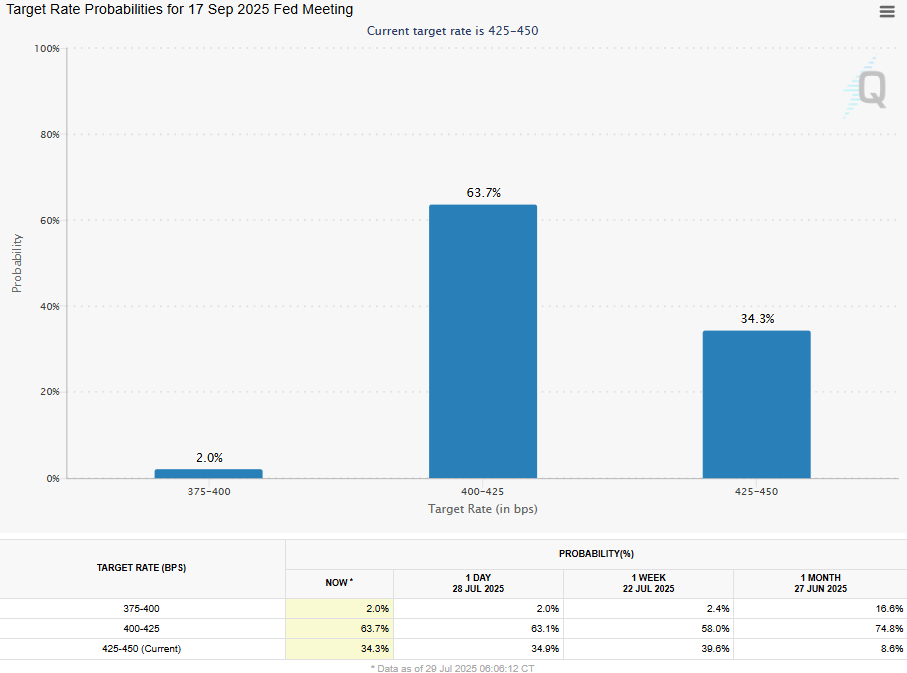
The central event of the current week is the Fed meeting, which has the potential to create significant market movement and set the tone for the coming months. Although there is virtually no chance of a rate cut at the end of July, investors and traders will be closely watching for signals in an attempt to assess the likelihood of policy easing in September.
According to the latest estimates, the futures market is pricing in a 64% chance of a rate cut in September after it was held steady at the end of July. This disposition leaves plenty of room for market expectations to be adjusted, ultimately affecting dollar market dynamics. The Fed prefers to give clearer hints in advance, changing its official commentary at least one meeting in advance. Wednesday’s decision promises to be a compromise between the three camps.
The doves prefer to cut now, noting the deterioration in the private sector employment situation. Two FOMC members have publicly voiced this position.
The largest camp of centrists is open to easing policy later this year. However, they want two more inflation reports confirming the slowdown.
There is also a small camp of hawks who want to see signs of a significant economic slowdown before supporting a rate cut. They note that many years of high inflation may have changed Americans’ perception of the norm. In other words, they fear that inflation is not yet under control.
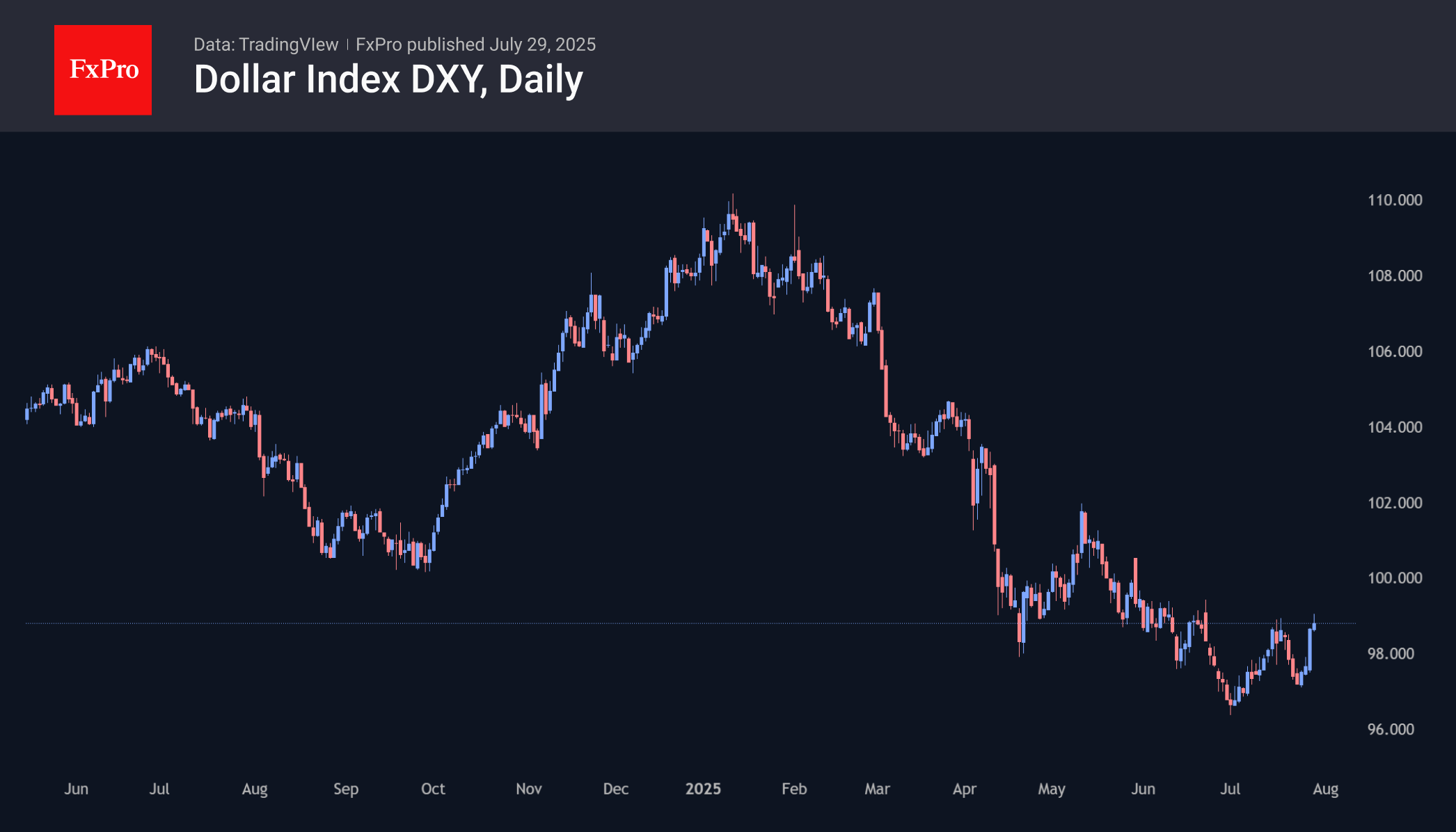
The most rational scenario seems to be preparing the markets for a rate cut in September, which could be met with a positive reaction from the debt and stock markets. For the dollar, this looks like a relatively neutral scenario, given its significant oversold condition.
However, a hawkish surprise could force a reassessment of expectations for the September or year-end rate. In this case, the stock and bond markets risk a sell-off, and the dollar will accelerate its growth.
There is also room for another surprise, such as Powell’s sudden resignation or a mention of his readiness to do so during the subsequent press conference. This would be a real black swan event with unpredictable consequences for the markets, where the dollar promises to be the main loser now.
Australian Dollar Under Pressure, CPI Expected to Ease
The Australian dollar is down for a fourth straight day. In the European session, AUD/USD is trading at 0.6497, down 0.36% on the day. The Aussie has slipped 1.5% in the current slide, as the US dollar continues to make inroads against most of the major currencies.
Australian CPI expected to ease to 2.2%
Australia's inflation rate has been falling and that trend is to continue in the second quarter report, which will be released on Wednesday. CPI is expected to ease to 2.2% y/y, down from 2.4% in Q1, which was the lowest level since Q1 2021. Quarterly, CPI is expected to tick lower to 0.8% in Q2, down from 0.9% in Q1.
The markets will be keeping a close eye on services inflation, which has been persistently well above the Reserve Bank of Australia's 2%-3% target. In the first-quarter report, services inflation fell to 3.7%, down sharply from 4.3% in Q4 2024.
Underlying inflation has also declined. The trimmed mean, the RBA's key gauge of core CPI, dropped to 2.9% y/y Q1, down from 3.2% in Q4 2020, which was the lowest level since Q4 2021.
If inflation eased in Q2, it will likely cement a rate cut at the next meeting on Aug. 12. The RBA is looking to lower rates, which will help growth and ease the inflation squeeze on consumers.
The RBA shocked the markets earlier this month when it maintained rates, as the markets had widely expected a quarter-point trim. The money markets have priced in a rate cut at the Aug. 12 meeting at around 87% and it's very unlikely that the Reserve Bank will blindside the markets at two straight meetings, which would hurt the central bank's credibility.
AUD/USD Technical
- AUD/USD has pushed below support at 0.6514 and is testing 0.6500. Below, there is support at 0.6484
- There is resistance at 0.6530 and 0.6544
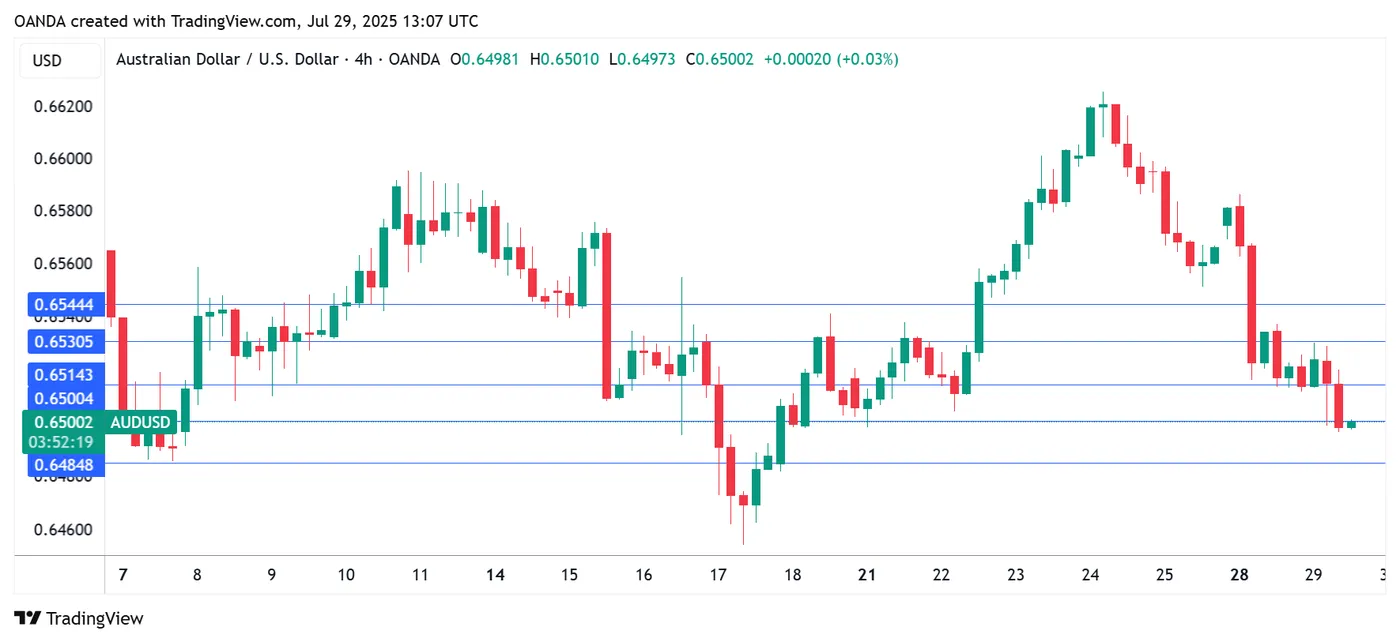
AUDUSD 4-Hour-Chart, July 29, 2025
USD/JPY Mid-Day Outlook
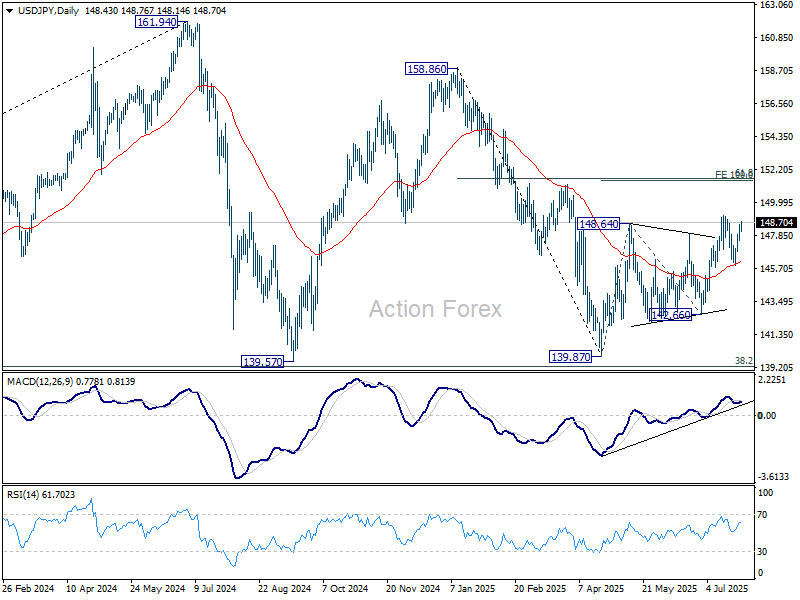
Daily Pivots: (S1) 147.85; (P) 148.22; (R1) 148.91; More...
Intraday bias in USD/JPY stays on the upside for retesting 149.17 resistance. Firm break there will resume whole rise from 139.87 to 100% projection of 139.87 to 148.64 from 142.66 at 151.43, which is close to 151.22 fibonacci level. On the downside, below 147.50 minor support will turn intraday bias neutral first. But risk will stay on the upside as long as 145.84 support holds, in case of retreat.
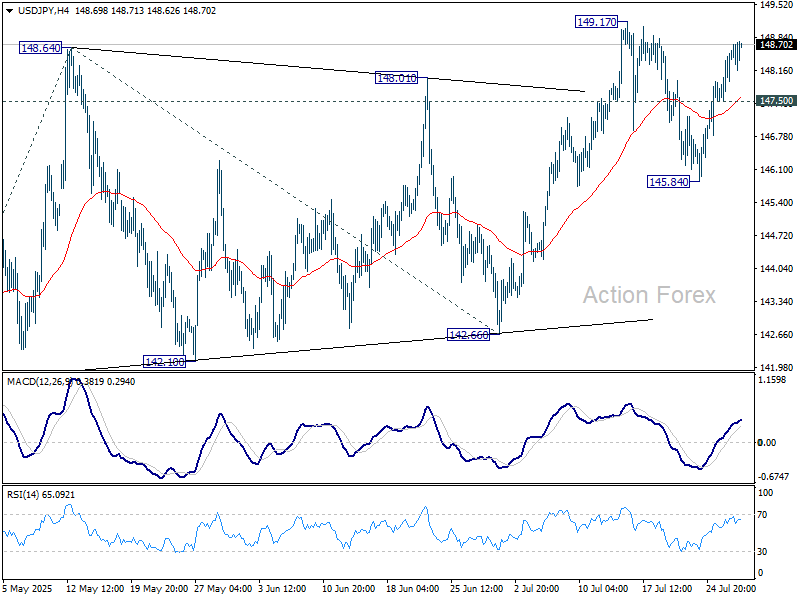
In the bigger picture, price actions from 161.94 (2024 high) are seen as a corrective pattern to rise from 102.58 (2021 low). Decisive break of 61.8% retracement of 158.86 to 139.87 at 151.22 will argue that it has already completed with three waves at 139.87. Larger up trend might then be ready to resume through 161.94 high. In case the corrective pattern extends with another fall, strong support is expected from 38.2% retracement of 102.58 to 161.94 at 139.26 to bring rebound.
USD/CHF Mid-Day Outlook
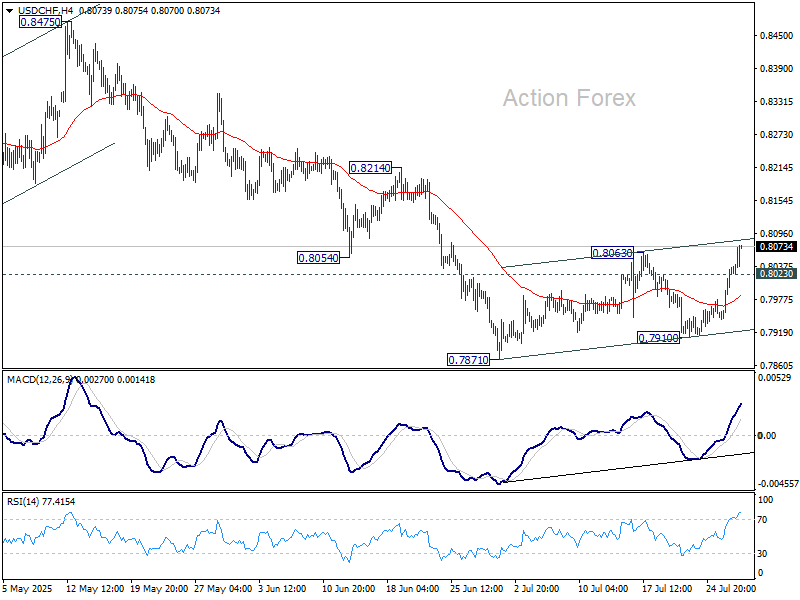
Daily Pivots: (S1) 0.7974; (P) 0.8007; (R1) 0.8068; More….
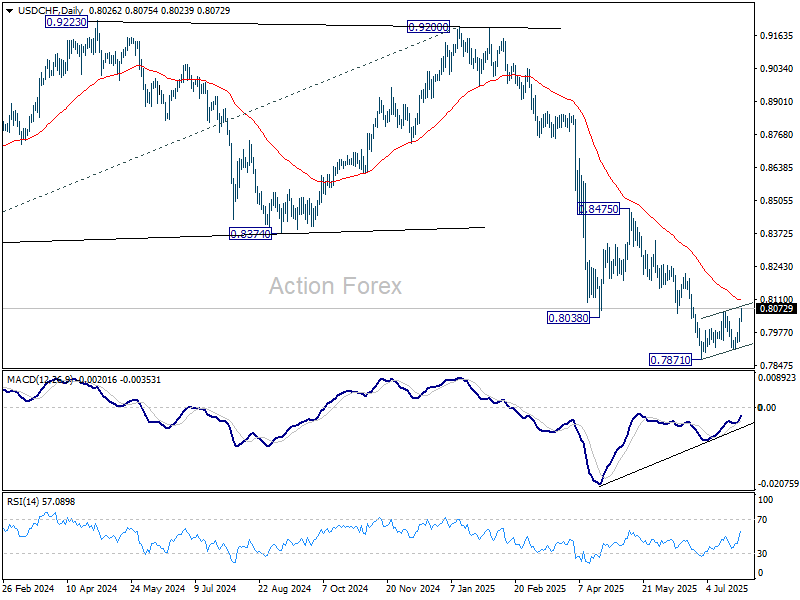
No change in USD/CHF's outlook and intraday bias stays on the upside. Price actions from 0.7871 are still seen as a corrective pattern. Further rise would be seen to 55 D EMA (now at 0.8107), but upside should be limited there. On the downside, below 0.8023 minor support will turn intraday bias neutral first. However, sustained trading above 55 D EMA will indicate medium term bottoming, and target 0.8475 resistance next.
In the bigger picture, long term down trend from 1.0342 (2017 high) is still in progress. Next target is 100% projection of 1.0146 (2022 high) to 0.8332 from 0.9200 at 0.7382. In any case, outlook will stay bearish as long as 0.8475 resistance holds.
GBP/USD Mid-Day Outlook
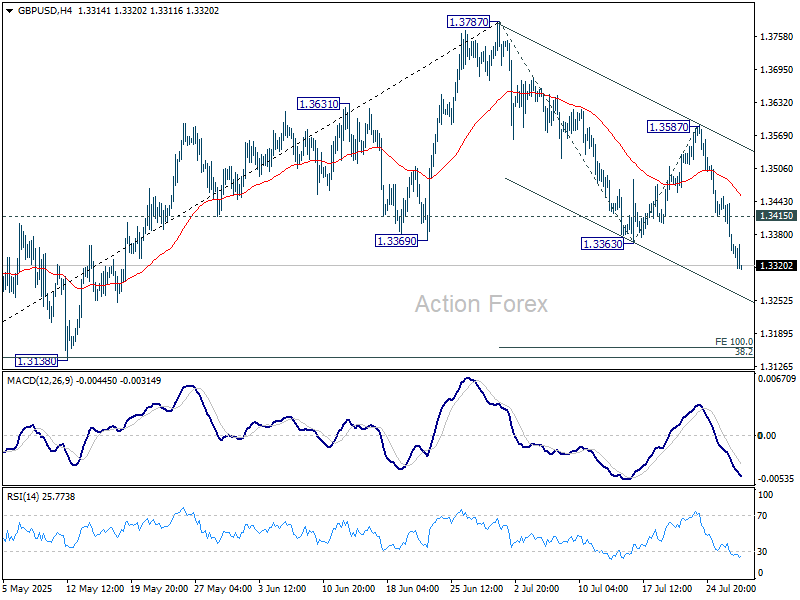
Daily Pivots: (S1) 1.3320; (P) 1.3386; (R1) 1.3422; More...
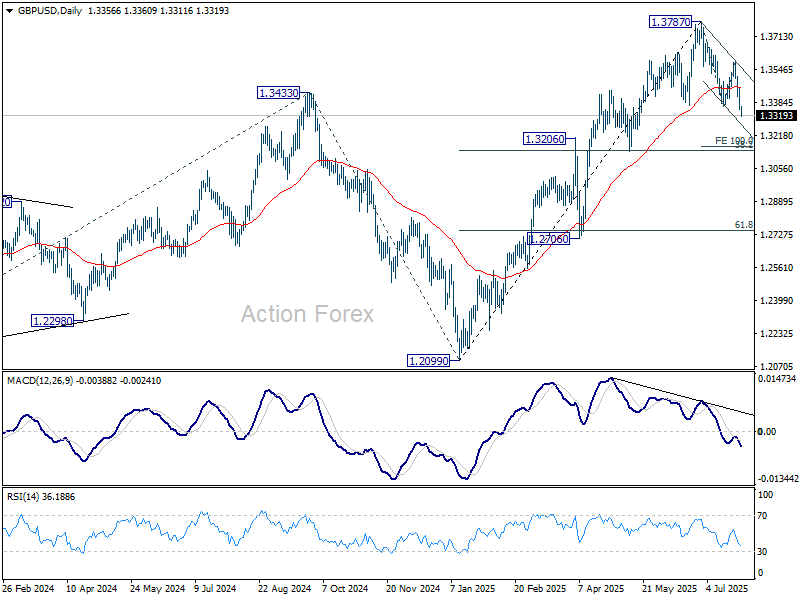
Intraday bias in GBP/USD remains on the downside for the moment. Fall from 1.3787 is seen as correcting whole rise from 1.2099. Deeper fall would be seen to 100% projection of 1.3787 to 1.3363 from 1.3587 at 1.3163. On the upside, above 1.3415 minor resistance will turn intraday bias neutral first. But risk will stay on the downside as long as 1.3587 resistance holds, in case of recovery.
In the bigger picture, up trend from 1.3051 (2022 low) is in progress. Next medium term target is 61.8% projection of 1.0351 to 1.3433 from 1.2099 at 1.4004. Outlook will now stay bullish as long as 55 W EMA (now at 1.3045) holds, even in case of deep pullback.
EUR/USD Mid-Day Outlook
Daily Pivots: (S1) 1.1526; (P) 1.1648; (R1) 1.1711; More...
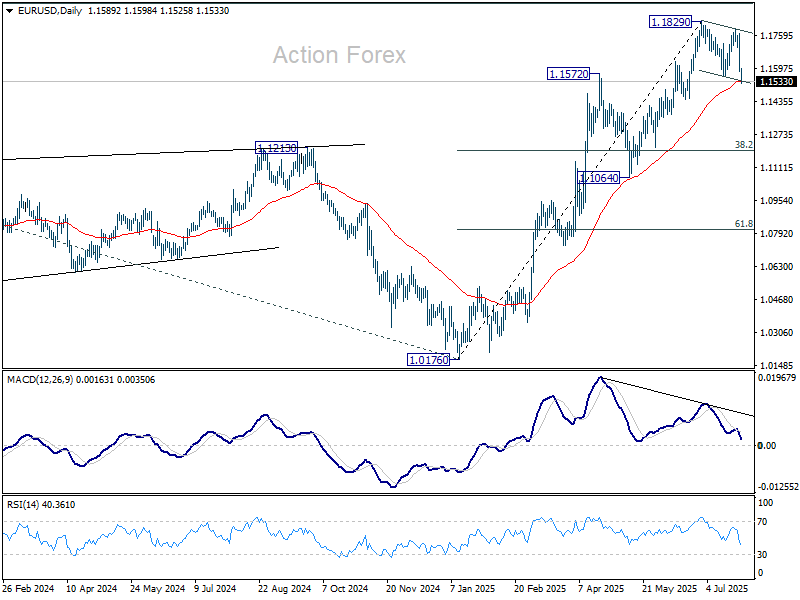
Intraday bias in EUR/USD remains on the downside with focus on 55 D EMA (now at 1.1538). Sustained break there will argue that fall from 1.1829 is already correcting the whole rise from 1.0176. Deeper decline should then be seen to 38.2% retracement of 1.0176 to 1.1829 at 1.1198. Nevertheless, strong rebound from the EMA will maintain near term bullishness. Above 1.1598 minor resistance will turn intraday bias neutral first.
In the bigger picture, rise from 0.9534 long term bottom could be correcting the multi-decade downtrend or the start of a long term up trend. In either case, further rise should be seen to 100% projection of 0.9534 to 1.1274 from 1.0176 at 1.1916. This will remain the favored case as long as 1.1604 support holds.
Markets Back Dollar Strength, Await Australian Inflation Clarity
Dollar’s broad-based advance continues today, underpinned by firm sentiment that recent US trade deals with the EU and Japan mark the clearing of major global trade risks, at least for now. Though US–China talks continue in Stockholm, markets appear unbothered. Officials on both sides have indicated willingness to negotiate terms and extend the August 12 tariff truce by another 90 days. The absence of escalation risk is helping to sustain a risk-on bias, even if a full breakthrough is still pending.
Euro, meanwhile, continues to lag. Even as EU politicians criticize the terms of the US-EU framework agreement, equity markets seem more constructive. Germany’s DAX and France’s CAC 40 both gained more than 1% in early European trade, lifted by a string of upbeat earnings reports and relief that trade escalation was at least avoided.
This divergence in sentiment is visible across currencies. Dollar tops the leaderboard this week so far, followed by Loonie and Yen. On the other side, Euro is the weakest performer, trailed by the Franc and Kiwi. Aussie and Sterling are stuck in the middle.
Next up, focus turns to Australia’s Q2 CPI due in the Asian session. Headline inflation is expected to slow from 2.4% yoy to 2.2% yoy, continuing the steady down trend from 7.8% yoy peak in Q4 2022. The RBA held rates steady last month on a split vote of 6-3. Since then, jobs data have softened while price growth remains sticky. A soft CPI reading would help cement the case for another rate cut in August.
Technically, AUD/USD has been clearly losing upward momentum since May, as seen in D MACD. But there is not clear sign of topping yet. However, firm break of 0.6453 support will argue that it will at least be correcting the rebound from 0.5913, and target 38.2% retracement of 0.5913 to 0.6624 at 0.6352.

In Europe, at the time of writing, FTSE is up 0.54%. DAX is up 1.10%. CAC is up 1.20%. UK 10-year yield is down -0.017 at 4.638. Germany 10-year yield is up 0.002 at 2.695. Earlier in Asia, Nikkei fell -0.79%. Hong Kong HSI fell -0.15%. Singapore Strait Times rose 0.33%. Singapore Strait Times fell -0.28%. Japan 10-year JGB yield rose 0.006 to 1.575.
ECB survey shows inflation fears recede, growth pessimism softens
Eurozone consumers are dialing back their inflation expectations, according to the ECB's latest Consumer Expectations Survey for June. Median one-year inflation expectations fell from 2.8% to 2.6%, fully reversing the uptick seen in March and April. Longer-term expectations remained anchored, with three-year and five-year outlooks steady at 2.4% and 2.1% respectively, the latter unchanged for seven consecutive months.
Household sentiment on spending also weakened. Expected nominal spending growth dropped to 3.2% in June, down from 3.5% in May and 3.7% in April. The continued decline suggests rising caution among consumers, likely driven by lingering geopolitical uncertainty, uneven wage growth, and lower perceived price pressures ahead.
On growth, expectations became slightly less negative. Median expectations for economic growth over the next 12 months improved to -1.0% from -1.1% in May and -1.9% in April. Still, households broadly expect economic contraction, reflecting the Eurozone’s fragile recovery and ongoing concerns around trade, manufacturing, and domestic demand.
EUR/USD Mid-Day Outlook
Daily Pivots: (S1) 1.1526; (P) 1.1648; (R1) 1.1711; More...
Intraday bias in EUR/USD remains on the downside with focus on 55 D EMA (now at 1.1538). Sustained break there will argue that fall from 1.1829 is already correcting the whole rise from 1.0176. Deeper decline should then be seen to 38.2% retracement of 1.0176 to 1.1829 at 1.1198. Nevertheless, strong rebound from the EMA will maintain near term bullishness. Above 1.1598 minor resistance will turn intraday bias neutral first.
In the bigger picture, rise from 0.9534 long term bottom could be correcting the multi-decade downtrend or the start of a long term up trend. In either case, further rise should be seen to 100% projection of 0.9534 to 1.1274 from 1.0176 at 1.1916. This will remain the favored case as long as 1.1604 support holds.