

Sample Category Title
Bitcoin – Extended Sideways Mode Between Falling Daily Cloud and Tenkan-Sen
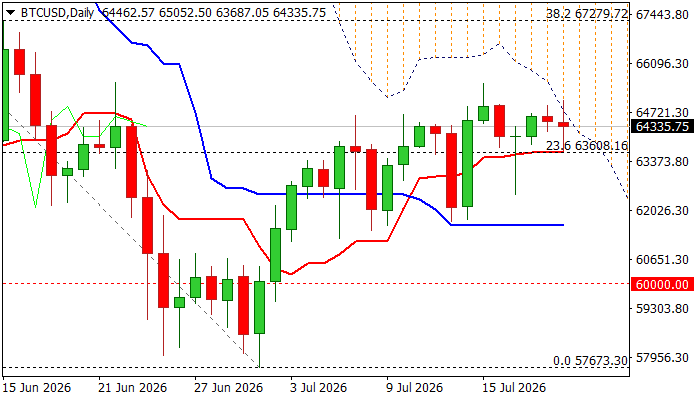
BTCUSD remains in a sideways mode for the past few sessions, showing mild reaction on geopolitical developments and recent key economic data (US inflation) with focus shifting towards major central banks.
Near-term action remains underpinned by daily Tenkan-sen (63620) which tracks the price since July 2 and has created bull-cross with Kijun-sen on July 10.
On the other hand, falling and thickening daily Ichimoku cloud (base at 64780) caps for now and weighs on near-term action, along with fading positive momentum.
Look for initial direction signal on violation of daily Tenkan-sen (negative) or cloud base (positive).
However, either signal will require verification, with extension below daily Kijun-sen (61603) to confirm that bears regained control and open way for retest of 60K support, while sustained penetration of daily cloud would expose target at 67280 (Fibo 38.2% of 82821/57673 downtrend).
Res: 64780; 65827; 67280; 70000
Sup: 63620; 62450; 61603; 60000
GBPCAD Rally: Perfect Reaction from the Extreme Area
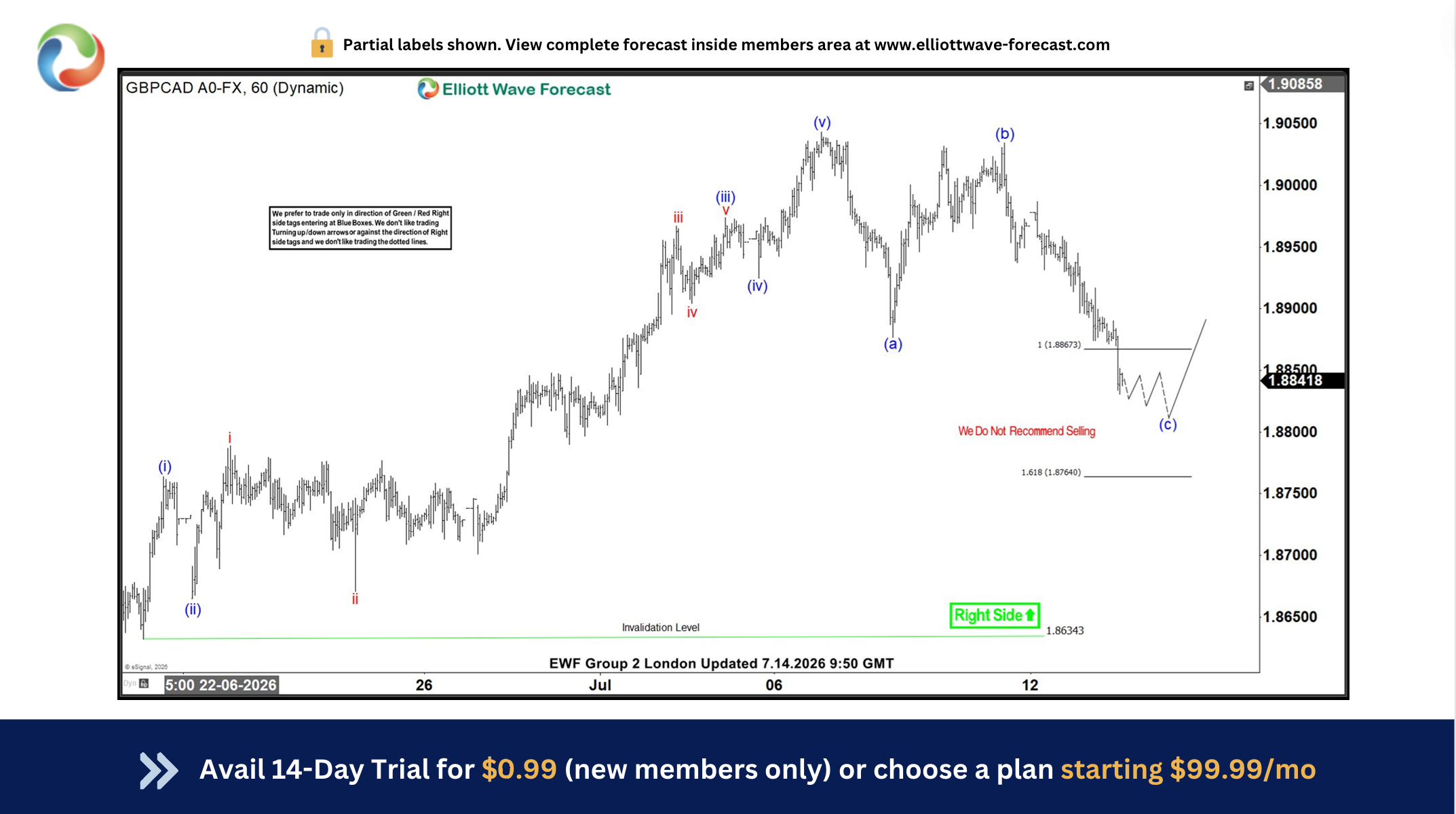
GBP/CAD has spent the past few weeks tracing out a clean five-wave rally on the 1-hour chart, and now the pair looks to be working through the correction that typically follows a completed impulse. Here’s a breakdown of the structure and what it could mean for the path ahead.
The Rally: A Textbook Five-Wave Advance
Starting from the June 22 low near 1.863, GBP/CAD pushed higher in a sequence that fits the classic five-wave impulse pattern:
- Wave (i) kicked off the advance, followed by a shallow wave (ii) pullback that held well above the starting point.
- Wave (iii) was the strongest leg of the move, itself breaking down into a smaller five waves (i–v) as the pair accelerated toward the 1.895–1.900 area.
- Wave (iv) brought a brief, contained dip before buyers stepped back in.
- Wave (v) carried price to the cycle high just above 1.905, completing the five-wave structure and marking the top of the rally.
That high represents the point where the bullish impulse likely finished, opening the door for a corrective pullback.
The Correction: An A-B-C (ZigZag) Pattern Taking Shape
What is an A-B-C (ZigZag) Pattern?
The image below illustrates an A‑B‑C Zigzag structure, similar to the one highlighted on the GBPCAD chart above.
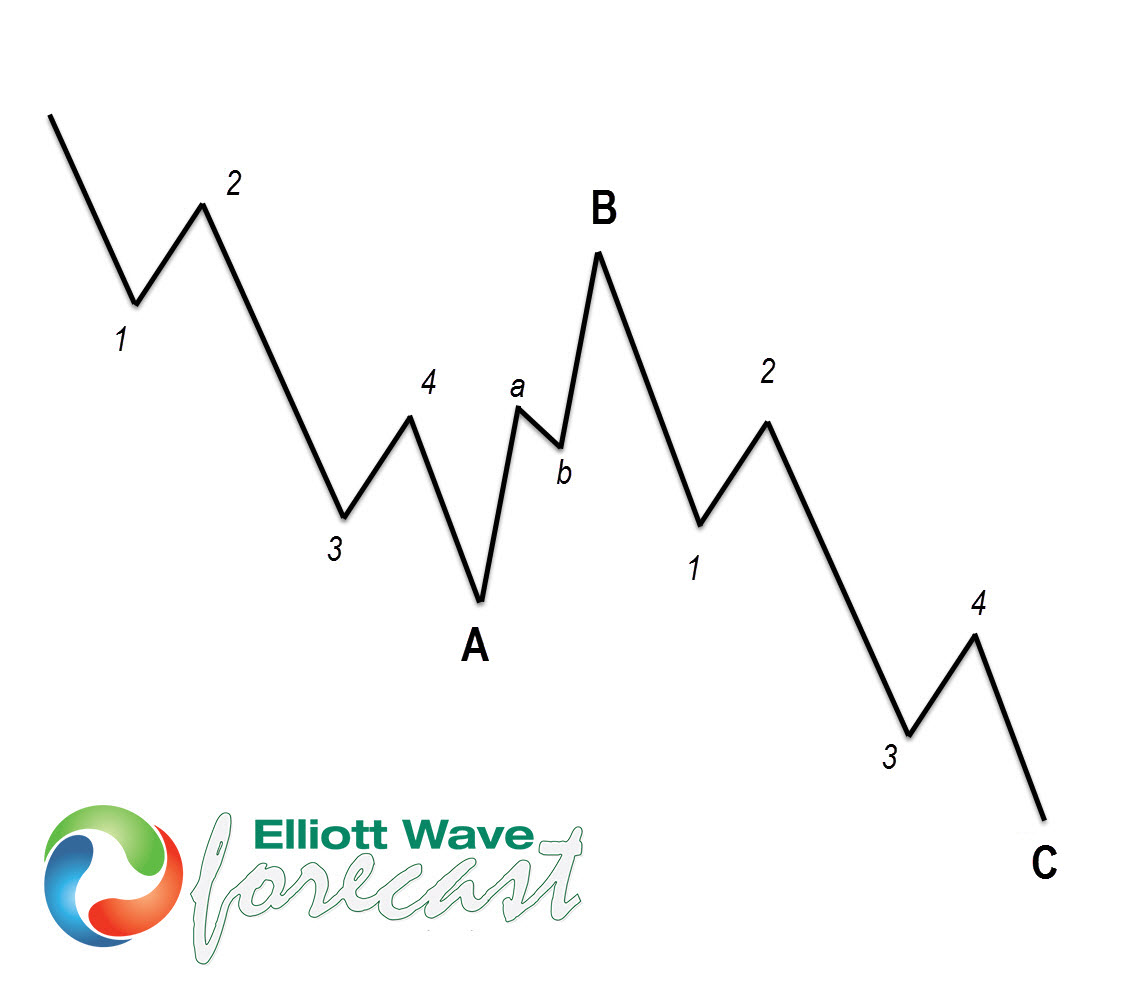
A Zigzag structure in Elliott Wave Theory is a sharp three‑wave corrective pattern labelled A‑B‑C, with a distinct 5‑3‑5 subdivision. It represents a counter‑trend move and is one of the most common corrective formations.
- Wave A → 5 sub‑waves (impulsive decline or rise depending on trend).
- Wave B → 3 sub‑waves (a smaller counter‑move).
- Wave C → 5 sub‑waves (another impulsive move, usually equal to or longer than Wave A).
Trading Insights
- Zigzags often signal continuation after correction, making them useful for identifying re‑entry points in the direction of the larger trend.
- Traders watch for Blue Box zones (high‑probability reversal areas) to align entries with the end of Wave C.
- Recognizing zigzags helps avoid mistaking them for trend reversals—they are corrective pauses, not new dominant trends.
Now that we understand what a Zigzag correction is, we can clearly connect that concept to the corrective structure shown in the GBPCAD chart above.
Since topping out, GBP/CAD has been unwinding in a standard three-wave (A-B-C) correction:
- Wave (a) dropped sharply off the highs, retracing a large chunk of the prior advance.
- Wave (b) brought a corrective bounce back up toward the 1.903 area — a classic “relief rally” that retraces part of wave (a) without exceeding the prior high.
- Wave (c) is now underway, pressing the pair back down toward the 1.884–1.876 zone, with a key Fibonacci extension level sitting around 1.876.
As of the most recent update, price is trading around 1.884, right in the area where wave (c) is expected to find support and complete the pullback.
What Comes Next
Based on this count, the correction is viewed as a buying opportunity rather than a setup to sell. The expectation is for GBP/CAD to carve out a smaller, choppy dip-and-recovery pattern near current levels before turning back higher, targeting a resumption of the broader uptrend. A key support/invalidation zone sits down near 1.863 — a break below that level would call the entire bullish wave count into question.
The Final Leg Down Completed as Expected
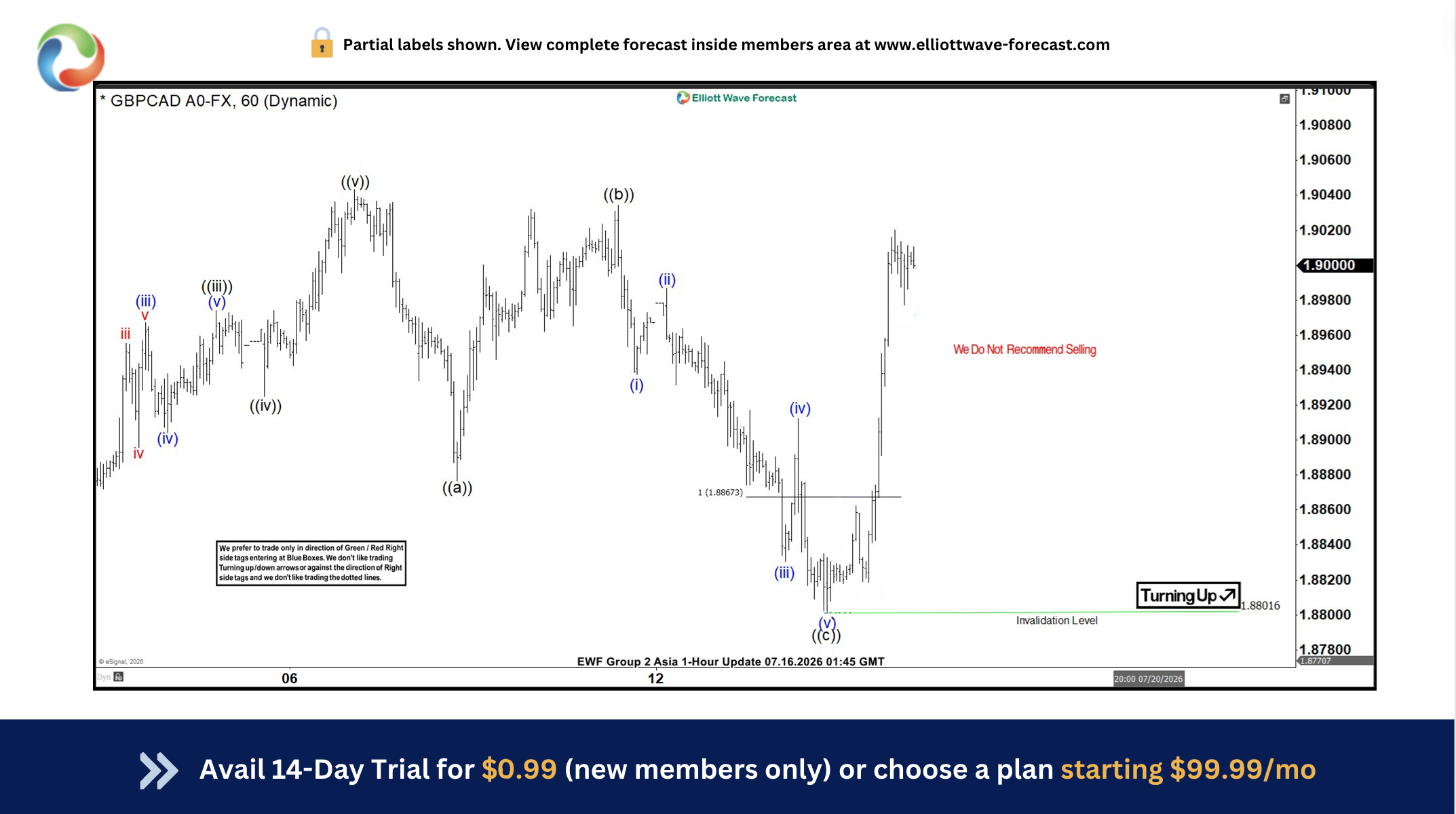
Zooming into the internal structure of wave ((c)), price carved out a clean five-wave decline (labeled (i) through (v)) that bottomed right at the extreme of the expected support zone, just above 1.880. That low landed almost exactly on the invalidation level near 1.88016, which is precisely the kind of reaction technicians look for — a move that reaches into a well-defined support area, taps it, and reverses rather than breaking cleanly through it.
That low marks the completion of the entire corrective sequence from the 1.905 high: wave ((a)) down, wave ((b)) bounce back toward 1.903, and wave ((c)) down into the 1.880 extreme.
A Sharp, Decisive Reaction
What stands out most on this update is the strength of the reaction off that low. Rather than a slow, grinding recovery, GBP/CAD snapped back aggressively, rallying from the 1.880 extreme up through 1.890 and on toward the 1.900–1.902 area in a single strong push — essentially retracing the entire wave ((c)) decline in short order. That kind of sharp, impulsive reaction off a support extreme is typically read as a sign that the corrective phase has genuinely finished and that sellers were overwhelmed at the low.
Why the Extreme Mattered
This is a good example of why the 1.876–1.884 zone was flagged as the key area to watch in the first place. It wasn’t just a round-number guess — it lined up with:
- The Fibonacci extension target near 1.876
- The internal five-wave count of wave ((c)) reaching a natural completion point
- A structural invalidation level just below 1.880 that, as long as it held, kept the broader bullish wave count intact
Price respected that confluence, printed the low, and turned — which is exactly the kind of reaction that gives a wave count credibility.
Bottom Line
GBP/CAD did exactly what the prior wave count anticipated: it pushed into the extreme of the support zone, completed a five-wave decline into that area, and reacted sharply higher — a textbook reaction at the extreme that reinforces the case for a resumption of the uptrend.
Why Choose EWF ?
At Elliottwave Forecast (EWF), we deliver consistent market updates through regular charts update. Our analysts update 1‑hour charts four times daily and 4‑hour charts once per day across all 78 instruments. In addition, we host five live sessions each day and maintain a 24‑hour chatroom, providing clients with real‑time market guidance and answers to any questions they may have.
You can start a 14‑day trial with us today here and cancel anytime by emailing
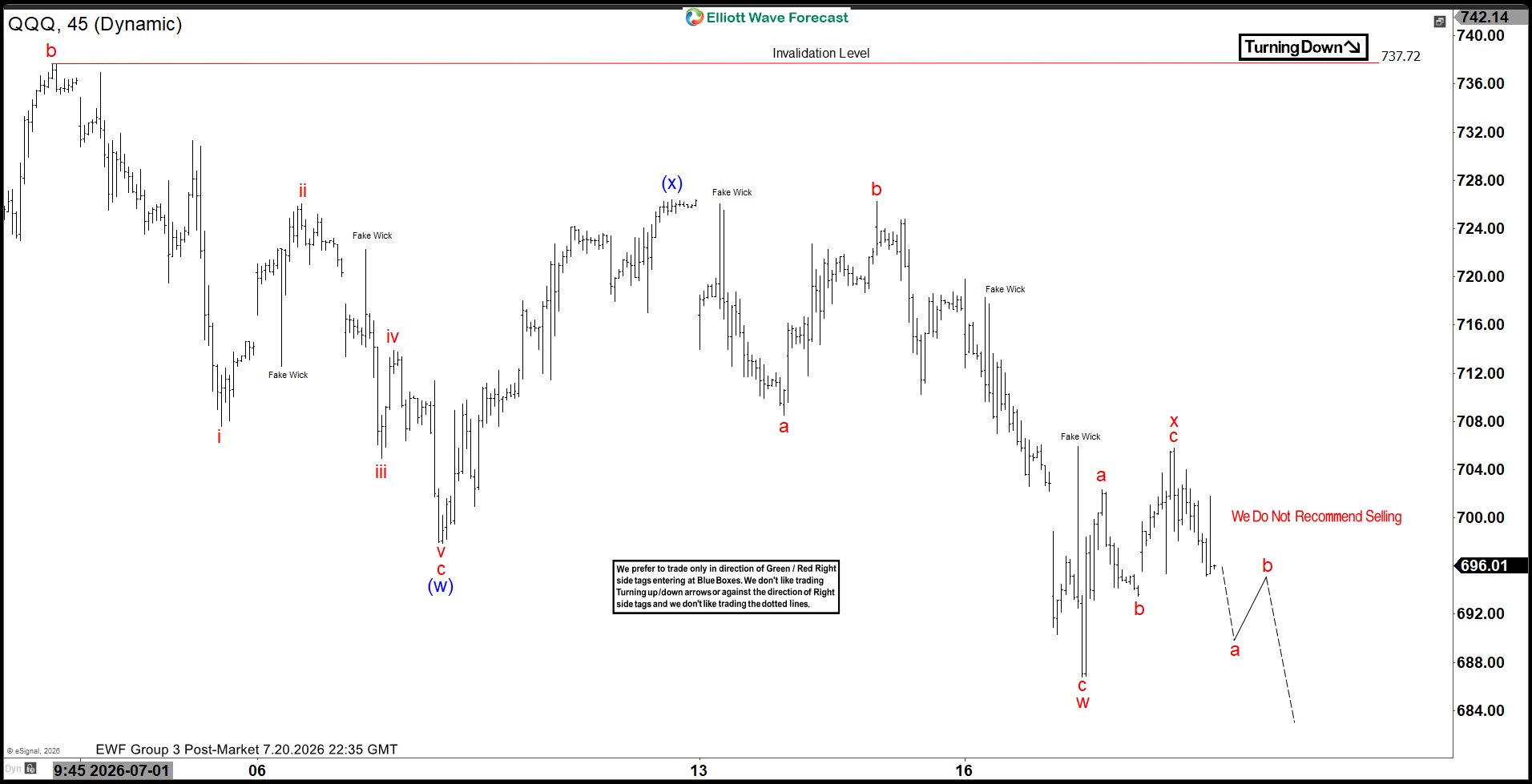
NASDAQ 100 ETF (QQQ) Elliott Wave Signals Double Correction Toward 684
The short‑term Elliott Wave view on the Nasdaq 100 ETF (QQQ) shows that the instrument is correcting the cycle from the March 30, 2026 low. The decline from the June 3, 2026 all‑time high continues, with the extreme target zone defined by the 100%–161.8% Fibonacci extension. This area lies between $646 and $684 and represents the next logical support cluster within the ongoing correction.
From the June 16 high, the cycle has unfolded as a double three structure. Wave (w) ended at $697.86, followed by a counter‑trend rally in wave (x) that peaked at $726.40. The ETF then resumed lower in wave (y), which subdivides into another double three, highlighting the complexity of the correction.
Within wave (y), the decline from wave (x) produced wave w at $686.76. The subsequent rally in wave x ended at $705.80. The ETF has since turned lower again. A break beneath $686.76 is required to confirm that the correction is extending as a double sequence. Until then, the possibility of a more complex consolidation remains.
Near term, the pivot at $737.72 is critical. As long as this high remains intact, rallies are expected to fail in either three or seven swings. This reinforces the downside bias and favors continuation lower toward the $684 area, consistent with the projected Fibonacci extension zone.
Nasdaq 100 ETF (QQQ) 45-Minute Elliott Wave Chart
QQQ Elliott Wave Video:
https://www.youtube.com/watch?v=XNYCNjGQvww
EURUSD Wave Analysis
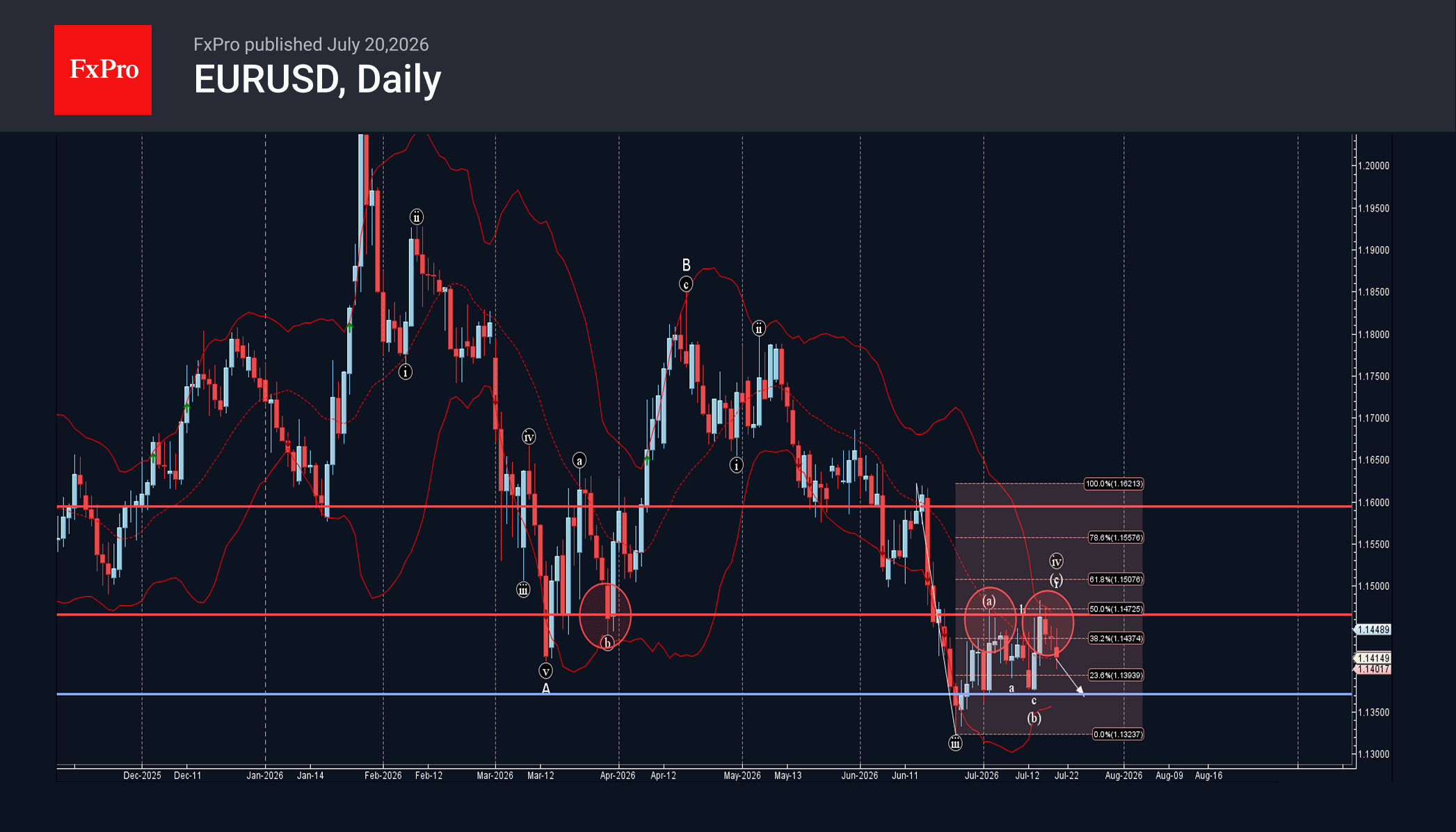
EURUSD: ⬇️ Sell
– EURUSD reversed from resistance level 1.1465
– Likely to fall to support level 1.1370
EURUSD currency pair recently reversed from the resistance level 1.1465 (top of earlier wave a) intersecting with the 50% Fibonacci correction of the downward impulse from June.
The downward reversal from the resistance level 1.1465 (also strengthened by the upper daily Bollinger band) started the active impulse wave iii.
Given the clear daily downtrend, EURUSD currency pair can be expected to fall further to the next support level 1.1370 (low of earlier wave b).
Eco Data 7/21/26
| GMT | Ccy | Events | Act | Cons | Prev | Rev |
|---|---|---|---|---|---|---|
| 22:45 | NZD | CPI Q/Q Q2 | 1.50% | 1.50% | 0.90% | |
| 22:45 | NZD | CPI Y/Y Q2 | 4.10% | 4.00% | 3.10% | |
| 06:00 | GBP | Claimant Count Change Jun | 6.7K | 29.4K | 31.2K | |
| 06:00 | GBP | ILO Unemployment Rate (3M) May | 4.90% | 4.90% | 4.90% | |
| 06:00 | GBP | Average Earnings Excluding Bonus 3M/Y May | 3.40% | 3.40% | 3.40% | |
| 06:00 | GBP | Average Earnings Including Bonus 3M/Y May | 4.30% | 4.50% | 4.40% | |
| 09:00 | EUR | Germany ZEW Economic Sentiment Jul | 26.3 | 15.1 | 10.5 | |
| 09:00 | EUR | Germany ZEW Current Situation Jul | -77.6 | -77.8 | -81 | |
| 09:00 | EUR | Eurozone ZEW Economic Sentiment Jul | 23.4 | 11.2 | 9.5 |
| 22:45 | NZD |
| CPI Q/Q Q2 | |
| Actual | 1.50% |
| Consensus | 1.50% |
| Previous | 0.90% |
| 22:45 | NZD |
| CPI Y/Y Q2 | |
| Actual | 4.10% |
| Consensus | 4.00% |
| Previous | 3.10% |
| 06:00 | GBP |
| Claimant Count Change Jun | |
| Actual | 6.7K |
| Consensus | 29.4K |
| Previous | 31.2K |
| 06:00 | GBP |
| ILO Unemployment Rate (3M) May | |
| Actual | 4.90% |
| Consensus | 4.90% |
| Previous | 4.90% |
| 06:00 | GBP |
| Average Earnings Excluding Bonus 3M/Y May | |
| Actual | 3.40% |
| Consensus | 3.40% |
| Previous | 3.40% |
| 06:00 | GBP |
| Average Earnings Including Bonus 3M/Y May | |
| Actual | 4.30% |
| Consensus | 4.50% |
| Previous | 4.40% |
| 09:00 | EUR |
| Germany ZEW Economic Sentiment Jul | |
| Actual | 26.3 |
| Consensus | 15.1 |
| Previous | 10.5 |
| 09:00 | EUR |
| Germany ZEW Current Situation Jul | |
| Actual | -77.6 |
| Consensus | -77.8 |
| Previous | -81 |
| 09:00 | EUR |
| Eurozone ZEW Economic Sentiment Jul | |
| Actual | 23.4 |
| Consensus | 11.2 |
| Previous | 9.5 |
Brent Price Eases from New Multi-Week High on Signals of Potential Diplomatic Action
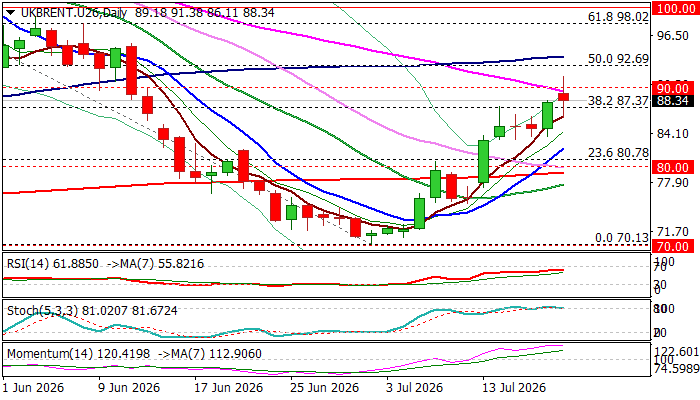
Brent price spiked to five-week high on Monday after gap-higher opening and break above psychological $90 barrier, in extension of last week’s 13% advance, before quick pullback of about $5 that reversed all overnight gains.
Geopolitics were again key market driver, with growing fears of further escalation that would put the whole Middle East on fire, while subsequent comments from Iran about diplomacy based on national interests, were interpreted as chance for fresh round of negotiations that deflated oil prices.
Overall picture remains bullishly aligned with fundamentals representing strong uncertainty about global oil supply (Hormuz strait remains closed due to the latest escalation of the war after a month of fragile ceasefire), while predominantly bullish daily studies underpin the action.
Today’s action should ideally close above broken Fibo barrier at $87.37 (38.2% of $115.26/$70.13) to keep immediate bulls intact, with potential deeper pullback to find ground above higher base at $83.30 zone.
Firm break of $90 to expose targets at $92.69 (50% retracement) and $93.90 (100DMA).
Res: 90.00; 91.38; 92.69; 93.90
Sup: 87.37; 86.27; 85.97; 83.70
Canadian Inflation Cooled in June
- Headline CPI inflation eased to 2.8% year-on-year (y/y) in June, down from 3.2% in May, thanks to lower prices at the pump.
- Prices at the pump fell 10.2% in June, but were still up 20.5% y/y. Canadians also got some relief at grocery stores, with prices for food purchased from stores up 3.9% y/y in June, down from 4.3% y/y in May.
- Shelter inflation cooled further, up only 1.5% y/y in June, down from 1.7% y/y in May. Overall services inflation was a little hotter, up 2.2% y/y and a couple of tenths higher than the prior month. Much of this was driven by higher by travel-related costs.
- The effects of the World Cup showed up in June inflation. Prices for traveller accommodation were up 10.1% y/y, and prices in Ontario and B.C. (where games were played) saw increases of roughly 20%. Rental car inflation (+6.8 y/y), travel tours (+6.8% y/y) and air transportation (+9.6% y/y) all showed evidence of higher World-cup related demand. Though fuel costs and strong domestic demand were cited by StatCan in airfare costs.
- Core inflation also cooled a bit more than markets were expecting. The Bank of Canada's preferred core inflation metrics (median and trim) averaged 1.9% in June, versus 2.1% in May. Lower core goods inflation likely played a role, as it took a step back to 1.1% y/y, down from 1.6% y/y in May.
Key Implications
- June’s inflation print came in a little cooler than expected. However, the rise in oil prices in recent weeks means that the downdraft from lower gasoline prices is likely to evaporate in July’s CPI. With oil prices remaining below recent highs, we still think inflation has peaked in Canada this year.
- Inflation remains very benign in Canada, as a relatively soft demand backdrop leans against sellers raising prices. Not surprisingly, the yield on the two-year Government of Canada bond is down a few ticks in the wake of the number. June's inflation report reinforces our view that the Bank of Canada can remain on the sidelines for quite some time.
Stock Market: Rotation Is Gathering Pace
- The S&P 500 was spooked by Kimi K3, just as it had been by DeepSeek in the past.
- Investors have turned their backs on the Magnificent Seven and are on the hunt for new stars.
The S&P 500 was down on Thursday and Friday as investors sold off tech shares. The market believes that the massive investments in artificial intelligence will become increasingly difficult to justify against a backdrop of intensifying competition and falling service costs. The catalyst for the slump was the news that the Chinese firm Moonshot had unveiled the Kimi K3 model, which outperforms its American counterparts. This immediately brought to mind the events of early 2025, when DeepSeek sent the broad stock index tumbling.
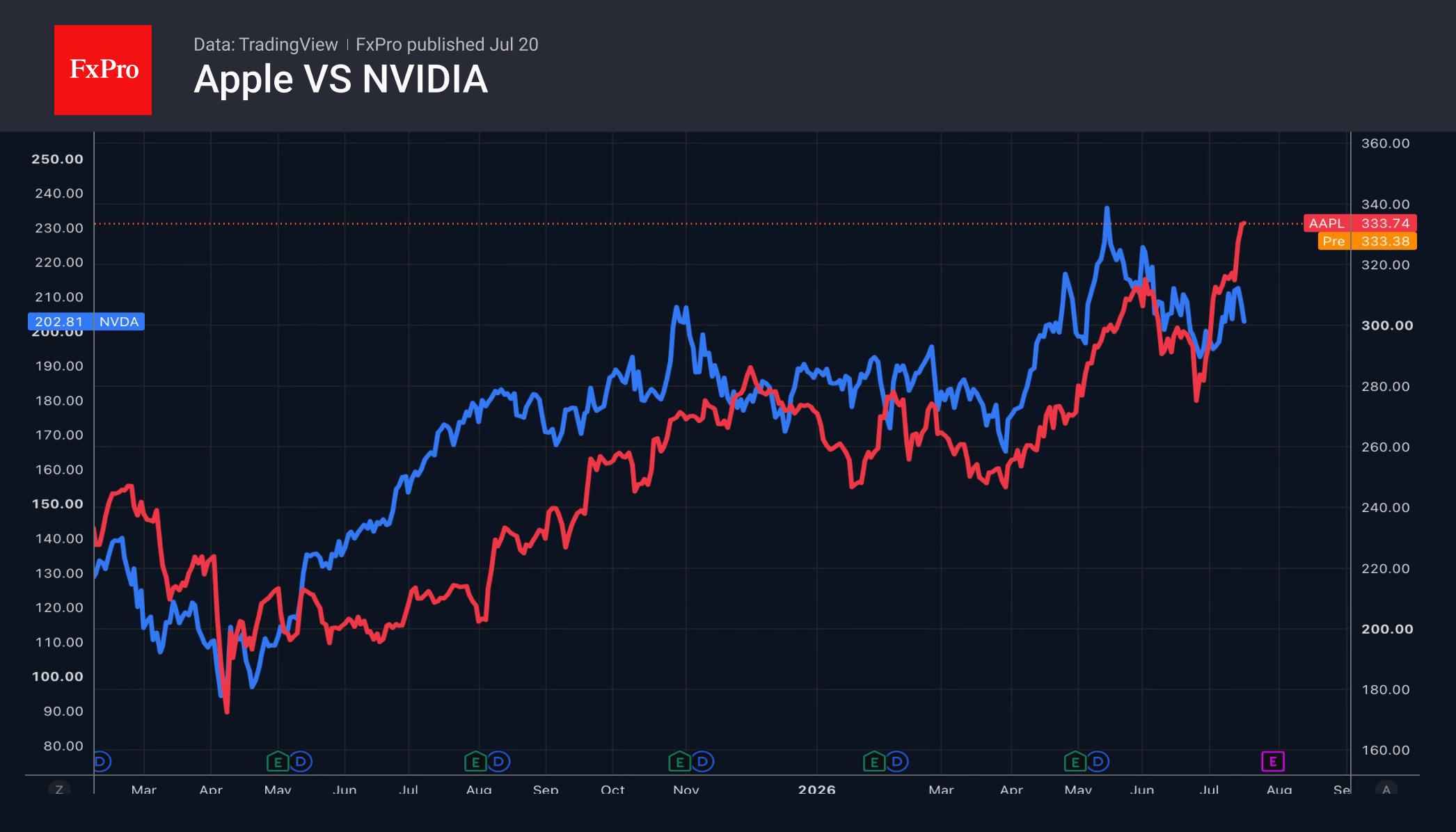
Investors’ long-standing love affair with the Magnificent Seven is drawing to a close. The group of companies has barely grown since the start of the year and is underperforming both the S&P 500 and the weighted average index. The latter hit a record high during trading on 16 July, indicating broad-based market growth. It is no longer dependent on a handful of issuers. At the same time, Apple’s market value briefly exceeded NVIDIA’s market capitalisation, making the iPhone manufacturer the world’s most valuable company again.
Investors are on the lookout for new stars and are actively rotating their portfolios. Moreover, there is a massive withdrawal of funds from chip manufacturers’ shares, which have replaced the ‘Magnificent Seven’. This has led to a 20% fall in the SOX semiconductor index from its record highs, signalling a shift to a bear market.
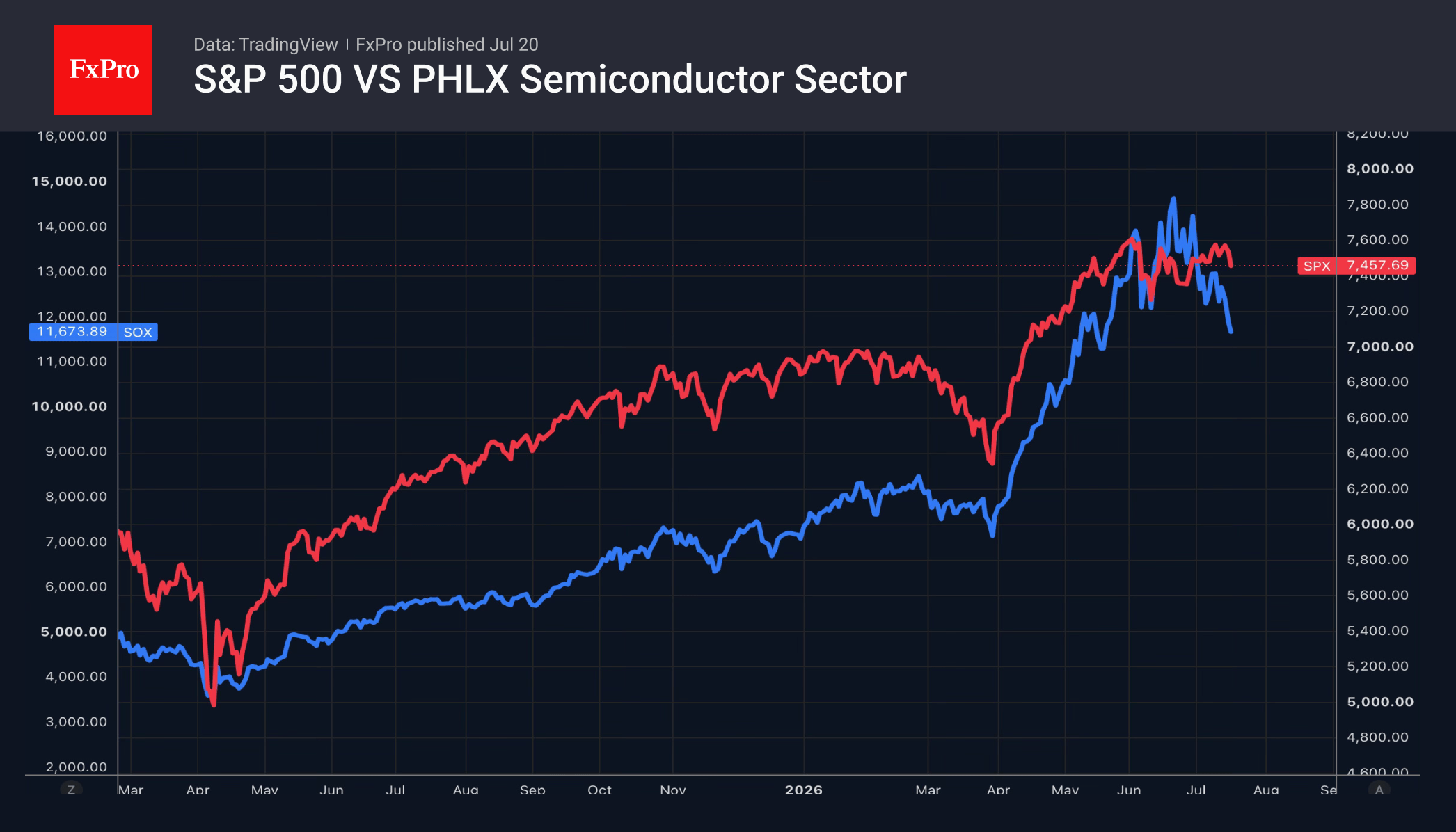
Investors are eagerly awaiting second-quarter corporate results to confirm or dispel their fears regarding the poor performance of technology companies. This week, up to 24 July, attention will focus on results from General Motors, Alphabet, IBM, Tesla, Intel and Verizon.
The market is focused on finding new stars and is reacting little to other factors. For instance, the resurgence of conflict in the Middle East and the associated rise in oil prices have had no impact on the S&P 500. Yet this could lead to prolonged inflation and a rise in the federal funds rate, both of which are bearish factors for the stock market.
Investors have also ignored the slowdown in consumer and producer prices, which has reduced the likelihood of further Fed rate hikes and, in theory, should have helped the broad stock index. At present, however, the index is driven solely by sector rotation.
The FxPro Analyst Team
Markets Shrug Off Weekend Escalation as Diplomacy Hopes Keep Risk Appetite Intact
Financial markets showed surprising resilience on Monday despite another escalation in the US-Iran conflict over the weekend. Brent crude briefly surged above $90 after opening with a gap higher but failed to sustain the advance, retreating back below that level during the European session. The inability of oil to extend its gains helped stabilize broader market sentiment, with European equities trading mixed rather than broadly lower, while US index futures pointed to a firmer Wall Street open.
Although the US completed its ninth consecutive day of strikes on Iran overnight, investors found reassurance in signs that diplomatic channels remain open. Iranian Foreign Ministry spokesman Esmail Baghaei said negotiations with the US could still proceed if they align with Iran's national interests, adding that intermediaries have continued exchanging messages despite the latest military exchanges. The comments reinforced the market's prevailing view that, while geopolitical risks remain elevated, the conflict is still more likely to be contained than to develop into a prolonged regional war involving a significantly larger US military commitment.
Politics in the UK also attracted attention as Andy Burnham formally became the country's seventh prime minister in a decade after being invited by King Charles to form a government. However, financial markets reacted with little enthusiasm or concern. Investors appeared relieved by expectations that Home Secretary Shabana Mahmood will become chancellor instead of the more left-leaning Ed Miliband, while UK bond markets remained broadly stable, suggesting fiscal concerns are viewed as a longer-term issue rather than an immediate risk.
In the currency markets, Australian Dollar led gains, followed by New Zealand Dollar and Dollar, while Swiss Franc underperformed despite the geopolitical backdrop, further highlighting the absence of a classic flight to safety. Canadian Dollar and Euro also lagged, with Sterling and Yen trading near the middle of the performance table.
Attention now turns to New Zealand's second-quarter CPI report in the upcoming Asian session. Headline inflation is expected to accelerate to 4.1% year-on-year from 3.1%, exceeding the RBNZ's own 3.9% projection. With oil prices remaining elevated, policymakers will be particularly focused on whether higher fuel costs are beginning to spill over into broader inflation measures, making the various core inflation gauges just as important as the headline reading.
Silver Bears Miss Their Chance as Oil Rally Fails to Extend Selling
Silver briefly fell below $55 but quickly recovered as fresh geopolitical tensions failed to trigger another wave of selling. Despite Brent crude initially jumping above $90 after renewed US-Iran escalation, markets appeared to view the latest developments as largely priced in following last week's sharp oil rally. Diplomatic signals from Tehran also helped calm fears of an immediate deterioration, although silver remains vulnerable if the Strait of Hormuz crisis deepens and Brent advances toward $100. Technically, downside risks persist below 59.66, but fading bearish momentum suggests a short-term bottom may be forming. Read More.
Brent Oil Above $90: Is $100 Next if Hormuz Blockade Persists?
Brent oil opened the week above $90 after renewed escalation in the US-Iran conflict, but restrained buying suggests much of the weekend's developments had already been priced following last week's 17% surge. The market's focus is now shifting from geopolitical headlines to the duration of the Strait of Hormuz blockade, as every additional day of disruption increases the risk of genuine physical supply shortages. Technically, Brent's breakout strengthens the case for a medium-term bullish reversal, with a sustained move above $95 potentially opening the way toward $100 and, eventually, a retest of this year's highs. Read More.
Canada Inflation Cools Sharply as Lower Gasoline Prices Pull Headline CPI Below Expectations
Canada's annual inflation rate slowed more than expected to 2.8% in June as lower gasoline prices drove the largest monthly decline in CPI since December 2024. Core inflation also eased, with both CPI Median and CPI Trimmed undershooting expectations, suggesting underlying price pressures continued to moderate despite elevated energy costs earlier in the quarter. Read More.
ECB SAFE Survey: Loan Conditions Tighten While Inflation Expectations Hold Steady
The ECB's latest SAFE survey showed Eurozone firms continued to face tighter financing conditions in the second quarter, with a sharp increase in bank loan interest rates even as overall credit availability remained broadly stable. At the same time, businesses reported slower expected growth in selling prices, input costs and wages, while inflation expectations stayed well anchored across one-, three- and five-year horizons. Read More.
New Zealand Exports Surge 25% Y/Y, Imports Up 28% Y/Y in June, Leaving Trade Balance Near Flat
New Zealand's June trade surplus came in well below expectations at NZD 23M, but underlying trade activity remained healthy. Exports expanded strongly across major trading partners, while imports increased even faster, pointing to firm domestic demand. Read More.
PBOC Holds Loan Prime Rates Steady, Keeps Easing Option Open as Growth Slows
China's central bank left its one-year and five-year Loan Prime Rates unchanged at 3.0% and 3.5%, respectively, extending its policy pause to a 14th consecutive month. The decision reflects a cautious balance between slowing economic growth and rising external risks from the Middle East, while resilient exports and high-tech industries continue to support activity. Although the PBOC is expected to rely on targeted policy tools for now, modest rate cuts later this year remain possible if domestic demand weakens further and inflation stays subdued. Read More.
AUD/USD Daily Report
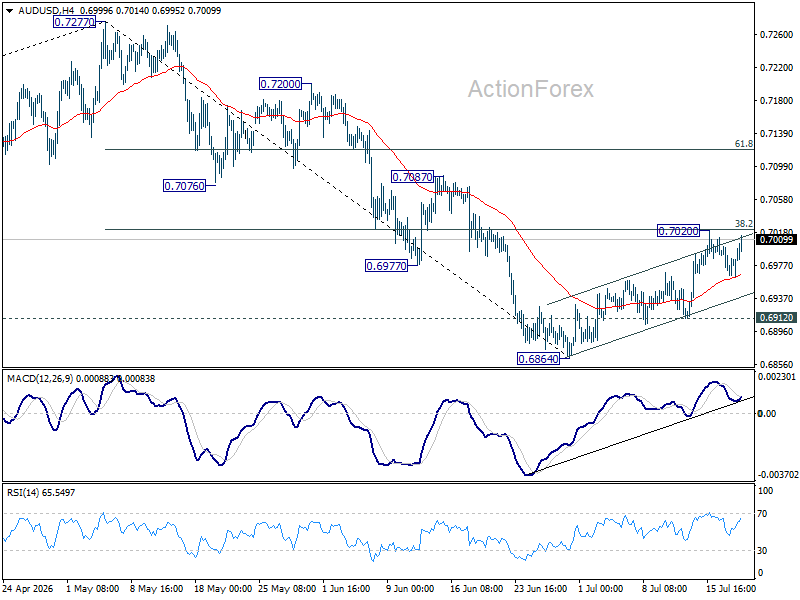
Intraday bias in AUD/USD remains neutral for the moment. As long as 38.2% retracement of 0.7277 to 0.6864 at 0.7022 holds, fall from 0.7277 is mildly in favor to continue. On the downside, below 0.6912 minor support will bring retest of 0.6864 low. However, sustained break of 0.7022 will bring stronger rally to 61.8% retracement at 0.7119 next.
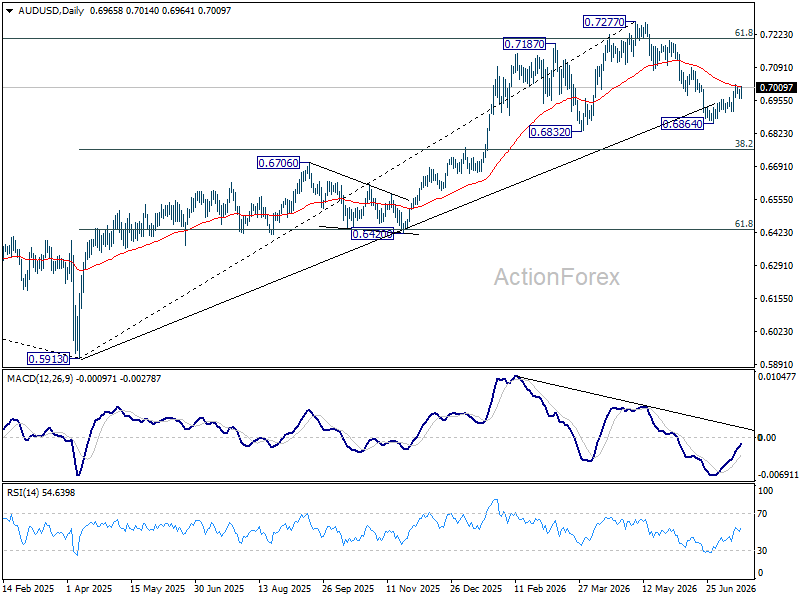
In the bigger picture, considering bearish divergence condition in D MACD, a medium term top could be formed at 0.7277 after failing to sustain above 61.8% retracement of 0.8006 (2021 high) to 0.5913 (2024 low) at 0.7206. Deeper fall could be seen to 38.2% retracement of 0.5913 to 0.7277 at 0.6756 as a correction. But strong support should be seen there to bring rebound. Consolidations would continue below 0.7277 for a while.
Canada Inflation Cools Sharply as Lower Gasoline Prices Pull Headline CPI Below Expectations
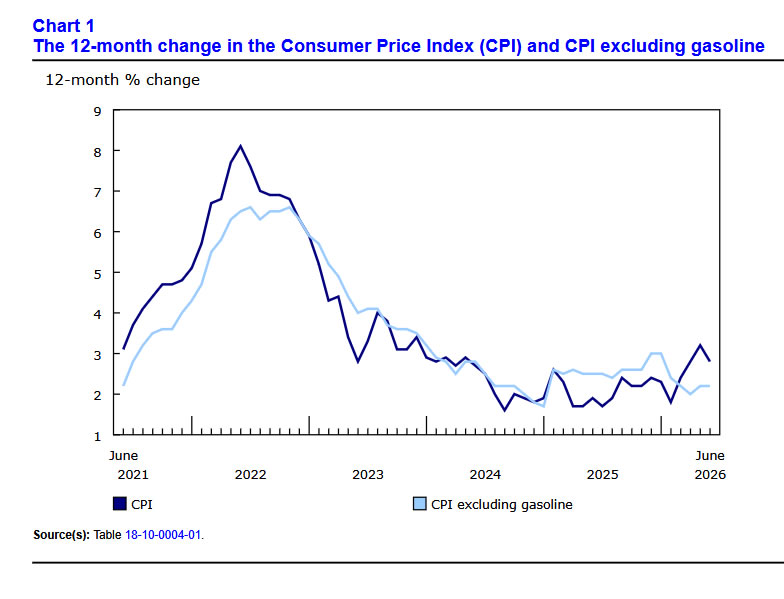
Canada's annual inflation rate slowed more than expected to 2.8% in June from 3.2% in May, while headline CPI fell -0.4% on the month, marking the largest monthly decline since December 2024. The moderation was driven primarily by gasoline prices, which remained elevated from a year earlier but rose at a much slower annual pace than in May as easing oil prices during June weighed on pump prices. Gasoline prices fell -10.2% on the month, helping pull headline inflation lower despite continued geopolitical tensions in the Middle East.
Underlying inflation also softened. CPI Median eased to 1.9% year-on-year from 2.1%, while CPI Trimmed slowed to 1.8% from 2.0%, both undershooting market expectations. Common CPI edged down to 2.6% from 2.7%, although it remained slightly above consensus. Excluding gasoline, headline CPI was unchanged at 2.2% year-on-year, indicating that broader price pressures remained relatively contained even as energy prices continued to exert outsized influence on the headline figure.
The report should reinforce expectations that Bank of Canada can maintain a patient approach to policy. While geopolitical risks continue to cloud the inflation outlook through energy markets, June's data suggest the earlier oil-driven price surge did not generate broader second-round inflation pressures. With both headline and core inflation measures moving lower, policymakers are likely to remain focused on whether easing energy prices can continue to offset the risk of renewed volatility should tensions in the Middle East escalate again.
Economic Data
| Indicator | Actual | Expected | Previous |
|---|---|---|---|
| CPI M/M | -0.4% | -0.2% | 1.0% |
| CPI Y/Y | 2.8% | 2.9% | 3.2% |
| CPI Median Y/Y | 1.9% | 2.1% | 2.1% |
| CPI Trimmed Y/Y | 1.8% | 2.0% | 2.0% |
| CPI Common Y/Y | 2.6% | 2.5% | 2.7% |
Market Takeaways
- Headline inflation slowed more than expected, helped by a sharp decline in gasoline prices during June.
- Monthly CPI posted its largest decline since December 2024, indicating easing energy price pressures outweighed gains elsewhere.
- Both CPI Median and CPI Trimmed undershot expectations, reinforcing the moderation in underlying inflation.
- Excluding gasoline, inflation held steady at 2.2%, suggesting broader price pressures remain relatively contained.
- The report supports a patient Bank of Canada stance, although the inflation outlook remains sensitive to renewed volatility in global oil prices.