Tue, Apr 07, 2026 01:23 GMT
More

    Sample Category Title

    The Good, the Bad and the Simply Perplexing

    Australia’s economy is in a cyclical upswing, and the latest quarterly accounts suggest there is more supply capacity than some feared. Public sector programs continue to absorb resources, while consumer spending is not as strong as we thought.

    • This week’s national accounts confirm that Australia is in a cyclical upswing that is becoming more broadly based. This is good news: much of the strength is in activities that invest in Australia’s future. Data revisions also imply that supply capacity is better than many observers feared, and more in line with our existing view.
    • The bid for resources by the public sector remains robust and possibly overlaps with the needs coming from growing business and housing investment. Consistent with this, the income tax burden on households has returned to high levels. Households are also facing higher petrol prices while the war in the Middle East continues.
    • The Q4 consumption data were a puzzle, slower than we or the RBA expected. Some of the miss looks to be noise that reverses next quarter and some may be measurement issues that get revised later. Based on what we know now, though, it seems that the anticipated private sector recovery is more about investment (both business and housing) than consumption. The consumer will be reined in until the current inflation pulse subsides.

    Every quarter, the ABS runs the ruler over the economy, and we learn something about the underlying activity pulse, now and in the past. The story is usually a mixed bag of positive and negative news, and some results are simply perplexing. This quarter was no different.

    The good

    Australia is in a cyclical upswing that is becoming more broadly based. In the quarter, solid growth was seen across a range of both public and private demand. Business investment is looking positive even as the lumpy timing of buying in data centre equipment versus building the actual data centre induces volatility in the components. While the external sector detracted from growth overall, minerals export volumes bounced after a long period of relative stability. Factor in higher commodity prices across many key exports and the income (and tax revenue) boost from this source is material.

    This is an unambiguously good thing. Growth had been lacklustre for much of the post-pandemic period, even with the ramp-up in the care economy. And stronger dwelling investment means more housing supply. Overall, we see the composition of recent and near-term growth as being consistent with investing in Australia’s future.

    Supply capacity is better than many observers feared. As one of my old bosses used to say, most changes to your view come from revisions to history. His observation was especially pertinent in the Q4 accounts. While growth in the quarter lagged our final estimate, the previous three quarters were each revised up slightly. As well as meaning that our year-ended growth forecast was on the money, the material cumulative revision implies that the inflation seen recently occurred alongside stronger growth than previously understood. This inherently implies that supply capacity was higher and growing faster than previous data releases implied. We have long believed that Australia can grow sustainably faster than 2%; this week’s data is evidence in favour of our view and against the slow-trend hypothesis.

    Productivity growth at 1.0%yr (and even higher at 1.5%yr in the market sector as mining productivity bounced back) is well above the RBA’s February forecast. Commentators pointing to the flat quarterly result for productivity growth in Q4 as evidence of ongoing stagnation ignore the prospects for further data revisions in future releases, given their recent pattern. That view also ignores the inherent volatility of these imperfectly measured data, as well as the vagaries of measurement in the non-market sector.

    The bad

    The public sector continues to expand its share of the economy. While infrastructure spending has been rolling over as projects complete, other realms of public spending remain robust. The ‘handover’ from public to private spending was less complete than we initially thought. This becomes a particular issue if the spending calls on resources that the private sector is also competing for. As we have previously highlighted, much of the private sector investment has been in ‘structural’ areas such as energy transition and data centres that are not simply responses to consumer demand and thus will be resilient to consumer weakness. They also lean heavily on construction capacity that public programs such as Housing Australia and the Brisbane Olympics also seek to draw on.

    A large public sector is not inherently bad. Many of the spending initiatives, including on disability and social care, address important needs and create opportunities for the people helped. They have probably supported the labour force participation of others as well. However, all this support must be funded. One of the other features of the Q4 national accounts is that taxation as a share of household income rose over 2025, reversing almost all the reduction from the Stage 3 tax cuts. This is again a material drag on household disposable incomes and spending. Given that many Australian households are very lightly taxed, a rising tax burden on the rest has distributional implications.

    Separate to the national accounts, there is a war on. The hostilities in the Middle East have closed the Strait of Hormuz and damaged Qatari LNG production. Global oil prices have spiked and local petrol prices have also risen significantly; we recently released some scenario analysis on how this might play out for inflation and growth in Australia and New Zealand. A key point is that global gas prices as well as oil prices are being affected. There is an export and tax revenue fillip for Australia from this that will cushion the cost shock.

    Inflation expectations in Australia remained relatively well anchored through the post-pandemic inflation surge. The RBA even assumes this will continue when it forecasts inflation or assesses the tightness of the labour market. Thus, while it would be nervous, knowing that petrol prices are very salient for household beliefs about inflation, it should be keeping this risk in perspective and not act on a possibility that expectations might lift.

    The simply perplexing

    A comprehensive, interlinked data set such as the national accounts will always throw up some puzzles. We were surprised that the consumption data were not stronger in the December quarter. Some of the miss was likely noise, relating to weather effects on actual electricity consumption and the mapping from total vehicle sales to sales to households. But there is also a notable gap between our estimates of non-tourism spending offshore, such as online shopping, gaming and gambling, based on customer card spending, and the ABS’s estimates based on other sources. This is an area where the data revisions my old boss used to warn about might come into play at some point.

    The bottom line

    The anticipated private sector recovery is underway, but it is more about investment than household consumption. The consumer will again be reined in by restrictive monetary policy and rising tax burdens until the current inflation pulse subsides.

    EUR/USD: NFP Looms as 1.1578 Support Faces Critical Test

    • The pair is under pressure, trading below 1.1600 due to geopolitical tensions (Middle East conflict, Iran leadership) and the ECB's "persistent uncertainty" which prevents the Euro from decoupling from the US Dollar's strength.
    • The highly anticipated US Nonfarm Payrolls (NFP) report tomorrow is expected to cause significant volatility, with a strong reading cementing Dollar dominance.
    • The immediate future hinges on the 1.1578 support level.

    EUR/USD finds itself at a critical technical and fundamental juncture. After a volatile week defined by a "flight to safety," the pair has broken back below the psychological 1.1600 barrier.

    What is driving EUR/USD price action?

    One could almost call EUR/USDs conundrum as a ‘tale of two tensions’. The pair is navigating through a mix of geopolitical anxiety and central bank caution.

    The European Central Bank (ECB) published its meeting accounts today. While the Governing Council expressed confidence that inflation is trending toward target, they emphasized "persistent uncertainty."

    This cautious rhetoric suggests the ECB is in no rush to pivot aggressively, but it also fails to provide the hawkish spark the Euro needs to decouple from the Dollar’s strength.

    Add to this the escalating conflict in the Middle East and you have a cocktail for explaining the slide in EUR/USD.

    Looking at the latest from the Middle East, according to reporting from Axios, President Trump has asserted that he must be personally involved in the process of selecting Iran’s next leader. While acknowledging that Mojtaba Khamenei is currently the most likely individual to succeed the Supreme Leader, the President characterized such an outcome as unacceptable.

    This is likely to keep tensions high and a peace deal or ceasefire out of reach which would continue to lend support to the US Dollar and drag EUR/USD lower.

    NFP & jobs data tomorrow

    Recent US economic indicators, including a strong ISM Services PMI (56.1) and steady private payroll data, continue to paint a picture of US economic outperformance. This "American exceptionalism" keeps the Federal Reserve's policy path looking more robust compared to its European counterpart.

    Tomorrow though will bring the highly anticipated NFP release. As the most significant labor market data point of the month, a strong reading could cement the Dollar's dominance, while a miss might provide the Euro the breathing room it needs to stage a relief rally.

    For all market-moving economic releases and events, see the MarketPulse Economic Calendar. (click to enlarge)

    What comes next for EUR/USD?

    The immediate future of EUR/USD hinges on whether the 1.1578 support level can hold on a daily closing basis.

    The Bearish Case: If the pair closes below 1.1578, technical analysts warn of a "deeper slide" toward 1.1500. Such a move would likely be triggered by a renewed surge in oil prices (potentially toward $100/bbl) or a further escalation in regional hostilities.

    A test of the 1.1450 level will be intriguing. This has been a multi-year pivot level for EUR/USD and if this holds, it may present an opportunity for position traders.

    The Bullish Case: For a meaningful recovery, the Euro must reclaim its 200-day moving average near 1.1670. A break above this level would signal that the broader uptrend remains intact and could trigger a wave of technical buying back toward 1.1800.

    EUR/USD Four-Hour Chart, January 6, 2026

    Source:TradingView.com

    For now, EUR/USD remains in a "wait-and-see" mode, pinned between geopolitical headlines and looming US data. Traders should remain cautiously optimistic only if 1.1580 holds; otherwise, the path of least resistance remains to the downside.

    Canadian Dollar Loves Conflict – Has CAD Reached a Long-Term Bottom?

    The Canadian Dollar had been a victim of a rough stretch since the beginning of Trump's second term.

    Isolated by its historic neighbor amid US First policies, the Canadian Economy had been taking a sustained hit, leading to an accelerated cooling. The Land of Maple Syrup is known to be highly cyclical. Structurally, it tends to be dependent on commodity prices, global trade, and particularly on the US, which harshly pumped the brakes.

    Canadian GDP Growth since end 2020 – Courtesy of Trading Economics

    This phenomenon got accelerated by the historic Canadian mortgage structure: Variable loans are particularly affected when rates rise, compared to the typical 30-year fixed rates offered in the US.

    Hence, after the 2 years of ultra-low rates during COVID policies, the Bank of Canada hikes sent the hypersonic economy into a rock-hard wall.

    Add to this a general productivity restructuring, as massive waves of immigration saw another brutal stop; business confidence and investment stalled suddenly over the past few years – this shows up particularly in GDP per capita in Canada, which has remained broadly unchanged since 2012.

    Canadian GDP per Capita since 1985 – Courtesy of Macro Micro

    But there is light at the end of the tunnel. After years of questioning within Canada's natural Liberal party, Justin Trudeau stepped aside for Mark Carney, who has since cast doubt on some political issues.

    Since his ascension to power in March 2025, Carney and his party have brought three Conservatives into their ranks. Conservatives are going through their own crisis with internal trouble and separatist causes in Alberta. The Liberal Party is now three seats away from a majority in the House of Commons.

    But that's just politics. Even if the Canadian economy remains deeply strained from the latest rounds of US Policies, Carney has begun a new wave of international trade deals with India, China, and Europe – The rise of the "Middle power".

    Canada's manoeuvre options were thin, with the trilateral USMCA deal in limbo, but its capacities are slowly increasing.

    What is of traders' interest is how all of this relates to the Loonie.

    After reaching 16-year lows against the Euro, 22-year troughs against the USD, and a new nadir against the Swiss Franc, the Canadian Dollar is forging a sharp turn, supported by higher petroleum and gold prices.

    Canadian Dollar and Oil Tight Correlation – Source: TradingView

    While its economy remains crippled by structural factors, Markets are forward-looking, and traders should do the same, so let's ask a simple question.

    Have we seen a long-term bottom in the Canadian Dollar?

    Let's dive into the weekly charts for USD/CAD, CAD/CHF, and EUR/CAD to see if we can get some clues from higher-timeframe technical analysis.

    Canadian Dollar 3-Pair Weekly Timeframe Analysis

    USD/CAD Weekly Chart and Major Levels

    USD/CAD Weekly Chart, March 5, 2026 – Source: TradingView

    USD/CAD has now officially broken its 2021 long-term uptrend – But such rarely signify immediate U-turns.

    The Major North American pair is currently ranging between 1.35 and 1.38, stabilized by its 200-Week Moving Average (1.36378).

    The consolidation isn't looking to be break on the immediate outlook, but keep these two breakout zones in mind:

    • Breaking and closing on the week below 1.35 would hint at further downside in the pair.
    • Rebounding a closing above its 50-Week MA (1.3830) could lead to a retest of 1.40 (lower odds)

    USD/CAD Higher timeframe levels

    Resistance Levels:

    • 1.38 Major Daily Resistance & 50-Week MA (1.3830)
    • 2026 highs 1.39288
    • November 2025 Peak 1.40 to 1.4150
    • December 2024 Consolidation 1.44 to 1.45

    Support Levels:

    • 200-Week MA 1.36378
    • 2025 lows Support 1.35 to 1.36 (bearish below)
    • September 2024 lows 1.34420
    • 1.32 to 1.33 July 2023 Next Support

    CAD/CHF Weekly Chart and Major Levels

    CAD/CHF Weekly Chart, March 5, 2026 – Source: TradingView

    The Canadian Dollar has lost more than 25% of its value against the CHF since 2022 – But this trend looks to be reverting.

    Contrarily to the more rangebound USD/CAD, momentum is taking a significant shift towards a rebounding trend after a weekly double-bottom and supported by a weekly bullish divergence.

    The 50-Week MA will be the upcoming target for bulls who are attempting to grab control – Closing above it may easily relaunch the pair towards 0.60.

    CAD/CHF Higher timeframe levels

    Resistance Levels:

    • Major Momentum Pivot 0.57 to 0.58 (50-Week MA 0.58133)
    • 0.59 mini-resistance
    • Next Key Resistance 0.60 to 0.6050
    • 2024 Base Resistance 0.62 to 0.6270
    • 2024 Major Resistance 0.64 to 0.64750 (200-Week MA)

    Support Levels:

    • All-Time Lows Support 0.56
    • 0.56013 All-Time Lows
    • Next Psychological Support 0.55

    EUR/CAD Weekly Chart and Major Levels

    EUR/CAD Weekly Chart, March 5, 2026 – Source: TradingView

    EUR/CAD is also seeing a significant shift in its trend throughout this week's break lower.

    Now falling below its 50-Week Moving Average and crossing back below the significant 1.60 psychological level, sellers should remain in control all the way towards the 1.57 - 1.58 Major Support.

    • Mean reversion there could assist a re-entry for further downside, particularly if prices retake the 1.59 level.
    • Watch for selling acceleration on a weekly close below 1.57.

    EUR/CAD Higher timeframe levels

    Resistance Levels:

    • 2020 Resistance Zone – 1.59 to 1.60
    • 50-Week MA 1.6020
    • Major Resistance at 2018 Highs – 1.61 to 1.6150
    • Major Resistance at 2018 Highs – 1.63 to 1.64
    • 16-Year high 1.64703

    Support Levels:

    • Upcoming support 1.57 to 1.58 Zone
    • March 2025 Support Zone 1.5475 to 1.55
    • Pre-Breakout Support 1.5150 to 1.52
    • 2024 Major Support 1.46 to 1.4750

    Eco Data 3/6/26

    GMT Ccy Events Act Cons Prev Rev
    08:00 CHF Foreign Currency Reserves (CHF) Feb 710B 712B
    10:00 EUR Eurozone GDP Q/Q Q4 F 0.20% 0.30% 0.30%
    13:30 USD Retail Sales M/M Jan -0.20% -0.20% 0.00%
    13:30 USD Retail Sales ex Autos M/M Jan 0.00% 0.00% 0.00%
    13:30 USD Nonfarm Payrolls Feb -92K 65K 130K 126K
    13:30 USD Unemployment Rate Feb 4.40% 4.30% 4.30%
    13:30 USD Average Hourly Earnings M/M Feb 0.40% 0.30% 0.40%
    15:00 USD Business Inventories Dec 0.10% 0.10% 0.10% 0.00%
    15:00 CAD Ivey PMIFeb 56.6 51.2 50.9
    08:00 CHF
    Foreign Currency Reserves (CHF) Feb
    Actual 710B
    Consensus
    Previous 712B
    10:00 EUR
    Eurozone GDP Q/Q Q4 F
    Actual 0.20%
    Consensus 0.30%
    Previous 0.30%
    13:30 USD
    Retail Sales M/M Jan
    Actual -0.20%
    Consensus -0.20%
    Previous 0.00%
    13:30 USD
    Retail Sales ex Autos M/M Jan
    Actual 0.00%
    Consensus 0.00%
    Previous 0.00%
    13:30 USD
    Nonfarm Payrolls Feb
    Actual -92K
    Consensus 65K
    Previous 130K
    Revised 126K
    13:30 USD
    Unemployment Rate Feb
    Actual 4.40%
    Consensus 4.30%
    Previous 4.30%
    13:30 USD
    Average Hourly Earnings M/M Feb
    Actual 0.40%
    Consensus 0.30%
    Previous 0.40%
    15:00 USD
    Business Inventories Dec
    Actual 0.10%
    Consensus 0.10%
    Previous 0.10%
    Revised 0.00%
    15:00 CAD
    Ivey PMIFeb
    Actual 56.6
    Consensus 51.2
    Previous 50.9

    Sunset Market Commentary

    Markets

    As bombings in the Middle-East continue, markets jump from headline to headline in search of something that might structurally change current dynamics. Today’s early focus went to Iran’s state-run Islamic Republic News Agency (IRNA). They said that deputy foreign minister Takht-Ravanchi commented in an interview with MS NOW on recent nuclear negotiations. The nation’s stockpile of highly enriched uranium “is the result of our practical achievements and that we are ready to get rid of it, provided we get something good in return”. Rewatching the interview, we couldn’t retrace those quotes. He did say that Iran is in defensive mode and that it didn’t had any contact with the US (or any other nation for that matter) since the start of the war. The IRNA article temporarily stopped the test of the $85/b area in Brent crude, but the correction lower didn’t went far. In the same vein, algo trading briefly lifted European stock markets into positive daily territory only to succumb those profits as the US trading session gained traction. The trade-weighted dollar spiked lower on the headlines, but that move won’t make it in this week’s highlights. Next talking points were an Iranian drone attack on Azerbaijan’s Naxcivan enclave which only broadened the conflict, Qatar reporting more missiles and drones being fired from Iran, UK PM Starmer confirming that UK jets were in the skies last night over Jordan and Qatar and the WSJ reporting that ship insurers are willing to work with US President Trump on the Straight of Hormuz cover. US defence secretary Hegseth will give a new press briefing later today.

    The recap above highlights low visibility on the near or longer term developments in the conflict which Israeli and US officials say might last for weeks. In this context we err on the side of higher energy prices, weighing on both stocks and bonds and making USD the by default winner in FX space. For the record some levels which are prone to the developing story. EUR/USD holds around 1.16, so above first support at 1.1573. European and US equity indices currently lose about 0.5% with the EuroStoxx50 failing to really get away from the 5800 support area. The German yield curve bear flattens with yields adding between 3.7 bps (30-yr) and 10.2 bps (2-yr) with Minutes of the previous ECB meeting suggesting that the current policy rate allows enough flexibility to react to shocks. Current patience should not be mistaken for being hesitant to act or being asymmetric. The market implied probability of a September rate hike is now 50%. German Bunds and UK Gilts underperform US Treasuries today.

    News & Views

    Swedish inflation fell short of expectations in February. The CPIF headline gauge (using a fixed interest rate) eased from 2% to 1.7% vs 1.8% expected with the monthly pace coming in at 0.6%. Core CPIF missed the annual bar by the same margin with the 1.4% the lowest outcome since August 2021. The Riksbank itself had penciled in a much lower 1.3% in the December projections for the overall figure while expecting core inflation at 1.7%. Sweden’s central bank kept the policy rate unchanged at 1.75% during the end-January policy meeting and expects it to remain at that level for some time to come. We do not think today’s inflation numbers throw the Riksbank off-track. Sweden’s economy grew at a solid pace at the end of last year despite the large amount of (geopolitical) uncertainty, the central bank said, with household consumption continuing to rise and the labour market showing increasingly clear signs of improvement. With risks since this week clearly tilted to the upside, the Riksbank has every reason to wait things out. The CPI print barely left a dent in SEK. EUR/SEK is trading a tad higher in the 10.68 area.

    UK CFOs in the Bank of England monthly Decision Maker Panel lowered their year-ahead inflation expectations by 0.1 ppt to 3.1% in the three months to February, the lowest since February 2025. The 3-year gauge inched lower similarly, to 2.8%. They reported annual wage growth at 4.3% (-0.1 ppt) and expected wages to grow 3.6% (unchanged) in the year ahead, implying a 0.7 ppt cooldown over the next 12 months. Annual employment growth was -0.2%, which was less of a contraction than the -0.5% in the three months to January. Expectations for employment growth over the next year improved slightly, rising by 0.3 ppts to 0.1%. It’s the first positive reading since August of last year. In terms of the central bank rate, the three-month ahead expectations indicator stood at 3.5% with the year- and three-year series printing at 3.2% and 3.1% respectively. It should be noted that the survey was conducted between Feb 6 and Feb 20, before the recent sharp increase in energy prices.

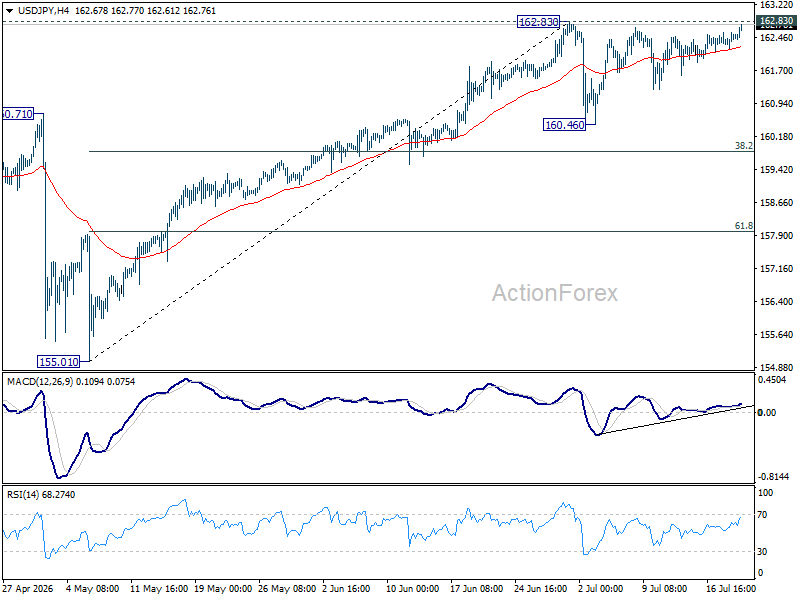
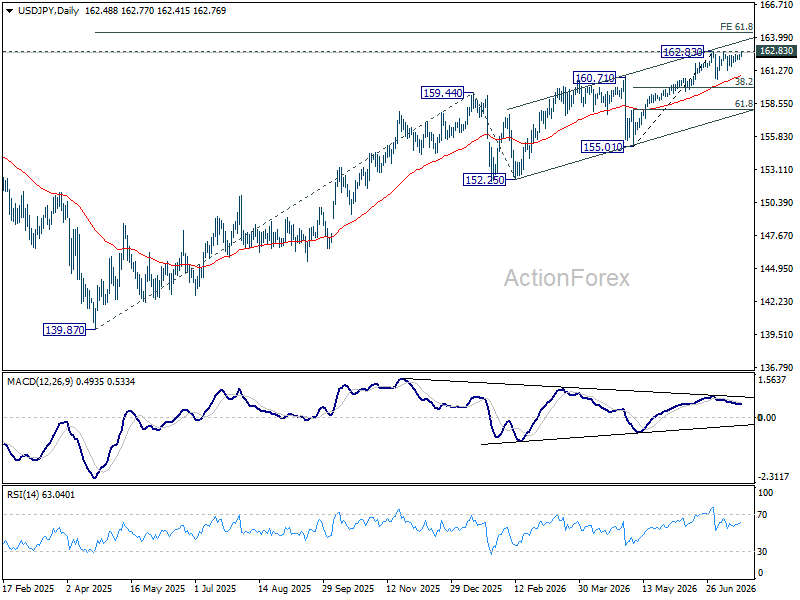
    USD/JPY: Larger Bulls Gain Traction After Limited Pullback

    USDJPY strengthened on Thursday after a pullback from new multi-week high (157.96, hit on Mar 3) was contained by rising 10DMA (156.34).

    Thursday’s action has so far been shaped in a Hammer candle that signals potential end of a shallow correction (157.96/156.44).

    Overall structure remains firmly bullish on daily chart, supported by strong positive momentum and multiple bull-crosses of daily MA’s (in bullish configuration), contributing to signals of bullish continuation of the upleg from 152.26 (Feb 12 low) following violation of key barrier at 157.65 (former top of Feb 9).

    The notion is supported by strengthening dollar on increased safe-haven demand and fading expectations for Fed rate cuts, as deepening geopolitical crisis threatens of boosting inflation.

    Bulls look for retest and clear break of Tuesday’s peak at 157.96 that would confirm fresh bullish signal and a double bottom at 152.11/26) and expose targets at 159.22/45 (tops of Jan 23/14).

    Initial supports lay at 156.62/34 (Fibo 23.6% of 152.26/157.96 / 10DMA), followed by 155.98 (daily Tenkan-sen) and more significant 155.79 (Fibo 38.2%/top of thin daily cloud) which should contain potential dips and keep larger bulls in play.

    Res: 157.65; 157.89; 158. 90; 159.22.
    Sup: 156.62; 156.34; 155.98; 155.79.

    Crypto: An Encouraging Rebound in a Bear Market

    Market Overview

    The crypto market cap rose 4.8% to $2.45 trillion, then climbed to $2.50 trillion at the end of the day on Wednesday, a four-week high. This is a strong indication of a base forming and a reversal to growth. The capitalisation level is approaching the 50-day moving average, below which it has been steadily trading since the end of January. Consolidation above this line could be an additional signal of a reversal to growth.

    On the other hand, this may be just a corrective rebound, as the typical Fibonacci correction range suggests a rebound to $2.53T for the decline since January and to $2.92T as part of a technical recovery from the entire decline since the October peak. Thus, despite the encouraging momentum, this may be nothing more than a rebound in a bear market.

    Bitcoin rose to $74K, breaking through the resistance area of the last four weeks with an encouraging surge. We attribute the magnitude of the short squeeze to the confidence of bears who pulled their stops too close to the market price. The recovery lost momentum near the 61.8% level of the January-February decline and just short of the 50-day moving average. Simply put, the bulls still have to convince the community that the bear market is over.

    News Background

    Bitcoin jumped above $74K on Wednesday, to its highest level in a month, amid active inflows into US spot Bitcoin ETFs, totalling $1.4 billion over the last five trading sessions.

    After five months of decline, Bitcoin has entered the third deepest oversold zone in its history, according to K33 Research. Historically, after such a bear market, the average 90-day return has been 62% (with a 78% probability).

    The Kraken crypto exchange was the first to gain access to the US Federal Reserve’s payment system. Now, the crypto exchange’s subsidiary bank can use the central bank’s payment infrastructure alongside other American banks.

    According to BitcoinTreasuries, public mining companies are selling off their cryptocurrency reserves en masse. The proceeds are being used to create infrastructure for artificial intelligence.

    EUR/USD Mid-Day Outlook

    Daily Pivots: (S1) 1.1590; (P) 1.1622; (R1) 1.1670; More….

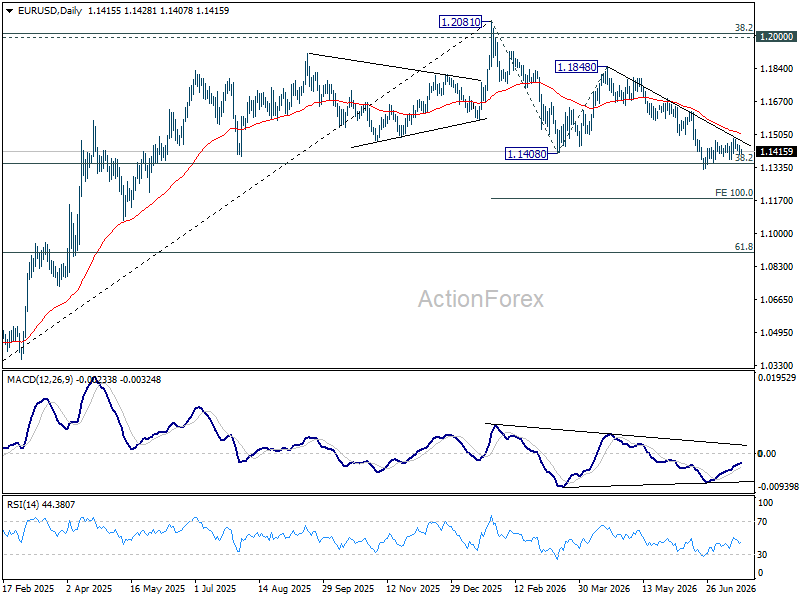
    EUR/USD is staying in consolidations above 1.1529 temporary low and intraday bias stays neutral. On the downside, below 1.1529 will resume the fall from 1.2081. Sustained break of 1.1576 structural support would confirm rejection by 1.2 key psychological level. That should also confirm medium term topping on bearish divergence condition in D MACD. Further decline should be seen to 38.2% retracement of 1.0176 to 1.2081 at 1.1353 next. However, firm break of 1.1740 support turned resistance will revive near term bullishness, and bring stronger rebound back to retest 1.2081 high.

    In the bigger picture, as long as 55 W EMA (now at 1.1494) holds, up trend from 0.9534 (2022 low) is still in favor to continue. Decisive break of 1.2 key psychological level will add to the case of long term bullish trend reversal. Next medium term target will be 138.2% projection of 0.9534 to 1.1274 from 1.0176 at 1.2581. However, sustained trading below 55 W EMA will argue that rise from 0.9534 has completed as a three wave corrective bounce, and keep long term outlook bearish.

    GBP/USD Mid-Day Outlook

    Daily Pivots: (S1) 1.3318; (P) 1.3361; (R1) 1.3417; More...

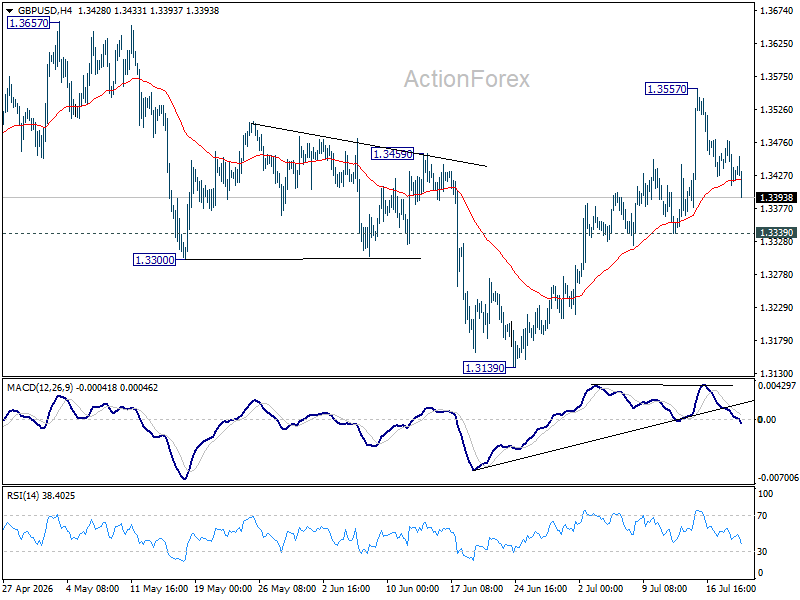
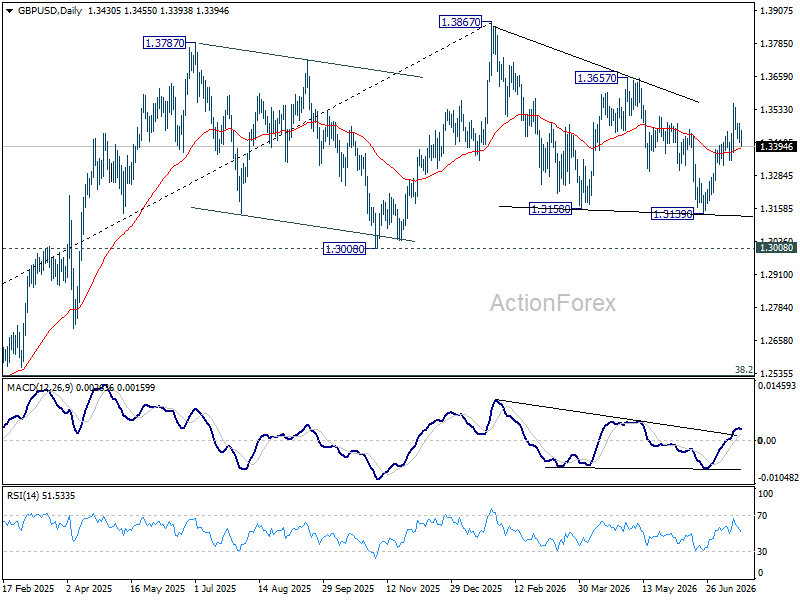
    GBP/USD is staying in consolidations above 1.3252 temporary low and intraday bias stays neutral. Fall from 1.3867 should at least be correcting the rise from 1.2009. Below 1.3252 will target 38.2% retracement of 1.2099 to 1.3867 at 1.3192. Sustained break there will pave the way to 1.3008 support. For now, risk will stay on the downside as long as 1.3574 resistance holds, in case of recovery.

    In the bigger picture, as long as 1.3008 support holds, rise from 1.3051 (2022 low) should still be in progress for 1.4284 key resistance (2021 high). Decisive break there will add to the case of long term bullish trend reversal. However, firm break of 1.3008 will raise the chance of medium term bearish reversal and target 1.2099 support next.

    USD/CHF Mid-Day Outlook

    Daily Pivots: (S1) 0.7765; (P) 0.7812; (R1) 0.7838; More….

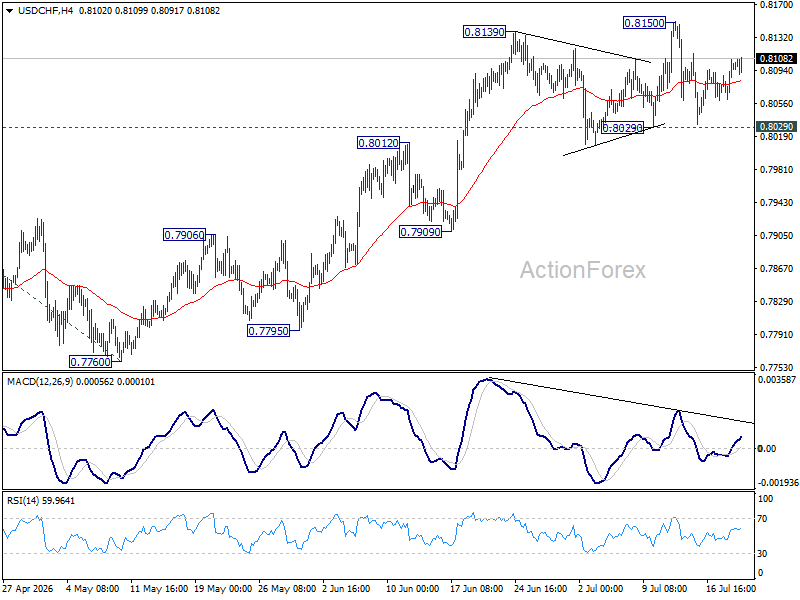
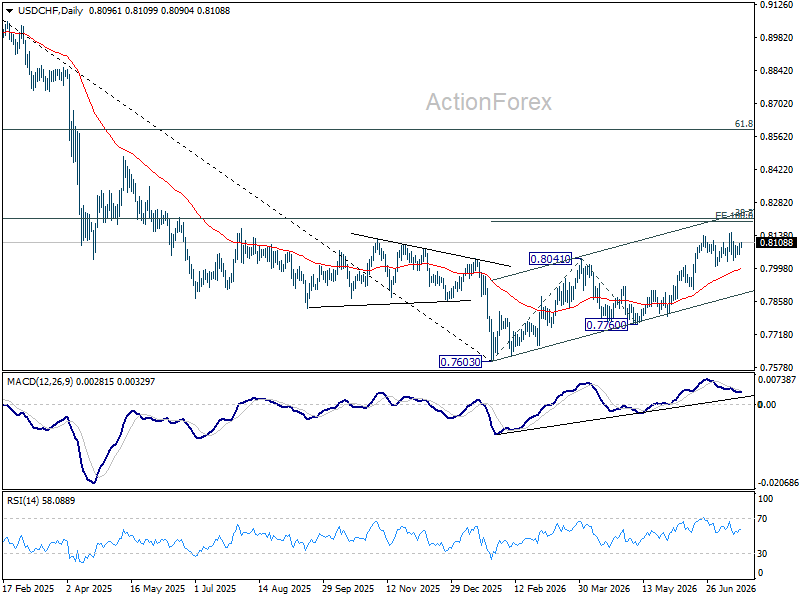
    No change in USD/CHF's outlook and intraday bias remains neutral. More consolidations could be seen below 0.7877 temporary top first. Further rise is expected as long as 0.7671 support holds. Rebound from 0.7603 is seen as correcting the whole fall from 0.9022. Above 0.76877 will target 0.8039 resistance next.

    In the bigger picture, a medium term bottom could be in place at 0.7603 on bullish convergence condition in D MACD, Firm break of 0.8039 resistance will argue that it's at least correcting the down trend from 0.9002. Stronger rebound would then be seen to 38.2% retracement of 0.9200 to 0.7603 at 0.8213.