

Sample Category Title
EUR/JPY Daily Outlook
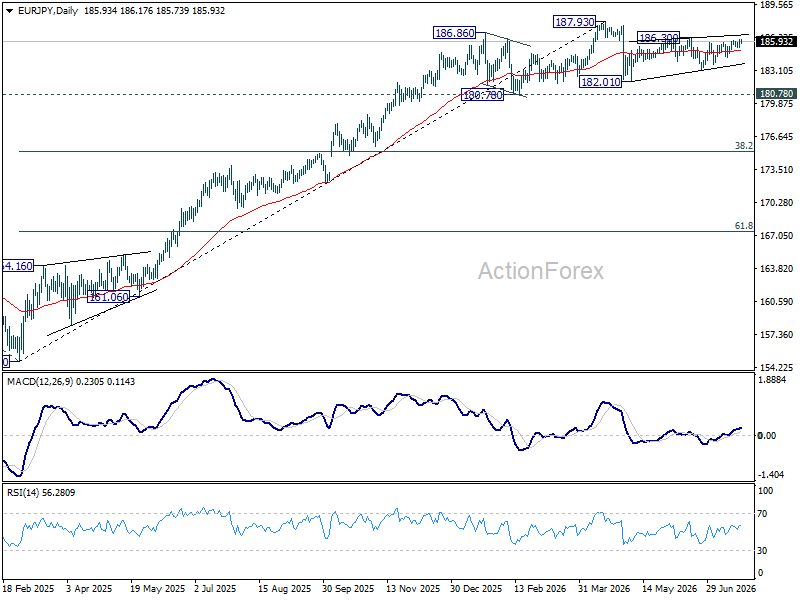
Intraday bias in EUR/JPY remains neutral and outlook is unchanged. While the price actions from 182.10 are looking corrective, stronger rebound cannot be ruled out. On the upside, firm break of 186.30 will resume the rebound from 182.10 towards 187.93 high. On the downside, break of 183.14 will bring deeper fall to retest 182.10.
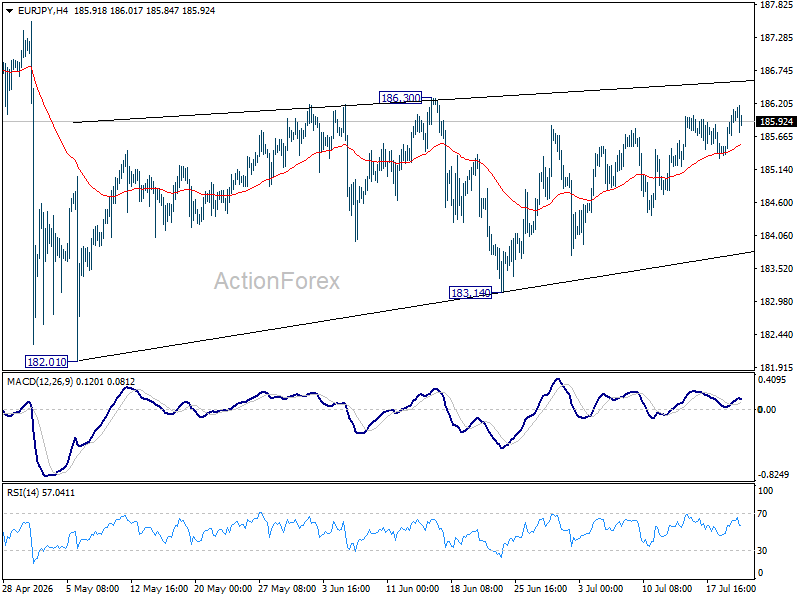
In the bigger picture, uptrend from 114.42 (2020 low) is still expected to resume at a later stage to 78.6% projection of 124.37 (2022 low) to 175.41 (2025 high) from 154.77 at 194.88. However, sustained break of 55 W EMA (now at 180.15) will argue that it's already in a medium term down trend to 175.41 resistance turned support and below.
EUR/GBP Daily Outlook
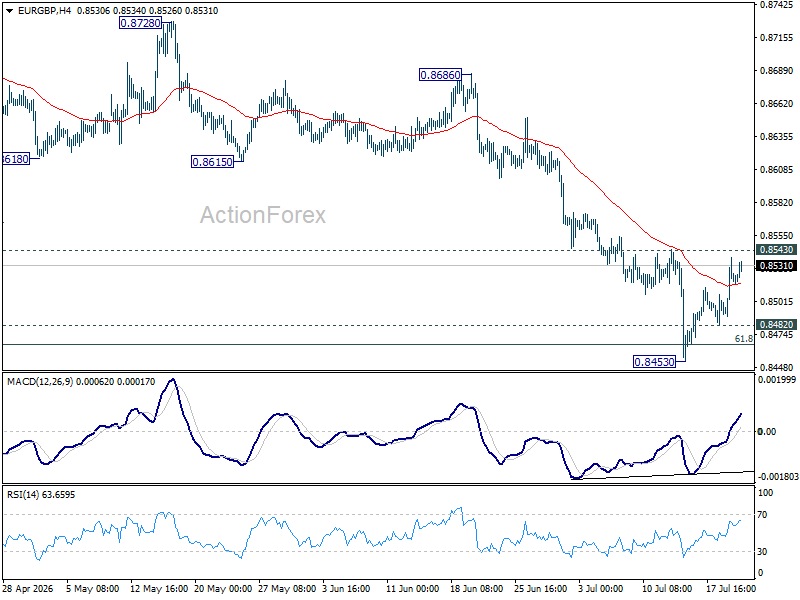
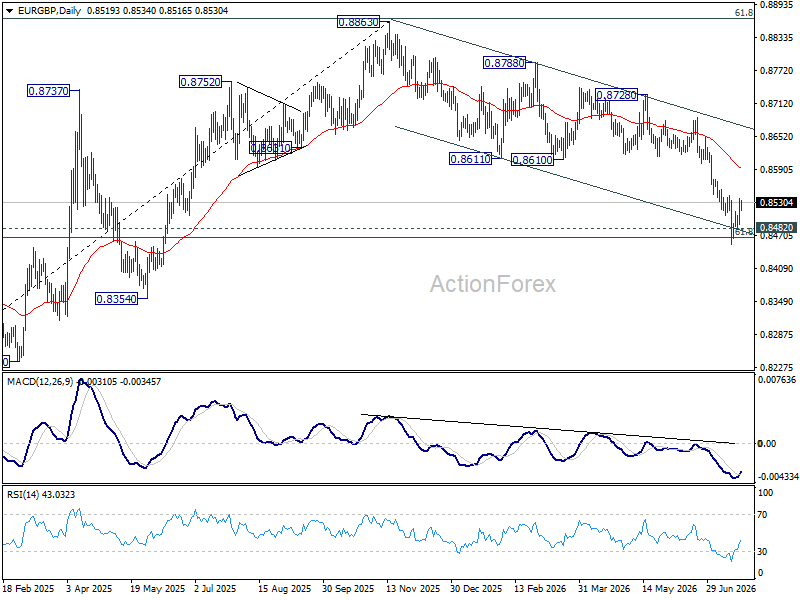
Intraday bias in EUR/GBP remains neutral and further fall is expected with 0.8543 resistance intact. On the downside, below 0.8482 minor support will bring retest of 0.8453 first. Firm break there and sustained trading below 61.8% retracement of 0.8221 to 0.8863 at 0.8466, will extend the decline from 0.8863 to retest 0.8221 low. However, decisive break of 0.8543 will bring stronger rebound to 55 D EMA (now at 0.8592).
In the bigger picture, current development suggests that rise from 0.8221 (2024 low) has completed at 0.8863, just ahead of 38.2% retracement of 0.9267 (2025 high) to 0.8221 at 0.8867. Deeper fall would be seen back to 0.8221. For now, outlook will be neutral at best as long as 0.8610 support turned resistance hold.
EUR/AUD Daily Outlook
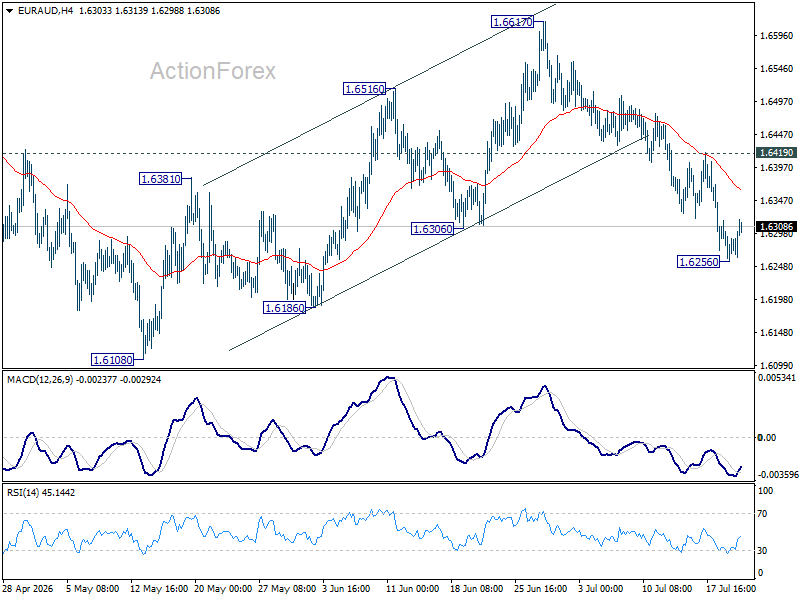
Intraday bias in EUR/AUD is turned neutral first with current recovery. Further fall is expected as long as 1.6419 resistance holds. Rebound from 1.6108 could have completed at 1.6617 already. Below 1.6256 will target a retest on 1.6108 low. Firm break there will resume larger down trend.
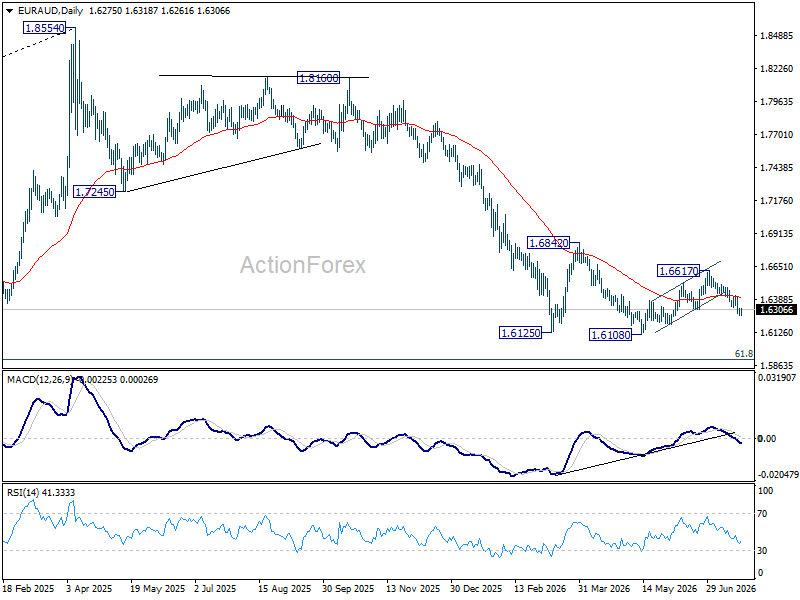
In the bigger picture, outlook will stay bearish as long as 1.6842 resistance holds. Fall from 1.8554 (2025 high) is expected to continue to 61.8% retracement of 1.4281 to 1.8554 at 1.5913. Decisive break there will pave the way back to 1.4281 (2022 low). However, firm break of 1.6842 should confirm medium term bottoming, and bring stronger rally.
EUR/CHF Daily Outlook
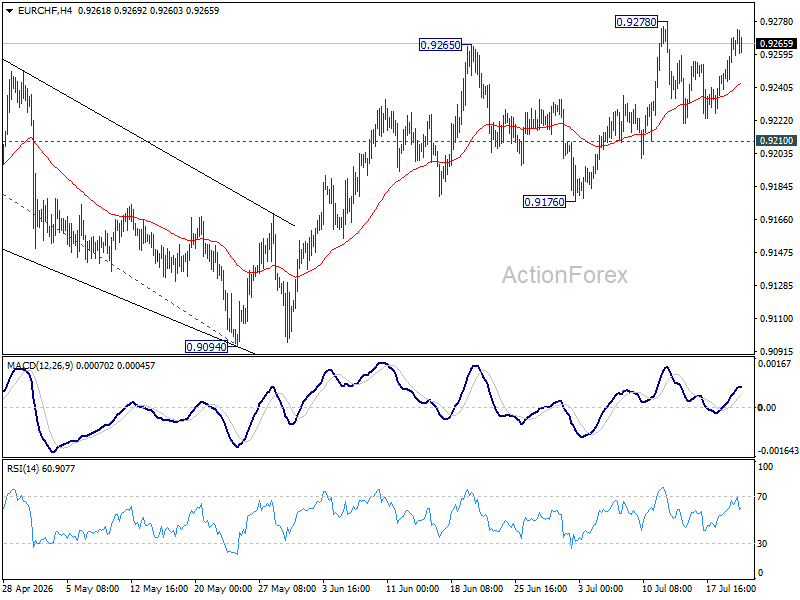
EUR/CHF is still staying in range below 0.9278 despite extended recovery. Intraday bias remains neutral and more consolidations could be seen. After all, with 0.9210 support intact, further rally is still in favor. On the upside, break 0.9278 will resume the rise from 0.8979 to 100% projection of 0.8979 to 0.9264 from 0.9094 at 0.9379. However, decisive break of 0.9210 support will turn bias back to 0.9176 support instead.
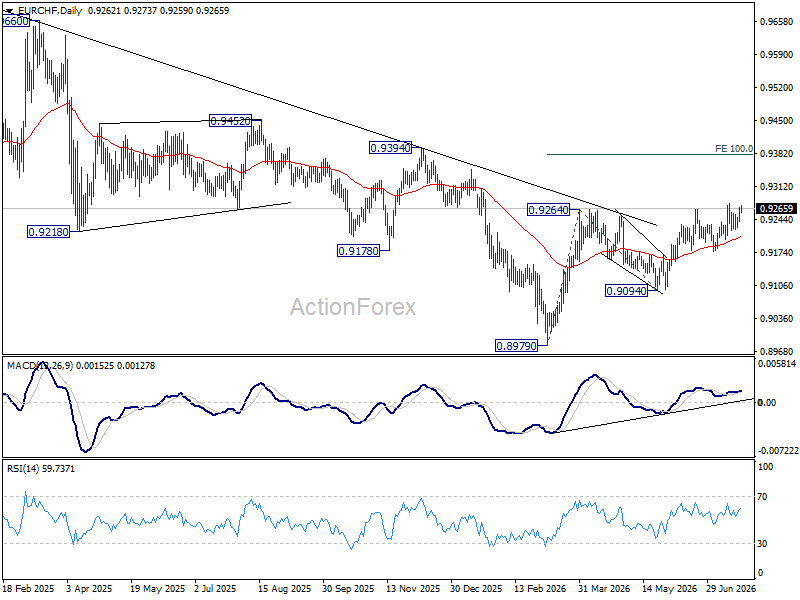
In the bigger picture, the break of medium term falling trend line resistance indicates that 0.8979 is already a medium term bottom. Considering bullish convergence condition in W MACD, rise from there should at least be reversing the fall from 0.9928, with prospect of developing into a medium term up trend. Firm break of 0.9394 resistance will add more credence to this case. For now risk will remain on the upside as long as 0.9094 support holds, in case of retreat.
US – Fed Preview: A Divided Hold
- We expect the Federal Reserve to remain on hold in the July meeting, in line with consensus. Markets price in 20-25% probability for a hike.
- Without new projections or forward guidance from Warsh, the focus will be on the vote split. We think the most likely outcome is 2-4 votes in favour of a hike.
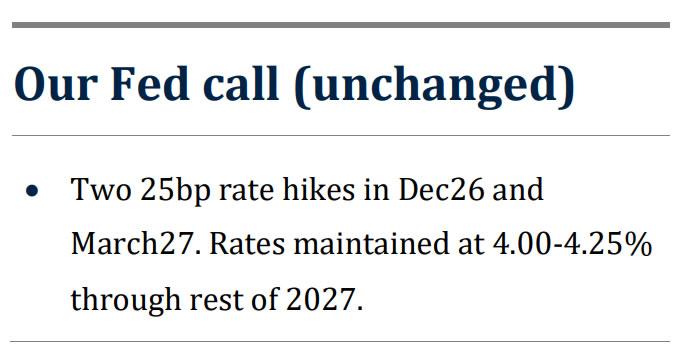
- We forecast 25bp hikes in December and March, with risks skewed towards an earlier start. We recommend remaining short EUR/USD spot going into next week's meeting.
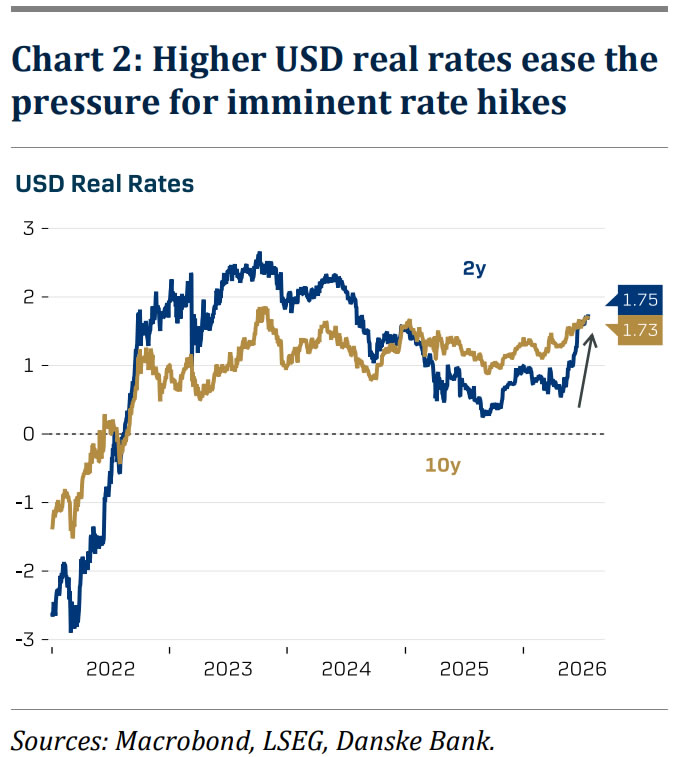
The first month after Kevin Warsh's debut at the FOMC's June meeting has brought mixed signals on the inflation front. On one hand, the re-escalation of the war in Iran has lifted energy prices higher again. Yet on the other hand, Warsh's hawkish comments have already lifted real rates, supported broad USD and tightened financial conditions while realized inflation surprised to the downside in June.
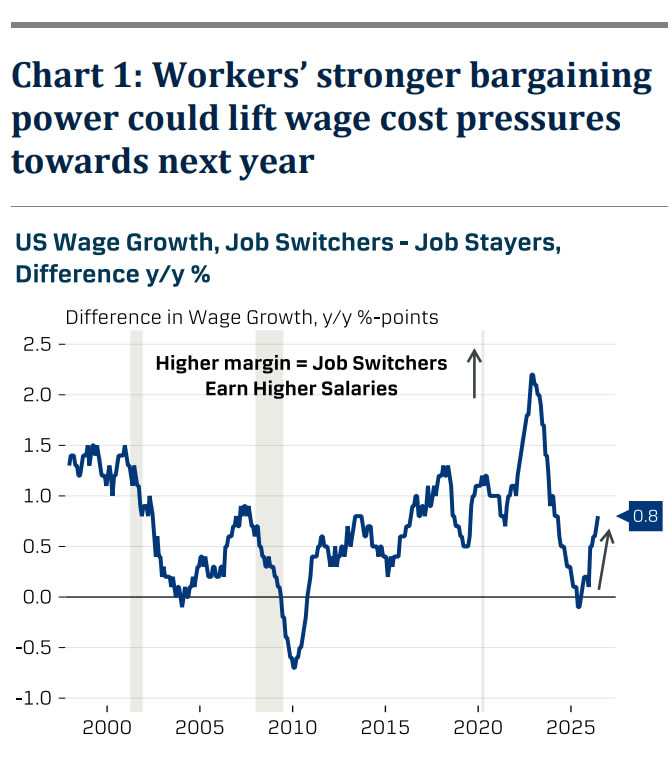
Assuming Warsh sticks with only limited forward guidance, the meeting could leave markets with little to digest aside from the rate decision itself. In the June 'dots', 6 participants saw at least two hikes this year. We see a chance for 2-4 votes in favour of a hike already in July. Aside from Warsh, regional Fed hawks Logan, Hammack and Kashkari have appeared open to tightening policy at a relatively early stage. Governor Waller warned before the June CPI release that if core inflation was 'hot', FOMC would need to consider tightening policy in the near-term. However, we think that the broadly lower-than-expected reading eased the need for rapid tightening.
Looking further ahead, we assess that Bowman, Jefferson and Cook could eventually tilt the balance towards hiking in the later meetings. Williams, Daly, Paulson and Barr have not signalled an imminent bias towards hiking, while Powell has (intentionally) remained on the backlines when it comes to communication.
Back in May, we laid out the three main arguments for tightening policy: the AI-capex boom, more supportive fiscal impulse and re-tightening labour market balance. We still think these will justify hiking rates twice, in December and March, but elevated energy prices skew the balance of risks towards an earlier start. Markets price in 5-6bp worth of hike probability for next week, 36bp by year-end and 47bp by March.
Last week, we recommended a tactical short EUR/USD spot position ahead of the July rate decision(s). We see an asymmetric outcome space around the meeting, where a unanimous hold would not materially affect hike expectations in later meetings, but a surprise hike or a close-call split decision could drive a hawkish repricing of USD real rates and support broad USD FX.
Finally, we do not expect any changes to the Fed’s balance sheet policies, as the task force announced in July will continue its work towards year-end. For now, NY Fed continues to expand the Fed’s T-bill holdings with net reserve management purchases a USD10bn per month, as has been the case since mid-May.
Gold: The Floor Has Been Found, but Where Is the Ceiling?
- The strong support at 4,000 helps gold defy the fundamentals.
- Rising Treasury yields and a strong US dollar are creating headwinds.
The US dollar staged a four-day growth against the backdrop of air strikes on Iran. Rumours of a temporary ceasefire have not been confirmed, pushing Brent to near $93 per barrel and fuelling inflation fears. The odds of two Fed rate hikes in 2026 are estimated at 50/50, supporting the USD.
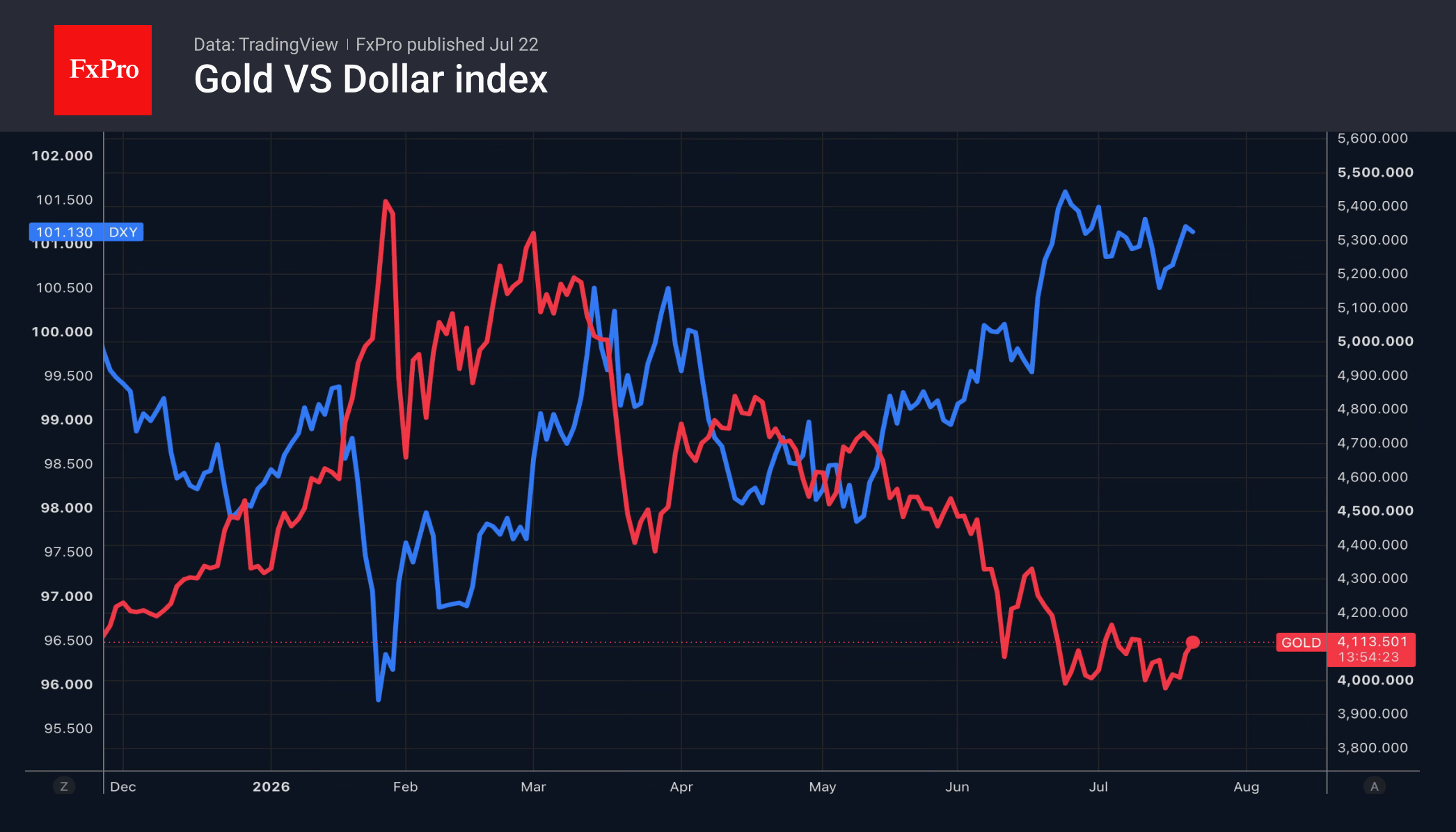
This makes the gold rally all the more surprising, as a strong dollar and rising Treasury yields are typical headwinds. However, this time demand is supporting the precious metal. Capital outflows from ETFs have given way to inflows. The 7.4-metric-tonne increase in holdings of specialised exchange-traded funds on 21 July was the month’s largest. Hedge funds have increased their net long positions in gold to a five-week high.
It is likely that the resilience of support at $4,000 per ounce, together with gold’s poor performance in previous periods, has led investors to view the precious metal as oversold. By the end of June, it had recorded its worst monthly performance since the 2008 global economic crisis, falling at its fastest pace since 2013.
During this period, pressure on gold prices was fuelled by rumours that central banks in the Gulf states were selling bullion via intermediaries. Turkey was the main focus of these rumours. Its gold reserves fell by 81 tonnes in the first half of the year, equivalent to $10.6 billion at current prices. The June deal between the US and Iran was, in theory, intended to halt this process, but the escalation of geopolitical tensions could accelerate it.
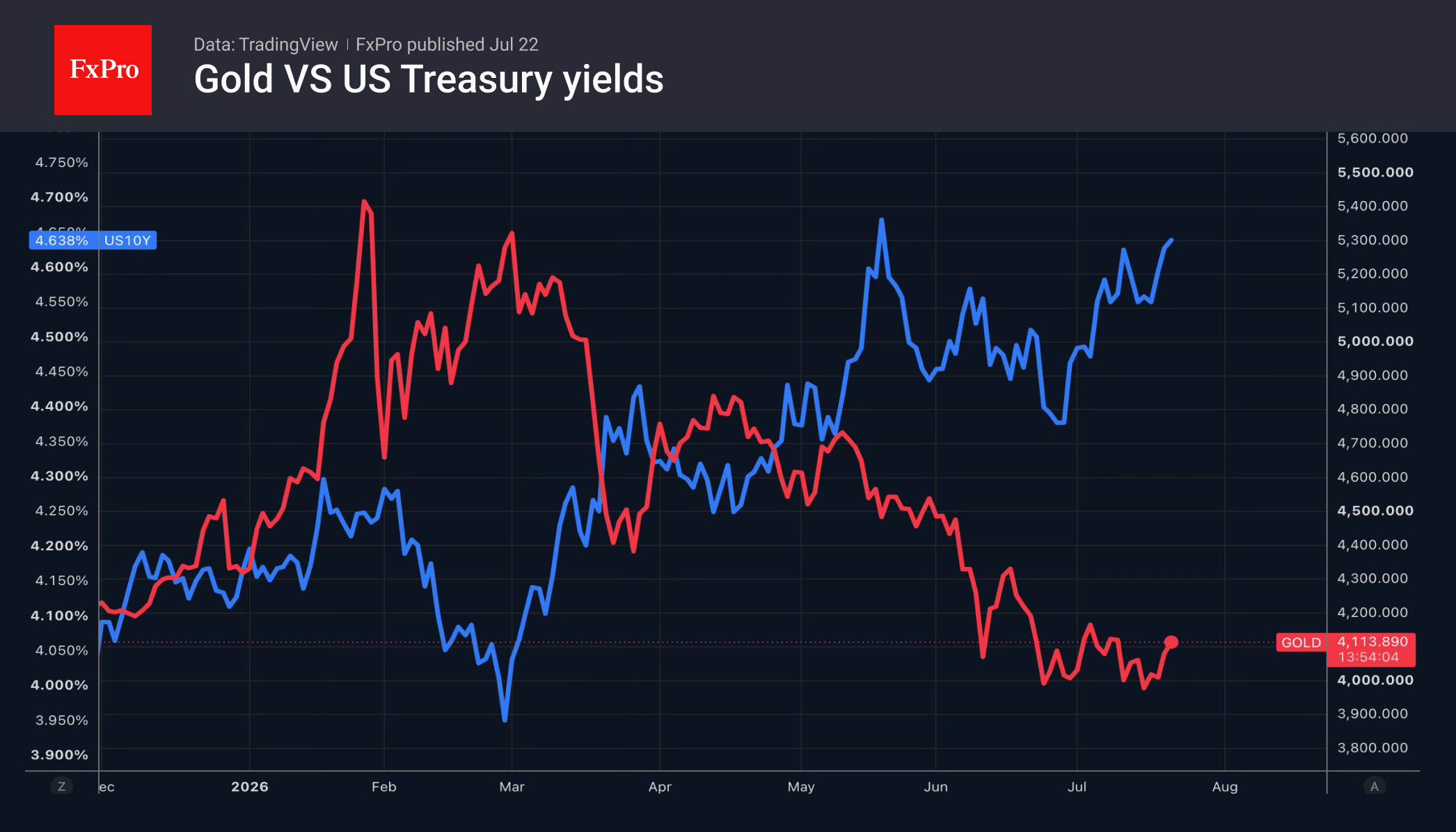
Despite the price rebound, the external backdrop remains highly unfavourable. The higher Brent climbs, the more likely it is that high inflation will become entrenched in the US economy. At the same time, the Fed’s shift from verbosity to brevity is alarming investors. Under these conditions, the likelihood is growing that the central bank will tighten monetary policy without warning.
The strengthening of the US dollar has pushed USDJPY above 163 for the first time in four decades. This has prompted government officials to step up their verbal interventions. Finance Minister Satsuki Katayama has ruled out taking bold and decisive action if necessary.
The FxPro Analyst Team
Yen Hits Fresh 40-Year Low. Can Japan Still Defend Its Currency?
The Japanese Yen tumbled to another four-decade low today, with USD/JPY breaking above the 163 mark as investors continued to unwind Yen positions against the backdrop of widening global yield differentials and surging energy prices. The move has once again thrust Japan's currency policy into the spotlight, raising familiar questions over whether authorities will step into the market to slow the decline.
For now, markets appear unconvinced that intervention is imminent. Although Japan has a history of acting when currency moves become disorderly, officials have generally avoided fighting strong market trends during periods of deep liquidity, where intervention tends to be both more costly and less effective. Instead, traders are focused on a more fundamental question: whether Tokyo still has any policy tools capable of reversing the Yen's structural weakness rather than merely slowing its pace.
That question is becoming relevant ahead of the Bank of Japan's July 31 policy meeting. While intervention threats may still generate bouts of volatility, the bigger issue for markets is whether monetary policy, fiscal policy and global interest-rate dynamics have left Japan with few attractive options.
Intervention Threats Are Losing Their Bite?
Japanese officials wasted little time responding to the Yen's latest slide. After USD/JPY climbed through 163 overnight, Finance Minister Satsuki Katayama reiterated the government's familiar warning, saying authorities' stance "has not changed at all" and that they would "take decisive action appropriately at any time" if needed. Chief Cabinet Secretary Minoru Kihara delivered a similar message, stressing that the government stood ready to "respond as appropriate at any time." Yet the market reaction was tellingly muted. Traders largely ignored the remarks, underscoring how verbal intervention has become increasingly ineffective after repeated use over the past several years.
The silence from top currency diplomat Atsushi Mimura was perhaps equally noteworthy. As the official widely regarded by markets as having the greatest influence over the timing of any intervention, his decision not to make any public comments left investors with little reason to believe immediate action was being prepared. While authorities have repeatedly demonstrated a willingness to intervene when currency moves become excessively volatile, they have also shown a preference for acting when market conditions are thinner, allowing intervention to have a greater impact with less firepower.
That consideration may be particularly important this week. With global markets fully staffed and liquidity deep through the middle of the week, any attempt to push back against a yield-driven Dollar rally would likely prove expensive and short-lived. Instead of challenging the trend directly, Tokyo may prefer to preserve the element of surprise while relying on verbal warnings to discourage speculative positioning. So far, however, those warnings have fallen on deaf ears, with investors increasingly convinced that intervention can at best slow the Yen's decline rather than reverse it.
BoJ Hike Speculation May Buy Time, Not Solve the Problem
The Yen did find brief relief after Bloomberg reported that Bank of Japan officials were open to raising interest rates at a faster pace than economists currently expect, as the currency's persistent weakness increases upside risks to inflation. The report suggested policymakers are becoming more concerned that a weaker Yen is amplifying imported inflation, even though markets still overwhelmingly expect the BoJ to leave policy unchanged at its July 31 meeting before considering another rate hike later this year.
Whether officially sanctioned or not, such reports could form part of a broader strategy to steady the currency ahead of next week's meeting. If outright intervention has become less effective, shaping market expectations through carefully calibrated rhetoric or policy leaks may offer a less costly way to support the Yen. By encouraging investors to price in a more hawkish BoJ path, officials could narrow rate expectations modestly and trigger bouts of Yen short-covering without spending foreign exchange reserves.
That possibility makes the coming days particularly important. Markets will be watching closely for any further hints from BoJ officials or government sources that policymakers are becoming less comfortable with current exchange rate levels. A steady drumbeat of hawkish signals would suggest authorities are attempting to prepare markets for a more assertive policy stance. Even so, expectations alone can only provide temporary support. Unless the BoJ ultimately delivers a meaningfully more aggressive tightening cycle than markets currently anticipate, any Yen rebound driven by rhetoric is likely to prove short-lived.
Japan's Policy Dilemma Runs Deeper Than the Exchange Rate
Even if the Bank of Japan ultimately decides to tighten policy more aggressively, it is far from clear that doing so would produce a sustained recovery in the Yen. The fundamental problem is that Japan's currency weakness is rooted in structural yield differentials rather than simply expectations for one additional rate hike. With Brent crude climbing above $94 a barrel, markets are concerned that renewed energy inflation could keep the Federal Reserve and other major central banks on a tighter policy path for longer. If overseas interest rates continue rising alongside Japanese rates, the gap underpinning Yen weakness may barely narrow.
At the same time, the BoJ cannot focus solely on the exchange rate. Japan's government bond market is already showing signs of strain, with the 10-year JGB yield reaching 2.90% earlier this month—its highest level since the late 1990s—before easing modestly to around 2.73%. Rising yields reflect not only inflation concerns linked to higher oil prices but also growing unease over Prime Minister Sanae Takaichi's fiscal expansion plans. Investors are D demanding higher compensation to hold Japanese government debt as expectations for further monetary tightening collide with concerns over expanding government borrowing.
That leaves policymakers confronting a difficult balancing act. A faster pace of rate hikes could lend the Yen some support, but it would also risk accelerating the rise in JGB yields, tightening financial conditions and increasing the government's debt-servicing burden. In other words, the BoJ is not dealing with a single policy objective. It faces a two-front challenge: stabilizing a weakening currency while avoiding unnecessary stress in a bond market already grappling with multi-decade high yields. Under those circumstances, even a more hawkish BoJ is unlikely to deliver the kind of sustained Yen appreciation markets are hoping for.
Technical Outlook: Bulls Eye 163.47 Before 166.70
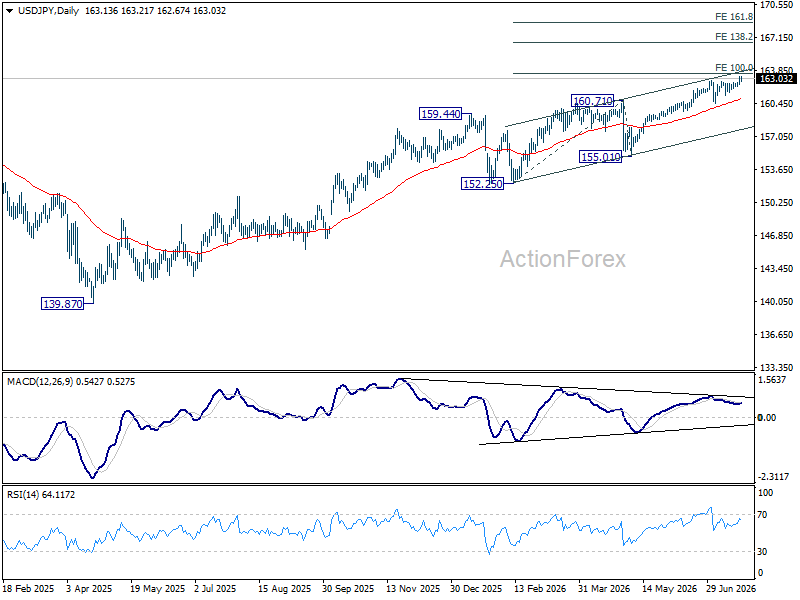
Technically, immediate target for USD/JPY is now on 100% projection of 152.25 to 160.71 from 155.01 at 163.47. Firm break there, and sustained trading above rising channel ceiling, could prompt upside acceleration to 138.2% projection at 166.70.
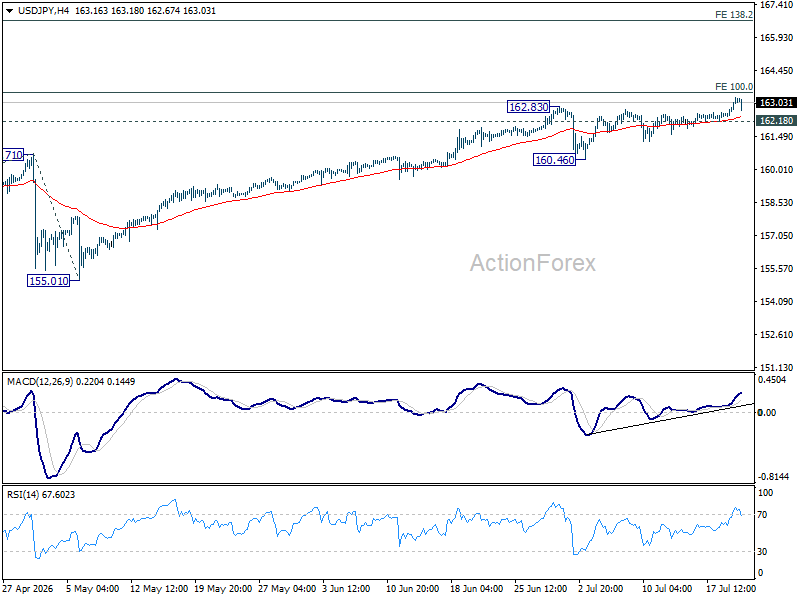
On the downside, break of 162.018 minor support will bring more consolidations first. But near term outlook will now stay bullish as long as 160.46 support holds, even in case of deep retreat.
NZD/USD Analysis: a Tug-Of-War at the Critical Level
The kiwi has strengthened meaningfully against most peers this month. However, against the US dollar specifically, NZD/USD remains well below its 2026 highs, trading in the mid-0.58 area versus January's peak near 0.6075.
New Zealand's Q2 inflation data, released this week, blew past expectations: annual CPI accelerated to 4.1%, above both forecasts and the RBNZ's own 3.9% projection, reinforcing the case for further tightening after the central bank's surprise hike to 2.50% earlier in July—its first in over three years.
The dollar side of the equation remains the real wildcard. June's payrolls report badly missed expectations, coming in at just 57,000, with prior months revised sharply lower, undercutting the Fed's near-term tightening case despite still-sticky core inflation near 2.9%. Markets currently assign roughly even odds to a September hike, leaving NZD/USD's next move hostage to next week's Fed decision and any further escalation in Middle East tensions.
NZD/USD Technical Analysis
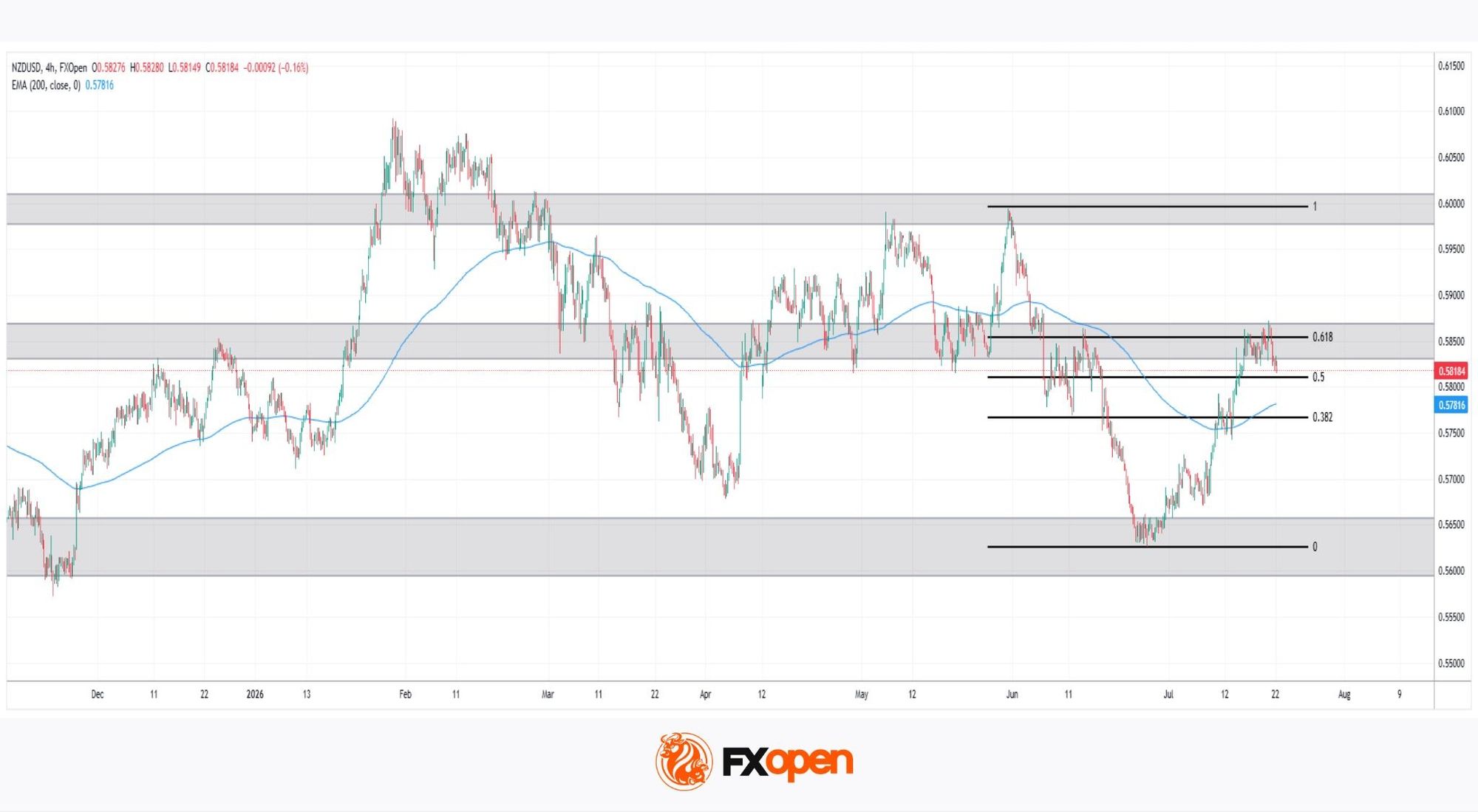
As the 4-hour chart shows, NZD/USD has arrived at a genuinely pivotal zone around 0.5850, a level that has repeatedly flipped between support and resistance throughout the year. Currently acting as resistance, this area has become the focal point of a tug-of-war that has now played out for several sessions.
Bullish Scenario
After bouncing from the medium-term support at 0.5600–0.5650, price staged a decisive recovery, breaking above the 200-period EMA and successfully retesting it as new support, all while forming a clear pattern of higher highs and higher lows. This strength has been reinforced by supportive central bank rhetoric and macro data favoring the kiwi. A confirmed break above 0.5850, coinciding with the 0.618 Fibonacci retracement of the late-June decline, would open the path toward the next resistance and psychological level at 0.6000.
Bearish Scenario
A rejection at this critical zone, however, would hand momentum back to sellers, sending price first toward a retest of the 200-period EMA near 0.5781. A break below that level would expose the well-defended 0.5600 support once again.
With the Fed decision looming and price sitting at such a decisive technical juncture, NZD/USD looks set for a significant move next week. Can the kiwi withstand the coming dollar volatility?
Trade over 50 forex markets 24 hours a day with FXOpen. Take advantage of low commissions, deep liquidity, and spreads from 0.0 pips (additional fees may apply). Open your FXOpen account now or learn more about trading forex with FXOpen.
This article represents the opinion of the Companies operating under the FXOpen brand only. It is not to be construed as an offer, solicitation, or recommendation with respect to products and services provided by the Companies operating under the FXOpen brand, nor is it to be considered financial advice.
Gold Rises Amid Heightened External Risks
Gold traded around 4,080 USD per ounce on Wednesday, having risen nearly 2% the previous day. Investors continue to assess developments in the Middle East and the impact of elevated oil prices on inflation and interest rates.
Donald Trump has played down the prospects of an imminent resumption of negotiations with Iran and warned of further strikes, which continues to support oil prices. Additional supply risks are emerging from disruptions to shipping across the Red Sea due to actions by the Yemeni Houthis, as well as a series of attacks on the Caspian Pipeline Consortium terminal on Russia's Black Sea coast.
ADP data showed a further slowdown in the US labour market. In the four weeks to 4 July, the private sector created an average of 16,500 jobs per week, down from 19,250 in the previous four-week period. The pace of hiring has now declined for four consecutive periods.
Markets have little doubt that the Federal Reserve will keep rates unchanged at next week's meeting. At the same time, the probability of a rate hike in September now exceeds 55%, which limits gold's upside potential.
Technical Analysis
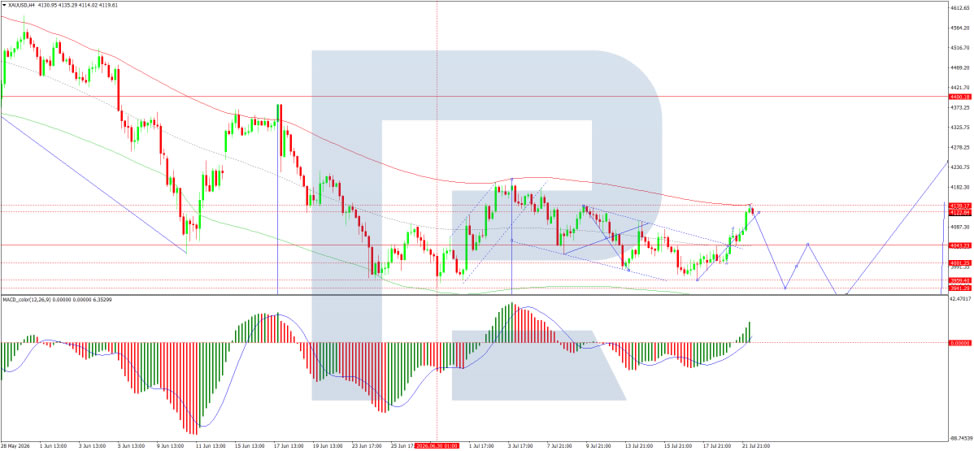
On the H4 XAU/USD chart, the market is trading within a consolidation range around the 4,044 USD level. After an upside breakout, the market moved higher to 4,140 USD. A decline to 4,044 USD followed, with a subsequent rebound to 4,088 USD. A further move lower towards 3,940 USD is expected. The MACD indicator signals the early stages of bearish momentum, with its signal line above the centre line and beginning to turn downwards.
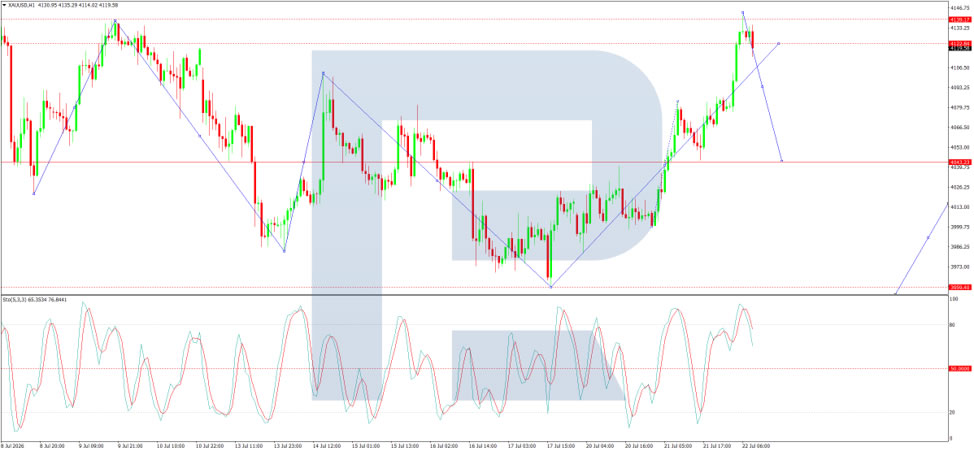
On the H1 chart, the market has broken below the 4,122 USD level and is moving lower towards 4,044 USD, followed by a potential rise to 4,088 USD. A wide consolidation range is forming around 4,088 USD. The Stochastic oscillator confirms this scenario, with its signal line below 80 and pointing downwards towards 20, indicating increasing short-term downside pressure.
Conclusion
Gold has rallied in response to rising external risks, including escalating tensions in the Middle East, fresh warnings from President Trump on Iran, and supply disruptions in the Red Sea and Black Sea. These factors have pushed oil prices higher, reinforcing concerns about inflation. However, the metal's gains have been tempered by a cooling US labour market, as ADP data showed a fourth consecutive slowdown in hiring. Markets expect the Fed to hold rates next week, although the probability of a September hike exceeds 55%, limiting gold's upside potential. Technically, gold may see a pullback towards 4,044 USD before any further upside, with the broader trend depending on geopolitical developments and US monetary policy expectations.
AUD/USD and USD/CAD React to Rising Geopolitical Risks
Commodity-linked currencies remain under pressure as geopolitical tensions in the Middle East continue to escalate. The United States has maintained strikes on targets in Iran, while the Tehran-backed Houthis have intensified threats to shipping in the Red Sea and near key oil transit routes. Heightened geopolitical uncertainty has increased demand for traditional defensive assets, supporting the US dollar while weighing on risk-sensitive currencies such as the Australian dollar.
In the coming trading sessions, market participants will focus on Australia's labour market report. Employment growth is expected to slow sharply, while the unemployment rate is forecast to remain unchanged at 4.4%. Weaker-than-expected figures could add pressure to AUD/USD by reinforcing expectations that the Reserve Bank of Australia may continue easing monetary policy.
For USD/CAD, attention will also turn to the weekly US crude oil inventory data. Although geopolitical developments continue to support oil prices, the outlook for commodity-linked currencies will depend not only on the direction of the energy market but also on incoming macroeconomic data and further developments in the Middle East.
AUD/USD
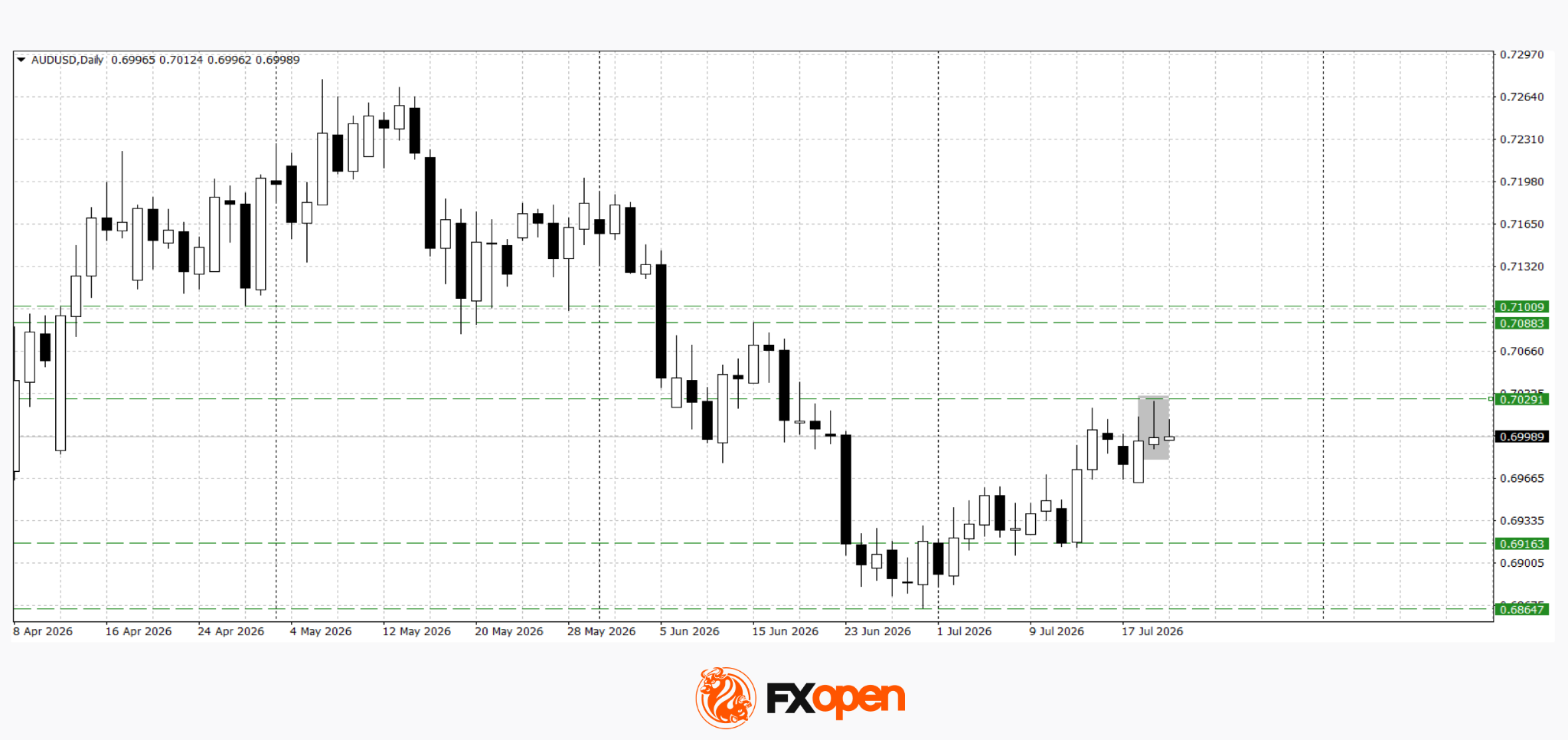
AUD/USD has begun to lose upside momentum after testing the key resistance zone between 0.7000 and 0.7030. On the daily chart, a doji candlestick has formed, suggesting the pair could resume its decline towards the 0.6920–0.6870 area. However, a decisive break and close above 0.7030 could open the way for a further advance towards 0.7080–0.7100.
Key events for AUD/USD:
- Tomorrow at 04:30 (GMT+3): Australia Employment Change
- Tomorrow at 04:30 (GMT+3): Australia Labour Force Participation Rate
- Tomorrow at 15:30 (GMT+3): US Initial Jobless Claims
USD/CAD
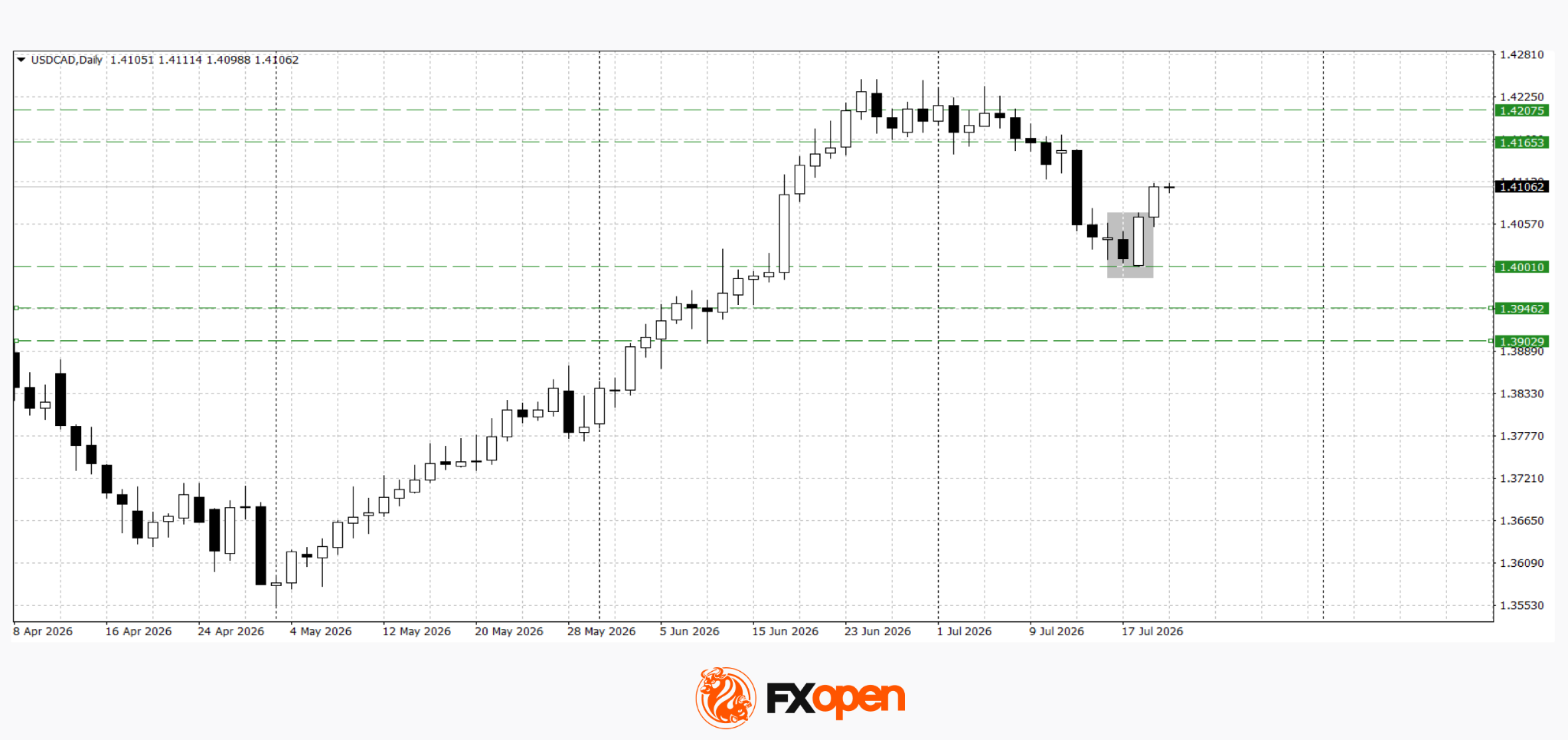
USD/CAD has formed a bullish engulfing candlestick pattern after rebounding sharply from the significant support level at 1.4000. The technical outlook suggests the pair could extend its recovery towards the 1.4170–1.4200 region if the pattern plays out. Conversely, a break below 1.4000 could expose the next downside target around 1.3900–1.3940.
Key events for USD/CAD:
- Today at 14:00 (GMT+3): US MBA Mortgage Applications Index
- Today at 17:30 (GMT+3): US Crude Oil Inventories
- Tomorrow at 15:30 (GMT+3): Canada Core Retail Sales
Overall, geopolitical tensions continue to underpin the US dollar while limiting the recovery of commodity-linked currencies. Over the coming days, the key drivers for AUD/USD and USD/CAD will be Australia's labour market data, movements in oil prices, and further developments in the Middle East. If geopolitical risks remain elevated, the US dollar may continue to outperform. Conversely, easing tensions or weaker-than-expected US economic data could support a recovery in commodity-linked currencies.
Trade over 50 forex markets 24 hours a day with FXOpen. Take advantage of low commissions, deep liquidity, and spreads from 0.0 pips (additional fees may apply). Open your FXOpen account now or learn more about trading forex with FXOpen.
This article represents the opinion of the Companies operating under the FXOpen brand only. It is not to be construed as an offer, solicitation, or recommendation with respect to products and services provided by the Companies operating under the FXOpen brand, nor is it to be considered financial advice.