Sample Category Title
EUR/USD Recovers as Dollar Weakens
EUR/USD rose to 1.1429 on Thursday, with the US dollar continuing its moderate decline from the previous session. The market is assessing rising inflation risks driven by elevated energy prices against a backdrop of weakening economic data, while seeking further signals on Federal Reserve policy.
At next week's meeting, the regulator is expected to keep rates unchanged. However, uncertainty about future decisions has increased due to the lack of clear guidance from the new Fed Chairman Kevin Warsh.
Dollar declines are being limited by persistent demand for safe-haven assets. Tensions remain high in the Middle East, with Donald Trump stating that the US will strike Iranian infrastructure in response to attacks on vessels in the Strait of Hormuz. Tehran has threatened retaliation against energy and infrastructure facilities in the region.
Additional concerns have been raised by attacks on tankers in the Red Sea – the first such incidents since late February. Markets are worried about the potential expansion of the conflict and new disruptions to global trade.
Technical Analysis
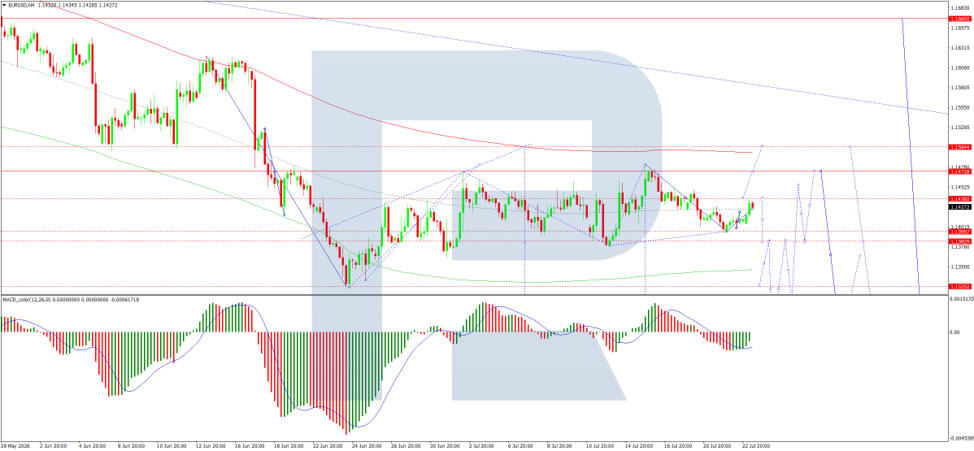
On the H4 chart of EUR/USD, the market has formed a consolidation range around the 1.1410 level, currently extending down to 1.1405 and up to 1.1434. This consolidation range is nearing completion. An upside breakout would suggest a corrective move towards 1.1500, followed by a decline to 1.1260. A direct downside breakout would open the way for a move to 1.1260. The MACD indicator supports this scenario, with its signal line below zero and pointing firmly downwards, reflecting continued bearish momentum.
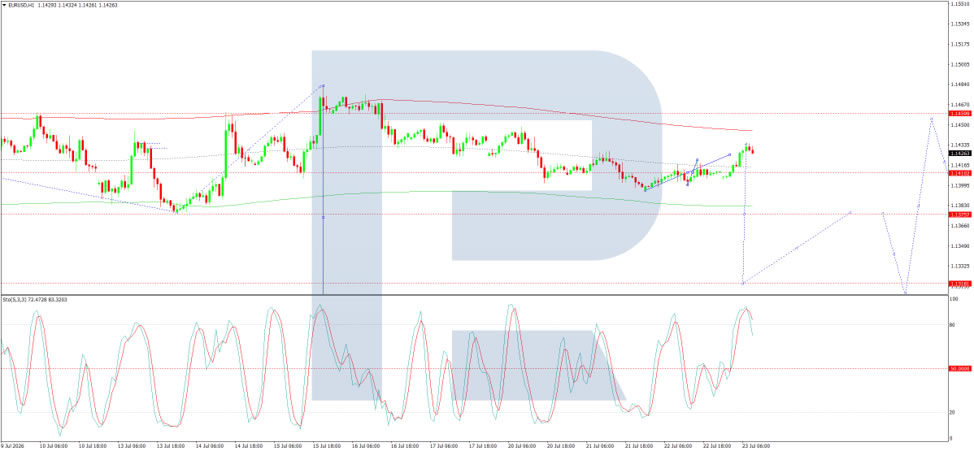
On the H1 chart, the market has completed an upward move to the 1.1434 level. A consolidation range is currently forming below this level. Today, a move lower to 1.1400 is expected, followed by a move higher to 1.1420, and then a continuation of the downward trend to 1.1370. The Stochastic oscillator confirms this scenario, with its signal line above 80 and pointing downwards towards 20, indicating increasing short-term downside pressure.
Conclusion
EUR/USD has recovered modestly as the dollar softened amid heightened geopolitical uncertainty and a lack of clear guidance from the Federal Reserve. Rising energy prices and tensions in the Middle East – including threats of strikes on Iranian infrastructure and renewed attacks in the Red Sea – continue to fuel inflation concerns and risk-off sentiment. Markets expect the Fed to hold rates steady next week, while the outlook beyond that remains uncertain. Technically, the pair may see a temporary corrective move towards 1.1500, but the broader bearish structure remains intact, with downside potential towards 1.1260 in the medium term. The direction will largely depend on geopolitical developments and any future signals from the Fed.
Red Sea Attacks Push Brent Oil Toward $100. Will Markets Finally React?
TL;DR: Brent oil has surged from to above $97 on Red Sea attacks and Strait of Hormuz escalation, bringing the psychological $100 level into view. While broader markets (stocks, bonds, currencies) have treated the move as a geopolitical risk premium, a decisive break above $100 could signal investors are pricing genuine supply disruption—a narrative shift that would reshape inflation expectations across asset classes.
Why This Matters to Traders Across All Markets
Oil's path to $100 isn't just about energy prices. For currency traders, commodity traders, and equity investors, the $100 level represents a psychological and fundamental turning point. As long as the rally is treated as a geopolitical risk premium, central banks can justify staying patient on rate cuts, inflation expectations remain anchored, and currencies respond modestly. But if $100 signals that supply disruption is real—not just threatened—then Treasury yields could accelerate, equities may reprice growth expectations lower, and central banks face renewed pressure to keep rates higher for longer. Understanding what happens at $100 is essential for positioning across all major asset classes.
Three Catalysts Are Making This Oil Rally More Durable Than Previous Flare-Ups
The latest rally has been driven by three developments that together paint a more bullish picture than previous geopolitical spikes:
- Active Red Sea front: Houthi forces claimed missile and drone strikes on two Saudi tankers (Encelia and Layla), marking an escalation from threats to direct attacks on commercial shipping. Combined with Strait of Hormuz uncertainty, two critical maritime chokepoints now face simultaneous pressure.
- Mechanical US retaliation framework: President Trump outlined an automatic response protocol—every Iranian attack on shipping through Hormuz triggers strikes against specific Iranian infrastructure. This reduces uncertainty over the US response but increases the likelihood that escalation could become self-reinforcing if attacks continue.
- Fading diplomatic prospects: Secretary of State Marco Rubio argued Iran has shown little seriousness after violating last month's Memorandum of Understanding. Without a credible diplomatic off-ramp, markets are less willing to bet on rapid de-escalation that could reverse gains.
Unlike previous oil spikes, this one has both tactical triggers (actual attacks on shipping) and structural support (no visible path to quick resolution). That combination is why the rally feels more durable than typical geopolitical noise.
The $100 Level: Where Risk Premium Becomes Supply Crisis Narrative
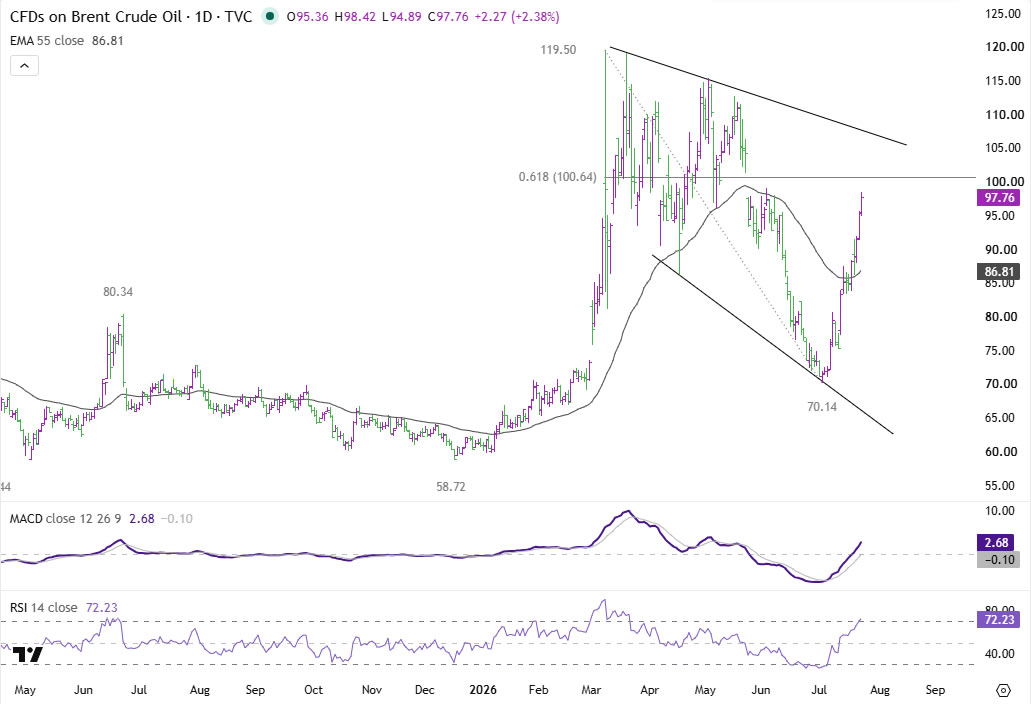
Attention now shifts to the technical and psychological zone around $100. More specifically, a decisive move through 100 and the nearby 61.8% retracement of the 119.50 to 70.15 decline at 100.64 would represent more than another milestone in the rally. It would likely signal that investors are becoming increasingly convinced the current geopolitical premium is evolving into something more durable: the risk of genuine supply disruption.
Here's the critical distinction: investors have so far treated higher oil prices as an uncomfortable but manageable geopolitical premium. Equities have absorbed the move. Treasury yields have risen only gradually. Currency pairs remain in familiar ranges. That changes if Brent establishes itself above $100 while evidence emerges that Red Sea attacks are materially disrupting Saudi export volumes rather than simply threatening them.
If a simultaneous constraint on both the Red Sea and the Strait of Hormuz unfolds, the conversation shifts from geopolitical uncertainty to confirmed supply losses. That's the point where Treasury yields could accelerate higher, equity markets may begin pricing a larger growth shock, and central banks could face renewed questions over how long restrictive monetary policy will remain necessary.
Technical Signals Align With Fundamental Story
The technical backdrop reinforces the bullish narrative. Brent's decline from 119.50 appears to have completed as a three-wave correction ending at 70.14. The subsequent rally has developed characteristics consistent with a new impulsive advance:
- Daily RSI has remained above 70 (strong upside momentum)
- Daily MACD has turned sharply higher (momentum strengthening, not fading)
- Trend structure suggests continuation rather than reversal
Technical and fundamental signals are now pointing in the same direction.
ActionForex's Technical View on Brent Oil
Short-term pullbacks should not be ruled out. Momentum indicators are already in overbought territory, and profit-taking around $100 would not be surprising. However, unless Brent falls back below the rising 55-day EMA at 86.82, any correction would likely be viewed as a healthy pause rather than evidence that the uptrend has run its course.
Buyers would probably use weakness to rebuild positions if geopolitical tensions remain elevated. If Brent establishes itself above $100.64, the path toward a retest of the prior high at 119.50 becomes considerably more credible. The upside target from there would depend on the pace of escalation and any shifts in geopolitical expectations.
Pound Weakens After Soft UK Inflation Data as EURo Awaits Fresh Market Signals
The pound remains under pressure following the release of weaker-than-expected UK inflation data. The slowdown in inflation has strengthened expectations that the Bank of England could adopt a more accommodative policy stance in the coming months, weighing on sterling. Meanwhile, the euro continues to trade within a relatively narrow range as investors await fresh signals from the eurozone economy.
Market participants also remain cautious due to the ongoing escalation of tensions in the Middle East. The United States continues to carry out strikes on targets in Iran, supporting demand for traditional refuge assets, including the US dollar, and limiting the recovery potential of European currencies.
Attention in the coming days will focus on the preliminary Purchasing Managers' Index (PMI) releases from Germany, France, the United Kingdom, and the eurozone, which will provide an early assessment of economic conditions at the start of the third quarter. The data are particularly important for the euro, as they could influence expectations for the European Central Bank's next policy moves. Stronger-than-expected figures may support the single currency, while weaker readings could reinforce expectations of further ECB policy easing. In addition, the weekly US initial jobless claims report will provide another update on the health of the US labour market.
EUR/USD
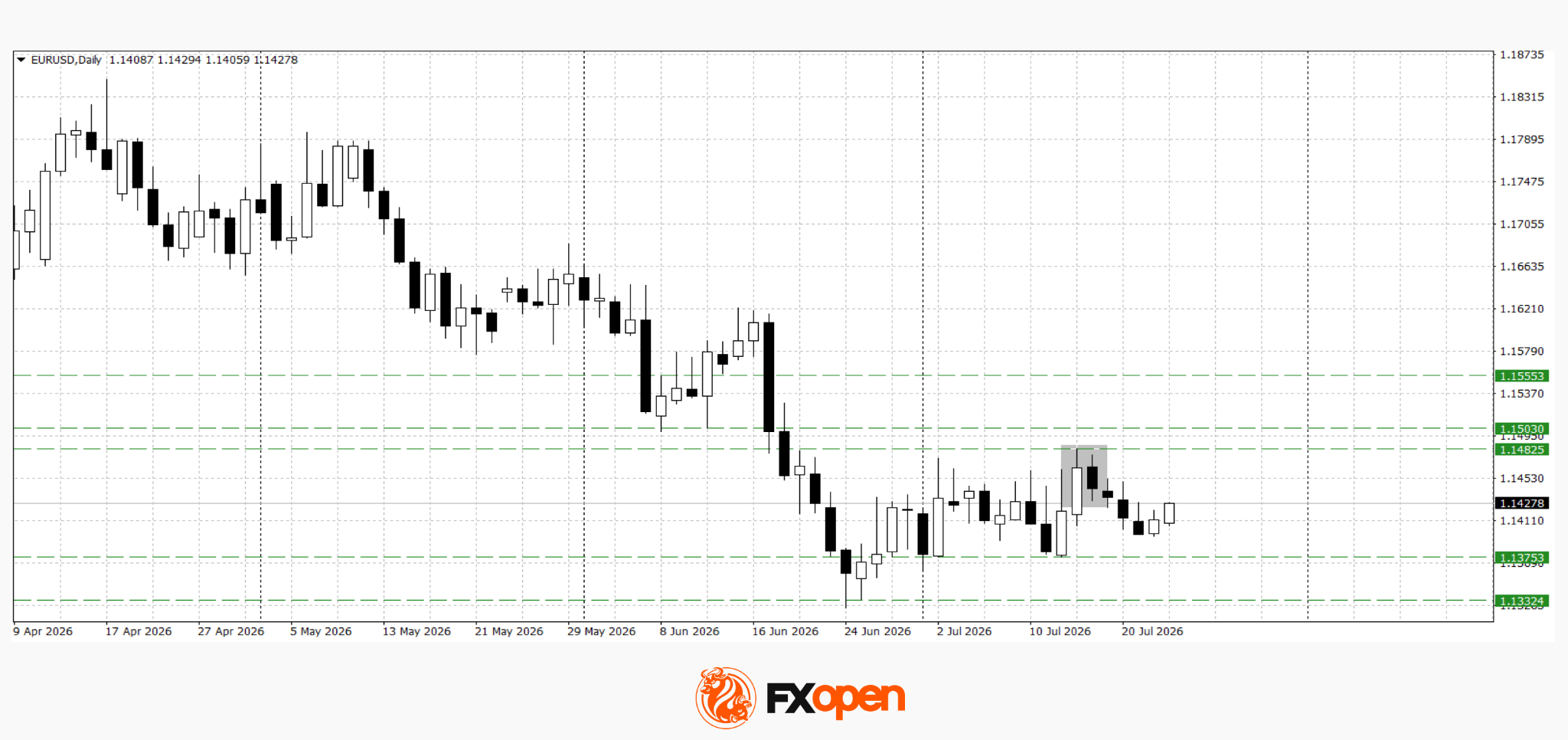
EUR/USD has entered a consolidation phase after failing to test the key resistance level at 1.1500. Technical analysis suggests the pair could decline towards the 1.1330–1.1370 area, as a bearish harami pattern has formed on the daily timeframe. A renewed upward correction may become more likely only after a decisive break and close above 1.1500.
Key events for EUR/USD:
- Today at 09:45 (GMT+3): France Flash PMI
- Today at 10:20 (GMT+3): Speech by Bundesbank Executive Board member Sabine Mauderer
- Tomorrow at 10:00 (GMT+3): Germany GfK Consumer Climate Index
GBP/USD
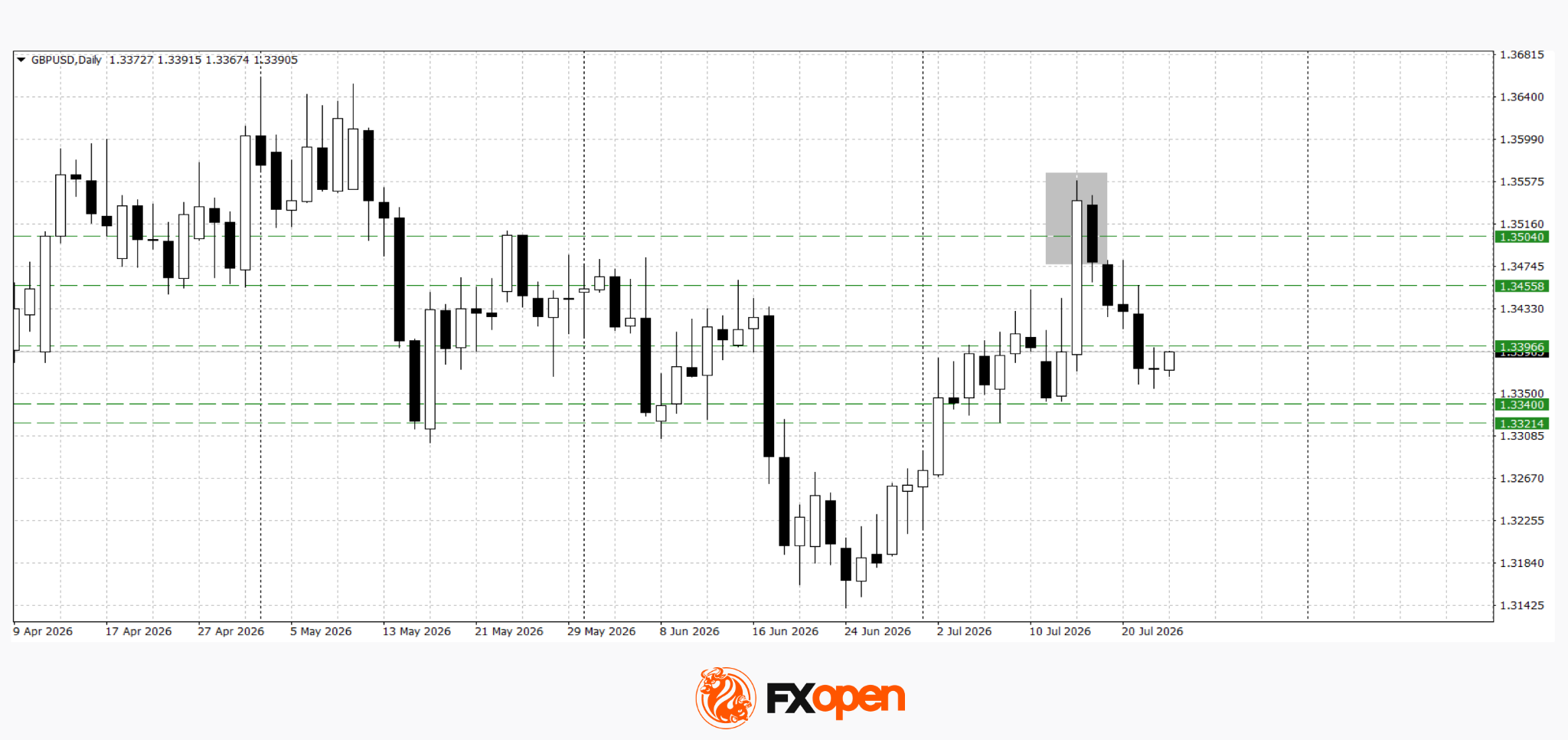
GBP/USD is undergoing a bearish pullback after buyers failed to establish a foothold above 1.3500. A bearish harami pattern has also formed on the daily chart, increasing the likelihood of another test of the nearby support zone at 1.3320–1.3340. The bearish scenario would only be invalidated by a decisive close above 1.3400.
Key events for GBP/USD:
- Today at 13:00 (GMT+3): UK CBI Industrial Trends Orders
- Today at 15:30 (GMT+3): US Initial Jobless Claims
- Tomorrow at 11:30 (GMT+3): UK Flash Manufacturing PMI
Summary
Sterling remains under pressure following softer UK inflation data, while the euro continues to consolidate as traders await fresh economic signals from the eurozone. Over the coming days, the preliminary PMI releases are likely to be the main catalysts for European currencies, as they could reshape expectations for future policy decisions by both the European Central Bank and the Bank of England. US macroeconomic data and developments in the Middle East are also expected to remain important drivers of market sentiment.
Trade over 50 forex markets 24 hours a day with FXOpen. Take advantage of low commissions, deep liquidity, and spreads from 0.0 pips (additional fees may apply). Open your FXOpen account now or learn more about trading forex with FXOpen.
This article represents the opinion of the Companies operating under the FXOpen brand only. It is not to be construed as an offer, solicitation, or recommendation with respect to products and services provided by the Companies operating under the FXOpen brand, nor is it to be considered financial advice.
Sunrise Market Commentary
Markets
Core bonds grinded lower in a bear flattening move. US Treasuries yields added 1.4-3.7 bps. Doing so brought the 2-yr yield to its highest level since February 2025. The longest 30-yr tenor also drew attention by having held above 5% for the longest stretch since 2007, according to Bloomberg. With policy rates 150 bps lower than they were back then, it underscores how risk premia (e.g. public finances) have come back with a vengeance after years of artificial suppression. For the same reason we see the European 30-year swap (-1.6 bps) hovering near the very recent new 15-year highs. Other maturities added up to 3.8 bps at the front end of the curve. The 2-yr swap smashed through the earlier YtD highs to trade at the highest levels since July 2024. ECB hiking bets have jumped with the cumulative amount of expected tightening (nearly four hikes by mid-2027) now even topping what was discounted at the height of the Middle East war in March/April. That follows of course the ongoing surge in energy prices. Brent oil has shot up 35% from the lows seen early July. Another bump this morning after the first Saudi ships were targeted by Houthis in the Red Sea brings the price of one barrel to just shy of $96. Gas prices (Dutch TTF) at any point since the Iran war haven't closed higher than they did yesterday (€62.5/MWh). They are marching higher again this morning to beyond €63. The dollar FX market contrasted in being an ocean of calm. EUR/USD eked out tiny gains around the 1.14 barrier while DXY barely budged around 101. USD/JPY wasn't impressed by a report that the BoJ is open to increase rates faster than the market expects. The pair is going nowhere around 40-year highs. Sterling's recent slide after a stellar run in the first half of July continued. EUR/GBP is closing in on the 0.855 barrier. Wall Street finished with minor losses going into the earnings of Alphabet. The Big Tech/AI company printed stellar results and raised its 2026 capex target to around $200 bln. Massive investments, however, resulted in the first negative free cash flow since the company went public in 2004. That probably helps explain the cautious investor response.
The ECB is in focus today. Since policymakers have ruled out any action, the main policy rate is all but certain to remain at 2.25%. Frankfurt won't commit to anything but markets will be very attentive to clues for September, which features updated forecasts. If the ECB had to update the scenarios today, it would have to take into account an oil price futures curve that is $1.5-$2 per barrel lower but a gas price curve that's about €12-€14 higher. Money market pricing quickly went from the central bank's milder scenario over the base towards the adverse one. President Lagarde will be cautious in being explicit about the monetary policy response to the upcoming inflation shock. Confirming nor rejecting the current market expectations may tactically be the best move in a fast changing geopolitical environment. September is priced in for 90% with a third move by December given an equal chance.
News & Views
The Australian June labour market report beat expectations by a big margin. Employment growth accelerated from 44k in May to 76.3K in June. The rise was mainly driven by part time employment (47k), but full time job growth also printed at a solid 29.3k. The unemployment rate was unchanged at 4.4% as the participation rate grew from 66.7% to 67%. Solid labour market data allow the Reserve Bank of Australia to keep its focus on inflation. The RBA in June kept its policy rate unchanged at 4.35% after raising three times by 25 bps. The RBA concluded that after the tightening earlier this year 'Monetary policy is well placed to respond to developments'. It still committed to 'do what it considers necessary to achieve that outcome, including increasing the cash rate target further if required'. With current strong labour market data and energy prices rising again, markets again fully discount an additional RBA rate hike by the end of the year. The 3-y government bond yield rose 6.3 bps to 4.62%. The Aussie dollar gained modestly from the AUD/USD 0.669 area to currently 0.701. CPI data will be published next Wednesday, 29 July.
GDP growth in South Korea was reported stronger than expected at 0.6% Q/Q, bringing the Y/Y measure to 3.7%. The Q2 performance came after an even stronger 1.8% Q/Q and 3.8% Y/Y in Q1. Manufacturing (1.2% Q/Q) and services growth (+1.1%) were important drivers as construction declined by 1.9% Q/Q. The data indicate that exports of semiconductors contributed to a solid growth performance alongside domestic demand. The Bank of Korea last week raised its policy rate by 25 bps to 2.75%. The strong Q2 growth data suggest that the BOK might raise the policy rate further during the second half of the year, by at least one more 25 bps step. CPI inflation in Korea was reported at 3.2% in June. The won this morning extended its rebound with USD/KRW easing to 1466.
EUR/CHF Rally Points to Hawkish ECB Hold as Oil Reignites Inflation Risks
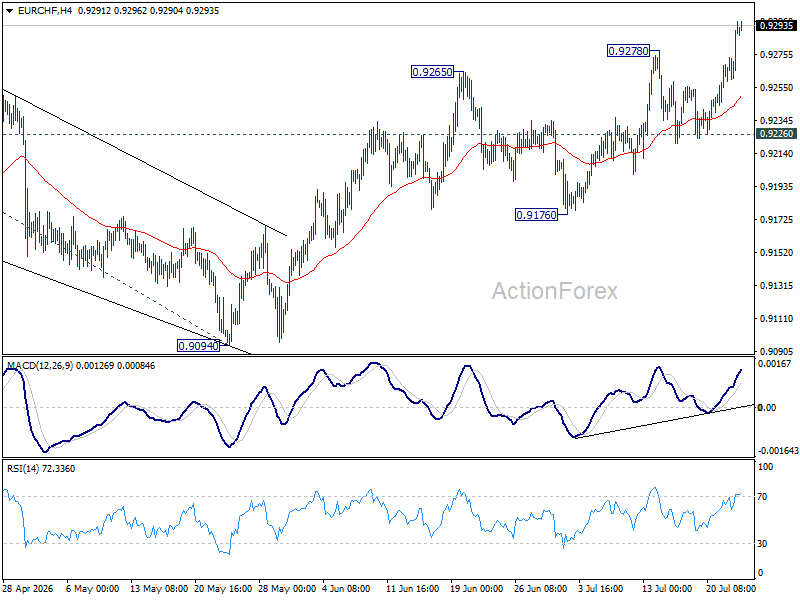
EUR/CHF may already be telling investors what to expect from today's European Central Bank meeting. The cross broke decisively above 0.9278 this week, extending its recent rally as surging oil prices revived inflation concerns across Europe. The move suggests markets have begun positioning for a relatively more hawkish ECB even though policymakers are almost universally expected to leave the deposit rate unchanged at 2.25%. With the decision itself largely priced in, attention will instead turn to whether President Christine Lagarde validates—or pushes back against—the hawkish repricing already underway.
The backdrop confronting the Governing Council has changed dramatically since it last met in June. At that meeting, Brent crude was also trading around $95 a barrel, but the trend pointed firmly lower as markets anticipated a breakthrough in US-Iran negotiations. Optimism was soon rewarded with a 60-day ceasefire announced on June 17, sending Brent to around $70 by early July and reinforcing expectations that energy-driven inflation would continue to ease. That narrative has since been turned on its head. The ceasefire has collapsed, military conflict has resumed, shipping risks around the Strait of Hormuz have intensified, and Brent has climbed back above $95. The crucial difference is that oil is now surging rather than falling, fundamentally changing the inflation outlook facing European policymakers.
Financial markets appear to have recognized that shift before the ECB has had a chance to respond. This week's move in EUR/CHF suggests investors are increasingly pricing a policy outlook that is more hawkish than it appeared only a few weeks ago. While markets are not yet fully convinced another rate hike will follow, they have become less willing to assume June's increase marked the end of the tightening cycle. The renewed rise in energy prices has reopened the possibility that inflation could prove more persistent than previously expected.
That leaves Lagarde's press conference carrying far greater significance than the policy announcement itself. Given the speed at which geopolitical developments are evolving, the ECB is unlikely to provide firm forward guidance. The most likely message is that inflation risks have shifted to the upside, uncertainty surrounding the Middle East and the Strait of Hormuz remains exceptionally high, and policy decisions will continue to depend on incoming data. Preserving flexibility is likely to take precedence over signalling a specific policy path.
The key question is whether Lagarde chooses to resist growing market expectations for another rate hike as early as September. Such a question is certain to surface during the press conference. If she explicitly dismisses those expectations, recent Euro gains could fade as markets pare back hawkish bets. On the other hand, if she simply acknowledges heightened inflation risks without challenging current pricing, investors may interpret that as tacit acceptance that another hike remains a live possibility should the energy shock persist.
Meanwhile, EUR/CHF could emerge as the cleaner expression of today's outcome than EUR/USD. Any hawkish shift from the ECB is likely to be offset by similar expectations that higher oil prices will also keep the Federal Reserve on a tighter path. By contrast, the Swiss National Bank is still widely expected to leave rates unchanged at 0.00% through the remainder of the year, leaving EUR/CHF more directly exposed to changes in ECB expectations.
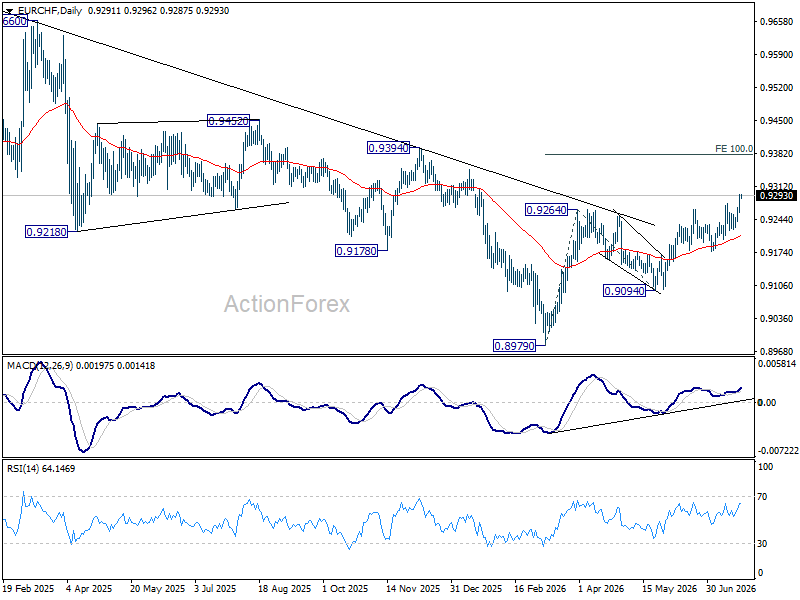
Technically for EUR/CHF, Wednesday's break above 0.9278 resumed the rally from March's 0.8979 low and keeps the pair on course for 100% projection of 0.8979 to 0.9264 from 0.9094 at 0.9379. Just beyond lies the key structural resistance at 0.9394. A sustained break above that level would strengthen the case for a medium-term bullish reversal, reinforcing the view that investors are pricing a widening policy divergence between Frankfurt and Zurich rather than simply reacting to day-to-day geopolitical headlines.
Australian Jobs Blow Past Forecasts With 76.3k Growth as Participation Keeps Unemployment Steady
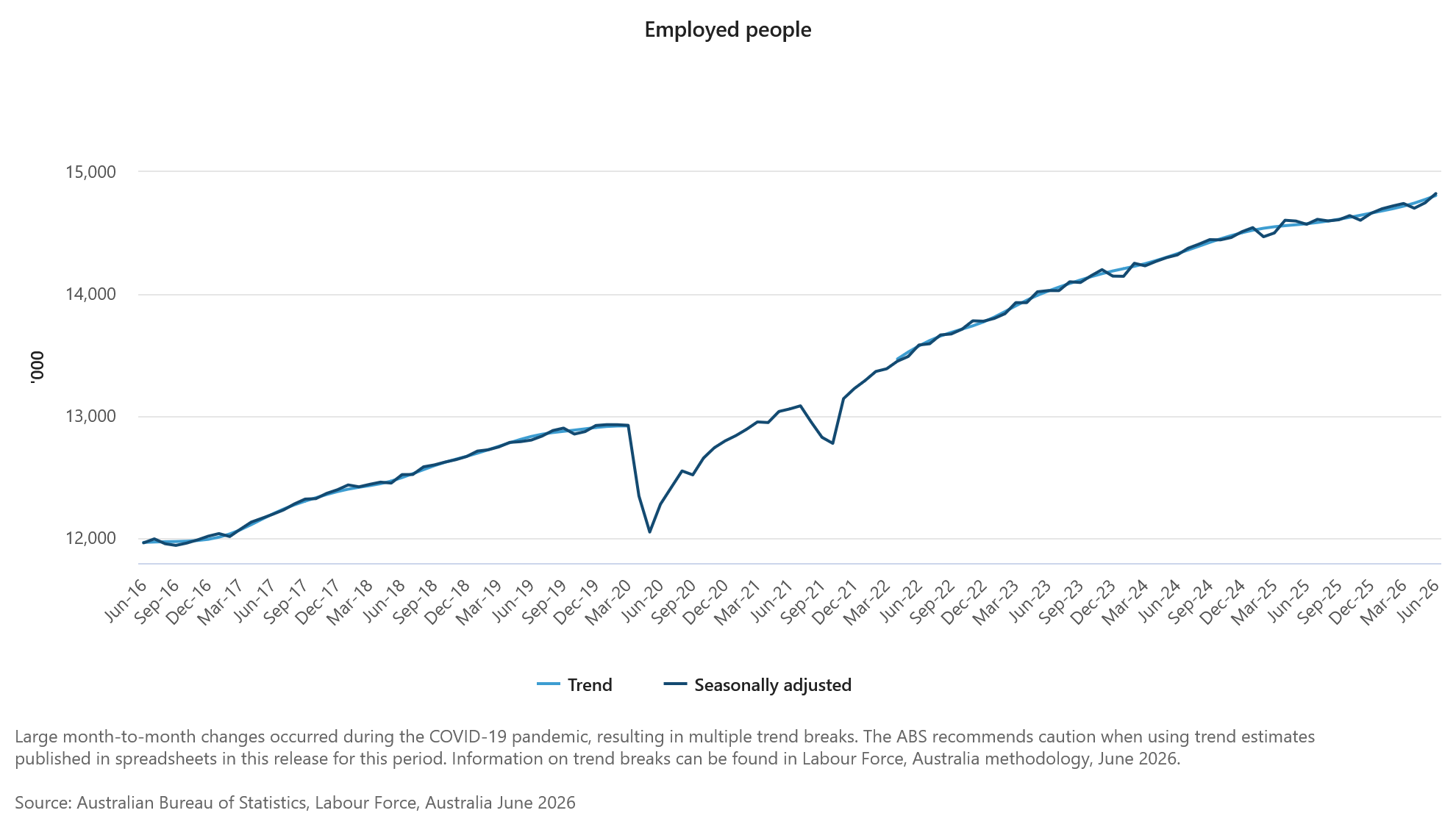
Australia's labour market delivered a much stronger-than-expected performance in June, with employment jumping by 76.3k, far exceeding expectations of 15.0k and accelerating from May's 40.3k gain. Despite the surge in hiring, the unemployment rate held steady at 4.4%, as forecast, with the participation rate climbing from 66.7% to a record-equalling 67.0%. The data point to continued resilience in labour demand while also highlighting a growing supply of workers entering the labour force.
According to the Australian Bureau of Statistics, much of June's employment gain was driven by a 47k increase in part-time employment, with some of the strength reflecting people who had been waiting to start jobs in May. The ABS also noted that elevated job retention continued to support employment growth. At the same time, the number of unemployed people rose by 12.7k, while the underemployment rate edged up from 6.3% to 6.5%, suggesting that although hiring remained robust, spare capacity in the labour market has yet to disappear completely. Total hours worked increased 0.2% on the month, led by a 1.2% rise in part-time hours, while full-time hours were unchanged.
The stronger-than-expected employment gain reinforces the economy's underlying resilience, but the combination of a steady unemployment rate, higher participation and rising underemployment points to a labour market that is expanding without generating a fresh wave of wage pressures. Attention will now turn to inflation data to determine whether the RBA sees sufficient evidence that price pressures are easing before considering any adjustment to policy.
Economic Data
| Indicator | Actual | Expected | Previous |
|---|---|---|---|
| Employment Change | +76.3k | +15.0k | +40.3k |
| Unemployment Rate | 4.4% | 4.4% | 4.4% |
| Participation Rate | 67.0% | — | 66.7% |
| Underemployment Rate | 6.5% | — | 6.3% |
| Employment-to-Population Ratio | 64.0% | — | 63.8% |
Key Takeaways
- Employment rose by a much stronger-than-expected 76.3k, led primarily by part-time hiring (+47k).
- Unemployment held steady at 4.4% as a higher participation rate (67.0%) brought more people into the labour force.
- Underemployment increased to 6.5%, indicating some spare capacity remains despite robust hiring.
- Total hours worked rose 0.2% m/m, driven by higher part-time hours while full-time hours were unchanged.
- The report reinforces labour market resilience but is unlikely, by itself, to materially alter the RBA's policy outlook. Inflation data remain the more important policy driver.
WTI Crude Oil Powers Ahead, Putting $90 Back on the Radar
Key Highlights
- WTI Crude Oil started a fresh rally above $82 and $85.
- A bullish trend line is forming with support at $84.80 on the 4-hour chart of XTI/USD.
- Gold started a fresh recovery and cleared the $4,080 resistance.
- EUR/USD trimmed gains and might decline below 1.1375.
WTI Crude Oil Price Technical Analysis
WTI Crude Oil prices started a steady increase above $80 against the US Dollar. The price cleared key hurdles near $82 and $85 to enter a positive zone.
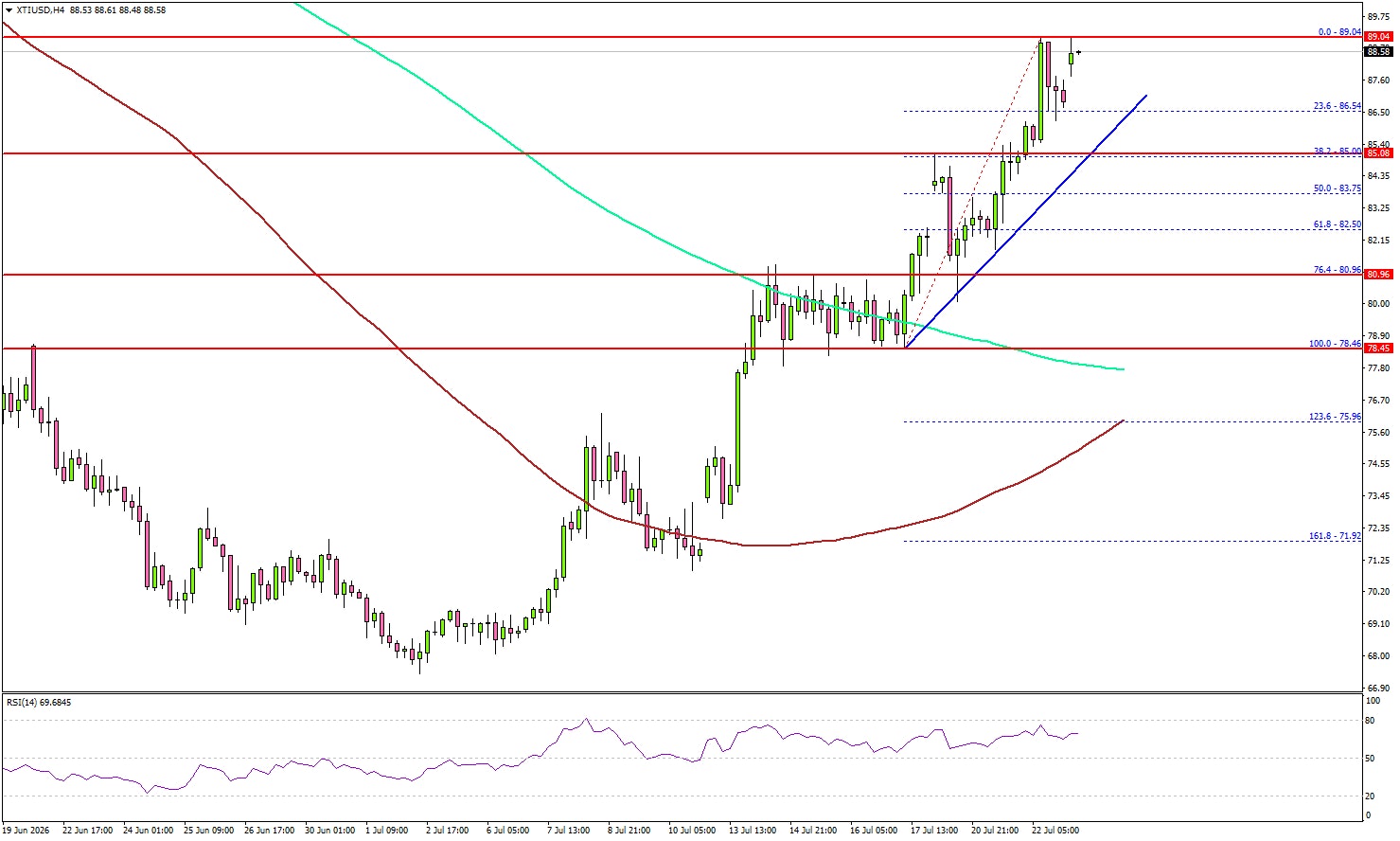
Looking at the 4-hour chart of XTI/USD, the price settled above $85, the 100 simple moving average (red, 4-hour), and the 200 simple moving average (green, 4-hour). If the bulls remain in action, they could aim for a push above $90.
On the upside, the price could face resistance at $91.20. The next resistance might be $92.00. The first key hurdle for the bulls could be $93.50. A close above $93.50 might send Oil prices toward $98.00.
On the downside, the first major support could be near the $85.50 zone. The next support might be $84.80. There is also a bullish trend line forming with support at $84.80. The main support for the current wave might be near the 76.4% Fibonacci retracement level of the upward move from the $78.46 swing low to the $89.04 high at $80.95.
A close below $80.95 might even push the price toward the 200 simple moving average (green, 4-hour) at $78.50. Any more losses could open the doors for a push below the 100 simple moving average (red, 4-hour).
Looking at Gold, the price started a decent increase, but it must settle above $4,150 to continue higher in the near term.
Economic Releases to Watch Today
- ECB Press Conference.
- ECB Monetary Policy Statement.
- US Initial Jobless Claims - Forecast 212K, versus 208K previous.
- Chicago Fed National Activity Index for June 2026 – Forecast -0.11, versus -0.10 previous.
FTSE Elliott Wave Outlook: Bullish Bias with 5‑Swing Progression Since March 2026
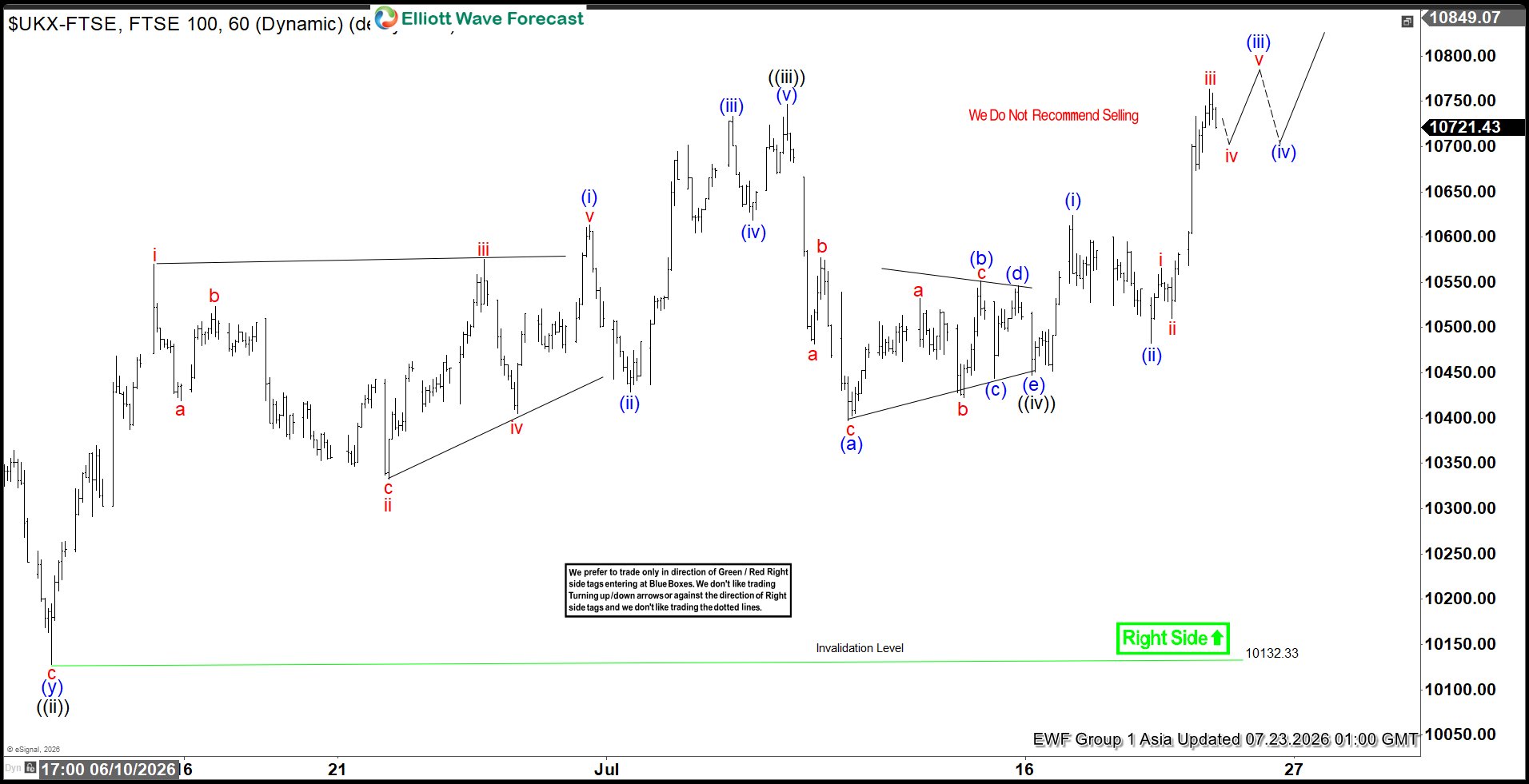
The short‑term Elliott Wave outlook for FTSE highlights a sustained bullish progression since the March 23, 2026 low. From that base, the Index has carved a clear five‑swing advance, which is classified as a motive sequence and supports the expectation of further upside. The initial rally produced wave ((i)) at 10,687.88, followed by a corrective pullback in wave ((ii)) that concluded at 10,132. This corrective action was contained and preserved the broader bullish structure, as reflected in the one‑hour chart.
Subsequently, the Index resumed higher in wave ((iii)), reaching 10,747.01. A consolidation then unfolded, with wave ((iv)) completing at 10,447.55 in the form of a triangle. This pattern reinforced the continuation bias, as triangles typically precede the final leg of a motive sequence. The Index is now advancing in wave ((v)), with scope for additional highs before the structure completes. Once wave ((v)) finishes, a corrective phase should emerge to adjust the larger cycle from the March 2026 low. This correction is expected to unfold in either three or seven swings, consistent with Elliott Wave guidelines, before the broader rally resumes.
Near term, the key pivot remains at 10,132. As long as this level holds, the bullish view is favored, and the Index should continue extending higher to complete the five‑wave structure from the March 2026 low.
FTSE 60-Minute Elliott Wave Chart
FTSE Elliott Wave Video:
https://www.youtube.com/watch?v=zWs0fiMCxys
NZDCAD Wave Analysis
NZDCAD: ⬇️ Sell
– NZDCAD reversed from resistance zone
– Likely to fall to support level 0.8160
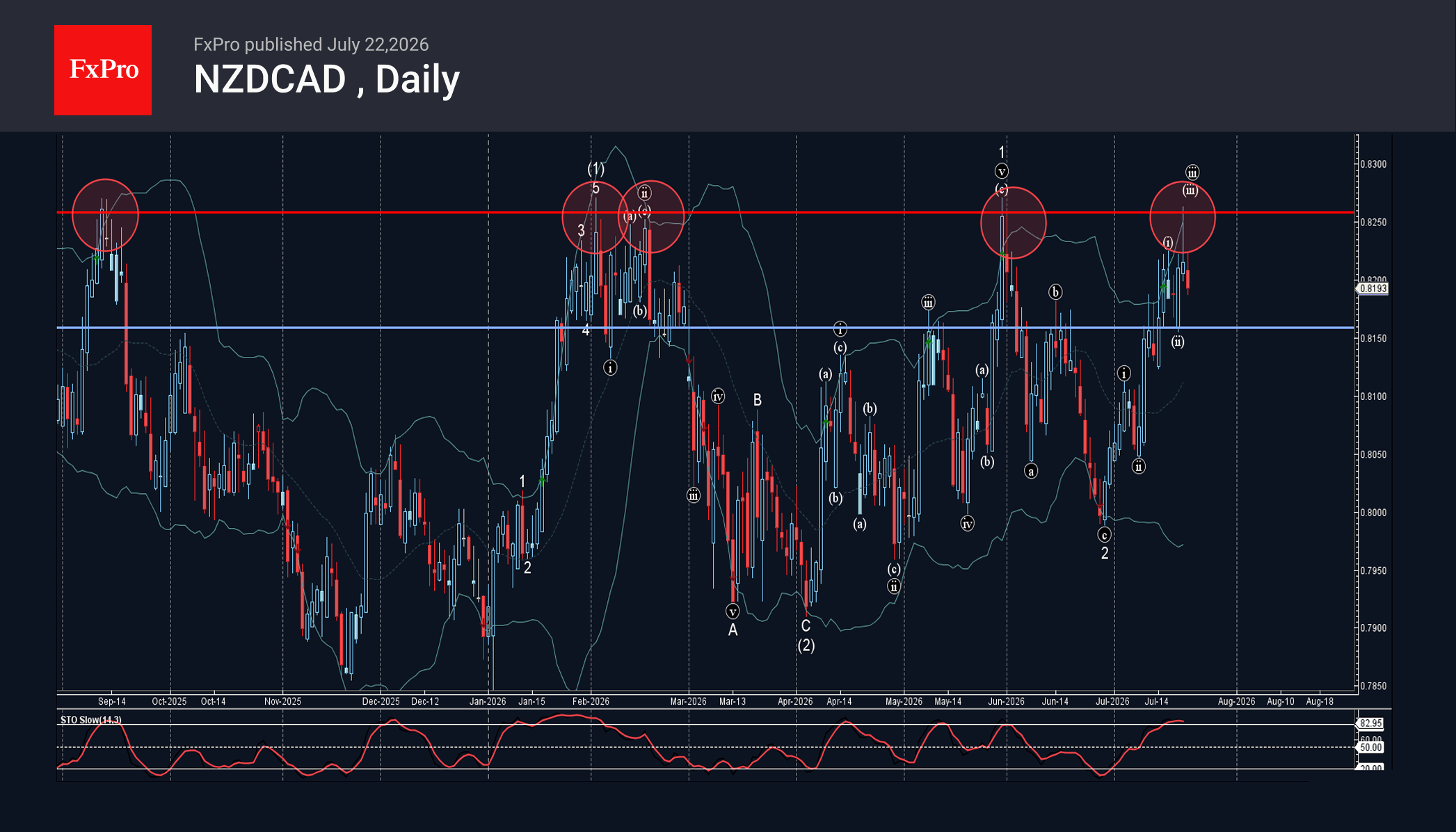
NZDCAD currency pair recently reversed down from the resistance zone between the long-term resistance level 0.8260 (which has been reversing the price from last September) and the upper daily Bollinger Band.
The downward reversal from the resistance level 0.8260 created the daily Japanese candlesticks reversal pattern Shooting Star.
Given the strength of the resistance level 0.8260 and the overbought daily Stochastic, NZDCAD currency pair can be expected to fall to the next support level 0.8160.
WTI Crude Oil Wave Analysis
WTI crude oil: ⬆️ Buy
– WTI crude oil rising inside impulse wave 3
– Likely to rise to resistance level 90.00
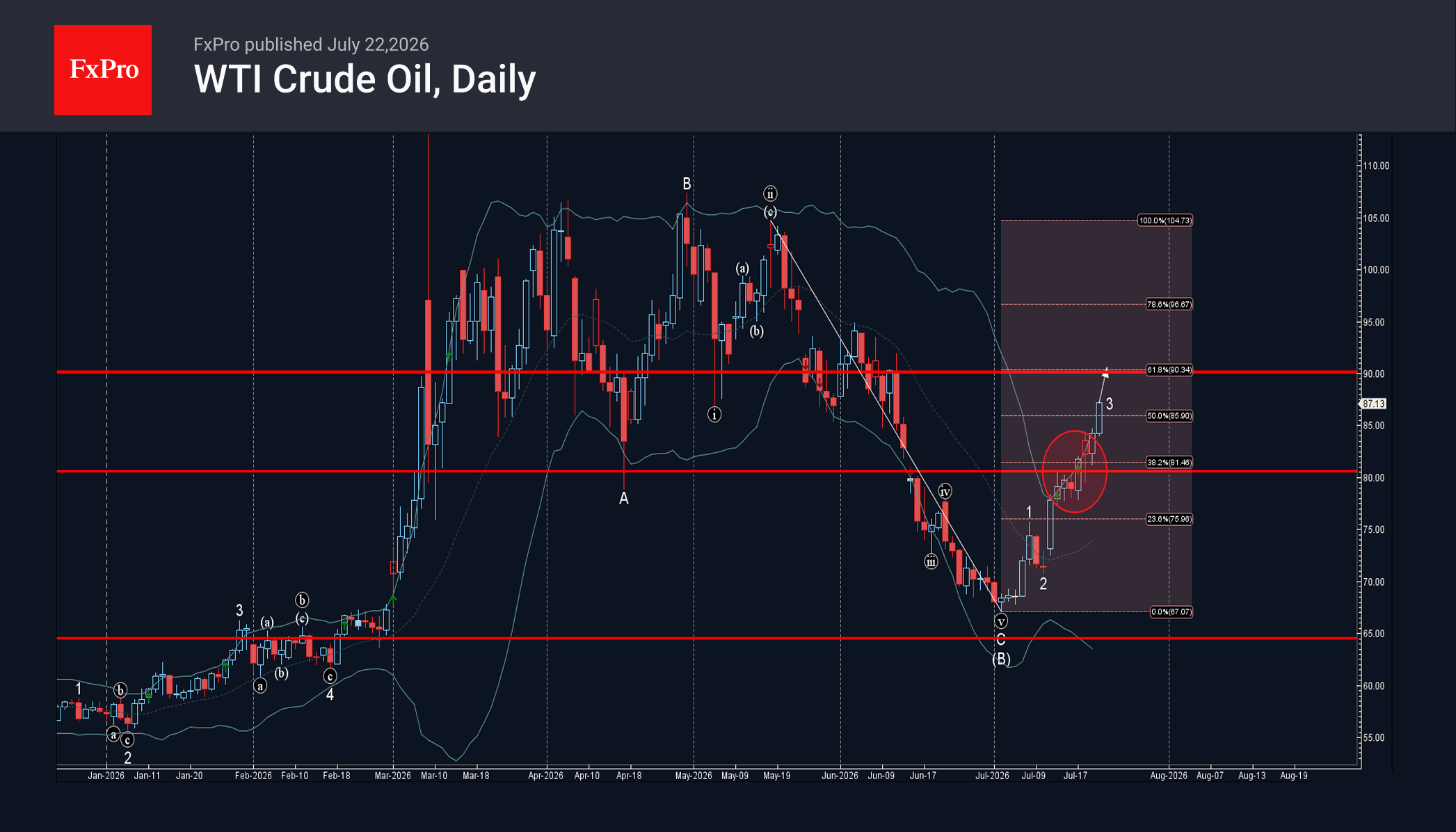
WTI crude oil recently broke the resistance zone between the resistance level 80.00 (former strong support from April) and the 38.2% Fibonacci correction of the downward impulse from March.
The breakout of this resistance zone accelerated the active impulse wave 3 of the intermediate impulse wave (C) from July.
WTI crude oil can be expected to rise to the next resistance level 90.00, target price for the completion of the active impulse wave 3.