Sample Category Title
Sunset Market Commentary
Markets
In the run-up to the ECB policy decision, the list of core EMU bond yields featuring 'the highest level since' label grew ever longer. At the (very) short end of the curve, the 2023/24 post-corona highs still survive as 'aggressive' policy tightening at that time still outpaces expectations on what is deemed necessary to curb current, mostly energy related supply-shock. Still the 2-y EMU swap and Bund yield earlier this week surpassed the highs since the start of the Iran conflict. The 2-y swap topping the 3% mark suggests markets are ever more pondering some kind of higher-for-longer scenario unless energy prices return to more comfortable levels in a not that distant future. With hostilities in the Middle East intensifying, brent oil nearing the $100 p/b reference and the EMU Dutch gas reference contract at the highest levels seen since the start of the conflict (€63 p/MWh), markets consider avoiding a higher for long scenario as growing ever more difficult. For Bunds, the 'tipping point' to overcome the post corona peak levels currently hovers near the 5-y maturity. From there on, the reference goes back to 2011 (30-y) or even 2008 (5-y), with 'decompression' of risk premia and fiscal sustainability probably playing in the background next to uncertainty on inflation premia. Another symbolic breach: the French 10-y yield this morning briefly surpassed the 4% barrier for the first time since…2009! Somewhat of a similar narrative for US bonds yields. In the US oil/energy prices play somewhat of a more modest role, but over there domestic eco strength also is still in play. The US 2-y yield at 4.34% is still somewhat further away from the 5% 2023 top. For the 30-y the multiyear top from May also is only a whisker away (5.18% currently vs 5.2% in May), which in turn was the highest since… mid 2007! Of course, central bank policy mostly determines the short end of the curve, but a too loose approach probably won't help to contain financial stability and inflation risks at the long end of the curve.
In this context, the ECB today decided on monetary policy with market looking for guidance, or at least for some clarification on the bank's reaction function in the light of the scenario reference that was put in place/updated at the previous meeting. The ECB as expected left its policy rate unchanged at 2.25%. It stressed the volatile nature of current moves in energy prices but 'admitted' that they currently stand close to baseline scenario of the June staff projections. In this context, the bank still sticks to a meeting-by-meeting end data-dependent approach as it closely monitors the intensity and the duration of the shock as well as its indirect and second round effects. This of course is no commitment on any particular rate path. Even as the decision was unanimous, Lagarde at the press conference admitted that some members asked themselves if a hike was needed. In this context, markets didn't see any reason to backtrack on its positioning of a next rate hike in September (92%) and other 25 bps step being almost fully discounted by the end of the year. Lagarde on a question also indicated that markets understand the ECB reaction function well. In a daily perspective, German yields add between 4 bps (2-y) and 1.8 bps (30-y). US yields are rising between 6 bps (5-y) and 4 bps (30-y) with yields pushing slightly higher intraday after comments from president Trump that the US will hold Iran responsible for Houthi strikes, suggesting no de-escalation in the near term. Brent oil at $99.5 p/b is only a whisker away from the $100 barrier. On FX markets, USD finally gains some momentum (DXY 101.45; EUR/USD 1.138).
News & Views
Czech president Pavel vetoed a bill that would have eased the country's fiscal rules by widening the room to raise spending without parliamentary approval. The proposal foresaw exemptions for road, rail, nuclear power plants and dam projects to be included in the budget deficits as well as extended an exemption given to defense spending if it exceeds 2% of GDP. The bill would also allow the government to raise spending by up to 10% under loosely defined security threats. Czechia's independent budget watchdog had called the proposed changes a fundamental weakening of fiscal discipline. Pavel echoed those concerns, saying it threatens long-term fiscal sustainability. The Czech budget deficit fell to 2.1% last year.
Will Burnham’s Arrival at No. 10 Spell the End of the Pound’s Four-Year Recovery?
- Andy Burnham becomes the UK's 10th prime minister in 10 years.
- Will his UK regeneration plan work or do his policies just mean more spending?
- Any trouble in gilt markets would put the brakes on pound's long-term recovery.
Starmer's rise and fall
It was hoped that when the UK Labour Party won a super-majority of 411 seats at the June 2024 general election, the days of post-Brexit political instability would be over. However, things haven't panned out that way, with Keir Starmer coming under fire just a few months into the job.
Although the controversies surrounding his leadership were not as scandalous as those for his Tory predecessors Liz Truss and Boris Johnson, Starmer lacked the political instinct to recover from the several mini-crises, until ultimately, the Peter Mandelson saga earlier this year proved one too many errors of judgement for his party to forgive.
Overwhelming support for Burnham
But perhaps what's been the most fascinating to watch during Starmer's downfall is how the parliamentary Labour party unified instantly behind Andy Burnham – until recently, the mayor of Manchester – to anoint him as the rightful heir to the Labour throne. Burnham has had his eye on Number 10 for some time and judging by the speed at which he appointed his Cabinet and set out some of his policies, it can be argued that he was better prepared for government than Starmer was when he won the election two years ago.
Starmer's unpreparedness for power likely explains the lack of comprehensive plans to achieve his manifesto pledges, inevitably leading to multiple embarrassing U-turns, leaving him unable to regain control over his party.
Debt jitters persist
Can Burnham suffer the same fate? Although he has certainly been busy asserting his authority by purging Starmer's allies in the cabinet and immediately announcing a 5% reduction in VAT on electricity bills, markets are nervous about what else is to come as Burnham has made helping households with the cost-of-living crisis one of his central policy pillars.
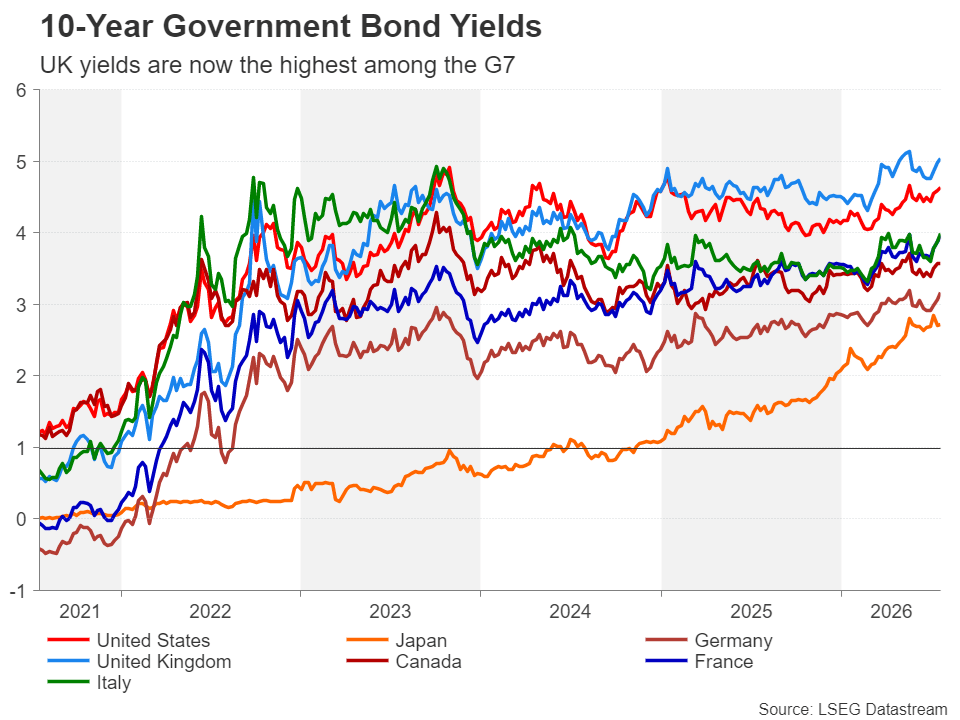
Investors have already given the thumbs down to the suggestion by Burnham that whilst he is promising to abide by the existing fiscal rules set out by Starmer and ousted chancellor, Rachel Reeves, he will seek to use "any flexibility within them". This is being seen as a sign that the fiscal rules are open to interpretation, and UK bond markets are not impressed. Gilt yields have spiked to May highs at the peak of the energy crisis, with the 10-year yield now back above 5.0%. The UK now has the highest yield within the G7, putting the country at greater risk from any panic-driven government debt selloff.
The temptation to spend
On the positive side, there is some relief from Burnham's pick of finance minister – former Defence Secretary John Healey – who replaces Reeves. Healey is seen as a relatively safe pair of hands at the Treasury, having worked within the department during the Blair/Brown years. However, he may use his role to push for higher defence spending, as his disagreement with Starmer's modest funding increase was the reason he quit the post.
On the other hand, Burnham has yet to confirm his commitment to the new NATO spending target of 3.5% of GDP on defence, although it's possible he may incorporate some of that spending within other budgets as part of plans for a broader boost to domestic industry.
A new drive for re-industrialisation
Reindustrialization is one of Burnham's big priorities, but history has proven this is far easier said than done, and he has yet to outline a detailed plan on how he will achieve this. More importantly, there is very little wiggle room in the budget to increase investment spending substantially.
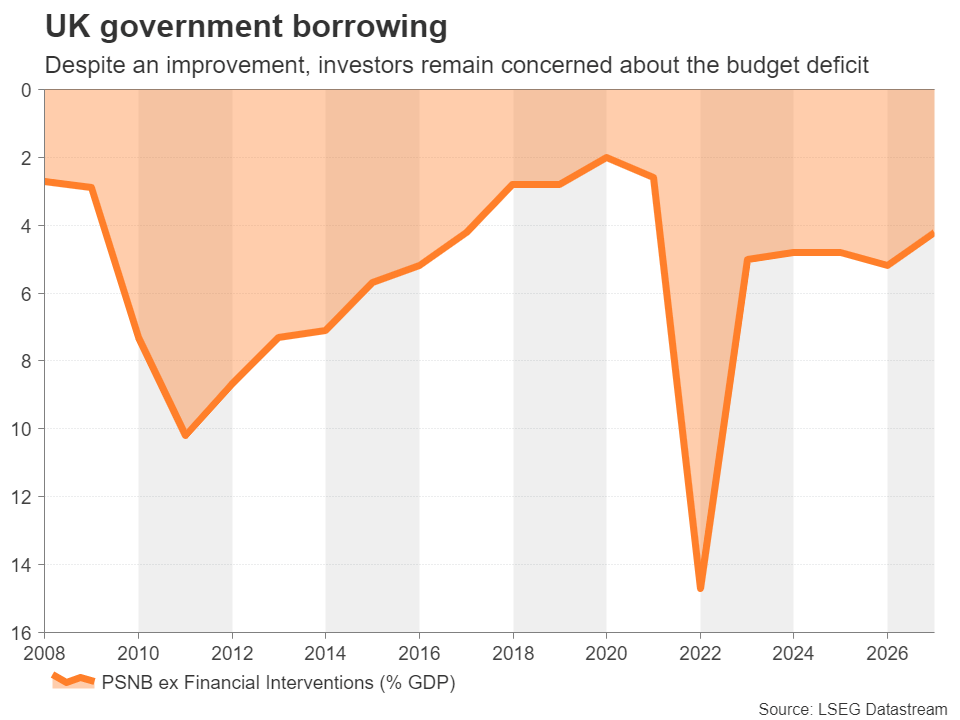
The budget constraints also raise question marks about how Burnham will deliver his pledge to build more council homes. But there is no doubt this will take centre stage after he re-appointed Angela Rayner, who has strong influence in her party, to the post of Housing Secretary.
Much of the success of these policies depends not only on how much funding they receive but also on how effective the government's devolution strategy is. Coming from his role as Mayor of Manchester, Burnham is a strong advocate of devolving more power to the regions, handing control over some taxation as well as services such as transport and utilities to local authorities.
The nationalization debate is back
This then brings us to Burnham's more worrying policy ambition – renationalization. Firstly, it's worth pointing out that this is not exactly a new trend. A number of rail companies have gone back into public ownership in recent years, as well as some grid operators. One of the more high-profile cases – Thames Water – is also at risk of being nationalized, while as recently as last week, the government announced it is taking over British Steel.
For investors, it's still a bit of an unknown what Burnham's real intentions are regarding nationalization. Certainly, renationalizing some sectors such as energy must be compelling for him, as it would allow the government to bring down prices. But all the indications are that Burnham is being pragmatic and focusing on giving decentralised authorities greater say in areas such as public procurement and franchising to improve services and keep prices down.
Will there be more tax hikes?
But does this mean that further tax hikes are unlikely under Andy Burnham? Most definitely not. Although Burnham is displaying some fiscal constraint by deciding against raising the income tax threshold, he is sure to come up with other giveaways. Some reports suggest he is considering a wealth tax of 2% on people earning more than £100 million.
The good news is that the packages announced already are being financed by re-diverted funds. The temporary VAT cut on electricity will be paid for by scrapping Starmer's digital ID scheme and another measure – the £2 cap on single bus fares – will mostly be backed by money set aside for international climate projects, which will switch from grants to loans.
Nevertheless, all this careful reallocation of funds hasn't eased investor concerns about unsustainable government borrowing. The pound has slid sharply against both the US dollar and euro this week, although the losses can partly be explained by a technical correction following strong gains over the prior three weeks.
Pound bulls hit stumbling block
For cable, Burnham's arrival coincides with a weakening of the longer-term bullish outlook. In the weekly chart, the pound has been trading sideways since April 2025 after an impressive rebound from the depths of the September 2022 low of $1.0382. But it is fast approaching two ascending trendlines, with a high risk of breaching both over the coming weeks, compromising the bullish structure.
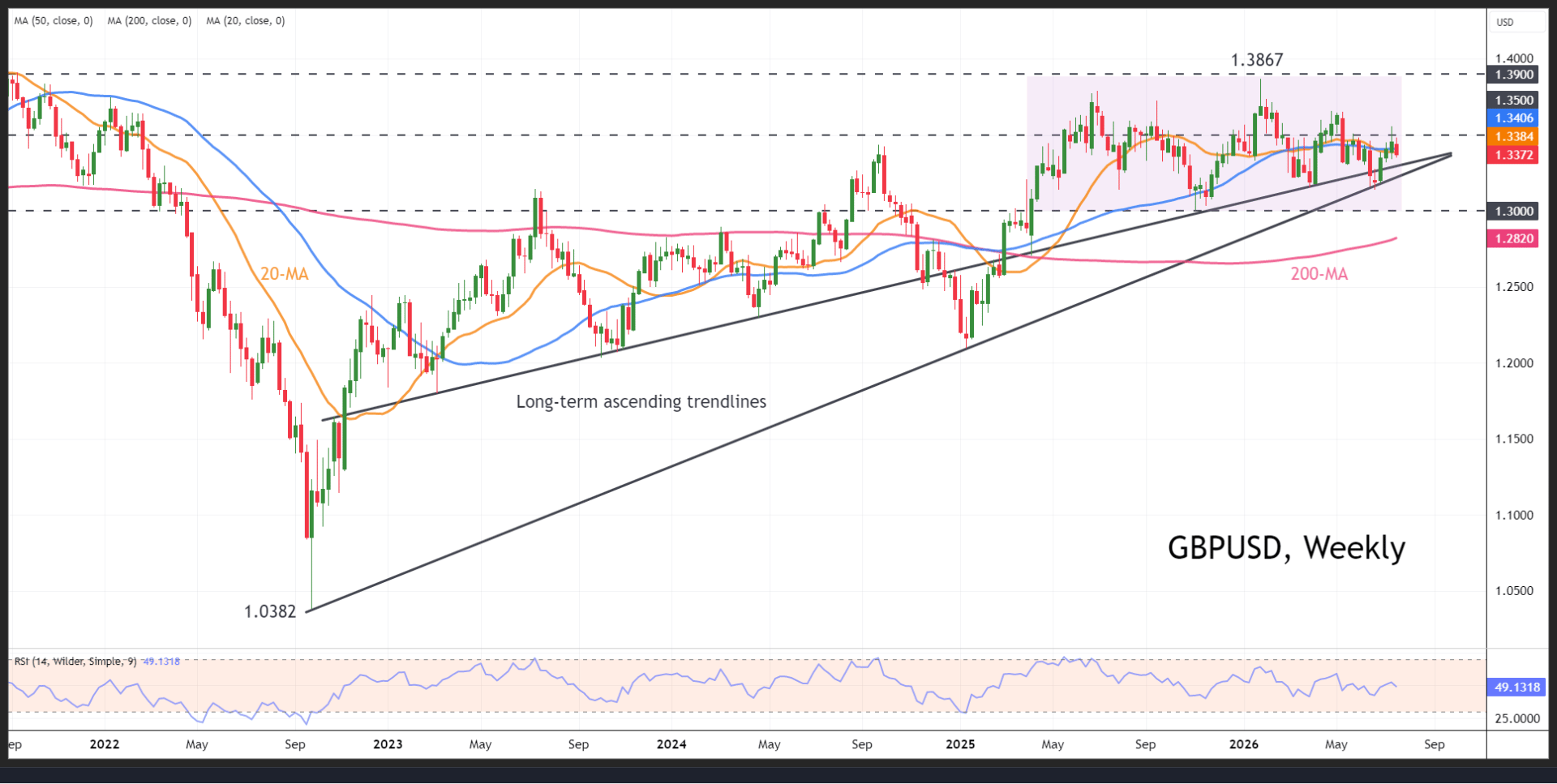
Having managed to stay above $1.3000 during the consolidation period, any panic that sends cable below this crucial level would symbolise a significant loss of investor confidence in the British currency. Burnham would be lucky to maintain the current neutral medium-term picture given the risk premium attached for the UK's debt position.
Markets yet to give their verdict to Burnham
The US-Iran conflict hasn't done these worries any favours. With the energy price shock fuelling inflation again, and in turn, lifting the Bank of England's expected rate path, gilt yields have soared, pushing up borrowing costs for the government. If Burnham doesn't do more to calm investor fears, yields could soon surpass the post-Iran war peak, risking triggering an accelerated selloff in gilts.
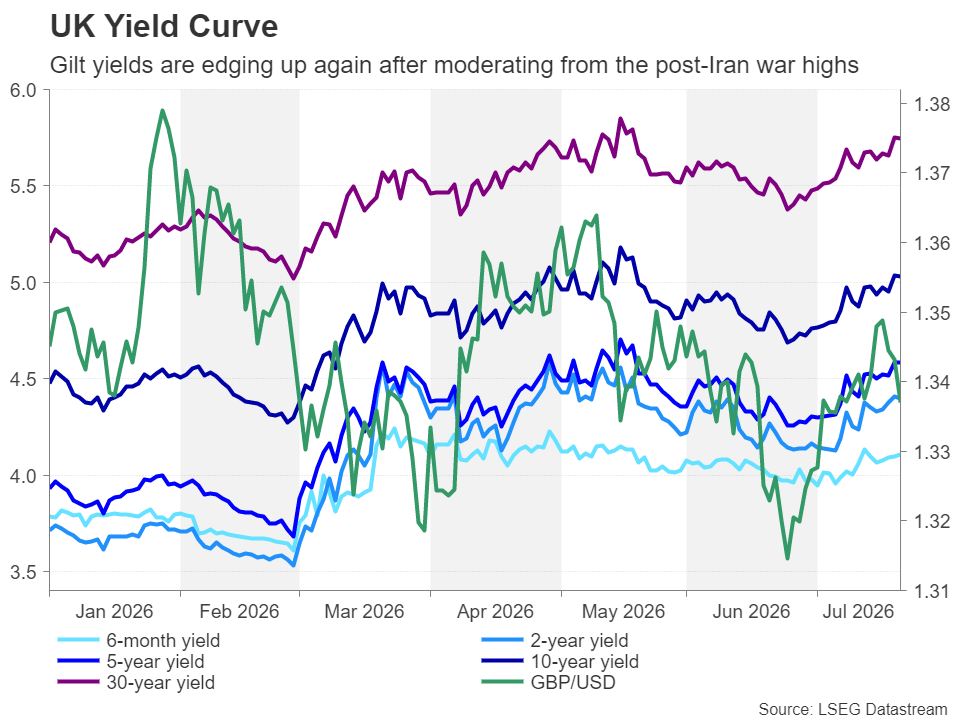
As demonstrated during the Liz Truss mini budget crisis in September 2022, a sharp slide in gilt prices tends to be devastating for the pound. A return to the $1.2000 handle or lower cannot be ruled out during a rout. For now, though, investors are cautiously giving Burnham the benefit of the doubt.
The big test for the new government of course will be the August budget statement. If Healey demonstrates a satisfactory degree of fiscal discipline and there are no announcements of unfunded spending or tax breaks until then, sterling could be well positioned to revisit its January high of $1.3867 and resume its longer-term uptrend.
Dollar and Yield Surge as Brent Near $100 Sparks Broader Market Repricing
Oil has finally become everyone else's problem. After days in which crude prices climbed while equities, bond markets and currencies remained relatively composed, Thursday brought the first convincing signs that investors are beginning to treat higher energy prices as a broader macroeconomic threat. Brent crude surged toward $100 and WTI broke above $90, while Treasury yields jumped, stocks turned lower and the Dollar rallied sharply. The synchronized move suggests markets are starting to price the return of stagflation risks rather than viewing the latest oil rally as a temporary geopolitical premium.
The catalyst was another escalation in Middle East tensions. Yemen's Houthis said they had targeted two Saudi oil tankers with drones and missiles, raising concerns that the Red Sea is becoming an active second front alongside the Strait of Hormuz. President Donald Trump then warned that the US would hold Iran responsible for future Houthi attacks, threatening "major military punishment" against both Tehran and the Houthis. Coming as US forces completed a twelfth consecutive night of strikes on Iran, the developments reinforced fears that disruptions to global energy supplies could become more prolonged.
The reaction across fixed-income markets was particularly striking. US 10-year Treasury yields climbed above 4.70% for the first time since January 2025 as investors reassessed the inflation outlook in light of surging energy prices. Germany's 10-year Bund yield also pushed above 3.2%, reaching its highest level since 2011, underscoring that the repricing is extending well beyond the United States. Rising bond yields point to growing expectations that central banks may need to keep monetary policy restrictive for longer if higher oil prices feed into broader inflation.
Equity markets also began reflecting those concerns. European stocks traded lower across the board, while US futures pointed to a sharply weaker open, with Dow futures down more than -500 points and Nasdaq futures lower by around -380 points. Although the selling remained orderly, the pattern is consistent with investors becoming less willing to dismiss higher energy costs as a risk confined to commodity markets. Instead, attention is shifting toward the implications for corporate margins, consumer spending and inflation.
Currency markets completed the broader repricing. The Dollar led gains as higher Treasury yields boosted its appeal, while USD/JPY climbed to fresh 40-year highs above 163 despite the continued risk of official intervention. The Canadian Dollar benefited from the surge in crude prices, and the Euro remained supported after the ECB acknowledged that "the full inflationary impact of the energy shock has yet to play out" while maintaining its data-dependent policy stance. By contrast, the New Zealand Dollar underperformed, followed by the Yen and Swiss Franc.
The next milestone is Brent's test of $100. Markets have so far been willing to view higher oil prices as an insurance premium against geopolitical uncertainty rather than evidence of physical supply shortages. A sustained break above $100—particularly if accompanied by confirmation that attacks are materially disrupting exports through both the Red Sea and the Strait of Hormuz—would strengthen the case that the oil rally is evolving into a genuine supply shock. That would likely reinforce the current repricing across bonds, equities and currencies, extending the resurgence in global stagflation fears.
Red Sea Attacks Push Brent Oil Toward $100. Will Markets Finally React?
Brent oil's rally is entering a potentially decisive phase as renewed Middle East tensions push prices toward the key $100 level. While broader financial markets have so far remained relatively calm, a decisive break above $100—particularly if accompanied by evidence of actual supply disruptions through both the Red Sea and Strait of Hormuz—could mark the point where investors begin pricing a genuine energy supply shock rather than simply elevated geopolitical risk. Read more.
ECB Holds Rates, Closely Watches Energy Shock and Inflation Spillovers
The European Central Bank left interest rates unchanged as expected but delivered a mildly hawkish message by emphasizing that the recent energy shock is still working its way through the economy. The Governing Council warned that "the full inflationary impact of the energy shock has yet to play out" and said it is closely monitoring the shock's intensity, duration and potential second-round effects on broader inflation. While reiterating its commitment to a data-dependent, meeting-by-meeting approach and avoiding any pre-commitment on future rates, the ECB signaled that rising energy prices remain a key risk to the inflation outlook. Read More.
US Jobless Claims Fall Shaprly to 187k vs exp 212k
US initial jobless claims fell by 22K to 187K in the week ended July 18, well below expectations of 212K. Continuing claims also edged lower to 1.796 million while the insured unemployment rate held at 1.2%, pointing to an exceptionally tight labor market with limited layoffs and steady re-employment. Read More.
Canada Retail Sales Rise 1.0% in May, June Momentum Seen Continuing
Canada's retail sales increased 1.0% in May, with all nine retail subsectors posting gains, highlighting resilient consumer spending despite a challenging macro backdrop. Core retail sales, which exclude autos and gasoline, rose 0.9%, pointing to broad-based strength beyond energy-related spending. Statistics Canada's advance estimate of a further 0.4% rise in June suggests household demand remained firm heading into the end of the second quarter. Read More.
EUR/CHF Rally Points to Hawkish ECB Hold as Oil Reignites Inflation Risks
EUR/CHF may already be revealing how markets expect the European Central Bank to respond to a rapidly changing inflation outlook. Although the ECB is widely expected to leave its deposit rate unchanged at 2.25%, Brent crude's surge back above $95 following renewed US-Iran hostilities has revived concerns that energy-driven inflation could persist for longer. The breakout in EUR/CHF suggests investors have begun pricing a hawkish hold and a growing possibility of another ECB rate hike later this year. The key question now is whether President Christine Lagarde validates that repricing—or pushes back against it—during her press conference. Read More.
Australian Jobs Blow Past Forecasts With 76.3k Growth as Participation Keeps Unemployment Steady
Australia's labour market significantly outperformed expectations in June, with employment rising by 76,300 compared with forecasts for a 15,000 increase. However, the unemployment rate remained at 4.4% because more people entered the workforce, lifting the participation rate to 67.0%. The ABS said part of the hiring reflected delayed job commencements from May, while higher job retention also supported employment growth. Although the data reinforce the resilience of the labour market, the rise in underemployment to 6.5% suggests spare capacity has not been fully absorbed, leaving inflation data as the key determinant of the Reserve Bank of Australia's next policy move. Read More.
USD/CHF Daily Outlook
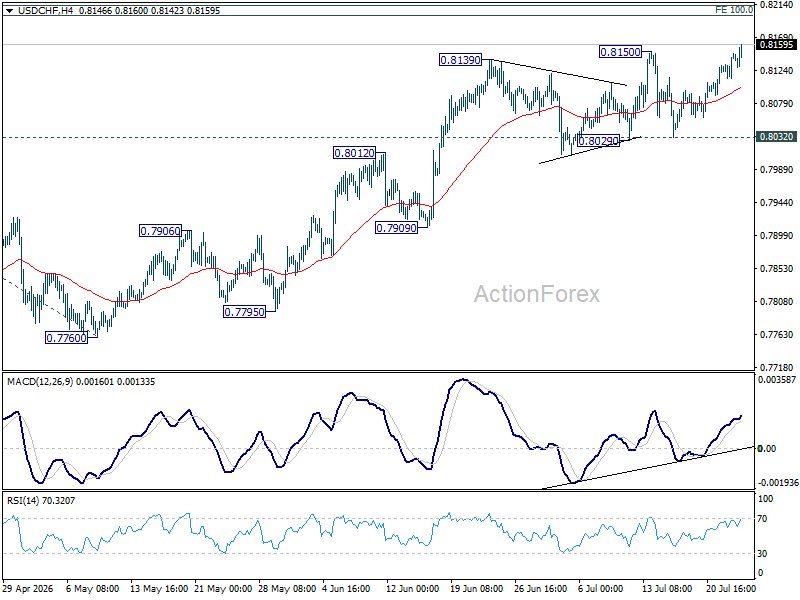
Intraday bias in USD/CHF is back on the upside with break of 0.8150. Rise from 0.7603 is resuming and should target 100% projection 0.7603 to 0.8041 from 0.7600 at 0.8198 next. For now, outlook will remain bullish as long as 0.8029 support holds, in case of retreat.
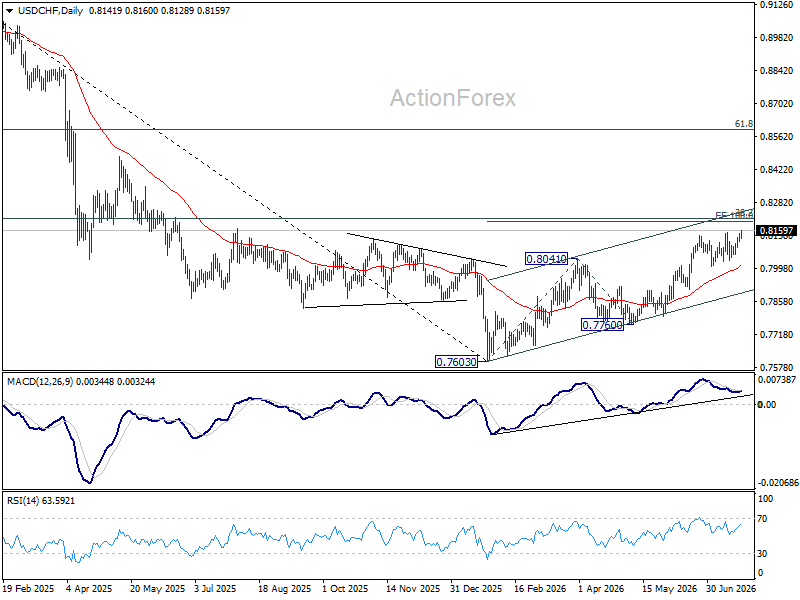
In the bigger picture, while a medium term bottom was formed at 0.7603, it's still early to call for bullish trend reversal. As long as 38.2% retracement of 0.9200 (2025 high) to 0.7603 at 0.8213 holds, the larger down trend could still continue through 0.7603 at a later stage. However, firm break of 0.7603 will argue that the trend has reversed and turn focus to 0.8332 support turned resistance (2023 low) for confirmation.
Canada Retail Sales Rise 1.0% in May, June Momentum Seen Continuing
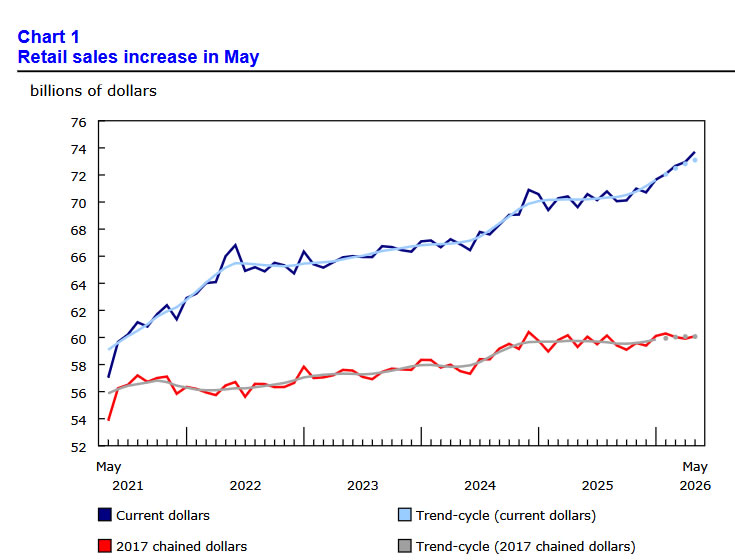
Canada's retail sales rose 1.0% mom to CAD 73.7B in May, marking a broad-based improvement in consumer spending as all nine retail subsectors posted gains. The increase was led by gasoline stations and fuel vendors, reflecting higher fuel prices, while motor vehicle and parts dealers also contributed with a second consecutive monthly increase. Excluding the more volatile gasoline and auto categories, core retail sales still advanced a solid 0.9%, suggesting household demand remained resilient beyond energy-related spending.
The composition of the report painted a slightly more nuanced picture. Sales at gasoline stations and fuel vendors rose 3.1% in value terms, but volumes fell -2.7%, indicating that higher prices rather than stronger demand drove much of the increase. Meanwhile, motor vehicle and parts dealers recorded a 0.7% gain, with new car dealers leading the advance. Overall retail sales volumes rose 0.3%, pointing to modest but positive growth in the quantity of goods purchased after adjusting for price changes.
The outlook also remained constructive. Statistics Canada's advance estimate suggests retail sales increased a further 0.4% in June, indicating consumer spending continued to expand heading into the second quarter's close.
Economic Data
| Indicator | Actual | Expected | Previous |
|---|---|---|---|
| Retail Sales (May, m/m) | +1.0% | +0.7% | +0.3% |
| Core Retail Sales (May, m/m) | +0.9% | — | +0.2% |
| Retail Sales Volume (May, m/m) | +0.3% | — | +0.5% |
| Advance Estimate – Retail Sales (Jun, m/m) | +0.4% | — | — |
Key Takeaways
- Broad-based strength: Retail sales rose 1.0% m/m, with all nine retail subsectors recording gains, indicating consumer spending remained resilient.
- Underlying demand improved: Core retail sales, excluding autos and gasoline, increased 0.9%, showing the strength extended beyond volatile sectors.
- Energy prices boosted headline sales: Sales at gasoline stations rose 3.1%, but volumes fell -2.7%, indicating higher fuel prices rather than stronger demand drove much of the increase.
- Real spending still expanded: Overall retail sales volumes increased 0.3%, suggesting consumers purchased more goods even after adjusting for price effects.
- Auto sector remained supportive: Motor vehicle and parts dealers posted a second consecutive monthly gain, led by higher new vehicle sales.
- Momentum carried into June: Statistics Canada's advance estimate points to another 0.4% increase in June retail sales, indicating household spending remained on a firm footing heading into Q2's close.
US Jobless Claims Fall Sharply to 187k vs exp 212k
US initial jobless claims fell sharply by -22k to 187k in the week ended July 18, well below expectations of 212k. The prior week's figure was revised slightly higher to 209k from 208k, while the four-week moving average declined by -7.25k to 207.5k. The data point to continued resilience in the labor market despite mounting uncertainty surrounding energy prices and global geopolitical tensions.
The improvement was also reflected in continuing claims, which edged down by -2k to 1.796m in the week ended July 11, while the insured unemployment rate held steady at 1.2%. Although the decline was modest, it suggests workers who lose their jobs are still finding new employment relatively quickly, reinforcing the view that labor market conditions remain tight rather than deteriorating. The four-week average of continuing claims also fell, indicating that broader labor market momentum has remained intact.
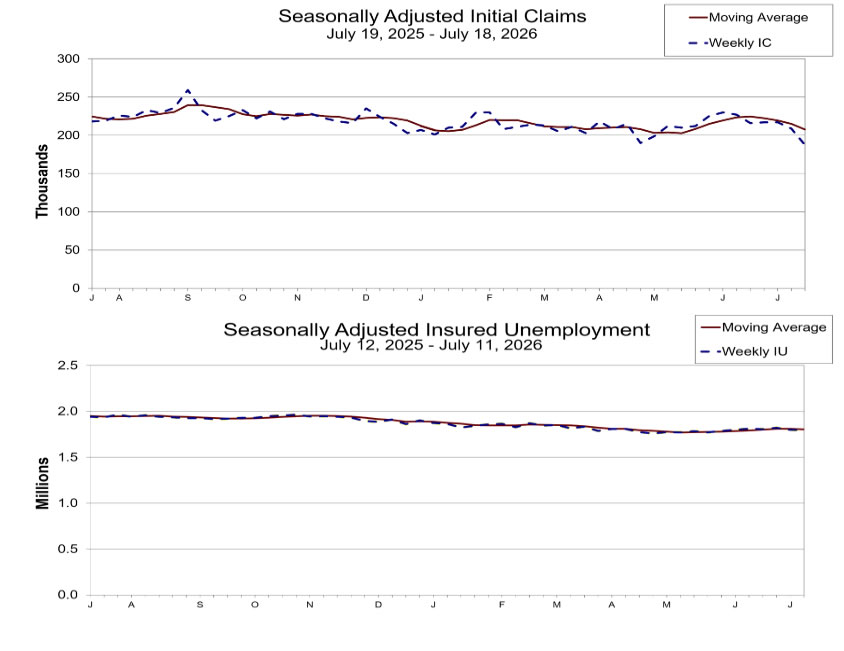
Economic Data
| Indicator | Actual | Expected | Previous |
|---|---|---|---|
| Initial Jobless Claims (Jul 18) | 187K | 212K | 209K |
| 4-Week Average | 207.5K | — | 214.75K |
| Continuing Claims (Jul 11) | 1.796M | — | 1.798M |
| Insured Unemployment Rate | 1.2% | — | 1.2% |
ECB Holds Rates, Closely Watches Energy Shock and Inflation Spillovers
The European Central Bank left its key interest rates unchanged as widely expected, keeping the deposit rate at 2.25%, while acknowledging that renewed energy market volatility has complicated the inflation outlook. Rather than signalling any change in policy direction, the Governing Council emphasized that the "outlook for energy prices, while highly volatile," remains well above levels seen before the Middle East conflict, adding that "the full inflationary impact of the energy shock has yet to play out." The statement reinforces that policymakers are focused on how persistent higher energy costs could feed through to broader inflation.
The ECB said it is "closely monitoring the intensity and duration of the shock, as well as its indirect and second-round effects," highlighting concerns that sustained increases in energy prices could eventually spill over into wages and underlying inflation. At the same time, policymakers stressed that they remain "committed to setting monetary policy to ensure that inflation stabilizes at its 2% target in the medium term." The statement stopped short of endorsing expectations for another rate hike, instead reiterating that the Governing Council will continue to determine policy on a "data-dependent and meeting-by-meeting approach" and is "not pre-committing to a particular rate path."
Overall, the statement leans mildly hawkish without materially changing the ECB's policy framework. By explicitly acknowledging that the energy shock is still unfolding while avoiding any guidance on future rate moves, the Governing Council has left itself maximum flexibility as geopolitical developments continue to evolve. Attention now shifts to President Christine Lagarde's press conference, where markets will look for clues on whether she validates growing expectations that renewed energy-driven inflation could keep the door open to another rate hike later this year.
(ECB) Monetary policy decisions
23 July 2026
The Governing Council today decided to keep the three key ECB interest rates unchanged. The outlook for energy prices, while highly volatile, currently stands close to the baseline of the June Eurosystem staff projections and well above the levels recorded prior to the conflict in the Middle East. Uncertainty remains high and the full inflationary impact of the energy shock has yet to play out. The Governing Council is therefore closely monitoring the intensity and duration of the shock, as well as its indirect and second-round effects. The Governing Council is committed to setting monetary policy to ensure that inflation stabilises at its 2% target in the medium term.
With today’s decision, the Governing Council remains well positioned to navigate the uncertainty caused by the conflict. It will follow a data-dependent and meeting-by-meeting approach to determining the appropriate monetary policy stance. In particular, the Governing Council’s interest rate decisions will be based on its assessment of the inflation outlook and the risks surrounding it, in light of the incoming economic and financial data, as well as the dynamics of underlying inflation and the strength of monetary policy transmission. The Governing Council is not pre-committing to a particular rate path.
Key ECB interest rates
The interest rates on the deposit facility, the main refinancing operations and the marginal lending facility will remain unchanged at 2.25%, 2.40% and 2.65% respectively.
Asset purchase programme (APP) and pandemic emergency purchase programme (PEPP)
The APP and PEPP portfolios are declining at a measured and predictable pace, as the Eurosystem no longer reinvests the principal payments from maturing securities.
***
The Governing Council stands ready to adjust all of its instruments within its mandate to ensure that inflation stabilises at its 2% target in the medium term and to preserve the smooth functioning of monetary policy transmission. Moreover, the Transmission Protection Instrument is available to counter unwarranted, disorderly market dynamics that pose a serious threat to the transmission of monetary policy across all euro area countries, thus allowing the Governing Council to more effectively deliver on its price stability mandate.
The President of the ECB will comment on the considerations underlying these decisions at a press conference starting at 14:45 CET today.
EUR/USD Daily Outlook
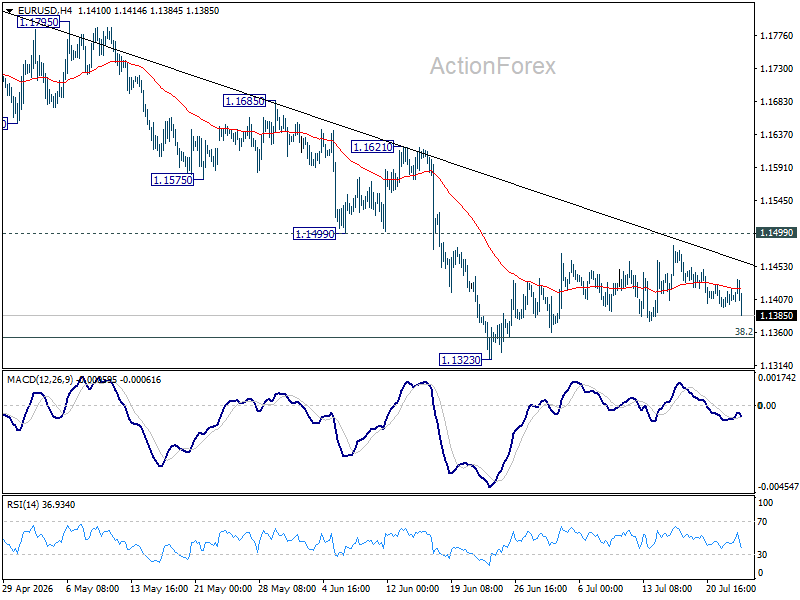
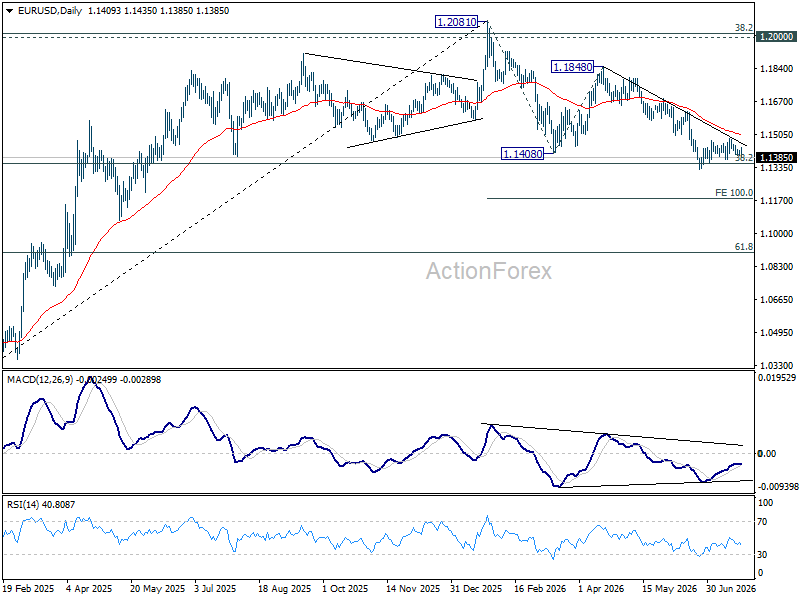
No change in EUR/USD's outlook as it's still bounded in consolidations from 1.1323. Intraday bias remains neutral. With 1.1499 support turned resistance intact, further decline is expected. On the downside, break of 1.1323 will resume the fall from 1.2081 to 100% projection of 1.2081 to 1.1408 from 1.1848 at 1.1175. However, decisive break of 1.1499 will turn bias back to the upside for 1.1621 resistance.
In the bigger picture, focus is back on 38.2% retracement of 1.0176 to 1.2081 at 1.1353. Decisive break there will revive the case of medium term bearish trend reversal after rejection by 1.2 key cluster resistance level. Further fall should be seen to 61.8% retracement at 1.0904. Nevertheless, strong rebound from 1.1353, followed by break of 1.1621 resistance, will retain medium term bullishness.
USD/JPY Daily Outlook
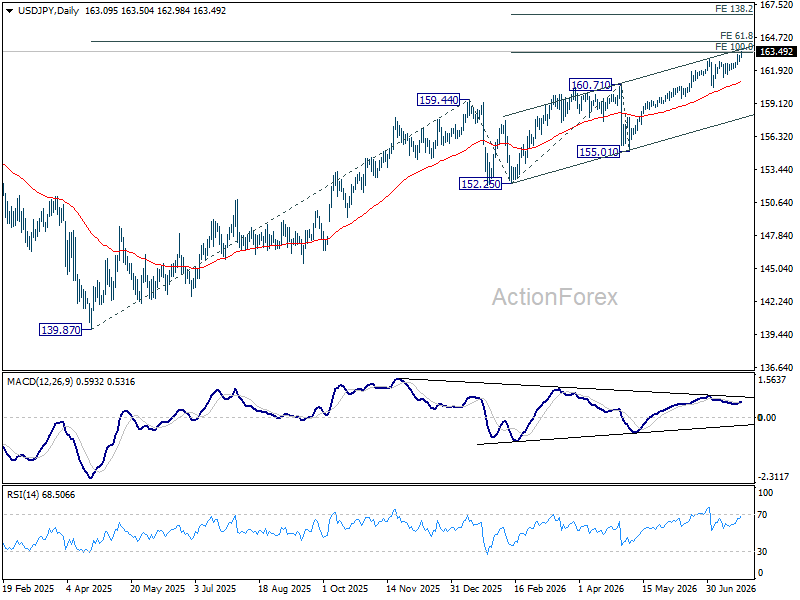
USD/JPY's rally continues today and met 100% projection of 152.25 to 160.71 from 155.01 at 163.47 already. There is no sign of topping, and intraday bias stays on the upside for 138.2% projection at 166.07 next. On the downside, below 162.67 minor support will turn bias neutral and bring consolidations. But outlook will stay bullish as long as 160.46 support holds, in case of retreat.
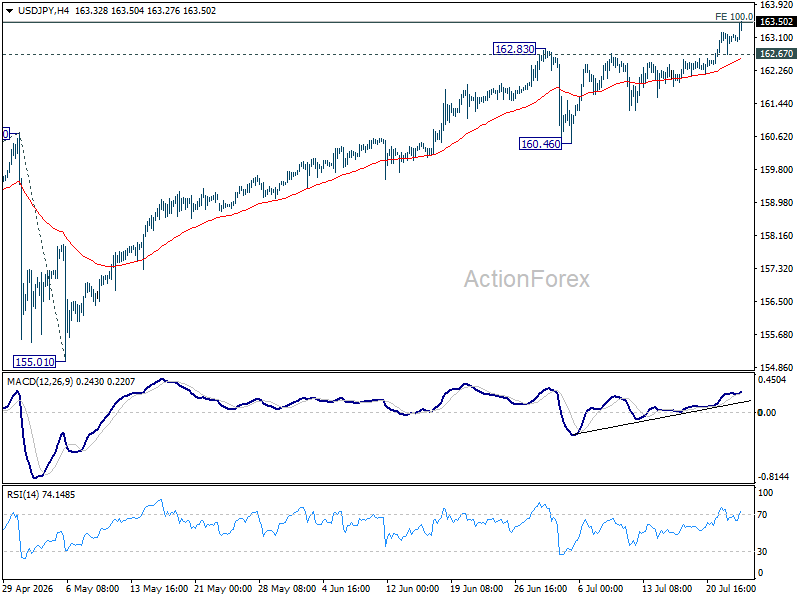
In the bigger picture, rise from 139.87 (2025 low) is seen as another rising leg of the long term up trend. Next target is 61.8% projection of 139.87 to 159.44 from 152.25 at 164.34. Firm break break there will target 100% projection at 171.82. For now, outlook will remain bullish as long as 155.01 support holds, even in case of deep pullback.
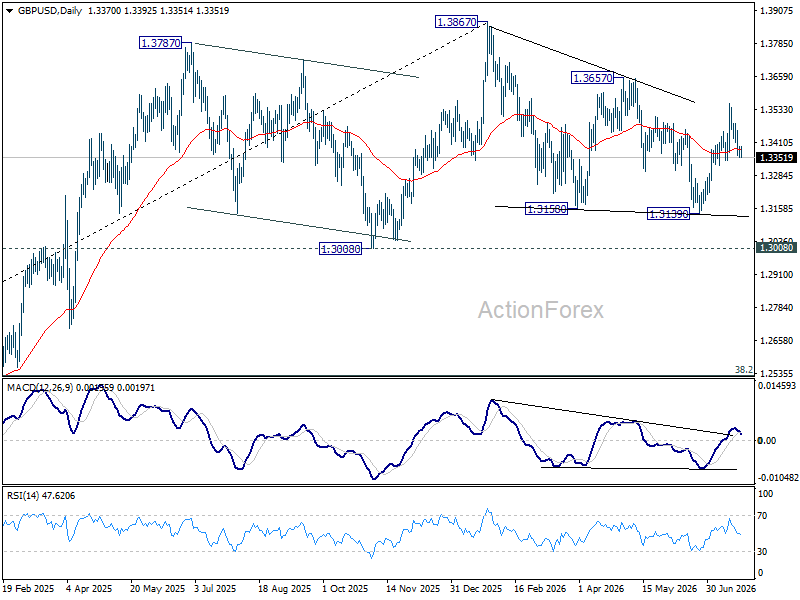
GBP/USD Daily Outlook
Intraday bias in GBP/USD remains neutral for the moment. Further rally is expected as long as 1.3339 support holds. Above 1.3557 will target 1.3657 first. Firm break there will bring retest of 1.3867 high. However, break of 1.3339 support will dampen this bullish view and bring deeper fall back to 1.3139 instead.
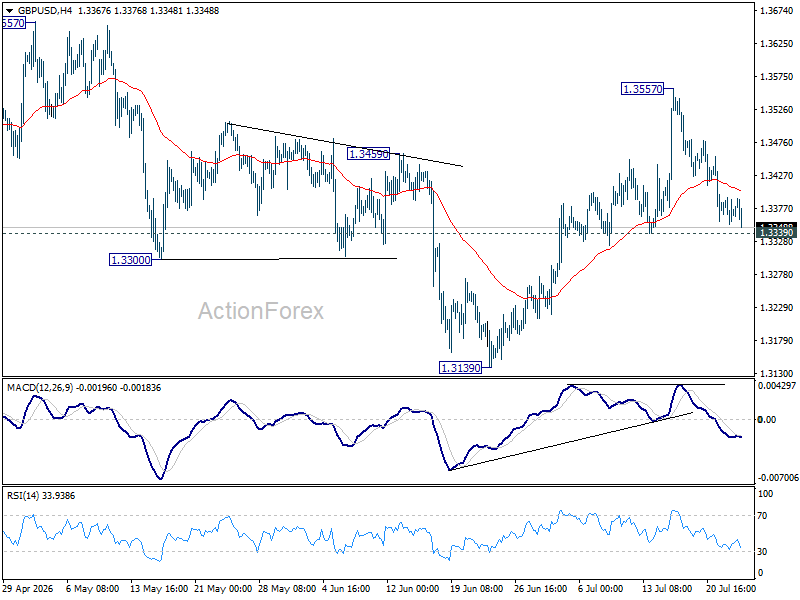
In the bigger picture, price actions from 1.3867 are a corrective pattern within the broader up trend from 1.0351 (2022 low). With 1.3008 support intact, medium term bullishness is maintained and break of 1.3867 is in favor for a later stage, towards 1.4248 key resistance (2021 high). However, firm break of 1.3008 will at least bring deeper fall to 38.2% retracement of 1.0351 to 1.3867 at 1.2524, with increased risk of bearish reversal.