Mon, Apr 06, 2026 20:39 GMT
More

    Sample Category Title

    AUD/USD and NZD/USD Struggle as Market Jitters Shake Risk Sentiment

    AUD/USD failed to stay in a positive zone and declined below 0.7000. NZD/USD is also moving lower and might extend losses below 0.5850.

    Important Takeaways for AUD/USD and NZD/USD Analysis Today

    • The Aussie Dollar started a fresh decline from well above 0.7100 against the US Dollar.
    • There is a bearish trend line forming with resistance at 0.7020 on the hourly chart of AUD/USD at FXOpen.
    • NZD/USD declined steadily from 0.6000 and traded below 0.5900.
    •  There is a key bearish trend line forming with resistance at 0.5900 on the hourly chart of NZD/USD at FXOpen.

    AUD/USD Technical Analysis

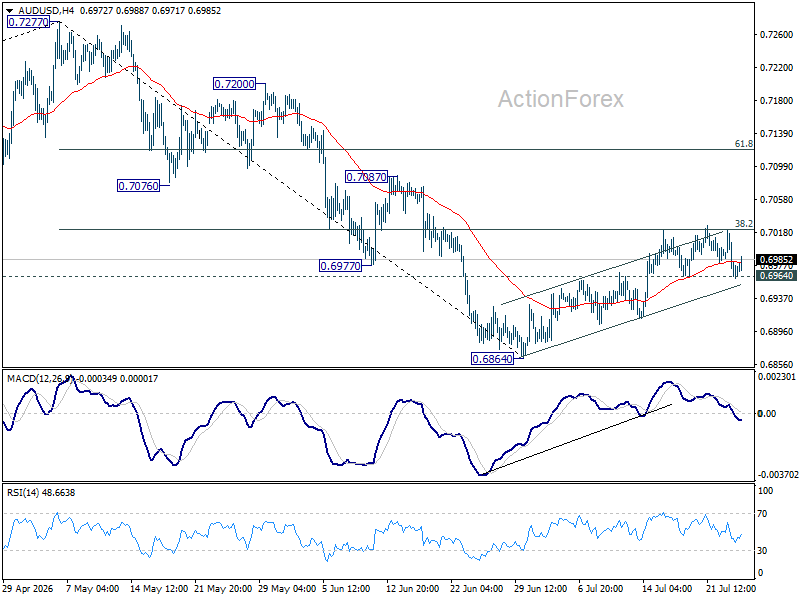
    On the hourly chart of AUD/USD at FXOpen, the pair struggled to clear 0.7150. The Aussie Dollar started a fresh decline below 0.7050 against the US Dollar.

    The pair even settled below 0.7000 and the 50-hour simple moving average. There was a clear move below 0.6980. A low was formed at 0.6956, and the pair is now consolidating losses. There was a minor recovery wave above the 23.6% Fib retracement level of the downward move from the 0.7089 swing high to the 0.6956 low.

    On the upside, immediate hurdle is near the 50-hour simple moving average and the 50% Fib retracement at 0.7020. There is also a bearish trend line forming with resistance at 0.7020.

    The next major level for the bears could be 7060. The main selling point could be 0.7090, above which the price could rise toward 0.7140. Any more gains might send the pair toward 0.7200. A close above 0.7200 could start another steady increase in the near term. In the stated case, the next key resistance on the AUD/USD chart could be 0.7280.

    On the downside, initial support is near 0.6975. The next area of interest might be 0.6955. If there is a downside break below 0.6955, the pair could extend its decline. The next target for the bears might be 0.6920. Any more losses might send the pair toward 0.6900.

    NZD/USD Technical Analysis

    On the hourly chart of NZD/USD on FXOpen, the pair also followed a similar pattern and declined from the 0.6000 zone. The New Zealand Dollar gained bearish momentum and traded below 0.5950 against the US Dollar.

    The pair settled below 0.5900 and the 50-hour simple moving average. Finally, it tested 0.5850 and is currently consolidating losses. There was a minor increase above the 23.6% Fib retracement level of the downward move from the 0.5948 swing high to the 0.5848 low.

    If the pair recovers, it could face hurdles near 0.5900 and a key bearish trend line. The next major barrier is at 0.5910 since it coincides with the 61.8% Fib retracement.

    If there is a move above 0.5910, the pair could rise toward 0.5950. Any more gains might open the doors for a move toward 0.6010 in the coming days. On the downside, immediate support on the NZD/USD chart is 0.5850.

    The next major stop for the bears might be 0.5835. If there is a downside break below 0.5835, the pair could extend its decline toward 0.5800. The main target for the bears could be 0.5740.

    Trade over 50 forex markets 24 hours a day with FXOpen. Take advantage of low commissions, deep liquidity, and spreads from 0.0 pips (additional fees may apply). Open your FXOpen account now or learn more about trading forex with FXOpen.

    This article represents the opinion of the Companies operating under the FXOpen brand only. It is not to be construed as an offer, solicitation, or recommendation with respect to products and services provided by the Companies operating under the FXOpen brand, nor is it to be considered financial advice.

    WTI Crude Oil Soars Over 30% Before Settling Below 120.00

    • WTI crude oil posts a bullish gap, reaching its highest levels since July 2022.
    • Iran-related tensions fuel upward pressure, but rally could be short-lived.
    • Momentum indicators mirror the surge, extending into overbought territory.

    WTI crude oil surged more than 30% on Monday, reaching its highest levels since mid‑2022, as the deepening conflict in the Middle East intensified supply‑disruption fears, further amplified by the appointment of Iran’s new supreme leader. The rally pushed prices just shy of the 120.00 level before easing lower toward the 102.00 area.

    If the pullback extends, as the price action currently continues to retreat from the intraday spike, a sustained break below the 200% Fibonacci level at 103.97 and a stabilization near the 102.00 area would expose the next support at 94.63, followed by 92.80, which marks an over two‑and‑a‑half‑year high. Below that, additional support is located in the 88.87-85.30 region.

    That said, the technical indicators reinforce the strong bullish momentum, with the RSI pushing deep into overbought territory, and the MACD continuing to overextend above zero and its red signal line.

    Thus, if the accelerated buying persists above the 261.8% Fibonacci retracement level of the June-December 2025 downleg at 119.58, the price could retest resistance at the June 2023 highs near 123.70, followed by the March peaks in the 127.00-130.00 zone.

    Overall, WTI crude oil has extended a six‑day rally to climb toward nearly four‑year highs. However, with price action now paring gains and volatility triggering aggressive swings between 98.00 and 120.00, the advance may pause, potentially allowing for a retracement toward the 90.00 region before the broader uptrend resumes.

    All Eyes Remain on the Conflict in the Middle East

    Markets

    Unexpected weak US payrolls on Friday brought a temporary interruption from the war-related, inflationary narrative. Contrary to mostly solid US data of late (e.g. ISMs), the US economy in February shed 92k jobs. The unemployment rate rose from 4.3% to 4.4%. Wage growth (AHE) rose slightly more than expected (0.4% M/M and 3.8% Y/Y). Some specific issues might have been in play (strikes, weather related topics). Even so, the outcome questions recent cautiously growing optimism on the US job market, which also became apparent in comments from at least from some Fed members. Whatever the assessment, the outcome helped to (temporarily) balance the energy price driven rise in US yields. US yields closed little changed (<2 bps across the curve). Any mitigating impact on EMU (or e.g. UK yields) understandably was far less, as at the same time the oil price (Brent) was closing in on $90+ p/b. The yield curve further bear flattened with the 2-y adding 7 bps, the 10-y rising 1.9 bps while the 30-y eased slightly (-0.8 bps). In the meantime, headlines on several key production facilities in the Gulf shutting down production (oil and gas production) continued to roll in. The combination of war-rated inflation fears and weak US payrolls evidently didn’t help equities. US indices lost between 0.94% (Dow) and 1.59% (Nasdaq). The recent ‘strong dollar bid’ temporarily receded. DYX closed slightly lower near 99. EUR/USD avoided a close below 1.16 (close 1.1618). Interestingly, sterling both outperformed the euro (close EUR/GBP 0.8663) and the dollar (cable close 1.3413).

    This morning, all eyes remain on the conflict in the Middle East. There are few signs pointing to any de-escalation. Iran named Mojtaba Khamenei, the sone of the previous Ayatollah, as the new supreme leader. US comments suggest they intend further action to reach their objectives, including seizing the Iran’s uranium. Oil this morning briefly spiked to only a whisker away from the $120 p/b level (Brent). In very volatile trading, oil currently eases slightly off those peak levels, but developments suggest that recent (stagflationary) dynamics with energy prices in focus might continue dominating trading. Asian equities are declining sharply (Nikkei -5.2%). US and European equity futures are also deeply in red. Short-term (EMU yields) again open sharply higher (2-y swap + 15 bps). US yields add 4-5 bps across the curve. Question is how fast money markets will price in the necessity for ECB action if the oil-price/inflation uptick persists. Everything remains highly conditional, but in a scenario of oil prices permanently at > $100 p/b, it shouldn’t surprise that markets ponder a scenario of the ECB being forced to raise rates already in June. The dollar also spiked higher this morning, but momentum currently also eases. EUR/USD tested the low 1.15 area, but currently again trades near 1.1545. USD/JPY (158.6) is nearing the YTD and December peak levels. Despite the sharp repositioning of late, it looks premature to already expect a turnaround especially in the trends of higher short-term (European) yields and in higher dollar/weaker euro. For EUR/USD, the November low at 1.1469 is next reference on the charts, with the August low at 1.1392.

    News & Views

    Chinese CPI rebounded from 0.2% to 1.3% in February, topping expectations for a 0.9% outcome. On a monthly basis, CPI was up 1%, accelerating from January’s 0.2%. Food and services drove the quickening with the former rising 1.7% y/y and the latter 1.6%. Both were significantly higher than in January (-0.7% and 0.1% respectively). This suggests the price surge was at least partially driven by stronger-than-usual holiday spending during the Lunar New Year month. The jury remains out on the longer-term consequences of this typically one-off event. Factory gate prices meanwhile remain deeply wired in deflation territory, coming in at -0.9% y/y. It was less than the -1.4% in January though and also surpassed consensus for -1.1%. Consumer goods printed at -1.6%, showing little improvement from -1.7%. China’s yuan gapped lower during this morning’s risk-off session but pared losses intraday. USD/CNY is currently trading around 6.91.

    Rating agency Fitch raised the outlook on Portugal’s A+ credit rating to positive from stable. It expects “policies to continue to focus on sound budgetary management, generating employment, and boosting investment, particularly in the fast-growing services sector”, allowing the debt ratio to continue to fall firmly over the next years. Moderate deficits or even surpluses (eg. in 2025) are expected to push debt lower to 86.8% by end 2027 from 89.6% end-2025. Economic growth is seen hovering just below 2% on average over 2026-2029 with strong household and company finances as supporting elements, along with “EU transfers, significant net immigration, and the competitive cost structure for the productive sector--including lower energy prices compared to EU peers.” Net exports are likely to remain a drag amid still-high uncertainty, including tariff-related risks, and the high import intensity of demand.

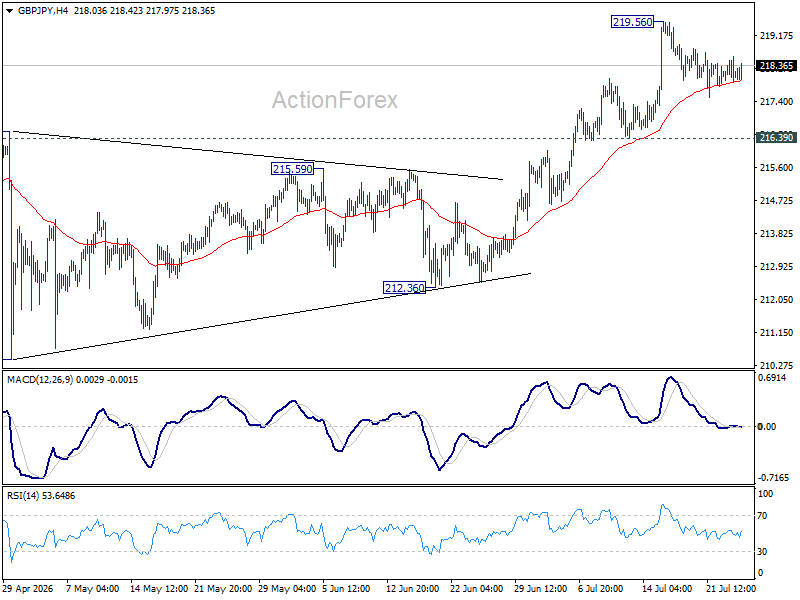
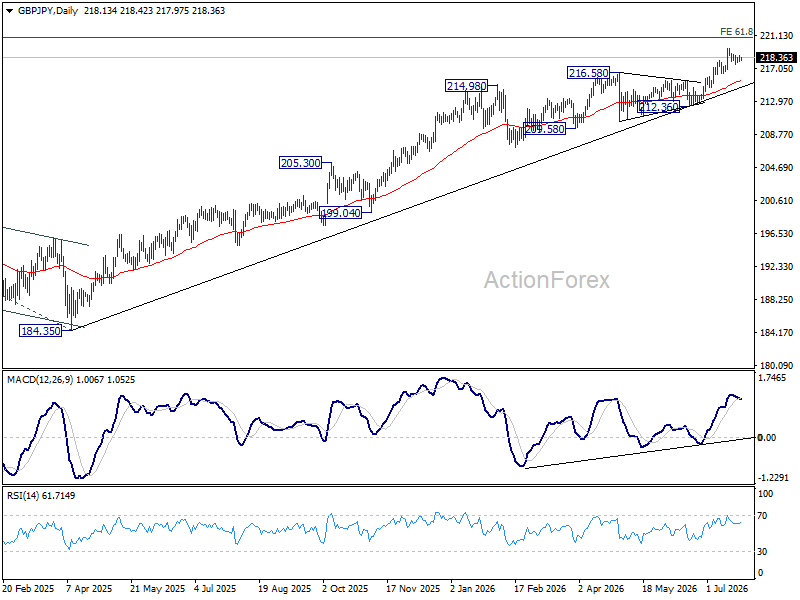
    GBP/JPY Daily Outlook

    Daily Pivots: (S1) 210.57; (P) 211.14; (R1) 212.26; More...

    Intraday bias in GBP/JPY remains neutral for the moment. Overall, price actions from 214.98 are seen as a corrective pattern that could extend further. On the upside, break of 212.10 will resume the rebound from 207.20 to retest 214.98 high. On the downside, though, break of 207.20 will resume the fall from 214.98, to correct whole rally from 184.35.

    In the bigger picture, up trend from 123.94 (2020 low) is still in progress. Firm break of 214.98 will target 61.8% projection of 148.93 (2022 low) to 208.09 (2024 high) from 184.35 at 220.90. This will remain the favored case as long as 55 W EMA (now at 202.80) holds, even in case of another deep pullback.

    EUR/JPY Daily Outlook

    Daily Pivots: (S1) 182.66; (P) 183.03; (R1) 183.68; More...

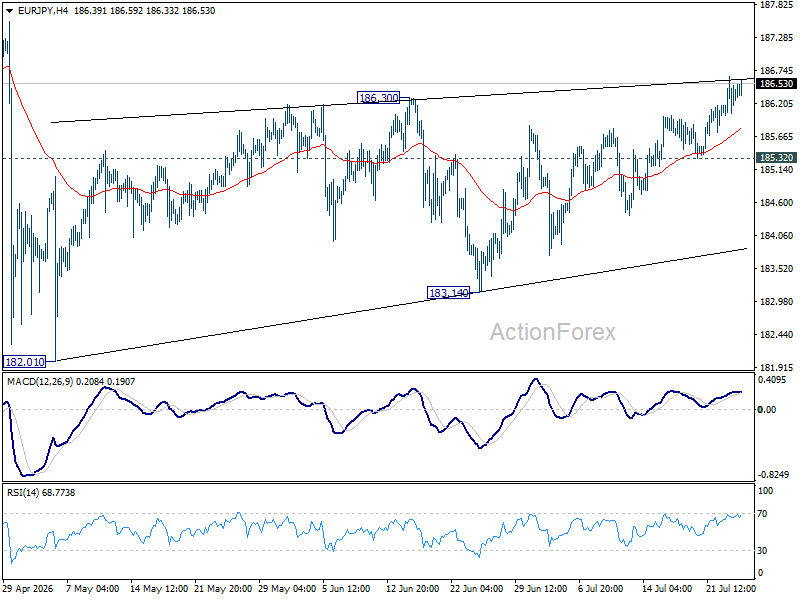
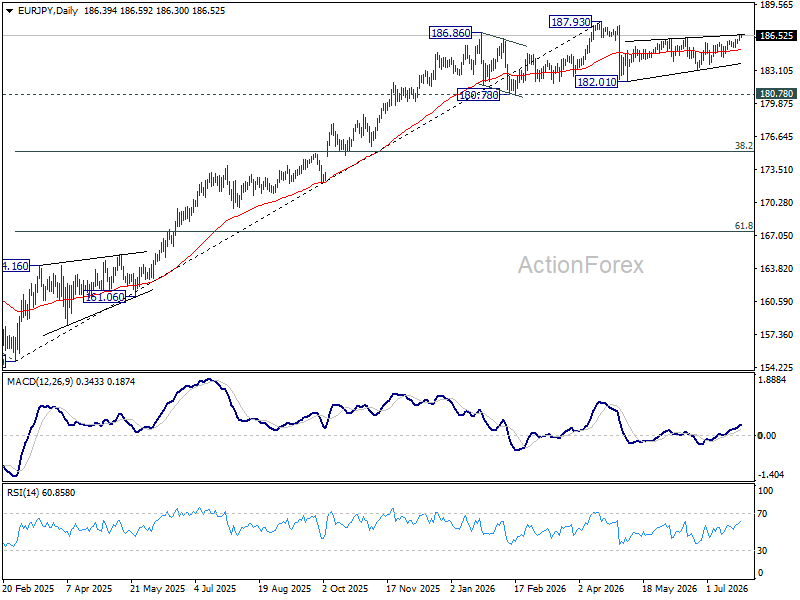
    Intraday bias in EUR/JPY remains neutral at this point. On the downside, firm break of 180.78 support will indicate that fall from 186.86 is already correcting whole up rise from 154.77. Deeper fall should then be seen to 38.2% retracement of 154.77 to 186.86 at 174.60. For now, near term outlook is neutral at best as long as 186.86 holds, or until there is sign of upward acceleration.

    In the bigger picture, a medium term top should be in place at 186.86 and some more consolidations could be seen. Nevertheless, the larger up trend from 114.42 (2020 low) remains intact. Firm break of 186.86 will pave the way to 78.6% projection of 124.37 (2022 low) to 175.41 (2025 high) from 154.77 at 194.88 next.

    EUR/GBP Daily Outlook

    Daily Pivots: (S1) 0.8642; (P) 0.8672; (R1) 0.8688; More…

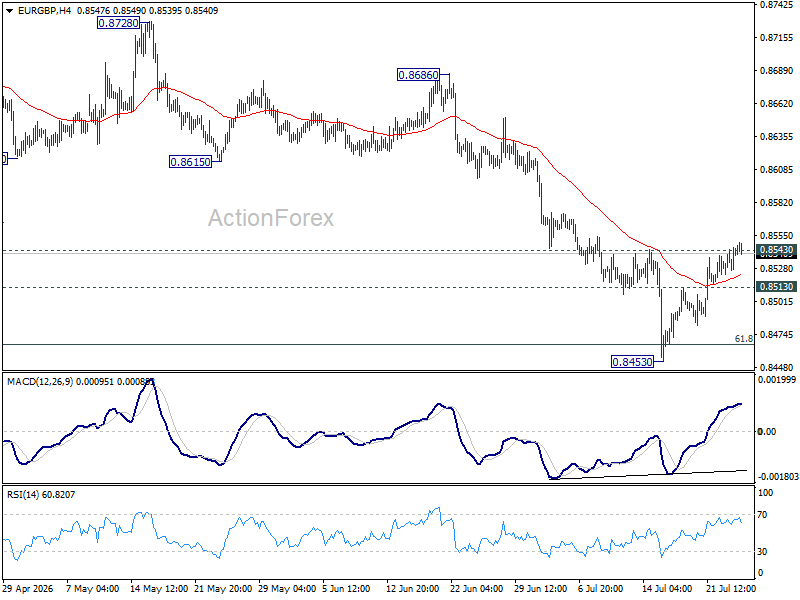
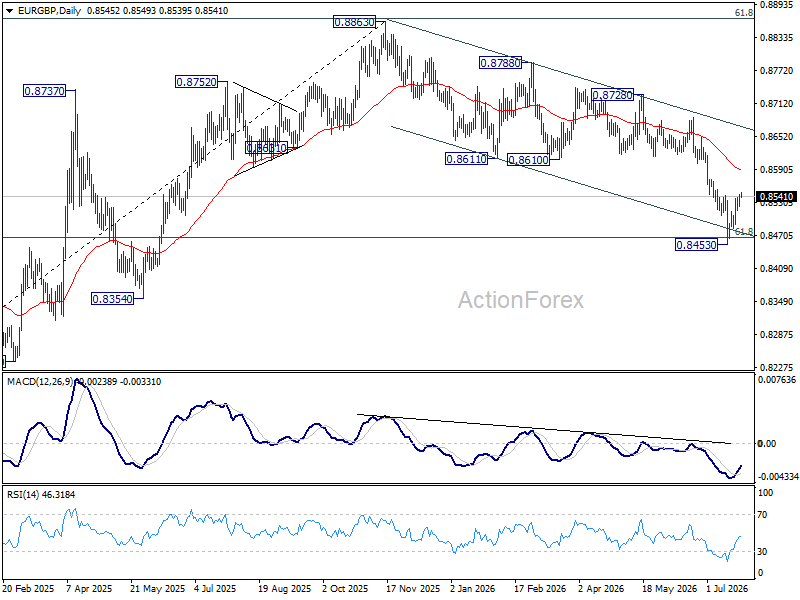
    Intraday bias in EUR/GBP remains on the downside at tis point. Fall from 0.8788 is the third leg of the pattern from 0.8863. Deeper fall would be seen to 0.8611 support. Firm break there will target 100% projection of 0.8863 to 0.8611 from 0.8788 at 0.8536. On the upside, above 0.8711 minor resistance will turn intraday bias neutral again first.

    In the bigger picture, current development revived the case that whole rise from 0.8221 (2024 low) has completed at 0.8863, after rejection by 61.8% retracement of 0.9267 (2022 high) to 0.8221 at 0.8867. Sustained trading below 38.2% retracement of 0.8821 to 0.8863 at 0.8618 will confirm this case, and bring deeper fall to 61.8% retracement at 0.8466 at least. For now, medium term outlook is neutral at best as long as 0.8863 resistance holds.

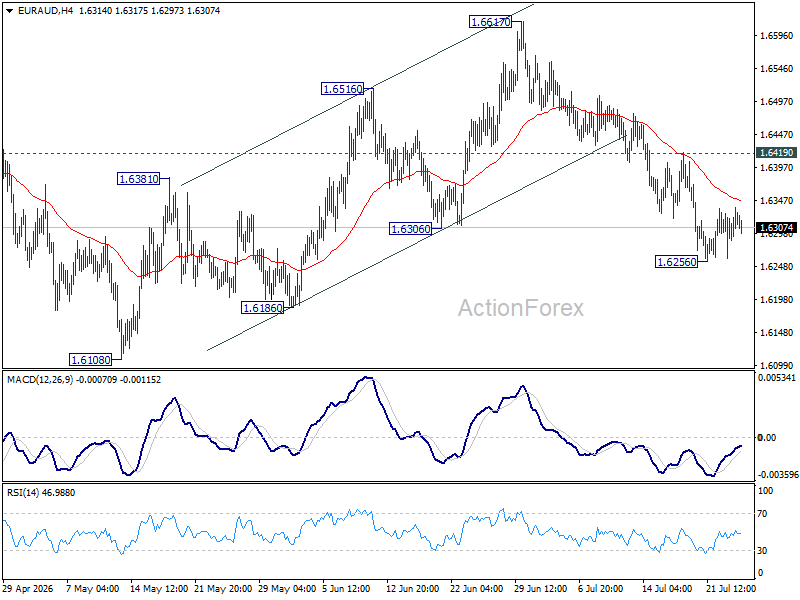
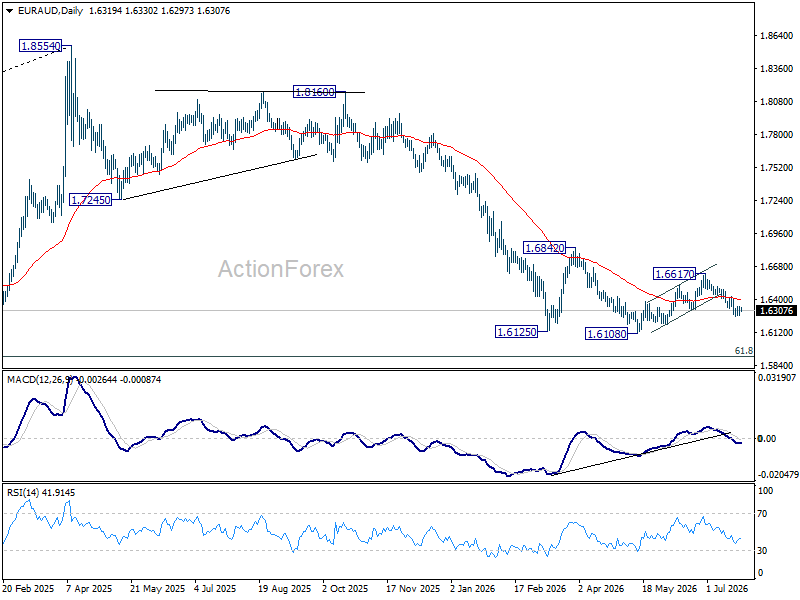
    EUR/AUD Daily Outlook

    Daily Pivots: (S1) 1.6472; (P) 1.6523; (R1) 1.6576; More...

    Intraday bias in EUR/AUD remains neutral for the moment and more consolidations could be seen. On the downside, sustained break of 138.2% projection of 1.8554 to 1.7245 from 1.8160 at 1.6351 will extend larger down trend to 161.8% projection at 1.6042 next. However, considering bullish convergence condition in 4H MACD, firm break of 1.6691 resistance will indicate short term bottoming. Intraday bias will be back on the upside for stronger rebound towards 55 D EMA (now at 1.6962).

    In the bigger picture, fall from 1.8554 medium term top is seen as reversing the whole up trend from 1.4281 (2022 low). Deeper decline should be seen to 61.8% retracement of 1.4281 to 1.8554 at 1.5913, which is slightly below 1.5963 structural support. For now, risk will stay on the downside as long as 1.7245 support turned resistance holds, even in case of strong rebound.

    EUR/CHF Daily Outlook

    Daily Pivots: (S1) 0.8993; (P) 0.9034; (R1) 0.9059; More....

    Intraday bias in EUR/CHF remains on the downside at this point. Firm break of 61.8% projection of 0.9347 to 0.9092 from 0.9149 at 0.8991 will pave the way to 100% projection at 0.8894. On the upside, above 0.9071 resistance will turn intraday bias neutral again first. But outlook will remain bearish as long as 0.9149 resistance holds.

    In the bigger picture, down trend from 0.9928 (2024 high) is still in progress. Next target is 61.8% projection of 1.1149 to 0.9407 from 0.9928 at 0.8851. Outlook will stay bearish as long as 0.9394 resistance holds, in case of rebound.

    Oil Surges as Iran Conflict Deepens

    In focus today

    All focus this morning is on the escalating situation in the Middle East and the impact on energy prices. It is a fluid situation, and investors will monitor the news flow communication as well as any revised policy signals from central banks.

    In the euro area, we will receive the Sentix investor confidence for March. We expect to see a sharp decline in the index due to the war in Iran.

    Overnight, China releases trade data for January and February combined. Especially exports are in focus. We expect to still see solid export growth out of China due to strong competitiveness and robust global manufacturing activity.

    Economic and market news

    What happened over the weekend

    In Iran, the Assembly of Experts has officially elected Mojtaba Khamenei, the late leader's son, as the new supreme leader, consolidating the hold of hardliners over the country. Mojtaba's appointment followed a decisive vote on Sunday, granting him ultimate authority over all state matters, with Iran's armed forces and the Islamic Revolutionary Guard Corps pledging allegiance to the new leader.

    Fighting escalated on day nine of the US-Israeli campaign against Iran, as Israeli forces expanded their bombardment of Iran, striking major oil storage facilities near Tehran. Israeli forces also targeted senior Iranian Quds Force commanders in a drone strike on Beirut on Sunday. Meanwhile, Bahrain reported that an Iranian drone attack had damaged one of its desalination plants, according to Reuters. For a deep dive on recent events, read our Geopolitical Radar Extra: Contagion risk from Middle East is significant, 8 March.

    Oil prices rose sharply as the market opened after the weekend. At the time of writing, Brent crude is up 25% to USD 116/bbl. The increase follows the developments over the weekend in the Middle East, where producers have started to shut down production amid the halt of traffic through the Strait of Hormuz and a large oil depot in Iran was hit. The pace of the price increase and the level of prices are reminiscent of the developments in 2022, when Russia attacked Ukraine. Then US sold strategic reserves to help cap the price increase. It will likely take similar action although, it will not be able to replace all the oil shutdown in in the Middle East. It further raises the pressure on the US to finish the war to cool energy markets. The current situation is unprecedented, and we stress that the oil price may rise further as the war continues. The key point for the oil market and a reversal of prices is still a potential resumption of shipments through the Strait of Hormuz.

    In the US, the February jobs report showed a sharp deterioration in labour market conditions, with nonfarm payrolls declining by 92k (Danske: +70k, cons: +60k). The unemployment rate rose to 4.4% from 4.3% in January. A technical revision to household employment in January also revealed a 1.4 million downward adjustment due to updated population estimates. On a positive note, wage growth surprised to the upside, with average hourly earnings rising 0.4% m/m. Market reaction saw US Treasury yields decline, as the report reinforced expectations for a potential Fed rate cut. Markets have now almost fully priced in a cut by July.

    Separately, President Trump hosted Latin American leaders in Florida to launch a new coalition aimed at combating drug cartels. Leaders from Argentina, Chile, Ecuador and other nations joined the summit where Trump pledged stronger US involvement in the region, including military support if requested by partners.

    Overnight, China released February CPI inflation, showing a surge to 1.3% y/y (1.0% m/m) from 0.2% y/y (0.2% m/m) in January, marking the highest print in over three years and exceeding market expectations of 0.8% y/y. The rise was driven by the Lunar New Year holiday, which boosted domestic travel and consumer spending. Food inflation rebounded sharply to 1.7% y/y from -0.7% y/y, while non-food inflation rose to 1.3% y/y from 0.4% y/y. Core inflation, excluding food and energy, climbed to 1.8% y/y, the strongest since March 2019, indicating broad-based price pressures.

    In the euro area, the third estimate of Q4 2025 GDP confirmed softer growth momentum, with the economy expanding by 0.2% q/q, down from both the earlier estimate of 0.3% and the 0.3% pace recorded in Q3. For the full year 2025, growth reached 1.4%, up from 0.9% in 2024. Meanwhile, compensation per employee grew by 3.7% y/y in Q4, down from 4.0% y/y in Q3, reflecting softer wage growth than we anticipated.

    In Germany, Sunday's state election in Baden-Württemberg was the first test this year for Friedrich Merz and his grand coalition. Home to around 11 million residents and one of Germany's most economically important regions, the state has been governed by the Greens since 2011. The results on Sunday showed that the Greens narrowly defeated Merz's CDU, securing 30.2% of the vote against the CDU's 29.7%. The far-right AfD came in third with 18.8%, confirming its status as Germany's main opposition party.

    In Norway, manufacturing production disappointed with a 0.3% m/m decline in January, which fell short of expectations for a 0.7% increase. Capital goods (energy) supported production, while intermediate goods became a significant drag, and consumer goods remained flat amid monthly volatility.

    Equities: The transmission mechanism from this war to financial markets remains through the oil price. As such, futures are down meaningfully this morning with US and European futures down ~-2%. Asia is hit the worst, with South Korea's Kospi down -6% this morning and the Nikkei 225 down -5%. These are all sizeable moves, but in line with historic events: it is when oil prices have risen dramatically and persistently that the biggest impact on equities has occurred. Hence, our assessment is that market moves have been sound and measured, including today's sell-off. The backside of this is that positioning metrics are far from "oversold", partly as positioning has not moved aggressively underweight risk yet, but adjustment has largely been back towards benchmark levels. Hence, positioning metrics do not yet support a contrarian "buy the dip" strategy. Instead, the oil price will continue to govern the direction of equities. That naturally involves upside risk as well: the oil price spike has only lasted just over a week. If a solution emerges, or negotiations allow oil to flow, oil prices could drop just as quickly, equities should rebound.

    FI and FX: Last week saw a sharp increase in oil and gas prices following the developments in the Middle East. Overnight, oil prices continued to increase with Brent crude up 25% to USD 116/bbl. The overall themes were a stronger USD and CHF, while NOK had a mixed performance amid rising energy prices and a deterioration of risk sentiment. EUR FI sold off following renewed inflationary pressures from the sharp rise in energy prices and by extension short term inflation expectations. During Friday's session, NFP released in the negatives and undershot expectations. The move reversed some of the USD strength and sent US yields slightly lower.

    Crude Oil Hits $120pb

    It’s happening. US crude just hit $120 per barrel at the open before retreating to around $107 by the time I came to my desk, while Brent crude peaked at $113 per barrel before retreating as well. Still, both benchmarks are consolidating above the $100 per barrel mark this morning as hopes for peace waned following the appointment of Khamenei’s son as Iran’s next Supreme Leader – a decision that did not please the US at all.

    The choice suggests that Iran will not back down to the US, and that means a potentially prolonged war in the Middle East – which is home to about 50% of global oil reserves and around 40% of the world’s natural gas reserves. About 20% of the world’s oil and LNG flows through the Strait of Hormuz, which is presently closed, making it one of the most critical energy chokepoints in the global economy.

    US Natural Gas, on the other hand, is up 6%, and the European TTF will likely open the week on a very ugly note.

    China had already ordered its biggest refiners to stop exporting refined products last week. The US will likely be forced to tap its Strategic Petroleum Reserve, but the SPR currently holds around 415 million barrels — barely 60% of capacity and far below the roughly 640 million barrels held just a few years ago. That makes it a short-term buffer, not a durable solution to a prolonged energy shock.

    So what happens next? Oil prices will reach a peak at some point – maybe they already have, maybe there’s more to come – but they are likely to fluctuate at elevated levels for weeks, perhaps months. Eventually – even if the war persists – energy prices will likely come down. But during this period, high energy prices will revive inflation globally and weigh notably on growth.

    The euro area economy, for example, didn’t wait for a new energy crisis to slow in 2025, while things in the US aren’t looking brilliant either. The headline growth number there looks better thanks to massive AI investment, but that doesn’t tell the full story.

    Friday’s US jobs report is the latest example that the US economy isn’t doing that well. Instead of adding jobs, the US economy shed 92K nonfarm jobs in February, 12K manufacturing jobs were lost, and the previous month’s figure was revised down by 69K. The unemployment rate unexpectedly rose to 4.4%, and wage growth accelerated to 3.8%, which was also unexpected.

    Retail sales were stronger than expected – as wealthier Americans continue to spend – but the combination of job losses and stronger wage growth did not reassure investors at a time when inflation expectations are rising alongside energy prices amid escalating tensions in the Middle East. Soon, these pressures will start showing up in consumer prices.

    Hence, the weak jobs report failed to revive dovish Federal Reserve (Fed) expectations. The US 2-year Treasury yield, which best captures Fed expectations, spiked to 3.63% on Friday and is consolidating near that level this morning, while the US 10-year yield climbed to 4.20%.

    Elsewhere, global yields are also pushing higher, as the spike in energy prices raises expectations that central banks may have to tighten policy again to deal with a new energy shock. Asian indices opened the week with deep losses, while US and European futures are pointing to 2–3% declines at the open.

    The US dollar is better bid, and it is pretty much the only traditional safe haven benefiting from strong inflows.

    Even gold is down this morning, unable to attract safety flows despite its reputation as an inflation hedge. Why? Hard to tell. According to a Bloomberg report, the Middle East war may also be disrupting gold flows. Gold stranded in Dubai, they say, is “being sold at a discount as grounded flights make it harder to move the precious metal.”

    If global markets are on fire, it’s because energy is central to inflation dynamics. Energy can account for roughly one-third to one-half of CPI fluctuations, and in periods of market stress the impact can be even greater.

    And it’s not only energy: food prices could also be badly impacted by Middle East trade disruptions.

    More than a century ago, two German scientists developed a process that changed global agriculture forever. Known as the Haber-Bosch process, it produces fertilizer by combining nitrogen from the air with hydrogen. The process relies heavily on natural gas, and the Gulf region handles a large share of global nitrogen fertilizer trade.

    Nitrogen fertilizer is essential to modern agriculture and supports roughly half of global food production. With Gulf countries in conflict and traffic through the Strait of Hormuz near a complete halt, it may only be a matter of time before global food prices start rising sharply, adding further pressure to consumer prices.

    So when the US releases its latest CPI report on Wednesday, investors will keep in mind that whatever the print, next month’s figures will likely be higher. Rising inflation expectations will likely keep Fed doves at bay.

    The Fed will struggle to deliver the two rate cuts that markets had anticipated before the Middle East conflict erupted. And even if it does – because yes, the Fed can cut rates if it wants to – the market may not follow.

    Investors could refuse to “buy” an unjustified rate cut, meaning sovereign yields could keep rising despite lower policy rates, and monetary policy may fail to transmit effectively to markets if perceived as inappropriate.

    Remember the Fed’s jumbo rate cut in September 2024: the US 10-year yield rebounded by about 120bp in the following three months.

    So no, the Fed cannot simply cut rates — and may not be able to cut at all this year if the war extends beyond a few weeks.