Sample Category Title
EUR/JPY Weekly Outlook
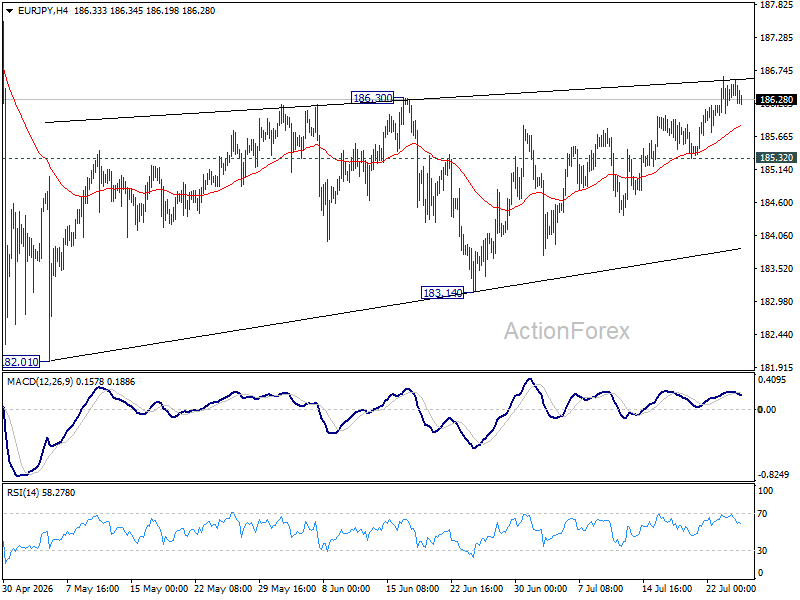
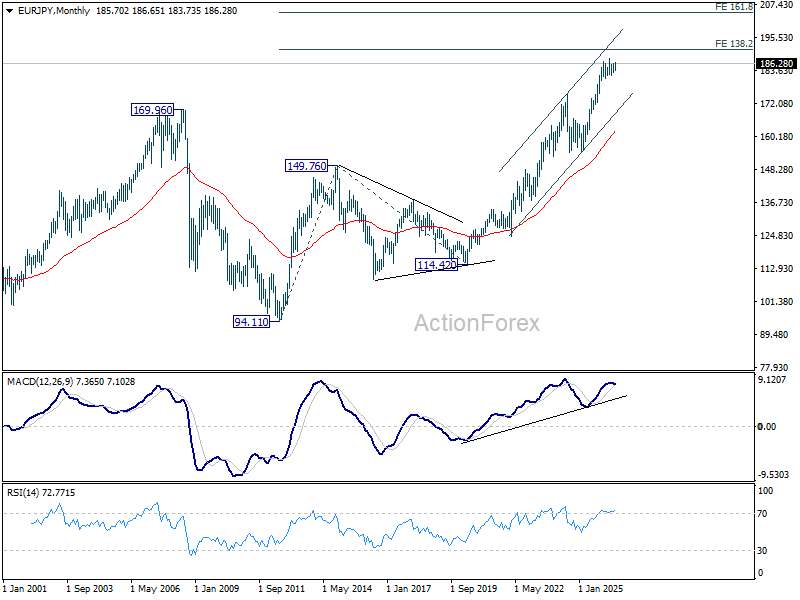
EUR/JPY's rise from 182.10 resumed by breaking 186.30 last week. Initial bias remains mildly on the upside this week for retesting 187.93 high. Nevertheless, since this rebound is viewed as a corrective move, strong resistance should be seen from 187.93 to limit upside. On the downside, below 185.32 support will turn intraday bias neutral first.
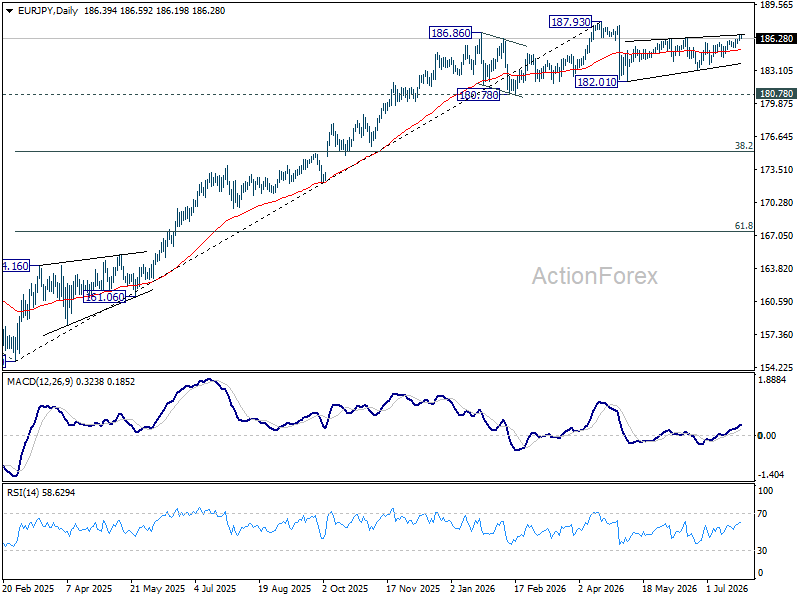
In the bigger picture, uptrend from 114.42 (2020 low) is still expected to resume at a later stage to 78.6% projection of 124.37 (2022 low) to 175.41 (2025 high) from 154.77 at 194.88. However, sustained break of 55 W EMA (now at 180.17) will argue that it's already in a medium term down trend to 175.41 resistance turned support and below.
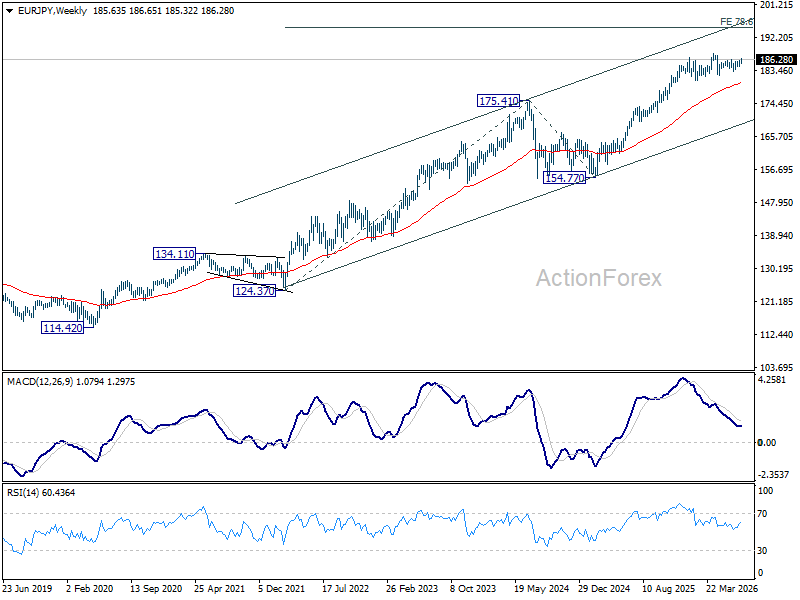
In the long term picture, up trend from 94.11 (2021 low) is in progress. Next target is 138.2% projection of 94.11 to 149.76 (2014 high) from 114.42 (2020 low) at 191.32. This will remain the favored case as long 55 W EMA holds.
EUR/GBP Weekly Outlook
EUR/GBP's extended rebound indicates short term bottoming at 0.8453. Initial bias stays mildly on the upside for 55 D EMA (now at 0.8589) and possibly above. But strong resistance should be seen from 0.8610 to limit upside. On the downside, below 0.8513 minor support will bring retest of 0.8453 low instead.
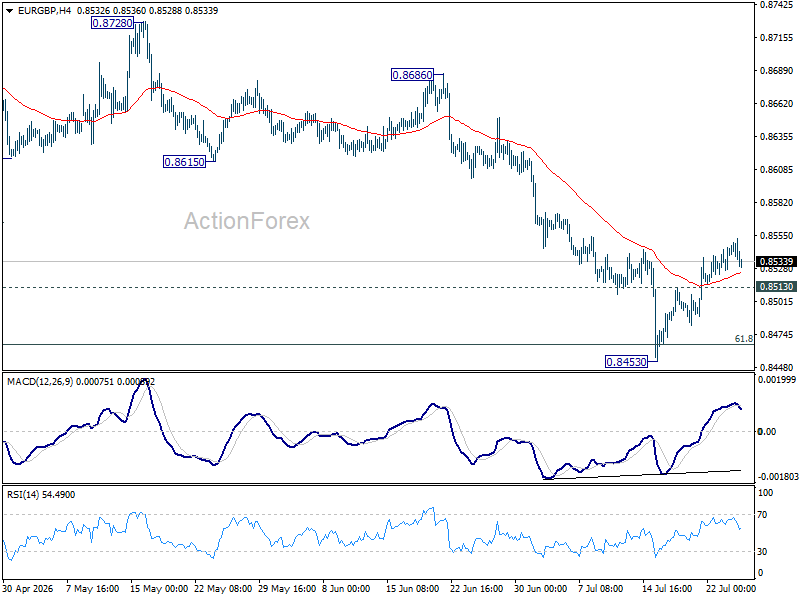
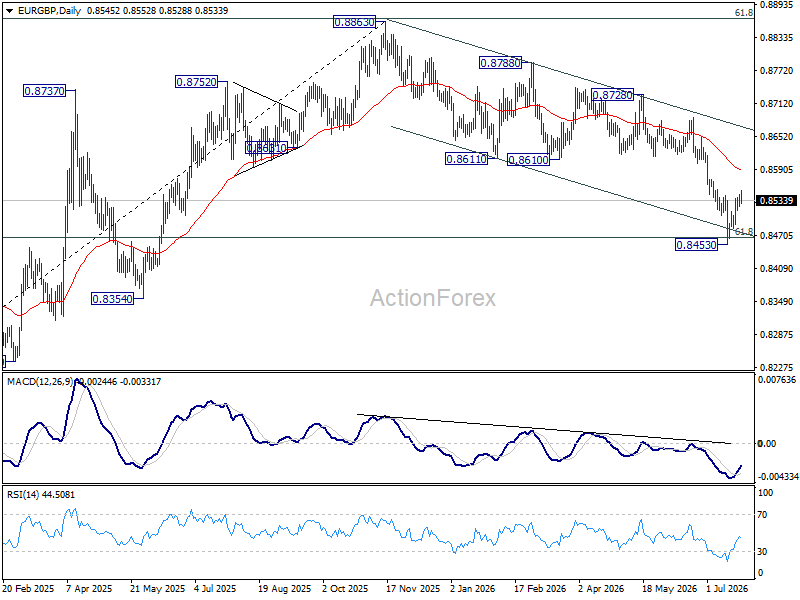
In the bigger picture, rise from 0.8221 (2024 low) should have completed at 0.8863, just ahead of 38.2% retracement of 0.9267 (2025 high) to 0.8221 at 0.8867. Deeper fall would be seen back to 0.8221. For now, outlook will be neutral at best as long as 0.8610 support turned resistance hold.
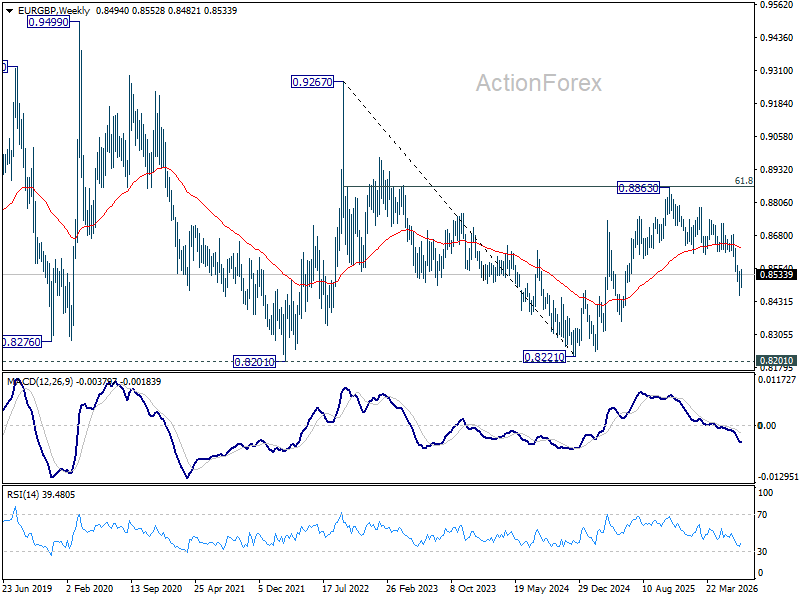
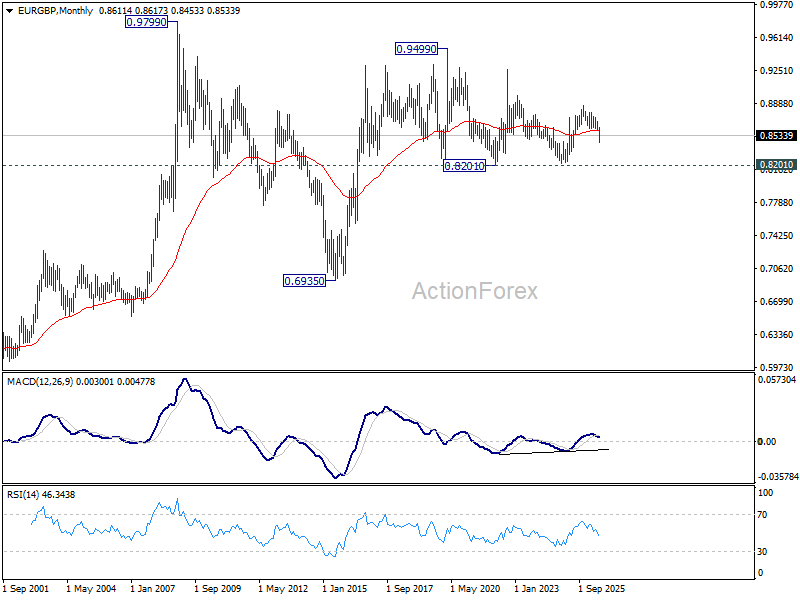
In the long term picture, price action from 0.9499 (2020 high) is seen as part of the long term range pattern from 0.9799 (2008 high). Range trading should continue between 0.8201 and 0.9499, until there is clear signal of imminent breakout.
EUR/AUD Weekly Outlook
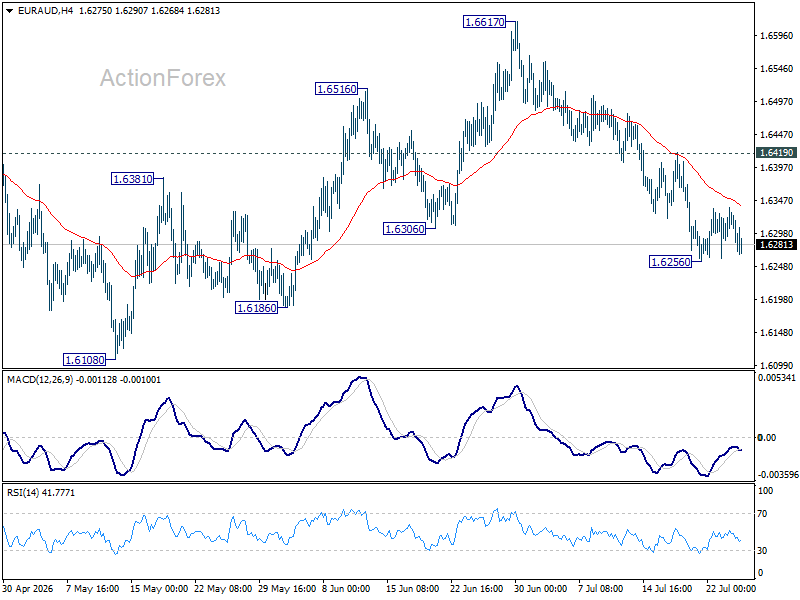
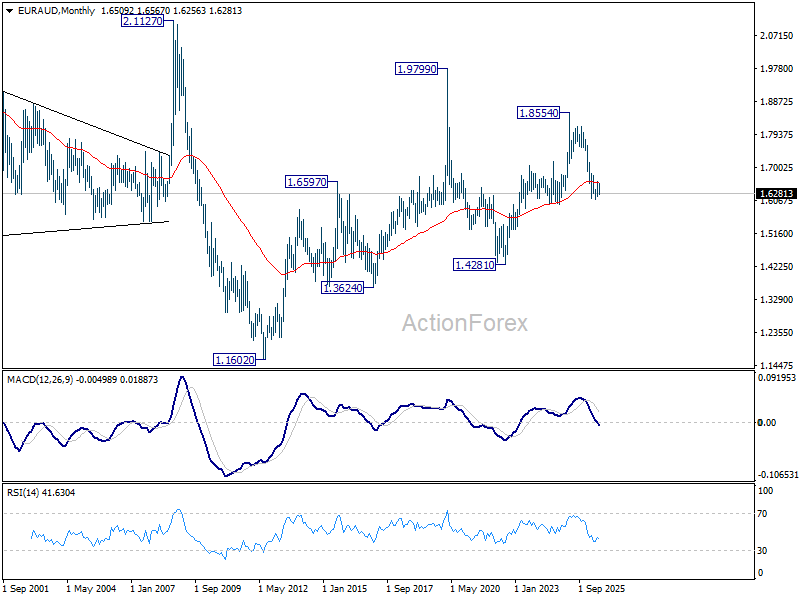
EUR/AUD's extended fall last week suggests that rebound from 1.6108 has completed at 1.6617 already. But as a temporary low was formed at 1.6256, initial bias remains neutral this week first. Further decline is expected as long as 1.6419 resistance holds. Below 1.6256 will target 1.6108 low. Firm break there will resume larger down trend.
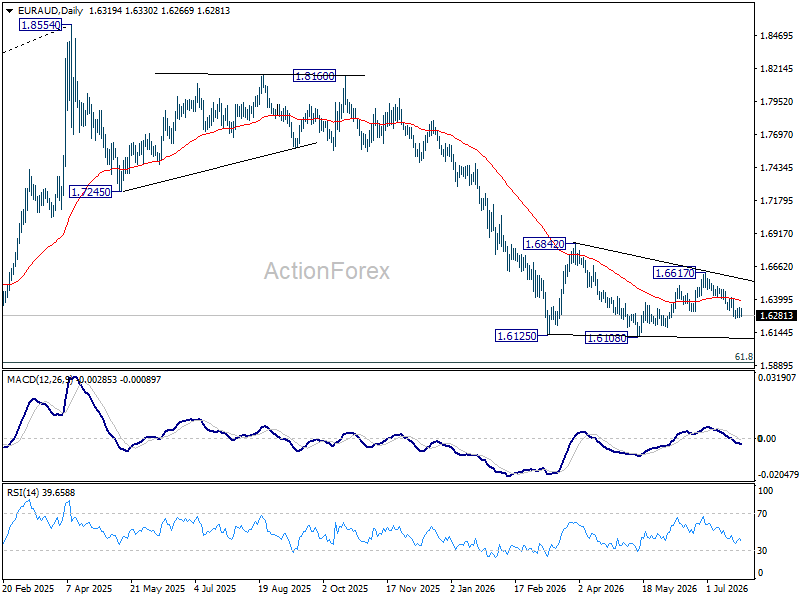
In the bigger picture, outlook will stay bearish as long as 1.6842 resistance holds. Fall from 1.8554 (2025 high) is expected to continue to 61.8% retracement of 1.4281 to 1.8554 at 1.5913. Decisive break there will pave the way back to 1.4281 (2022 low). However, firm break of 1.6842 should confirm medium term bottoming, and bring stronger rally.
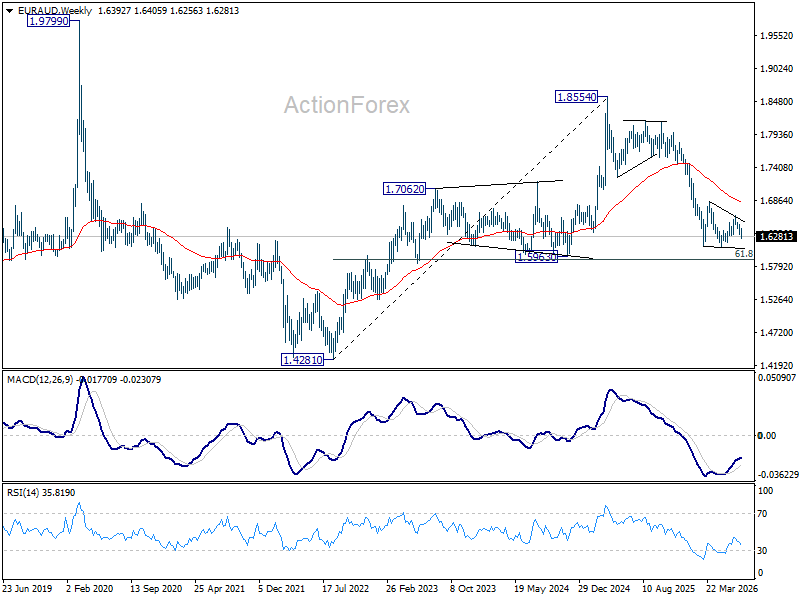
In the longer term picture, fall from 1.8554 is seen as the third leg of the pattern from 1.9799 (2020 high), which is part of the pattern from 2.1127 (2008 high). Sustained trading below 55 M EMA (now at 1.6577) will confirm this bearish case, and pave the way back towards 1.4281.
EUR/CHF Weekly Outlook
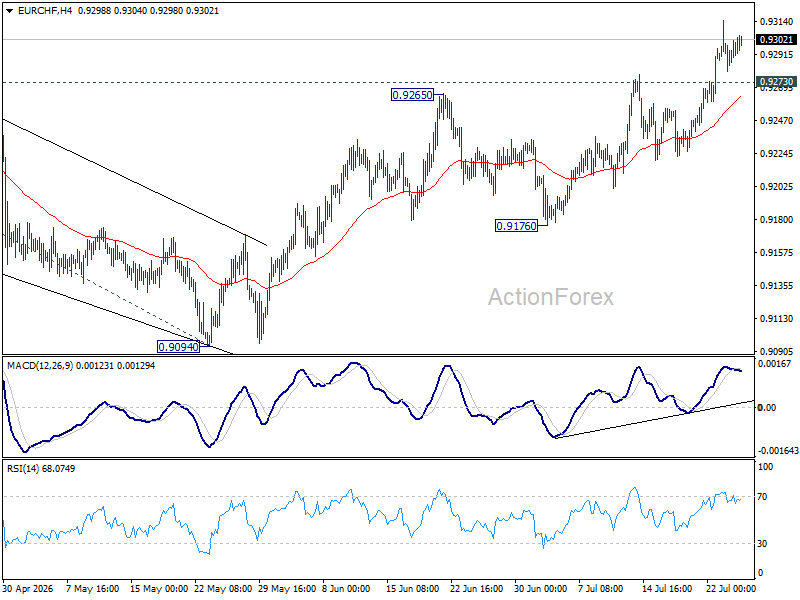
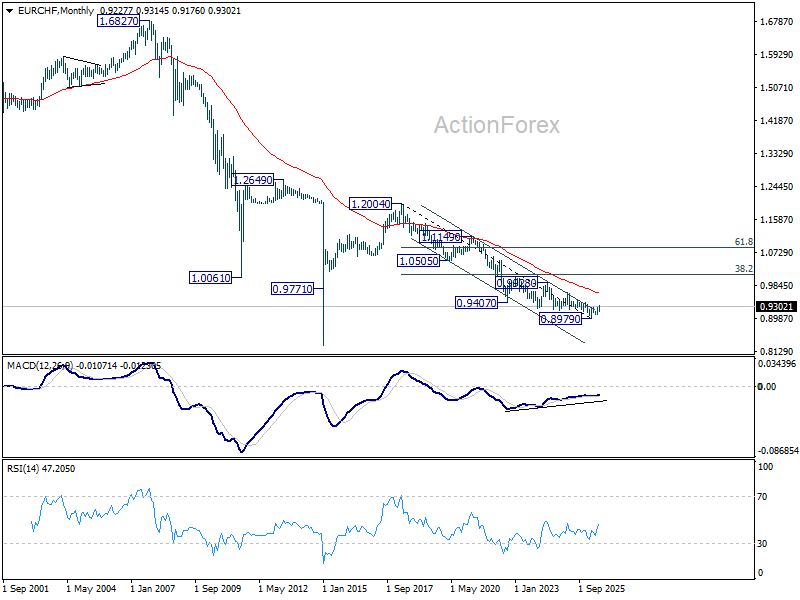
EUR/JPY's rally from 0.8979 continued last week and there is no clear sign of topping. Initial bias stays on the upside for 100% projection of 0.8979 to 0.9264 from 0.9094 at 0.9379. On the downside, below 0.9273 minor support will turn bias neutral and bring consolidations. But outlook will remain bullish as long as 55 D EMA (now at 0.9214) holds, in case of retreat.
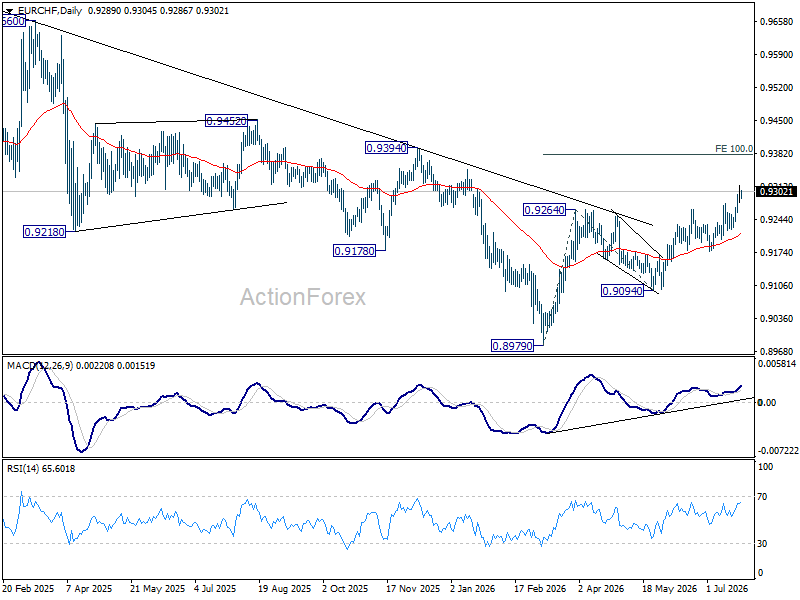
In the bigger picture, the break of medium term falling trend line resistance indicates that 0.8979 is already a medium term bottom. Considering bullish convergence condition in W MACD, rise from there should at least be reversing the fall from 0.9928, with prospect of developing into a medium term up trend. Firm break of 0.9394 resistance will add more credence to this case. For now risk will remain on the upside as long as 0.9094 support holds, in case of retreat.
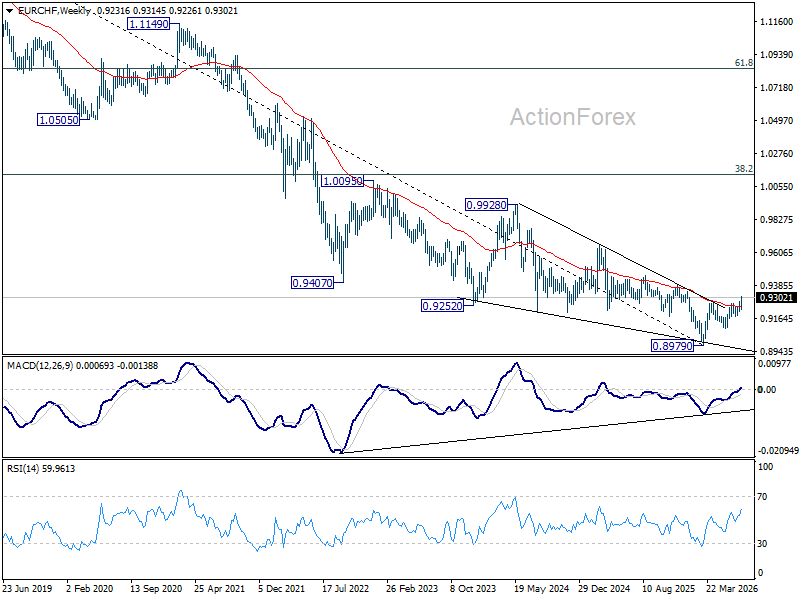
In the long term picture, outlook will stay bearish as long as 0.9407 support turned resistance (2022 low) holds. However, firm break of 0.9407 will argue that the down trend from 1.2004 (2018 high) has completed with five waves down to 0.8979. Stronger rebound should then be seen to 38.2% retracement of 1.2004 to 0.8979 at 1.0135 in the medium term.
The Weekly Bottom Line: Cooler Inflation Quiets Calls for a July Hike
Our summary of recent economic events and what to expect in the weeks ahead.
Canadian Highlights
- The Bank of Canada left rates unchanged at 2.25% but struck a more constructive tone on the near-term economic outlook, projecting a sharp rebound in Q2 growth.
- Inflation remains the key source of uncertainty, though the removal of references to potential "consecutive" rate hikes suggests policymakers are growing more comfortable that energy-led price pressures are not spreading broadly.
- This week's data broadly supported the Bank's outlook, with strength in manufacturing, wholesale trade, and home sales pointing to an economy that is gradually regaining traction.
U.S. Highlights
- Tensions in the Middle East continued to escalate this week, pushing WTI prices back above $80 per-barrel.
- Inflation pressures cooled more than expected in June. Though the recent U-turn in oil prices raises concerns over the durability of the disinflationary dynamics.
- Retail sales remained decently strong in June, suggesting consumer spending regained some momentum in Q2 after stalling in Q1.
Canada – The Rebound Gains Credibility
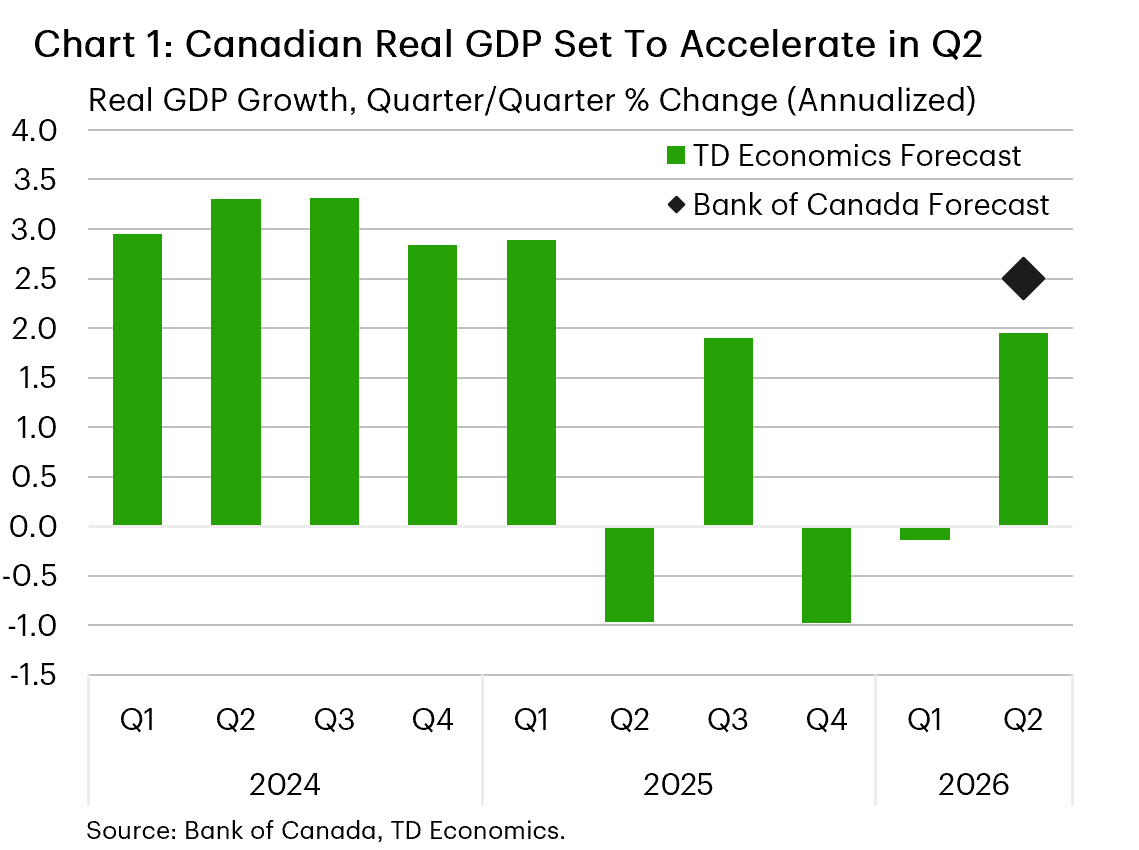
The Bank of Canada interest rate decision was the main event this week, but the decision itself wasn't the main story. Indeed, the Bank left the overnight rate unchanged at 2.25% for a sixth consecutive meeting, which was universally expected by markets. The more notable development came in the Bank's updated economic outlook, which struck a somewhat more constructive tone on the economy and suggested that the soft patch weighing on growth may be starting to ease.
Following back-to-back quarters of no growth, the Bank now projects GDP to rebound at a 2.5% annualized pace in Q2, supported by stronger exports, resilient consumer spending, and tentative signs of stabilization in housing markets (Chart 1). To be sure, excess supply remains and labour market conditions are still described as soft. Though the overall growth outlook remains unchanged, recent data have increased policymakers' confidence that the economy is moving off the bottom rather than slipping further into weakness.
The economy may be showing more signs of life, but the Bank's policy stance remains firmly in wait-and-see mode. Inflation remains the key source of uncertainty, with headline CPI still running above 3% due largely to higher energy costs stemming from the conflict in the Middle East. The Bank continues to expect inflation to moderate over the coming quarters, though higher crude prices since the forecast cut-off date add a modest upside risk. With next week's CPI release we will be watching closely for signs that headline inflation is peaking, and that energy-related price pressures are beginning to fade.
All told, it appears policymakers are becoming somewhat more comfortable with the inflation backdrop. In its recent statement, the Bank dropped its previous reference to the possibility of "consecutive" rate hikes if inflation pressures broadened, reflecting confidence that higher energy costs have yet to meaningfully spill into underlying inflation. Financial markets took that as confirmation that the Bank remains firmly on hold. Bond yields were little changed, the Canadian dollar gained a cent on the U.S. dollar, and market pricing continues to imply low odds of a policy move by the end of the year. Recall, at the onset of the U.S.-Iran conflict, markets priced in as many as three quarter-point rate hikes by December.
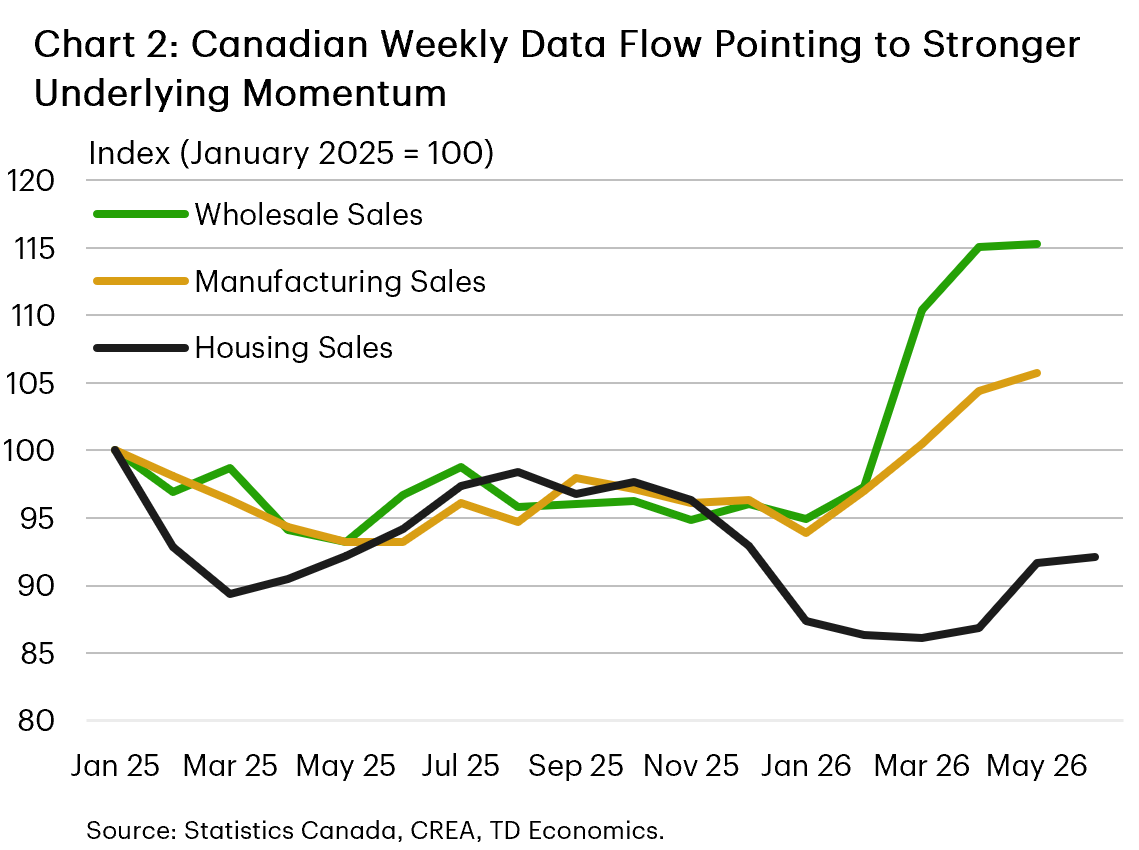
This week's economic data broadly backed up the Bank's assessment. Manufacturing sales rose for a fourth consecutive month by 1.3% m/m in May, reaching a record high and wholesale activity remained elevated following several months of gains (Chart 2). Home sales increased for a third consecutive month in June, although housing starts were somewhat softer, suggesting the recovery remains uneven across sectors. Still, the broader signal from this week's releases is one of an economy that is gradually regaining traction after a difficult start to the year.
Marc Ercolao, Economist
U.S. – Cooler Inflation Quiets Calls for a July Hike
Despite a relatively busy week on the economic data calendar, market attention remained focused on renewed tensions in the Middle East. Earlier in the week, Iranian forces attacked multiple oil vessels transiting the Strait of Hormuz, prompting the U.S. to resume strikes on various military targets across Iran and reimpose its naval blockade. Tanker traffic through the vital passageway has again come to a halt, pushing WTI prices back above $80 per barrel.
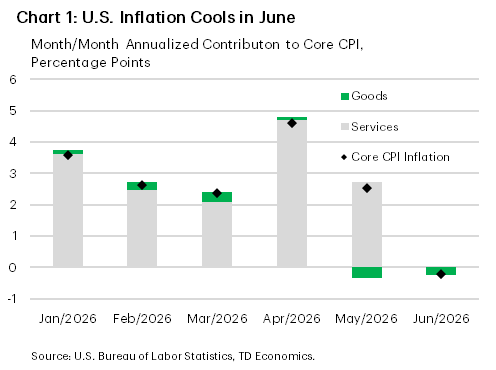
The renewed upward pressure on oil prices helped to temper the market response to an otherwise very encouraging inflation report. Headline CPI declined by 0.4% m/m in June – its first pullback since June 2024 and largest since April 2020 – pushing the 12-month change down to 3.5%. A sharp drop in gasoline prices was largely responsible for last month's decline, though even after removing these effects there were plenty of positive developments. Core inflation was flat for the month, as both goods and services were little changed (Chart 1). Importantly, many of the categories where tariffs had been adding to price pressures over the past year, including appliances, medical goods and apparel were all lower on the month – suggesting the worst of the tariff passthrough is now in the rearview mirror. Also encouraging was the fact that there was little evidence of higher energy prices bleeding into core inflation.
The disinflationary dynamics were further reinforced by a soft producer price index reading, which helped to remove speculation of a Fed rate hike later this month. That said, Fed futures are still priced for a little more than one rate hike by year-end, as the U-turn in oil prices is already raising concerns on the durability of the disinflationary dynamics.
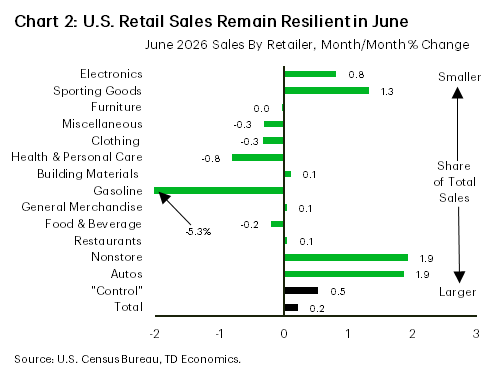
Retail sales for the month of June provided further confirmation that households continue to shrug off the effects of higher energy prices (Chart 2). While the headline figure posted only a modest gain, that was partly related to a sharp drop in nominal sales at gasoline stations – owing to price effects. Focusing on the control group, which removes volatile categories, it showed a much healthier gain in spending while revisions to the prior month were a bit higher. This reinforces the view that consumer spending regained some momentum in Q2, after sputtering in Q1. However, the spend dynamics remain K-shaped, with lower-and-middle income consumers increasingly price sensitive and hesitant to spend on discretionary items – something that was highlighted in this week's Fed Beige Book.
Anyone hoping that Fed Chair Warsh would relent and provide some forward guidance during his first Congressional testimony this week was sorely disappointed. Instead, Warsh restated the Committee's unwavering commitment to return price stability, but provided no hints on the Fed's next move. Several other policymakers spoke this week and perhaps the biggest takeaway is that while all were encouraged by last month's softer inflation figures, one data point does not make a trend. Several more months of easing inflation will be required to convince officials that price pressures are moving in the right direction. If this were to occur, expectations for rate hikes should fade, leading to some downward pressure on yields.
Economics Week Ahead
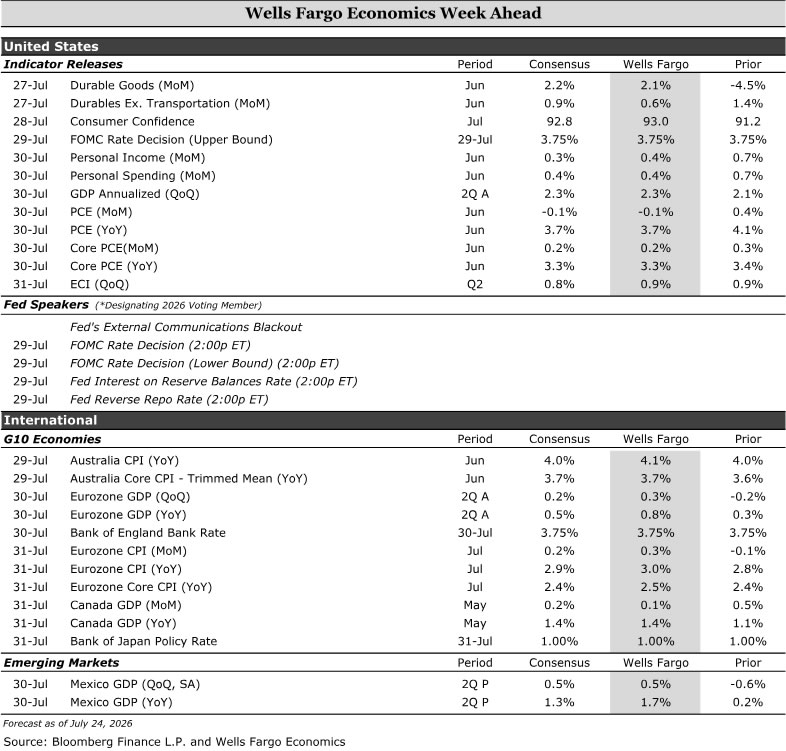
With Warsh's second FOMC meeting approaching, we expect the Fed to remain on hold while maintaining a modest tightening bias. Next week's PCE report will either reinforce or challenge that view, though we continue to expect slightly cooler inflation. We also expect Q2 GDP growth to moderate from Q1, despite continued economic resilience.
In Australia, we expect inflationary pressures to remain elevated. Over in the U.K., we expect the BoE to leave rates unchanged. Likewise, we expect the BoJ to keep policy unchanged as it continues its gradual normalization process. In Canada, we expect GDP growth to expand modestly. In the Eurozone, we expect firmer GDP growth and inflation. In emerging markets, Mexico's GDP growth is expected to rebound, but not meaningfully accelerate.
- United States: FOMC (Wednesday), Personal Income & Spending (Thursday), Q2 GDP (Thursday)
- G10 Economies: Australia CPI (Wednesday), Bank of England (Thursday), Bank of Japan (Friday), Canada GDP (Friday), Eurozone GDP & CPI (Friday)
- Emerging Markets: Mexico GDP (Thursday)
U.S. Week Ahead
FOMC • Wednesday
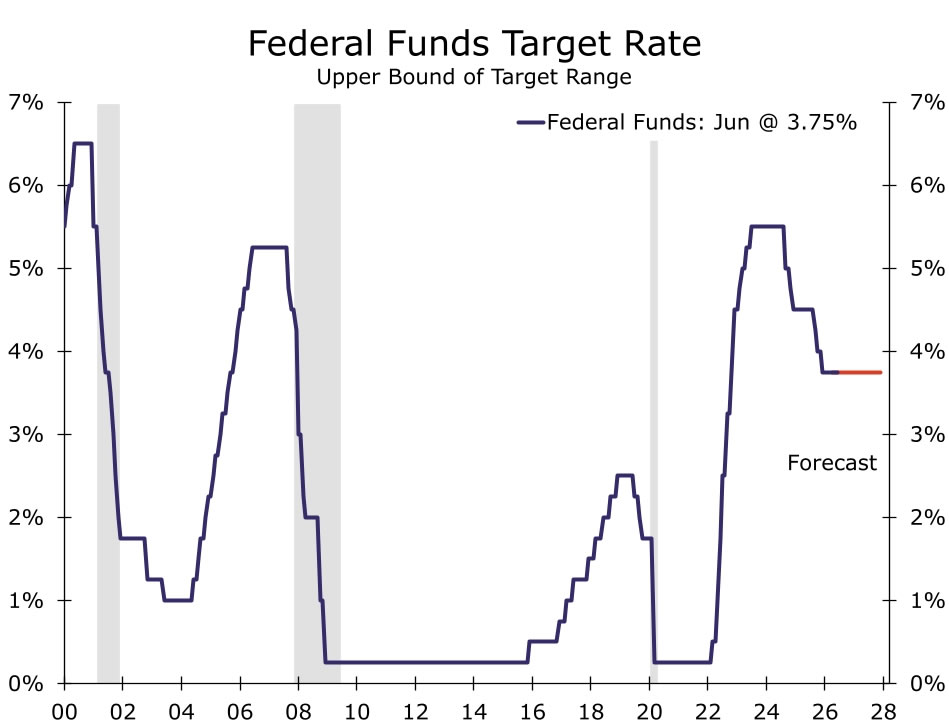
We expect Kevin Warsh's second meeting as FOMC Chair to be a punt to September as the Committee awaits more data that either confirm or dispel their hawkish leanings. Since the last FOMC meeting, both employment and inflation have come in cooler than expected, and these factors should tilt the scales toward a policy rate hold. But, it is clear from recent Fed communications that the bar to hike rates is low, and the recent jump in oil prices is once again threatening to drive inflation higher in the months ahead. At least two hawkish dissents are probable, most likely from Dallas Fed President Lorie Logan and Cleveland Fed President Beth Hammack.
There will be no updated SEP at this meeting, and with Chair Warsh generally adopting a "less is more" mindset to Fed communications, we would be surprised if the shortened statement or press conference yielded any big reveals. We expect Chair Warsh will use the press conference to buy the Committee time ahead of its next meeting on September 16. He likely will note that policy is in a good place to await additional information and that the Committee will deliver on its inflation target. We expect he will point to the ongoing work of the task forces when asked about balance sheet policy, Committee communications, and the outlook for inflation.
Source: Federal Reserve Board and Wells Fargo Economics
We will be listening closely for any hints about where the median of the Committee's views lie as it relates to what would trigger rate hikes, especially as it relates to the next few inflation reports. Our base case forecast remains that the FOMC will keep the fed funds rate on hold for the foreseeable future as core inflation gradually slows in the months ahead.
Personal Income & Spending • Thursday
June figures for personal income and spending become available the very day after the FOMC meeting. Financial markets will be dialed in to the latest inflation data delivered with that report, specifically the core PCE numbers. Despite the relatively benign inflation reading in the June CPI and PPI data, we are forecasting a monthly gain of 0.2% in core PCE which would translate to a year-over-year core inflation reading of 3.3%, only slightly cooler than the 3.4% print in May. At the moment inflation is concentrated in a handful of categories. For example, the AI build-out has whetted the appetites of hyperscalers and tech firms for all the needed tech inputs. Demand for these computer software & accessories has given a predictable lift to prices for them. The fact that this category has a larger weight in the PCE than in the CPI helps explain our expectation for only a modest cooling in core inflation.
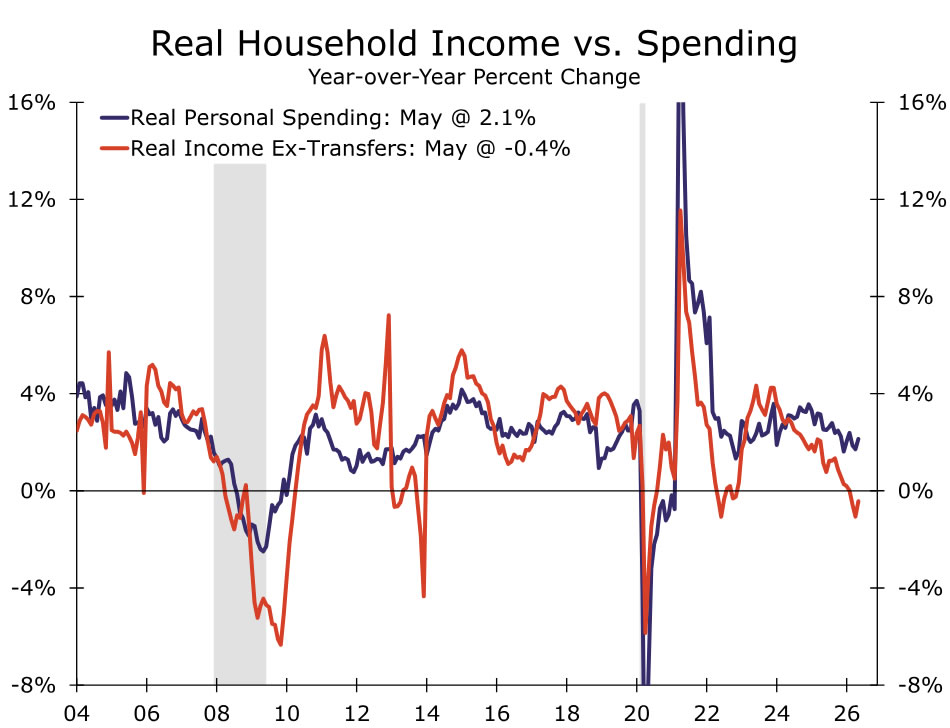
A solid June retail sales report points to a decent month for goods spending and upward revisions to May data. A key question will be whether households can afford to keep splashing out. Real disposable income growth has been under pressure and the saving rate has dipped to multi-year lows. The composition of income growth and any changes in the saving rate will offer some fresh perspective on how long the consumer can keep spending in the face of higher energy prices, especially now that tax refunds and the extra cash they provided have largely run their course.
Source: U.S. Department of Commerce and Wells Fargo Economics
Q2 GDP • Thursday
Alongside Thursday's personal income & spending report, we'll get the first comprehensive look at Q2 GDP, which we expect to show the U.S. economy expanded at a 1.8% annualized pace. As in Q1, growth was likely driven by robust business investment, with the AI buildout supporting a double-digit gain in equipment spending. Because much of that investment has been imported, however, we expect a sizable drag from net exports to offset some of this strength. Consumer spending also appears to have firmed, with growth likely exceeding a 2% annualized rate as larger-than-usual tax refunds largely offset higher gasoline prices. While the report should reinforce the economy's resilience, we doubt growth will accelerate in the second half of the year given a softer labor market, weak real income growth and a saving rate that remains near historic lows.
G10 Week Ahead
Australia CPI • Wednesday
Australia's June CPI and Q2 inflation releases are due next week and will be critical for the Reserve Bank of Australia's (RBA) August policy decision. We expect headline inflation to rise to 4.1% year-over-year in June, while quarterly trimmed mean inflation comes in at 0.9% quarter-over-quarter, lifting the annual rate to 3.7%. Lower petrol and diesel prices should provide some relief in June, although higher fuel costs earlier in the quarter linked to the initial escalation of the Middle East conflict are still likely to be reflected in the Q2 data.
Underlying inflation pressures also remain elevated. Recent PMI surveys suggest strong demand is allowing service providers to become more aggressive in their pricing, raising the risk that inflation remains higher for longer. The inflation data will be released against a backdrop of resilient growth and a still-tight labor market, which leaves policymakers focused on whether progress toward the inflation target is slowing.
While a softer-than-expected inflation print could support another hold in August, the recent re-escalation of hostilities in the Middle East keeps upside inflation risks front of mind for the RBA. As such, we continue to expect a 25 bps rate hike in Q3. August remains our base case, though a softer inflation outcome could delay the move to September. Either way, we continue to expect the RBA to raise the Cash Rate to a terminal rate of 4.60%, which would mark its fourth hike this year.
Source: Bloomberg Finance L.P. and Wells Fargo Economics
Bank of England Monetary Policy Meeting • Thursday
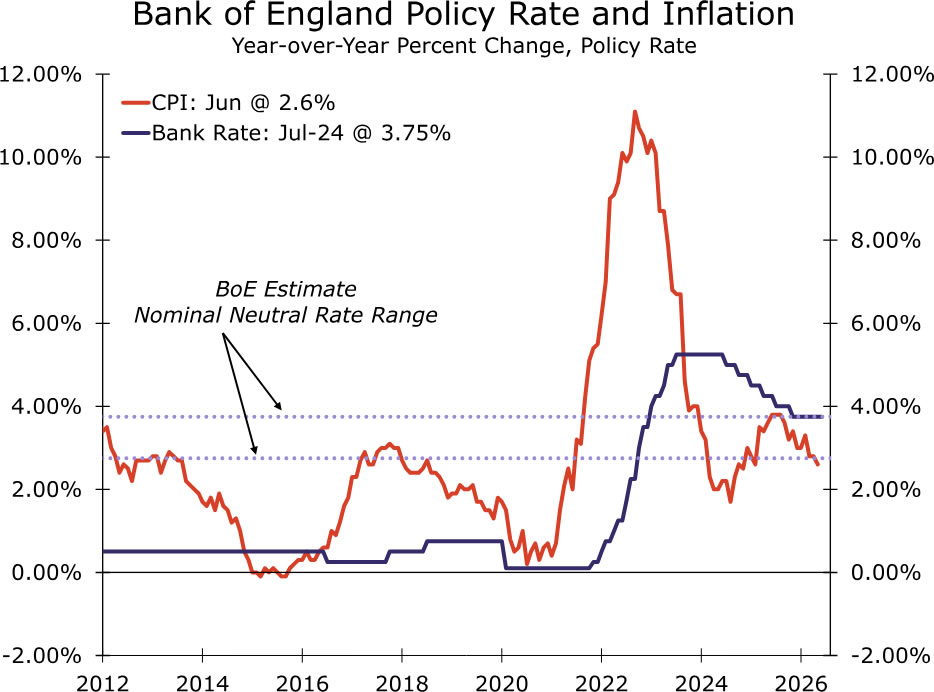
When Bank of England (BoE) policymakers meet next week, we expect the Bank Rate to remain unchanged at 3.75%. The June meeting revealed a more hawkish Committee than the headline 7-2 hold suggested. Catherine Mann, despite voting to hold, joined dissenters' view of upside inflation risks as the more prominent threat.
The data nevertheless give the majority room to wait. June CPI slowed to 2.6% year-over-year from 2.8%, while services inflation eased to 3.6% and core inflation held at 2.6%. At the same time, the labor market continues to soften, with unemployment at 4.9% and private-sector regular pay growth slowing to 2.9%. While the 13.5% increase in the Ofgem energy price cap is likely to push headline inflation higher and household inflation expectations remain elevated at 4.0%, there is little evidence yet that those pressures are passing through more broadly.
We therefore expect the BoE to hold next week while preserving a tightening bias. We look for the Monetary Policy Report to revise near-term inflation higher and growth lower. We continue to expect a 25 bps hike in Q4, though risks remain tilted toward an extended hold should growth weaken further, or labor market conditions soften more quickly than expected.
Source: Bank of England, Bloomberg Finance L.P. and Wells Fargo Economics
Bank of Japan Monetary Policy Meeting • Friday
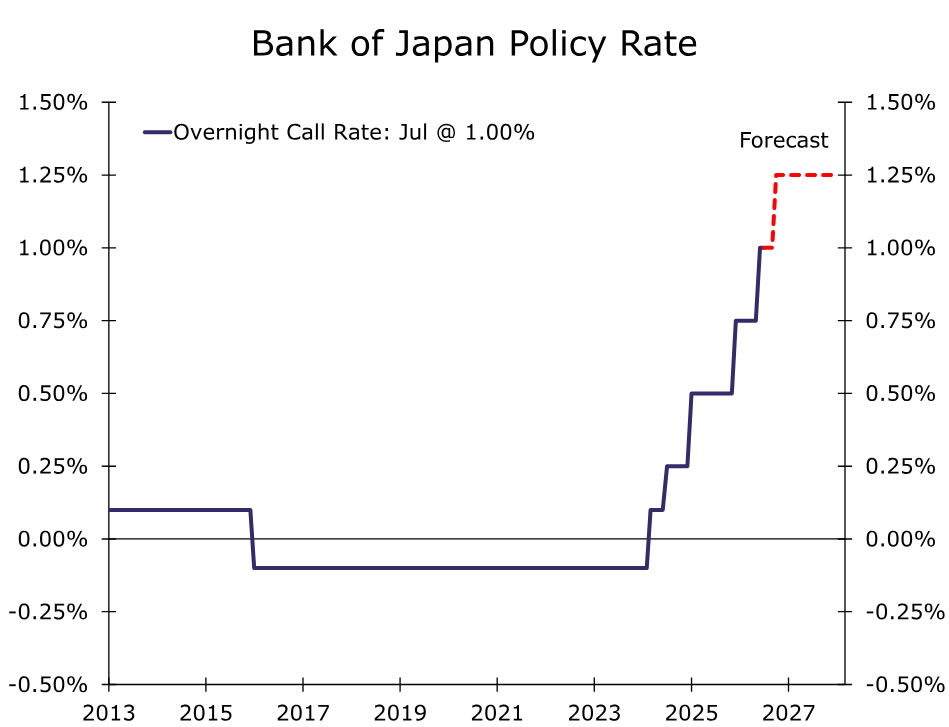
At its July meeting, we expect the Bank of Japan (BoJ) to keep its policy rate unchanged at 1.00%. Although headline CPI rose to 1.7% in June from 1.5% in May, core-core inflation eased to 1.7% from 1.8%, reflecting higher energy costs rather than a broadening in underlying inflation. Renewed conflict in the Middle East has increased the risk of higher energy prices and import costs in the coming months. Japan's PPI has already risen sharply, driven largely by energy and import-price pressures. Further cost pass-through by firms could generate second round effects and broaden consumer inflation beyond energy, keeping the BoJ's tightening bias intact. However, this would be less favorable cost-push inflation rather than the wage- and demand-driven inflation the central bank wants to see.
The renewed energy shock also brings back downside risks to Japan's economic activity. While Japan's economy has improved in recent quarters, growth remains moderate, and higher import costs could squeeze household purchasing power and firm margins. Resilient PMI and Tankan readings, alongside continued support from AI-related demand and investment, suggest the economy retains some momentum. However, a prolonged conflict could weigh on domestic demand and slow progress toward a self-sustaining wage-price cycle.
Against this uncertain backdrop, we expect the BoJ to remain on hold in July while maintaining a tightening bias. We continue to expect a 25 bps increase in Q4, most likely in October, bringing the policy rate to 1.25% year-end.
Source: Bloomberg Finance L.P. and Wells Fargo Economics
Canada GDP • Friday
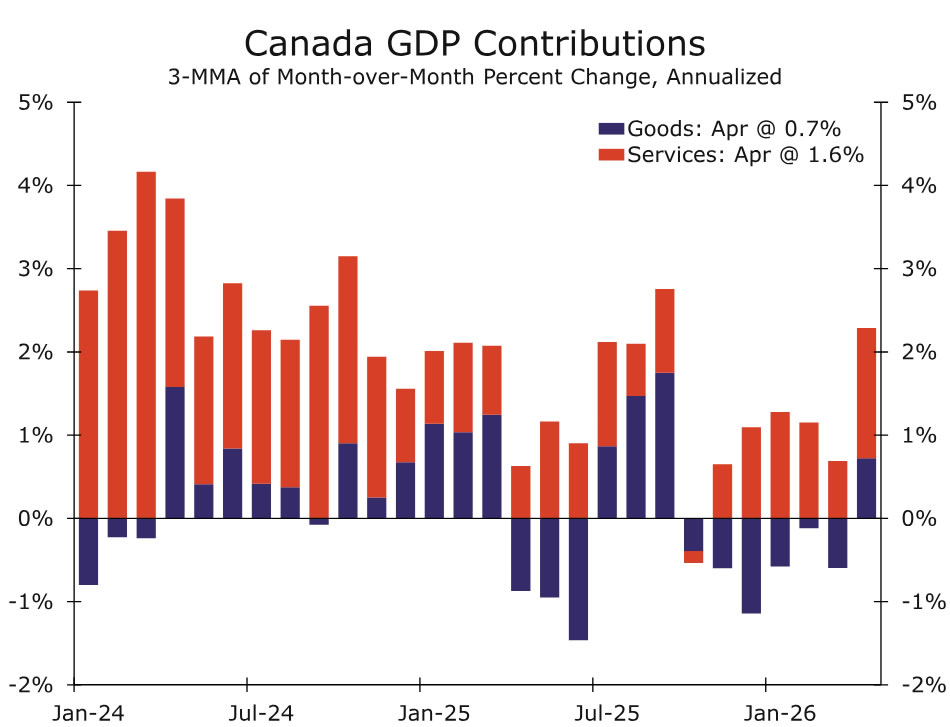
We expect Canadian GDP to rise 0.1% month-over-month in May, matching Statistics Canada's advance estimate, following an outsized gain in April. While some payback is likely after the previous month's strength, incoming data continue to point to an economy that is expanding modestly rather than slipping toward recession.
Purchasing manager indices remained on firmer footing through May across both manufacturing and services, suggesting activity held up despite ongoing geopolitical uncertainty. Growth was likely led by service-producing industries, with gains in finance & insurance and real estate offsetting weakness in wholesale trade and agriculture.
Taken together, the monthly data point to a rebound in activity in Q2 after a soft patch over the past year. A firmer growth backdrop should continue to alleviate recession concerns and reinforces our expectation that the Bank of Canada will remain on hold for the foreseeable future. That said, downside risks remain, particularly surrounding the evolution of the U.S.-Iran conflict and the path of USMCA negotiations.
Source: Haver Analytics and Wells Fargo Economics
Eurozone GDP & CPI • Friday
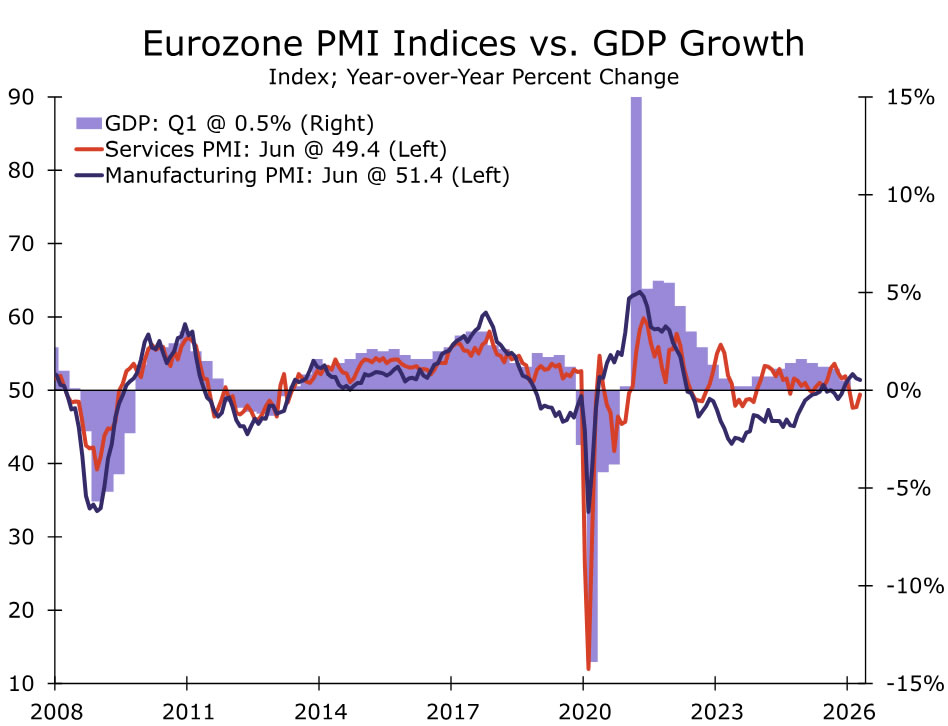
Next week's Eurozone GDP and CPI releases will provide important insight into the European Central Bank's (ECB) policy outlook. We expect Q2 GDP growth to improve to 0.3% quarter-over-quarter from 0% in Q1, lifting annual growth to 0.8% year-over-year. Recent indicators point to firmer activity through the second quarter, though renewed tensions in the Middle East remain a headwind and raise questions about whether growth can maintain its recent resilience.
On inflation, we expect July headline CPI to rise to 3.0% year-over-year from 2.8% in June, while core inflation edges up to 2.5% from 2.4%. Although underlying inflation has remained relatively contained, higher energy prices continue to work their way through the economy. Firms continue to face higher input costs and are increasingly looking to pass those costs on through higher selling prices, leaving policymakers focused on whether broader price pressures begin to emerge.
While limited second-round effects and weaker-than-expected growth could strengthen the case for an extended hold, continued volatility in energy markets and ongoing disruptions in the Middle East keep upside inflation risks in focus. As such, we continue to expect the ECB to deliver one additional 25 bps rate hike in September, bringing the Deposit Rate to 2.50% by year-end.
Source: Bloomberg Finance L.P. and Wells Fargo Economics
EM Week Ahead
Mexico GDP • Thursday
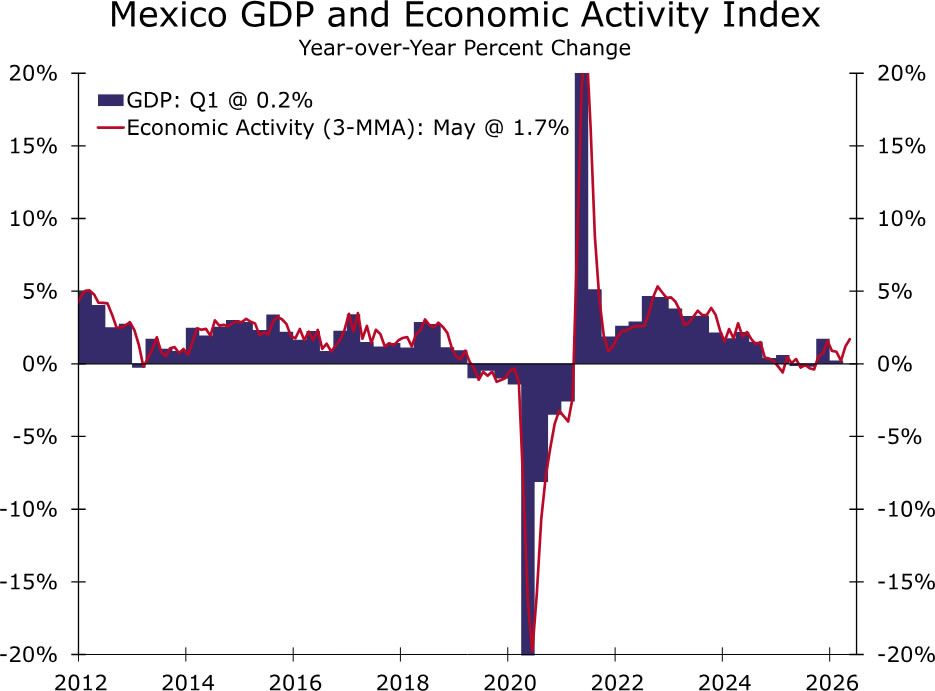
Next week's GDP release will show whether Mexico's economy stabilized in Q2 following a weak start to the year. We expect growth to rebound to 0.5% quarter-over-quarter and 1.7% year-over-year in Q2 after real GDP contracted 0.6% in Q1 and annual growth slowed to 0.2%.
Recent indicators point to some stabilization, but not a meaningful acceleration. Mexico's economic activity, a monthly proxy for GDP, grew 1.1% from a year earlier, slowing from the prior month. Services remained the main source of growth, while industrial activity stayed weak. Retail sales momentum has moderated following an earlier rebound, and modest remittance growth should provide only limited support to household spending. Alongside continued weakness in fixed investment, domestic demand will likely remain subdued in Q2.
Manufacturing conditions are still mixed. The S&P manufacturing PMI moved into expansion in June, but any improvement in factory activity remains tentative. Looking ahead, uncertainty surrounding the USMCA review, together with our expectation that the nearshoring impulse will gradually fade, could constrain investment and limit the scope for a sustained manufacturing recovery.
We continue to expect Banxico to hold its policy rate at 6.50% through 2027. A firmer GDP reading would reinforce the case for remaining comfortably on hold, while another contraction, particularly alongside the recent moderation in inflation, could revive expectations for additional easing.
Source: Bloomberg Finance L.P. and Wells Fargo Economics
Summary 7/27 – 7/31
Monday, Jul 27, 2026
| GMT | Ccy | Events | Cons | Prev |
|---|---|---|---|---|
| 23:50 | JPY | Corporate Service Price Index Y/Y Jun | 3.40% | 3.30% |
| 08:00 | EUR | Germany IFO Business Climate Jul | 86.1 | 85.6 |
| 08:00 | EUR | Germany IFO Current Assessment Jul | 87 | |
| 08:00 | EUR | Germany IFO Expectations Jul | 84.1 | |
| 08:00 | EUR | Eurozone M3 Money Supply Y/Y Jun | 3.20% | 3.20% |
| 12:30 | USD | Durable Goods Orders Jun | 1.60% | -4.50% |
| 12:30 | USD | Durable Goods Orders ex Transport Jun | 0.90% | 1.40% |
| 23:50 | JPY |
| Corporate Service Price Index Y/Y Jun | |
| Consensus | 3.40% |
| Previous | 3.30% |
| 08:00 | EUR |
| Germany IFO Business Climate Jul | |
| Consensus | 86.1 |
| Previous | 85.6 |
| 08:00 | EUR |
| Germany IFO Current Assessment Jul | |
| Consensus | |
| Previous | 87 |
| 08:00 | EUR |
| Germany IFO Expectations Jul | |
| Consensus | |
| Previous | 84.1 |
| 08:00 | EUR |
| Eurozone M3 Money Supply Y/Y Jun | |
| Consensus | 3.20% |
| Previous | 3.20% |
| 12:30 | USD |
| Durable Goods Orders Jun | |
| Consensus | 1.60% |
| Previous | -4.50% |
| 12:30 | USD |
| Durable Goods Orders ex Transport Jun | |
| Consensus | 0.90% |
| Previous | 1.40% |
Tuesday, Jul 28, 2026
| GMT | Ccy | Events | Cons | Prev |
|---|---|---|---|---|
| 12:30 | USD | Goods Trade Balance (USD) Jun P | -98.0B | -106.5B |
| 12:30 | USD | Wholesale Inventories Jun P | 0.20% | 0.10% |
| 13:00 | USD | Housing Price Index M/M May | 0.10% | -0.10% |
| 14:00 | USD | Consumer Confidence Jul | 92.1 | 91.2 |
| 12:30 | USD |
| Goods Trade Balance (USD) Jun P | |
| Consensus | -98.0B |
| Previous | -106.5B |
| 12:30 | USD |
| Wholesale Inventories Jun P | |
| Consensus | 0.20% |
| Previous | 0.10% |
| 13:00 | USD |
| Housing Price Index M/M May | |
| Consensus | 0.10% |
| Previous | -0.10% |
| 14:00 | USD |
| Consumer Confidence Jul | |
| Consensus | 92.1 |
| Previous | 91.2 |
Wednesday, Jul 29, 2026
| GMT | Ccy | Events | Cons | Prev |
|---|---|---|---|---|
| 01:30 | AUD | CPI M/M Jun | 0.20% | -0.70% |
| 01:30 | AUD | CPI Y/Y Jun | 4.00% | 4.00% |
| 01:30 | AUD | Trimmed Mean CPI M/M Jun | 0.40% | 0.40% |
| 01:30 | AUD | Trimmed Mean CPI Y/Y Jun | 3.70% | 3.60% |
| 01:30 | AUD | CPI Q/Q Q2 | 0.70% | 1.40% |
| 01:30 | AUD | CPI Y/Y Q2 | 4.10% | 4.10% |
| 01:30 | AUD | Trimmed Mean CPI Q/Q Q2 | 0.90% | 0.80% |
| 01:30 | AUD | Trimmed Mean CPI Y/Y Q2 | 3.70% | 3.50% |
| 08:30 | GBP | M4 Money Supply M/M Jun | 0.20% | 0.10% |
| 08:30 | GBP | Mortgage Approvals Jun | 56K | 56K |
| 14:30 | USD | Crude Oil Inventories (Jul 24) | -1.7M | 2.0M |
| 18:00 | USD | Fed Interest Rate Decision | 3.75% | 3.75% |
| 18:30 | USD | FOMC Press Conference |
| 01:30 | AUD |
| CPI M/M Jun | |
| Consensus | 0.20% |
| Previous | -0.70% |
| 01:30 | AUD |
| CPI Y/Y Jun | |
| Consensus | 4.00% |
| Previous | 4.00% |
| 01:30 | AUD |
| Trimmed Mean CPI M/M Jun | |
| Consensus | 0.40% |
| Previous | 0.40% |
| 01:30 | AUD |
| Trimmed Mean CPI Y/Y Jun | |
| Consensus | 3.70% |
| Previous | 3.60% |
| 01:30 | AUD |
| CPI Q/Q Q2 | |
| Consensus | 0.70% |
| Previous | 1.40% |
| 01:30 | AUD |
| CPI Y/Y Q2 | |
| Consensus | 4.10% |
| Previous | 4.10% |
| 01:30 | AUD |
| Trimmed Mean CPI Q/Q Q2 | |
| Consensus | 0.90% |
| Previous | 0.80% |
| 01:30 | AUD |
| Trimmed Mean CPI Y/Y Q2 | |
| Consensus | 3.70% |
| Previous | 3.50% |
| 08:30 | GBP |
| M4 Money Supply M/M Jun | |
| Consensus | 0.20% |
| Previous | 0.10% |
| 08:30 | GBP |
| Mortgage Approvals Jun | |
| Consensus | 56K |
| Previous | 56K |
| 14:30 | USD |
| Crude Oil Inventories (Jul 24) | |
| Consensus | -1.7M |
| Previous | 2.0M |
| 18:00 | USD |
| Fed Interest Rate Decision | |
| Consensus | 3.75% |
| Previous | 3.75% |
| 18:30 | USD |
| FOMC Press Conference | |
| Consensus | |
| Previous | |
Thursday, Jul 30, 2026
| GMT | Ccy | Events | Cons | Prev |
|---|---|---|---|---|
| 01:00 | NZD | ANZ Business Confidence Jul | 36.6 | |
| 01:00 | NZD | ANZ Activity Outlook Jul | 36.9 | |
| 01:30 | AUD | Import Price Index Q/Q Q2 | 0.00% | 0.10% |
| 05:00 | JPY | Consumer Confidence Index Jul | 34.2 | 33.8 |
| 05:30 | EUR | France GDP Q/Q Q2 P | 0.20% | -0.10% |
| 07:00 | CHF | KOF Leading Indicator Jun | 100.7 | 101.2 |
| 08:00 | EUR | Germany GDP Q/Q Q2 P | 0.10% | 0.30% |
| 09:00 | EUR | Eurozone GDP Q/Q Q2 P | 0.20% | -0.20% |
| 09:00 | EUR | Eurozone Economic Sentiment Indicator Jul | 96 | 95 |
| 09:00 | EUR | Eurozone Industrial Confidence Jul | -7 | -7.7 |
| 09:00 | EUR | Eurozone Services Sentiment Jul | 3.8 | 3.2 |
| 09:00 | EUR | Eurozone Consumer Confidence Jul F | -15.9 | -15.9 |
| 11:00 | GBP | BoE Interest Rate Decision | 3.75% | 3.75% |
| 11:00 | GBP | MPC Official Bank Rate Votes | 2--0--7 | 2--0--7 |
| 12:00 | EUR | Germany CPI M/M Jul P | 0.70% | -0.30% |
| 12:00 | EUR | Germany CPI Y/Y Jul P | 2.70% | 2.30% |
| 12:30 | USD | Initial Jobless Claims (Jul 24) | 201K | 187K |
| 12:30 | USD | Personal Income M/M Jun | 0.30% | 0.70% |
| 12:30 | USD | Personal Spending Jun | 0.40% | 0.70% |
| 12:30 | USD | PCE Price Index M/M Jun | -0.10% | 0.40% |
| 12:30 | USD | PCE Price Index Y/Y Jun | 3.70% | 4.10% |
| 12:30 | USD | Core PCE Price Index M/M Jun | 0.20% | 0.30% |
| 12:30 | USD | Core PCE Price Index Y/Y Jun | 3.30% | 3.40% |
| 12:30 | USD | GDP Annualized Q2 P | 2.30% | 2.10% |
| 12:30 | USD | GDP Price Index Q2 P | 4.10% | 3.60% |
| 14:30 | USD | Natural Gas Storage (Jul 24) | 37B | 32B |
| 01:00 | NZD |
| ANZ Business Confidence Jul | |
| Consensus | |
| Previous | 36.6 |
| 01:00 | NZD |
| ANZ Activity Outlook Jul | |
| Consensus | |
| Previous | 36.9 |
| 01:30 | AUD |
| Import Price Index Q/Q Q2 | |
| Consensus | 0.00% |
| Previous | 0.10% |
| 05:00 | JPY |
| Consumer Confidence Index Jul | |
| Consensus | 34.2 |
| Previous | 33.8 |
| 05:30 | EUR |
| France GDP Q/Q Q2 P | |
| Consensus | 0.20% |
| Previous | -0.10% |
| 07:00 | CHF |
| KOF Leading Indicator Jun | |
| Consensus | 100.7 |
| Previous | 101.2 |
| 08:00 | EUR |
| Germany GDP Q/Q Q2 P | |
| Consensus | 0.10% |
| Previous | 0.30% |
| 09:00 | EUR |
| Eurozone GDP Q/Q Q2 P | |
| Consensus | 0.20% |
| Previous | -0.20% |
| 09:00 | EUR |
| Eurozone Economic Sentiment Indicator Jul | |
| Consensus | 96 |
| Previous | 95 |
| 09:00 | EUR |
| Eurozone Industrial Confidence Jul | |
| Consensus | -7 |
| Previous | -7.7 |
| 09:00 | EUR |
| Eurozone Services Sentiment Jul | |
| Consensus | 3.8 |
| Previous | 3.2 |
| 09:00 | EUR |
| Eurozone Consumer Confidence Jul F | |
| Consensus | -15.9 |
| Previous | -15.9 |
| 11:00 | GBP |
| BoE Interest Rate Decision | |
| Consensus | 3.75% |
| Previous | 3.75% |
| 11:00 | GBP |
| MPC Official Bank Rate Votes | |
| Consensus | 2--0--7 |
| Previous | 2--0--7 |
| 12:00 | EUR |
| Germany CPI M/M Jul P | |
| Consensus | 0.70% |
| Previous | -0.30% |
| 12:00 | EUR |
| Germany CPI Y/Y Jul P | |
| Consensus | 2.70% |
| Previous | 2.30% |
| 12:30 | USD |
| Initial Jobless Claims (Jul 24) | |
| Consensus | 201K |
| Previous | 187K |
| 12:30 | USD |
| Personal Income M/M Jun | |
| Consensus | 0.30% |
| Previous | 0.70% |
| 12:30 | USD |
| Personal Spending Jun | |
| Consensus | 0.40% |
| Previous | 0.70% |
| 12:30 | USD |
| PCE Price Index M/M Jun | |
| Consensus | -0.10% |
| Previous | 0.40% |
| 12:30 | USD |
| PCE Price Index Y/Y Jun | |
| Consensus | 3.70% |
| Previous | 4.10% |
| 12:30 | USD |
| Core PCE Price Index M/M Jun | |
| Consensus | 0.20% |
| Previous | 0.30% |
| 12:30 | USD |
| Core PCE Price Index Y/Y Jun | |
| Consensus | 3.30% |
| Previous | 3.40% |
| 12:30 | USD |
| GDP Annualized Q2 P | |
| Consensus | 2.30% |
| Previous | 2.10% |
| 12:30 | USD |
| GDP Price Index Q2 P | |
| Consensus | 4.10% |
| Previous | 3.60% |
| 14:30 | USD |
| Natural Gas Storage (Jul 24) | |
| Consensus | 37B |
| Previous | 32B |
Friday, Jul 31, 2026
| GMT | Ccy | Events | Cons | Prev |
|---|---|---|---|---|
| 23:30 | JPY | Unemployment Rate Jun | 2.50% | 2.50% |
| 23:30 | JPY | Tokyo CPI Y/Y Jul | 1.70% | |
| 23:30 | JPY | Tokyo CPI Core Y/Y Jul | 1.80% | 1.60% |
| 23:30 | JPY | Tokyo CPI Core-Core Y/Y Jul | 1.90% | |
| 23:50 | JPY | Industrial Production M/M Jun P | 0.70% | 0.10% |
| 23:50 | JPY | Retail Trade Y/Y Jun | 2.80% | 5.30% |
| 01:30 | AUD | Private Sector Credit M/M Jun | 0.60% | 0.70% |
| 01:30 | AUD | PPI Q/Q Q2 | 0.30% | 0.40% |
| 01:30 | AUD | PPI Y/Y Q2 | 3.00% | |
| 01:30 | CNY | NBS Manufacturing PMI Jul | 49.9 | 50.3 |
| 01:30 | CNY | NBS Non-Manufacturing PMI Jul | 50 | 50.2 |
| 03:11 | JPY | BoJ Interest Rate Decision | 1.00% | 1.00% |
| 05:00 | JPY | Housing Starts Y/Y Jun | 13.20% | 33.90% |
| 06:30 | JPY | BoJ Press Conference | ||
| 06:30 | CHF | Real Retail Sales Y/Y Jun | 3.20% | 3.50% |
| 07:55 | EUR | Germany Unemployment Change Jun | 5K | -1K |
| 07:55 | EUR | Germany Unemployment Rate Jun | 6.30% | 6.30% |
| 09:00 | EUR | Eurozone CPI Y/Y Jul P | 2.90% | 2.80% |
| 09:00 | EUR | Eurozone Core CPI Y/Y Jul P | 2.40% | 2.40% |
| 12:30 | CAD | GDP M/M May | 0.20% | 0.50% |
| 12:30 | USD | Employment Cost Index Q2 | 0.80% | 0.90% |
| 13:45 | USD | Chicago PMI Jul | 57.5 | 56.7 |
| 14:00 | USD | UoM Consumer Sentiment Jul F | 54.2 | 54.4 |
| 14:00 | USD | UoM 1-Yr Inflation Expectations Jul F | 4.20% |
| 23:30 | JPY |
| Unemployment Rate Jun | |
| Consensus | 2.50% |
| Previous | 2.50% |
| 23:30 | JPY |
| Tokyo CPI Y/Y Jul | |
| Consensus | |
| Previous | 1.70% |
| 23:30 | JPY |
| Tokyo CPI Core Y/Y Jul | |
| Consensus | 1.80% |
| Previous | 1.60% |
| 23:30 | JPY |
| Tokyo CPI Core-Core Y/Y Jul | |
| Consensus | |
| Previous | 1.90% |
| 23:50 | JPY |
| Industrial Production M/M Jun P | |
| Consensus | 0.70% |
| Previous | 0.10% |
| 23:50 | JPY |
| Retail Trade Y/Y Jun | |
| Consensus | 2.80% |
| Previous | 5.30% |
| 01:30 | AUD |
| Private Sector Credit M/M Jun | |
| Consensus | 0.60% |
| Previous | 0.70% |
| 01:30 | AUD |
| PPI Q/Q Q2 | |
| Consensus | 0.30% |
| Previous | 0.40% |
| 01:30 | AUD |
| PPI Y/Y Q2 | |
| Consensus | |
| Previous | 3.00% |
| 01:30 | CNY |
| NBS Manufacturing PMI Jul | |
| Consensus | 49.9 |
| Previous | 50.3 |
| 01:30 | CNY |
| NBS Non-Manufacturing PMI Jul | |
| Consensus | 50 |
| Previous | 50.2 |
| 03:11 | JPY |
| BoJ Interest Rate Decision | |
| Consensus | 1.00% |
| Previous | 1.00% |
| 05:00 | JPY |
| Housing Starts Y/Y Jun | |
| Consensus | 13.20% |
| Previous | 33.90% |
| 06:30 | JPY |
| BoJ Press Conference | |
| Consensus | |
| Previous | |
| 06:30 | CHF |
| Real Retail Sales Y/Y Jun | |
| Consensus | 3.20% |
| Previous | 3.50% |
| 07:55 | EUR |
| Germany Unemployment Change Jun | |
| Consensus | 5K |
| Previous | -1K |
| 07:55 | EUR |
| Germany Unemployment Rate Jun | |
| Consensus | 6.30% |
| Previous | 6.30% |
| 09:00 | EUR |
| Eurozone CPI Y/Y Jul P | |
| Consensus | 2.90% |
| Previous | 2.80% |
| 09:00 | EUR |
| Eurozone Core CPI Y/Y Jul P | |
| Consensus | 2.40% |
| Previous | 2.40% |
| 12:30 | CAD |
| GDP M/M May | |
| Consensus | 0.20% |
| Previous | 0.50% |
| 12:30 | USD |
| Employment Cost Index Q2 | |
| Consensus | 0.80% |
| Previous | 0.90% |
| 13:45 | USD |
| Chicago PMI Jul | |
| Consensus | 57.5 |
| Previous | 56.7 |
| 14:00 | USD |
| UoM Consumer Sentiment Jul F | |
| Consensus | 54.2 |
| Previous | 54.4 |
| 14:00 | USD |
| UoM 1-Yr Inflation Expectations Jul F | |
| Consensus | |
| Previous | 4.20% |
Six Takeaways for Canada from Latest U.S. Tariff Threats; GDP Likely Rose Again in May
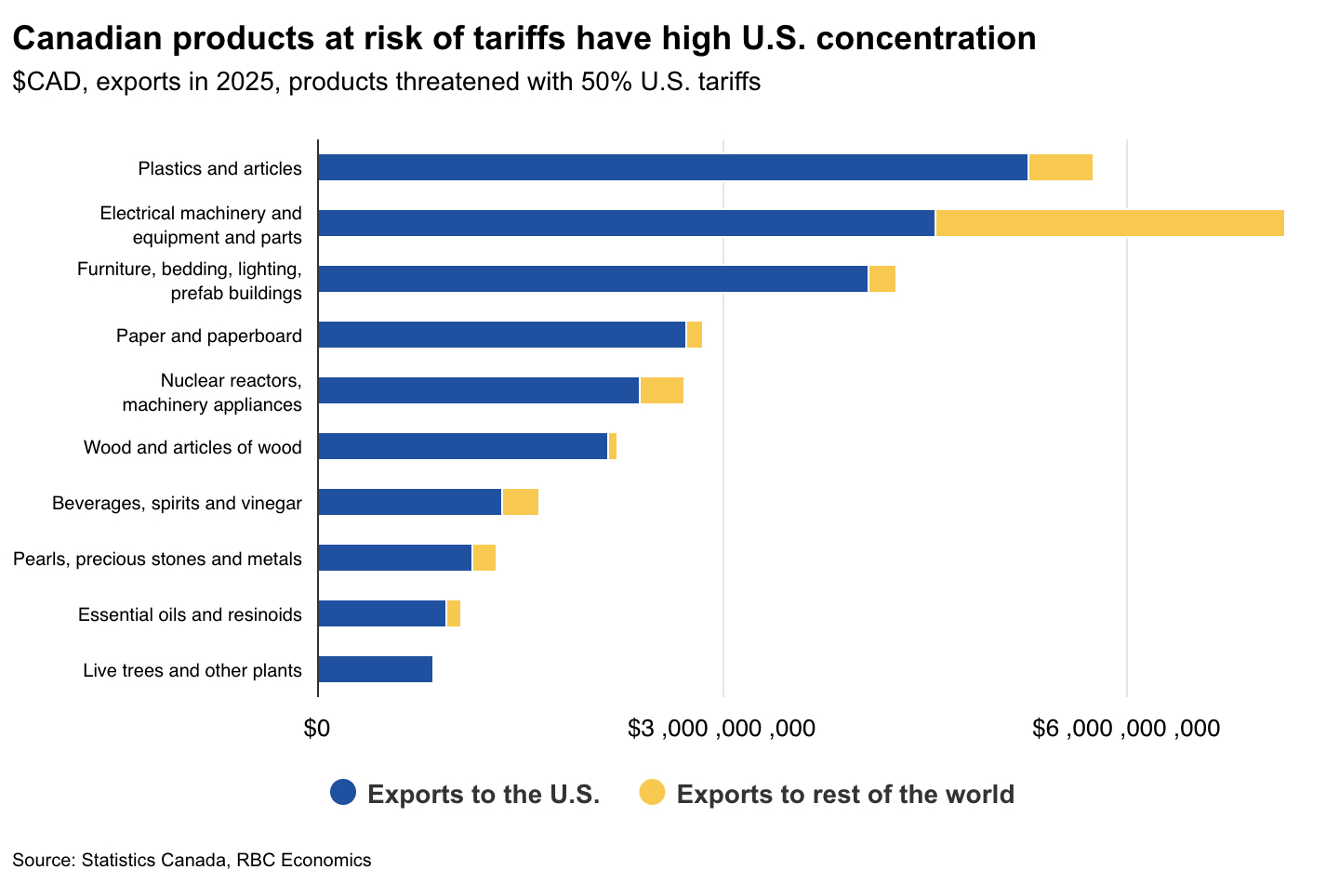
Another month of recovery is in the cards for Canada’s economy next Friday where we expect to see a 0.2% increase in GDP data for May (more details below), but the outlook is once again clouded by the latest bout of U.S. tariff threats that suggest the path ahead could be bumpier.
Just how bumpy is challenging to clearly assess. For one, we’re keenly aware that tariffs threatened in the past have often been significantly modified or halted ahead of the implementation date. New U.S. Section 301 (broader global) tariffs imposed on July 24 maintain a duty free exemption for imports from Canada under CUSMA, and the more severe 50% Section 338 product- and Canada-specific tariffs don’t take effect until Aug. 20.
Secondly, as we emphasized back in February 2025, the economic impact will depend on a wide range of factors from how firms creatively navigate tariffs, the path of the Canadian dollar to government responses and the Bank of Canada’s decisions.
That said, there are six early thoughts from the developments of this week:
- Big picture: Canada should be able to manage through new wave of potential tariffs
Targeted sectors would struggle - New tariffs would further exacerbate provincial divergences
- Domestic demand for tariffed goods could provide partial offset
- BoC even more likely to hold interest rates this year
- Business sentiment needs to be monitored
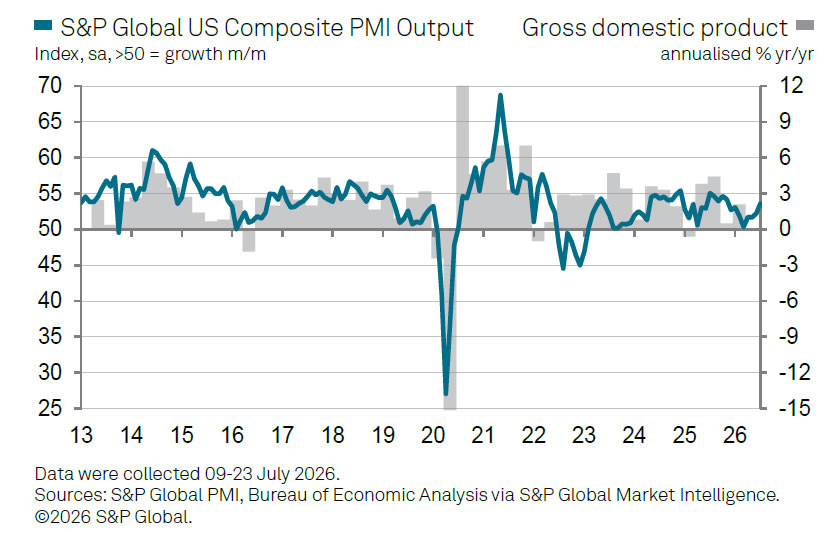
We expect the Federal Reserve will stay on hold in Wednesday’s meeting. June’ Consumer Price Index report showed broad-based deceleration in inflation pressures—a turn from the run of hotter core CPI prints to take an immediate rate hike off the table. Still, the path forward remains highly uncertain, and entirely contingent on future inflation data while labour market resilience persists.
On Thursday, we’ll receive the advance Q2 U.S. GDP report, where headline growth is expected to come at an annualized 2.4% quarter-over-quarter. Much of this growth has been supported by resilient consumer spending, which is expected to accelerate to 2%. Business fixed investment likely expanded, offset by net trade that is projected to have subtracted from growth.
US PMI Hits Eight-Month High,Yet Rising Costs and Supply Delays Raise Caution
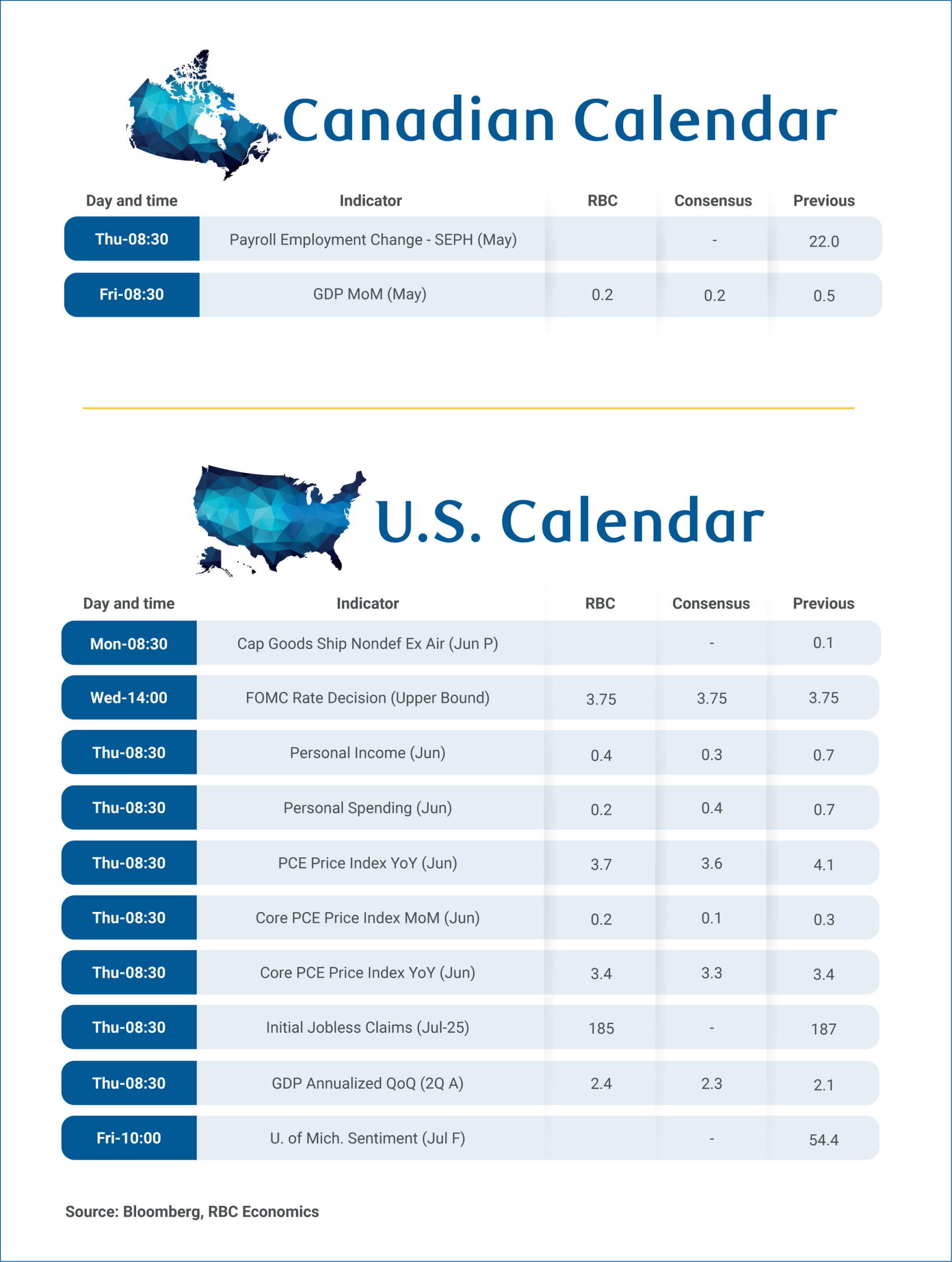
US business activity accelerated at the start of the third quarter, with S&P Global's Flash Composite PMI Output Index rising from 51.9 to 53.6 in July, its highest level in eight months. The improvement was driven by the services sector, where the Business Activity Index climbed from 51.2 to 53.6, also an eight-month high. Manufacturing, however, showed signs of losing momentum. The Manufacturing PMI edged down from 53.9 to 53.8, while the Manufacturing Output Index fell sharply from 56.2 to 53.6, marking a four-month low as earlier inventory-driven strength began to fade.
According to S&P Global Market Intelligence Chief Business Economist Chris Williamson, the survey is consistent with the US economy expanding at an annualized pace of around 2.0% in the third quarter, improving from the roughly 1.2% pace signaled for the second quarter. Businesses also returned to hiring for the first time in three months, pointing to improving labor demand. However, Williamson cautioned that some of July's strength may prove temporary, with spending boosted by the FIFA World Cup and USA 250 anniversary celebrations.
More importantly, the survey highlighted renewed signs of cost pressures emerging beneath the surface. Manufacturers reported intensifying supply chain delays and a renewed increase in input prices as inventory accumulation lost momentum. Williamson warned that the latest escalation in the Middle East is likely to aggravate supply disruptions and inflation pressures further, raising downside risks for growth. The data therefore suggest the US economy entered the third quarter on firmer footing, but the durability of that improvement will depend heavily on whether geopolitical tensions evolve into another sustained energy and supply-chain shock.
Economic Data
| Indicator | Actual | Previous |
|---|---|---|
| Flash Composite PMI Output Index | 53.6 | 51.9 |
| Flash Services PMI Business Activity Index | 53.6 | 51.2 |
| Flash Manufacturing PMI | 53.8 | 53.9 |
| Flash Manufacturing Output Index | 53.6 | 56.2 |
Key Takeaways
- US private-sector activity accelerated in July, with the Composite PMI rising to an eight-month high of 53.6.
- Services led the improvement, with business activity also reaching an eight-month high.
- Manufacturing remained in expansion but lost momentum as earlier inventory building began to fade.
- Employment increased for the first time in three months, pointing to firmer labour demand.
- S&P Global estimates the survey is consistent with annualized GDP growth of around 2.0% in Q3, up from roughly 1.2% signaled for Q2.
- Temporary factors, including spending related to the FIFA World Cup and USA 250 celebrations, may have boosted July activity.
- Manufacturers reported worsening supply chain delays and renewed input-cost inflation.
- Escalating Middle East tensions are expected to intensify supply disruptions and price pressures, posing downside risks to growth.
Week Ahead – Fed, BoE and BoJ Face Inflation Test as Markets Reprice Interest Rate Paths
- Fed decision in focus as markets price in more US rate hikes
- Middle East tensions, oil rally, and tariffs reignite inflation fears
- BoE and BoJ meetings could drive sterling and yen volatility
- Big Tech earnings to test Wall Street sentiment
Middle East and Trump's tariffs revive inflation fears
The US dollar gained against the other major currencies this week amid the escalating tensions in the Middle East as well as US President Trump's decision to proceed with a new round of tariffs after previously imposed levies expired.
Although the latest inflation data showed that US prices slowed more than expected in June, the hostilities in the Middle East, the reclosure of the Strait of Hormuz, the resulting rally in oil prices, and Trump's fresh trade levies have all revived fears about inflation spiraling out of control again.
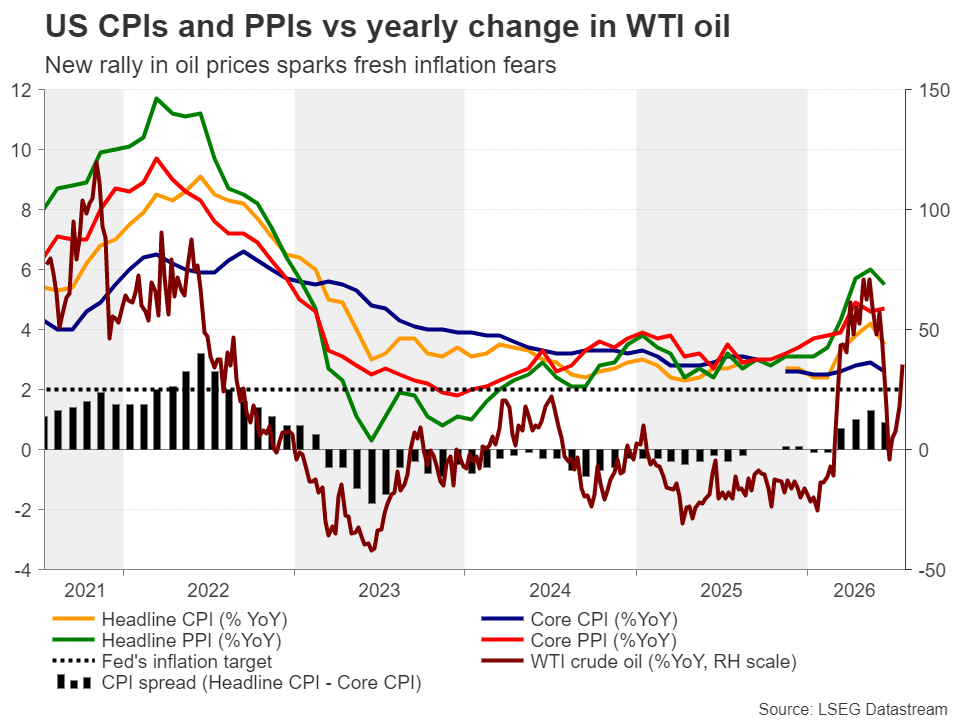
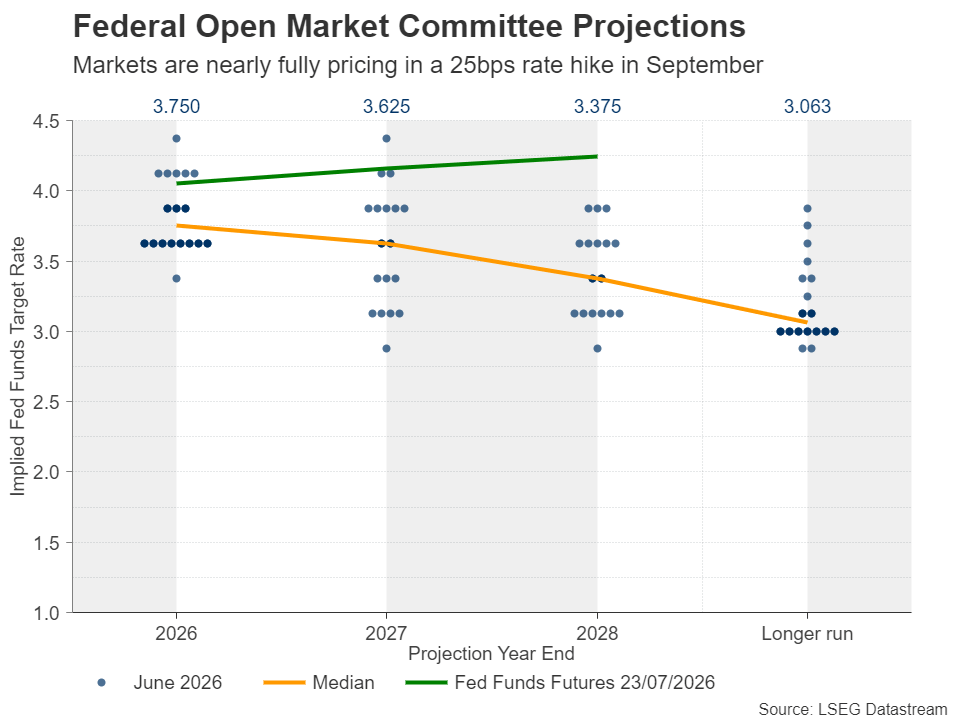
According to Fed fund futures, investors are now fully pricing in a quarter-point hike by the Fed in September, while another one is factored in for March. There is even a decent 35% chance that policymakers could press the rate hike button this week.
Fed decision takes center stage
With all that in mind, Wednesday's decision may attract special interest. Even if the Fed does not act at this gathering, any hints corroborating the notion that they could do so in September are likely to add further fuel to the dollar's engines as Treasury yields could drift higher. At the same time, gold may come under renewed pressure as the opportunity cost for holding the metal increases.
That said, with Kevin Warsh avoiding providing clear signals and the forward guidance being removed from the statement under his leadership, investors may find it difficult to arrive at safe conclusions from the statement and the Chair's press conference, especially with no fresh updated interest rate projections to accompany this decision.
Now in the case of the Fed pressing the hike button at this meeting, the market will react in a similar manner, with the only difference being that the aforementioned moves will be magnified as the implied rate path could become much steeper.
The PCE inflation data for June will be released the day after the Fed decision. Although the PCE indices are the Fed's favorite inflation metrics, they may pass largely unnoticed this time. After all, they concern a period before the latest escalation in the Middle East and the new rally in oil prices, let alone that the CPI data have already revealed how inflation fared during that month. What's more, investors will already have the Fed decision to digest and reevaluate their own rate projections.
Will the BoE hint at a September rate hike?
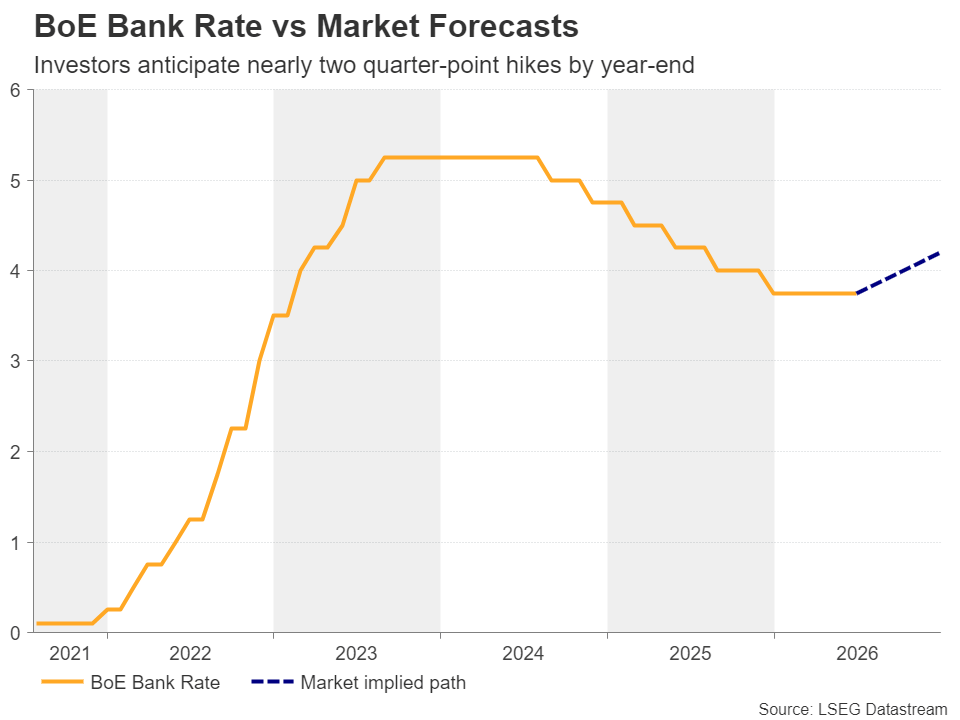
On Thursday, the central bank torch will be passed to the Bank of England. At their June meeting, UK policymakers held interest rates unchanged via a 7-2 vote, with the two dissenters favoring a 25bps rate increase. However, in the statement accompanying the decision there was no evidence that policymakers are in a rush to raise interest rates. Investors interpreted the overall message as neutral and continued expecting the Bank to remain on hold in July as well. They were fully penciling in a 25bps hike in November.
However, the latest CPI data revealed that although the headline rate slowed by more than expected in June, due to the steep fall in oil prices, the core CPI rate held steady at 2.6%. Combined with recent remarks by MPC member Alan Taylor, who stressed the importance of learning from past inflation episodes and warned about the resurgence of inflation risks, this allowed investors to assign a strong 75% chance of a September hike, with another one being nearly fully priced in by December.
Thus, for the pound to benefit from this decision, the Committee needs to convince traders that a rate hike is looming at the next gathering, either through the voting pattern (more dissenters than in June), or through the statement and Governor Bailey's press conference.
Can the BoJ come to the yen's rescue?
Next in line will be the Bank of Japan. When they last met, Japanese policymakers raised interest rates to a three-decade high of 1% via a 7-1 vote, noting that they expect the yearly CPI to "speed up well above 2%" and to ease back to the Bank's objective between the second half of fiscal 2026 and fiscal 2027.
Since then, remarks by several policymakers have leaned to the hawkish side. Board member Tamura said that the BoJ should raise rates roughly every few months if the economy evolves as expected, while Ayano Sato, who is considered a dove, stressed the need to monitor the impact of the weak yen on inflation and added that the BoJ will remain independent from the government. Taking into account Prime Minister Takaichi's dovish view, this is considered a hawkish tilt by Sato. What's more, a recent Bloomberg report revealed that BoJ officials are open to raising rates faster than the previously expected pace if inflationary pressures intensify.
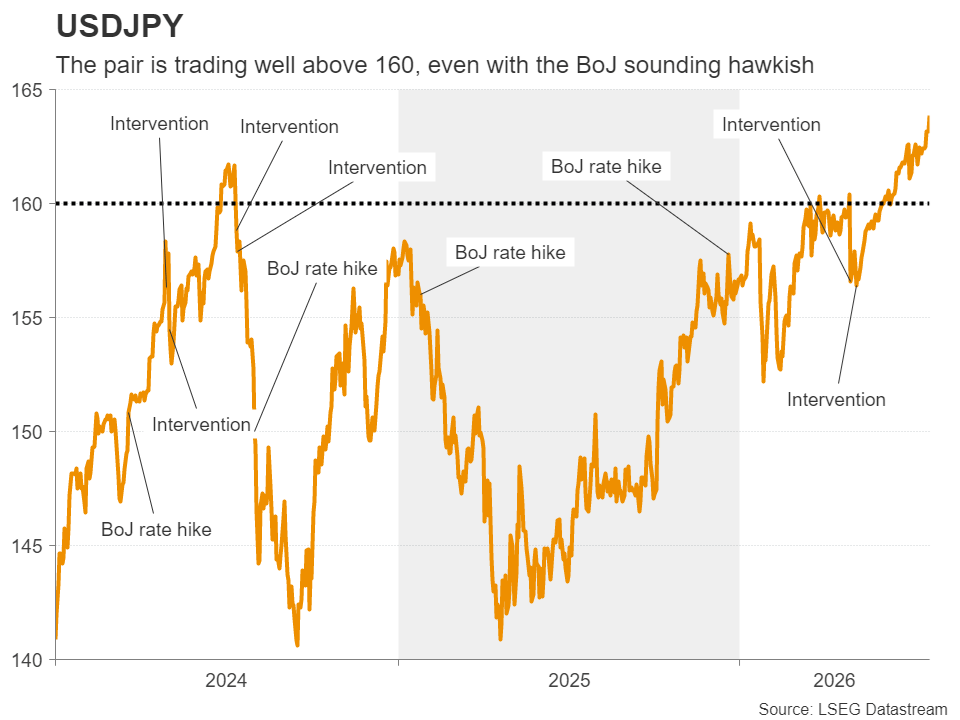
Although the market is still penciling in another 25bps rate hike by the end of the year, the yen did not capitalize on this hawkishness. Perhaps investors do not believe that the BoJ can become more hawkish than it is now, especially with PM Takaichi calling for interest rates to remain low. Takaichi cannot directly intervene in the BoJ's plans but deciding whom to appoint to the Board could make a big difference.
The dissenter at the latest meeting was one of her appointees, while another one, who joined the Board more recently, is also seen favoring looser policy moving forward. What's more, the term of two hawks will end next summer, allowing Takaichi to appoint more doves within the Board.
Thus, even if a hawkish message boosts the yen on Friday, any decline in dollar/yen is likely to remain limited and short-lived. Even intervention seems unable to change the yen's fate. Speculation that the BoJ could start leaning to the dovish side in the coming months, combined with mounting Fed hike bets, could keep dollar/yen bulls into the game.
Ahead of the BoJ announcement, the Tokyo CPI data for July will provide a first glimpse as to how the resurgence of US-Iran hostilities and the new rally in oil prices have impacted consumer prices after June's relative calmness. June retail sales will also be released.
Australian and Eurozone CPI data also on the agenda
Elsewhere, Australia releases CPI data for Q2, while in the Eurozone, the preliminary GDP for Q2 and the flash CPI data for June will be released. Following three rate hikes and a new wave of tensions in the Middle East, investors anticipate a nearly 40% chance of a rate hike at the upcoming meeting. A slowdown in prices during Q2 is unlikely to change that chance, thereby leaving the aussie unfazed.
As for the Eurozone, the ECB remained on hold this week and said that it is "well positioned to wait and see." This marks a less-hawkish-than-expected stance in the midst of all this uncertainty and soft GDP and CPI data could prompt traders to push back the timing of when they expect the ECB to press the hike button again.
China will release its official PMI data for July on Friday.
Earnings results to stay in the spotlight
Besides the central banks and the data, the earnings parade continues with results from tech-giants Microsoft, Meta, Amazon and Apple, as well as the semiconductor designers ARM and Qualcomm.
The latest earnings updates from large tech firms brought back to light fears over heavy AI spending that it is not translating into profitability. This week, Tesla stock fell more than 10% after the EV carmaker reported weaker-than-expected profitability, despite upbeat revenue, while Alphabet also sank after the firm revealed high spending plans. Therefore, it will be interesting to see whether more results will add to investors' anxiety and, thereby, add more pressure on Wall Street.