

Sample Category Title
EUR/USD Ahead of a Key Week: Holding Near Lows
EUR/USD enters the final week of July at 1.1369. Friday's modest decline in energy prices reduced expectations that the Federal Reserve could raise rates as early as its upcoming meeting, scheduled for Tuesday and Wednesday.
At the same time, the main currency pair remains very close to the monthly low recorded in late June. Markets continue to price in at least one Fed rate hike before the end of the year.
Inflation risks have risen following a renewed escalation in the US–Iran conflict. Restrictions on the movement of energy tankers in the Persian Gulf and the Red Sea have pushed oil and fuel prices higher.
Additional support for the dollar is coming from strong US economic data. S&P PMIs showed the fastest pace of private business activity growth this year. Meanwhile, the number of initial jobless claims fell at the fastest pace in nearly six decades, confirming the resilience of the labour market.
Technical Analysis
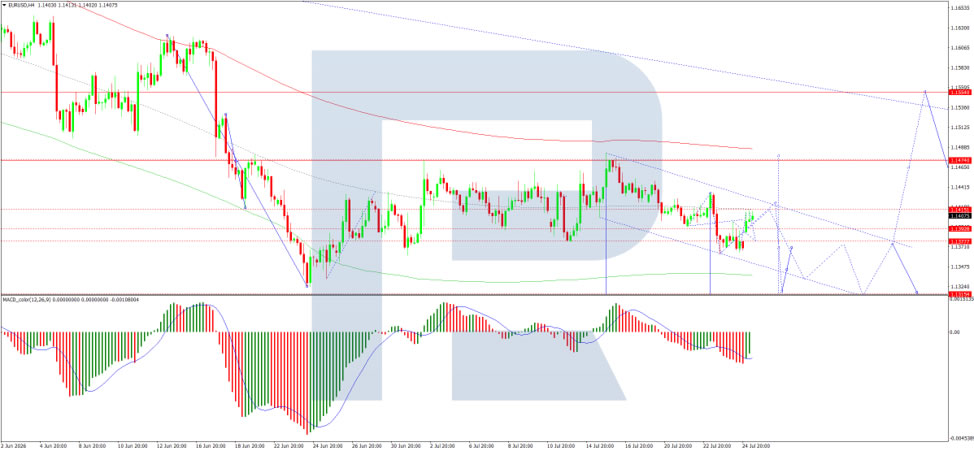
On the H4 chart of EUR/USD, the market has formed a consolidation range around the 1.1389 level, currently extending between 1.1336 and 1.1413. This range is nearing completion. An upside breakout would suggest a corrective move towards 1.1420, followed by a decline to 1.1313. A direct downside breakout would open the way for a move to 1.1313. The MACD indicator supports this scenario, with its signal line below zero and pointing firmly downwards, reflecting continued bearish momentum.
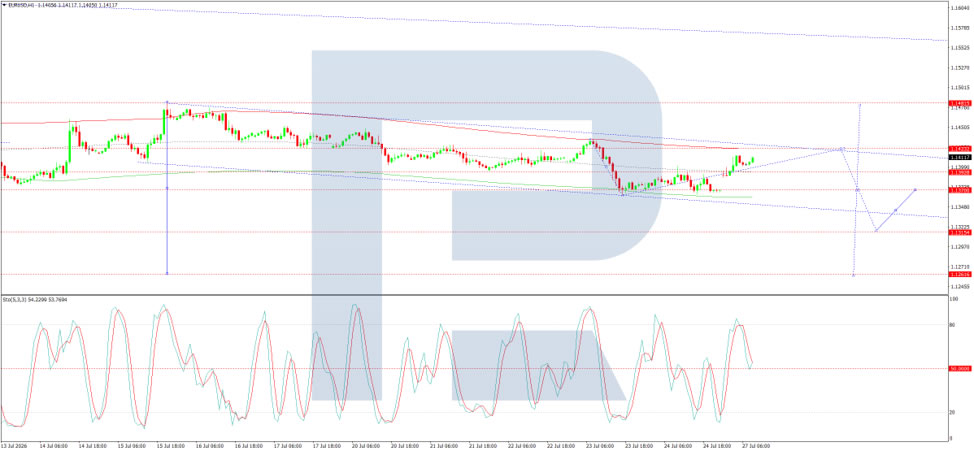
On the H1 chart, the market has completed an upward move to the 1.1414 level. A consolidation range is currently forming below this level. Today, a move lower to 1.1390 is expected, followed by a move higher to 1.1420, and then a decline to 1.1370, with scope for the trend to extend to 1.1313. The Stochastic oscillator confirms this scenario, with its signal line below 80 and pointing downwards towards 20, indicating increasing short-term downside pressure.
Conclusion
EUR/USD remains under pressure as it approaches the final week of July, hovering near monthly lows. The modest retreat in energy prices at the end of last week briefly reduced expectations of an immediate Fed rate hike, but markets continue to price in at least one increase before the end of the year. Renewed US–Iran tensions and supply disruptions in the Persian Gulf and the Red Sea have pushed oil prices higher, reinforcing inflation risks. Strong US economic data – including robust PMI readings and a sharp decline in jobless claims – continue to support the dollar. Technically, the pair may see a temporary corrective move towards 1.1420, but the broader bearish structure remains intact, with downside potential towards 1.1313. The Federal Reserve meeting this week will be the key catalyst.
Germany’s Ifo Business Climate Hits Five-Month as Manufacturing and Trade Recover
Germany's business sentiment improved further in July, with the Ifo Business Climate Index rising to 86.6 from 85.7 in June as companies grew more optimistic about the months ahead despite ongoing uncertainty surrounding the conflict in the Persian Gulf. The improvement was driven entirely by stronger expectations, while firms were slightly less satisfied with current business conditions. The latest survey suggests German companies are becoming increasingly confident that activity will recover, even if that improvement has yet to fully materialize.
Manufacturing led the gains, with business confidence rising noticeably as expectations strengthened and demand picked up. Companies also reported easing material shortages, although their assessment of current conditions softened somewhat. The services sector likewise became less pessimistic about the outlook despite a slightly weaker view of present business. Trade confidence improved again, supported by better assessments of both current conditions and future prospects, with retailers becoming less concerned about business performance. Construction also showed further signs of stabilization as both current assessments and expectations improved, while fewer firms reported insufficient order books.
Taken together, the survey points to a broad-based improvement in confidence across Germany's economy, extending the gradual recovery seen in recent months. The contrast between stronger expectations and weaker assessments of current conditions suggests businesses see better conditions ahead but remain cautious about the near-term environment. While the Ifo survey alone is unlikely to materially alter European Central Bank policy expectations, it supports the view that Germany's economy is stabilizing despite persistent geopolitical risks and a still challenging growth backdrop.
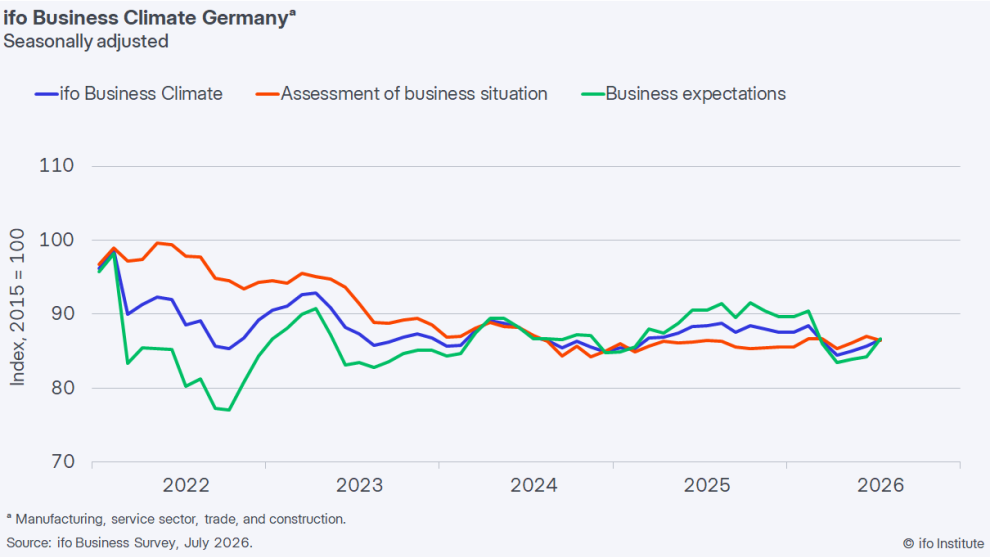
Survey Details
| Component | Current | Previous | Trend |
|---|---|---|---|
| Business Climate | 86.6 | 85.7 | ▲ Improved |
| Current Situation | 86.5 | 87.0 | ▼ Slightly weaker |
| Expectations | 86.7 | 84.3 | ▲ Strong improvement |
Key Takeaways
- German business confidence rose for a third consecutive month, with the Ifo Business Climate Index increasing to 86.6 from 85.7, its highest level since February.
- The recovery was driven by expectations rather than current activity. Expectations jumped to 86.7 from 84.3, while assessments of current business conditions edged down to 86.5 from 87.0.
- Manufacturing showed encouraging signs of improvement, with stronger demand and easing material shortages supporting confidence despite softer assessments of current conditions.
- Confidence improved across all major sectors, including services, trade and construction, suggesting the recovery is becoming more broad-based.
- Companies appeared less concerned about geopolitical risks, with the Ifo Institute noting firms were less pessimistic despite continued uncertainty surrounding the Persian Gulf.
- For markets, the survey supports the narrative of a gradual German economic stabilization, but the divergence between stronger expectations and weaker current conditions suggests the recovery is still in its early stages and is unlikely to materially alter ECB policy expectations on its own.
ECB’s Kazimir Sees At Least One More Rate Hike, Warns Oil Shock Could Require More
European Central Bank Governing Council member Peter Kazimir from Slovak reinforced the hawkish bias on Monday, arguing that policymakers will likely need to raise interest rates at least once more and warning that a worsening energy shock could ultimately require even more tightening than markets currently anticipate. His remarks come just days after the ECB left policy unchanged while signaling that another move is likely at its September meeting as renewed Middle East tensions push oil and gas prices higher.
Kazimir said he "remain[s] of the view that at least one more hike will be needed as part of our measured adjustment to inflation risks," adding that this would be justified "even if the situation improves somewhat." He also set a high bar for changing that view, saying "very convincing" economic data and geopolitical developments would be needed over the coming weeks for him not to support a September rate increase. More importantly, Kazimir argued the ECB should act before higher energy costs feed through to broader inflation, warning that second-round effects "often form quietly" and that policymakers must "act before that point, not after."
He also opened the door to a more aggressive tightening cycle if the energy shock intensifies. "Should the situation escalate, with the price pressures becoming stronger and more persistent, we will need to tighten more over the next quarters than is currently expected," he said. That aligns with the ECB's recent emphasis on monitoring whether higher energy prices evolve into broader and more persistent inflation pressures rather than treating them as temporary supply shocks. Kazimir added that "we did not surprise the markets in July, and we should not surprise them in September," reinforcing the ECB's preference for preparing markets ahead of major policy moves.
ECB Governing Council member Ante Žigman of Croatia echoed that cautious approach in a separate interview, saying uncertainty "remains high" and that the impact of the latest energy shock "will only be seen in the coming months." He stressed that the "intensity and duration of the shock are crucial" and reiterated that future decisions would depend on incoming data and updated projections while keeping the ECB's medium-term objective of inflation around 2%.
Together, the comments suggest policymakers remain firmly on course for another rate hike while leaving open the possibility of additional tightening should energy-driven inflation prove more persistent than currently expected.
Will the Fed and BoJ Trigger USD/JPY’s Biggest Move This Week?
TL;DR:Will the Fed and BoJ jointly surprise markets this week? USD/JPY, already at a 40-year high above 163, faces amplified two-way risk from their combined policy signals.
Why This Week Matters More Than a Typical Central Bank Cycle
Three major central bank decisions are packed into little more than 60 hours: the Federal Reserve announces policy Wednesday, the Bank of England follows Thursday, and the Bank of Japan concludes its meeting Friday. Markets are unlikely to distribute their attention evenly across all three. The Fed and BoJ have the greatest potential to reshape rate expectations, and the interaction between the two could make USD/JPY the week's most sensitive pair.
With the pair already trading at a 40-year high, even modest surprises from either central bank could trigger an outsized reaction. That asymmetry — high positioning risk meeting high event risk — is what separates this week from routine policy meetings.
The Fed: A Unanimous Hold, But a Contested Path Ahead
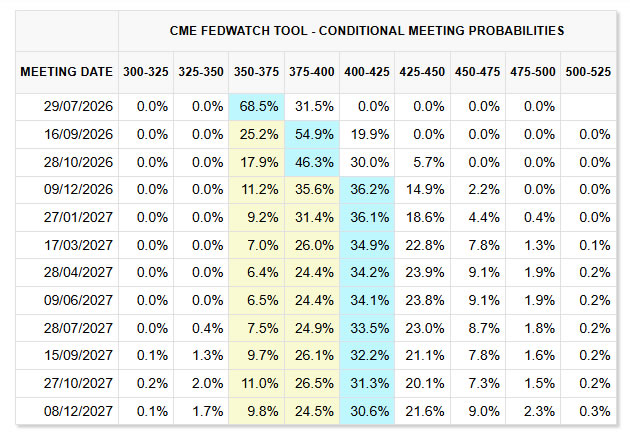
The Fed is universally expected to leave the federal funds target range unchanged at 3.50–3.75% on Wednesday. Reuters' July 21 survey showed all 104 economists expecting no policy change, while futures markets assign only around a one-third probability of an immediate hike.
Yet that headline consensus masks a more important debate over the path ahead. Futures continue to price:
- Roughly a 75% probability of a September hike
- Better than even odds of two increases before year-end
That pricing is considerably more aggressive than economists' consensus for rates to hold steady through December — a disconnect that leaves Treasury yields particularly sensitive to any signal that policymakers are growing less comfortable waiting.
What to Watch: The Voting Breakdown and Warsh's Tone
The meeting's most important signal may not be the rate decision itself but the voting breakdown. Minutes from the previous FOMC meeting revealed several policymakers were already prepared to support an immediate rate increase before ultimately agreeing to wait for more evidence. Any rise in dissenting votes favoring tightening would give investors a concrete measure of how quickly sentiment inside the Committee is shifting.
Markets will also need to adjust to Chair Kevin Warsh's communication style. Unlike predecessor Jerome Powell, Warsh has consistently rejected detailed forward guidance. Investors are likely to focus instead on how he characterizes labor market resilience, whether he places greater weight on inflation risk from higher oil prices, and whether he pushes back on the market's aggressive tightening expectations.
The BoJ: A Quiet Hold With a Loud Subtext
Attention then shifts to Tokyo, where the BoJ is also widely expected to leave its policy rate unchanged at 1.00%. The real focus is the quarterly Outlook Report and Governor Kazuo Ueda's assessment of whether inflation and growth data justify a faster normalization cycle.
Reuters' latest survey found an overwhelming majority expecting no move this week but anticipating another hike before year-end, with October and December emerging as the most likely windows. Bloomberg has separately reported that some BoJ officials are becoming more receptive to accelerating the pace of tightening if persistent yen weakness keeps feeding domestic inflation.
Even without immediate action Friday, upward revisions to inflation forecasts or stronger confidence in the outlook would reinforce expectations the Bank could move sooner than markets currently anticipate.
Why USD/JPY Carries Unusually High Event Risk
That combination gives USD/JPY unusually high event risk from both directions:
- On the US side, the key question is whether the Fed signals an approaching rate hike
- On the Japanese side, investors are watching for stronger evidence that policy normalization is gathering pace
A hawkish outcome from either central bank would normally move the exchange rate on its own. If both occur in the same week, the resulting repricing could be considerably larger than either event in isolation.
Positioning further amplifies that risk. USD/JPY has already climbed above 163 — its highest level in four decades — despite repeated verbal intervention from Japanese officials. Earlier currency intervention totaling JPY 11.73 trillion only stabilized the exchange rate for roughly six weeks before the broader yen selloff resumed.
ActionForex analysis suggests that experience has made markets increasingly reluctant to challenge the underlying interest-rate differential unless accompanied by a genuine shift in monetary policy — meaning this week's decisions may prove far more influential than official rhetoric alone.
ActionForex's Technical View on USD/JPY
Technically, USD/JPY appears to have formed a temporary top at 163.97 following today's retreat. Any correction should stay relatively shallow and brief as long as the 55 4H EMA, currently at 162.93, continues to hold.
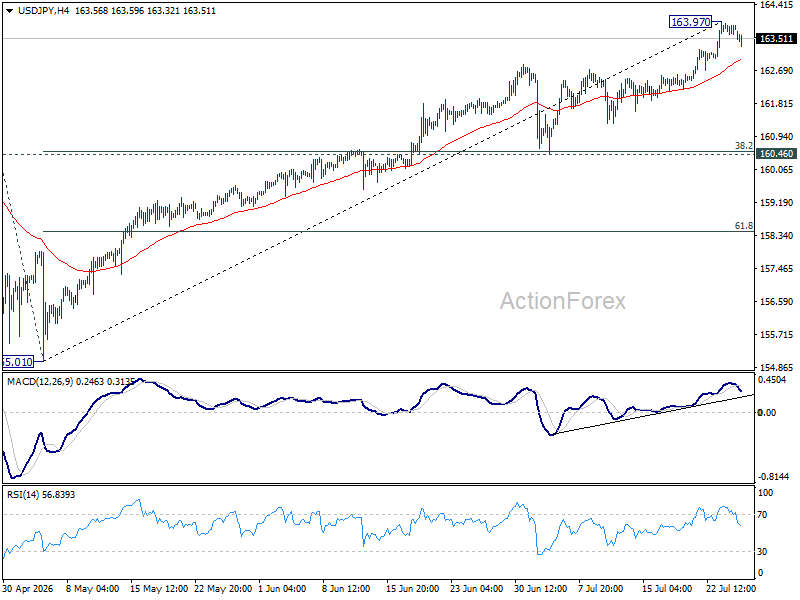
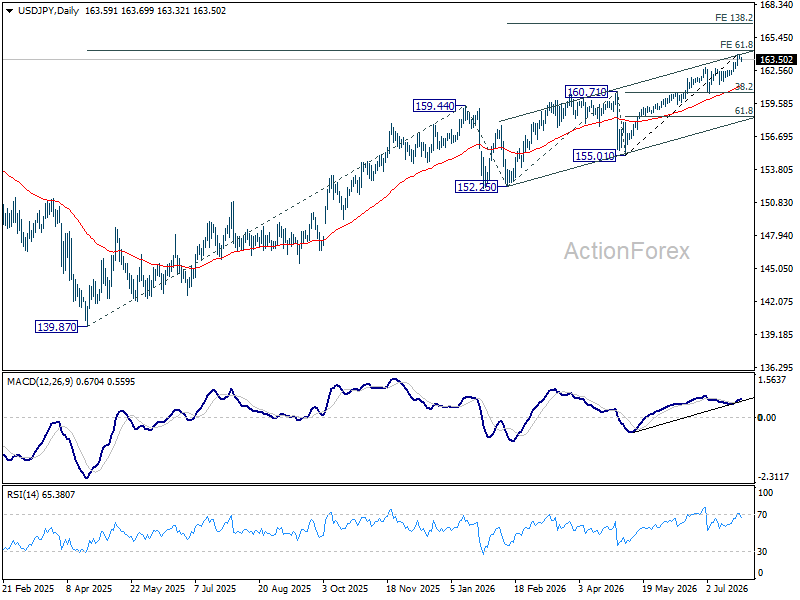
A decisive break above 163.97 would resume the broader uptrend from 155.01 and target 138.2% projection of the 152.25-160.71 advance measured from 155.01 at 166.07.
On the downside, sustained trading below the 55 4H EMA would suggest the rally from 155.01 has entered a corrective phase. That would shift focus toward the 160.46 support cluster, which includes the 38.2% retracement of 155.01 to 163.97.
Key Takeaways
- The Fed is expected to hold rates at 3.50–3.75%, but futures price a 75% chance of a September hike — well ahead of economist consensus
- The voting breakdown and Chair Warsh's tone on inflation and labor resilience matter more than the headline decision
- The BoJ is expected to hold at 1.00%, but the Outlook Report and Ueda's language on inflation could signal an accelerated tightening timeline
- USD/JPY, at a 40-year high above 163, faces amplified two-sided risk if both the Fed and BoJ surprise hawkishly in the same week
- 163.97 is the key upside pivot; a break above targets 166.07, while a failure to hold the 55 4H EMA (162.93) opens the 160.46 support zone
NZD/USD: Inflation Surge Meets Strong US Dollar Pressure
On 21 July, Stats NZ reported an acceleration in inflation: the Consumer Price Index rose 1.5% in the second quarter, while the annual inflation rate climbed to 4.1%, its highest level in more than two years and slightly above analysts' consensus forecast of 4.0%. The increase was driven primarily by higher fuel prices amid tensions in the Middle East. The data was released after the Reserve Bank of New Zealand raised the official cash rate to 2.50% on 8 July, reinforcing expectations of further monetary tightening in September. However, the impact proved short-lived, as escalating tensions between the US and Iran boosted demand for the US dollar as a safe-haven asset, causing the New Zealand dollar to surrender part of its recent gains during the second half of the week.
Technical Outlook
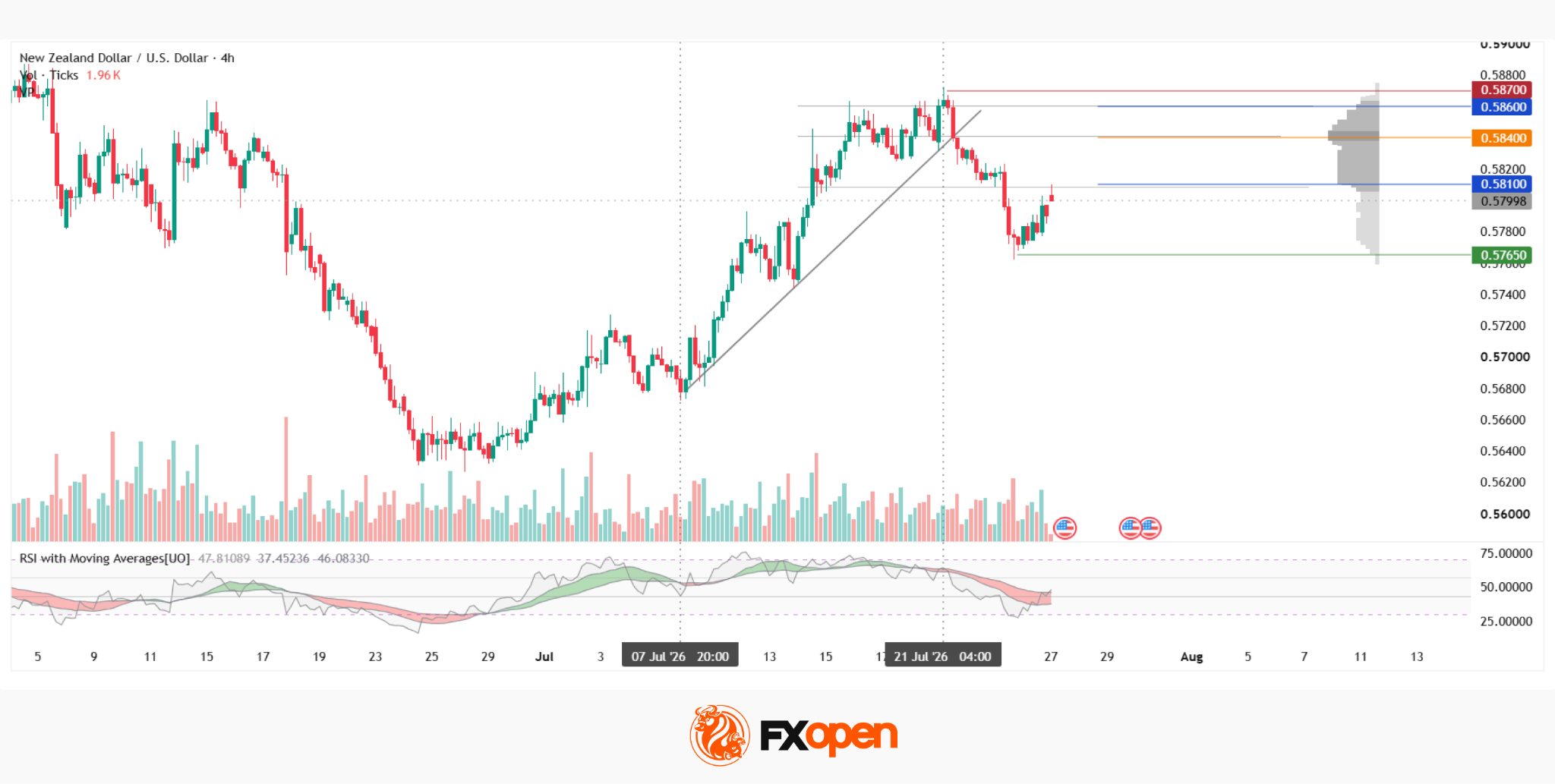
On the four-hour chart, NZD/USD has been developing a short-term uptrend since 26 June, with a trendline forming as the pair advanced towards 0.5870, where resistance emerged. The pair subsequently broke below the trendline, fell beneath the lower boundary of the current market profile and declined to the 0.5765 area, where the green support level is now located. Following a rebound from this zone, the pair moved on to test the lower boundary of the market profile at 0.5810. If this level holds and the price turns lower, the green support at 0.5765 could provide support. Should the pair continue to rise, attention may return to the POC area at 0.5840.
It is worth noting the close proximity of the upper boundary of the market profile at 0.5860 and the red resistance zone at 0.5870, making this a potentially strong resistance area. The RSI + MAs indicator currently reads 46, 37 and 46. It is also worth noting that the slower moving average has yet to leave the neutral zone, while the RSI briefly entered oversold territory before returning to neutral, casting doubt on the strength of the current breakout.
Summary
The pair's near-term direction will likely depend on whether sellers can defend the lower boundary of the market profile. From a fundamental perspective, interest in the pair will hinge on whether the support provided by the stronger US dollar amid tensions in the Middle East proves more durable than the positive impact of New Zealand's unexpectedly strong inflation data.
Trade over 50 forex markets 24 hours a day with FXOpen. Take advantage of low commissions, deep liquidity, and spreads from 0.0 pips (additional fees may apply). Open your FXOpen account now or learn more about trading forex with FXOpen.
This article represents the opinion of the Companies operating under the FXOpen brand only. It is not to be construed as an offer, solicitation, or recommendation with respect to products and services provided by the Companies operating under the FXOpen brand, nor is it to be considered financial advice.
Sunrise Market Commentary
Markets
Friday brought some, maybe unexpected relief to global (energy) markets, even as US president Trump end last week still threatened to scale up military action against Iran. Houthi militants attacking Saudi targets and complicating Saudi Arabia's oil exports through the alternative route via the Bab-el-Mandeb strait only added another layer of uncertainty. Still, energy markets took a breather after recent sharp rise in oil and gas prices. (Brent) oil eased back below the $100 p/b mark (close $96.7 p/b). The Dutch TTF gas reference held most of its recent rise near €62.6 p/Mwh). Markets apparently reached some kind of short-term point of evaluation. The 'softening' also spilled over to interest rate markets. US yields eased between 2.6 bps (5-y) and 0.2 bps (30-y). German yields declined between 5.6 bps (2-y) and 1.6 bps (30-y). Given the permanently changing geopolitical narrative and the outlook for energy supply & prices, eco data these days tend to have become a bit outdated upon release. Even so, the July PMIs at least suggested that not only the US economy (composite PMI 53.6 from 51) but even the EMU (composite PMI 51.9 from 50.0) were in fairly good shape at the onset of de most recent flaring up of the conflict in the Middle East. Price pressures, while easing a bit in EMU, still remained very elevated in the US with worsening supplier delays and intensifying price pressures both on the supply side and on the selling side. Something to keep a close eye on for the Warsh Fed when it meets later this week. The softer tone on energy and bond markets also gave equities some breathing space (EuroStoxx 50 +1.14%, S&P 500 +0.05% but Nasdaq still losing 0.64%). On FX markets, the dollar still held the upper hand. USD/JPY jumped to just shy of the 164 big figure. EUR/USD held below 1.14 (close 1.137). Sterling also got some reprieve after recent correction, supported by a milder global context and a set of better than expected domestic data (strong June retail sales at 1.0% M/M and 4.2% Y/Y, composite PMI at 52.1 from 49.3).
This morning, markets are trying to find out the meaning of the apparent ceasefire as the US and Iran refrained from military actions against each other this weekend. This suggests some new diplomatic action even as the nature and level of any talks remains highly difficult to assess. Still, markets continue to see some good reason to build on Friday's easing. Brent oil this morning trades near $92 p/b after touching $100+ levels end last week. US yields are softening about 4 bps across the curve this morning and such a move might be copied on European markets. The dollar is ceding some ground (DXY 101.15, EUR/USD 1.14, USD/JPY 163.6). The eco calendar today contains US durable goods orders (headline expected +1.8% M/M) and German IFO business confidence (expected 86.0 from 85.6), but these data are no game-changers. The US Treasury later today will sell $69 bln of 2-y Notes and $70 bln 5-y notes. In the run-up to Wednesday's Fed policy decision, the debate on the timing of a potential Fed rate hike will continue. On the back of current decline of the oil price, markets are slightly scaling back the probability of a Fed rate hike this week to 30%-35%. Aside from the Fed policy decision, the Bank of England will hold a regular policy meeting on Thursday. The Bank of Japan decides on its policy rate on Friday. For both, markets expect no change, but they will keep a close eye at the economic update.
News & Views
According to the Confidence indicator of the National Bank of Belgium business confidence in the country maintained the positive momentum seen since May. The overall smoothed synthetic curve, which reflects the underlying economic trend, showed a slight further upturn from -12.4 to -11.9. The business climate has improved in business-related services for the third consecutive month (-3.8 from -7.4). It remained almost unchanged in the manufacturing industry (-15.5 from -15.7) but has weakened slightly in the building industry (-5.0 from -4.2) and the trade sector (-10.8 from -9.3). In the business-related services sector, confidence has risen for the third consecutive month, as expectations concerning future activity and market demand have strengthened. The assessment of current activity is also more positive. In manufacturing demand expectations have improved significantly. Assessments of total order books are also more positive, but stock levels are considered to be higher than normal and business leaders expect to employ fewer staff. In the building industry, some of the optimism seen in recent months has been lost. Capacity utilization rate in the manufacturing industry has fallen for the third consecutive quarter, from 76.1% in April to 74.6% in July.
Is Brent Oil’s Gap Lower a Bull Trap in Disguise?
TL;DR: Brent crude gapped sharply lower to $85.50 as US and Iran refrained from further strikes over the weekend, but shipping data from the Strait of Hormuz and Bab el-Mandeb shows the physical supply crisis is far from resolved — raising the risk that this selloff is a bull trap rather than a genuine reversal.
Why This Matters
Brent crude opened the week with one of its sharpest downside gaps in recent months, plunging to as low as $85.50 from Friday's close at $98.69 after the United States and Iran refrained from launching fresh attacks over the weekend. The absence of further military escalation prompted traders to rapidly unwind part of the geopolitical risk premium that had driven prices above $100 last week. Yet the sharp selloff appears to reflect improving sentiment more than improving fundamentals, as there has been little evidence that physical oil flows are returning to normal.
What has actually changed is limited. US airstrikes stopped on Friday and Saturday, with Sunday marking the second consecutive day without military action, while Iran said it had responded in kind. According to US Ambassador to the United Nations Mike Waltz, President Donald Trump decided to pause further strikes to allow more time for diplomacy. However, this pause falls well short of the June 17 interim agreement, which was formalized through a signed memorandum of understanding. Neither Washington nor Tehran has announced a ceasefire or any binding commitment to de-escalation. Instead, the current arrangement appears to be a fragile, conditional pause, with Iran continuing to describe its approach as "attack for attack" rather than a permanent shift toward negotiations.
What Shipping Data Actually Shows
The disconnect between market optimism and physical supply conditions is even more apparent in shipping data. Fewer than ten commodity vessels transited the Strait of Hormuz daily over the weekend, according to Kpler, compared with a pre-conflict average of more than one hundred crossings a day.
- Hormuz: Vessel traffic remains below 10 crossings per day, versus a pre-conflict average above 100.
- Bab el-Mandeb: Traffic fell to just eleven vessels on Sunday after Houthi forces expanded their campaign to strike Saudi Aramco's onshore facilities at Jizan and Yanbu — a significant escalation beyond previous tanker attacks.
In other words, one critical chokepoint has yet to recover while another has deteriorated further, suggesting disruption is spreading beyond maritime transport to oil infrastructure itself.
Bull Trap or Genuine Reversal?
That divergence raises the possibility that Monday's sharp decline proves to be a bull trap rather than the beginning of a sustained reversal. Financial markets can remove geopolitical risk premium within hours, but restoring confidence in global shipping networks typically takes much longer. Unless vessel traffic through Hormuz begins recovering meaningfully and conditions stabilize in the Red Sea, physical supply constraints will continue to limit how much geopolitical premium can realistically be removed. A quick recovery above the $90 mark would suggest Monday's gap primarily flushed speculative long positions rather than signaling that the underlying supply shock has ended.
ActionForex's Technical View on Brent Crude
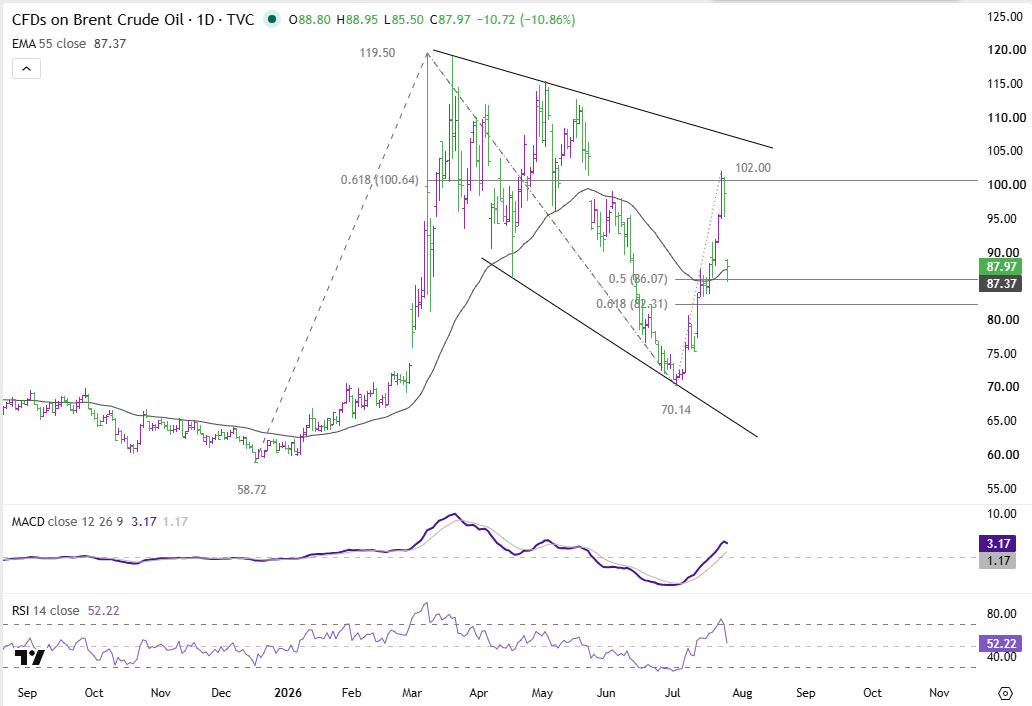
Technically, Brent was firmly rejected by the 61.8% retracement of the 119.50-70.14 decline at 100.64, triggering a steep pullback from last week's high near 102. Even so, the broader bullish interpretation has not been invalidated. The advance from 70.14 is still viewed as the first impulsive wave of a larger long-term uptrend, while the current decline has retraced into the fourth-wave territory of a lesser degree between 83.71 and 87.55, a common corrective zone in Elliott Wave analysis. Selling pressure also paused just ahead of the 50% retracement of 70.14 to 102.00 at 86.07, with the 55 D EMA at 87.37 providing additional support.
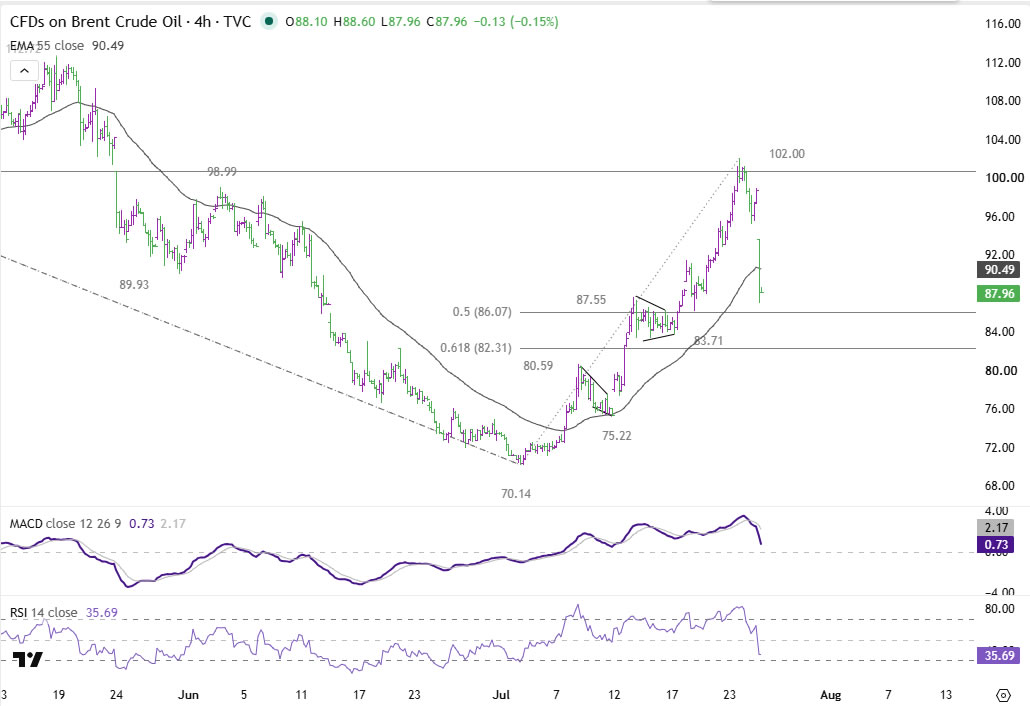
While consolidation below 102.00 is now likely, the near-term bias still favors another upside break provided physical supply conditions fail to improve. A swift rebound above 90 would strengthen the case that Monday's selloff was largely a positioning washout before the broader advance resumes. Conversely, a decisive break below 86.07, accompanied by sustained trading beneath the 55 D EMA, would significantly weaken the bullish structure and shift focus back toward a deeper fall, potentially reopening the path to the 70.14 low.
Key Takeaways
- Brent's gap from $98.69 to $85.50 reflects a rapid unwind of geopolitical risk premium, not evidence that physical supply has normalized.
- Vessel traffic through Hormuz remains below 10 crossings a day versus a pre-conflict average above 100, while Bab el-Mandeb traffic has fallen further after strikes on Saudi Aramco facilities.
- A quick reclaim of $90 would support the bull-trap thesis — a positioning washout rather than a real reversal.
- A decisive break below 86.07, with sustained trading under the 55 D EMA, would weaken the bullish structure and open the path back to 70.14.
- The broader advance from 70.14 is still treated as an impulsive first wave, keeping the long-term bullish structure intact for now.
EUR/USD Under Pressure as Fresh Downside Risks Emerge
Key Highlights
- EUR/USD started a fresh decline from the 1.1475 resistance zone.
- A bearish trend line is forming with resistance at 1.1405 on the 4-hour chart.
- GBP/USD trimmed most gains and traded below 1.3400.
- WTI Crude Oil prices might attempt a move above $95.00.
EUR/USD Technical Analysis
The Euro failed to clear the 1.1475 hurdle against the US Dollar. EUR/USD started a fresh decline below 1.1450 and 1.1420.
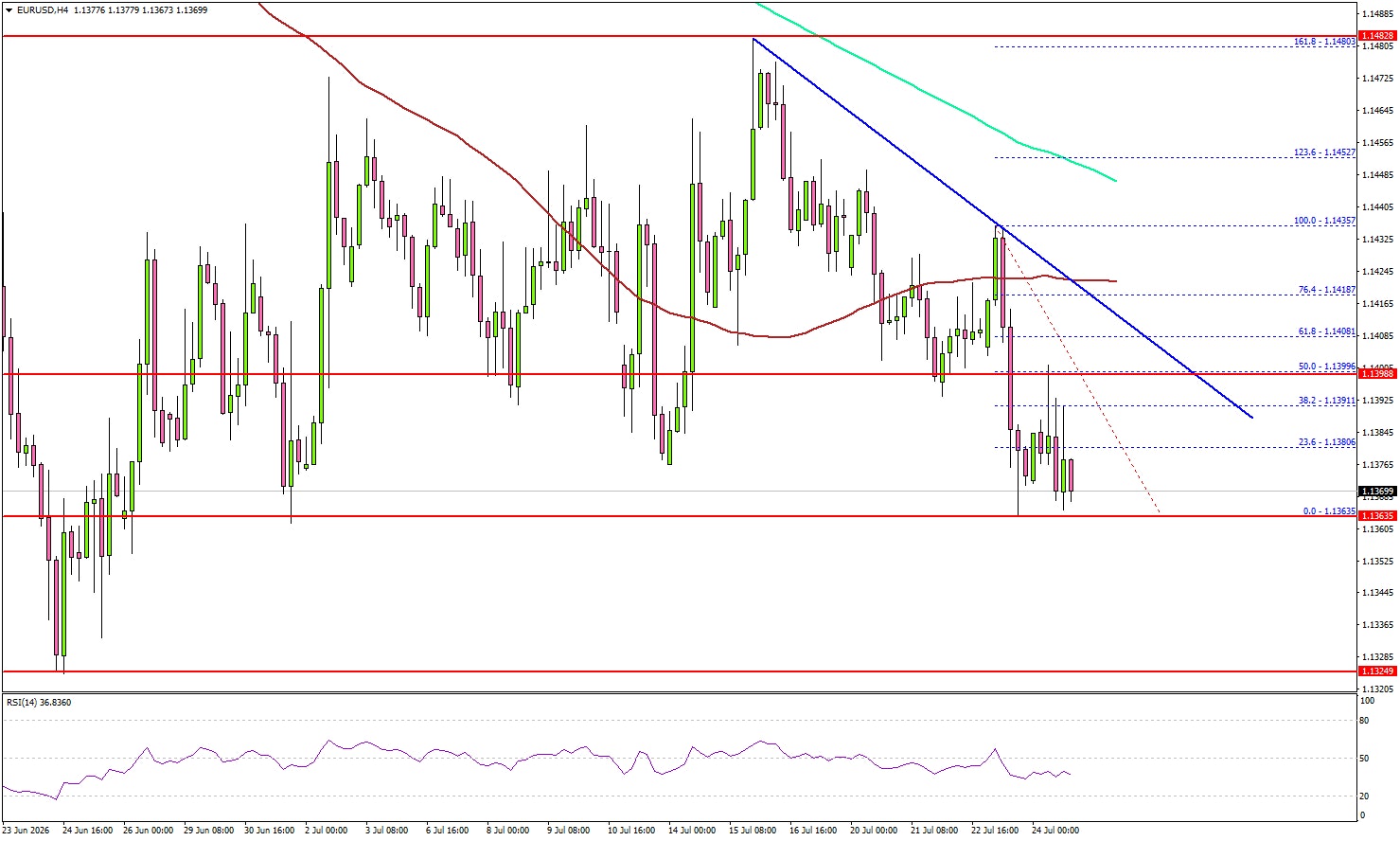
Looking at the 4-hour chart, the pair settled below 1.1420, the 100 simple moving average (red, 4-hour), and the 200 simple moving average (green, 4-hour). The bears pushed the pair toward the 1.1365 support.
If there is an increase in bearish pressure, the pair could decline below 1.1350. The first major support could be near 1.1325. The main support might be 1.1300.
A downside break and close below 1.1300 might send the pair toward 1.1265. Any more losses could open the doors for a test of 1.1240. On the upside, the pair could face resistance near 1.1400. There is also a bearish trend line forming with resistance at 1.1405.
The next major resistance might be 1.1420 and the 100 simple moving average (red, 4-hour). A close above 1.1420 could start another steady increase. In the stated case, the bulls could aim for a move to 1.1450. Any more gains might open the doors for a test of 1.1475.
Looking at WTI Crude Oil, the price seems to be following a bullish path, and the bulls could soon aim for a move above the $95.00 level.
Upcoming Key Economic Events:
- German IFO Business Climate Index for July 2026 – Forecast 86.1, versus 85.6 previous.
- German IFO Current Assessment Index for July 2026 - Forecast 87.1, versus 87.0 previous.
- German IFO Expectations Index for July 2026 – Forecast 84.2, versus 84.1 previous.
- US Durable Goods Orders for June 2026 – Forecast +1.6% versus -4.5% previous.
USD/JPY Rises Near 164 Ahead of Central Bank Meetings
The Japanese yen weakened toward 164 against the U.S. dollar, its lowest level in around 40 years. Middle East tensions supported the dollar, while concerns about Japan’s finances and the large gap between U.S. and Japanese interest rates continued to pressure the yen. Warnings of possible intervention had little effect.
Global stock markets fell as investors became more cautious about the large amounts being spent on artificial intelligence. A sharp rise in oil prices also hurt market sentiment. WTI crude moved higher as fighting in the Middle East continued and hopes for a ceasefire faded.
Higher oil prices increased concerns that inflation could rise again, making a Federal Reserve rate hike more possible. The European Central Bank kept rates unchanged but said future increases were still possible. Economic data was limited and mostly close to expectations.
Markets This Week
U.S. Stocks
The Dow Jones fell for a third consecutive week as high WTI crude oil prices and tariff concerns encouraged further selling. The index remains in a short-term downtrend, and there may be more room to fall after the strong gains since June. Selling near the 10-day moving average may offer the best opportunities while the bearish trend continues. Resistance levels are at 52,500, 53,000, 53,500 and 54,000. Support is seen at 51,500, 51,000, 50,000, 49,500 and 49,000.
Japanese Stocks
The Nikkei 225 ended the week lower as concerns about high valuations and losses in overseas equity markets weakened sentiment. The index continued to fall despite the weaker yen, which is a bearish sign. Selling into strength near the 10-day moving average remains the preferred strategy this week. Resistance is seen at 66,000, 67,000, 68,000, 69,000 and 70,000, while support is at 64,000, 62,000, 61,000, 60,000 and 59,000.
USD/JPY
USD/JPY strengthened significantly last week, rising above 163 and testing 164. Higher WTI crude oil prices increased U.S. inflation concerns, supporting expectations that the interest-rate gap between the United States and Japan will remain wide. Japan’s government spending plans also raised concerns about increased government borrowing. For short-term traders, selling near resistance at 164 may offer the best opportunity early this week, ahead of the important Federal Reserve and Bank of Japan meetings. Resistance is at 164.00 and 165.00, while support is seen at 162.00, 161.00, 160.50, 160.00, 159.00, 158.00, 157.00 and 156.00.
Gold
Gold briefly fell below $4,000 early last week as higher WTI crude oil prices increased expectations of higher U.S. interest rates, which is negative for gold because it does not provide a yield. Support near last month’s low held, with central banks likely buying at lower levels, but the weekly recovery remained limited. Strong support may continue to protect the downside, but with U.S. interest rates likely to rise this year, large gains could be difficult. Range trading may therefore be the better short- and medium-term strategy. Resistance is at $4,150, $4,200, $4,300, $4,400 and $4,500, while support is at $3,950, $3,900, and $3,800.
Crude Oil
WTI crude oil rose sharply for a second consecutive week after negotiations between the U.S. and Iran broke down. However, the significant rise in oil prices may encourage the U.S. to return to negotiations and reduce tensions to protect the economy. Looking for selling opportunities after any positive developments may therefore be the better strategy this week. Resistance is at $95, $100 and $105, while support is at $80.00, $75.00, $67.50, $65, and $60.
Bitcoin
Bitcoin briefly rose above resistance at $65,000 early last week, but weaker risk appetite as stock markets fell pushed the market slightly lower by the close. The 10-day moving average now suggests that the recent uptrend has ended, so returning to a range-trading strategy may be the better approach in the short term. Resistance is at $65,000, $75,000, $80,000, $85,000, and $90,000, while support is at $60,000, $55,000 and $50,000.
This Week’s Focus
- Monday: Japan Coincident Indicator, U.S. Durable Goods Orders
- Tuesday: U.S. OPEC Meeting and CB Consumer Confidence
- Wednesday: Australia CPI, U.S. Fed Interest Rate Decision
- Thursday: Australia Building Approvals, E.U. GDP and Unemployment Rate, U.K. BoE Interest Rate Decision, U.S. Core PCE Price Index and GDP
- Friday: Japan Tokyo Core CPI, Unemployment Rate, Industrial Production, Retail Sales and BoJ Interest Rate Decision, Australia PPI, U.K. Nationwide HPI, E.U. CPI, U.S. Employment Cost Index, Chicago PMI and Michigan Consumer Sentiment
Markets will focus on central bank meetings this week. The Fed, Bank of England and Bank of Japan are expected to keep interest rates unchanged, but their comments could still cause large market moves. Markets now see an 82% chance of a U.S. rate rise in September, up from less than 53% a week ago. U.S. durable goods orders will also be important, while another rise in WTI crude oil could increase inflation worries and put pressure on stock markets.
Eco Data 7/27/26
| GMT | Ccy | Events | Act | Cons | Prev | Rev |
|---|---|---|---|---|---|---|
| 23:50 | JPY | Corporate Service Price Index Y/Y Jun | 3.20% | 3.40% | 3.30% | 3.40% |
| 08:00 | EUR | Germany IFO Business Climate Jul | 86.6 | 86.1 | 85.6 | |
| 08:00 | EUR | Germany IFO Current Assessment Jul | 86.5 | 87 | ||
| 08:00 | EUR | Germany IFO Expectations Jul | 86.7 | 84.1 | 84.3 | |
| 08:00 | EUR | Eurozone M3 Money Supply Y/Y Jun | 3.30% | 3.20% | 3.20% | |
| 12:30 | USD | Durable Goods Orders Jun | 0.30% | 1.60% | -4.50% | -4.00% |
| 12:30 | USD | Durable Goods Orders ex Transport Jun | 0.60% | 0.90% | 1.40% | 1.40% |
| 23:50 | JPY |
| Corporate Service Price Index Y/Y Jun | |
| Actual | 3.20% |
| Consensus | 3.40% |
| Previous | 3.30% |
| Revised | 3.40% |
| 08:00 | EUR |
| Germany IFO Business Climate Jul | |
| Actual | 86.6 |
| Consensus | 86.1 |
| Previous | 85.6 |
| 08:00 | EUR |
| Germany IFO Current Assessment Jul | |
| Actual | 86.5 |
| Consensus | |
| Previous | 87 |
| 08:00 | EUR |
| Germany IFO Expectations Jul | |
| Actual | 86.7 |
| Consensus | |
| Previous | 84.1 |
| Revised | 84.3 |
| 08:00 | EUR |
| Eurozone M3 Money Supply Y/Y Jun | |
| Actual | 3.30% |
| Consensus | 3.20% |
| Previous | 3.20% |
| 12:30 | USD |
| Durable Goods Orders Jun | |
| Actual | 0.30% |
| Consensus | 1.60% |
| Previous | -4.50% |
| Revised | -4.00% |
| 12:30 | USD |
| Durable Goods Orders ex Transport Jun | |
| Actual | 0.60% |
| Consensus | 0.90% |
| Previous | 1.40% |
| Revised | 1.40% |