Sample Category Title
Brent Oil Prices Fall 10% as US and Iran Pause Attacks
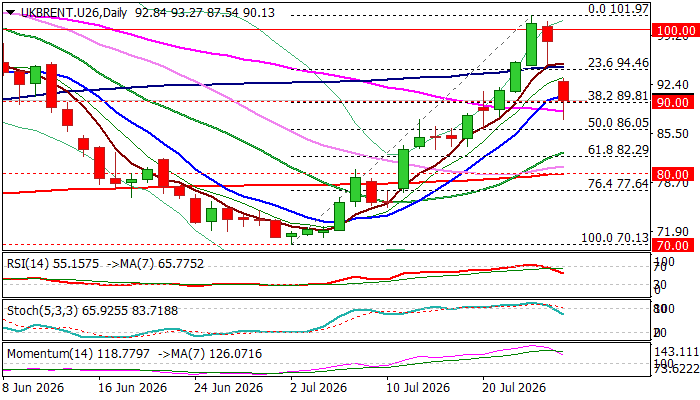
Brent price fell over 10% on Monday (down 5.5% on opening) driven by fresh wave of optimism after US and Iran paused hostilities, reviving hopes that diplomacy may replace attacks and lead towards possible solution.
The action came at the right time, as oil price cracked critical barrier at $100 (violation of which would have significant psychological impact on the markets and push global economy further towards deep crisis).
Oil prices fell sharply after a false break above $100 and hit the lowest levels in one week ($87.54) with violation of next strong support at $90 zone (daily cloud base / psychological / Fibo 38.2% of $70.13/$101.97), on track to generate fresh negative signal (on clear break lower).
Meanwhile, profit-taking after 10% drop slowed the action, with so far limited upticks likely to signal consolidation ahead of fresh push lower (in case fundamentals remain unchanged or improve further).
Sustained break of $90 zone and 55DMA ($88.66) to expose Fibo support at $86.05 (50% retracement of $70.13/$101.97).
Res: 90.83; 91.95; 93.27; 94.80
Sup: 88.66; 87.52; 86.05; 83.80
Eco Data 7/28/26
| GMT | Ccy | Events | Act | Cons | Prev | Rev |
|---|---|---|---|---|---|---|
| 12:30 | USD | Goods Trade Balance (USD) Jun P | -101.5B | -98.0B | -106.5B | -105.9B |
| 12:30 | USD | Wholesale Inventories Jun P | 0.30% | 0.20% | 0.10% | |
| 13:00 | USD | Housing Price Index M/M May | 0.30% | 0.10% | -0.10% | |
| 14:00 | USD | Consumer Confidence Jul | 90.8 | 92.1 | 91.2 | 92.2 |
| 12:30 | USD |
| Goods Trade Balance (USD) Jun P | |
| Actual | -101.5B |
| Consensus | -98.0B |
| Previous | -106.5B |
| Revised | -105.9B |
| 12:30 | USD |
| Wholesale Inventories Jun P | |
| Actual | 0.30% |
| Consensus | 0.20% |
| Previous | 0.10% |
| 13:00 | USD |
| Housing Price Index M/M May | |
| Actual | 0.30% |
| Consensus | 0.10% |
| Previous | -0.10% |
| 14:00 | USD |
| Consumer Confidence Jul | |
| Actual | 90.8 |
| Consensus | 92.1 |
| Previous | 91.2 |
| Revised | 92.2 |
Sunset Market Commentary
Markets
Guided by some kind of 'no news is good news' motto, markets show some further relieve as the US and Iran didn't exchange any additional military strikes since Friday. The path toward restoring a (lasting) (free?) passage of traffic through the Strait of Hormuz and/or the Bab-el-Mandeb Strait probably remains a complex procedure. Even so, markets at least again see the glass a bit more half full rather than half empty. The Brent oil price temporarily dropped below the $90 reference (currently again $91). In similar move, the Dutch TTF gas reference contract also falls to €59.75 p/Mwh to be compared with peak levels at €64 end last week. The energy momentum trade to some extent spills over to core interest rate/bond markets. US yields are easing between 1.5 bps (2-y) and 3.5 bps (30-y). German bunds slightly outperform (yields declining 3-4 bps across the curve). However, in broader perspective today's move doesn't profoundly change the technical picture after recent (protracted) rise in yields. At best, the test of recent (ST or even multi-year) peak levels has been put on hold. Especially US money markets see this decline in oil prices (even after softer than expected US Juni CPI data), as not enough to extinguish the debate on a Fed rate hike as soon as Wednesday (still +/- 33% discounted). In EMU, the two year swap yield struggles to return below 3.0%. ECB Chair Lagarde at last week's press conference suggested the possibility that another MoU or other good news from the conflict in the Middle East might not have to same positive impact of previous announcements ('once burned, twice shy'). Maybe EMU interest rate markets currently apply this kind of thinking as visibility remains low. ECB's Kazimir at least also advocated that some further tightening is needed, even if the situation 'improves somewhat'. Stocks get some relief (Eurostoxx 50 +0.9%, S&P 500 +0.8%, Nasdaq +0.9%). However, especially for US equities (and in particular for the Tech sector) question remains what will be the dominant factor: A milder global context or investors' assessment on the sustainability of the AI driven rally? (Cf Microsoft, Meta, Apple and Amazon results later this week, amongst many others).
On FX markets, the dollar quite easily resists current 'risk rebound'. DXY at 101.4 keeps the June top (101.8) within reach. An initial EUR/USD attempt to regain the 1.14 barrier this morning failed (currently 1.1385). At 163.7, USD/JPY is also only a whisker away from its multi-year/decade top. Investors apparently stay cautious on holding USD shorts going into a more unpredictable Fed policy meeting. Contrary to Friday, sterling this time doesn't profit from the milder global context. EUR/GBP even gained slightly to trade near 0.855.
News & Views
The July Business Climate Index of the German IFO institute showed a further improvement in Business Sentiment in the country. The Business climate index climbed from 85.7 to 86.6. The rise was due to a substantial improvement in the expectations component (from 84.3 to 86.7). Companies were a bit less satisfied with their current business performance (86.5 from 87.0). Even so, Ifo analyzes that companies have become less pessimistic despite the uncertain situation in the Persian Gulf. Sentiment improved in the four sectors reported (Manufacturing, services, trade & construction). Especially the index of the manufacturing sector rose noticeably (balance from -12.5 to -9.6). In manufacturing, it was also expectations that drove the improvement. Demand picked up, and material shortages were reported to have eased. In the service sector, business climate also improved (balance -4.4 from -5.1). Service providers were also less skeptical about the coming months. The trade subindex balance improved from -26.7 to -23.4. Even construction sentiment picked up (-20.4 from -22.8) as fewer companies reported a lack of orders.
According to the distributive trades survey of the Confederation of British Industry (CBI), retail sales volumes fell at a markedly slower pace in the year to July with the indicator rising from -54% to -26%. Retailers still judged July's sales below seasonal norms, though also to a considerably lesser degree than last month (-18 from -40). Sales are expected to fall at a similar pace next month as was the case in July (-26%) and are set to fall short of seasonal norms to a greater extent (-29%). Wholesale sales volumes were broadly unchanged in the year to July (+2% from -20% in June), ending a run of 25 months of decline. However, wholesalers expect sales to fall again next month (-7%). CBI economist Martin Sartorius commented that "Retailers reported that the ongoing sales downturn lost steam in July, but a recovery still looks some way off as gloomy sentiment and elevated cost pressures weigh on activity." CBI also said it looks forward to broader business rates reform from the new Prime Minister to address key constraints on investment and growth and also called on the government to take further action to tackle rising labour costs.
Markets Cheer Pause in US-Iran Conflict, but Hormuz Closure Clouds Outlook
Risk sentiment improved markedly at the start of the week after the United States and Iran suspended military strikes over the weekend, encouraging investors to unwind part of last week's geopolitical premium. Brent crude, which briefly traded above the psychologically important $100 mark last week amid fears of a prolonged supply disruption, opened sharply lower with a sizeable downside gap before stabilizing around $85. The retreat in oil prices eased immediate concerns about another inflation shock and helped revive demand for risk assets.
The improvement in sentiment was reflected across global equity markets. In Asia, Nikkei closed 0.50% higher while KOSPI gained 0.97%. European markets extended the rally, with Germany's DAX outperforming by more than 1.5% at the time of writing. US equity futures also pointed to a strong Wall Street open, with Dow futures advancing more than 500 points. While these moves were far from euphoric, they suggested investors were willing to price in a scenario where the Middle East conflict stops short of developing into a sustained regional war capable of causing prolonged disruptions to global energy supplies.
However, the relief rally may be running ahead of developments on the ground. The US military halted two weeks of strikes to give diplomatic efforts "some space," while Iran has similarly refrained from attacking regional targets. Yet diplomacy remains indirect, with Washington and Tehran still communicating through intermediaries rather than engaging in formal negotiations. That leaves considerable uncertainty over whether the pause can evolve into a durable ceasefire.
More importantly for financial markets, the key driver behind last week's surge in oil prices remains unresolved. Iran's Foreign Ministry spokesperson Esmail Baghaei reiterated on Monday that "the situation in the Strait of Hormuz has not changed and it is still closed." In other words, while missiles may have stopped flying for now, one of the world's most important energy shipping lanes remains shut. Traffic through Hormuz continues to be severely disrupted, while attacks affecting shipping in the Red Sea have yet to normalize. The simultaneous disruption of both Gulf and Red Sea export routes continues to pose a significant risk to global energy supply chains.
That distinction between military de-escalation and physical supply normalization is important. Financial markets can remove geopolitical risk premium quickly once tensions appear to ease, but restoring shipping flows is a much slower process involving security assessments, insurance costs and the gradual return of commercial traffic. Unless meaningful progress is made toward reopening Hormuz, oil prices could regain some of the lost risk premium even if direct military confrontation remains paused.
Beyond geopolitics, markets now face a busy week for central banks. The Federal Reserve, Bank of England and Bank of Japan will all announce policy decisions within the next few days, and although each is widely expected to leave interest rates unchanged, the accompanying guidance could prove far more important than the decisions themselves.
The Fed arguably carries the greatest uncertainty. Under Chair Kevin Warsh, the FOMC has shifted toward shorter policy statements and significantly reduced forward guidance, placing greater emphasis on the voting pattern itself. Minutes from the previous meeting showed that several officials had already been prepared to vote for an immediate rate hike before agreeing to wait for more evidence. Markets will therefore pay close attention to whether more policymakers formally dissent in favor of tighter policy, providing another indication that the Committee continues to lean toward further rate increases if inflation risks persist.
The BoJ also retains considerable surprise potential. Recent media reports suggest policymakers are increasingly open to accelerating the pace of policy normalization from roughly one hike every six months to something closer to quarterly adjustments. Whether that shift materializes will depend heavily on the Bank's updated Outlook Report and whether revised inflation and growth forecasts justify a faster tightening cycle. Meanwhile, at the BoE, the spotlight will fall on whether concerns over persistent inflation, previously highlighted by external MPC member Megan Greene and Chief Economist Huw Pill, begin to attract broader support within the Committee.
Currency markets reflected the cautious improvement in sentiment rather than the start of a new trend. Swiss Franc outperformed as falling oil prices reduced pressure for additional global policy tightening, while Aussie found support from improved risk appetite ahead of this week's monthly CPI release. Canadian Dollar lagged as crude prices retreated. Yet despite these relative moves, almost every major currency pair and cross remained comfortably inside last week's trading ranges. That suggests investors are consolidating positions rather than establishing fresh directional trades, waiting for this week's central bank decisions—and developments in the Middle East—to determine the next major move.
Will the Fed and BoJ Trigger USD/JPY's Biggest Move This Week?
Three major central banks will announce policy decisions within 60 hours, but USD/JPY stands out as the week's key market to watch. While both the Fed and BoJ are expected to hold rates, the Fed's voting split, Chair Kevin Warsh's assessment of inflation risks, and the BoJ's updated Outlook Report could significantly reshape interest-rate expectations. With USD/JPY already at a 40-year high, even modest policy surprises could trigger outsized moves. Read More.
Is Brent Oil's Gap Lower a Bull Trap in Disguise?
Brent oil gapped sharply lower after US and Iranian attacks paused over the weekend, but physical supply conditions have barely improved. Hormuz traffic remains at a fraction of pre-war levels, while disruption at Bab el-Mandeb has worsened following attacks on Saudi oil infrastructure. A quick recovery above $90 would suggest the selloff mainly cleared crowded long positions, while sustained trading below 86.07 and the 55-day EMA would weaken the bullish outlook. Read More.
US Durable Goods Orders Rise 0.3%, But Growth Misses Expectations
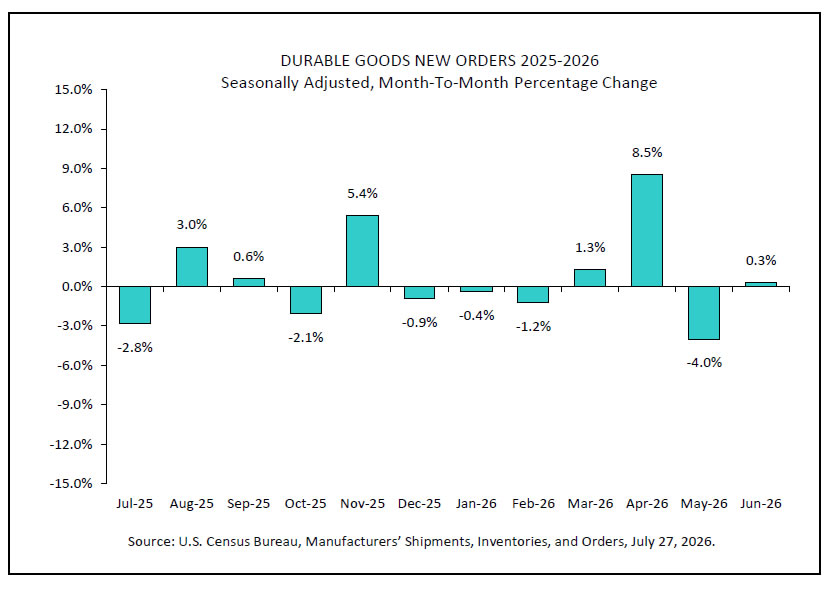
US durable goods orders rose 0.3% in June after May's- 4.0% decline, returning to growth but missing market expectations. Despite the softer headline, underlying demand remained resilient, with orders excluding transportation rising 0.6% and computers and electronic products posting another strong gain. The report points to moderating, rather than weakening, business investment. Read More.
ECB’s Kazimir Sees At Least One More Rate Hike, Warns Oil Shock Could Require More
ECB Governing Council member Peter Kazimir reinforced the case for another interest rate hike, saying "at least one more hike will be needed" and warning that a worsening energy shock could require even more tightening than markets currently expect. Meanwhile, Croatia's Ante Žigman said policymakers remain data dependent, with the intensity and duration of the energy shock likely to determine the ECB's next steps. Read More.
Germany's Ifo Business Climate Hits Five-Month as Manufacturing and Trade Recover
Germany's Ifo Business Climate Index rose to 86.6 in July from 85.7, marking a third consecutive monthly increase as companies became significantly more optimistic about the months ahead. Manufacturing, services, trade and construction all reported improving sentiment, although firms were slightly less satisfied with current business conditions. The survey suggests Germany's economy continues to stabilize, with expectations recovering faster than actual activity despite ongoing uncertainty in the Persian Gulf. Read More.
US Durable Goods Orders Rise 0.3%, But Growth Misses Expectations
New orders for U.S. manufactured durable goods rose 0.3% mom in June, returning to positive territory after May's revised -4.0% decline but falling short of expectations for a 1.6% increase. Excluding transportation, orders increased 0.6%, also below the 0.9% consensus, while orders excluding defense edged up 0.3%. Although the headline figures disappointed, the report showed business investment remained on a positive footing rather than slipping back into contraction.
The underlying details were broadly constructive. Durable goods orders have now increased in three of the past four months, suggesting May's sharp decline was more of a setback than the start of a sustained downturn. Technology-related demand continued to stand out, with computers and electronic products rising 3.1%, marking gains in nine of the past ten months. The sector's strength highlights continued investment in digital infrastructure and advanced manufacturing, helping offset softer performance elsewhere.
Overall, the report points to moderating rather than weakening manufacturing activity. The slowdown from April's surge and May's sharp correction suggests order growth is normalizing, while positive readings in both headline and core measures indicate business spending remains resilient.
Economic Data Summary
| Indicator | Actual | Expected | Previous |
|---|---|---|---|
| Durable Goods Orders (Jun) | 0.3% m/m | 1.6% | -4.0% |
| Durable Goods Orders ex Transportation | 0.6% m/m | 0.9% | 1.4% |
| Durable Goods Orders ex Defense | 0.3% m/m | — | -4.3% |
Key Takeaways
- US durable goods orders returned to growth in June, rising 0.3% m/m after May's revised 4.0% decline, although the rebound fell well short of market expectations.
- Underlying business investment remained resilient. Orders excluding transportation increased 0.6%, while orders excluding defense also posted a 0.3% gain, indicating manufacturing demand continued to expand despite a slower pace.
- Technology remained a bright spot. Orders for computers and electronic products rose 3.1%, extending gains to nine of the past ten months and highlighting continued investment in digital infrastructure and advanced manufacturing.
- The report suggests normalization rather than deterioration. Durable goods orders have now increased in three of the last four months, implying May's sharp decline was more of a correction following April's surge than the start of a sustained downturn.
It’s Time to Weigh Up the Risks for the S&P 500
- The US stock market is not factoring in the existing risks.
- Investors are increasingly focusing on the cash flows of S&P 500 companies.
US stock indices have closed in the red the last two weeks, something that hasn’t happened since March. The stock market has weathered both the armed conflict in the Middle East and rising expectations of a tighter Fed policy, along with the associated rise in Treasury bond yields. Despite these headwinds, the S&P 500 is just 3% under its record high. However, investors are increasingly asking themselves: Is there a limit to how long this resilience can last?
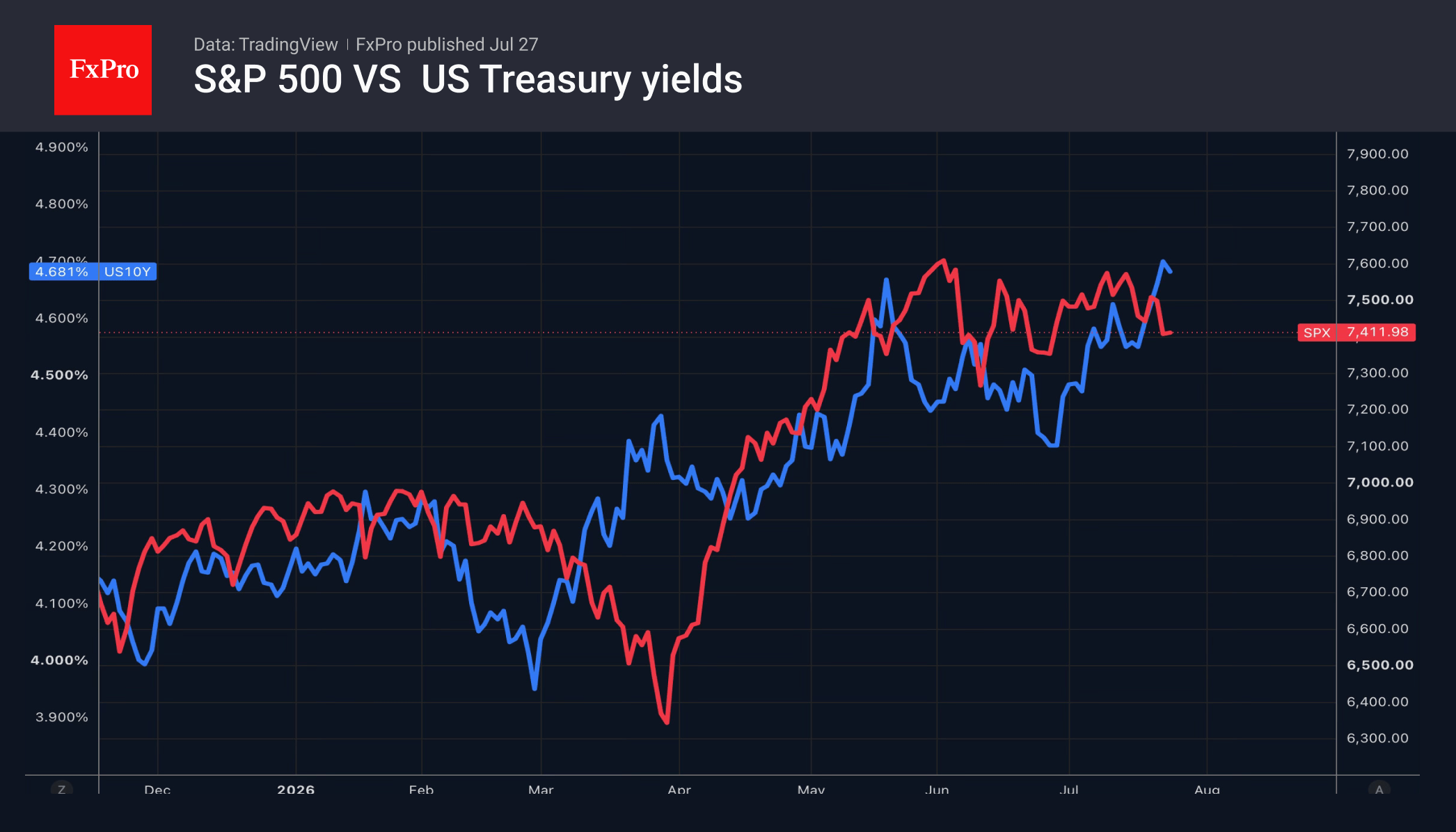
According to Bank of America, the markets are operating on the assumption that everything is going well and are failing to factor in existing risks. Investor expectations regarding profit margins, five-year forward earnings growth and other indicators are at record levels, whilst risk premiums have slipped to 20-year lows. There is a complete lack of fear in the equity market, and this could lead to a 7–8% fall in the S&P 500 if negative events materialise.
Adverse factors include the conflict in the Middle East and everything associated with it, including the rally in oil prices, Treasury yields and the increased likelihood of a Fed rate rise. Furthermore, Bank of America notes the low return on investment in AI and the high costs incurred by companies in funding research in this area. This combination is forcing investors to focus on cash flow rather than profit. Alphabet’s negative cash flow sent the entire market tumbling.
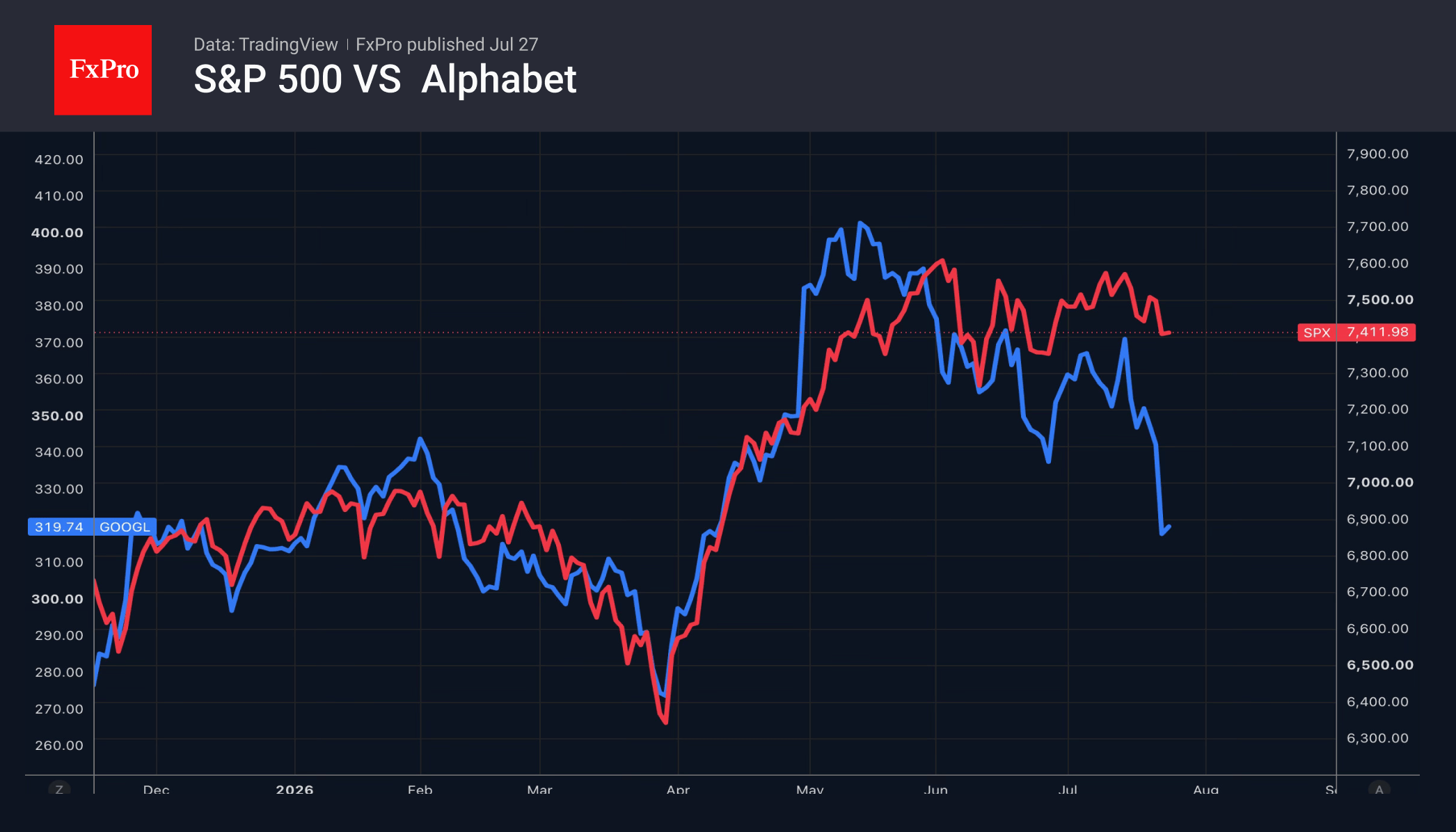
In the final week of July, more than a third of S&P 500 companies by market capitalisation will be reporting their results. If cash flow issues emerge at Microsoft, Meta Platforms, Amazon and Apple, the correction in the broad stock index risks continuing.
On the other hand, the stock market may breathe a sigh of relief. The ceasefire in the Middle East, coupled with the de-escalation, falling oil prices and a decline in Treasury bond yields, is reducing the geopolitical risk premium. At the same time, the Fed may be able to afford to be less ‘hawkish’ than investors expect. A ‘TACO’ rebound, coupled with the federal funds rate being held steady, could breathe new life into the S&P 500. The key is that the tech giants’ earnings reports do not disappoint.
The FxPro Analyst Team
EUR/USD Daily Outlook
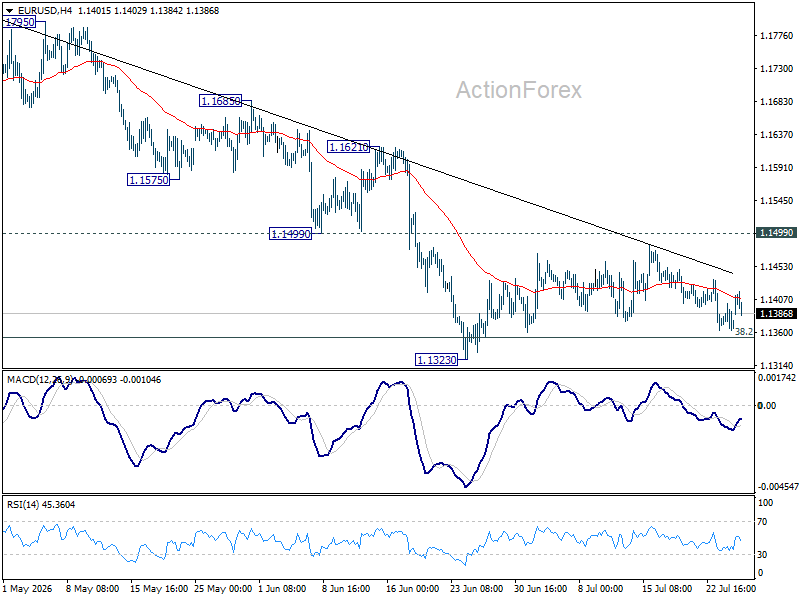
Intraday bias in EUR/USD remains neutral for the moment as consolidations continue above 1.1323. Outlook stays bearish with 11499 support turned resistance intact. On the downside, break of 1.1323 will resume the fall from 1.2081 to 100% projection of 1.2081 to 1.1408 from 1.1848 at 1.1175. However, decisive break of 1.1499 will turn bias back to the upside for 1.1621 resistance.
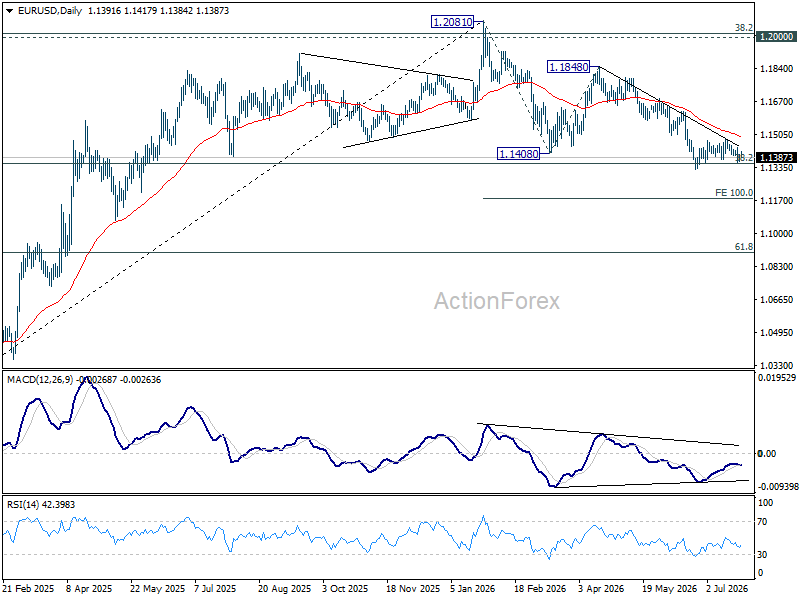
In the bigger picture, focus is back on 38.2% retracement of 1.0176 to 1.2081 at 1.1353. Decisive break there will revive the case of medium term bearish trend reversal after rejection by 1.2 key cluster resistance level. Further fall should be seen to 61.8% retracement at 1.0904. Nevertheless, strong rebound from 1.1353, followed by break of 1.1621 resistance, will retain medium term bullishness.
USD/JPY Daily Outlook
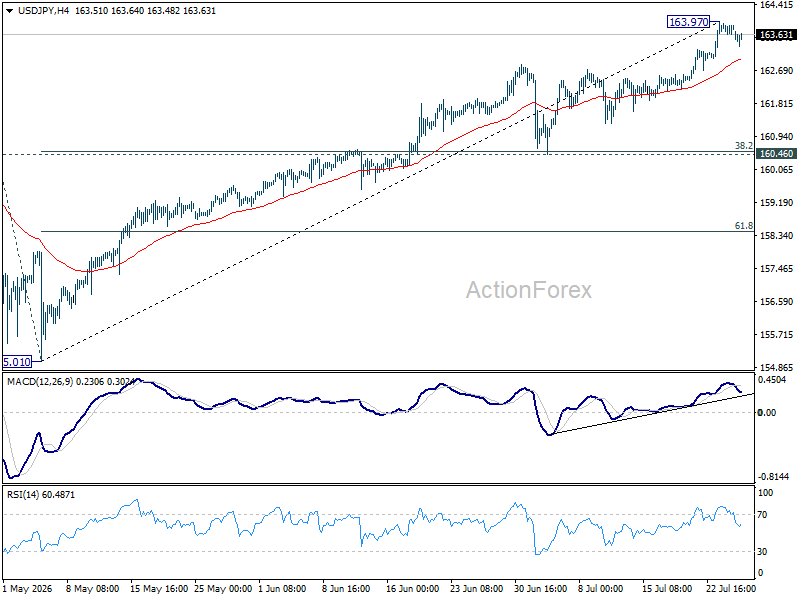
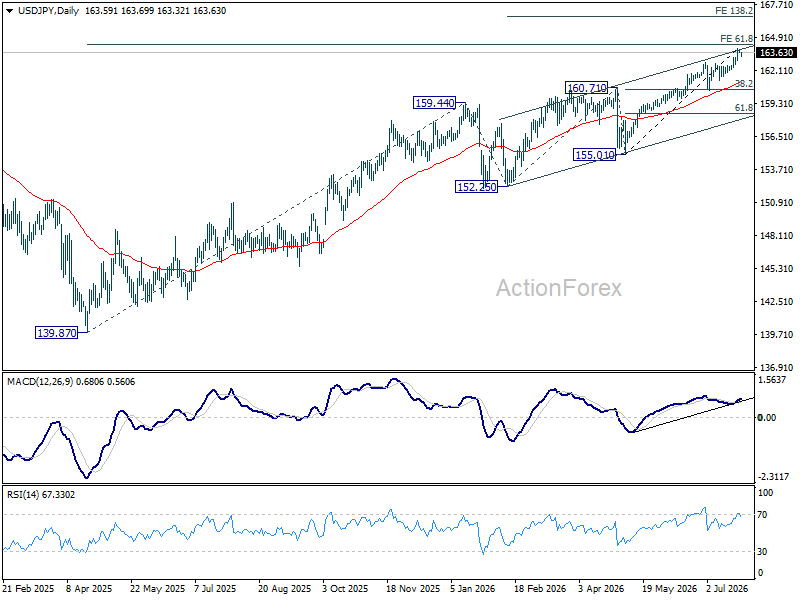
Intraday bias in USD/JPY is turned neutral with current retreat. Some consolidation should be seen but it should be brief as long as 55 4H EMA (now at 162.98) holds. Above 153.97 will resume larger up trend to 138.2% projection of 152.25 to 160.71 from 155.01 at 166.07. However, sustained break of 55 4H EMA will argue that it's already correcting the rise from 155.01, and bring deeper fall to 160.46 cluster support (38.2% retracement of 155.01 to 163.97 at 160.54.
In the bigger picture, rise from 139.87 (2025 low) is seen as another rising leg of the long term up trend. Next target is 61.8% projection of 139.87 to 159.44 from 152.25 at 164.34. Firm break there will target 100% projection at 171.82. For now, outlook will remain bullish as long as 159.44 resistance turned support holds, even in case of deep pullback.
USD/CHF Daily Outlook
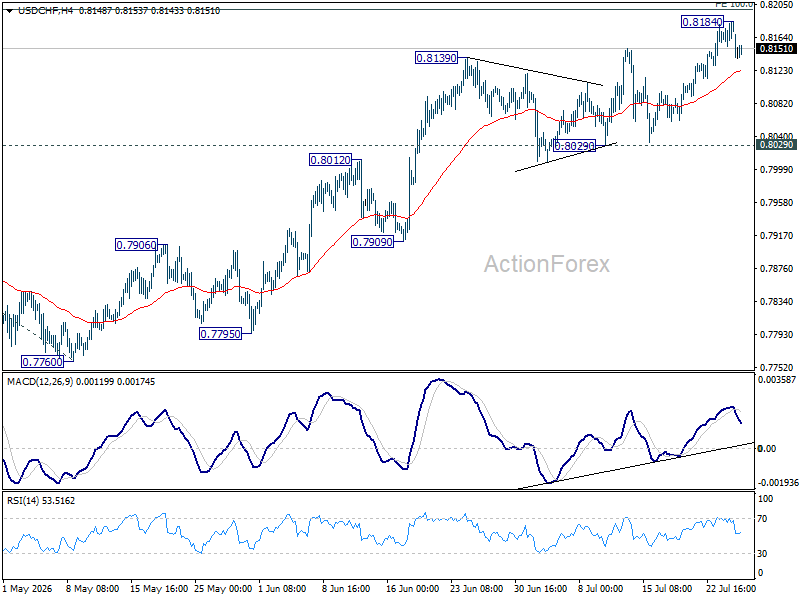
Intraday bias in USD/CHF is turned neutral with current retreat. Some consolidations could be seen but outlook will remain bullish as long as 0.8029 support holds. On the upside, decisive break of 100% projection 0.7603 to 0.8041 from 0.7600 at 0.8198 will target 161.8% projection at 0.8469.
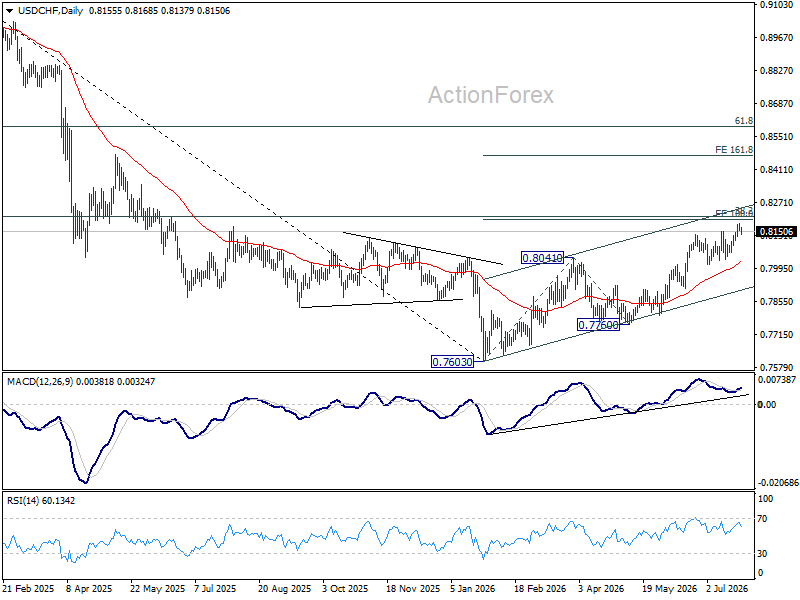
In the bigger picture, focus is now on 38.2% retracement of 0.9200 (2025 high) to 0.7603 at 0.8213. Decisive break will argue that USD/CHF is reversing the medium term trend, and turn focus to 0.8332 support turned resistance (2023 low) for confirmation. Nevertheless, rejection by 0.8213 will maintain medium term bearishness for another fall through 0.7603 at a later stage.
AUD/USD Daily Report
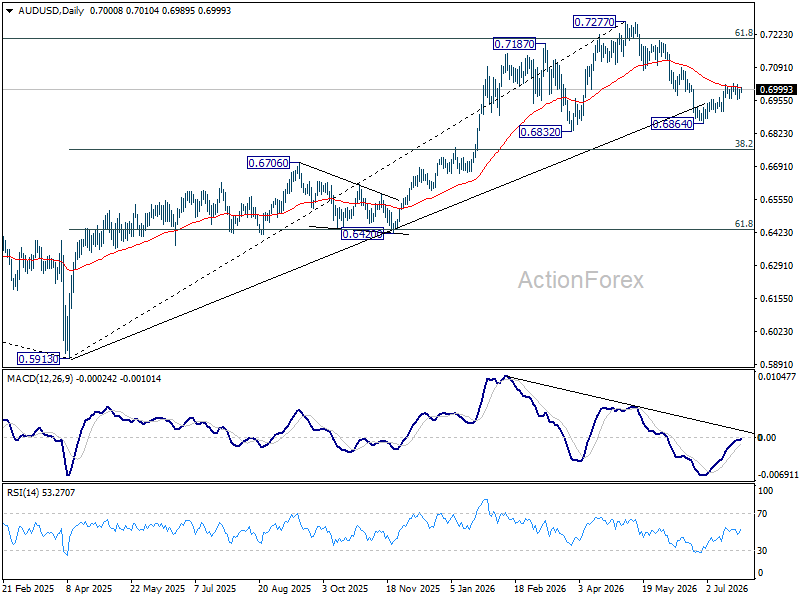
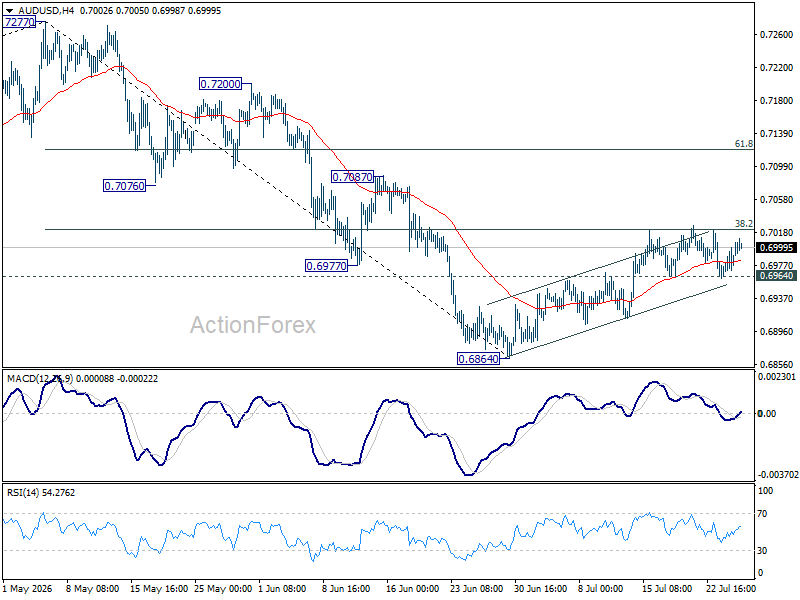
Intraday bias in AUD/USD remains neutral for the moment. On the downside, firm break of 0.6964 will argue that rebound from 0.6846 has completed as a correction, after rejection at 38.2% retracement of 0.7277 to 0.6864 at 0.7022. Intraday bias will be back to the downside for retesting 0.6864 low. However, sustained break of 0.7022 will bring stronger rally to 61.8% retracement at 0.7119 next.
In the bigger picture, considering bearish divergence condition in D MACD, a medium term top could be formed at 0.7277 after failing to sustain above 61.8% retracement of 0.8006 (2021 high) to 0.5913 (2024 low) at 0.7206. Deeper fall could be seen to 38.2% retracement of 0.5913 to 0.7277 at 0.6756 as a correction. But strong support should be seen there to bring rebound. Consolidations would continue below 0.7277 for a while.