

Sample Category Title
Bitcoin Falls Back Ahead of the High-Stakes Fed Decision
Key Highlights
- Bitcoin failed to surpass $65,650 and started a fresh decline.
- A key bearish trend line is forming with resistance at $64,500 on the 4-hour chart of BTC/USD.
- Ethereum also struggled above $1,920 and dipped from resistance.
- The Fed interest rate decision is scheduled, and the market forecast is no change from 3.75%.
Bitcoin Price Technical Analysis
Bitcoin price attempted to gain pace for a move above $65,500 against the US Dollar but failed. BTC trimmed most gains and signaled a downside break.
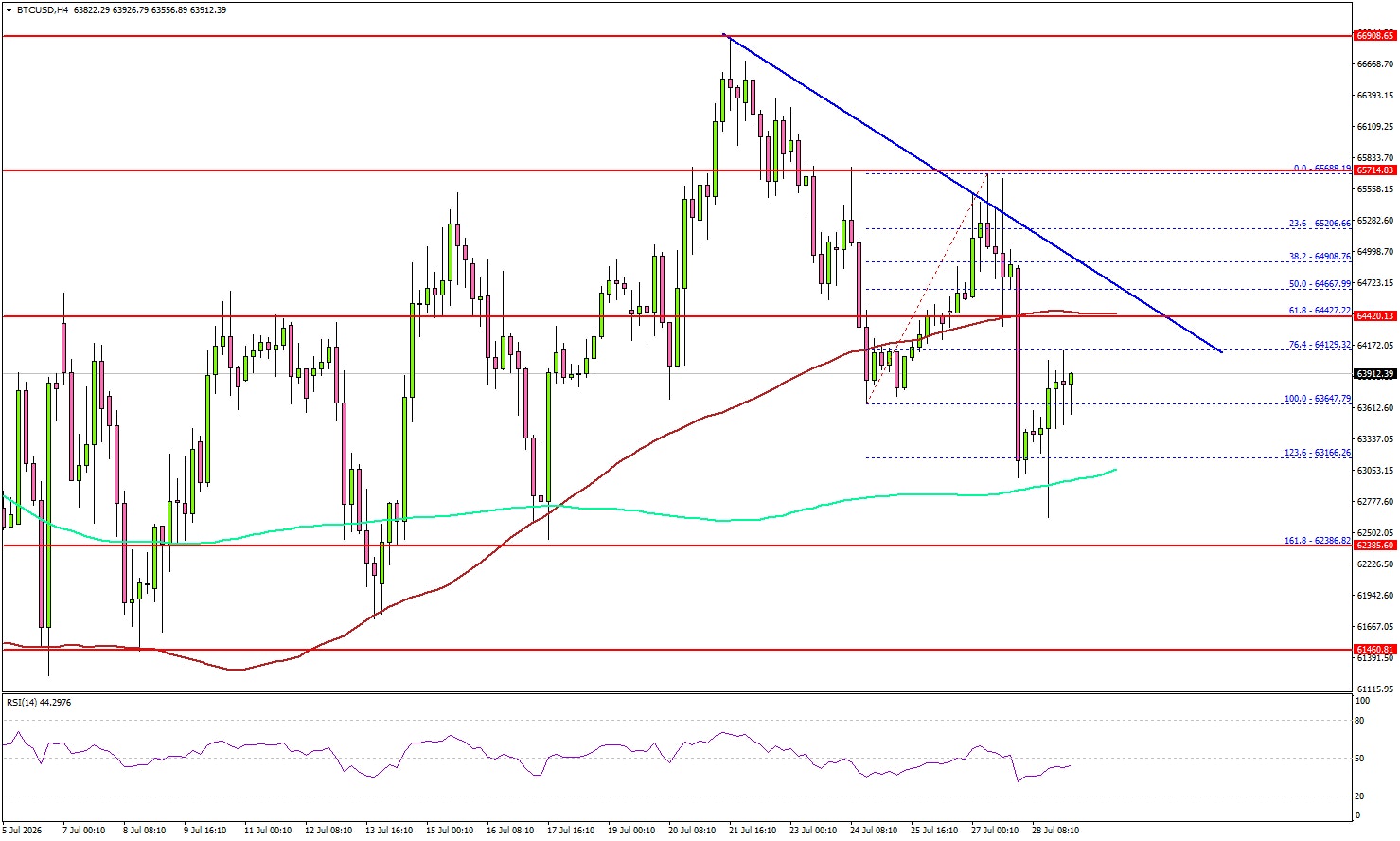
Looking at the 4-hour chart, the price formed a high near $65,688 and started a fresh decline. There was a move below $65,000 and $64,200. The price traded below the 76.4% Fib retracement level of the upward move from the $63,647 swing low to the $65,688 high.
More importantly, BTC settled below the 100 simple moving average (red, 4-hour) and tested the 200 simple moving average (green, 4-hour). If the bears remain in action, the price might find bids near the 1.236 Fib extension level at $62,385.
A downside break and close below $62,385 could trigger a sharp decline. In the stated scenario, the price could test $61,200 or even $60,500.
On the upside, an immediate resistance could be $64,200. The first major resistance might be $64,500 and a bearish trend line. The main resistance might be $65,650. A close above $65,650 could send the price toward $66,800. Any more gain might call for a test of $68,000.
Looking at Ethereum, the price trimmed some gains, and the bears might now aim for a drop below $1,820.
Today’s Key Economic Releases
- Fed Interest Rate Decision - Forecast 3.75%, versus 3.75% previous.
- Fed Monetary Policy Statement.
- FOMC Press Conference.
Australia Inflation Slows to 3.8% as Core CPI Misses Forecasts 3.6%
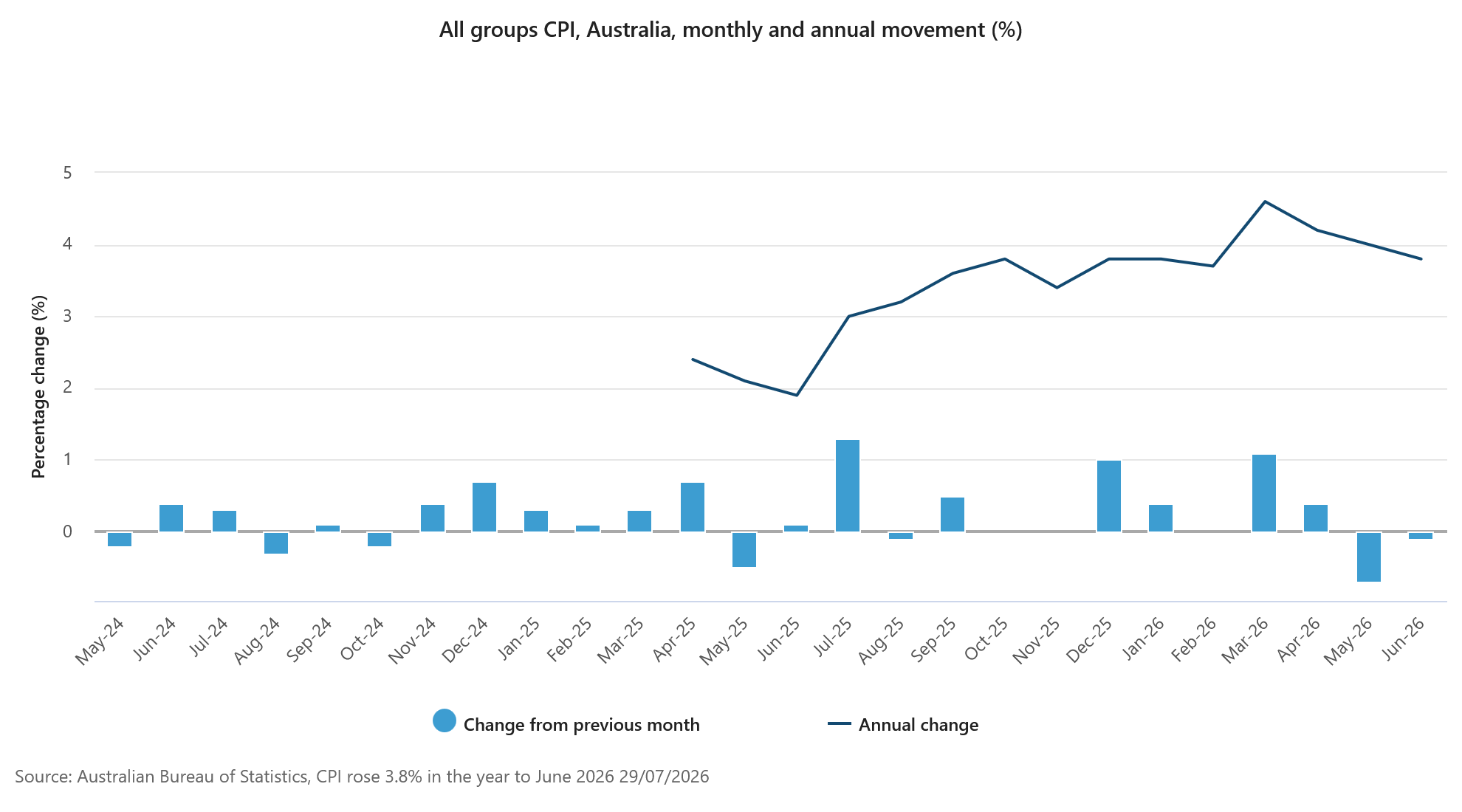
Australia's inflation report offered further evidence that price pressures are gradually easing, strengthening the case for the Reserve Bank of Australia to remain on hold in August. Both the quarterly and monthly measures came in softer than expected, while underlying inflation remained below the RBA's own forecasts. The outcome supports Governor Michele Bullock's recent assessment that inflation is evolving broadly as anticipated and suggests there is little pressing need to resume tightening immediately after three rate hikes already delivered this year.
The quarterly figures, which carry the greatest weight for RBA policy, were particularly encouraging. Headline CPI unexpectedly fell -0.1% qoq in the second quarter, compared with expectations for a 0.7% increase, after rising 1.4% in the first quarter. Annual headline inflation slowed from 4.1% to 3.8%. More importantly, quarterly trimmed mean inflation—the RBA's preferred gauge of underlying price pressures—rose 0.8% qoq, below the 0.9% consensus and matching the pace recorded in the first quarter. On an annual basis, trimmed mean inflation edged up from 3.5% to 3.6%, but remained below both the 3.7% market consensus and the RBA's own 3.8% forecast published in May.
The monthly CPI indicator told a similar story. Headline CPI slowed from 4.0% yoy in May to 3.8% yoy in June, while monthly trimmed mean inflation held steady at 3.6% yoy, undershooting expectations for a rise to 3.7%. On a monthly basis, both the trimmed mean and weighted median increased just 0.3%, while prices excluding volatile items and holiday travel were unchanged. Tradable and goods prices each declined -0.8% mom during the month, extending the disinflation trend in imported goods. Services inflation remained firmer at 4.0% yoy, while non-tradables rose 4.9% yoy, indicating that domestically generated inflation continues to moderate only gradually.
Taken together, the report reinforces the view that the RBA's tightening bias remains intact but the urgency to act has diminished. Inflation remains above target, meaning policymakers are unlikely to declare victory. However, with both headline and underlying inflation coming in below expectations—and trimmed mean inflation also below the RBA's own forecasts—the data give the Board little reason to abandon June's pause and rush into another rate increase in August.
Economic Data
Quarterly CPI (Q2 2026)
| Indicator | Actual | Expected | Previous |
|---|---|---|---|
| CPI q/q | -0.1% | 0.7% | 1.4% |
| CPI y/y | 3.8% | 4.1% | 4.1% |
| Trimmed Mean CPI q/q | 0.8% | 0.9% | 0.8% |
| Trimmed Mean CPI y/y | 3.6% | 3.7% | 3.5% |
Monthly CPI (June 2026)
| Indicator | Actual | Expected | Previous |
|---|---|---|---|
| CPI m/m | -0.1% | 0.2% | -0.7% |
| CPI y/y | 3.8% | 4.0% | 4.0% |
| Trimmed Mean CPI m/m | 0.3% | 0.4% | 0.4% |
| Trimmed Mean CPI y/y | 3.6% | 3.7% | 3.6% |
Key Takeaways
- Australia's inflation report was softer than expected across both the quarterly and monthly measures. Headline and trimmed mean inflation all undershot market forecasts.
- Quarterly trimmed mean inflation—the RBA's preferred measure—rose 0.8% q/q and 3.6% y/y, below both market expectations and the RBA's own May forecast of 3.8%.
- The monthly CPI indicator reinforced the quarterly message, with headline CPI slowing to 3.8% y/y and monthly trimmed mean inflation holding at 3.6% instead of rising as expected.
- The details point to broader disinflation rather than just lower fuel prices. Prices excluding volatile items and holiday travel were flat in June, while tradable and goods prices both fell 0.8%.
- Housing remained the largest source of inflation, rising 6.8% y/y, driven by electricity (+22.4%) following the expiry of government rebates and new dwelling costs (+5.8%) as builders passed through higher labour and material costs.
- Services and non-tradables remain sticky, with annual inflation of 4.0% and 4.9% respectively, indicating domestic inflation pressures have eased only gradually.
- For the RBA, the report weakens the case for an August rate hike. The Bank's tightening bias remains intact, but inflation is evolving slightly better than expected, giving policymakers more room to assess the cumulative impact of previous tightening.
FTSE 100 Wave Analysis
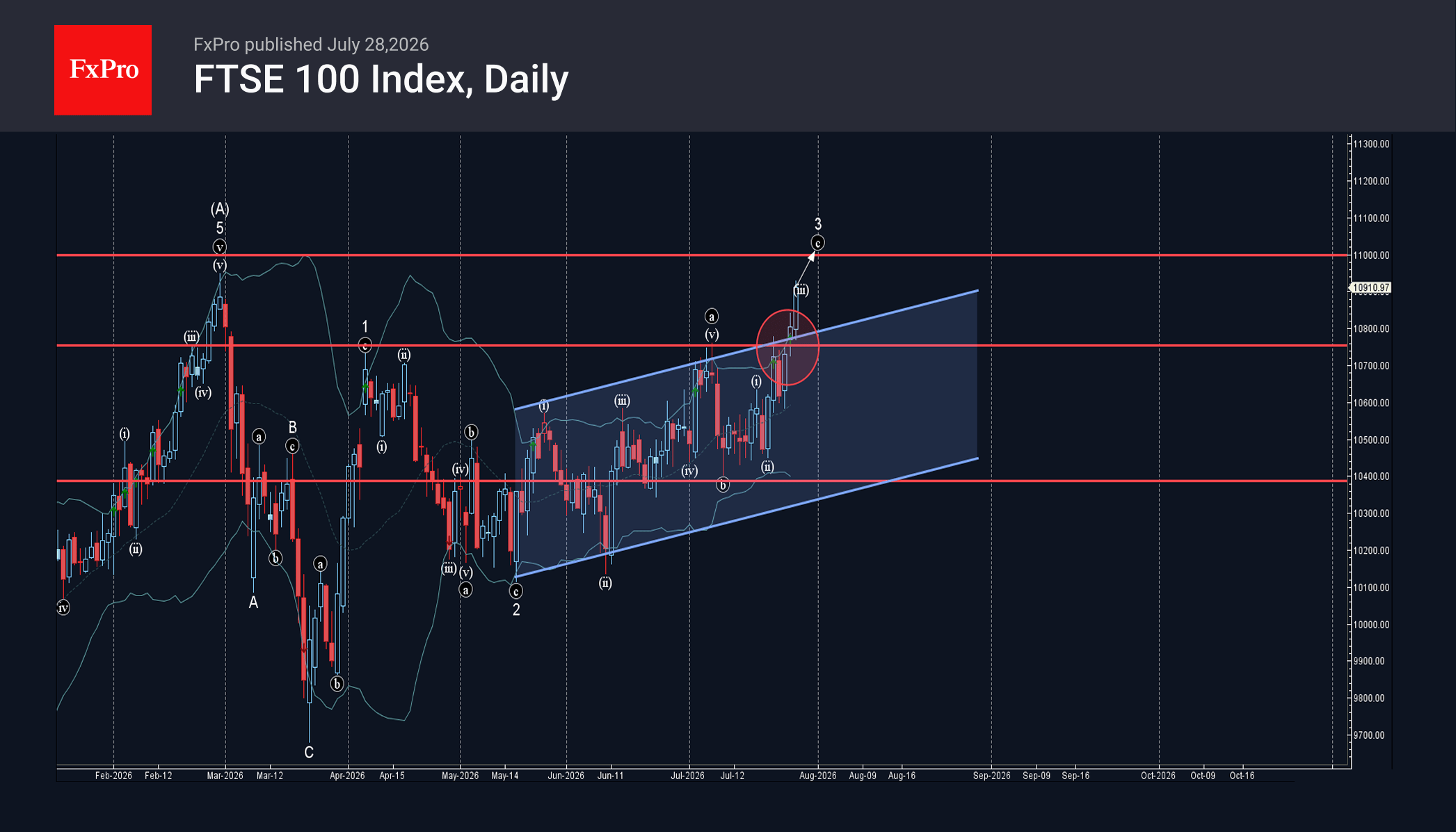
FTSE 100: ⬆️ Buy
– FTSE 100 broke resistance area
– Likely to rise to resistance level 11000.00
FTSE 100 index recently broke the resistance area between the key resistance level 10750.00 (which has been reversing the price from April) and the resistance trendline of the daily up channel from May.
The breakout of this resistance zone accelerated the active minor impulse wave 3 of the sharp intermediate impulse wave (C) from May.
FTSE 100 index can be expected to rise to the next resistance level 11000.00 – target price for the completion of the active impulse wave 3.
WTI Crude Oil Wave Analysis
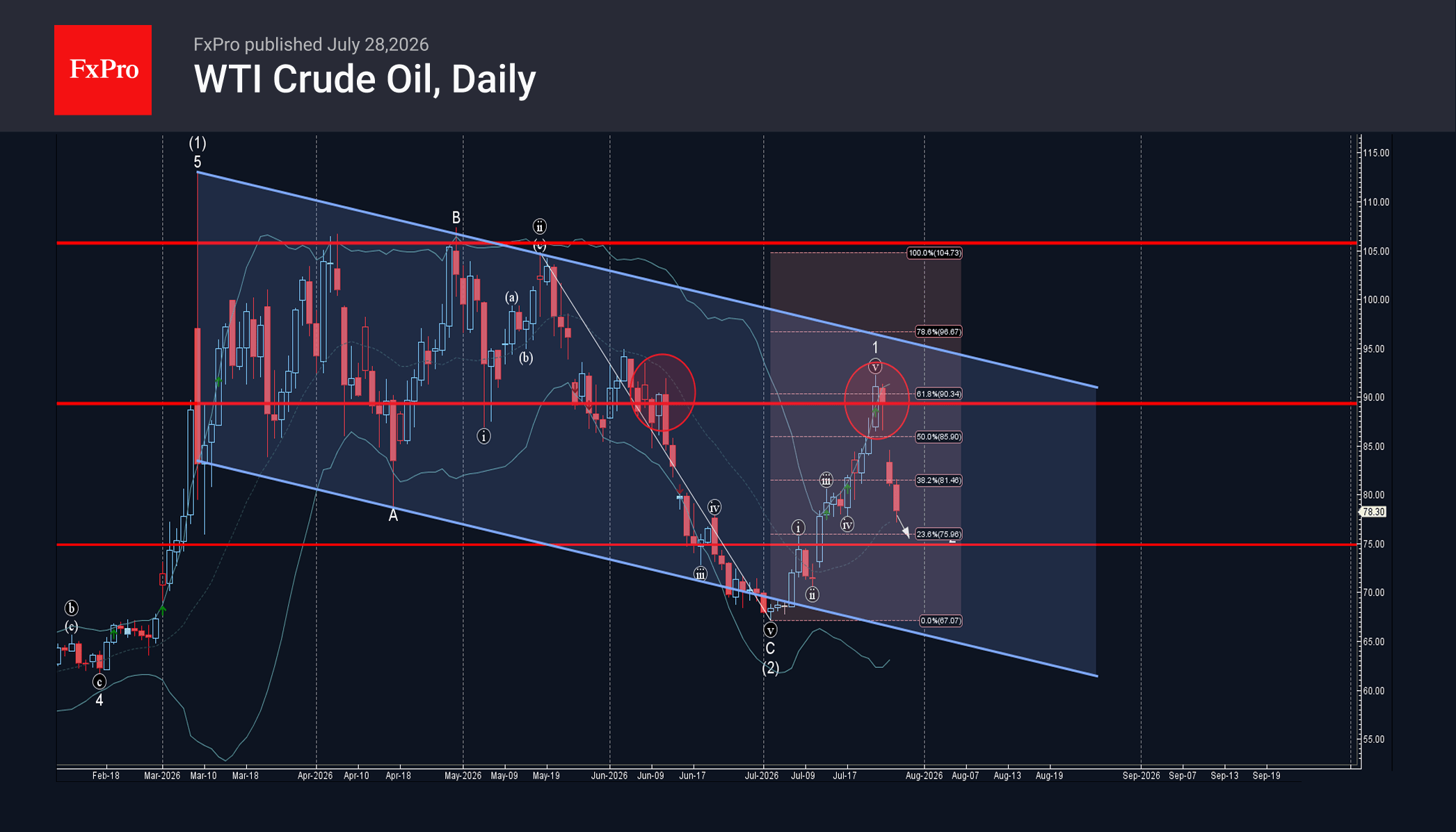
WTI Crude Oil: ⬇️ Sell
– WTI Crude Oil reversed from resistance area
– Likely to fall to support level 75.00
WTI Crude Oil recently reversed from the resistance area between the resistance level 90.00 (former strong support from May), upper daily Bollinger Band and the 61.8% Fibonacci correction of the downward impulse from May.
The downward reversal from this resistance zone stopped the previous minor impulse wave 1 from the start of July.
WTI Crude Oil can be expected to fall further to the next support level 75.00 – former resistance from the start of July.
Eco Data 7/29/26
| GMT | Ccy | Events | Act | Cons | Prev | Rev |
|---|---|---|---|---|---|---|
| 01:30 | AUD | CPI M/M Jun | -0.10% | 0.20% | -0.70% | |
| 01:30 | AUD | CPI Y/Y Jun | 3.80% | 4.00% | 4.00% | |
| 01:30 | AUD | Trimmed Mean CPI M/M Jun | 0.30% | 0.40% | 0.40% | |
| 01:30 | AUD | Trimmed Mean CPI Y/Y Jun | 3.60% | 3.70% | 3.60% | |
| 01:30 | AUD | CPI Q/Q Q2 | -0.10% | 0.70% | 1.40% | |
| 01:30 | AUD | CPI Y/Y Q2 | 3.80% | 4.10% | 4.10% | |
| 01:30 | AUD | Trimmed Mean CPI Q/Q Q2 | 0.80% | 0.90% | 0.80% | |
| 01:30 | AUD | Trimmed Mean CPI Y/Y Q2 | 3.60% | 3.70% | 3.50% | |
| 08:30 | GBP | M4 Money Supply M/M Jun | 0.80% | 0.20% | 0.10% | |
| 08:30 | GBP | Mortgage Approvals Jun | 58K | 56K | 56K | 57K |
| 14:30 | USD | Crude Oil Inventories (Jul 24) | -7.2M | -1.7M | 2.0M | |
| 18:00 | USD | Fed Interest Rate Decision | 3.75% | 3.75% | 3.75% | |
| 18:30 | USD | FOMC Press Conference |
| 01:30 | AUD |
| CPI M/M Jun | |
| Actual | -0.10% |
| Consensus | 0.20% |
| Previous | -0.70% |
| 01:30 | AUD |
| CPI Y/Y Jun | |
| Actual | 3.80% |
| Consensus | 4.00% |
| Previous | 4.00% |
| 01:30 | AUD |
| Trimmed Mean CPI M/M Jun | |
| Actual | 0.30% |
| Consensus | 0.40% |
| Previous | 0.40% |
| 01:30 | AUD |
| Trimmed Mean CPI Y/Y Jun | |
| Actual | 3.60% |
| Consensus | 3.70% |
| Previous | 3.60% |
| 01:30 | AUD |
| CPI Q/Q Q2 | |
| Actual | -0.10% |
| Consensus | 0.70% |
| Previous | 1.40% |
| 01:30 | AUD |
| CPI Y/Y Q2 | |
| Actual | 3.80% |
| Consensus | 4.10% |
| Previous | 4.10% |
| 01:30 | AUD |
| Trimmed Mean CPI Q/Q Q2 | |
| Actual | 0.80% |
| Consensus | 0.90% |
| Previous | 0.80% |
| 01:30 | AUD |
| Trimmed Mean CPI Y/Y Q2 | |
| Actual | 3.60% |
| Consensus | 3.70% |
| Previous | 3.50% |
| 08:30 | GBP |
| M4 Money Supply M/M Jun | |
| Actual | 0.80% |
| Consensus | 0.20% |
| Previous | 0.10% |
| 08:30 | GBP |
| Mortgage Approvals Jun | |
| Actual | 58K |
| Consensus | 56K |
| Previous | 56K |
| Revised | 57K |
| 14:30 | USD |
| Crude Oil Inventories (Jul 24) | |
| Actual | -7.2M |
| Consensus | -1.7M |
| Previous | 2.0M |
| 18:00 | USD |
| Fed Interest Rate Decision | |
| Actual | 3.75% |
| Consensus | 3.75% |
| Previous | 3.75% |
| 18:30 | USD |
| FOMC Press Conference | |
| Actual | |
| Consensus | |
| Previous | |
BoJ Set to Stay on Hold, But Can It Throw the Yen a Lifeline? – Preview
- BoJ expected to keep rates unchanged at 1.00% on July 31.
- Inflation overshoot warning likely to remain.
- Markets seek clues on the timing of the next hike.
- Can a hawkish tone assist the ailing yen?
Pause likely, spotlight on next hike and Takaichi's doves
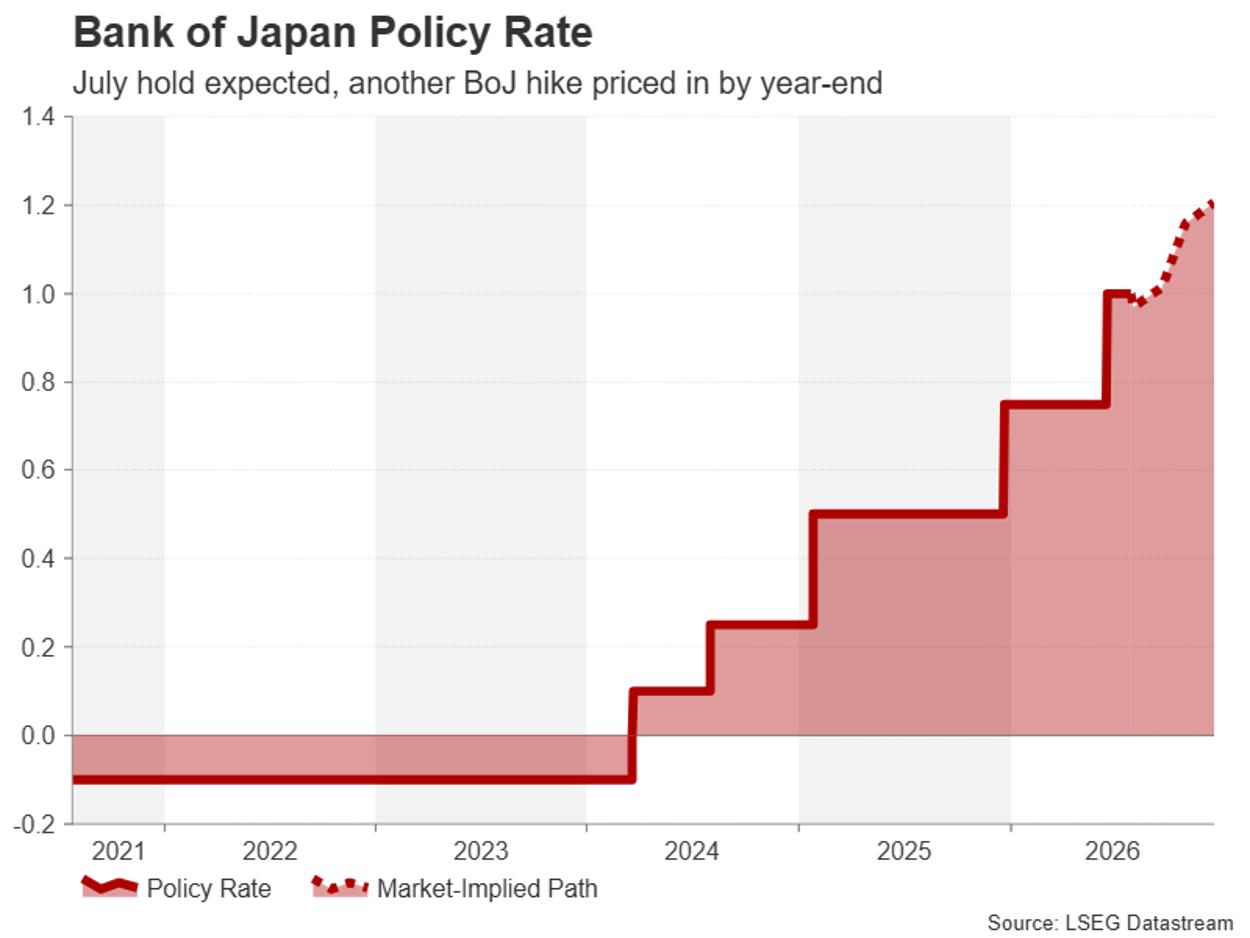
Having delivered a 25bp rate hike in June, lifting borrowing costs to a 31-year high, the Bank of Japan is widely expected to leave its policy rate unchanged at 1.00% on Friday. With no policy change anticipated, attention will shift to Governor Kazuo Ueda's guidance, the quarterly Outlook Report and any signals on the timing of the next rate hike.
While policymakers are likely to maintain a tightening bias, a broadly balanced message, even alongside a renewed warning about inflation overshooting the central bank's 2% target, would suggest policy continuity rather than a hawkish shift, potentially limiting the immediate market reaction. Nevertheless, inflation pressures linked to yen weakness, elevated energy costs and rising wage growth suggest the BoJ is unlikely to abandon its cautious normalization path.
December remains the market's base case for the next hike, which would lift rates to 1.25% by year-end. However, September or October could emerge as live meetings if inflation proves more persistent or the yen resumes its decline.
For Ueda, the challenge will be balancing support for the yen through hawkish communication while avoiding friction with a government wary of higher interest rates. Friday's meeting will also mark the first appearance of board member Ayano Sato, the second appointee of dovish PM Sanae Takaichi, adding to scrutiny over the balance of views within the policy board and what that could mean for the pace of the BoJ's normalization process.
BoJ to retain warning of inflation overshoot risk
The BoJ's quarterly Outlook Report is expected to show a somewhat stronger growth backdrop than projected in April, as concerns over a severe economic impact from Middle East tensions have eased.
At the same time, inflation forecasts may be revised slightly lower due to government subsidies and softer oil prices relative to earlier assumptions. Any downgrade is expected to be modest, however, as renewed energy-market volatility and rising import costs from a weak yen continue to pose upside risks.
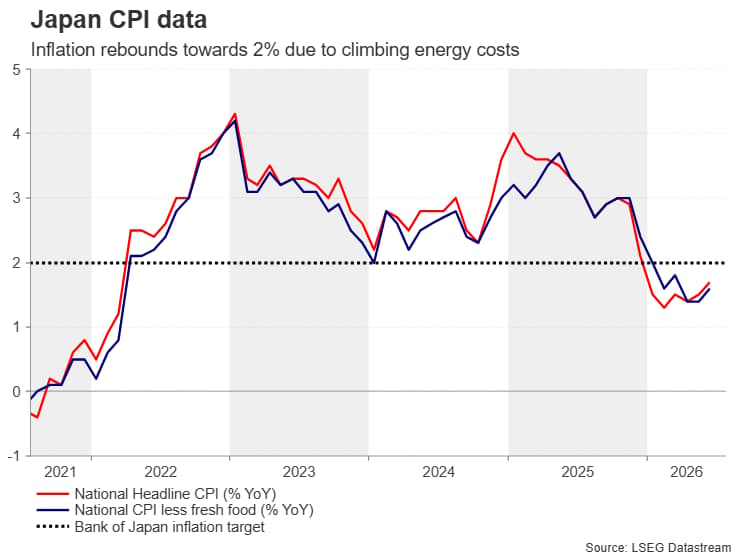
Recent inflation data has highlighted this balancing act. Japan's core CPI rose to 1.6% year-on-year in June from 1.4% previously, although it has remained below the BoJ's 2% target for several months. Policymakers nevertheless expect import costs, producer prices and currency weakness to support inflation later this year.
Importantly, the BoJ is expected to retain its warning that inflation could overshoot the 2% target, even as fears of an oil-driven price shock have moderated somewhat. With the BoJ having projected fiscal 2026 growth of 0.5% and core inflation of 2.8% in April, this week's forecast revisions could prove important for future rate expectations.
Rising JGB yields reinforce the hawkish case
Recent developments continue to support the case for further rate increases. The BoJ's latest Tankan survey showed corporate inflation expectations reaching record highs, while regional reports suggest many firms are preparing additional price increases in response to higher costs. Persistent yen weakness is also contributing to imported inflation pressures.
Meanwhile, more hawkish policymakers have argued that interest rates remain below neutral levels and may need to rise further. Japanese government bond yields also remain elevated, near multi-decade highs, reflecting expectations that policy normalization still has room to run.
Can the BoJ support the Yen?
Despite higher Japanese bond yields and expectations for additional tightening, the yen has struggled to gain traction. Investors remain unconvinced that the BoJ can turn significantly more hawkish, particularly given political sensitivities around higher borrowing costs. Markets are already pricing another rate hike by year-end, meaning policymakers may need to hint at a possible Autumn rather than late-year move to generate a more sustained yen recovery.
A cautious message from Ueda may keep pressure on the yen, while stronger warnings about inflation risks and a clearer commitment to further tightening could provide support.
USD/JPY remains pinned near multi-decade highs
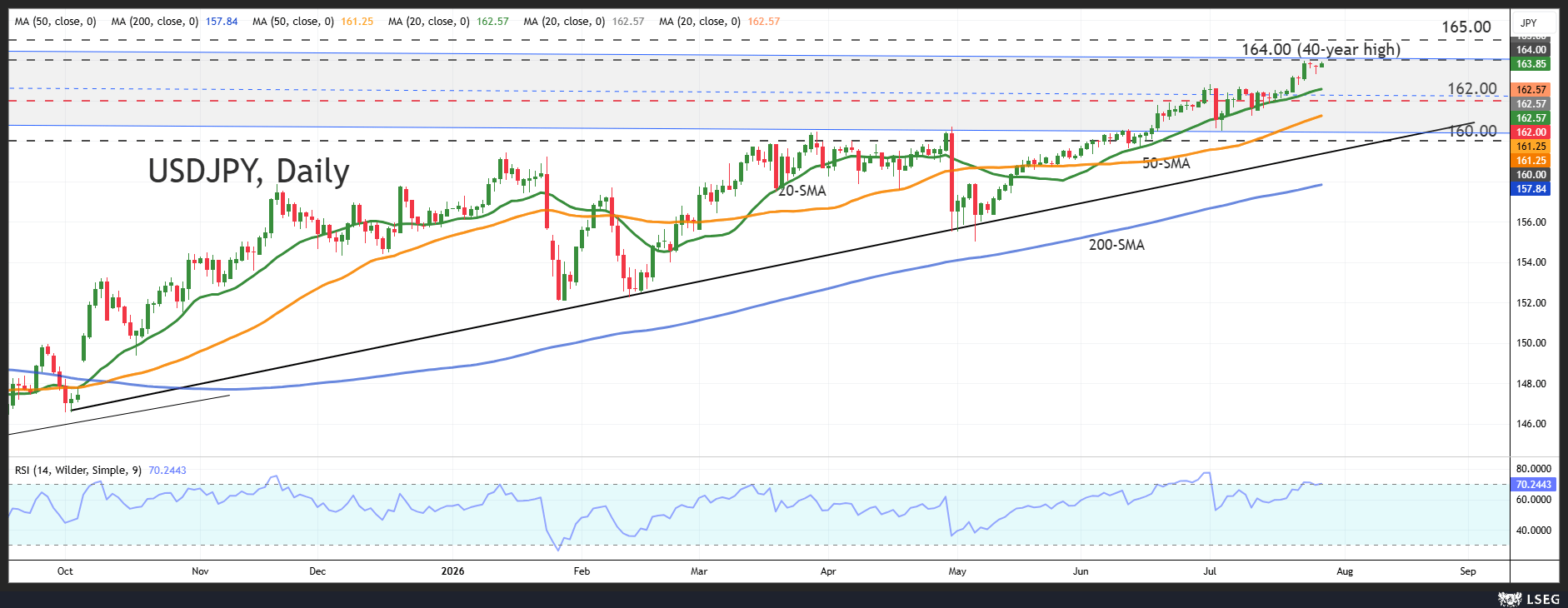
USD/JPY recently climbed to fresh 40-year highs near 164 before easing toward 163.50 levels on Tuesday, supported by the wide US-Japan yield gap and expectations that the Fed may keep policy restrictive for longer, leaving the broader bullish trend intact. Assuming that Japanese authorities don't intervene at 164, the next key resistance is seen around the 165.00 region, with a break potentially opening the door for fresh highs.
On the downside, a hawkish shift in BoJ communication, particularly if it revives intervention concerns from Tokyo, could trigger a pullback toward 162.00, with stronger support emerging around the 160.00 area.
Sunset Market Commentary
Markets
Today, volatility in tech related equities (and other assets) probably was at least as much of a focal point on global markets than was the case for the developments regarding the conflict in the Middle East. With respect to the conflict in Iran, US president Trump at least didn't bring much concrete news on the next steps in the process of reaching a deal with Iran. Brent oil this morning briefly dropped below $85 p/b, but currently again trades near $86.5 p/b. According to sources OPEC+ pauses its gradual output hikes after still a final increase in September. Of course, the impact of such a decision remains some kind of symbolic and any impact on prices is difficult to assess as long as disruptions in the export from in the Persian Gulf/Middle East region continue. The TTF European gas reference contract also didn't decline any further (€57.7 p/MWh). In this set-up there was also no big reason for yields to ease aggressively further. Markets consider current pause in the Iran conflict as to little to already profoundly change their assessment of CB policy going forward. At current levels for energy prices, some kind of high(er) for longer scenario for both the ECB and the Fed can't be ruled or even scaled back yet. US yields are easing between 2.3 bps (30-y) and 3.5 bps (2-y). Just call it wait-and-see trading ahead of tomorrow's Fed policy decision. Declines in German yields are even slightly less (2-y -1.8 bp, 30-y unchanged). In the meantime, all kinds of questions on sustainability of different aspects of the AI rally has become an additional factor of uncertainty and volatility on equity markets. At least for now, this kind of 'risk-off' apparently doesn't really help any kind of safe haven bid for core bond markets. One can even raise the question whether recent rise in real yields (as a risk premium) doesn't add to pressure at least on some assets in the tech sector. The Eurostoxx 50 initially trade about 0.5% higher, but couldn't hold to that gain (currently -0.2%). US indices also suggest some further sector rotation with the Dow rising 0.6%, but the Nasdaq again cedes 1.3%.
No clear trend in the major FX cross rates today. The dollar holds yesterday's gain, but with hardly any follow-through price action (EUR/USD 1.1370, DXY 105.5). USD/JPY again came very close to its multi-decade top (low for the yen) just below the 164 big figure. Markets in this respect keep an eye at tomorrow's Fed policy decision and the BOJ policy meeting on Friday. In the context of a 'hawkish' Fed holding to its commitment to deliver price stability, it will not be easy for the BOJ to balance its anti-inflation strategy against the government's growth agenda. In this respect, a rumored sales tax cut potentially to be announced in the near future, probably won't help fiscal credibility, and the yen. EUR/GBP today also showed no clear trend hovering near 0.855.
News & Views
According to the INSEE Monthly consumer survey, household confidence in France continued to recover in July. At 86, the indicator that summarizes the survey increased by 2 points, but remains below its long-term average (100). Even so, the survey showed rather broad-based improvements across sub-indices. In July, households' opinion regarding their personal financial situation, past (-26 from -28) and future (-14 from -16) has improved again and moved closer to their long-term averages. The proportion of households believing it is a good time to make major purchases has also increased (-36 from -38), but also remains below its long-term average. Households' opinion on future standard of living in France even has risen sharply again (-59 from -65), but still holds well below average. Households' fears about unemployment have fallen back sharply. Aside from the positive assessment on aspects of their personal situation, consumers' assessment on inflation also improved substantially. The proportion of households who consider that prices will accelerate over the next twelve months has fallen sharply (-33 from -15), the associated balance of opinion has declined by 8 points, after falling by 14 in June. It returns to nearly the same level as in February, before the beginning of the war in the Middle East, as well as to its long-term average.
US Consumer Confidence Falls to 90.8 in July, Expectations Remain Below Recession Threshold
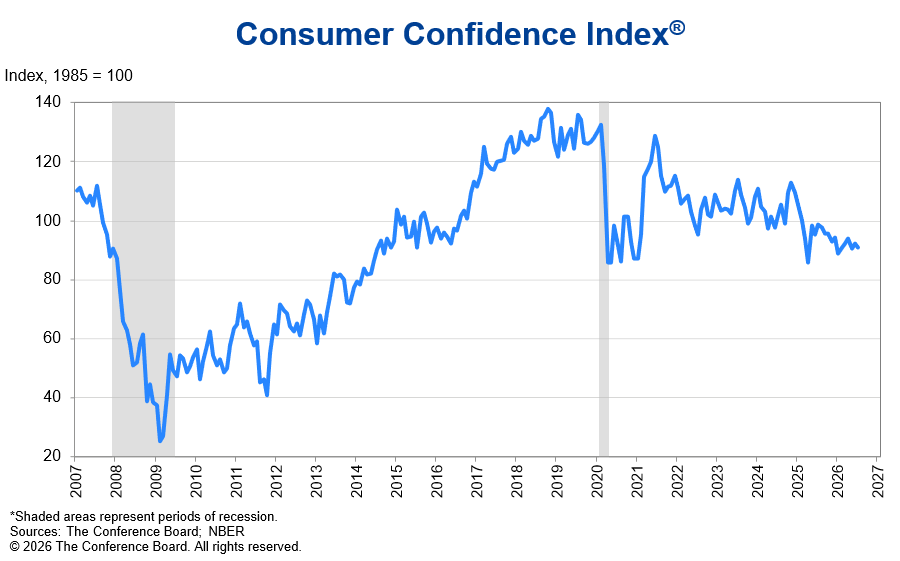
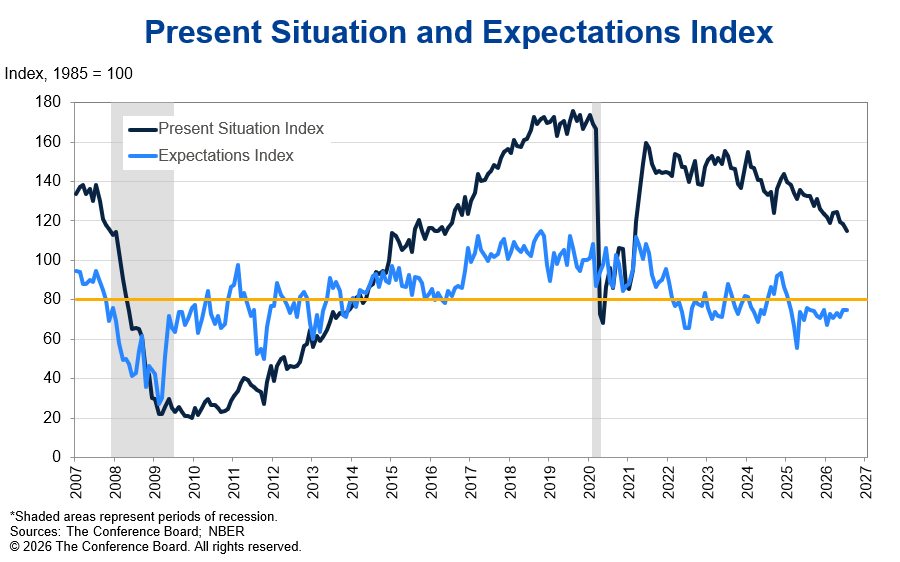
US consumer confidence weakened further in July as households grew less upbeat about current business conditions and the labor market, although easing inflation expectations offered a modest offset. The Conference Board's Consumer Confidence Index slipped -1.4 points to 90.8 from an upwardly revised 92.2 in June. The Present Situation Index fell -3.6 points to 114.9, marking its third consecutive monthly decline, while the Expectations Index held steady at 74.7—well below the 80 level that has historically been associated with recession risks.
The latest survey suggests consumers remain unconvinced that economic conditions will improve meaningfully in the months ahead. According to Dana M. Peterson, Chief Economist at The Conference Board, confidence has continued its gradual downtrend since late 2021 as assessments of current business conditions and, to a lesser extent, the labor market deteriorated further. While expectations for future employment became slightly less pessimistic, consumers continued to anticipate little improvement in overall business conditions over the next six months. Household income expectations also moderated, although they remained positive overall.
There were, however, some encouraging signs beneath the headline figures. Both average and median 12-month inflation expectations eased in July, suggesting consumers are becoming somewhat less concerned about future price pressures. Even after recent market volatility, households continued to expect stock prices to rise over the coming year. Meanwhile, 61.3% of respondents still anticipated higher interest rates over the next 12 months, unchanged from June, indicating consumers remain prepared for monetary policy to stay restrictive even as confidence gradually softens.
Economic Data
| Indicator | Actual | Previous |
|---|---|---|
| Consumer Confidence Index | 90.8 | 92.2 |
| Present Situation Index | 114.9 | 118.5 |
| Expectations Index | 74.7 | 74.7 |
| Average 12-mth Inflation Expectations | Lower | Higher |
| Median 12-mth Inflation Expectations | Lower | Higher |
Key Takeaways
- Consumer confidence fell for a second straight month, extending the gradual downtrend that has been in place since late 2021.
- The decline was driven by weaker assessments of current business conditions and the labor market, with the Present Situation Index falling for a third consecutive month.
- The Expectations Index remained at 74.7, below the 80 threshold that has historically been associated with recession risks, suggesting consumers remain cautious about the economic outlook.
- Consumers expect little improvement in business conditions over the next six months, although labor market expectations became slightly less pessimistic.
- Inflation expectations eased further, indicating households are becoming less concerned about future price pressures.
- Despite recent equity market volatility, consumers continued to expect stock prices to rise over the next year.
- A majority (61.3%) still expect interest rates to move higher over the coming 12 months, highlighting expectations that monetary policy will remain restrictive.
Full US Conference Board consumer confidence release here.
Dollar Rises as AI Rout Meets Sticky September Fed Hike Bets
Dollar pushed broadly higher on Tuesday as investors navigated a combination of deteriorating risk sentiment and persistent expectations that the Federal Reserve could still raise rates in September. A sharp selloff across global AI-related technology shares sparked an immediate flight into the greenback, while the continued resilience of Fed tightening expectations prevented Dollar buying from fading even as oil prices extended their sharp correction.
AI selloff sends shockwaves through Asian markets
Asian equity markets absorbed the worst of the selling. South Korea's KOSPI tumbled -10.84%, its largest daily loss since March 4, after plunging as much as -11.3% intraday, triggering a market-wide circuit breaker and briefly falling below the 6,000 level for the first time since April. Japan's Nikkei 225 lost -3.95%, ending at its weakest close in more than two months.
The semiconductor sector remained firmly in the spotlight. SK Hynix slid -14.7% after its ADRs posted record lows in New York, while Samsung Electronics suffered its biggest daily decline since 2008, falling -14.4%. Japanese AI-related suppliers were also heavily sold, with Kioxia Holdings dropping as much as -18% and Tokyo Electron, Disco, Nikon and Murata Manufacturing all falling more than -9%.
The latest wave of selling reflects growing investor concerns over Nvidia's evolving role within the AI industry. Rather than simply supplying chips, Nvidia is increasingly seen as helping finance the very companies buying its hardware. That "circular financing" model has revived memories of vendor-financing practices during the dot-com boom, raising questions about whether parts of the AI investment cycle are becoming increasingly dependent on self-funded demand. Those concerns have triggered a broader reassessment of AI valuations after months of extraordinary gains.
Oil falls, but Fed hike expectations refuse to budge
If risk aversion explained the initial move into the Dollar, interest-rate markets provided the second source of support. Despite Brent crude sliding below $85 after last week's surge above $100, traders have shown remarkably little willingness to unwind expectations for another Fed hike. Diplomatic developments have continued to point toward de-escalation, with Iranian Foreign Minister Seyyed Abbas Araqchi discussing regional developments with Saudi Arabia and Oman, while President Donald Trump said Washington and Tehran were engaged in "very friendly negotiations."
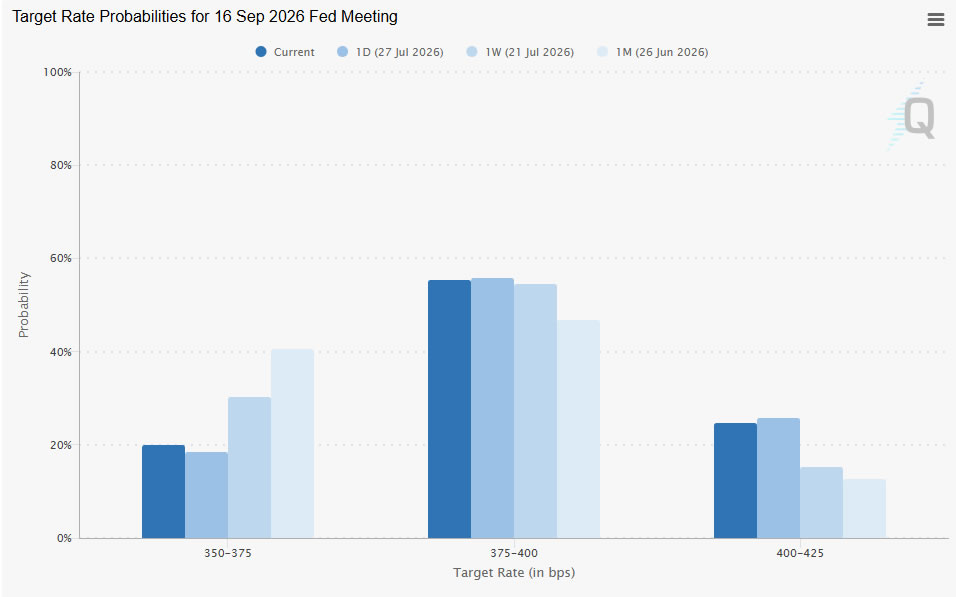
Normally, such a collapse in oil prices would be expected to ease inflation concerns and reduce expectations for tighter monetary policy. Instead, September Fed hike odds implied by futures remain around 80%, barely changed from earlier in the week and still notably higher than before the Middle East conflict intensified. The stability of those expectations despite oil's decline suggests markets believe the inflationary effects of last week's price spike have not yet run their course. Higher energy costs typically filter through transport, production and consumer prices with a lag, meaning lower spot crude today does not immediately erase the inflation impulse already created.
FOMC now the next hurdle for Dollar bulls
That backdrop continues to provide fundamental support for the Dollar. Nevertheless, traders remain cautious ahead of Wednesday's FOMC decision. The greenback has yet to break convincingly higher against either Euro or Yen, while gains against Sterling, Swiss Franc and Canadian Dollar have also been relatively modest. Markets will likely need stronger confirmation from the Fed—either through a distinctly hawkish statement, Chair Kevin Warsh's guidance, or dissenting votes in favor of an immediate hike—before fully embracing another round of Dollar buying.
Among major currencies, Canadian Dollar outperformed as it recovered part of Monday's oil-driven losses. Dollar ranked second and remains the week's strongest performer overall. Australian Dollar underperformed as the regional AI-led equity rout compounded caution ahead of Wednesday's Australian CPI report. Yen and Swiss Franc also lagged despite the broader risk-off tone, as elevated US rate expectations continued to favor the Dollar over traditional low-yielding defensive currencies.
Key Takeaways
- Oil crashed, but Fed hike bets didn't move: September Fed hike odds held near 80% even as Brent fell below $85, because energy-driven inflation typically filters through with a lag rather than reversing immediately.
- The AI rout has a financing problem, not just a valuation problem: Nvidia's circular financing model, where it helps fund the buyers of its own chips, is drawing dot-com-era comparisons and triggering a broad reassessment of AI valuations.
- Dollar rose for two separate reasons at once: Risk aversion from the AI selloff and sticky Fed rate expectations both pushed capital into the greenback, rather than into traditional safe havens like Yen or Swiss Franc.
- The Dollar rally is not yet confirmed: Gains against Euro and Yen remain unconvincing. Markets want to hear a distinctly hawkish signal from Wednesday's FOMC decision before committing further.
- Watch Wednesday's Australian CPI and FOMC decision together: Both will test whether this week's rate-hike narratives, for the Fed and RBA alike, have room to run further.
Related Coverage
- See why the RBA's hurdle for another rate hike keeps rising, and what Tuesday's CPI print needs to show for a rangebound AUD/USD to break out: Rangebound AUD/USD Awaits Australia CPI as Bullock Signals Higher Hurdle for RBA Hike
- Read how Nvidia's financing model is fueling circular-financing fears across the AI trade, and why Bitcoin got caught in the same selloff: Bitcoin Joins Tech Selloff as Circular Financing Fears Hit Nvidia and AI Trade
- See why Governor Bullock says it's still too early to call the RBA's tightening cycle finished, despite easing demand and labour conditions: RBA's Bullock Keeps Rate Hike Option Alive Despite Policy Lags
Frequently Asked Questions
Q: Why didn't Fed hike bets fall when oil crashed below $85?
A: Higher energy costs filter through transport, production, and consumer prices with a lag, so a drop in spot crude does not immediately erase the inflation impulse already created by last week's price spike. Markets believe the inflationary effects have not yet run their course, keeping September Fed hike odds near 80% even as oil retreats.
Q: What is circular financing and why is it spooking AI investors?
A: Circular financing describes a model where a chip supplier like Nvidia helps finance the very companies buying its hardware, rather than simply selling to independent customers. This revives memories of vendor-financing practices from the dot-com boom and raises questions about whether AI demand is becoming increasingly self-funded rather than organic. See how Bitcoin joined the tech selloff as circular financing fears spread beyond chipmakers.
Q: Why did the Dollar rise during a risk-off selloff instead of traditional safe havens like Yen or Swiss Franc?
A: Elevated US rate expectations continued to favor the Dollar over low-yielding defensive currencies. While Yen and Swiss Franc are traditional safe havens, the interest-rate differential created by sticky Fed hike bets made the Dollar the preferred destination for risk-averse capital this week.
Bitcoin Has Failed to Break Away from Its Long-Term Trend
Market Overview
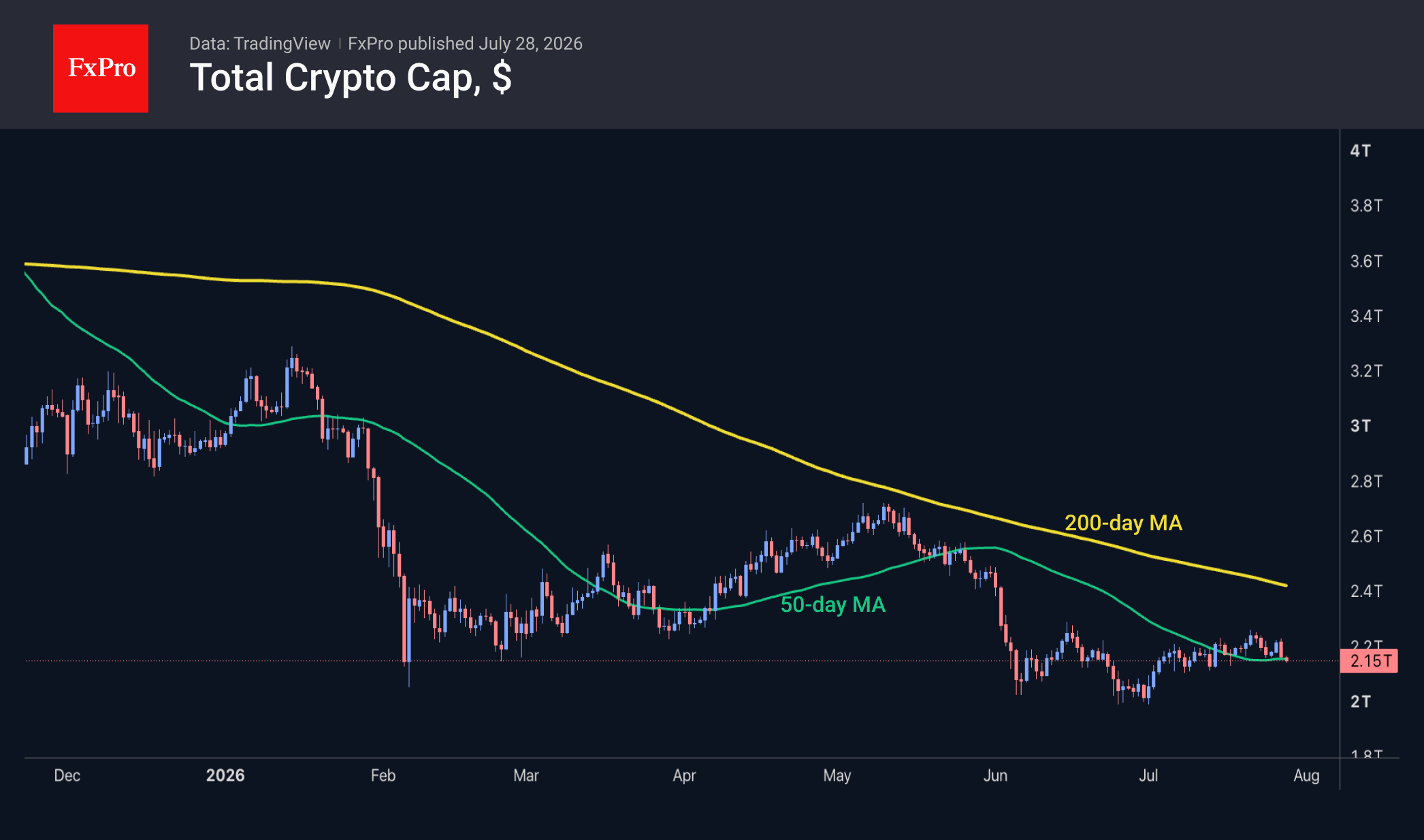
The crypto market trended lower at the end of Monday, mirroring the US equity market, as it fell from a peak of $2.23T to $2.16T before returning to recent local lows of $2.18T by Tuesday morning. This marks yet another test of the 50-day moving average (MA) as support, which sellers have been testing over the past couple of weeks. Among the top coins, losses ranged from -1.4% for Bitcoin Cash and -1.5% for BNB to -8.8% for Near and -8% for Basic Attention Token.
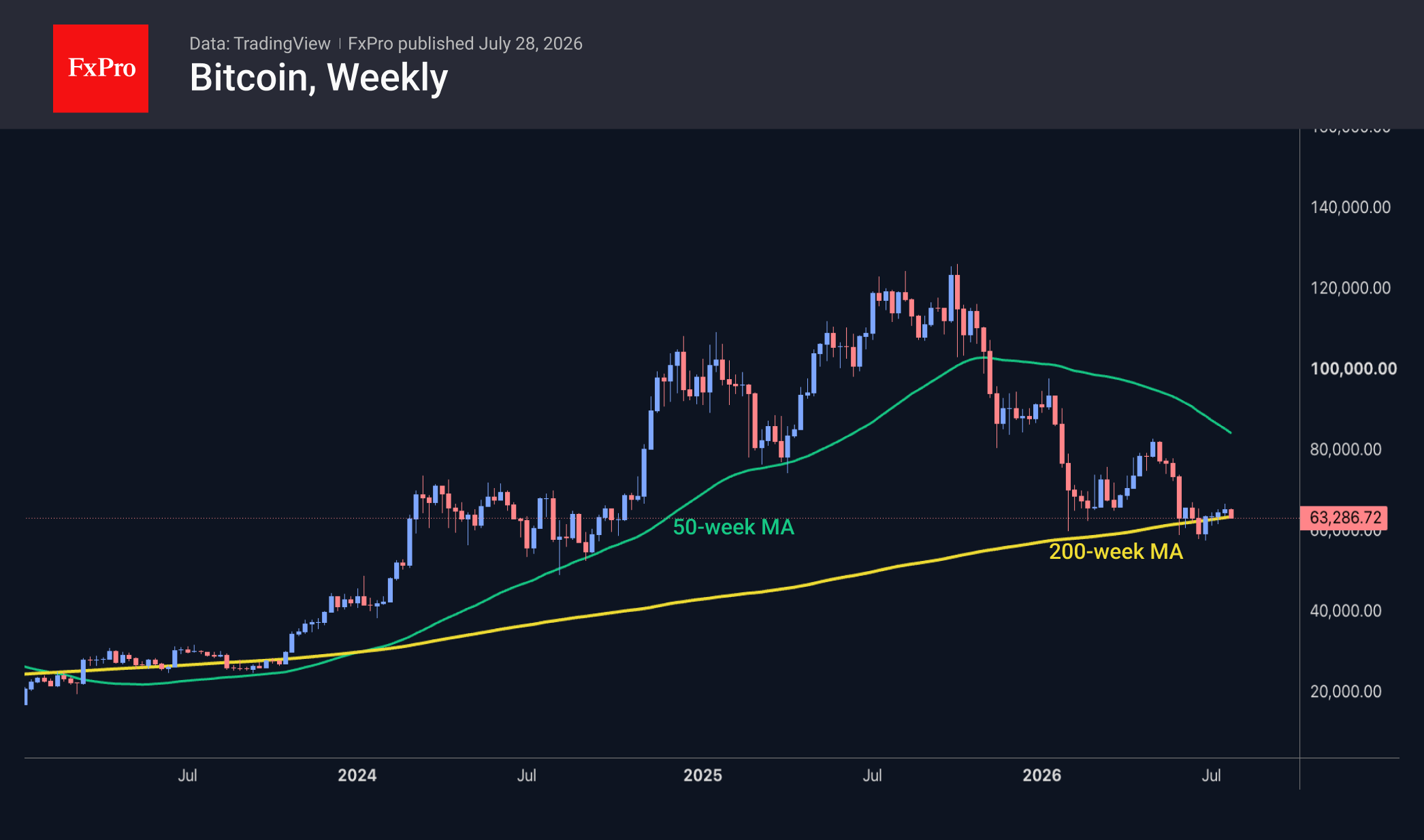
Bitcoin closed higher on Monday despite significant afternoon selling pressure. On Tuesday, the sell-off ahead of the start of Asian trading showed that bears remain in control, driving the price down from $65K to $63K, with a slight rebound to $63.4K. Consequently, the leading cryptocurrency is failing to break above the 200-week moving average, which the market had traded above for the previous three weeks. This is typical behaviour following a dip below this important long-term moving average, as the market is saturated with negativity in the lead-up to this level. It will likely take a few more weeks of stability or positive momentum to draw the wider public into the market.
News Background
On-chain data does not confirm sustained growth. Analyst Darkfost attributes the current price stabilisation to sellers running out of steam, rather than a return of buyers. Aggregate demand in the spot and futures markets is insufficient to trigger a reversal.
Based on four-year cycles, Alphractal hopes the bear market bottom is already taking shape and will be confirmed within the next couple of months.
Bloomberg has calculated that at least 12 companies that had been buying cryptocurrencies for their reserves have shifted their focus to AI-related sectors in recent months. This change in strategy has not yet helped to restore investor interest in the shares of such DAT companies.
The BitMart cryptocurrency exchange has announced a phased closure after nine years of operation. The platform will cease all operations definitively on 31 January 2027. The company did not specify the exact reason for the closure, citing “operational conditions, the market environment and future strategic direction”.
BitMine purchased an additional 9,946 ETH last week, bringing the total amount of Ethereum in its reserves to 5.79 million ETH. BitMine’s reserves now exceed 4.8% of the total Ethereum supply. Due to the asset’s value decline, the company remains at a loss of more than $8 billion, having purchased ETH at an average price of around $3.4K.
By selling 5.4 million ordinary shares, Strategy increased its dollar reserves by $544.5 million over the past week, to $3.75 billion. According to Michael Saylor, this will be sufficient to cover dividends on preference shares for more than two years. Strategy has not purchased any Bitcoin for 5 weeks and holds 843,775 BTC in its reserves.
The FxPro Analyst Team