Sample Category Title
Australian Dollar Slides on Softer Than Expected Inflation
Aussie dollar fell nearly 0.5% on Wednesday morning, following softer than expected Australian CPI data (Q2 3.9% from Q1 / forecast 4.1% and monthly indicator Jun 3.8% vs May / forecast 4.0%) that almost sidelined expectations for rate hikes this year.
However, better than expected inflation numbers across the western economies came as a result of recent US/Iran ceasefire, with renewed hostilities likely to revive inflationary pressures and change the current rate outlook.
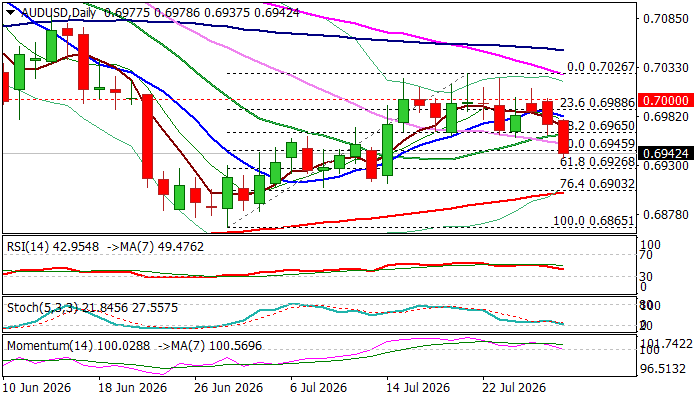
The pair’s price fell to the lowest levels in nearly two weeks on Wednesday, marking over 50% retracement of 0.6865/0.7026 recovery leg, adding to developing negative signals.
Weakening technical picture on daily chart (south heading RSI at 42 and 14- momentum hitting the centreline) support fresh bears, with daily close below 50% retracement (0.6945) to confirm signal and keep focus at the downside, though bears are expected to remain in play while the price stays below former range floor (0.6965) reinforced by 20DMA.
Firm break of 0.6945 to expose targets at 0.6926 (Fibo 61.8%) and 0.6900 zone (Fibo 76.4% / 200DMA).
All eyes are on tonight’s FOMC policy announcement, with the US central bank widely expected to keep rates unchanged, but Fed’s stance on near term policy action will be closely monitored.
Res: 0.6965; 0.6981; 0.7000; 0.7011
Sup: 0.6926; 0.6911; 0.6900; 0.6881
Gold: The Fed Will Lead the Way!
- Markets are awaiting the Fed’s decision on interest rates.
- Gold’s reaction will depend on the Fed’s rhetoric and the number of dissenting votes.
The US dollar has retreated as traders square positions ahead of the FOMC meeting results announcement. The futures market puts the odds of a Fed rate hike at 1 in 3 following the 28–29 July meeting. There is a high risk of a surprise from the Fed, so speculators are unwinding some of their record net long positions in the greenback, the highest since 2015.
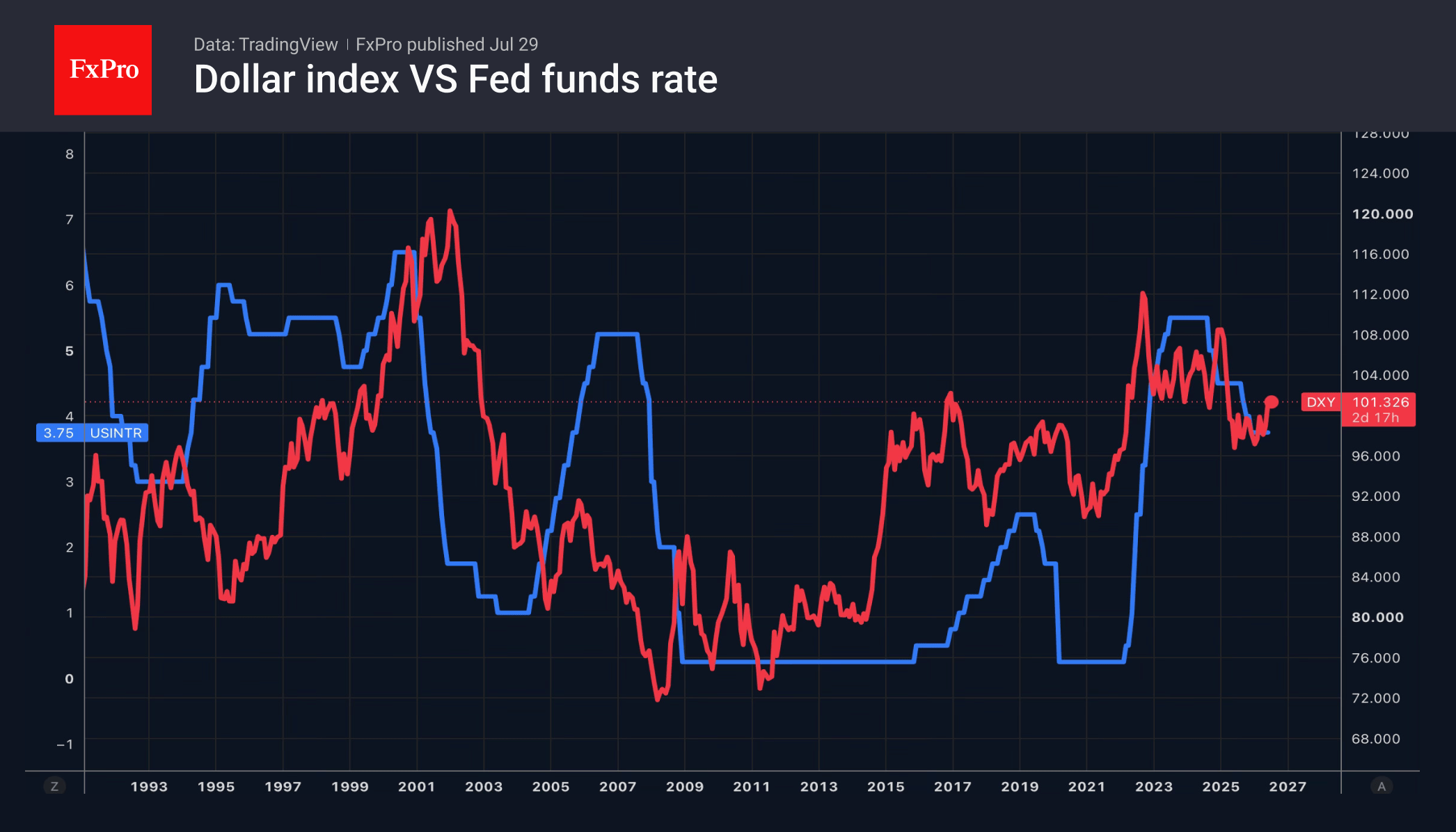
Data points to rates being held steady: June employment figures cooled after strong spring growth, and inflation has slowed. Furthermore, several FOMC officials have stated that monetary policy is in the right place, and Kevin Warsh gave no indication of tightening in his testimony before Congress.
Conversely, advocates of monetary tightening argue that the start of a tightening cycle signals the Fed’s readiness to deploy all its resources to ensure inflation returns to the 2% target, as Kevin Warsh has repeatedly stated. Without a 25-basis-point rise in July, the Fed may need to hike by 50 basis points in September. At the same time, the new Fed Chair could demonstrate his independence and the central bank’s independence from White House directives.
The Fed’s decision is of paramount importance for gold. The precious metal is under pressure and is unlikely to stray far from the $4,000-per-ounce mark, as the futures market anticipates two rounds of Fed rate hikes in 2026. In this regard, even if rates remain at their current level, hawkish rhetoric could have dire consequences for gold.
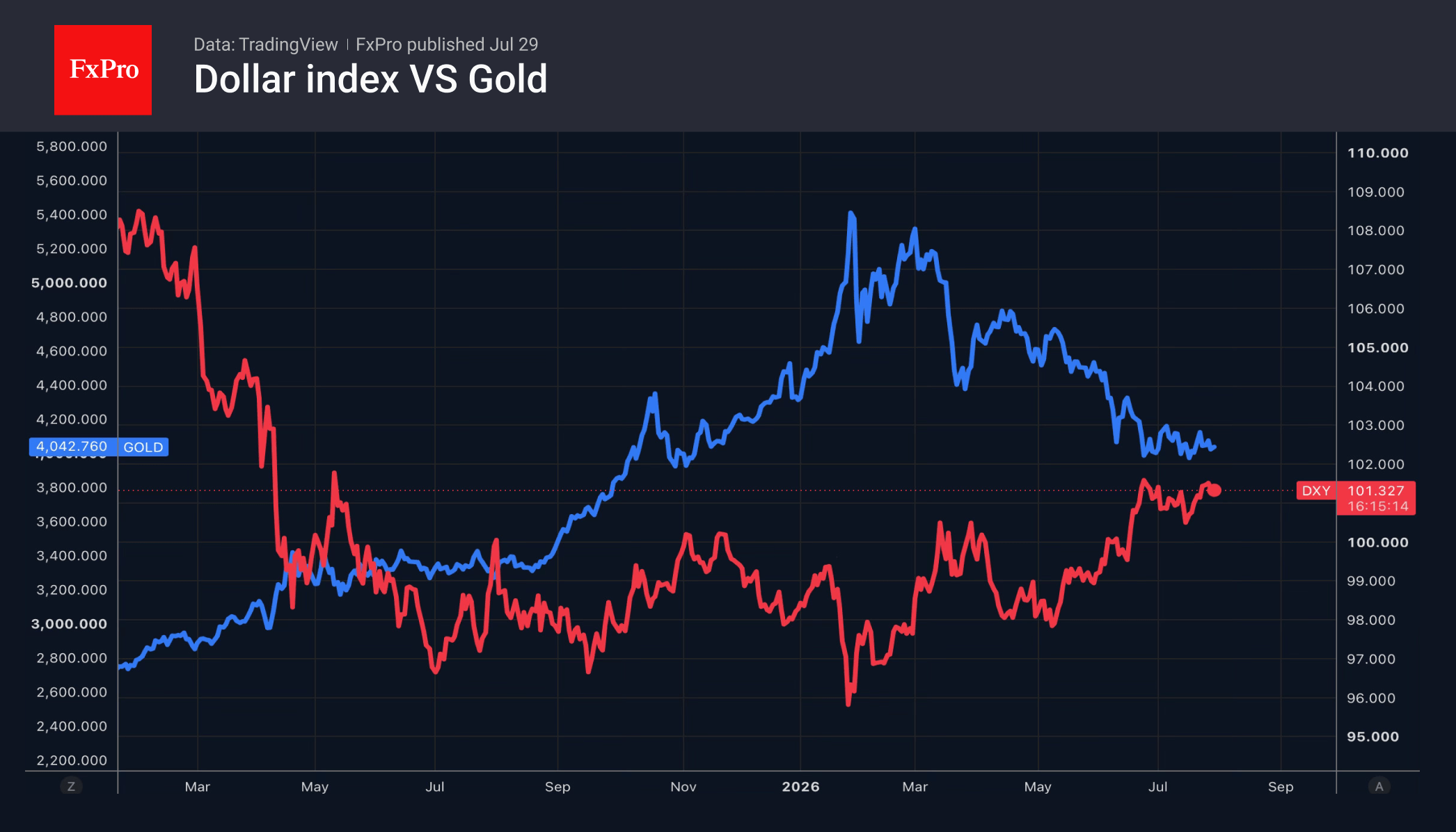
On the other hand, the US dollar risks weakening significantly if the Fed does not adjust its monetary policy and there are no more than two dissenting votes. This is the view of TD Securities, which forecasts that the presidents of the Cleveland and Dallas Feds, Beth Hammack and Lori Logan, will vote in favour of a rate hike. In this scenario, gold could head towards $4,150 and beyond.
The precious metal has reacted calmly to the rise in oil prices caused by Iran’s unexpected strikes on US bases in Jordan and to Hong Kong’s increase in gold bar imports to their highest level since late 2014. This points to strong demand from mainland China. However, history shows that when gold flows from West to East, i.e., from ETFs to Asian consumers, a downward trend in gold prices is the most common outcome.
The FxPro Analyst Team
Gold Hands the Baton Back to the Fed: Why Warsh and Waller’s Votes Matter Most
TL;DR: With geopolitical risk fading and Brent retreated sharply this week, Gold has settled into a narrow range above $4,000 — leaving today's FOMC vote breakdown, not the headline rate decision, as the market's next major catalyst.
Why the Market's Focus Is Shifting Back to the Fed
Gold has spent much of this week trapped in a narrow, established range, reluctant to break out on either side. The hesitation reflects a broader market transition. Last week, every move was dictated by developments in the Middle East, as fears of supply disruption sent Brent crude briefly above $100 and revived concerns about a renewed inflation shock. This week, that geopolitical premium has faded. Gold has settled into a narrow range above $4,000, and the baton has passed back to the Federal Reserve.
That transition reflects a rapid easing in market anxiety. Following the suspension of military strikes between the United States and Iran over the weekend, Brent crude has fallen sharply toward $80, erasing much of last week's war premium. Reports on Tuesday suggesting attacks resumed have done little to change the picture, with oil struggling to sustain gains beyond $85. Investors appear to believe a renewed, large-scale US offensive is not currently the most likely outcome, reducing concerns that energy prices will trigger another significant inflation shock.
As a result, both Gold and the Dollar have lost the clear directional impulses that dominated trading last week. Without a sustained energy shock feeding inflation fears, investors are once again looking through the geopolitical noise and back toward the Federal Reserve. That leaves today's FOMC meeting as the next major catalyst.
Why the Rate Decision Itself Won't Move Markets
With geopolitical risk fading into the background, attention naturally returns to monetary policy. The FOMC rate decision itself is unlikely to surprise — markets overwhelmingly expect the Fed to leave the federal funds target range unchanged at 3.50–3.75%. Nor is Chair Kevin Warsh expected to offer extensive forward guidance. Since taking office, he has consistently argued the Fed should communicate less about future policy paths and let incoming economic data speak for itself. That philosophy suggests neither the policy statement nor the post-meeting press conference is likely to materially reshape expectations.
Instead, investors are likely to judge the meeting by something far more revealing: the distribution of votes.
The Vote Math: Who's Hawkish, Who's Dovish, Who's Undecided
Fed funds futures currently imply roughly a 79% probability of a September rate hike. Whether that pricing proves justified may depend on how broad support for tighter policy has become within the Committee.
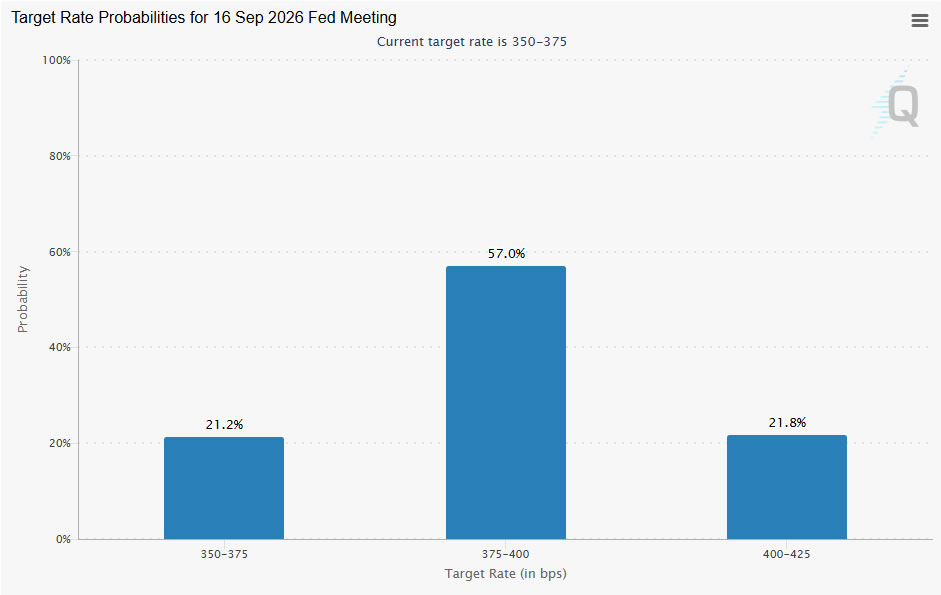
Cleveland Fed President Beth Hammack and Dallas Fed President Lorie Logan are widely expected to support an immediate hike, after consistently warning about persistent inflation risks. On the other side, Vice Chair Philip Jefferson, Governor Lisa Cook, and New York Fed President John Williams are generally viewed as favoring patience and expected to back holding rates steady.
The real uncertainty lies with several influential swing votes:
- Governor Christopher Waller has traditionally been among the Committee's more dovish members, but recently indicated he would need only one more inflation report before supporting another rate increase. Although June CPI came in softer than expected, that alone may not rule out a hawkish vote.
- Even more closely watched is Warsh himself. While he may avoid signaling future policy intentions publicly, his vote offers a direct window into his own assessment of inflation risks. A vote in favor of tightening would likely be interpreted as a meaningful shift in the Committee's center of gravity.
- Former Chair Jerome Powell, who remains a Governor, is another unknown after keeping a low profile on policy preferences. Minneapolis Fed President Neel Kashkari also represents a potential wildcard, while Governors Michael Barr and Michelle Bowman, together with Philadelphia Fed President Anna Paulson, round out a Committee whose internal balance is receiving unusually close scrutiny.
If only Hammack and Logan vote for a hike, markets may view the outcome as broadly consistent with current pricing. But if Warsh, Waller, or another influential policymaker joins the hawkish camp, investors could quickly strengthen expectations for a September rate increase. Treasury yields and the Dollar would likely move higher in response, increasing pressure on Gold and raising the risk of a downside break below its recent range.
ActionForex's Technical View on Gold
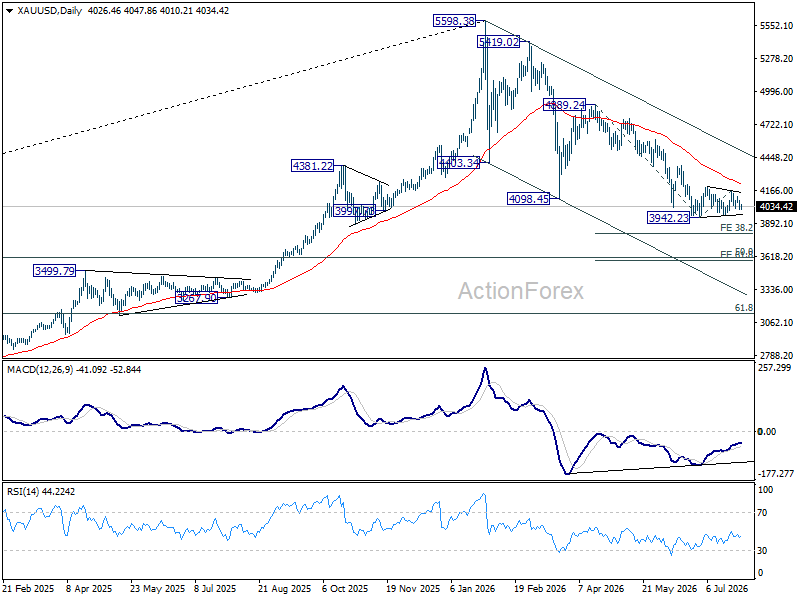
Technically, Gold's decline from the 4,166.08 high has lacked convincing downside momentum, suggesting sellers have yet to seize full control. Nevertheless, near-term risks continue to favor the downside while 4,116.09 minor resistance caps rebounds.
Retesting the 3,942.23 low appears the most likely scenario. A decisive break there would confirm resumption of the broader correction and target the 38.2% projection of 4,889.24 to 3,942.23 from 4,166.08, at 3,804.32. That would expose the next major projection level at 3,580.82.
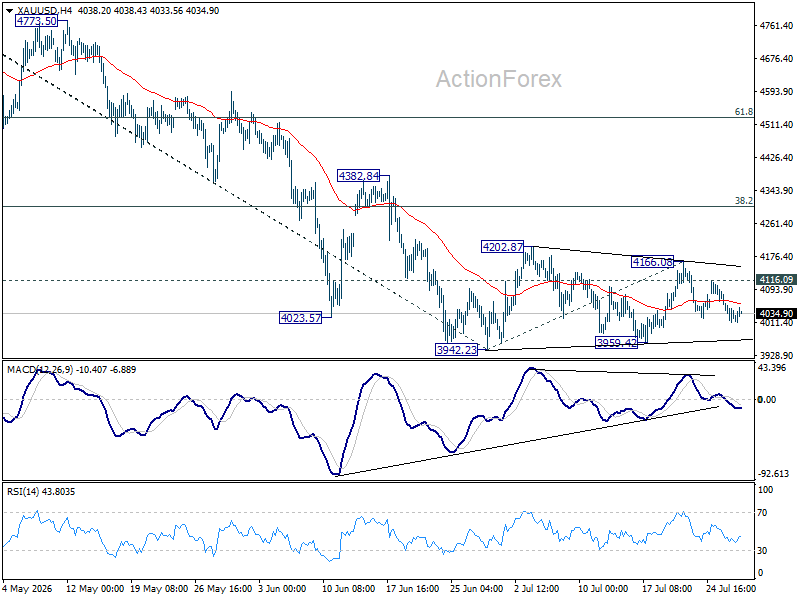
On the upside, a break above 4,116.09 would postpone the bearish scenario and instead signal the consolidation from 3,942.23 is extending. In that case, Gold could recover through 4,202.87 before the broader direction is reassessed.
Key Takeaways
- Gold has settled into a range above $4,000 as fading Middle East risk hands market focus back to the Fed.
- Today's FOMC rate decision itself is unlikely to surprise — the real signal lies in the voting breakdown, not the headline outcome.
- Waller and Warsh are the two swing votes markets are watching most closely, given their potential to shift the Committee's hawkish-dovish balance.
- A broader hawkish tilt in the vote count would likely lift the Dollar and Treasury yields, pressuring Gold toward a downside break of its recent range.
- 3,942.23 is the key support to watch; a break there targets 3,804.32, while a rally above 4,116.09 would extend the current consolidation instead.
Related Reading
- FOMC Vote Breakdown Explained: Why the Distribution Matters More Than the Decision.
- Christopher Waller's Pivot: Is the Fed's Most Dovish Voice Turning Hawkish?
- Brent Crude's Retreat from $100: What It Means for Inflation Expectations.
- Gold Technical Outlook: Mapping Support From 3,942 to 3,580.
- Kevin Warsh's Fed: Why Forward Guidance Is Disappearing.
CTA: Get ActionForex's real-time coverage of today's FOMC vote and its impact on Gold — subscribe to Action Insight for updates as the decision lands.
GBP/USD at Month’s Lows: The Outlook Remains Weak
GBP/USD continued to consolidate at 1.3283 on Wednesday. The British pound hit a near one-month low in the previous session as investors monitored developments in the Middle East, while the dollar drew support from expectations that the Federal Reserve could raise rates today.
The suspension of US strikes on Iran contributed to a decline in oil prices and somewhat eased inflationary risks. However, US government bond yields fell only modestly, reflecting cautious market sentiment.
Attention is now turning to the Bank of England meeting on Thursday. The regulator is expected to hold rates at 3.75%, a view supported by fresh inflation data. In June, consumer price growth slowed to 2.6% on an annual basis – a 15-month low and below the Bank’s own expectations.
The rise in wholesale energy prices has not yet been fully reflected in regulated tariffs for British households. This has kept UK inflation below that of the US and the eurozone, where markets still anticipate rate hikes in September or October.
Technical Analysis
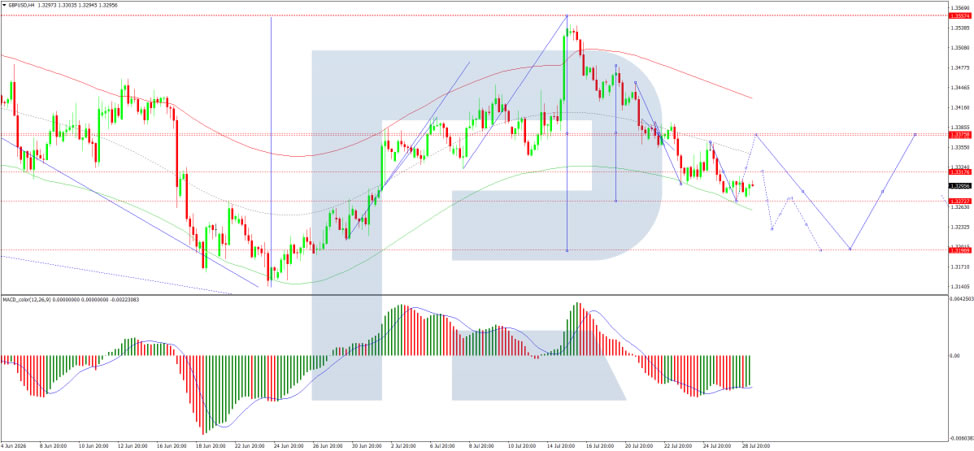
On the H4 GBP/USD chart, the market is forming a downward move towards 1.3267. A wide consolidation range around the 1.3310 level is taking shape. An upside breakout would open the way for a move towards 1.3375, while a downside breakout would suggest a move towards 1.3260, with scope for the trend to extend to 1.3190. The MACD indicator supports this scenario, with its signal line below zero and pointing firmly downwards.
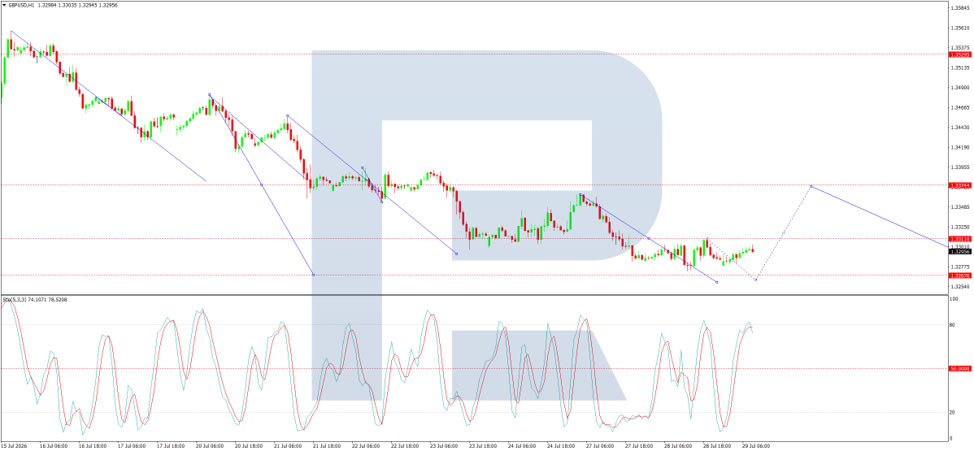
On the H1 chart, the market has formed a compact consolidation range around the 1.3309 level, currently extending down to 1.3272. A move higher towards 1.3310 is expected, followed by a decline to 1.3260. The Stochastic oscillator confirms this scenario, with its signal line below 80 and pointing downwards towards 20.
Conclusion
GBP/USD has fallen to its lowest level in nearly a month as the dollar remains supported by expectations of a potential Fed rate hike. While the suspension of US strikes on Iran has helped lower oil prices and ease inflationary pressures, cautious sentiment persists as markets await the outcome of the Federal Reserve’s policy meeting later today. Attention will then shift to the Bank of England’s ** decision on Thursday, where rates are expected to remain unchanged at 3.75%, supported by softer UK inflation data. Technically, sterling appears poised for further downside towards 1.3260 and potentially 1.3190, with the near-term outlook heavily dependent on central bank guidance and geopolitical developments.
Crypto Holds Firm Despite Tech Sell-Off
Market Overview
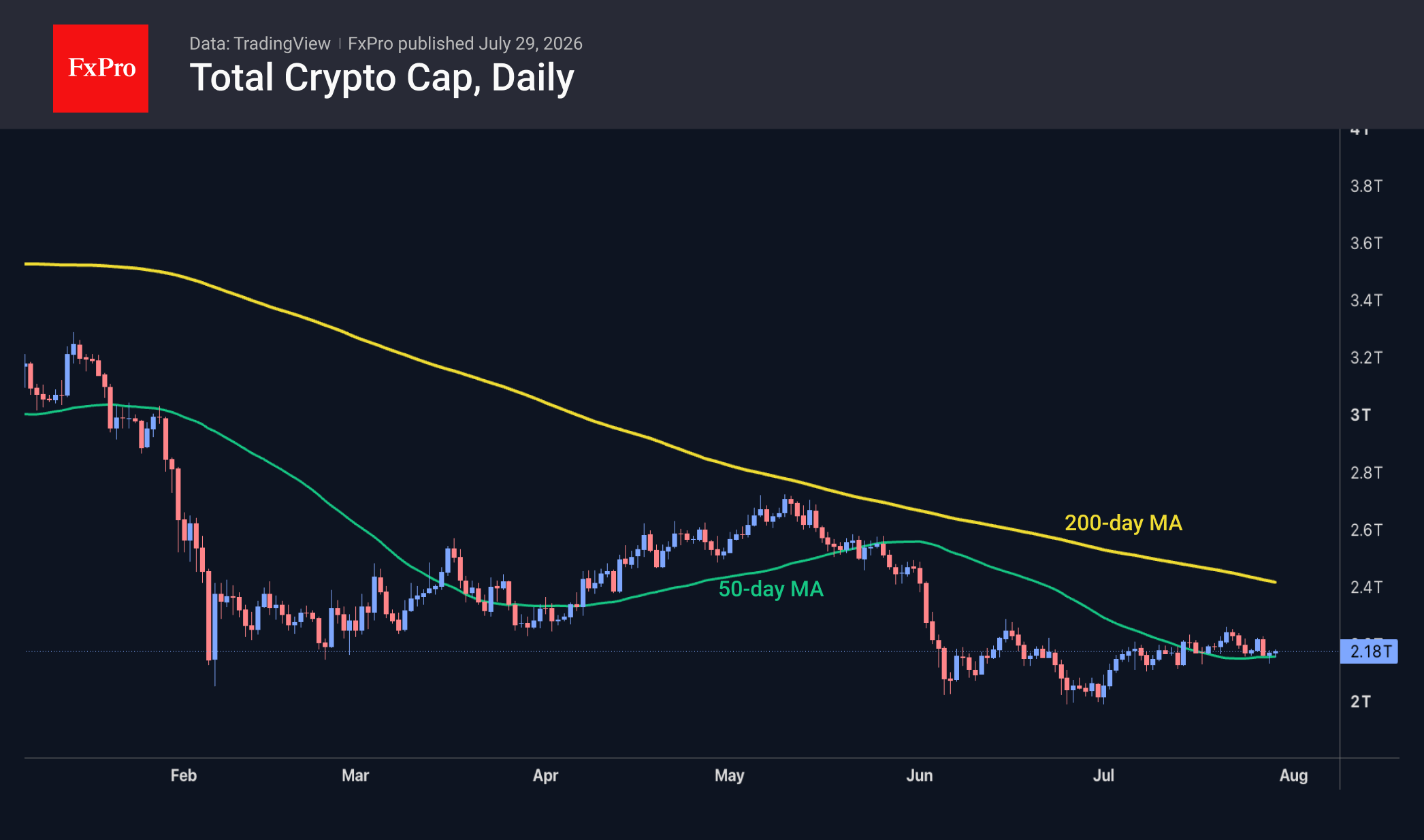
On Tuesday, the crypto market capitalisation fell towards $2.14T, a level at which it has repeatedly found support over the past three weeks. This time was no exception, leaving the market above its 50-day moving average – a significant sign of buyer strength, indicating a local shift in priorities. Since the beginning of the year, interest has shifted from cryptocurrencies to AI stocks. Despite the Nasdaq-100 entering a technical correction, with a more than 10% decline from its peak, cryptocurrencies have remained resilient. The top performers among the most popular coins over the past 24 hours were Cardano (+4.8%), Uniswap (+3.1%), and XRP (+3%). The worst performers were Immutable (-5.3%), Official Trump (-4.6%) and Theta Network (-3.7%).
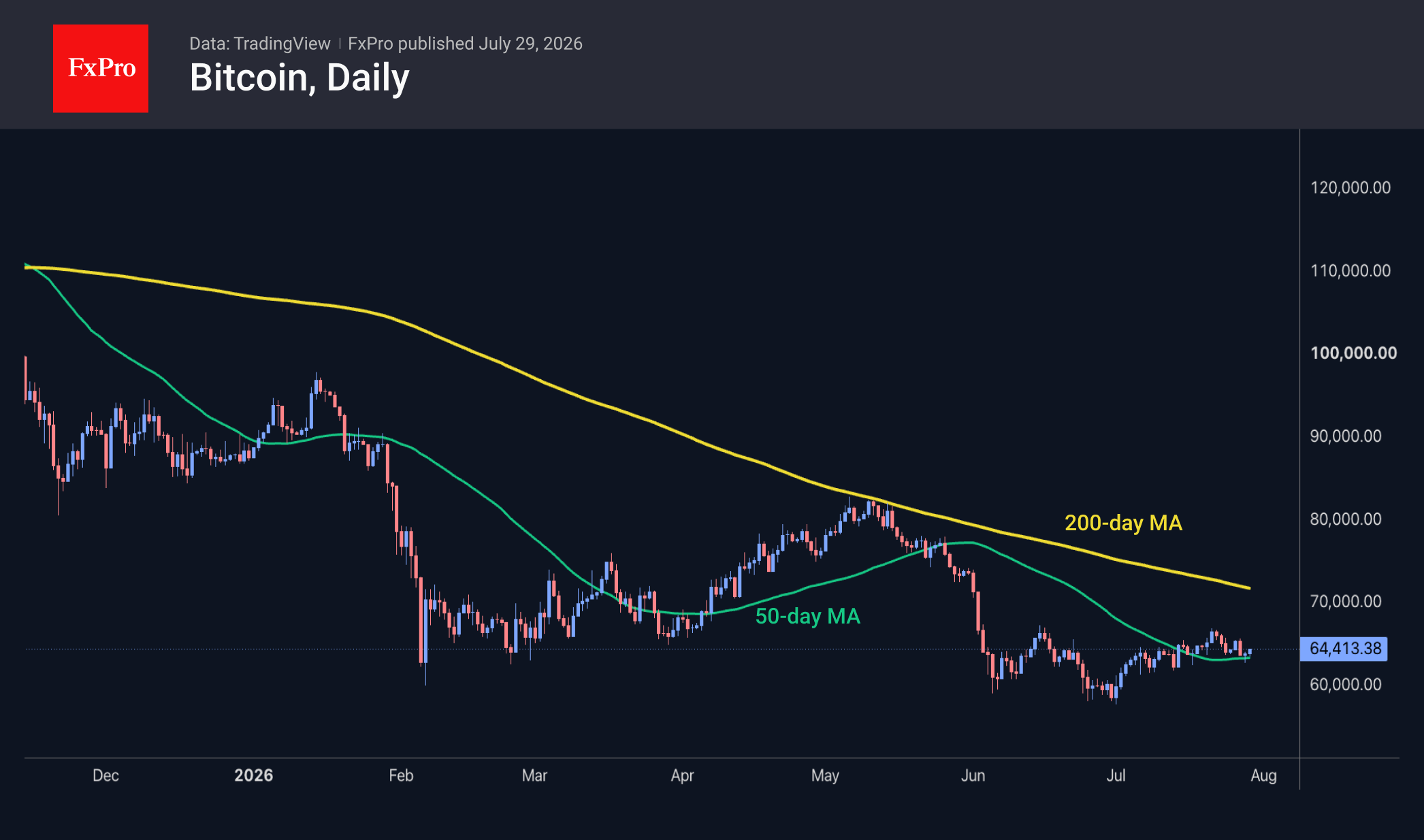
Bitcoin, as was the case a week earlier, dipped below $63K before attracting a fresh influx of buyers, recovering to $64.3K. Although the current support level is lower than it was in February–April, overall, market forces are on the bulls’ side in this area. Judging by the price action, the market is being swept up by large long-term investors who have not yet fulfilled their plans and are not overly concerned about the sell-off in the semiconductor sector. It is even possible that this profit-taking is contributing to capital inflows. However, if and when the sell-off in equities turns into a broad flight from risk, cryptocurrencies will struggle to hold their ground. The risk is that this shift could be driven by fundamental factors, starting with today’s decision and commentary on the Fed’s key interest rate.
News Background
Strive, one of the top ten public companies holding Bitcoin reserves, has increased its cryptocurrency holdings to 20,000 BTC. Last week, the company purchased 79 BTC for $5.2 million at an average price of $65.7K per coin. Since May, Strive has added approximately 3,264 BTC to its portfolio.
CryptoQuant notes that inflows of USDC stablecoins into crypto exchanges have exceeded outflows for the first time in over two months. An increase in USDC inflows into the market is usually linked to activity by US investors. The USDC stablecoin has become the primary instrument for institutional investors. According to Visa, USDC accounted for around 70% of all transactions in the first half of 2026.
According to DeFiLlama, the total market capitalisation of stablecoins has fallen by more than $10 billion from its May peak to $310 billion. The outflow marked the largest monthly decline since the collapse of Terra in May 2022.
The New York Attorney General’s Office has criticised the CLARITY Act. The bill could weaken states’ powers to oversee the crypto market and investigate fraud by transferring regulation of the digital assets market to the Commodity Futures Trading Commission (CFTC).
The Zcash developers have rolled out the Ironwood update on the mainnet following the discovery of a critical vulnerability a month ago. The update fixes a serious bug that allowed fake ZEC coins to be created undetected.
The FxPro Analyst Team
EUR/USD Daily Outlook
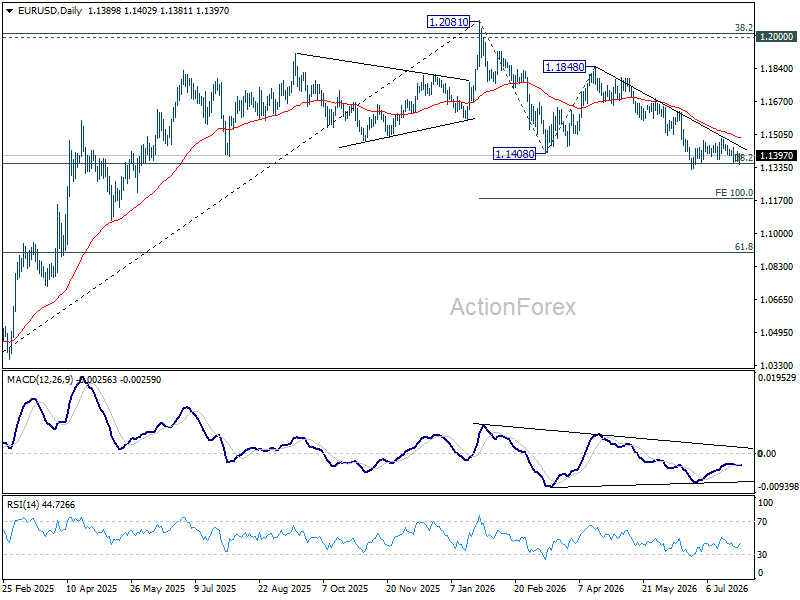
EUR/USD is still bounded in consolidations above 1.1323 and intraday bias stays neutral. With 1.1499 support turned resistance intact, outlook remains bearish. On the downside, break of 1.1323 will resume the fall from 1.2081 to 100% projection of 1.2081 to 1.1408 from 1.1848 at 1.1175. However, decisive break of 1.1499 will turn bias back to the upside for 1.1621 resistance.
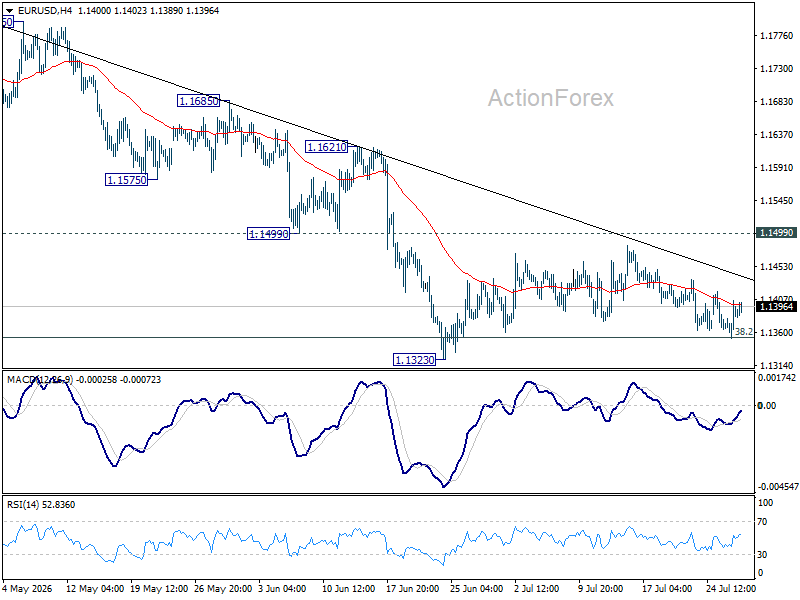
In the bigger picture, focus is back on 38.2% retracement of 1.0176 to 1.2081 at 1.1353. Decisive break there will revive the case of medium term bearish trend reversal after rejection by 1.2 key cluster resistance level. Further fall should be seen to 61.8% retracement at 1.0904. Nevertheless, strong rebound from 1.1353, followed by break of 1.1621 resistance, will retain medium term bullishness.
USD/JPY Daily Outlook
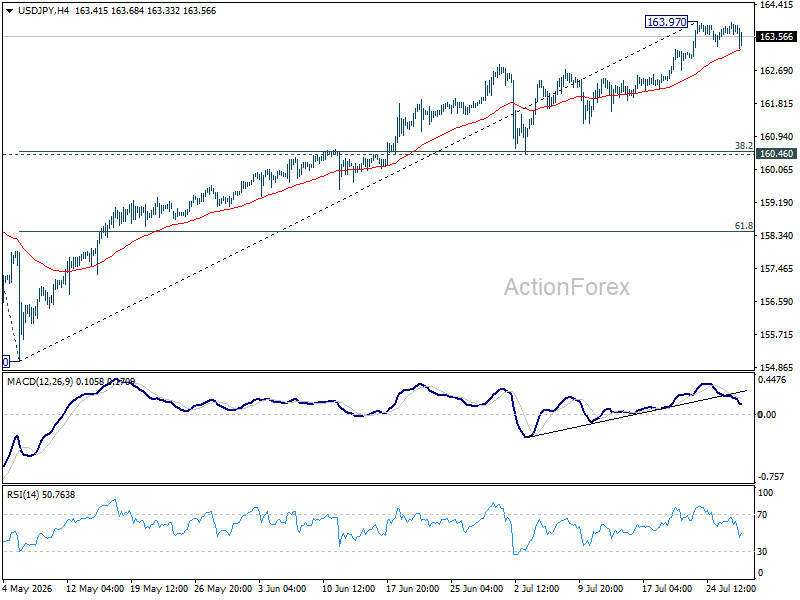
Intraday bias in USD/JPY remains neutral at this point. Consolidations should be brief as long as 55 4H EMA (now at 163.20) holds. Above 153.97 will resume larger up trend to 138.2% projection of 152.25 to 160.71 from 155.01 at 166.07. However, sustained break of 55 4H EMA will argue that it's already correcting the rise from 155.01, and bring deeper fall to 160.46 cluster support (38.2% retracement of 155.01 to 163.97 at 160.54).
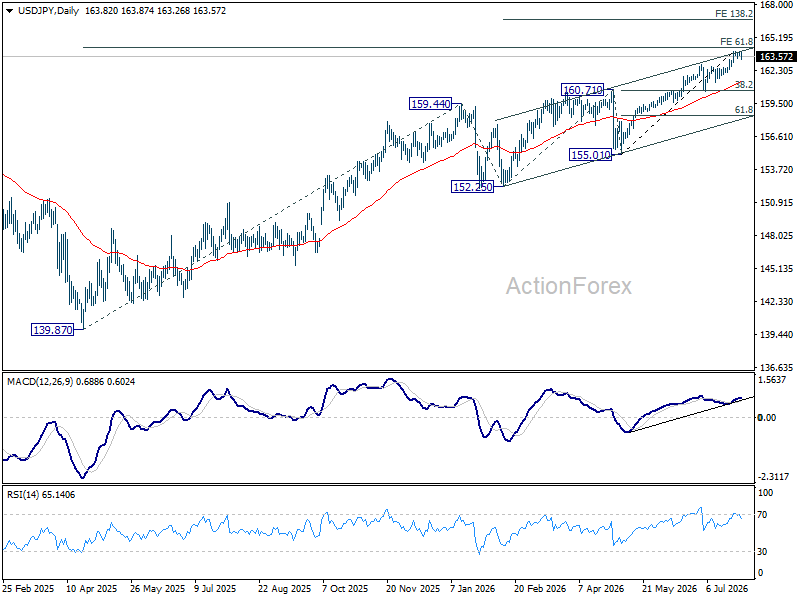
In the bigger picture, rise from 139.87 (2025 low) is seen as another rising leg of the long term up trend. Next target is 61.8% projection of 139.87 to 159.44 from 152.25 at 164.34. Firm break there will target 100% projection at 171.82. For now, outlook will remain bullish as long as 159.44 resistance turned support holds, even in case of deep pullback.
USD/CHF Daily Outlook
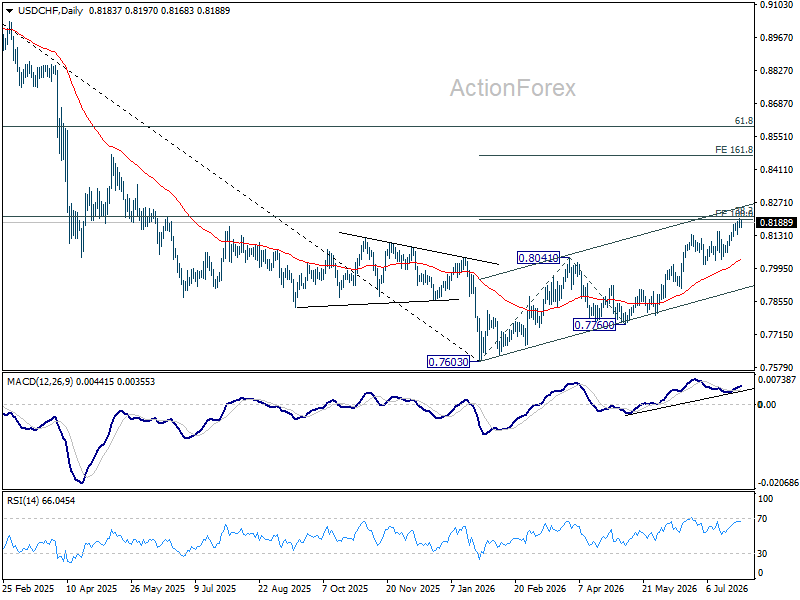
Intraday bias in USD/CHF remains on the upside for the moment. Firm break of 100% projection 0.7603 to 0.8041 from 0.7600 at 0.8198 will extend the rally from 0.7603 to 161.8% projection at 0.8469. On the downside, below 0.8137 minor support will turn intraday bias neutral again first.
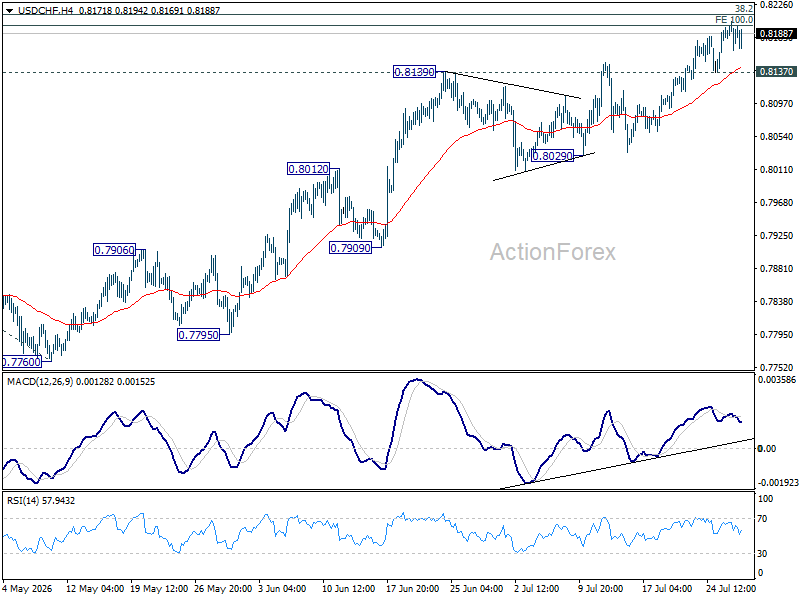
In the bigger picture, focus is now on 38.2% retracement of 0.9200 (2025 high) to 0.7603 at 0.8213. Decisive break will argue that USD/CHF is reversing the medium term trend, and turn focus to 0.8332 support turned resistance (2023 low) for confirmation. Nevertheless, rejection by 0.8213 will maintain medium term bearishness for another fall through 0.7603 at a later stage.
AUD/USD Daily Report
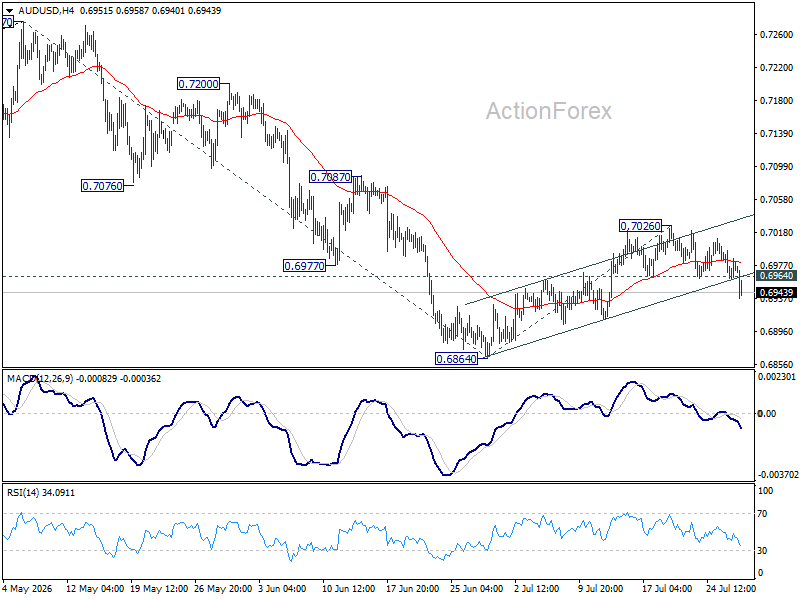
AUD/USD's break of 0.6964 support today suggests that corrective rebound from 0.6864 has completed at 0.7026, after rejection at 55 D EMA (now at 0.7006). Intraday bias is back on the downside for 0.6864 first. Firm break there will resume the whole decline from 0.7277 to 61.8% projection of 0.7277 to 0.6864 from 0.7026 at 0.6771. For now, risk will stay on the downside as long as 55 4H EMA (now at 0.6979) holds, in case of recovery.
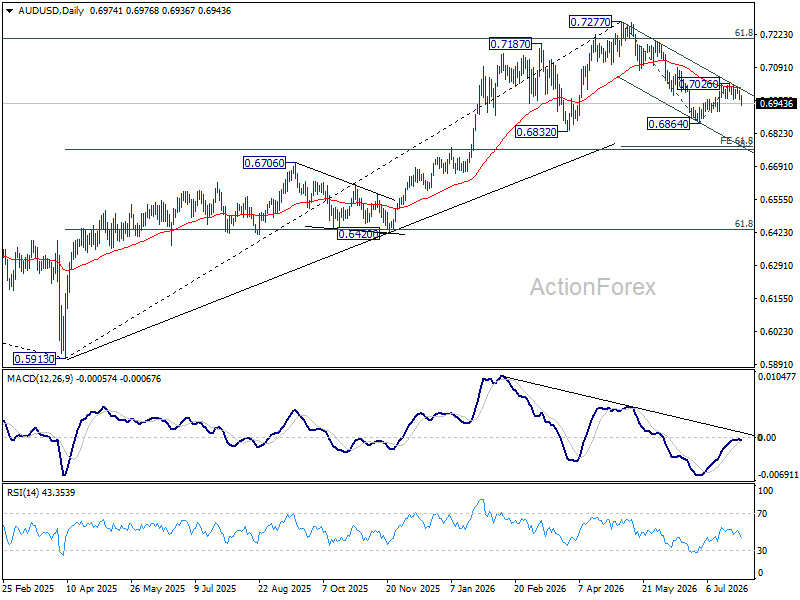
In the bigger picture, considering bearish divergence condition in D MACD, a medium term top could be formed at 0.7277 after failing to sustain above 61.8% retracement of 0.8006 (2021 high) to 0.5913 (2024 low) at 0.7206. Deeper fall could be seen to 38.2% retracement of 0.5913 to 0.7277 at 0.6756 as a correction. But strong support should be seen there to bring rebound. Consolidations would continue below 0.7277 for a while.
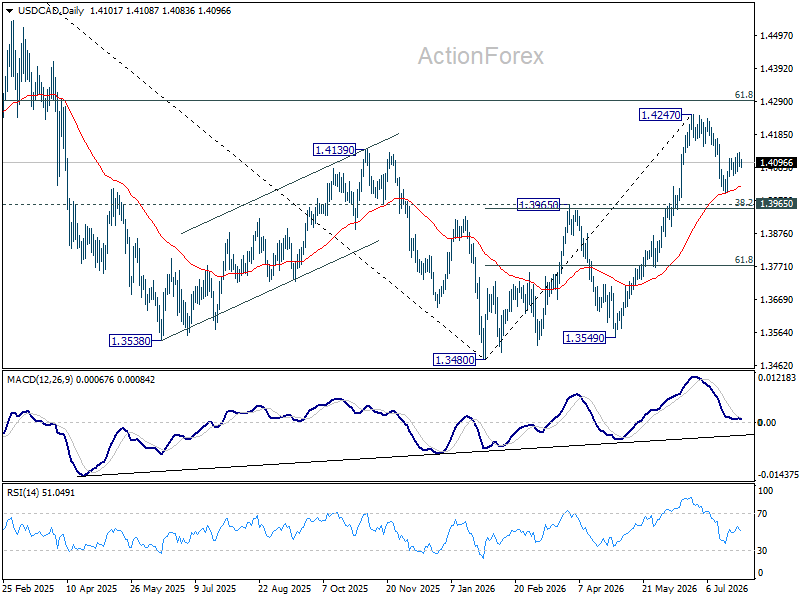
USD/CAD Daily Outlook
Intraday bias in USD/CAD is turned neutral again with current retreat. It's still slightly favored that corrective pullback from 1.4247 has completed at 1.4002. Above 1.4127 will bring stronger rebound to retest 1.4247 high. On the downside, though, below 1.4055 will extend the correction with another fall. But in that case, downside should be contained by 1.3965 cluster support (38.2% retracement of 1.3480 to 1.4247 at 1.3954) to bring rebound.
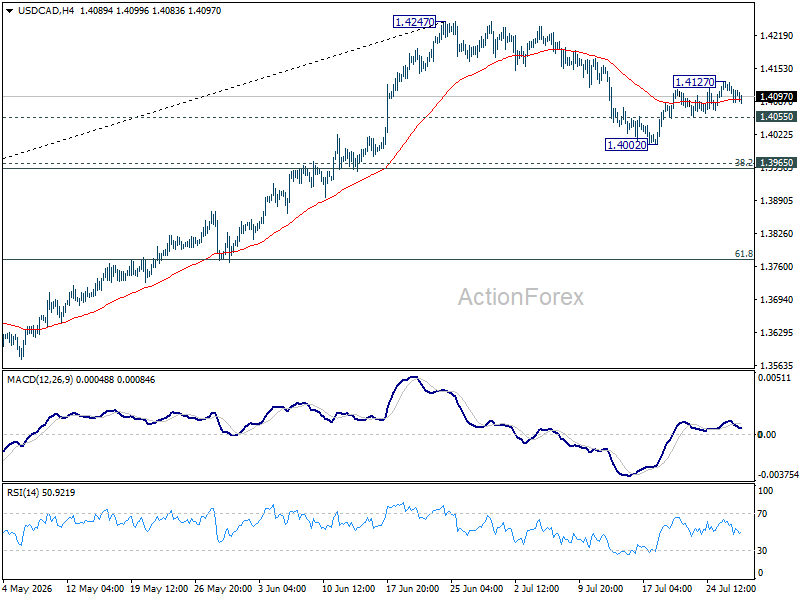
In the bigger picture, current development suggests that fall from 1.4791 has completed as a three wave correction to 1.3480. It's still early to judge if rise from there a corrective bounce, or resumption of the larger up trend from 1.2005 (2021 low). But in either case, retest of 1.4791 high should be seen next.