Sample Category Title
EUR/CHF Daily Outlook
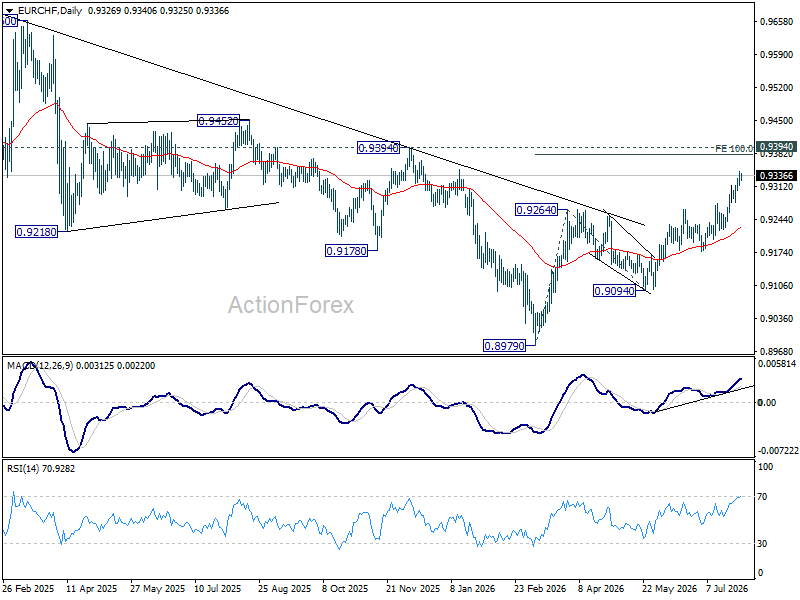
No change in EUR/CHF's outlook as the rally from 0.8979 continues. Intraday bias stays on the upside for 100% projection of 0.8979 to 0.9264 from 0.9094 at 0.9379. On the downside, below 0.9308 minor support will turn intraday bias neutral and bring consolidations. But downside should be contained by 0.9265 resistance turned support to bring another rise.
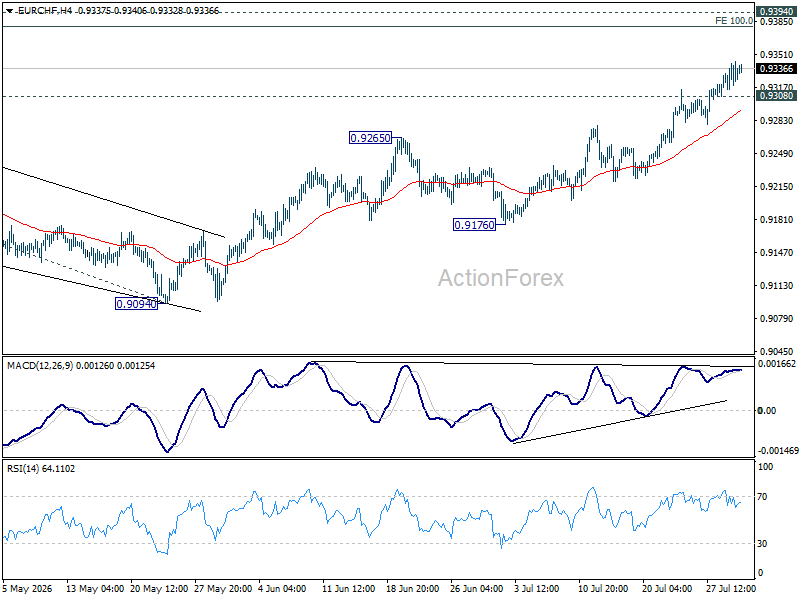
In the bigger picture, the break of medium term falling trend line resistance indicates that 0.8979 is already a medium term bottom. Considering bullish convergence condition in W MACD, rise from there should at least be reversing the fall from 0.9928, with prospect of developing into a medium term up trend. Firm break of 0.9394 resistance will add more credence to this case. For now risk will remain on the upside as long as 0.9094 support holds, in case of retreat.
Sunrise Market Commentary
Markets
Yesterday, the Fed decided on monetary policy for the second time under chair Warsh. As this Fed chair abstained from giving direct forward guidance on upcoming Fed policy steps, markets went into the decision with some more than usual uncertainty left on the outcome. Still, at his first policy meeting in June, Fed Chair Warsh delivered a straightforward message. As the economy and the labour market are doing quite well, the Fed can focus on inflation. Inflation already for quite some time is elevated compared to the Fed inflation target. The Warsh Fed simply 'promised' that it would deliver on its price stability mandate. Not words (forward guidance), but actions. The market gave it a chance. However, maintaining credibility on this commitment yesterday proved not easy. The Fed kept interest rates unchanged (3.50%/3.75%). No real surprise, even as money markets discounted a 30% chance that the Fed would already put its money where its mouth is. (25 bpn increase). Three (regional) governors also voted in favor of an increase. However, during the press conference, Fed Chair Warsh failed to clearly explain why the policy committee didn't already take action now or at least what concrete further developments are needed for the Fed to act. The market gradually started to question the strength of the Fed's inflation commitment. Even as conditions had tightened since the previous meeting, markets apparently also indicated that they couldn't do the job alone. At some point they need backing from Fed action. Short-term interest rates fell. The market now estimates the chance of a September hike at only 65% (was 100%). Contrary to the flattening post last meeting, the US yield curve this time steepened sharply. The 2-y yield declined 1.5 bp, but the 30-y rose 11.2 bps. The price of credibility! The 30-year yield rose to 5.23%, the highest since 2007! The dollar equally lost credibility. EUR/USD rebounded to close near 1.1465 (from 1.139). DXY finished at 100.88 (from 101.43). The yen only gained modestly (USD/JPY close 163.4).
Earlier in the day, UK and EMU interest rates in particular rose sharply due to the renewed tensions regarding the war between the US and Iran, and higher energy prices. (2-5-y EMU + 7 bpn). The higher (long-term) interest rates during the Fed press conference also kept the stock markets on the defensive (S&P 500 -1.52%).
This morning, Asian equities again show a mixed picture. The dollar regains some modest ground (EUR/USD 1.145). Brent oil rises further to currently trade well above $91 p/b as tensions in the Middle East are rising again. (US) yields build on yesterday's rise.
A very busy eco calendar today with, amongst others, preliminary Q2 GDP figures in the US and EMU and PCE inflation figures/deflators (June) in the US. The latter predate the renewed tension around Iran. After Fed Chair Warsh's performance yesterday, it remains to be seen how the market may assess (temporary) milder figures. Not so easy without some form of guidance by the central bank. Several EMU countries (including Germany, Spain, Belgium) will publish inflation figures for July. After the Fed yesterday, the BoE today will decide on monetary policy. The BoE has a new economic update available. Governor Bailey and its MPC are widely expected to keep the BoE policy rate unchanged at 3.75%, even as some more hawkish oriented members (2?) might raise the case for a rate hike. That said, at the previous meeting, the majority of the MPC considered fragile growth and risks to the labour market at least as important as inflation when balancing their policy assessment. The jury is still out, but if the majority maintains this bias, it probably won't help sterling. EUR/GBP yesterday extended its gradual comeback (close near 0.8575). Aside from the data and BoE decision, markets of course still will have to cope with an apparent re-escalation of the conflict in the Middle East. This suggests a further rise in risk premia, in the first place for (LT) bonds, but potentially also on other parts of the market.
GBP/USD and EUR/GBP Await Key Bank of England Decision
The pound strengthened following the outcome of the US Federal Reserve meeting, where the central bank, as expected, kept interest rates unchanged. However, the Fed did not provide the market with clear signals of an imminent shift towards rate cuts, maintaining a cautious approach to future monetary policy. Despite the Fed’s cautious tone, the dollar failed to gain fresh momentum, allowing the British currency to partially recover its recent losses.
Market attention is now almost entirely focused on the Bank of England meeting, as its decision is expected to be the main driver for sterling through the end of the week. Investors also do not expect a change in interest rates, but the key factors will be the Monetary Policy Committee’s vote split, the accompanying statement and comments from Bank of England Governor Andrew Bailey. Any signals regarding the timing of potential monetary policy easing could trigger notable volatility in the pound.
For the euro, today will also bring a number of important macroeconomic releases. Markets will focus on preliminary inflation and GDP data from Germany, as well as GDP and inflation figures from Spain. These reports will help investors assess the resilience of the eurozone economy and adjust expectations regarding the European Central Bank’s future actions. Stronger data could support the euro, while weaker figures may reinforce expectations of further ECB policy easing.
GBP/USD
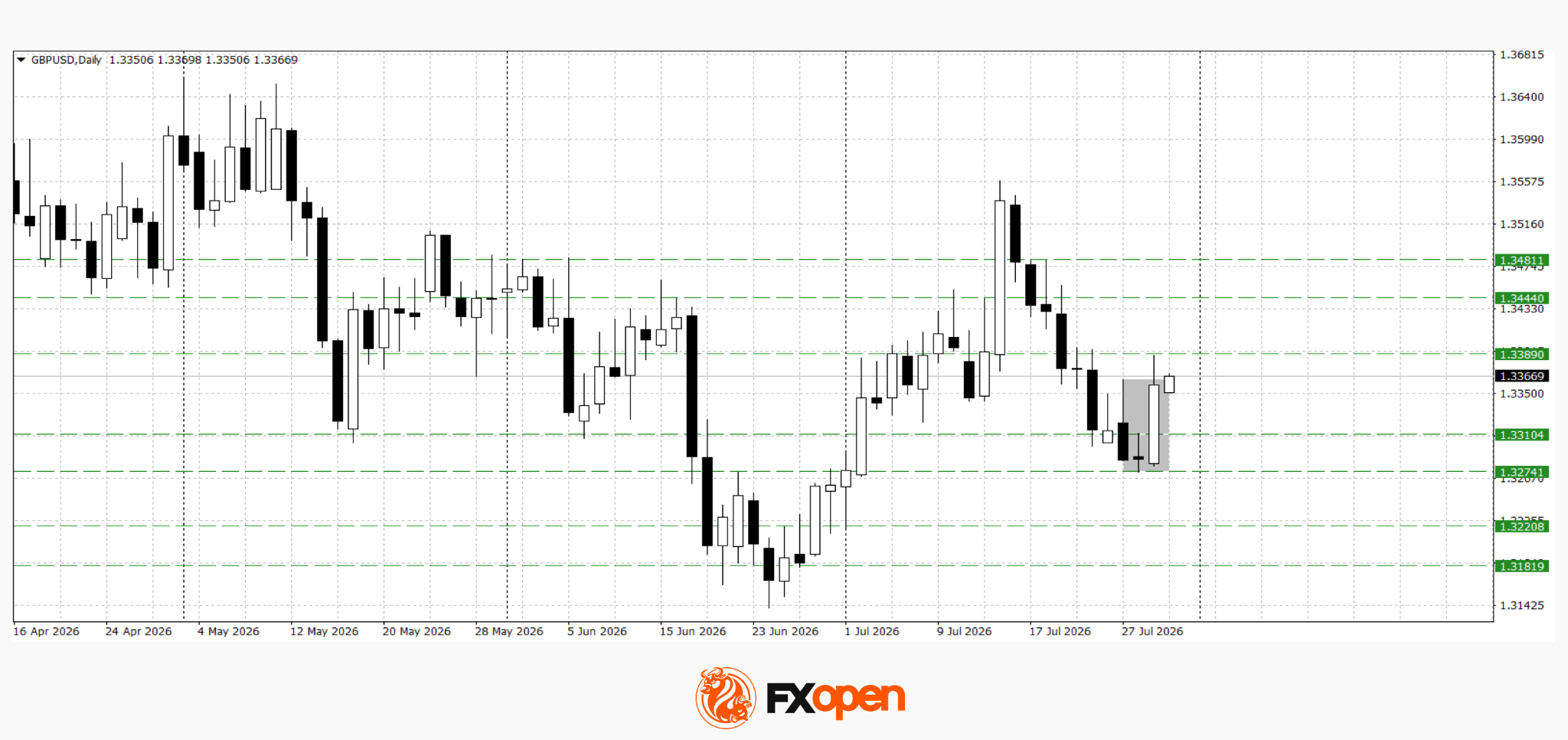
Following yesterday’s Fed meeting, GBP/USD moved towards the 1.3400 area. A rebound from the 1.3270 support level and a sharp daily rally allowed buyers to form a bullish engulfing pattern. Technical analysis of GBP/USD points to the possibility of further gains towards 1.3440–1.3480 if the 1.3270–1.3300 range becomes established as support. A decisive move below yesterday’s low could trigger a renewed decline towards 1.3180–1.3220.
Key events for GBP/USD:
- Today at 14:00 (GMT+3): Bank of England interest rate decision;
- Today at 14:30 (GMT+3): speech by Bank of England Governor Andrew Bailey;
- Today at 15:30 (GMT+3): US initial jobless claims.
EUR/GBP
EUR/GBP is showing signs of recovery after forming a bullish harami pattern on the daily timeframe. If market participants are disappointed by today’s Bank of England decision, the pair could extend its advance towards 0.8600–0.8620. The bullish scenario would be invalidated after a decisive break below the 0.8540–0.8560 support area.
Key events for EUR/GBP:
- Today at 08:30 (GMT+3): France GDP;
- Today at 11:00 (GMT+3): Germany GDP;
- Today at 15:00 (GMT+3): Germany Consumer Price Index (CPI).
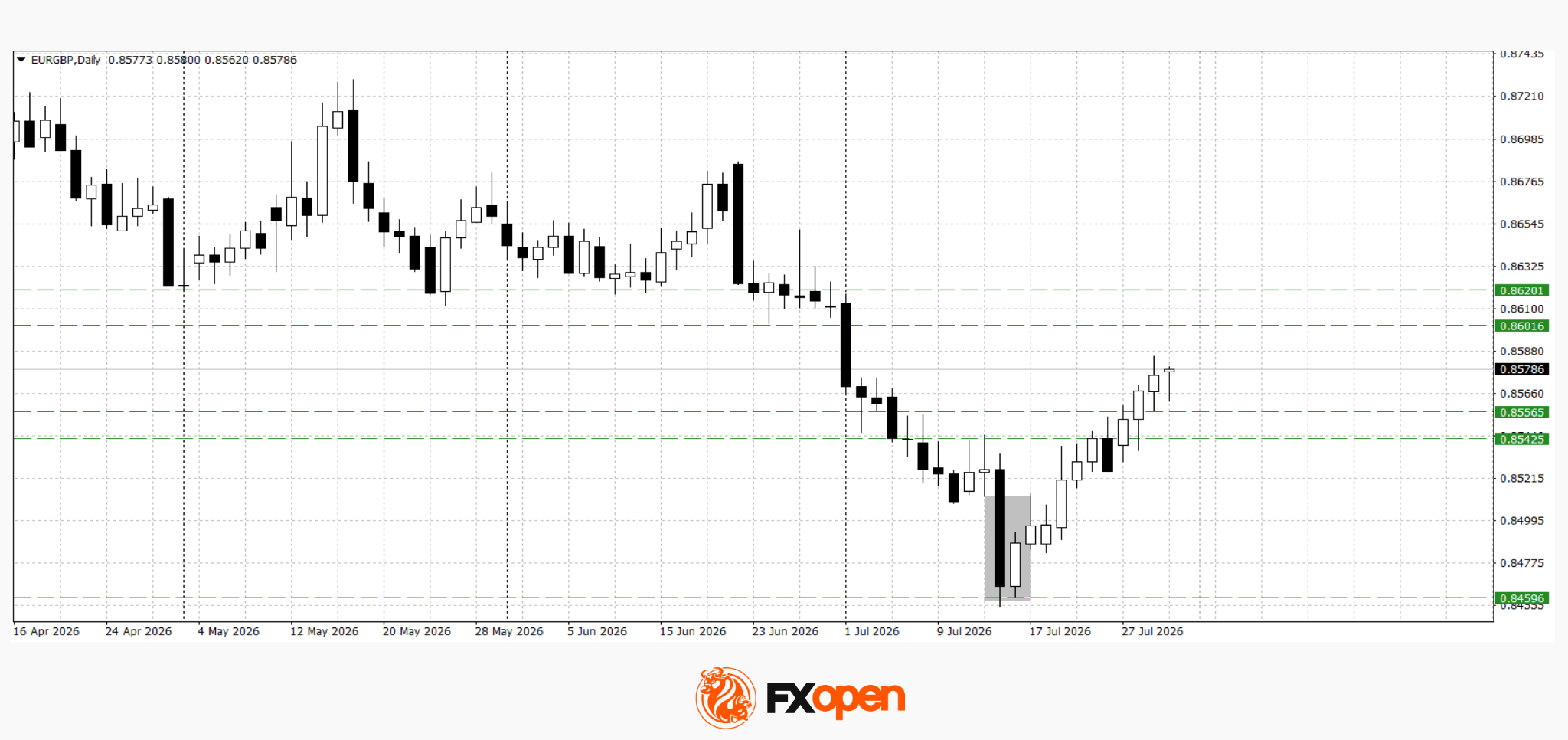
Overall, the near-term direction of sterling will depend primarily on the Bank of England’s decision, the Monetary Policy Committee’s vote split and Andrew Bailey’s comments on the future outlook for interest rates. For the euro, inflation and GDP releases from the eurozone’s largest economies will remain important, as they could influence expectations for the European Central Bank’s next policy steps. With the market impact of the Fed meeting now fading, European economic data and signals from the Bank of England could become the main drivers of GBP/USD and EUR/GBP through the end of the week.
Trade over 50 forex markets 24 hours a day with FXOpen. Take advantage of low commissions, deep liquidity, and spreads from 0.0 pips (additional fees may apply). Open your FXOpen account now or learn more about trading forex with FXOpen.
This article represents the opinion of the Companies operating under the FXOpen brand only. It is not to be construed as an offer, solicitation, or recommendation with respect to products and services provided by the Companies operating under the FXOpen brand, nor is it to be considered financial advice.
First Impressions: NZ Business Confidence, July 2026
Business confidence improved in July, but remains subject to fast-moving developments in the Middle East.
Key results, July 2026
- Business confidence: 56.1 (Prev: 36.6)
- Expectations for own activity: 49.3 (Prev: 36.9)
- Activity vs same month one year ago: 9.7 (Prev: 9.0)
- Inflation expectations: 3.14% (Prev: 3.36%)
- Pricing intentions: 47.2 (Prev: 50.7)
There was a strong lift in business confidence in the July ANZBO survey. General sentiment rose from 36.6 to 56.1, while firms’ own-activity expectations rose from 36.9 to 49.3. Both of these readings were the highest since the Iran conflict began, reaching just below their February levels.
The speed at which things have been evolving in the Middle East means that even relatively frequent (monthly) indicators may struggle to remain timely. Crude oil prices had receded to around US$70 a barrel at the start of July, but the resumption of hostilities between the US and Iran saw them surge to as high as US$100 a barrel. Unusually, though, fuel prices at the pump had barely moved by the end of the survey period.
This was partly reflected in the breakdown of the survey: early responses were much more positive compared to the June survey, while the later responses (a smaller group) were more in line with the June results. This suggests that we may see less optimism in the August survey, though again that depends on how things play out in the coming weeks.
A net 10% of firms reported that their activity was up on the same time last year, compared to a net 9% in June. Staff levels were reported to be about flat on last year, compared to the declines reported in May and June. This is consistent with our view that the Middle East conflict is acting as a headwind to an economy that was otherwise gathering momentum.
The various pricing measures in the survey were generally softer in July, which again suggests that businesses were responding to the previous drop in fuel prices rather than the more recent headlines. Inflation expectations for the year ahead fell from 3.36% to 3.14%, the lowest reading since March. Firms’ own pricing intentions fell to their lowest since last October. Actual and expected wage growth have remained broadly unchanged at low levels since the conflict began.
It remains the case that the pricing measures in the survey are elevated compared to pre-Covid levels, and as shown in last week’s CPI report, core inflation is running on the higher side of the RBNZ’s inflation target. That’s not an ideal starting point for the RBNZ as the economy starts to regain momentum, and underscores the case for removing some of the policy stimulus that was put in place last year. Following the increase in the OCR in early July, we expect further hikes in the coming months, but at a gradual data-dependent pace.
Bond Market Sends Different Message Than Fed as 30-Year Yield Hits Highest Since 2007
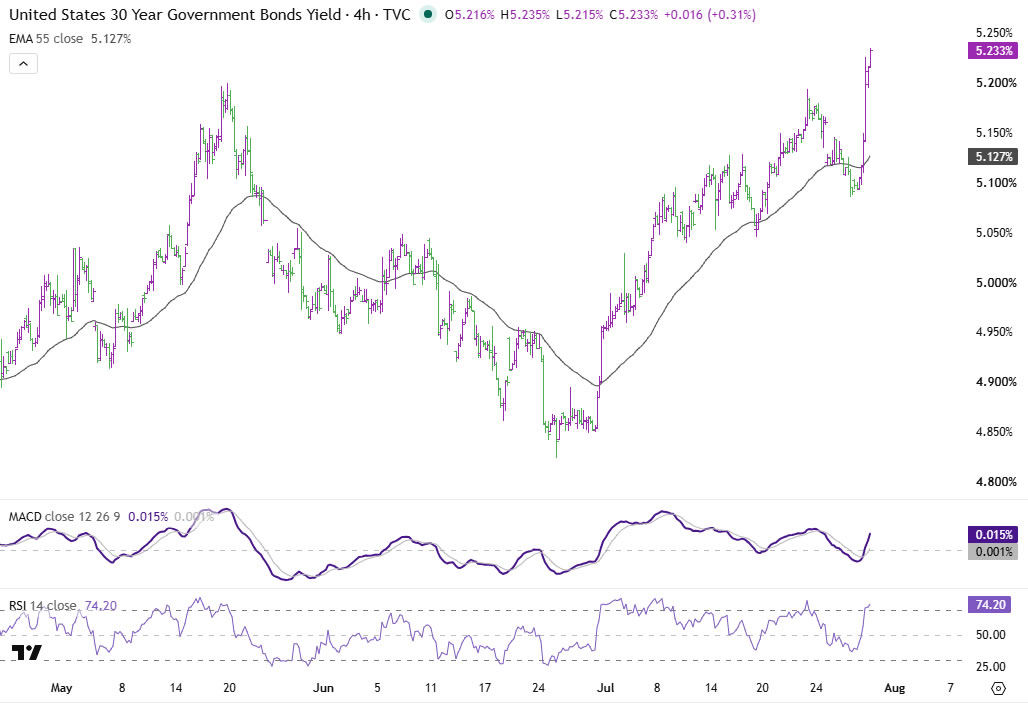
TL;DR: The Fed's July hold looked hawkish on the surface, but September hike odds actually fell to 65% from 76%. At the same time as the US 30-year Treasury yield hit its highest level since 2007, a split that points to a deeper term-premium story than a simple rate-path repricing.
The Puzzle: Two Markets, Two Opposite Signals
The Federal Reserve's July meeting produced one of the more unusual market reactions of recent years. On the surface, the outcome appeared hawkish. The FOMC voted 9-3 to leave rates unchanged at 3.50–3.75%, with Minneapolis Fed President Neel Kashkari unexpectedly joining Beth Hammack (Cleveland) and Lorie Logan (Dallas) in dissenting for an immediate quarter-point hike.
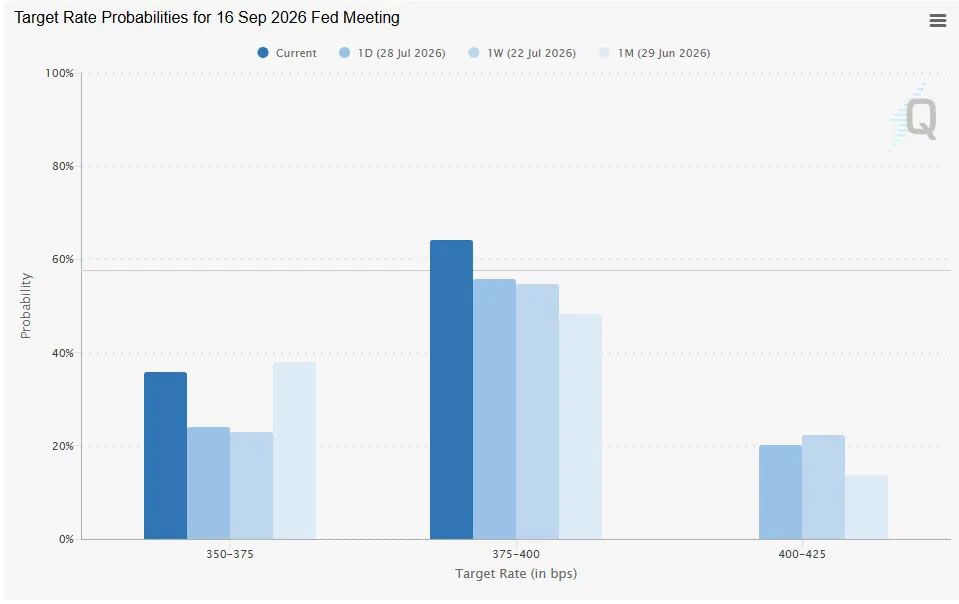
Yet instead of becoming more convinced another hike was imminent, markets moved the other way. CME FedWatch data showed the implied probability of a September rate increase falling to around 65%, down from roughly 76% just one day earlier.
At the same time, another market sent the opposite message. The 30-year Treasury yield climbed to 5.235% — its highest level since 2007 — while the 10-year yield rose to 4.704%. The move was concentrated at the long end of the curve: the 2-year Treasury, the maturity most closely tied to Fed policy expectations, closed at 4.281%, rising only modestly. That combination produced a textbook bear steepening.
If investors were simply concluding another Fed hike had become more likely, short-dated yields should have led the selloff and September odds should have risen, not fallen. Instead, markets became less concerned about the next meeting while demanding higher yields to lend the US government money for decades.
What the CME Repricing Data Actually Shows
The shift becomes clearer when broken down by scenario. For the September FOMC meeting:
- Probability of a hold (3.50–3.75%): roughly 35% currently, versus 24% one day earlier and 38% one month earlier.
- Probability of one hike (3.75–4.00%): roughly 63–64% currently, versus 56% one day earlier and 48% one month earlier.
- Probability of two hikes (4.00–4.25%): roughly 20% currently, versus 26% one day earlier and 14% one month earlier.
The combined hike probability — one hike or more — is what fell from roughly 76% one day before the meeting to 65% after it. In other words, the market didn't abandon its hike expectations; it consolidated around a single-hike outcome and pared back the tail risk of two.
Why the FOMC Statement Didn't Explain the Divergence
The FOMC itself offered little explanation for that divergence. The policy statement was almost identical to June's, reflecting Chair Kevin Warsh's preference for minimal forward guidance. The Committee again described economic activity as expanding at a solid pace despite Middle East uncertainty, noted inflation remained elevated because of supply shocks including energy, and reiterated its commitment to restoring price stability.
During his press conference, Warsh maintained the Fed is in a period of "watchful thinking, not watchful waiting." He noted that raising rates could help bring down annual inflation, currently at 3.5% and above the Fed's 2% target for five consecutive years, but argued there is no "magic wand" capable of quickly returning inflation to target. Markets therefore interpreted the meeting as keeping the door open for further tightening without signaling that September had become materially more likely.
The Real Story: A Term-Premium Repricing, Not a Rate-Path Repricing
That leaves the bond market's message pointing elsewhere. Rather than repricing the next one or two policy meetings, investors appear to be repricing the long-run inflation outlook and demanding a higher term premium for holding long-duration Treasuries. Several factors likely contributed:
- Warsh's strategy of stripping forward guidance from FOMC communications has removed one of the market's traditional policy anchors, leaving investors with greater uncertainty over the future path of rates.
- President Donald Trump's renewed criticism of unnamed Fed officials — accusing them of having "bad intentions" and arguing "rates should be lowered" and the economy "could be at 8%, 9%, 10%, 12% [annualized growth of] GDP" — while publicly praising Warsh as "fantastic," has revived debate over the central bank's independence.
- Geopolitical risk has shifted from a temporary oil shock to a potentially more persistent supply-side problem, after fresh attacks involving Iran, US forces, and Saudi Arabia renewed fears of prolonged disruption to Middle East energy flows.
What the Yield Curve Confirms
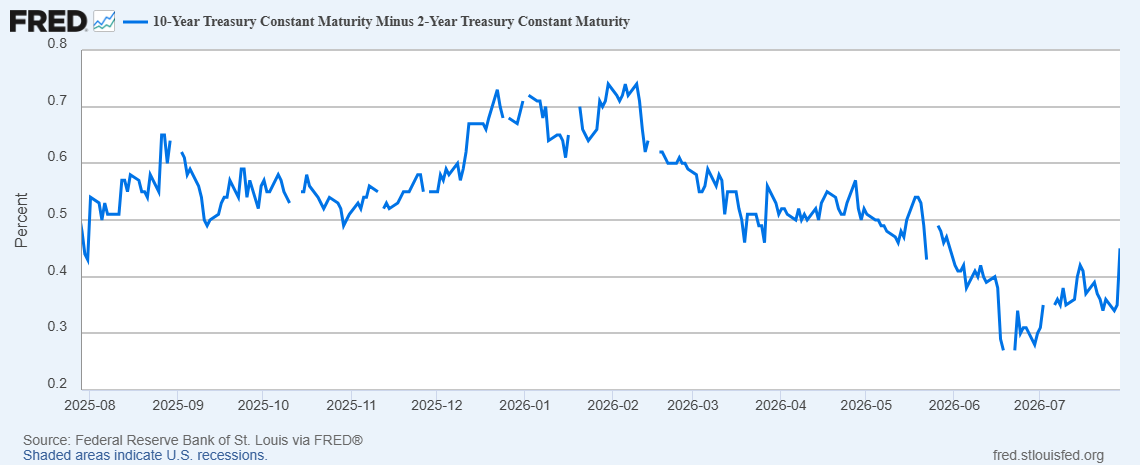
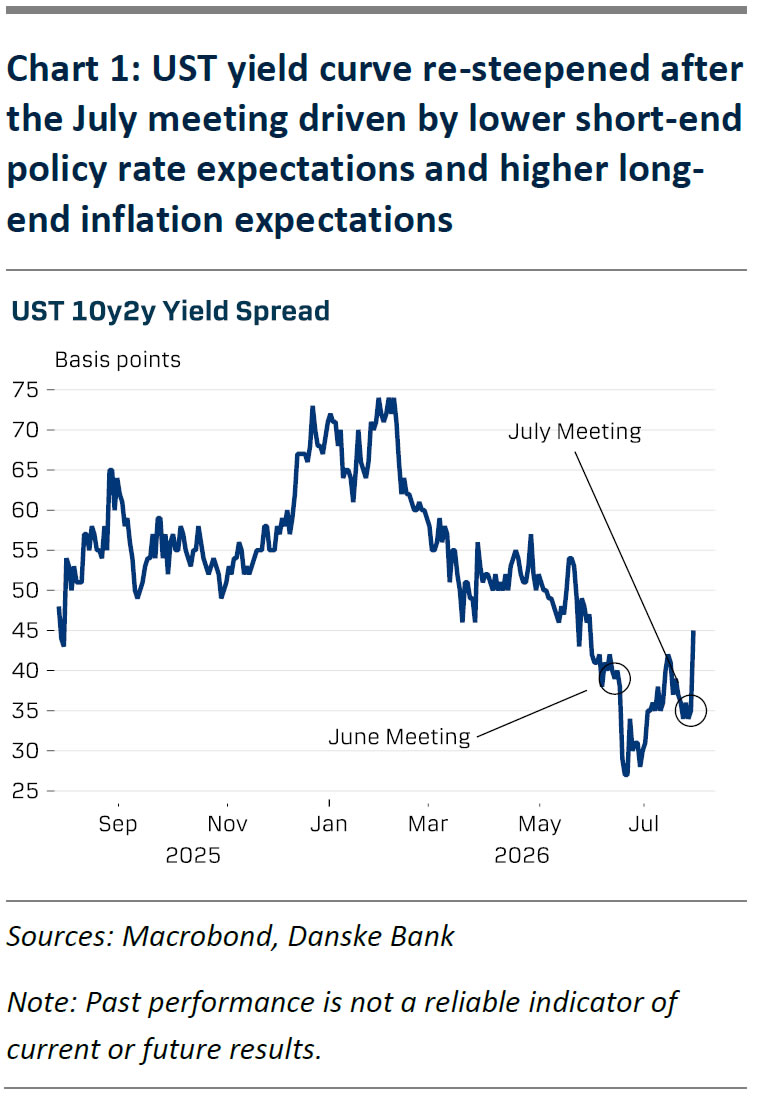
The recent behavior of the yield curve reinforces that interpretation. The 10-year/2-year spread has widened steadily from around 0.25–0.28 percentage points in mid-to-late June to roughly 0.45 now. That June low roughly coincided with Warsh's first meeting as Chair, a unanimous hold with guidance stripped from the statement.
Importantly, this steepening has unfolded over five to six weeks rather than erupting in a single trading session. Although the curve remains well below the 0.65–0.70 range seen in January–February 2026, the trend suggests investors have been gradually rebuilding inflation and uncertainty premiums — a partial retracement of prior flattening, not a new record steep — rather than merely reacting to one policy meeting.
Why This Distinction Matters
Whether the Fed raises rates in September will be resolved within weeks. Whether investors demand permanently higher compensation to hold long-term Treasury debt because of persistent inflation risks, diminished policy guidance, and greater uncertainty is a much more consequential question — one that isn't tied to any single decision and tends to persist well beyond it.
Wednesday's most important market signal may therefore have come not from the FOMC's three dissents, but from the bond market's increasingly uneasy view of the years beyond the next meeting: markets grew more relaxed about the next meeting or two (65% vs. 76%) while growing less relaxed about the multi-year outlook (the 30-year at an 18-year high). That split, not either data point alone, is the actual story.
Key Takeaways
- September hike odds fell to 65% from 76% even as the 30-year Treasury yield hit 5.228%, its highest level since 2007.
- Kashkari's surprise dissent alongside Hammack and Logan made the FOMC vote 9-3, hawkish on the surface but not the market's key takeaway.
- The bear-steepening pattern — long yields rising while the 2-year stayed contained — signals a term-premium repricing, not a near-term rate-path repricing.
- The 10s2s spread has widened from 0.25–0.28 in mid-June to 0.45 now, a five-to-six-week trend coinciding with Warsh's shift to minimal forward guidance.
- Trump's renewed criticism of Fed independence and persistent Middle East supply risk are compounding the long-end repricing alongside reduced policy guidance.
SPX Pullback Targets 7193–6953 Before Another Bounce
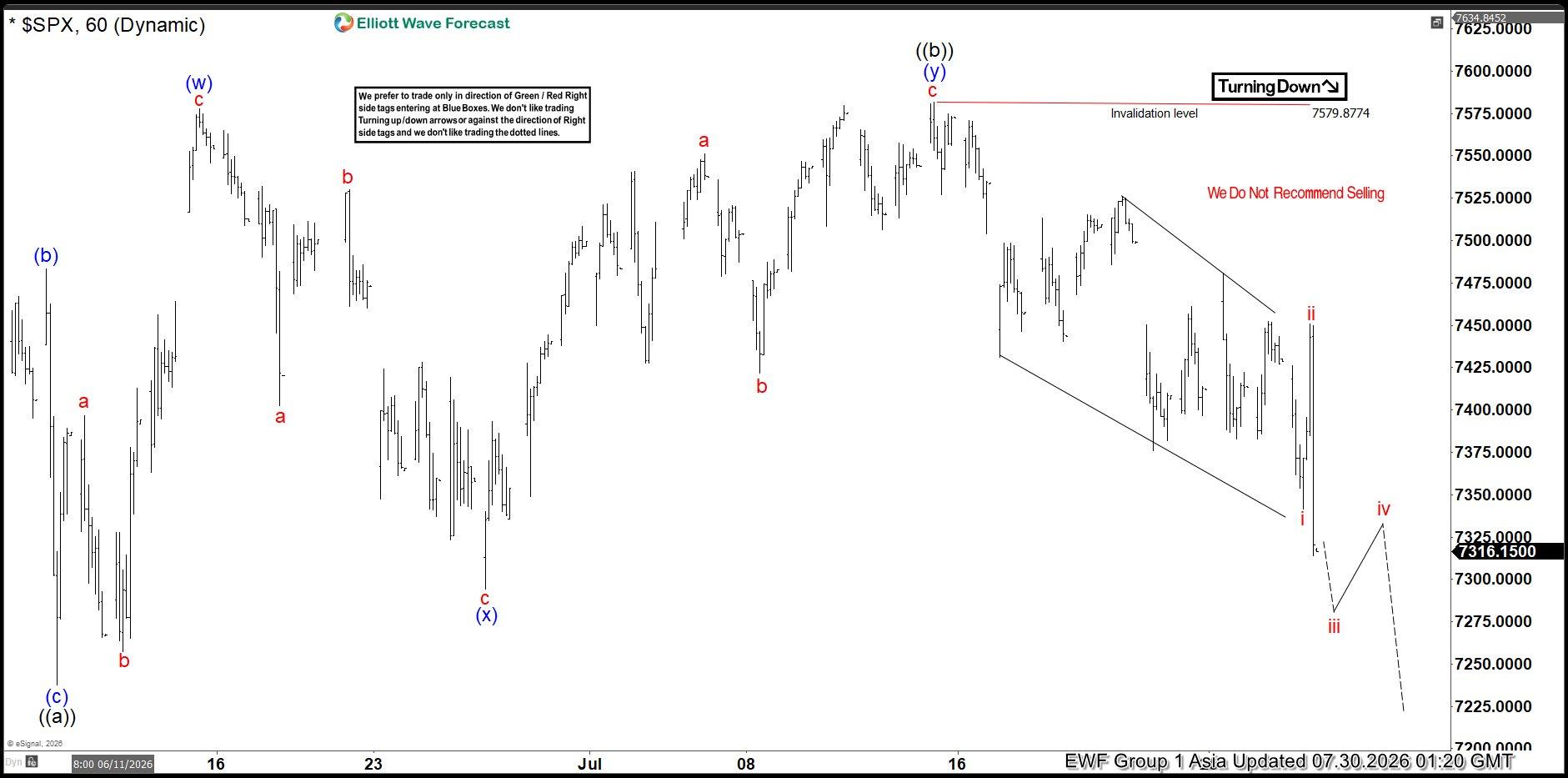
The S&P 500 (SPX) is currently correcting the strong advance from the 6317 low to the 7620 peak in wave 2. Based on the current Elliott Wave structure, the index appears to be forming a flat correction. Sub-waves ((a)) and ((b)) look complete, and SPX is now progressing lower in the final five-wave decline of wave ((c)). We expect wave ((c)) to extend toward the 7193–6953 area. This zone represents the 100%–161.8% Fibonacci extension of wave ((a)) and could provide an area for the correction to find support and trigger another bounce.
The structure still allows for the possibility of a deeper decline. However, as long as SPX remains above the 6317 low, we expect the pullback to eventually find support. The correction could complete in 3, 7, or 11 swings, depending on how the structure develops.
In the short term, the index remains vulnerable to further downside. Over the next 24 hours, we expect SPX to continue lower while staying below the 7579 invalidation level. The decline may include short-term corrective bounces along the way as wave ((c)) unfolds.
Once the correction completes, the broader bullish structure can resume, provided SPX holds above 6317. Therefore, the 7193–6953 region remains an important area to monitor for signs of support and a potential turn higher.
SPX 60 Min. Elliott Wave Counts
Video Analysis
https://elliottwave-forecast.com/wp-content/uploads/2026/07/SPX-7.29.mp4
USD/CHF Advances as Dollar Strength Builds Before GDP Data
Key Highlights
- USD/CHF gained strength for a move above 0.8150.
- A rising channel is forming with support at 0.8170 on the 4-hour chart.
- EUR/USD is now at risk of a move below 1.1350.
- Gold prices declined and traded below the $4,065 support.
USD/CHF Technical Analysis
The US Dollar remained well-bid above 0.8080 against the Swiss Franc. USD/CHF started a fresh increase above 0.8120 and 0.8150.
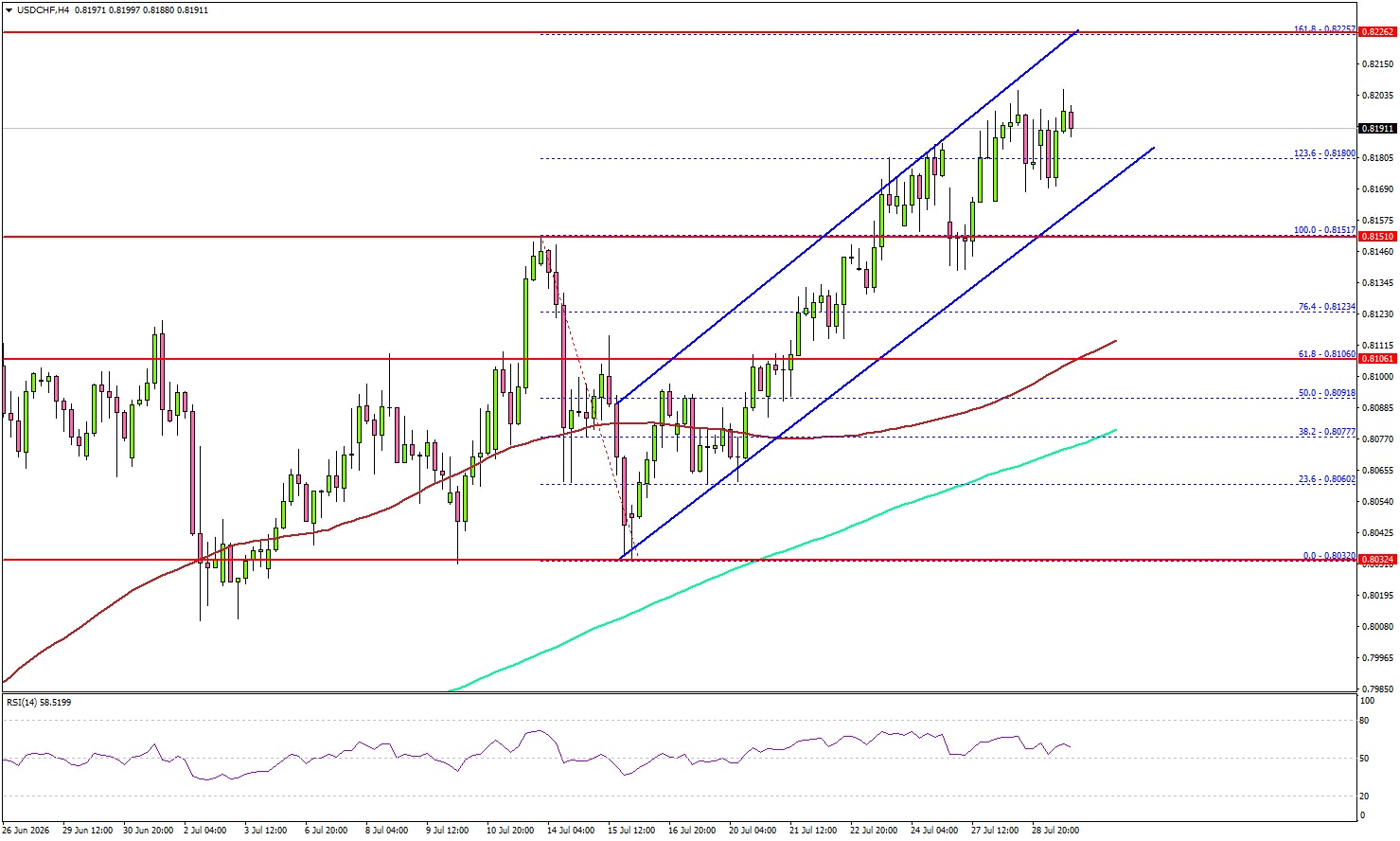
Looking at the 4-hour chart, the pair settled above 0.8150, the 100 simple moving average (red, 4-hour), and the 200 simple moving average (green, 4-hour). There was a clear move above the 1.236 Fib extension level of the downward move from the 0.8150 swing high to the 0.8032 low.
There is also a rising channel forming with support at 0.8170. On the upside, the pair could face resistance near 0.8200. The next major resistance might be 0.8220 or the 1.618 Fib extension level.
A close above 0.8220 could start another steady increase. In the stated case, the bulls could aim for a move to 0.8265. Any more gains might open the doors for a test of 0.8300.
If there is a downside correction, the pair could find bids near the channel support. The next major support could be near 0.8150. The main support might be 0.8100 and the 100 simple moving average (red, 4-hour).
A downside break and close below 0.8100 might send the pair toward 0.8050. Any more losses could open the doors for a test of 0.8000.
Looking at Gold, the price is again moving lower, and the bears could aim for a move below $3,950 in the near term.
Upcoming Key Economic Events:
- US Gross Domestic Product for Q2 2026 (Preliminary) – Forecast 2.1% versus previous 2.1%.
- US Personal Income for June 2026 (MoM) - Forecast +0.3%, versus +0.7% previous.
- US Initial Jobless Claims - Forecast 200K, versus 187K previous.
Australia Import Prices Surge Most Since 2021 as Hormuz Closure Drives Oil Shock
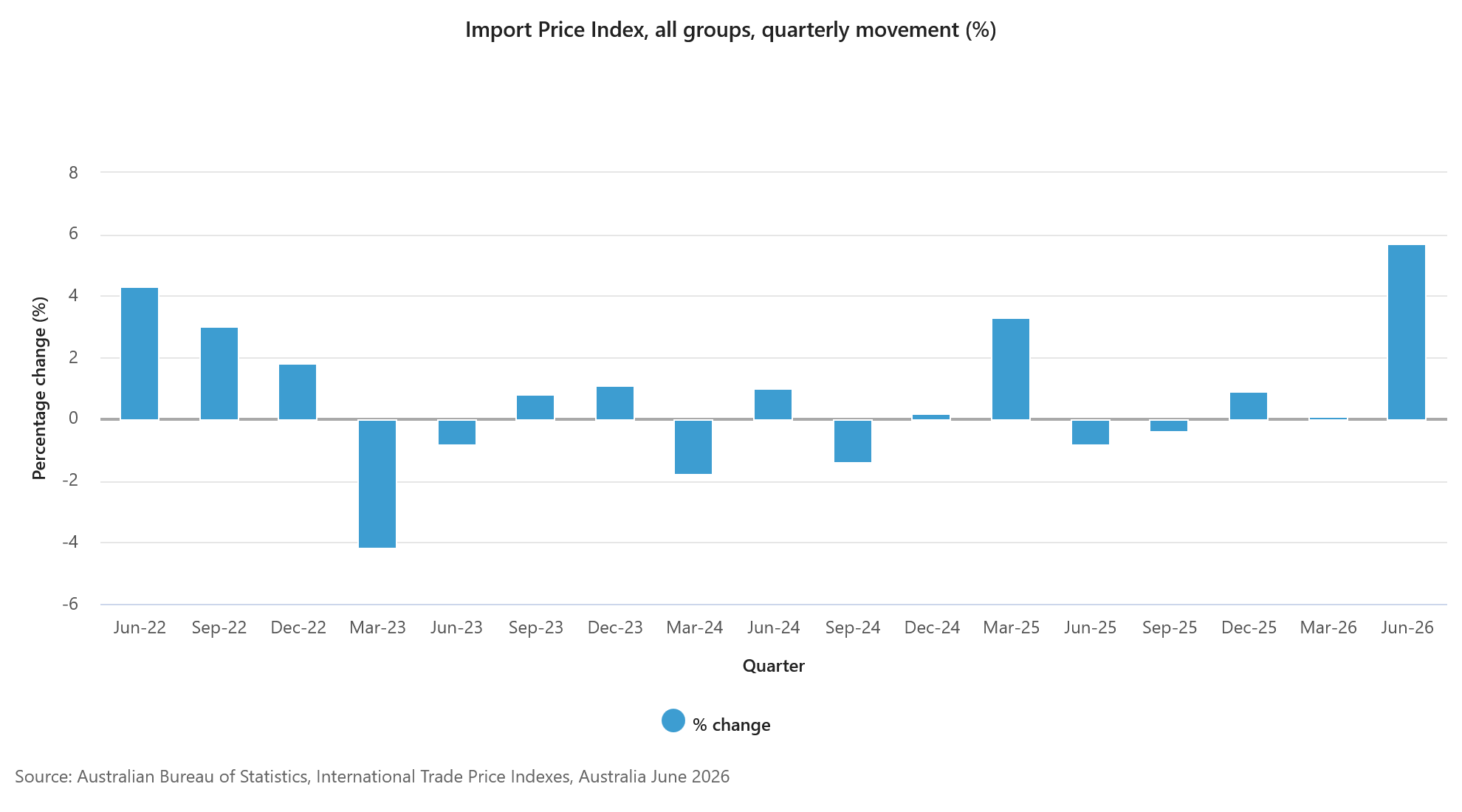
Australia's import prices surged 5.7% qoq in the second quarter, far exceeding expectations of a flat reading and marking the largest quarterly increase since the December 2021 quarter. The sharp acceleration underscores the extent to which the Strait of Hormuz closure has rippled through global supply chains, driving up the cost of key imported commodities despite broader signs that domestic inflation pressures have been easing.
According to the Australian Bureau of Statistics, the jump was led by a record 47.1% increase in petroleum and related products—the largest quarterly rise since the Import Price Index began in 1983. Fertilisers rose 25.1%, while plastics in primary forms gained 26.3%, reflecting widespread supply disruptions caused by the Middle East conflict.
ABS head of prices statistics Rachael McCririck said the closure of the Strait of Hormuz disrupted global supplies of oil, fertiliser and plastics, leading to broad-based increases in import costs. The only major offset came from non-monetary gold, which fell -9.1% as higher energy prices lifted inflation expectations, strengthened the US Dollar and reduced demand for non-yielding assets.
Export prices also increased, rising 1.1% qoq and 3.9% from a year earlier. Coal prices climbed 5.4% as concerns over global gas supplies boosted demand for thermal coal, while petroleum products and crude fertilisers rose 22.7% and 20.9%, respectively.
Although the data primarily reflect a global supply shock rather than stronger domestic demand, the sharp rise in import costs highlights the inflationary risks posed by prolonged disruptions in Middle East energy routes, a development the RBA will continue to monitor despite the recent moderation in consumer inflation.
Economic Data
| Indicator | Q2 2026 | Q1 2026 |
|---|---|---|
| Import Price Index (q/q) | 5.7% | 0.1% |
| Export Price Index (q/q) | 1.1% | — |
| Export Price Index (y/y) | 3.9% | — |
Major Import Price Components
| Component | Q2 Change |
|---|---|
| Petroleum & Related Products | 47.1% |
| Fertilisers (excluding crude) | 25.1% |
| Plastics in Primary Forms | 26.3% |
| Non-monetary Gold | -9.1% |
Major Export Price Components
| Component | Q2 Change |
|---|---|
| Petroleum & Related Products | 22.7% |
| Crude Fertilisers | 20.9% |
| Coal, Coke & Briquettes | 5.4% |
| Non-monetary Gold | -8.8% |
Key Takeaways
- Australia's Import Price Index surged 5.7% qoq, the strongest quarterly increase since Q4 2021 and far above expectations for no change.
- The increase was overwhelmingly driven by the Strait of Hormuz closure, which disrupted supplies of oil, fertilisers and plastics.
- Petroleum prices soared 47.1%, the largest quarterly increase since the Import Price Index began in 1983, highlighting the severity of the energy shock.
- Export prices also rose 1.1% qoq, supported by stronger prices for coal, petroleum products and fertilisers as global buyers sought alternative energy supplies.
- Falling non-monetary gold prices partially offset both import and export price gains, reflecting higher US interest rate expectations and a stronger US Dollar.
- The report illustrates how geopolitical supply shocks can rapidly feed into Australia's import costs, posing upside risks to inflation even as domestic price pressures have recently moderated.
Full Australia International Trade Price Indexes release here.
ANZ: New Zealand Business Confidence Jumps as Firms Look Beyond Geopolitical Risks
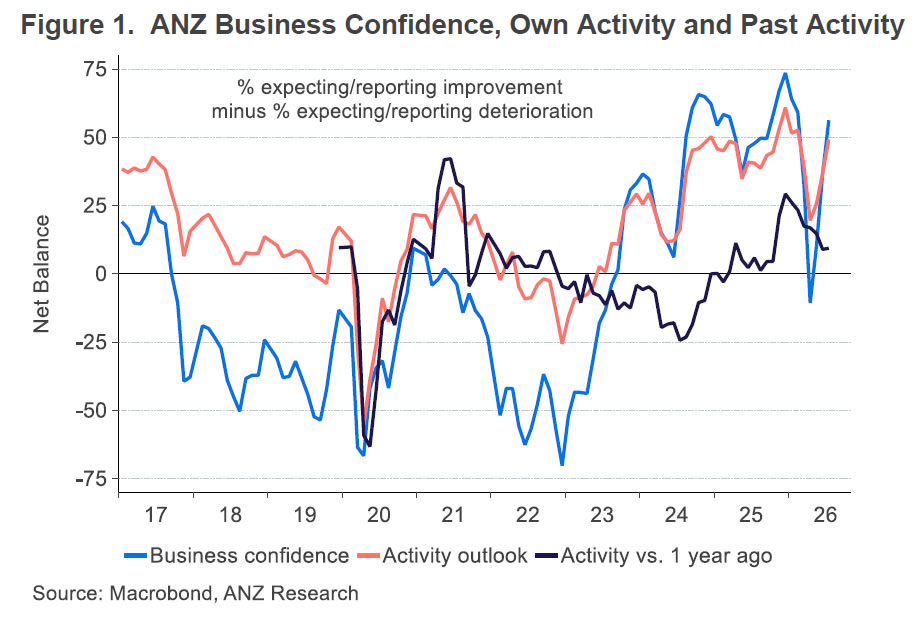
New Zealand business confidence strengthened sharply in July, with ANZ's Business Outlook survey suggesting firms have become increasingly optimistic about the economic outlook despite heightened geopolitical uncertainty. Headline business confidence rose sharply to 56.1 from 36.6, while firms' own activity outlook climbed to 49.3 from 36.9. Export, investment and employment intentions also improved, pointing to a broad-based recovery in business sentiment.
The survey painted an encouraging picture for the economy, but ANZ cautioned that the outlook remains unusually uncertain as businesses grapple with volatile oil prices and escalating tensions in the Middle East. "It feels like we need a weekly business confidence survey at the moment," the bank noted, highlighting how rapidly changing geopolitical developments have driven sharp swings in energy prices. The key question, according to ANZ, is whether firms and households continue with investment and spending plans or retreat into a more defensive stance if uncertainty persists.
For now, businesses appear to be looking through the near-term volatility. Just as importantly for the Reserve Bank of New Zealand, inflation indicators continued to soften even as confidence improved. One-year inflation expectations, pricing intentions and cost expectations all declined from June, suggesting the recovery in business sentiment has yet to generate renewed inflation pressure. That combination of firmer growth expectations and easing inflation should give policymakers greater confidence that the economy can continue recovering without requiring a renewed tightening response.
Economic Data
| Indicator | July | June |
|---|---|---|
| Business Confidence | 56.1 | 36.6 |
| Own Activity Outlook | 49.3 | 36.9 |
| Export Intentions | 26.6 | 18.1 |
| Investment Intentions | 22.8 | 16.5 |
| Employment Intentions | 18.1 | 9.4 |
| Residential Construction | 42.5 | 25.0 |
| Commercial Construction | 48.9 | 28.9 |
| Profit Expectations | 28.7 | 13.0 |
| Ease of Credit | 1.4 | -1.9 |
| Activity vs. Year Ago | 9.7 | 9.0 |
| Employment vs. Year Ago | -0.3 | -4.6 |
| Pricing Intentions (Net %) | 47.2 | 50.7 |
| Pricing Intentions (3 Months) | 1.78% | 2.03% |
| Cost Expectations (Net %) | 78.2 | 84.7 |
| Cost Expectations (3 Months) | 2.70% | 3.24% |
| Wage Expectations (12 Months) | 2.52% | 2.53% |
| Inflation Expectations (1 Year) | 3.14% | 3.36% |
Key Takeaways
- Business confidence jumped to 56.1, while firms' own activity outlook rose to 49.3, pointing to a broad-based improvement in economic sentiment.
- Export, investment and employment intentions all strengthened, suggesting businesses remain willing to expand despite heightened geopolitical uncertainty.
- Construction was a standout performer, with both residential and commercial activity expectations reaching multi-month highs.
- Inflation indicators continued to moderate. One-year inflation expectations, pricing intentions and cost expectations all declined from June.
- The survey presents a favorable combination of stronger growth expectations and easing inflation pressures, supporting the RBNZ's view that the recovery can continue without reigniting inflation.
- ANZ cautioned that sharp swings in oil prices and Middle East tensions have significantly increased uncertainty. Whether firms and households maintain spending and investment plans will be critical for the medium-term outlook.
Fed Review: Reversing Course (?)
- The Fed maintained its monetary policy unchanged in the July meeting. Three participants voted for a hike in line with our expectations, but importantly, Chair Warsh voted with the majority for unchanged rates.
- Warsh's tone was noticeably more neutral compared to his previous press conference, as he appeared satisfied with the rise in real rates since mid-June.
- Perhaps counterproductively, markets reversed part of its reaction to the June meeting. UST curve steepened, as markets cut back rate hike expectations and priced higher long-end inflation expectations. EUR/USD rose back above 1.14.
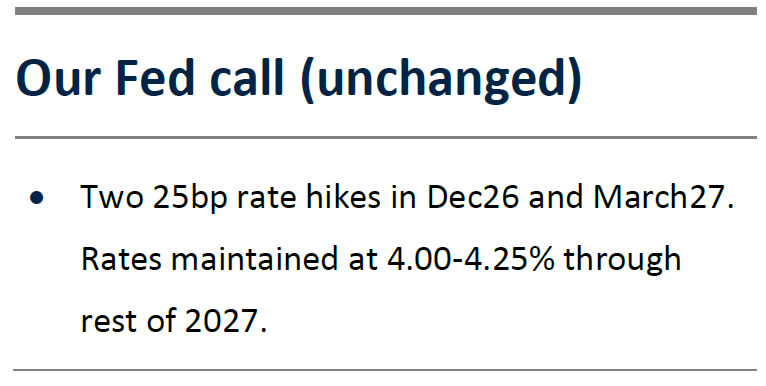
- We still think the macro case for tightening policy later on remains strong, and the market reaction could spark pushback from Fed speakers over coming days. We maintain our call for hikes in December and March meetings
At face value, the FOMC's 9-3 split decision hold was exactly in line with the expectations we laid out in our Fed preview - a divided hold, 22 July. We also named the three dissenters - Hammack, Logan and Kashkari - as the most likely hawks to support rapid tightening. But the most important part of forward guidance for markets was that Chair Warsh himself voted for an unchanged decision despite his hawkish commitment to price stability heard in June.
Warsh highlighted several times that real rates had risen during the intermeeting period because markets were taking the signal from data, instead of forward guidance. We do not share this view, as data released in late June landed close to expectations, and instead believe markets were reacting to Warsh's words of a 'regime shift'. And in this light, tonight's reaction felt like markets reconsidering their confidence in the Chair's ability to deliver on the promise of price stability.
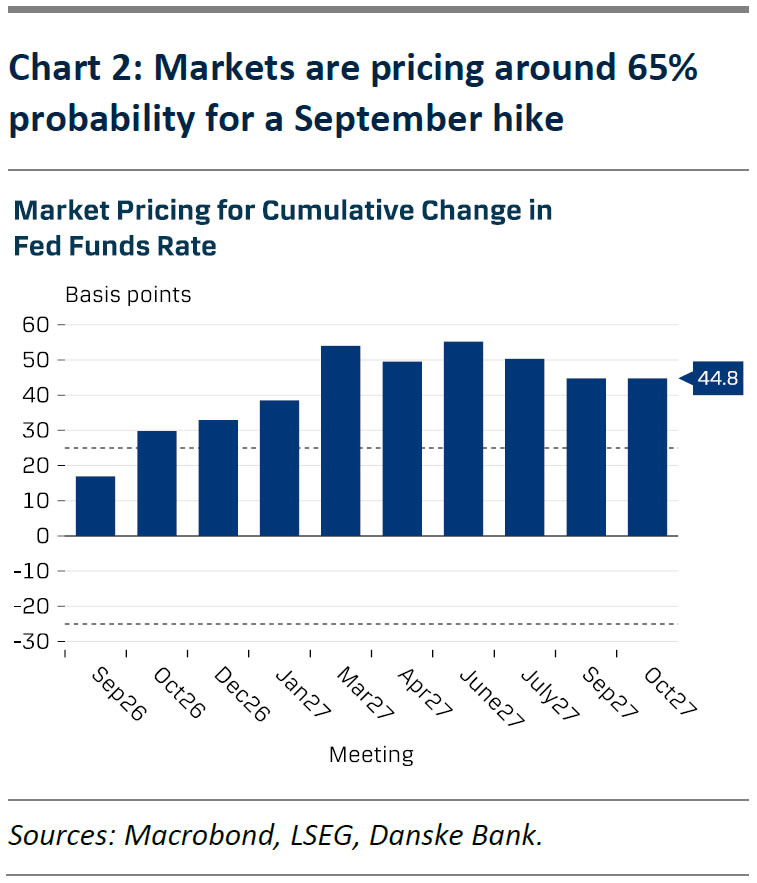
Markets cut back rate hike expectations, with cumulative hike pricing declining from 56bp to 50bp. The implied odds for a September hike declined from near-certain down to 65%. But more importantly, the UST yield curve saw the sharpest steepening since late March in 2s10s terms, as long-end inflation expectations moved higher. The current level (10y inflation swap at just above 2.3%) is by no means concerning as such, but if Warsh was happy with the post-June market reaction, tonight's shift was likely not what he intended.
We still think the macro case for tightening later on remains solid. AI-capex spending, retightening labour market balance, consumers' high propensity to spend and supportive fiscal policy all add to risk of persistent inflation. And if financial conditions ease further, Warsh might be forced to reconsider his vote already in September.
We maintain our base case for 25bp rate hikes in the December and March meetings. Note that the Fed made no changes to its balance sheet policy, and Warsh did not hint of changes before results from the task forces, which are expected by year-end. The NY Fed guides for reserve management purchases of T-bills at USD10bn/month.