Sample Category Title
BoE Split Widens as Policymakers Debate When—Not Whether—to Fight Inflation
The Bank of England left Bank Rate unchanged at 3.75% in a 6-3 vote today, but the decision masked a Committee that has become increasingly united on the direction of inflation risks while remaining divided over the timing of the policy response. Governor Andrew Bailey, Sarah Breeden, Swati Dhingra, Clare Lombardelli, Dave Ramsden and Alan Taylor voted to hold rates, while Megan Greene, Catherine Mann and Huw Pill preferred an immediate 25 basis point increase to 4.00%.
The meeting made clear that the debate is no longer whether renewed energy shocks pose an inflation risk. All members agreed that repeated Middle East escalations have left risks to energy prices skewed to the upside and that inflation is likely to rise later this year as higher fuel costs feed through to households and businesses. The key disagreement is whether policymakers should wait for evidence that higher energy costs are spilling into wages, services inflation and inflation expectations, or move pre-emptively to prevent those second-round effects from taking hold. The minutes explicitly acknowledged that monetary policy "could need to react before the risks around inflation persistence materialised conclusively," marking a notable shift toward a more proactive risk-management approach.
For the majority, restrictive monetary and financial conditions already provide sufficient insurance while policymakers gather more evidence. They argued that underlying disinflation remains intact, the labour market continues to soften and there is little evidence so far that higher energy prices are becoming embedded in broader inflation dynamics. Bailey summed up the balance by arguing that global conditions have become more inflationary, but domestic conditions remain comparatively benign, justifying a pause while retaining the flexibility to tighten later if needed.
The three dissenters viewed the risks differently. Greene argued that a proactive rate increase would reduce the probability of second-round effects becoming entrenched. Mann said the collapse of the US-Iran ceasefire and renewed volatility in energy markets had materially altered the policy backdrop, while Pill argued that tightening now would send a clear signal of the Bank's determination to keep inflation under control amid prolonged uncertainty over energy prices. Their common theme was that the cost of acting too early is likely to be lower than the cost of waiting until inflation persistence is already evident.
Taken together, the decision reinforces that the MPC has adopted an increasingly hawkish risk-management framework. While a majority judged it appropriate to hold rates this month, the minutes suggest future decisions will depend less on the direct impact of higher oil prices and more on whether evidence begins to emerge that the energy shock is feeding into wage growth and inflation expectations. Until then, markets are likely to interpret the BoE as remaining firmly biased toward tightening rather than easing.
Key Takeaways
- The BoE left Bank Rate unchanged at 3.75% in a 6-3 vote, with Megan Greene, Catherine L. Mann and Huw Pill voting for a 25bp hike to 4.00%.
- The Committee is divided over timing, not direction. All members agreed inflation risks remain skewed to the upside due to higher and more volatile energy prices, but differed on whether to tighten now or wait for more evidence.
- Second-round effects are now the BoE's central focus. Policymakers continue to look through the direct impact of higher energy prices and instead are watching for spillovers into wages, services inflation and inflation expectations.
- The minutes signal a more proactive policy framework. The MPC explicitly stated that monetary policy may need to react before inflation persistence becomes conclusively evident, reflecting a stronger risk-management approach.
- The hold camp believes policy is already restrictive enough. Members pointed to ongoing underlying disinflation, a softer labour market and tighter financial conditions as reasons to wait while monitoring incoming data.
- The hike camp argues the cost of acting early is lower than acting late. The three dissenters favored an immediate hike to reduce the risk that higher energy prices become embedded in inflation expectations and wage-setting.
- Future BoE decisions will hinge on domestic inflation persistence rather than oil prices alone. Wage growth, services inflation and inflation expectations are likely to become the key indicators ahead of the next meeting.
Brent Oil – Recovery Faces Headwinds but Holds Grip for Now
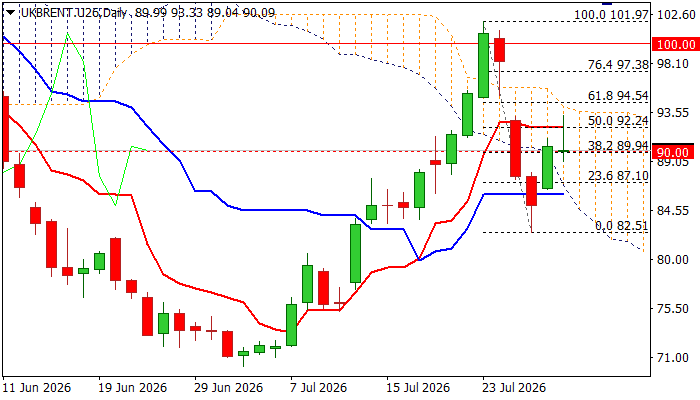
Brent price rose for the second straight day on Thursday as fresh escalation of US / Iran conflict faded recent optimism of potential diplomatic initiative and revived fears about potential supply disruption.
Oil price peaked at $93.33 during European session on Thursday, marking over 50% retracement of $101.97/$92.51 bear-leg, but recovery faced increased headwinds on approach to the top of daily Ichimoku cloud ($93.66) and so far, reversed the big part of today’s recovery.
With geopolitical picture (as dominant factor in creating near-term direction) being very fragile and with high risk of further escalation, technical studies on daily chart are neutral to bullishly aligned and partially contribute to recovery attempts.
Repeated daily close above $90 (psychological / broken Fibo 38.2% of $101.97/$82.51) will be required to keep near-term action biased higher, with extension and close above 50% retracement ($92.24) to validate positive signal and strengthen near-term structure for attack at $93.66 (daily cloud top) and $94.54/76 (Fibo 61.8% / 100DMA).
Caution on failure to told gains above $90 that would expose the lower pivot at $86.85 (daily cloud base).
Res: 92.24; 93.33; 93.66; 94.54
Sup: 89.04; 87.63; 86.85; 85.29
(BOE) Bank Rate maintained at 3.75%
Monetary Policy Summary, July 2026
At its meeting ending on 29 July 2026, the Monetary Policy Committee (MPC) voted by a majority of 6–3 to maintain Bank Rate at 3.75%. Three members voted to increase Bank Rate by 0.25 percentage points, to 4%.
In response to events in the Middle East, crude and refined energy prices have remained volatile and higher than pre-conflict. The impact of the energy shock on the UK economy remains uncertain. Monetary policy cannot influence energy prices but is being set to ensure that the economic adjustment to them occurs in a way that achieves the 2% inflation target sustainably. The policy stance required to achieve this will depend on the scale and duration of the shock, and how it propagates through the economy including via financial conditions.
CPI inflation has fallen to 2.6% since the previous meeting, although it is expected to rise later this year as the effects of higher energy prices continue to pass through. The risk of material second-round effects in price and wage-setting, against which policy needs to lean, is greater the longer higher energy prices persist. There is little evidence so far to suggest such effects, and there have continued to be clear signs of underlying disinflation in recent data. Loose labour market conditions, and higher interest rates faced by households and businesses than prior to the conflict, will also act to reduce inflation over time. The Committee judges that the risks to the inflation outlook are tilted to the upside relative to the central projection in the July Monetary Policy Report, but there remains scope for the outlook to change materially as events in the Middle East unfold.
The Committee judges that it is appropriate to maintain Bank Rate at this meeting. The Committee stands ready to act as necessary to ensure that CPI inflation remains on track to meet the 2% target in the medium term.
Minutes of the Monetary Policy Committee meeting ending on 29 July 2026
1: Before turning to its immediate policy decision, the Monetary Policy Committee (MPC) discussed key economic developments and its judgements around them, as well as its views on monetary policy strategy. The latest data and analysis underpinning these topics were set out in the accompanying July 2026 Monetary Policy Report.
The Committee’s discussions
2: At this meeting, the Committee discussed developments in global energy prices, the uncertainty surrounding the prospects for them and the implications for near-term inflation. It also discussed the extent of disinflation and slack in the economy, the potential scale of second-round effects and broader global factors as possible drivers of future inflation.
3: The conflict in the Middle East, and its impact on energy prices and the UK economy, remained the dominant source of uncertainty for the inflation outlook. In the run-up to this meeting, oil and gas prices were materially higher than pre-conflict. The Brent crude front-month future and the UK front-month natural gas future were $84 per barrel and 136 pence per therm respectively as at close of business on 28 July. In the June CPI outturn of 2.6%, motor fuel prices had contributed 0.6 percentage points to CPI inflation. Inflation was expected to rise further this year from the direct and indirect effects of higher energy prices. Volatility in energy prices would correspond to volatility in this near-term inflation outlook. Members continued to look through direct effects. But policy would need to guard particularly against second-round effects that created inflation persistence, while considering any trade-off with weaker economic activity. The risk of material second-round effects would depend on the scale and duration of the energy shock, which remained uncertain.
4: All members agreed that risks to the paths of energy prices remained skewed to the upside. Energy markets had been volatile, and there was concern that repeated re-escalations of the conflict could prolong this volatility. This could generate further upward pressure on energy prices, with uncertainty over how long this could linger. The release of strategic oil reserves and substitution between energy sources had been restraining more acute oil price increases, but could not mitigate the shock indefinitely. And gas and refined product prices, which were salient for households and businesses, had been less tempered by these mitigants owing to supply constraints. The Committee therefore remained attentive to the risk that consumer energy prices could stay elevated for longer, even if for most members the range of likely near-term global energy price paths had probably narrowed relative to the more extreme levels considered at the time of the April Monetary Policy Report.
5: In evaluating the impact of these developments on inflation, all members acknowledged that there had been sustained disinflation pre-conflict. Although above the 2% target, CPI inflation had fallen since the April Report, accounted for largely by continued moderation in services and food inflation. Abating domestic inflationary pressures had been supported by slowing wage growth and a soft labour market. Some members also noted that the absence of a monetary overhang was helping to create a more benign starting point for the energy shock compared to some previous episodes.
6: Members took varying degrees of reassurance from what this past disinflation implied for the inflation outlook. For most members, past disinflation was consistent with a margin of economic slack. This slack would continue to constrain the strength of inflation persistence in the medium term. For other members, this past disinflation was either not informative about future inflation, or in spite of it there was a significant risk of second-round effects taking hold. All members agreed that the likelihood of material second-round effects was the key uncertainty surrounding the appropriate policy response to bring inflation back to target in the medium term.
7: The Committee agreed that there had been little evidence of material second-round effects so far. It noted that, given lags in pass-through, this could not be taken as a strong signal about their future emergence, especially given measurement challenges. Renewed escalations in the Middle East could also change the assessment. For some members, the absence of adverse developments so far in key indicators including inflation expectations, own-price expectations in the DMP survey, wage-price feedback and food inflation, pointed to a likelihood of limited second-round effects to come. Other members derived little signal from current data given the lagged nature of second-round effects, particularly so for wage-setting dynamics for which indications of 2027 pay settlements were yet to come. And members were concerned to varying degrees that higher energy prices were occurring against a backdrop of persistent above-target inflation as well as elevated household attentiveness to inflation outturns. Taken together, this warranted caution in placing too much weight on initial evidence in determining the possibility of stronger second-round effects.
8: The Committee would continue to monitor the evolution of a wide range of forward-looking data and intelligence to allow timely assessments of the inflation outlook. Box A in the July Report set out a framework, a fuller set of monitoring indicators and analytical approaches that the Committee would continue to consider in evaluating second-round effects.
9: More broadly than the energy shock, global factors pointed to an economic environment that risked being more inflationary in future. While some factors appeared to be exerting some downward pressure on UK inflation at the moment, for example trade diversion due to higher global trade tariffs, some posed upside risks. These included strong demand for AI-related components creating sector-specific price pressures and the impact of El Niño on global food prices. While these risks might not materialise, or occur at the same time, the Committee noted that some could interact with one another and with commodity price developments in potentially inflationary ways. The Committee would continue to monitor these dynamics and their implications for the inflation outlook.
10: Taking all of the risks into account, the MPC judged that the risk of strong inflationary pressures was greater than the risk of weak inflationary pressures, although there remained a high degree of uncertainty around the outlook. The central projection for the economy and two scenarios were set out in the July Report. The central projection was conditioned on the 15 day average of energy price paths to 20 July and assumed moderate additional second-round effects. The adverse scenario was consistent with the likelihood of repeated re-escalations of the conflict with no clear resolution, resulting in persistently higher energy prices, and with an assumption of much stronger second-round effects. The milder scenario assumed lower energy prices around those that had been observed around the beginning of July, consistent with a more durable de-escalation of the conflict. In this case, additional second-round effects did not emerge and, in addition, household consumption was assumed to be weaker leading to softer demand and inflation pressures.
11: Members noted that monetary policy could need to react before the risks around inflation persistence materialised conclusively. There were two dimensions in considering the appropriate policy stance: the level of current monetary policy restrictiveness, and the degree to which policy should guard pre-emptively against the possibility of worse outcomes. Both considerations involved balancing the costs of leaning too little against inflation persistence against costs to economic activity by leaning too much.
12: In considering the appropriate level for Bank Rate, members noted that financial conditions had tightened materially compared with prior to the conflict, which had increased financing costs faced by households and firms. Members discussed the extent to which the tightening in financial conditions reflected ongoing uncertainty and a perception from market participants that risks to Bank Rate were skewed to the upside.
The immediate policy decision
13: The MPC sets monetary policy to meet the 2% inflation target sustainably.
14: Six members (Andrew Bailey, Sarah Breeden, Swati Dhingra, Clare Lombardelli, Dave Ramsden and Alan Taylor) preferred to maintain Bank Rate at this meeting. Holding Bank Rate, combined with the significant tightening of financial conditions that had occurred since the conflict started, was providing sufficient insurance against the upside risks to inflation stemming from fluctuations in energy prices. This would allow time to observe further evidence, preserving the option to change Bank Rate in future were the evidence to warrant it. Members recognised the potential need for additional policy restraint were signs of material second-round effects to emerge. But they also noted that the policy strategy could change were upside risks to inflation to subside durably and the underlying disinflation process to continue.
15: Three members (Megan Greene, Catherine L Mann and Huw Pill) preferred a 0.25 percentage point increase in Bank Rate at this meeting. These members were less reassured on the underlying disinflationary process, were concerned that second-round effects could be material, and thought it relevant that inflation had exceeded the 2% target for more than five years. For these members, uncertainty about how the conflict would evolve remained high, and so a risk management strategy was appropriate. They believed that a proactive increase in Bank Rate would reduce the probability of second-round effects setting in. Further, research found that setting policy as if there were stronger second-round effects and course correcting if needed, would prove to be less costly than vice versa.
16: The Chair invited the Committee to vote on the proposition that:
- Bank Rate should be maintained at 3.75%.
17: Six members (Andrew Bailey, Sarah Breeden, Swati Dhingra, Clare Lombardelli, Dave Ramsden and Alan Taylor) voted in favour of the proposition. Three members (Megan Greene, Catherine L Mann and Huw Pill) voted against the proposition, preferring to increase Bank Rate by 0.25 percentage points, to 4%.
MPC members’ views
18: Members set out the rationale underpinning their individual votes on Bank Rate.
Members are listed alphabetically under each vote grouping. References in parentheses relate to boxes in the July 2026 Monetary Policy Report. References to scenarios relate to those set out in Section 3 of the July Report.
Votes to maintain Bank Rate at 3.75%
Andrew Bailey: Events in the Middle East mean that the short-run path of inflation is uncertain owing to volatile energy prices. The possibility of repeated resumptions of conflict, combined with lower than usual European gas stock levels and a fall in global refining output, mean that risks to energy prices lie to the upside. Set against that, the process of underlying disinflation that was intact prior to the conflict remains in train. That provides some tentative evidence that inherited inflation persistence may be weaker than had been presumed. Alongside this, the labour market continues to ease, and the demand environment remains soft. There is little evidence yet of second-round effects (Boxes A and B), although it is too early to take much comfort from that. Financial conditions have tightened since the onset of the conflict (Box F). These conditions and the upward sloping yield curve, which in part reflects the energy-related upside risks to inflation, are weighing on any nascent inflation pressures. Holding Bank Rate is appropriate as global conditions look to be more uncertain and inflationary, while domestic conditions are on balance more benign as regards the prospects for inflation.
Sarah Breeden: Energy prices have been volatile since June. For monetary policy, what matters is the scale and duration of these shocks and how they propagate through the economy. Incoming data show underlying disinflation to have been firmly on track, consistent with weak demand and a loose labour market. Neither staff’s new granular measure of underlying inflation (Box C) nor broad money developments (Box E) signal upside inflation risks. Together with staff’s monitoring of second-round effects (Box B), that gives me greater confidence that such effects should be limited, although it remains early days. While my confidence around the domestic inflationary environment has increased, risks to global prices have shifted to the upside. Geopolitical tensions remain unresolved, gas and refined fuel prices are high, and global supply shocks – including those related to climate and AI (Box D) – could reinforce one another, increasing the likelihood of more material second-round effects. Financial conditions facing households and businesses have tightened materially since the onset of the conflict, and consistent with the baseline, provide sufficient restrictiveness for now. Looking ahead, I will continue to focus on how second-round effects are likely to evolve.
Swati Dhingra: The eventual size, persistence and propagation of the energy shock remain highly uncertain. So far, evidence suggests that inflationary pressures are more upstream, concentrated in a limited number of sectors, and do not yet appear to be broadening materially (Boxes B and C). The domestic economy is unlikely to amplify second-round effects as demand remains subdued, the labour market continues to loosen with vacancies below pre-pandemic levels and margins are not expanding in a way that magnifies the shock. An increase in Bank Rate now would be disproportionate as, unlike 2022, the starting point for this shock is much softer and the policy stance is more restrictive. I continue to see value in waiting for a clearer read on the energy shock in the coming months before deciding whether a change in policy is required, given the broad range of possible outcomes. We will learn more about first-round energy effects and 2027 wage-setting towards the end of this year. This would still allow time for monetary policy to mitigate second-round effects as needed at that point.
Clare Lombardelli: The outlook for UK inflation is being driven by global factors interacting with a weakening domestic environment. Indirect and second-round effects of previous higher energy prices remain a concern, exacerbated by the reemergence of elevated energy prices. Second-round effects take time to appear (Boxes A and B) but could be significant. Their current absence is informative but not conclusive. Recent data show underlying disinflation continuing and the looser labour market and weak pricing power should help limit propagation. The stance of monetary policy is restrictive, more so once broader financial conditions and the further underlying disinflation are factored in. This provides sensible risk management given the inflationary impulse from higher energy prices. Policy would need to be adjusted were there to be evidence of risks of significant second-round effects, including from persistently higher energy prices.
Dave Ramsden: There are two distinct aspects to the outlook, pulling in different directions. On the one hand, I see clear upside risks to inflation from the global environment, with the potential for a prolonged disruption to energy prices from repeated energy shocks, though perhaps smaller in amplitude than first considered in March and April. Alongside that, bottlenecks in AI supply chains and the impact of El Niño on food prices may add to inflationary pressures (Box D). On the other hand, domestic developments point to a more benign inflationary outlook (Box C), where inflation would have been likely to return to target absent the shocks from the conflict in the Middle East. And an early assessment of second-round effects (Box B) suggests they are more likely than not to be limited. The policy stance is currently delivering the restrictiveness necessary to weigh against the upside risks posed by the global environment. I will keep the degree of restrictiveness under review as we continue to learn more about the upside risks to inflation. If they were to crystallise, a hike in Bank Rate may be warranted. If the risks were to subside and the underlying disinflation process continued, I would consider resuming the cutting cycle.
Alan Taylor: The inflation outlook is shaped by opposing forces: benign, disinflationary background trends in domestic conditions versus incoming, volatile global shocks of unclear magnitude and duration. On the latter, especially conflict-related energy shocks, there is no evidence so far of second-round effects, but we continue to monitor them. These external risks are important and justify an upside-skewed scenario. But they are not the only risks that matter for policy thinking. In contrast, domestic inflation pressures continue to abate, with wage and private-sector AWE growth reaching target-consistent rates and recent CPI numbers surprising to the downside. The backdrop is one of greater slack, restrictive monetary conditions, cautious households and firms, and limited fiscal space. The economy is drifting further toward deficient demand, with material risk of larger output gaps, labour-market scarring, and a slowdown in growth over the next year or two. In that context, the possibility of downside surprises, and painful trade-offs, remains relevant. For me, the more likely outcomes sit between the baseline and milder scenario, albeit with a long right tail; keeping Bank rate on hold, at a higher level now than the pre-conflict implied path, gives insurance for now, before resuming cuts when and if geopolitical uncertainty clears.
Votes to increase Bank Rate to 4%
Megan Greene: There remains considerable uncertainty about the evolution of the conflict in Iran and its impact on the UK economy. Incoming data suggests the disinflation process has continued and the real side of the economy remains soft. Some recent forward-looking surveys have been collected during a peace deal and a conflict, making it difficult to parse signal from noise. Unsurprisingly, there has been scant evidence of second-round effects, but I expect some to emerge. There have been successive negative supply shocks, inflation has remained above target for roughly five years and inflation is likely to reach the threshold at which business and household expectations are more sensitive to outturns. Other supply risks loom as well, including a second energy choke point in the Red Sea, El Niño and supply constraints for AI-related hardware. As in June, there is significant uncertainty about which projection or scenario is most likely and I believe a risk management strategy is appropriate. Staff analysis illustrates that setting policy as if there are stronger second-round effects and course correcting if they prove to be smaller is less costly than vice versa. Furthermore, a proactive hike in Bank Rate may reduce the probability that second-round effects set in.
Catherine L Mann: Most indicators of nominal conditions have continued to moderate, although near-term inflation estimates skirt the inflation attentiveness threshold at which research suggests stronger second-round effects, which would build on an inflation rate that has remained above target for five years. That said, the key change in the environment for my decision is the collapse of the US-Iran Memorandum of Understanding, the widening of the Middle East conflict, and the associated volatility in energy prices. This ‘sporadic continuance’ of the conflict that I hypothesised last month appears to be the state of play. The shocks and volatility transmit through salience and production costs to affect expectations and price setting behaviours to impart an upward ratchet to CPI inflation. A variety of research methods concludes that Bank Rate should be higher than 3.75% to return inflation to the 2% target sustainably. Other research emphasises that the costs of leaning against upside risks that fail to materialise would be smaller than the cost of leaning too little against upside risks. Notwithstanding moderately restrictive nominal financial conditions, reinforcing policy credibility when faced with inflationary shocks implies that a 25 basis point increase in Bank Rate is appropriate at this time.
Huw Pill: While energy prices remain volatile, risks to achieving the inflation target lie firmly to the upside. It is comforting that, so far, staff analysis has identified neither a broad money overhang (Box E) nor second-round effects associated with the de-anchoring of longer-term inflation expectations. Nonetheless, I remain concerned about more insidious second-round effects driven by catch-up dynamics in wage and price setting. While these may be slower to emerge, they could prove more lasting and create greater intrinsic inflation persistence. Structural shifts in the economy have rendered the UK more vulnerable to such catch-up effects and are also associated with a less benign view of pre-conflict underlying inflation. The profound uncertainty surrounding the energy price outlook is likely to be prolonged and of unknown duration, rendering efforts to fine-tune the economy with monetary policy hazardous. As a result, it is appropriate to raise Bank Rate now, thereby cutting through noise in commodity and asset price developments to offer a clear and unambiguous signal of our willingness and ability to address upside risks to inflation stemming from events in the Gulf. This would place us in the best position to manage risks to the inflation target as they emerge.
Operational considerations
19: On 17 July, the stock of UK government bonds held for monetary policy purposes was £491 billion.
20: The following members of the Committee were present:
- Andrew Bailey, Chair
- Sarah Breeden
- Swati Dhingra
- Megan Greene
- Clare Lombardelli
- Catherine L Mann
- Huw Pill
- Dave Ramsden
- Alan Taylor
Brian Bell was present as the Treasury representative.
David Roberts was present on 21 July and 27 July, as an observer for the purpose of exercising oversight functions in his role as a member of the Bank’s Court of Directors.
USD Index Regains Traction After Post-Fed Drop as Worsening Geopolitical Situation Is Expected to Continue to Fuel Inflation
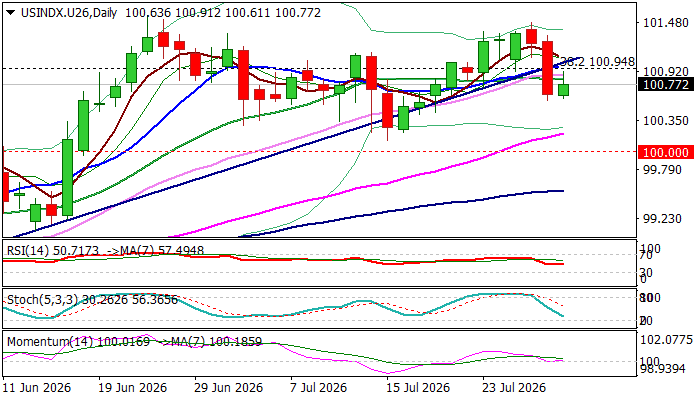
The dollar regained traction in early Thursday trading and recovered part of Wednesday’s post-Fed 0.6% drop, which pushed the US currency to the lowest since July 20.
The US central bank left rates unchanged at 3.50%/3.75% range as widely expected, but policymakers were split in policy view that deepens uncertainty over Fed’s next steps.
Although the Fed sticks to its rhetoric about closely watching developments and acting accordingly, markets keep high bets for September rate hike (with one more hike by the end of the year, not ruled out) that continues to underpin the dollar.
The latest escalation in the Middle East and signals that conflict may deepen and widen by more countries in the region being engulfed, will continue to fuel inflation (prolonged oil supply disruption would cause domino-effect) and increase pressure on the Fed for further policy tightening.
From that perspective we can see the sharp drop in past two days as a healthy correction (despite that bull-trendline off 97.40 higher base has been violated again, likely for another false break lower).
Technical picture on daily chart remains predominantly bullish and contribute to scenario of deeper correction (still within the limits) as positioning for fresh push higher.
Ascending and thickening daily Ichimoku cloud continues to underpin near-term action, with momentum studies being in neutral to positive mode.
Break and close above 20DMA (100.83) is seen as minimum requirement to validate initial positive signal, with return above bull-trendline (100.98, reinforced by 10DMA) to bring bulls back to play and shift focus on recent peaks at 100.48/55).
Larger bulls are expected to remain active if the price holds above 100 support zone.
Res: 100.98; 101.48; 101.55; 102.00
Sup: 100.58; 100.22; 100.00; 99.48
USD/JPY Temporary in Equilibrium: Multiple Factors in Focus
USD/JPY held near 163.50 on Thursday, with the yen retreating slightly after strengthening in the previous session. The currency had been supported by a broader dollar decline following the Federal Reserve's decision to keep interest rates unchanged.
However, three FOMC members voted in favour of a rate hike, and Fed Chairman Kevin Warsh stressed that the pause should not be interpreted as a rejection of further policy tightening. Future decisions will continue to be data-dependent.
The Bank of Japan is also expected to keep rates unchanged on Friday but is likely to signal that further hikes remain possible to contain the yen's decline. Verbal interventions from Japanese authorities have so far provided little relief, and the BOJ has offered no clear guidance on the timing of its next move.
Geopolitical tensions have once again intensified, with media reports indicating that the United States has resumed airstrikes on Iran following attacks on American forces in the region.
Technical Analysis
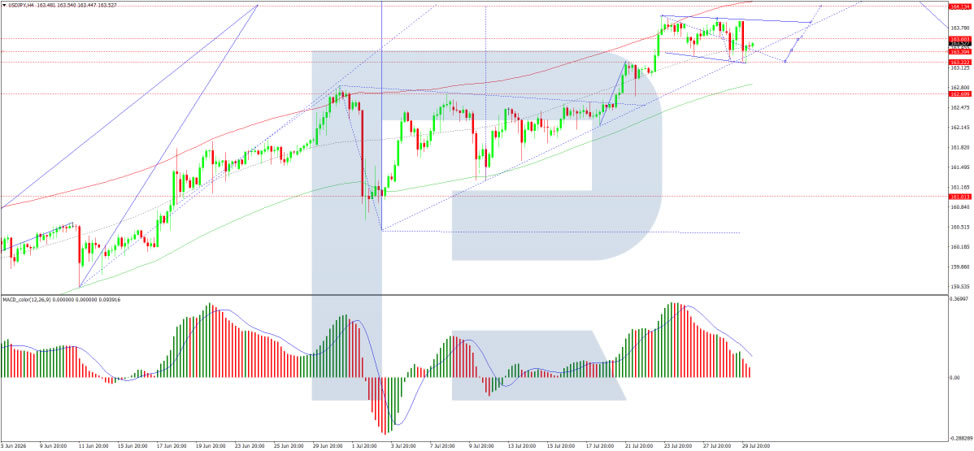
On the H4 USD/JPY chart, the market is forming a consolidation range around the 163.60 level, currently extending between 163.20 and 163.89. A move higher towards 163.60 is expected, with scope for the trend to extend to 164.15 and then to 164.85. The MACD indicator supports this scenario, with its signal line above zero but pointing downwards, indicating the potential for short-term consolidation before further upside.
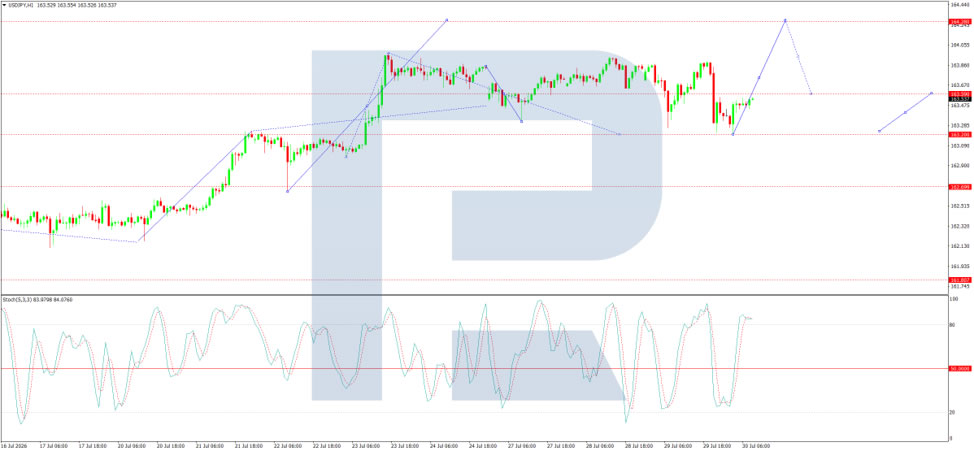
On the H1 chart, USD/JPY has completed a downward move to the 163.20 level. A move higher towards at least 163.60 is expected next. A breakout above this level would open the way for a continuation towards 164.15. The Stochastic oscillator confirms this scenario, with its signal line above 50 and pointing upwards towards 80, indicating short-term bullish momentum.
Conclusion
USD/JPY is trading in a narrow range as markets digest the Federal Reserve's decision to hold rates steady, despite three dissenting votes and Chairman Warsh's insistence that the pause does not signal the end of tightening. The dollar's modest decline after the announcement provided some relief for the yen, although the currency remains vulnerable. Attention now turns to the Bank of Japan's policy meeting on Friday, where rates are expected to be left unchanged but with hawkish signals to support the currency. Geopolitical risks have re-emerged following reports of renewed US airstrikes on Iran. Technically, the pair appears poised for further upside towards 163.60 and beyond, with the BOJ's guidance and intervention risks likely to determine the near-term direction.
Bank of England Vote Could Spur GBPusd Jump
• The US dollar has fallen on fears that the Fed will not raise interest rates.
• Positive policy outlook, including the BoE’s hawkish rhetoric, will support the pound.
The US dollar suffered its sharpest fall in the last two weeks following Kevin Warsh’s intention to shift the Fed’s responsibility for bringing inflation back to the 2% target onto the financial markets. The new Fed Chair emphasised that the rally in Treasury yields is tightening financial conditions and holding back price growth. Inflation expectations remain at acceptable levels.
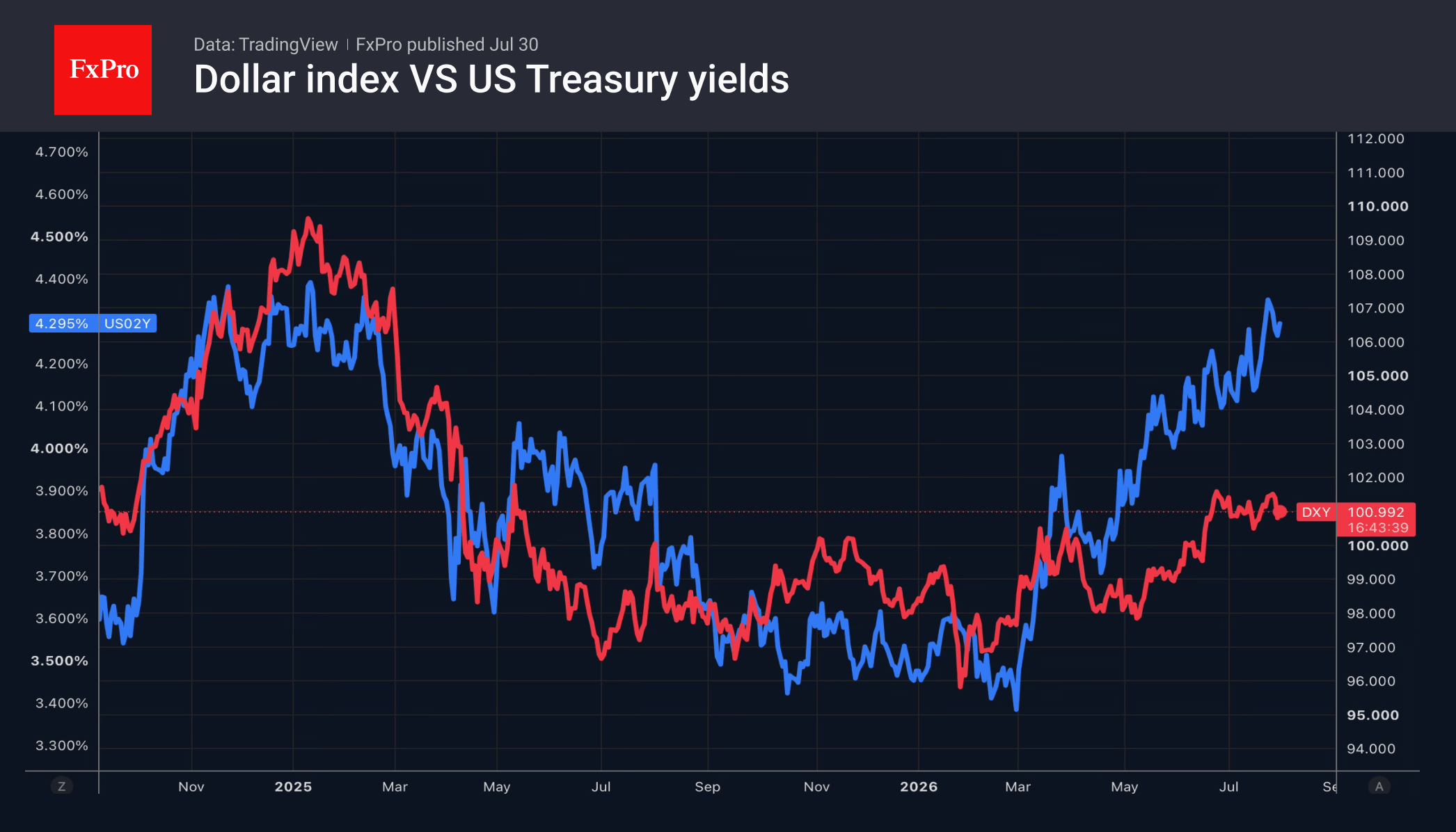
Investors interpreted this rhetoric as an intention to extend the pause and avoid tightening monetary policy for as long as possible. The probability of a federal funds rate hike in September has fallen from 75% to 65%, and the likelihood of two hikes in 2026 has dropped from 51% to 44%. This led to a weakening of the US dollar against major peers, despite falling stock indices, a rally in Treasury bond yields and rising oil prices against the backdrop of the escalating conflict in the Middle East.
However, Commerzbank believes that the rally in Brent crude will not necessarily weigh on the EURUSD and GBPUSD. It is leading to a rise in inflation expectations in Europe and to an increased likelihood of policy tightening by the ECB and the Bank of England. At the same time, inflation expectations in the US are not rising, nor is the likelihood of Fed monetary tightening. According to DBS Group, Kevin Warsh’s withdrawal of his forward guidance is leaving US markets and the dollar stumbling in the dark. By contrast, the euro and the pound may benefit from central banks maintaining their guidance on the future path of interest rates.
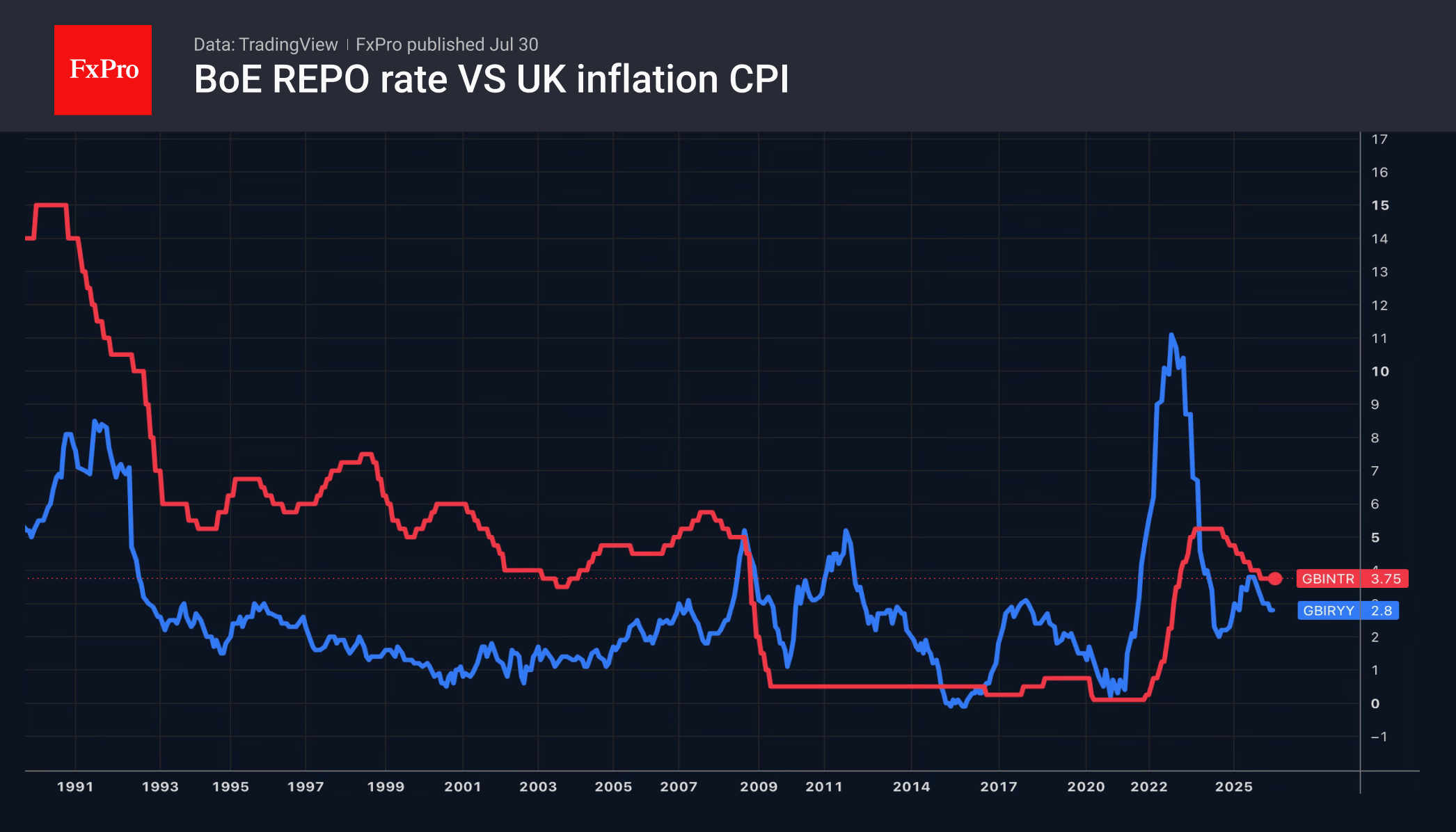
In this regard, the BoE meeting could provide sterling support. Investors do not expect a rise in the repo rate but anticipate hawkish rhetoric amid the escalating conflict in the Middle East and rising energy prices. Oil and gas prices are higher than they were at the time of the Committee’s previous meeting.
Despite the Bank of England holding rates for a fifth consecutive meeting, the futures market is pricing in a 65% chance of a hike in September and nearly two increases by the end of this year. Bloomberg experts forecast that only two of the nine MPC members will vote for a rate hike. If the number is higher, GBPUSD could rise.
The FxPro Analyst Team
EUR/USD Rebound Reflects ECB Repricing as Oil Revives September Hike Bets
TL;DR: EUR/USD's rebound reflects broad-based Euro strength as oil's rebound since mid-week pushes markets toward the ECB's own hawkish scenario, lifting September hike odds to roughly 70%.
Euro's Broad-Based Strength Tells a Bigger Story
EUR/USD has staged a notable rebound in the last 24 hours, but attributing the move solely to Dollar weakness misses a broader shift taking place in currency markets. The Dollar has indeed softened after investors pared expectations for a September Fed rate hike. Yet the Euro has strengthened not only against the Dollar, but against most major peers. That broad-based performance suggests investors are repricing the European Central Bank itself, rather than merely rotating away from weaker currencies.
Oil Is Moving the ECB's Reaction Function in a Hawkish Direction
The catalyst isn't that the ECB has changed its policy stance, but that the assumptions feeding its reaction function have shifted. In its March staff projections, the ECB outlined a baseline scenario built around Brent crude averaging around $90 and European natural gas around €57/MWh through 2026, while an adverse scenario assumed oil near $120 and gas around €102/MWh — resulting in materially higher inflation.
That framework has become relevant again. At the ECB's July 23 press conference, held as Brent broke above $100, President Christine Lagarde remarked that the earlier US-Iran ceasefire had been "short-lived," leading to "serious developments on commodity markets." She also stressed the ECB's reaction function was "very well understood" by markets and projected inflation to remain well above target into the first half of 2027. This week's renewed attacks involving Iran, US forces, and Saudi energy infrastructure have reversed much of the earlier decline in oil prices, pushing markets back toward the ECB's own baseline energy scenario.
Oil Doesn't Trigger Hikes Automatically
Importantly, the ECB hasn't become mechanically more hawkish simply because oil prices have risen. Lagarde has repeatedly emphasized that policymakers ultimately look for second-round effects — particularly stronger wage growth, firmer services inflation, and higher inflation expectations — before concluding inflation is becoming entrenched.
However, higher oil prices still matter because they shift the starting point. A sustained rise in energy costs lifts the projected path for headline inflation, making it easier for the Governing Council to conclude another rate hike is warranted. In effect, stronger oil prices lower the evidentiary burden for tightening even if second-round effects have yet to fully emerge, because the ECB's own scenario analysis already treats prolonged energy shocks as sufficient to generate materially higher inflation.
GDP Removes One of the Dovish Arguments
Today's stronger-than-expected GDP data reinforce that assessment. Eurozone GDP expanded 0.4% qoq in the second quarter, beating expectations and rebounding from the flat first quarter. While hardly signaling an economic boom, the figures weaken one of the main dovish arguments — that growth is too fragile to absorb another rate increase. With activity proving more resilient than expected, the ECB has greater room to tighten policy without immediately risking recession.
Markets and Banks Are Converging on a September Hike
That combination has fed directly into market pricing. Investors now assign roughly a 70% probability to a September rate hike, with much of this week's repricing driven by renewed oil strength outweighing the more dovish tone that emerged from the ECB's Sintra forum earlier this month.
Several major banks have moved in the same direction:
- Deutsche Bank now describes a September increase to 2.50% as "highly likely" and close to a "done deal."
- UOB expects one final 25 basis point hike followed by an extended pause.
- ING notes that around 23 basis points are already priced and argues the ECB has historically preferred to fully telegraph its policy moves.
What to Watch Next
Attention now turns to whether the oil rally proves durable. If tensions involving Iran continue to support energy prices into September, the ECB's adverse inflation scenario will become increasingly relevant. Conversely, a renewed de-escalation could quickly reduce the urgency for another hike. Investors will also closely monitor upcoming remarks from ECB officials to see whether the stronger GDP data strengthens confidence that another move is becoming appropriate.
ActionForex's Technical View on EUR/USD
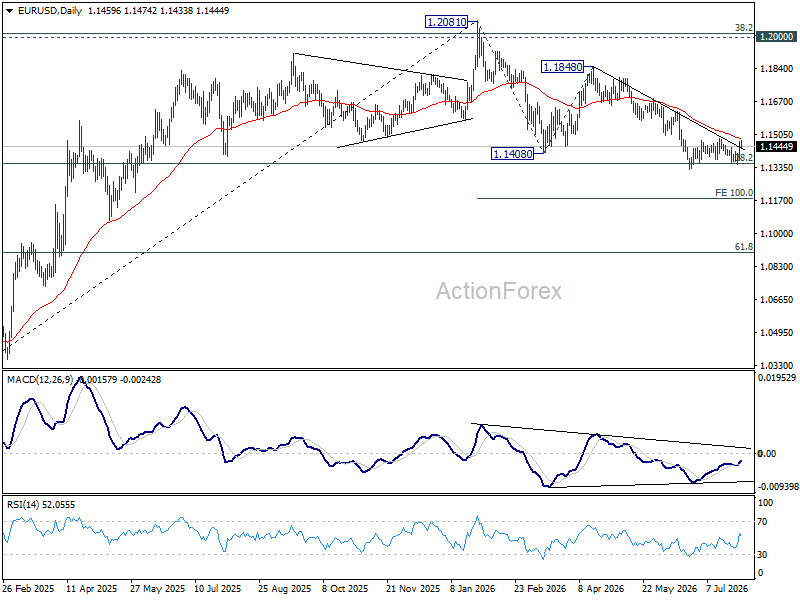
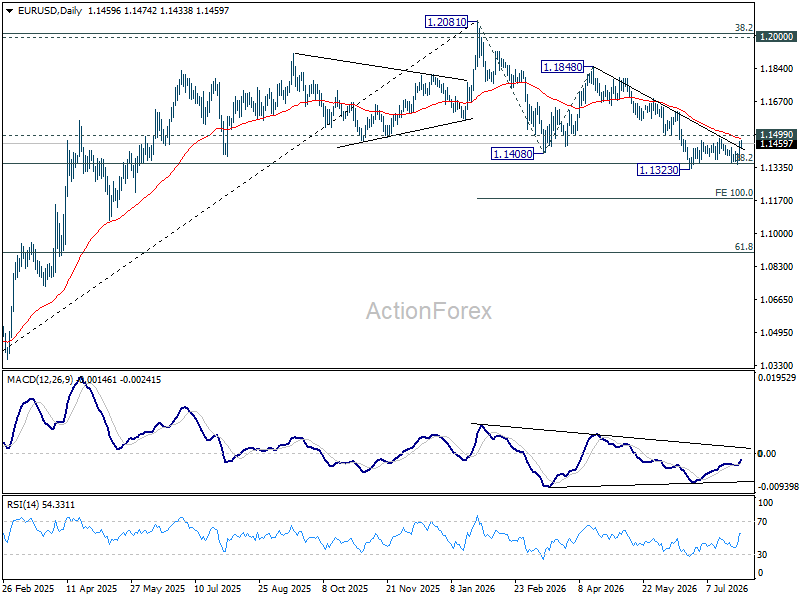
Technically, EUR/USD has improved but has yet to confirm a bullish reversal. The pair remains capped below 1.1499, which has switched from support to resistance. Encouraging signs are nevertheless emerging: the 4H MACD continues to strengthen, price has broken its near-term falling trend line, and the daily MACD continues to display bullish divergence. The pair is also finding support around the 38.2% retracement of 1.0176 to 1.2081, at 1.1353.
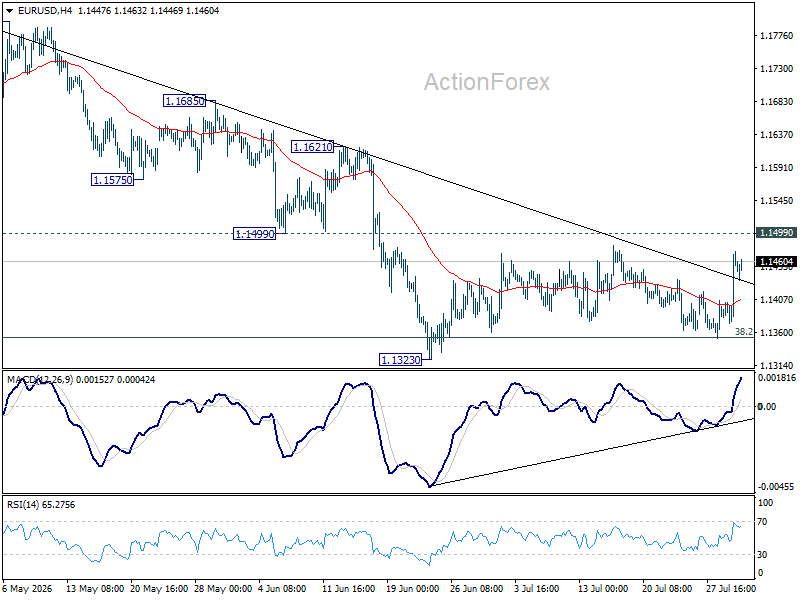
A decisive break above 1.1499, followed by sustained trading above the 55-day EMA at 1.1484, would strengthen the case that the decline from 1.2081 completed as a three-wave correction at 1.1323, opening the way toward 1.1848 and potentially higher.
Nevertheless, failure to overcome 1.1499 would keep the broader decline intact and leave scope for a deeper fall toward the 100% projection of 1.2081 to 1.1408 from 1.1848 at 1.1175.
Key Takeaways
- EUR/USD's rebound reflects broad Euro strength against most major peers, not just Dollar weakness from fading Fed hike bets.
- Oil's return above $100 is pushing markets toward the ECB's own adverse inflation scenario, lowering the bar for another hike without requiring new second-round effects.
- Stronger-than-expected Q2 Eurozone GDP (0.4% qoq) removes the argument that growth is too fragile to absorb another rate increase.
- Markets now price roughly a 70% probability of a September ECB hike, with Deutsche Bank, UOB, and ING all leaning toward a move to 2.50%.
- EUR/USD needs a decisive break above 1.1499 and the 55-day EMA at 1.1484 to confirm the decline from 1.2081 has completed as a corrective structure.
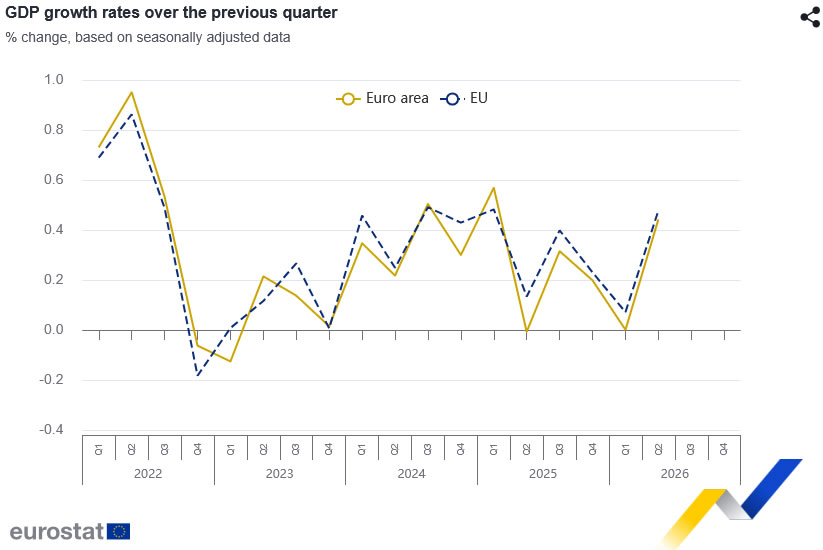
Eurozone Economy Rebounds in Q2 as GDP Growth Accelerates to 0.4%
Eurozone economic growth accelerated in the second quarter, with preliminary data from Eurostat showing GDP expanded 0.4% qoq, beating expectations of 0.2% and marking a clear improvement from the 0.0% pace recorded in the first quarter. The broader EU economy grew 0.5% qoq, up from 0.1%, suggesting the region regained momentum despite persistent geopolitical tensions and trade uncertainty.
The recovery also strengthened on an annual basis. Eurozone GDP growth accelerated to 1.0% yoy from 0.5%, while EU growth picked up to 1.2% from 0.8%. Country-level data pointed to a broader expansion rather than one driven by a handful of economies.
Spain and Portugal continued to outperform, Germany maintained its gradual recovery, France returned to quarterly growth after a contraction in the first quarter, while several smaller economies, including Sweden and Finland, posted robust gains. Although Belgium and Austria stagnated, the overall picture suggests the recovery has become increasingly widespread.
The stronger-than-expected GDP figures should provide some reassurance that the Eurozone economy is weathering external headwinds better than anticipated. However, the pace of expansion remains moderate rather than booming, with Germany still recovering only gradually and domestic demand showing little sign of overheating.
Economic Data
| Indicator | Q2 2026 | Q1 2026 |
|---|---|---|
| Eurozone GDP (q/q) | 0.4% | 0.0% |
| Eurozone GDP (y/y) | 1.0% | 0.5% |
| EU GDP (q/q) | 0.5% | 0.1% |
| EU GDP (y/y) | 1.2% | 0.8% |
| Market Expectation (Eurozone q/q) | 0.2% | — |
Selected Member States (Quarterly GDP)
| Economy | Q2 q/q | Q1 q/q |
|---|---|---|
| Spain | 0.7% | 0.6% |
| Portugal | 0.8% | 0.1% |
| Germany | 0.2% | 0.4% |
| France | 0.2% | -0.1% |
| Italy | 0.2% | 0.3% |
| Netherlands | 0.4% | 0.3% |
| Belgium | 0.0% | 0.2% |
| Austria | 0.0% | 0.2% |
Key Takeaways
- Eurozone GDP expanded 0.4% qoq, beating expectations of 0.2% and improving from flat growth in Q1.
- Annual growth accelerated to 1.0% y/y from 0.5%, while EU GDP strengthened to 1.2% from 0.8%.
- The recovery appears more broad-based, with Spain and Portugal continuing to outperform, Germany maintaining its gradual recovery, and France returning to positive quarterly growth.
- Several smaller economies, including Sweden, Finland and Lithuania, also posted robust quarterly gains, suggesting growth is becoming more geographically balanced.
- Belgium and Austria stalled during the quarter, while Ireland remained an outlier due to multinational-related volatility.
- Overall, the figures point to a steady recovery rather than an economic boom, supporting the view that the Eurozone economy is becoming more resilient despite geopolitical uncertainty and higher energy prices.
The Crypto Market Holds Its Ground Despite the Stock Market Slump
Market Overview
The crypto market capitalisation remained at $2.19T, showing little change over the past 24 hours, despite fairly volatile movements in the stock market. The market remains above its 50-day moving average, continuing to signal a fundamental shift in the medium-term trend towards bullishness. The divergence from the equity market, which had worked against cryptocurrencies at the start of the year, has now become a boon amid the sharp sell-off in the Nasdaq tech index. Among the most actively traded coins, performance ranges from a decline of around 2.5% for Dash and Aave to gains of 4% for Uniswap and 2.1% for Zcash.
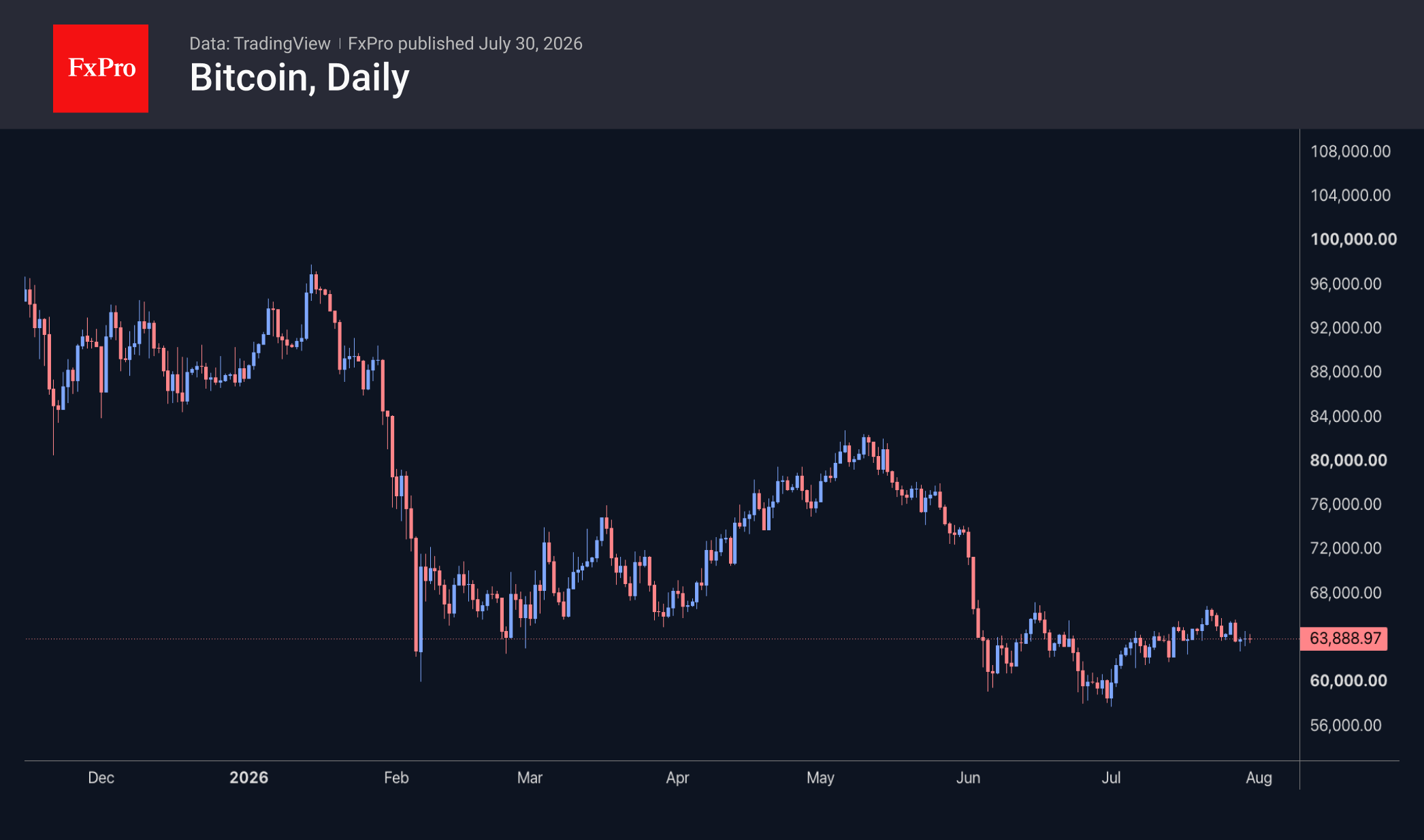
Bitcoin is trading at around $64K on Thursday morning, finding support from buyers on dips towards $63K, but lacking the fundamental grounds to resume its upward trend amid the sell-off in the equity market. This is the flip side of the abundance of institutional investors in the leading cryptocurrency. When risk-off sentiment takes hold, it is not only overbought shares that come under pressure, but also cryptocurrencies and metals.
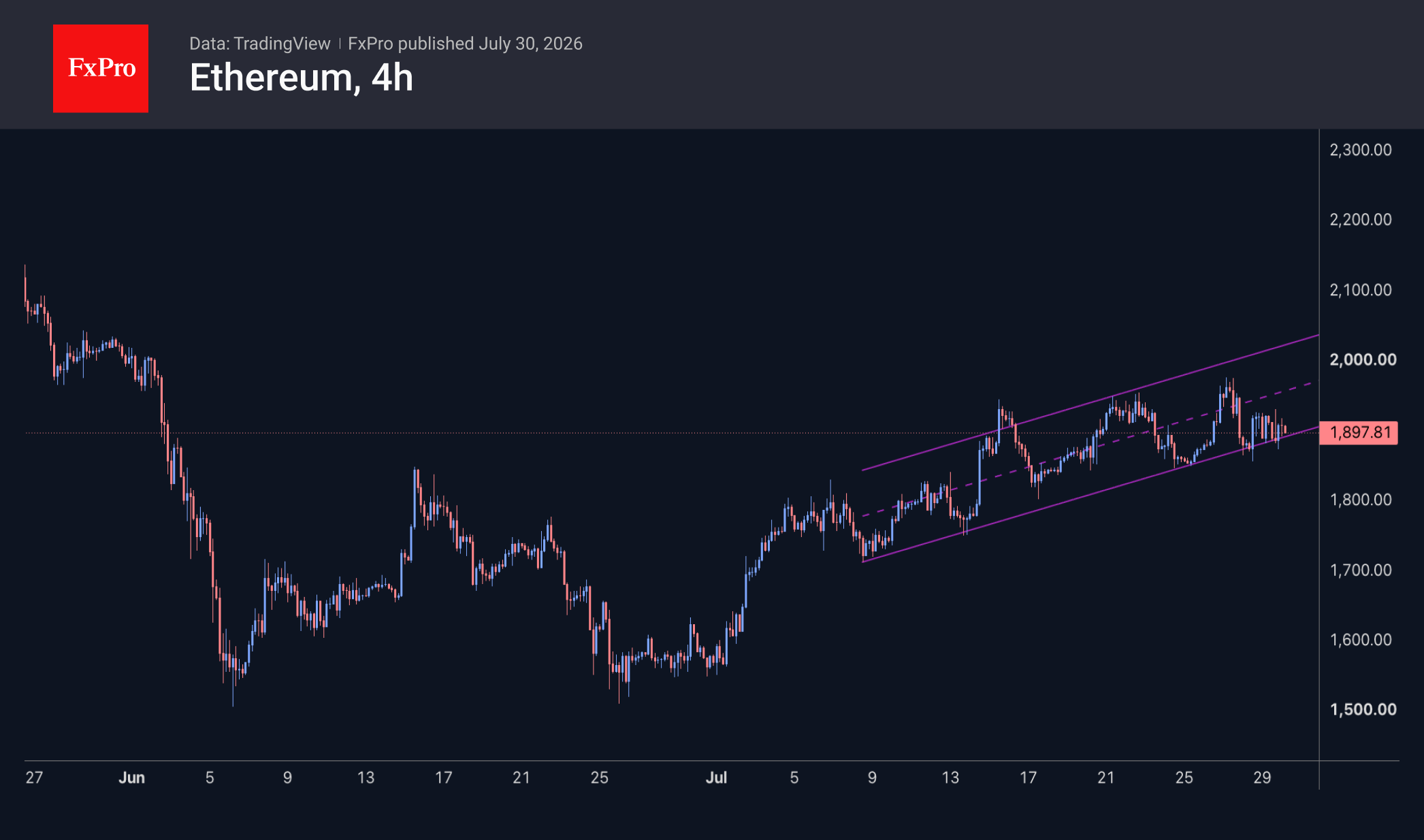
The Ethereum chart has been tracing a near-perfect uptrend for the fourth week in a row. It appears that this trend of methodical buying on dips began as early as the start of June, but a significant downward move at the end of last month disrupted the beauty of the initial picture. Could this be driven by BitMine’s commitment to buying, which is sustaining interest amongst a wider circle of speculators?
News Background
According to CryptoQuant, spot trading volumes for Bitcoin on major crypto exchanges have fallen by 75% from peak levels at the end of 2024.
In July, spot trading activity in the crypto market approached its lowest levels since November 2023, notes K33 Research. Weak activity is also evident in derivatives. July is historically the quietest period of the year for the crypto market in terms of trading volumes.
Institutional investors are adopting a passive stance: ETF inflows are weak, and major players are awaiting clearer signals from the Fed regarding the key interest rate, according to Millpay.
Crypto traders are increasingly opting to trade traditional assets rather than cryptocurrencies. This trend began to develop in earnest following the escalation of the conflict in the Middle East in February, and by July it had become almost universal.
According to Lookonchain, a wallet linked to Arthur Hayes, co-founder of the BitMEX crypto exchange, purchased 3,298 Ethereum for $6.39 million. In June, by contrast, Hayes’s wallets were selling off Ether.
The FxPro Analyst Team
EUR/USD Daily Outlook
While EUR/USD rebounded strongly, it's still staying below 1.1499 support turned resistance. Intraday bias remains neutral and outlook stays bearish. On the downside, break of 1.1323 will resume the fall from 1.2081 to 100% projection of 1.2081 to 1.1408 from 1.1848 at 1.1175. However, decisive break of 1.1499 will turn bias back to the upside for 1.1621 resistance.
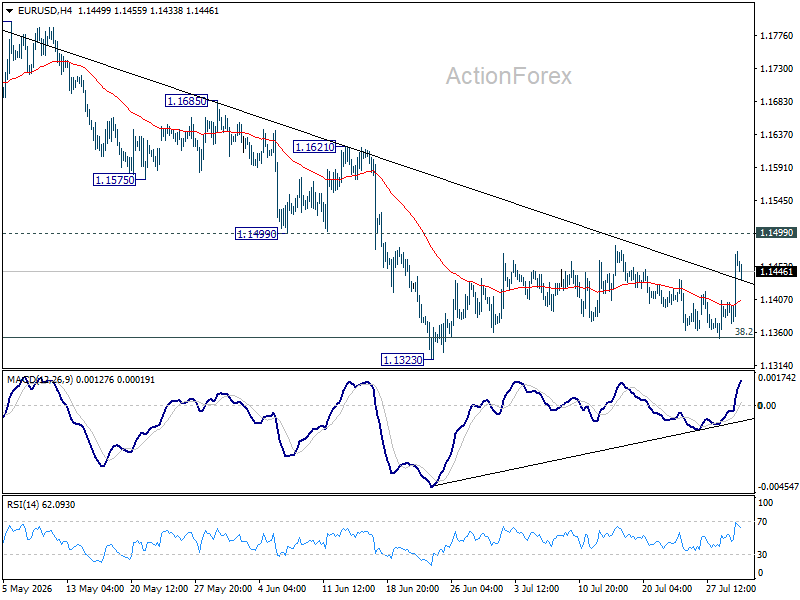
In the bigger picture, focus is back on 38.2% retracement of 1.0176 to 1.2081 at 1.1353. Decisive break there will revive the case of medium term bearish trend reversal after rejection by 1.2 key cluster resistance level. Further fall should be seen to 61.8% retracement at 1.0904. Nevertheless, strong rebound from 1.1353, followed by break of 1.1621 resistance, will retain medium term bullishness.