

Sample Category Title
Sunset Market Commentary
Markets
Markets today had to work through a heavy data calendar. Despite the conflict in the Middle East, the EMU economy showed resilience, with preliminary Q2 GDP growth at 0.4% Q/Q and 1.0% Y/Y. However, no expenditure breakdown is available yet. German Q2 growth at 0.2% Q/Q and 0.9% Y/Y also was better than expected (including an upward revision of Q1 growth). July German HICP inflation at 0.9% M/M and 2.8% Y/Y was close to expectations. Domestic core inflation slowed to 2.4% Y/Y from 2.5%. Spanish GDP growth remained strong (0.7% Q/Q, 2.7% Y/Y). Also here, HICP inflation at -0.1% M/M and 3.8% Y/Y was only marginally higher than expected. These data at least should keep the debate on a September ECB rate hike alive. In the US, the preliminary Q2 GDP at first sight disappointed at 1.5% Q/Q. However, personal consumption (3.2%) and gross private investment remained solid. It was mainly inventories and net exports contributing negatively. Price deflators for June were close to expectation (Headline 3.7% from 4.1; core 3.3% from 3.4%). Jobless claims remained low at 197K. After all the data were no big market movers. Yields apparently still elaborated a bit on yesterday post-Fed curve repositioning. Both US and German curves steepened (US 2-y -6.0 bps, 30-y +0.3 bp, with the latter still bumping against the highest levels since 2007 (currently 5.20%). Despite still elevated uncertainty regarding the conflict in the Middle East, Brent oil currently trades again slightly below $90 p/b. Post Fed, the dollar remains a bit in the defensive (EUR/USD 1.1475; DXY 100.7). The yen at the time of writing sharply gains (USD/JPY 160 area). Intervention? (speculation). Despite plenty of global and sector related uncertainty, equities even rebound (Eurostoxx 50 +1.45%; Nasdaq even +2.35%).
The Bank of England as expected left its policy rate unchanged at 3.75%. However, the decision was taken with a 6-3 split vote. Three members voted to increase the policy rate by 25 bps (7-2 vote in June). The MPC evidently was aware that high volatility in energy prices highly complicated the assessment on inflation and growth. Inflation has fallen to 2.6%, but is expected to rise again later this year due to higher energy prices filtering through. The base scenario sees 3.2% in October/November, before cooling down next year. Still the MPC sees little evidence so far of second round effects. Loose labour market conditions and higher interest rates faced by households and businesses than prior to the conflict, will also act to reduce inflation. The BoE stands ready to act as necessary, but for now judges that it is appropriate the keep the policy rate unchanged. The market apparently saw the MPC assessment as an indication that the bank still wants to avoid a degree of tightening that would unnecessarily slow growth. The UK yield curve steepens with the 2-y declining 11.0 bps. The 30-y trades little changed. Money markets currently see about 30% of a 25 bps hike in September. Early November is 85% discounted with cumulative 50 bps seen by Spring next year. Even so, the reaction of sterling was very modest. EUR/GBP saw a recent rise, but still trades near 0.878.
News & Views
Statbel reported. Core inflation (ex-energy products and unprocessed food) stood at 3.13%, compared to 3.04% in June. Focusing on some sub groups, energy inflation was 10.59% Y/Y, compared to 10.31% in June and 11.20% in May. Electricity prices rose 2.7% M/M and at 7.9% Y/Y, from 6.2% last month. Natural gas prices decreased 1.7% M/M to be up 10.3% Y/Y. Services inflation went from 5.10% to 5.17%. Inflation for rents eased from 3.38% Y/Y to 3.21%. Food price inflation (including alcoholic beverages) stands at 0.27% Y/Y (was 0.06%). On a monthly basis, most significant price increases were registered for plane tickets, electricity, holiday villages and camping sites, hotel rooms, motor fuels, meat, banking services and maintenance products. Natural gas and package holidays had a decreasing effect on the index. The first estimate for European HICP inflation amounts to 3.5% Y/Y.
In the CEE region, the Czech Republic and Hungary reported preliminary Q2 GDP estimates. Czech GDP growth at 0.4% Q/Q and 2.0% Y/Y (from 0.2% Q/Q and 2.2% in Q1) was softer than expected. The Statistical Office indicated that quarterly growth was positively influenced by a rise in final consumption expenditure and the international trade balance. Gross capital formation had a negative impact. In a valued added perspective, quarterly growth was supported especially by industrial activity. Most subsectors of services activities also performed well. Employment growth was reported at 0.2% Q/Q and 0.9% Y/Y. For Hungary, preliminary (seasonally adjusted) Q2 growth was 0.4% Q/Q and 1.6% Y/Y. YTD growth amounted to 1.7%. In a brief analysis, the Hungarian Statistical Office mentions that industry contributed positively while agriculture slowed it. The main contributor to the growth was services, within which especially professional, scientific, technical and administrative activities.
EUR/USD Mid-Day Outlook
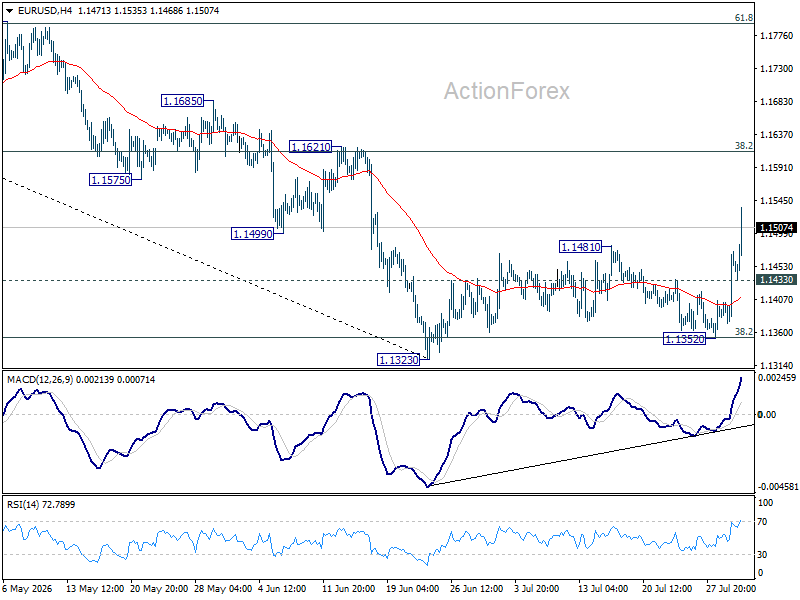
EUR/USD's break of 1.1499 support turned resistance argue that fall from 1.2081 might have completed as a three wave correction at 1.1323. Intraday bias is back on the upside for 1.1621 cluster resistance (38.2% retracement of 1.2081 to 1.1323 at 1.1613). Decisive break there will add more credence to this bullish case, and target 61.8% retracement at 1.1791. Nevertheless, break of 1.1433 minor support will turn bias back to the downside, for 1.1323/1352 support zone instead.
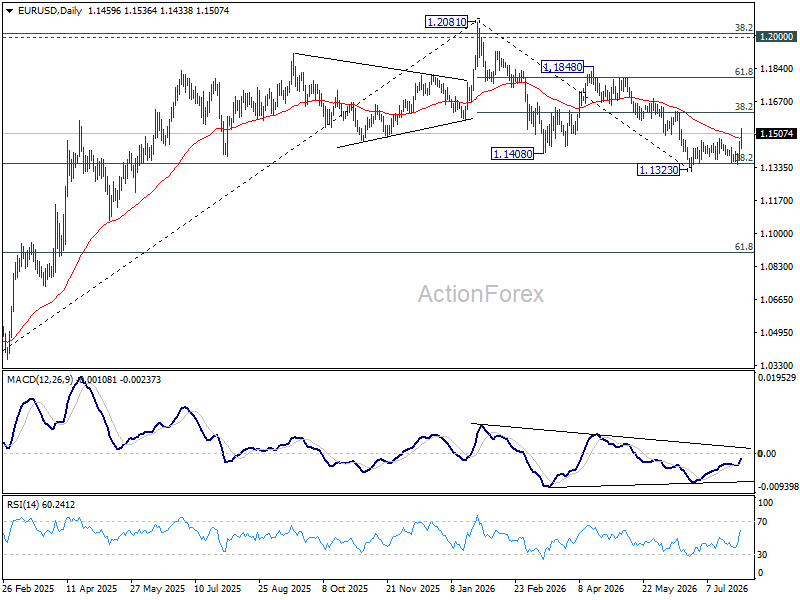
In the bigger picture, focus is back on 38.2% retracement of 1.0176 to 1.2081 at 1.1353. Decisive break there will revive the case of medium term bearish trend reversal after rejection by 1.2 key cluster resistance level. Further fall should be seen to 61.8% retracement at 1.0904. Nevertheless, strong rebound from 1.1353, followed by break of 1.1621 resistance, will retain medium term bullishness.
EUR/JPY Mid-Day Outlook
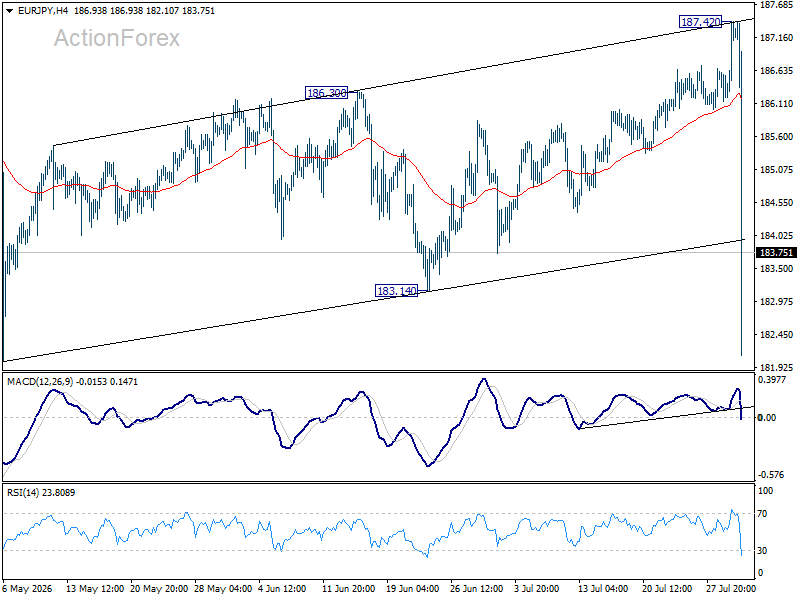
EUR/JPY's accelerated decline suggests that the corrective pattern from 187.93 has finally started the third leg. Deeper fall could be seen to 180.78 support. But downside should be contained there to bring rebound.
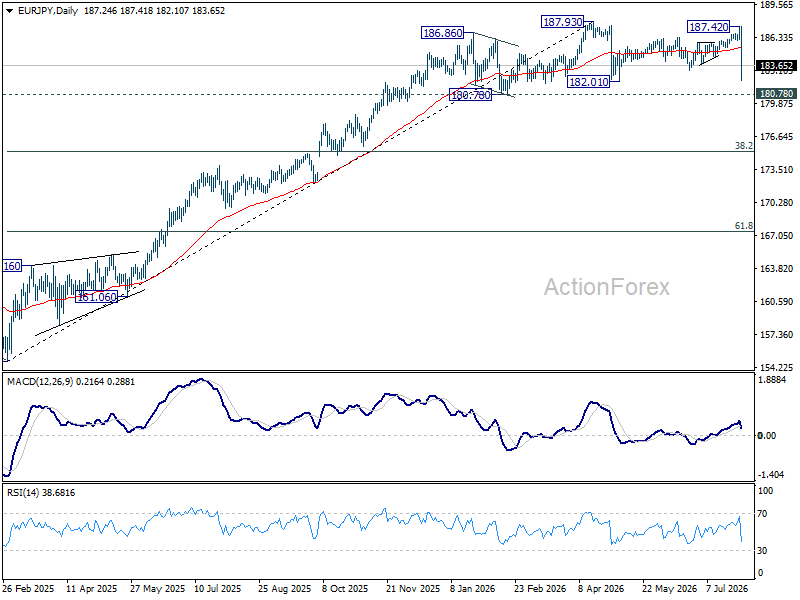
In the bigger picture, uptrend from 114.42 (2020 low) is still expected to resume at a later stage to 78.6% projection of 124.37 (2022 low) to 175.41 (2025 high) from 154.77 at 194.88. However, sustained break of 55 W EMA (now at 180.40) will argue that it's already in a medium term down trend to 175.41 resistance turned support and below.
GBP/JPY Mid-Day Outlook
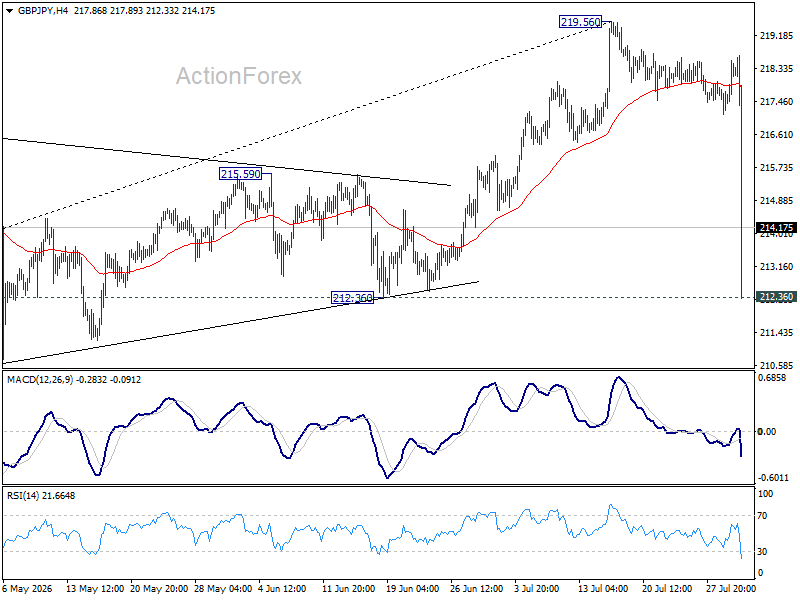
GBP/JPY's decline from 219.56 accelerated lower today, and focus is now on 212.26 support. Strong rebound from there will keep the up trend from 184.35 intact. In this case, some more consolidations would be seen below 219.56 first, and upside breakout should follow at a later stage. However, decisive break of 216.58 will indicate that it's already correcting the rise from 184.35, and target 38.2% retracement of 184.35 to 219.56 at 206.10.
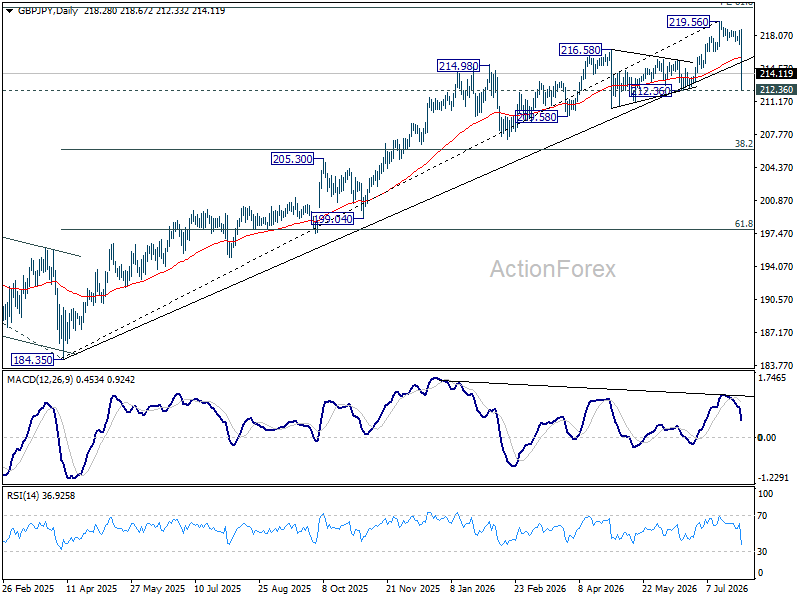
In the bigger picture, the long term up trend is in progress. As long as 55 W EMA (now at 208.95), another rally should be seen through 61.8% projection of 148.93 (2022 low) to 208.09 (2024 high) from 184.35 at 220.90 at a later stage.
USD/JPY Mid-Day Outlook
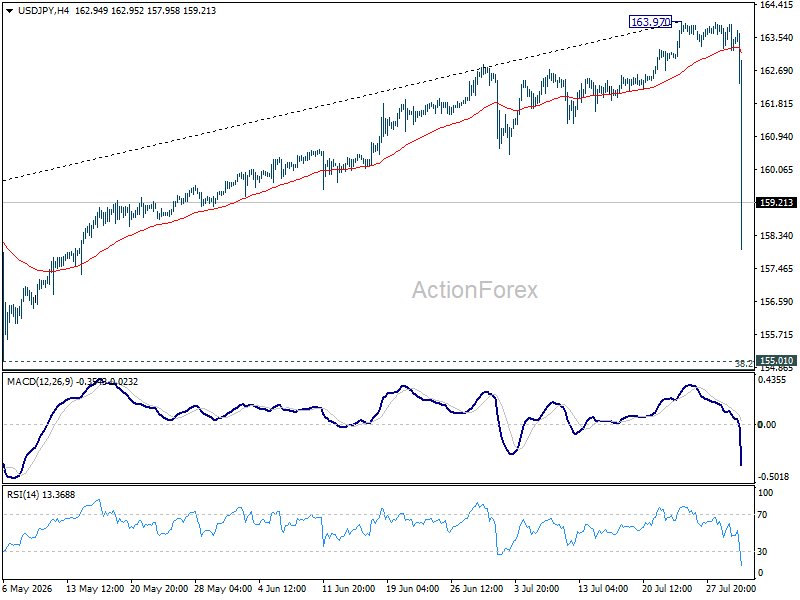
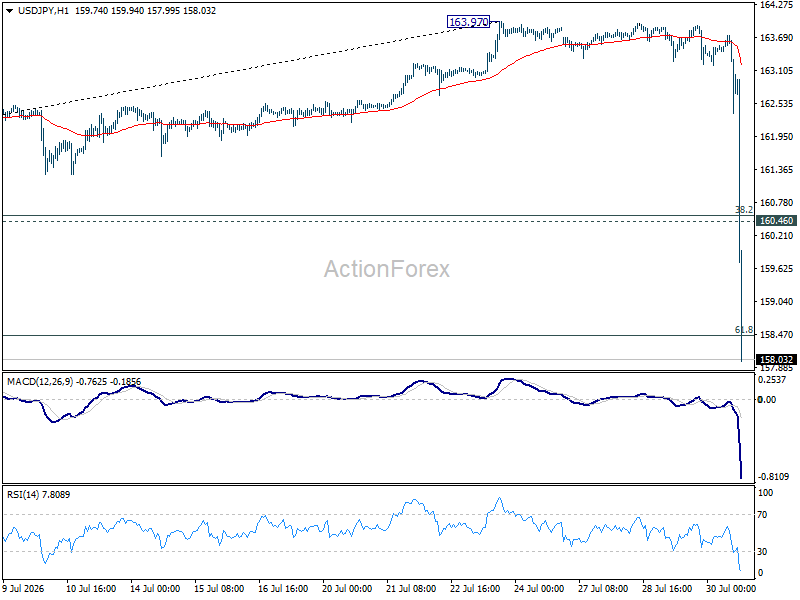
USD/JPY's steep decline today suggests that a medium term top is probably formed at 163.97 already. Immediate focus is now on rising channel floor (now at 158.74). Sustained break there will argue that fall from 163.97 is already correcting the whole rise from 139.87, and target 155.01 cluster support (38.2% retracement of 139.87 to 163.97 at 154.76. Strong rebound from the channel support will keep the rally from 139.87 intact. But still, even in this case, more consolidations would be seen below 163.97 for a while.
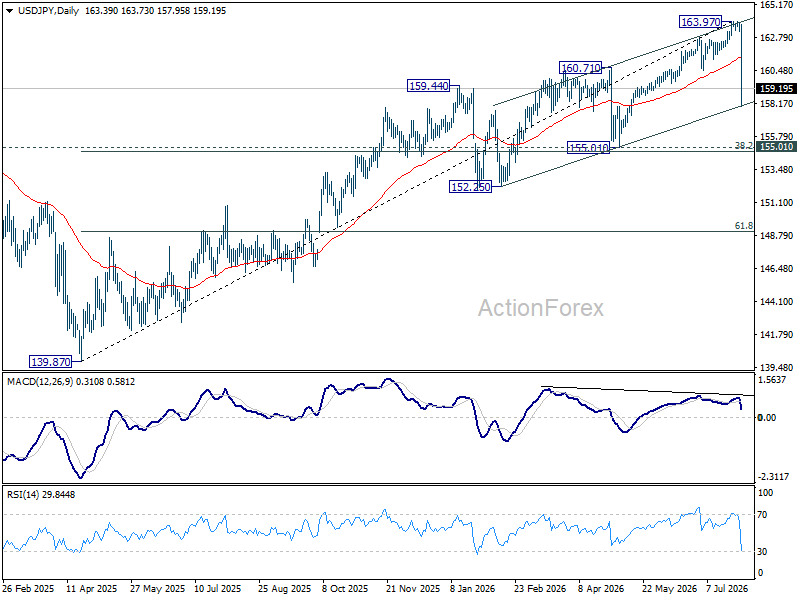
In the bigger picture, the break of 159.44 resistance turned support, together with bearish divergence condition in D MACD, suggests that a medium term top could be formed at 163.97 already. More consolidations would be seen in the near term. But still, outlook will remain bullish as long as 152.25 support holds. The long term up trend is still expected to continue at a later stage, only delayed.
Intervention or Positioning? Or Both? USD/JPY’s Slide Through 160 Has Traders Guessing
Why USD/JPY's plunge from 163.70 to below 160 has traders asking whether Japan intervened, not just whether the BoJ will hike in October
Why it matters: The size and timing of the move have shifted the question from "when will the BoJ hike" to "did Japan just intervene." A weak Dollar backdrop made this an unusually efficient window for authorities to act, since less official buying would be needed to generate a large decline in USD/JPY, but the move is just as explainable by an aggressive unwind of short Yen positioning alone.
USD/JPY Plunges From 163.70 to below 160 as Intervention Speculation Builds
Today's sharp fall in USD/JPY has shifted attention from the Bank of Japan meeting itself to a more immediate question: did Japanese authorities take advantage of the perfect market conditions to intervene?
The Japanese Yen extended its rally sharply during early US trading, sending USD/JPY below 160.00 from a day high at 163.70. Earlier in the European session, the Yen had already strengthened broadly, gaining around 100 pips against Dollar as investors unwound short positions ahead of Friday's Bank of Japan policy decision. But the renewed acceleration lower during US hours came as the Dollar weakened across the board following softer-than-expected US GDP and June PCE inflation data, creating an ideal window for intervention.
The Two-Stage Yen Move
| Session | USD/JPY Move | Likely Driver |
|---|---|---|
| European session | Roughly 100 pips lower | Short-covering ahead of Friday's BoJ decision |
| US session | Accelerated from a 163.70 day high to below 160.00 | Broad Dollar weakness (soft GDP/PCE) combined with possible official intervention |
Why This Was the Ideal Window for Intervention
The opportunity was unusually attractive. Dollar sentiment had already deteriorated after Wednesday's FOMC meeting, where investors concluded that although the Federal Reserve remains concerned about inflation, Chair Kevin Warsh's communication pointed to patience rather than urgency. Thursday's softer US data reinforced that view. Second-quarter GDP expanded by just 1.5%, below expectations, while June core PCE inflation slowed to 3.3%, extending the broader disinflation trend. Together, the data kept broad pressure on the Dollar, providing an ideal backdrop for any official Yen-buying operation by reducing the amount of intervention needed to generate a meaningful decline in USD/JPY.
Key US Data
- Q2 GDP: expanded just 1.5% annualized, below expectations
- Real final sales to private domestic purchasers: accelerated to 3.9%, pointing to resilient underlying household and business demand despite the headline miss
- June core PCE inflation: slowed to 3.3%, extending the broader disinflation trend
- Three Fed officials dissented in favor of an immediate rate hike, yet September hike odds fell from around 76% to 65%
- 30-year Treasury yield: climbed to its highest level since 2007, even as near-term hike odds fell
ActionForex analysis shows that divergence, in which near-term Fed odds fall while long-term borrowing costs rise, points to markets growing less concerned about the next meeting but more concerned about persistent inflation, reduced policy guidance, and geopolitical supply shocks feeding into the compensation investors demand to hold long-term government debt.
The Yen's Fundamentals Were Already Improving
Even without intervention, the Yen had fundamental support. Investors had already begun covering short Yen positions before Friday's BoJ decision amid expectations that policymakers could strengthen guidance toward another rate hike in October. Interest-rate markets already assign better than an 80% probability to such a move, yet the Yen has lagged well behind Japanese bond yields in reflecting that outlook.
Whether Thursday's late selloff ultimately proves to have been official intervention or simply an aggressive extension of market positioning, the combination of broad Dollar weakness and growing confidence in further BoJ normalization has finally given the Yen the momentum it had lacked for much of the past month.
Euro and Sterling Diverge on Central Bank Paths
Euro extended its weekly gains as stronger-than-expected Eurozone GDP and Brent crude's rebound revived expectations for another ECB insurance hike in September.
Sterling edged modestly higher after Bank of England held rates at 3.75% in a slightly more hawkish-than-expected 6-3 vote, with Catherine Mann joining Megan Greene and Huw Pill in calling for another increase. Governor Andrew Bailey acknowledged higher energy prices would lift inflation over coming months but stressed there was still little evidence of inflation becoming embedded domestically, limiting Sterling's follow-through gains.
Geopolitical Risk Still Simmering in the Background
Beyond central banks, geopolitical risks continued to simmer in the background. Iran's Revolutionary Guard threatened further retaliation following another wave of US strikes, while an apparent drone attack near Egypt's Damietta port raised concerns that disruptions could increasingly spread toward the Suez Canal as well as the Strait of Hormuz. Brent crude edged back toward the $90 mark but again struggled to establish a decisive break higher, suggesting markets remain cautious about pricing a prolonged disruption to global energy supplies even as regional tensions broaden.
Currency Performance This Week
Overall for the week so far, Dollar, Aussie, and Loonie are among the worst performers. Euro, Swiss Franc and Kiwi are the better performers. Sterling and Yen are positioning in the middle.
Related Coverage
Central Bank Deep Dives
- Read why the BoE's 6-3 hold is more hawkish than the headline suggests, and why future policy now hinges on wages and services inflation rather than oil prices alone: BoE Split Widens as Policymakers Debate When, Not Whether, to Fight Inflation.
- See why EUR/USD's rebound reflects genuine ECB repricing rather than just Dollar softness, and what's driving the case for a September hike: EUR/USD Rebound Reflects ECB Repricing as Oil Revives September Hike Bets.
- Read why the bond market is sending a different signal than the Fed itself, with the 30-year yield at its highest since 2007 even as September hike odds fall: Bond Market Sends Different Message Than Fed as 30-Year Yield Hits Highest Since 2007.
US Data Deep Dives
- See why Q2 GDP's headline miss masks a stronger underlying picture, including a jump in real final sales to private domestic purchasers: US Q2 GDP Growth Cools to 1.5%, Well Below Expectations.
- Read the full June core PCE breakdown supporting the Fed's wait-and-see stance, and what policymakers are watching next: US Core PCE Inflation Eases to 3.3% in June, Supporting Fed's Wait-and-See Stance.
Global Data Roundup
- See how the Eurozone economy regained momentum in Q2, with growth accelerating well beyond expectations: Eurozone Economy Rebounds in Q2 as GDP Growth Accelerates to 0.4%.
- Read why Switzerland's KOF Barometer points to above-trend growth in the months ahead: Swiss KOF Barometer Rises to 103.5, Reinforcing Recovery Outlook.
- See how the Hormuz closure is already showing up in Australia's import prices, with petroleum costs up a record 47.1%: Australia Import Prices Surge Most Since 2021 as Hormuz Closure Drives Oil Shock.
- Read why New Zealand business confidence is climbing even as firms flag geopolitical risk as a wildcard: ANZ: New Zealand Business Confidence Jumps as Firms Look Beyond Geopolitical Risks.
Frequently Asked Questions
Q: Did Japan actually intervene to drive USD/JPY from 163.70 to below 160.00?
A: It's not confirmed either way. The move split into two distinct phases: a roughly 100-pip decline during the European session tied to short-covering ahead of Friday's BoJ decision, then a sharper acceleration during US trading hours that coincided with broad Dollar weakness following soft GDP and PCE data. That combination makes the US-session move just as explainable as an aggressive extension of existing positioning as it is an actual Yen-buying operation.
Q: Why was this considered an "ideal window" for intervention?
A: Dollar sentiment had already deteriorated after Wednesday's FOMC meeting and Thursday's soft GDP and PCE data, meaning the Dollar was falling broadly on its own. That backdrop would let any official Yen-buying reinforce a move already in motion, reducing how much intervention would be needed to generate a meaningful decline in USD/JPY.
Q: Does it matter whether this was intervention or just positioning, for Friday's BoJ decision?
A: Not fundamentally. Investors were already covering short Yen positions ahead of Friday's meeting on expectations that the BoJ could strengthen guidance toward an October hike, a move rate markets already assign better than 80% odds to. Whether or not officials intervened, the Yen has now closed some of the gap it had been lagging behind Japanese bond yields.
Key Takeaways
- USD/JPY plunged from a 163.70 day high to below 160.00: One of the Yen's sharpest moves in weeks, split between pre-BoJ short-covering in the European session and an accelerated US-session decline tied to broad Dollar weakness.
- Whether Thursday's US-session move was official intervention remains unconfirmed: The backdrop of a broadly weaker Dollar made it an unusually efficient window either way, since less official buying would be needed to move USD/JPY meaningfully.
- Soft US data reinforced Dollar weakness: Q2 GDP grew just 1.5% and core PCE eased to 3.3%, extending the disinflation trend and reinforcing Chair Warsh's patience-over-urgency tone from Wednesday's FOMC.
- Euro and Sterling remain this week's hawkish outliers: Stronger Eurozone GDP and rebounding oil revived ECB September hike bets, while the BoE's 6-3 hold came with an unexpectedly hawkish vote split.
- Geopolitical risk keeps broadening without yet moving oil decisively: Iran's Revolutionary Guard threatened retaliation and a drone attack hit near Egypt's Damietta port, but Brent's push toward $90 has stalled, suggesting markets remain cautious about pricing a prolonged supply disruption.
What to Watch Next
Friday's BoJ decision now carries double significance: it's the week's key test for whether the Yen's fundamentals catch up to hawkish rate pricing, and it may prompt officials to confirm or deny Thursday's move if they choose to comment at all. Japanese authorities have historically stayed quiet on intervention for days or weeks, so confirmation may not come immediately. On the US side, markets will keep watching whether rising energy prices show up in the next round of inflation data, which is what's kept the Fed, and the long end of the Treasury curve, on alert even as near-term hike odds ease.
US: Real GDP Moderated in Q2, But Domestic Demand Was Strong
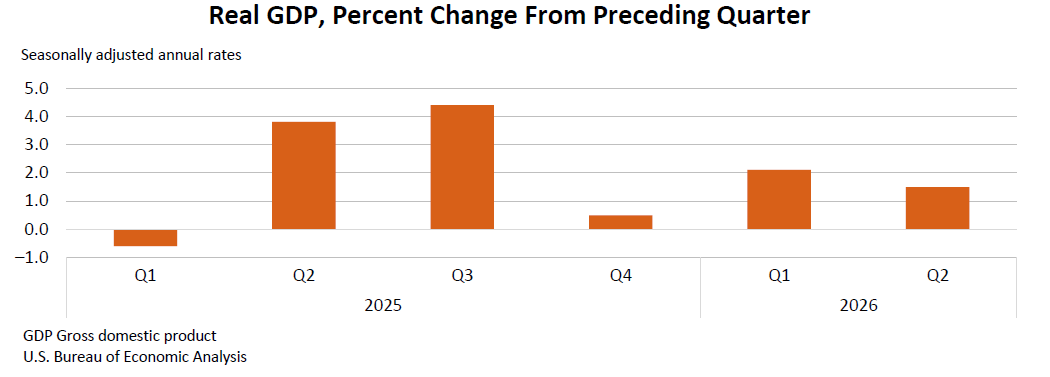
- The U.S. economy expanded by 1.5% quarter-on-quarter (q/q, annualized) in the second quarter, decelerating from 2.1% in the first quarter, and weaker than the consensus forecast of 2.0%.
- Underneath the softer headline, consumer spending rose by a healthy 3.2% q/q, well above Q1's 0.5%. Goods and services spending accelerated to 5.2% and 2.2% respectively.
- Business investment was also strong. Outlays grew by 8.4% q/q, supported by continued strength in equipment spending (+15.2%) and another solid gain in intellectual property products (+8.8%). Meanwhile, spending on structures (-5.0% q/q) declined for a tenth consecutive quarter. Residential investment (1.5%) rebounded modestly as home sales picked up with the spring buying season.
- Government spending (-0.8%) declined as the post-shutdown rebound in the first quarter faded.
- International trade shaved a full percentage point from growth in Q2, as a surge in imports (+11.5%) was only partly offset by a solid gain in exports (+4.5%). The gain in imports was driven by a pick-up in goods, though services were also marginally higher. Inventory investment also shaved 0.7 percentage points off of Q2 GDP.
- Final sales to private domestic purchasers, a better gauge of underlying demand as it includes only household consumption and fixed investment, rose by a very healthy 3.9%, an acceleration from Q1's gain of 1.7%.
- Core PCE inflation rose 3.4% q/q annualized, down a percentage point relative to Q1's 4.4%.
Key Implications
- Despite a seemingly disappointing headline, the advance estimate for real GDP showed that the economy remains healthy overall. Consumption growth was primed for a rebound after weather-related disruptions acted as a drag in Q1, but still came in well above expectations. Growth in consumer spending on discretionary items like eating out and recreation are also positive indicators. Moreover, while business investment remained concentrated in AI-related categories, it also expanded to other categories like industrial and transportation equipment. The primary constraint on growth in Q2 was strong import growth, which shaved 1.5 percentage points off total growth for a second consecutive quarter.
- This was a holistically solid reading for the economy, which when combined with moderate stabilization in the labor market provides a steady hand-off to the second half of the year. While rising interest rates, volatile energy prices, and new tariff policies could act as near-term headwinds, we expect the economy to be able to sustain growth of roughly 2% through the second half of the year on the back of continued investments in AI and moderate growth in consumer spending.
US: Solid June Caps A Strong Quarter for Consumer Spending
- Personal income advanced by 0.2% month-over-month (m/m) in June, slowing from the 0.7% pace seen in the previous month. After adjusting for inflation, taxes, and transfers, real disposable personal income rose 0.3 m/m, matching last month's pace.
- Consumer spending rose 0.3% m/m in nominal terms. The gain was slightly stronger in real terms, with volumes up 0.4% m/m, as consumers got some reprieve at gas stations last month. Revisions were also positive, with May's growth revised higher to 0.9% m/m from 0.7% reported previously.
- Looking across the broad categories, spending on goods remained robust for the second consecutive month, advancing by 0.7% in real terms, led by strong spending on motor vehicles and parts (+2.2% m/m), other durable goods (+2.2% m/m), and recreational goods and vehicles (+0.9% m/m). Inflation-adjusted spending on services advanced by 0.3% m/m, with modest gains across most categories. Spending on recreational services was an exception, posting a sizeable gain likely due to the World Cup events (+0.9% m/m).
- With spending outpacing income, the personal saving rate remained under pressure, declining to 2.7% from a downwardly revised 2.8% in May. This marks the lowest saving rate since June 2022.
- Inflationary pressures eased last month. Core PCE—the Fed’s preferred inflation gauge—rose 0.1% m/m, the smallest monthly increase since March 2025. The twelve-month change moderated to 3.3%, from 3.4% last month.
Key Implications
- Consumer spending growth slowed somewhat in June, but the moderation followed two months of strong gains, capping a solid quarter. Looking at the quarterly trend, consumer spending regained momentum in Q2, with real spending growth accelerating to a 3.2% annualized pace from a tepid 0.5% gain in Q1. The pickup was driven largely by stronger goods spending, particularly on durable goods such as cars and furniture, where spending rose by 6.9% annualized, pointing to resilient household demand despite elevated interest rates and higher gas prices.
- While lower gasoline prices provided a boost to households' purchasing power in June, that support may prove temporary as energy prices have moved higher amid renewed U.S.-Iran tensions. With the boost from higher tax refunds now fading, the sustainability of consumer spending will increasingly depend on continued labor market resilience and support from rising household wealth. Elevated energy prices are also clouding the inflation outlook for the Fed, keeping upside inflation risks alive, with core PCE inflation having run above the Fed's 2% target for more than five years. While the Fed remained on the sidelines this week, financial markets continue to price a rate hike by year-end.
US Core PCE Inflation Eases to 3.3% in June, Supporting Fed’s Wait-and-See Stance
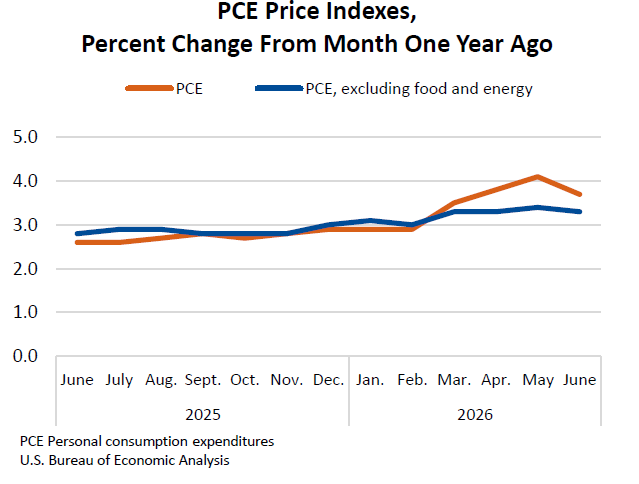
The Federal Reserve's preferred inflation gauge pointed to continued progress on underlying price pressures in June, even as higher energy costs remained a looming risk. The headline PCE price index fell -0.1% mom, matching expectations, while annual inflation slowed from 4.1% yoy to 3.7%. Core PCE, which excludes food and energy, rose just 0.1% mom, below expectations of 0.2%, with the annual rate easing from 3.4% to 3.3%. The figures reinforce the view that underlying inflation continued to moderate before the recent escalation in Middle East tensions began pushing oil prices sharply higher.
The report also suggested consumers remained cautious. Personal income increased 0.2% mom, while personal spending rose 0.3%, both slowing from May's pace but remaining positive. Real personal consumption expenditures increased 0.4%, indicating households continued to support economic growth despite elevated borrowing costs and tighter financial conditions.
For the Federal Reserve, the report provides further evidence that core inflation remains on a disinflationary path. However, policymakers are unlikely to take too much comfort from backward-looking data given the recent rebound in energy prices. The key question now is whether the oil shock proves temporary or begins feeding into wages, services inflation and inflation expectations.
Economic Data
| Indicator | Actual | Expected | Previous |
|---|---|---|---|
| Personal Income mom (Jun) | 0.2% | 0.3% | 0.7% |
| Personal Spending mom (Jun) | 0.3% | 0.4% | 0.7% |
| Real Personal Spending mom (Jun) | 0.4% | — | — |
| PCE Price Index mom (Jun) | -0.1% | -0.1% | 0.4% |
| PCE Price Index yoy (Jun) | 3.7% | 3.7% | 4.1% |
| Core PCE Price Index mom (Jun) | 0.1% | 0.2% | 0.3% |
| Core PCE Price Index yoy (Jun) | 3.3% | 3.3% | 3.4% |
Key Takeaways
- The Fed's preferred inflation gauge cooled. Headline PCE inflation slowed from 4.1% to 3.7% yoy, while core PCE eased from 3.4% to 3.3% yoy, reinforcing the broader disinflation trend.
- Monthly core inflation remained subdued. Core PCE rose just 0.1% mom, below expectations of 0.2%, suggesting underlying price pressures continued to moderate before the recent energy shock.
- Headline prices declined on the month. The PCE price index fell 0.1% mom, matching expectations and reversing May's 0.4% increase.
- Consumer spending moderated but remained positive. Personal spending slowed from 0.7% to 0.3%, while personal income eased from 0.7% to 0.2%, pointing to softer—but still resilient—household demand.
- Real consumption remained healthy. After adjusting for inflation, real PCE increased 0.4%, indicating consumers continued to increase spending in volume terms despite restrictive financial conditions.
- The report supports the Fed's cautious stance. June data show underlying inflation continued to improve, but with oil prices rising sharply after the survey period, policymakers are likely to focus on whether higher energy costs eventually spill over into wages, services inflation and inflation expectations.
US Q2 GDP Growth Cools to 1.5%, Well Below Expectations
The US economy expanded at an annualized rate of 1.5% in the second quarter, according to the advance estimate from the Bureau of Economic Analysis, slowing from 2.1% in the first quarter and falling short of market expectations of 2.3%. The softer headline reflected a downturn in government spending alongside slower investment and export growth, while a larger increase in imports also weighed on overall GDP. Consumer spending remained the main pillar of growth, accelerating from the previous quarter and helping keep the economy on a positive footing.
Beneath the headline, however, domestic demand remained considerably stronger than the top-line figure suggests. Real final sales to private domestic purchasers—a measure often viewed as a better gauge of underlying economic momentum—accelerated sharply to 3.9% from 1.7% in the first quarter. The improvement indicates that private consumption and business investment continued to hold up well despite restrictive monetary policy and tighter financial conditions, with much of the GDP slowdown driven by more volatile components such as government spending and trade.
Inflation presented a more mixed picture. The gross domestic purchases price index accelerated from 3.6% to 5.7%, while the headline PCE price index rose from 4.6% to 5.1%, reflecting the impact of higher energy prices during the quarter. At the same time, core PCE inflation eased from 4.4% to 3.4%, suggesting underlying price pressures outside food and energy continued to moderate.
Economic Data
| Indicator | Actual | Expected | Previous |
|---|---|---|---|
| GDP Annualized Q2 (Advance) | 1.5% | 2.3% | 2.1% |
| Real Final Sales to Private Domestic Purchasers | 3.9% | — | 1.7% |
| Gross Domestic Purchases Price Index | 5.7% | — | 3.6% |
| PCE Price Index | 5.1% | — | 4.6% |
| Core PCE Price Index | 3.4% | — | 4.4% |
Key Takeaways
- US economic growth slowed more than expected. Real GDP expanded at an annualized 1.5% in Q2, down from 2.1% in Q1 and below the 2.3% consensus, reflecting weaker government spending, slower investment and exports, and a larger drag from imports.
- Underlying private demand strengthened significantly. Real final sales to private domestic purchasers accelerated to 3.9% from 1.7%, suggesting household spending and business investment remained resilient despite restrictive monetary policy.
- Consumer spending remained the key growth engine. Stronger household spending partly offset weakness elsewhere and prevented a sharper slowdown in overall GDP.
- Headline inflation pressures picked up because of energy. The gross domestic purchases price index accelerated from 3.6% to 5.7%, while headline PCE inflation rose from 4.6% to 5.1%, highlighting the impact of higher energy prices during the quarter.
- Underlying inflation continued to improve. Core PCE inflation slowed from 4.4% to 3.4%, indicating broader domestic price pressures continued to moderate despite the energy shock.