Sample Category Title
China NBS Manufacturing PMI Falls Back Into Contraction at 49.2 as Domestic Demand Weakens
China's manufacturing activity slipped back into contraction in July, suggesting the recovery seen during the second quarter has lost momentum. The official NBS Manufacturing PMI fell from 50.3 to 49.2, below market expectations of 49.9 and marking the lowest reading since February. The decline also erased four consecutive months of expansion, indicating factories entered the third quarter on a weaker footing amid softening demand and a more challenging external environment.
The deterioration was broad-based. The production index dropped -1.5 points to 49.9, while the new orders index fell -2.7 points to 48.5, highlighting a renewed loss of domestic demand. New export orders also weakened to 49.6, while purchasing activity, imports and order backlogs all deteriorated, suggesting manufacturers became increasingly cautious about production plans. Although finished goods inventories and employment edged higher, business confidence softened, with the production and business activity expectations index slipping to 54.1. The National Bureau of Statistics' accompanying analysis emphasized that weak domestic demand remains the primary constraint on production and called for stronger fiscal support and infrastructure investment to revive private-sector activity.
The weakness extended beyond manufacturing. The official non-manufacturing PMI also fell back below the expansion threshold to 49.0 from 50.2, indicating slower activity in the broader services and construction sectors. Together, the surveys point to a broad loss of economic momentum at the start of the third quarter and reinforce expectations that policymakers may need to introduce additional measures to support domestic demand if growth continues to soften.
Economic Data
| Indicator | Actual | Expected | Previous |
|---|---|---|---|
| NBS Manufacturing PMI (Jul) | 49.2 | 49.9 | 50.3 |
| NBS Non-Manufacturing PMI (Jul) | 49.0 | 50.0 | 50.2 |
| Production Index | 49.9 | — | 51.4 |
| New Orders Index | 48.5 | — | 51.2 |
| New Export Orders Index | 49.6 | — | 50.1 |
| Purchasing Volume Index | 49.4 | — | 51.4 |
| Imports Index | 47.5 | — | 49.6 |
| Employment Index | 49.0 | — | 48.5 |
| Output Price Index | 47.8 | — | 48.2 |
| Input Price Index | 53.2 | — | 54.2 |
| Business Expectations Index | 54.1 | — | 54.3 |
Key Takeaways
- China's manufacturing sector slipped back into contraction. The official Manufacturing PMI fell from 50.3 to 49.2, below both the 50 expansion threshold and market expectations of 49.9, marking the weakest reading since February.
- Demand weakened noticeably. The new orders index dropped 2.7 points to 48.5, the largest decline among the major sub-indices, highlighting softer domestic demand. New export orders also slipped back below 50, indicating external demand remained subdued.
- Production lost momentum. The production index fell from 51.4 to 49.9, while purchasing activity and imports also weakened, suggesting manufacturers scaled back production plans in response to softer orders.
- Weakness was broad-based across company sizes. PMI fell below 50 for large (49.5), medium-sized (49.7) and small enterprises (47.4), with small firms continuing to face the greatest pressure.
- Business confidence softened but remained positive. The production and business activity expectations index eased slightly to 54.1, suggesting manufacturers still expect growth over the coming months despite weaker current conditions.
- Services also moved into contraction. The Non-Manufacturing PMI unexpectedly fell from 50.2 to 49.0, indicating economic weakness has broadened beyond factories into services and construction.
- The official assessment focused on domestic demand. The NBS noted that weakening domestic demand remains the main constraint on production and called for stronger fiscal support, infrastructure investment and measures to boost employment and household income.
Japan Factory Output Beats Forecasts as Retail Sales Lose Momentum
Japan's industrial sector delivered another encouraging performance in June, while household spending showed signs of losing momentum. Industrial production rose 1.3% m/m, accelerating from 0.1% in May and comfortably beating expectations of 0.7%. It marked the third consecutive monthly increase and the strongest gain since January, with output also rising 4.2% y/y, reversing May's -2.1% decline to record the fastest annual growth in nearly four years. In contrast, retail sales increased just 0.5% y/y, slowing sharply from a revised 5.0% and missing expectations of 3.1%.
The improvement in factory activity was broad enough to suggest manufacturing continues to recover. Production machinery rebounded 7.6% after falling -3.5% in May, while electrical machinery and information and communication electronics equipment rose 5.8% following a -5.1% decline. General-purpose and business-oriented machinery also recovered strongly. Manufacturers remain optimistic, projecting production to increase 1.2% in July and a further 4.5% in August, indicating confidence that the recovery still has momentum.
The retail figures, however, painted a more cautious picture of domestic demand. Although automobile sales remained strong and spending on clothing and personal goods increased, weakness was widespread elsewhere, with declines in food and beverages, department stores, machinery, fuel and pharmaceuticals. Retail sales also fell -4.1% m/m, the steepest monthly decline since April 2021.
Taken together, the data suggest Japan's recovery remains uneven. Manufacturing continues to benefit from improving external conditions and stronger business investment, while household consumption appears to be facing increasing pressure from higher living costs.
Economic Data
| Indicator | Actual | Expected | Previous |
|---|---|---|---|
| Industrial Production M/M (Jun P) | 1.3% | 0.7% | 0.1% |
| Industrial Production Y/Y (Jun) | 4.2% | — | -2.1% |
| Retail Sales Y/Y (Jun) | 0.5% | 3.1% | 5.0% |
| Retail Sales M/M (Jun) | -4.1% | — | 1.7% |
| Manufacturers' Output Forecast (Jul) | 1.2% | — | — |
| Manufacturers' Output Forecast (Aug) | 4.5% | — | — |
Key Takeaways
- Japan's manufacturing recovery gathered pace. Industrial production rose 1.3% m/m, beating expectations of 0.7% and marking the third consecutive monthly increase. Annual output rebounded from -2.1% to 4.2%, the strongest growth in nearly four years.
- Capital goods industries led the rebound. Production machinery, electrical machinery and business-oriented equipment all recorded strong gains, suggesting business investment and factory activity remain resilient.
- Manufacturers remain optimistic. The Ministry of Economy, Trade and Industry survey showed firms expect production to rise 1.2% in July and 4.5% in August, pointing to continued momentum in the industrial sector.
- Consumer spending weakened sharply. Retail sales slowed from 5.0% to 0.5% y/y, well below expectations of 3.1%, while sales fell 4.1% m/m, the steepest monthly decline since April 2021.
- Retail weakness was broad-based. Apart from strong automobile and apparel sales, most categories—including food and beverages, department stores, machinery, fuel, and pharmaceuticals—recorded declines.
- The data present a mixed picture for the BoJ. Strong factory activity supports confidence in the economic recovery and ongoing policy normalization, but weaker household spending suggests domestic demand remains fragile, arguing for a gradual rather than aggressive tightening path.
Japan’s Tokyo CPI Core Beats Expectations at 1.9 as Underlying Inflation Broadens
Tokyo inflation accelerated more than expected in July, offering fresh evidence that underlying price pressures remain resilient ahead of the Bank of Japan's policy decision later today. Headline consumer inflation rose from 1.7% to 2.0% year-over-year, while core CPI, which excludes fresh food, accelerated from 1.6% to 1.9%, beating expectations of 1.8%.The core-core, which excluding both fresh food and energy also edged up from 1.9% to 2.0%, indicating inflation gains are broad-based rather than being driven solely by volatile components.
The details of the report reinforced that view. Service-related prices continued to contribute positively, with dining out, rents, transportation and overseas package tours among the notable drivers of inflation. Food prices also remained firm across a range of categories including prepared meals, fresh fish, meat and vegetables. While a sharp decline in childcare fees weighed on the miscellaneous category, that reflected policy-related factors rather than weakening underlying inflation. On a seasonally adjusted basis, headline CPI rose 0.4% month-over-month, while both core and core-core measures increased 0.3%, pointing to continued price momentum.
The report strengthens the case that inflation is becoming more sustainable as the BoJ continues its gradual normalization process. While policymakers are widely expected to leave the policy rate unchanged at 1.00%, the stronger inflation data are likely to reinforce expectations that another rate hike could come as early as October.
Economic Data
| Indicator | Actual | Expected | Previous |
|---|---|---|---|
| Tokyo CPI Y/Y (Jul) | 2.0% | 1.7% | 1.7% |
| Tokyo Core CPI Y/Y (Jul) | 1.9% | 1.8% | 1.6% |
| Tokyo Core-Core CPI Y/Y (Jul) | 2.0% | — | 1.9% |
| Tokyo CPI M/M | 0.4% | — | 0.3% |
| Tokyo Core CPI M/M | 0.3% | — | 0.3% |
| Tokyo Core-Core CPI M/M | 0.3% | — | 0.4% |
Key Takeaways
- Tokyo inflation accelerated across all major measures. Headline CPI rose from 1.7% to 2.0%, while core CPI accelerated from 1.6% to 1.9%, beating expectations of 1.8%. Core-core CPI, excluding both fresh food and energy, also edged up from 1.9% to 2.0%.
- Underlying inflation remained broad-based. The increase was supported by higher prices for restaurants, housing, transportation, motor insurance and overseas travel, indicating domestic inflation pressures continue to build beyond volatile food and energy components.
- Monthly price momentum remained firm. Seasonally adjusted headline CPI rose 0.4% m/m, while both core and core-core CPI increased 0.3%, suggesting inflation momentum remains intact.
- Policy-related factors masked some inflation strength. A sharp decline in childcare fees weighed on the miscellaneous category, but this reflected a government policy change rather than weakening underlying inflation.
- The data support the BoJ's normalization narrative. While today's figures are unlikely to prompt an immediate rate hike, they reinforce confidence that inflation is becoming more sustainable around the 2% target and strengthen market expectations for another increase later this year.
- Attention now shifts to Governor Ueda. With markets already pricing a high probability of an October hike, investors will focus on whether the BoJ's statement and press conference validate expectations of a faster normalization path.
Beyond the “Technical Recession” – Canada’s Rolling Adjustment
Highlights
- Canada's economy has contracted for two consecutive quarters, but the "technical recession" label is misleading. Economic weakness has met the minimal duration test, but not the depth or breadth of a conventional recession.
- Large swings in population growth have shaped both the economy and the signal from the data, first overstating economic strength relative to the experience of households and businesses, and more recently making headline GDP appear weaker than underlying measures suggest.
- Rather than a conventional recession, Canada experienced a rolling slowdown as interest-sensitive, population-sensitive, and trade-exposed sectors weakened at different points in time.
- The next phase of the cycle should be judged by the quality and breadth of growth. Sustained gains in GDP per capita, rising industry participation, and a narrower gap between headline growth and lived economic conditions would signal a healthier and more durable recovery.
Canada's economy has contracted for two consecutive quarters, sparking debate over whether it has entered a "technical recession." That label fails to capture the nature of the current cycle. Recessions are judged by their depth, duration, and diffusion. Canada has met the minimum test on duration, but the downturn has not been deep or widespread enough to resemble a conventional recession.
Large swings in population growth have made economic data harder to interpret. Earlier in the cycle, rapid population growth lifted GDP and helped absorb some of the drag from higher interest rates, even as falling GDP per capita and weak sentiment showed that many households and businesses were under strain. More recently, slower population growth has weighed on headline GDP, while per-capita measures have improved.
The conventional recession-versus-growth framing misses the more interesting story. Canada has absorbed a series of rolling shocks, with strain in one sector often cushioned by resilience in another. Housing and construction softened first, population-sensitive sectors adjusted next, and trade-exposed industries are now under pressure from tariffs and global uncertainty. The result has been a prolonged adjustment that shifted from sector to sector without becoming a broad-based recession.
New shocks could still disrupt the recovery, particularly if trade tensions intensify. But the economy's ability to absorb these shocks without tipping into a broad-based recession is reason for cautious optimism. That optimism would strengthen if investment begins to broaden. As earlier drags fade, growth should become more durable, more capital intensive, and more visible in per-capita measures and industry participation.
Population Growth Lifted GDP While Conditions Weakened
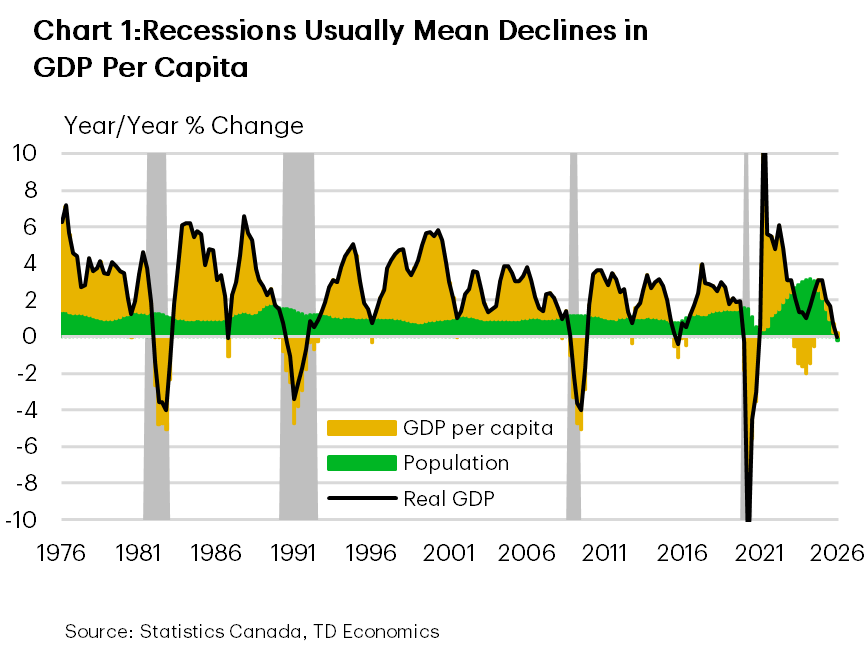
Headline GDP has been unusually difficult to interpret in this cycle. Rapid population growth boosted aggregate output in the early post-pandemic years, helping Canada avoid an outright decline in GDP even as underlying conditions softened. This was not just a measurement issue. By adding consumers, workers, students, and renters, the population surge helped sustain demand while higher interest rates weighed on large parts of the economy. GDP per capita told a different story, declining year-on-year through 2023 and 2024, a pattern normally associated with recessionary periods (Chart 1).
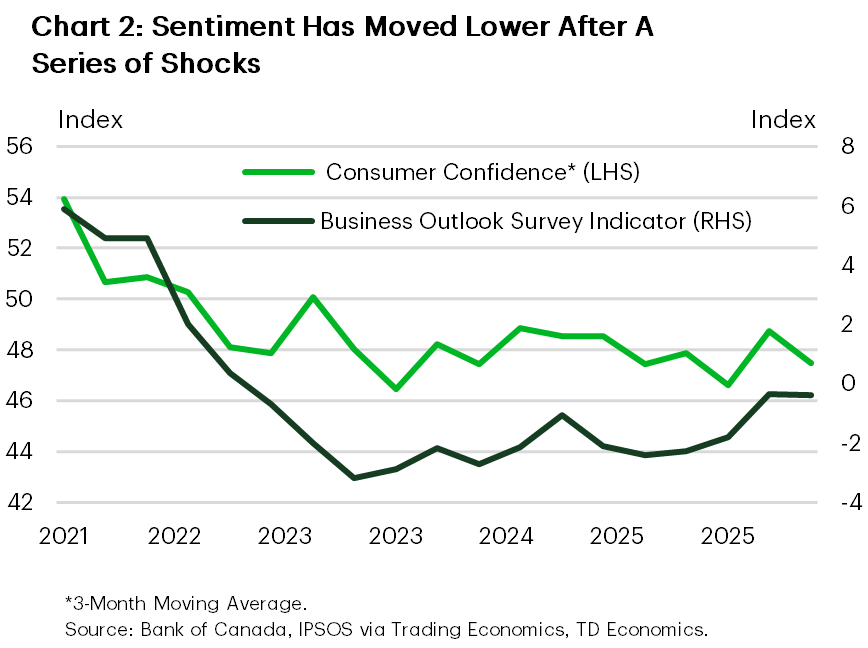
That disconnect explains why sentiment weakened even as headline data looked more resilient. Higher borrowing costs, rising uncertainty, and falling per-capita income left households and businesses increasingly strained. Business sentiment fell sharply in 2023 and struggled to regain momentum. Consumer sentiment followed a similar path (Chart 2).
The population story has now turned. A declining population is now weighing on headline GDP, which was down 0.2% year-on-year in the first quarter of 2026, while per-person GDP remained positive. This does not mean the economy has suddenly become strong. It means the distortion has changed direction. Headline GDP and per-capita measures now need to be read together to understand the underlying cycle.
A Sequence of Shocks Prolonged the Slowdown
Canada's slowdown has unfolded in stages. Just as one source of weakness began to fade, another emerged, preventing the recovery from gaining sustained momentum.
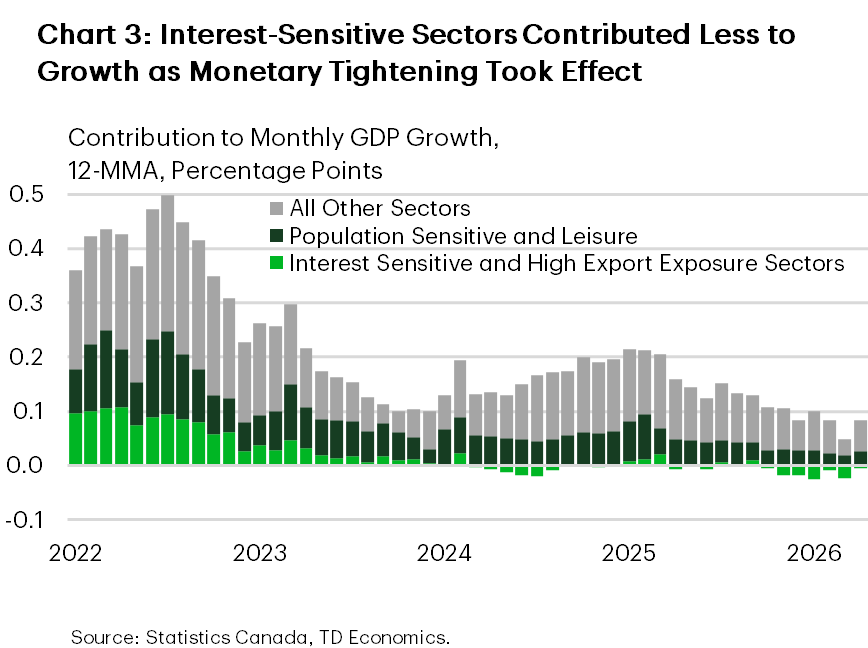
The first shock came from higher interest rates. Rapid monetary tightening hit the most rate-sensitive parts of the economy first, particularly housing and durable goods (Chart 3). These sectors weakened as borrowing costs rose and sales tumbled. At the same time, rapid population growth supported spending elsewhere, cushioning the impact on aggregate growth.
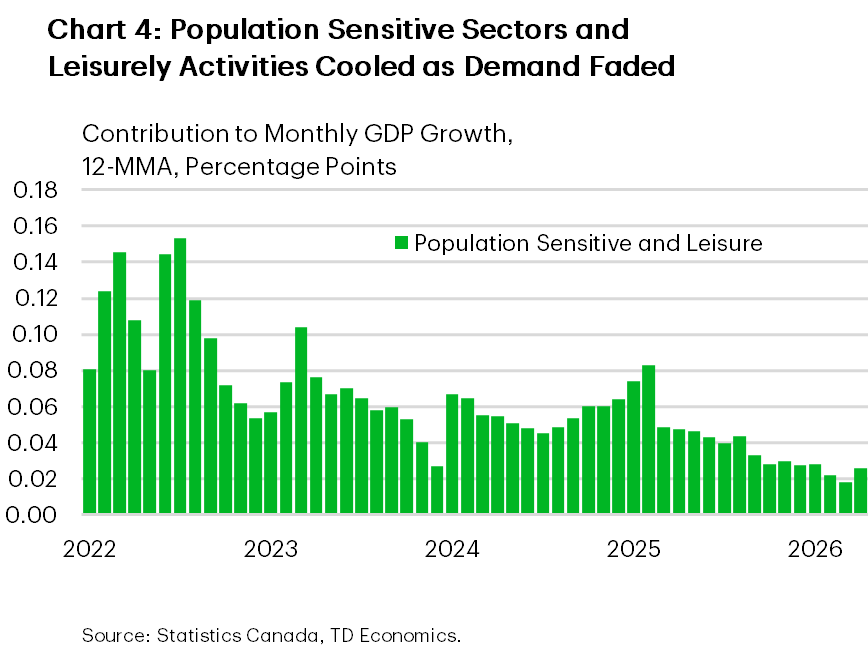
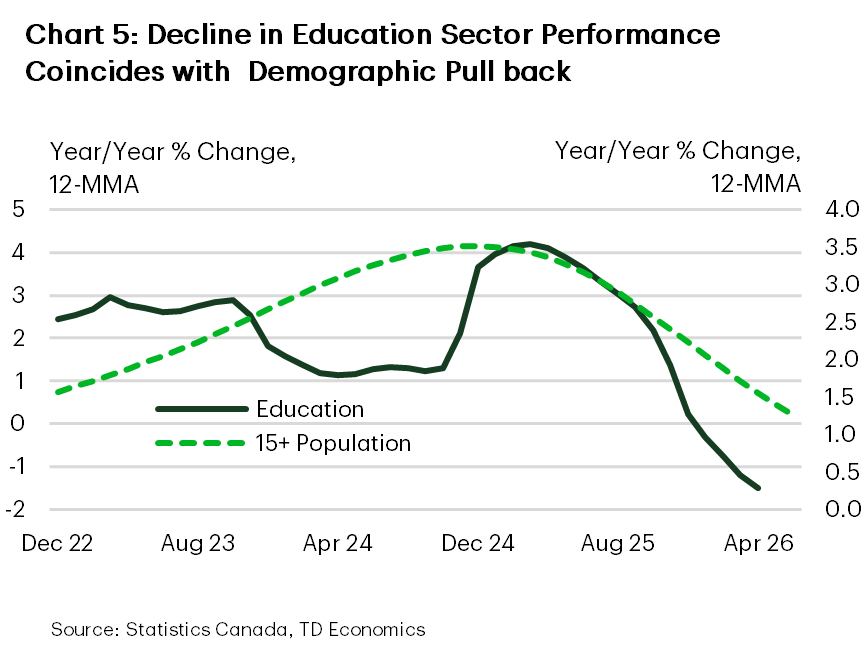
That support eventually faded. As the government lowered targets for both permanent and temporary residents and raised the financial requirements for international students, population-driven sectors weakened (Chart 4). With approved student permits down by about 35% from previous years, the education sector bore the brunt of this adjustment (Chart 5).
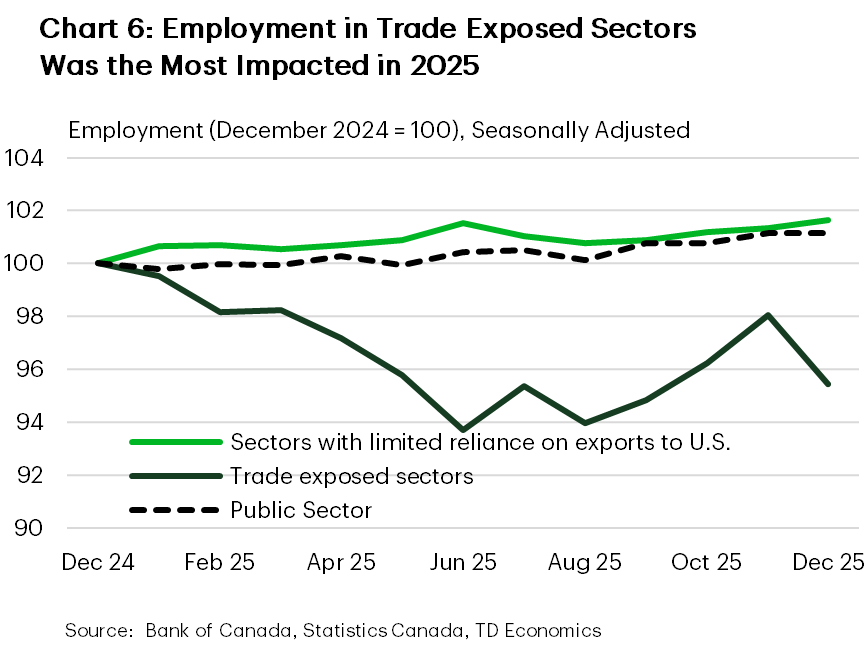
The most recent shock has been to trade. Trade-exposed industries have faced growing pressure since early 2025, as escalating trade tensions with the United States have weighed on exports and business investment. Manufacturing output has fallen and employment in export-oriented industries has weakened as firms adjust to a more uncertain trading environment (Chart 6).
The sharp decline in export volumes is unlikely to be repeated over the coming year, as much of the adjustment has already occurred. However, trade-related uncertainty remains elevated. The U.S. government recently announced plans, under Section 338 of the Tariff Act, to impose an additional 50% tariff on selected Canadian exports. Until there is greater clarity on the future trading environment, businesses are likely to remain cautious.
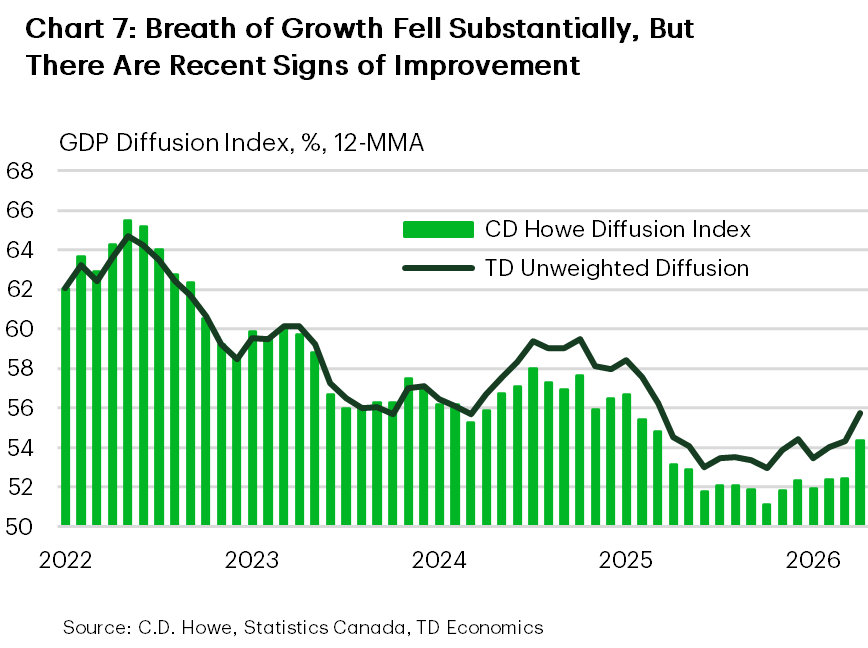
Taken together, these shocks explain why the economy has felt weak for so long without meeting the usual markers of a broad recession. Interest-sensitive sectors weakened first, population-sensitive sectors adjusted next, and trade-exposed industries are now absorbing a new kind of pressure. As a result, growth is being driven by a narrower group of industries (Chart 7), leaving the economy vulnerable even as it avoids a synchronized downturn.
How We Will Know the Adjustment Is Ending
The outlook depends on whether the sources of pressure continue to fade and whether the sources of resilience broaden. The drag from higher interest rates has largely run its course. Population growth will stabilize once the adjustment in non-permanent residents is complete. Trade disruptions may prove more persistent, but the latest tariffs are targeted and affect a limited share of Canada's trade with the United States. A stronger investment cycle would add another layer of support.
The recovery is likely to be gradual, as the effects of recent shocks fade at different speeds. Still, growth should improve as earlier headwinds ease and Canada's sources of resilience become more visible. That includes stronger per-capita growth, broader industry participation, and continued support from the natural resource sector.
In the immediate future, while the population adjustment continues, stronger growth in GDP per capita will be an important sign that conditions are improving beneath the headline. But it should not be the only test. The broader question is whether the gap between headline economic performance and the lived experience of households and businesses begins to narrow. As population growth normalizes, the focus should shift from whether total GDP rebounds in any single quarter to whether growth becomes broad enough and durable enough to be felt across the economy.
The Bottom Line
Canada's recent experience has not fit neatly into the usual recession-or-growth framework. Rapid population growth helped keep aggregate GDP from falling when higher rates first hit, but it also made the economy look healthier than many households and businesses experienced. Now that population growth has slowed, the reverse risk has emerged: headline GDP is weaker than underlying indicators suggest.
That is why the technical recession label is incomplete. Canada did not experience a classic, synchronized downturn. It has moved through a sequence of adjustments, with rate-sensitive sectors weakening first, population-sensitive sectors adjusting next, and trade-exposed industries now facing ongoing uncertainty.
The next stage should look better if fewer parts of the economy are hit by new challenges at the same time. But the standard should be higher than a rebound in headline GDP. The economy will feel healthier only when growth becomes broader, more durable, and more visible in the conditions facing households and businesses.
Cliff Notes: A Long-Awaited Reprieve
Key insights from the week that was.
In Australia, the much-anticipated Q2 CPI report came in below our and the market’s expectation. Headline inflation rose 0.6% in Q2, less than half of Q1’s 1.4% gain. This largely reflects a shrinking contribution from auto fuel prices, the temporary halving of the fuel excise tax and falling global oil prices the key drivers. Importantly, underlying trimmed mean inflation also surprised to the downside, the RBA’s preferred quarterly measure up 0.8% (3.6%yr) in Q2, 0.2ppts below their May Statement on Monetary Policy forecast. Two areas that policymakers and analysts were closely watching was housing and market services. Encouragingly, prices in these sectors are now rising at a much less alarming pace, alleviating fears over rapid and/or exaggerated pass-through.
Following the CPI release, Chief Economist Luci Ellis announced that Westpac Economics no longer expects additional rate hikes in 2026, though the Monetary Policy Board (MPB) is likely to hold on to a hawkish posture until risks fully subside. Absent an adverse price risk(s) materialising in the near term, at 4.35% the cash rate is appropriately restrictive to ensure inflation will sustainably return to the midpoint of the target range over the forecast period while prior gains for employment are retained. This capacity will provide the economy with a greater ability to weather future supply shocks, a topic taken up by Chief Economist Luci Ellis in this week’s essay.
Offshore, the FOMC left rates unchanged at their July meeting. Activity was characterised as solid, aided by strong investment and productivity growth, and the labour market broadly balanced. Inflation remains well above target, however, and the Committee is clearly focused on whether recent energy and semiconductor price shocks hold broader significance. Unnerving market participants on the day, it appears the FOMC is not in a rush to determine whether the current stance of policy is appropriate to bring inflation back to target, or indeed if it is better to allow the market to balance expectations and risks by itself. Several months of data and discussion are likely necessary to determine the next step based on economic data alone. However, it is entirely possible risks to inflation, or to the long end of the yield curve, will push the FOMC to a decision sooner. Policy will be live at coming meetings, particularly in September and October, with an on-hold decision most likely, but by a very narrow margin.
US data and the actions of the White House are likely to pose challenges for market participants and the FOMC as they seek to distinguish the most probable path and material risks for the economy through year end. Q2 GDP growth slowed more than expected to 1.5% annualised, although the underlying detail was constructive – consumer spending rebounding strongly after a weak Q1 while business investment held on to its buoyant momentum. A surge in imports offset this momentum, however, highlighting the extent of the US’ reliance on the global production chain. June PCE data provided further reassurance on inflation, core PCE slowing to 0.1% in June. But energy prices remain a significant threat, Brent oil whipsawed between USD82 and USD97 this week as the US and Iran halted then resumed military strikes, and the Houthis and Iran-linked groups in Iraq sought to disrupt energy trade in the region. Communication between the US and Iran is only occurring through intermediaries and their positions on key issues remain far apart.
Policymakers at the Bank of England unsurprisingly continued to highlight risks stemming from the Middle East as they voted to remain on hold in a split decision, the minority of three favouring a 25bp hike. That said, recent data have increased confidence that the domestic disinflation process remains intact, the recent downside surprise for inflation, slower wage growth and softer labour market conditions cited as evidence supportive of a sustainable return to trend. Updated forecasts lowered the inflation profile while modestly upgrading growth expectations, leaving the BoE comfortable remaining on hold for now, albeit with a need to carefully assess the evolving spectrum of risks meeting by meeting.
Four Shock Doctrines
Shocks make it hard to know where you are. It helps to know that some shocks are policy choices, people can respond to mitigate shocks, and net effects can vary and sometimes linger.
- Supply shocks complicate the already difficult task of assessing the supply–demand balance underlying monetary policy decisions. If estimates of current slack or trend growth in capacity are inaccurate, so will be the interpretation of the size and impact of a supply shock.
- Some general principles about shocks are useful for analysis. First, many “supply shocks” are policy shocks within the control of some decisionmaker, and thus specific to that decisionmaker. Second, other people have agency to respond to the shock, usually to mitigate it but occasionally exacerbating it.
- Third, buffers of inventories or spare capacity absorb supply shocks, making them less visible. Without economic slack, supply shocks might seem more frequent even if they are not.
- Fourth, temporary shocks can have lasting effects. This is especially relevant for geopolitical policymakers, but recent research suggests central banks need to allow for the possibility that a period of tight policy worsens supply capacity over the longer term.
The RBA’s hawkish tone in recent months stems from its assessment that demand is currently outstripping supply. It is trying to engineer a period of below-trend growth so that demand comes back into line with supply. How far it thinks it needs to go with that slowdown in turn depends on how fast it thinks Australia can grow without hitting capacity constraints. However, this is one of those situations where you do not know exactly where you are, or how fast you can go before hitting the skids. The data are uncertain, supply capacity can only be estimated not directly observed, and you just have to do the best you can with the available data.
This uncertainty matters even more when supply shocks occur. You can only see the movements in quantity and prices, which capture the combined effect of the shock and the trend growth in supply capacity, conditional on the pre-shock starting point. You don’t know how big the shock was, and if your estimates of the trend or the starting point are off, you will mis-attribute some of the resulting moves in price or quantity.
For example, a downbeat view of trend will lead you to attribute less of the weakness in quantity to the shock, and more to underlying supply capacity growth being slow. In this environment it is all too easy to either underestimate spare capacity or to overestimate the sensitivity of prices to shocks of this kind.
Extracting trend from shock and signal from noise is a perennial issue for any forecaster. If supply shocks have become more frequent or larger, though, forecasting becomes even harder. In that situation, it helps to think more deeply about the shocks themselves. There are principles that can help with this, some of which suggest a need to step outside traditional models developed decades ago and incorporate more recent research.
Many shocks are a choice
First, the really big adverse supply shocks of recent years are mostly policy shocks. Russia invading Ukraine was a choice. The US imposing tariffs was a choice, as was attacking Iran. And while the pandemic was caused by a virus, most of the economic impact was driven by policy choices around control measures.
Because they are policy shocks, their size and shape are determined by the costs and constraints they impose on the policymakers who unleash them. Thus Trump blinked when the market fallout from tariffs reached a threshold and tends to stop attacking Iran when oil prices rise high enough. If a policy choice imposes a large cost on the community, it is only because the decisionmakers believe that the alternative is worse (think the casualties of an uncontrolled pandemic, but also the loss of face and power from an invasion-turned-quagmire). In other words, you can stop punching yourself in the face anytime you like, so you will only keep punching if the pain is less than the benefit of looking tough.
Another implication of these being policy shocks is that their nature and frequency often depend on politics and personality. That means changing the personalities changes the shocks. For example, current trade disputes and other fractures in the US–European relationship should not be assumed to continue beyond 2028, though they still could.
Others can respond
Second, other people do not stand still. People can respond to shocks, and they will do so in ways that mitigate the impact on them. This is why second-round thinking is so important, as we have emphasised in a range of contexts.
Most of the time, responses that mitigate the impact on the individual reduce the overall impact as well. Much catastrophising about particular shocks is therefore overdone. However, sometimes people make things worse, as the panic buying of toilet paper in the pandemic and petrol more recently has shown. It is these adverse, compounding feedback loops that policymakers worry about most.
Shocks are perennial, symptoms differ
Third, economic slack is a buffer that absorbs supply shocks and makes them less visible. Supply shocks might not be more frequent, just more obvious. When economies no longer have significant spare capacity, even relatively small supply shocks become more visible in quantities and prices.
Consider a typical supply disruption – a flood or a train derailment affecting a mine, for example. Even if the repairs take a while, it is often the case that the disruption is not evident in economy-wide production or export data. Other facilities had enough spare capacity, or inventories were large enough, to fill the gap. And if there are spare resources in construction and related labour, the repairs are done quickly.
When supply and demand are in balance, though, small supply shocks cannot always be buffered. The inventories and other idle resources just aren’t there to make up the gap. Then you are more likely to see the shock in economy-wide quantities and prices. Thus it is not clear whether we have more supply shocks, or just more visible ones.
As noted last week in a labour market context, for example, extra labour supply when there is already labour market slack means more unemployment, not more employment. At full employment, though, extra labour supply boosts employment (the quantity). Whether it also boosts unemployment depends on how much demand moved at the same time.
Effects can linger beyond the shock
Fourth, temporary shocks can have lasting effects. For example, even if energy prices return to something like pre-war levels over time, every person who bought an EV in response to high petrol prices will dampen demand – and so prices – in a lasting way. Indeed, one of the constraints for the Iranian government in the current conflict is the risk that the rest of the world protects its energy security by permanently decoupling from Middle East oil supply. This is why, as we have noted previously, blocking the Strait of Hormuz is a time-limited source of leverage for Iran. Similarly, one can only disrupt relationships with allies (or customers) for so long until they start finding ways to do without you for good. It has also been known for some time that wars and crises lower output permanently.
These lasting effects are not always the ones people anticipate. Recall how worried people were about the scarring effects of job losses in the pandemic. But while it didn’t happen that time, forecasters need to be alert to the possibility that cyclical developments have lasting path-dependent effects. There is an emerging literature on this possibility, including from central banks (see here and here). According to this work, the full-employment level of employment and productivity could both be dragged down by overly tight policy, and a mildly ‘hot’ economy might actually help more than a weak economy hurts; this is an aspect of “holding onto the employment gains” that has been underplayed in much of the debate. Standard models do not allow for this, and it makes policy decisions even more fraught than widely believed.
USD/JPY Gives Up Gains as Weak US GDP Hits the Dollar
Key Highlights
- USD/JPY struggled near 164.00 and started a fresh slide.
- It traded below a major bullish trend line with support at 163.30 on the 4-hour chart.
- Bitcoin could gain strength if it settles above the $65,650 resistance.
- The US GDP grew 1.5% in Q2 vs 2.1% expected.
USD/JPY Technical Analysis
The US Dollar failed on more than two occasions near 164.00 against the Japanese Yen. USD/JPY reacted to the downside below 163.50.
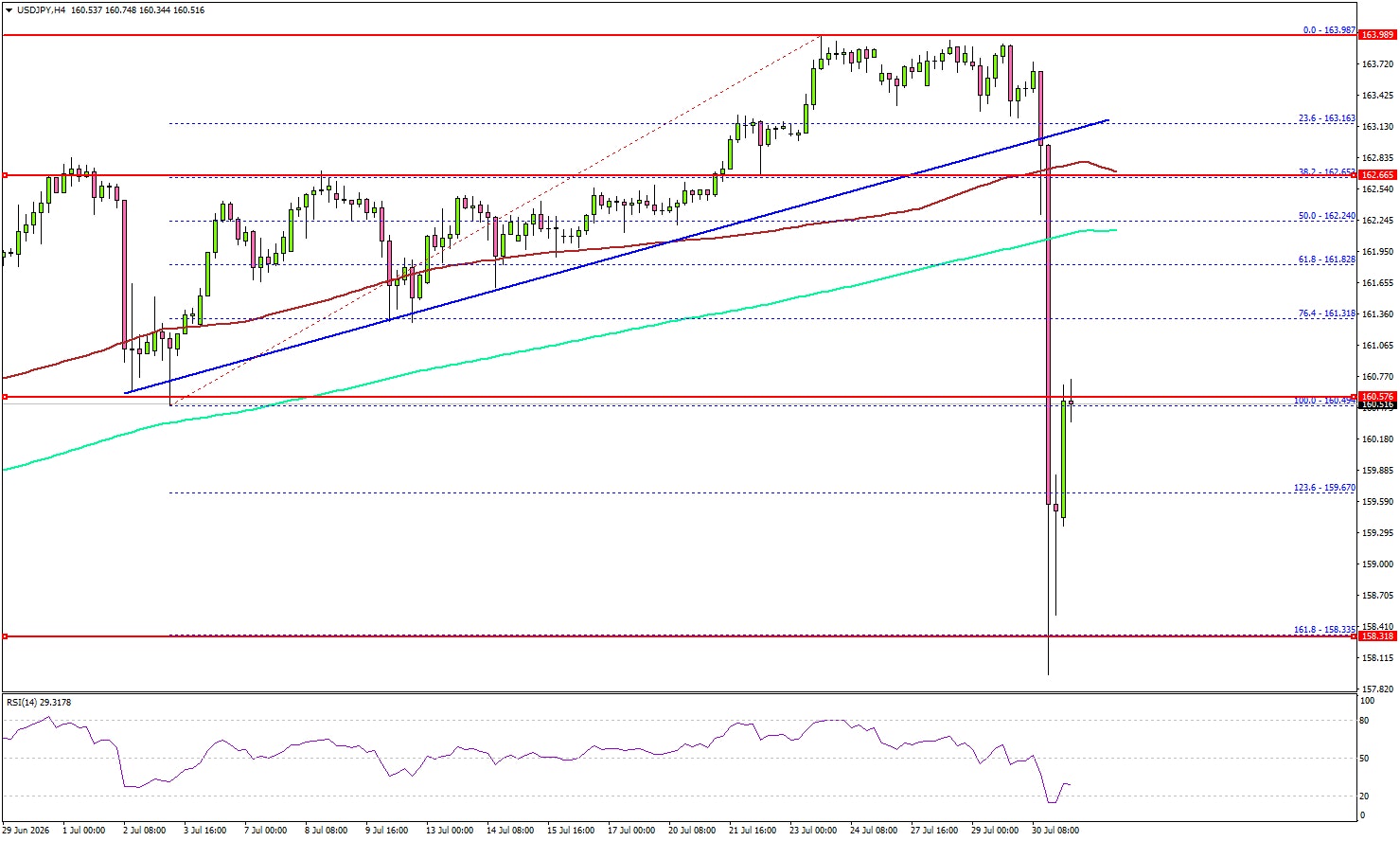
Looking at the 4-hour chart, the pair dipped below the 76.4% Fib retracement level of the upward move from the 160.49 swing low to the 163.98 high. There was also a move below a major bullish trend line with support at 163.30.
The pair even settled below the 100 simple moving average (red, 4-hour) and the 200 simple moving average (green, 4-hour).
If there are more losses, the pair could find bids near the 1.618 Fib extension level at 158.35. The next major support could be near 158.00. The main support might be 157.40. A downside break and close below 157.40 might send the pair toward 156.80. Any more losses could open the doors for a test of 155.50.
On the upside, the pair could face resistance near 161.50. The next major resistance might be 162.25 or the 200 simple moving average (green, 4-hour).
A close above 162.25 could start another steady increase. In the stated case, the bulls could aim for a move to 163.00. Any more gains might open the doors for a test of 164.00.
Looking at Bitcoin, the price started a steady increase, but it must settle above $65,650 to gain bullish momentum.
Upcoming Key Economic Events:
- Chicago Purchasing Manager’s Index for July 2026 – Forecast 56.0, versus 56.7 previous.
- Michigan Consumer Sentiment Index for July 2026 (Prelim) – Forecast 54.0, versus 54.4 previous.
Eco Data 7/31/26
| GMT | Ccy | Events | Act | Cons | Prev | Rev |
|---|---|---|---|---|---|---|
| 23:30 | JPY | Unemployment Rate Jun | 2.50% | 2.50% | 2.50% | |
| 23:30 | JPY | Tokyo CPI Y/Y Jul | 2.00% | 1.70% | ||
| 23:30 | JPY | Tokyo CPI Core Y/Y Jul | 1.90% | 1.80% | 1.60% | |
| 23:30 | JPY | Tokyo CPI Core-Core Y/Y Jul | 2.00% | 1.90% | ||
| 23:50 | JPY | Industrial Production M/M Jun P | 1.30% | 0.70% | 0.10% | |
| 23:50 | JPY | Retail Trade Y/Y Jun | 0.50% | 2.80% | 5.30% | |
| 01:30 | AUD | Private Sector Credit M/M Jun | 0.80% | 0.60% | 0.70% | |
| 01:30 | AUD | PPI Q/Q Q2 | 1.30% | 0.30% | 0.40% | |
| 01:30 | AUD | PPI Y/Y Q2 | 3.60% | 3.00% | ||
| 01:30 | CNY | NBS Manufacturing PMI Jul | 49.2 | 49.9 | 50.3 | |
| 01:30 | CNY | NBS Non-Manufacturing PMI Jul | 49 | 50 | 50.2 | |
| 03:11 | JPY | BoJ Interest Rate Decision | 1.00% | 1.00% | 1.00% | |
| 05:00 | JPY | Housing Starts Y/Y Jun | 18.60% | 13.20% | 33.90% | |
| 06:30 | JPY | BoJ Press Conference | ||||
| 06:30 | CHF | Real Retail Sales Y/Y Jun | 1.50% | 3.20% | 3.50% | 3.40% |
| 07:55 | EUR | Germany Unemployment Change Jun | 6K | 5K | -1K | |
| 07:55 | EUR | Germany Unemployment Rate Jun | 6.40% | 6.30% | 6.30% | |
| 09:00 | EUR | Eurozone CPI Y/Y Jul P | 2.90% | 2.90% | 2.80% | |
| 09:00 | EUR | Eurozone Core CPI Y/Y Jul P | 2.50% | 2.40% | 2.40% | |
| 12:30 | CAD | GDP M/M May | 0.30% | 0.20% | 0.50% | 0.60% |
| 12:30 | USD | Employment Cost Index Q2 | 0.90% | 0.80% | 0.90% | |
| 13:45 | USD | Chicago PMI Jul | 57.6 | 57.5 | 56.7 | |
| 14:00 | USD | UoM Consumer Sentiment Jul F | 55.2 | 54.2 | 54.4 | |
| 14:00 | USD | UoM 1-Yr Inflation Expectations Jul F | 4.20% | 4.20% |
| 23:30 | JPY |
| Unemployment Rate Jun | |
| Actual | 2.50% |
| Consensus | 2.50% |
| Previous | 2.50% |
| 23:30 | JPY |
| Tokyo CPI Y/Y Jul | |
| Actual | 2.00% |
| Consensus | |
| Previous | 1.70% |
| 23:30 | JPY |
| Tokyo CPI Core Y/Y Jul | |
| Actual | 1.90% |
| Consensus | 1.80% |
| Previous | 1.60% |
| 23:30 | JPY |
| Tokyo CPI Core-Core Y/Y Jul | |
| Actual | 2.00% |
| Consensus | |
| Previous | 1.90% |
| 23:50 | JPY |
| Industrial Production M/M Jun P | |
| Actual | 1.30% |
| Consensus | 0.70% |
| Previous | 0.10% |
| 23:50 | JPY |
| Retail Trade Y/Y Jun | |
| Actual | 0.50% |
| Consensus | 2.80% |
| Previous | 5.30% |
| 01:30 | AUD |
| Private Sector Credit M/M Jun | |
| Actual | 0.80% |
| Consensus | 0.60% |
| Previous | 0.70% |
| 01:30 | AUD |
| PPI Q/Q Q2 | |
| Actual | 1.30% |
| Consensus | 0.30% |
| Previous | 0.40% |
| 01:30 | AUD |
| PPI Y/Y Q2 | |
| Actual | 3.60% |
| Consensus | |
| Previous | 3.00% |
| 01:30 | CNY |
| NBS Manufacturing PMI Jul | |
| Actual | 49.2 |
| Consensus | 49.9 |
| Previous | 50.3 |
| 01:30 | CNY |
| NBS Non-Manufacturing PMI Jul | |
| Actual | 49 |
| Consensus | 50 |
| Previous | 50.2 |
| 03:11 | JPY |
| BoJ Interest Rate Decision | |
| Actual | 1.00% |
| Consensus | 1.00% |
| Previous | 1.00% |
| 05:00 | JPY |
| Housing Starts Y/Y Jun | |
| Actual | 18.60% |
| Consensus | 13.20% |
| Previous | 33.90% |
| 06:30 | JPY |
| BoJ Press Conference | |
| Actual | |
| Consensus | |
| Previous | |
| 06:30 | CHF |
| Real Retail Sales Y/Y Jun | |
| Actual | 1.50% |
| Consensus | 3.20% |
| Previous | 3.50% |
| Revised | 3.40% |
| 07:55 | EUR |
| Germany Unemployment Change Jun | |
| Actual | 6K |
| Consensus | 5K |
| Previous | -1K |
| 07:55 | EUR |
| Germany Unemployment Rate Jun | |
| Actual | 6.40% |
| Consensus | 6.30% |
| Previous | 6.30% |
| 09:00 | EUR |
| Eurozone CPI Y/Y Jul P | |
| Actual | 2.90% |
| Consensus | 2.90% |
| Previous | 2.80% |
| 09:00 | EUR |
| Eurozone Core CPI Y/Y Jul P | |
| Actual | 2.50% |
| Consensus | 2.40% |
| Previous | 2.40% |
| 12:30 | CAD |
| GDP M/M May | |
| Actual | 0.30% |
| Consensus | 0.20% |
| Previous | 0.50% |
| Revised | 0.60% |
| 12:30 | USD |
| Employment Cost Index Q2 | |
| Actual | 0.90% |
| Consensus | 0.80% |
| Previous | 0.90% |
| 13:45 | USD |
| Chicago PMI Jul | |
| Actual | 57.6 |
| Consensus | 57.5 |
| Previous | 56.7 |
| 14:00 | USD |
| UoM Consumer Sentiment Jul F | |
| Actual | 55.2 |
| Consensus | 54.2 |
| Previous | 54.4 |
| 14:00 | USD |
| UoM 1-Yr Inflation Expectations Jul F | |
| Actual | 4.20% |
| Consensus | |
| Previous | 4.20% |
S&P 500 Wave Analysis
S&P 500: ⬆️ Buy
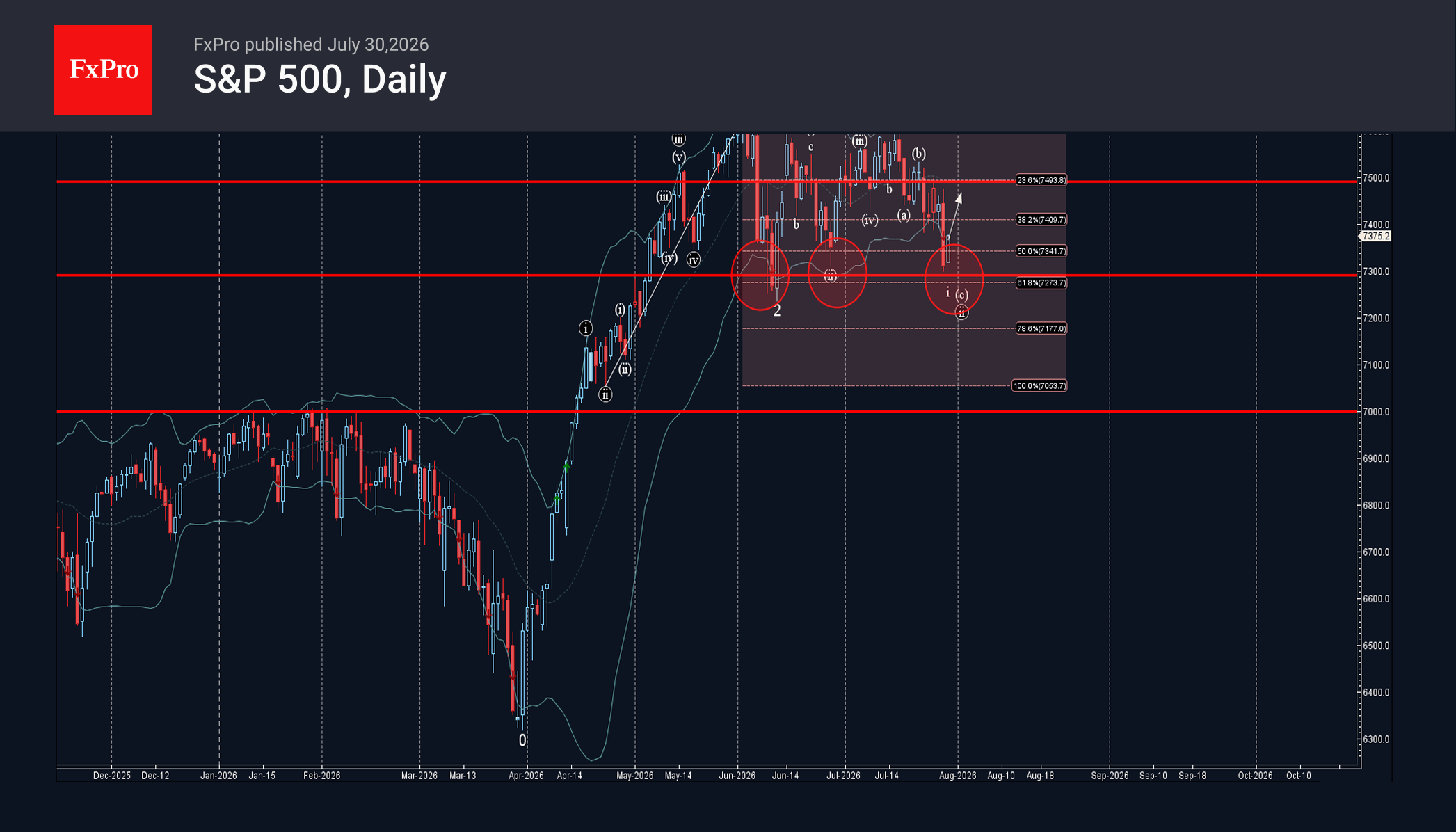
– S&P 500 reversed from support zone
– Likely to rise to resistance level 7500.00
S&P 500 index recently reversed up from the support zone between the support level 7290.00 (which has been reversing the price from the start of June), lower daily Bollinger Band and the 61.8% Fibonacci correction of the previous upward impulse from April.
The upward reversal from this support zone stopped the previous short-term correction ii
Given the strong daily uptrend, S&P 500 index can be expected to rise further to the next resistance level 7500.00.
Bank of England Review – Policy Outlook Highly Dependent on Situation in Middle East
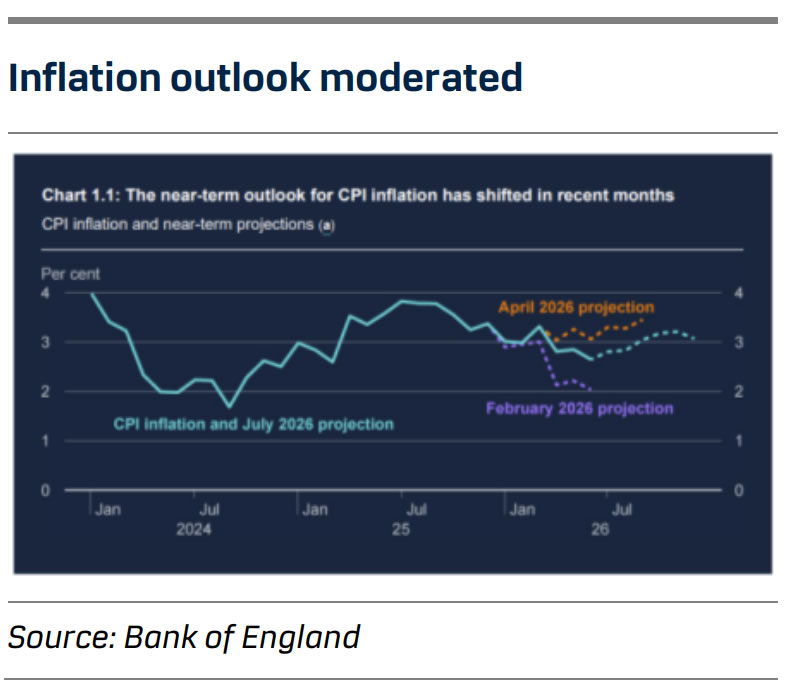
- The BoE kept Bank rate unchanged at 3.75%, as widely expected.
- On the one hand, 3 MPC members now call for a hike. On the other, the BoE now recognises that the risk to inflation is less imminent and has lowered its inflation outlook.
- We continue to see the BoE remaining on hold this year and have added a rate cut in 2027Q2 to our base case. This hinges on calmer energy markets, though, and the risk is skewed towards a hike in 2026H2.
The Bank of England (BoE) kept Bank Rate unchanged at 3.75% as expected. The decision was taken with a 6-3 vote (against 7-2 in June), with Mann joining the hawkish camp. Not a big surprise given some of her recent remarks. The BoE presented three scenarios in their monetary policy report. The central projection with energy prices conditioned on futures curves and moderate, persistent second-round effects now sees CPI inflation at 2.6% one year ahead, which is lower than all three scenarios presented in April.
The lack of evidence of second-round effects on inflation was also highlighted at the press conference. GDP growth is stronger and the unemployment rate is lower, leading the BoE to conclude that the UK economy is in a better position than anticipated in April. The central projection also incorporates two hikes in line with market pricing.
At the press conference, Governor Bailey highlighted the lack of evidence of second-round effects on inflation, but he also indicated that it might be necessary to act before any such effects appear. What seems increasingly clear is, that future policy will depend heavily on developments in the Middle East. While the vote split indicates a clear upside risk to rates at the short end, things could also turn around in H2. Deputy Governor Ramsden, who is seen as a centrist, now explicitly mentions resuming the cutting cycle if risks subside and the underlying disinflation process continues. In the end, Bailey will likely be the decisive vote, though. He does not look ready to vote for a cut anytime soon.
BoE call. Assuming that energy prices remain below alarming levels, our main scenario remains that the Bank Rate will be unchanged for the remainder of the year. We expect the BoE to resume the cutting cycle and deliver another 25bps rate cut in 2027Q2. For the remainder of the year, risks are tilted to the upside, though. Elevated energy prices over a prolonged period could still trigger a rate hike in H2, even in the absence of spillover to broader price-setting. The economy has been quite resilient despite tighter financial conditions and the cost of an "insurance hike" has declined over recent months.