

Sample Category Title
EUR/CHF Weekly Outlook
EUR/CHF rose further to 0.9348 last week but turned sideway since then. Initial bias remains neutral this week for some consolidations first. Further rally is expected as long as 0.9265 resistance turned support holds. Break of 0.9348 will extend larger rally from 0.8979 to 100% projection of 0.8979 to 0.9264 from 0.9094 at 0.9379. However, firm break of 0.9265 will indicate that deeper correction is underway to 55 D EMA (now at 0.9230).
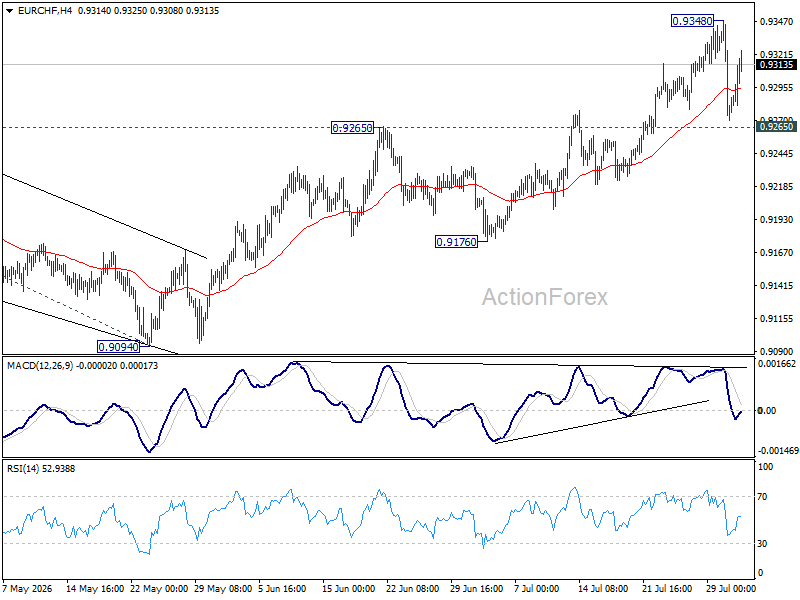
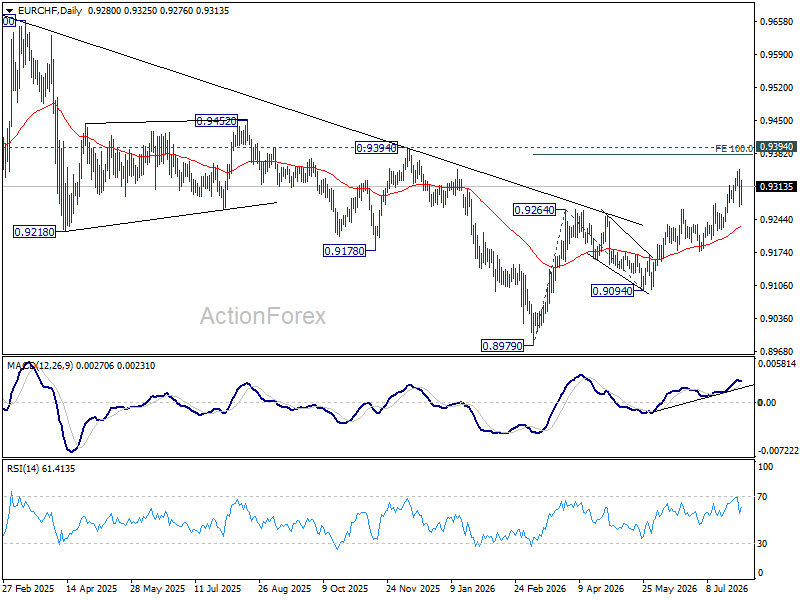
In the bigger picture, considering bullish divergence condition in W MACD, rise from 0.8979 medium term bottom should at least be reversing the fall from 0.9928, with prospect of developing into a medium term up trend. Firm break of 0.9394 resistance will add more credence to this case. For now risk will remain on the upside as long as 0.9094 support holds, in case of retreat.
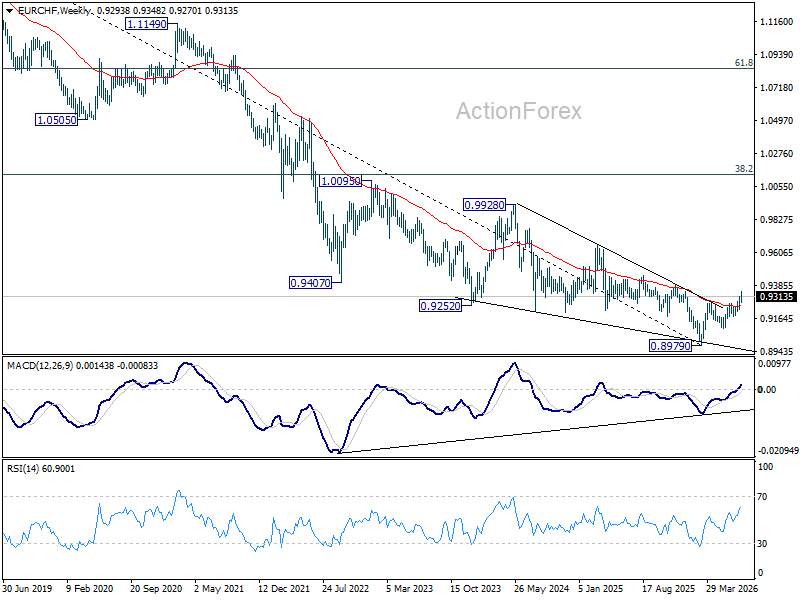
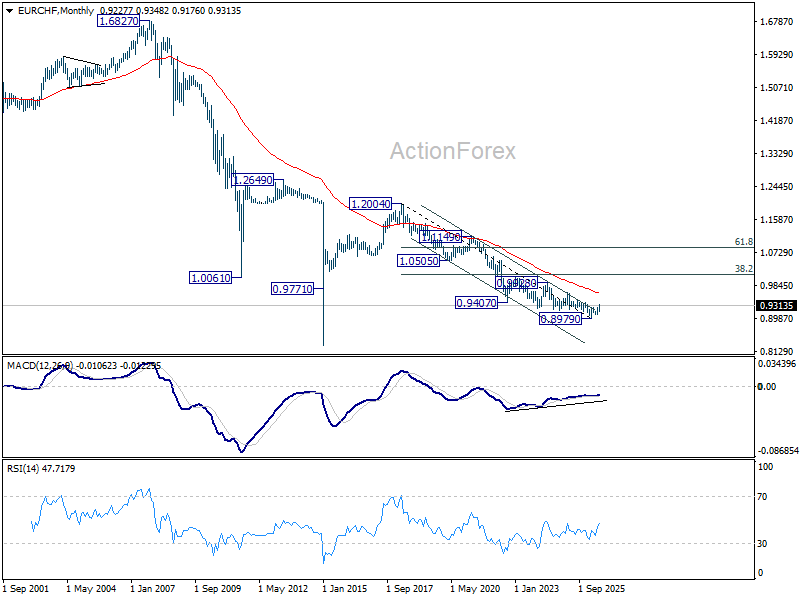
In the long term picture, outlook will stay bearish as long as 0.9407 support turned resistance (2022 low) holds. However, firm break of 0.9407 will argue that the down trend from 1.2004 (2018 high) has completed with five waves down to 0.8979. Stronger rebound should then be seen to 38.2% retracement of 1.2004 to 0.8979 at 1.0135 in the medium term.
The Weekly Bottom Line: Markets Issue a Yellow Card to the Fed
Our summary of recent economic events and what to expect in the weeks ahead.
Canadian Highlights
- Canadian GDP surprised to the upside in May, leaving Q2 on track for its strongest quarterly performance in two years.
- Payroll employment posted a second consecutive monthly gain in May and reinforced signals that hiring conditions may be stabilizing.
- Despite firmer growth, we expect the Bank of Canada to remain in wait-and-see mode, holding the policy rate at 2.25% until year-end.
U.S. Highlights
- Financial markets were volatile as technology stocks came under pressure amid renewed scrutiny of AI spending, while elevated oil prices added to inflation concerns.
- The Fed held rates unchanged for a fifth consecutive meeting. Growing markets' concerns about the Fed's ability to lower inflation pushed 30-year Treasury yields to a 19-year high.
- Second-quarter GDP growth moderated, but a softer headline print masked stronger domestic demand as consumer spending rebounded and business investment remained strong.
Canada – Proof of Progress
The Bank of Canada's growing confidence in the economy was put to the test this week, and the latest GDP data delivered. Real GDP rose 0.3% m/m in May – handily beating expectations – while the advance estimate points to another 0.2% m/m gain in June. Under the hood, goods-producing industries helped drive the upside surprise, led by activity in construction and natural resources. Canada's services side of the economy also chipped in, now having growth for four consecutive months. The latest gains across the economy have been broad-based, and importantly, trade-exposed sectors are showing tentative signs of recovery after a difficult start to the year. Taken together, second-quarter growth is tracking close to 3.5% annualized, well above the BoC's latest projection (Chart 1). Should that materialize, it would mark Canada's first three-handled quarterly growth rate since mid-2024.
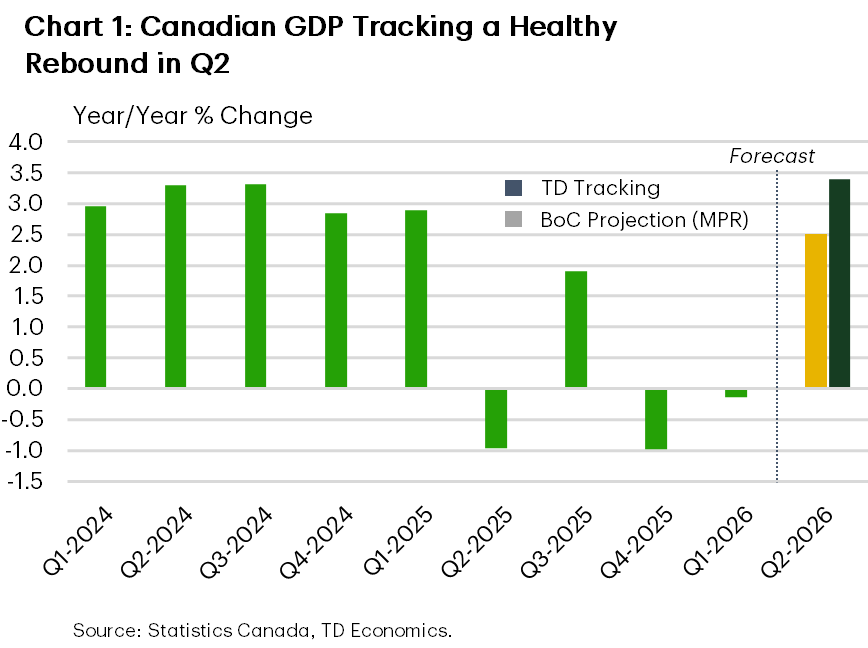
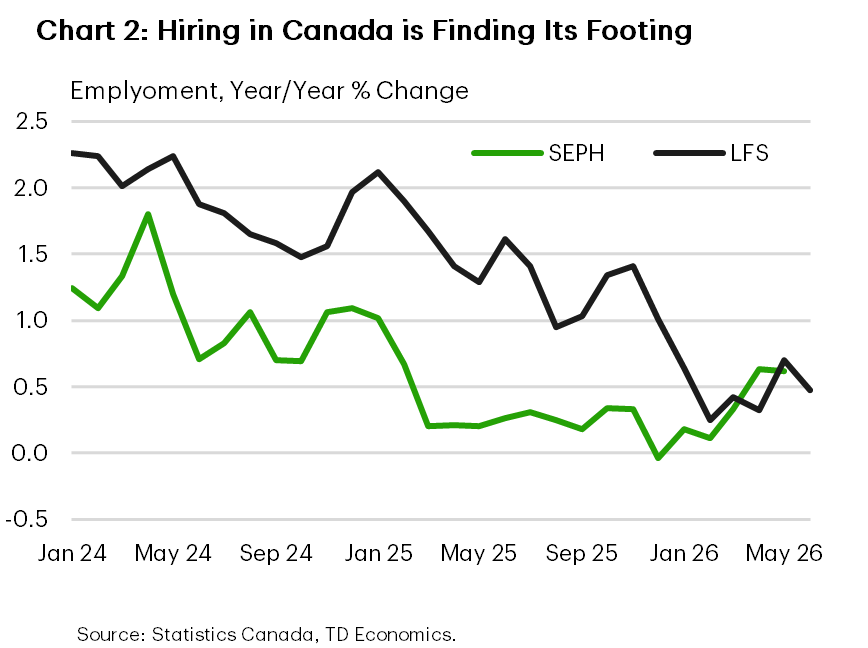
The rebound is encouraging but should be kept in perspective. Even with a strong Q2, GDP growth in the first half of the year is tracking near 1.5% annualized, or roughly trend pace. Still, the data broadly validate the more constructive tone struck by policymakers earlier this month, who argued that the soft patch weighing on activity through late-2025 and early-2026 was beginning to fade. Excess supply remains and labour market conditions continue to show signs of slack, but the trend is improving. That improvement was also evident in this week's Survey of Employment, Payrolls and Hours (SEPH) release, which showed a second consecutive 0.2% m/m gain in May payroll employment, reinforcing signals from the Labour Force Survey that hiring may be turning a corner (Chart 2).
Financial markets took the data largely in stride. Canadian two- and ten-year bond yields rose only a few basis points over the week, while the loonie gained roughly half a percent on firm oil prices and broad U.S. dollar weakness. Market pricing for a Bank of Canada hike edged modestly higher, but not enough to materially alter the outlook for rates. The muted reaction suggests investors view stronger growth as supportive, but not enough to change the policy outlook. Inflation remains the Bank's primary source of uncertainty, with energy markets still vulnerable to renewed disruptions. Yet this week's Summary of Deliberations from the last BoC rate decision offered little indication that policymakers are becoming more concerned about underlying inflation pressures. Instead, the Bank appears increasingly confident that the recent pickup in headline inflation remains largely an energy story.
That leaves monetary policy in a relatively comfortable position. Growth is proving resilient enough to rule out additional rate relief, while labour market slack, contained core inflation, and trade uncertainty continue to argue against a more restrictive stance. As such, this week's developments remain consistent with our view that the Bank will stay on hold through the remainder of the year. Even so, the economy appears to have entered the second half of the year on firmer footing than expected.
Marc Ercolao, Economist
U.S. – Markets Issue a Yellow Card to the Fed
Financial markets had plenty to digest this week, with mega-cap tech earnings, the FOMC decision, and the second-quarter GDP. Equities swung sharply as investors weighed technology earnings against renewed scrutiny over AI-related capital spending and China's progress in AI capabilities and semiconductor manufacturing. Still, stronger-than-expected results from several technology heavyweights helped revive the sentiment toward the end of the week. Oil prices also were in focus, with WTI crude easing relative to last week's highs, but remained elevated at around US$85 per barrel Friday morning. Against that backdrop, investors have turned their attention to the Fed, where growing concern about inflation and rising doubts over the Committee's willingness to do what is necessary to restore price stability pushed longer-term Treasury yields sharply higher.
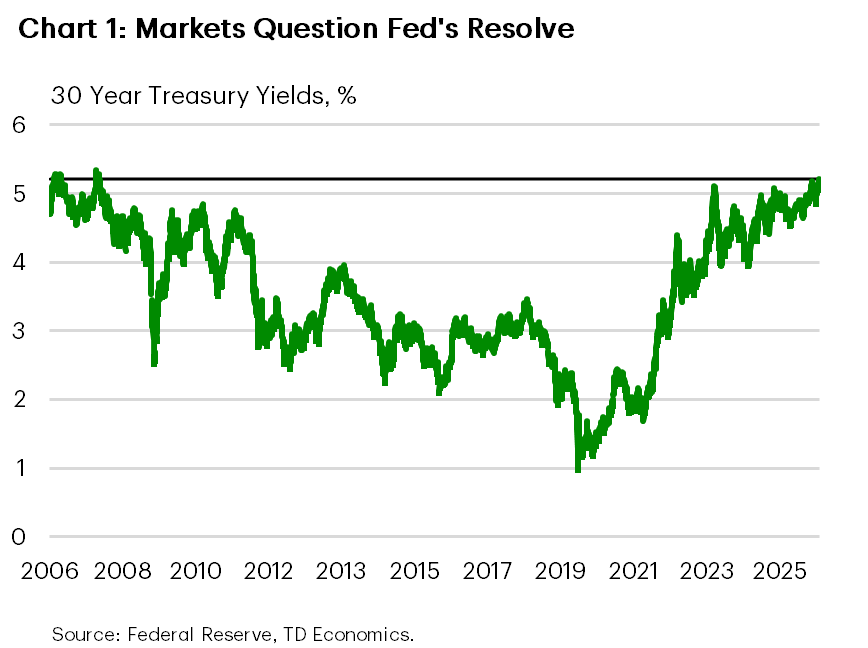
The FOMC meeting was the week's marquee event, though the main surprise was in the vote and not the policy announcement. Three officials dissented in favor of a 25-basis-point hike, highlighting growing concern within the Committee about inflation risks. The data support that concern. While inflation eased modestly in June, the improvement is unlikely to last if energy prices remain elevated. Core PCE inflation has remained above the Fed's 2% target for more than five years, and the Fed is still searching for the back of the net. So even as Chair Warsh reiterated that the Committee would not "waver" in its commitment to restoring price stability, financial markets grew uneasy about the Fed's willingness to raise rates to bring inflation back to target. 30-Year Treasury yields rose sharply following the meeting and remain near a 19-year high (Chart 1).
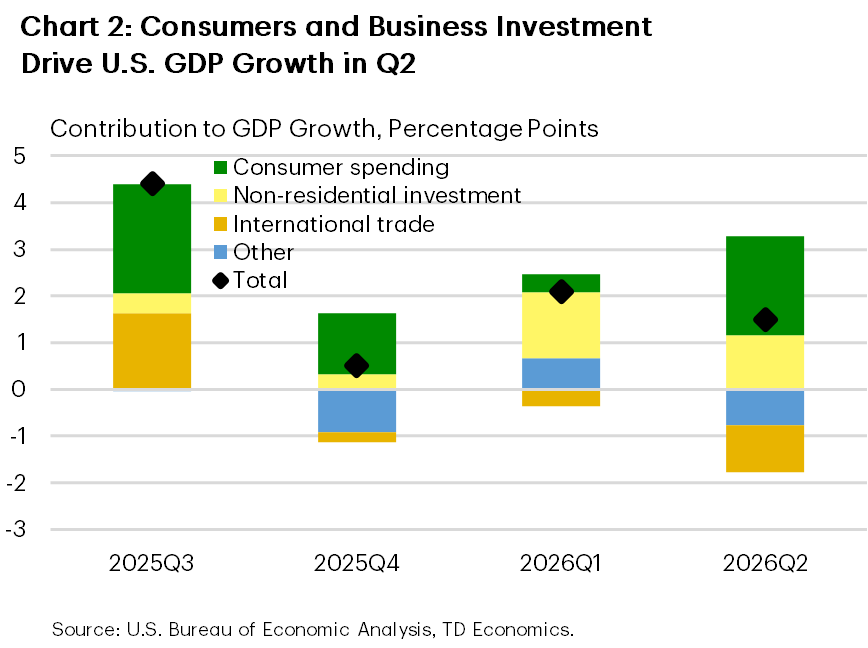
Despite the market jitters, the incoming data still point to an economy with solid underlying momentum. Real GDP growth slowed to a 1.5% annualized pace in the second quarter from 2.1% previously, but the softer headline largely reflected a surge in imports, with net trade subtracting roughly one percentage point from growth.
Under the hood, the economy's engine was running considerably hotter than the headline GDP figure suggested, supported by a rebound in consumer spending and robust business investment (Chart 2). Consumer spending rebounded by a solid 3.2% annualized after a weather-affected first quarter. However, spending continued to outpace income, pushing the personal saving rate to its lowest level since mid-2022. With the boost from larger tax refunds fading, consumer resilience will increasingly depend on labor market strength and rising household wealth. Business investment also remained a bright spot. AI-related investment remained robust, but it was no longer the only game in town. Spending on industrial equipment surged 29% annualized in the second quarter, adding to evidence that the current capital spending cycle is becoming more broad-based.
Next week's ISM surveys and the July employment report will shed further light on the balance of risks to prices and employment. For now, resilient domestic demand and persistent inflation pressures suggest the Fed's inflation fight is entering overtime, with markets seeking reassurance that policymakers can credibly bring inflation back to target.
Economics Week Ahead
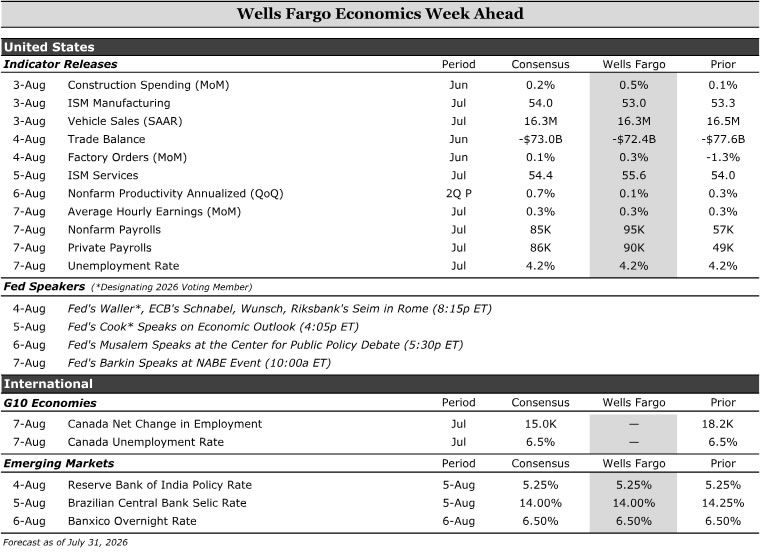
Next week's U.S. employment report is expected to show the labor market remained broadly stable in July. We look for modest payroll growth, an unchanged unemployment rate and wage growth consistent with limited labor-driven inflation pressure.
Internationally, Canada's labor market is expected to show further signs of stabilization, supporting a patient BoC stance. Among emerging markets, we expect Brazil's central bank to cut rates by 25 bps as inflation cools and growth loses momentum. In India, we expect the RBI to remain on hold, though elevated inflation and rupee weakness could prompt a more hawkish tone. In Mexico, Banxico is also expected to stay on hold, with stronger Q2 growth likely to fade in the second half of the year.
- United States: Employment (Friday)
- G10 Economies: Canada Labor Force Survey (Friday)
- Emerging Markets: Brazilian Central Bank (Wednesday), Reserve Bank of India (Friday), Banxico (Friday)
Source: Bloomberg Finance L.P. and Wells Fargo Economics
U.S. Week Ahead
Employment • Friday
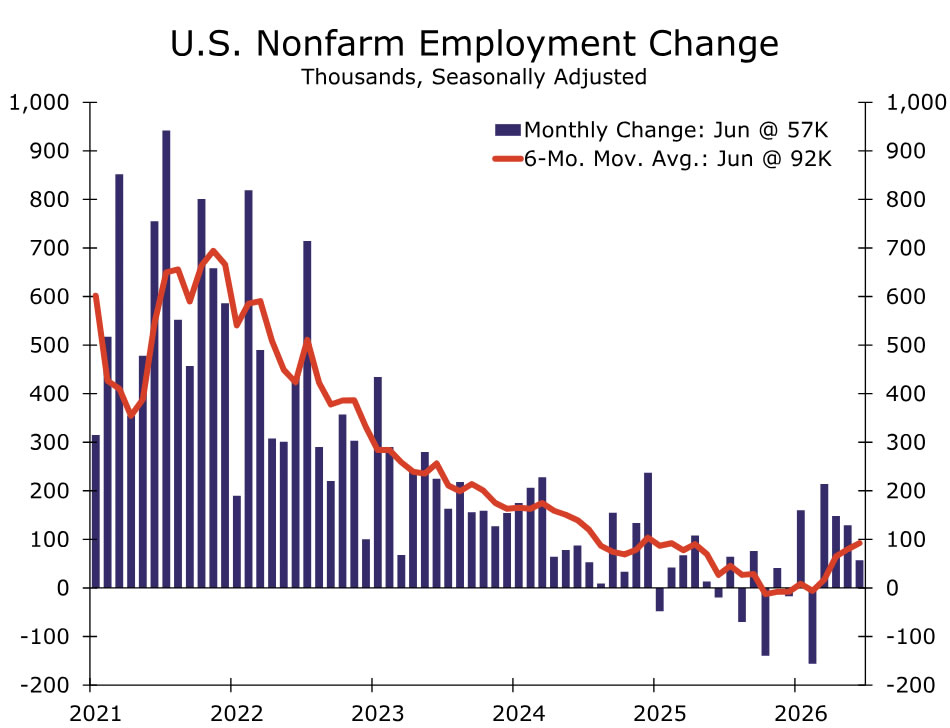
Labor market conditions appear to have been little changed in July. Nonfarm payroll growth averaged 92K over the first half of the year, and we look for a similar 95K increase in July. Small business hiring plans improved in June and initial jobless claims moved lower between survey weeks, suggesting layoffs remain limited. But, not all the July labor data are pointing in a positive direction. Indeed, job postings are hovering below year-ago levels, while ADP's measure of weekly private-sector payroll growth has slowed since the spring.
Tepid labor demand has been accompanied by slower labor supply growth, helping to keep the labor market in balance. We expect the unemployment rate to hold at 4.2% in July. That said, June's sharp decline in prime-age labor force participation looks difficult to square with broader economic conditions and may reflect some greater-than-usual monthly volatility in the household survey. The potential for a rebound in the labor force participation rate creates some upside risk for the unemployment rate.
Wage growth should remain consistent with a labor market that is not generating meaningful inflation pressure. We forecast average hourly earnings to rise 0.3% in July, holding the year-over-year rate at 3.5%. Taken together, the report should reinforce the view that labor demand and labor supply have cooled in tandem, leaving the labor market broadly stable.
Source: U.S. Department of Labor and Wells Fargo Economics
G10 Week Ahead
Canada Labor Force Survey • Friday
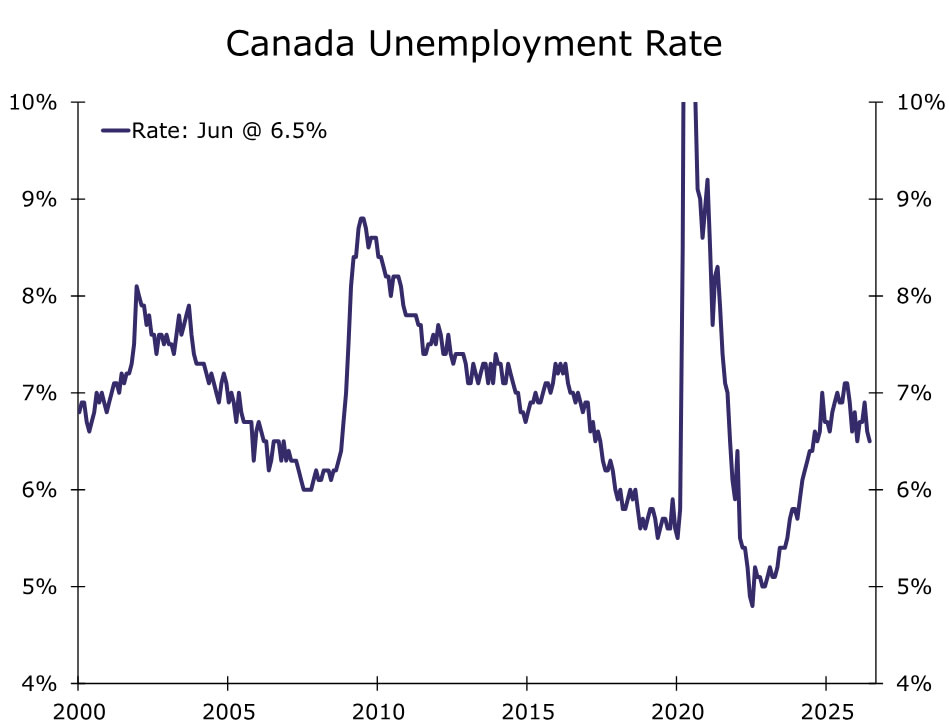
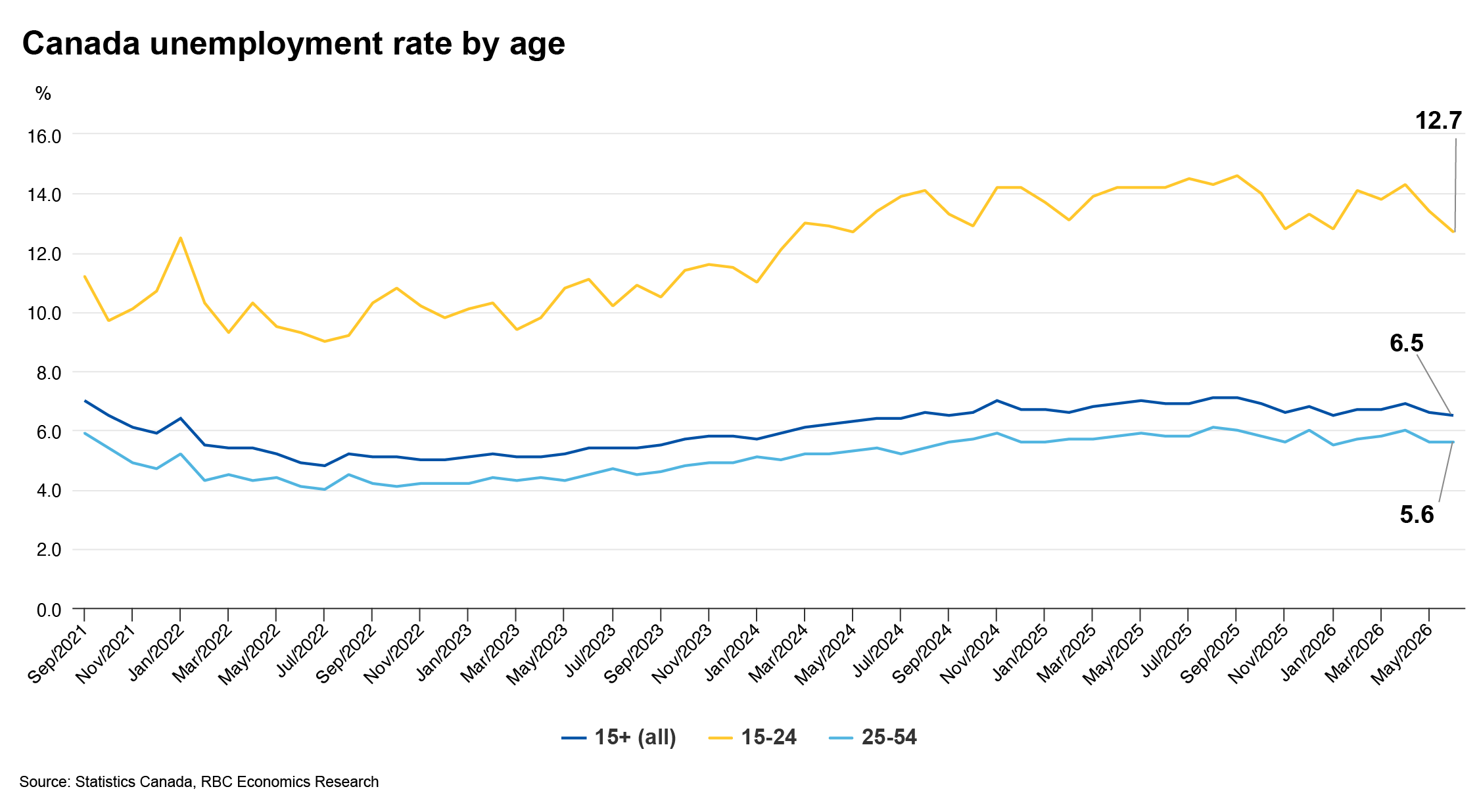
Canada's labor market has shown tentative signs of stabilization in recent months. Employment gains in May and June reversed some of the weakness seen earlier in the year, though the latest increase of 18K was driven largely by part-time work. As a result, the broader trend remains one of modest hiring, with employment growth running sub-1% year-over-year.
The unemployment rate slid to 6.5% in June, at the lower-end of its recent 12-month range. Cooling labor supply should keep a lid on unemployment even as labor demand remains subdued. Wage growth and other measures of labor demand continue to cool gradually rather than abruptly.
While further hiring gains are likely to be modest, the labor market no longer appears to be deteriorating at the pace seen through much of 2024. For policymakers, that should reinforce the case for patience, with labor market conditions remaining weak enough to contain inflation pressures but not weak enough to necessitate additional near-term easing.
Source: Bloomberg Finance L.P. and Wells Fargo Economics
EM Week Ahead
Brazilian Central Bank • Wednesday
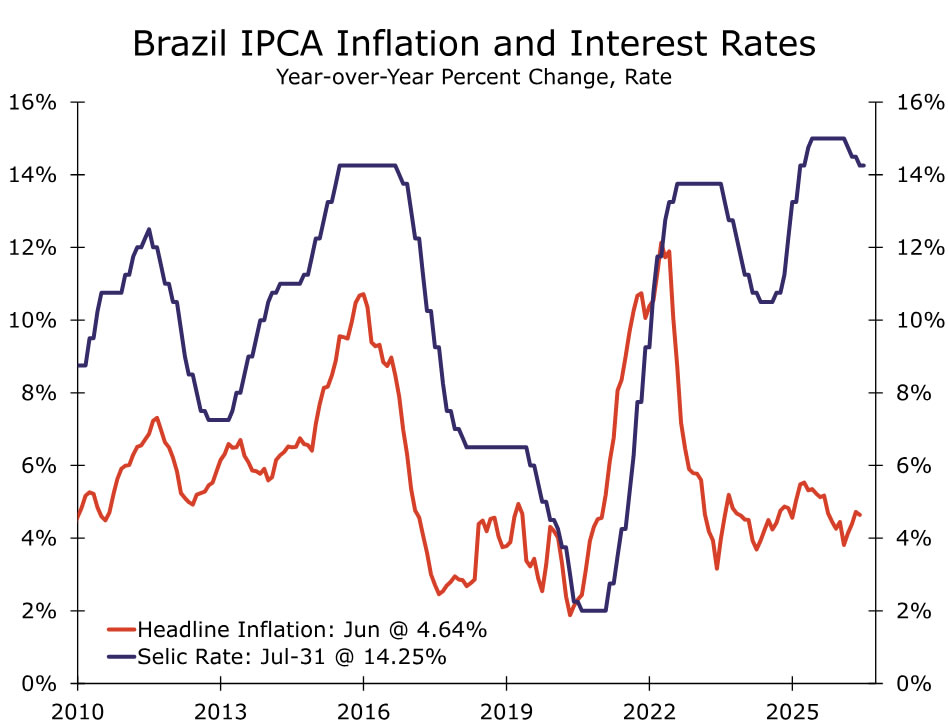
We expect the Brazilian Central Bank (BCB) to continue its easing cycle with a 25 bps rate cut next week, bringing the Selic Rate to 14.00%. Recent indicators support this move, with IPCA-15 inflation slowing to 4.52% year-over-year and 0.06% month-over-month in mid-July. Economic activity also appears to be losing momentum, as Brazil's economic activity index slowed to 0.8% over the year in May from 1.1%.
That said, policymakers are likely to remain cautious. While the latest inflation data were encouraging, services inflation remains elevated and inflation expectations are still above target. At the same time, uncertainty surrounding energy prices, El Niño-related weather risks and the fiscal outlook suggests the disinflation process may not be fully secured.
Against this backdrop, we expect the BCB to continue easing gradually while retaining the option to pause if inflation risks reaccelerate. We continue to expect the Selic Rate to reach 14.00% by year-end, with another 25 bps cut in Q4.
Source: Bloomberg Finance L.P. and Wells Fargo Economics
Reserve Bank of India • Friday
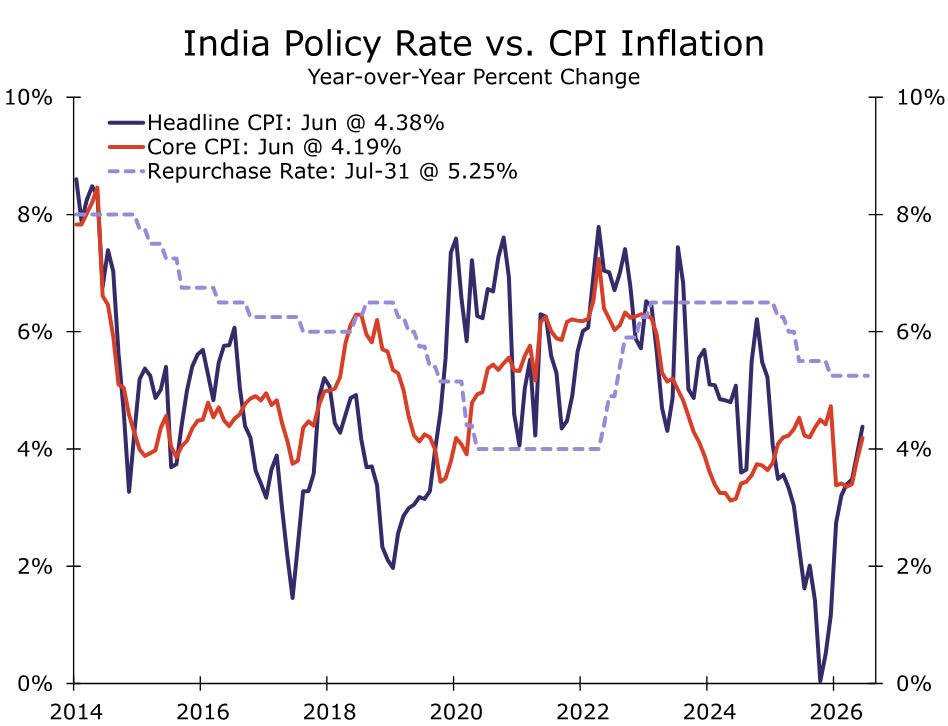
We expect the Reserve Bank of India (RBI) to keep the Repurchase Rate unchanged at 5.25% next week. Headline and core inflation rose to 4.38% and 4.19% year-over-year in June, respectively, which placed both measures above the RBI's 4% midpoint target. Producer price pressures also remain elevated, with wholesale price inflation at 9.87% year-over-year. El Niño conditions add to food inflation risks.
While inflation risks have increased, the growth outlook remains mixed. Industrial production rose 7.3% year-over-year in June, but July PMI data point to slower momentum and stronger output price pressures. Higher oil prices have also widened the trade deficit and intensified pressure on the rupee despite substantial RBI intervention.
These competing pressures should keep the RBI on hold next week, though elevated inflation and rupee weakness may prompt a more hawkish tilt from its current neutral stance. We continue to expect a 25 bps hike in Q4, which would bring the Repurchase Rate to 5.50% by year-end.
Source: Bloomberg Finance L.P. and Wells Fargo Economics
Banxico • Friday
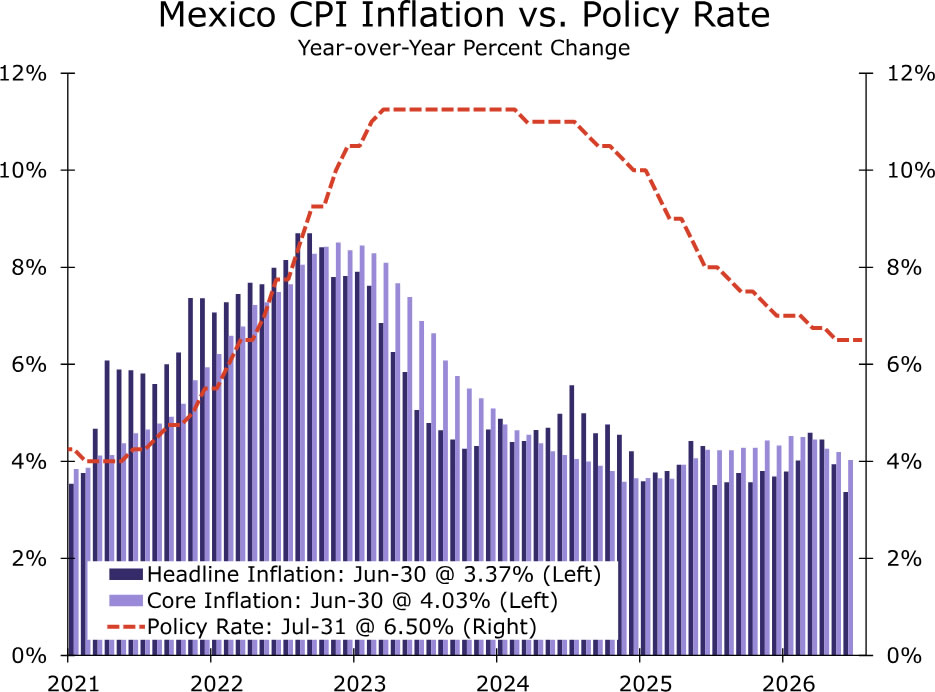
We expect Banxico to keep the Overnight Rate unchanged at 6.50% next week. Mexico's economy rebounded strongly in Q2 after a weak start to the year, with GDP rising 1.5% quarter-over-quarter after a 0.6% contraction in Q1 and 2.2% year-over-year from 0.2%. Growth was broad-based, but we doubt this pace will be sustained. Q2 likely marked the strongest quarter of the year, with momentum set to fade in the second half as persistent USMCA uncertainty weighs on capex and limits the scope for a stronger recovery.
The latest biweekly inflation data point to continued disinflation, though core inflation remains sticky despite slowing since the start of the year. Inflation expectations also remain elevated over the year-ahead horizon. At the same time, ample slack should limit demand-driven price pressures.
We continue to expect Banxico to keep rates on hold through year-end. The bar for easing remains high, though weaker growth and further progress on inflation could open the door to a cut later this year or in early 2027.
 Source: Bloomberg Finance L.P. and Wells Fargo Economics
Canada’s Labour Market Expected to Show Further Stabilization into Summer
Next Friday’s labour market report for July in Canada is the first for Q3, and an important update on whether the gradual improvement seen in recent months is continuing.
We expect jobs to increase by 5,000 with the unemployment rate holding steady at 6.5%. That would still leave the employment count down slightly in 2026, but would add to increases over May and June. And, with population (and labour force growth) slowing, the unemployment rate holding at 6.5% (down from 6.9% in April, and lower 0.4% from a year ago) remains consistent with per-worker market conditions broadly improving.
Recent labour market indicators, including job postings, have changed little heading into July, suggesting hiring demand has continued to stabilize despite ongoing trade uncertainty.
The composition of employment gains and wage growth will also remain important. June’s increase was driven primarily by part-time jobs, while full-time positions saw a more modest gain. Average hourly wage growth also picked up slightly in June after slowing sharply in May, but that’s likely to continue to drift lower with slack in the market still high by historical standards.
More broadly, recent jobs reports have been consistent with an economy that continues to recover at a modest pace. Employment has continued to increase, the unemployment rate has edged lower from its April peak, and other indicators point to rebounding growth in Q2. The separately released Survey of Employment, Payrolls and Hours data showed employment up 95,000 this year to May—stronger than the more timely Labour Force Survey—with hours worked tracking firm.
A July report broadly in line with our expectations would reinforce our base case forecast that Canada’s labour market is continuing to stabilize, supporting the view that the economy remains on a path of modest, but steady expansion.
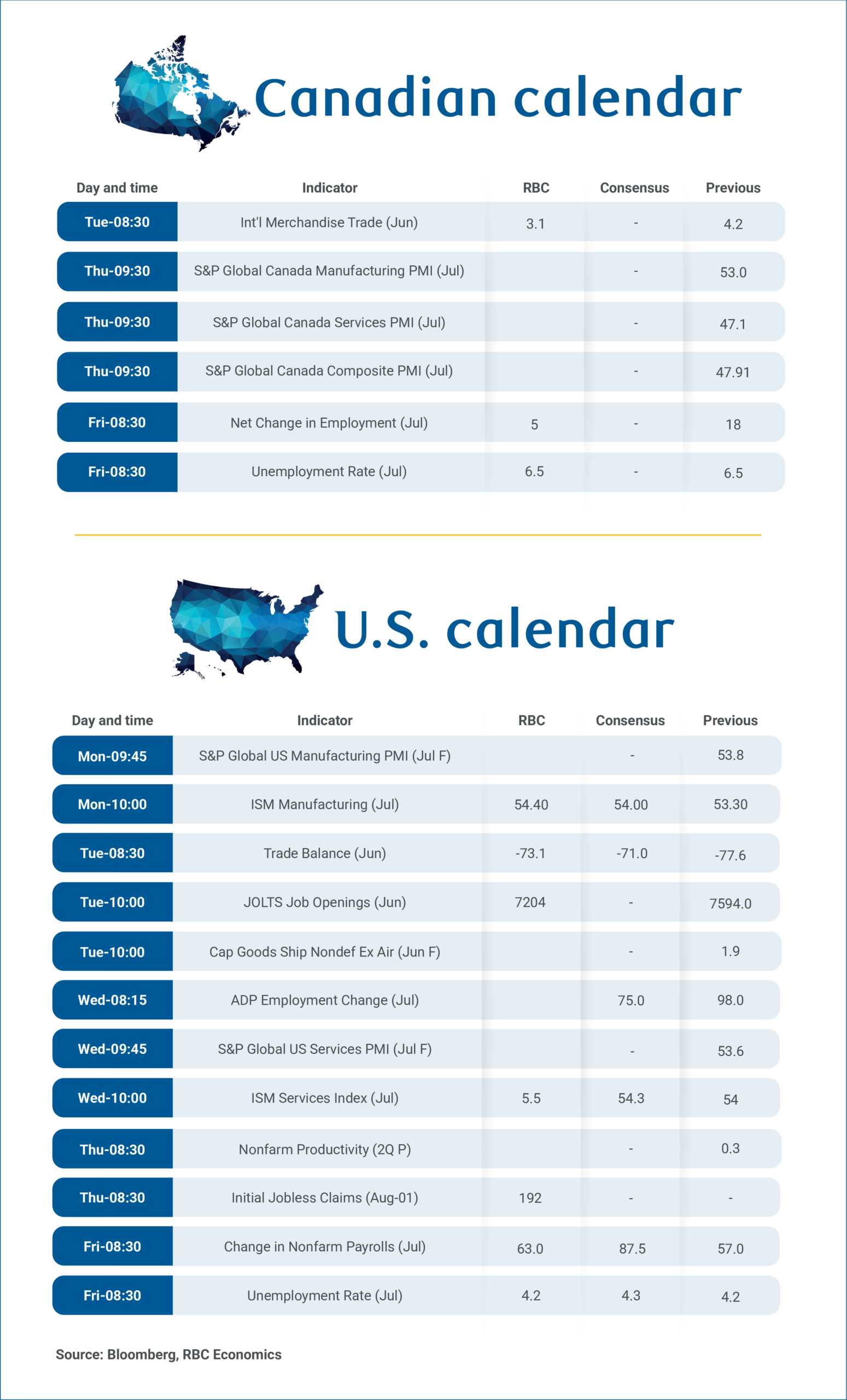
We expect Canadian exports to decrease by 1.2% in June, while imports increase by 0.3%. The decline in exports is likely due mostly to lower oil prices during the month, while imports are expected to reflect moderate growth in motor vehicle shipments. On balance, we expect the merchandise trade balance to narrow to a $3.1 billion surplus, down from $4.2 billion in May.
Summary 8/3 – 8/7
Monday, Aug 3, 2026
| GMT | Ccy | Events | Cons | Prev |
|---|---|---|---|---|
| 22:45 | NZD | Building Permits Jun | -4% | |
| 23:00 | AUD | Manufacturing PMI Jul F | 51.7 | 51.7 |
| 00:30 | JPY | Manufacturing PMI Jul F | 54.7 | 54.7 |
| 01:00 | AUD | TD-MI Inflation Gauge M/M Jul | -0.40% | |
| 01:45 | CNY | RatingDog Manufacturing PMI Jul | 52 | 51.7 |
| 06:00 | EUR | Germany Retail Sales M/M Jun | -0.50% | 1.10% |
| 06:30 | CHF | CPI M/M Jul | -0.10% | 0% |
| 06:30 | CHF | CPI Y/Y Jul | 0.50% | |
| 07:30 | CHF | Manufacturing PMI Index Jul F | 54.5 | 54.3 |
| 07:50 | EUR | France Manufacturing PMI Jul F | 50 | 50 |
| 07:55 | EUR | Germany Manufacturing PMI Jul F | 52.2 | 52.2 |
| 08:00 | EUR | Eurozone Manufacturing PMI Jul F | 52 | 52 |
| 08:30 | GBP | Manufacturing PMI Jul F | 52.8 | 52.8 |
| 13:45 | USD | Manufacturing PMI Jul F | 53.8 | 53.8 |
| 14:00 | USD | ISM Manufacturing PMI Jul | 54 | 53.3 |
| 14:00 | USD | ISM Manufacturing Prices Paid Jul | 70 | 73 |
| 14:00 | USD | ISM Manufacturing Employment Index Jul | 49.7 | |
| 14:00 | USD | Construction Spending M/M Jun | 0.20% | 0.10% |
| 22:45 | NZD |
| Building Permits Jun | |
| Consensus | |
| Previous | -4% |
| 23:00 | AUD |
| Manufacturing PMI Jul F | |
| Consensus | 51.7 |
| Previous | 51.7 |
| 00:30 | JPY |
| Manufacturing PMI Jul F | |
| Consensus | 54.7 |
| Previous | 54.7 |
| 01:00 | AUD |
| TD-MI Inflation Gauge M/M Jul | |
| Consensus | |
| Previous | -0.40% |
| 01:45 | CNY |
| RatingDog Manufacturing PMI Jul | |
| Consensus | 52 |
| Previous | 51.7 |
| 06:00 | EUR |
| Germany Retail Sales M/M Jun | |
| Consensus | -0.50% |
| Previous | 1.10% |
| 06:30 | CHF |
| CPI M/M Jul | |
| Consensus | -0.10% |
| Previous | 0% |
| 06:30 | CHF |
| CPI Y/Y Jul | |
| Consensus | |
| Previous | 0.50% |
| 07:30 | CHF |
| Manufacturing PMI Index Jul F | |
| Consensus | 54.5 |
| Previous | 54.3 |
| 07:50 | EUR |
| France Manufacturing PMI Jul F | |
| Consensus | 50 |
| Previous | 50 |
| 07:55 | EUR |
| Germany Manufacturing PMI Jul F | |
| Consensus | 52.2 |
| Previous | 52.2 |
| 08:00 | EUR |
| Eurozone Manufacturing PMI Jul F | |
| Consensus | 52 |
| Previous | 52 |
| 08:30 | GBP |
| Manufacturing PMI Jul F | |
| Consensus | 52.8 |
| Previous | 52.8 |
| 13:45 | USD |
| Manufacturing PMI Jul F | |
| Consensus | 53.8 |
| Previous | 53.8 |
| 14:00 | USD |
| ISM Manufacturing PMI Jul | |
| Consensus | 54 |
| Previous | 53.3 |
| 14:00 | USD |
| ISM Manufacturing Prices Paid Jul | |
| Consensus | 70 |
| Previous | 73 |
| 14:00 | USD |
| ISM Manufacturing Employment Index Jul | |
| Consensus | |
| Previous | 49.7 |
| 14:00 | USD |
| Construction Spending M/M Jun | |
| Consensus | 0.20% |
| Previous | 0.10% |
Tuesday, Aug 4, 2026
| GMT | Ccy | Events | Cons | Prev |
|---|---|---|---|---|
| 23:50 | JPY | Monetary Base Y/Y Jul | -13.00% | -13.70% |
| 12:30 | CAD | Trade Balance (CAD) Jun | 3.0B | 4.2B |
| 12:30 | USD | Trade Balance (USD) Jun | -73.0B | -77.6B |
| 13:30 | CAD | Manufacturing PMI Jul F | 50.2 | 53 |
| 14:00 | USD | Factory Orders M/M Jun | 0.50% | -1.30% |
| 23:50 | JPY |
| Monetary Base Y/Y Jul | |
| Consensus | -13.00% |
| Previous | -13.70% |
| 12:30 | CAD |
| Trade Balance (CAD) Jun | |
| Consensus | 3.0B |
| Previous | 4.2B |
| 12:30 | USD |
| Trade Balance (USD) Jun | |
| Consensus | -73.0B |
| Previous | -77.6B |
| 13:30 | CAD |
| Manufacturing PMI Jul F | |
| Consensus | 50.2 |
| Previous | 53 |
| 14:00 | USD |
| Factory Orders M/M Jun | |
| Consensus | 0.50% |
| Previous | -1.30% |
Wednesday, Aug 5, 2026
| GMT | Ccy | Events | Cons | Prev |
|---|---|---|---|---|
| 22:45 | NZD | Unemployment Rate Q2 | 5.40% | 5.30% |
| 22:45 | NZD | Employment Change Q2 | 0.10% | 0.20% |
| 22:45 | NZD | Labour Cost Index Q/Q Q2 | 0.60% | 0.50% |
| 23:00 | AUD | Services PMI Jul F | 53 | 53 |
| 23:30 | JPY | Labor Cash Earnings Y/Y Jun | 3.40% | 3.20% |
| 23:50 | JPY | BoJ Minutes | ||
| 00:30 | JPY | Services PMI Jul F | 51.9 | 51.9 |
| 01:45 | CNY | RatingDog Services PMI Jul | 53.7 | 54.1 |
| 06:45 | EUR | France Industrial Output M/M Jun | 0.30% | -0.10% |
| 07:50 | EUR | France Services PMI Jul F | 49.8 | 49.8 |
| 07:55 | EUR | Germany Services PMI Jul F | 49.6 | 49.6 |
| 08:00 | EUR | Eurozone Services PMI Jul F | 51.6 | 51.6 |
| 08:30 | GBP | Services PMI Jul F | 51.8 | 51.8 |
| 09:00 | EUR | Eurozone PPI M/M Jun | -0.30% | 0.20% |
| 09:00 | EUR | Eurozone PPI Y/Y Jun | 4.60% | 5.90% |
| 12:15 | USD | ADP Employment Change Jul | 75K | 98K |
| 13:45 | USD | Services PMI Jul F | 53.6 | 53.6 |
| 14:00 | USD | ISM Services PMI Jul | 54.2 | 54 |
| 14:00 | USD | ISM Services Prices Paid Jul | 67.7 | |
| 14:00 | USD | ISM Services Employment Index Jul | 51.2 | |
| 14:30 | USD | Crude Oil Inventories (Jul 31) | -1.5M | -7.2M |
| 22:45 | NZD |
| Unemployment Rate Q2 | |
| Consensus | 5.40% |
| Previous | 5.30% |
| 22:45 | NZD |
| Employment Change Q2 | |
| Consensus | 0.10% |
| Previous | 0.20% |
| 22:45 | NZD |
| Labour Cost Index Q/Q Q2 | |
| Consensus | 0.60% |
| Previous | 0.50% |
| 23:00 | AUD |
| Services PMI Jul F | |
| Consensus | 53 |
| Previous | 53 |
| 23:30 | JPY |
| Labor Cash Earnings Y/Y Jun | |
| Consensus | 3.40% |
| Previous | 3.20% |
| 23:50 | JPY |
| BoJ Minutes | |
| Consensus | |
| Previous | |
| 00:30 | JPY |
| Services PMI Jul F | |
| Consensus | 51.9 |
| Previous | 51.9 |
| 01:45 | CNY |
| RatingDog Services PMI Jul | |
| Consensus | 53.7 |
| Previous | 54.1 |
| 06:45 | EUR |
| France Industrial Output M/M Jun | |
| Consensus | 0.30% |
| Previous | -0.10% |
| 07:50 | EUR |
| France Services PMI Jul F | |
| Consensus | 49.8 |
| Previous | 49.8 |
| 07:55 | EUR |
| Germany Services PMI Jul F | |
| Consensus | 49.6 |
| Previous | 49.6 |
| 08:00 | EUR |
| Eurozone Services PMI Jul F | |
| Consensus | 51.6 |
| Previous | 51.6 |
| 08:30 | GBP |
| Services PMI Jul F | |
| Consensus | 51.8 |
| Previous | 51.8 |
| 09:00 | EUR |
| Eurozone PPI M/M Jun | |
| Consensus | -0.30% |
| Previous | 0.20% |
| 09:00 | EUR |
| Eurozone PPI Y/Y Jun | |
| Consensus | 4.60% |
| Previous | 5.90% |
| 12:15 | USD |
| ADP Employment Change Jul | |
| Consensus | 75K |
| Previous | 98K |
| 13:45 | USD |
| Services PMI Jul F | |
| Consensus | 53.6 |
| Previous | 53.6 |
| 14:00 | USD |
| ISM Services PMI Jul | |
| Consensus | 54.2 |
| Previous | 54 |
| 14:00 | USD |
| ISM Services Prices Paid Jul | |
| Consensus | |
| Previous | 67.7 |
| 14:00 | USD |
| ISM Services Employment Index Jul | |
| Consensus | |
| Previous | 51.2 |
| 14:30 | USD |
| Crude Oil Inventories (Jul 31) | |
| Consensus | -1.5M |
| Previous | -7.2M |
Thursday, Aug 6, 2026
| GMT | Ccy | Events | Cons | Prev |
|---|---|---|---|---|
| 01:30 | AUD | Trade Balance (AUD) Jun | -1.08B | -3.02B |
| 06:00 | EUR | Germany Factory Orders M/M Jun | 0.50% | 1.90% |
| 08:00 | CHF | Unemployment Rate Jul | 3.10% | 3.10% |
| 08:00 | EUR | ECB Economic Bulletin | ||
| 08:30 | GBP | Construction PMI Jul | 40.2 | 38.4 |
| 09:00 | EUR | Eurozone Retail Sales M/M Jun | 0.10% | 0.20% |
| 12:30 | USD | Initial Jobless Claims (Jul 31) | 203K | 197K |
| 12:30 | USD | Nonfarm Productivity Q2 P | 0.70% | 0.30% |
| 12:30 | USD | Unit Labor Costs Q2 P | 2.70% | 1.80% |
| 14:00 | USD | Wholesale Inventories Jun | 0.30% | 0.30% |
| 14:30 | USD | Natural Gas Storage (Jul 31) | 30B | 28B |
| 01:30 | AUD |
| Trade Balance (AUD) Jun | |
| Consensus | -1.08B |
| Previous | -3.02B |
| 06:00 | EUR |
| Germany Factory Orders M/M Jun | |
| Consensus | 0.50% |
| Previous | 1.90% |
| 08:00 | CHF |
| Unemployment Rate Jul | |
| Consensus | 3.10% |
| Previous | 3.10% |
| 08:00 | EUR |
| ECB Economic Bulletin | |
| Consensus | |
| Previous | |
| 08:30 | GBP |
| Construction PMI Jul | |
| Consensus | 40.2 |
| Previous | 38.4 |
| 09:00 | EUR |
| Eurozone Retail Sales M/M Jun | |
| Consensus | 0.10% |
| Previous | 0.20% |
| 12:30 | USD |
| Initial Jobless Claims (Jul 31) | |
| Consensus | 203K |
| Previous | 197K |
| 12:30 | USD |
| Nonfarm Productivity Q2 P | |
| Consensus | 0.70% |
| Previous | 0.30% |
| 12:30 | USD |
| Unit Labor Costs Q2 P | |
| Consensus | 2.70% |
| Previous | 1.80% |
| 14:00 | USD |
| Wholesale Inventories Jun | |
| Consensus | 0.30% |
| Previous | 0.30% |
| 14:30 | USD |
| Natural Gas Storage (Jul 31) | |
| Consensus | 30B |
| Previous | 28B |
Friday, Aug 7, 2026
| GMT | Ccy | Events | Cons | Prev |
|---|---|---|---|---|
| 23:30 | JPY | Overall Household Spending Y/Y Jun | 0.90% | -0.40% |
| 03:00 | CNY | Trade Balance (USD) Jul | 107B | 125.6B |
| 05:00 | JPY | Leading Economic Index Jun P | 116.5 | 116.5 |
| 06:00 | EUR | Germany Industrial Production M/M Jun | 0.00% | 0.90% |
| 06:00 | EUR | Germany Trade Balance (EUR) Jun | 16.7B | 19.1B |
| 07:00 | CHF | Foreign Currency Reserves (CHF) Jul | 759B | |
| 07:00 | CHF | SECO Consumer Climate (3m) Q3 | -35 | -40 |
| 12:30 | CAD | Net Change in Employment Jul | 17.8K | 18.2K |
| 12:30 | CAD | Unemployment Rate Jul | 6.50% | 6.50% |
| 12:30 | USD | Nonfarm Payrolls Jul | 85K | 57K |
| 12:30 | USD | Unemployment Rate Jul | 4.20% | 4.20% |
| 12:30 | USD | Average Hourly Earnings M/M Jul | 0.30% | 0.30% |
| 14:00 | CAD | Ivey PMI Jul | 55.4 | 56.2 |
| 23:30 | JPY |
| Overall Household Spending Y/Y Jun | |
| Consensus | 0.90% |
| Previous | -0.40% |
| 03:00 | CNY |
| Trade Balance (USD) Jul | |
| Consensus | 107B |
| Previous | 125.6B |
| 05:00 | JPY |
| Leading Economic Index Jun P | |
| Consensus | 116.5 |
| Previous | 116.5 |
| 06:00 | EUR |
| Germany Industrial Production M/M Jun | |
| Consensus | 0.00% |
| Previous | 0.90% |
| 06:00 | EUR |
| Germany Trade Balance (EUR) Jun | |
| Consensus | 16.7B |
| Previous | 19.1B |
| 07:00 | CHF |
| Foreign Currency Reserves (CHF) Jul | |
| Consensus | |
| Previous | 759B |
| 07:00 | CHF |
| SECO Consumer Climate (3m) Q3 | |
| Consensus | -35 |
| Previous | -40 |
| 12:30 | CAD |
| Net Change in Employment Jul | |
| Consensus | 17.8K |
| Previous | 18.2K |
| 12:30 | CAD |
| Unemployment Rate Jul | |
| Consensus | 6.50% |
| Previous | 6.50% |
| 12:30 | USD |
| Nonfarm Payrolls Jul | |
| Consensus | 85K |
| Previous | 57K |
| 12:30 | USD |
| Unemployment Rate Jul | |
| Consensus | 4.20% |
| Previous | 4.20% |
| 12:30 | USD |
| Average Hourly Earnings M/M Jul | |
| Consensus | 0.30% |
| Previous | 0.30% |
| 14:00 | CAD |
| Ivey PMI Jul | |
| Consensus | 55.4 |
| Previous | 56.2 |
Week Ahead – US Payrolls Report and AI Earnings to Keep Investors on Edge
- After the Fed decision, NFP report awaited for more rate hike clues.
- Employment also on the agenda in Canada and New Zealand.
- Chinese trade and Japanese wage data to be watched too.
- But Iran and AI headlines to remain in driver's seat for risk sentiment.
Fed confuses the markets
With the Fed still pondering how soon it would be appropriate to raise interest rates, the July jobs report looks set to take centre stage in a week where little else is likely to attract much attention. Although with tensions in the Middle East remaining high and blockbuster earnings struggling to stop the bleeding on Wall Street, volatility isn't about to ebb.
One recent source of volatility is uncertainty about the Fed policy path, with the July decision only adding to the doubts rather than offering clarity. Fed Chair Kevin Warsh's resolute stance on abandoning forward guidance has brought on an era of mixed messages about what the Fed intends to do next.
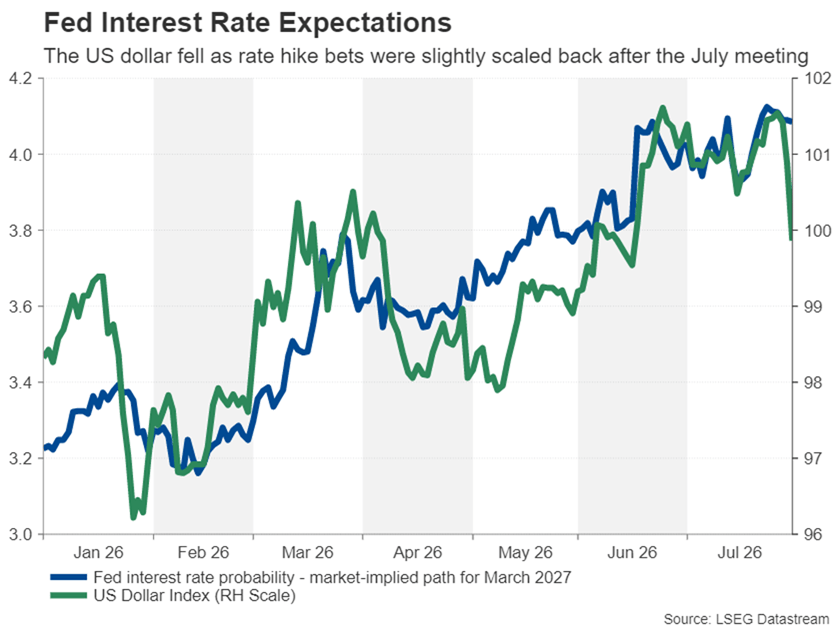
On the one hand, Warsh appeared to be setting the stage for a September rate hike, on the other, he seemed to stop short of signalling that higher rates are necessary to bring inflation back towards the 2% target.
Crucially, despite all the talk about the importance of the Fed achieving its price goal, a September rate hike is now only about 65% priced in compared to being fully baked in prior to the meeting. Warsh seems to be hoping that by talking tough on inflation, it will magically hit the target by itself. Bond markets weren't impressed, pushing the 30-year Treasury yield to the highest since 2007.
Will July jobs report seal a September hike?
With the upcoming week bringing a plethora of job indicators, September rate hike odds are likely to continue swinging back and forth before culminating with the all-important nonfarm payrolls report.
The ISM business surveys will also provide vital updates on the economy. The ISM manufacturing PMI will kick off the week on Monday, and the services PMI follows on Wednesday. Both sectors have so far been immune to the war in the Middle East, with the only notable impact being the jump in the respective prices indices.
Investors will be watching whether there was any resurgence in price pressures in July when the US-Iran ceasefire was broken and traffic through the Strait of Hormuz collapsed again.
June factory orders out on Tuesday is the only other non-labour market data of the week, which will be released at the same time as the JOLTS job openings. On Wednesday, the ADP private employment report will be gauged for any insights into Friday's official numbers, while Thursday's Challenger Layoffs for July will be the next piece of the jobs puzzle.
On Friday, all eyes will be on the payrolls data. Following June's disappointing print of 57k, analysts are forecasting a slight improvement of 91k jobs. The unemployment rate is expected to have ticked up, however, from 4.2% to 4.3%. Any reading above 100k would likely boost confidence in the labour market, fuelling rate hike bets for September.
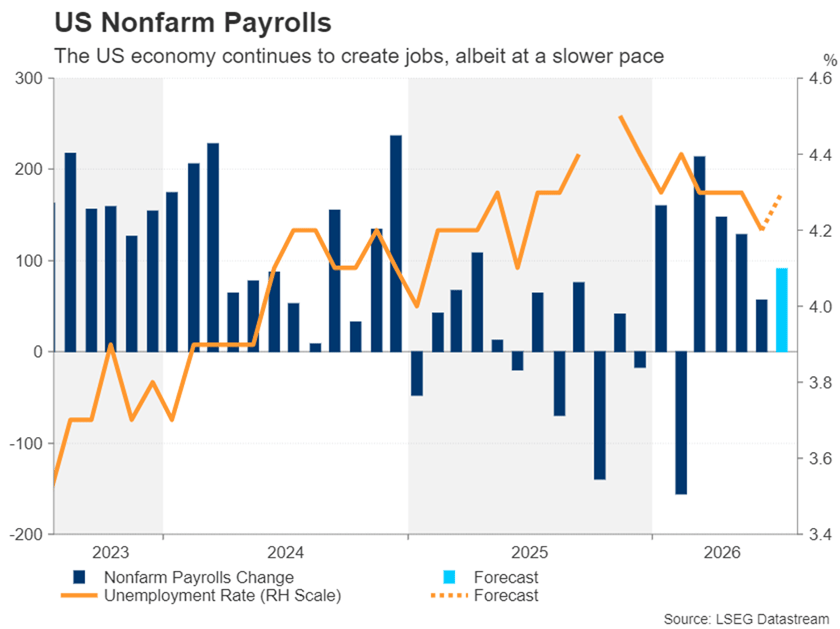
However, a second straight month of a negative surprise would raise question marks about the strength of hiring, leading investors to pare back rate hike expectations.
Can chip stocks stage a rebound?
Yet, any signs of labour market weakness are unlikely to be seen as a reason to worry about the broader economy. After all, even Kevin Warsh thinks that the economy is showing "impressive resilience", and the strong earnings growth enjoyed by most Wall Street firms in the second quarter is evidence of this. Hence, a soft jobs report would be positive for risk appetite, as September bets would decline further, though this would come at the expense of dollar strength.
Nonetheless, stellar earnings, especially at a time of elevated geopolitical and trade frictions, haven't been enough to ease concerns about an AI bubble. Doubts about overinvestment in the AI sector and how all this spending is being financed continue to dog sentiment around AI-related stocks. And with stretched valuations, investors have set the bar for both actual and expected earnings very high.
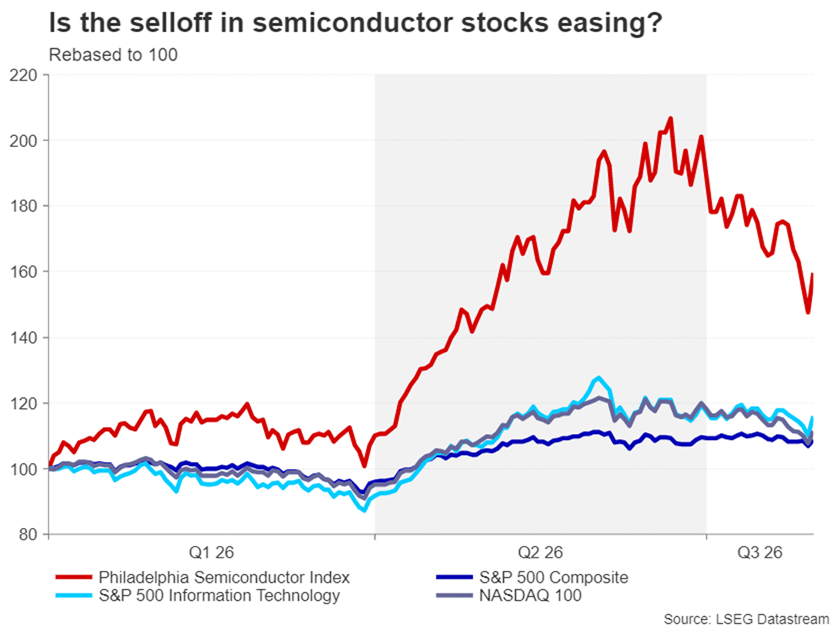
But the selloff may have been overdone, particularly in semiconductor stocks, and a rebound is underway. Considering that volatility was partly exacerbated due to the questionable regulation of South Korea's stock market where chip giants SK Hynix and Samsung are listed, a further recovery could be on the cards if the upcoming AI earnings continue to point to robust revenue growth.
The highlights will be Palantir Technologies on Monday, SpaceX and Advanced Micro Devices on Tuesday, and Sandisk Corporation and Western Digital on Wednesday.
Divergent rate outlooks for BoC and RBNZ
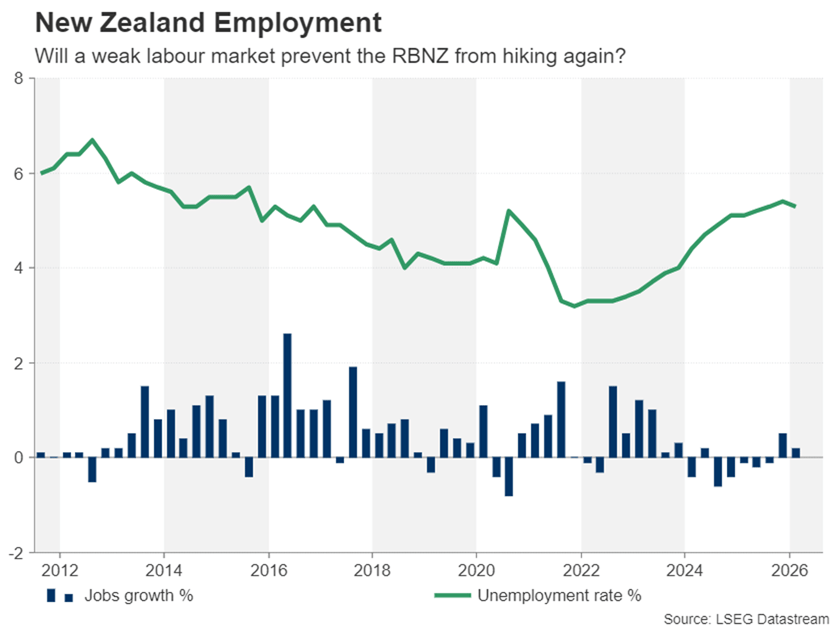
Switching back to economic data, employment will take the spotlight in Canada and New Zealand. Although both countries have seen their jobless rates trend north since 2023, the inflation picture has been somewhat different. The Reserve Bank of New Zealand raised interest rates earlier in July to tackle surging inflation, which hit 4.1% y/y in the second quarter. However, inflationary pressures have been more benign in Canada, and the Bank of Canada may well end up being the only major central bank not to hike interest rates during the Middle East conflict.
The July employment figures due Friday are unlikely to significantly alter the rate outlook for the BoC, with any impact on the Canadian dollar probably being confined to a knee-jerk reaction, even if there are surprises.
However, New Zealand's jobs data out on Wednesday could be more vital for RBNZ rate hike expectations. A second rate hike is fully priced in for the RBNZ at its September meeting. But with the labour market showing only tentative signs of recovery, any fresh deterioration in Q2 could prompt the RBNZ to delay further tightening, weighing on the New Zealand dollar.
Yen enjoys intervention lift as BoJ stands pat
After the yen repeatedly tested the 164 per dollar level, the Japanese government finally decided to intervene on Thursday, boosting it to the 158.00 per dollar level. The intervention came despite the yen already being offered some relief from the Fed's mixed signals on the likelihood of rate hikes. Not that the Bank of Japan necessarily did a better job as it kept rates unchanged. But there was a visible hawkish tilt, as policymakers sounded more worried about underlying inflation overshooting their 2% target.
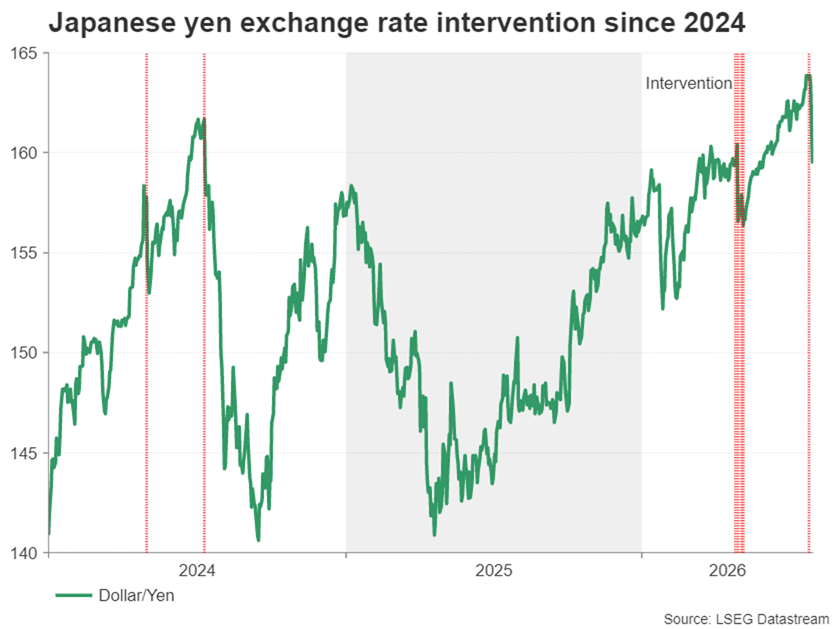
Wage growth and household spending figures due Wednesday and Friday, respectively, could help build the case for the BoJ to bring forward its next rate hike from December, as currently anticipated by investors, to September or October.
The Bank of Japan sees sustained wage increases backed by strong household spending as key to hitting its inflation target sustainably, so more progress on this front would be positive for the yen. Nevertheless, the risk of further intervention remains high as hot US data could easily send the yen spinning again.
In addition, Middle East headlines could jolt markets at any point, as the US and Iran seem far from agreeing to any new talks, so further attacks are more likely than a pause. Chinese trade figures released on Friday will also be important for setting the market tone, as investors assess the effects of the five-month-old war on the major economies.
Sunset Market Commentary
There will be no KBC Sunset from Monday August 3 until Monday August 10. We resume our publication on Tuesday August 11.
Markets
The EMU flash CPI release for the month of July showed a modest reacceleration in prices. Headline CPI rose 0.2% M/M and 2.9% Y/Y (from 2.8%). Core CPI (ex-energy, food, alcohol and tobacco) rose slightly more than expected (0.0% M/M, but up from 2.4% Y/Y to 2.5%). Energy prices add 2.4% M/M to be up 10.0% Y/Y. Services inflation at 1.1% M/M and 3.3% Y/Y also remain rather elevated. On the soft side, prices of non-energy industrial goods declined 2.2% M/M to be 0.9% higher compared to the same month last year. As such, the report shouldn't come as a big surprise for the ECB (or markets). However, combined with solid Q2 growth data published yesterday and ongoing uncertainty on any solution to the conflict in the Middle East, keeping energy prices at elevated levels (Brent $90 p/b, TTF gas contract near €60 p/Mwh) it should keep the ECB on some kind of alert modus. The data at least also caused European interest rate markets to reverse yesterday's (mostly US inspired) steeping move. The German yields curve bear flattens with the 2-y rising 6.0 bps and the 30-y rising 30 bp. The EMU 2-y swap yields now again trades north of 3.0%. EMU money markets again discount a 90% of a September rate. US interest rate markets in some way apparently also have digested the nervousness post Fed Chair Warsh's press conference earlier this week. The US yields curve also corrects on the recent steepening move (5-y +6.0 bps; 30-y +5.0 bp). The focus of US investors now can turn to the early month US eco update next week including the ISM's and labour market data (ADP, JOLTS, jobless claims & Payrolls). Of course, the Fed focus is on inflation. Still it will be interesting to see the market reaction, especially in case of solid US activity data. Interestingly, two of the dissenters at this week's meeting (Cleveland Fed president Beth Hammack & Minneapolis Fed president Neels Kashkari) in a statement elaborated on the reasons why they already wanted to raise the policy rate at this month's meeting. On other markets, equities try to recover a bit further from recent AI/chip rout. EuroStoxx 50 (+0.2%, Nasdaq +0.3%).
The rise in EMU yields at least didn't help the euro. EUR/USD after trading north of 1.15 late yesterday and this morning again slips below this big figure (1.148). However, at least for some part the yen might be to blame. Yesterday's broader USD decline to some extent mirrored spill-over effects for the USD/JPY set-back on suspected yen interventions from Japanese authorities to support the yen. Given a rather hawkish assessment at this morning's BOJ meeting, including similar comments from BOJ governor Ueda, USD/JPY during the session in nervous trading hovered near 160.
News & Views
The flash estimate of the Polish Consumer price index published by Statistics Poland today, indicates that CPI inflation in the country in July rose 0.8% M/M and 3.0% Y/Y. The outcome was close to expectations. Indices for some subcategories were also published. Food prices declined -0.8% M/M and prices were also 0.2% lower compared to the same month last year. Prices of electricity and gas rose 0.1% M/M and 4.0% Y/Y. Prices for fuel for personal transport equipment rose 13.9% M/M and 15.8% Y/Y as some measures to cap fuel prices for consumers ended in June. At the same time, prices again rose in the wake of the renewed tensions in the Middle East. At least headline inflation is now again above the 2.5% inflation target midpoint of the National Bank of Poland. This outcome at least complicates governor Glapinski's intentions as he indicated to consider proposing a rate cut after the summer break. However, given the high degree of uncertainty, other members of the MPC recently gave more cautious comments. At least today, the Polish 2-y swap yields didn't change much (4.14%). After rebounding yesterday, the zloty today again lost some modest ground (EUR/PLN 4.31). As such the pair still trades near the 4.30/31 area, the top of a band that capped trading in the pair during most of 2025 and till early this month.
Weekend Risk Brings Dollar Buyers Back Despite Fed Repricing
Why Friday's Dollar rebound doesn't undo the week's bearish narrative, and what a volatile weekend could do next
Why it matters: The rebound reflects risk management, not conviction. Any renewed Iran-related escalation over the weekend could deliver a "double-positive" shock for the Dollar, since higher oil would revive inflation and Fed-hike expectations while a risk-off shift would simultaneously boost safe-haven demand for the currency.
Why Dollar Rallied on a Week It's Still Losing
Dollar staged a broad rebound on Friday as investors locked in profits after Thursday's sharp selloff and pared back bearish positions ahead of a potentially volatile weekend in the Middle East. The recovery did little to alter the week's broader narrative, with the Greenback still the weakest major currency as fading expectations for another near-term Federal Reserve rate hike continued to weigh following softer US GDP and cooling inflation data. Instead, Friday's move reflected prudent position management as traders weighed the possibility that geopolitical developments could quickly reverse this week's macro themes.
Oil Signals the Crisis Isn't Over
Oil prices offered the clearest indication that markets remain far from convinced the crisis is over. Brent crude climbed back above $88 a barrel, suggesting investors continue to assign a meaningful geopolitical premium to prices. While Commonwealth Bank of Australia estimates that tanker traffic through the Strait of Hormuz has recovered to roughly 30-35% of pre-conflict levels, the actual degree of recovery remains uncertain, with shipping trackers offering widely differing assessments. Even if those estimates prove accurate, throughput would still be running at roughly one-third of normal capacity. Meanwhile, Brent's futures curve remains in backwardation, indicating traders continue to price tight near-term supply rather than a rapid normalization. The broader conflict has also shown little sign of genuine de-escalation, with this week's sequence of temporary pauses, renewed missile attacks and strikes involving Saudi and Iraqi targets highlighting that multiple flashpoints remain active, including the Red Sea and key Saudi energy infrastructure.
Key Data Points
- Brent crude: back above $88 a barrel
- Hormuz tanker traffic: estimated at 30-35% of pre-conflict levels (CBA estimate; shipping trackers vary widely)
- Futures curve: in backwardation, signaling tight near-term supply expectations
- Active flashpoints: Red Sea shipping, Saudi energy infrastructure, Iraqi targets
Why the Weekend Could Deliver a Double-Positive Shock for the Dollar
Against that backdrop, reducing Dollar shorts before the weekend became a rational risk-management decision rather than a reversal of the bearish Dollar narrative. Any renewed escalation involving Iran could deliver a double-positive shock for the Greenback: higher oil prices would revive inflation concerns and rebuild expectations for further Fed tightening, while a deterioration in risk sentiment would simultaneously boost demand for traditional safe-haven assets. Those two channels would reinforce rather than offset each other, making the Dollar particularly sensitive to geopolitical headlines over the coming days.
Confirmed Yen Intervention Adds a Second Layer of Uncertainty
Japan is another source of uncertainty after reports from Nikkei effectively confirmed Thursday's Yen-buying intervention, a move that was neither denied by the Bank of Japan nor reportedly opposed by US authorities. The confirmation means investors cannot dismiss Thursday's dramatic Yen rally as purely speculative positioning. At the same time, the BoJ itself delivered another Yen-supportive policy message. While keeping its policy rate unchanged at 1.00%, the decision featured an 8-1 vote, with Takata Hajime again calling for an immediate rate hike. Governor Kazuo Ueda also struck a cautiously hawkish tone, warning that failing to secure stable inflation could ultimately force the Bank into much more aggressive tightening that would destabilize financial markets. Together, official intervention and a central bank still committed to gradual normalization have materially strengthened the Yen's medium-term support.
BoJ Decision Details
- Policy rate: held at 1.00%
- Vote: 8-1, with Takata Hajime dissenting in favor of an immediate hike
- Governor Ueda: cautiously hawkish, warned that delaying action could eventually force much more aggressive tightening
- Yen-buying intervention: effectively confirmed by Nikkei reports, not denied by the BoJ, not reportedly opposed by US authorities
Currency Performance This Week
Even after Friday's rebound, the Dollar remains the week's weakest performer. Domestically, the currency has been pressured by fading Fed tightening expectations. Externally, confirmed Japanese intervention amplified the downside against the Yen and shifted broader FX positioning. The Yen comfortably leads weekly performance despite surrendering part of Thursday's gains, followed by the New Zealand Dollar and Swiss Franc. The Canadian Dollar and Australian Dollar rank among the weakest alongside the Greenback, while the Euro and Sterling have settled near the middle of the pack as markets head into a weekend where geopolitics may once again prove more important than economics.
Related Coverage
Central Bank Deep Dives
- Read the full BoJ decision breakdown showing why the Outlook Report keeps an October hike very much alive: BoJ Holds Steady, Hawkish Dissent and Outlook Keep October Hike in Focus.
- See why Eurozone core inflation's surprise jump to 2.5% strengthens the case for another ECB insurance hike: Eurozone Core Inflation Unexpectedly Accelerates to 2.5%, Reinforcing ECB Hawkishness.
Japan Data Deep Dives
- Read why Tokyo's broad-based inflation beat is a preview of what the BoJ is watching nationally: Japan's Tokyo CPI Core Beats Expectations at 1.9 as Underlying Inflation Broadens.
- See why Japan's factory rebound is running into a retail sales pullback, and what that split means for the recovery: Japan Factory Output Beats Forecasts as Retail Sales Lose Momentum.
Global Growth & Commodities
- Read why Canada's GDP beat points to a resilient Q2 despite an uncertain external backdrop: Canada GDP Beats Expectations, June Estimate Points to Strong Q2 Growth.
- See why China's factory and services PMIs both slipped below 50, and what it signals for regional demand: China NBS Manufacturing PMI Falls Back Into Contraction at 49.2 as Domestic Demand Weakens.
- Read why Gold and Silver aren't keeping pace with the falling Dollar, and what that says about this week's real driver: Why Aren't Gold and Silver Keeping Up With the Falling Dollar?.
Frequently Asked Questions
Q: Why did the Dollar rally Friday if the Fed's rate-hike odds are still fading?
A: Friday's rebound reflected profit-taking and prudent position management, not a reversal of the bearish Dollar narrative. Traders pared back bearish bets ahead of a potentially volatile weekend in the Middle East, while the underlying driver of Dollar weakness, fading expectations for a near-term Fed hike after softer GDP and cooling inflation data, remained unchanged. The Dollar is still the week's weakest major currency even after Friday's bounce.
Q: Why could a weekend escalation in the Middle East be a "double-positive" for the Dollar?
A: Renewed Iran-related escalation would work through two channels that reinforce each other rather than offset. Higher oil prices would revive inflation concerns and rebuild expectations for further Fed tightening, while a deterioration in risk sentiment would simultaneously boost demand for the Dollar as a traditional safe haven. That combination is why reducing Dollar shorts before the weekend was a rational risk-management move.
Q: Does confirmed Yen intervention change the outlook for USD/JPY?
A: Reports from Nikkei effectively confirmed Thursday's Yen-buying intervention, a move neither denied by the Bank of Japan nor reportedly opposed by US authorities. Combined with the BoJ's 8-1 vote and Governor Ueda's cautiously hawkish tone warning that delayed action could eventually force more aggressive tightening, official intervention and a central bank still committed to gradual normalization have materially strengthened the Yen's medium-term support.
Key Takeaways
- Friday's Dollar rebound is risk management, not a reversal: The Dollar remains the week's weakest major currency even after Friday's bounce, as traders simply reduced bearish bets ahead of a volatile weekend.
- Oil signals the crisis is far from resolved: Brent back above $88, Hormuz tanker traffic estimated at just 30-35% of pre-conflict levels, and a backwardated futures curve all point to markets still pricing tight near-term supply.
- A weekend escalation could hit the Dollar from two directions at once: Higher oil would revive Fed-hike expectations while risk-off flows would boost safe-haven demand, reinforcing rather than offsetting each other.
- Yen intervention is now effectively confirmed: Nikkei reports were neither denied by the BoJ nor reportedly opposed by US authorities, while the BoJ's 8-1 vote and Ueda's hawkish tone add further medium-term support for the currency.
- The Yen leads the week's performance, the Dollar trails it: Yen tops weekly gains despite giving back some of Thursday's move, while CAD and AUD rank alongside the Dollar as the weakest performers.
What to Watch Next
The weekend is the real test: any Iran-related escalation would hit the Dollar from both the inflation/Fed-hike channel and the safe-haven channel at once, while a quiet weekend would leave the week's bearish Dollar narrative fully intact. On the Yen side, watch for any official confirmation or denial of Thursday's intervention, alongside how markets digest the BoJ's signal that the debate has shifted from whether policy normalization continues to how quickly it should proceed.
Canada’s Economy Beats Expectations in May
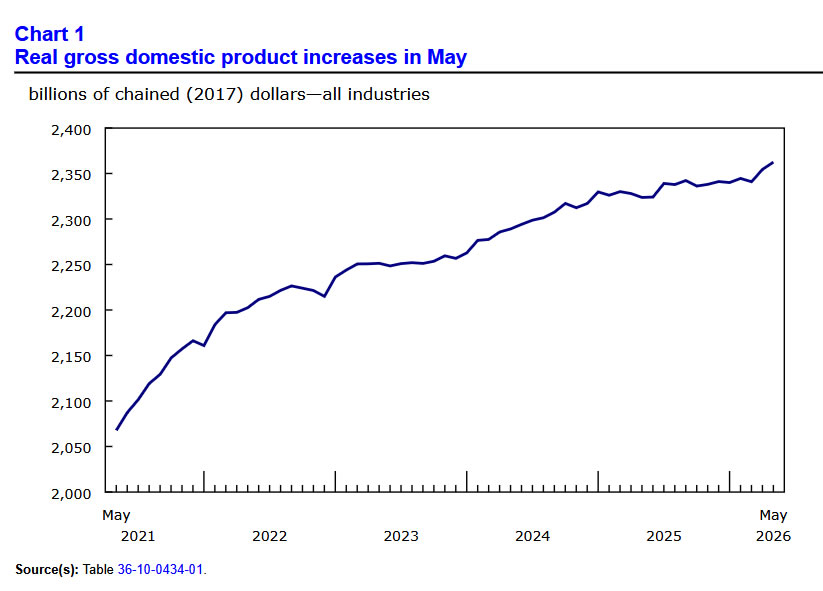
- Canadian GDP rose by 0.3% month-on-month (m/m) in May, two ticks higher than Statistics Canada's advanced guidance.
- Growth was broad-based with 13 of 20 industries registering an increase on the month. Goods industries rose for a second straight month (+0.6% m/m), while the services sector grew by 0.2% m/m.
- Outside of agriculture (-0.9% m/m), goods producing industries were up across the board, led by a 1.0% m/m increase in the mining, oil & gas sector. Solid gains in construction (0.8% m/m) and utilities (0.7% m/m) provided an assist.
- On the services side, the public sector aggregate expanded 0.3% m/m, led by an advance in public administration. The real estate sector continues to gain steam (+0.4% m/m) while transportation and warehousing also jumped by 0.3% m/m. Canada's services side of the economy has now grown for four consecutive months.
- Advanced guidance for June points to another gain of 0.2% m/m gain. A lift in the finance/insurance/real estate and wholesale/retail sector is expected to be partially offset by a drag in utilities.
Key Implications
- This was a solid print coming off the heels of April's strong rebound. May's GDP gain reinforces confidence in the Bank of Canada's view that growth resumed in the second quarter, with real GDP tracking around 3.0% annualized, slightly ahead of the Bank's most recent forecast. It's increasingly looking like the stalling of growth in the first quarter was more reflective of temporary drags and volatility rather than a meaningful deterioration in underlying activity.
- For the Bank of Canada, this keeps the policy narrative largely unchanged. Growth is proving resilient enough to forego additional rate relief, while contained inflation readings, lingering labour market slack and ongoing trade uncertainty argue against a shift toward a more restrictive stance. As such, today's report is consistent with our expectation that the Bank has cover to remain on the sidelines for the remainder of the year. Growth will likely take a breather come the third quarter as temporary factors related to Census hiring and World Cup activities unwind.
Canada GDP Beats Expectations, June Estimate Points to Strong Q2 Growth
Canada's economy expanded 0.3% month-over-month in May, beating expectations of 0.2% and marking a second consecutive monthly increase. Growth was broad-based, with 13 of 20 industrial sectors posting gains as both goods-producing and services-producing industries contributed to the expansion. Statistics Canada also estimated that real GDP rose a further 0.2% in June, pointing to annualized growth of 0.8% for the second quarter based on industry data.
The goods-producing sector led the way with a 0.6% increase in May, supported by widespread gains across most industries. Mining, quarrying and oil and gas extraction advanced 1.0%, extending April's recovery as two of its three subsectors posted a second straight monthly increase. Manufacturing also grew 0.3%, with most subsectors expanding during the month. On the services side, output rose 0.2%, driven primarily by gains in real estate and rental and leasing as well as public administration. Real estate activity increased 0.4%, with all subsectors contributing to the advance.
The latest figures suggest the Canadian economy maintained solid momentum through the second quarter despite an uncertain external backdrop. The advance estimate for June indicates growth remained supported by wholesale trade, finance and insurance, and retail trade, although weaker utilities and agriculture partially offset those gains. With domestic activity continuing to broaden across both goods and services sectors, the data point to an economy that has proved more resilient than expected heading into the second half of the year.
Economic Data Summary
| Indicator | Actual | Expected | Previous |
|---|---|---|---|
| GDP M/M (May) | 0.3% | 0.2% | 0.5% |
| GDP M/M (June Advance) | 0.2% | — | — |
| Q2 2026 GDP (Industry-Based Estimate) | 0.8% | — | — |
Sector Breakdown
| Component | Current | Trend |
|---|---|---|
| Goods-producing industries | 0.6% | ↑ Broad-based growth |
| Services-producing industries | 0.2% | ↑ Continued expansion |
| Mining, quarrying & oil and gas | 1.0% | ↑ Second consecutive gain |
| Manufacturing | 0.3% | ↑ Majority of subsectors higher |
| Real estate & rental and leasing | 0.4% | ↑ Broad-based gains |
Key Takeaways
- Canada's economy outperformed expectations in May. Real GDP rose 0.3% month-over-month, beating the 0.2% consensus forecast and marking a second consecutive monthly increase.
- Growth was broad-based. Thirteen of twenty industrial sectors expanded, with both goods-producing and services-producing industries contributing to the overall gain.
- Goods production led the expansion. Goods-producing industries grew 0.6%, supported by stronger mining, oil and gas extraction, and manufacturing output.
- Mining and energy remained key drivers. The mining, quarrying and oil and gas extraction sector increased 1.0%, posting a second straight monthly gain.
- Services continued to provide support. Services-producing industries rose 0.2%, led by real estate and rental and leasing (0.4%) together with public administration.
- June appears to have maintained the momentum. Statistics Canada's advance estimate points to another 0.2% increase in June, driven by wholesale trade, finance and insurance, and retail trade.
- Second-quarter growth looks solid. Based on May data and the June advance estimate, real GDP by industry is on track to have expanded 0.8% in Q2, suggesting the Canadian economy entered the second half of the year with steady momentum.