

Sample Category Title
EUR/USD: Busy Week Ahead
EUR/USD begins the week around 1.1540. Following a volatile week, market attention has shifted from the Federal Reserve meeting to US economic data. Investors will assess whether incoming figures reinforce the case for a September rate hike or, conversely, point to a cooling of the US economy.
Monday brings business activity indices from China and the US. The US ISM Manufacturing PMI is expected at approximately 53.0, down from 53.3 previously. Holding firmly above 50 would support the dollar, while a more pronounced slowdown would raise doubts about economic resilience and provide support for EUR/USD. On Tuesday, attention turns to JOLTS job openings, with forecasts pointing to a decline to 7.3 million from 7.594 million.
Wednesday’s highlight is the ISM Services PMI, expected to rise to 55 from 54. A strong reading would support the dollar, as services remain a key component of the US economy and an important source of inflationary pressure. Thursday’s calendar is relatively quiet, leaving the pair to consolidate ahead of Friday’s key releases.
On Friday, Germany will release foreign trade data, with the surplus expected to narrow to €11.2 billion from €19.1 billion. The main event, however, will be the US labour market report. Non-farm payrolls are forecast to rise by 79,000, up from 57,000, while unemployment is expected to hold steady at 4.2%. A stronger reading would reinforce expectations of a Fed rate hike and weigh on EUR/USD, while weak job growth or rising unemployment would support the euro.
Technical Analysis
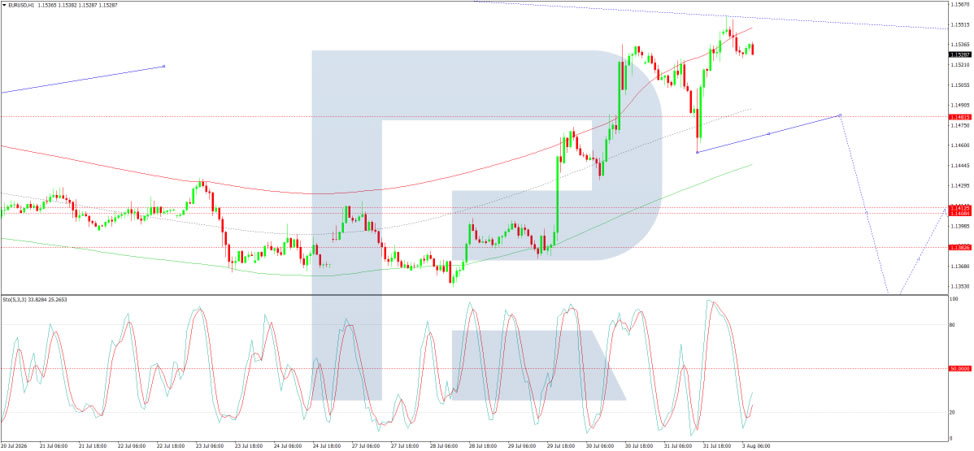
On the H4 chart of EUR/USD, the market has formed a consolidation range around the 1.1533 level, currently extending between 1.1524 and 1.1538. This range is nearing completion. An upside breakout would suggest a corrective move towards 1.1556, followed by a decline to 1.1480. A direct downside breakout would open the way for a move to 1.1400. The MACD indicator supports this scenario, with its signal line above zero but pointing downwards, reflecting weakening upward momentum.
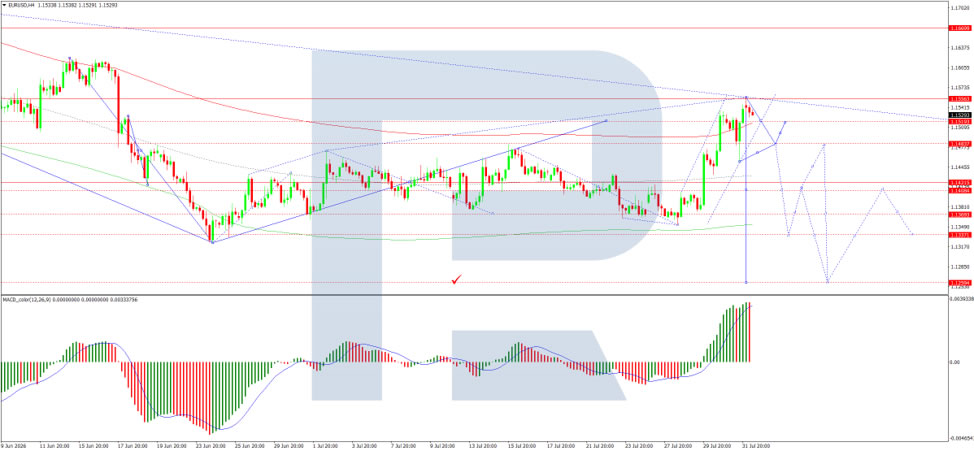
On the H1 chart, the market has completed an upward move to the 1.1556 level. A consolidation range is currently forming below this level. Today, a move lower towards 1.1480 is expected, followed by a move higher to 1.1518, and then a continuation of the downward move to 1.1400, with scope for the trend to extend to 1.1330. The Stochastic oscillator confirms this scenario, with its signal line below 80 and pointing downwards towards 20, indicating increasing short-term downside pressure.
Conclusion
EUR/USD begins a data-heavy week with markets focused on US economic indicators following the Fed’s policy decision. The ISM manufacturing and services PMIs, JOLTS job openings, and Friday’s labour market report will be crucial in shaping expectations for a potential September rate hike. A strong set of data would support the dollar, while weaker readings could support the euro. Technically, the pair appears to be consolidating around 1.1533, with a potential corrective move towards 1.1556 before resuming its broader bearish trajectory towards 1.1400 and possibly 1.1330. The week’s data releases will be the key catalysts for direction.
Disclaimer
Any forecasts contained herein are based on the author's particular opinion. This analysis may not be treated as trading advice. RoboForex bears no responsibility for trading results based on trading recommendations and reviews contained herein.
Why Gold Ignores Oil, Yields and Dollar—And What Could Finally Break the Range
TL;DR: Gold has barely moved despite dramatic swings in oil, Treasury yields, and the Dollar over the past month — because the Fed's abandonment of forward guidance and a widening gap between geopolitical rhetoric and physical Hormuz supply data have raised the bar for what counts as a genuine catalyst.
A Range That Refuses to Break
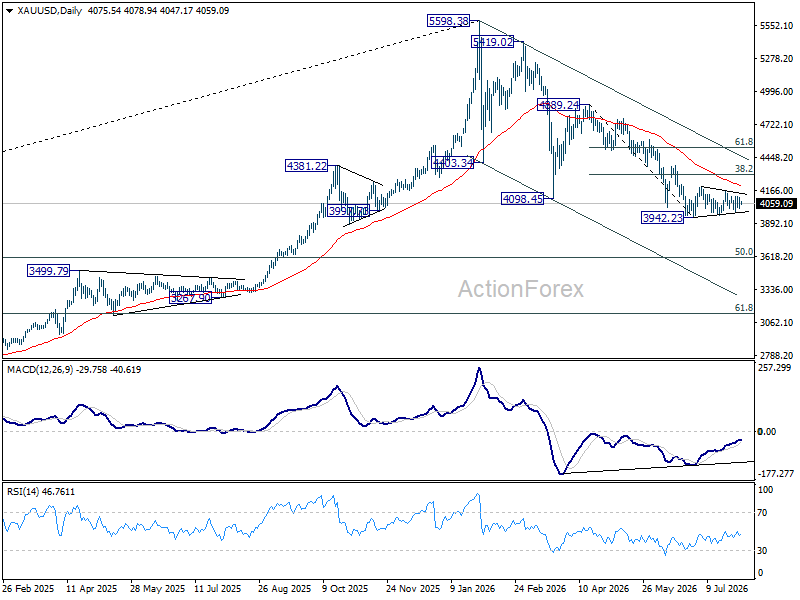
Gold traders enter another pivotal week expecting a familiar set of catalysts to finally break the precious metal out of the 3,942–4,202 range that has contained prices since late June. ISM surveys, Friday's non-farm payrolls, and the latest developments surrounding the Strait of Hormuz would normally be more than enough to generate a decisive move. Yet there's a growing risk that those waiting for a breakout are looking in the wrong places.
Gold's Striking Lack of Sensitivity
Over the past month, Gold has shown a striking lack of sensitivity to the very markets that usually drive it:
- Brent crude surged from around $70 on July 12 to as high as $102 on July 23, before plunging back to $80 and rebounding again.
- The US 10-year Treasury yield climbed from 4.36% in late June to above 4.74% last week.
- The Dollar Index fell from above 101 to as low as 99.4.
Under normal circumstances, such dramatic swings in energy prices, yields, and the Dollar would have triggered a clear directional move in Gold. Instead, the metal barely left its established trading range.
Why Warsh's Fed Changed the Reaction Function
The explanation may lie less in Gold itself than in the way markets now process information. Since Kevin Warsh became Federal Reserve Chair, the Fed has largely abandoned the explicit forward guidance that previously helped investors translate incoming economic data into a reasonably predictable policy path. Instead of signaling where interest rates were likely to head, Warsh has repeatedly stressed flexibility and a willingness to let incoming evidence speak for itself.
That shift has fundamentally changed the market's reaction function. Before Warsh, a stronger-than-expected payrolls report or ISM survey could meaningfully alter expectations for the next FOMC meeting, because investors had a relatively clear policy framework against which to judge the data.
Today, markets already assign roughly a 64% probability to a September rate hike. Ordinary economic surprises may shift those probabilities slightly, but without an explicit policy commitment from the Fed, those adjustments often fail to produce sustained moves in Treasury yields, the Dollar, or Gold. Only data strong or weak enough to force policymakers themselves to abandon the current wait-and-see approach are likely to generate a lasting repricing.
Why Hormuz Headlines Aren't Moving Gold Either
A similar process appears to be unfolding in the Middle East. Throughout this cycle, markets have been confronted with repeated headlines suggesting progress toward reopening the Strait of Hormuz or de-escalating tensions, often accompanied by optimistic statements from Washington. Yet those announcements have rarely been matched by equivalent confirmation from Tehran, or by clear evidence that oil flows have materially changed. The gap between political messaging and physical developments has become a recurring feature rather than an exception.
As a result, Gold barely reacted to the informal pause in hostilities, repeated claims a deal was close, or successive statements hinting at improving conditions — because traders have learned that announcement-level optimism doesn't necessarily translate into changes in physical supply. What would matter far more is independently verifiable evidence that Hormuz has genuinely reopened to normal shipping, or conversely, confirmation of sustained disruption to tanker traffic. Those outcomes would have direct implications for oil prices, inflation expectations, and central bank policy — making them far more meaningful for Gold than another round of competing political statements.
The Threshold for a Catalyst Has Risen, Not Disappeared
Taken together, these shifts suggest Gold isn't short of potential catalysts. Rather, the threshold for what constitutes a meaningful catalyst has risen. Ordinary US economic data may not be sufficient unless it fundamentally alters expectations for Fed policy, while ordinary geopolitical headlines have become less influential unless backed by observable changes in energy markets. In both cases, markets are demanding confirmation rather than inference.
ActionForex's Technical View on Gold
The technical picture tells much the same story. Gold remains trapped within the medium-term falling channel from the 5,598.38 peak and continues to trade comfortably below the falling 55-day EMA, now around 4,213. While the daily MACD has developed bullish divergence, indicating downside momentum is fading, loss of momentum alone isn't evidence of a trend reversal.
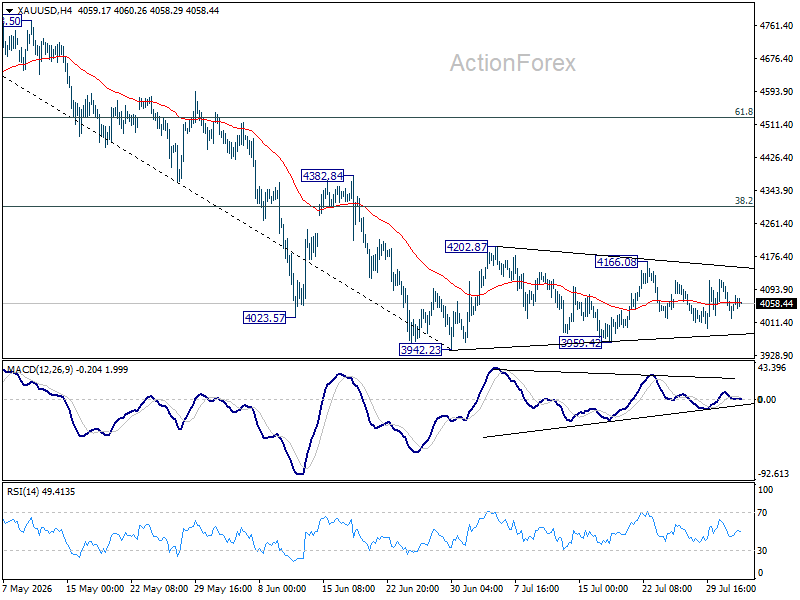
The consolidation above 3,942.23 could certainly extend, but any rebound is likely to encounter significant resistance around the 55-day EMA unless a genuinely new macro catalyst emerges.
What It Would Take to Finally Break the Range
For now, both bulls and bears may need patience. Gold isn't reacting automatically to higher oil prices, a lower Dollar, or routine shifts in Treasury yields. It's waiting for information capable of breaking the market's current base case — either a Fed forced into a clear policy commitment by truly exceptional economic data, or a physically confirmed change in conditions around Hormuz that reshapes the inflation outlook. Until one of those occurs, Gold's prolonged consolidation may have further to run.
Key Takeaways
- Gold has stayed within its 3,942-4,202 range despite Brent swinging from $70 to $102, the 10-year yield rising from 4.36% to 4.74%, and the Dollar Index falling from 101 to 99.4.
- Warsh's abandonment of Fed forward guidance means ordinary economic data no longer reliably shifts rate expectations, muting Gold's usual sensitivity to yields and the Dollar.
- Markets have learned that geopolitical optimism around Hormuz rarely matches physical supply confirmation, reducing Gold's reaction to political headlines alone.
- The bar for a genuine catalyst has risen: only data forcing a clear Fed policy shift, or verified physical change in Hormuz shipping, is likely to break Gold's range.
- Gold remains capped below the falling 55-day EMA near 4,213, with bullish MACD divergence suggesting fading downside momentum but not yet a confirmed reversal.
UK PMI Manufacturing at Four Month Low, but Faster Output Growth Points to Resilient Recovery
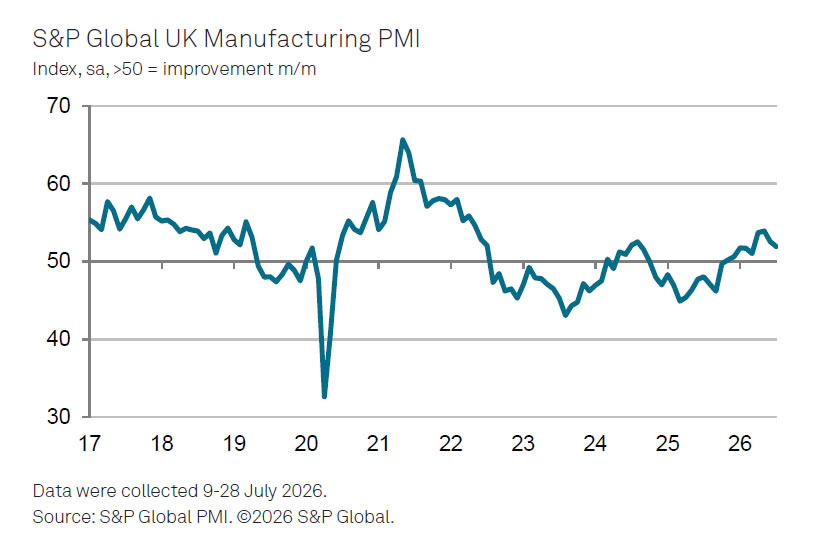
The UK's manufacturing sector lost some momentum in July, with the final S&P Global Manufacturing PMI easing to 51.9 from 52.5 in June, its lowest level in four months. Even so, the index remained above the 50 threshold for a ninth consecutive month, indicating that the sector continues to expand despite a moderation in the pace of improvement.
The details of the survey painted a more encouraging picture than the headline suggested. Manufacturing output rose for a fourth straight month, with production growth accelerating to its fastest pace in nearly two years as stronger market conditions boosted new orders and export demand. Four of the five PMI components remained consistent with improving operating conditions, while the decline in the headline index mainly reflected a sharp reduction in stocks of purchases, slower hiring and a smaller deterioration in supplier delivery times. Growth, however, remained uneven, with medium and large manufacturers outperforming smaller firms, where production declined modestly.
S&P Global also pointed to improving supply and cost conditions. Input cost inflation slowed to a five-month low as supply-chain delays eased to their weakest level since the outbreak of the Middle East conflict, offering manufacturers some relief after months of disruption. Although hiring growth nearly stalled, the first increase in backlogs of work in more than four years suggests labor demand could strengthen if new orders continue to improve. Still, business confidence remained subdued, with geopolitical developments, global trade tensions and the new UK government's industrial and tax policies likely to shape the outlook in the months ahead.
Economic Data
| Indicator | Actual | Previous |
|---|---|---|
| Manufacturing PMI | 51.9 | 52.5 |
| Manufacturing Output | Near 2-year high | Expanded |
| New Orders | Expanded | Expanded |
| New Export Orders | Accelerated | Expanded |
| Employment | Increased | Increased |
| Input Cost Inflation | 5-month low | Higher |
Market Takeaways
- Manufacturing PMI eased from 52.5 to 51.9, a four-month low, but remained above the 50 threshold for a ninth consecutive month, signalling continued expansion.
- Factory output accelerated to its fastest pace in almost two years, supported by stronger domestic and export demand.
- The softer headline PMI largely reflected lower stocks of purchases, slower hiring and a smaller deterioration in supplier delivery times rather than weaker demand.
- Input cost inflation slowed to a five-month low, while supply-chain delays eased to their lowest since the outbreak of the Middle East conflict, providing relief for manufacturers.
- Employment growth nearly stalled despite stronger production, although the first increase in backlogs of work in more than four years suggests hiring could improve if demand remains firm.
- The recovery remained uneven, with medium and large manufacturers outperforming smaller firms, where production continued to decline modestly.
Brent Analysis: Oil Retreats from $100 as Saudi Arabia Proposes Maritime Coalition Initiative
On 23 July 2026, Brent crude rose above $100 amid reports of attacks on tankers and infrastructure in the Red Sea area, as well as strong statements from Donald Trump towards Iran over threats to shipping security through the Strait of Hormuz. The move proved short-lived: on 30 July, Saudi Arabia proposed creating a maritime coalition to protect key shipping routes amid the ongoing confrontation between the US and Iran. According to CNBC data from 31 July, tanker traffic through the Strait of Hormuz partially resumed, although the Islamic Revolutionary Guard Corps claimed attacks on vessels under US escort — claims that have not been confirmed by Western maritime authorities.
Technical Analysis of Brent Crude Oil
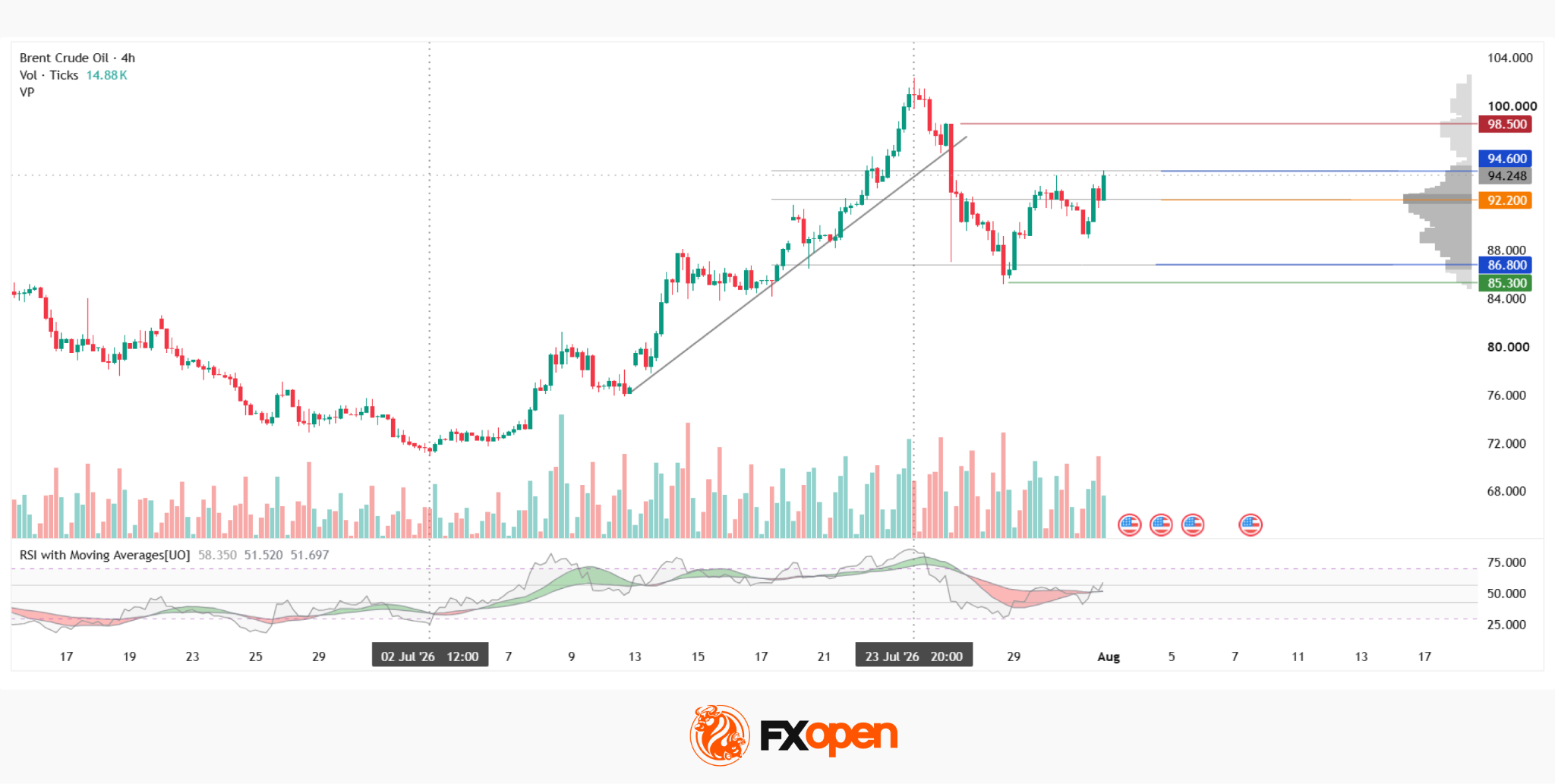
On the four-hour XBRUSD chart, the asset formed a short-term trend from the beginning of July, moving from around $71 towards the $102 area. The trendline was then broken, after which the current market profile was formed, within which the price is currently trading. The asset is now positioned between the POC (Point of Control) zone at $92.20 and the upper boundary of the profile at $94.60. A breakout above this boundary could open the way towards the red resistance level at $98.50.
If the price moves below the POC zone, the next area of interest would be the cluster of two important levels: the lower profile boundary at $86.80 and the green support level at $85.30. The RSI + MAs indicator shows readings of 58, 51 and 51, with all oscillator values returning to the neutral zone after a period of elevated volatility. Trading volume remains relatively high, confirming continued market interest from participants.
Summary
Saudi Arabia’s initiative to create a maritime coalition could gradually reduce the geopolitical risk premium priced into oil if diplomatic efforts continue to make progress. However, unconfirmed reports of incidents in the Strait of Hormuz continue to leave room for increased volatility. The neutral positioning of the RSI + MAs indicators currently suggests that there is no clear directional momentum.
Start trading commodity CFDs with tight spreads (additional fees may apply). Open your trading account now or learn more about trading commodity CFDs with FXOpen.
This article represents the opinion of the Companies operating under the FXOpen brand only. It is not to be construed as an offer, solicitation, or recommendation with respect to products and services provided by the Companies operating under the FXOpen brand, nor is it to be considered financial advice.
Eurozone PMI Manufacturing At Three-Month High, but Recovery Still Lacks Fresh Demand
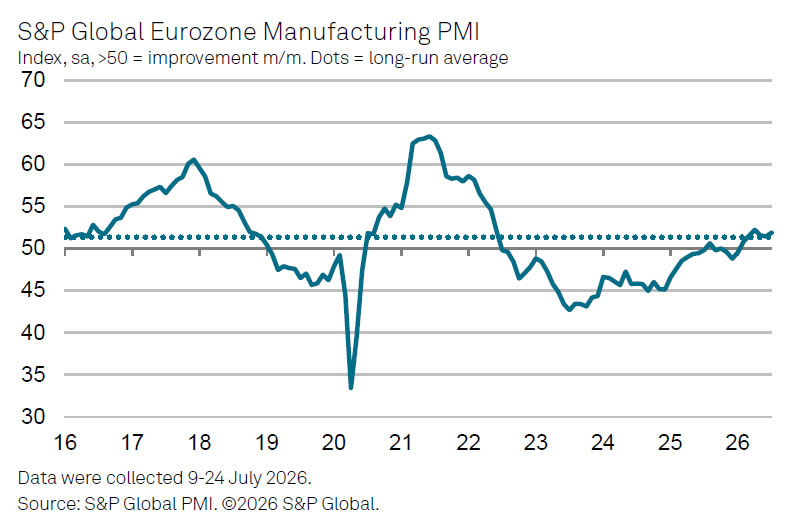
Eurozone manufacturing extended its recovery in July, with the final S&P Global Manufacturing PMI rising to 51.9 from 51.4 in June, marking a three-month high and the strongest improvement in factory conditions since April. Factory output was an even brighter spot, with the Output Index jumping to 52.9 from 51.7, its highest level in 52 months, suggesting production continued to accelerate at the start of the third quarter.
Beneath the headline strength, however, the survey painted a less convincing picture of demand. Output growth was supported largely by manufacturers working through existing order backlogs rather than a meaningful pickup in new business. While new orders continued to increase, the pace remained sluggish, prompting firms to rely on orders secured in previous months to keep production lines running. At the same time, manufacturers continued to trim headcounts, reflecting concerns that current demand may not be sufficient to sustain production once existing backlogs are exhausted.
The recovery also remained highly uneven across the region. Germany led the way with one of its strongest PMI readings in more than four years, while Italy stayed in expansion despite losing some momentum. By contrast, manufacturing activity in France and Spain was broadly stagnant, underscoring the uneven nature of the region's industrial recovery. According to S&P Global's Chris Williamson, several economies continue to struggle with weak demand, elevated prices and lingering supply constraints despite recent improvements.
The survey also suggested that geopolitical risks remain an important headwind. Although supply bottlenecks and energy-related cost pressures eased somewhat in July, tensions in the Middle East continued to keep supply chains under strain and energy prices elevated. With new orders still growing only modestly, the durability of the current recovery will depend on whether demand strengthens enough to replace the backlog-driven boost to production. Until then, the impressive rise in output may prove stronger than the underlying health of the manufacturing sector.
Economic Data
| Indicator | Actual | Previous |
|---|---|---|
| Eurozone Manufacturing PMI | 51.9 | 51.4 |
| Eurozone Output Index | 52.9 | 51.7 |
Market Takeaways
- Eurozone Manufacturing PMI rose from 51.4 to 51.9, reaching a three-month high and signalling the strongest improvement in factory conditions since April.
- The Output Index jumped from 51.7 to 52.9, its highest level in 52 months, pointing to a sharp acceleration in manufacturing production.
- Production growth continued to outpace demand, with manufacturers relying on existing order backlogs as new orders increased only modestly.
- Germany remained the region's manufacturing leader, while Italy stayed in expansion despite slowing. France and Spain were broadly stagnant, highlighting an uneven regional recovery.
- Manufacturers continued to reduce employment, reflecting concerns that current production may not be sustainable without a stronger pickup in new business.
- Although supply bottlenecks and energy-related cost pressures eased slightly, Middle East tensions continued to keep supply chains under strain and inflationary pressures elevated, posing risks to the durability of the recovery.
Swiss CPI Slips to 0.4% in July on Lower Fuel and Airfare Costs
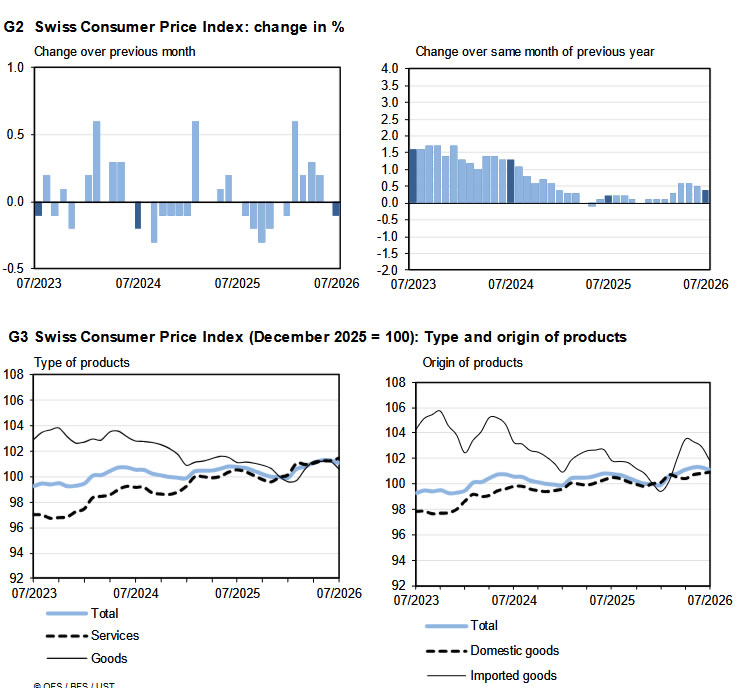
Switzerland's CPI fell -0.1% mom in July, pulling annual inflation down to 0.4% from 0.5% in June, according to the Federal Statistical Office. The decline was largely driven by lower prices for air transport, diesel and petrol, while seasonal discounts also pushed clothing and footwear prices lower. Despite the softer headline reading, inflation remained positive on an annual basis, extending Switzerland's low-inflation environment.
The broader breakdown suggests price pressures eased mainly through imported goods rather than domestic demand. Imported product prices fell -1.1% mom on the month, a much steeper decline than June's -0.4% fall, leaving annual imported inflation at 0.0% yoy. By contrast, domestic product prices rose 0.1% mom on the month and held steady at 0.5% yoy, while core inflation remained unchanged at 0.3% yoy despite a -0.1% mom decline.
Not all price categories weakened during the month. The FSO said prices for other parahotel accommodation, heating oil, car rental and car sharing all increased, partially offsetting declines elsewhere. Overall, the July report reinforces the picture of subdued inflation in Switzerland, with lower energy and transport costs continuing to suppress headline inflation even as domestic price pressures remain relatively stable.
Economic Data
| Indicator | Actual | Previous |
|---|---|---|
| CPI (m/m) | -0.1% | 0.0% |
| CPI (y/y) | +0.4% | +0.5% |
| Core Inflation (m/m) | -0.1% | 0.0% |
| Core Inflation (y/y) | +0.3% | +0.3% |
| Domestic Products (m/m) | +0.1% | +0.1% |
| Domestic Products (y/y) | +0.5% | +0.5% |
| Imported Products (m/m) | -1.1% | -0.4% |
| Imported Products (y/y) | 0.0% | +0.2% |
Market Takeaways
- Headline CPI eased from +0.5% y/y to +0.4% y/y, while consumer prices fell 0.1% m/m, reflecting another month of subdued inflation.
- Lower airfares, diesel, petrol, and seasonal discounts on clothing and footwear were the main drivers of the monthly decline.
- Core inflation held steady at +0.3% y/y, suggesting underlying inflation pressures remained contained despite the softer monthly reading.
- Domestic inflation remained stable at +0.5% y/y, indicating price pressures generated within the Swiss economy have changed little.
- Imported prices were the main source of disinflation, falling 1.1% m/m and leaving annual imported inflation at 0.0%, highlighting the continued influence of lower energy and other imported costs.
- Higher prices for other parahotel accommodation, heating oil, car rental and car sharing only partly offset the broader decline in consumer prices.
Oil Lower After Trump Says Iran Talks Will Resume
Oil Lower After Trump Says Iran Talks Will Resume
In focus today
In the US, ISM manufacturing index will be released for July. In the euro area, focus will be on the final July manufacturing PMIs, followed by the final services PMIs on Wednesday. Markets will also be eying developments between the US-Iran as negotiations are set to continue over today.
For the remainder of the week the most important releases will be the Swedish inflation prints on Thursday, and the US July Jobs Report out on Friday. We forecast NFP at +70k and unemployment rate steady at 4.2%, near consensus.
Economic and market news
What happened overnight
In the US-Iran war, Trump confirmed on Sunday that negotiations with Iran would resume on Monday after calling off what he described as the "biggest attack since World War II" at the request of Gulf allies. He declined to set a deadline or disclose the location and participants. Oil prices fell sharply on signs of de-escalation, with Brent crude trading just below USD84/bbl this morning after closing around USD90/bbl on Friday.
In China, the private RatingDog manufacturing PMI eased to a four-month low of 50.9 overnight (cons: 51.5, June: 51.7), as output and new orders grew more slowly. New export orders returned to growth for the first time in three months, while employment rose at its fastest pace since August 2023. The soft print adds to Friday's official NBS manufacturing PMI, which unexpectedly slipped into contraction at 49.2 (June: 50.3), reinforcing concerns over slowing growth and weak domestic demand.
What happened over the weekend
In commodities, OPEC+ approved an oil production quota increase of around 188,000 barrels per day from September, completing the rollback of a 1.65 million barrels per day cut from 2023. Despite successive monthly hikes over most of the year, market impact has been limited due to export disruptions caused by the Iran and Ukraine wars.
In the euro area, inflation came in slightly higher in July, consistent with consensus expectations. Headline inflation increased to 2.9% y/y (cons: 2.9%, prior: 2.8%), while core inflation rose to 2.5% y/y (cons: 2.4%, prior: 2.4%). The upside surprise in core seems to have been driven in part by accommodation prices in France, which should prove temporary. Moreover, the low s.a. m/m inflation print in May and June mechanically makes the July reading somewhat stronger. Coupled with selling price expectations having declined to below their March level, it remains hard to trace any contagion effects on broader price pressures.
In the US, the Q2 Employment Cost Index for wages and salaries grew slightly more than expected (0.9% q/q, cons: 0.8%), though the reading had little impact on markets. This was also the case for comments from the three hawkish dissenters at last week's FOMC meeting (Logan, Hammack and Kashkari), who all underscored the risk of a persistent inflation overshoot if policy is not tightened further. Over the weekend, non-voter Barkin described the decision to hike as a "close call", while Chair Warsh is reportedly planning to propose reducing the annual number of FOMC meetings from eight to four.
In Norway, the July NAV labour market report revealed net unemployment rising to 2.1% s.a., matching Norges Bank's June forecast. The release underpins continued labour market loosening, with gross unemployment rising modestly since February and new vacancies ticking lower, suggesting somewhat lower labour demand.
In Japan, policy rates were left unchanged at 1.00%, as widely expected with an 8-1 vote. The Bank of Japan (BoJ) highlighted its intention to "continue to raise the policy interest rate and adjust the degree of monetary accommodation". The new outlook report is broadly unchanged. The BoJ flagged the Middle East, the yen and global AI-related demand as key risks, while seeing overall growth risks as balanced. Compared to the recent outlook in April, the board continues to see the risk to inflation clearly on the upside in the short term. We pencil in the next rate hike from the BoJ in Q4 followed by another one in Q2 2027.
USD/JPY extended its sharp decline on Friday after Japan and the US Treasury jointly intervened to support the yen, as confirmed by Japan's Ministry of Finance on Monday. The move marked the first co-ordinated yen-support intervention in nearly 30 years, with officials signalling readiness to act again if needed.
In China, July official NBS PMIs were broadly weaker than expected. Manufacturing fell to 49.2 (prior: 50.3), while non-manufacturing dropped to 49.0 (prior: 50.2). Concerningly, both indices were dragged lower by demand indicators. Alongside weak Q2 GDP and cooling credit growth, the leading data supports the case for further stimulus. Last week's Politburo meeting did however not signal a new policy "bazooka", instead pointing to continued targeted support, as expected. If anything, planned fiscal stimulus could be accelerated to support growth back to target during H2.
Equities: Equity indices have been broadly unchanged over the summer, but beneath the surface the rotations have been substantial. Higher oil prices naturally supported energy stocks, but equally important has been another significant rotation within the technology sector.
Unlike earlier this year, software has materially outperformed while semiconductors have lagged. This has not reflected disappointing earnings. Instead, investor attention has again centred around the uncertainty surrounding the longer-term AI capital expenditure cycle.
Regional equity performance has mirrored these sector dynamics. Emerging Markets have underperformed while Norway has benefited from higher energy prices. Interestingly, both Europe and Sweden have delivered relative outperformance throughout the geopolitical escalation, a notable contrast to previous episodes earlier this year.
This morning sentiment is improving once again as lower oil prices support risk appetite. South Korea is the notable exception with equities down around 6%, while both US and European futures indicate another opening close to fresh all-time highs.
FI and FX: US President Trump said talks on a deal with Iran would continue today and Brent Crude declined below USD84/bbl. Broad USD weakness continued at the end of last week, with the DXY index hitting its lowest level since mid-June. Yield curves steepened and EUR/USD traded above 1.15 as uncertainty rises about the FOMC's policy direction. Overnight, USD/JPY declined below 157 following remarks by Japan's currency chief Mimura that further joint intervention remains firmly on the table and will continue without hesitation if required. In Scandies, the combination of a weaker USD and still a higher than 50% likelihood of a Norges Bank hike in August could extend the tactical rally in NOK FX from July. Last week brought several encouraging indicators from the economy in Sweden, supporting our view of decent activity and GDP growth above 2% in 2026. This week's data focus will be on the US July Jobs Report on Friday, we forecast NFP at +70k and unemployment rate steady at 4.2%, near consensus.
Why Japan and US Confirm Intervention So Fast? Can USD/JPY Hold 155?
TL;DR: Washington and Tokyo abandoned decades of deliberate ambiguity by confirming their coordinated Yen intervention within hours, turning the confirmation itself into forward guidance for USD/JPY — and this week's battle to hold 155 will test whether that credibility strategy can work.
An Unusually Fast Confirmation
USD/JPY extended last week's intervention-driven decline on Monday after both Washington and Tokyo took the highly unusual step of publicly confirming their coordinated yen-buying operation within hours of one another. The pair briefly tested the key 155 support area before recovering, suggesting traders are now weighing not only the intervention itself, but what the unprecedented communication strategy says about the authorities' intentions.
The intervention was already remarkable as the first coordinated US-Japan currency operation since 2011. Yet the bigger surprise may have come afterward. Japan's Ministry of Finance has traditionally refused to confirm intervention for days or even weeks, using uncertainty itself as a policy tool. This time, however, US President Donald Trump, Treasury Secretary Scott Bessent, and Japan's Finance Minister Satsuki Katayama all moved quickly to acknowledge the operation before Asia trading gathered momentum — raising the question of whether they were merely confirming what happened, or deliberately shaping market behavior ahead of a week packed with US data.
Why Fast Confirmation Matters More Than the Intervention Itself
Currency intervention has traditionally been as much about psychology as the actual buying or selling of currencies. For decades, Japan's Ministry of Finance deliberately cultivated uncertainty by refusing to confirm whether it had intervened, sometimes leaving markets guessing for weeks. That ambiguity forced traders to consider the possibility of further official action at any moment, raising the cost of rebuilding speculative positions against the Yen.
Last week's operation broke sharply with that playbook. Trump first revealed on Sunday that Japan had sought assistance, saying "they have a weakening yen, and they wanted a little bit of help. And we're always there for Japan." Bessent followed shortly afterward with the formal US Treasury confirmation on X, before Katayama provided Tokyo's definitive confirmation Monday morning. For the first coordinated US-Japan currency intervention since 2011, the speed and clarity of those statements were highly unusual.
That sequence suggests the communication strategy itself was part of the policy response. Rather than preserving uncertainty, Washington and Tokyo appeared intent on eliminating any doubt they had acted together and were prepared to do so again if necessary. A government seeking to reinforce the credibility of future intervention has little incentive to leave markets debating whether the first intervention even occurred.
Why the Timing May Matter Even More Than the Speed
Had officials waited several days or weeks, as Japan has often done in the past, markets would have entered Monday's Asian session debating whether intervention had actually taken place and whether authorities were willing to act again. That uncertainty could have encouraged investors to rebuild Yen-funded carry trades quickly, particularly if they believed the operation was a one-off rather than the start of a more active intervention strategy.
Instead, Washington and Tokyo effectively closed that window before it opened. By confirming the coordinated operation ahead of the week's first full trading session, policymakers ensured traders started pricing not only last week's intervention, but the possibility of another one — reinforced before markets turned to a packed top-tier US data calendar, including ISM surveys, JOLTS job openings, ADP employment, and Friday's non-farm payrolls.
That sequencing is unlikely to be coincidental. A string of stronger-than-expected US data could quickly revive expectations that the Fed will keep policy restrictive for longer, widening yield differentials in favor of the Dollar and renewing upward pressure on USD/JPY. By establishing the credibility of their intervention before those catalysts arrive, US and Japanese officials may have sought to influence market positioning in advance, rather than being forced to respond after another rapid climb toward 160. Viewed this way, the confirmation functioned as a form of forward guidance for the foreign exchange market.
What the Market Is Actually Pricing Now
Despite Monday's renewed selloff, price action suggests investors are not yet pricing an official campaign to drive USD/JPY significantly lower. The pair briefly tested the 155 support area before recovering, indicating buyers are still willing to step in around a level that also carries considerable technical significance. That rebound is consistent with the view that the intervention was aimed at preventing another disorderly surge above 160, rather than reversing the broader Dollar-Yen trend altogether.
That distinction matters because intervention can pursue different objectives — defending a specific exchange rate, smoothing excessive volatility, or discouraging speculative momentum. The events of the past few days point more toward the latter. For now, the base case is that both governments are trying to reshape market behavior rather than establish a new exchange-rate target below 155, effectively creating an unofficial trading range between roughly 155 and 160.
That interpretation isn't beyond challenge, however. If USD/JPY breaks decisively below 155 and officials continue or intensify their intervention rhetoric, markets would have to consider that policymakers are seeking a materially stronger Yen rather than merely limiting excessive weakness — a significant escalation from the current strategy.
What Would Confirm — or Invalidate — This Interpretation
The key question isn't whether USD/JPY rebounds — that would be natural if US data continues supporting higher Treasury yields — but whether the pair can do so without quickly returning to the 160 area that prompted official action.
A stronger-than-expected run of US data would offer the first meaningful challenge. ISM surveys, JOLTS job openings, ADP employment, weekly jobless claims, and Friday's non-farm payrolls all have the potential to reinforce expectations the Fed will keep policy restrictive for longer. If the pair nevertheless remains comfortably below 160, it would suggest the authorities' communication strategy is succeeding in changing market behavior independently of interest-rate expectations.
Conversely, a rapid recovery toward the 160–163 area over the next two or three weeks would weaken the credibility argument considerably. Markets would likely conclude the swift confirmation was little more than a more public version of previous intervention episodes — effective at generating an initial correction, but ultimately unable to alter the broader incentives driving capital flows.
ActionForex's Technical View on USD/JPY
The technical picture reinforces the broader macro narrative. USD/JPY's decline from 163.97 is still viewed as a correction within the larger uptrend that began at 139.87, rather than the start of a structural reversal. Current focus is on the 155.01 support zone, which closely aligns with the 38.2% retracement of 139.87 to 163.97, at 154.76. This cluster has already attracted buying interest, with the pair rebounding after briefly testing the area Monday.
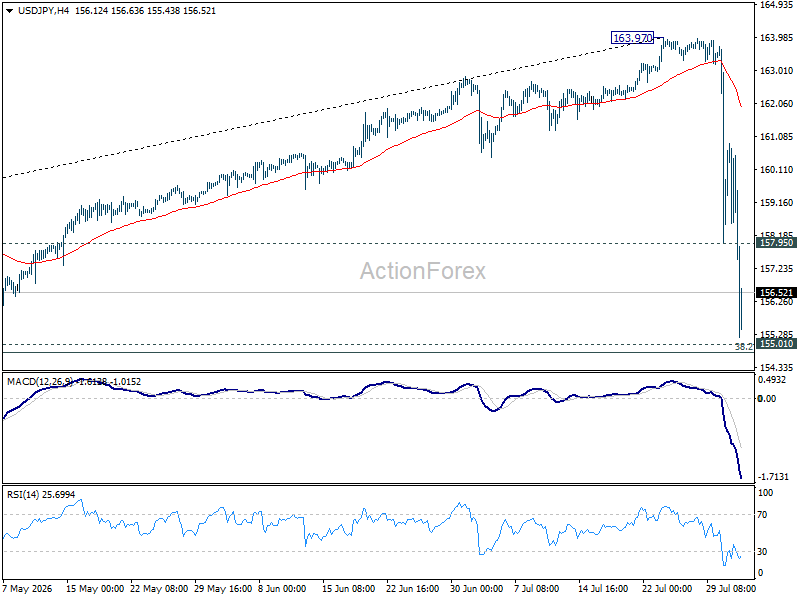
That technical support also fits neatly with the current policy interpretation. If the coordinated intervention and its swift confirmation were primarily intended to prevent another rapid move above 160 rather than engineer a much stronger Yen, holding around the 155 area would be a logical outcome — a period of consolidation between roughly 155 and 160 would suggest policymakers have succeeded in discouraging speculative momentum without fundamentally changing the market's longer-term Dollar-Yen assessment.
The first technical indication that selling pressure is easing would be a recovery above 157.95 minor resistance, suggesting the corrective decline from 163.97 is losing momentum. The downside scenario is equally important: a decisive break below the 154.76/155.01 support cluster would fundamentally challenge the current thesis, implying markets are pricing a more persistent shift in policy expectations or a more determined official effort to strengthen the Yen. In that case, the correction from 163.97 would likely deepen toward the 61.8% retracement at 149.07.
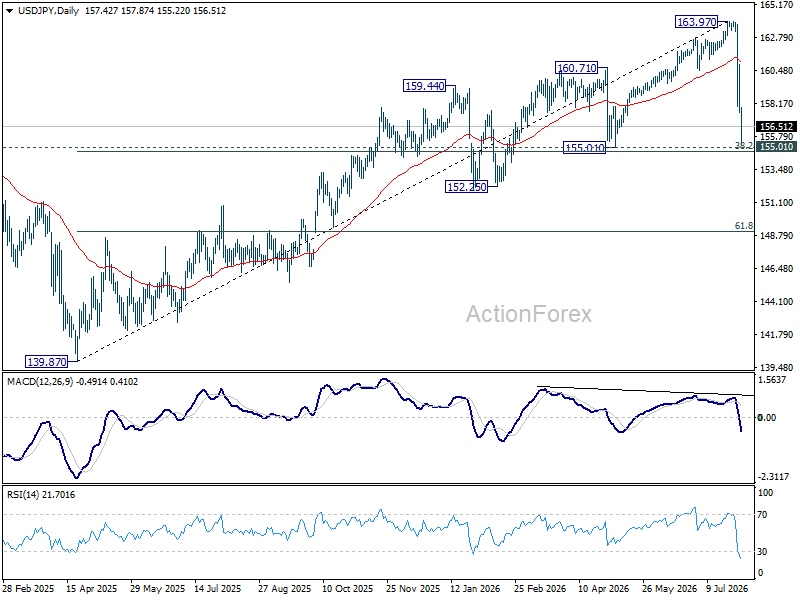
Conclusion: This Week May Decide Whether Credibility Can Replace Ambiguity
The coordinated intervention itself was always likely to trigger a sharp correction in USD/JPY. The more important question is whether Washington and Tokyo have changed the rules of the game by abandoning ambiguity in favor of an explicit credibility signal.
If a series of strong US economic releases fails to push USD/JPY back toward 160, it would suggest the swift confirmation has successfully altered traders' risk calculations. If, however, USD/JPY quickly resumes its climb toward 160–163 despite the barrage of official statements, the communication strategy will look less like a new intervention doctrine and more like a more public version of previous operations.
For now, the intervention has created a new variable for markets to price: not just the willingness of authorities to enter the market, but the credibility of their resolve.
Key Takeaways
- Washington and Tokyo confirmed their coordinated Yen intervention within hours, a sharp break from Japan's traditional strategy of deliberate ambiguity.
- The swift confirmation functions as forward guidance, aiming to raise the perceived cost of rebuilding long USD/JPY positions ahead of a heavy US data week.
- USD/JPY briefly tested 155 before rebounding, suggesting markets see the intervention as capping upside near 160 rather than targeting a much stronger Yen.
- A stronger-than-expected US data run without USD/JPY returning to 160 would confirm the credibility strategy is working; a quick climb back toward 160-163 would undermine it.
- 155.01/154.76 is the key support cluster; a break opens 149.07, while recovery above 157.95 would signal the corrective decline from 163.97 is losing momentum.
EUR/USD Builds on Gains as Bulls Eye Higher Levels
Key Highlights
- EUR/USD started a fresh increase above 1.1500.
- It traded above a key bearish trend line with resistance at 1.1410 on the 4-hour chart.
- USD/JPY declined heavily below the 157.50 support zone.
- Gold seems to be consolidating above the $4,000 zone.
EUR/USD Technical Analysis
The Euro formed a base above 1.1350 against the US Dollar. EUR/USD started a fresh increase above the 1.1440 and 1.1500 resistance levels.
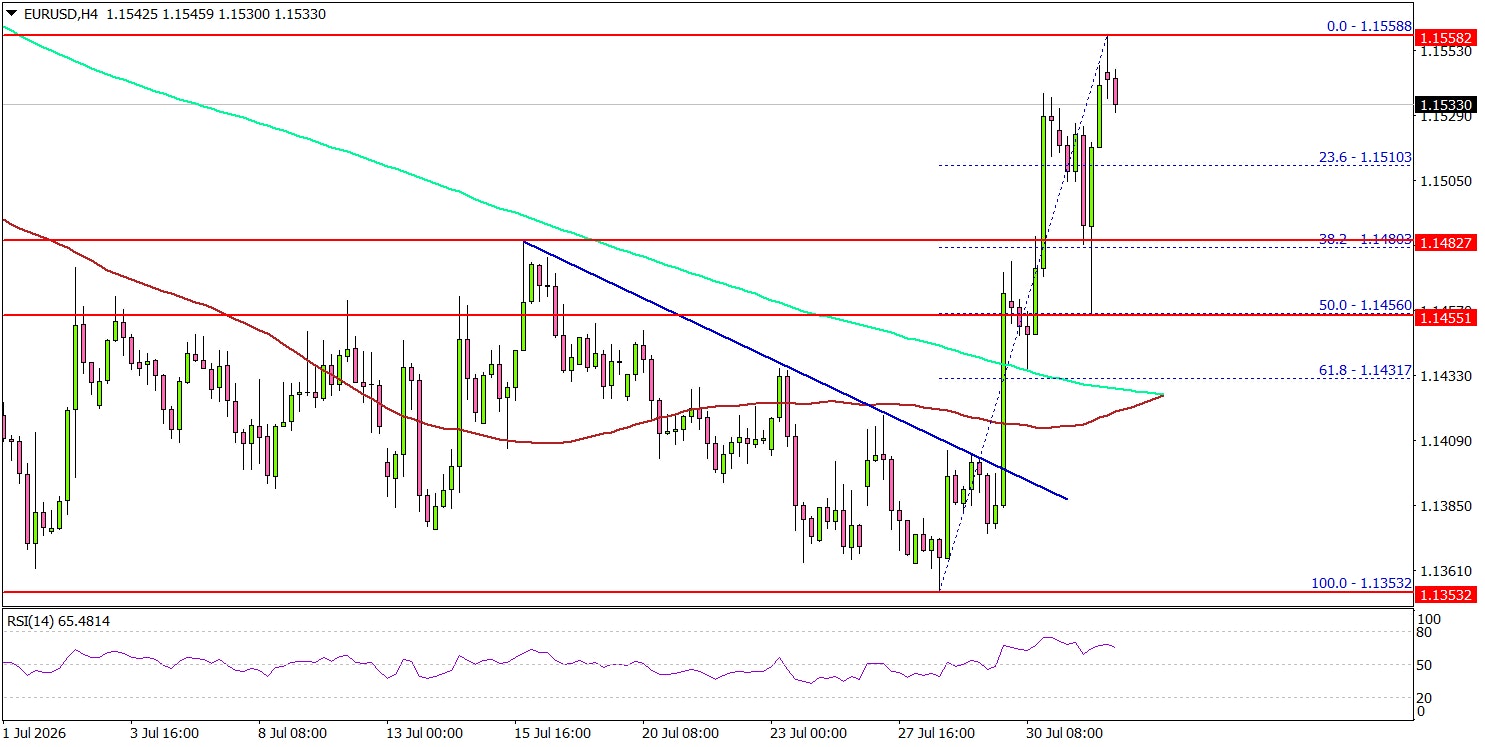
Looking at the 4-hour chart, the pair gained pace for a move toward 1.1550. There was a close above 1.1500, the 100 simple moving average (red, 4-hour), and the 200 simple moving average (green, 4-hour).
A high was formed at 1.1558, and the pair is now consolidating gains. If there is a downside correction, the pair might find support near 1.1480 or the 38.2% Fib retracement level of the upward move from the 1.1353 swing low to the 1.1558 high.
If there are more losses, the pair could find bids near the 50% Fib retracement level at 1.1455. The main support could be 1.1430 or the 100 simple moving average (red, 4-hour) and the 200 simple moving average (green, 4-hour).
A downside break and close below 1.1430 might send the pair toward 1.1350. Any more losses could open the doors for a test of 1.1300.
On the upside, the pair could face resistance near 1.1550. The next major resistance might be 1.1580. A close above 1.1580 could start another steady increase. In the stated case, the bulls could aim for a move to 1.1620. Any more gains might open the doors for a test of 1.1650.
Looking at Gold, the bears are putting up a tough fight, and they might aim for a drop below the $3,950 support.
Upcoming Key Economic Events:
- US ISM Manufacturing Index for July 2026 – Forecast 54.0, versus 53.3 previous.
- US S&P Global Manufacturing PMI for July 2026 – Forecast 53.8, versus 53.8 previous.
China’s Manufacturing Expansion Slowed, but Three Trends Offer Encouragement
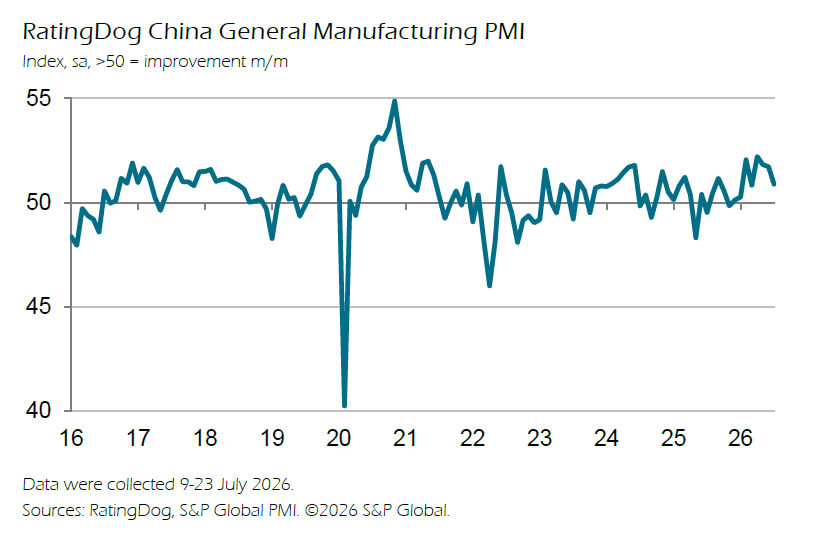
China's private manufacturing sector remained in expansion territory for an eighth consecutive month in July, although growth moderated from June. The RatingDog China General Manufacturing PMI eased to 50.9 from 51.7, the lowest reading in four months, but still signaled improving operating conditions. The current expansion matches the longest stretch of manufacturing growth in five years, with all five PMI components contributing positively for a second straight month.
The slowdown reflected softer growth across several key indicators rather than a reversal in activity. Total new orders continued to rise for a fourteenth consecutive month—the longest expansion since 2018—though the pace eased. Manufacturing output also expanded for an eighth straight month at a slower rate, while new export orders returned to growth after two months of contraction, providing a positive signal for external demand. Employment increased for a second consecutive month, although hiring remained modest.
Inflation pressures continued to ease, offering manufacturers some relief. Input cost inflation slowed to a six-month low, while firms largely kept selling prices unchanged despite higher costs. The survey also pointed to a mixed inventory picture, with companies continuing to build input stocks while reducing purchasing activity for the first time since November 2025, suggesting earlier inventory accumulation may be sufficient for near-term production needs. Looking ahead, business confidence improved slightly on expectations of stronger demand, new product launches and capacity expansion, although RatingDog expects manufacturing growth to remain positive but moderate in the coming months.
Economic Data
| Indicator | Actual | Expected | Previous |
|---|---|---|---|
| Manufacturing PMI | 50.9 | — | 51.7 |
| New Orders | Expanded (14th consecutive month) | — | Expanded |
| New Export Orders | Returned to expansion | — | Contracted |
| Manufacturing Output | Expanded (8th consecutive month) | — | Expanded |
| Employment | Modest increase | — | Increased |
| Input Cost Inflation | Six-month low | — | Higher |
| Output Prices | Broadly unchanged | — | Increased marginally |
Market Takeaways
- Manufacturing PMI eased from 51.7 to 50.9, marking a four-month low but remaining above the 50 threshold for an eighth consecutive month, matching the longest expansion in five years.
- Domestic demand remained resilient, with total new orders rising for a fourteenth straight month—the longest growth streak since 2018.
- New export orders returned to expansion after two months of contraction, suggesting external demand improved at the start of the third quarter.
- Cost pressures continued to ease, with input price inflation slowing to a six-month low while firms largely kept selling prices unchanged.
- Inventory dynamics were mixed. Companies continued to build input stocks for an eighth consecutive month but reduced purchasing activity for the first time since November 2025, indicating existing inventories were sufficient to support near-term production.
- Business confidence strengthened slightly as firms anticipated firmer demand, new product launches and expanded production capacity in the year ahead.