

Sample Category Title
Government vs BoJ? Japan’s Kiuchi Offers Softer View on Inflation Risks
Japan's Economy Minister Minoru Kiuchi struck a more measured tone on inflation than the Bank of Japan, suggesting the recent surge in energy prices has yet to generate broad-based consumer price pressures. Speaking at a press conference on Tuesday, Kiuchi said the pass-through from the Middle East conflict has so far remained limited, noting that "the overall consumer price index rose 1.7% year-on-year in June, showing only moderate rises." His remarks contrasted with the BoJ's warning last week that inflation risks could overshoot its 2% target.
Kiuchi acknowledged that inflationary pressures could build in the months ahead, saying policymakers "do need to be vigilant to the possibility that costs could be gradually passed onto food and other consumer goods from summer through autumn." Still, he emphasized that households should be better placed to absorb higher prices, forecasting average real wages to rise by nearly 1% in the current fiscal year while pointing to government fuel subsidies as an important buffer against higher living costs.
While avoiding direct criticism of the BoJ, Kiuchi's comments appeared to temper market expectations for a more aggressive policy response. He said he hoped the central bank would "continue to guide appropriate policy to stably and sustainably achieve its 2% inflation target," language consistent with his long-standing preference for accommodative monetary settings. The remarks suggest the government remains more comfortable with a gradual approach to policy normalization even after the BoJ raised interest rates to 1% in June.
Key Takeaways
- Japan's Economy Minister Minoru Kiuchi offered a more measured assessment of inflation than the BoJ, saying June's 1.7% CPI increase still represented only "moderate" price rises.
- While acknowledging that higher energy costs could gradually feed into food and consumer goods prices, Kiuchi stressed that cost pass-through from the Middle East conflict has so far remained limited.
- Kiuchi expects real wages to rise by nearly 1% this fiscal year and highlighted government fuel subsidies as an important buffer against higher living costs.
- His remarks contrasted with the BoJ's stronger warning last week that inflation could overshoot its 2% target, suggesting the government sees less urgency for further monetary tightening.
- Although Kiuchi reiterated support for the BoJ achieving its inflation target, his comments reinforced the government's preference for a gradual and cautious normalization of monetary policy.
NASDAQ 100 Analysis: De-Escalation Around Iran Boosts Demand for Technology Stocks
The beginning of August brought renewed optimism to the US technology sector. President Donald Trump announced the cancellation of a planned strike on Iran and expressed his intention to resume negotiations, prompting a sharp decline in oil prices. Investors interpreted the easing of geopolitical tensions as a signal that inflationary risks may also begin to moderate. Additional support for the market came from the Federal Reserve’s earlier decision on 29 July to keep the benchmark interest rate unchanged within the 3.5–3.75% range, although the decision was not unanimous. Together, these developments helped restore investors’ appetite for risk, particularly in large-cap technology stocks.
Technical Analysis of Nasdaq 100
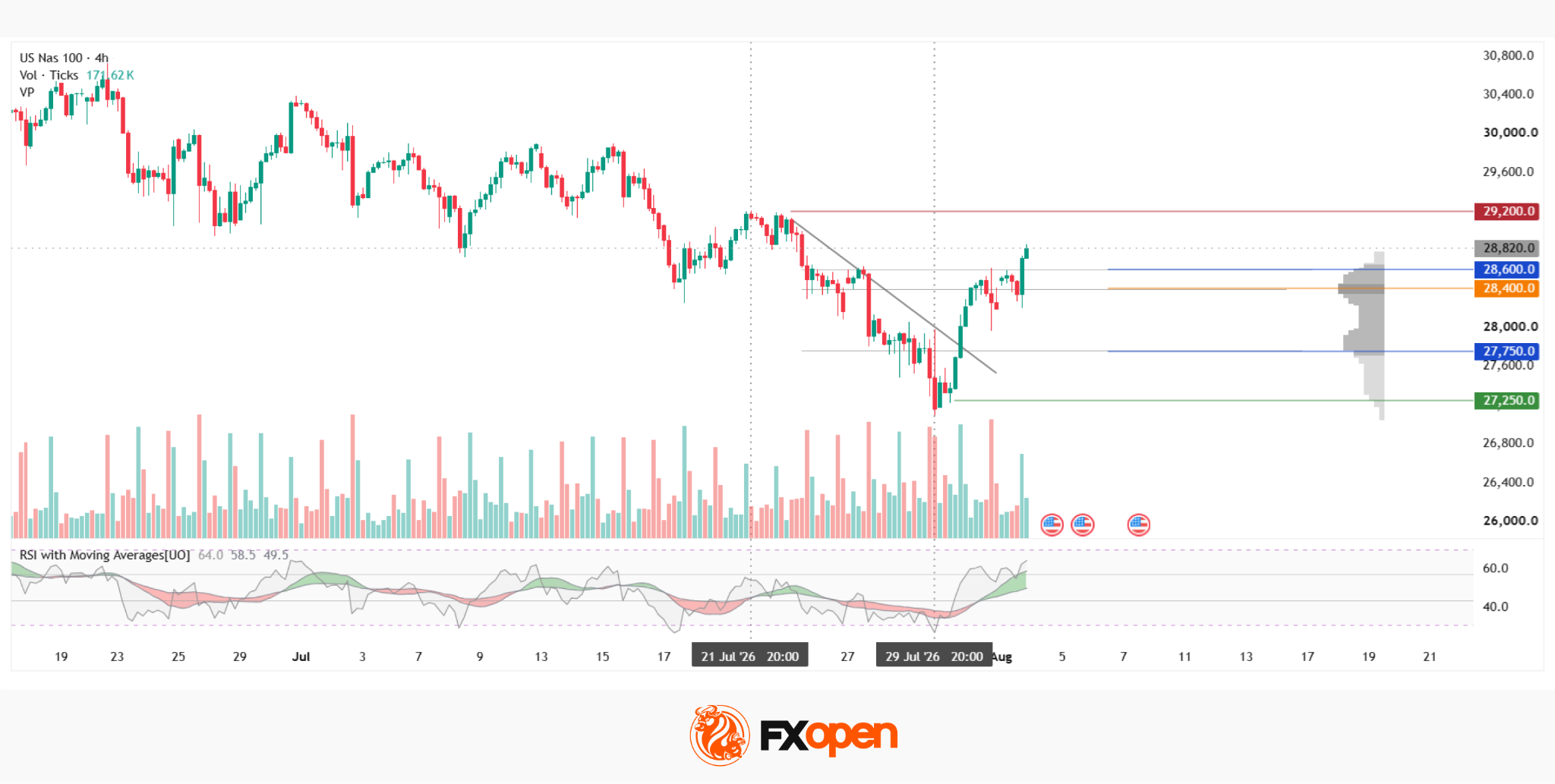
Since mid-July, the Nasdaq 100 index (NDXm on FXOpen) had been moving within a short-term downtrend defined by a descending trendline, before falling towards the 27,100 area, marked by the green support zone. From there, the price reversed, broke above the descending trendline, and recovered roughly half of the previous decline. Following a brief period of consolidation, the current market profile was formed, with the index now trading above its upper boundary at 28,600. Above current levels lies the base of the previous trend at 29,200, marked on the chart as the red resistance level.
Should the current direction reverse, the index may encounter several important technical levels. The POC (Point of Control) at 28,400 represents the nearest area of highest trading activity over the analysed period. Below it are the lower boundary of the market profile at 27,750 and the green support level at 27,250, located near the trend low. The RSI + MAs indicator currently shows readings of 64, 58 and 49. Although the oscillator suggests that the current move may continue, the slower moving average remains within the neutral zone, leaving the bullish signal unconfirmed.
Summary
The Nasdaq 100’s near-term direction is likely to depend heavily on developments surrounding negotiations with Iran. Any deterioration in the geopolitical situation could renew selling pressure on the index, while further diplomatic progress may create room for a move towards higher price levels.
Trade global index CFDs with zero commission and tight spreads (additional fees may apply). Open your FXOpen account now or learn more about trading index CFDs with FXOpen.
This article represents the opinion of the Companies operating under the FXOpen brand only. It is not to be construed as an offer, solicitation, or recommendation with respect to products and services provided by the Companies operating under the FXOpen brand, nor is it to be considered financial advice.
US JOLTs Report in Focus
In focus today
In the US, the June JOLTs report will be in the spotlight. Job openings have increased modestly this year, which has historically predicted rising wage cost pressures ahead. June trade balance data will also be released in the afternoon and the preliminary reading pointed towards a stable trade deficit from May. The Fed's Schmid (non-voter, hawk) will be on the wires overnight.
In Denmark, the FX reserve figures for July are set to release at 17:00 CET. Danmarks Nationalbank (DN) intervened in June for the first time in more than three years to curb the upwards pressure on EUR/DKK. EUR/DKK has continued to trade at an elevated level, and the market will look to see whether this has prompted more FX intervention. If that was the case, it may add to speculation about a unilateral rate hike by DN over the coming year.
Economic and market news
What happened overnight
In oil markets, Brent crude traded slightly higher overnight, moving back above USD84/bbl but holding most of Monday's decline. The move came amid conflicting headlines on whether US-Iran talks have resumed and US President Trump calling his latest offer of talks a "final chance" for Iran.
What happened yesterday
In the euro area, the final July manufacturing PMI came in at 51.9, only marginally below the preliminary 52.0 and still higher than the 51.4 recorded in June. The release broadly confirmed the preliminary picture of a rebound in manufacturing activity, with output rising further and factory price pressures easing, although new orders only rose modestly and employment remained weak.
In the US, the ISM manufacturing activity index came in at 55.6 in July, above consensus expectations of 54.0 and up from 53.3 in June. The release followed a similar positive uptick in the PMIs. Within the ISM details, new orders and especially employment improved, while the prices index moderated slightly. The production index moved sharply higher to 58.5 from 52.2, marking the strongest reading since November 2021. Furthermore, the order-inventory balance continued to improve, indicating a further need for increasing output. The bottom line is that US cyclical data is still looking very solid.
The Fed's Williams said he still expects inflation to cool gradually and reach the 2% target on a sustained basis by 2028, assuming energy prices and tariffs have peaked. He described policy as "well positioned" but stressed that the Fed would hike rates if inflation does not slow as expected.
Equities: Equities started August on a positive note with fresh all-time highs for several of the MSCI world indices. The move was driven by a strong sector rotation, combining further relief in software, which has now recovered 16% over the past week, with lower oil prices following more constructive rhetoric around Iran and the Strait of Hormuz. The cyclical rotation seen over the past three sessions therefore continued, while several defensive sectors traded lower despite the solid index gains. In Asia this morning, sentiment is somewhat weaker as scepticism around Asian tech and semiconductors weighs on regional markets. As a result, Asian equities trade lower even as both US and European futures move modestly higher.
FI and FX: Broad based yields declined and EUR/USD remained above 1.15 over yesterday's session, as cooling tensions between the US and Iran held Brent crude below USD85/bbl. Both sides of the war have sent very conflicting signals on whether any talks are actually ongoing, with Iran denying all discussions aside from the ones held with Oman regarding the Strait of Hormuz. Today's most interesting data release will be the US June JOLTs report; job openings have shifted moderately higher this year, which has historically predicted rising wage pressures ahead. Additionally, Danmarks Nationalbank will release the FX reserve figures for July at 17:00 CET and markets will look for any FX intervention. If that was the case, it may add to speculation about a unilateral rate hike by DN over the coming year.
EURUSD: Expecting Move Lower
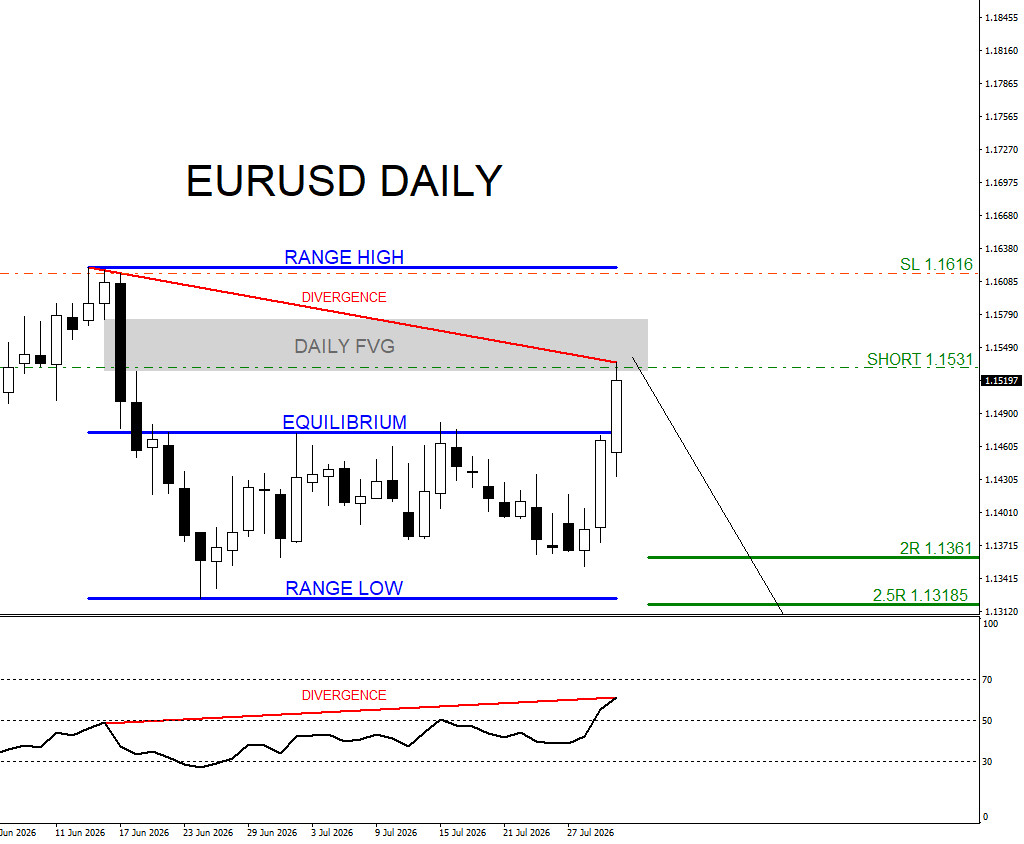
I am already riding a EURUSD sell entry. I posted the sell July 30 2026 on social media @AidanFX : “EURUSD Sold at 1.1531 Stop Loss at 1.1616 Target at 1.1361” and expecting a move lower.
EURUSD Daily Chart July 30 2026
 A trader should always have multiple strategies all lined up before entering a trade. Never trade off one simple strategy. When multiple strategies all line up it allows a trader to see a clearer trade setup. We at EWF never say we are always right. No market service provider can forecast markets with 100% accuracy. Only thing we at EWF 100%, is that we are RIGHT more than we are WRONG.
Of course, like any strategy/technique, there will be times when the strategy/technique fails so proper money/risk management should always be used on every trade. Hope you enjoyed this article and follow me on social media for updates and questions> @AidanFX
At Elliottwave-Forecast we cover 78 instruments (Forex, Commodities, Indices, Cryptos, Stocks and ETFs) in 4 different time frames and we offer 5 Live Session Webinars everyday. We do Daily Technical Videos, Elliott Wave Trade Setup Videos and we have a 24 Hour Chat Room. Our clients are always in the loop for the next market move.
How Elliott Wave Mapped the CADJPY Drop
In today’s blog post, we take a trip down memory lane and look back at a previous CADJPY analysis. This serves as a great example of how we use technical analysis to identify potential market moves.
Specifically, we’ll be examining the CADJPY chart from 07.29.2026. At that time, we were tracking a potential bullish move. Our Elliott Wave analysis suggested that a primary wave (B) corrective pattern was nearing completion.
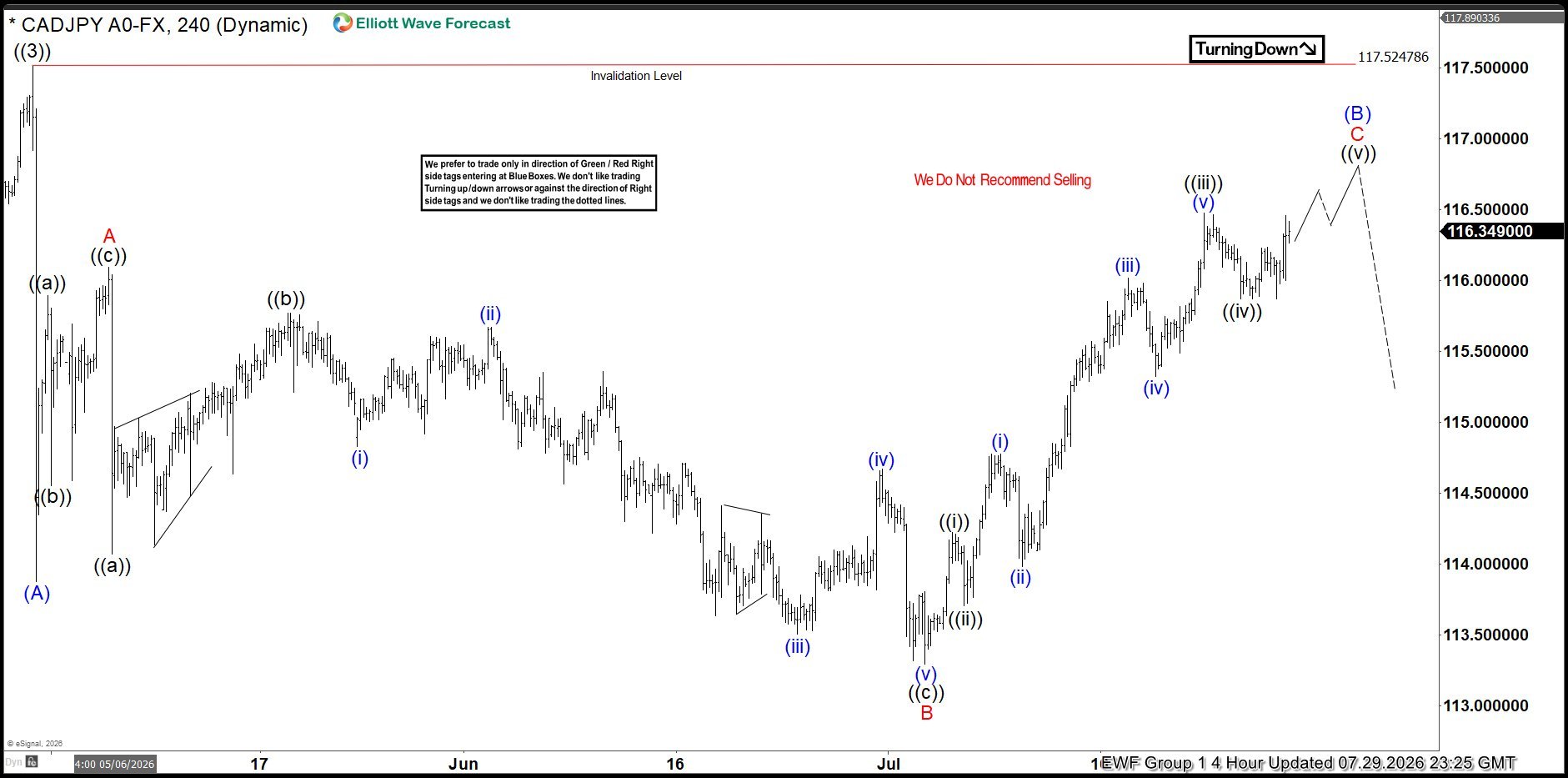
According to our forecast, we anticipated that CADJPY would form a significant high somewhere in the 117.52 region. This level represented a major Fibonacci resistance zone, and we believed it would be a logical place for the bulls to take profits and for the bears to re-enter the market.
The Reaction: Sharp Reversal from the Highs
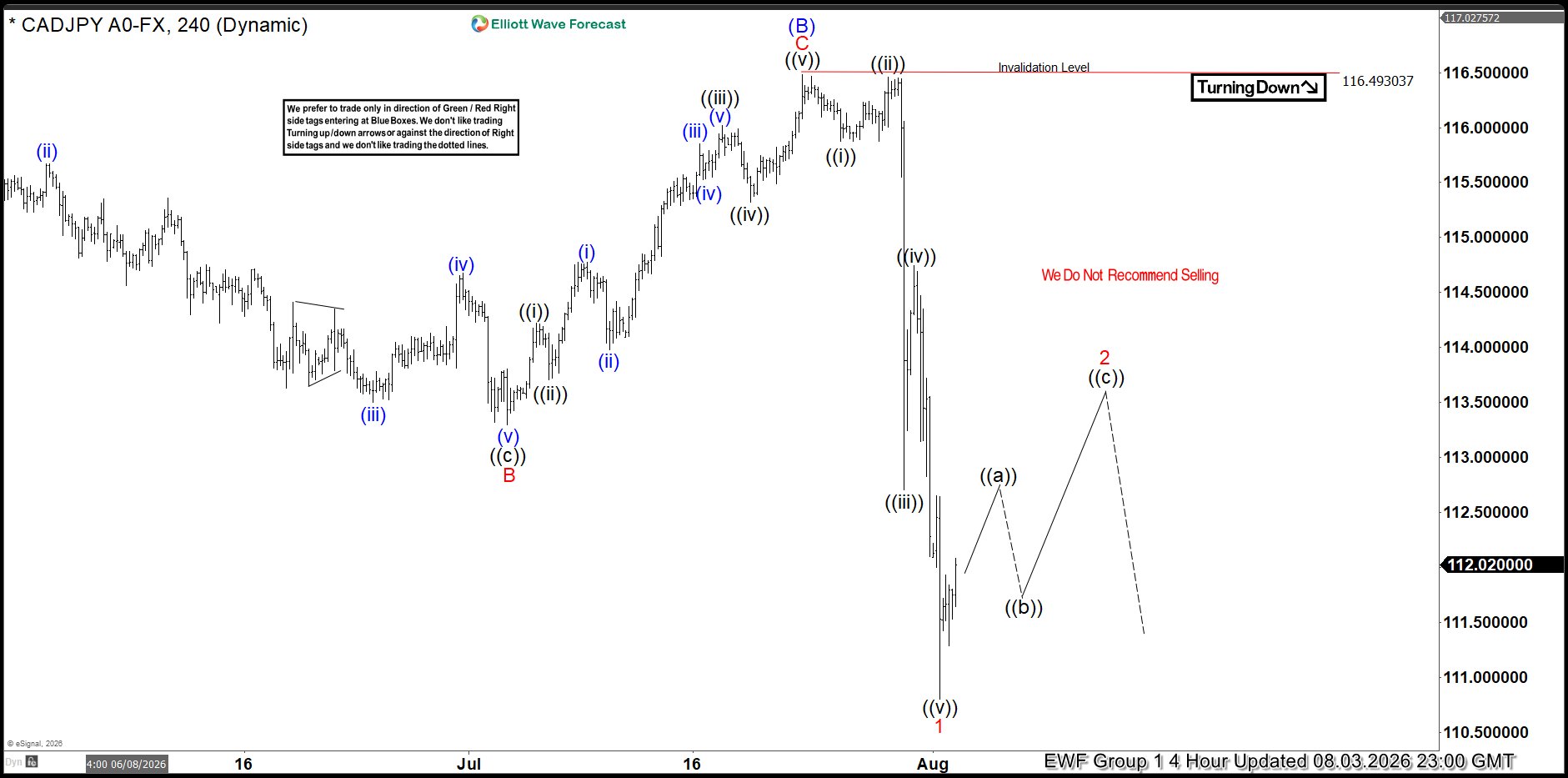
As anticipated, CADJPY capped its upward momentum right at the projected peak area and reversed aggressively to the downside. The pair completed wave ((v)) of C of (B) just below the 116.49 invalidation level, confirming the top before launching into a sharp impulsive decline.
This sell‑off drove prices more than 500 pips lower, reaching the 110.50 zone to complete wave 1, now trading around 112.02. The initial drop unfolded in five clear sub‑waves, underscoring the strength of the move.
Looking ahead, with wave 1 complete, the forecast calls for a corrective three‑wave bounce in wave 2—((a)), ((b)), and ((c))—toward the 113.50–114.00 region. Once this corrective rally is complete, the higher‑degree downtrend is expected to resume, extending the bearish sequence. Importantly, selling directly into current lows is not advised, as a corrective bounce is anticipated before the next major decline unfolds.
Conclusion
The CADJPY sequence is a textbook example of how Elliott Wave analysis maps out corrective structures and anticipates reversals. By combining wave counts, invalidation levels, and right‑side tags, traders can position themselves with the trend rather than against it.
Why EWF ?
At Elliottwave Forecast (EWF), we deliver consistent market updates through regular charts update. Our analysts update 1‑hour charts four times daily and 4‑hour charts once per day across all 78 instruments. In addition, we host five live sessions each day and maintain a 24‑hour chatroom, providing clients with real‑time market guidance and answers to any questions they may have.
You can start a 14‑day trial with us today here and cancel anytime by emailing support@elliottwave-forecast.com
AUD/NZD Pressured as Inflation Backs More RBNZ Tightening, Jobs Need Only Confirm It
TL;DR: With markets already convinced the RBA is done hiking, tomorrow's New Zealand employment report matters less for whether the RBNZ turns more hawkish and more for whether the labor market stays resilient enough to keep its tightening bias intact — a dynamic already pressuring AUD/NZD lower.
Why the Focus Has Shifted Across the Tasman
Markets have already reached a broad consensus that the Reserve Bank of Australia has finished tightening for this year. The focus is now shifting across the Tasman, where the Reserve Bank of New Zealand still appears to have work left to do. That makes tomorrow's second-quarter employment report less about whether the RBNZ will turn more hawkish, and more about whether the labor market is resilient enough to keep its existing tightening bias intact.
Inflation Already Made the Case for More Tightening
The case for further tightening was largely established by inflation. New Zealand's second-quarter CPI rose 4.1% y/y, exceeding the RBNZ's 3.9% forecast and reminding policymakers that price pressures remain more persistent than expected. More importantly, non-tradable inflation held at an elevated 3.4%, indicating domestic inflation — not just higher fuel costs linked to the Middle East conflict — continues to pose a challenge.
Stronger business sentiment since then has only reinforced that picture, with July's ANZ Business Confidence jumping to 56.1 from 36.6.
Why Tomorrow's Data Doesn't Need to Surprise
Against that backdrop, tomorrow's labor market data don't need to surprise on the upside to support the policy outlook. Consensus forecasts call for:
- Employment growth of 0.1% q/q.
- Unemployment edging up from 5.3% to 5.4%.
- The Labour Cost Index accelerating from 0.5% to 0.6% q/q.
Those figures are broadly consistent with the RBNZ's own projections, meaning an in-line report would leave the Bank's economic assessment largely intact. Instead of weakening the tightening narrative, it would reinforce the view that policy still needs to move somewhat further into restrictive territory to contain domestic inflation and limit second-round effects from higher energy prices.
What Would Actually Move Markets
The bigger market reaction would likely come from a stronger-than-expected report. Faster employment growth, firmer wage inflation, or a lower unemployment rate would strengthen the case for another hike as early as September, and increase expectations that the Official Cash Rate ultimately reaches the upper end of the 2.75%–3.00% range currently expected by many economists. Only a materially weaker labor market would cast meaningful doubt on that outlook, by suggesting higher borrowing costs are beginning to bite more sharply than anticipated.
Why This Matters for AUD/NZD
Those shifting policy expectations have become important for AUD/NZD. Australia's softer-than-expected second-quarter CPI has persuaded markets the RBA is likely to keep the cash rate unchanged at 4.35% through year-end, effectively ending a period in which Australian rate expectations consistently outpaced those in New Zealand. With the RBA sidelined, investors are now watching whether the RBNZ can narrow the policy differential through further tightening, providing fundamental support for the New Zealand Dollar against its Australian counterpart.
ActionForex's Technical View on AUD/NZD
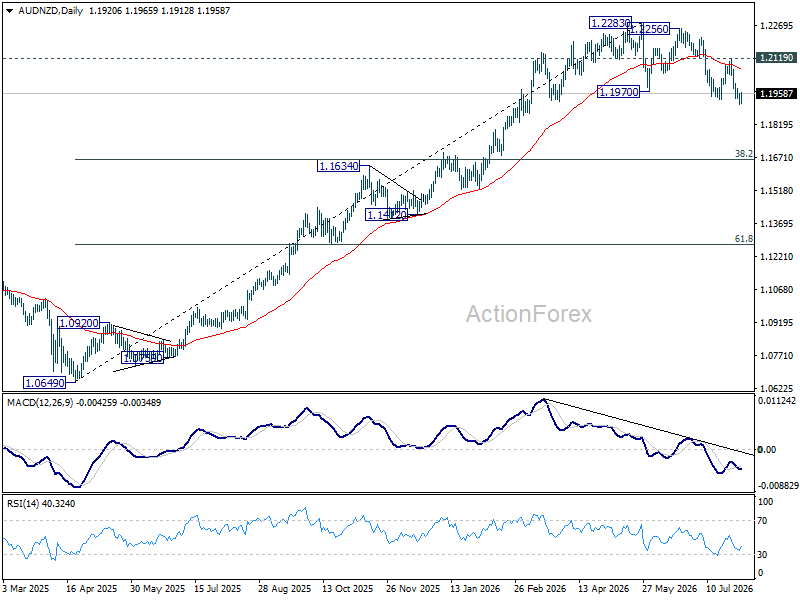
The technical picture complements the macro story. AUD/NZD's decline from 1.2283 continues to look like a correction of the five-wave advance from 1.0649. As long as 1.2119 resistance caps rebounds, the bias remains lower. The next downside objective remains the 38.2% retracement at 1.1658, which sits just above the previous fourth-wave consolidation around 1.1412–1.1634.
Against a backdrop of narrowing policy differentials, tomorrow's New Zealand labor market report has the potential to provide the catalyst for the next leg lower in AUD/NZD.
Key Takeaways
- New Zealand's Q2 CPI beat the RBNZ's own forecast at 4.1% y/y, with sticky non-tradable inflation at 3.4% keeping the tightening bias intact.
- Consensus expects tomorrow's employment data to come in broadly in line with RBNZ projections, meaning an in-line print alone would reinforce, not weaken, the hawkish case.
- A stronger-than-expected report would raise September hike odds and support an Official Cash Rate move toward the top of the 2.75%-3.00% range.
- Australia's softer CPI has convinced markets the RBA is done hiking, shifting the AUD/NZD policy narrative fully toward the RBNZ's next move.
- AUD/NZD's decline from 1.2283 remains capped below 1.2119 resistance, with 1.1658 the next downside objective if the labor data supports further RBNZ tightening.
GBP/USD Could Push Higher If Buyers Hold Control
Key Highlights
- GBP/USD started a fresh increase above 1.3400.
- It traded above a key bearish trend line with resistance at 1.3305 on the 4-hour chart.
- Bitcoin seems to be facing hurdles near $64,500 and $65,650.
- EUR/USD rallied above 1.1500 before it started a consolidation phase.
GBP/USD Technical Analysis
The British Pound started a decent increase above 1.3380 against the US Dollar. GBP/USD even surpassed 1.3400 to enter a positive zone.
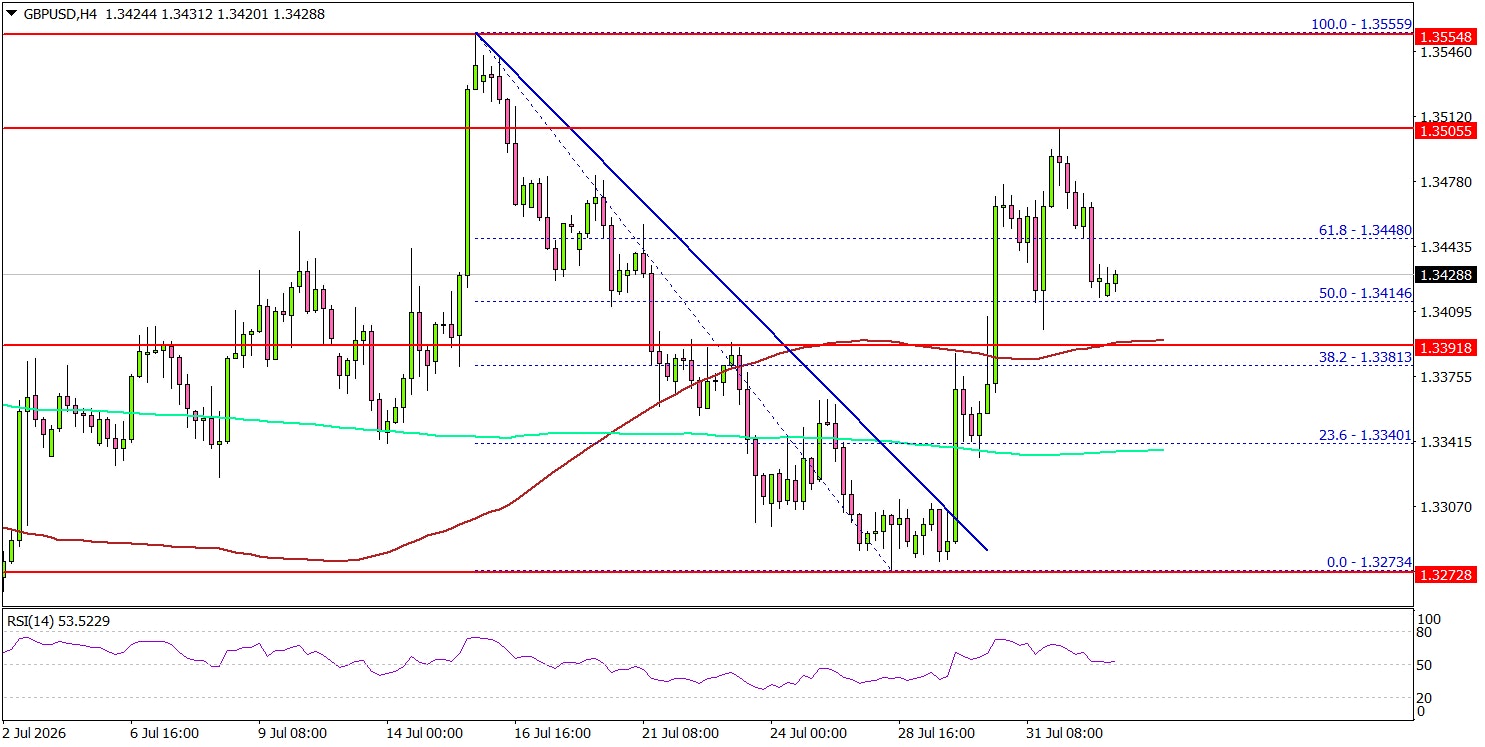
Looking at the 4-hour chart, the pair settled above 1.3400, the 100 simple moving average (red, 4-hour), and the 200 simple moving average (green, 4-hour). There was a move above the 61.8% Fib retracement level of the downward move from the 1.3555 swing high to the 1.3273 low.
However, the bears are active near the 1.3520 zone. If there is a downside correction, the pair might find support near 1.3290 or the 100 simple moving average (red, 4-hour).
The first key support is near the 1.3350 level and the 200 simple moving average (green, 4-hour). A downside break and close below 1.3350 might send the pair toward 1.3320. Any more losses could open the doors for a test of 1.3250.
On the upside, the pair could face resistance near 1.3500. The next major resistance might be 1.3520. A close above 1.3520 could start another steady increase. In the stated case, the bulls could aim for a move to 1.3555. Any more gains might open the doors for a test of 1.3620.
Looking at Bitcoin, the bears seem to be in control, and they could aim for a fresh push toward the $60,000 level.
Upcoming Key Economic Events:
- US Factory Orders for June 2026 (MoM) - Forecast +0.2%, versus -1.3% previous.
- US Goods and Services Trade Balance for June 2026 - Forecast $-73.0B, versus $-77.6B previous.
NASDAQ-100 Wave Analysis
Nasdaq-100: ⬆️ Buy
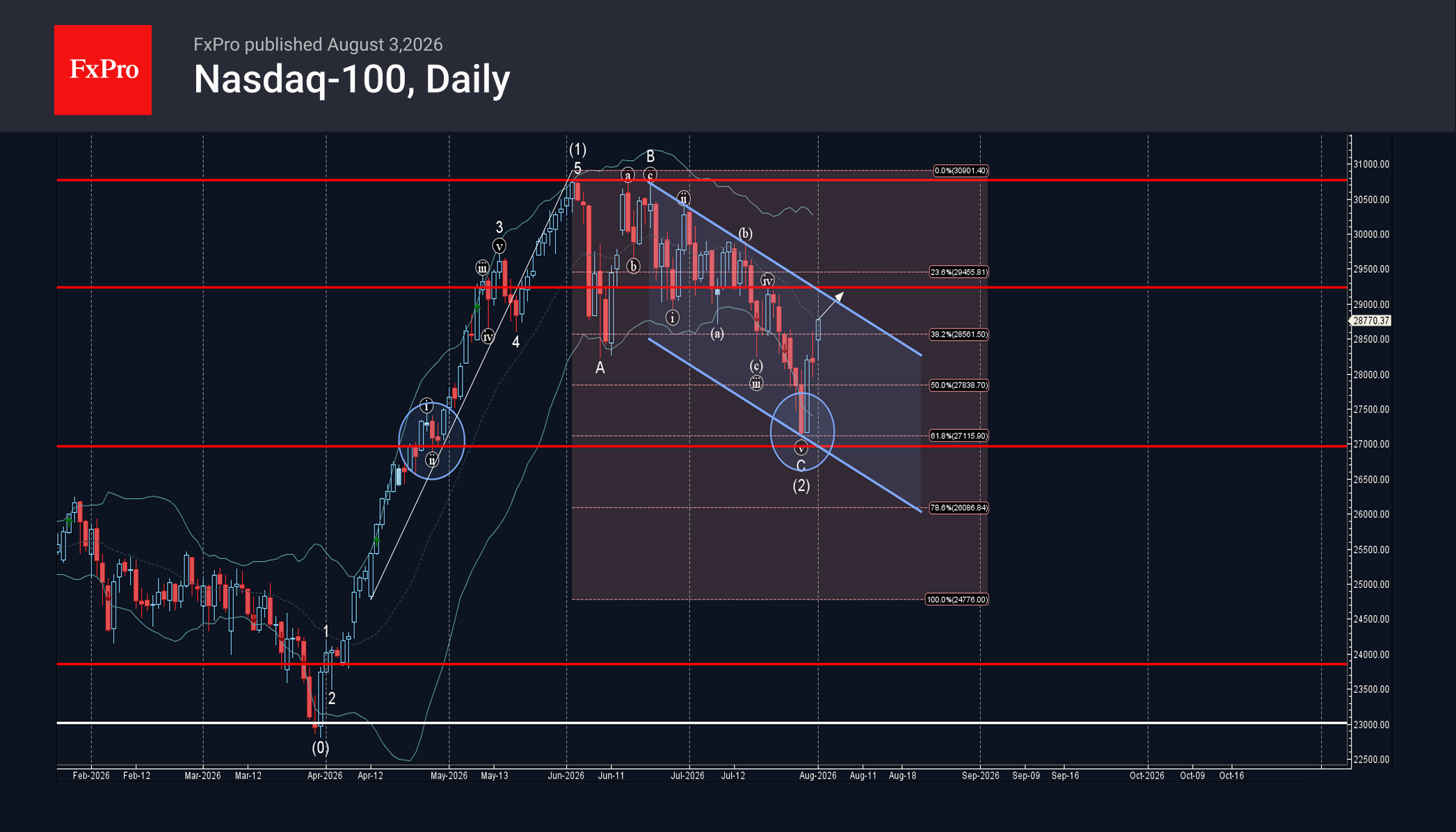
– Nasdaq-100 reversed from support zone
– Likely to rise to resistance level 29200.00
Nasdaq-100 index recently reversed from the support zone between the key support level 27000.00 (which also reversed the price in April), lower daily Bollinger Band and the 61.8% Fibonacci correction of the upward impulse (1) from April.
The upward reversal from this support zone created the daily Japanese candlesticks reversal pattern Bullish Engulfing – which started active impulse wave (3).
Given the clear daily uptrend, Nasdaq-100 index can be expected to rise further to the next resistance level 29200.00.
GBPJPY Wave Analysis
GBPJPY: ⬆️ Buy
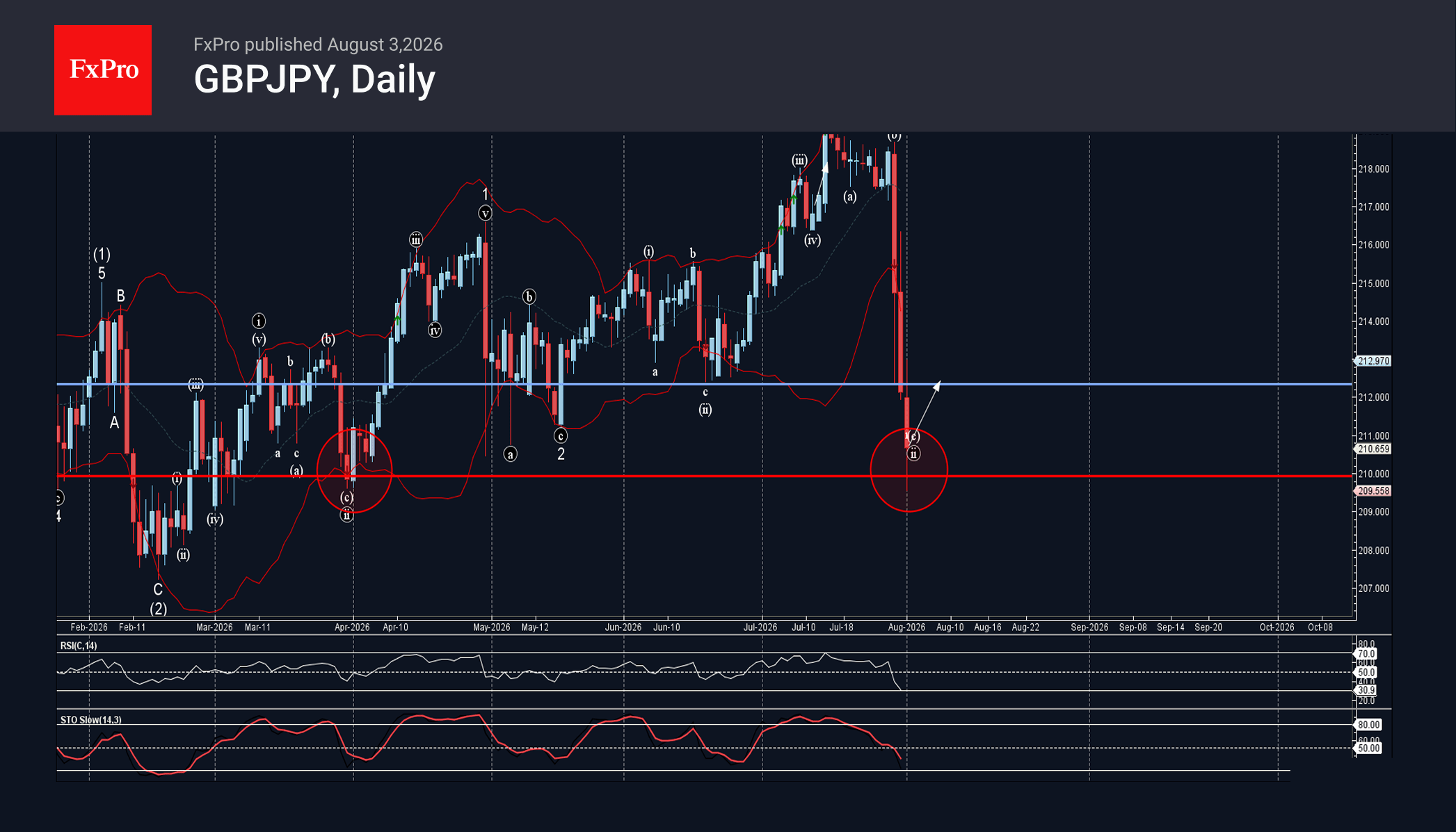
– GBPJPY reversed from support zone
– Likely to rise to resistance level 212.35
GBPJPY currency pair recently reversed from the support zone between the key support level 210.00 (which has been reversing the price from March) and the lower daily Bollinger Band.
The upward reversal from the support level 210.00 stopped the previous sharp downward impulse wave C.
Given the strength of the support level 210.00 and the oversold daily Stochastic and RSI, GBPJPY currency pair can be expected to further to the next resistance level 212.35.
The S&P 500 Is Churning Under the Surface
- The calm and consolidation in the US equity market are deceptive.
- The S&P 500 is paying closer attention to macro risks.
The S&P 500 closed July with a modest gain, yet beneath the calm surface, real storms were brewing. These began to surface halfway through the corporate earnings season, when results from the ‘Magnificent Seven’ led to significant volatility in their shares. Whilst Microsoft recorded the largest increase in market capitalisation in stock market history and Amazon’s shares jumped by 15%, Apple and Meta Platforms suffered their worst selloffs since Liberation Day in April 2025.
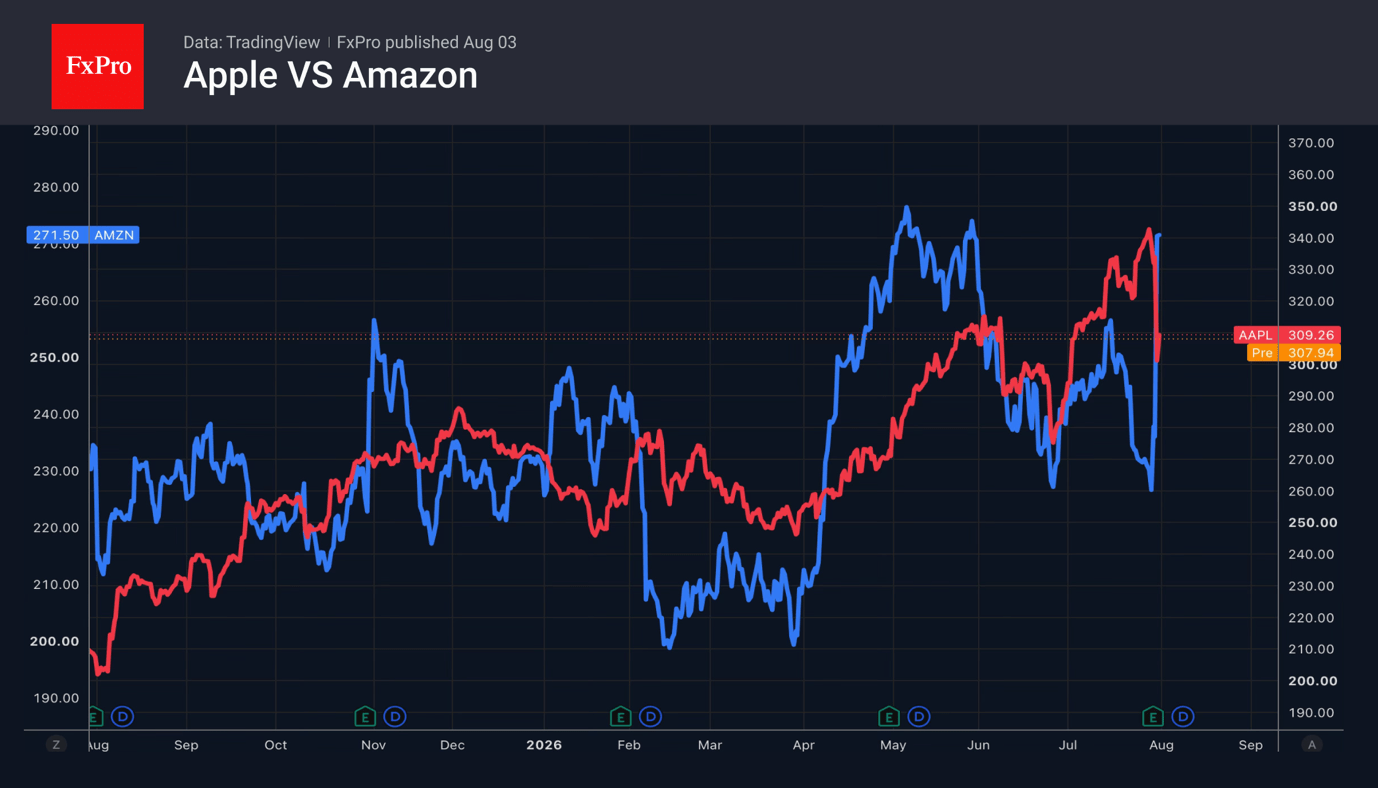
While the markets are racking their brains over whether Big Tech will reap the rewards of its colossal investments in artificial intelligence, cloud computing business models appear fairly straightforward. Companies purchase buildings and equipment and lease them out to recoup their costs. Meanwhile, the 39% rise in operating profit at Amazon Web Services has driven up shares across the entire consumer discretionary sector, to which the issuer belongs.
By contrast, the technology sector ended the last day of July in the red due to setbacks at Apple, which reported component shortages affecting its products. Such significant volatility within the Big Tech sector is depriving the stock market of its safety net. Previously, the S&P 500 had turned a blind eye to challenges such as tariffs, geopolitics or the Fed’s intentions to raise interest rates. The stock index had been rising steadily, driven by investor interest in artificial intelligence. It is now paying closer attention to macroeconomic risks.
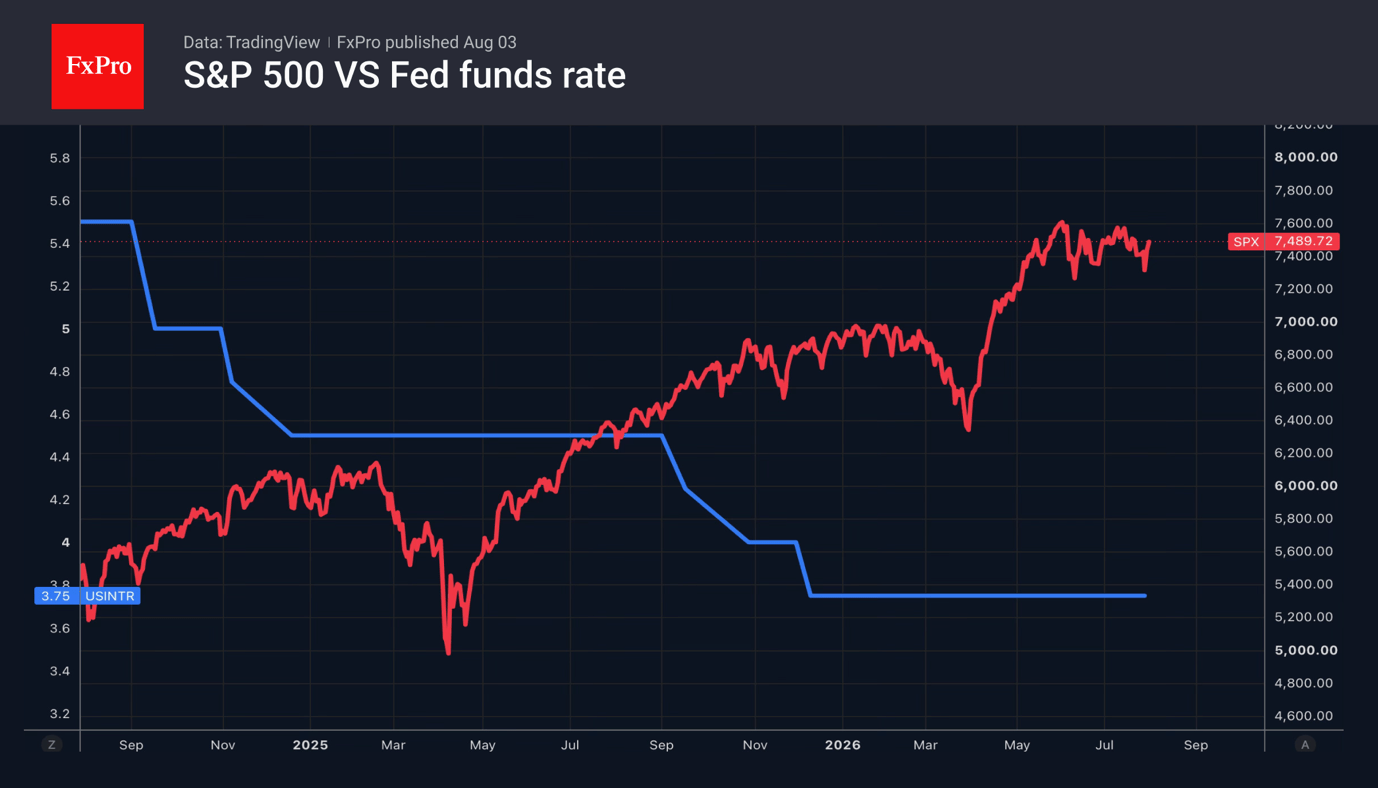
The S&P 500’s reaction to the outcome of the July FOMC meeting was telling: the stock index suffered a significant dip as the number of Fed officials prepared to vote for tighter monetary policy increased. Admittedly, the following day, it turned a blind eye to the disappointing second-quarter GDP figures, influenced by the narrative that Kevin Warsh was in no hurry to raise interest rates. However, the fact remains: the US equity market is beginning to look beyond artificial intelligence technologies. All the more so as the corporate earnings season has passed its halfway point.
In this regard, developments in the Middle East and the release of the US July employment data could lead to significant volatility in the S&P 500.
The FxPro Analyst Team