

Sample Category Title
Australia Composite PMI Climbs to Six-Month High on Stronger Services Activity
Australia's private sector gained momentum at the start of the third quarter, with the services sector leading a broad-based improvement in business activity. The S&P Global Australia Services PMI rose to 53.6 in July from 50.5 in June, the highest level in six months, while the Composite PMI advanced to 53.2 from 50.4, marking the strongest expansion since January. Manufacturing joined services in growth for the first time in six months, signaling that the recovery is becoming more broad-based.
The improvement was underpinned by a renewed expansion in new orders, ending four consecutive months of decline. Stronger domestic demand helped lift business activity, although export orders continued to contract, highlighting ongoing weakness in external markets. Firms also turned more optimistic about the outlook, raising staffing levels at a faster pace as confidence improved.
Despite the stronger growth signals, inflation remains an important challenge. Input cost inflation eased further in July, but companies accelerated output price increases, suggesting businesses are still attempting to rebuild margins after an extended period of rising costs. Combined with uncertainty surrounding developments in the Middle East, the survey points to a more encouraging outlook for third-quarter growth, while reinforcing that inflationary pressures have not yet fully subsided.
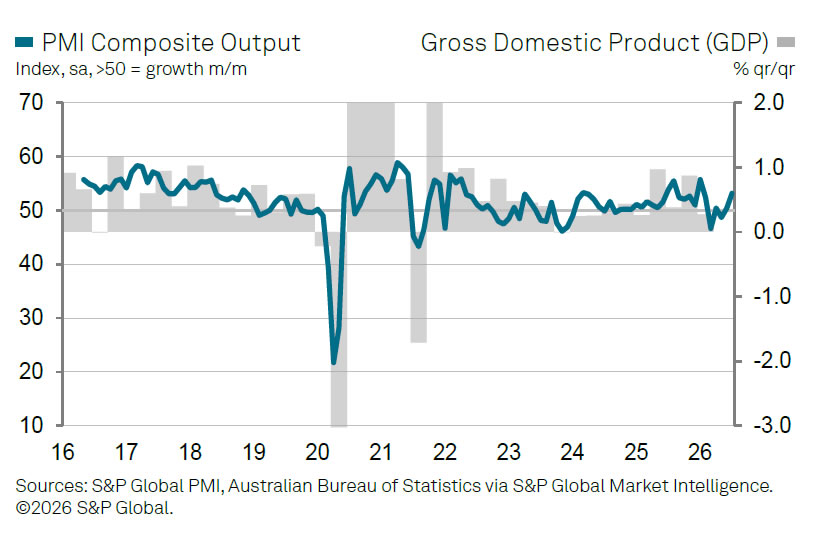
Data Summary
| Component | July | June | Trend |
|---|---|---|---|
| Services PMI | 53.6 | 50.5 | ▲ Six-month high |
| Composite PMI | 53.2 | 50.4 | ▲ Six-month high |
| Business activity | Expanded | Expanded | Fastest since January |
| New orders | Expanded | Contracted | First rise in five months |
| New export orders | Contracted | Contracted | Still weak |
| Employment | Increased | Increased | Hiring accelerated |
| Business confidence | Improved | — | More optimistic |
| Input costs | Increased | Increased | Inflation eased further |
| Output prices | Increased | Increased | Inflation accelerated |
Key Takeaways
- Australia's Services PMI jumped to 53.6, while the Composite PMI rose to 53.2, both reaching their highest levels in six months.
- Business activity strengthened across both manufacturing and services for the first time in six months, pointing to a broader-based recovery.
- New orders returned to growth after four consecutive months of contraction, signalling firmer domestic demand.
- Export demand remained a weak spot, with new export orders continuing to decline.
- Companies became more optimistic and accelerated hiring, suggesting confidence in the near-term outlook has improved.
- Inflation pressures remain mixed. While input cost inflation eased, firms raised selling prices at a faster pace, indicating ongoing efforts to rebuild margins.
- The survey points to a stronger start to Q3 GDP, but persistent price pressures and Middle East uncertainty remain risks.
New Zealand Jobs Surprise: Strong Hiring Outweighs Rise in Unemployment
New Zealand's labor market delivered a stronger-than-expected employment report for the second quarter, reinforcing the case for further RBNZ tightening even as the unemployment rate rose. Employment increased 0.5% qoq, comfortably beating expectations of 0.1%, while the Labour Cost Index accelerated to 0.7% qoq from 0.5%. The unemployment rate climbed to 5.6% from 5.3%, above the expected 5.4%, but the rise was accompanied by a higher labor force participation rate, pointing to an expanding labor supply rather than a sharp deterioration in hiring.
The underlying details painted a more balanced picture. The labor force participation rate increased to 70.7%, while the number of people employed rose 1.2% from a year earlier. Private-sector wage growth remained firm at 0.7% qoq, highlighting persistent domestic inflation pressures. At the same time, the underutilisation rate rose to 13.8%, while hours worked edged lower during the quarter, suggesting some additional slack is emerging despite robust hiring.
For the RBNZ, the report is likely to be viewed as supportive of maintaining its tightening bias rather than accelerating it. Strong employment growth and faster wage inflation reinforce concerns that domestic price pressures remain sticky, while the higher unemployment rate appears to reflect greater labor force participation rather than weakening demand for workers. The data therefore strengthen expectations that further policy tightening remains on the table, although the increase in labor market slack argues against an urgent need for more aggressive action.
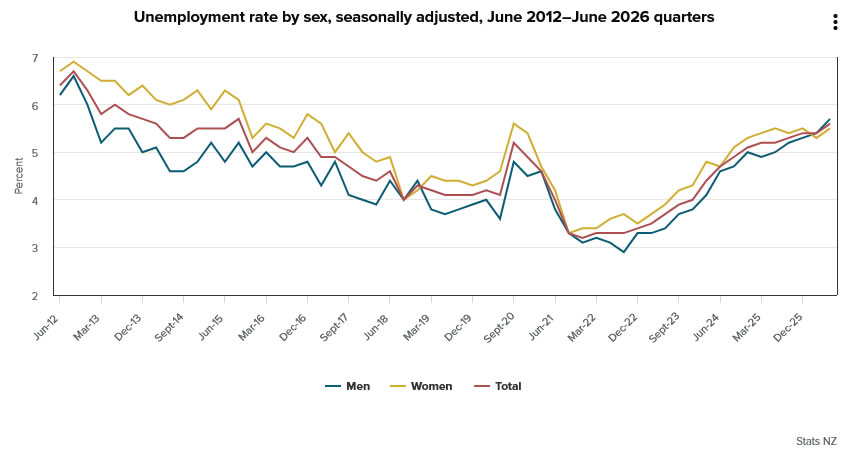
Data Summary
| Indicator | Q2 2026 | Q1 2026 | Consensus | Assessment |
|---|---|---|---|---|
| Employment Change Q/Q | +0.5% | +0.2% | +0.1% | Strong beat |
| Unemployment Rate | 5.6% | 5.3% | 5.4% | Higher than expected |
| Labour Cost Index Q/Q | +0.7% | +0.5% | +0.6% | Stronger wage growth |
| Labour Force Participation Rate | 70.7% | 70.5% | — | Higher |
| Employment Rate | 66.7% | 66.6% | — | Slightly higher |
| Underutilisation Rate | 13.8% | 13.0% | — | More slack |
| Private Sector LCI Q/Q | +0.7% | +0.5% | — | Accelerated |
| Public Sector LCI Q/Q | +0.4% | +0.4% | — | Unchanged |
Key Takeaways
- Employment growth surprised strongly to the upside, rising 0.5% q/q against expectations of 0.1%, pointing to resilient labour demand.
- The Labour Cost Index accelerated to 0.7% q/q, reinforcing concerns that domestic wage pressures remain persistent.
- Although the unemployment rate rose to 5.6%, the increase coincided with a higher labour force participation rate, suggesting more people entered the workforce rather than widespread job losses.
- The report was not uniformly strong. Underutilisation increased to 13.8% and hours worked edged lower, indicating some labour market slack is emerging.
- Overall, the data are net hawkish for the RBNZ, supporting expectations that further policy tightening remains likely, albeit at a measured pace.
- The report is supportive for the New Zealand Dollar, particularly relative to currencies backed by central banks expected to remain on hold.
WTI Crude Oil Trim Losses, Risk of More Losses Increase
Key Highlights
- WTI Crude Oil started a fresh decline from the $94.00 zone.
- A bearish trend line is forming with resistance at $80.50 on the 4-hour chart of XTI/USD.
- Gold prices are consolidating and might rise if it closes above $4,200.
- EUR/USD could start another increase if it clears 1.1560.
WTI Crude Oil Price Technical Analysis
WTI Crude Oil prices failed to surpass $94.00 against the US Dollar. The price started a fresh decline and traded below the $85.00 support zone.
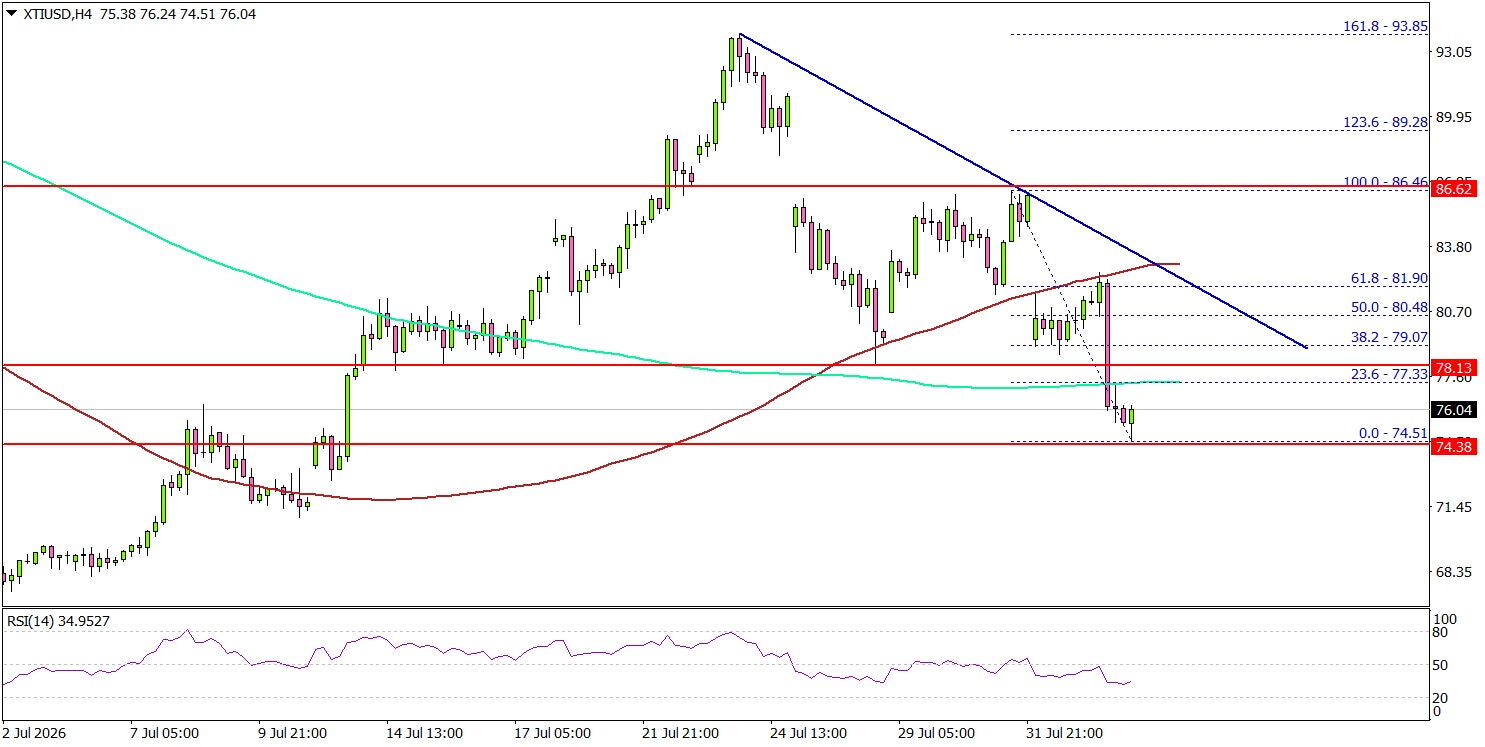
Looking at the 4-hour chart of XTI/USD, the price gained bearish momentum below $82.00 and the 100 simple moving average (red, 4-hour). The bears even pushed the price below $80.00 and the 200 simple moving average (green, 4-hour).
If the bears remain in action, there could be more losses. On the downside, the first major support could be near the $74.50 zone. The next support might be $72.80. The main support might be $70.00.
A close below $70.00 might even push the price toward $68.00. Any more losses could open the doors for a push below $66.20. On the upside, the price could face resistance at $78.10. The next resistance might be $80.50 and a connecting bearish trend line.
The first key hurdle for the bulls could be $82.50 and the 100 simple moving average (red, 4-hour). A close above $82.50 might send Oil prices toward $85.00.
Looking at Gold, the price started a decent increase, but it must settle above $4,200 to continue higher in the near term.
Economic Releases to Watch Today
- US ISM Services Index for July 2026 – Forecast 54.5, versus 54.0 previous.
- US ADP Employment Change for July 2026 - Forecast 70K, versus 98K previous.
Oil Markets Have Bought Time, Not Insurance
Highlights
- Oil prices remain hostage to geopolitics as markets continue to swing between de-escalation hopes and renewed shipping disruptions.
- The oil market has leaned on several mechanisms to absorb the shock. Key buffers like inventory drawdowns, strategic reserves, rerouted flows, and softer demand have cushioned supply losses, leaving less room to respond to future disruptions.
- Recent events are unfolding largely in line with our June outlook. Near-term risks to oil remain skewed to the upside, but we expect oil prices to moderate in Q4 and through 2027 as markets gradually rebalance.
In recent weeks, oil markets have struggled to settle on a narrative. Following the U.S.-Iran peace deal and ceasefire agreement in mid-June, WTI crude fell from roughly $85/bbl to its pre-war level of below $70/bbl, as the conflict risk premium largely evaporated. By mid-July, attacks on shipping vessels in the Strait of Hormuz and Red Sea had challenged the peace deal framework and pushed prices back to above $90/bbl. At the time of writing, prices have settled between $80-85/bbl (Chart 1).
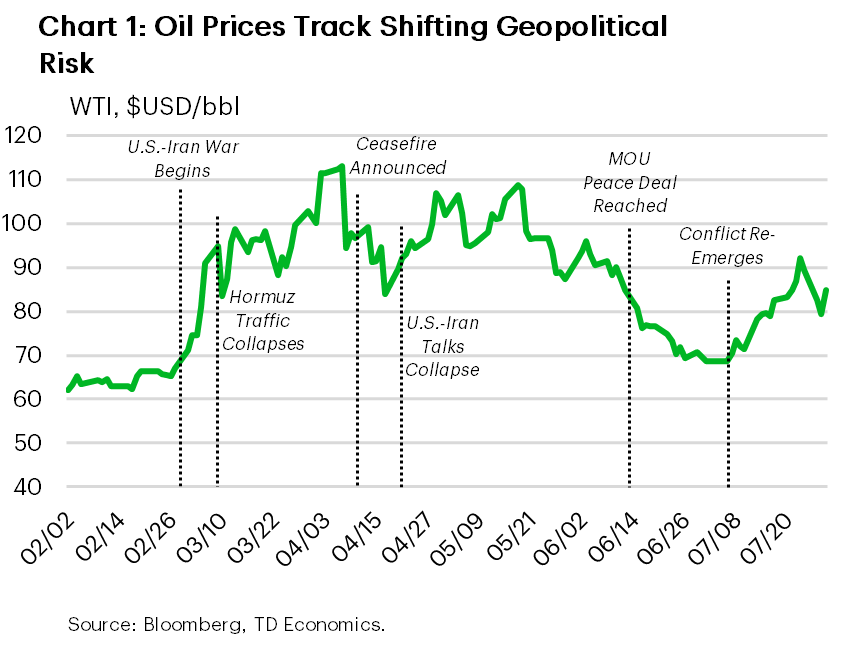
Recent conflict flare-ups underscore how quickly geopolitical risks can re-emerge and how rapidly markets can reprice risk. Together, the Strait of Hormuz and Bab el-Mandeb handle nearly 30 million barrels per day (bpd) of crude and refined product flows, equivalent to over one-quarter of global oil consumption. Hormuz carries approximately 20 million/bpd, while another 8-9 million/bpd transits the Bab el-Mandeb corridor between the Red Sea and Indian Ocean. Historically, the Red Sea route has acted as a partial pressure valve during periods of heightened Hormuz risk, allowing some Gulf producers, particularly Saudi Arabia, to redirect crude exports westward. But that safety valve becomes less effective when security concerns emerge at both chokepoints simultaneously. Where things go from here remains highly uncertain. But in this environment, markets are assessing how much more disruption they can realistically absorb if tensions escalate further.
Markets Have Adjusted, But the Margin for Error is Slimming
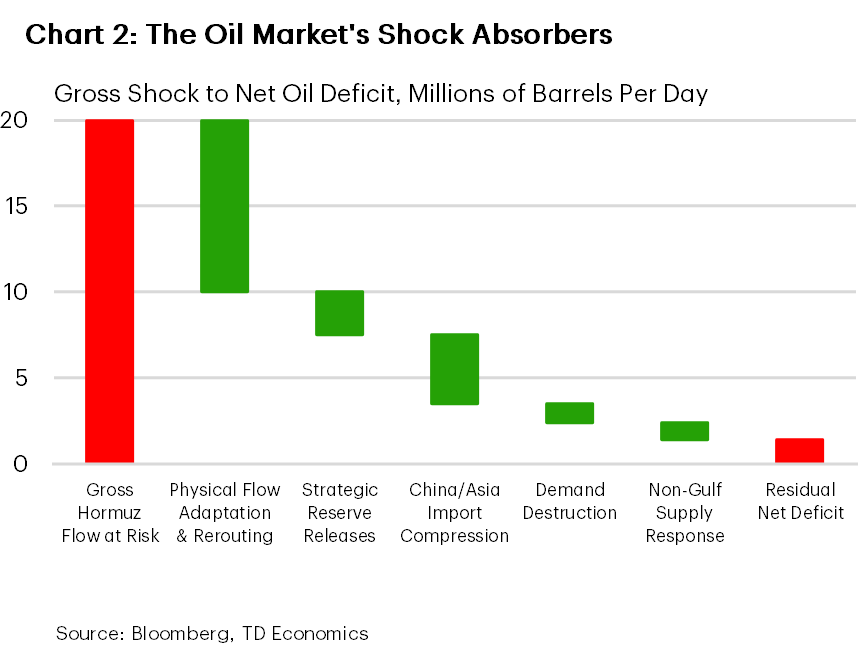
Abstracting from the recent price gyrations, the overall impact on energy markets from the supply shock has been more contained than many analysts would have expected. This can be chalked up to various adjustment mechanisms that have been working under the surface. Barrels have been rerouted where possible, strategic reserves have been released in massive quantities, inventories have been drawn down rapidly, buyers in Asia have reduced imports or leaned on stockpiles, and higher prices have encouraged some demand restraint (Chart 2). That resilience comes with an important caveat moving forward, in that many of the shock absorbers that helped stabilize the market are temporary or exhaustible.
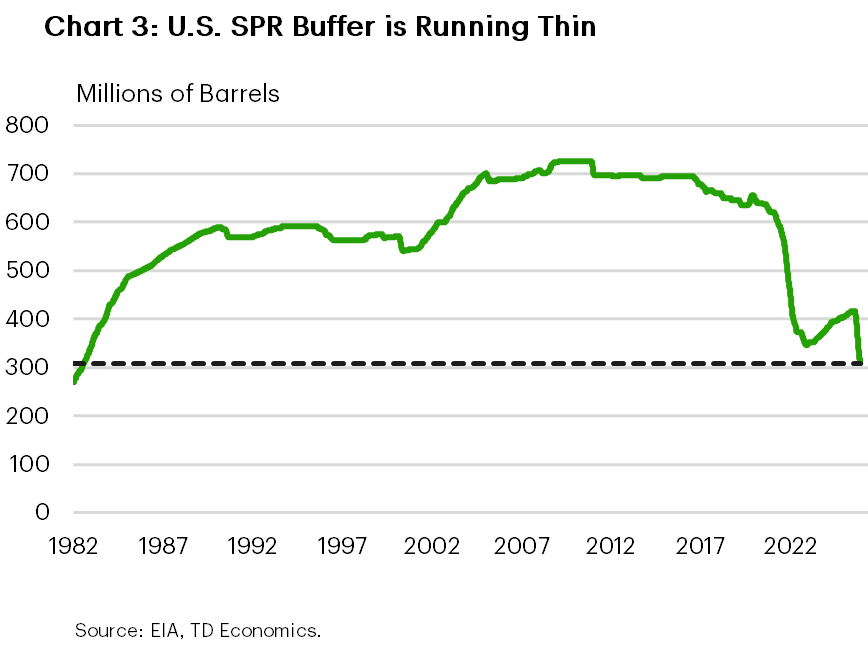
For one, strategic reserves and commercial inventories cannot be drawn down forever. The U.S. Strategic Petroleum Reserve (SPR) currently stands at roughly 310 million barrels, down from approximately 700 million barrels prior to the 2022 release program and at its lowest level since 1983 (Chart 3). Similarly, OECD petroleum inventories remain materially below pre-pandemic norms, while global inventories have continued to decline throughout 2026 as supply has struggled to keep pace with demand. Strategic releases and inventory drawdowns helped to cushion earlier shocks, but they leave the market with less flexibility the longer disruptions last.
Product markets are sending a similar warning. Even with refineries running near full tilt, U.S. refined product inventories remain lean, with gasoline stocks roughly 7% below their five-year average and distillate inventories about 10% below. That matters because the inflation risk from oil shocks is often felt most directly through refined products, especially diesel, where tight inventories and elevated crack spreads can keep pump and freight costs sticky even if crude prices ease. In other words, the market's buffer problem is not just about crude barrels, but also about the availability of finished fuels.
At the same time, crude barrels were rerouted toward the Red Sea and Asian refiners sourced more crude from the Atlantic Basin. Saudi Arabia alone redirected roughly 5-7 million/bpd of crude flows through its East-West pipeline and Red Sea export system, helping keep supplies moving despite severe disruptions in Hormuz. But those alternatives may become less effective when security concerns emerge across both the Persian Gulf and Red Sea corridors.
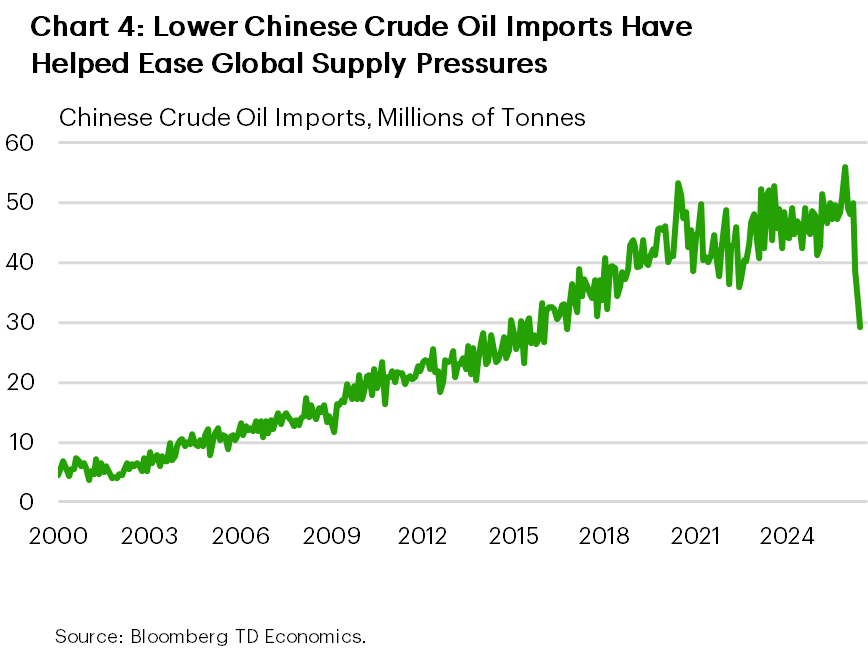
China is also an important part of the story. Weaker import demand and inventory drawdowns have helped offset some supply pressures over the past year. Relative to pre-war, Chinese crude purchases have been running roughly 4-5 million/bpd lower (Chart 4), equivalent to almost 5% of global oil demand. However, should Chinese refiners and strategic buyers decide to rebuild inventories, it could create a meaningful new source of demand just as global balances tighten. In other words, one of the adjustments that helped absorb the initial shock could become a source of future pressure.
Taken together, the market's margin for error has narrowed considerably. The lesson is not that Hormuz or Bab el-Mandeb disruptions are inconsequential. Rather, it is that buffers bought the global economy time. Any future shock (or a prolonged current shock) will be more difficult to absorb and more visible in prices, inflation, and growth.
Forecast Implications
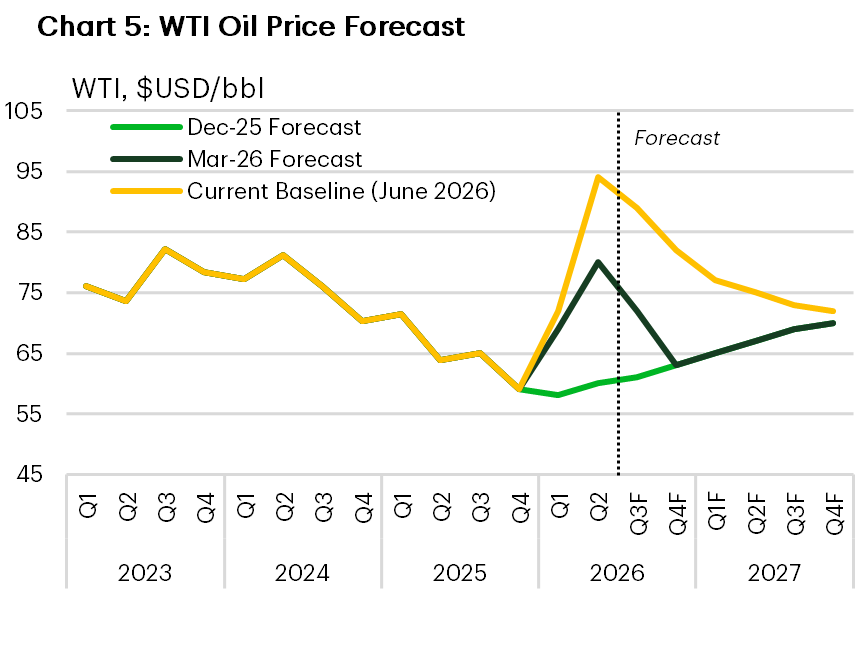
Recent developments are broadly consistent with our June outlook. At the time, we anticipated that oil markets would remain tight through the third quarter as many of the market's safeguards began to fade. So far in Q3-26, WTI prices are currently tracking close to our price target of $89/bbl on average. We remain comfortable with our existing outlook given the re-emergence of shipping risks and the market's reduced ability to absorb ongoing disruptions.
Looking ahead, our base case continues to assume that the U.S. and Iran ultimately refocus on diplomatic negotiations, allowing oil flows and tanker traffic through the Gulf region to gradually recover. As inventories stop drawing aggressively and supply normalizes, we expect prices to land in the low $80s/bbl by year-end before decelerating further into the $70s/bbl range in 2027 (Chart 5). Full market normalization will likely extend well into next year, as inventory rebuilding, insurance costs, and shipping logistics lag any political agreements reached today.
Forecasting oil prices in this environment remains exceptionally difficult, and risks remain two-sided. Weaker global growth or stronger-than-expected non-OPEC supply could place additional downward pressure on prices relative to our baseline. On the other hand, any renewed disruption to shipping lanes or Gulf production would likely have an outsized impact in the current market. On balance, we see risks slightly skewed to the upside in the coming months.
First Impressions: NZ Labour Market Surveys, June Quarter 2026
The unemployment rate rose to 5.6% in the June quarter, higher than expected. Surveyed employment growth was outweighed by a rise in participation.
- Unemployment rate: 5.6% (prev: 5.4%, Westpac: 5.4%, RBNZ: 5.4%, mkt: 5.4%)
- Employment change: 0.5% (prev: +0.1%, Westpac: +0.1%, RBNZ: +0.1%, mkt: +0.1%)
- Participation rate: 70.7% (prev: 70.4%, Westpac: 70.3%, RBNZ: 70.3%, mkt: 70.4%)
- Labour costs (private sector): +0.7% (prev: +0.5%, Westpac: +0.6%, RBNZ: +0.6%, mkt: +0.6%)
The June quarter surveys pointed to soft labour market conditions overall, but with some surprises in the details. The unemployment rate rose to 5.6%, above market and RBNZ expectations and the highest reading since September 2015. Wage growth was a little stronger than expected, but is not obviously accelerating in the face of mounting cost-of-living pressures.
The Household Labour Force Survey (HLFS) showed a surprisingly large 0.5% lift in employment in the June quarter. However, this was accompanied by an even larger rise in the labour force participation rate from 70.4% to 70.7%. Large co-movements in these measures are typically an indicator of sampling error in the survey, and indeed there is other evidence that labour demand was not as strong as these figures suggest. The Monthly Employment Indicator (MEI) suggests a rise of around 0.1% in filled jobs over the quarter, while the employer-focused Quarterly Employment Survey (QES) showed a 0.4% fall in filled jobs and a 0.3% fall in hours paid.
In these circumstances we generally recommend focusing on the unemployment rate, which is less vulnerable to sampling error (but not immune). The rise in unemployment to 5.6% was larger than we and the market were expecting, and follows an upward revision in the March quarter to 5.4% (previously reported as a fall to 5.3%). A move of this size is in line with the long-run history of this series – the last five years or so have been relatively unusual in terms of how smoothly the unemployment rate has evolved. And our Westpac McDermott-Miller Employment Confidence Survey had suggested a reasonable lift in labour market slack in the quarter.
The Labour Cost Index (LCI) showed a 0.7% rise in private sector wages and salaries for the quarter, leaving annual growth unchanged at 2.0%. Public sector wages were more subdued at 0.5% for the quarter and 1.7% for the year. The results were a little stronger than we assumed, but they point to a stabilisation rather than an accelerating in wage pressures. The distribution of pay increases was unchanged from last quarter, with increases converging on the 2-3% range. While more employers are citing the cost of living as a reason for increasing pay rates, fewer are citing the need to attract or retain workers – that is, it suggests a shift in the justification rather than a groundswell for larger pay rises.
Overall, we think the details are mixed from the RBNZ’s perspective. The unemployment rate rose by more than expected, and although the employment measures were mixed, on average they support our expectation of soft growth in activity over the quarter. (This will be compounded by the seasonal distortion in the GDP figures, which mean that the June quarter result will likely print negative). Wage growth showed some signs of passthrough from higher inflation, but otherwise the demand for labour appears soft.
CADJPY Wave Analysis
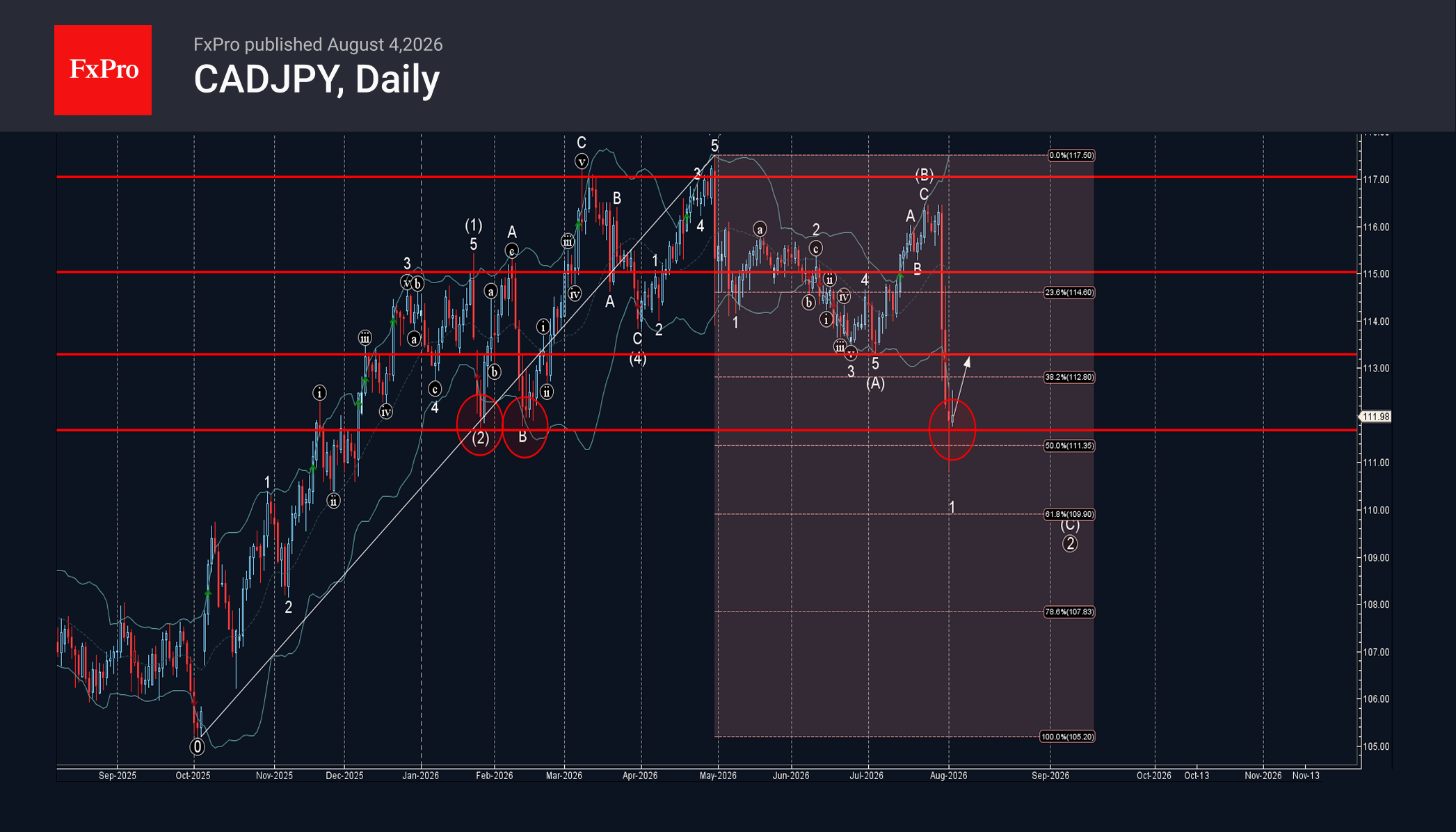
CADJPY: ⬆️ Buy
– CADJPY reversed from support zone
– Likely to rise to resistance level 113.30
CADJPY currency pair recently reversed from the support zone between the key support level 111.85 (which has been reversing the price from January), 50% Fibonacci correction of the upward impulse from October and the lower daily Bollinger Band.
The upward reversal from the support level 111.85 stopped the previous sharp downward impulse wave 1.
Given the strength of the support level 111.85 bullish Canadian dollar sentiment seen today, CADJPY currency pair can be expected to further to the next resistance level 113.30.
Platinum Wave Analysis
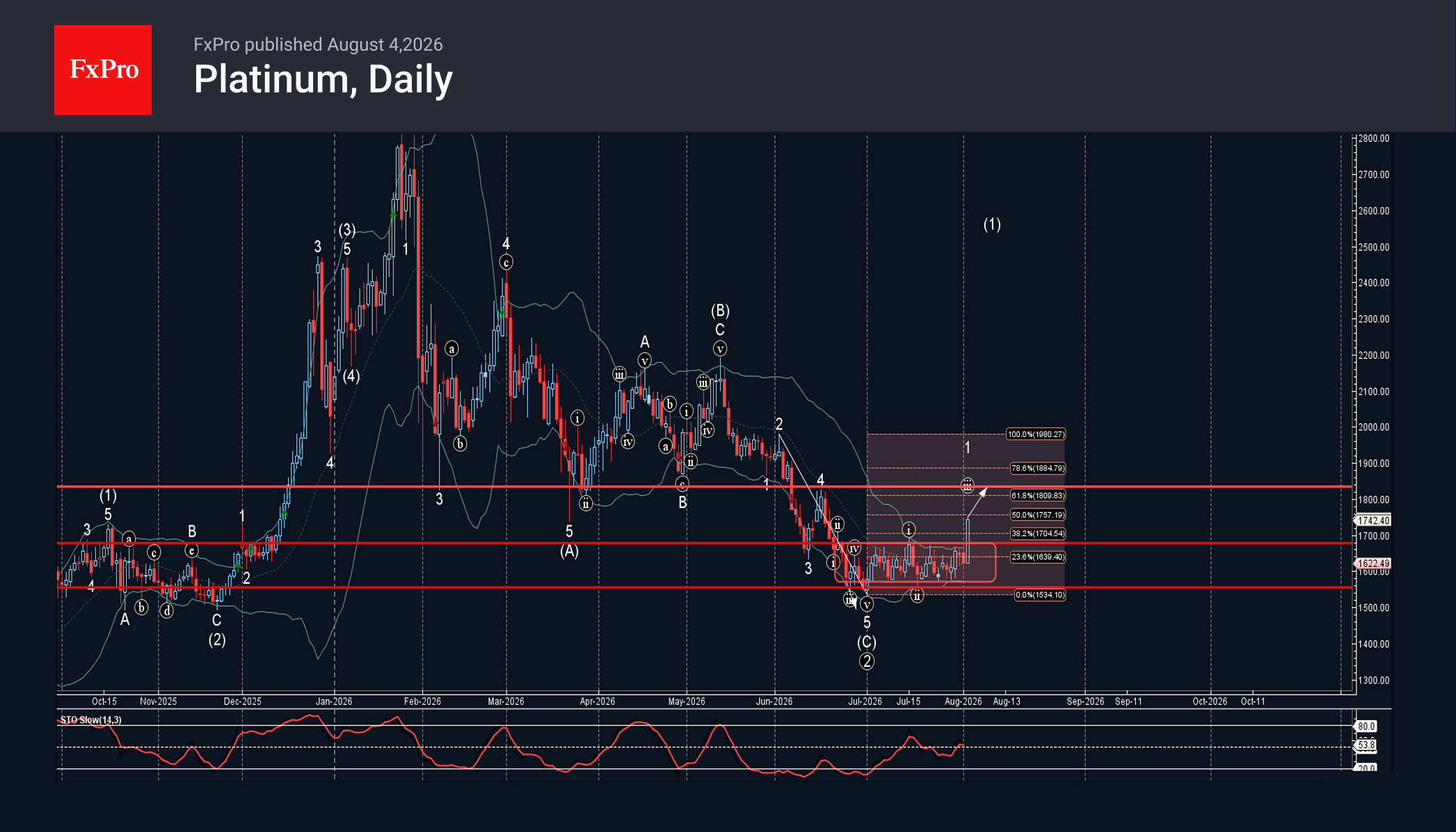
Platinum: ⬆️ Buy
– Platinum broke resistance level 1680.00
– Likely to rise to resistance level 1835.00
Platinum recently broke the resistance level 1680.00 (which is the upper border of the narrow sideways price range inside which the price has been moving from the end of June).
The breakout of the resistance level 1680.00 coincided with the breakout of the 38.2% Fibonacci correction of the downward impulse from the start of June.
Platinum can be expected to rise further to the next resistance level 1835.00 (top of wave 4 from the start of June).
S&P 500 Wave Analysis
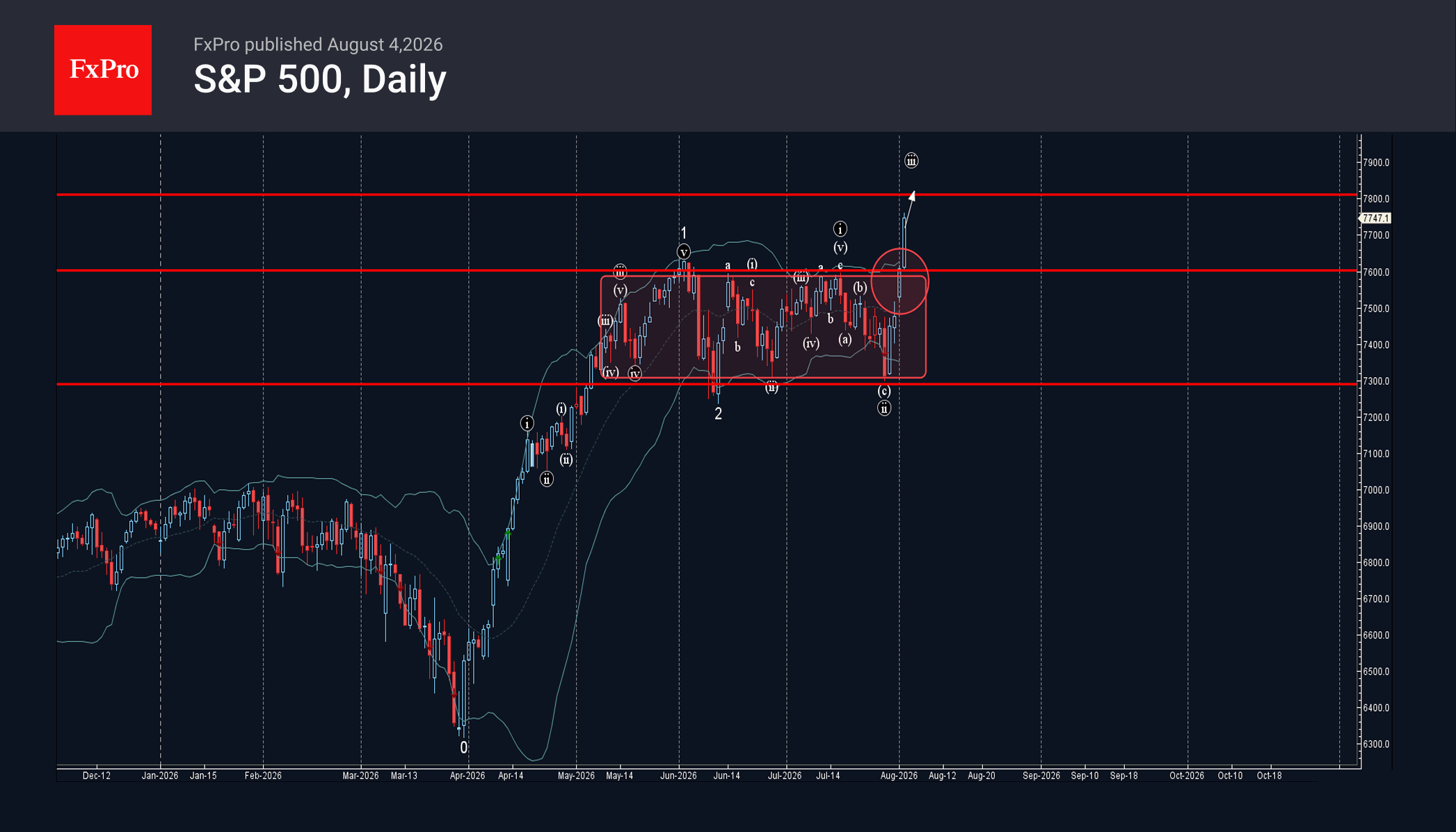
S&P 500: ⬆️ Buy
– S&P 500 broke resistance level 7600.0
– Likely to rise to resistance level 7800.00
S&P 500 recently broke above the pivotal resistance level 7600.0 (upper border of the sideways price range inside which the price has been moving from the start of May).
The breakout of the resistance level 7600.00 accelerated the active impulse wave iii – that belongs to the impulse wave 3 from June.
Given the strong daily uptrend, S&P 500 can be expected to rise further to the next resistance level 7800.00 (target for the completion of the active impulse wave iii).
Eco Data 8/5/26
| GMT | Ccy | Events | Act | Cons | Prev | Rev |
|---|---|---|---|---|---|---|
| 22:45 | NZD | Unemployment Rate Q2 | 5.60% | 5.40% | 5.30% | 5.40% |
| 22:45 | NZD | Employment Change Q2 | 0.50% | 0.10% | 0.20% | |
| 22:45 | NZD | Labour Cost Index Q/Q Q2 | 0.70% | 0.60% | 0.50% | |
| 23:00 | AUD | Services PMI Jul F | 53.6 | 53 | 53 | |
| 23:30 | JPY | Labor Cash Earnings Y/Y Jun | 3.40% | 3.40% | 3.20% | |
| 23:50 | JPY | BoJ Minutes | ||||
| 00:30 | JPY | Services PMI Jul F | 51.2 | 51.9 | 51.9 | |
| 01:45 | CNY | RatingDog Services PMI Jul | 50.4 | 53.7 | 54.1 | |
| 06:45 | EUR | France Industrial Output M/M Jun | 0.10% | 0.30% | -0.10% | |
| 07:50 | EUR | France Services PMI Jul F | 49.6 | 49.8 | 49.8 | |
| 07:55 | EUR | Germany Services PMI Jul F | 49.8 | 49.6 | 49.6 | |
| 08:00 | EUR | Eurozone Services PMI Jul F | 51.7 | 51.6 | 51.6 | |
| 08:30 | GBP | Services PMI Jul F | 52.1 | 51.8 | 51.8 | |
| 09:00 | EUR | Eurozone PPI M/M Jun | -0.30% | -0.30% | 0.20% | |
| 09:00 | EUR | Eurozone PPI Y/Y Jun | 4.60% | 4.60% | 5.90% | |
| 12:15 | USD | ADP Employment Change Jul | 44K | 75K | 98K | 95K |
| 13:45 | USD | Services PMI Jul F | 54.6 | 53.6 | 53.6 | |
| 14:00 | USD | ISM Services PMI Jul | 54.1 | 54.2 | 54 | |
| 14:00 | USD | ISM Services Prices Paid Jul | 70.3 | 67.7 | ||
| 14:00 | USD | ISM Services Employment Index Jul | 47.4 | 51.2 | ||
| 14:30 | USD | Crude Oil Inventories (Jul 31) | 2.5M | -1.5M | -7.2M |
| 22:45 | NZD |
| Unemployment Rate Q2 | |
| Actual | 5.60% |
| Consensus | 5.40% |
| Previous | 5.30% |
| Revised | 5.40% |
| 22:45 | NZD |
| Employment Change Q2 | |
| Actual | 0.50% |
| Consensus | 0.10% |
| Previous | 0.20% |
| 22:45 | NZD |
| Labour Cost Index Q/Q Q2 | |
| Actual | 0.70% |
| Consensus | 0.60% |
| Previous | 0.50% |
| 23:00 | AUD |
| Services PMI Jul F | |
| Actual | 53.6 |
| Consensus | 53 |
| Previous | 53 |
| 23:30 | JPY |
| Labor Cash Earnings Y/Y Jun | |
| Actual | 3.40% |
| Consensus | 3.40% |
| Previous | 3.20% |
| 23:50 | JPY |
| BoJ Minutes | |
| Actual | |
| Consensus | |
| Previous | |
| 00:30 | JPY |
| Services PMI Jul F | |
| Actual | 51.2 |
| Consensus | 51.9 |
| Previous | 51.9 |
| 01:45 | CNY |
| RatingDog Services PMI Jul | |
| Actual | 50.4 |
| Consensus | 53.7 |
| Previous | 54.1 |
| 06:45 | EUR |
| France Industrial Output M/M Jun | |
| Actual | 0.10% |
| Consensus | 0.30% |
| Previous | -0.10% |
| 07:50 | EUR |
| France Services PMI Jul F | |
| Actual | 49.6 |
| Consensus | 49.8 |
| Previous | 49.8 |
| 07:55 | EUR |
| Germany Services PMI Jul F | |
| Actual | 49.8 |
| Consensus | 49.6 |
| Previous | 49.6 |
| 08:00 | EUR |
| Eurozone Services PMI Jul F | |
| Actual | 51.7 |
| Consensus | 51.6 |
| Previous | 51.6 |
| 08:30 | GBP |
| Services PMI Jul F | |
| Actual | 52.1 |
| Consensus | 51.8 |
| Previous | 51.8 |
| 09:00 | EUR |
| Eurozone PPI M/M Jun | |
| Actual | -0.30% |
| Consensus | -0.30% |
| Previous | 0.20% |
| 09:00 | EUR |
| Eurozone PPI Y/Y Jun | |
| Actual | 4.60% |
| Consensus | 4.60% |
| Previous | 5.90% |
| 12:15 | USD |
| ADP Employment Change Jul | |
| Actual | 44K |
| Consensus | 75K |
| Previous | 98K |
| Revised | 95K |
| 13:45 | USD |
| Services PMI Jul F | |
| Actual | 54.6 |
| Consensus | 53.6 |
| Previous | 53.6 |
| 14:00 | USD |
| ISM Services PMI Jul | |
| Actual | 54.1 |
| Consensus | 54.2 |
| Previous | 54 |
| 14:00 | USD |
| ISM Services Prices Paid Jul | |
| Actual | 70.3 |
| Consensus | |
| Previous | 67.7 |
| 14:00 | USD |
| ISM Services Employment Index Jul | |
| Actual | 47.4 |
| Consensus | |
| Previous | 51.2 |
| 14:30 | USD |
| Crude Oil Inventories (Jul 31) | |
| Actual | 2.5M |
| Consensus | -1.5M |
| Previous | -7.2M |
US JOLTS Job Openings Slip, But Labor Market Still Shows No Meaningful Weakness
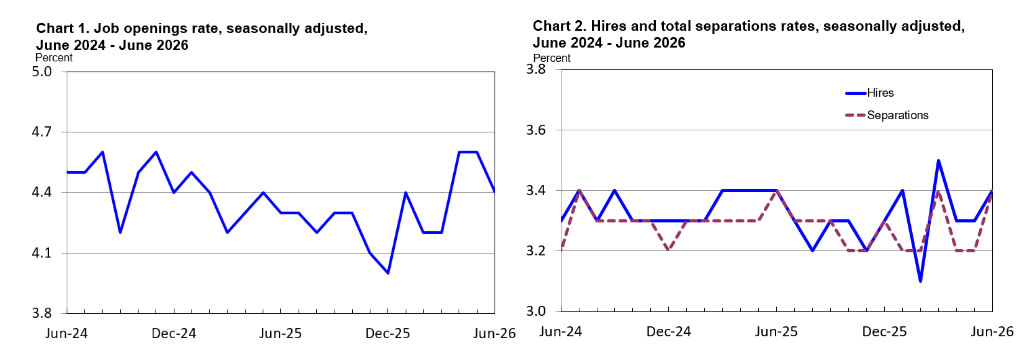
US job openings edged lower in June, but the broader picture remained one of a labor market that is cooling gradually rather than deteriorating. The Job Openings and Labor Turnover Survey (JOLTS) showed vacancies easing from a revised 7.54 million in May to 7.36 million, while the job openings rate slipped from 4.5% to 4.4%. Hires were little changed at 5.35 million, and total separations also held broadly steady, suggesting labor demand remains resilient despite restrictive monetary policy.
The details offered little evidence of broad-based weakness. Job openings increased in transportation, warehousing and utilities as well as federal government, but declined in wholesale trade, nondurable goods manufacturing, and mining and logging. Workers' willingness to change jobs remained subdued, with quits unchanged at 3.2 million, while layoffs and discharges also held steady at 1.8 million, reinforcing the view that employers continue to retain staff despite slower hiring momentum.
The report is unlikely to materially alter expectations for Federal Reserve policy. Coming after Monday's stronger-than-expected ISM Manufacturing survey, the JOLTS data suggest the labor market remains sufficiently firm to support the Fed's wait-and-see approach. Attention now shifts to ADP employment on Wednesday and Friday's Non-Farm Payrolls report, which are likely to carry much greater weight in determining whether markets increase or scale back expectations for another rate hike later this year.
Data Summary
| Indicator | June 2026 | May 2026 (Rev.) | Trend |
|---|---|---|---|
| Job openings | 7.359M | 7.537M | ▼ -178K |
| Job openings rate | 4.4% | 4.5% | Slightly lower |
| Hires | 5.348M | 5.252M | Broadly unchanged |
| Hires rate | 3.4% | 3.3% | Slightly higher |
| Total separations | 5.351M | 5.260M | Little changed |
| Separations rate | 3.4% | 3.3% | Stable |
| Quits | 3.170M | 3.170M | Unchanged |
| Quits rate | 2.0% | 2.0% | Unchanged |
| Layoffs & discharges | 1.828M | 1.811M | Little changed |
| Layoffs rate | 1.1% | 1.1% | Unchanged |
Notable Industry Changes
| Category | June Change |
|---|---|
| Job openings | |
| Transportation, warehousing & utilities | ▲ +97K |
| Federal government | ▲ +39K |
| Wholesale trade | ▼ -74K |
| Nondurable manufacturing | ▼ -55K |
| Mining & logging | ▼ -9K |
| Hires | |
| Federal government | ▼ -6K |
| Quits | |
| Federal government | ▼ -4K |
Key Takeaways
- Job openings edged down to 7.36 million, but remained consistent with a labor market that is cooling gradually rather than weakening sharply.
- Hiring held broadly steady at 5.35 million, while the hires rate ticked up to 3.4%, indicating employers continue to add workers.
- Layoffs and discharges remained unchanged at 1.8 million, suggesting companies are still reluctant to reduce headcount.
- Workers' willingness to change jobs remained subdued, with quits holding steady at 3.2 million and the quits rate unchanged at 2.0%.
- Transportation and warehousing led gains in job openings, while wholesale trade and nondurable manufacturing softened.
- The report is unlikely to materially change Fed expectations, leaving attention firmly on ADP employment and Friday's Non-Farm Payrolls.