

Sample Category Title
GBP/JPY Daily Outlook
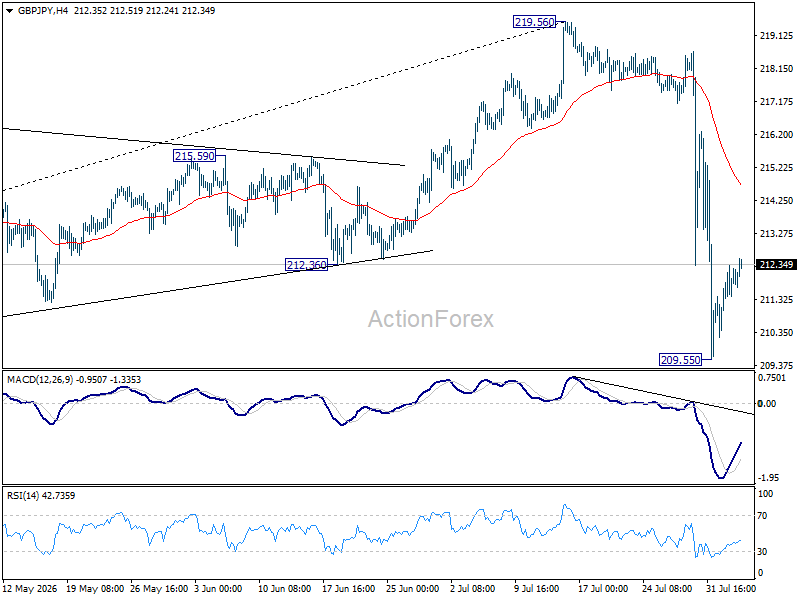
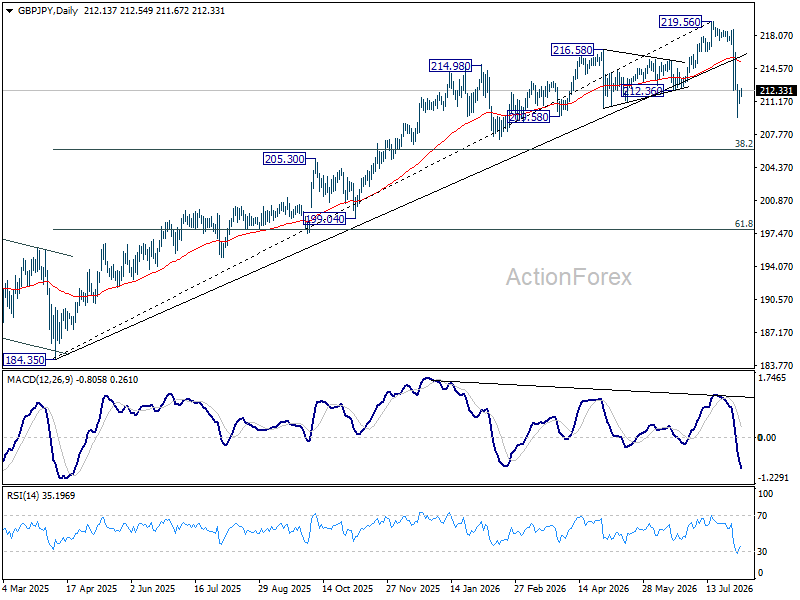
Intraday bias in GBP/JPY remains neutral and more consolidations would be seen above 209.55 temporary low. Risk will stay on the downside as long as 55 4H EMA (now at 214.69) holds. Below 209.55 will extend the fall from 219.56 to 38.2% retracement of 184.35 to 219.56 at 206.10.
In the bigger picture, as long as 55 W EMA (now at 208.85) holds, the long term up trend is still expected to continue. But some more consolidations should be seen below 219.56 medium term top first. However, sustained break of 55 W EMA will argue that it's already in a medium term down trend to 184.35 support and below.
EUR/JPY Daily Outlook
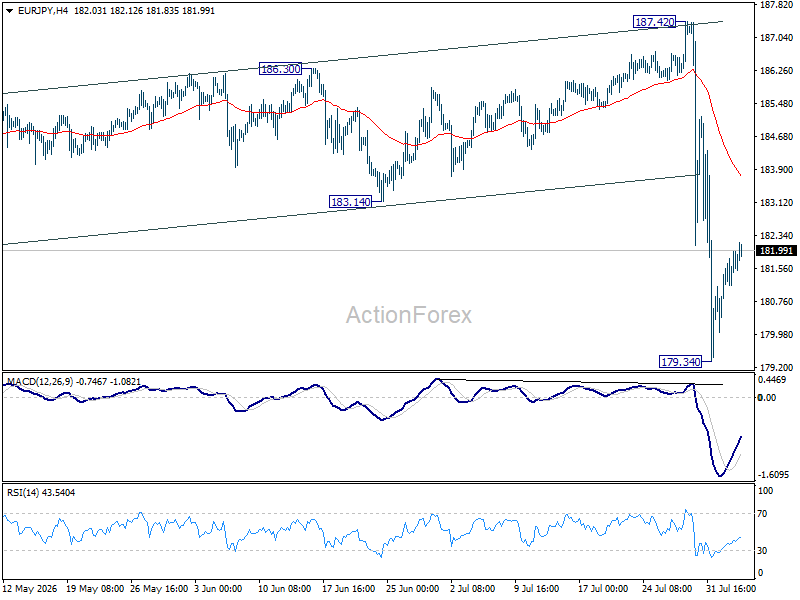
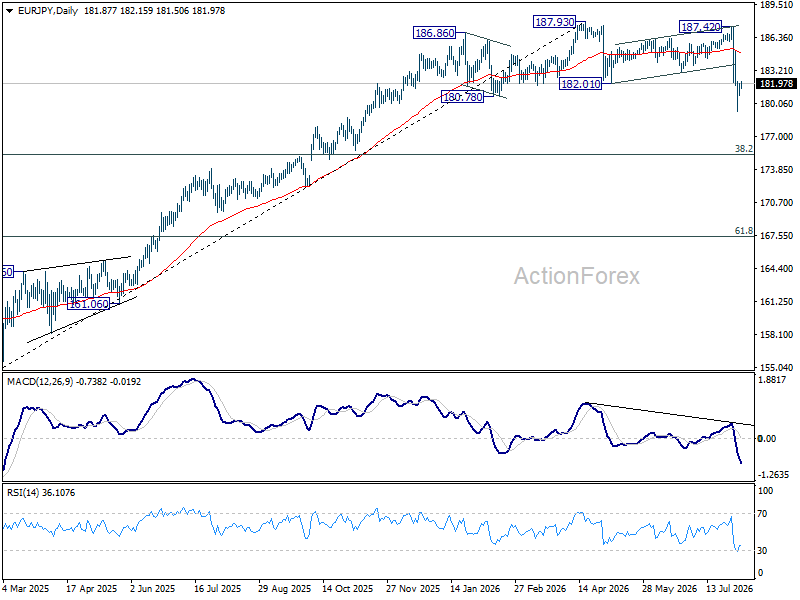
Intraday bias in EUR/JPY and more consolidations could be seen above 179.34 temporary low. Risk will remain on the downside as long as 55 4H EMA (now at 183.74) holds. Below 179.34 will extend the decline from 187.93 to 38.2% retracement of 154.77 to 187.93 at 175.26.
In the bigger picture, uptrend from 114.42 (2020 low) is still expected to resume at a later stage to 78.6% projection of 124.37 (2022 low) to 175.41 (2025 high) from 154.77 at 194.88. However, sustained break of 55 W EMA (now at 180.26) will argue that it's already in a medium term down trend to 175.41 resistance turned support and below.
EUR/GBP Daily Outlook
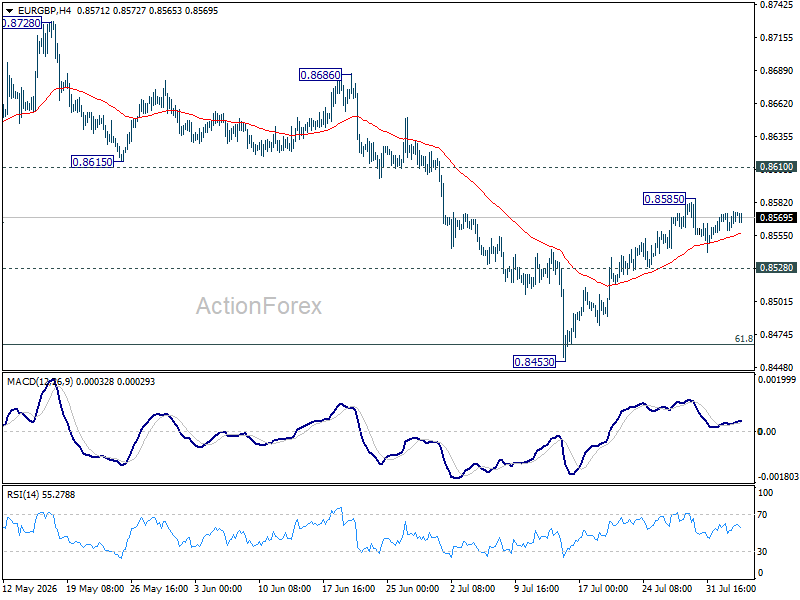
Intraday bias in EUR/GBP stays neutral and outlook is unchanged. While another rise cannot be ruled out, strong resistance should be seen from 0.8610 support turned resistance to limit upside. On the downside, break of 0.8258 support will argue that the corrective rebound from 0.8453 has completed, and turn bias back to the downside for retesting this low.
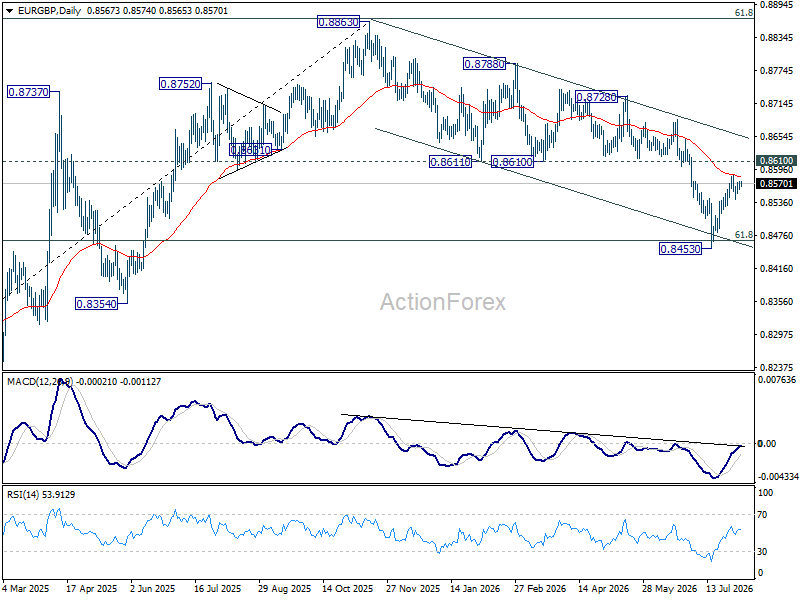
In the bigger picture, rise from 0.8221 (2024 low) should have completed at 0.8863, just ahead of 38.2% retracement of 0.9267 (2025 high) to 0.8221 at 0.8867. Deeper fall would be seen back to 0.8221. For now, outlook will be neutral at best as long as 0.8610 support turned resistance hold.
EUR/AUD Daily Outlook
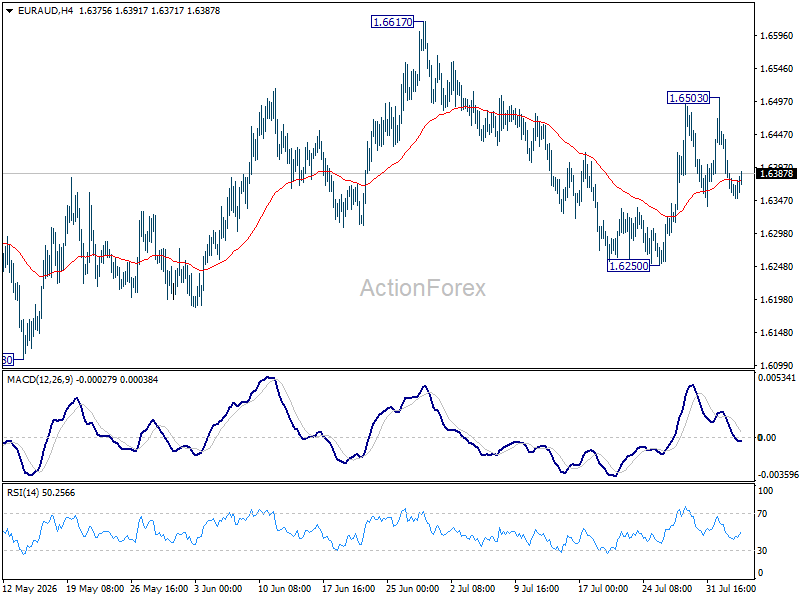
Intraday bias in EUR/AUD stays neutral at this point. Overall, near term corrective pattern from 1.6108 (or 1.6125) is still extending. On the upside, above 1.6503 will target 1.6617 resistance first. On the downside, break of 1.6250 will bring deeper fall back to retest 1.6108 low.
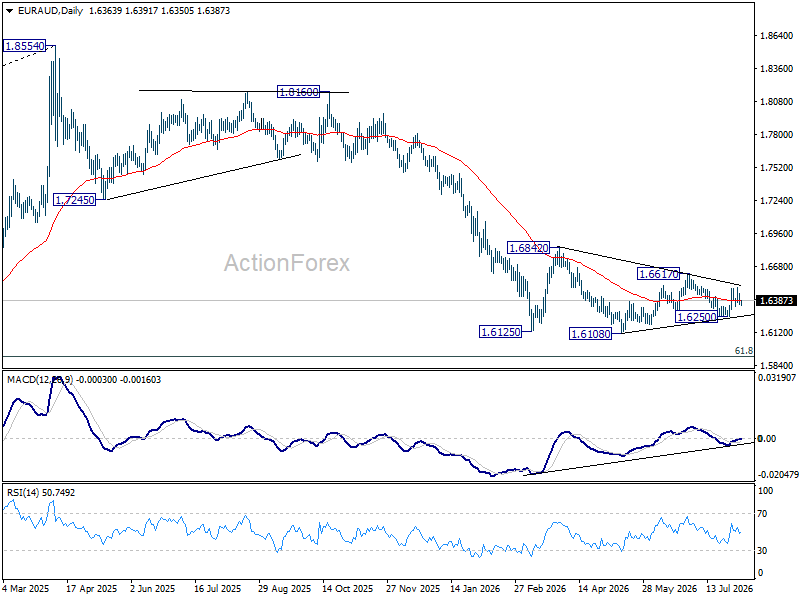
In the bigger picture, outlook will stay bearish as long as 1.6842 resistance holds. Fall from 1.8554 (2025 high) is expected to continue to 61.8% retracement of 1.4281 to 1.8554 at 1.5913. Decisive break there will pave the way back to 1.4281 (2022 low). However, firm break of 1.6842 should confirm medium term bottoming, and bring stronger rally.
EUR/CHF Daily Outlook
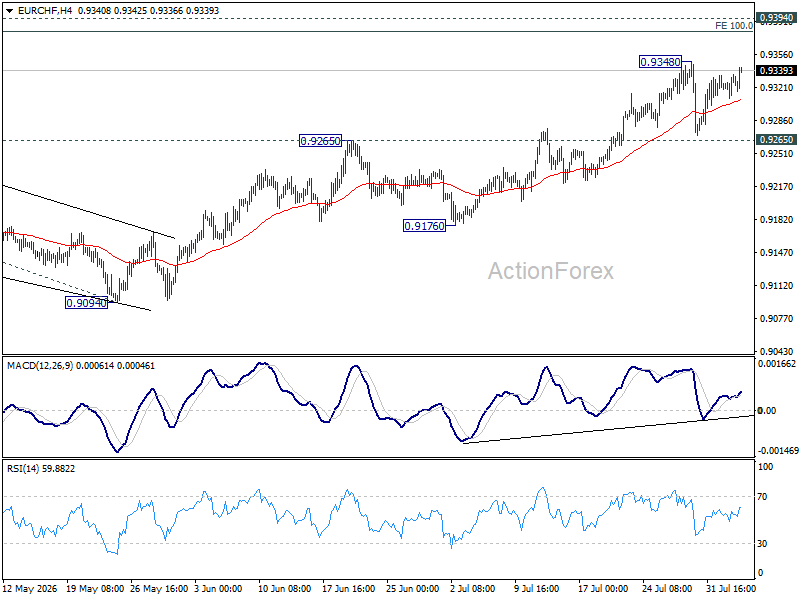
EUR/CHF is still bounded in range below 0.9348 and intraday bias remains neutral. More consolidations could be seen. With 0.9265 support intact, further rally is expected. On the upside, firm break of 0.9348 will extend larger rally from 0.8979 to 100% projection of 0.8979 to 0.9264 from 0.9094 at 0.9379. However, firm break of 0.9265 will indicate that deeper correction is underway to 55 D EMA (now at 0.9241).
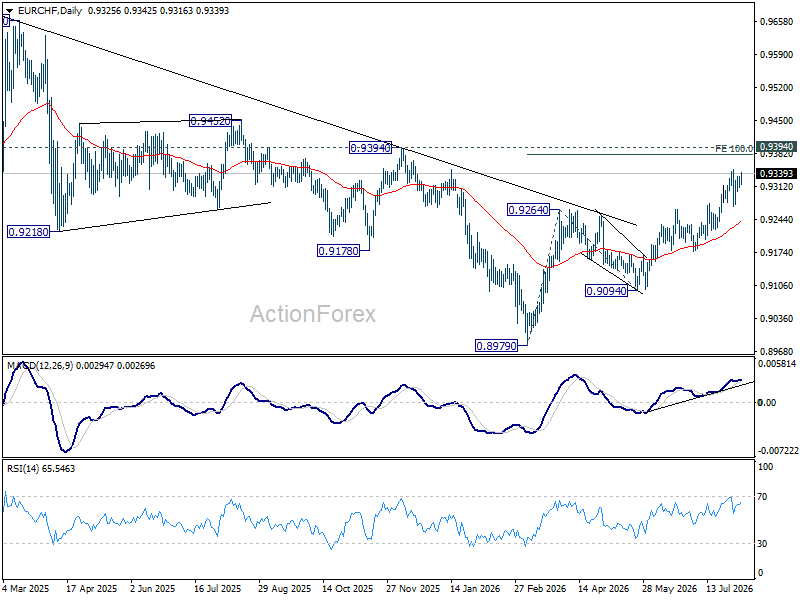
In the bigger picture, considering bullish divergence condition in W MACD, rise from 0.8979 medium term bottom should at least be reversing the fall from 0.9928, with prospect of developing into a medium term up trend. Firm break of 0.9394 resistance will add more credence to this case. For now risk will remain on the upside as long as 0.9094 support holds, in case of retreat.
USD/JPY Holds Steady After Intervention: Outlook Remains Uncertain
USD/JPY fell to 157.47 on Wednesday, with the Japanese yen pausing its recent strengthening. US Treasury Secretary Scott Bessent reaffirmed Washington’s support for Japan following the historic joint currency intervention.
Over three sessions, the yen appreciated by nearly 5% after coordinated purchases by Tokyo and Washington, marking the largest such operation in decades. Both countries have declared their readiness to intervene again if necessary.
According to the Bank of Japan, Tokyo deployed approximately 5.33 trillion yen during Friday’s operations to support the currency. The previous day, media reports indicated that intervention volumes had reached a record 8.45 trillion yen.
In July 2026, the yen had fallen to four-decade lows, weighed down by rising energy prices, budget risks, and a wide interest rate differential. In parallel, real wages in Japan rose for the sixth consecutive month in June, strengthening the case for further rate hikes by the Bank of Japan.
Technical Analysis
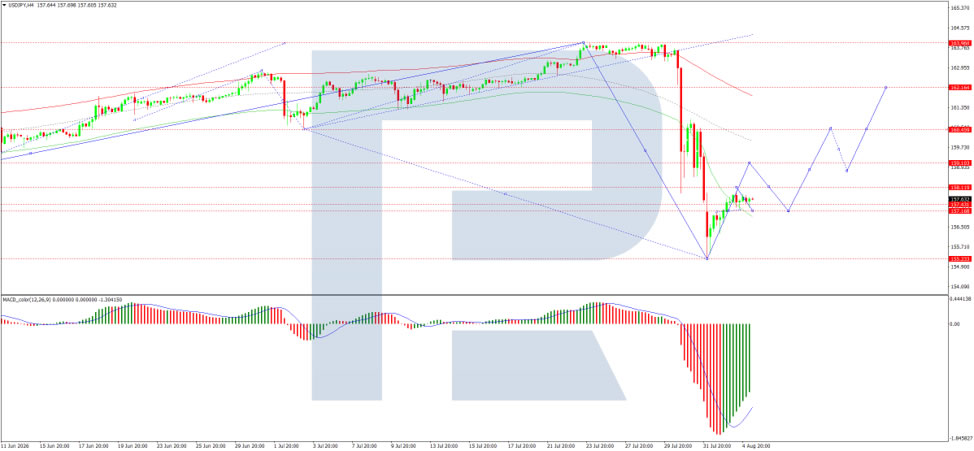
On the H4 USD/JPY chart, the market is forming a consolidation range around the 157.17 level, currently extending up to 157.90. A move lower towards 157.17 is expected today, followed by a move higher to 159.10. The MACD indicator supports this scenario, with its signal line below zero and pointing upwards.
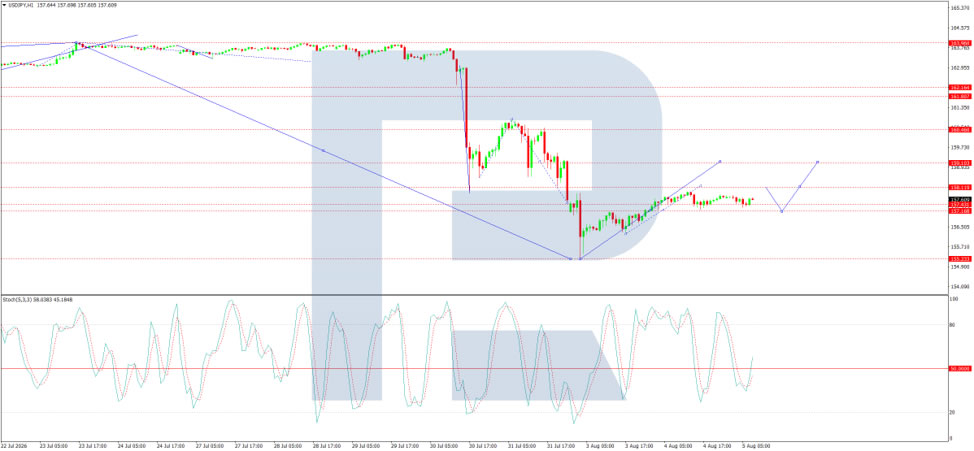
On the H1 chart, USD/JPY has completed a downward move to 156.22, followed by a rise to 157.90. A move lower towards at least 157.17 is expected next, followed by a move higher to 159.10. The Stochastic oscillator confirms this scenario, with its signal line below 50 and pointing downwards towards 20, indicating short-term downside pressure.
Conclusion
USD/JPY has stabilised after a historic joint intervention by Japanese and US authorities, which drove a nearly 5% appreciation in the yen over three sessions. Both countries have signalled readiness to act again if needed, with Tokyo deploying record intervention volumes. The yen had previously fallen to multi-decade lows due to high energy prices, fiscal concerns, and interest rate differentials. However, rising real wages and signals from the Bank of Japan may support further yen strength. Technically, USD/JPY appears to be consolidating around 157.17, with a potential pullback towards this level before resuming an upward move to 159.10. The pair’s direction remains uncertain, hinging on further intervention, Bank of Japan policy signals, and global risk sentiment.
Oil Nearing a Bad Deal
- US involvement in FX interventions has weakened the dollar.
- Brent is banking on a de-escalation of the conflict in the Middle East.
The US dollar has pulled back amid strong headwinds. The S&P 500 hit a new record high, Brent plunged below $80 a barrel, and yields on US Treasury bonds fell. These asset movements point to an improvement in global risk appetite while safe-haven currencies, including the greenback, come under pressure.
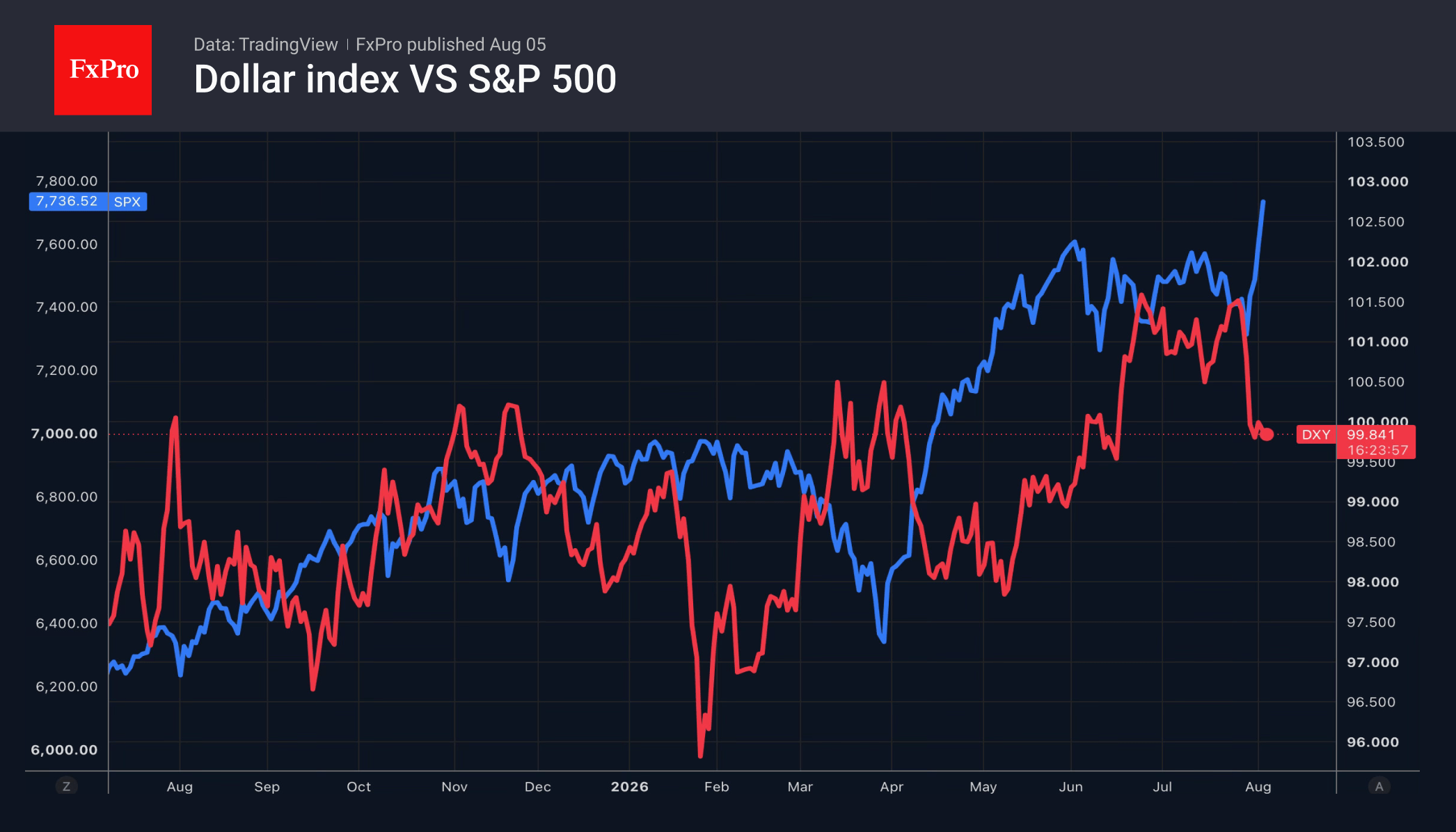
Scott Bessent’s statement on the reasons for US participation in currency interventions coordinated with Japan further pressured the USD index. According to the Treasury Secretary, if the yen continued to weaken, it would trigger a chain reaction of other currencies depreciating against the dollar, which would in turn harm US exporters. Furthermore, the yen’s weakness has, in the past, fuelled economic instability worldwide. A prime example is the Asian financial crisis of the 1990s.
Thus, US involvement in these interventions can be interpreted as a measure aimed at achieving the competitive devaluation of the dollar. Eliminating economic instability is equivalent to reducing demand for the greenback as a safe-haven asset.
However, the fall in the USD index was largely driven by another statement from Scott Bessent, suggesting that a deal with Iran would be reached any day now. Combined with Qatar’s message regarding the mediators’ successes, Saudi Arabia’s intentions to pursue a diplomatic path in its relations with the Houthis, and Axios’s report that Iran and Oman are close to an agreement to open the Strait of Hormuz, this sent Brent plunging to its lowest level since 13 July.
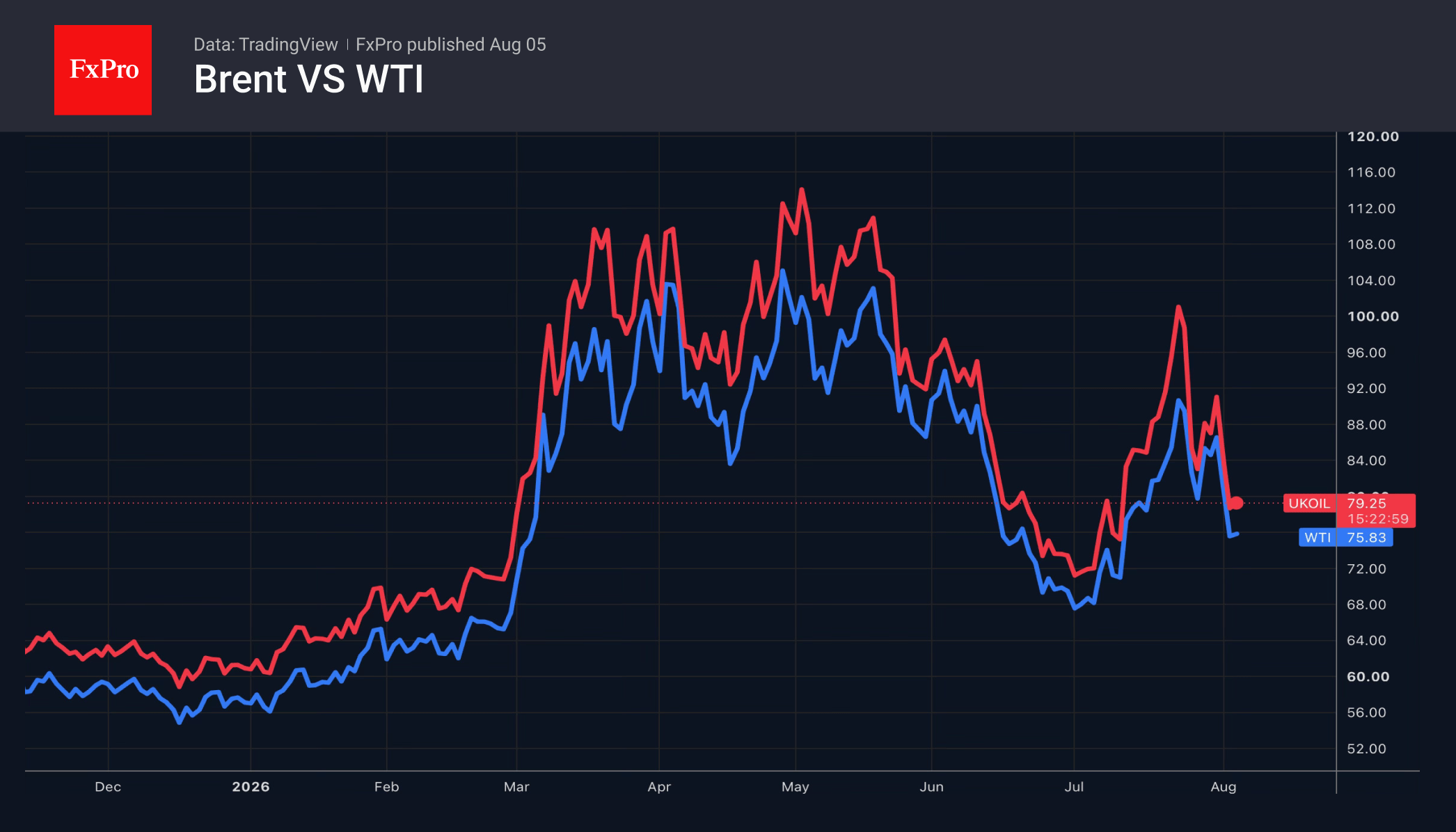
Mizuho believes a deal unfavourable to the US will be concluded, one that will fail to resolve a host of outstanding issues. IG notes that the main sticking point is the transit fee for the Strait of Hormuz. Tehran seeks compensation for losses incurred during the conflict. However, will Washington agree to this?
Meanwhile, traffic through the world’s main oil artery remains subdued. According to Kpler, only nine vessels have passed through the Strait of Hormuz, compared with 130–140 before the conflict in the Middle East. The American Petroleum Institute estimates that traffic has fallen from 20 to 6 million barrels per day. The situation remains tense, and a breakdown in negotiations could quickly return control of the market to the bulls.
The FxPro Analyst Team
AUD/USD Is Rising. Why Isn’t It Rising Faster?
TL;DR: AUD/USD is rallying on improving risk sentiment and a softer Dollar, but the same falling oil prices driving that optimism are also weakening two of Australia's own fundamental supports — explaining why the pair has lagged the broader market risk momentum.
A Rally That Looks Surprisingly Restrained
AUD/USD has staged a rally over the past two days, benefiting from a broad improvement in global risk sentiment, a softer US Dollar, and surging industrial commodity prices. Yet the Aussie's momentum has looked surprisingly restrained. Wall Street has pushed to fresh record highs, Asian equities have rebounded, and copper has climbed to another record — but AUD/USD has merely edged toward resistance rather than breaking decisively higher.
The contrast suggests the market is weighing two very different implications of the same geopolitical story. Optimism that the Strait of Hormuz could reopen is undoubtedly supporting risk assets globally, but it's also lowering oil prices in a way that weakens some of Australia's own fundamental supports. The result is a currency pair caught between powerful global tailwinds and equally meaningful domestic headwinds.
Risk Appetite Is Providing Plenty of Support
There's little doubt the global backdrop has become more supportive for growth-sensitive currencies. The Dow Jones Industrial Average climbed to another record high overnight, while both Japan's Nikkei and South Korea's KOSPI surged more than 3.5%, reflecting a broad-based improvement in investor confidence rather than isolated strength in individual markets. Such an environment has traditionally favored the Australian Dollar, often treated as a high-beta proxy for global growth expectations.
Commodity markets have reinforced that narrative. Copper has climbed to fresh record highs this week, supported by structural demand from AI-related infrastructure investment and ongoing supply constraints in China. For Australia, this is particularly significant — copper isn't merely another commodity but an important contributor to the country's terms of trade, meaning sustained gains normally translate into stronger support for the Australian Dollar.
At the same time, the US Dollar has weakened as markets rapidly scaled back expectations for further Federal Reserve tightening. The probability of the Fed leaving rates unchanged in September has risen sharply over the past two days, as hopes of a Strait of Hormuz reopening reduced fears of another energy-driven inflation shock. Lower Treasury yields have weighed broadly on the Dollar, providing AUD/USD with an additional lift even without any improvement in Australia's own economic outlook.
The Same Oil Story Is Working Against Australia
The complication is that the very catalyst supporting global markets is simultaneously creating domestic headwinds for the Australian Dollar.
Lower oil prices reduce imported inflation pressures, reinforcing recent market repricing that the Reserve Bank of Australia can comfortably remain on hold after softer inflation and cooling labor market data. Markets had already moved toward expecting a prolonged pause in the RBA's tightening cycle; falling energy prices only strengthen that conviction by reducing one of the principal upside risks to inflation.
Oil also matters to Australia through a less obvious but equally important channel. A large share of Australia's LNG exports is priced against Japanese Customs-Cleared Crude benchmarks. As Brent declines, Australia's export revenues from LNG become less supportive for the country's terms of trade. In other words, the same fall in oil prices that boosts global equities also removes one of the Australian Dollar's traditional sources of fundamental support.
This explains why AUD/USD has lagged behind the broader improvement in market sentiment. The global risk environment argues for a stronger Australian Dollar, but Australia's own interest rate outlook and export dynamics are pulling in the opposite direction.
ActionForex's Technical View on AUD/USD
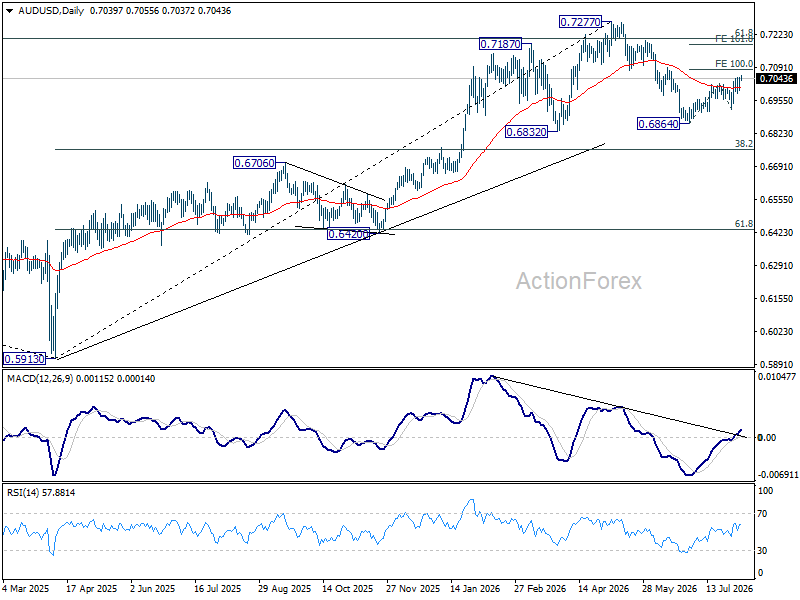
Technically, AUD/USD's rebound from 0.6864 resumed by breaking through temporary top today. For now, further rally is expected as long as 0.6983 minor support holds. The next target is the 100% projection of 0.6864 to 0.7026 from 0.6921, at 0.7021. A decisive break there would argue the rebound is an impulsive move — and, more importantly, add to the case that it's reversing the whole fall from 0.7277. In that scenario, further rally should be seen to the 161.8% projection at 0.7183 next.
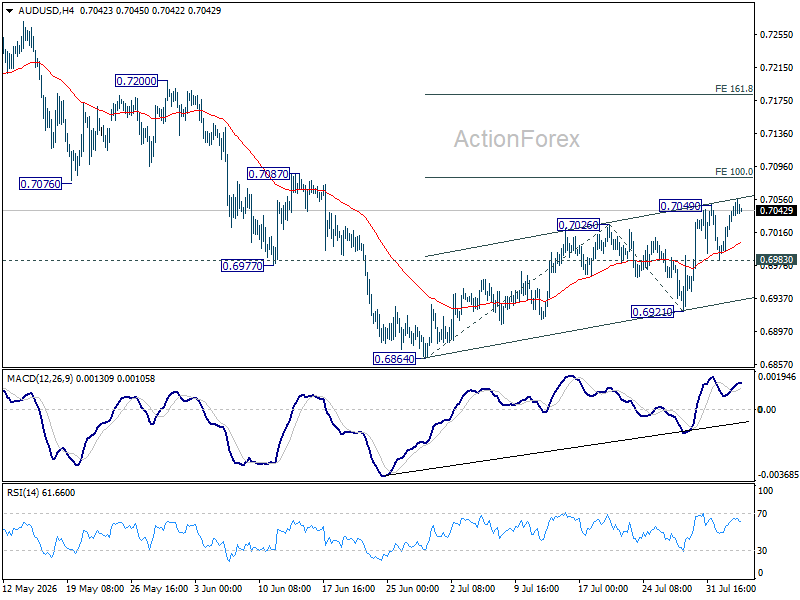
However, rejection at or below 0.7021, followed by a break of 0.6983, will turn focus back to 0.6921. A firm break there would argue the rebound has completed as a corrective move, in turn suggesting the fall from 0.7277 is ready to resume through the 0.6864 low.
Key Takeaways
- AUD/USD has lagged Wall Street's record highs, a 3.5%+ Asian equity surge, and record copper prices despite the same optimism driving all three.
- Falling oil prices, tied to Strait of Hormuz reopening hopes, are cutting two ways: supporting global risk assets while reducing Australia's imported inflation and LNG export revenue.
- Markets are increasingly confident the RBA can stay on hold, and falling energy prices reinforce that view by removing a key upside inflation risk.
- A softer US Dollar, driven by fading Fed tightening expectations, is providing AUD/USD support independent of any change in Australia's own outlook.
- 0.7021 is the key resistance for confirming an impulsive rebound toward 0.7183; a break of 0.6921 would instead point to a resumed fall toward 0.6864.
AUD/NZD: a Mixed Jobs Report Meets a Critical Chart Level
The Aussie and the Kiwi are telling two very different monetary policy stories right now, and the divergence is starting to show up clearly in the cross. The RBA held its cash rate at 4.35% in August, but the hawkish tone that once dominated has faded fast: Q2 inflation cooled to 3.9% from 4.1%, prompting Goldman Sachs to abandon its call for one final hike this year. Markets now price next to no chance of an August move, with only roughly even odds of a hike by November.
Across the Tasman, the RBNZ is playing a different game entirely. Having already hiked to 2.50% in June, the central bank has kept its guidance firmly hawkish, and markets are now almost fully pricing a further 25bp increase in September. Wednesday's employment data added an interesting twist: employment change q/q beat expectations sharply at 0.5% against 0.1% forecast, yet the unemployment rate also rose to 5.6% from 5.4%, above forecasts—a genuinely mixed print that complicates the otherwise hawkish RBNZ narrative.
The result: a Reserve Bank stepping back from further tightening against one still leaning hawkish, though now facing a labor market sending conflicting signals of its own.
Technical Analysis of AUD/NZD
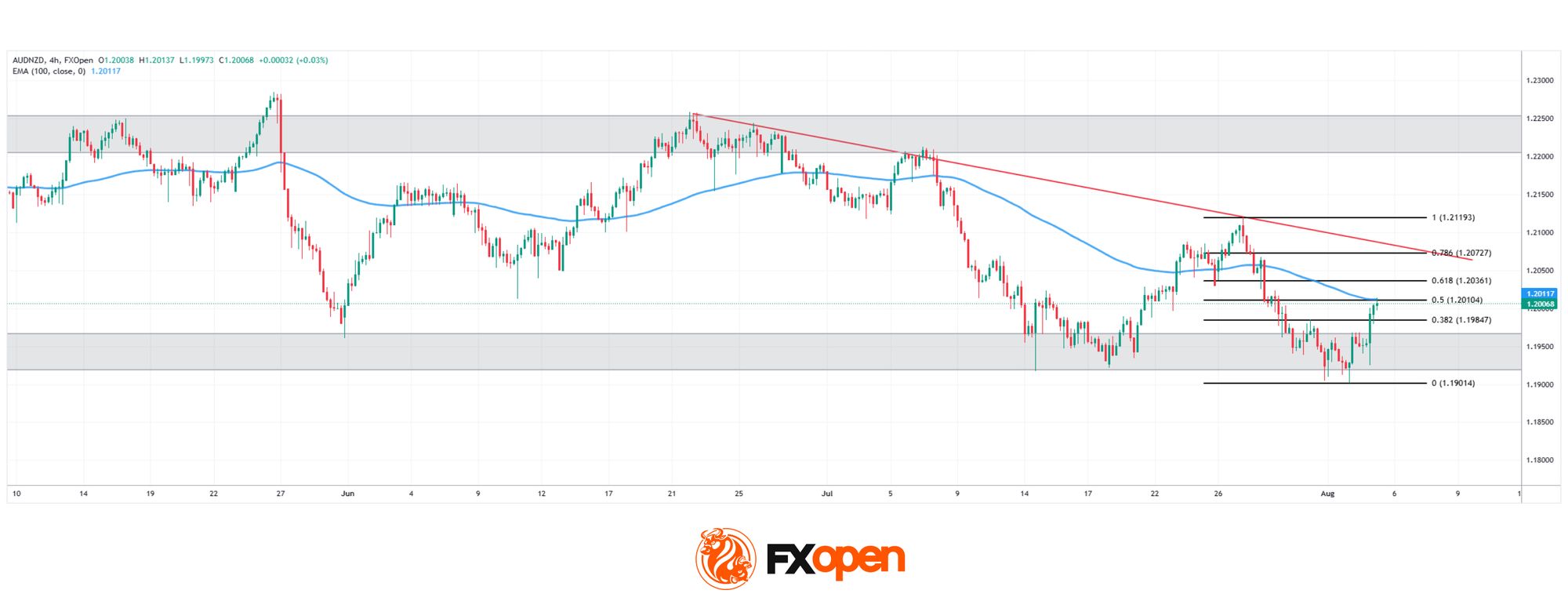
As AUD/NZD chart shows, the pair broke above the 100-period EMA back in July and is now testing this level again, right where it converges with the 0.5 Fibonacci retracement near 1.2011-1.2013. This confluence marks a critical juncture after weeks of steady decline.
Bullish Scenario
Should buyers break this EMA-Fibonacci confluence decisively, the path would open toward the 0.618 retracement near 1.2037, followed by the descending trendline, which itself converges with the 0.786 level around 1.2073. A break above this second confluence would leave room to retest the 1.2200-1.2250 resistance, the upper boundary of the broader range that has trapped price since April..
Bearish Scenario
Conversely, a rejection at the EMA-0.5 confluence would send price back down to retest the 1.1900-1.1950 support, the level that has held since March.. This is the real test: a confirmed break below it would open the door to a more sustained and decisive downtrend.
With price wedged right at this pivotal confluence, and the broader March-to-August range still very much intact, AUD/NZD looks ready to decide whether it's building toward a genuine breakout, or simply setting up for another rejection within its months-long range.
Trade over 50 forex markets 24 hours a day with FXOpen. Take advantage of low commissions, deep liquidity, and spreads from 0.0 pips (additional fees may apply). Open your FXOpen account now or learn more about trading forex with FXOpen.
This article represents the opinion of the Companies operating under the FXOpen brand only. It is not to be construed as an offer, solicitation, or recommendation with respect to products and services provided by the Companies operating under the FXOpen brand, nor is it to be considered financial advice.
USD/JPY and USD/CAD Consolidate Ahead of Adp Employment Report
Following last week’s sharp decline, the US dollar has entered a consolidation phase against most major currencies. At the same time, some instruments, including USD/JPY, are showing a moderate recovery as markets await fresh macroeconomic signals. Today’s key event will be the release of the preliminary ADP private-sector employment report. Forecasts suggest that job growth will slow to 68,000 after 98,000 in the previous month. If the data comes in below expectations, pressure on the dollar could increase as markets price in a more dovish Federal Reserve stance. Conversely, a stronger report could support the US currency ahead of the official US labour market data release.
Additional attention will be focused on US services sector activity indicators. Markets expect the preliminary S&P Global Services PMI to improve to 53.6 points, while the ISM Non-Manufacturing Index is forecast to rise to 54.5. Strong readings could partly offset any weakness in the ADP report and confirm the resilience of the largest sector of the US economy. It is worth noting that market participants traditionally view the ADP report only as an early indicator ahead of the official Nonfarm Payrolls release. Although the trends in the two reports do not always align, today’s data could significantly influence short-term expectations regarding the health of the US labour market.
USD/JPY
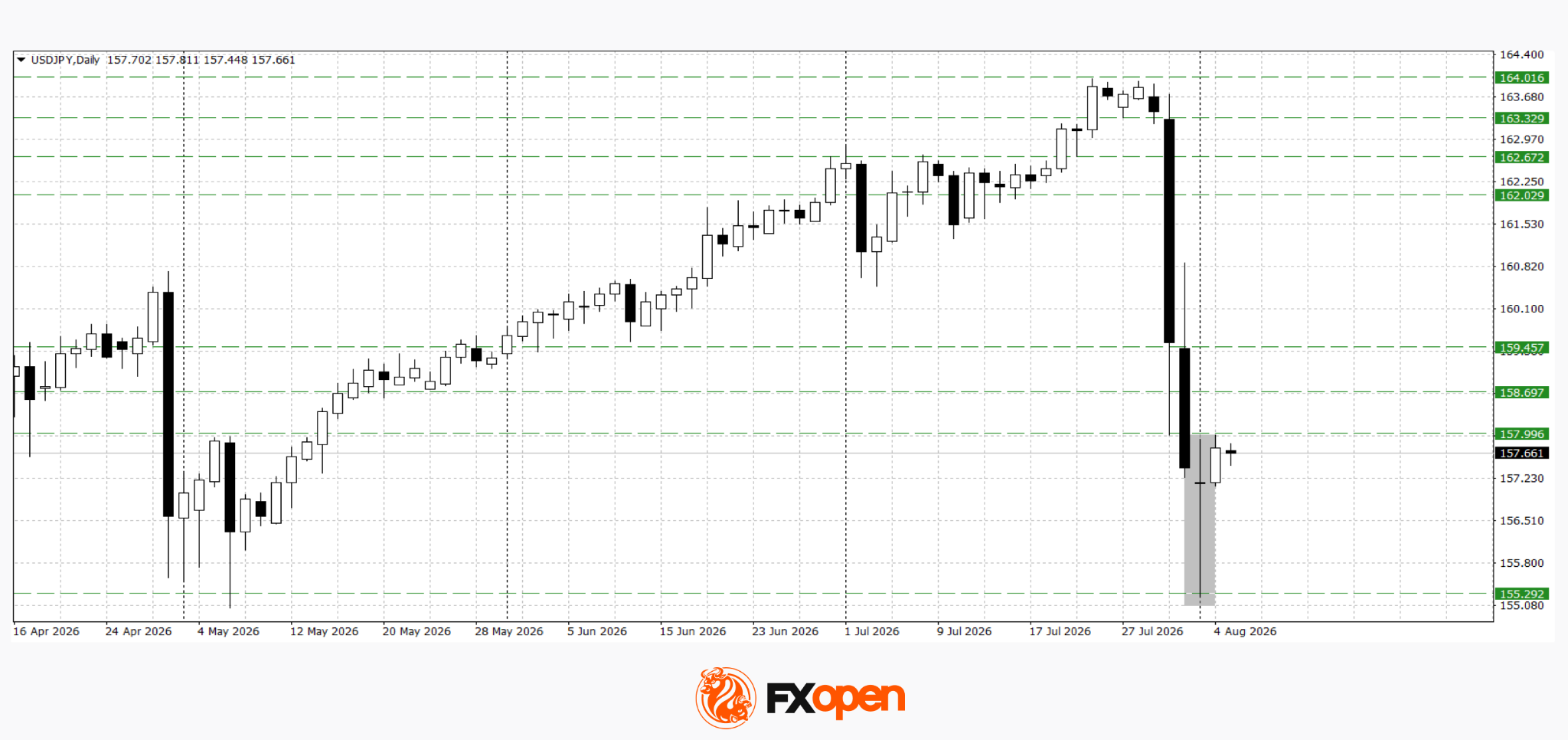
Last week, following the Federal Reserve meeting, USD/JPY declined sharply, losing more than 500 pips over several trading sessions. At the beginning of the current week, after testing the key support level at 155.30, buyers managed to push the pair back towards 158.00, while forming a “doji” candlestick pattern, which may signal a weakening of the bearish momentum. If the price breaks above yesterday’s high, the corrective move could extend towards 158.70–159.40. Weaker US employment data could trigger a renewed downward move.
Key events for USD/JPY:
- Today at 15:15 (GMT+3): ADP change in US non-farm private employment;
- Today at 16:45 (GMT+3): US Services PMI;
- Tomorrow at 17:00 (GMT+3): US ISM Non-Manufacturing PMI.
USD/CAD
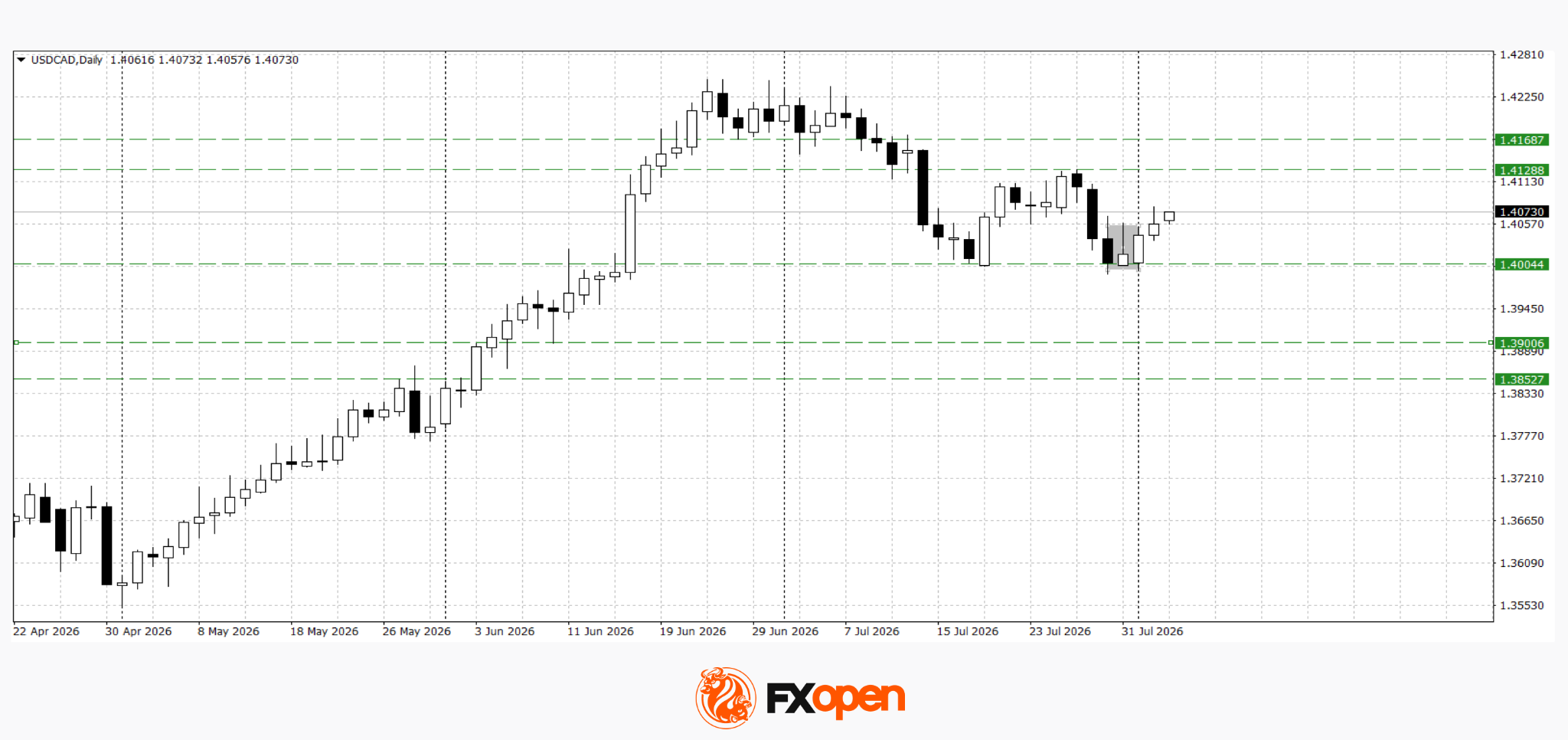
Last week, USD/CAD retested the key support level around 1.4000, forming a “bullish harami” pattern after the rebound. Technical analysis of USD/CAD suggests the potential for further recovery towards 1.4130–1.4170. Weaker US economic data, however, could trigger another test of the 1.4000 level.
Key events for USD/CAD:
- Today at 17:30 (GMT+3): US crude oil inventories;
- Today at 23:05 (GMT+3): speech by Federal Reserve Governor Lisa D. Cook;
- Tomorrow at 16:30 (GMT+3): Canada Services PMI.
The main drivers for the US dollar today will be the preliminary ADP employment figures and US services sector activity data. If the releases confirm the resilience of the US economy, USD/JPY and USD/CAD could continue their recovery following the dollar’s recent correction. Weaker data, on the other hand, could strengthen expectations of a more accommodative Fed policy, adding further pressure on the US currency and allowing sellers to regain control. However, investors are likely to draw more definitive conclusions about the labour market after the official Nonfarm Payrolls report is released later this week.
Trade over 50 forex markets 24 hours a day with FXOpen. Take advantage of low commissions, deep liquidity, and spreads from 0.0 pips (additional fees may apply). Open your FXOpen account now or learn more about trading forex with FXOpen.
This article represents the opinion of the Companies operating under the FXOpen brand only. It is not to be construed as an offer, solicitation, or recommendation with respect to products and services provided by the Companies operating under the FXOpen brand, nor is it to be considered financial advice.