Sample Category Title
UK Construction PMI Improves to 44.7, but Sector Remains in Prolonged Contraction
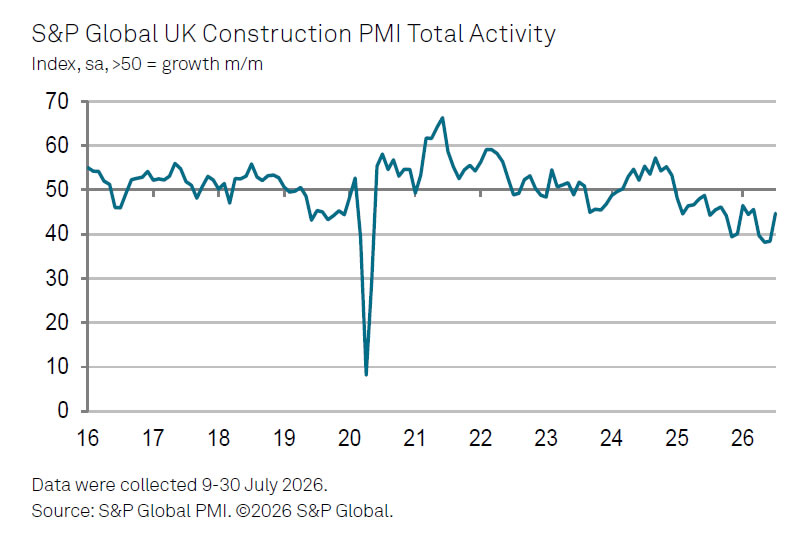
The UK construction sector showed further signs of stabilizing in July, although activity remained firmly in contraction for a nineteenth consecutive month. The S&P Global UK Construction PMI rose to 44.7 from 38.4 in June, its highest level in four months but still below the 50 threshold that separates expansion from contraction. While the reading points to another decline in overall activity, it also suggests the sharp downturn seen through the second quarter has begun to ease.
The improvement was broad-based across the sector. Commercial construction proved the most resilient, with its activity index rising to 46.8, while house building recorded its least severe contraction since October 2025 at 41.8. Civil engineering remained the weakest segment at 38.3, though even there the pace of decline moderated. According to S&P Global, the slower contraction reflected the smallest fall in new orders since September 2025, with some firms reporting improving client enquiries and a revival in tender opportunities despite generally subdued market conditions.
Encouragingly, business optimism strengthened to its highest level since February as firms became more confident about activity over the coming year. Construction companies also benefited from improving supplier performance and the slowest rise in input costs for five months. Although respondents continued to cite higher fuel and raw material costs linked to the Middle East conflict, easing cost pressures and tentative signs of recovering demand suggest the sector may be moving beyond its weakest phase, even if a sustained recovery has yet to take hold.
Data Summary
| Component | July | June | Trend |
|---|---|---|---|
| Construction PMI | 44.7 | 38.4 | ▲ Four-month high |
| Commercial Activity | 46.8 | N/A | ▲ Slowest contraction |
| House Building | 41.8 | N/A | ▲ Least severe decline since Oct 2025 |
| Civil Engineering | 38.3 | N/A | ▲ Contraction eased but remained weakest |
| Overall Activity | < 50 | < 50 | ▼ 19th consecutive month of contraction |
Key Takeaways
- UK Construction PMI rose to 44.7 in July from 38.4, reaching a four-month high and signalling that the sector's downturn is easing, although activity remains in contraction.
- The sector has now contracted continuously since January 2025, marking its longest period of decline since the Global Financial Crisis.
- All three major segments improved, with commercial construction proving the most resilient (46.8), while house building recorded its mildest contraction since October 2025.
- Survey respondents reported early signs of improving client demand and more tender opportunities, resulting in the smallest decline in new orders since September 2025.
- Business confidence climbed to its highest level since February, suggesting firms expect activity to improve over the coming year.
- Cost pressures eased to a five-month low, although companies continued to cite higher fuel and raw material prices linked to the Middle East conflict.
Euro and Pound Hold Gains as Markets Assess the US Employment Outlook
The euro and the pound continue to trade higher against the US dollar following last week's Federal Reserve meeting. As widely expected, the Fed left interest rates unchanged and reiterated that future monetary policy decisions would depend on incoming economic data. This cautious stance failed to provide fresh support for the dollar, while yesterday's weaker US labour market figures added further downward pressure. According to the latest ADP report, the US private sector added just 44,000 jobs, well below forecasts of 68,000 and the previous month's 95,000. Although the S&P Global Services PMI exceeded expectations, the ISM report painted a more mixed picture: the headline services index edged down to 54.1, while the employment component fell to 47.4, signalling continued cooling in the labour market. As a result, investors increased their expectations of a broader slowdown in the US economy, allowing both the euro and the pound to maintain their upward momentum.
EUR/USD
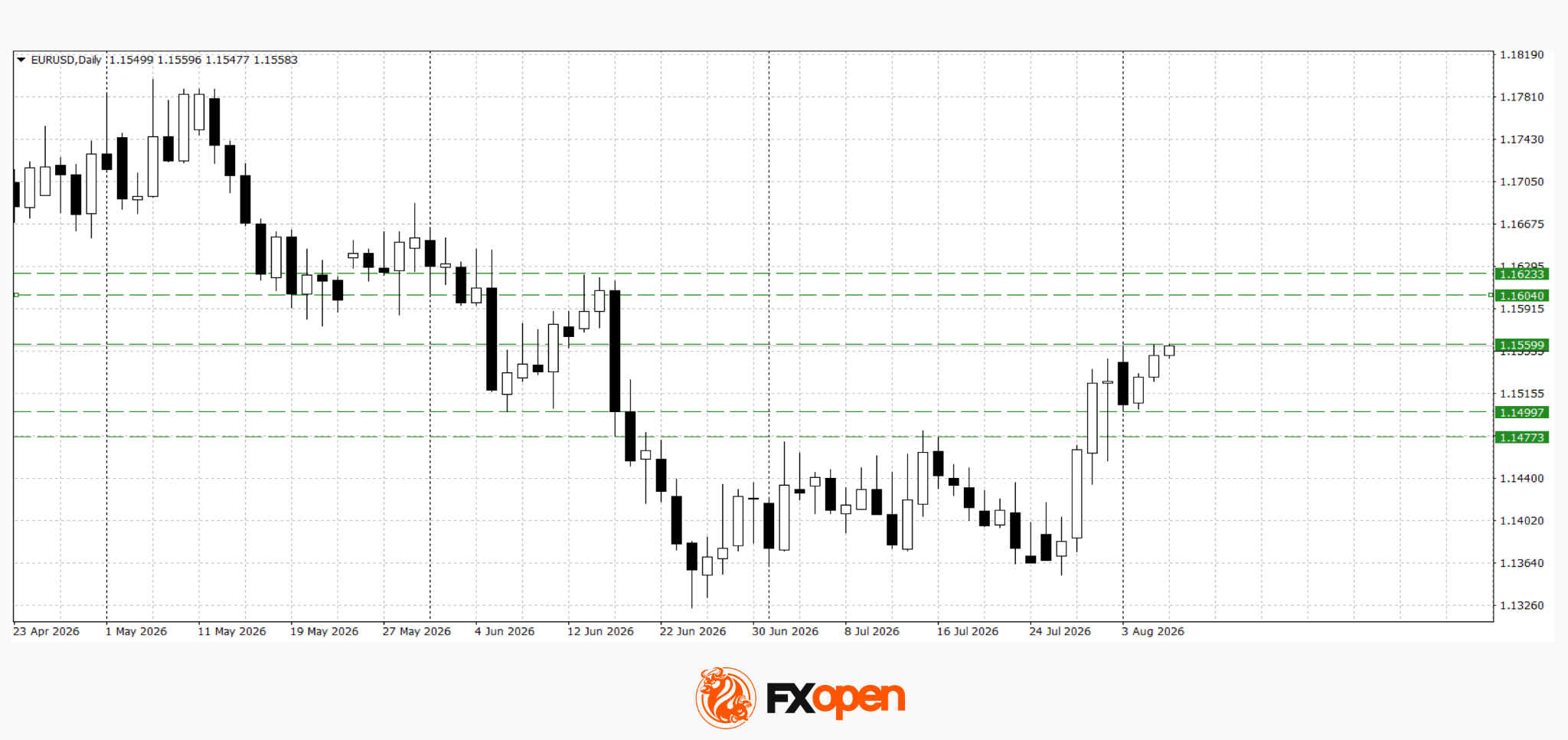
EUR/USD rallied strongly last week, breaking above the key resistance level at 1.1500. Since the start of this week, the pair has been trading sideways between 1.1500 and 1.1560 as investors await fresh macroeconomic data. Technical analysis suggests the bullish trend could extend towards 1.1600–1.1620 if the 1.1560 level becomes established as support. Conversely, a sustained move below 1.1500 would weaken the bullish outlook.
Key events for EUR/USD:
- Today at 09:00 (GMT+3): German Factory Orders;
- Today at 10:30 (GMT+3): Germany S&P Global Construction PMI;
- Today at 15:30 (GMT+3): US Initial Jobless Claims.
GBP/USD
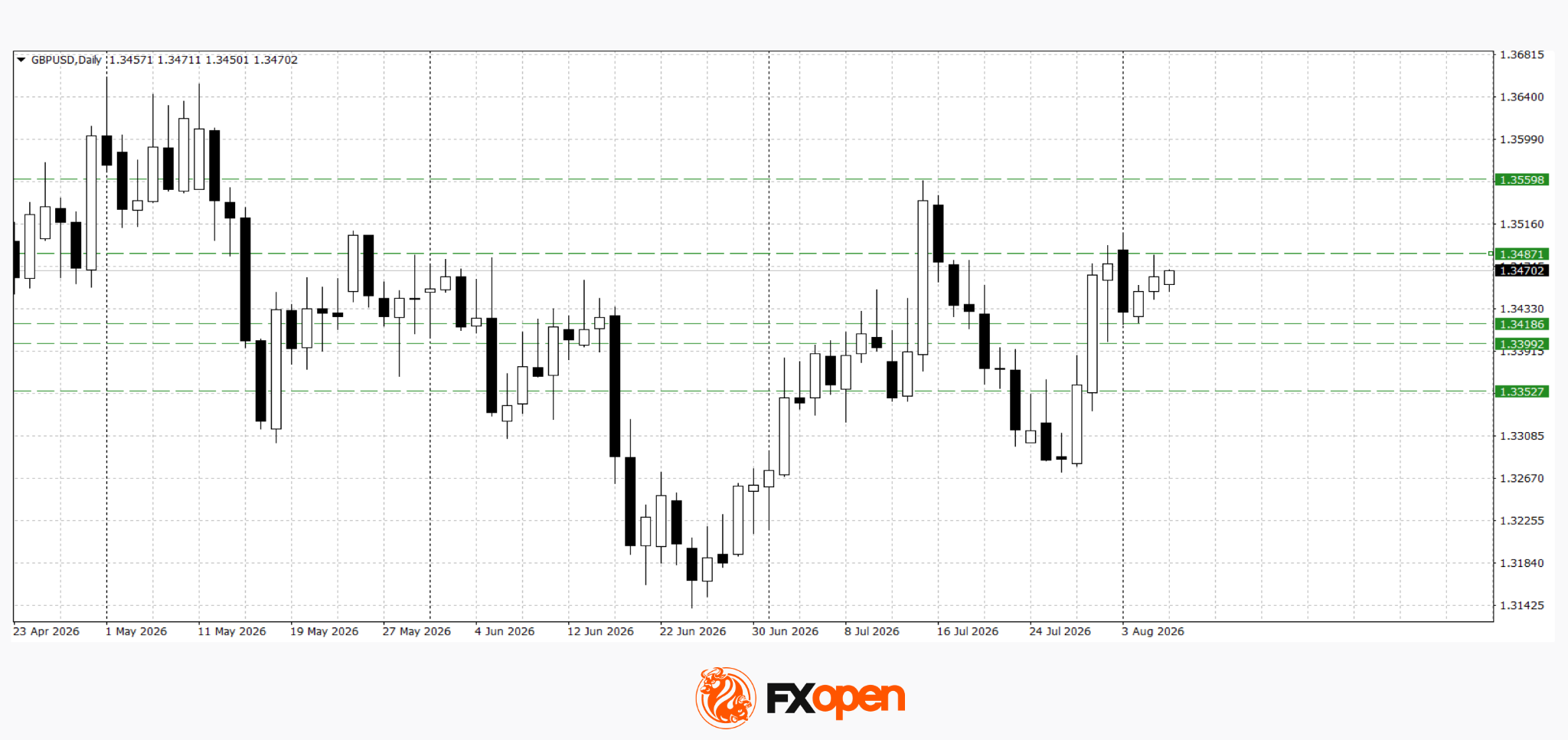
GBP/USD is showing a similar pattern, consolidating between 1.3420 and 1.3480 after last week's sharp advance. A decisive break above 1.3480 could pave the way for a retest of the July high near 1.3560. On the other hand, stronger-than-expected US economic data could push the pair back towards the 1.3350–1.3400 range.
Key events for GBP/USD:
- Today at 11:30 (GMT+3): UK Construction PMI;
- Today at 18:30 (GMT+3): Atlanta Fed GDPNow estimate;
- Tomorrow at 15:30 (GMT+3): US ADP Private Non-Farm Employment Change.
The official US Nonfarm Payrolls report remains the key event for currency markets this week. Employment growth, the unemployment rate and wage data will provide investors with a clearer picture of the strength of the US economy and help shape expectations for future Federal Reserve policy. If the figures confirm further signs of labour market cooling, the dollar could come under renewed pressure, allowing EUR/USD and GBP/USD to extend their recent gains. Stronger-than-expected data, however, could revive demand for the US dollar and trigger a correction in both European currencies.
Trade over 50 forex markets 24 hours a day with FXOpen. Take advantage of low commissions, deep liquidity, and spreads from 0.0 pips (additional fees may apply). Open your FXOpen account now or learn more about trading forex with FXOpen.
This article represents the opinion of the Companies operating under the FXOpen brand only. It is not to be construed as an offer, solicitation, or recommendation with respect to products and services provided by the Companies operating under the FXOpen brand, nor is it to be considered financial advice.
Markets Eye Swedish Inflation Figures
In focus today
In Sweden, preliminary July inflation figures are due today. We expect core inflation at 0.4% y/y, CPIF at 0.6% y/y and CPI at 0.1% y/y. The low annual readings mainly reflect the full July effect of the temporary fuel tax cut and public transport subsidy, as outlined in Sweden: Inflation forecast - July inflation preview, 4 August.
In the US, the July Challenger Report for layoff announcements, Q2 flash productivity growth and weekly jobless claims are set to be released in the afternoon.
In China, trade data will be released overnight going into Friday. Focus will be on whether exports continue to benefit from improving foreign demand, which has been a rare bright spot as domestic leading indicators have weakened over the summer.
Economic and market news
What happened overnight
In the US, Fed Governor Cook (voter, neutral) voted with the majority last week to hold rates steady but said that may no longer be possible unless there are sure signs ahead that inflation is easing, pointing to inflation still being too high and risks to inflation outweighing risks to employment. Meanwhile, San Francisco Fed's Daly (non-voter) fully backed the July hold, saying the Fed needs more information on whether inflation is driven by temporary supply shocks or is becoming more persistent.
What happened yesterday
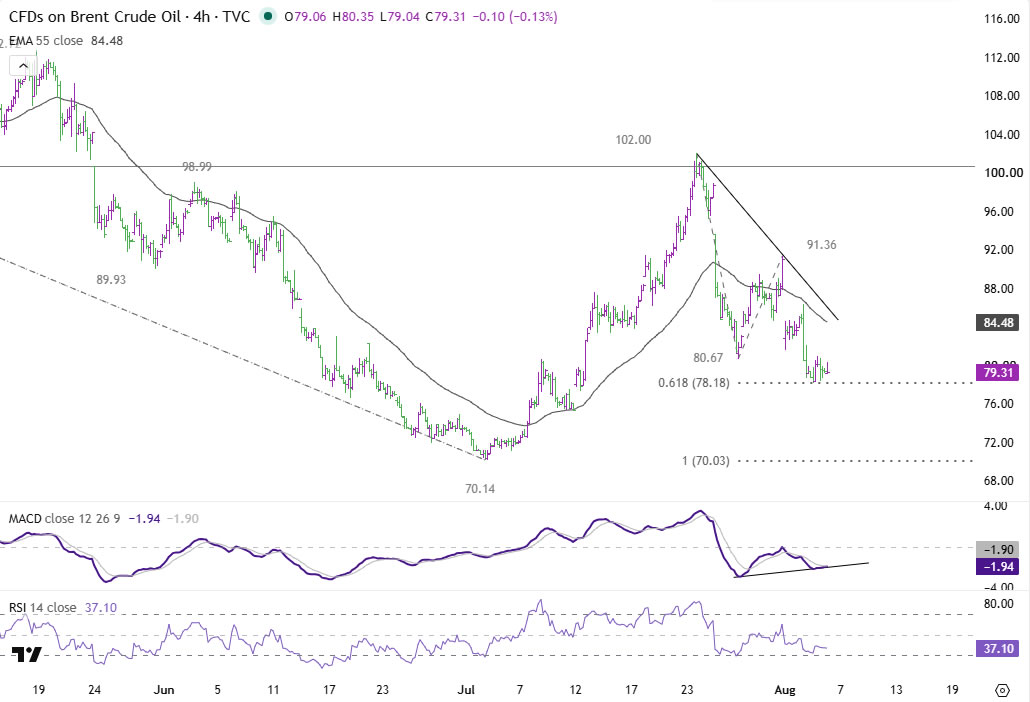
In commodities, Brent crude traded in the USD79-81/bbl range as oil markets remained anxious but held on to hopes of a new US-Iran deal to reopen the Strait of Hormuz. Iran said talks with Oman were moving forward and that an agreement had been reached on a shipping route, though safe passage and a broader deal remain uncertain.
In the US, ADP's National Employment Report for July came in weaker than expected at 44k (cons: 70k), with hiring uneven across sectors. Education and health care added jobs, while leisure and hospitality declined. However, it was noteworthy that ADP reported an uptick in wage growth among workers changing jobs, suggesting that labour market conditions are tightening and workers' bargaining power is improving despite slow aggregate job growth. At the margin, this is a hawkish signal for the Fed.
Moreover, the ISM services index rose slightly to 54.1 in July from 54.0 in June, below consensus expectations of 54.5. The report was mixed, with business activity, new orders and price indices all rising, while the employment index weakened sharply. Still, the report points to the notion of strong demand, with price pressures continuing to rise.
The contrast among Fed officials remained clear, as Minneapolis Fed's Kashkari (voter, hawk) said rates should "start slowly moving up", arguing policy is not particularly restrictive, in contrast to Philly Fed's Paulson, who yesterday said policy is already mildly restrictive and favoured holding rates steady.
In the euro area, the final July services and composite PMIs were revised only marginally higher from the flash estimates, to 51.7 and 52.0 respectively, confirming a clear improvement in activity conditions compared with June.
In Norway, house prices fell by 1.1% m/m in July, exceeding Norges Bank's forecast and marking the sharpest monthly decline since March 2020. While this may suggest that higher interest rates are starting to weigh on the housing market, the July CPI figures due on Monday will be the decisive input ahead of next Thursday's rate meeting.
In China, the private-sector RatingDog services PMI fell sharply to 50.4 in July from 54.1 in June, confirming the declines seen in the official NBS data. The latest reading shows that services growth weakened over the summer both in current demand and new orders. Overall, China's leading indicators are moving lower, in contrast to the more stable or improving picture across most developed market economies.
Equities: Global equities extended gains for a fifth consecutive session, taking the five-day advance to roughly 5%. That is noteworthy in itself. Moves of this magnitude typically follow periods of elevated volatility and sharp drawdowns, yet this rally has been accompanied by only a modest decline in implied vol. The VIX has eased only from just above 17 to just below 16 over the past five sessions. Performance has been dominated by cyclicals outperforming defensives and growth continuing to outperform value, underlining that this has primarily been a tech driven rally rather than a macro driven one. Yesterday followed the same pattern, although to a lesser extent, with enthusiasm around the tech theme fading through the US session. Consequently, US tech and the Nasdaq underperformed broader markets into the close. This morning, sentiment around the tech trade remains somewhat more cautious. Asia is largely catching up with the late Wall Street moves, producing the now familiar divergence with highly tech sensitive South Korea materially weaker while less tech exposed markets trade firmer. European and US futures are higher this morning, although Nasdaq futures are again marginally lagging.
FI and FX: Broad euro area and US yields ended yesterday's session about flat, as markets held onto hopes of an interim US-Iran deal to reopen the Strait of Hormuz. An Iranian official said an agreement with Oman was in its final stages, adding that they had agreed on the coordinates for a navigable channel. EUR/USD traded higher towards 1.1550, EUR/NOK was anchored close to the 11.00 level and EUR/SEK fell to 10.95 – the lowest level since mid-June. Markets are now pricing in only 40bp worth of Fed hikes over the coming year, but we think risks are skewed towards more hikes even if energy prices continue moderating. For today, we receive the Swedish July CPI, euro area retail sales figures, the US July Challenger Report and in the afternoon the Fed's Musalem is set to speak.
Gold’s Rally Looks Real. Three Markets Will Decide Whether It Reaches 4,500
TL;DR: Gold's rebound has technical and macro confirmation behind it, but whether it extends toward 4,500 depends on three interlinked markets — Brent crude, US Treasury yields, and Fed rate expectations — all still hinging on whether Strait of Hormuz negotiations produce a durable breakthrough.
A Rally That Looks More Convincing Than a Routine Bounce
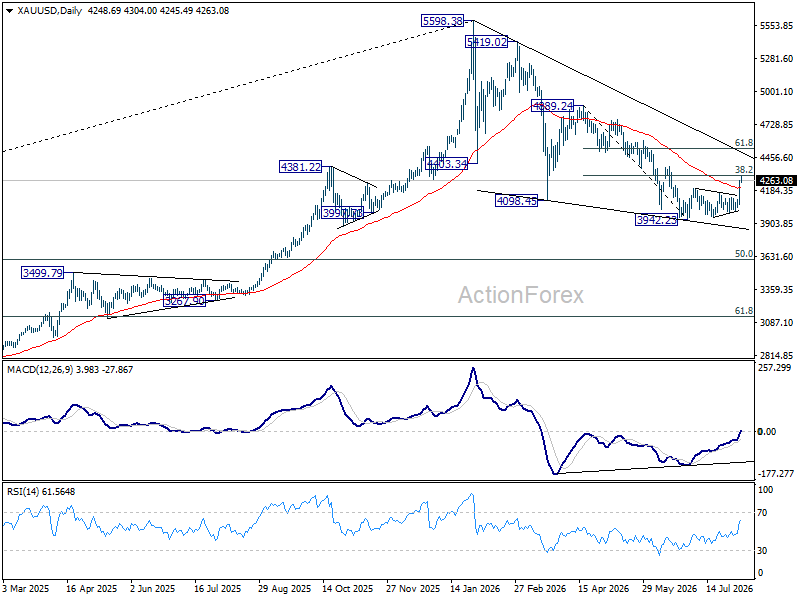
Gold's rebound has evolved into something more convincing than a routine recovery from oversold conditions. The metal has broken back above its 55-day EMA, the daily MACD has developed bullish divergence, and — perhaps most importantly — markets have rapidly priced out the likelihood of a September Federal Reserve rate hike. Those developments have materially strengthened the case that Gold is attempting a medium-term trend reversal rather than simply retracing part of its decline from the record high.
Yet declaring victory now would be premature. The macro backdrop driving the rally still hinges on one unresolved question: whether optimism surrounding the reopening of the Strait of Hormuz develops into a durable geopolitical breakthrough. Until that question is answered, Gold, Brent crude, and US Treasury yields are likely to remain tightly linked, with all three acting as real-time gauges of market confidence in the same underlying narrative.
The Fed Story Has Already Changed
The immediate catalyst behind Gold's latest advance has been a sharp shift in interest-rate expectations rather than a sudden surge in safe-haven demand.
Over the past several sessions, investors have increasingly concluded that easing tensions around the Strait of Hormuz could significantly reduce the risk of another energy-driven inflation shock. As Brent crude retreated from above $100 toward the high-$70s, markets rapidly repriced the Fed outlook. The probability of rates remaining unchanged in September has risen sharply, Treasury yields have rolled over from recent highs, and the Dollar has weakened accordingly — together creating a much more supportive environment for non-yielding assets like Gold.
Technically, the improvement is becoming difficult to ignore. Breaking back above the 55-day EMA after forming bullish divergence on the daily MACD suggests downside momentum has been exhausted. Unlike previous rebounds during the decline from the record high, this rally is now receiving confirmation from both technical indicators and a meaningful improvement in the macro backdrop.
Markets Still Aren't Fully Buying the Hormuz Story
Yet markets are stopping short of fully embracing the optimistic scenario. Headlines continue to suggest negotiations are making progress — Iranian officials confirmed that Tehran and Oman have agreed on the geographical coordinates of a proposed safe shipping route, and reports have indicated negotiations are advancing, with some regional officials suggesting an agreement could come within days.
But the details remain far less reassuring than the headlines imply. Iran continues to describe the discussions as arrangements with Oman rather than direct negotiations with Washington. Reuters reported important issues remain unresolved despite President Donald Trump's repeated suggestions a deal is close, while CNN quoted Gulf officials assigning only a 50-50 probability that an agreement can be reached by Friday. More importantly, Iran's Islamic Revolutionary Guard Corps — the organization ultimately responsible for enforcing any agreement — has yet to publicly endorse the proposal.
Just as important is what happens after any agreement is signed. Whether the arrangement proves durable or merely another temporary pause remains an unanswered question, and that uncertainty continues to prevent markets from fully removing the geopolitical risk premium.
Why Brent and Treasury Yields Hold the Key
That uncertainty is visible not only in Gold, but also in Brent crude and the US Treasury market.
Brent's decline has already stalled after reaching the 61.8% projection of 102.00 to 80.67 from 91.36, at 78.18, suggesting sellers are becoming more cautious. A decisive break below that level would indicate traders are increasingly convinced a Hormuz agreement is both imminent and sustainable, opening the way toward the 100% projection at 70.03, close to the 70.14 low.
Conversely, a breakdown in talks and a return to conflict could bring a strong rebound in Brent. A decisive break of the 55 4H EMA, now at 84.48, would argue the fall from 102.00 has completed as a correction, setting up another strong rally back toward 102.00.
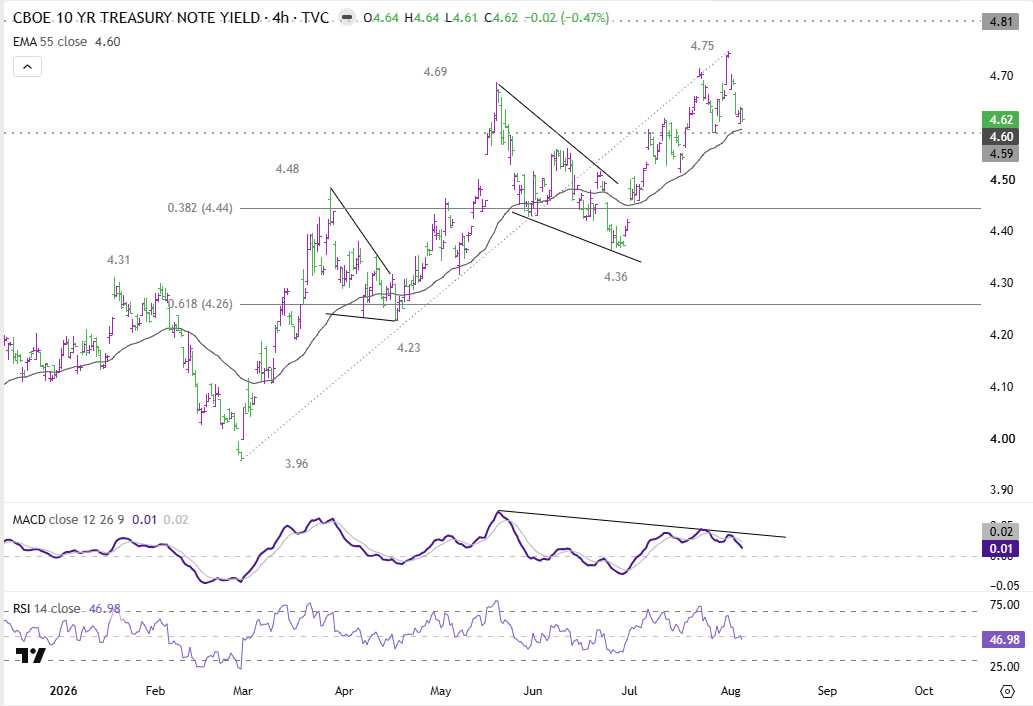
Treasury yields tell a similar story. The US 10-year yield has begun showing bearish divergence on the 4H MACD after topping around 4.75%. A firm break below 4.60%, together with the 55 4H EMA, would confirm markets are becoming increasingly comfortable with the view that lower energy prices will keep the Fed on hold.
Failure to break that support, however, would indicate investors remain unconvinced inflation risks have truly subsided — a strong rebound from 4.60% would keep the near-term rally intact for another rise through 4.75%.
ActionForex's Technical View on Gold
Gold itself has reached an important technical crossroads. The rally is now close to the 38.2% retracement of 4,889.24 to 3,942.23, at 4,303.98, while the four-hour RSI is already in overbought territory. That combination argues for some consolidation, or even a modest pullback, rather than an immediate continuation higher.
The broader picture, however, has improved substantially. If a credible and durable Hormuz agreement emerges, Brent breaking below 78 and the 10-year Treasury yield falling through 4.60% would provide the macro confirmation Gold bulls have been waiting for. In that environment, the current recovery would likely extend beyond 4,300 toward the medium-term trendline resistance near 4,500, strengthening the case that a genuine trend reversal is underway.
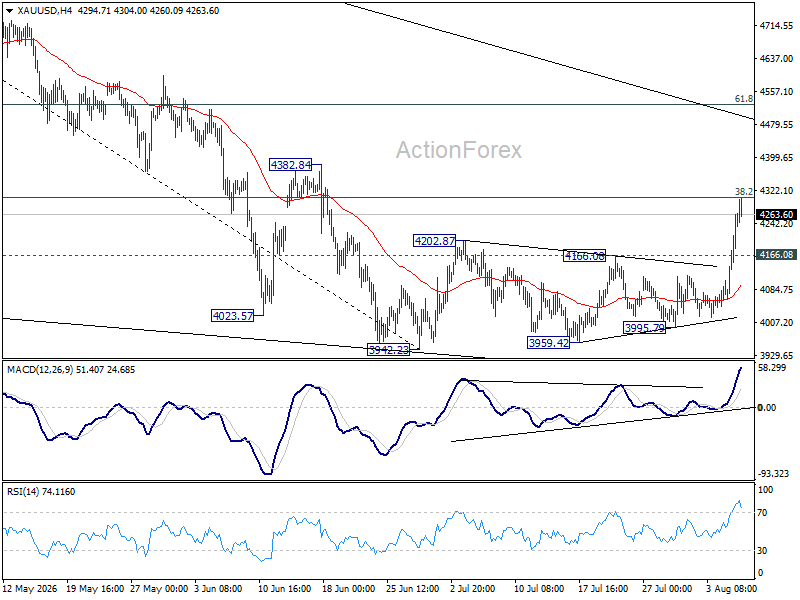
On the other hand, if negotiations falter and geopolitical tensions re-escalate, the recent improvement in Fed expectations could quickly unwind. A break back below 4,166.08, now acting as support, would suggest the latest rally was merely another corrective rebound within the broader downtrend from 4,889.24.
For now, Gold's technicals are sending an increasingly bullish message — but the final verdict still rests with oil, Treasury yields, and the next chapter of the Hormuz negotiations.
Key Takeaways
- Gold's rally has both technical confirmation (55-day EMA reclaim, bullish MACD divergence) and macro support (fading September Fed hike odds), distinguishing it from prior failed rebounds.
- Gulf officials assign only a 50-50 probability of a Hormuz agreement by Friday, and Iran's Revolutionary Guard Corps has yet to endorse any proposal, keeping a geopolitical risk premium intact.
- Brent's decline has stalled at 78.18; a break below opens 70.03, while a break of 84.48 resistance would instead point to a rebound back toward 102.00.
- The 10-year Treasury yield breaking below 4.60% would confirm markets are comfortable with a Fed on hold; failure to break it risks a rebound toward 4.75%.
- A durable Hormuz deal with Brent below 78 and yields below 4.60% could extend Gold's rally toward 4,500; a break below 4,166.08 would instead signal the rally was only corrective.
Copper (Hg #F) Continues to Favor More Upside Near Term
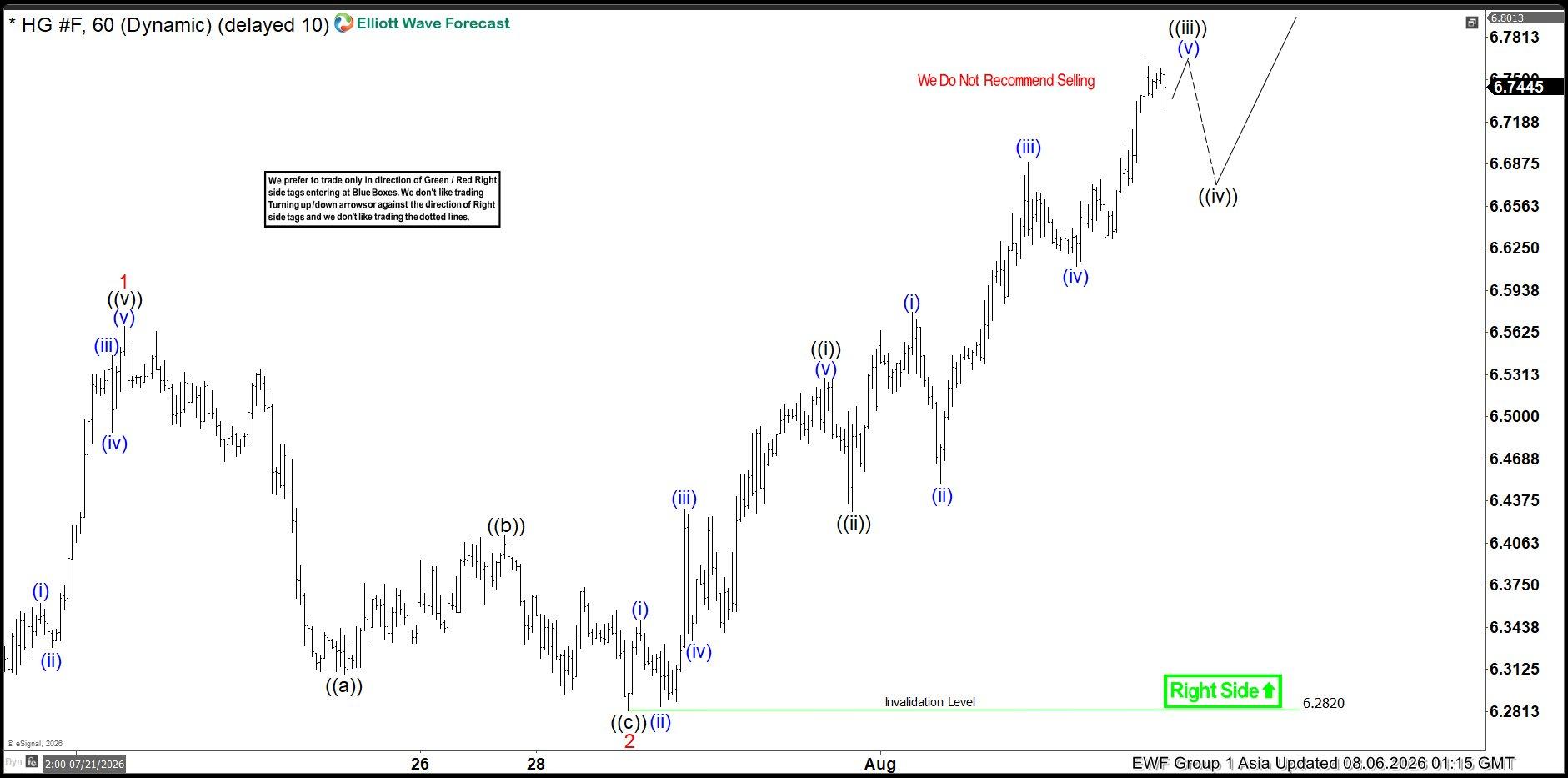
Copper futures (HG #F) continue to trade within a bullish Elliott Wave structure, with price maintaining an incomplete three-swing sequence from the 6.2820 low. The current rally remains constructive, suggesting buyers are still in control. As long as Copper holds above the 6.2820 invalidation level, the path of least resistance remains to the upside. The broader Elliott Wave structure continues to favor higher prices before a larger corrective pullback develops.
The 60-minute Elliott Wave chart shows Copper advancing within black wave ((iii)). A push toward 6.858 should complete the current five-wave impulsive sequence in wave ((iii)). Once this move finishes, we expect a corrective pullback in at least three swings as part of wave ((iv)). This pullback should present another buying opportunity, provided it remains above the 6.479 swing low and, more importantly, above the 6.2820 invalidation level.
Looking beyond the near-term correction, the higher-timeframe Elliott Wave count continues to point higher. We expect the current advance to extend toward 6.981, which represents the equal legs target for red wave 1 within wave 3. Reaching this level would complete another important phase of the larger bullish structure before any meaningful correction takes place.
Overall, our Copper Elliott Wave forecast remains bullish. Any pullback in the coming hours is expected to find support in 3, 7, or 11 swings, keeping the broader trend intact. Until key support levels break, traders should continue to favor buying pullbacks, with 6.981 remaining the next major upside objective.
08.06.2026 HG #F 60 Min. Elliott Wave Chart
08.06.2026 Video Analysis:
https://www.youtube.com/watch?v=Lw8tJYRcvUg
Gold Pushes Higher as Buying Interest Strengthens
Key Highlights
- Gold started a fresh increase above the $4,200 region.
- It surpassed a major contracting triangle with resistance at $4,090 on the 4-hour chart.
- WTI Crude Oil started a fresh decline and traded below $80.00.
- Bitcoin gained bullish momentum for a move above $64,200.
Gold Price Technical Analysis
Gold found bids near $4,020 and $4,050 against the US Dollar. The price started a decent increase after there was a close above $4,100.
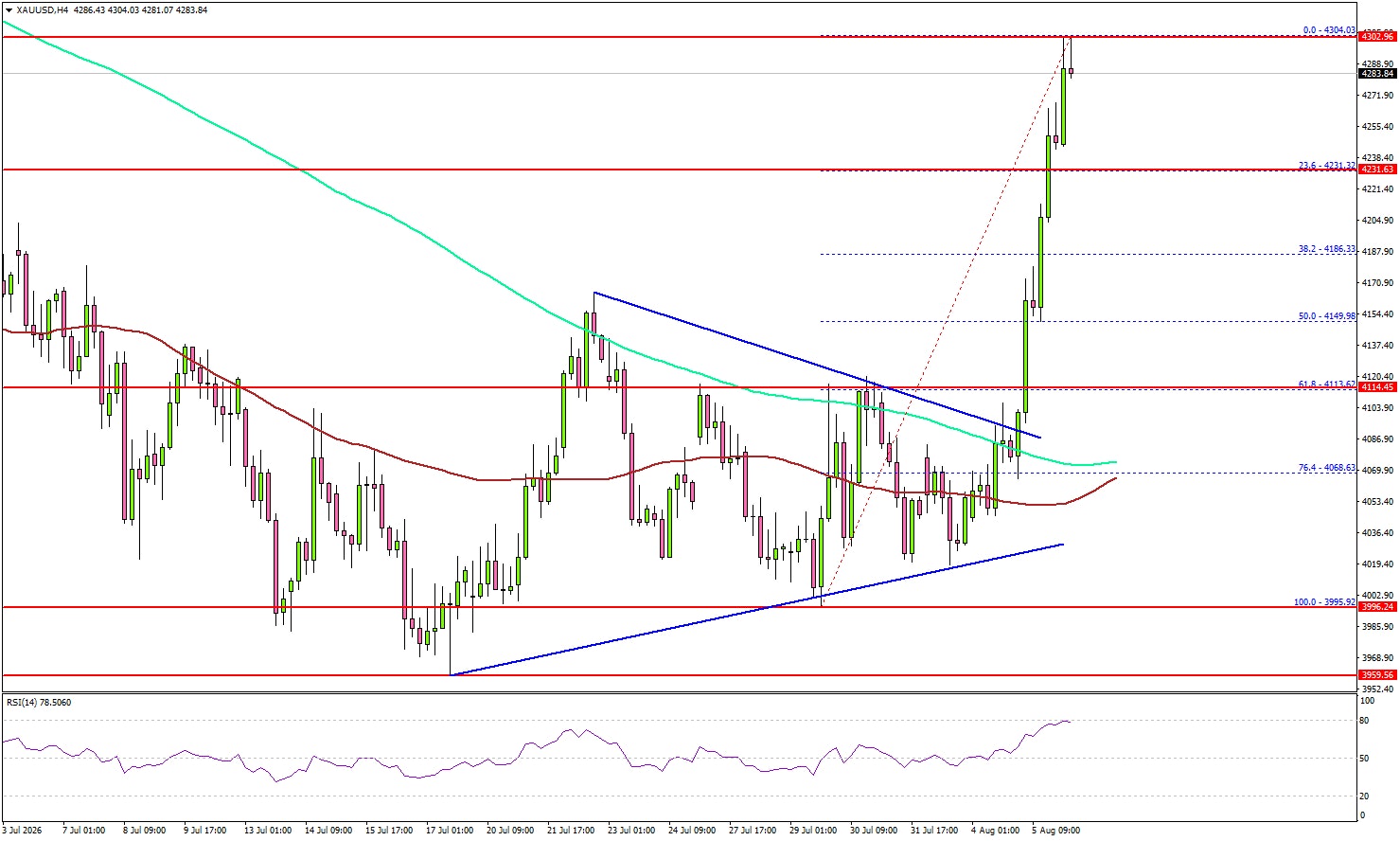
The 4-hour chart of XAU/USD indicates that the price surpassed a major contracting triangle with resistance at $4,090. There was a close above $4,150, the 100 Simple Moving Average (red, 4 hours), and the 200 Simple Moving Average (green, 4 hours).
The price traded as high as $4,304 and is currently consolidating gains. On the upside, immediate resistance could be $4,300. The next major resistance might be $4,350.
A clear move above $4,350 could open the doors for more upside. In the stated case, the bulls could aim for a move toward $4,420 or even $4,450. Any more gains might send the price toward the $4,500 level.
If there is a downside correction, the price could revisit the $4,230 support or the 23.6% Fib retracement level of the upward move from the $3,995 swing low to the $4,304 high. The first major support sits at $4,185.
The next support could be $4,150, below which the price might slide to $4,110. The main support sits at $4,065. Any more losses might call for a test of $4,020 or even $4,000 in the coming days.
Looking at WTI Crude Oil, the bears are back, and they could aim for a move below the $75.00 support zone in the near term.
Economic Releases to Watch Today
- US Initial Jobless Claims - Forecast 202K, versus 197K previous.
- US Wholesale Inventories for June 2026 (preliminary) – Forecast +0.3%, versus +0.3% previous.
Fed’s Daly: Businesses Have Limited Ability to Raise Prices
San Francisco Fed President Mary Daly said there are growing reasons to believe inflation will moderate without additional monetary tightening, arguing that businesses are finding it increasingly difficult to pass higher costs on to consumers. Speaking at an economics conference in Tokyo, Daly said she was "completely supportive" of last week's decision to keep interest rates unchanged, stressing that policymakers still need more evidence before deciding whether inflation is being driven by temporary supply shocks or more persistent forces. "We have a lot of information we need to collect" ahead of the September FOMC meeting, she said.
Daly pointed to several factors that could help ease inflation in the months ahead. Most notably, she argued that businesses now have "limited pricing power" and will struggle to pass rising input costs through to customers. She also said there are "good reasons" to believe the supply-driven shocks that have fueled inflation "will not have a lasting impact," adding that an eventual end to the Middle East conflict should lower oil prices and reduce one of the public's biggest inflation concerns. Together, those developments support the case for allowing more time to assess incoming data before adjusting policy.
Even so, Daly emphasized that patience should not be mistaken for complacency. She warned the Fed must remain "vigilant to watch the information as it comes in, but be very prepared to take action" if inflation proves more persistent than expected. While she acknowledged concerns that renewed inflation could become embedded in public expectations, her remarks place her firmly among the policymakers who believe the current evidence still justifies waiting rather than preemptively raising interest rates.
Key Takeaways
- San Francisco Fed President Mary Daly fully supported last week's decision to keep interest rates unchanged, saying policymakers need more data before deciding whether inflation pressures are temporary or persistent.
- Daly argued that businesses now have limited ability to pass higher costs on to consumers, suggesting pricing power is weakening and inflation could moderate without additional tightening.
- She also cited three supportive factors for disinflation: fading supply shocks, the prospect of lower oil prices if Middle East tensions ease, and consumers' sensitivity to energy prices.
- Despite her relatively optimistic outlook, Daly stressed the Fed must remain "vigilant" and "be very prepared to take action" if inflation momentum begins building again.
- Her comments place her firmly in the Fed's wait-and-see majority, contrasting with officials who have recently advocated resuming rate hikes immediately.
Cook Says Fed Can’t Afford to Wait Forever on Inflation
Federal Reserve Governor Lisa Cook said policymakers cannot afford to be complacent after more than five years of above-target inflation, warning that patience has limits if price pressures fail to ease. Speaking on Wednesday, Cook reiterated that "inflation is too high" despite some improvement in June, stressing that she would "not put too much weight on a single data point" given the highly uncertain environment. While she supported leaving interest rates unchanged at last week's FOMC meeting, she made clear that "I am prepared to act by raising rates, if necessary."
Cook argued that inflation risks continue to outweigh labor market risks, citing elevated energy prices linked to the Middle East conflict and AI-driven investment as two unexpected sources of upward pressure on prices. Together, she said, these developments "have shifted the balance of risks toward inflation and away from the labor market." At the same time, she characterized employment as stable in a "low-hire, low-fire environment," with subdued hiring offset by historically low layoffs. That backdrop, in her view, allows the Fed to remain focused on restoring price stability.
Even so, Cook explained why she supported holding rates for now. She pointed to three disinflationary forces already emerging: fading tariff effects, the prospect of lower oil prices later this year, and easing AI-related goods inflation as supply chains adjust. Those factors could help bring inflation back toward target without further tightening. However, she warned that "if I do not see signs of continued disinflation soon, I am prepared to act," adding that "we do not have that luxury" of waiting indefinitely because prolonged above-target inflation risks becoming entrenched in wage- and price-setting behavior.
Key Takeaways
- Fed Governor Lisa Cook said inflation remains "too high" and the Fed "can't afford to wait forever" if price pressures fail to continue easing.
- While she supported keeping rates unchanged last week, Cook stressed she is "prepared to act by raising rates, if necessary" should disinflation stall.
- Cook argued that inflation risks currently outweigh labor market risks, citing higher energy prices from the Middle East conflict and AI-related investment as key drivers of persistent inflation.
- She described the labor market as a "low-hire, low-fire environment," with stable unemployment reflecting subdued hiring but also historically low layoffs.
- Cook identified three potential disinflationary forces—fading tariff effects, lower oil prices later this year, and easing AI-related supply constraints—as reasons to remain on hold for now.
- However, she warned that prolonged above-target inflation risks becoming entrenched, leaving the Fed with less room to wait if inflation progress stalls.
Eco Data 8/6/26
| GMT | Ccy | Events | Act | Cons | Prev | Rev |
|---|---|---|---|---|---|---|
| 01:30 | AUD | Trade Balance (AUD) Jun | 1.93B | -1.08B | -3.02B | -2.37B |
| 06:00 | EUR | Germany Factory Orders M/M Jun | 3.10% | 0.50% | 1.90% | |
| 08:00 | CHF | Unemployment Rate Jul | 3.10% | 3.10% | 3.10% | |
| 08:00 | EUR | ECB Economic Bulletin | ||||
| 08:30 | GBP | Construction PMI Jul | 44.7 | 40.2 | 38.4 | |
| 09:00 | EUR | Eurozone Retail Sales M/M Jun | -0.30% | 0.10% | 0.20% | |
| 12:30 | USD | Initial Jobless Claims (Jul 31) | 199K | 203K | 197K | 198K |
| 12:30 | USD | Nonfarm Productivity Q2 P | 1.40% | 0.70% | 0.30% | |
| 12:30 | USD | Unit Labor Costs Q2 P | 1.30% | 2.70% | 1.80% | |
| 14:00 | USD | Wholesale Inventories Jun | 0.20% | 0.30% | 0.30% | |
| 14:30 | USD | Natural Gas Storage (Jul 31) | 33B | 30B | 28B |
| 01:30 | AUD |
| Trade Balance (AUD) Jun | |
| Actual | 1.93B |
| Consensus | -1.08B |
| Previous | -3.02B |
| Revised | -2.37B |
| 06:00 | EUR |
| Germany Factory Orders M/M Jun | |
| Actual | 3.10% |
| Consensus | 0.50% |
| Previous | 1.90% |
| 08:00 | CHF |
| Unemployment Rate Jul | |
| Actual | 3.10% |
| Consensus | 3.10% |
| Previous | 3.10% |
| 08:00 | EUR |
| ECB Economic Bulletin | |
| Actual | |
| Consensus | |
| Previous | |
| 08:30 | GBP |
| Construction PMI Jul | |
| Actual | 44.7 |
| Consensus | 40.2 |
| Previous | 38.4 |
| 09:00 | EUR |
| Eurozone Retail Sales M/M Jun | |
| Actual | -0.30% |
| Consensus | 0.10% |
| Previous | 0.20% |
| 12:30 | USD |
| Initial Jobless Claims (Jul 31) | |
| Actual | 199K |
| Consensus | 203K |
| Previous | 197K |
| Revised | 198K |
| 12:30 | USD |
| Nonfarm Productivity Q2 P | |
| Actual | 1.40% |
| Consensus | 0.70% |
| Previous | 0.30% |
| 12:30 | USD |
| Unit Labor Costs Q2 P | |
| Actual | 1.30% |
| Consensus | 2.70% |
| Previous | 1.80% |
| 14:00 | USD |
| Wholesale Inventories Jun | |
| Actual | 0.20% |
| Consensus | 0.30% |
| Previous | 0.30% |
| 14:30 | USD |
| Natural Gas Storage (Jul 31) | |
| Actual | 33B |
| Consensus | 30B |
| Previous | 28B |
Gold Price Jumps and Violates Key Barriers on Fresh US-Iran Peace Hopes
Gold price rose over 3% and hit the highest in nearly six weeks on Wednesday, lifted by fresh wave of optimism over a peace talks between the US and Iran, which eased inflation concerns and deflated the US dollar.
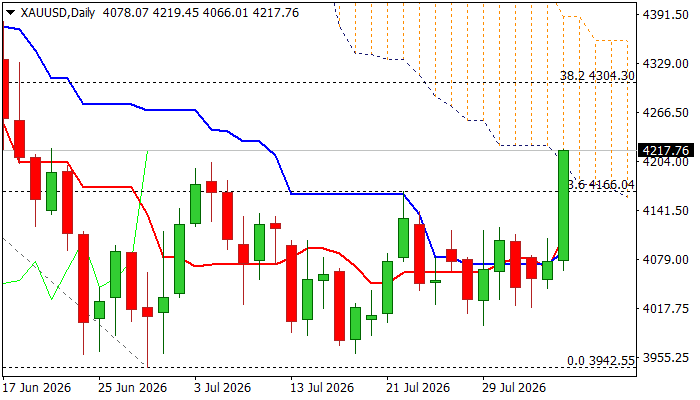
This was so far the strongest market reaction in more than one month, as fresh rally violated range top ($4203), reinforced by the base of falling and thickening daily Ichimoku cloud, generating significant bullish signals.
However, signals require confirmation on sustained break above these barriers that would open way for stronger recovery and expose next key barrier at $4304 (Fibo 38.2% of $4889/$3942) violation of which to generate reversal signal.
Strengthening positive momentum and formation of daily Tenkan/Kijun-sen bull cross, show positive developments on daily technical studies, which contributes to improving near-term outlook.
Geopolitical factor is likely to remain key price driver, with traders being cautious and focus on comments from President Trump (so far known for quick changes of direction of his views that kept market action highly volatile) that would continue to strongly impact traders’ sentiment.
Fresh acceleration higher is likely to face increased headwinds at $4200 zone, due to significance of these barriers, as some investors may decide to collect profits, however subsequent dips should hold above $4166 (broken Fibo 23.6% of $4889/$3942) to revived bulls in play.
Res: 4261; 4304; 4387; 4399
Sup: 4166; 4137; 4100; 4066