

Sample Category Title
GBP/JPY Daily Outlook
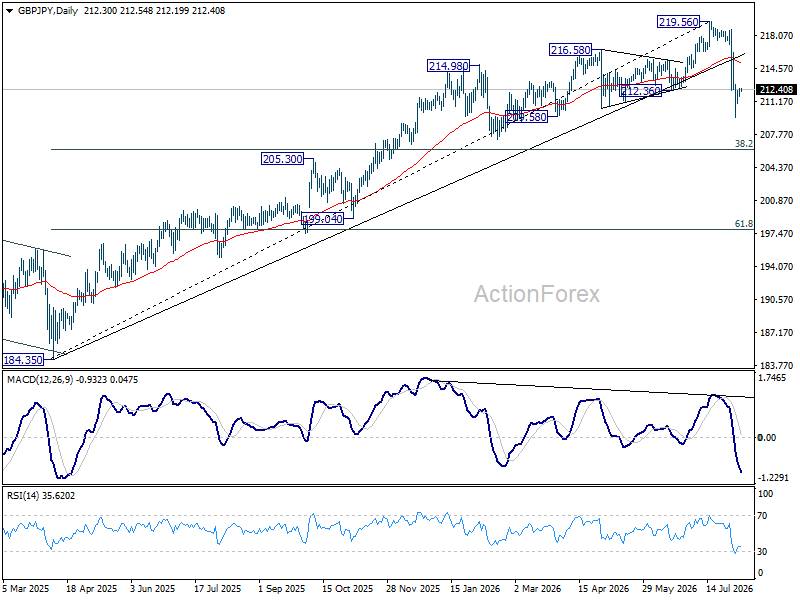
Intraday bias in GBP/JPY stays neutral for the moment. More consolidations would be seen above 209.55 temporary low. Risk will stay on the downside as long as 55 4H EMA (now at 214.31) holds. Below 209.55 will extend the fall from 219.56 to 38.2% retracement of 184.35 to 219.56 at 206.10.
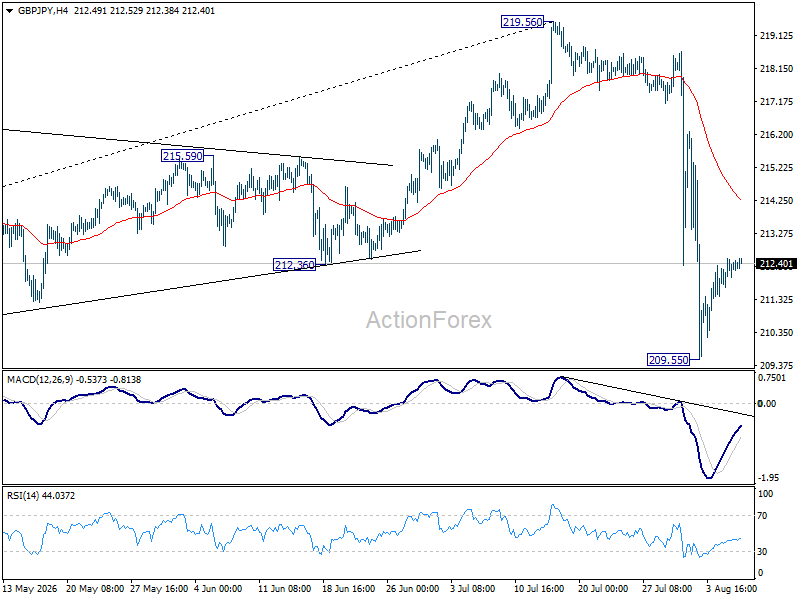
In the bigger picture, as long as 55 W EMA (now at 208.85) holds, the long term up trend is still expected to continue. But some more consolidations should be seen below 219.56 medium term top first. However, sustained break of 55 W EMA will argue that it's already in a medium term down trend to 184.35 support and below.
EUR/JPY Daily Outlook
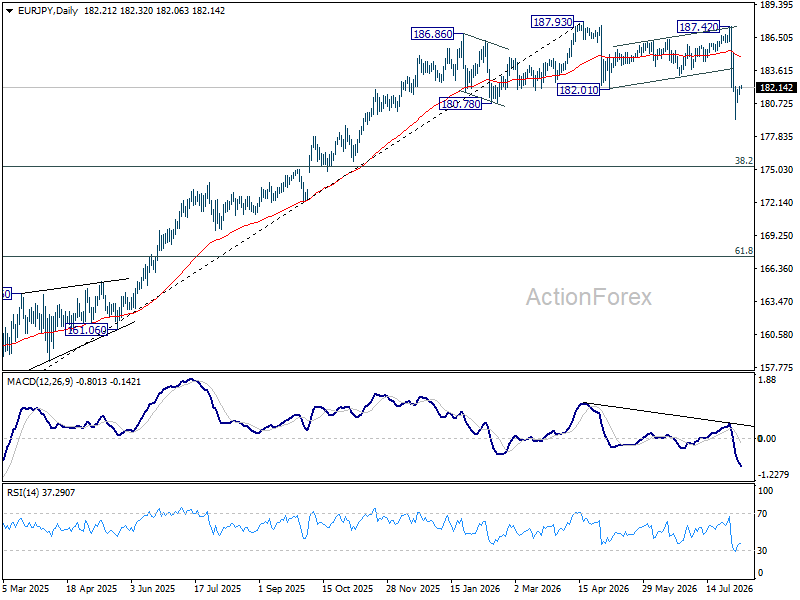
Intraday bias in EUR/JPY remains neutral. More consolidations could be seen above 179.34 temporary low. Risk will remain on the downside as long as 55 4H EMA (now at 183.48) holds. Below 179.34 will extend the decline from 187.93 to 38.2% retracement of 154.77 to 187.93 at 175.26.
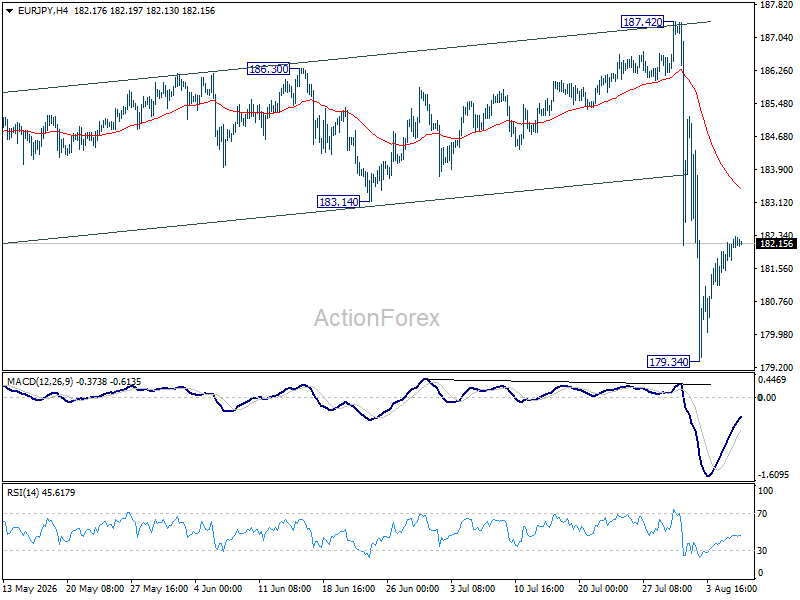
In the bigger picture, uptrend from 114.42 (2020 low) is still expected to resume at a later stage to 78.6% projection of 124.37 (2022 low) to 175.41 (2025 high) from 154.77 at 194.88. However, sustained break of 55 W EMA (now at 180.26) will argue that it's already in a medium term down trend to 175.41 resistance turned support and below.
EUR/GBP Daily Outlook
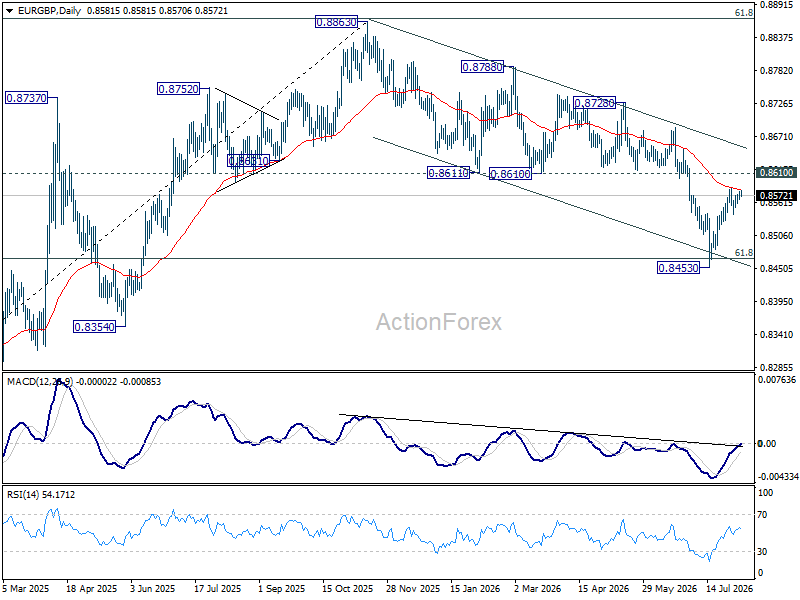
Intraday bias in EUR/GBP stays neutral at this point. While another rise cannot be ruled out, strong resistance should be seen from 0.8610 support turned resistance to limit upside. On the downside, break of 0.8258 support will argue that the corrective rebound from 0.8453 has completed, and turn bias back to the downside for retesting this low.
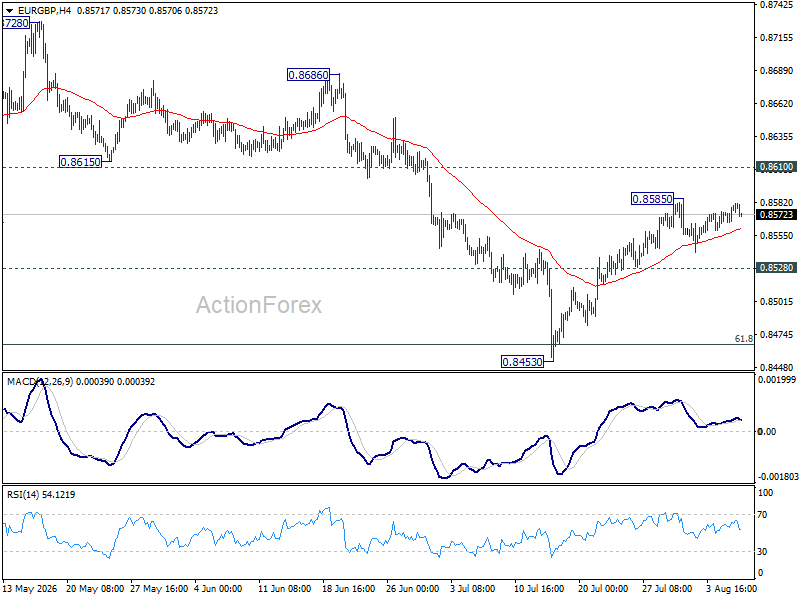
In the bigger picture, rise from 0.8221 (2024 low) should have completed at 0.8863, just ahead of 38.2% retracement of 0.9267 (2025 high) to 0.8221 at 0.8867. Deeper fall would be seen back to 0.8221. For now, outlook will be neutral at best as long as 0.8610 support turned resistance hold.
EUR/AUD Daily Outlook
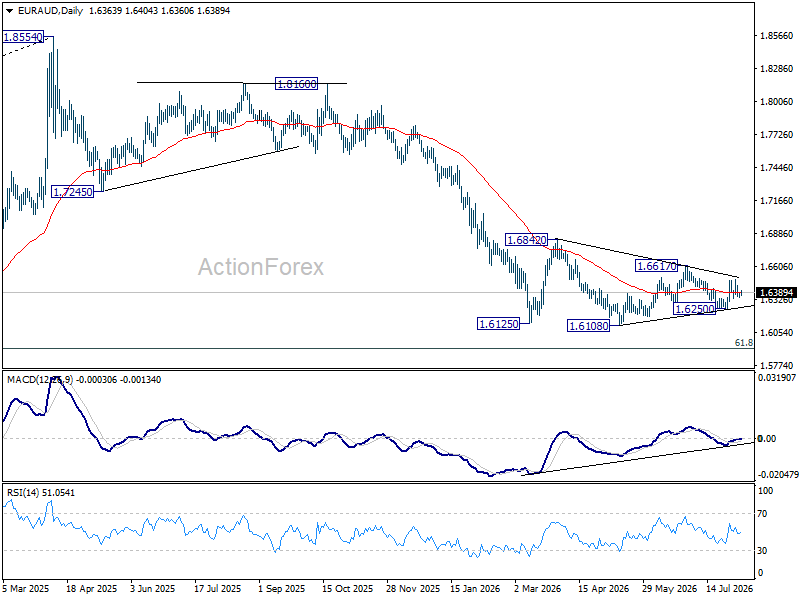
Range trading continues in EUR/AUD and intraday bias stays neutral. Overall, near term corrective pattern from 1.6108 (or 1.6125) is still extending. On the upside, above 1.6503 will target 1.6617 resistance first. On the downside, break of 1.6250 will bring deeper fall back to retest 1.6108 low.
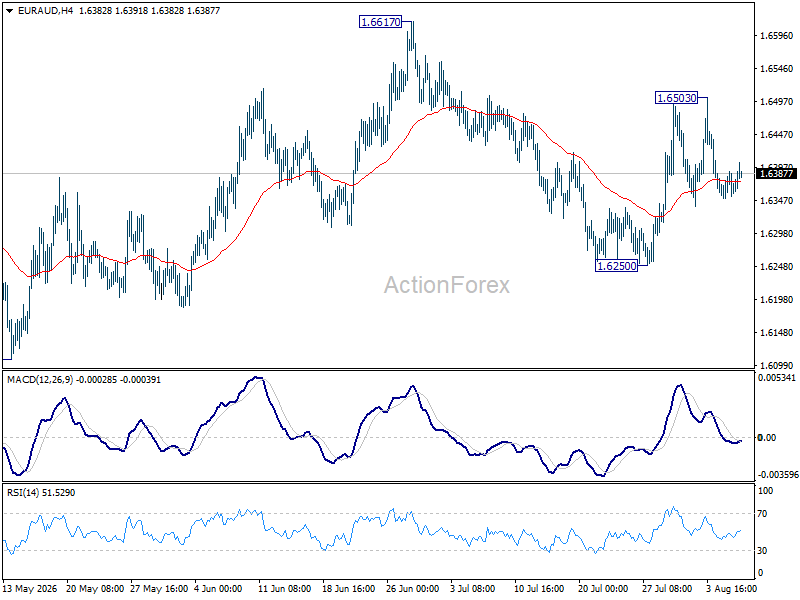
In the bigger picture, outlook will stay bearish as long as 1.6842 resistance holds. Fall from 1.8554 (2025 high) is expected to continue to 61.8% retracement of 1.4281 to 1.8554 at 1.5913. Decisive break there will pave the way back to 1.4281 (2022 low). However, firm break of 1.6842 should confirm medium term bottoming, and bring stronger rally.
EUR/CHF Daily Outlook
No change in EUR/CHF's outlook as it remains bounded in range below 0.9348. Intraday bias stays neutral at this point. With 0.9265 support intact, further rally is expected. On the upside, firm break of 0.9348 will extend larger rally from 0.8979 to 100% projection of 0.8979 to 0.9264 from 0.9094 at 0.9379. However, firm break of 0.9265 will indicate that deeper correction is underway to 55 D EMA (now at 0.9241).
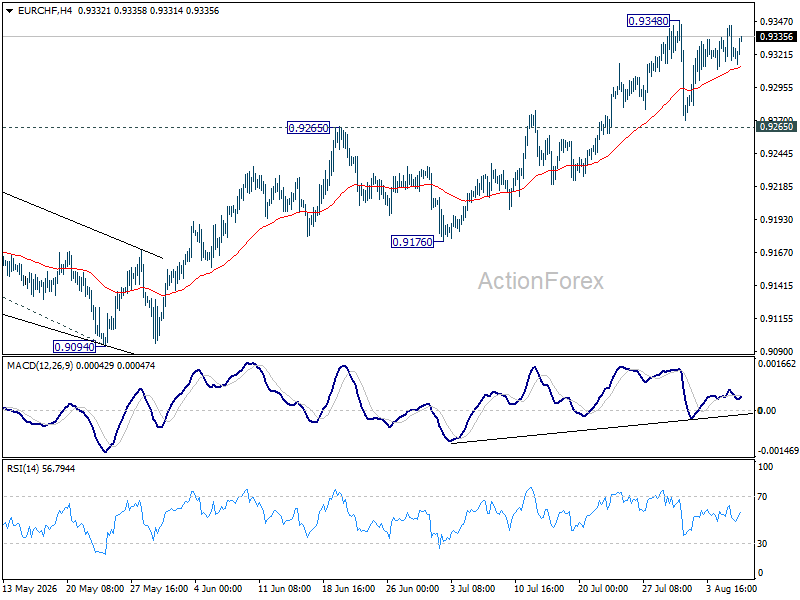
In the bigger picture, considering bullish divergence condition in W MACD, rise from 0.8979 medium term bottom should at least be reversing the fall from 0.9928, with prospect of developing into a medium term up trend. Firm break of 0.9394 resistance will add more credence to this case. For now risk will remain on the upside as long as 0.9094 support holds, in case of retreat.
Eurozone Retail Sales Fall -0.3% MoM in June as Food and Non-Food Demand Weakens
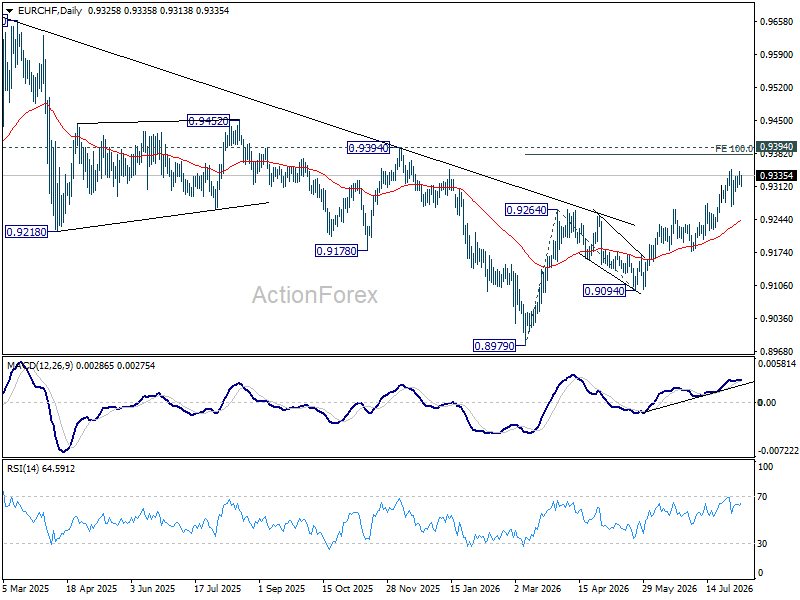
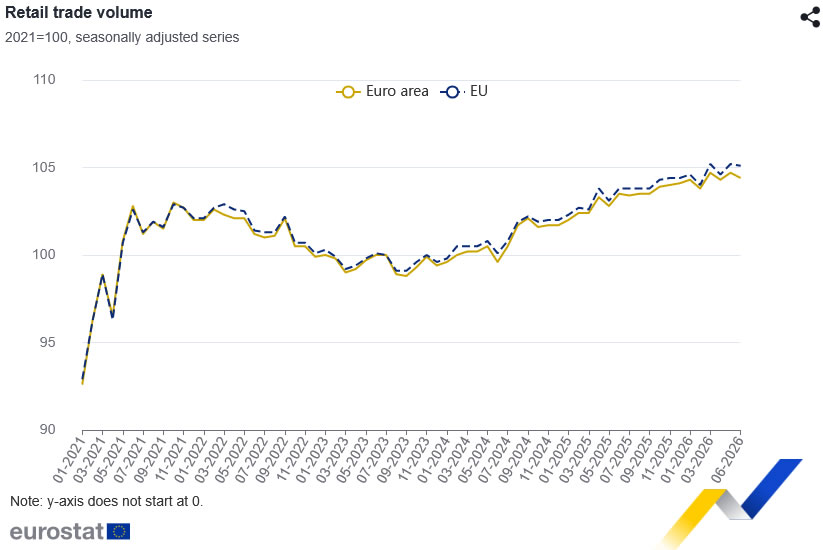
Eurozone retail sales weakened in June, adding to signs that household demand remains fragile despite improving business surveys. Retail trade volume fell -0.3% mom after rising 0.4% in May. Sales across EU declined -0.1% following 0.6% growth. On annual basis, retail sales still increased 0.7% yoy in Eurozone and 1.2% across EU, indicating consumer spending has not collapsed but continues to lack consistent momentum.
Weakness was broad across core spending categories. In Eurozone, food, drinks and tobacco sales fell -0.5% mom, while non-food sales declined -0.4%. Automotive fuel provided only offset, rising 1.5%. Pattern was similar across EU, where food sales dropped -0.4%, non-food purchases fell -0.3%, and fuel sales increased 1.7%. That composition suggests consumers remained cautious on discretionary and everyday spending even as driving-related demand improved.
National data also pointed to uneven conditions across region. Finland, Romania and Germany recorded largest monthly declines, while Luxembourg, Portugal, Croatia and Sweden posted strongest gains. For ECB, softer retail activity supports patience on further tightening, particularly while policymakers assess whether easing pipeline inflation can continue without renewed pressure from energy markets.
Data Summary
Eurozone Retail Sales
| Indicator | June 2026 | May 2026 | Trend |
|---|---|---|---|
| Total Retail Sales (m/m) | -0.3% | +0.4% | ▼ Weaker |
| Retail Sales (y/y) | +0.7% | — | ▲ Annual growth |
| Food, Drinks & Tobacco | -0.5% | +0.4% | ▼ Lower |
| Non-food (ex. Automotive Fuel) | -0.4% | +0.5% | ▼ Lower |
| Automotive Fuel | +1.5% | -1.8% | ▲ Rebounded |
EU Retail Sales
| Indicator | June 2026 | May 2026 | Trend |
|---|---|---|---|
| Total Retail Sales (m/m) | -0.1% | +0.6% | ▼ Weaker |
| Retail Sales (y/y) | +1.2% | — | ▲ Annual growth |
| Food, Drinks & Tobacco | -0.4% | +0.4% | ▼ Lower |
| Non-food (ex. Automotive Fuel) | -0.3% | +0.9% | ▼ Lower |
| Automotive Fuel | +1.7% | -1.4% | ▲ Rebounded |
Largest Monthly Changes by Member State
| Largest Declines | m/m | Largest Gains | m/m |
|---|---|---|---|
| Finland | -1.5% | Luxembourg | +2.5% |
| Romania | -1.2% | Portugal | +1.7% |
| Germany | -1.1% | Croatia | +1.5% |
| Sweden | +1.5% |
Key Takeaways
- Eurozone retail sales fell 0.3% m/m in June after a 0.4% increase in May, while EU retail sales slipped 0.1% following 0.6% growth.
- Despite the monthly setback, retail sales remained higher than a year earlier, rising 0.7% y/y in the Eurozone and 1.2% y/y across the EU.
- The decline was broad-based, with both food, drinks and tobacco (-0.5%) and non-food products (-0.4%) weakening in the Eurozone.
- Automotive fuel sales rose 1.5% in the Eurozone and 1.7% in the EU, partially offsetting softer spending elsewhere.
- Germany, Finland and Romania recorded the largest monthly declines, highlighting continued weakness in several major consumer markets.
- The report suggests household demand remains subdued, reinforcing the divergence between improving business surveys and still-cautious consumers.
Gold Rises for Fourth Consecutive Day: Geopolitics and Data Lend Support
Gold rose to 4,300 USD per ounce on Thursday, marking its fourth consecutive session of gains. The metal has advanced nearly 6% since the start of the week, supported by a partial agreement to reopen shipping through the Strait of Hormuz, which has weighed on oil prices and eased concerns over inflation and further rate hikes.
Iran and Oman agreed to establish a shipping corridor through the strait, raising expectations of a recovery in energy supplies from the Middle East. Against this backdrop, markets have scaled back expectations for Fed tightening, now pricing in only one rate hike before the end of the year, down from two a week ago.
Additional support for gold came from weak ADP employment data. In July, the US private sector added just 44,000 jobs – the lowest since January and well below the 70,000 forecast – adding to signs of a cooling labour market and putting pressure on the dollar.
At the same time, Federal Reserve official Lisa Cook reiterated her readiness to support a rate hike if inflation does not slow, warning that the regulator may not be able to delay action for long to bring inflation back to the 2% target.
Technical Analysis
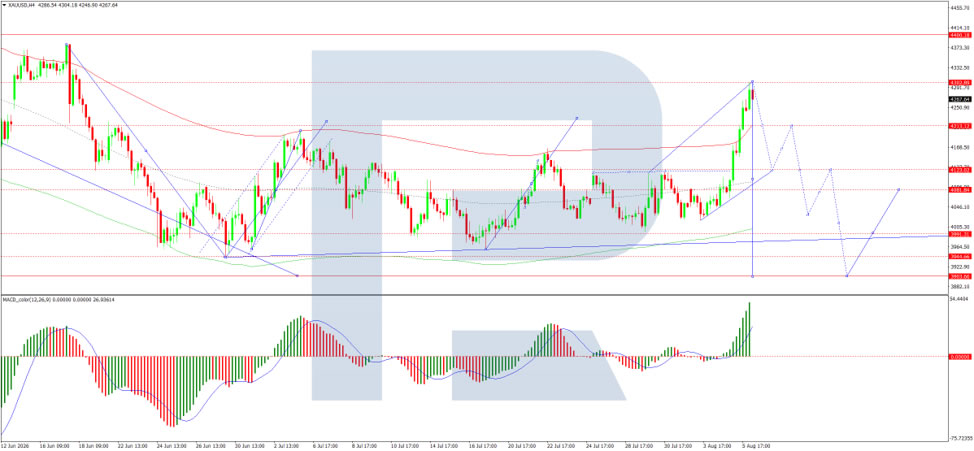
On the H4 XAU/USD chart, the market formed a consolidation range around the 4,102 USD level and, following an upside breakout, moved higher to 4,300 USD. A consolidation range is now forming below this level. A move lower towards 4,100 USD is expected next. The MACD indicator signals the early stages of bearish momentum, with its signal line above the centre line and turning downwards.
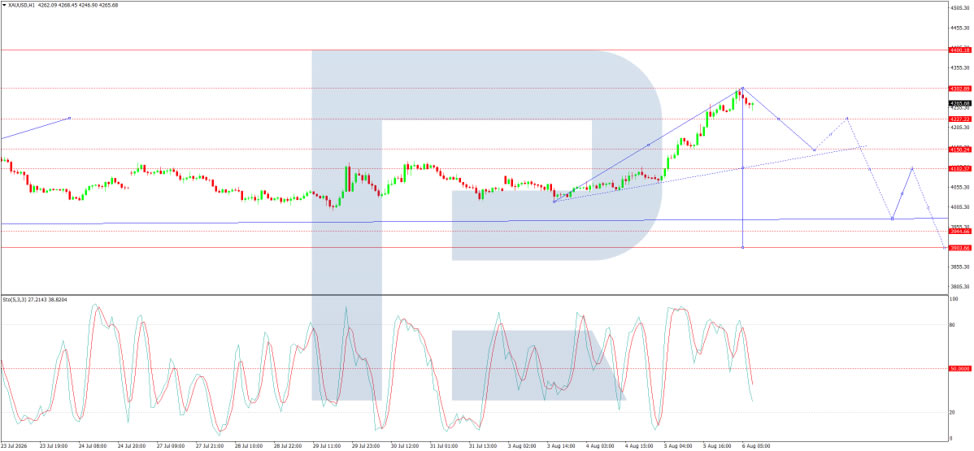
On the H1 chart, the market broke below the 4,272 USD level and moved lower to 4,244 USD, followed by a correction to 4,272 USD. A wide consolidation range is forming around this level. A continuation of the downward move to 4,100 USD is expected. The Stochastic oscillator confirms this scenario, with its signal line below 50 and pointing downwards towards 20, indicating increasing short-term downside pressure.
Conclusion
Gold has rallied for a fourth consecutive day, driven by a partial agreement to reopen the Strait of Hormuz and weaker-than-expected US labour market data. The deal has weighed on oil prices and reduced inflation concerns, prompting markets to scale back expectations for Fed tightening from two rate hikes to just one. Meanwhile, weak ADP employment data added to signs of a cooling US economy, weighing on the dollar. However, Fed official Lisa Cook’s hawkish comments served as a reminder that further tightening remains possible if inflation proves persistent. Technically, gold may see a pullback towards 4,100 USD in the near term, with further direction likely to depend on US economic data and geopolitical developments.
How Will the Yen Defend Its Gains?
- The BoJ’s support is needed to maintain current USDJPY levels.
- The return of the ‘sell America’ trade is weighing on the USD.
The US dollar continued its retreat against a backdrop of easing geopolitical risks and the return of the ‘sell America’ trade, which was popular during the trade wars. Distrust of US policy has grown following coordinated currency intervention. An insider report in the Wall Street Journal is adding fuel to the fire, claiming that Donald Trump is in regular contact with Kevin Warsh. If the new Fed chair is a puppet of the White House, the greenback is in for a rough ride.
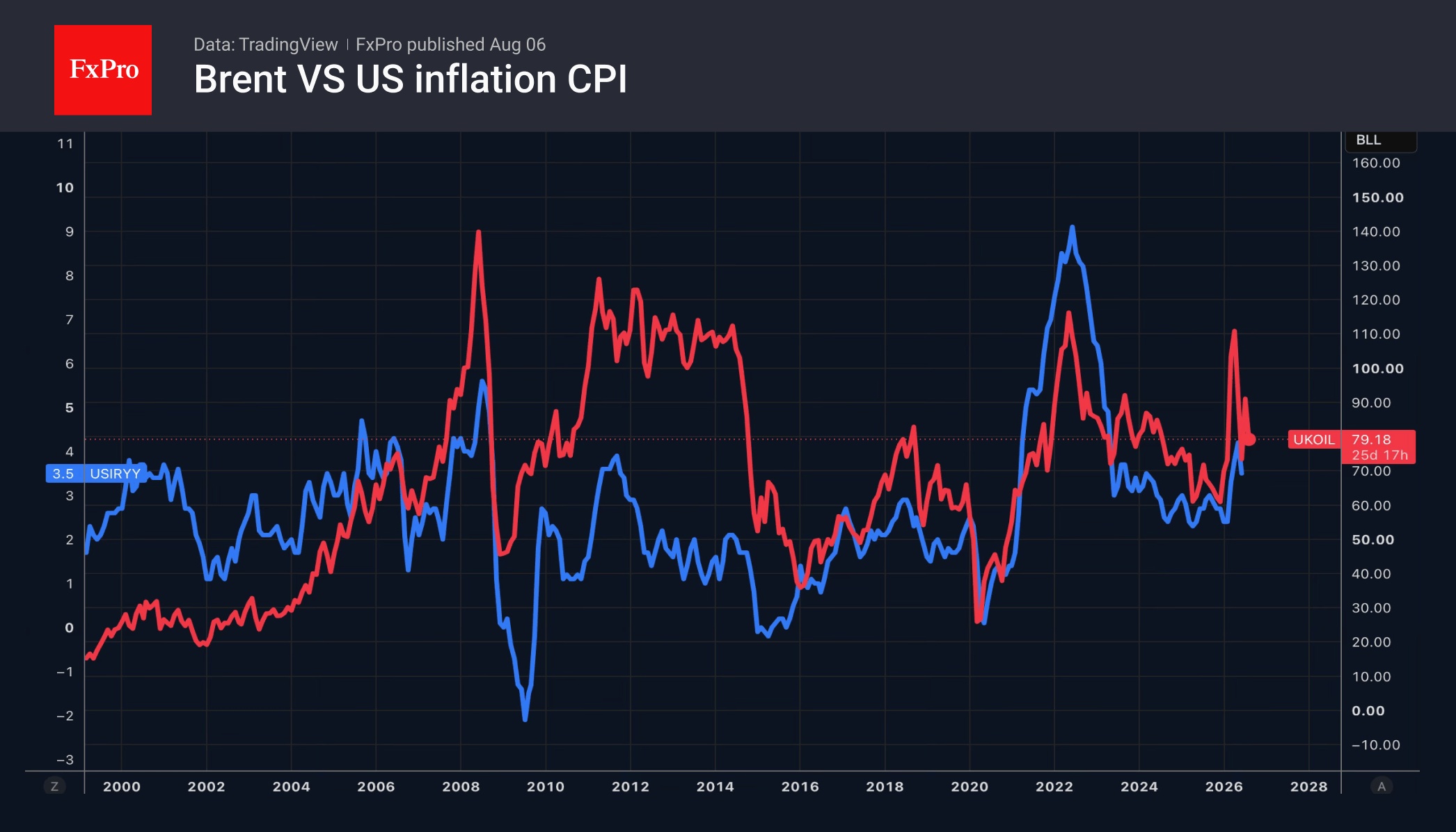
Oman and Iran are close to striking a deal to reopen the Strait of Hormuz without charging a fee. But this requires action from the US. Most likely, this involves the lifting of sanctions. As a result, oil supply will increase, leading to a fall in prices. The risks of accelerating inflation will diminish, and with them the likelihood of the Fed tightening monetary policy. This will allow other currencies to strengthen against the US dollar.
Will the yen be an exception? According to Bank of America, USDJPY will plummet to 149 by the end of the year, as the Bank of Japan will be forced to accelerate its monetary policy tightening to maintain the currency pair’s current levels. A policy of ‘acting in September rather than waiting until October’ will help strengthen the yen.
By contrast, CBA forecasts a rally in USDJPY to 165 by the second quarter of 2027. By that time, the Bank of Japan will have raised its overnight rate only twice. The Fed, meanwhile, will tighten monetary policy three or four times, starting in December.
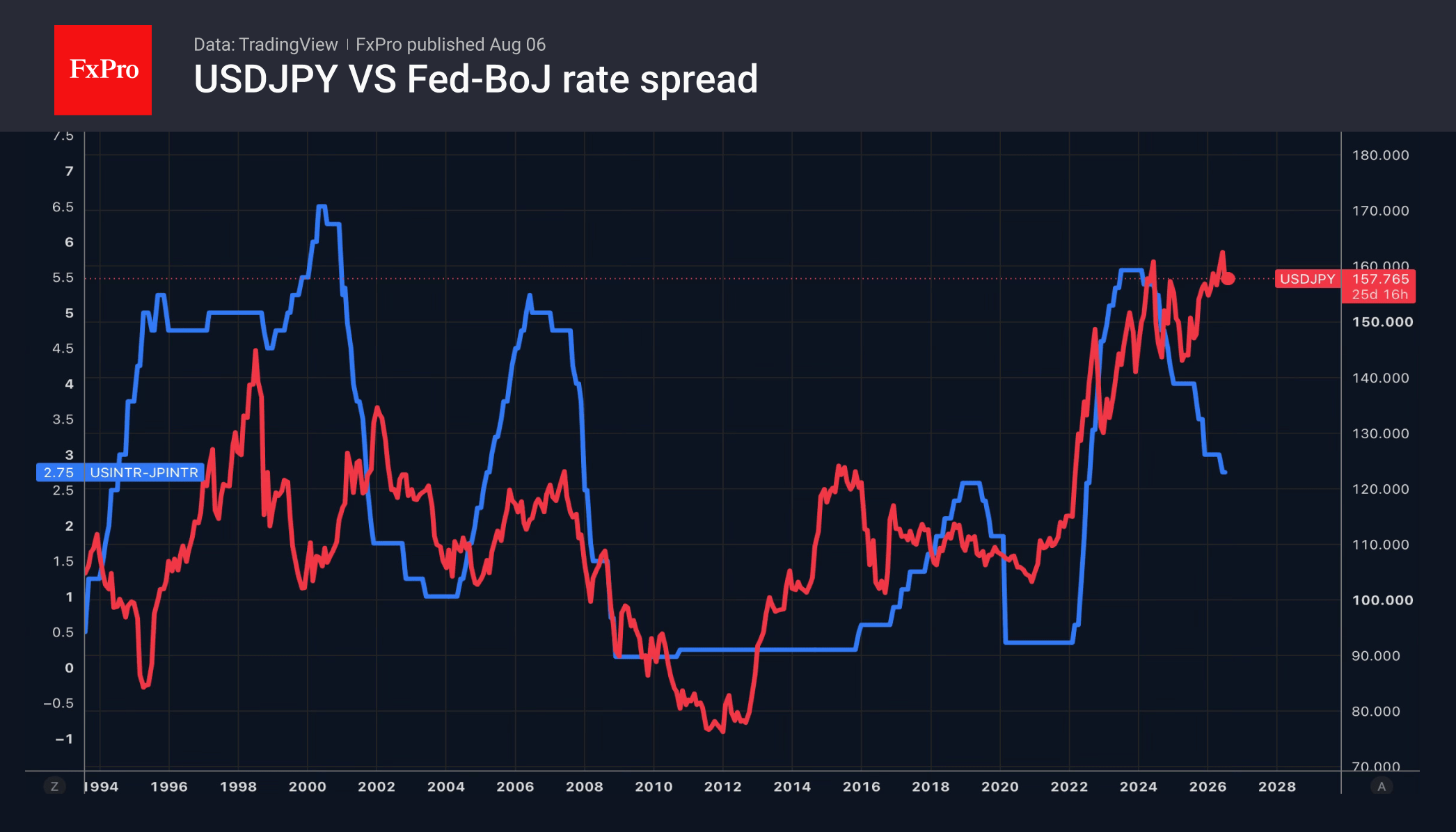
A resurgence in carry trades could put pressure on the yen. Due to coordinated currency intervention, the Bloomberg EM FX Carry Risk Premia Index fell by approximately 1%. In 2024, Japan’s interventions in the forex market resulted in a 4% slump in the index. Carry traders were prepared for such a scenario and had diversified their portfolios. They are now gradually returning to selling the yen as a funding currency, anticipating a slow normalisation of the BoJ’s monetary policy.
The fate of USDJPY remains in the hands of the central banks. Meanwhile, US employment data for July will influence all dollar pairs. A strong labour market will increase the likelihood of a Fed rate hike and support the greenback. Conversely, a cooling labour market will help the yen.
The FxPro Analyst Team
Crypto Took the Stock Market Rally with Caution
Market Overview
The crypto market capitalisation has risen by 1% over the past day to $2.21T, returning to the levels seen at the end of last month. Over the past 24 hours, the top performers among the most actively traded altcoins were Theta (+5.6%), SushiSwap (+4.2%) and Aptos (+3.2%). The biggest declines were seen in Aave (-3.4%), Basic Attention Token (-3.2%) and Algorand (-2.7%). The recovery in risk appetite across global markets has once again had a knock-on effect on cryptocurrencies, as hopes for the imminent adoption of the CLARITY Act fade and shares are increasingly seen as a competitor, drawing interest and capital away from cryptocurrencies.
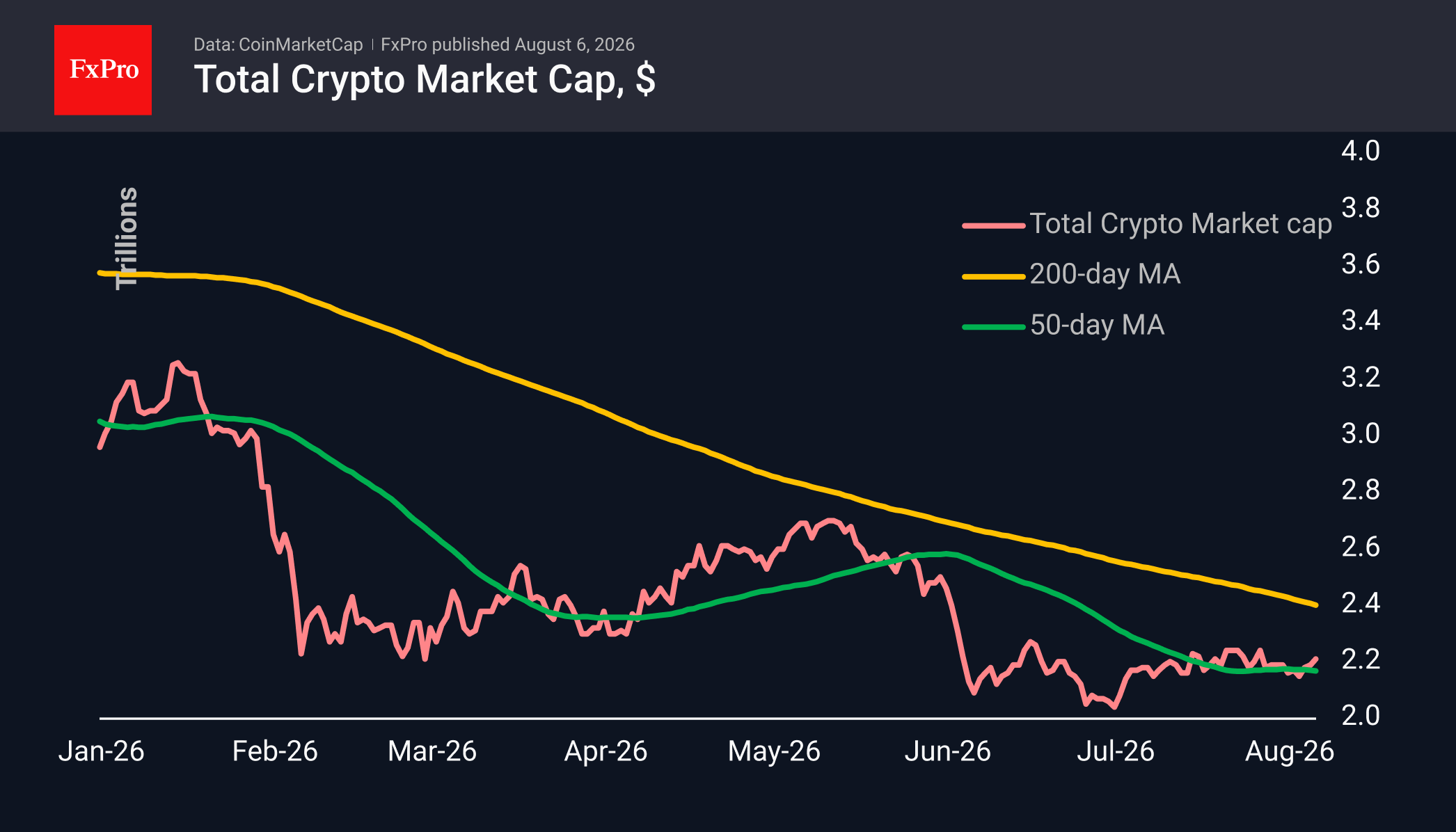
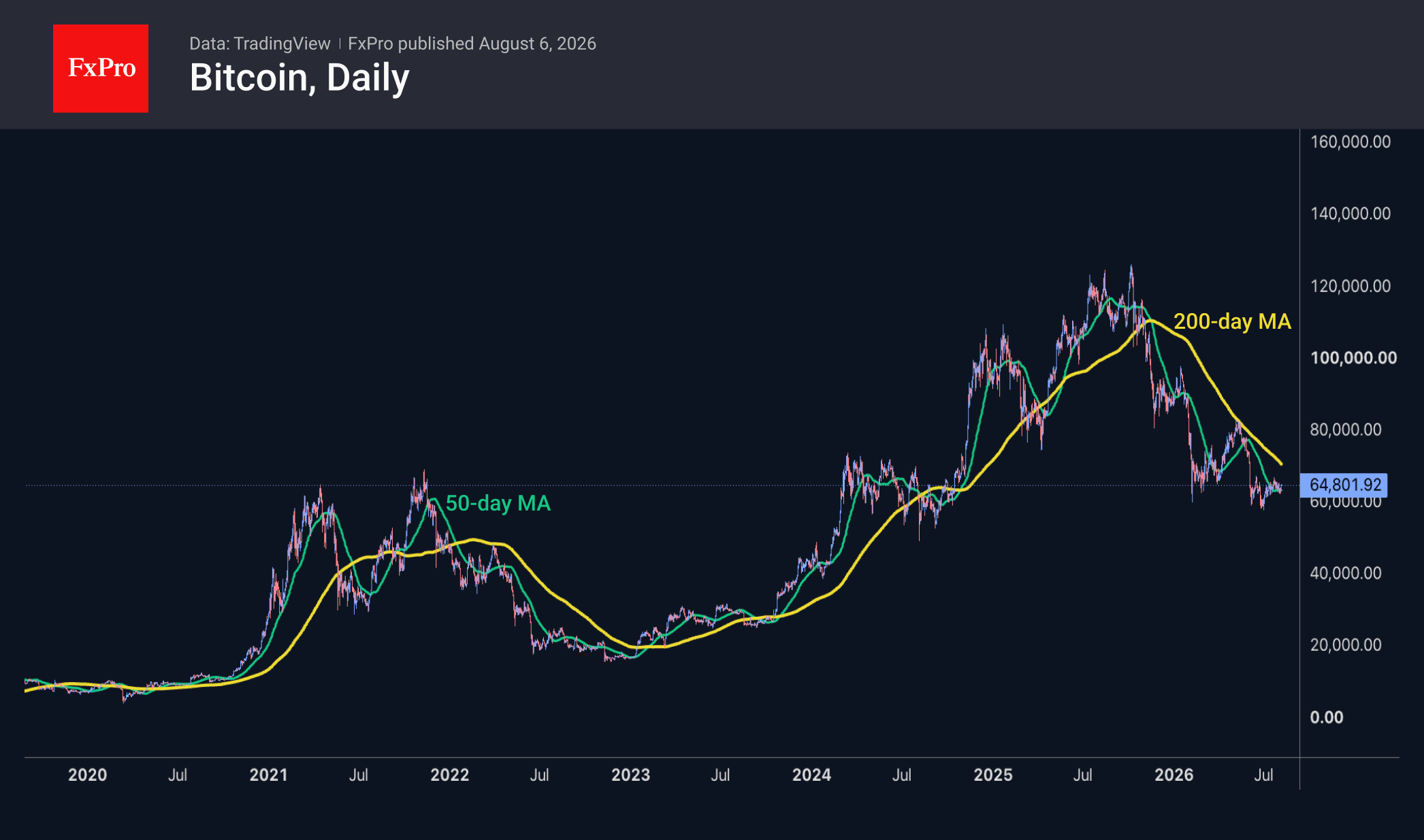
Bitcoin approached $65K, its highest level in five days. This achievement does not seem particularly significant against the backdrop of the impressive rally in US equity markets and the surge in precious metals prices on Wednesday. It appears that traders in the leading cryptocurrency do not consider this surge in risk appetite to be favourable for cryptocurrencies. In previous prolonged downtrends, confident buying by a broad range of participants began after the 200-day moving average turned upwards and the price consolidated above it. This approach does not allow one to buy at the lowest price, but it optimises the duration of the drawdown, given market uncertainty.
News Background
The crypto market is in the late stages of a bear market but has not yet bottomed out, according to Glassnode, citing a composite indicator of 45 Bitcoin on-chain metrics. Weekly inflows into spot Bitcoin ETFs have resumed, while the number of active addresses and adjusted transaction volumes on the BTC network has risen sharply. Wintermute echoes this view, noting that major cryptocurrencies have remained resilient amid macroeconomic turmoil. Selling pressure is nearing exhaustion.
Prolonged regulatory uncertainty is holding back some professional investors from investing in cryptocurrencies, Bitwise notes. Consideration of the CLARITY Act in the US Senate may be postponed until September or December. Polymarket estimates the probability that the bill will be signed into law by the end of this year at 15%, down from 82% in February.
According to Lookonchain, Strategy and MARA have transferred 7,030 BTC, worth around $450 million, to new addresses. This may indicate a readiness to sell the asset. MARA remains among the top five corporate holders of Bitcoin.
The collapse of the AI bubble is inevitable, according to BitMEX co-founder Arthur Hayes. In such a scenario, reminiscent of the 2008 mortgage crisis, the authorities will be forced to prop up the financial system with new economic stimulus programmes, causing Bitcoin to rise to $1 million.
The FxPro Analyst Team
FTSE 100 Analysis: Strong BAE Systems Earnings Support the Index Rally Near Record Highs
On 30 July, BAE Systems reported its first-half 2026 financial results, with sales rising 9% year-on-year to £15.8 billion. Underlying operating profit increased by 11% to £1.7 billion, while underlying earnings per share climbed 13% to 38.9 pence. The company also raised its full-year outlook for sales, operating profit and EPS, supported by a record order backlog of £84 billion following £16.4 billion in newly secured contracts. On the same day, the FTSE 100 reached a fresh intraday high, helped by gains in mining stocks amid stronger commodity prices and positive momentum across industrial companies after encouraging earnings releases. The advance came alongside renewed focus on developments surrounding Iran and expectations ahead of the Bank of England’s rate decision.
Technical Analysis of FTSE 100
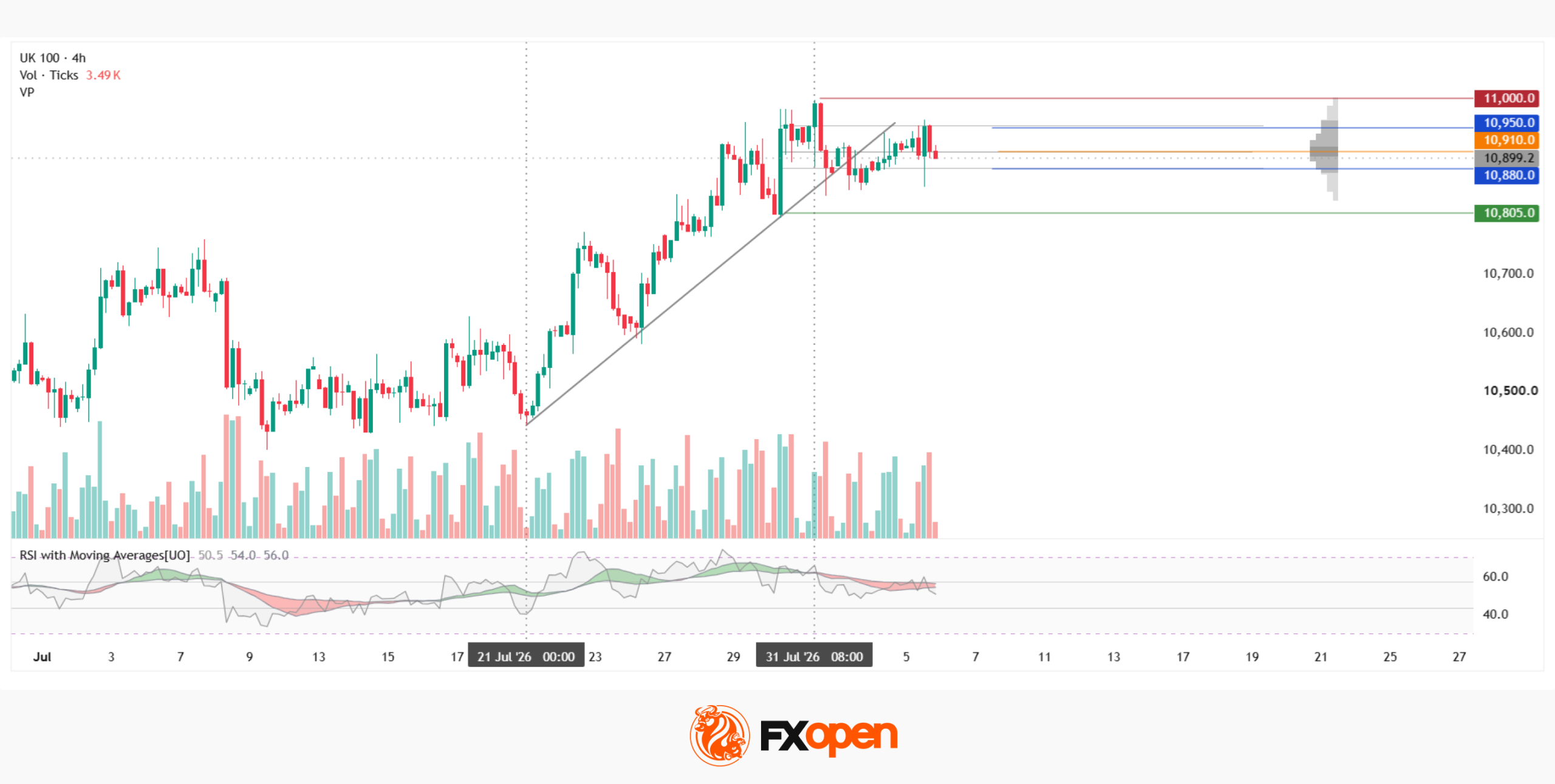
The FTSE 100 index has been trending higher since reaching a low near 10,450 on 21 July. The index advanced along a rising trendline towards the red resistance zone around 11,000 before breaking above the trendline and entering a consolidation phase. Currently, the price is trading within the boundaries of the latest volume profile, with the upper boundary at 10,950, the lower boundary near 10,880, and the Point of Control (POC) located at 10,910. The close positioning of these levels creates a relatively narrow trading zone, limiting the space for an extended sideways move.
The current profile is surrounded by key technical levels on both sides. The 11,000 resistance area remains above the market and marks the recent short-term peak, while the green support level at 11,805 could act as a reference if the lower profile boundary is breached. The RSI + MAs indicator is currently showing readings of 50, 54 and 56, with all components remaining in neutral territory and offering no clear directional signal.
Summary
BAE Systems’ strong earnings provide additional fundamental support for the FTSE 100 rally, although the technical picture suggests that momentum has started to slow. The RSI + MAs indicator has moved into a more balanced position, while the index remains below its recent high. Further upside is likely to depend on whether upcoming corporate results can justify current market expectations and maintain investor confidence.
Trade global index CFDs with zero commission and tight spreads (additional fees may apply). Open your FXOpen account now or learn more about trading index CFDs with FXOpen.
This article represents the opinion of the Companies operating under the FXOpen brand only. It is not to be construed as an offer, solicitation, or recommendation with respect to products and services provided by the Companies operating under the FXOpen brand, nor is it to be considered financial advice.