Sample Category Title
US ISM Services Holds Firm at 54.1 as Employment Contracts, Prices Accelerate
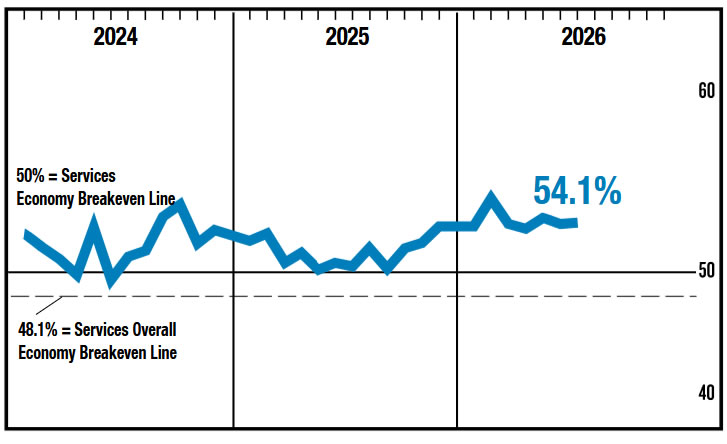
The US services sector continued to expand at a healthy pace in July, suggesting the economy remains resilient even as cracks emerge in the labor market. The ISM Services PMI edged up to 54.1 from 54.0, remaining comfortably above its 12-month average of 53.4. According to ISM's historical relationship, the latest reading is consistent with 1.9% annualized real GDP growth, indicating that overall economic activity continues to expand despite growing uncertainty over monetary policy and the outlook for employment.
Beneath the steady headline, however, the report revealed a more mixed picture. The Employment Index dropped sharply to 47.4 from 51.2, slipping back into contraction after just one month of growth. Survey respondents pointed to modest workforce reductions, with some firms citing AI adoption while others continued shifting jobs to lower-cost overseas locations. The weaker employment reading follows softer ADP payroll data earlier in the day, reinforcing signs that hiring momentum in the US economy is cooling.
Inflation pressures, meanwhile, moved in the opposite direction. The Prices Index climbed to 70.3, up from 67.7, marking the 110th consecutive month of rising input costs and lifting its 12-month average to the highest level since April 2023. The combination of resilient activity, softer hiring and firmer prices leaves the Federal Reserve with a familiar policy dilemma. While slowing employment supports the case for patience, persistent cost pressures are likely to keep policymakers cautious about declaring victory over inflation.
Data Summary
| Indicator | July 2026 | June 2026 | Trend |
|---|---|---|---|
| ISM Services PMI | 54.1 | 54.0 | ▲ Slight improvement |
| Market Expectation | 54.2 | — | Slight miss |
| Business Activity | 59.1 | 55.4 | ▲ Strong acceleration |
| New Orders | 57.2 | 55.1 | ▲ Demand strengthened |
| Employment | 47.4 | 51.2 | ▼ Back to contraction |
| Prices Paid | 70.3 | 67.7 | ▲ Inflation pressures intensified |
| New Export Orders | 52.0 | 50.4 | ▲ Faster expansion |
| Imports | 51.8 | 49.4 | ▲ Returned to growth |
| Backlog of Orders | 50.9 | 54.9 | ▼ Growth slowed |
| Supplier Deliveries | 52.8 | 54.4 | ▼ Delivery delays eased |
Key Takeaways
- ISM Services PMI edged up to 54.1 in July, signaling a 25th consecutive month of expansion and pointing to 1.9% annualized real GDP growth according to ISM's historical relationship.
- Business activity (59.1) and new orders (57.2) accelerated, indicating demand across the services sector remained healthy despite a softer macro backdrop.
- The Employment Index dropped sharply to 47.4, slipping back into contraction after one month above 50 and reinforcing earlier signs from the ADP report that labor demand is cooling.
- Survey respondents cited AI adoption, workforce reductions and continued hiring shifts to lower-cost overseas locations as factors behind weaker employment.
- The Prices Paid Index jumped to 70.3, marking the 110th consecutive month of rising input costs and its highest 12-month average since April 2023.
- The report delivers a mixed signal for the Fed: solid economic activity argues against recession concerns, while weaker hiring supports patience, but stronger price pressures keep inflation risks alive.
Dollar Slips as Weak ADP Reinforces Fading Fed Hike Bets
What's happening: Weak US ADP employment data (44k, well below expectations) reinforced the market's already-building conviction that the Fed has room to hold rates, a narrative driven primarily by growing optimism that the Strait of Hormuz could reopen soon and ease energy-driven inflation risk.
Why it matters: The ADP report didn't create this dovish shift, it just added to an existing case. September hike odds had already retreated sharply over the prior two days on lower oil prices alone, and Minneapolis Fed's Kashkari's pushback for immediate tightening found little support from markets.
Why the Dollar's Rebound Attempt Faded
The Dollar attempted to recover early in Wednesday's session, but the rebound quickly faded after weaker-than-expected private employment data reinforced the market's growing conviction that the Federal Reserve has time to keep interest rates on hold. While the ADP report is no longer regarded as a reliable predictor of Friday's non-farm payrolls, the gain of just 44k jobs was enough to strengthen an existing market narrative rather than create a new one. Investors had already been scaling back September rate hike expectations as optimism grew that the Strait of Hormuz could soon reopen, reducing the risk of another sustained energy-driven inflation shock.
Risk Assets Extend Gains as Fed Patience Narrative Builds
That shift in sentiment continued to support risk assets. Dow futures traded more than 250 points higher ahead of the US open, pointing to another record after Wall Street's latest advance. Treasury yields remained soft as markets interpreted weaker hiring alongside falling oil prices as further evidence that the Fed could afford to remain patient. Expectations for a September rate hike have already retreated sharply over the past two days as prospects of lower energy costs eased concerns that inflation would reaccelerate. Against that backdrop, the ADP report simply raised the hurdle for the hawkish case.
Key Data
- ADP private payrolls: +44k, well below expectations
- Dow futures: more than 250 points higher ahead of the US open, pointing to another record
- September Fed hike odds: retreated sharply over the past two days
- Treasury yields: remained soft, tracking weaker hiring and falling oil prices
Kashkari's Pushback Finds Little Support
Minneapolis Fed President Neel Kashkari attempted to push back against that repricing, defending his dissent at last week's FOMC meeting by arguing that "now is the time to start slowly moving up as we get more data in." Kashkari maintained that he still saw little evidence current policy was sufficiently restrictive and preferred taking "small steps" now rather than risking more aggressive tightening later. Markets, however, showed little inclination to embrace that message, with Kashkari and the other two dissenters remaining firmly in the minority camp.
Currency Markets: Euro and Sterling Lead, Kiwi Lags Despite Strong Jobs Data
In the currency markets, the Dollar was the second weakest major currency of the day, while the Euro led gains, followed by Sterling, with both also benefiting from buying against the Swiss Franc. The New Zealand Dollar underperformed despite stronger-than-expected employment growth in the second quarter, as investors focused instead on the jump in the unemployment rate to 5.6%, though that increase was accompanied by higher labor force participation rather than outright job losses, and the prospect that lower oil prices reduce the urgency for further RBNZ tightening, much as they reinforce expectations that the RBA will remain on hold. The Canadian Dollar traded in the middle of the pack, balancing weaker oil prices against generally constructive domestic fundamentals. The Yen also consolidated after recent intervention-driven gains.
Related Coverage
Fed & Rates Deep Dives
- Read the fuller ADP breakdown showing wage growth stayed firm even as hiring slowed sharply: US ADP Employment Miss at 44k, Growth Slows Sharply, But Wage Growth Stays Firm.
- See Kashkari's full case for why the Fed should start raising rates now rather than wait: Fed's Kashkari: Better to Start Raising Rates Now Than Wait.
Commodities & FX Deep Dives
- Read why Hormuz optimism is pulling AUD/USD in two directions at once, boosting risk appetite while dimming Australia's LNG export outlook: AUD/USD Is Rising. Why Isn't It Rising Faster?.
- See why Silver's breakout attempt may have stronger foundations this time, from Hormuz-driven Fed repricing to industrial demand: Silver Breakout Attempt Builds as Hormuz Hopes Reshape Fed Expectations.
Eurozone & UK Data
- Read why Eurozone producer prices excluding energy kept rising even as the headline turned negative: Eurozone PPI Falls -0.3% M/M on Cheaper Energy, Core Producer Prices Still Rise.
- See why the Eurozone's composite PMI hit an eight-month high, and what it implies for Q3 GDP growth: Eurozone Composite PMI Climbs to Eight-Month High, Indicates 0.3% Quarterly GDP Growth.
- Read why record UK job losses are casting a shadow over an otherwise improving services recovery: UK Services PMI Returns to Growth, but Record Job Losses Cast Shadow.
Asia-Pacific Data
- See why six straight months of real wage growth are strengthening the case for further BoJ normalization: Japan's Wage Cycle Keeps Improving as Real Pay Rises for Sixth Month.
- Read why Japan's manufacturing strength is offsetting a slowdown in services growth: Japan Services PMI Eases to 51.2 in July, Composite Holds at 52.7.
- See why Australia's private sector hit a six-month high, and why accelerating selling prices remain a concern: Australia Composite PMI Climbs to Six-Month High on Stronger Services Activity.
- Read the full New Zealand labour report showing why strong hiring outweighs the uptick in unemployment: New Zealand Jobs Surprise: Strong Hiring Outweighs Rise in Unemployment.
- See why China's services PMI slowdown is being driven by falling business confidence, not weaker exports: China Private Services PMI Slows Sharply to 50.4 as Domestic Demand Loses Momentum.
Frequently Asked Questions
Q: Did the weak ADP report cause the Fed's dovish repricing?
A: Not on its own. September Fed hike odds had already retreated sharply over the prior two days as optimism grew that the Strait of Hormuz could reopen, easing the risk of another energy-driven inflation shock. The ADP report's 44k gain, well below expectations, simply reinforced that existing narrative rather than creating a new one, since ADP is no longer considered a reliable predictor of Friday's non-farm payrolls.
Q: Why did the New Zealand Dollar underperform despite a strong jobs report?
A: New Zealand's Q2 employment growth beat expectations, but investors focused instead on the unemployment rate rising to 5.6% and on how lower oil prices reduce the urgency for further RBNZ tightening, much as they reinforce expectations that the RBA stays on hold. The unemployment uptick came alongside higher labor force participation rather than outright job losses, but markets prioritized the RBNZ policy implications over the headline hiring beat.
Q: Why is Kashkari's push for another hike not moving markets?
A: Kashkari was one of three dissenters at last week's FOMC meeting who favored an immediate hike, and he remains firmly in the minority. His argument for taking "small steps" now rather than risking more aggressive tightening later hasn't gained traction because markets are increasingly convinced the Fed has room to be patient, especially with Hormuz-related oil price relief reducing near-term inflation risk.
Key Takeaways
- The dovish Fed narrative predates the ADP miss: September hike odds already retreated sharply over the prior two days on Hormuz reopening optimism; the weak ADP report reinforced that shift rather than starting it.
- Risk assets kept climbing on the same theme: Dow futures rose more than 250 points toward another record as Treasury yields stayed soft, both consistent with a patient Fed.
- Kashkari's dissent remains a minority view: His case for immediate, gradual tightening found little market traction, with all three FOMC dissenters still outnumbered.
- Euro and Sterling led currency gains, Kiwi lagged despite strong jobs data: NZD underperformed on the unemployment uptick and reduced RBNZ urgency from lower oil, even though Q2 employment growth beat expectations.
- The Yen and Loonie sat out the bigger moves: Yen consolidated after its intervention-driven rally, while CAD balanced weaker oil against still-constructive domestic fundamentals.
What to Watch Next
Friday's non-farm payrolls report is the week's real test, not Wednesday's ADP number, which has lost its predictive reliability. Markets will also keep watching Hormuz headlines, since further confirmation of reopening progress would extend the same oil-driven, Fed-patience narrative that's already been building for two days.
Fed’s Kashkari: Better to Start Raising Rates Now Than Wait
Minneapolis Fed President Neel Kashkari defended his dissent at last week's FOMC meeting, arguing that the central bank should begin raising interest rates gradually rather than risk falling behind inflation. Speaking to CNBC from the Aspen Ideas Festival, Kashkari said he was not advocating aggressive tightening but believed the Fed should "start slowly moving up as we get more data in." He was one of three policymakers who voted for a 25-basis-point rate hike, while the majority opted to keep the federal funds rate unchanged at 3.50%-3.75%.
Kashkari's central argument was that current monetary policy has yet to become meaningfully restrictive. "I don't see evidence monetary policy is particularly restrictive right now," he said, pointing to robust corporate earnings, resilient consumer spending and a labor market that continues to hold up well. While acknowledging that June inflation showed some improvement as oil prices temporarily retreated, he warned that persistent supply shocks continue to threaten the inflation outlook. "We have more work to do to get inflation back down," he said, adding that he would "rather get going now in small steps than wait till later" and risk having to raise rates much more aggressively.
His remarks sharpen the contrast within the Federal Reserve following last week's meeting. Just a day earlier, Philadelphia Fed President Anna Paulson argued policy was already "mildly restrictive" and supported holding rates steady while assessing incoming data. Kashkari stopped short of explicitly calling for a September hike, stressing that future decisions would depend on economic data. He also revealed that Fed Chair Kevin Warsh encouraged independent judgment, recalling that Warsh told him to "do what you think is the right thing to do for the economy.
Key Takeaways
- Minneapolis Fed President Neel Kashkari argued the Fed should begin raising rates gradually rather than risk falling behind inflation and being forced into larger hikes later.
- Kashkari believes current monetary policy is not sufficiently restrictive, citing strong corporate earnings, resilient consumer spending and a still-solid labour market.
- Despite some improvement in June inflation, he warned that supply-side inflation risks remain, saying the Fed still has "more work to do" to return inflation to its 2% target.
- Kashkari did not explicitly endorse a September rate hike, emphasizing that upcoming economic data will determine the appropriate policy path.
- His comments highlight the growing divide within the FOMC, contrasting with Philadelphia Fed President Anna Paulson's view that policy is already "mildly restrictive."
- Kashkari also said Fed Chair Kevin Warsh encouraged independent judgment, suggesting an open policy debate despite the unusual three dissents at last week's meeting.
US ADP Employment Miss at 44k Growth Slows Sharply, But Wage Growth Stays Firm
US private-sector hiring slowed more sharply than expected in July. The ADP National Employment Report showed private employment increased by 44k, well below the 75k consensus forecast and down from a revised 95k in June. Hiring remained concentrated in the service sector, which added 47k jobs, while goods-producing industries shed 3k, leaving overall employment growth at its weakest pace in recent months.
The softer headline, however, was accompanied by continued resilience in wages. Annual pay growth for workers who stayed with their employers held steady at 4.4%, while wage growth for job changers accelerated to 7.0%, the strongest since August 2025.
ADP Chief Economist Nela Richardson noted that stronger pay gains for job changers suggest labour shortages persist in parts of the economy even as employers adjust hiring plans to shifting macroeconomic conditions.
Data Summary
| Indicator | July | June | Trend |
|---|---|---|---|
| ADP Private Employment | 44k | 95k | ▼ Hiring slowed sharply |
| Market Expectation | 75k | — | Missed by 31k |
| Goods-Producing Employment | -3k | — | ▼ Contracted |
| Service-Providing Employment | +47k | — | ▲ Continued growth |
| Small Businesses | +23k | — | ▲ Largest contributor |
| Medium Businesses | +8k | — | ▲ Positive |
| Large Businesses | +13k | — | ▲ Positive |
| Pay Growth – Job Stayers | 4.4% y/y | 4.4% | ► Unchanged |
| Pay Growth – Job Changers | 7.0% y/y | 6.7% | ▲ Highest since Aug 2025 |
Key Takeaways
- US private employment rose by just 44k in July, well below the 75k consensus forecast and down from a revised 95k in June, pointing to slower hiring momentum.
- Employment growth remained concentrated in the services sector (+47k), while goods-producing industries lost 3k jobs.
- Hiring was positive across businesses of all sizes, with small firms accounting for more than half of July's job gains.
- Wage growth remained resilient. Pay for job stayers held steady at 4.4%, while job changers saw pay growth accelerate to 7.0%, the strongest since August 2025.
- ADP said stronger wage gains for job changers suggest labour shortages persist in parts of the economy, even as employers become more cautious about hiring.
- The report reinforces the picture of a cooling—but not collapsing—labour market, keeping attention firmly on Friday's official nonfarm payrolls report for confirmation.
EUR/USD Daily Outlook
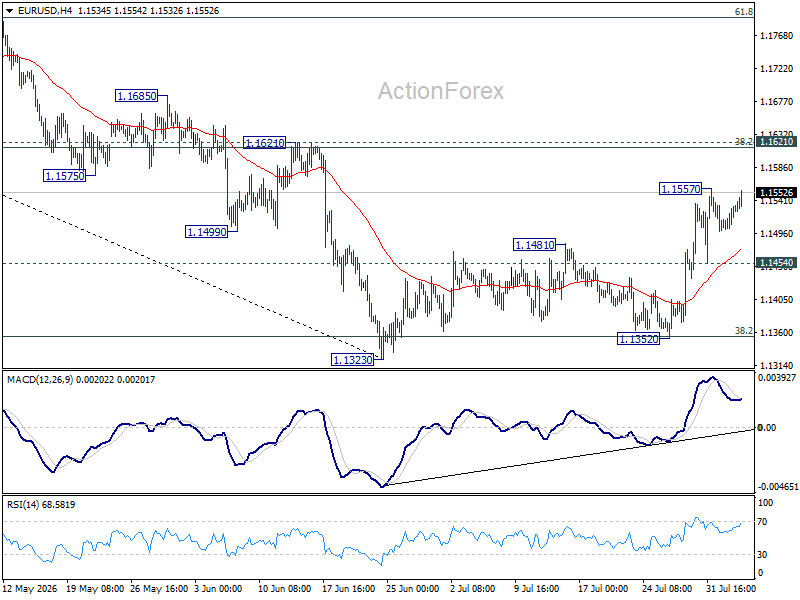
Intraday bias in EUR/USD remains neutral first. On the upside, above 1.1557 will extend the rebound from 1.1323 to cluster resistance (38.2% retracement of 1.2081 to 1.1323 at 1.1613). Decisive break there will target 61.8% retracement at 1.1791. Nevertheless, break of 1.1454 minor support will turn bias back to the downside for 1.1323/1352 support zone instead.
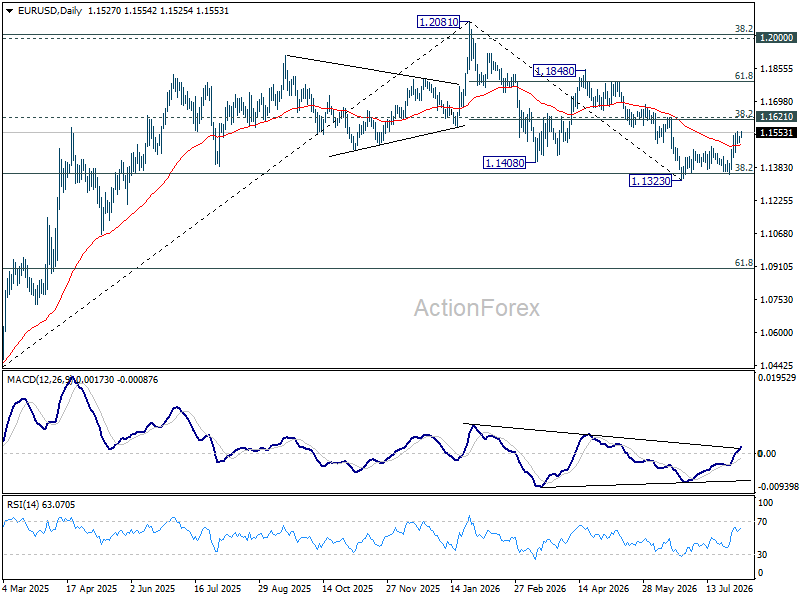
In the bigger picture, focus is staying on 38.2% retracement of 1.0176 to 1.2081 at 1.1353. Decisive break there will revive the case of medium term bearish trend reversal after rejection by 1.2 key cluster resistance level. Further fall should be seen to 61.8% retracement at 1.0904. Nevertheless, strong rebound from 1.1353, followed by break of 1.1621 resistance, will retain medium term bullishness.
USD/JPY Daily Outlook
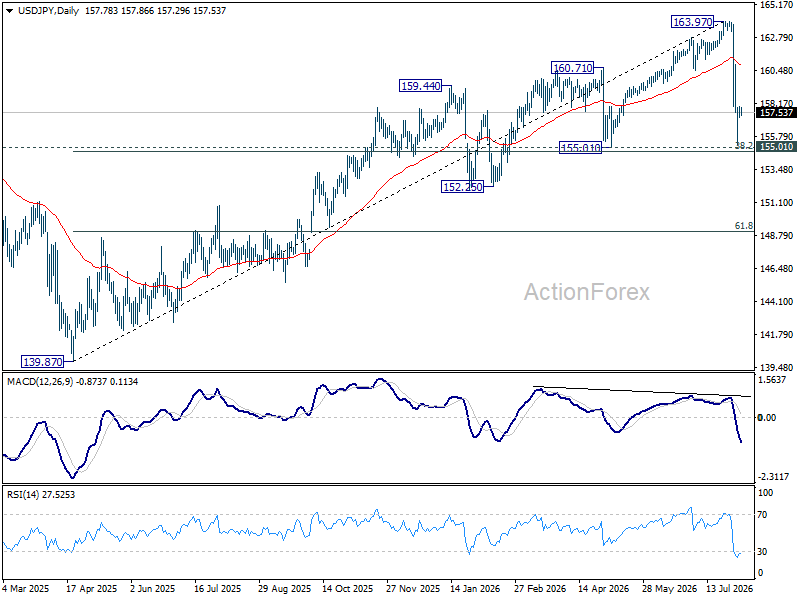
Intraday bias in USD/JPY remains neutral first. While another fall cannot be ruled out, strong support is still expected from (38.2% retracement of 139.87 to 163.97 at 154.76) bring rebound. Still, sustained break of 55 4H EMA (now at 160.23) is needed to indicate that fall from 163.97 has completed. Otherwise, risk will remain on the downside. Meanwhile, sustained break of 154.76/155.01 will pave the way to 61.8% retracement at 149.07.
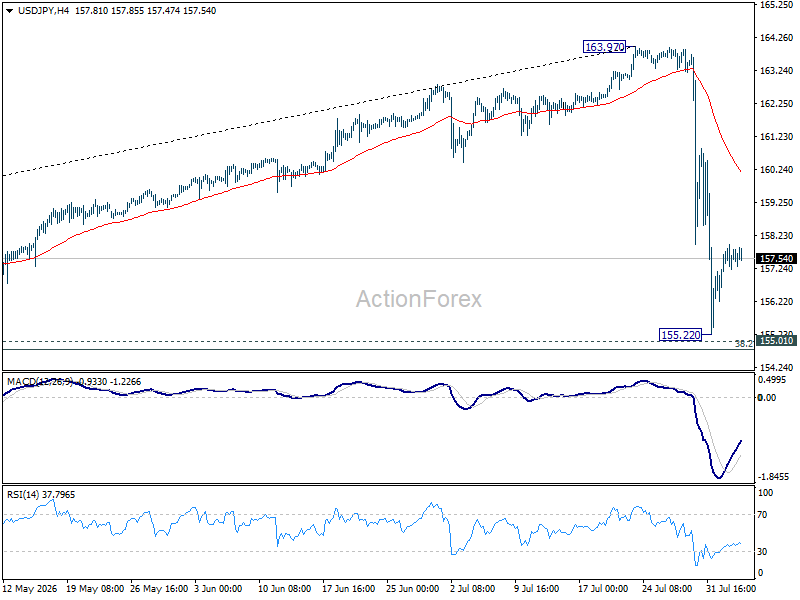
In the bigger picture, as long as 155.01 structural support holds, the larger up trend is still expected to continue through 163.97 after current correction completes. However, firm break of 155.01 will raise the chance that USD/JPY is already in a larger scale correction, and open up deeper fall back to 139.87 (2025 low) in the medium term.
GBP/USD Daily Outlook
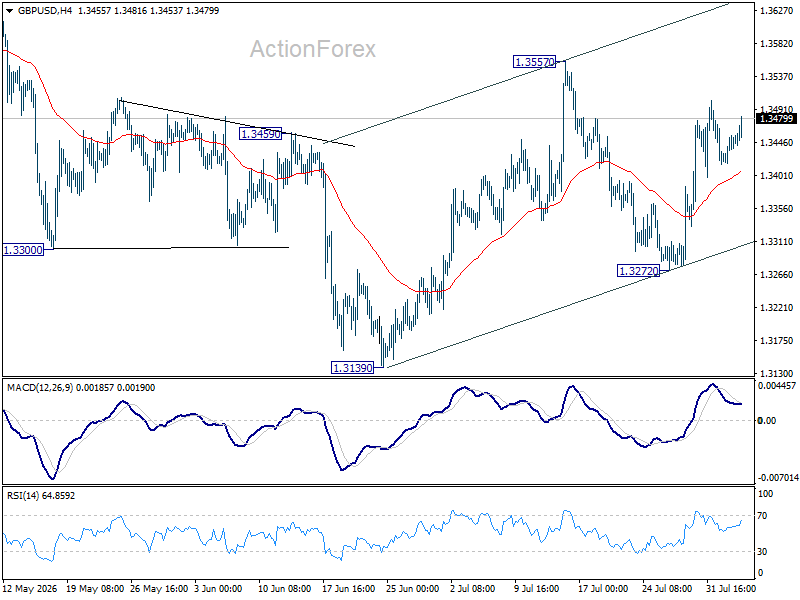
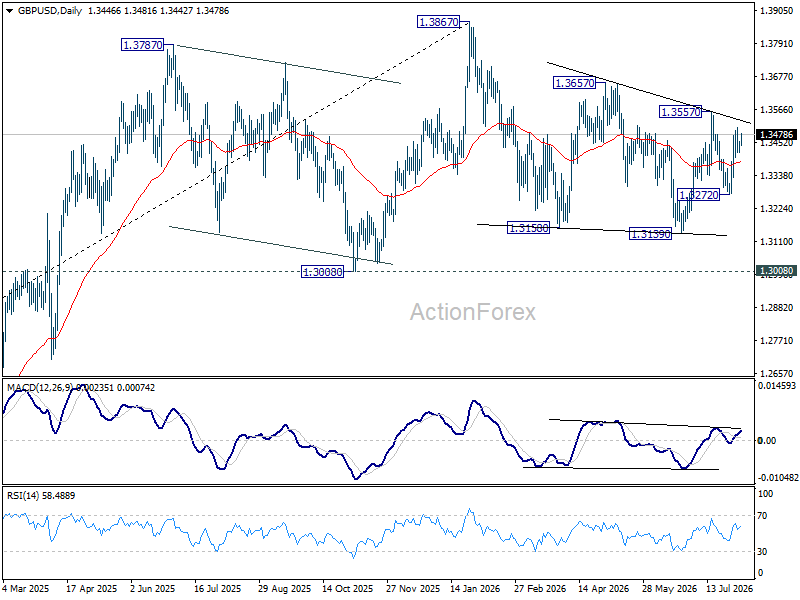
Intraday bias in GBP/USD remains neutral as range trading continues. Overall, corrective pattern from 1.3867 is still extending. On the upside, break of 1.3557 will extend the rise from 1.3139 to 1.3657 resistance first. On the downside, below 1.3272 will target 1.3139 support.
In the bigger picture, price actions from 1.3867 are a corrective pattern within the broader up trend from 1.0351 (2022 low). With 1.3008 support intact, medium term bullishness is maintained and break of 1.3867 is in favor for a later stage, towards 1.4248 key resistance (2021 high). However, firm break of 1.3008 will at least bring deeper fall to 38.2% retracement of 1.0351 to 1.3867 at 1.2524, with increased risk of bearish reversal.
USD/CHF Daily Outlook
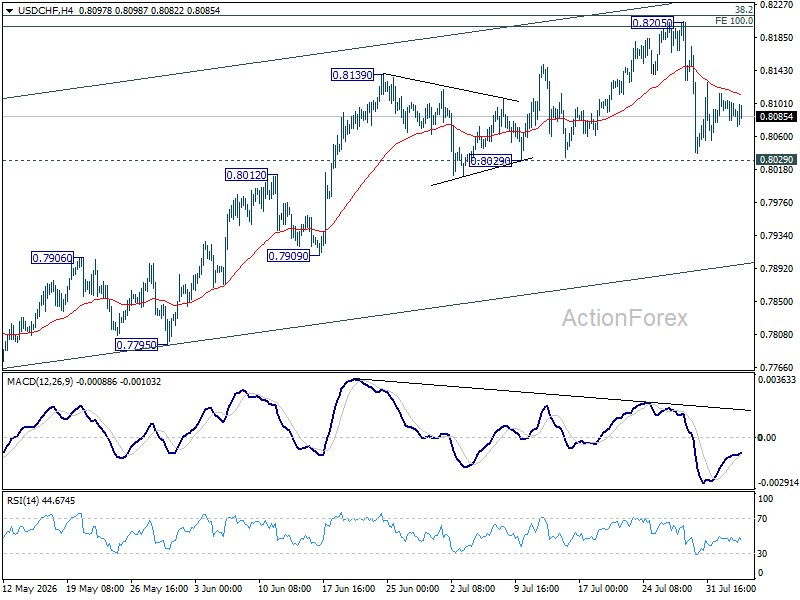
Intraday bias in USD/CHF stays neutral at this point. More consolidations could be seen below 0.8205. Further rally is in favor with 0.8029 support intact. Firm break of 0.8205 will extend the rally from 0.7603 to 161.8% projection 0.7603 to 0.8041 from 0.7600 at 0.8469. However, decisive break of 0.8029 will bring deeper fall to channel support (now at 0.7911).
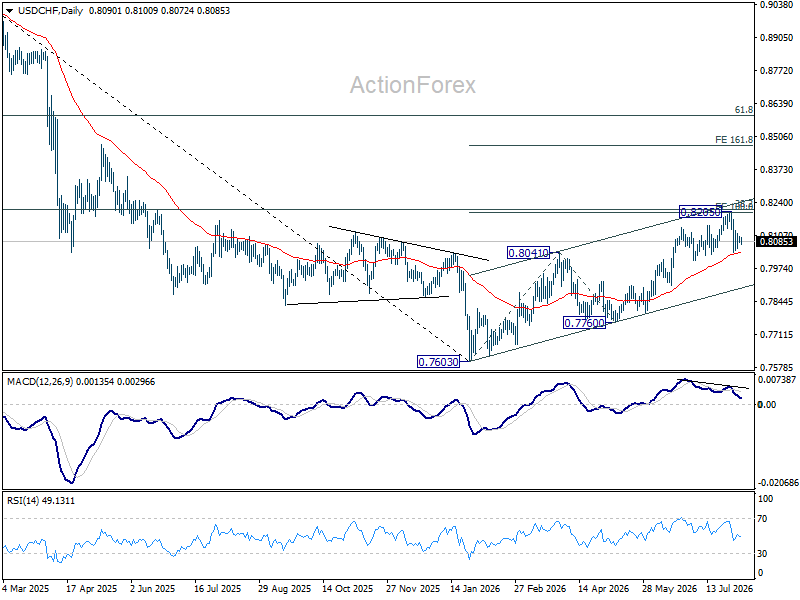
In the bigger picture, focus is now on 38.2% retracement of 0.9200 (2025 high) to 0.7603 at 0.8213. Decisive break will argue that USD/CHF is reversing the medium term trend, and turn focus to 0.8332 support turned resistance (2023 low) for confirmation. Nevertheless, rejection by 0.8213 will maintain medium term bearishness for another fall through 0.7603 at a later stage.
AUD/USD Daily Report
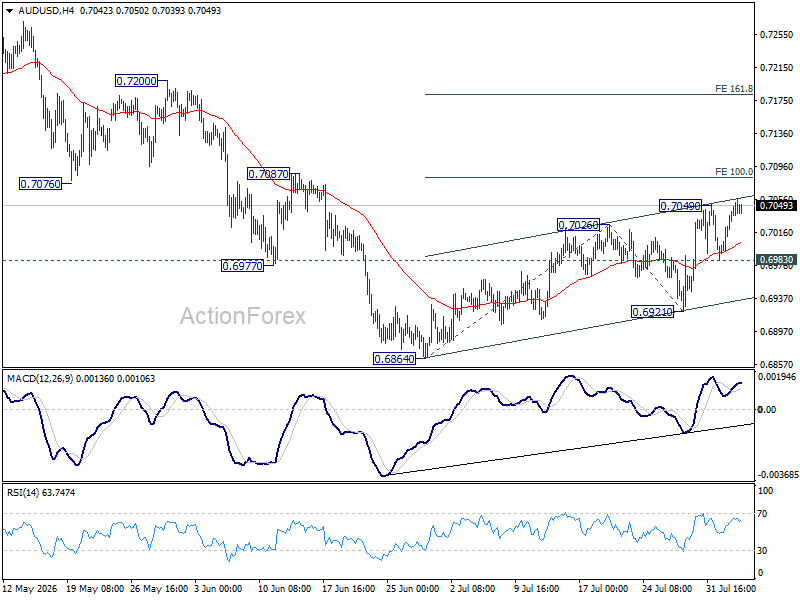
AUD/USD's rebound from 0.6864 resumed by breaking through 0.7049 temporary top. Intraday bias is back on the upside for 100% projection of 0.6864 to 0.7026 from 0.6921 at 0.7083. Firm break there could prompt upside acceleration to 161.8% projection at 0.7183. On the downside, however, break of 0.6894 will turn bias back to the downside back to 0.6921 support instead.
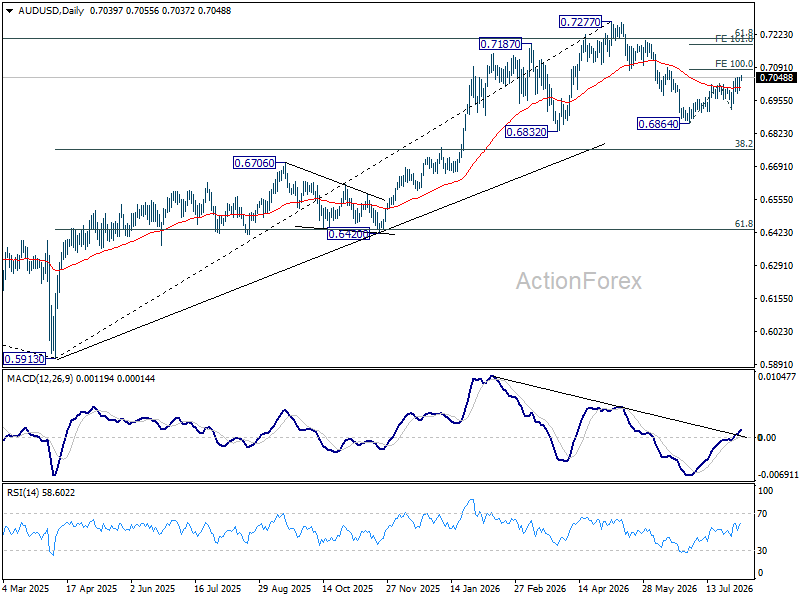
In the bigger picture, price action from 0.7277 medium term top is seen as developing into a correction to rise from 0.5913 only. While deeper decline cannot be ruled out, downside should be contained by 38.2% retracement of 0.5913 to 0.7277 at 0.6756 to bring rebound. Consolidations would continue below 0.7277 for a while, before an eventual upside breakout.
USD/CAD Daily Outlook
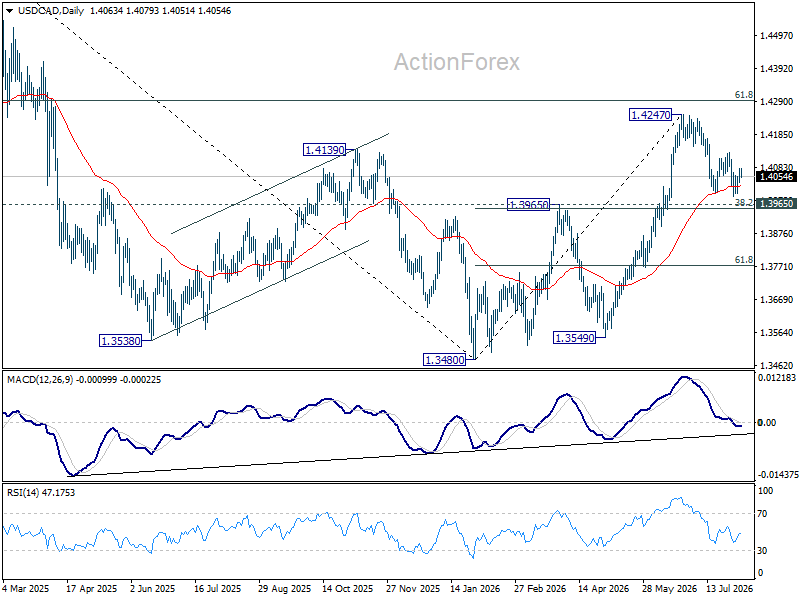
Outlook in USD/CAD remains unchanged. Corrective fall from 1.4247 might extend lower. But downside should be contained by 1.3965 cluster support (38.2% retracement of 1.3480 to 1.4247 at 1.3954 to bring rebound. Firm break of 1.4127 will bring stronger rally to retest 1.4247 high. However, sustained break of 1.3954/65 will bring deeper fall to 61.8% retracement at 1.3773, and argue that rebound from 1.3480 might have completed.
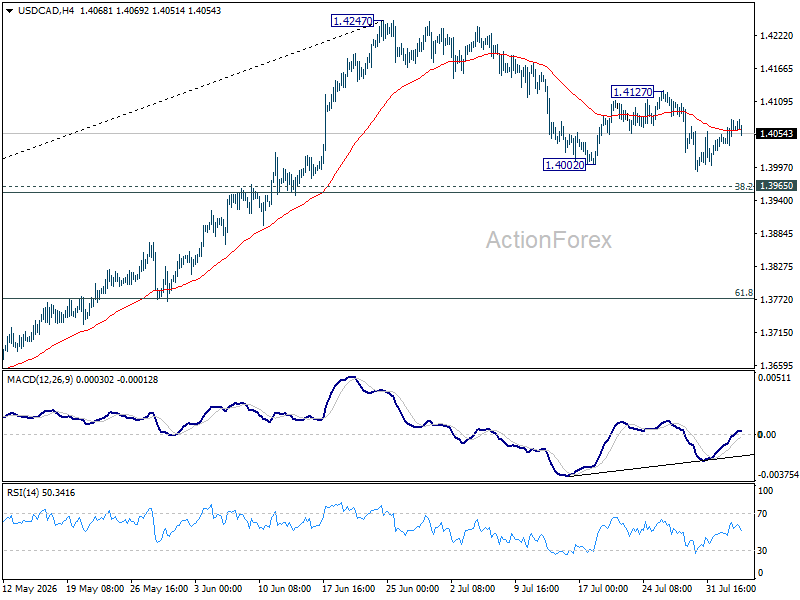
In the bigger picture, fall from 1.4791 medium term top has completed as a three wave correction to 1.3480. It's still early to judge if rise from there a corrective bounce, or resumption of the larger up trend from 1.2005 (2021 low). But in either case, sustained break of 61.8% retracement of 1.4791 to 1.3480 at 1.4290 will pave the way to retest 1.4791 high. However, rejection by 1.4290 will argue that fall from 1.4791 is going to extend with another leg through 1.3480 instead.