Sample Category Title
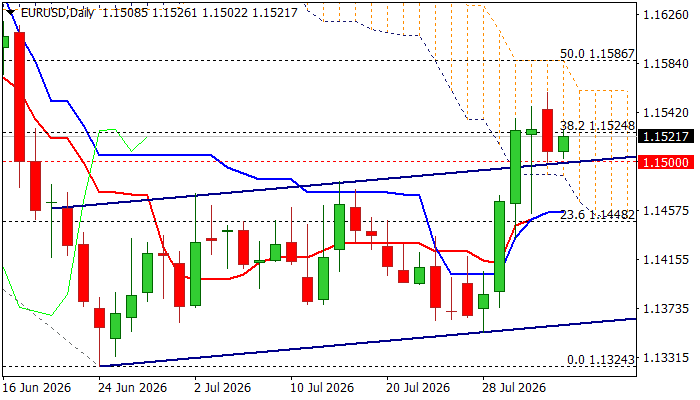
EURUSD – Bulls Faced Headwinds but Remain in Play While 1.1500 Support Holds
EURUSD remains constructive and holding above 1.1500 mark (round-figure / broken upper bull-channel boundary) for the fourth consecutive day, despite Monday’s pullback from new highest since June 17 that warned of potential stall of the latest recovery rally from 1.1353 to 1.1559.
Bulls were so far unable to register a clear break above Fibo barrier at 1.1524 (38.2% of 1.1849/1.1324 descend) and additionally capped by falling trendline off 1.1849 (currently at 1.1533), but the following action found footstep at 1.1500 (guarding another significant support at 1.1465, provided by daily cloud base), keeping near term bias with bulls, despite fading bullish momentum and overbought stochastic on daily chart.
Weaker dollar contributes to Euro’s positively aligned near term outlook, though sustained break of 1.1524/33 pivots remain required to validate scenario and signal bullish continuation and unmask next barriers at 1.1567 (100DMA); 1.1586 (daily cloud top) and 1.1627 (200DMA) in extension.
Res: 1.1540; 1.1567; 1.1586; 1.1627
Sup: 1.1500; 1.1465; 1.1448; 1.1433
Canada’s Trade Surplus Widens for Fourth Consecutive Month in June
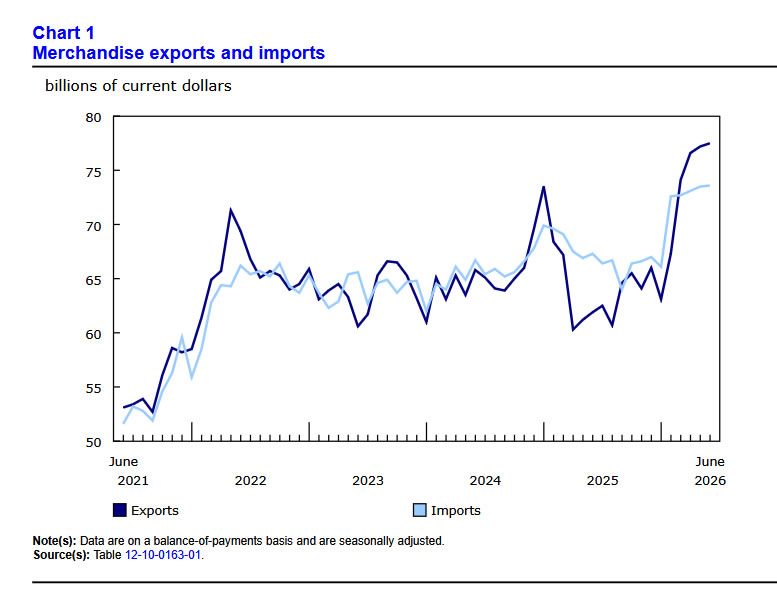
- Canada's trade balance moved further into surplus territory in June, widening to $3.9 billion from $3.7 billion the prior month. A notably weaker Canadian dollar in June provided a modest boost to trade values, lifting export receipts, while increasing the Canadian-dollar cost of imports.
- Exports in June rose by 0.4% month-on-month (m/m) continuing a string of sturdy gains over the past few months. A sizeable 27.9% m/m gain in unwrought gold exports offset a 10% m/m decline in energy exports, mainly driven by lower oil prices. Exports of metal ores and non-metallic minerals advanced again (+15.1% m/m), while exports of motor vehicles and parts notched a decent 2.4% m/m gain.
- Goods imports edged up by 0.2% m/m in June, reversing April's drag. The gain was narrowly-based with imports of computers and computer peripherals (+59% m/m) contributing to most of the gain. Otherwise, 9 of 11 subsectors saw a decrease in imports, including industrial machinery and parts (-3.3% m/m), consumer goods (-3.3% m/m), and metal ores and non-metallic minerals (-1.3% m/m).
- In volume terms, exports rose by 1.1% m/m while imports slid by 1.5% m/m.
- Canada's merchandise trade surplus with the United States narrowed to $10 billion in June from $11.1 billion in April. Exports to non-U.S. destinations rose 0.7% on the month.
Key Implications
- With the full quarter trade picture now in hand, net exports look to have shifted from a material Q1 drag to a solid tailwind for Q2 real GDP tracking. That should reinforce the narrative that real GDP is expected to rebound handsomely following flat growth last quarter. However, signals in trade remain noisy given the still-outsized swings in energy, autos, gold and computer equipment-related flows.
- Looking ahead, the risks to the trade backdrop remain slightly tilted to the downside. CUSMA remains in force despite a failure to renew the agreement by the July 1st deadline, but annual reviews will prolong uncertainty. More recently, if the new 50% Section 338 tariffs take effect on August 19, they would add a targeted but sapping shock on top of existing tariffs, even as solid U.S. demand and commodity flows provide some offset.
Markets Cheer as Bessent Sees Hormuz Reopening Soon. Why Doesn’t Brent Oil Break $80?
Why Brent's failure to break below $80 reveals lingering doubt about Bessent's Hormuz optimism
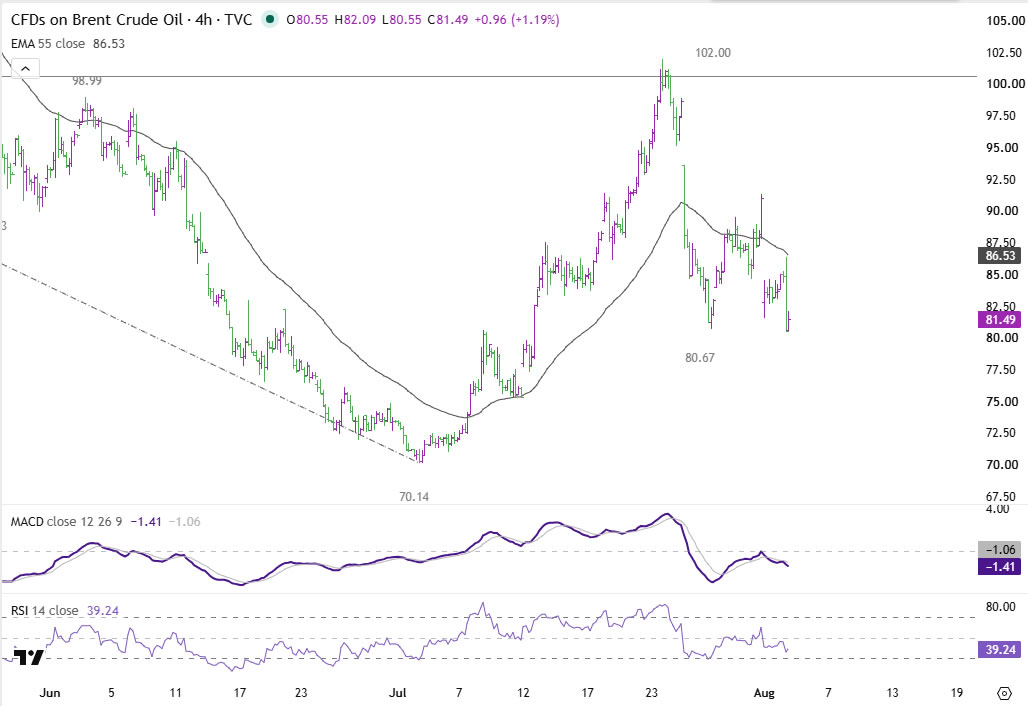
What's happening: Treasury Secretary Scott Bessent said the US and Iran could reach a deal as early as Tuesday or Wednesday to reopen the Strait of Hormuz, sending Brent crude from around $86 to near $80 and lifting equity futures and risk sentiment broadly.
Why it matters: Brent failed to break decisively below $80, a hesitation that suggests traders aren't ready to fully price out the geopolitical risk premium. The gap between Washington's optimistic messaging and Iran's unresolved tolling and sovereignty demands over Hormuz is still very much intact.
Bessent's Hormuz Comments Spark a Broad Risk Rally
Risk appetite strengthened across global markets after US Treasury Secretary Scott Bessent said the United States and Iran could reach a deal as early as Tuesday or Wednesday to reopen the Strait of Hormuz to commercial shipping. Speaking to CNBC, Bessent said, "There is a chance we may have a deal today or tomorrow to open the strait and move towards a more normalized position in this conflict." The remarks sent Brent crude tumbling from around $86 to near $80, while US equity futures rallied more than 1%, extending Wall Street's bullish tone. Treasury yields edged slightly lower, with the benchmark 10-year yield slipping to around 4.66%.
Market Reaction
- Brent crude: fell from around $86 to near $80
- US equity futures: rallied more than 1%
- 10-year Treasury yield: slipped to around 4.66%
Why Brent's Failure to Break $80 Matters
Yet one detail stood out amid the market's enthusiastic response: Brent failed to break decisively below the $80 level. That hesitation suggests traders remain reluctant to fully price out the geopolitical risk premium despite Bessent's optimism. The immediate reaction reflected relief that diplomacy may be gaining traction, but the oil market appeared unconvinced that a lasting resolution is yet within reach.
The Unresolved Question: Who Controls Tolls Through Hormuz?
The missing piece is the question of tolls and sovereignty over the Strait of Hormuz. Asked directly whether Iran would retain the right to charge commercial vessels for passage, Bessent instead replied that any agreement would ensure "freedom of movement" through the waterway. That formulation leaves considerable room for interpretation. Freedom of movement does not necessarily imply free passage, nor does it explicitly address Tehran's long-standing position that it intends to retain sovereign control and tolling rights once any temporary arrangements expire. Until that issue is resolved, the gap between Washington's optimistic messaging and Iran's publicly stated objectives remains largely intact.
Markets Have Been Here Before
Markets have seen a similar pattern before. President Donald Trump has repeatedly suggested that a breakthrough with Iran was close, only for negotiations to stall and military tensions to escalate again. That history helps explain why Brent found buyers near last week's $80 low instead of extending its decline. Investors appear willing to reduce the immediate risk premium, but not eliminate it without confirmation from Tehran or clear evidence that commercial shipping is resuming under mutually accepted terms.
Currency Markets: Commodity Currencies Lead, Yen Lags
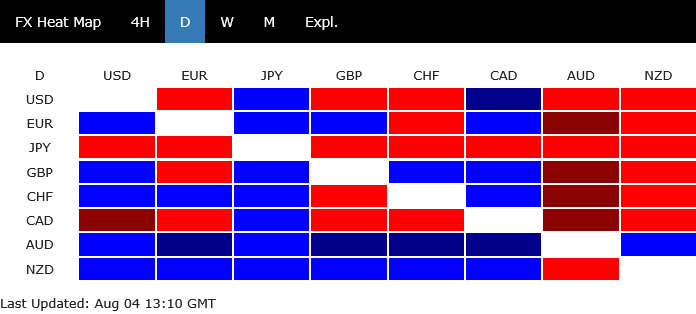
Despite that caution in oil, broader market sentiment remained constructive. Commodity-linked and growth-sensitive currencies benefited most from the improvement in risk appetite, with the Australian and New Zealand Dollars leading gains. Attention now turns to New Zealand's second-quarter labor market report. With inflation already exceeding the RBNZ's own forecasts and domestic price pressures remaining elevated, an employment report that merely matches expectations, rather than beating them, could be enough to reinforce further rate-hike expectations and extend the Kiwi's outperformance against the Aussie. At the other end of the spectrum, the Japanese Yen was the day's weakest performer as recent intervention-driven gains started to unwind. The Canadian Dollar also underperformed as falling oil prices weighed on sentiment, while the US Dollar softened modestly. The Euro, Sterling and Swiss Franc traded largely sideways against one another as markets waited for the next decisive catalyst.
Related Coverage
Currency Deep Dives
- Read the two technical and fundamental obstacles standing between GBP/CAD and a sustained breakout: Two Things Stand Between GBP/CAD and an Upside Breakout.
- See why New Zealand's Q2 labour data doesn't need to surprise to extend AUD/NZD's decline: AUD/NZD Pressured as Inflation Backs More RBNZ Tightening, Jobs Need Only Confirm It.
Central Bank & Policy
- Read what Philadelphia Fed's Paulson says would actually force another rate hike: Fed's Paulson Explains What Would Force Another Rate Hike.
- See why Japan's Economy Minister is taking a softer line on inflation than the BoJ itself: Government vs BoJ? Japan's Kiuchi Offers Softer View on Inflation Risks.
Trade & Growth
- Read why Canada's export volumes, not just a weaker Loonie, are driving the widening trade surplus: Canada's Trade Surplus Widens, Though Weaker Loonie Boosts Headline.
Frequently Asked Questions
Q: Why didn't Brent break decisively below $80 if a Hormuz deal is close?
A: The hesitation suggests traders aren't ready to fully price out the geopolitical risk premium. Markets have seen this pattern before, with President Trump repeatedly suggesting a breakthrough was close only for negotiations to stall and tensions to escalate again, which is why Brent found buyers near last week's $80 low instead of extending its decline.
Q: What did Bessent's "freedom of movement" comment leave unresolved?
A: Asked directly whether Iran would retain the right to charge commercial vessels for passage, Bessent said any agreement would ensure "freedom of movement" through the waterway. That phrasing doesn't necessarily imply free passage, and it doesn't address Tehran's long-standing position that it intends to retain sovereign control and tolling rights once any temporary arrangements expire.
Q: Why are markets skeptical even though Bessent sounded optimistic?
A: Investors appear willing to reduce the immediate risk premium but not eliminate it without confirmation from Tehran or clear evidence that commercial shipping is resuming under mutually accepted terms. Until the tolls-and-sovereignty question is resolved, the gap between Washington's optimistic messaging and Iran's publicly stated objectives remains largely intact.
Key Takeaways
- Bessent's Hormuz comments triggered a broad risk rally: Brent fell from around $86 to near $80, equity futures rallied more than 1%, and the 10-year Treasury yield slipped to about 4.66%.
- Brent's failure to break decisively below $80 is the real signal: That hesitation shows traders aren't ready to fully price out the geopolitical risk premium despite the optimistic headlines.
- Tolls and sovereignty remain unresolved: Bessent's "freedom of movement" language sidesteps whether Iran keeps the right to charge vessels or retain sovereign control once any temporary arrangement ends.
- History explains the market's caution: Repeated past claims of an imminent breakthrough that later stalled are why Brent found buyers near $80 instead of extending its slide.
- Commodity currencies led gains while the Yen lagged: AUD and NZD benefited most from the improved risk appetite, and NZ's Q2 employment report may only need to match forecasts, not beat them, to extend Kiwi outperformance given inflation already running above RBNZ projections. The Yen was the day's weakest performer as intervention-driven gains began to unwind, and CAD underperformed on falling oil.
What to Watch Next
Tuesday or Wednesday is the window Bessent flagged for a potential deal, making confirmation from Tehran, or tangible evidence of shipping resuming through Hormuz, the next real catalyst for oil. On the currency side, New Zealand's Q2 labor market report will help determine whether the Kiwi can extend its outperformance against the Aussie.
Canada’s Trade Surplus Widens, Though Weaker Loonie Boosts Headline
Canada recorded its fourth consecutive monthly merchandise trade surplus in June, with exports and imports both reaching record levels. Exports rose 0.4% m/m to CAD 77.5B, while imports edged up 0.2% to CAD 73.6B, allowing the trade surplus to widen modestly from CAD 3.7B to CAD 3.9B. The latest figures extend a strong run for exports, which have increased for five straight months and are up 22.8% since January.
The headline strength, however, was partly a reflection of exchange-rate movements. The Canadian dollar posted its largest monthly decline against the US dollar since October 2022, boosting the value of trade when converted into Canadian dollars. In US-dollar terms, both exports and imports actually contracted by around -2% in June. Nevertheless, export volumes increased 1.1%, indicating that the improvement was not purely the result of currency translation.
Bilateral trade with the United States remained firm, though Canada's surplus narrowed as imports grew faster than exports. Shipments to the US rose 0.3%, extending their growth streak to five months, while imports climbed 3.0%, driven mainly by computers and related equipment. Beyond the US, imports fell -3.7%, reflecting weaker purchases from China, South Korea and Germany. At the same time, exports to non-US markets increased 0.7%, helped by stronger gold shipments to the United Kingdom despite weaker exports of energy products and aluminum to the Netherlands.
Overall, the June report suggests Canada's external sector remains in good shape, but the details are more nuanced than the headline figures imply. Record export values and a wider trade surplus are encouraging, yet the weaker Canadian dollar exaggerated part of the improvement. With export volumes still advancing and trade outside the United States showing signs of improvement, the underlying trend remains constructive, although sustaining that momentum will likely depend on continued strength in global demand rather than currency effects alone.
Data Summary
| Indicator | June 2026 | May 2026 | Trend |
|---|---|---|---|
| Merchandise exports | CAD 77.5B | CAD 77.2B | ▲ +0.4% (Record high) |
| Merchandise imports | CAD 73.6B | CAD 73.5B | ▲ +0.2% (Record high) |
| Trade balance | CAD 3.9B surplus | CAD 3.7B surplus | Surplus widened |
| Exports (volume) | +1.1% | — | Higher |
| Exports (USD terms) | -2.0% | — | Lower |
| Imports (USD terms) | -2.1% | — | Lower |
| Exports to US | +0.3% | — | Fifth straight gain |
| Imports from US | +3.0% | — | Record high |
| Trade surplus with US | CAD 10.0B | CAD 11.1B | Narrowed |
| Exports to non-US markets | +0.7% | — | Higher |
| Imports from non-US markets | -3.7% | — | Lower |
| Trade deficit with non-US markets | CAD 6.1B | CAD 7.4B | Narrowed |
Key Takeaways
- Canada's merchandise trade surplus widened from CAD 3.7B to CAD 3.9B, marking a fourth consecutive monthly surplus.
- Both exports (CAD 77.5B) and imports (CAD 73.6B) reached record highs, with exports rising for a fifth straight month.
- The weaker Canadian dollar boosted headline trade values. In US-dollar terms, exports and imports both declined around 2%, highlighting the currency's contribution to the record figures.
- Export growth was supported by higher shipment volumes, with real exports increasing 1.1%, indicating underlying trade remained resilient.
- Canada's surplus with the United States narrowed as imports from the US grew faster than exports.
- Trade with the rest of the world improved, helped by stronger gold exports to the UK and weaker imports from China, South Korea and Germany.
Fed’s Paulson Explains What Would Force Another Rate Hike
Federal Reserve Bank of Philadelphia President Anna Paulson made clear that another rate hike remains on the table, but only if incoming data show inflation is failing to resume its downward path. In remarks on Tuesday, Paulson welcomed recent progress, saying "the recent improvement in some inflation data is welcome," but quickly cautioned that "it is only one step." She reiterated her support for last week's decision to leave the federal funds target range unchanged at 3.50-3.75%, while stressing that future policy will remain firmly data dependent.
Rather than offering guidance on the Fed's next move, Paulson emphasized the conditional framework increasingly adopted under Chair Kevin Warsh. "I am committed to keeping an open mind as I assess the evidence and determine the appropriate path for policy," she said. While noting that current policy is already restraining economic activity, she explained what would change her outlook: "If policy is appropriately calibrated, I would expect to see growing signs that inflation is coming down." However, "if instead underlying inflation remains stubbornly elevated, the passage of time without progress would itself signal that more restrictive policy is needed."
Paulson also distinguished between temporary supply shocks and persistent underlying inflation. She argued that the brief easing in Middle East tensions showed energy-related price spikes can prove transitory and therefore should not automatically drive monetary policy. Instead, her focus remains on underlying inflation, which she estimated at 2.4% to 2.8%, describing it as "what I am most focused on" because it has remained elevated for an extended period.
Key Takeaways
- Philadelphia Fed President Anna Paulson supported last week’s decision to keep rates unchanged at 3.50–3.75%, but stressed that one better inflation reading is not enough to declare progress secure.
- Her key condition for another hike is persistent underlying inflation without further improvement. As she put it, “the passage of time without progress would itself signal that more restrictive policy is needed.”
- Paulson estimates underlying inflation at around 2.4%–2.8% and said this is the area she is “most focused on,” rather than temporary swings in headline inflation.
- She argued that energy shocks linked to the Middle East can be temporary and should generally be looked through when setting policy.
- Her stance is cautiously hawkish: current policy may be sufficiently restrictive, but only if inflation continues to move lower.
- The remarks fit the post-Warsh communication framework, with officials emphasizing conditions for action rather than offering forward guidance on the next meeting.
EUR/USD Daily Outlook
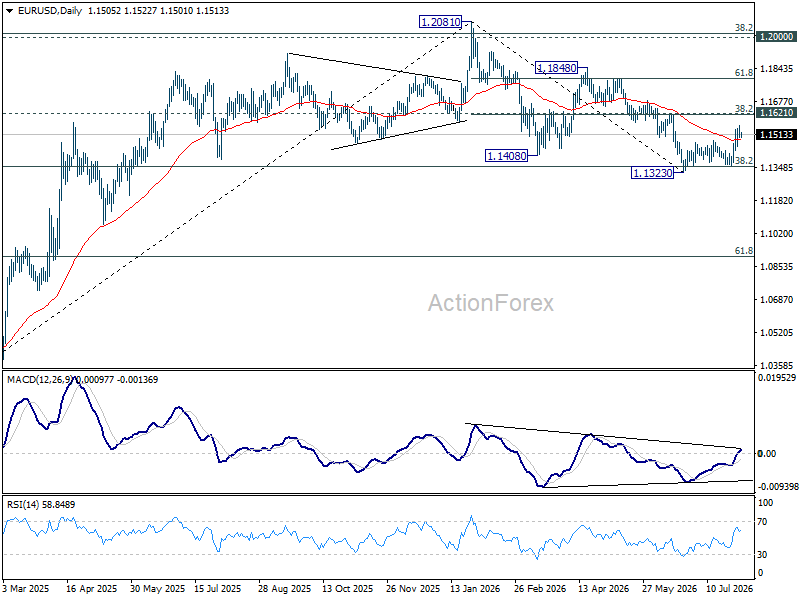
Intraday bias in EUR/USD is turned neutral first with current retreat. On the upside, above 1.1557 will extend the rebound from 1.1323 to cluster resistance (38.2% retracement of 1.2081 to 1.1323 at 1.1613). Decisive break there will target 61.8% retracement at 1.1791. Nevertheless, break of 1.1454 minor support will turn bias back to the downside for 1.1323/1352 support zone instead.
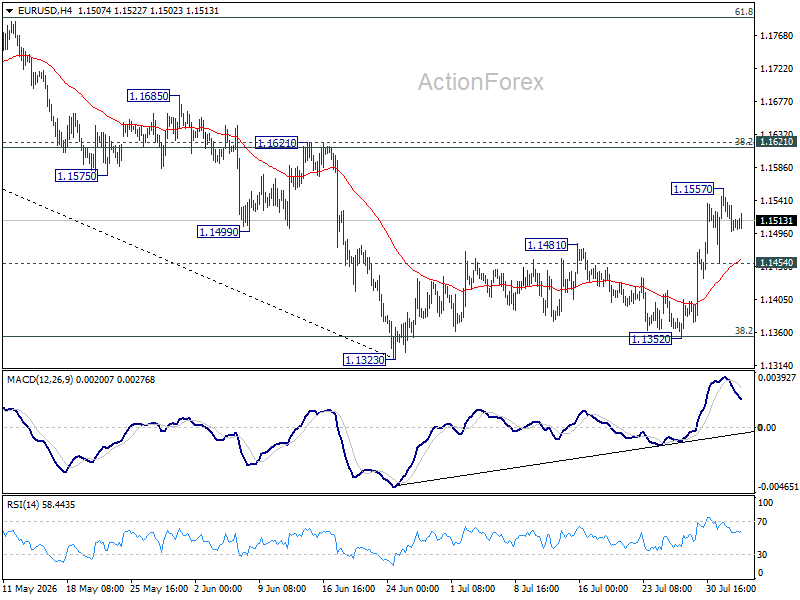
In the bigger picture, focus is staying on 38.2% retracement of 1.0176 to 1.2081 at 1.1353. Decisive break there will revive the case of medium term bearish trend reversal after rejection by 1.2 key cluster resistance level. Further fall should be seen to 61.8% retracement at 1.0904. Nevertheless, strong rebound from 1.1353, followed by break of 1.1621 resistance, will retain medium term bullishness.
USD/JPY Daily Outlook
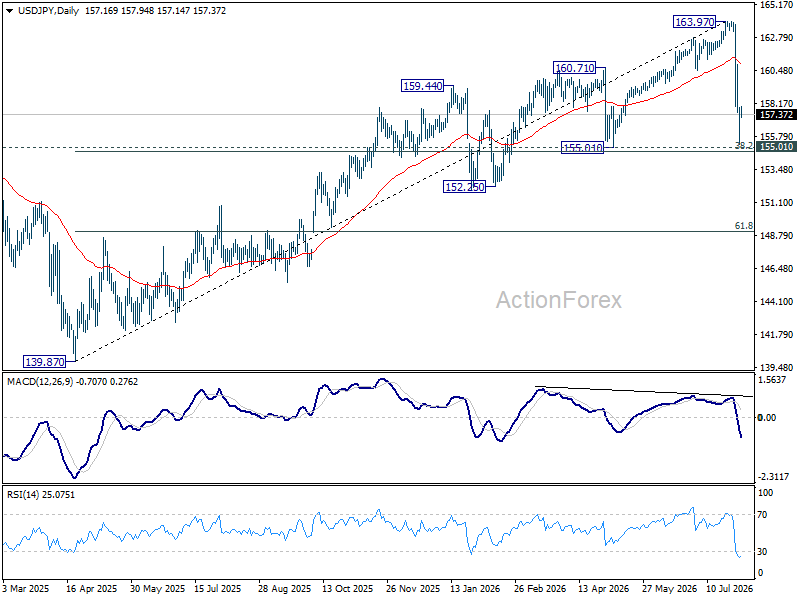
Intraday bias in USD/JPY is turned neutral first with current retreat. While another fall cannot be ruled out, strong support is still expected from (38.2% retracement of 139.87 to 163.97 at 154.76) bring rebound. Still, sustained break of 55 4H EMA (now at 160.74) is needed to indicate that fall from 163.97 has completed. Otherwise, risk will remain on the downside. Meanwhile, sustained break of 154.76/155.01 will pave the way to 61.8% retracement at 149.07.
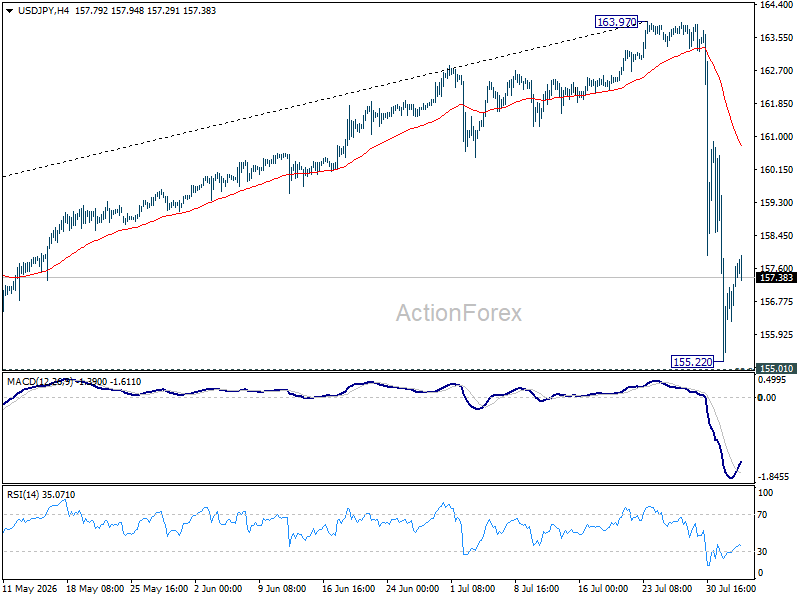
In the bigger picture, as long as 155.01 structural support holds, the larger up trend is still expected to continue through 163.97 after current correction completes. However, firm break of 155.01 will raise the chance that USD/JPY is already in a larger scale correction, and open up deeper fall back to 139.87 (2025 low) in the medium term.
GBP/USD Daily Outlook
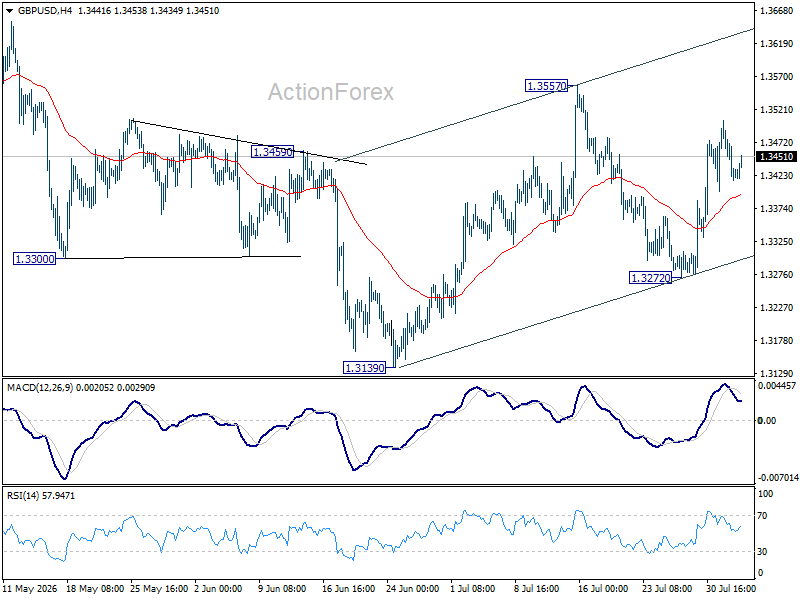
Range trading continues in GBP/USD and intraday bias stays neutral. Overall, corrective pattern from 1.3867 is still extending. On the upside, break of 1.3557 will extend the rise from 1.3139 to 1.3657 resistance first. On the downside, below 1.3272 will target 1.3139 support.
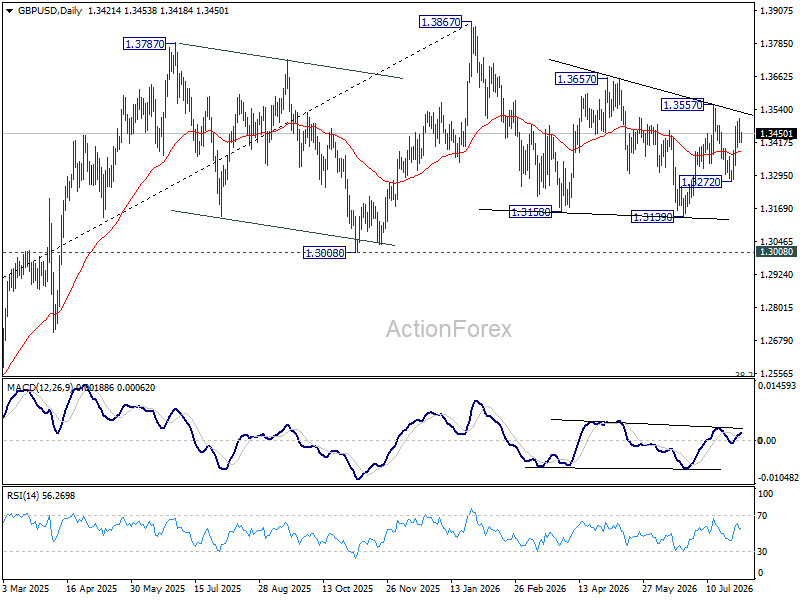
In the bigger picture, price actions from 1.3867 are a corrective pattern within the broader up trend from 1.0351 (2022 low). With 1.3008 support intact, medium term bullishness is maintained and break of 1.3867 is in favor for a later stage, towards 1.4248 key resistance (2021 high). However, firm break of 1.3008 will at least bring deeper fall to 38.2% retracement of 1.0351 to 1.3867 at 1.2524, with increased risk of bearish reversal.
USD/CHF Daily Outlook
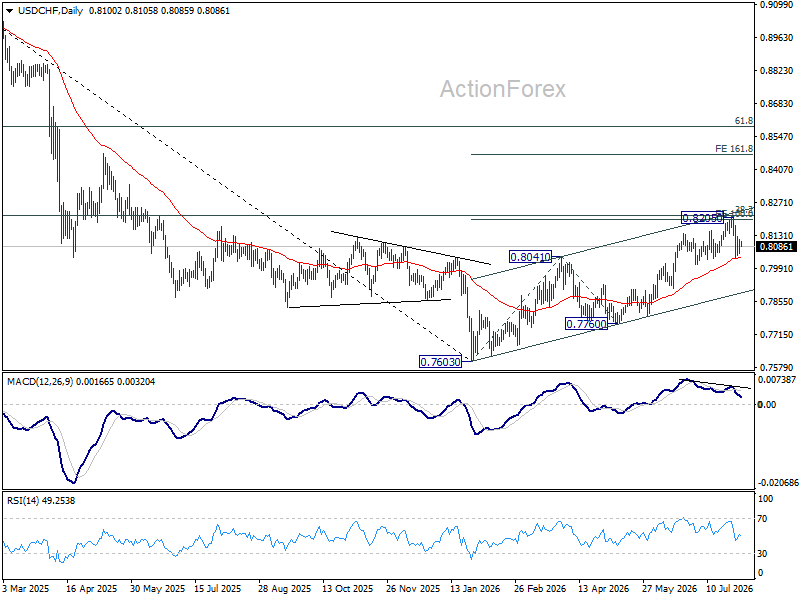
Intraday bias in USD/CHF remains neutral for the moment. More consolidations could be seen below 0.8205. Further rally is in favor with 0.8029 support intact. Firm break of 0.8205 will extend the rally from 0.7603 to 161.8% projection 0.7603 to 0.8041 from 0.7600 at 0.8469. However, decisive break of 0.8029 will bring deeper fall to channel support (now at 0.7911).
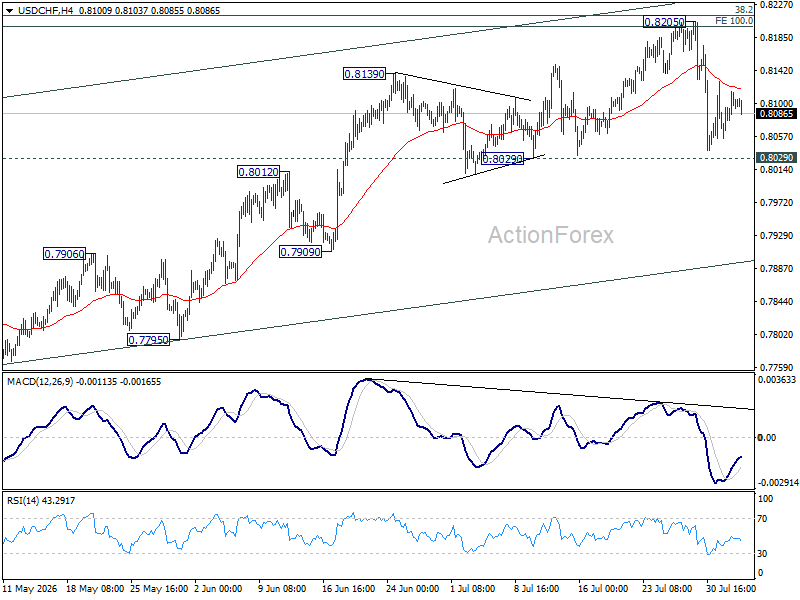
In the bigger picture, focus is now on 38.2% retracement of 0.9200 (2025 high) to 0.7603 at 0.8213. Decisive break will argue that USD/CHF is reversing the medium term trend, and turn focus to 0.8332 support turned resistance (2023 low) for confirmation. Nevertheless, rejection by 0.8213 will maintain medium term bearishness for another fall through 0.7603 at a later stage.
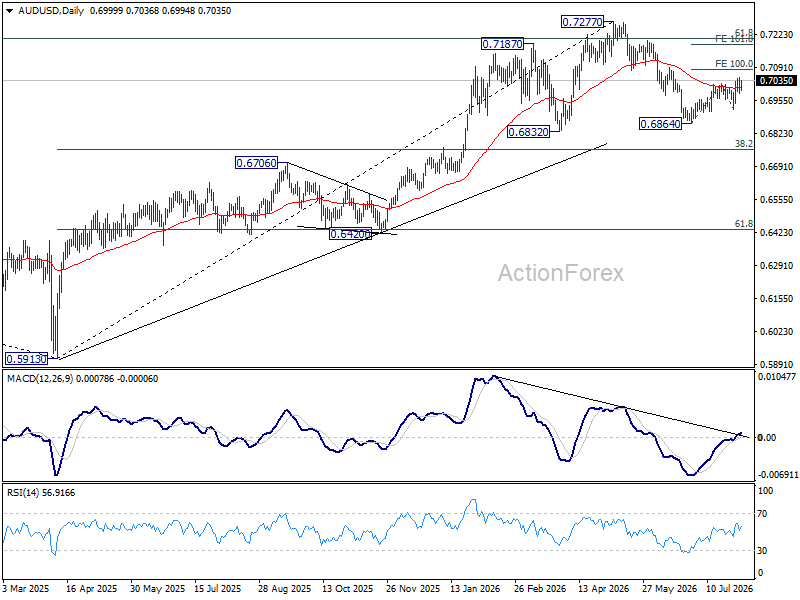
AUD/USD Daily Report
Intraday bias in AUD/USD remains neutral at this point. On the upside, above 0.7049 will extend the rebound from 0.6864 to 100% projection of 0.6864 to 0.7026 from 0.6921 at 0.7083. However, firm break of 0.6921 will argue that the rebound has completed and bring retest of 0.6864 low.
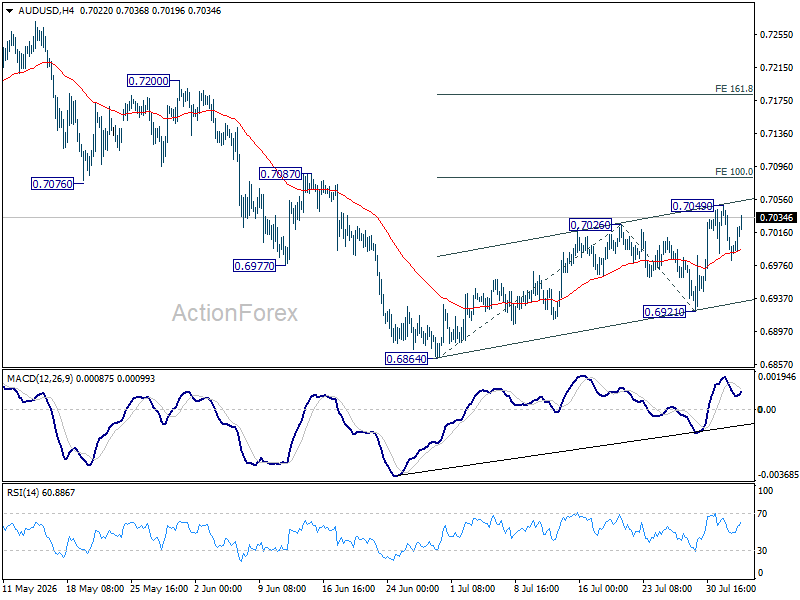
In the bigger picture, price action from 0.7277 medium term top is seen as developing into a correction to rise from 0.5913 only. While deeper decline cannot be ruled out, downside should be contained by 38.2% retracement of 0.5913 to 0.7277 at 0.6756 to bring rebound. Consolidations would continue below 0.7277 for a while, before an eventual upside breakout.