

Sample Category Title
Fed Review: Reversing Course (?)
- The Fed maintained its monetary policy unchanged in the July meeting. Three participants voted for a hike in line with our expectations, but importantly, Chair Warsh voted with the majority for unchanged rates.
- Warsh's tone was noticeably more neutral compared to his previous press conference, as he appeared satisfied with the rise in real rates since mid-June.
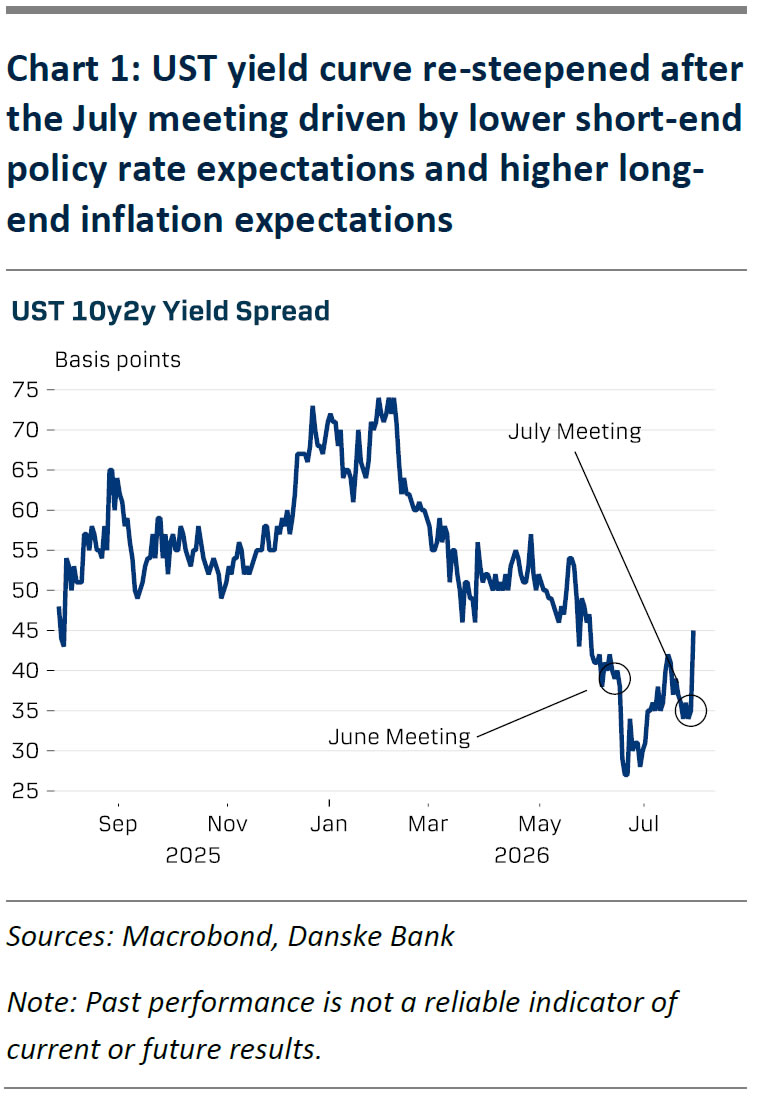
- Perhaps counterproductively, markets reversed part of its reaction to the June meeting. UST curve steepened, as markets cut back rate hike expectations and priced higher long-end inflation expectations. EUR/USD rose back above 1.14.
- We still think the macro case for tightening policy later on remains strong, and the market reaction could spark pushback from Fed speakers over coming days. We maintain our call for hikes in December and March meetings
At face value, the FOMC's 9-3 split decision hold was exactly in line with the expectations we laid out in our Fed preview - a divided hold, 22 July. We also named the three dissenters - Hammack, Logan and Kashkari - as the most likely hawks to support rapid tightening. But the most important part of forward guidance for markets was that Chair Warsh himself voted for an unchanged decision despite his hawkish commitment to price stability heard in June.
Warsh highlighted several times that real rates had risen during the intermeeting period because markets were taking the signal from data, instead of forward guidance. We do not share this view, as data released in late June landed close to expectations, and instead believe markets were reacting to Warsh's words of a 'regime shift'. And in this light, tonight's reaction felt like markets reconsidering their confidence in the Chair's ability to deliver on the promise of price stability.
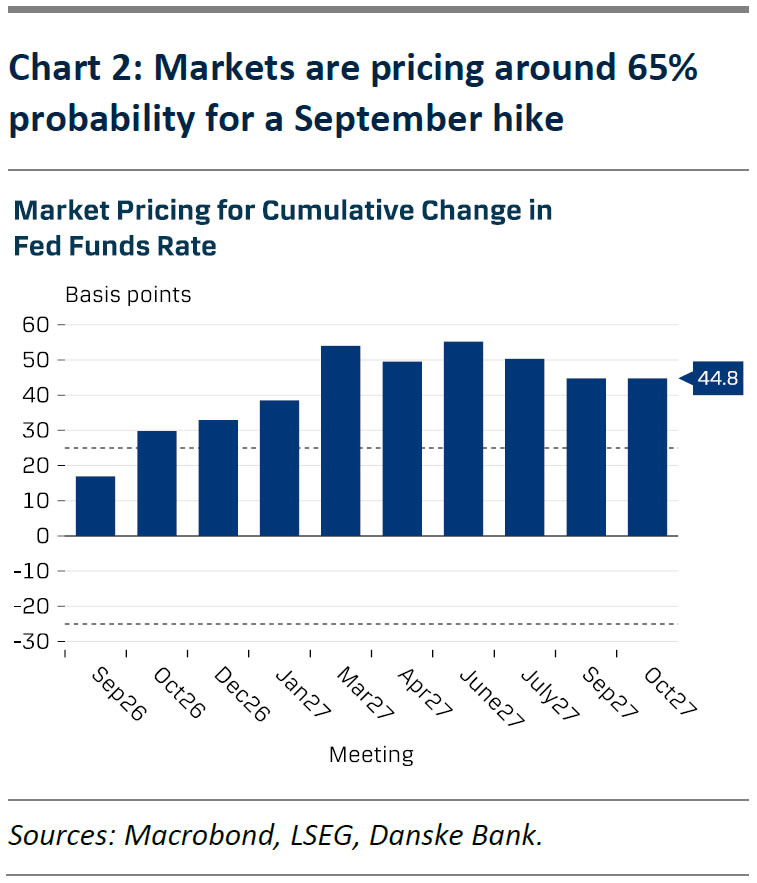
Markets cut back rate hike expectations, with cumulative hike pricing declining from 56bp to 50bp. The implied odds for a September hike declined from near-certain down to 65%. But more importantly, the UST yield curve saw the sharpest steepening since late March in 2s10s terms, as long-end inflation expectations moved higher. The current level (10y inflation swap at just above 2.3%) is by no means concerning as such, but if Warsh was happy with the post-June market reaction, tonight's shift was likely not what he intended.
We still think the macro case for tightening later on remains solid. AI-capex spending, retightening labour market balance, consumers' high propensity to spend and supportive fiscal policy all add to risk of persistent inflation. And if financial conditions ease further, Warsh might be forced to reconsider his vote already in September.
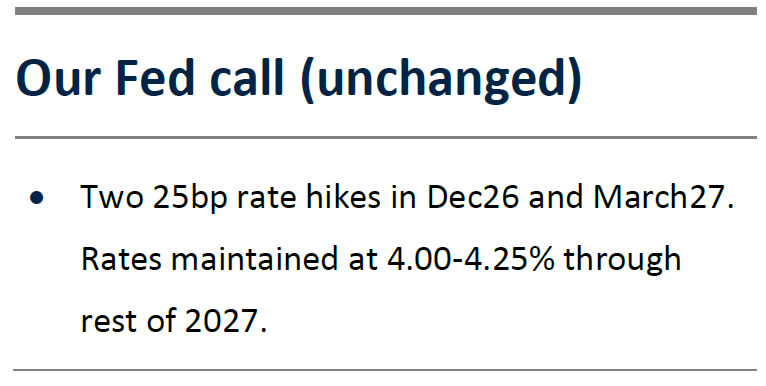
We maintain our base case for 25bp rate hikes in the December and March meetings. Note that the Fed made no changes to its balance sheet policy, and Warsh did not hint of changes before results from the task forces, which are expected by year-end. The NY Fed guides for reserve management purchases of T-bills at USD10bn/month.
FOMC Uncertainty to Continue Testing Markets
Real data is unlikely to be decisive for policy in coming months, leaving market expectations to determine financial conditions.
At their July meeting, the FOMC voted 9-3 to leave the fed funds rate unchanged. Productivity growth and capital investment were characterised as “strong” and overall economic momentum “solid” despite considerable uncertainty. Labour demand and supply were assessed to be in balance, the unemployment rate having “changed little”.
“Inflation [meanwhile] remains elevated… in part reflecting supply shocks that have driven price increases in certain sectors”. In both the statement and the press conference, the FOMC and Chair Warsh were resolute in their determination to bring inflation sustainably back to the 2.0%yr target. However, also apparent is that, at this juncture, it is unclear how far price shocks are permeating through the consumer basket. This applies to the current volatility in energy prices, due to the conflict in the Middle East, and the ongoing price surge for tech components. It will take many months to determine the full implications for underlying inflation; though, in the interim, expectations amongst households and businesses and the skew of risks will shape policy decisions.
In the press conference, Chair Warsh highlighted another area of debate for the Committee: the drivers and implications of long-term yields. Nominal and real yields have risen materially in recent months. The strength of economic activity, particularly investment, was cited as a factor, and potentially greater uncertainty over the FOMC’s reaction function. It seems the FOMC may be comfortable allowing the market to adjust financial conditions to balance inflation risks without an explicit contribution from the FOMC. The immediate response of the market to this idea was a material steepening of the yield curve, highlighting participants’ anxiety over inflation and policy uncertainty.
Overall, it appears the FOMC is not in a rush to determine whether the current stance of policy is appropriate to bring inflation back to target, or indeed if it is better to allow the market to balance expectations by itself. Several months of data and discussion are likely necessary to determine the next step based on economic data alone. However, it is entirely possible risks to inflation, or to the long end of the yield curve, will push the FOMC to a decision sooner. Policy will be live at coming meetings, particularly in September and October. On hold decisions are most likely, but by a very narrow margin.
FTSE 100 Wave Analysis
FTSE 100: ⬇️ Sell
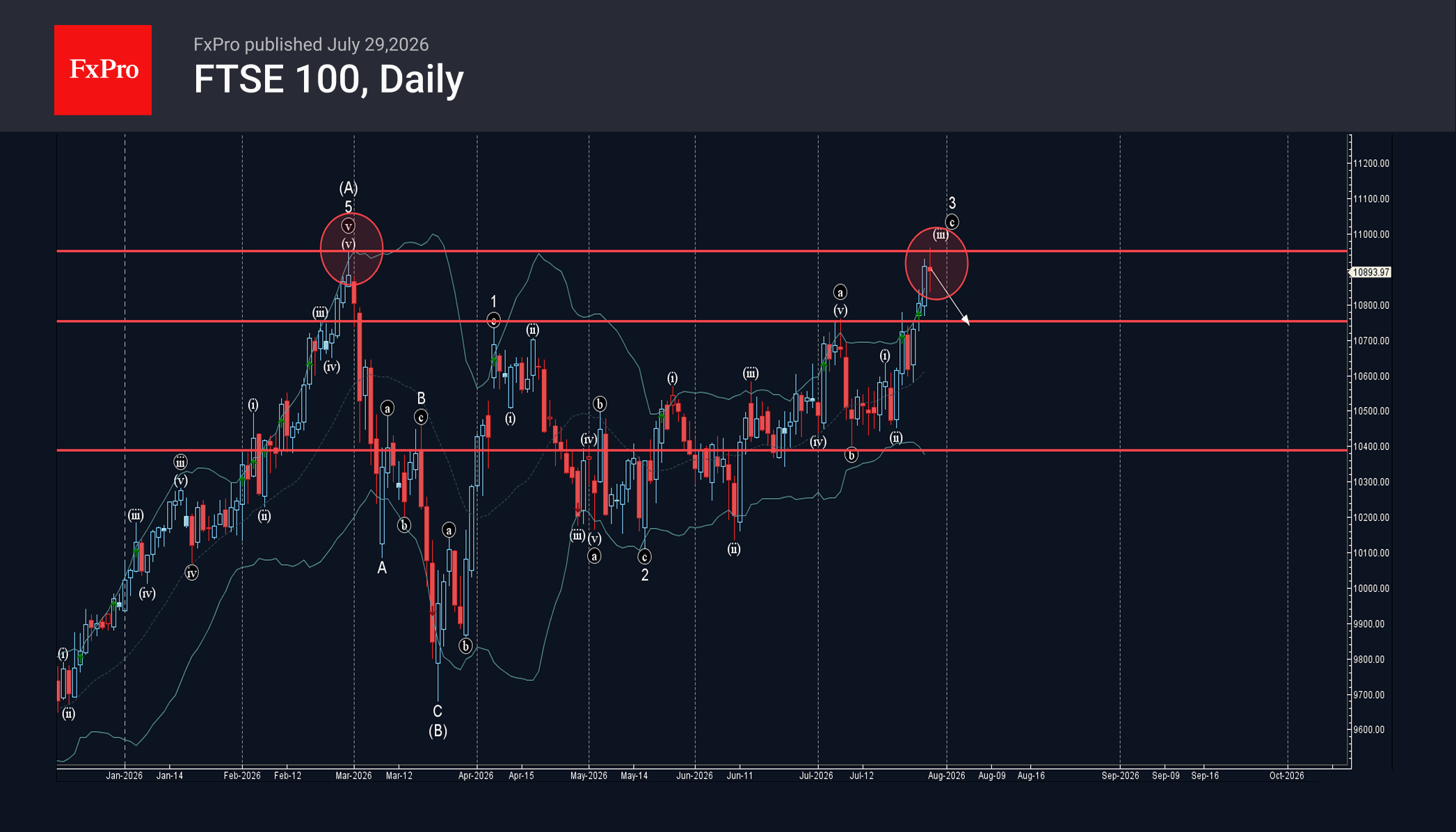
– FTSE 100 reversed from resistance area
– Likely to fall to support level 10750.00
FTSE 100 index today reversed down from the resistance area between the key resistance level 10950.00 (which stopped sharp impulse wave A in February) and the upper daily Bollinger Band.
The downward reversal from this resistance zone stopped the earlier minor impulse wave 3 of the sharp intermediate impulse wave (C) from March.
Given the strength of the resistance level 10950.00, FTSE 100 index can be expected to fall to the next support level 10750.00 – former resistance from April.
Eco Data 7/30/26
| GMT | Ccy | Events | Act | Cons | Prev | Rev |
|---|---|---|---|---|---|---|
| 01:00 | NZD | ANZ Business Confidence Jul | 56.1 | 36.6 | ||
| 01:00 | NZD | ANZ Activity Outlook Jul | 49.3 | 36.9 | ||
| 01:30 | AUD | Import Price Index Q/Q Q2 | 5.70% | 0.00% | 0.10% | |
| 05:00 | JPY | Consumer Confidence Index Jul | 34.9 | 34.2 | 33.8 | |
| 05:30 | EUR | France GDP Q/Q Q2 P | 0.20% | 0.20% | -0.10% | |
| 07:00 | CHF | KOF Leading Indicator Jun | 103.5 | 100.7 | 101.2 | 102.1 |
| 08:00 | EUR | Germany GDP Q/Q Q2 P | 0.20% | 0.10% | 0.30% | |
| 09:00 | EUR | Eurozone GDP Q/Q Q2 P | 0.40% | 0.20% | -0.20% | 0.00% |
| 09:00 | EUR | Eurozone Economic Sentiment Indicator Jul | 96.9 | 96 | 95 | 95.4 |
| 09:00 | EUR | Eurozone Industrial Confidence Jul | -6.1 | -7 | -7.7 | -7.5 |
| 09:00 | EUR | Eurozone Services Sentiment Jul | 4.7 | 3.8 | 3.2 | 4.2 |
| 09:00 | EUR | Eurozone Consumer Confidence Jul F | -15.9 | -15.9 | -15.9 | |
| 11:00 | GBP | BoE Interest Rate Decision | 3.75% | 3.75% | 3.75% | |
| 11:00 | GBP | MPC Official Bank Rate Votes | 3--0--6 | 2--0--7 | 2--0--7 | |
| 12:00 | EUR | Germany CPI M/M Jul P | 0.80% | 0.70% | -0.30% | |
| 12:00 | EUR | Germany CPI Y/Y Jul P | 2.80% | 2.70% | 2.30% | |
| 12:30 | USD | Initial Jobless Claims (Jul 24) | 197K | 201K | 187K | 188K |
| 12:30 | USD | Personal Income M/M Jun | 0.20% | 0.30% | 0.70% | |
| 12:30 | USD | Personal Spending Jun | 0.30% | 0.40% | 0.70% | 0.90% |
| 12:30 | USD | PCE Price Index M/M Jun | -0.10% | -0.10% | 0.40% | |
| 12:30 | USD | PCE Price Index Y/Y Jun | 3.70% | 3.70% | 4.10% | |
| 12:30 | USD | Core PCE Price Index M/M Jun | 0.10% | 0.20% | 0.30% | |
| 12:30 | USD | Core PCE Price Index Y/Y Jun | 3.30% | 3.30% | 3.40% | |
| 12:30 | USD | GDP Annualized Q2 P | 1.50% | 2.30% | 2.10% | |
| 12:30 | USD | GDP Price Index Q2 P | 6.20% | 4.10% | 3.60% | |
| 14:30 | USD | Natural Gas Storage (Jul 24) | 28B | 37B | 32B |
| 01:00 | NZD |
| ANZ Business Confidence Jul | |
| Actual | 56.1 |
| Consensus | |
| Previous | 36.6 |
| 01:00 | NZD |
| ANZ Activity Outlook Jul | |
| Actual | 49.3 |
| Consensus | |
| Previous | 36.9 |
| 01:30 | AUD |
| Import Price Index Q/Q Q2 | |
| Actual | 5.70% |
| Consensus | 0.00% |
| Previous | 0.10% |
| 05:00 | JPY |
| Consumer Confidence Index Jul | |
| Actual | 34.9 |
| Consensus | 34.2 |
| Previous | 33.8 |
| 05:30 | EUR |
| France GDP Q/Q Q2 P | |
| Actual | 0.20% |
| Consensus | 0.20% |
| Previous | -0.10% |
| 07:00 | CHF |
| KOF Leading Indicator Jun | |
| Actual | 103.5 |
| Consensus | 100.7 |
| Previous | 101.2 |
| Revised | 102.1 |
| 08:00 | EUR |
| Germany GDP Q/Q Q2 P | |
| Actual | 0.20% |
| Consensus | 0.10% |
| Previous | 0.30% |
| 09:00 | EUR |
| Eurozone GDP Q/Q Q2 P | |
| Actual | 0.40% |
| Consensus | 0.20% |
| Previous | -0.20% |
| Revised | 0.00% |
| 09:00 | EUR |
| Eurozone Economic Sentiment Indicator Jul | |
| Actual | 96.9 |
| Consensus | 96 |
| Previous | 95 |
| Revised | 95.4 |
| 09:00 | EUR |
| Eurozone Industrial Confidence Jul | |
| Actual | -6.1 |
| Consensus | -7 |
| Previous | -7.7 |
| Revised | -7.5 |
| 09:00 | EUR |
| Eurozone Services Sentiment Jul | |
| Actual | 4.7 |
| Consensus | 3.8 |
| Previous | 3.2 |
| Revised | 4.2 |
| 09:00 | EUR |
| Eurozone Consumer Confidence Jul F | |
| Actual | -15.9 |
| Consensus | -15.9 |
| Previous | -15.9 |
| 11:00 | GBP |
| BoE Interest Rate Decision | |
| Actual | 3.75% |
| Consensus | 3.75% |
| Previous | 3.75% |
| 11:00 | GBP |
| MPC Official Bank Rate Votes | |
| Actual | 3--0--6 |
| Consensus | 2--0--7 |
| Previous | 2--0--7 |
| 12:00 | EUR |
| Germany CPI M/M Jul P | |
| Actual | 0.80% |
| Consensus | 0.70% |
| Previous | -0.30% |
| 12:00 | EUR |
| Germany CPI Y/Y Jul P | |
| Actual | 2.80% |
| Consensus | 2.70% |
| Previous | 2.30% |
| 12:30 | USD |
| Initial Jobless Claims (Jul 24) | |
| Actual | 197K |
| Consensus | 201K |
| Previous | 187K |
| Revised | 188K |
| 12:30 | USD |
| Personal Income M/M Jun | |
| Actual | 0.20% |
| Consensus | 0.30% |
| Previous | 0.70% |
| 12:30 | USD |
| Personal Spending Jun | |
| Actual | 0.30% |
| Consensus | 0.40% |
| Previous | 0.70% |
| Revised | 0.90% |
| 12:30 | USD |
| PCE Price Index M/M Jun | |
| Actual | -0.10% |
| Consensus | -0.10% |
| Previous | 0.40% |
| 12:30 | USD |
| PCE Price Index Y/Y Jun | |
| Actual | 3.70% |
| Consensus | 3.70% |
| Previous | 4.10% |
| 12:30 | USD |
| Core PCE Price Index M/M Jun | |
| Actual | 0.10% |
| Consensus | 0.20% |
| Previous | 0.30% |
| 12:30 | USD |
| Core PCE Price Index Y/Y Jun | |
| Actual | 3.30% |
| Consensus | 3.30% |
| Previous | 3.40% |
| 12:30 | USD |
| GDP Annualized Q2 P | |
| Actual | 1.50% |
| Consensus | 2.30% |
| Previous | 2.10% |
| 12:30 | USD |
| GDP Price Index Q2 P | |
| Actual | 6.20% |
| Consensus | 4.10% |
| Previous | 3.60% |
| 14:30 | USD |
| Natural Gas Storage (Jul 24) | |
| Actual | 28B |
| Consensus | 37B |
| Previous | 32B |
Fed Holds Rates, Three Dissents Reinforce September Hike Expectations
Federal Reserve left the federal funds target range unchanged at 3.50-3.75%, as widely expected, but the 9-3 vote delivered a more hawkish signal than markets had anticipated. Cleveland Fed President Beth Hammack and Dallas Fed President Lorie Logan both dissented in favor of an immediate 25 basis point hike, as expected. More notably, Minneapolis Fed President Neel Kashkari joined them, suggesting support for tighter policy is broadening within the Committee and reinforcing expectations that another rate increase could come as soon as September.
The statement itself offered few surprises. Policymakers continued to characterize economic activity as expanding at a solid pace despite elevated uncertainty linked partly to the Middle East conflict. The labor market was described as remaining resilient, with job gains keeping pace with workforce growth and unemployment little changed.
On inflation, the Committee reiterated that price pressures remain elevated relative to its 2% objective, while explicitly acknowledging that supply shocks, particularly in energy, have contributed to persistent inflation. The statement again emphasized the Fed's commitment to restoring price stability.
The voting breakdown is likely to attract more market attention than the statement. Markets had largely expected Hammack and Logan to dissent, but Kashkari's decision to support an immediate hike marks a notable shift from one of the Committee's members. Although Chair Kevin Warsh refrained from joining the hawkish camp, the 9-3 outcome nevertheless strengthens the case that support for another rate increase is expanding.
(FED) Federal Reserve Issues FOMC Statement
The Federal Open Market Committee approved the following statement for release by a 9 – 3 vote:
The Committee decided to maintain the target range for the federal funds rate at 3-1/2 to 3-3/4 percent, in support of the Federal Reserve's dual mandate. The Committee is continuing its policy of maintaining ample reserves in the banking system.
Economic activity is expanding at a solid pace despite elevated uncertainty that owes, in part, to the conflict in the Middle East. Productivity growth and capital investment are strong. Job gains have kept pace with the workforce, and the unemployment rate has changed little.
Inflation remains elevated relative to the Committee's 2 percent goal, in part reflecting supply shocks that have driven price increases in certain sectors, including energy. The Committee will deliver price stability.
Voting against the monetary policy action were Beth M. Hammack, Neel Kashkari, and Lorie K. Logan, who preferred to raise the target range for the federal funds rate by 1/4 percentage point at this meeting.
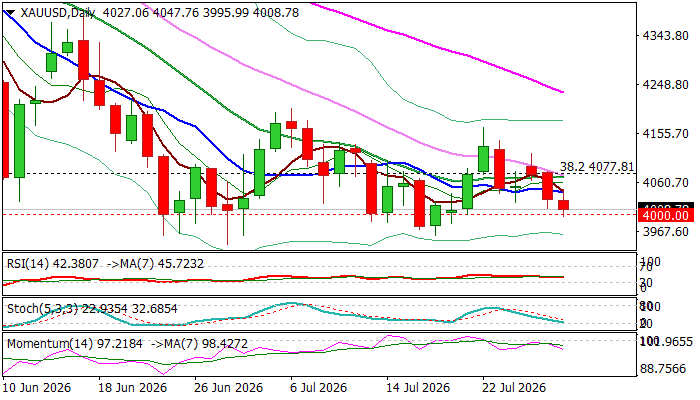
Gold Remains at the Back Foot Ahead of Fed, Inflation Data
Gold price eases for the third straight day and retests very important $4000 support on Wednesday, as initial enthusiasm about diplomatic action replacing hostilities in the Middle East, faded after fresh attacks of US / Saudi armies on Iraq.
The dollar firmed, keeping the yellow metal in defensive, as markets await results from Fed’s policy meeting and comments from Chairman Warsh, to get more information about the central bank’s next steps, as the Fed is widely expected to keep rates on hold in July meeting.
The latest developments in the Middle East warn of fresh pressure on prices (if the situation escalates further) that may keep gold at the back foot, especially if policymakers show more hawkish stance today.
Focus will be also on release of US June PCE price index (Fed’s preferred inflation gauge), due on Thursday, which would add more details to inflation picture.
Overall, the metal is expected to remain under increased pressure, especially if Fed hints more policy tightening (markets already bet for rate hike in September), with eventual break below $4000 to trigger fresh acceleration lower.
Res: 4077; 4116; 4166; 4180
Sup: 3960; 3942; 3900; 3842
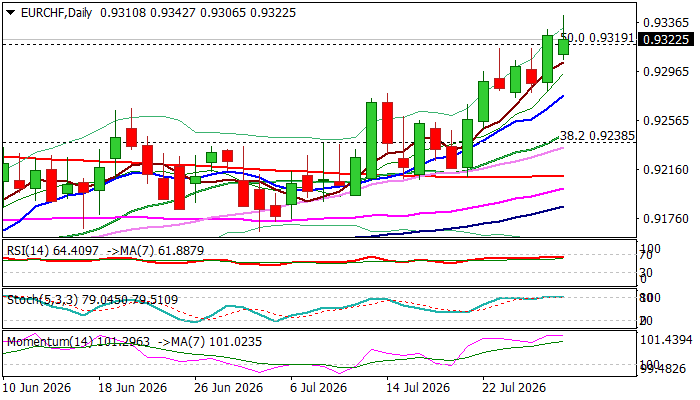
EURCHF Continues to Trend Higher as Swiss Franc Remains Pressured by Low Interest Rates
EURCHF hit new highest level in nearly seven months, following the latest acceleration higher on Tue/Wed, extension of larger uptrend.
The Swiss Franc remains under pressure due to low interest rates, with the latest rumors that the SNB may hold zero rates until end of 2027, adding to negative outlook for the currency.
Bulls broke above 50% retracement of 0.9661/0.8978 downtrend, holding in green for the fourth consecutive week and on track for the second monthly gain, with reversal pattern developing on monthly chart (bullish failure swing), signaling that recovery from new multi-year low (0.8977) is gaining traction.
Daily studies remain in full bullish setup but overbought stochastic and momentum indicators turned to sideways mode, suggesting that bulls may take a breather for consolidation before resuming towards 0.9400 zone (Fibo 61.8% / top of weekly Ichimoku cloud).
Former tops at 0.9270/80 zone (June/July) reinforced by ascending 10DMA should ideally contain dips and guard supports at 0.9244/38 (20DMA / broken Fibo 38.2%).
Res: 0.9342; 0.9400; 0.9445; 0.9500
Sup: 0.9303; 0.9266; 0.9244; 0.9211
Sunset Market Commentary
Markets
Since this morning, markets again face another layer of uncertainty regarding the conflict in the Middle East. After a pause in the military actions since Friday, the US reported a missile attack by Iran on its military forces in the region. The US and Saudi-Arabia were reported to have hit targets of 'Iran-aligned terrorists' in Iraq. US President Trump also again threatened to hit Iran hard. This kind of sequence of events of course often occurred over the previous months. For markets is very difficult to guess what this might mean for the outcome of any negotiations and/or for the flow of energy commodities from the region. Markets apply the 'usual' Pavlov reaction. The Brent oil price after easing over the previous days, rebounded to currently trading just below $90 p/b. The European TTF gas contract even jumped back higher from a close below €58 p/Mwh yesterday to currently €61.2. Inflation fears returning to the forefront also overthrew this week's calm on bond interest rate markets. European (and UK) markets again were hit substantially harder compared to the US. UK yields rose between 8.5 bps (2-y) and 4.0 bps (30-y). German yields in a similar move add between 5.5 bps (2-y) and 1.5 bps. US yields only rose 2.5 bps-1.5 bp across the curve. Equity markets in Europe show a mixed picture even after ongoing Tech related volatility in Asia this morning (South Korea in particular). US markets now are looking forward to the earnings' reports from Meta and Microsoft to be released this evening. The EuroStoxx 50 declines 0.5%. US indices are trading mostly lower (Dow -1.0%, Nasdaq -0.5%). The rise on geopolitical uncertainty still has only a limited impact on the major dollar cross rates. EUR/USD still holds near 1.138. DXY gains slightly (101.45). USD/JPY (163.85) is back within reach of the multi-year top but for now doesn't break the 164 big figure. Higher UK yields/risk premia again don't help sterling. EUR/GBP is slowing creeping further north (EUR/GBP 0.857 area).
Of course, the main dish for markets still might come later today as the Fed will announce its policy decision. For the first time in quite a while, there is still 'real' uncertainty left going into the announcement of the decision as Fed Chair Warsh abstains from concrete 'forward guidance'. Will the Fed policy rate (3.50%/3.75%) already be raised? The majority in the market still expects a 25 bps Fed rate hike only at the September meeting. Still, the money market is pricing a one in three chance that the trigger will be pulled today. The arguments for and against action today are both economic (e.g. waiting after favorable inflation figures for June) but also tactical in nature (Warsh can gain credibility if the Fed already acts 'preventively' today). Last month's Fed dots (9 members anticipating at least one rate hike this year) only adds to the idea that it might be a close call today. To be decided at 20:00 CET this evening.
News & Views
A preliminary estimate of Belgian Q2 GDP growth published by the National Bank of Belgium today shows that activity in the country stagnated in the April-June quarter. Real GDP, adjusted for seasonal and calendar effects, was unchanged in the second quarter of 2026 compared to the previous quarter (was 0.2% Q/Q in Q1). Y/Y growth rate stood at 0.5% (was 0.8% Y/Y in Q1). The estimate only provided data on added value on the supply side of the economy. Value added in the services sector grew 0.2% Q/Q. However, activity in both industry (-0.8%) and the construction sector (-0.5%) contracted compared to the previous quarter.
Statistics Sweden published quarterly and monthly GDP indicators. The monthly indicator declined 0.2% resulting in 2.4% Y/Y growth, coming after solid May data (0.9% M/M). For Q2 as whole, the indicator estimates 1.4% Q/Q and 2.8% Y/Y growth, substantially stronger than expected. The GDP indicator provides an early picture compiled with more limited and preliminary statistics than the regular national accounts. The agency analyzes that activity for both June and for Q2 as a whole is noticeably above levels seen in corresponding periods of the preceding year. At its June 17 policy meeting, the Riksbank left its policy rate at 1.75%. Inflation is low (June CPIF 0.3% M/M and 1.3% Y/Y), due to a dampening effect of fiscal measures. The RB at that time also pointed to somewhat weaker than normal economic activity and only a tentative recovery in the labour market. Still, due to the higher inflation risks (Iran war), RB indicated a higher probability that the policy rate might be raised later this year. Today's data at least suggest that also growth is improving. Markets still only see a first RB rate hike fully priced in by December. The krone this year weakened from EUR/SEK 10.50 to currently trade near EUR/SEK 11.05. RB reluctance to bring the policy rate to a more restrictive level in this respect probably played a role.
Risk Appetite Faces Three-Front Battle as Oil Rebounds, AI Worries Deepen and Fed Looms
Geopolitical escalation, deepening AI valuation doubts, and a high-stakes Fed vote all collide in the same session
- Middle East escalation is rebuilding oil's risk premium, with Brent rebounding above $87 after US-Saudi strikes in Iraq and Iran's rejection of a Hormuz administration proposal.
- AI valuation concerns are deepening, with KOSPI down -5.98% despite strong SK Hynix earnings, as investors question whether AI spending is generating adequate returns ahead of Microsoft and Meta earnings.
- The Fed's vote count, not the rate decision, is Wednesday's main event, as markets watch for a broader hawkish coalition beyond the two policymakers already expected to dissent.
A modest recovery signaled by US equity futures offered little reassurance that market sentiment has stabilized. Instead, investors are approaching one of the busiest sessions in weeks with three major risks converging at once: geopolitical tensions are re-escalating in the Middle East, confidence in the AI-driven equity rally continues to deteriorate, and the Federal Reserve is preparing to announce a policy decision where the vote count matters far more than the rate decision itself.
Middle East Escalation Rebuilds Oil's Risk Premium
Geopolitical concerns have returned after only a brief lull. The United States and Saudi Arabia launched joint strikes against Iran-backed armed groups in Iraq, marking Washington's first military action since suspending attacks on Iran last week and Saudi Arabia's first publicly acknowledged participation alongside the United States during the conflict. The development raises the prospect that the confrontation is broadening geographically rather than winding down.
Iran has rejected Oman's proposal for joint administration of the Strait of Hormuz while claiming to have fired on ships transiting the waterway and on US military facilities in Jordan. Separately, Yemen's Houthi movement is reportedly considering charging commercial vessels to pass through the southern Red Sea after announcing a blockade of Saudi Arabia last week. Although markets still appear reluctant to price a return to full-scale regional war, ActionForex analysis shows the risk premium in energy markets is clearly rebuilding.
Key Developments
- US and Saudi Arabia launched joint strikes against Iran-backed armed groups in Iraq — Washington's first military action since suspending Iran strikes, Saudi Arabia's first acknowledged participation
- Iran rejected Oman's proposal for joint administration of the Strait of Hormuz, claims strikes on transiting ships and US facilities in Jordan
- Houthi movement reportedly considering charges for vessels transiting the southern Red Sea, following last week's announced blockade of Saudi Arabia
- Brent crude: rebounded above $87 after plunging to $80.67 earlier this week, on course to fill Monday's downside gap of $89-95
That shift is evident in Brent crude, which has rebounded above $87 after plunging to $80.67 earlier this week. The recovery puts the market on course to fill Monday's downside gap of $89-95 and underscores how quickly traders are willing to reprice supply risks when disruptions spread beyond a single flashpoint.
AI Valuation Doubts Deepen Ahead of Microsoft and Meta Earnings
Technology shares present the second challenge. Selling pressure intensified across Asia, with South Korea's KOSPI dropping -5.98% despite strong corporate earnings. SK Hynix delivered operating profit more than six times higher than a year earlier, yet its shares still slumped -9.6% as investors judged the results against exceptionally high expectations.
That reaction illustrates the increasingly demanding environment facing US technology giants. Microsoft and Meta report after the US close, but following disappointing cash flow updates from Alphabet and Tesla last week, investors appear more focused on whether AI spending is generating sufficient returns than on headline earnings growth. With sentiment already fragile, even respectable results may struggle to spark a sustained recovery if markets continue reassessing lofty valuations.
Key Data
- KOSPI: -5.98% despite strong corporate earnings
- SK Hynix: operating profit more than six times higher year-over-year, shares still fell -9.6%
- Microsoft and Meta report after the US close, following disappointing cash flow updates from Alphabet and Tesla last week
The Fed's Vote Count Matters More Than the Rate Decision
The final test comes from the Federal Reserve. Policymakers are universally expected to leave interest rates unchanged at 3.50-3.75%, making the statement and the voting pattern the meeting's primary sources of potential surprise.
Cleveland Fed President Beth Hammack and Dallas Fed President Lorie Logan are widely expected to vote for an immediate hike. Any additional support for tighter policy would likely be interpreted as a meaningful step toward a September increase. Markets will pay particular attention to Chair Kevin Warsh and Governor Christopher Waller, whose votes could signal whether inflation concerns are spreading beyond the Committee's established hawks. Former Chair Jerome Powell, now a Governor, together with Neel Kashkari, are also wildcards.
A broader hawkish coalition would likely push Treasury yields and the Dollar higher while adding fresh pressure on global equities already wrestling with geopolitical risks and AI-related uncertainty.
Who to Watch
- Cleveland Fed's Hammack and Dallas Fed's Logan: widely expected to vote for an immediate hike
- Chair Warsh and Governor Waller: votes could signal whether hawkish sentiment is broadening beyond the Committee's established hawks
- Powell (now a Governor) and Kashkari: wildcards
Currency Markets: CAD Leads, AUD Under Pressure
In foreign exchange markets, Canadian Dollar is the day's strongest performer as the rebound in oil prices improves Canada's terms of trade. Yen follows on cautious risk sentiment, while Dollar holds steady ahead of the FOMC announcement. Australian Dollar is under pressure after weaker-than-expected inflation data prompted all four major domestic banks to forecast an extended RBA pause through year-end. Swiss Franc and New Zealand Dollar also underperform, while Euro and Sterling trade in the middle of the major currency rankings as investors wait for the next decisive catalyst.
Australia's Q2 CPI came in at 3.8% headline, with quarterly trimmed mean inflation missing the RBA's own 3.6% forecast. That miss prompted Westpac to abandon its call for another rate hike, completing a rare consensus among Australia's Big Four banks that the RBA is likely to stay on hold through year-end.
Key Takeaways
- Three risks are converging at once: Middle East escalation, deepening AI valuation doubts, and a high-stakes Fed vote are all in play the same session, and a modest futures recovery does little to offset that.
- Oil's risk premium is rebuilding fast: Brent rebounded above $87 from $80.67 as the Iraq strikes and Hormuz standoff suggest the conflict is broadening, not de-escalating.
- AI earnings need to show returns, not just growth: SK Hynix's beat-and-selloff shows investors are judging AI-linked earnings against demanding return expectations, a bar Microsoft and Meta face after the US close.
- The Fed decision itself is a formality; the vote count is not: Markets are watching whether Hammack and Logan's hawkish votes gain support from Warsh, Waller, Powell, or Kashkari as a signal toward a September hike.
- Currency markets are already pricing the risk split: CAD gained on oil's rebound while AUD fell after core CPI missed the RBA's own 3.6% forecast, completing a rare Big Four consensus for an extended hold, even before the FOMC decision lands.
Related Coverage
- See why Gold's next move may hinge entirely on Warsh and Waller's votes, not on the Fed's widely expected hold: Gold Hands the Baton Back to the Fed: Why Warsh and Waller's Votes Matter Most.
- Read why AUD/USD's break lower could open the door to 0.6750, now that Westpac has dropped its RBA hike call: AUD/USD Breaks Lower as Australia CPI Seals Case for Extended RBA Hold. Is 0.6750 Next?.
- See the full Australia CPI breakdown showing why trimmed mean inflation missed the RBA's own forecast: Australia Inflation Slows to 3.8% as Core CPI Misses Forecasts 3.6%.
Frequently Asked Questions
Q: Why is oil's risk premium rebuilding after this week's plunge?
A: The US and Saudi Arabia's joint strikes in Iraq, combined with Iran's rejection of a Hormuz administration proposal and the Houthi movement's threat to charge vessels transiting the southern Red Sea, all point toward the conflict broadening geographically rather than winding down. That shift is why Brent has rebounded above $87 after plunging to $80.67 earlier this week.
Q: Why does the Fed's vote count matter more than the rate decision itself this week?
A: Policymakers are universally expected to hold rates at 3.50-3.75%, so the decision itself carries no surprise. The real signal is whether Cleveland Fed's Hammack and Dallas Fed's Logan gain company from other policymakers like Chair Warsh, Governor Waller, Powell, or Kashkari in voting for tighter policy — that would be read as a concrete step toward a September hike.
Q: Why did SK Hynix shares fall despite blowout earnings?
A: SK Hynix delivered operating profit more than six times higher than a year earlier, yet investors judged the results against exceptionally high expectations rather than rewarding the headline growth. It's the same dynamic now facing Microsoft and Meta, which report after the US close following disappointing cash flow updates from Alphabet and Tesla last week.