

Sample Category Title
GBP/JPY Daily Outlook
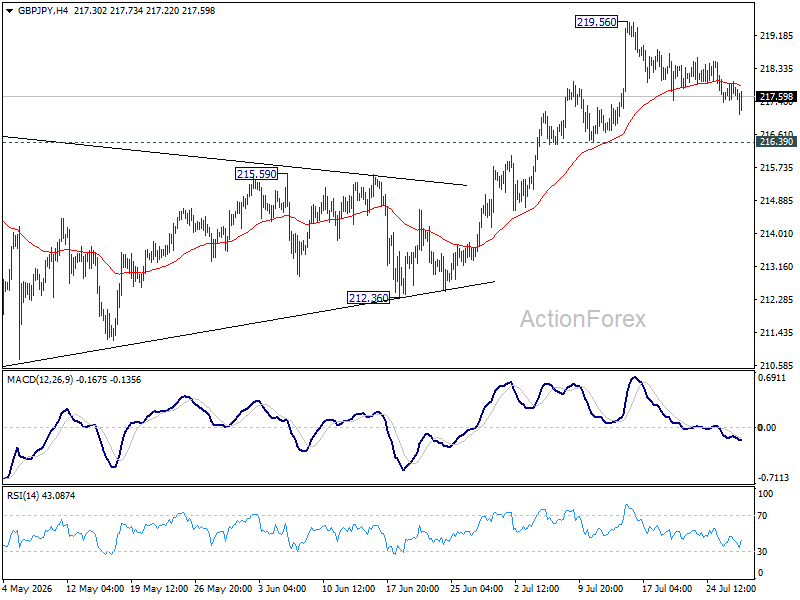
Intraday bias in GBP/JPY stays neutral at this point. More consolidations would be seen below 219.56. Downside should be contained by 216.39 support to bring another rally. On the upside, firm break of 219.56 will extend larger up trend to 220.90 fibonacci projection level next. However, firm break of 216.39 will bring deeper decline towards 212.36 support instead.
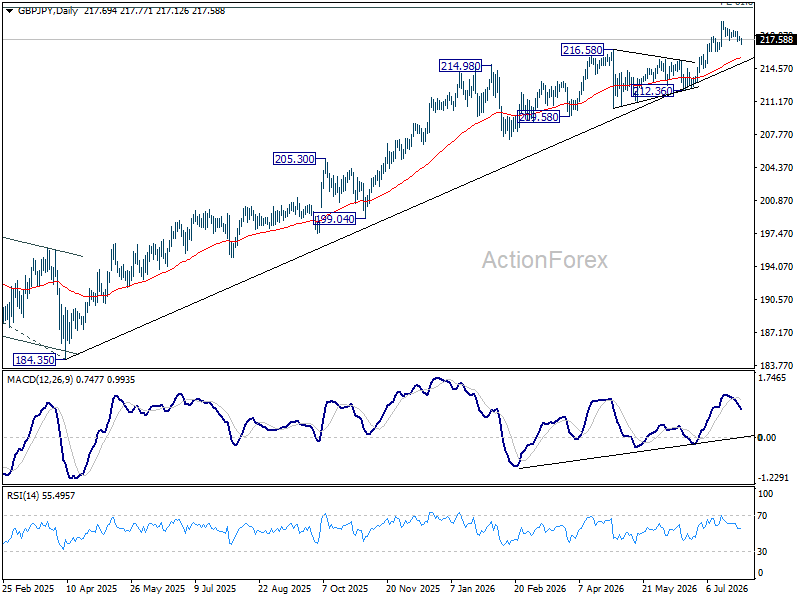
In the bigger picture, the long term up trend is in progress. Next target is 61.8% projection of 148.93 (2022 low) to 208.09 (2024 high) from 184.35 at 220.90. For now, outlook will remain bullish as long as 55 W EMA (now at 208.95) holds, in case of pullback.
EUR/JPY Daily Outlook
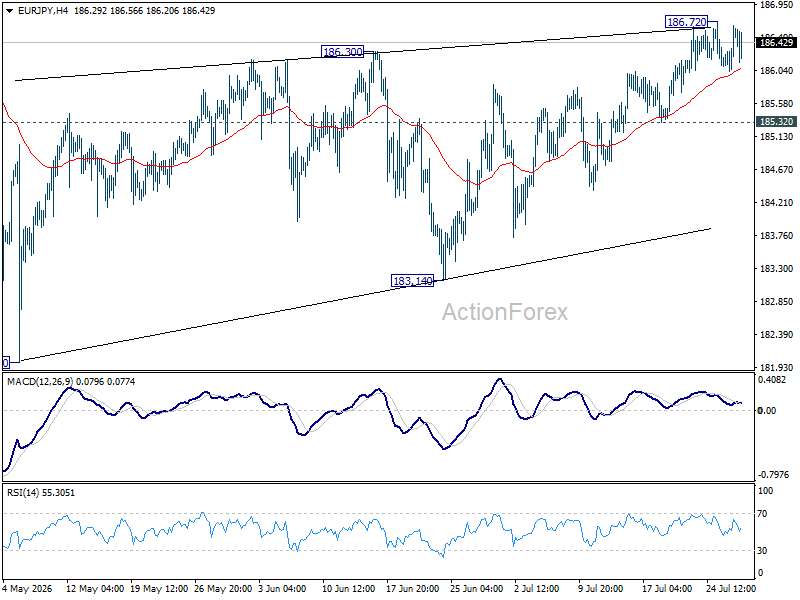
Intraday bias in EUR/JPY stays neutral as consolidations continue below 186.72 temporary top. Rebound from 182.10 could still extend higher, and above 186.72 will target 187.93 high. Nevertheless, since this rebound is viewed as a corrective move, strong resistance should be seen from 187.93 to limit upside. On the downside, below 185.32 support will turn intraday bias back to the downside for 183.14 support.
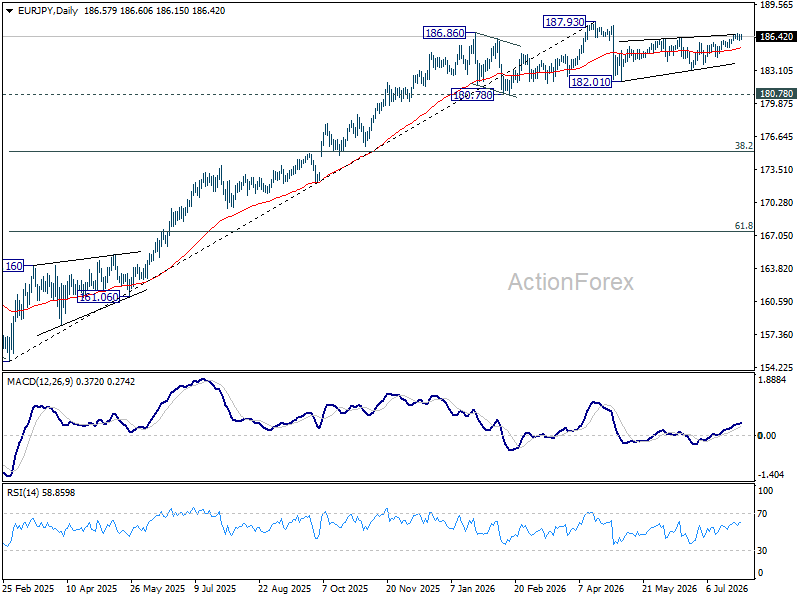
In the bigger picture, uptrend from 114.42 (2020 low) is still expected to resume at a later stage to 78.6% projection of 124.37 (2022 low) to 175.41 (2025 high) from 154.77 at 194.88. However, sustained break of 55 W EMA (now at 180.40) will argue that it's already in a medium term down trend to 175.41 resistance turned support and below.
EUR/GBP Daily Outlook
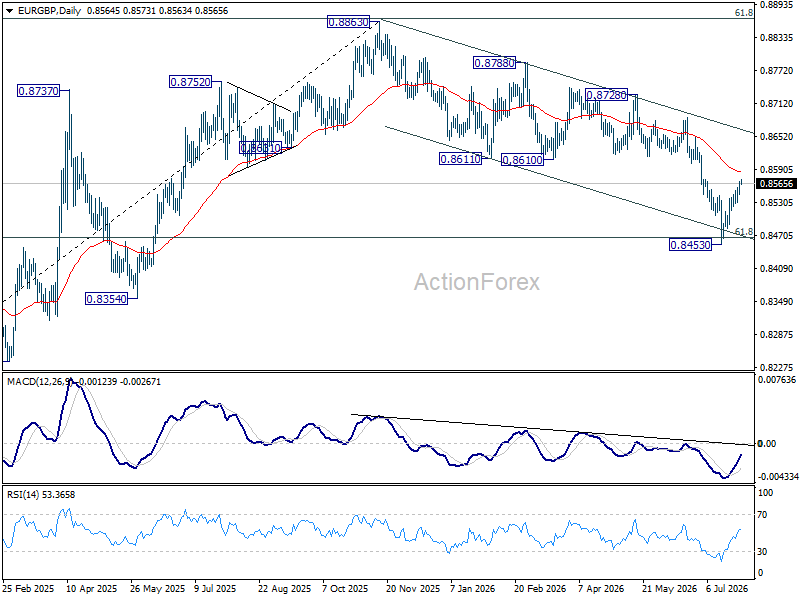
Intraday bias in EUR/GBP remains mildly on the upside, as rebound from 0.8453 is in progress for (now at 0.8586). But strong resistance should be seen from 0.8610 to limit upside. On the downside, below 0.8528 minor support will turn bias back to the downside for retesting 0.8453 low.
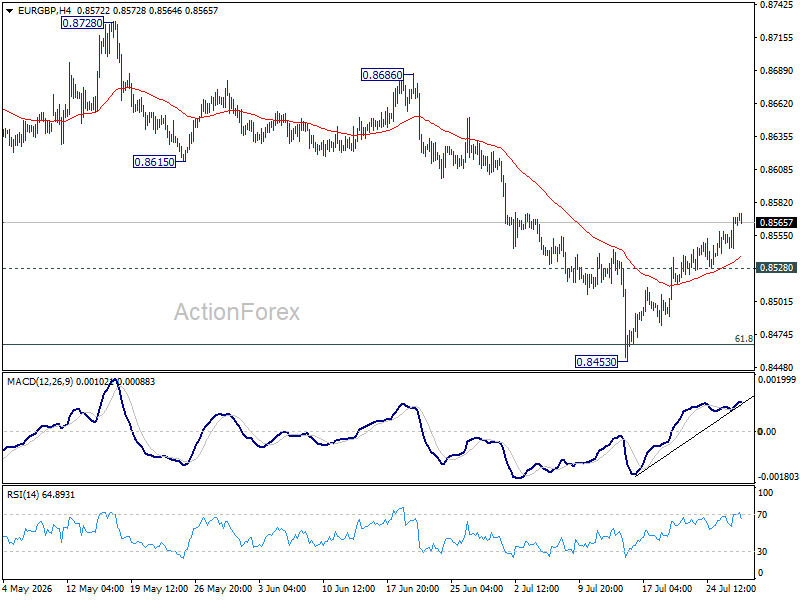
In the bigger picture, rise from 0.8221 (2024 low) should have completed at 0.8863, just ahead of 38.2% retracement of 0.9267 (2025 high) to 0.8221 at 0.8867. Deeper fall would be seen back to 0.8221. For now, outlook will be neutral at best as long as 0.8610 support turned resistance hold.
EUR/AUD Daily Outlook
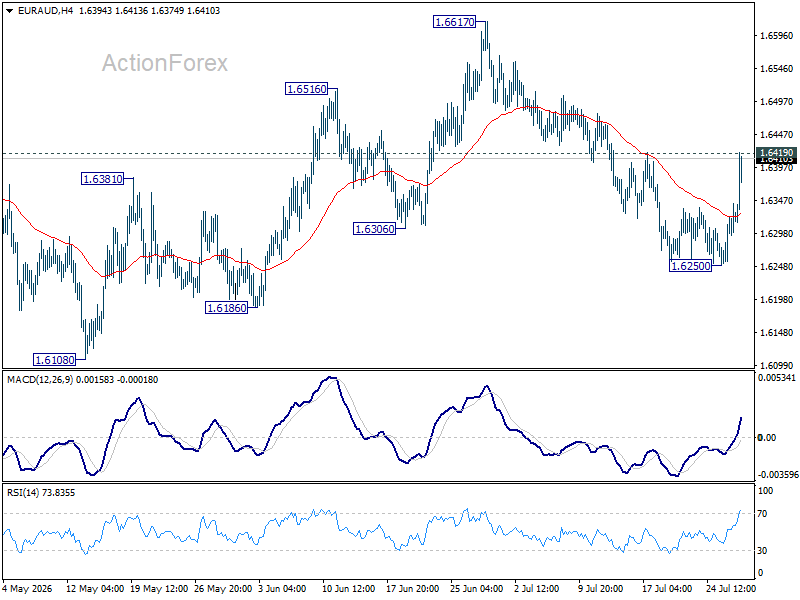
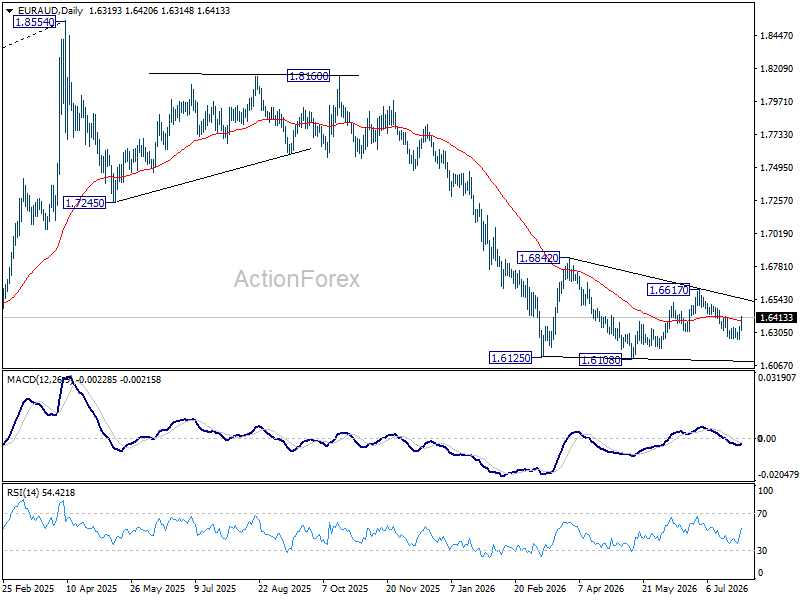
Intraday bias in EUR/AUD remains neutral for now. But immediate focus is now on 1.6419 resistance with today's strong rebound. Firm break there will suggest that pullback from 1.6617 has completed at 1.6250, and rise from 1.6108 is not complete. Intraday bias will be turned back to the upside for 1.6617 resistance. on the downside, below 1.6250 will bring retest of 1.6108 low.
In the bigger picture, outlook will stay bearish as long as 1.6842 resistance holds. Fall from 1.8554 (2025 high) is expected to continue to 61.8% retracement of 1.4281 to 1.8554 at 1.5913. Decisive break there will pave the way back to 1.4281 (2022 low). However, firm break of 1.6842 should confirm medium term bottoming, and bring stronger rally.
EUR/CHF Daily Outlook
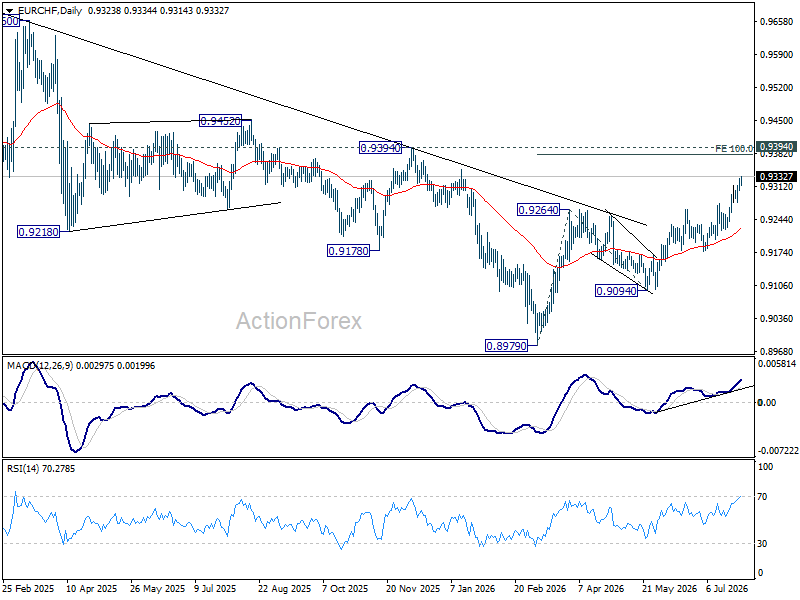
EUR/CHF's rally is still in progress today and intraday bias remains on the upside. Current rise from 0.8979 should target 100% projection of 0.8979 to 0.9264 from 0.9094 at 0.9379. On the downside, below 0.9278 minor support will turn intraday bias neutral and bring consolidations again, before staging another rally.
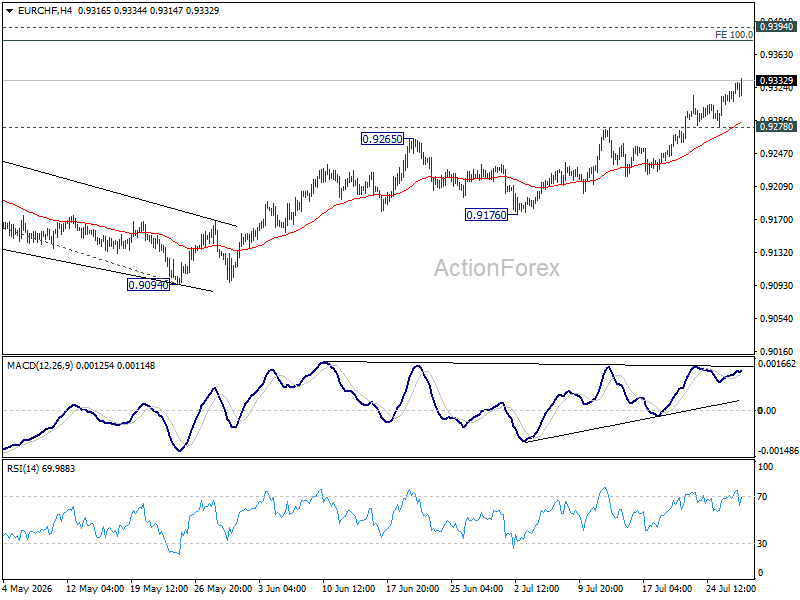
In the bigger picture, the break of medium term falling trend line resistance indicates that 0.8979 is already a medium term bottom. Considering bullish convergence condition in W MACD, rise from there should at least be reversing the fall from 0.9928, with prospect of developing into a medium term up trend. Firm break of 0.9394 resistance will add more credence to this case. For now risk will remain on the upside as long as 0.9094 support holds, in case of retreat.
EUR/USD: All Eyes on the Fed as the Range Reaches Its Breaking Point
The dollar's next move hinges on tonight's Fed decision, and this time markets genuinely don't know what to expect. While economists still lean toward a hold—with CME FedWatch odds sitting near 68.5% for no change—Kevin Warsh's hawkish rhetoric on having "no tolerance" for inflation, paired with growing internal FOMC support for a hike, has pushed hike odds up sharply from just 18% two weeks ago to over 30% today. Complicating things further, Warsh has deliberately scaled back forward guidance, meaning tonight's press conference may offer fewer clues than usual.
The euro, meanwhile, has already had its say: the ECB held rates steady at 2.25% last Thursday, as expected, with Lagarde reaffirming the 2% target while flagging that energy-driven inflation risks from the Middle East conflict have yet to fully play out. Eurozone inflation cooled to 2.8% in June, but sticky services inflation near 3.5–4% keeps the door only cautiously open for a September move in either direction.
With EUR/USD trading near 1.1408, tonight's Fed decision—not the ECB—is what will likely determine the pair's next major direction.
EUR/USD Technical Analysis
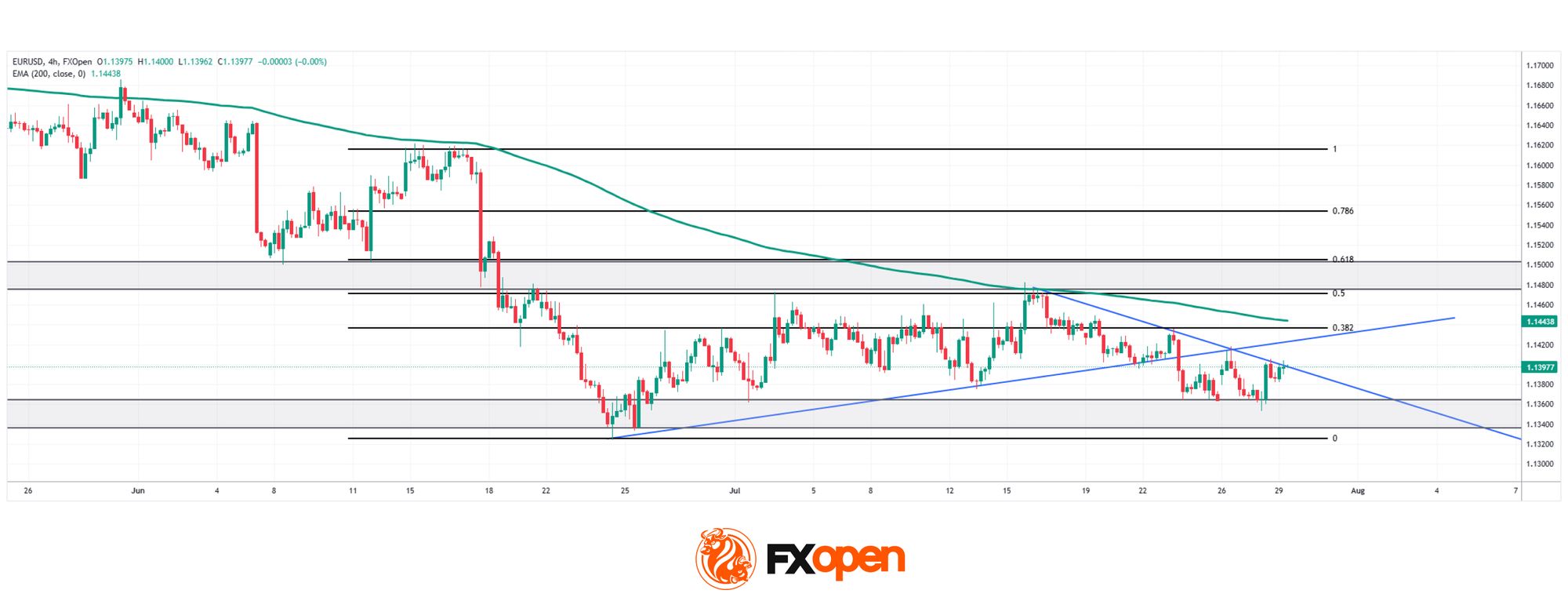
As the EUR/USD chart shows, the pair has been consolidating within a defined range since late June, squeezed between an ascending trendline and a descending trendline, both converging around the current price near 1.1400. The 200-period EMA continues to slope lower above price, reinforcing a cautious backdrop ahead of tonight's Fed decision.
Bullish Scenario
Should the dollar weaken on a dovish Fed outcome, price would need to break above the converging trendlines and reclaim the 0.382 Fibonacci retracement near 1.1420, with the 200-period EMA just above acting as the next key test. A confirmed break above the EMA would open the path towards the 0.5 and 0.618 retracements near 1.1480–1.1500, where stronger resistance has capped rallies since late June.
Bearish Scenario
Conversely, a hawkish surprise—or even a hike—could send the euro sharply lower, breaking both the ascending trendline and the psychological 1.1360 support level. A confirmed break here would expose the 1.1320 zone, the 0.0 Fibonacci level marking the origin of the entire recovery move, with further downside risk towards fresh multi-week lows if selling pressure accelerates.
With price coiled right at the intersection of both trendlines and the Fed decision just hours away, EUR/USD looks primed for a decisive move. Will the dollar reassert its dominance, or will the euro finally break free of this range?
Trade over 50 forex markets 24 hours a day with FXOpen. Take advantage of low commissions, deep liquidity, and spreads from 0.0 pips (additional fees may apply). Open your FXOpen account now or learn more about trading forex with FXOpen.
This article represents the opinion of the Companies operating under the FXOpen brand only. It is not to be construed as an offer, solicitation, or recommendation with respect to products and services provided by the Companies operating under the FXOpen brand, nor is it to be considered financial advice.
Sunrise Market Commentary
Markets
Yesterday, markets still lived on hope that the pause in military confrontation between the US and Iran was an indication of negotiations behind the scenes. However, there was little concrete news from the parties potentially involved in any negotiating process. Markets had to operate in some kind of no man's land. Energy prices eased slightly further (Brent close $84 p/barrel, TTF gas €57.7 p/Mwh). The same goes for interest rates. U.S. yields fell between 3.5 bps (2-y & 5-y) and 4.8 bpn (30-y). European yields eased by a similar amount, but here the short-end outperformed (2-y Germany -4.5 bps, 30-y -1.8 bp). The difference in reaction function probably had to do with investor caution ahead of today's Fed meeting. In addition to the conflict around Iran, the technology sector remains a source of nervousness, especially in some Asian markets. The impact on broader US and European indices remains orderly for the time being, although the Nasdaq is testing the important support around 25.000. Again little enthusiasm on FX markets. EUR/USD is stuck in a narrow band near 1.14 (close 1.139).
Overnight, the ceasefire in the Middle East was disturbed by the US reporting that it intercepted an Iranian attack against American targets in the region. Oil rebounds to $87 per barrel. The impact on interest rates and the dollar (EUR/USD 1.14) is limited for the time being. USD/JPY even eases slightly (163.55).
Today, the conflict in the Middle East and uncertainty on the AI/technology sector (Meta and Microsoft results today) must share attention with the Fed as it decides on its policy. Will the Fed policy rate (3.50%/3.75%) already be raised? Fed Chairman Warsh's intention to reduce forward guidance for sure is already paying off. The market is not certain. Even as the Fed Chair in its recent communication stressed that the Fed will deliver on its mandate of price stability, he didn't give any concrete hints on what this might mean for (the timing of) any interest rate steps. The majority in the market still expects a 25 bps Fed rate hike only at the September meeting. Still, the money market is pricing a one in three chance that the trigger will be pulled today. The arguments for and against action today are both economic (e.g. waiting after favorable inflation figures for June) but also tactical in nature (Warsh can gain credibility if the Fed already acts 'preventively' today). Last month's Fed dots (9 members anticipating at least one rate hike this year) only adds to the idea that it might be a close call today. If the Fed would hike rates already today, it could give the dollar a boost, although that is certainly not the Fed's main concern. In any case, tonight at 8 p.m. (CET), for the first time in a long time the markets can prepare for a Fed interest rate decision whose outcome is not a priori more or less certain.
News & Views
Australia CPI data published this morning printed on the softer side of expectations. In a monthly perspective, prices in June eased -0.1% M/M, bringing the Y/Y measure to 3.8% from 4.0%. The consensus expected an unchanged Y/Y figure at 4.0%. The largest contributor to annual inflation in June was Housing, which rose by 6.8 per cent. The next largest contributors were Food and non-alcoholic beverages and Recreation and culture, both rising by 3.3 per cent. Annual Housing inflation of 6.8% reflects rising costs for Electricity and New dwellings. However, the rise in electricity prices was mainly due to the government finishing rebates which reduced households' energy prices. Y/Y inflation for new dwellings reached its highest level in almost three years (5.8%), driven by builders passing on higher material and labour costs, the ABS analyses. Annual inflation for Transport moderated to 0.1% Y/Y, down from 3.3%. The trimmed mean June underlying measure was 0.3% M/M and 3.6% Y/Y (Unchanged). Quarterly headline inflation slowed from 1.4% in Q1 to 0.6% in Q2. Trimmed mean quarterly inflation remained at 0.8% Q/Q and 3.6% Y/Y. Even as the figures remain above the RBA 2-3% target, it was below its May forecast (3.8%). The 3-y Australia Government bond yield eases 7.5 bps this morning to 4.49%. Markets reduced expected probability of an additional RBA rate hike early next year to about 60% (was about 90% yesterday). The Aussie dollar dropped from the AUD/USD 0.697 area to currently trade near 0.6955.
USD/JPY and USD/CAD Test Resistance Ahead of Fresh Fed Signals
The US dollar continues to hold the upper hand against most major currencies ahead of the outcome of the latest Federal Reserve meeting. While the base-case scenario remains for interest rates to stay unchanged, markets are also pricing in the possibility of a rate hike. The Fed's decision, together with its comments on inflation, economic conditions and the future path of monetary policy, could determine the direction of the US dollar over the coming weeks.
Another factor supporting the dollar is the ongoing geopolitical uncertainty in the Middle East. Despite the temporary suspension of US strikes on Iran and renewed diplomatic efforts, the risk of further military escalation remains, prompting investors to remain cautious ahead of this week's key events. Geopolitical uncertainty continues to underpin demand for the US dollar as a safe-haven asset. At the same time, USD/JPY's approach towards multi-year highs has increased expectations of fresh warnings from Japanese authorities and raised the risk of currency intervention. For USD/CAD, oil prices remain another important driver: weaker crude prices continue to limit support for the Canadian dollar and help preserve the pair's bullish potential.
USD/JPY
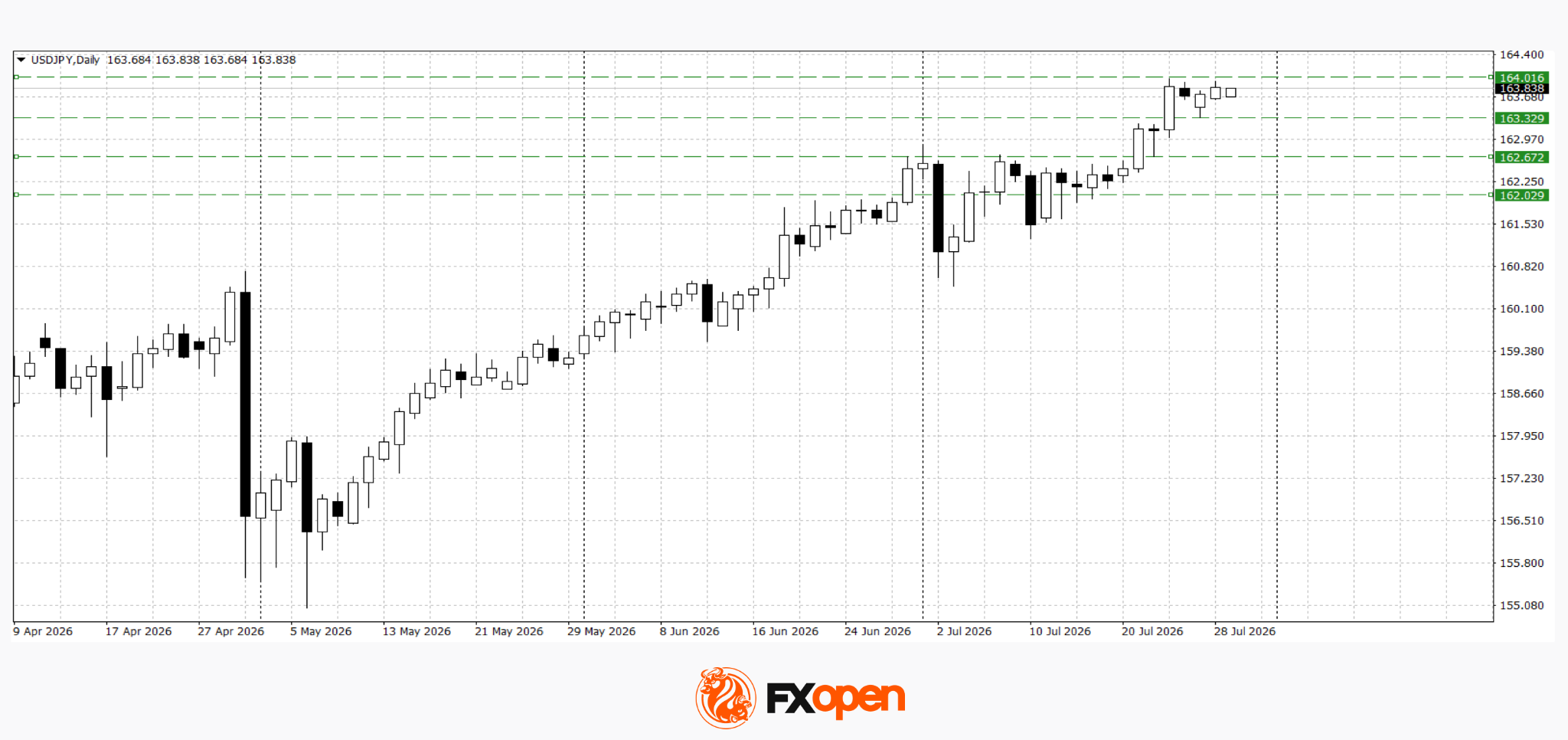
USD/JPY tested another multi-year high near 164.00 last week. Following the strong rally, the pair has entered a modest pullback. However, if the Federal Reserve delivers a more hawkish outcome or maintains its hawkish tone, the pair could extend its advance towards 165.00–165.50. A decisive move below 163.30 could trigger a deeper correction towards the 162.00–162.60 support area.
Key events for USD/JPY:
- Today at 21:00 (GMT+3): US Federal Reserve interest rate decision;
- Today at 21:30 (GMT+3): Federal Open Market Committee (FOMC) press conference;
- Tomorrow at 15:30 (GMT+3): US Core Personal Consumption Expenditures (PCE) Price Index.
USD/CAD
USD/CAD's recovery following the formation of a bullish engulfing pattern has stalled near resistance at 1.4130. The pair is currently consolidating within the 1.4060–1.4130 range. A decisive break above the upper boundary of this range could pave the way for further gains towards 1.4160–1.4200. Conversely, a move below 1.4060 could lead to a retest of the recent low near 1.4000.
Key events for USD/CAD:
- Today at 17:30 (GMT+3): US crude oil inventories;
- Today at 20:30 (GMT+3): Bank of Canada Summary of Deliberations;
- Tomorrow at 15:30 (GMT+3): US GDP data.
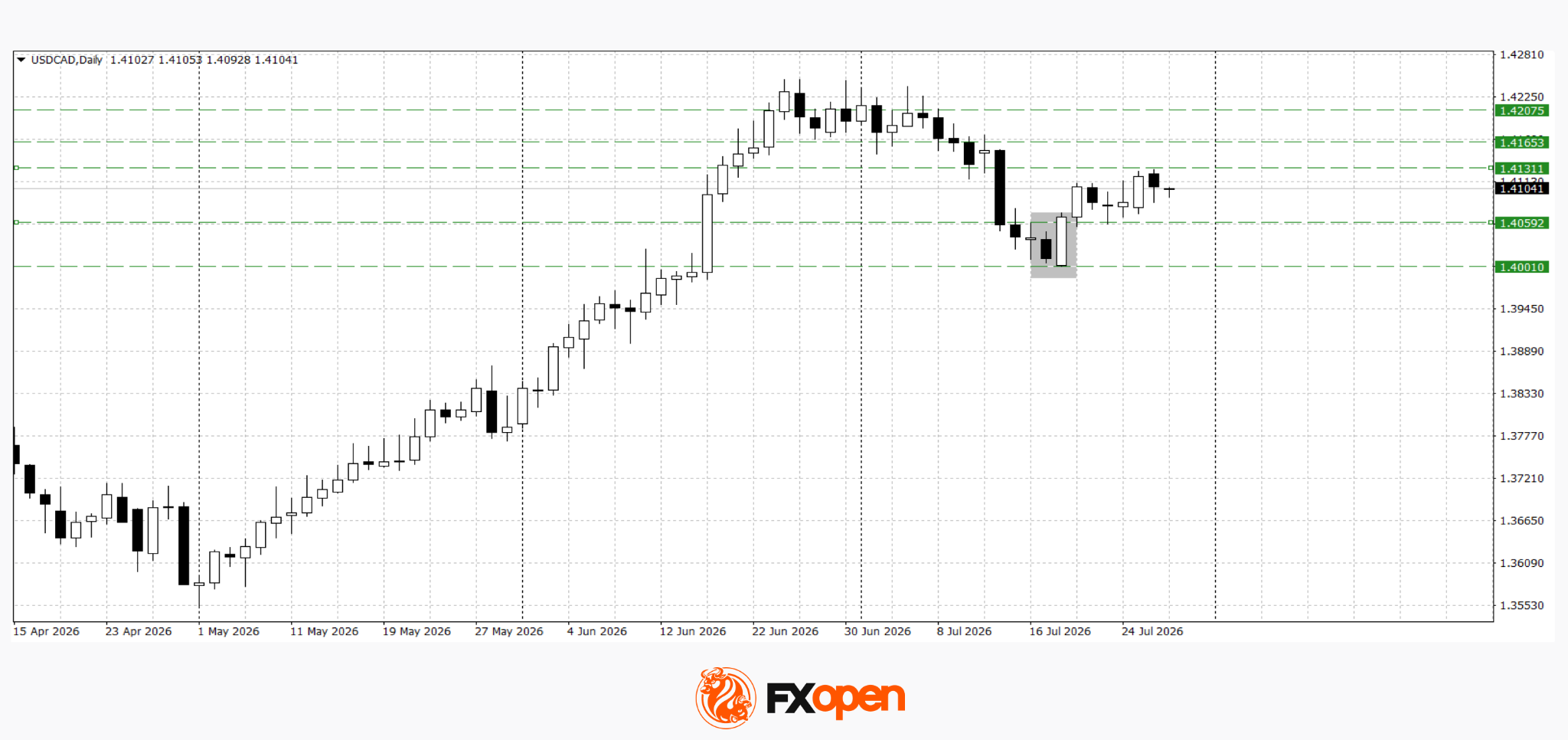
Overall, the near-term direction of both USD/JPY and USD/CAD will depend primarily on the Federal Reserve's decision and its guidance on the future path of interest rates. A more hawkish stance could support a breakout above nearby resistance levels and reinforce the US dollar's strength. Conversely, a more dovish message could trigger a correction in the greenback, particularly against the Japanese yen, where the proximity of multi-year highs increases the likelihood of renewed warnings from Japanese officials. For USD/CAD, oil price movements and the Bank of Canada's Summary of Deliberations will remain important additional drivers.
Trade over 50 forex markets 24 hours a day with FXOpen. Take advantage of low commissions, deep liquidity, and spreads from 0.0 pips (additional fees may apply). Open your FXOpen account now or learn more about trading forex with FXOpen.
This article represents the opinion of the Companies operating under the FXOpen brand only. It is not to be construed as an offer, solicitation, or recommendation with respect to products and services provided by the Companies operating under the FXOpen brand, nor is it to be considered financial advice.
AUD/USD Breaks Lower as Australia CPI Seals Case for Extended RBA Hold. Is 0.6750 Next?
TL;DR: Australia's soft CPI print has pushed all four major banks into agreement that the RBA's tightening cycle is over for now, driving AUD/USD below its rising channel with 0.6750 emerging as the next major support cluster.
Why This CPI Print Changes the Story
Australia's softer inflation report is more than just another downside CPI surprise — it marks the point where markets concluded the RBA's tightening cycle has effectively run its course. That shift in policy expectations triggered a sharp decline in AUD/USD, but its implications extend well beyond Wednesday's trading session. With expectations for further RBA tightening fading rapidly, the Australian dollar is losing one of its few remaining domestic pillars of support.
What the Data Actually Showed
The inflation data itself offered little justification for another near-term rate increase. Headline CPI slowed from 4.0% to 3.8% y/y in June, while trimmed mean inflation was unchanged at 3.6%. Quarterly figures echoed the same trend, with headline inflation easing from 4.1% to 3.8% and trimmed mean inflation rising only modestly from 3.5% to 3.6%.
The most important detail, however, was how those figures compared with the RBA's own expectations. Both the monthly and quarterly trimmed mean measures came in below the central bank's May forecast of 3.8%. That outcome effectively validated Governor Michele Bullock's remarks on Tuesday that underlying inflation had evolved broadly as expected since May — while also hinting the disinflation process may be progressing slightly faster than policymakers themselves anticipated.
Westpac's Reversal Seals a Rare Bank Consensus
The biggest surprise came from Westpac. Until Wednesday, it had been the only one of Australia's Big Four banks still forecasting another rate hike in August. Following the CPI release, Westpac abandoned that call, now expecting the RBA to remain on hold for the rest of 2026 — leaving open only a conditional risk of a November hike should inflation reaccelerate sharply during the third quarter.
That revision carries significance beyond a single economist's forecast. For the first time this tightening cycle, all four major Australian banks are united in expecting the RBA to leave policy unchanged through year-end based on current information. That consensus reinforces the perception that Australia's monetary tightening phase has probably ended — unless a fresh inflation shock, such as another sustained surge in oil prices, materializes.
Where the Risk Shifts Now: The Fed and Asian Equities
Attention therefore shifts away from Australia and toward global developments. Domestically, the policy story is largely settled for now. Externally, however, AUD/USD still faces several potentially bearish catalysts.
- The first is the Federal Reserve, with the FOMC rate decision scheduled for today. Cleveland Fed President Beth Hammack and Dallas Fed President Lorie Logan are widely expected to vote in favor of another rate increase. If additional FOMC members also dissent, markets would likely interpret the outcome as a more hawkish signal than currently anticipated — supporting higher Treasury yields and extending the Dollar's recent strength.
- The second is regional risk sentiment. Asian equity markets remain fragile despite Wednesday's brief rebound. Renewed selling in technology shares has already pushed the KOSPI roughly 17% lower this week, while pressure continues to build across the broader AI sector. Given the Australian dollar's strong correlation with Asian equity performance and global growth expectations, a deeper regional correction could reinforce downside momentum.
ActionForex's Technical View on AUD/USD
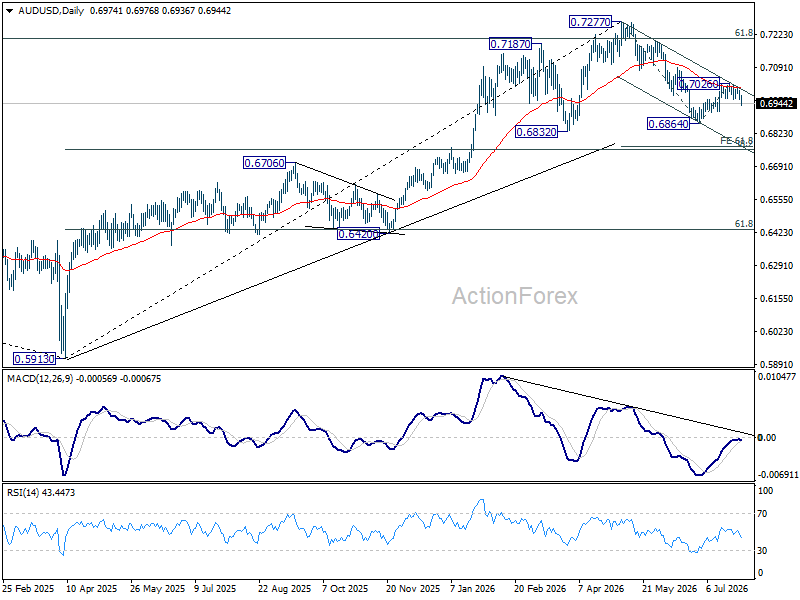
The technical picture has already begun reflecting that deteriorating backdrop. AUD/USD broke decisively below its short-term rising channel after once again failing to overcome the falling 55 D EMA near 0.7004. The price action strongly suggests the rebound from 0.6864 ended at 0.7026 as merely a corrective recovery within the broader decline from 0.7277.
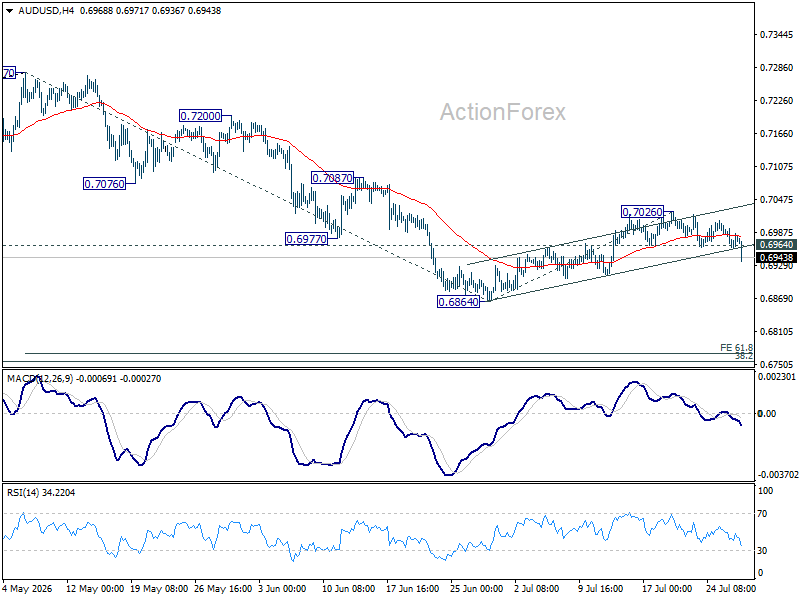
As long as rallies remain capped below the 55 4H EMA around 0.6981, the path of least resistance remains lower. A retest of 0.6864 should be seen next, with a sustained break opening the way toward the 61.8% projection of 0.7277 to 0.6864 from 0.7026, at 0.6771. That level sits just above a major medium-term Fibonacci support — the 38.2% retracement of 0.5913 to 0.7277, at 0.6756 — creating a critical support cluster around 0.6750.
Whether buyers are prepared to defend that area should decide whether the broader uptrend from 0.5913 remains intact or gives way to a much deeper medium-term decline.
Key Takeaways
- Australia's Q2 trimmed mean CPI came in below the RBA's own 3.8% May forecast, validating Bullock's "evolving as expected" framing.
- Westpac abandoned its lone August hike call, leaving all four major Australian banks aligned on an RBA hold through year-end.
- Today's FOMC decision and continued Asian equity weakness (KOSPI down ~17% this week) are now the dominant risks for AUD/USD, not domestic policy.
- AUD/USD broke its short-term rising channel after failing at the 55 D EMA (0.7004), with the 0.6864–0.7026 rebound now viewed as corrective.
- 0.6750 is the key support cluster to watch — a break opens a deeper medium-term decline; holding it keeps the broader uptrend from 0.5913 intact.
Hawkish RBA Hold Expected in August After Benign Break on Inflation
Downside surprise on inflation removes case for rate hike in August. Downbeat narrative on supply in question.
- We no longer expect rate hikes by the RBA this year. Inflation has been more benign than we feared and the RBA forecast. The substantial pass-through of higher energy costs seen in the early phase of the Middle East conflict has not been followed up in recent months. This is welcome – we took no pleasure in our prior hawkish view on pass-through, and so monetary policy.
- There is still a risk of a hike in November if inflation picks up again in Q3. But that is not our base case. Meanwhile the timing of the eventual unwind of the recent hikes (August 2027 start) has not been shifted by the latest data, but we will continue to assess new information.
- Ever since the June meeting’s pause, RBA communication has been signalling that they think they are not finished hiking rates. Inflation is too high and while the economy is slowing, that is – as the Governor noted in yesterday’s Q&A – “part of the plan”. We therefore expect the communication of the RBA to stay hawkish and not rule out further hikes, similar to the language in June.
- But it all depended on the inflation outlook, and the Q2 data show this has broken the other way, below our (and the RBA’s) expectations. In particular, market services inflation and the all-important housing-related components both came in below expectations. If underlying inflation had been in line with our (and the market’s) forecasts, a rate hike in August would have been more clearly on the table at the next Monetary Policy Board meeting. Although we still expect the Board will debate the case for a hike, things have not turned out in a way that supports the case for one.
- Even if inflation had turned out as forecast, there would have been arguments made against a hike in the Board room. The labour market has turned out a bit softer than the RBA expected, with the participation and unemployment rates both higher in the June quarter than the RBA forecast in May. Revisions to history for underemployment could also be view-changing for the RBA. But our read of the communication and RBA forecasts was that below-expectation inflation was needed to rule out the hike, which is what we got.
- In addition, as we highlighted last week, the downbeat view about potential growth in supply capacity might not be shared by all Board members. Treasury’s forecasts for labour force participation and assumptions on trend productivity growth are both notably higher than the RBA’s. Had inflation turned out differently today, a split vote on a hike would have been quite likely.
- As we have been noting for some time, we think the RBA has been overly bearish on the trend growth in supply capacity. This is one of the reasons why our end-point for underlying inflation was below the RBA’s, even though we had been slightly to the upside of their May forecasts in the near term. The more benign inflation data calls the RBA’s supply view into question even sooner than we had believed.