

Sample Category Title
EUR/CHF Daily Outlook
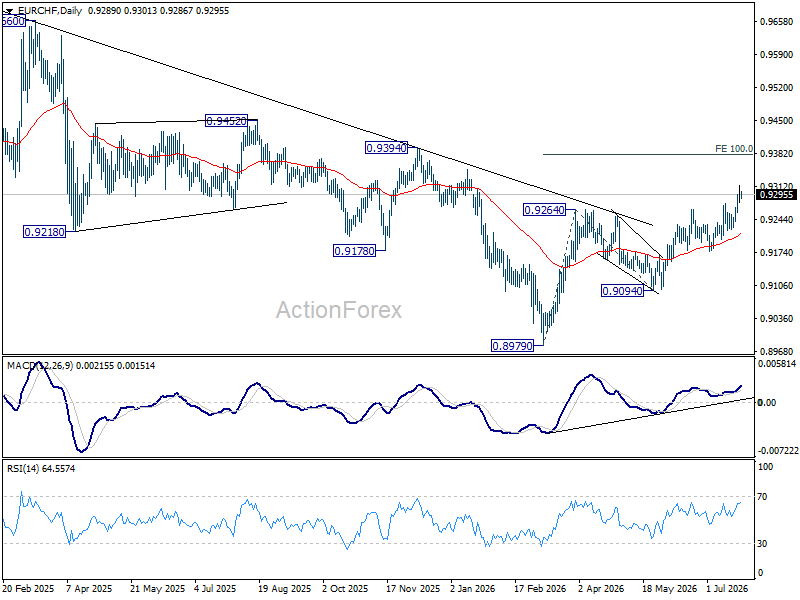
Intraday bias in EUR/CHF remains on the upside at his point. Current rally from 0.8979 should target 100% projection of 0.8979 to 0.9264 from 0.9094 at 0.9379. On the downside, below 0.9259 minor support will turn intraday bias neutral first. But near term outlook will stay bullish as long as 0.9226 support holds, in case of retreat.
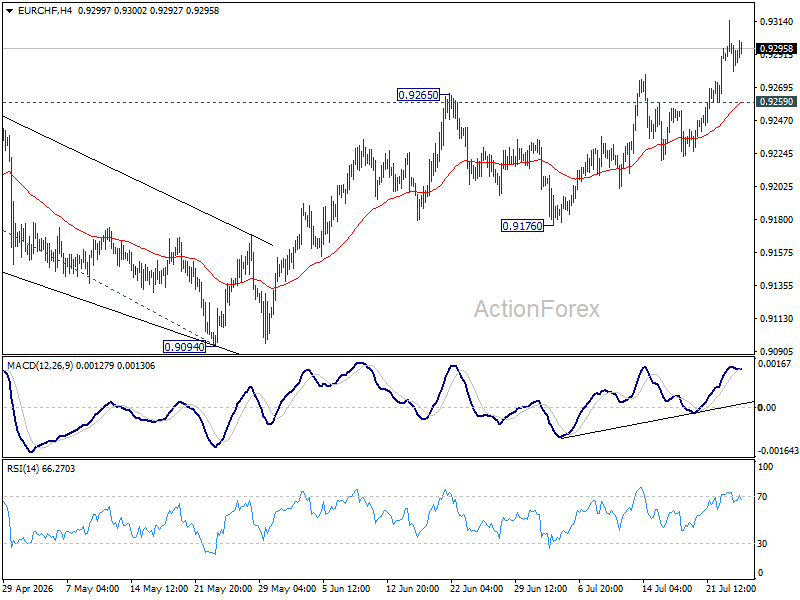
In the bigger picture, the break of medium term falling trend line resistance indicates that 0.8979 is already a medium term bottom. Considering bullish convergence condition in W MACD, rise from there should at least be reversing the fall from 0.9928, with prospect of developing into a medium term up trend. Firm break of 0.9394 resistance will add more credence to this case. For now risk will remain on the upside as long as 0.9094 support holds, in case of retreat.
Sunrise Market Commentary
Markets
The ECB is ready to raise rates in September, Bloomberg reported citing unnamed sources. Frankfurt kept rates steady yesterday but Lagarde admitted that some asked themselves if a hike should be considered. The ECB chair then pointed at the huge volume of data that's inbound in the coming weeks, suggesting the discussion is more appropriate at the September 10 gathering. This meeting also produces updated projections that could serve as the basis. In terms of the central bank's scenarios, the statement spoke of the current energy prices being close to the June baseline (which embedded two to three rate hikes). Lagarde added that the mild one looks "quite unlikely" to materialize and said that the more balanced risk assessment (less upside inflation risks and less downside growth risks) she conveyed in Sintra is no longer the view today. She was mindful of the possibility that a new MoU and/or ceasefire may not trigger the same sharp (oil) market response as it did previously. "Once bitten, twice shy." Euro area money markets discount a 90% probability for a September hike, with a third end-of-year move given same odds. Regarding such pricing, Lagarde noted that the central bank's reaction function is "very well understood".
The reaction to the ECB was overshadowed by the sharp moves on energy markets. Brent oil moved back into triple digit territory after Trump was said to be close to a "massive attack" on Iran (Axios). It is the US president's response to the Houthis opening a new front in Yemen and choking off another key oil artery in the Bab-el-Mandeb Strait. Dutch TTF gas prices shot up to a new post-war high before paring some of the earlier gains to around €62/MWh. That prompted some more bear flattening in core bond curves. US rates jumped 1.4-5.1 bps higher. European yields rose up to 4.5 bps. The front end in both the euro area and the US confirmed the break above the previous 2026 highs. The US 10-yr did so too. The 10-yr in Germany punched to a new 15-year high. Risk off rolled over stock markets. Tech led the decline with the Nasdaq shedding more than 2%. Support around 25k prevented worse. The US dollar outshined the competition in FX markets. EUR/USD lost the battle for 1.14 but for now stays away from key support at 1.1325. DXY climbed towards the previous YtD highs and USD/JPY rallied towards 164 – a 40 (!) year high.
We expect Iran-related uncertainty to play the dominating role going into the weekend with even high-profile data such as the July PMIs, which will probably have captured some of the energy price rebound, at risk of being ignored unless of a material surprise. Markets are on high alert for another escalation in US strikes after the Axios report yesterday. Brent closing the week above $100 would be an important signal. Watch out for its refined products, particularly diesel. Refining capacity has been severely crippled (including in Russia), putting prices of the industry's most important energy source on even stronger upward pressure relative to oil. Diesel prices are currently trading as if Brent would change hands around $140-$150. Erring to the side of caution implies a bearish core bond and bullish dollar bias. In tariff news, the Trump administration imposed a 10-12.5% levy on some 60 nations, including the EU, that replaces the 10% temporary global rate (lapses tonight). There's still a lot of uncertainty, however, for what it means for partners that have struck a trade deal with the US in the meantime. In particular for the EU, which agreed to a 15% tariff cap, it's unclear whether these new tariffs stack, substitute or are subject to that 15% cap.
News & Views
Japanese inflation excluding fresh food rose in June for the first time in three months, from 1.4% y/y in May to 1.6% in June. The core measure ex. fresh food and energy still slowed to 1.7% from 1.8% in May. Food prices were stable in a monthly perspective, but y/y prices eased from 3.5% to 3.2%. Energy prices, which are subject to government subsides still were below zero y/y (-0.1%) but negative figures from the previous months (e.g. -2.5% y/y in June) are gradually petering out. A similar trend is visible for utility prices. Prices for household goods (2.4% y/y) and medical care (1.3% from 0.0%) also rose compared to May. Services inflation slowed from 1.4% to 1.2%. The data are a final input for the BoJ policy meeting to be held next Friday. A Reuters comment this morning, referring to sources familiar with the thinking within the Bank of Japan, indicates that the BoJ is likely to maintain its warning on the risk of an overshoot of the 2% target, but at the same time that it will indicate that risks have not increased significantly over the previous three months. The central bank will have a new quarterly outlook report available as a reference when setting out its monetary policy path. Amongst others, a weak yen will be an important factor in the debate, with USD/JPY this morning touching levels only just below 164. The BoJ is nevertheless widely expected to keep its policy rate at 1%, with markets positioning for a next move by the final quarter of this year.
UK Retail Sales Surge 1.0% mom as Online Spending Leads Broad-Based June Rebound
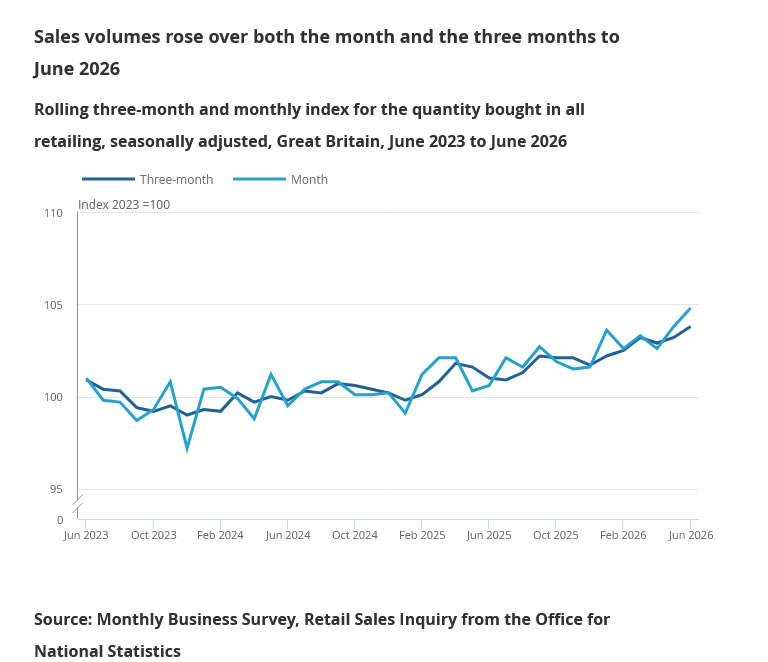
UK retail sales volumes jumped 1.0% mom in June, far exceeding expectations for a -0.3% mom decline, following an unrevised 1.2% mom increase in May. The stronger-than-expected performance points to resilient consumer demand despite elevated borrowing costs and persistent cost-of-living pressures. Retailers credited sales promotions and warm weather for boosting spending, particularly at online and clothing retailers.
The gains extended beyond the headline figure. Excluding automotive fuel, retail sales rose 1.1% mom, while volumes increased 1.2% qoq in Q2. Non-store retailing was the standout performer, with sales surging 4.4% mom and 3.8% qoq, reflecting strong online demand. Other non-food stores also posted solid gains, while clothing retailers rebounded 1.9% mom after recent weakness. Food sales edged higher, suggesting spending strength was relatively broad-based across consumer categories.
Fuel sales was the notable weak spot, falling -0.8% mom and 6.0% qoq as higher pump prices continued to weigh on demand following the Middle East-related stockpiling seen in March. Overall, the report suggests UK consumers remain willing to spend selectively when supported by discounts and seasonal factors, reinforcing the view that household consumption continues to provide a cushion for the economy.
Economic Data
| Indicator | Actual | Expected | Previous |
|---|---|---|---|
| Retail Sales mom (Jun) | 1.0% | -0.3% | 1.2% |
| Retail Sales ex-Fuel mom (Jun) | 1.1% | — | — |
| Retail Sales qoq (Q2 vs Q1) | 0.6% | — | — |
| Retail Sales ex-Fuel qoq (Q2 vs Q1) | 1.2% | — | — |
Category Breakdown
| Component | June mom | Q2 vs Q1 | Trend |
|---|---|---|---|
| Non-store Retailing | 4.4% | 3.8% | ▲ Strong |
| Textile, Clothing & Footwear | 1.9% | -0.1% | ▲ Rebounded |
| Other Non-food Stores | 1.8% | 1.2% | ▲ Strong |
| Food Stores | 0.3% | 0.3% | ▲ Modest |
| Household Goods Stores | -0.6% | 2.9% | Mixed |
| Department Stores | -1.7% | 1.6% | Mixed |
| Automotive Fuel | -0.8% | -6.0% | ▼ Weak |
Key Takeaways
- UK retail sales rose 1.0% mom in June, sharply beating expectations for a -0.3% decline.
- May's 1.2% mom gain was unrevised, while April was revised up to -0.7% mom from -1.0% mom.
- Excluding automotive fuel, retail sales increased 1.1% mom, indicating that the strength was broad-based rather than driven by volatile fuel sales.
- Retail sales volumes rose 0.6% in Q2 from Q1, or 1.2% excluding fuel, pointing to resilient household spending through the quarter.
- Online retailers were the standout performer, with non-store sales jumping 4.4% mom and 3.8% qoq, helped by sales promotions and warm weather.
- Clothing retailers rebounded 1.9% mom, while other non-food stores also posted solid gains.
- Fuel sales remained the weakest segment, falling -0.8% mom and -6.0% qoq after motorists cut back following March's conflict-driven stockpiling and subsequent rise in pump prices.
- The report suggests UK consumers continue to spend selectively despite high interest rates, reinforcing the resilience of domestic demand.
Germany’s GfK Consumer Climate Slips to -29.6 as Income Outlook Weakens and Saving Stays Elevated
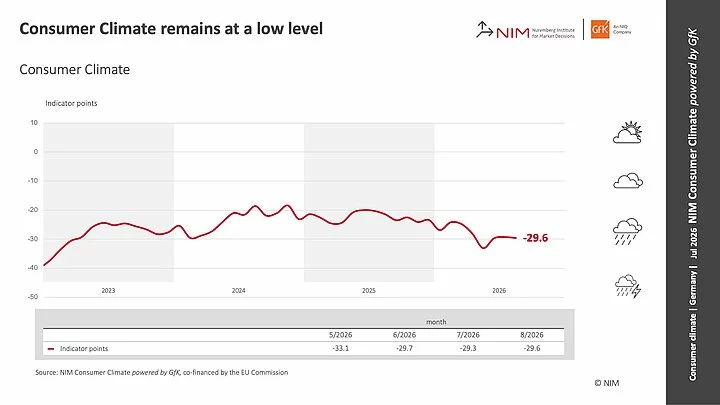
Germany's GfK Consumer Climate edged down from -29.3 to -29.6 for August, highlighting that household confidence remains deeply depressed despite modest improvement in some underlying indicators. The slight deterioration was driven by weaker income expectations and a renewed rise in precautionary saving, offsetting gains in willingness to buy and economic expectations.
Income expectations fell from -12.2 to -14.5, reversing part of the gradual improvement seen in recent months as households turned more pessimistic about their financial outlook over the coming year. Meanwhile, willingness to save rose from 13.9 to 17.0, remaining exceptionally high by historical standards and signaling that consumers continue to prioritize building financial buffers amid persistent uncertainty. Although willingness to buy improved from -13.4 to -9.9, it remained firmly negative, suggesting that households are still reluctant to commit to major purchases.
The survey also showed economic expectations improving for a third consecutive month, with the indicator rising from -8.7 to -6.3, indicating that pessimism about Germany's economy is gradually easing. However, consumers still expect economic conditions to worsen over the next year. At the same time, inflation concerns ticked higher following the expiration of the fuel subsidy at the end of June, with higher pump prices reinforcing caution.
Overall, the survey points to a consumer sector that remains constrained, suggesting household spending is unlikely to provide a meaningful boost to Germany's economic recovery in the near term.
Economic Data
| Component | Current | Previous | Trend |
|---|---|---|---|
| Consumer Climate (Aug) | -29.6 | -29.3 | ▼ Slightly weaker |
| Income Expectations (Jul) | -14.5 | -12.2 | ▼ Weaker |
| Willingness to Buy (Jul) | -9.9 | -13.4 | ▲ Improved |
| Willingness to Save (Jul) | 17.0 | 13.9 | ▲ Higher |
| Economic Expectations (Jul) | -6.3 | -8.7 | ▲ Improved |
| Price Expectations (Jul) | -2.1 | -2.9 | ▲ Inflation concerns rose slightly |
Key Takeaways
- Consumer Climate edged down from -29.3 to -29.6, indicating German consumer confidence remains deeply subdued.
- Income expectations fell from -12.2 to -14.5, ending several months of gradual improvement.
- Willingness to save rose from 13.9 to 17.0, highlighting continued precautionary behaviour amid economic uncertainty.
- Willingness to buy improved from -13.4 to -9.9, but remained firmly negative, suggesting consumers are still reluctant to make major purchases.
- Economic expectations improved for a third consecutive month, with the index rising from -8.7 to -6.3, although most households still expect economic conditions to worsen over the next year.
- Inflation concerns increased modestly following the expiry of Germany's fuel subsidy, which pushed fuel prices higher.
- Overall, the survey points to weak household demand, suggesting private consumption is unlikely to become a major driver of Germany's economic recovery in the near term.
Gold and Silver Tumble as Oil Link Returns; Trump’s Looming Decision on Iran Adds Binary Risk
TL;DR: Gold and Silver tumbled as markets returned to the oil-rates relationship that governed Q2, with Brent above $100 and 10-year Treasury yields above 4.7% restoring pressure on the metals — leaving their next move hostage to Trump's binary decision on Iran.
Why This Matters
Gold and Silver tumbled as markets returned to trading precious metals through the oil-rates relationship that governed markets in Q2. Brent's move above $100 lifted inflation expectations, while the US 10-year Treasury yield surged beyond 4.7%. Investors responded by extending higher-for-longer Fed pricing, restoring pressure on non-yielding assets after a brief period in which geopolitical demand had insulated them from rising yields.
That earlier resilience this week now looks like a temporary anomaly rather than a durable shift in intermarket relationships. Attention has moved from the war itself to the economic consequences of the war. Higher oil threatens to keep inflation elevated, stronger inflation would push the Fed toward tightening, and rising Treasury yields increase the relative appeal of interest-bearing assets over Gold and Silver.
Trump's Binary Choice on Iran
With that relationship restored, Gold and Silver are now highly exposed to US President Donald Trump's next decision on Iran. As the conflict enters its fifth month without a clear end in sight, Trump is reportedly becoming increasingly frustrated and impatient, and leaning toward greater use of force rather than extended diplomacy. Additional US forces, medical units, and weaponry are also being moved into the region, increasing the risk that the next step will be dramatic rather than incremental.
Trump appears to face an binary choice: a major military escalation, potentially including deployment of ground forces, or a negotiated settlement. Either outcome could produce an abrupt move in oil. What matters for precious metals is that the current oil-rates transmission is likely to remain intact, amplifying Gold and Silver's response in either direction.
- Escalation scenario: Stronger oil would lift inflation expectations, reinforce expectations that the Fed must keep rates high, and push Treasury yields higher — intensifying pressure on Gold and Silver and potentially accelerating their declines.
- Settlement scenario: Falling oil would ease inflation concerns and drag yields lower, creating conditions for a strong rebound in both metals.
Direction therefore depends on Trump's choice, but the current macro relationship points to a clear transmission in either scenario.
ActionForex's Technical View on Gold
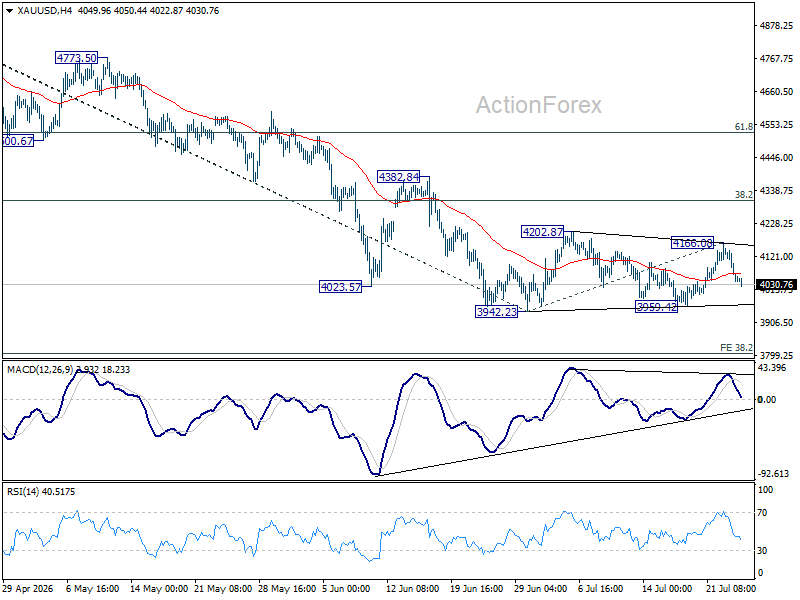
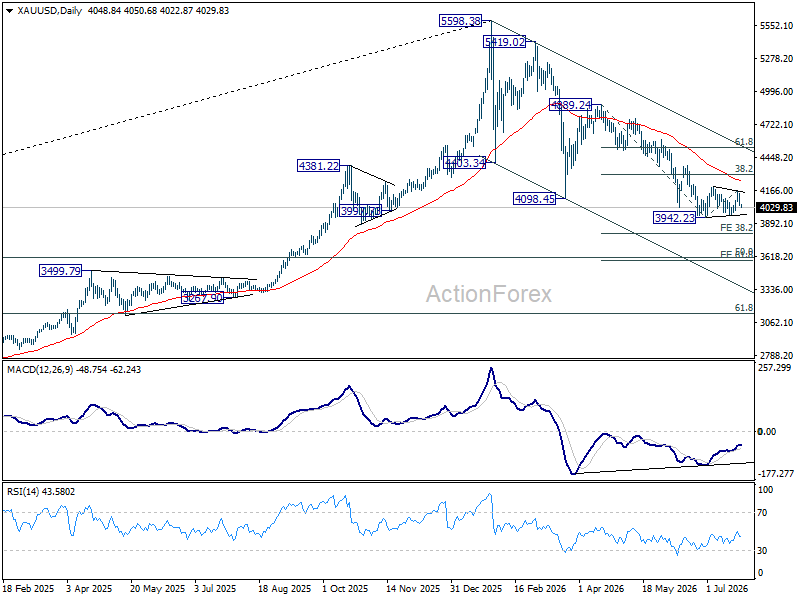
Gold's rebound from 3,959.42 to 4,166.08 this week looks more like another leg within the triangle consolidation from 3,942.23 than the start of a sustained recovery. Price is still well below the falling 55-day EMA, reinforcing the view that the decline from 4,889.24 is not complete. An eventual break of 3,942.23 is favored, targeting the 38.2% projection of 4,889.24 to 3,942.23 from 4,166.08 at 3,804.32, followed by the 61.8% projection at 3,580.82. Even in the case of another rebound, the outlook will stay bearish while the 38.2% retracement at 4,303.98 holds.
ActionForex's Technical View on Silver
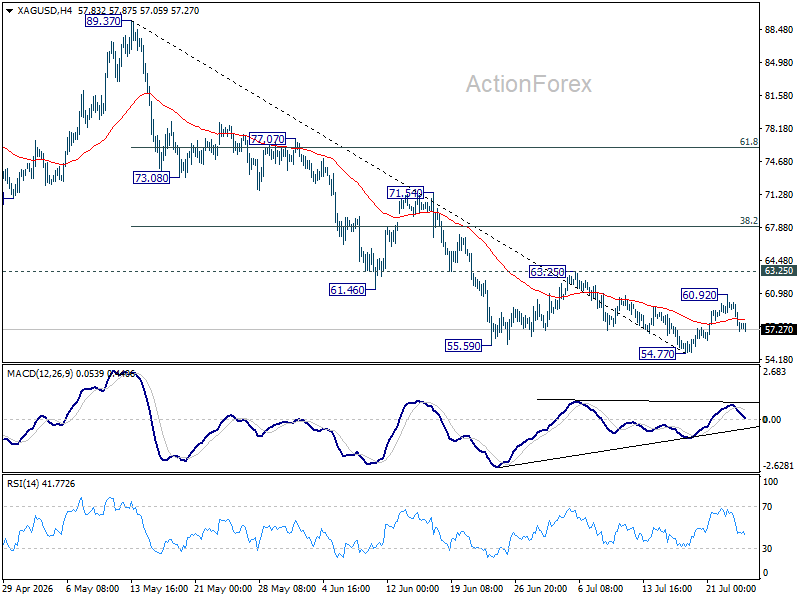
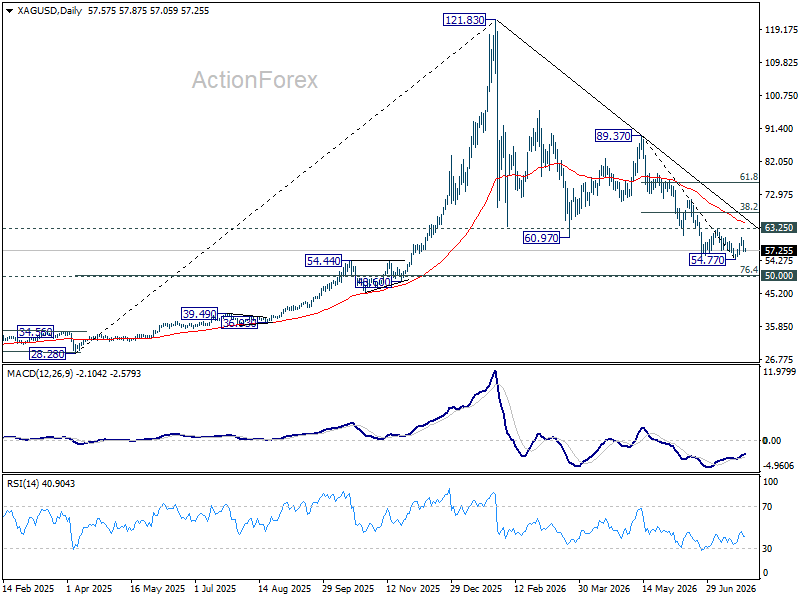
Silver's rebound from 54.77 was slightly stronger than expected, but it remained well below the 63.25 structural resistance and comfortably under the falling 55-day EMA. Another decline through 54.77 is still expected, with the $50 psychological level the next target. That area is close to the 76.4% retracement of 28.28 to 121.83 at 50.35. A break of 63.25 is needed to provide the first sign of bottoming; otherwise, downside risk will continue to dominate.
Key Takeaways
- The oil-rates relationship that drove Q2 trading has reasserted itself, ending the brief window in which geopolitical demand insulated Gold and Silver from rising yields.
- Brent above $100 and 10-year yields above 4.7% are the two levers now driving precious metals sentiment.
- Trump's Iran decision is effectively binary — escalation or settlement — and both scenarios transmit cleanly into oil, yields, and metals.
- Gold's structure favors an eventual break of 3,942.23, targeting 3,804.32 and then 3,580.82, while 4,303.98 caps any bullish reassessment.
- Silver needs a break of 63.25 to signal bottoming; until then, $50 remains the next downside target.
USD/JPY Breakout Gathers Pace as Bulls Dominate Trading
Key Highlights
- USD/JPY started a fresh increase above 163.20 and 163.50.
- A key bullish trend line is forming with support at 163.00 on the 4-hour chart.
- EUR/USD is struggling below the 1.1450 resistance zone.
- WTI Crude Oil prices rallied further above $92.00 and $92.50.
USD/JPY Technical Analysis
The US Dollar started a fresh increase from 162.65 against the Japanese Yen. USD/JPY cleared the key hurdle at 163.20 to enter a bullish zone.
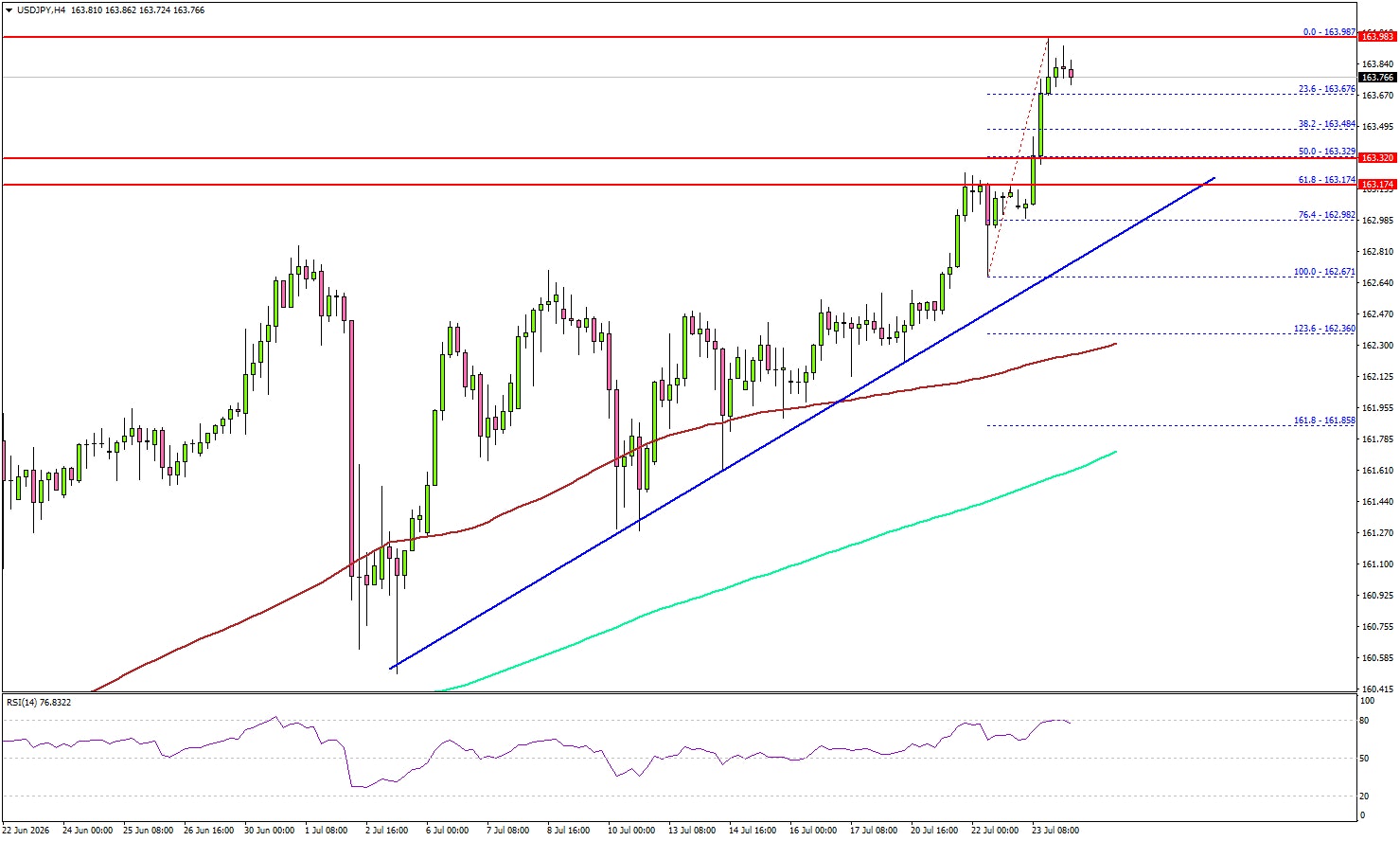
Looking at the 4-hour chart, the pair settled above 163.20, the 100 simple moving average (red, 4-hour), and the 200 simple moving average (green, 4-hour). The pair traded as high as 163.98 and started a consolidation phase.
On the upside, the pair could face resistance near 164.00. The next major resistance might be 164.40. A close above 164.40 could start another steady increase.
In the stated case, the bulls could aim for a move to 165.00. Any more gains might open the doors for a test of 165.20. If there is a downside correction, the pair might find bids near 163.50. The first major support could be near 163.20.
The main support might be 163.00. There is also a key bullish trend line forming with support at 163.00. A downside break and close below 163.00 might send the pair toward the 100 simple moving average (red, 4-hour) at 162.30. Any more losses could open the doors for a test of 162.00.
Looking at WTI Crude Oil, the bulls remained in action, and they might soon aim for a move above the $95.00 level.
Upcoming Key Economic Events:
- US S&P Global Manufacturing PMI for June 2026 (Preliminary) – Forecast 54.5, versus 53.9 previous.
- US S&P Global Services PMI for June 2026 (Preliminary) – Forecast 51.0, versus 51.2 previous.
Japan Core CPI Picks Up to 1.6% in June, but Underlying Inflation Remains Contained
Japan's core consumer inflation accelerated in June, with the CPI excluding fresh food rising from 1.4% yoy to 1.6% yoy, matched expectations. Headline inflation also picked up from 1.5% yoy to 1.7% yoy. The figures point to firmer price pressures ahead of next week's Bank of Japan policy meeting, though both measures remained below the central bank's 2% target. Meanwhile, the core-core CPI, which strips out both fresh food and energy, eased from 1.8% yoy to 1.7% yoy, suggesting underlying inflation remained relatively contained despite the rebound in headline prices.
Food continued to be the main source of inflation. Prices excluding fresh food rose 3.1% from a year earlier, driven by higher raw material costs that lifted prices of processed foods such as bento meals and chocolates. By contrast, government subsidies aimed at cushioning households from higher fuel costs continued to suppress energy prices. Energy costs fell -0.1% yoy after declining -2.5% in May, with lower gasoline and electricity prices offsetting part of the upward pressure from global crude oil markets. Healthcare and household durable goods also contributed to the rise in consumer prices.
The June data are unlikely to alter expectations that the BoJ will keep its policy rate unchanged at next week's meeting after raising it to 1.00% in June. Instead, attention will center on the Bank's updated economic and inflation projections, particularly its assessment of the risks posed by rising oil prices and a weak Yen. With Brent crude at $100 and Japan heavily dependent on imported energy, today's inflation figures suggest the recent pickup in price growth has yet to fully reflect the potential impact of higher energy costs should government subsidies be scaled back or global oil prices continue climbing.
Economic Data
| Indicator | Actual | Expected | Previous |
|---|---|---|---|
| Headline CPI (Jun, y/y) | +1.7% | — | +1.5% |
| Core CPI ex-Fresh Food (Jun, y/y) | +1.6% | +1.6% | +1.4% |
| Core-Core CPI ex-Fresh Food & Energy (Jun, y/y) | +1.7% | — | +1.8% |
| Food ex-Fresh Food (Jun, y/y) | +3.1% | — | +3.5% |
| Energy Prices (Jun, y/y) | -0.1% | — | -2.5% |
| Gasoline Prices (Jun, y/y) | -0.7% | — | — |
| Electricity Prices (Jun, y/y) | -1.7% | — | — |
Key Takeaways
- Core inflation accelerated: CPI excluding fresh food rose from 1.4% to 1.6%, but stayed below BoJ's 2% target for a fifth consecutive month.
- Headline inflation also picked up: Headline CPI increased from 1.5% to 1.7%, reflecting firmer food and other consumer prices.
- Underlying inflation softened slightly: Core-core CPI eased from 1.8% to 1.7%, suggesting broader domestic price pressures have not reaccelerated.
- Food remained main driver: Food excluding fresh items rose 3.1%, though inflation slowed from 3.5%, as higher raw material costs continued to lift processed-food prices.
- Energy subsidies limited upside: Energy prices fell only 0.1%, narrowing sharply from May's 2.5% decline, but government support still restrained gasoline and electricity costs.
- Oil and Yen create upside risks: Brent near $100 and weak Yen could raise imported inflation later, particularly if government subsidies are reduced.
- BoJ likely to pause: Data should not alter expectations for rates to stay at 1.00% next week after June's hike.
- Outlook Report matters more: Markets will focus on how BoJ incorporates Middle East supply disruptions, higher oil and Yen weakness into new inflation forecasts.
Japan PMI Composite rises to 53.1 as AI Demand Boosts Manufacturing
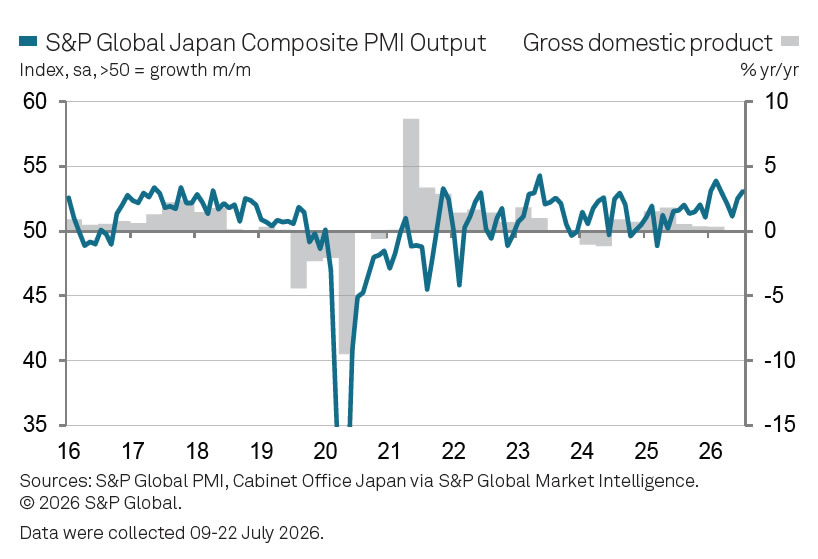
Japan's private sector expanded at its fastest pace since February in July, with the S&P Global Flash Composite PMI Output Index edging up from 52.8 to 53.1. The survey marked a sixteenth consecutive month of expansion, reflecting resilient business activity at the start of the second half of the year. While the Manufacturing PMI eased marginally from 54.8 to 54.7, manufacturing output accelerated sharply, with the Output Index rising from 54.3 to 56.1. Meanwhile, services activity cooled modestly as the Services PMI Business Activity Index slipped from 52.2 to 51.9.
The latest survey pointed to an increasingly uneven recovery. Manufacturing continued to outperform, supported by robust demand from the semiconductor and artificial intelligence industries, while services lost some momentum. At the same time, geopolitical tensions in the Middle East continued to shape business conditions. Manufacturers reported building inventories of finished goods and raw materials to guard against supply chain disruptions and higher input costs linked to the conflict, even as overall cost inflation eased slightly from June.
Despite the stronger pace of activity, the outlook became more cautious. Firms remained able to pass higher costs on to customers, with services companies in particular reporting faster increases in selling prices as they sought to protect margins. However, business confidence weakened, especially in the services sector, reflecting uncertainty over the economic outlook and geopolitical risks.
Economic Data
| Indicator | Actual | Previous |
|---|---|---|
| Flash Composite PMI Output Index (Jul) | 53.1 | 52.8 |
| Flash Services PMI Business Activity Index (Jul) | 51.9 | 52.2 |
| Flash Manufacturing PMI (Jul) | 54.7 | 54.8 |
| Flash Manufacturing PMI Output Index (Jul) | 56.1 | 54.3 |
Key Takeaways
- Private sector expansion strengthened: Japan's Flash Composite PMI Output Index edged up from 52.8 to 53.1, marking the strongest pace of growth since February and extending the expansion streak to 16 consecutive months.
- Manufacturing led the improvement: Although the headline Manufacturing PMI eased slightly from 54.8 to 54.7, the Manufacturing Output Index jumped from 54.3 to 56.1, signaling a sharp acceleration in factory production.
- Services lost some momentum: The Services PMI Business Activity Index slipped from 52.2 to 51.9, indicating that growth remained positive but moderated during July.
- Technology demand remained supportive: Manufacturers continued to benefit from robust demand linked to the semiconductor and AI industries, helping offset external headwinds.
- Middle East tensions continued to affect businesses: Firms reported building inventories of goods and raw materials amid supply chain disruptions and higher costs stemming from the regional conflict.
- Inflation pressures remained elevated: While input cost inflation eased slightly, selling prices continued to rise strongly, particularly in the services sector as firms sought to protect profit margins.
- Business confidence softened: Optimism about future output declined, especially among services firms, highlighting growing uncertainty despite solid current activity.
Australia PMI Composite Hits 2026 High at 52.6 as Domestic Demand Rebounds
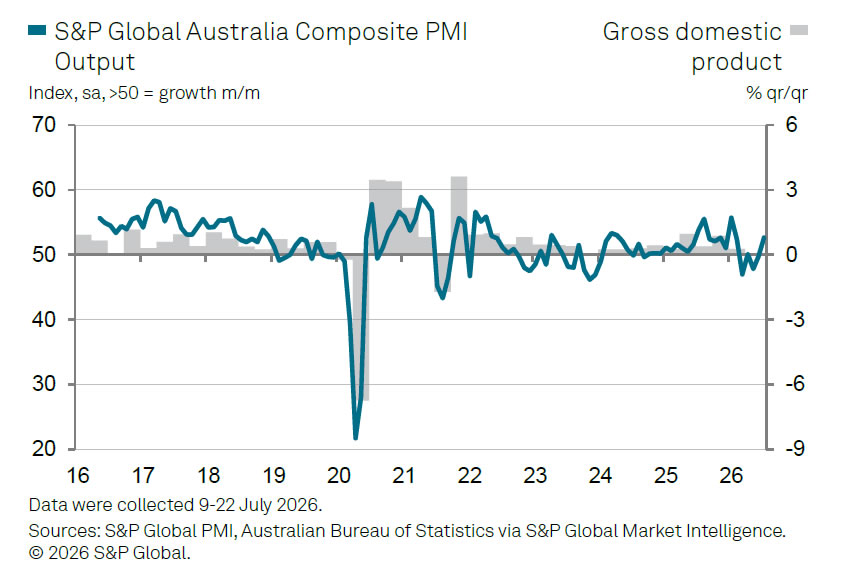
Australia's private sector gained momentum in July, with the S&P Global Flash Composite PMI rising from 50.4 to 52.6, its highest reading since the start of the year. The improvement was driven primarily by the services sector, where the Services PMI Business Activity Index climbed from 50.5 to 53.0, while Manufacturing PMI edged up from 51.5 to 51.7. The data point to a firmer pace of economic expansion at the start of the third quarter, with overall business activity growing at a rate above the survey's long-run average.
A notable feature of the report was the improvement in demand. New orders increased for the first time in five months, indicating that domestic demand is beginning to recover despite continued weakness in overseas markets. While services remained the main engine of growth, manufacturing also showed signs of stabilizing. Factory output remained slightly below the expansion threshold at 49.9, but improved from June's 49.5, suggesting the sector's downturn is gradually easing rather than deepening.
The survey also offered encouraging news on inflation. Input cost pressures continued to moderate, providing further evidence that disinflation remains on track even as demand strengthens. At the same time, firms became more willing to protect profit margins as business conditions improved. Looking ahead, however, businesses remained cautious about the outlook, reflecting uncertainty surrounding the global economy and trade environment.
Economic Data
| Indicator | Actual | Previous |
|---|---|---|
| Flash Composite PMI Output Index (Jul) | 52.6 | 50.4 |
| Flash Services PMI Business Activity Index (Jul) | 53.0 | 50.5 |
| Flash Manufacturing PMI (Jul) | 51.7 | 51.5 |
| Flash Manufacturing PMI Output Index (Jul) | 49.9 | 49.5 |
Key Takeaways
- Private sector growth accelerated: Australia's Flash Composite PMI rose from 50.4 to 52.6, the strongest reading of 2026 and above the survey's long-run average, signaling a firmer pace of economic expansion.
- Services remained the growth engine: The Services PMI Business Activity Index climbed from 50.5 to 53.0, accounting for most of the improvement in overall business activity.
- Manufacturing continued to stabilize: The headline Manufacturing PMI edged up from 51.5 to 51.7, while the Manufacturing Output Index improved from 49.5 to 49.9, suggesting factory activity is nearing stabilization despite remaining slightly below the expansion threshold.
- Domestic demand improved: New orders increased for the first time in five months, indicating a recovery in domestic demand even as export sales weakened further.
- Disinflation trend continued: Businesses reported easing input cost pressures, providing further evidence that inflationary pressures are moderating despite stronger activity.
- Margin protection improved: More stable demand enabled firms to pass through costs more effectively and better protect profitability.
- Outlook remained cautious: Despite stronger current conditions, businesses continued to express uncertainty about the year ahead, reflecting concerns over the global economic and trade environment.
Cliff Notes: Markets on Edge
Key insights from the week that was.
The June Labour Force Survey offered both noise and signal. Employment surprised materially to the upside, rising 76.3k in the month. However, the gain was matched by a sizeable lift in labour supply, the participation rate bouncing 0.3ppts to 67.0%, a 13-month high.
The ABS noted in the June release that there was a large group of individuals outside the labour force with a job lined up in May, and that they began work in June. With the employment gain driven by new labour force entrants, the unemployment rate held steady at 4.4% (edging up from 4.37% to 4.43% at the second decimal place). Rising unemployment and the sharp lift in underemployment over recent months both suggest labour market slack is building steadily.
Unlike previous readings which implied a sudden loss of momentum, employment growth now looks to have been steadier over the first half of the year, albeit with significant month-to-month volatility. This is in line with our belief that any further softening was more likely to occur in the second half once the drag from higher inflation and recent interest rate rises works through the economy.
The Q2 Westpac Business Signal showcased that cost pressures are growing and consumer-facing industries are most exposed to deteriorating growth prospects. Together with weaker employment intentions from other business surveys, this points to a sluggish outlook for employment through the turn of the year when we expect the unemployment rate to peak around 5.0%.
Offshore, the Middle East remained the market’s focus as tensions continued to ratchet higher. Overnight, President Trump stated he was close to deciding on a "massive attack" against Iran and threatened "major military punishment" for the Houthis and Iran if the Houthis attack any other ships in the Middle East after they targeted two Saudi ships a day earlier. This follows yesterday’s threat that US forces “will bomb and destroy ONE BRIDGE OR POWER PLANT, including those located next to, or in, the Capital City of Tehran” any time Iran’s military “shoots at a ship in the Strait of Hormuz”. Iran continues to hold to their position on retaliation, with like-for-like strikes on regional military installations and infrastructure threatened. Brent oil reached USD102 overnight and currently trades just under that level.
Fresh for markets today are the potential implications of the imposition of an announced 10% to 12.5% tariff by the US on 99% of its imports effective 12:01am Friday Washington time. The basis for the tariff is an assessment by US authorities of 60 countries’ restrictions on the use of forced labour in their production chain, though the tariff catches exporters to the US to almost the same degree. This measure replaces the temporary 10% tariff set to expire at 12:00am. As a result, it should have little-to-no net impact on US inflation or growth. That said, it maintains pressure on US households and businesses at a particularly inopportune time and so is a threat to sentiment.
Against that backdrop, the ECB left rates unchanged while emphasising the full inflationary impact of higher energy prices are yet to be felt and that risks remain skewed to the upside. While June inflation surprised to the downside and the ECB, as yet, has seen no evidence of secondary effects from 2026’s energy price spike, heightened uncertainty and the skew of risks favour another hike in September along with the possibility of another late in the year, if conditions do not improve.
Turning to the UK, attention centred on the first week of UK Prime Minister Andy Burnham's government. Aside from cabinet appointments, Burnham indicated he would operate within existing fiscal rules while pursuing a "new economic model" aimed at boosting growth, likely through cost-of-living measures. He has already removed VAT from household electricity bills and is expected to announce initiatives targeting youth employment and further education. Markets are anticipating a generous Budget in November, although higher-than-expected borrowing is likely to constrain policymakers.
Economic data recently received for the UK is broadly reassuring. Labour market indicators pointed to stabilisation, the unemployment rate holding at 4.9% in the three months to May and employment rising by 148k. That said, alternative measures, including the Bank of England's Decision Maker Panel, suggest the labour market is at risk of weakening further. The latest inflation data is consistent with a gradual easing in domestic pressures. Consumer prices rose 0.1% in June, slowing annual inflation from 2.8%yr to 2.6%yr. Services inflation was little changed at 3.6%yr, however, indicating that underlying price pressures remain. Taken together, the data did little to materially alter expectations for Bank of England policy.