

Sample Category Title
Elliott Wave Outlook: Gold (Xauusd) Rally Rejected, Downside Potential Remains
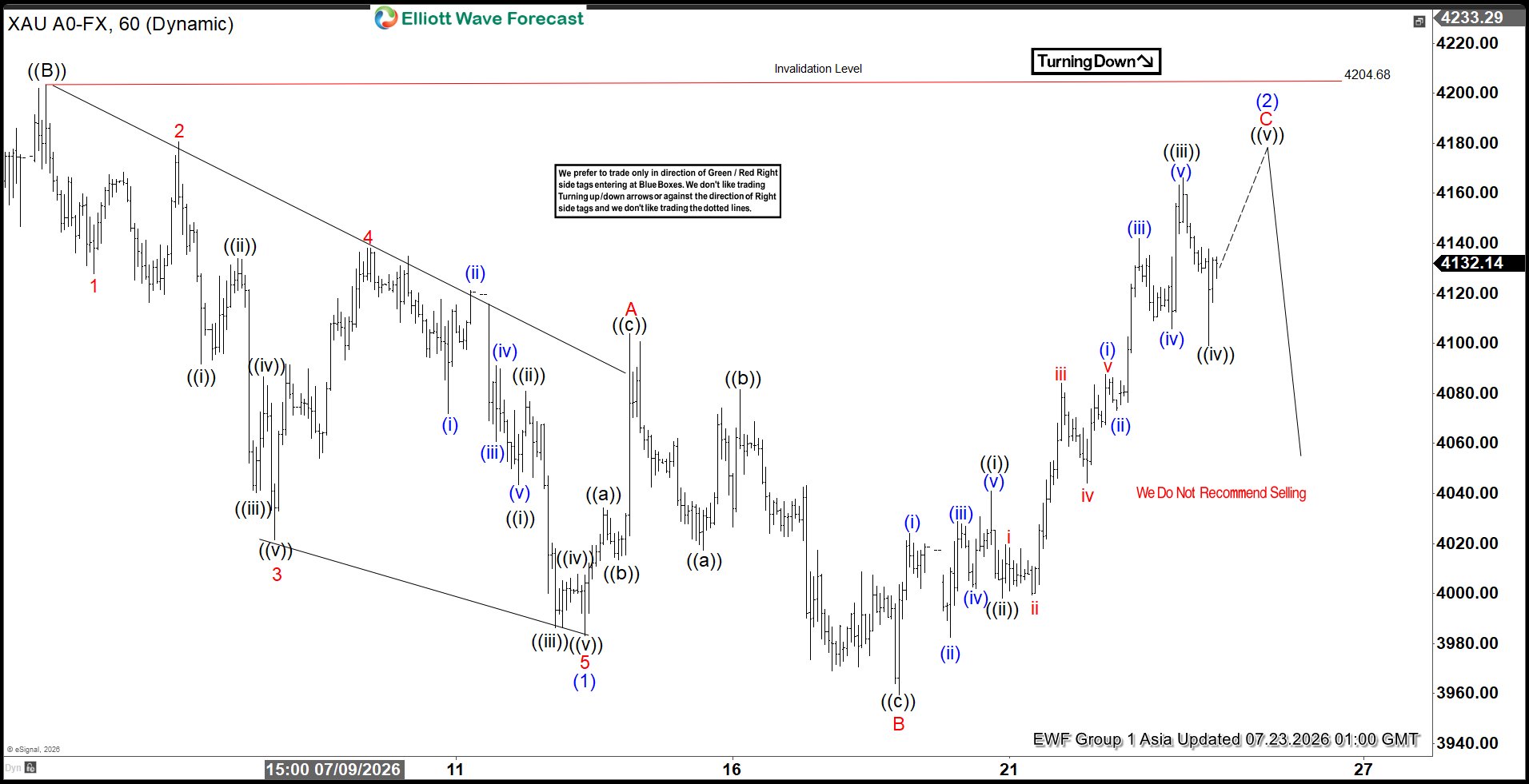
The short‑term Elliott Wave outlook in Gold (XAUUSD) indicates that the rally to $4204 marked the completion of wave ((B)), after which the metal turned lower in wave ((C)). The internal subdivision of wave ((C)) is unfolding as a five‑wave structure. Within this sequence, wave (1) ended at $3983.2. The subsequent rally in wave (2) developed as an expanded flat formation. From the wave (1) low, wave A advanced to $4103.7, followed by a pullback in wave B that reached $3959.3. The final leg, wave C, extended higher to $4166.07, completing wave (2) at a higher degree.
From this point, the metal resumed its decline in wave (3). Down from wave (2), wave ((i)) ended at $4099.03, while the corrective rally in wave ((ii)) concluded at $4141.05. The expectation is for Gold to extend two additional lows to complete wave ((v)) of 1. Once this sequence finishes, the market should rally in wave 2 to correct the decline from the July 22 high of wave (2). This corrective phase will precede the next bearish leg.
In the near term, the pivot at $4204.6 remains decisive. As long as this level holds, rallies are expected to fail within three or seven swings, reinforcing the downside bias. The structure highlights continued weakness and suggests further bearish potential in the short horizon.
Gold (XAUUSD) 60-Minute Elliott Wave Chart
XAUUSD Elliott Wave Video:
https://www.youtube.com/watch?v=ByoMty8Zf3k
Brent Price Rises Above $100 Per Barrel as Supply Disruption Widens
Brent oil jumped above psychological $100 barrier on Thursday, hitting the levels last traded in late May, as fresh escalation in the Middle East after Yemen’s Houthis hit two Saudi oil tankers in the Bab el-Mandeb straight caused further uncertainty in global oil supply.
Closure of the Red Sea, Saudi Arabia’s alternative route for shipping oil, in addition to already closed Strait of Hormuz, causes panic in the market and this directly affects 25% of global oil supply.
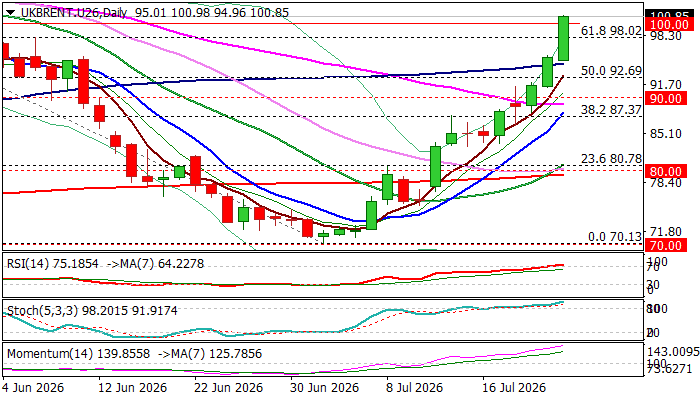
Oil price remains in a steep ascend that extends into third straight day and accelerated on Thursday (oil price was up nearly 6% for the day), with break of important Fibo barrier at $98.02 (61.8% retracement of $115.26/$70.13 descend) and psychological $100 resistance, generated fresh bullish signals, with daily close above $98.02 to keep firm bullish structure intact (daily studies are overbought and $100 marks significant barrier which is unlikely to be clearly broken in first attempt).
Sustained break of $100 is likely to be seen if current situation on the ground persists or deteriorates that would fuel uncertainty and keep the price action in steep ascend, eyeing targets at $104.61 (Fibo 76.4%) and $110 (round-figure) in extension.
Broken Fibo level at $98.02 reverted to solid support, guarding 100DMA ($94.56).
Res: 100.98; 104.61; 106.34; 110.00
Sup: 100.00; 98.02; 95.91; 94.56
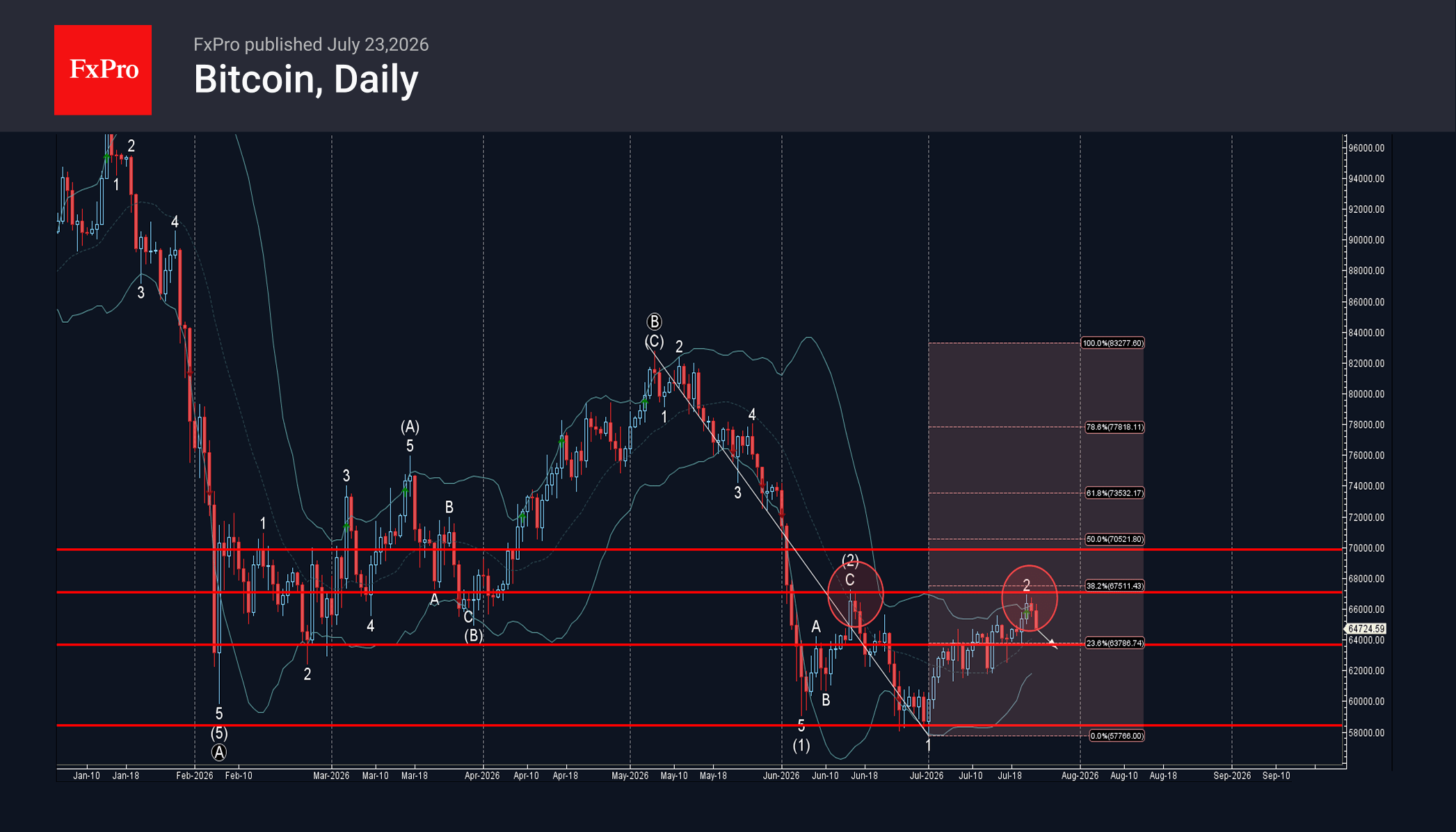
Bitcoin Wave Analysis
Bitcoin: ⬇️ Sell
– Bitcoin reversed from resistance level 67070.00
– Likely to fall to support level 64000.00
Bitcoin cryptocurrency recently reversed from the resistance zone between the resistance level 67070.00 (top of wave 2 from June), upper daily Bollinger Band and the 38.2% Fibonacci correction of the downward impulse from May.
The downward reversal from this resistance zone stopped the previous minor ABC correction 2 from the end of June.
Given the strong daily downtrend, Bitcoin cryptocurrency can be expected to fall further to the next support level 64000.00.
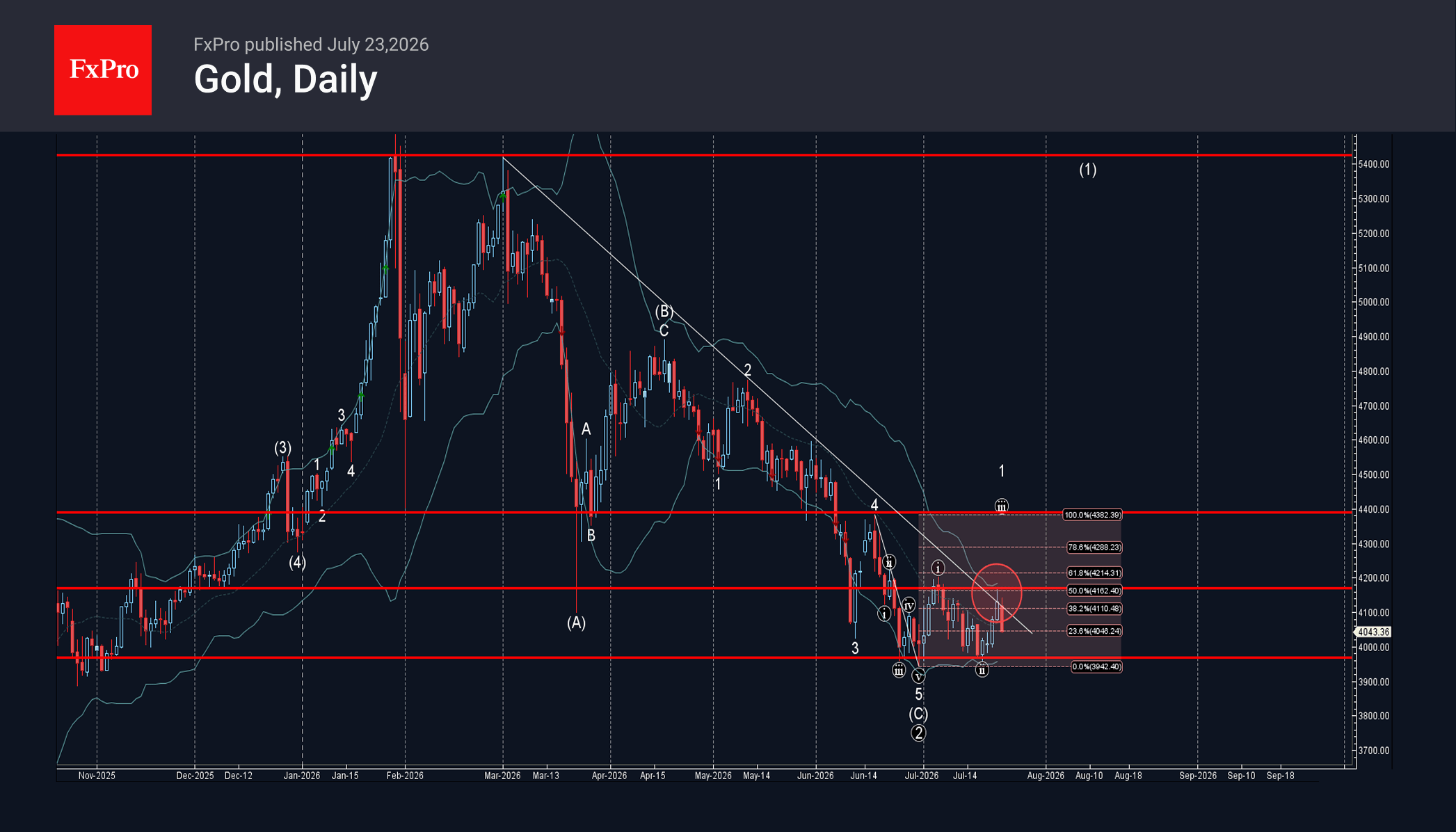
Gold Wave Analysis
Gold: ⬇️ Sell
– Gold reversed from resistance level 4210.00
– Likely to fall to support level 3965.00
Gold recently reversed from the resistance area located at the intersection of the resistance level 4210.00 (top of wave i from the start of July), resistance trendline from February and the 50% Fibonacci correction of the downward impulse from June.
The downward reversal from this resistance zone stopped the previous minor impulse wave iii from the middle of July.
Given the overriding daily downtrend, Gold can be expected to fall further to the next support level 3965.00.
USDCHF Wave Analysis
USDCHF: ⬆️ Buy
– USDCHF broke key resistance level 0.81400
– Likely to rise to resistance level 0.8250
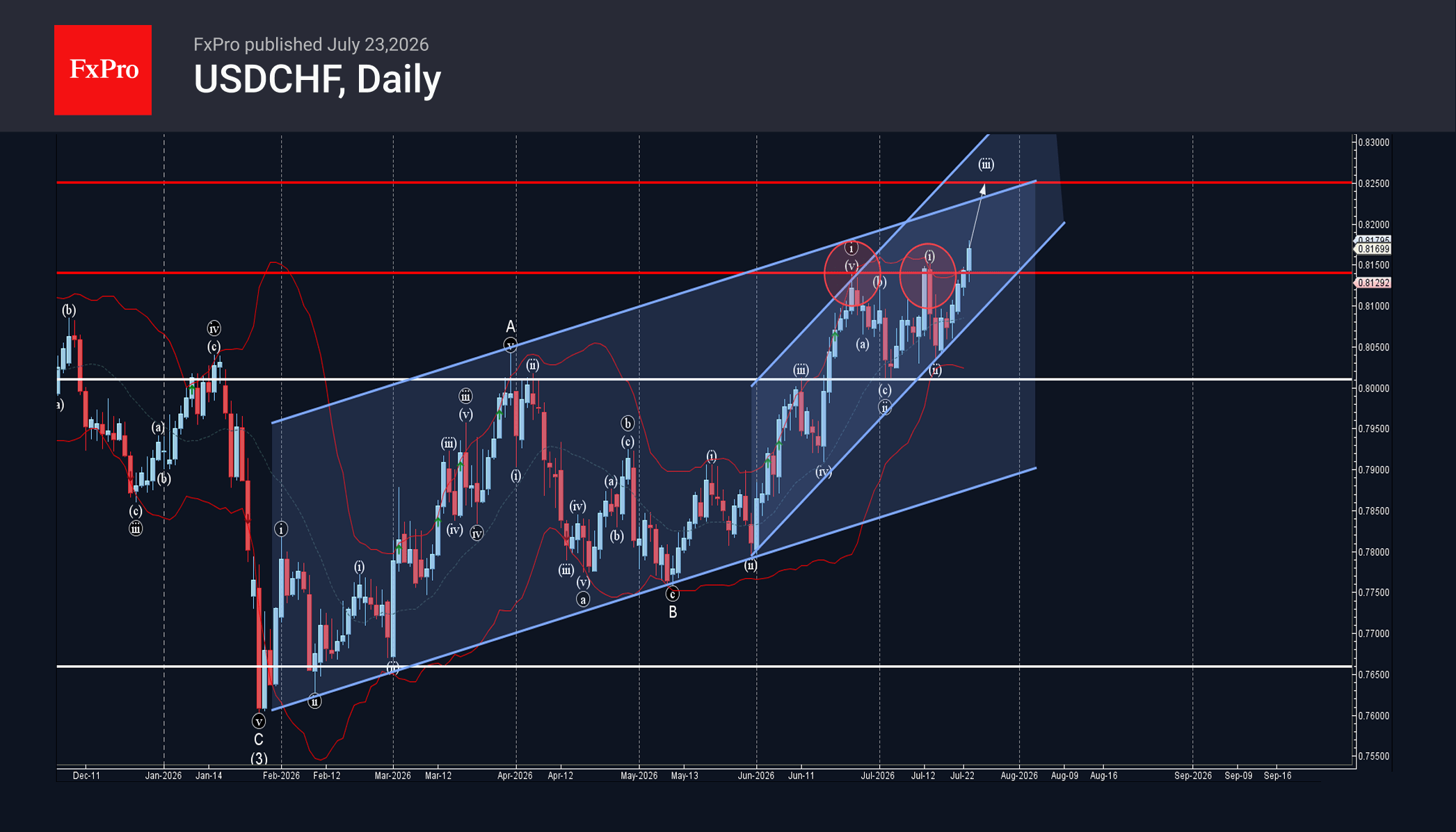
USDCHF currency pair recently broke above the key resistance level 0.81400 (which stopped the two previous impulse waves I and I, as can be seen below).
The breakout of the resistance level 0.81400 accelerated the active minor impulse wave iii that belongs to wave C from May.
Given the clear daily uptrend, USDCHF currency pair can be expected to rise further to the next resistance level 0.8250 – target for the completion of the active minor impulse wave iii.
Brent Crude Oil Wave Analysis
Brent Crude Oil: ⬆️ Buy
– Brent Crude Oil broke resistance zone
– Likely to rise to resistance level 98.00
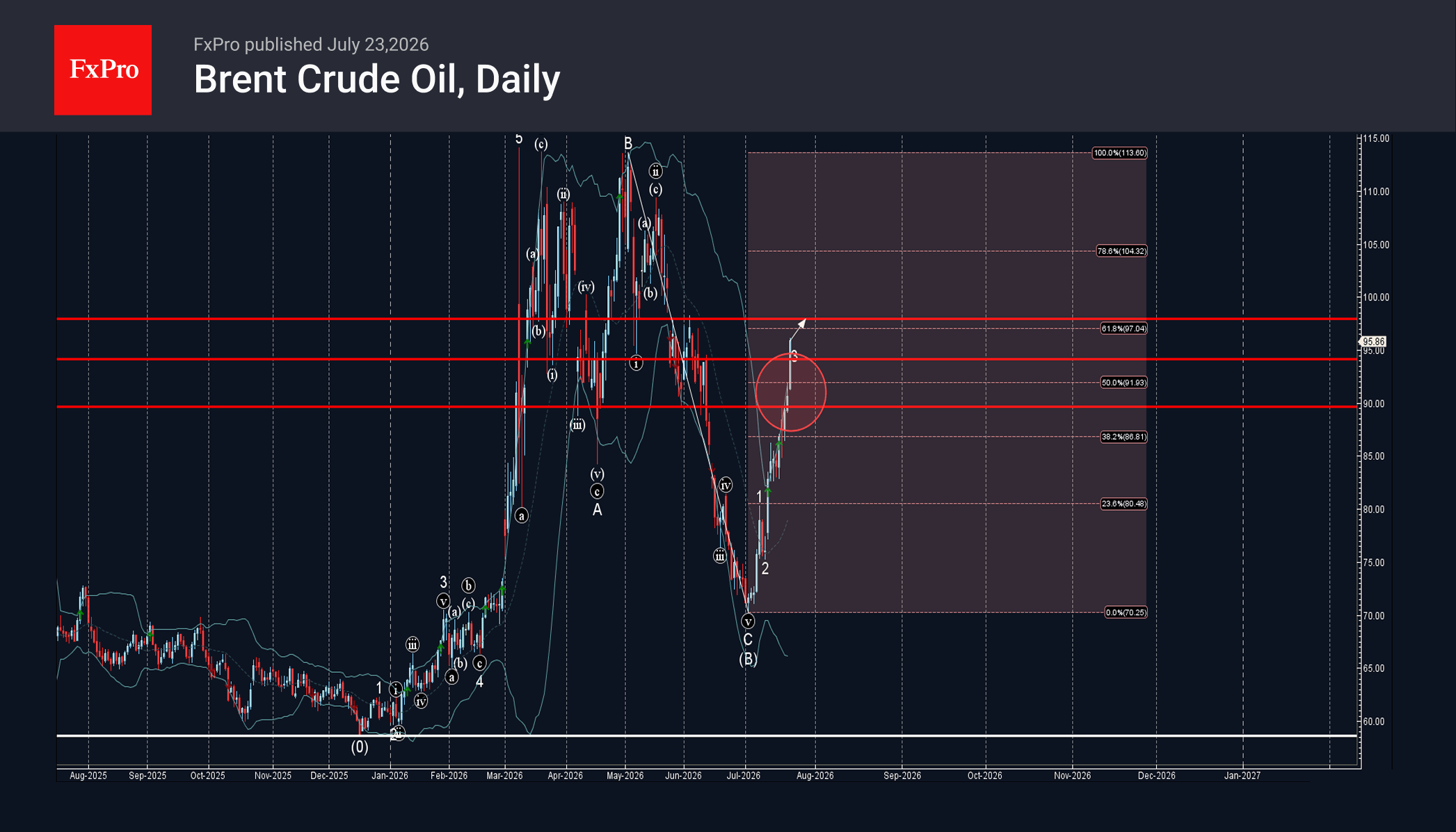
Brent Crude Oil recently broke the resistance zone between the resistance levels 90.00 and 95.00 (former strong support from May).
The breakout of this resistance zone and the inspecting 50% Fibonacci correction of the earlier sharp downward impulse wave C from May accelerated the active minor impulse wave 3.
Brent Crude Oil can be expected to rise further to the next resistance level 98.00 – former monthly high from June.
ECB Review – Back to the Baseline
- The ECB kept policy rates unchanged at the July meeting, with the deposit rate at 2.25%, in line with consensus and market pricing.
- Lagarde kept full optionality on the future policy rate path, without pre-committing. There was no market reaction to the meeting.
- We expect a final 25bp hike in September, bringing the deposit rate to 2.50%.
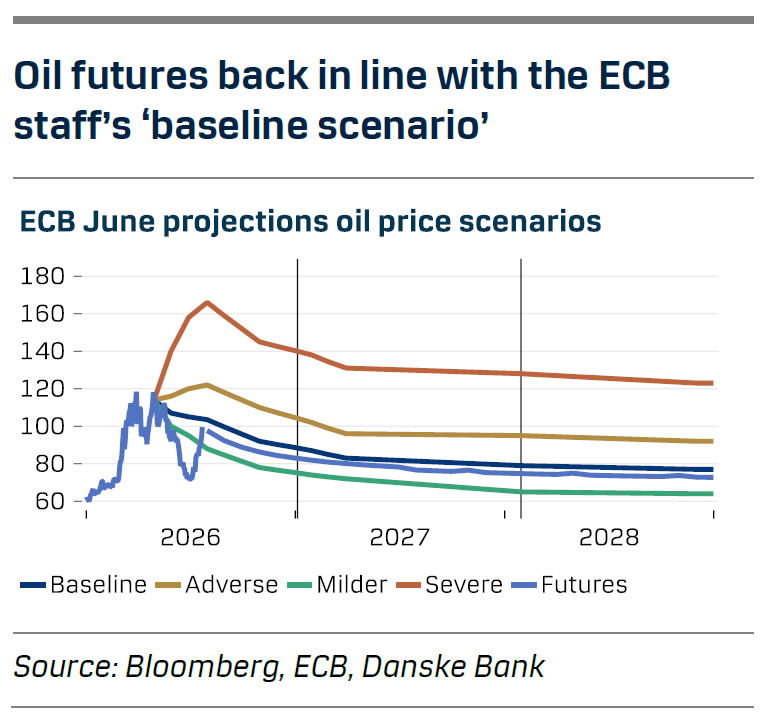
The ECB decided to keep its three key policy rates unchanged at the July meeting, as expected, with the deposit rate at 2.25%. Lagarde said that the economic outlook was back to the baseline from the June meeting, following recent developments in energy prices. The risk assessment is also back to where it was in June, compared with the Sintra conference, where she said that risks were "more balanced".
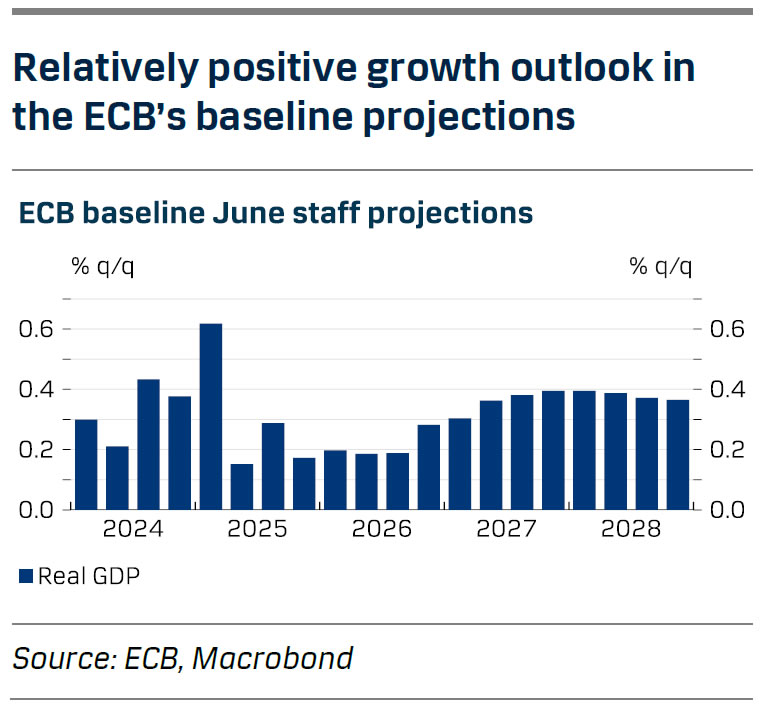
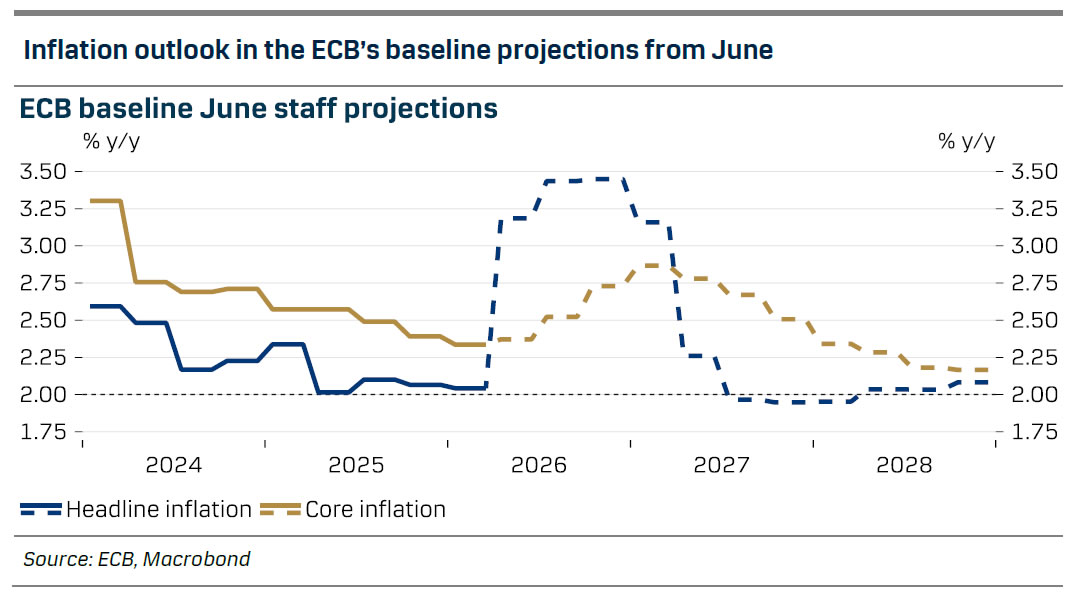
Lagarde sounded relatively positive on the growth outlook, noting that services activity is recovering, manufacturing is holding up, and fiscal and AI spending are supportive. She stressed that the weak June inflation print was likely temporary, as selling price expectations have risen and the energy shock has yet to feed through. This assessment makes a hike in September very likely, in our view.
However, she also made clear that the ECB is not seeing any second-round effects, and that wage growth is therefore still expected to decline over the forecasting period. This is a key argument for why we do not expect more than one additional hike from the ECB compared to market's expectations of around two additional hikes this year.
Lagarde gave very little guidance, leading to no market reaction. She said that some members of the Governing Council asked themselves whether a hike was needed, but they ultimately decided unanimously to wait for more data and new staff projections before potentially hiking the policy rate, in line with our expectations.
Eco Data 7/24/26
| GMT | Ccy | Events | Act | Cons | Prev | Rev |
|---|---|---|---|---|---|---|
| 23:00 | AUD | Manufacturing PMI Jul P | 51.7 | 51.5 | ||
| 23:00 | AUD | Services PMI Jul P | 53 | 50.5 | ||
| 23:01 | GBP | GfK Consumer Confidence Jul | -17 | -21 | -23 | |
| 23:30 | JPY | National CPI Y/Y Jun | 1.70% | 1.50% | ||
| 23:30 | JPY | National CPI Core Y/Y Jun | 1.60% | 1.60% | 1.40% | |
| 23:30 | JPY | National CPI Core-Core Y/Y Jun | 1.70% | 1.80% | ||
| 00:30 | JPY | Manufacturing PMI Jul P | 54.7 | 54.5 | 54.8 | |
| 00:30 | JPY | Services PMI Jul P | 51.9 | 52.2 | ||
| 06:00 | EUR | Germany GfK Consumer Confidence Aug | -29.6 | -28.5 | -29.2 | -29.3 |
| 06:00 | GBP | Retail Sales M/M Jun | 1.00% | -0.30% | 1.20% | |
| 07:15 | EUR | France Manufacturing PMI Jul P | 50 | 51 | 51.2 | |
| 07:15 | EUR | France Services PMI Jul P | 49.8 | 48 | 46.8 | |
| 07:30 | EUR | Germany Manufacturing PMI Jul P | 52.2 | 50.1 | 50.3 | |
| 07:30 | EUR | Germany Services PMI Jul P | 49.6 | 48.8 | 48.6 | |
| 08:00 | EUR | Eurozone Manufacturing PMI Jul P | 52 | 51.3 | 51.4 | |
| 08:00 | EUR | Eurozone Services PMI Jul P | 51.6 | 49.8 | 49.4 | |
| 08:30 | GBP | Manufacturing PMI Jul P | 52.8 | 52.1 | 52.5 | |
| 08:30 | GBP | Services PMI Jul P | 51.8 | 49.6 | 48.8 | |
| 12:30 | CAD | New Housing Price Index M/M Jun | -0.10% | -0.20% | -0.30% | |
| 12:30 | CAD | Industrial Product Price M/M Jun | -1.40% | -0.40% | 1.20% | 1.40% |
| 12:30 | CAD | Raw Material Price Index Jun | -6.90% | -1.50% | 0.70% | 0.50% |
| 13:45 | USD | Manufacturing PMI Jul P | 53.8 | 54.5 | 53.9 | |
| 13:45 | USD | Services PMI Jul P | 53.6 | 51 | 51.2 | |
| 14:00 | USD | New Home Sales M/M Jun | 617K | 580K |
| 23:00 | AUD |
| Manufacturing PMI Jul P | |
| Actual | 51.7 |
| Consensus | |
| Previous | 51.5 |
| 23:00 | AUD |
| Services PMI Jul P | |
| Actual | 53 |
| Consensus | |
| Previous | 50.5 |
| 23:01 | GBP |
| GfK Consumer Confidence Jul | |
| Actual | -17 |
| Consensus | -21 |
| Previous | -23 |
| 23:30 | JPY |
| National CPI Y/Y Jun | |
| Actual | 1.70% |
| Consensus | |
| Previous | 1.50% |
| 23:30 | JPY |
| National CPI Core Y/Y Jun | |
| Actual | 1.60% |
| Consensus | 1.60% |
| Previous | 1.40% |
| 23:30 | JPY |
| National CPI Core-Core Y/Y Jun | |
| Actual | 1.70% |
| Consensus | |
| Previous | 1.80% |
| 00:30 | JPY |
| Manufacturing PMI Jul P | |
| Actual | 54.7 |
| Consensus | 54.5 |
| Previous | 54.8 |
| 00:30 | JPY |
| Services PMI Jul P | |
| Actual | 51.9 |
| Consensus | |
| Previous | 52.2 |
| 06:00 | EUR |
| Germany GfK Consumer Confidence Aug | |
| Actual | -29.6 |
| Consensus | -28.5 |
| Previous | -29.2 |
| Revised | -29.3 |
| 06:00 | GBP |
| Retail Sales M/M Jun | |
| Actual | 1.00% |
| Consensus | -0.30% |
| Previous | 1.20% |
| 07:15 | EUR |
| France Manufacturing PMI Jul P | |
| Actual | 50 |
| Consensus | 51 |
| Previous | 51.2 |
| 07:15 | EUR |
| France Services PMI Jul P | |
| Actual | 49.8 |
| Consensus | 48 |
| Previous | 46.8 |
| 07:30 | EUR |
| Germany Manufacturing PMI Jul P | |
| Actual | 52.2 |
| Consensus | 50.1 |
| Previous | 50.3 |
| 07:30 | EUR |
| Germany Services PMI Jul P | |
| Actual | 49.6 |
| Consensus | 48.8 |
| Previous | 48.6 |
| 08:00 | EUR |
| Eurozone Manufacturing PMI Jul P | |
| Actual | 52 |
| Consensus | 51.3 |
| Previous | 51.4 |
| 08:00 | EUR |
| Eurozone Services PMI Jul P | |
| Actual | 51.6 |
| Consensus | 49.8 |
| Previous | 49.4 |
| 08:30 | GBP |
| Manufacturing PMI Jul P | |
| Actual | 52.8 |
| Consensus | 52.1 |
| Previous | 52.5 |
| 08:30 | GBP |
| Services PMI Jul P | |
| Actual | 51.8 |
| Consensus | 49.6 |
| Previous | 48.8 |
| 12:30 | CAD |
| New Housing Price Index M/M Jun | |
| Actual | -0.10% |
| Consensus | -0.20% |
| Previous | -0.30% |
| 12:30 | CAD |
| Industrial Product Price M/M Jun | |
| Actual | -1.40% |
| Consensus | -0.40% |
| Previous | 1.20% |
| Revised | 1.40% |
| 12:30 | CAD |
| Raw Material Price Index Jun | |
| Actual | -6.90% |
| Consensus | -1.50% |
| Previous | 0.70% |
| Revised | 0.50% |
| 13:45 | USD |
| Manufacturing PMI Jul P | |
| Actual | 53.8 |
| Consensus | 54.5 |
| Previous | 53.9 |
| 13:45 | USD |
| Services PMI Jul P | |
| Actual | 53.6 |
| Consensus | 51 |
| Previous | 51.2 |
| 14:00 | USD |
| New Home Sales M/M Jun | |
| Actual | |
| Consensus | 617K |
| Previous | 580K |
Canada: Retail Sales Rise in May as Real Activity Rebounds
- Retail sales rose 1.0% month-on-month (m/m) in May, in line with Statistics Canada’s advance estimate.
- In volume terms, retail trade was up 0.3% m/m, pointing to a rebound in underlying demand.
- Motor vehicle and parts dealers posted a 0.7% m/m increase, driven by higher sales at new car dealers (+0.5% m/m).
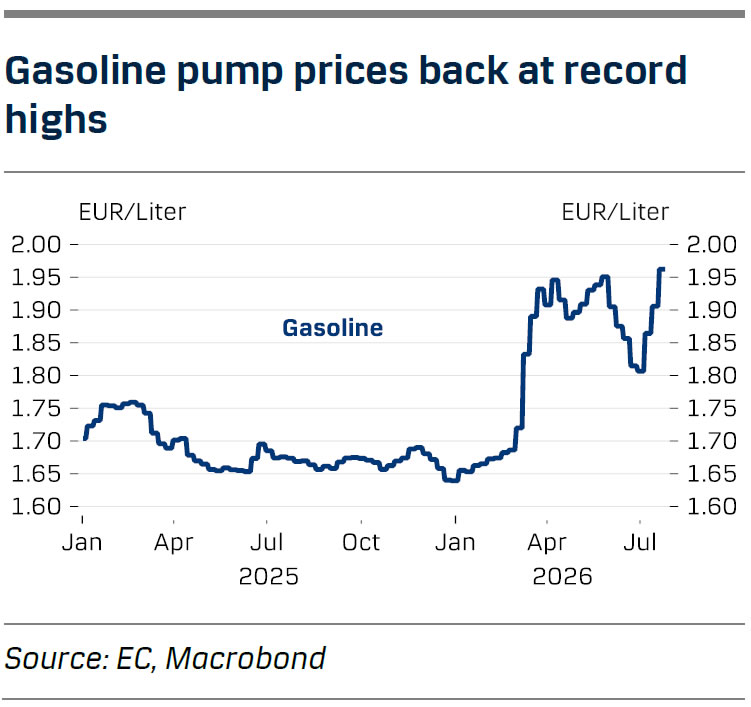
- Receipts at gasoline stations and fuel vendors rose 3.1% m/m, however volumes fell 0.7% m/m, suggesting the headline gain was largely driven by prices.
- Core retail sales (excluding autos and gasoline) rebounded after two consecutive monthly declines, rising 0.9% m/m. All major categories posted gains, but the advance was driven by a 1.0% m/m rise at general merchandise stores.
- Retail e-commerce sales declined 1.5% m/m in May.
- Statistics Canada’s advance estimate points to a 0.4% m/m increase in June.
Key Implications
- May delivered a solid month for retail sales, with core spending and real activity rebounding after two consecutive monthly declines. While Statistics Canada’s advance estimate points to slower nominal sales growth in June, last month’s fall in consumer prices suggests this mostly reflects a price effect and not weaker demand. Our internal TD Spend data reinforces that view, with services spending continuing to strengthen in June, supported by FIFA-related activity and recent federal government income support measures. Taken together, this points to a stronger outlook for real personal consumption growth in Q2 than currently embedded in our forecast.
- The durability of this experience remains an open question. Oil prices have resumed their climb this morning and, while they remain below the highs reached in April, they still represent an incremental tax on household purchasing power, particularly for lower-income consumers.
Sunset Market Commentary
Markets
In the run-up to the ECB policy decision, the list of core EMU bond yields featuring 'the highest level since' label grew ever longer. At the (very) short end of the curve, the 2023/24 post-corona highs still survive as 'aggressive' policy tightening at that time still outpaces expectations on what is deemed necessary to curb current, mostly energy related supply-shock. Still the 2-y EMU swap and Bund yield earlier this week surpassed the highs since the start of the Iran conflict. The 2-y swap topping the 3% mark suggests markets are ever more pondering some kind of higher-for-longer scenario unless energy prices return to more comfortable levels in a not that distant future. With hostilities in the Middle East intensifying, brent oil nearing the $100 p/b reference and the EMU Dutch gas reference contract at the highest levels seen since the start of the conflict (€63 p/MWh), markets consider avoiding a higher for long scenario as growing ever more difficult. For Bunds, the 'tipping point' to overcome the post corona peak levels currently hovers near the 5-y maturity. From there on, the reference goes back to 2011 (30-y) or even 2008 (5-y), with 'decompression' of risk premia and fiscal sustainability probably playing in the background next to uncertainty on inflation premia. Another symbolic breach: the French 10-y yield this morning briefly surpassed the 4% barrier for the first time since…2009! Somewhat of a similar narrative for US bonds yields. In the US oil/energy prices play somewhat of a more modest role, but over there domestic eco strength also is still in play. The US 2-y yield at 4.34% is still somewhat further away from the 5% 2023 top. For the 30-y the multiyear top from May also is only a whisker away (5.18% currently vs 5.2% in May), which in turn was the highest since… mid 2007! Of course, central bank policy mostly determines the short end of the curve, but a too loose approach probably won't help to contain financial stability and inflation risks at the long end of the curve.
In this context, the ECB today decided on monetary policy with market looking for guidance, or at least for some clarification on the bank's reaction function in the light of the scenario reference that was put in place/updated at the previous meeting. The ECB as expected left its policy rate unchanged at 2.25%. It stressed the volatile nature of current moves in energy prices but 'admitted' that they currently stand close to baseline scenario of the June staff projections. In this context, the bank still sticks to a meeting-by-meeting end data-dependent approach as it closely monitors the intensity and the duration of the shock as well as its indirect and second round effects. This of course is no commitment on any particular rate path. Even as the decision was unanimous, Lagarde at the press conference admitted that some members asked themselves if a hike was needed. In this context, markets didn't see any reason to backtrack on its positioning of a next rate hike in September (92%) and other 25 bps step being almost fully discounted by the end of the year. Lagarde on a question also indicated that markets understand the ECB reaction function well. In a daily perspective, German yields add between 4 bps (2-y) and 1.8 bps (30-y). US yields are rising between 6 bps (5-y) and 4 bps (30-y) with yields pushing slightly higher intraday after comments from president Trump that the US will hold Iran responsible for Houthi strikes, suggesting no de-escalation in the near term. Brent oil at $99.5 p/b is only a whisker away from the $100 barrier. On FX markets, USD finally gains some momentum (DXY 101.45; EUR/USD 1.138).
News & Views
Czech president Pavel vetoed a bill that would have eased the country's fiscal rules by widening the room to raise spending without parliamentary approval. The proposal foresaw exemptions for road, rail, nuclear power plants and dam projects to be included in the budget deficits as well as extended an exemption given to defense spending if it exceeds 2% of GDP. The bill would also allow the government to raise spending by up to 10% under loosely defined security threats. Czechia's independent budget watchdog had called the proposed changes a fundamental weakening of fiscal discipline. Pavel echoed those concerns, saying it threatens long-term fiscal sustainability. The Czech budget deficit fell to 2.1% last year.