Sample Category Title
Eco Data 7/23/26
| GMT | Ccy | Events | Act | Cons | Prev | Rev |
|---|---|---|---|---|---|---|
| 01:30 | AUD | Employment Change Jun | 76.3K | 15.0K | 40.3K | |
| 01:30 | AUD | Unemployment Rate Jun | 4.40% | 4.40% | 4.40% | |
| 12:15 | EUR | ECB Rate On Deposit Facility | 2.25% | 2.25% | 2.25% | |
| 12:15 | EUR | ECB Main Refinancing Operations Rate | 2.40% | 2.40% | 2.40% | |
| 12:15 | EUR | ECB Monetary Policy Statement | ||||
| 12:30 | CAD | Retail Sales M/M May | 1.00% | 1.00% | 0.50% | |
| 12:30 | CAD | Retail Sales ex Autos M/M May | 1.20% | 1.30% | 0.10% | 0.40% |
| 12:30 | USD | Initial Jobless Claims (Jul 17) | 187K | 212K | 208K | |
| 12:45 | EUR | ECB Press Conference | ||||
| 14:00 | EUR | Eurozone Consumer Confidence Jul P | -16 | -17 | -18 | |
| 14:30 | USD | Natural Gas Storage (Jul 17) | 32B | 29B | 41B |
| 01:30 | AUD |
| Employment Change Jun | |
| Actual | 76.3K |
| Consensus | 15.0K |
| Previous | 40.3K |
| 01:30 | AUD |
| Unemployment Rate Jun | |
| Actual | 4.40% |
| Consensus | 4.40% |
| Previous | 4.40% |
| 12:15 | EUR |
| ECB Rate On Deposit Facility | |
| Actual | 2.25% |
| Consensus | 2.25% |
| Previous | 2.25% |
| 12:15 | EUR |
| ECB Main Refinancing Operations Rate | |
| Actual | 2.40% |
| Consensus | 2.40% |
| Previous | 2.40% |
| 12:15 | EUR |
| ECB Monetary Policy Statement | |
| Actual | |
| Consensus | |
| Previous | |
| 12:30 | CAD |
| Retail Sales M/M May | |
| Actual | 1.00% |
| Consensus | 1.00% |
| Previous | 0.50% |
| 12:30 | CAD |
| Retail Sales ex Autos M/M May | |
| Actual | 1.20% |
| Consensus | 1.30% |
| Previous | 0.10% |
| Revised | 0.40% |
| 12:30 | USD |
| Initial Jobless Claims (Jul 17) | |
| Actual | 187K |
| Consensus | 212K |
| Previous | 208K |
| 12:45 | EUR |
| ECB Press Conference | |
| Actual | |
| Consensus | |
| Previous | |
| 14:00 | EUR |
| Eurozone Consumer Confidence Jul P | |
| Actual | -16 |
| Consensus | -17 |
| Previous | -18 |
| 14:30 | USD |
| Natural Gas Storage (Jul 17) | |
| Actual | 32B |
| Consensus | 29B |
| Previous | 41B |
Sunset Market Commentary
Markets
Energy markets remain at the center of attention after the latest escalation in the Middle East conflict which involved the US widening the scope of its airstrikes and Iran-allied Houthis imposing a maritime blockade in the Bab-el-Mandeb Strait. Brent crude hit an intraday high of $95.5 before paring gains a bit to $94.5 currently. The forward curve is now less than $4 below the one the ECB used in its June projections (cut-off date May 20). Gas prices, another key European energy source, isn't grabbing as much attention as we think it should. The Dutch reference contract (TTF) is trading at levels seen only at the height of the war in March (€60+ per MWh) with the forward curve between 12-14 €/MWh higher than in June. That brings this component straight in the ECB's adverse scenario (which assumed a €60 price in Q3). We're keen to find out ECB president Lagarde's view on this at the press conference tomorrow. The recent developments have caused core bond yields to bounce higher again with more of the same happening today. The European curve bear flattens with yields adding up to 4 bps at the front. UK yields increase between 1.8-3.3 bps. UK inflation came close to expectations and barely left a dent. A slight miss in headline (2.6% from 2.8% vs 2.7% expected) was compensated by a higher-than-anticipated reading in core and services CPI and, frankly, should be ignored altogether due to the recent energy price swings. Stock markets trade with minor gains in Europe but are fragile in the US. The Nasdaq opens lower. After-market results from AI bellwether Alphabet serve as the opening to the Big Tech earnings season and will be closely watched for huge capex to have paid off (enough) or not. In currency markets, the Japanese yen staged a futile attempt to recover after hitting a new multi decade low against the US dollar just yesterday. The bounce followed a report that the Bank of Japan is open to hike rates faster than markets and analysts currently assume – which is more or less every six months. USD/JPY went as low as 162.69 before wiping out almost all losses to trade back at 163 levels. The greenback loses out modestly against most other peers with EUR/USD rising to 1.1416 and DXY to 101.13, in technically irrelevant trading though. EUR/GBP extends a recent recovery towards 0.8533.
News & Views
The National Bank of Belgium's consumer confidence indicator continued the upward trend that was already observed last month. The overall index improved from -7 to -5. For the fourth consecutive month, consumers are more positive about the economic situation in Belgium (subindex at -27 from -33). Their expectations concerning unemployment (14), however, remain pessimistic and have dropped back to the level seen two months ago. On a personal level, Belgian consumers became more optimistic about their capacity to save (23 from 19). Even so, their expectations concerning their own financial situation remain unchanged (-2). In February, before the start of the conflict in the Middle East, the overall confidence indicator stood at 1.
Retail sales in Poland in June as reported by the Statistical office of Poland today came out stronger than expected. Real sales rose 1.4% m/m and 6.2% y/y (was -1.7% M/M and 3% Y/Y in May). Over the period of January-June 2026 sales increased by 3.5% y/y. In June 2026, retail sales (at constant prices) increased compared with the corresponding month of 2025. In y/y terms, sales increased in all subgroups in June 2026. High sales growth was recorded in categories including "furniture, radio, TV and household appliances" (by 14.8%), "pharmaceuticals, cosmetics, orthopedic equipment" (by 10.2%), "motor vehicles, motorcycles, parts" (by 9.6%), "solid, liquid and gaseous fuels" (by 9%). Also the value of retail sales via internet (current prices) was 12.3% higher than a year ago. The zloty eases marginally today to EUR/PLN 4.33. The pair holds north of the 4.30 range top that guided trading since end 2024 until after the NBP policy decision earlier this month. At the press conference the day after that decision Governor Glapinski was quite outspoken that he favoured a rate cut potentially already after the summer break. However, comments from other MPC members showed manifest internal division on the topic.
Oil Climbs on Middle East Escalation, But Markets Resist Full Risk-Off Shift
Geopolitical tensions remained firmly in focus on Wednesday as conflict in the Middle East entered its eleventh consecutive day of US military strikes and expanded into the Red Sea, keeping Brent crude hovering near $95 a barrel. Yet outside the energy market, investor reaction remained notably restrained. Asian equities ended mixed, major European indexes traded modestly higher, and US equity futures slipped only slightly, suggesting markets are resisting the kind of broad-based risk-off move typically associated with a deepening regional conflict.
Speaking at the ASEAN Foreign Ministers' Meeting in the Philippines today, US Secretary of State Marco Rubio reiterated that Washington remained open to a diplomatic resolution with Iran. He said the US would welcome an agreement under which Tehran abandons support for terrorism and its pursuit of nuclear weapons. At the same time, Rubio questioned Iran's willingness to negotiate in good faith, accusing Tehran of violating commitments made under last month's Memorandum of Understanding within weeks. He also adopted a firmer tone on maritime security, rejecting Iran's implied authority over the Strait of Hormuz and describing freedom of navigation as a fundamental principle. While stressing that diplomacy remains the preferred outcome, Rubio made clear that US forces would continue protecting commercial shipping and urged other countries to join those efforts.
Even so, investors appear to believe the conflict remains largely contained, at least for now. Another factor limiting broader market moves is the focus on a packed US earnings calendar. Results from Alphabet, Tesla, IBM, ServiceNow, Texas Instruments and AT&T are expected to provide important insight into corporate spending, particularly whether the AI investment cycle remains intact. That has left equity investors balancing geopolitical risks against what could prove an equally important catalyst for market direction over the near term.
The currency market painted a similarly nuanced picture. Higher oil prices have pushed investors to price in a greater likelihood of further Fed tightening, yet Dollar gains have been surprisingly limited. Rather than rallying broadly, the greenback traded largely within recent ranges against most major currencies. The notable exception was the Japanese Yen, which extended its decline to another 40-year low as USD/JPY broke above 163. Tokyo's renewed verbal intervention warnings had little lasting impact, while reports that Bank of Japan officials may be open to a faster pace of rate hikes ahead of next week's policy meeting only triggered a brief bout of Yen buying before selling resumed.
Meanwhile, Gold and Silver continued to challenge recent relationships. In previous energy-driven inflation episodes, rising oil prices typically lifted bond yields and the Dollar, creating headwinds for precious metals. This time, however, both Gold and Silver have continued to strengthen alongside crude oil. Whether that reflects temporary positioning, persistent geopolitical demand, or the emergence of a broader shift in macro market behavior remains uncertain, but the divergence is becoming difficult to ignore.
The past two weeks suggest investors are becoming more selective in how they price geopolitical shocks. Energy markets continue to bear the brunt of escalating tensions, but equities remain anchored by earnings expectations, the Dollar has struggled to establish broad momentum despite renewed Fed tightening bets, and precious metals are behaving differently from previous inflation-driven oil rallies. Whether these divergences prove temporary or mark the beginning of a new market regime may become one of the defining questions for investors in the weeks ahead.
Yen Hits Fresh 40-Year Low. Can Japan Still Defend Its Currency?
The Japanese Yen has fallen to a fresh 40-year low, with USD/JPY breaking above 163 and shifting attention from whether Japan will intervene to whether intervention can still make a lasting difference. While markets expect officials to step up verbal warnings and potentially guide expectations for faster BoJ rate hikes ahead of the July 31 meeting, Japan faces a deeper dilemma. Wider global yield differentials, rising oil prices and growing strains in the domestic bond market mean policymakers have few cost-free options, leaving the Yen's long-term outlook tilted to the downside despite the risk of sharp intervention-driven pullbacks. Read More.
Gold Defies Higher Oil and Yields. Is the Market Entering a New Regime?
Gold's rally above $4,100 is challenging one of the market's dominant themes of recent months. Despite Brent crude climbing above $92, US Treasury yields rising to 4.63% and markets pricing a 71% chance of a September Fed hike, both gold and silver continue to advance. The divergence suggests investors may be shifting from viewing higher oil primarily as an inflation and interest-rate story toward seeing it as a broader geopolitical and stagflation risk. While it is too early to declare a lasting regime change, the combination of improving technicals and an unusual macro backdrop makes the move one of the week's most important developments. Read More.
UK CPI Slows to 2.6%, But Sticky Core Inflation Keeps BoE Cautious
UK inflation delivered a mixed signal in June. Headline CPI slowed from 2.8% to 2.6%, undershooting expectations of 2.7%, while monthly inflation matched forecasts at 0.1%. However, core CPI held steady at 2.6%, above the expected 2.5%, indicating underlying price pressures remain sticky. Although goods and services inflation both eased, the report is unlikely to alter the Bank of England's policy outlook, supporting expectations that interest rates will remain unchanged for now. Read More.
Japan Exports Surge Most Since 2022 on Weak Yen, but Oil-Driven Imports Push Trade Back Into Deficit
Japan’s exports accelerated from 16.8% to 19.3% year-on-year in June, the strongest growth since November 2022 and above expectations, as semiconductor equipment shipments and Yen weakness lifted export values. However, volumes rose only 0.2%, while imports surged 25.4% on a 59.3% jump in petroleum imports, pushing the trade balance into a JPY 406.9B deficit. Read More.
EUR/USD Daily Outlook
Intraday bias in EUR/USD remains neutral as consolidations continues above 1.1323. With 1.1499 support turned resistance intact, further decline is expected. On the downside, break of 1.1323 will resume the fall from 1.2081 to 100% projection of 1.2081 to 1.1408 from 1.1848 at 1.1175. However, decisive break of 1.1499 will turn bias back to the upside for 1.1621 resistance.
In the bigger picture, focus is back on 38.2% retracement of 1.0176 to 1.2081 at 1.1353. Decisive break there will revive the case of medium term bearish trend reversal after rejection by 1.2 key cluster resistance level. Further fall should be seen to 61.8% retracement at 1.0904. Nevertheless, strong rebound from 1.1353, followed by break of 1.1621 resistance, will retain medium term bullishness.
EUR/USD Daily Outlook
Intraday bias in EUR/USD remains neutral as consolidations continues above 1.1323. With 1.1499 support turned resistance intact, further decline is expected. On the downside, break of 1.1323 will resume the fall from 1.2081 to 100% projection of 1.2081 to 1.1408 from 1.1848 at 1.1175. However, decisive break of 1.1499 will turn bias back to the upside for 1.1621 resistance.
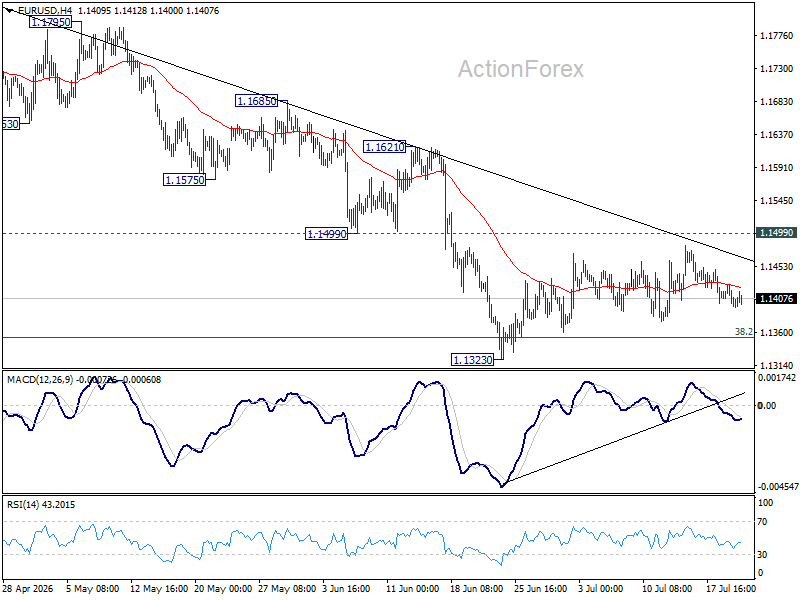
In the bigger picture, focus is back on 38.2% retracement of 1.0176 to 1.2081 at 1.1353. Decisive break there will revive the case of medium term bearish trend reversal after rejection by 1.2 key cluster resistance level. Further fall should be seen to 61.8% retracement at 1.0904. Nevertheless, strong rebound from 1.1353, followed by break of 1.1621 resistance, will retain medium term bullishness.
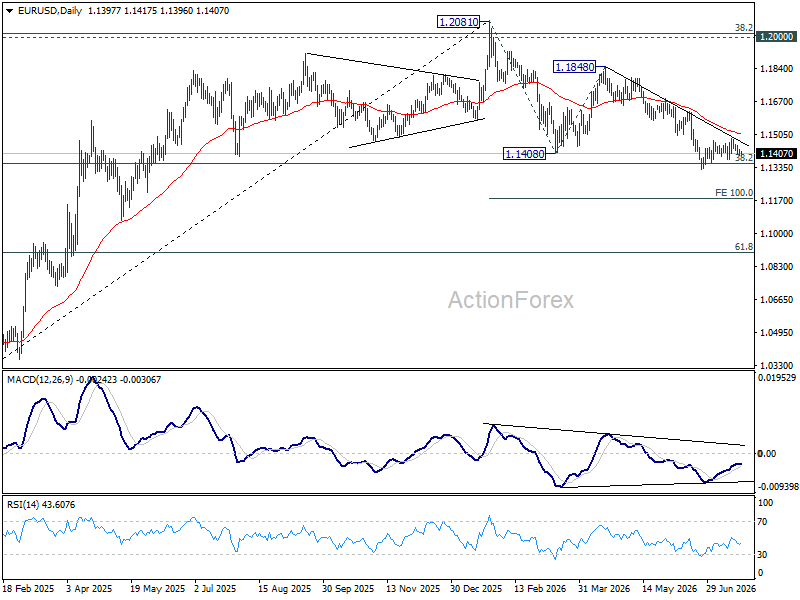
USD/JPY Daily Outlook
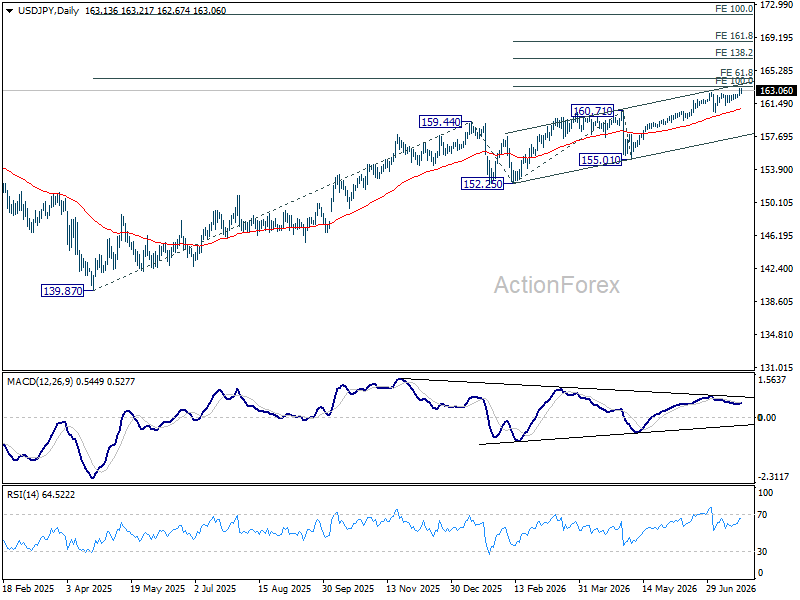
USD/JPY's up trend resumed by breaking through 162.83. Intraday bias is now on the upside for 100% projection of 152.25 to 160.71 from 155.01 at 163.47. Firm break there will target 138.2% projection at 166.07 next. On the downside, below 162.18 minor support will turn bias neutral and bring consolidations. But outlook will stay bullish as long as 160.46 support holds, in case of retreat.
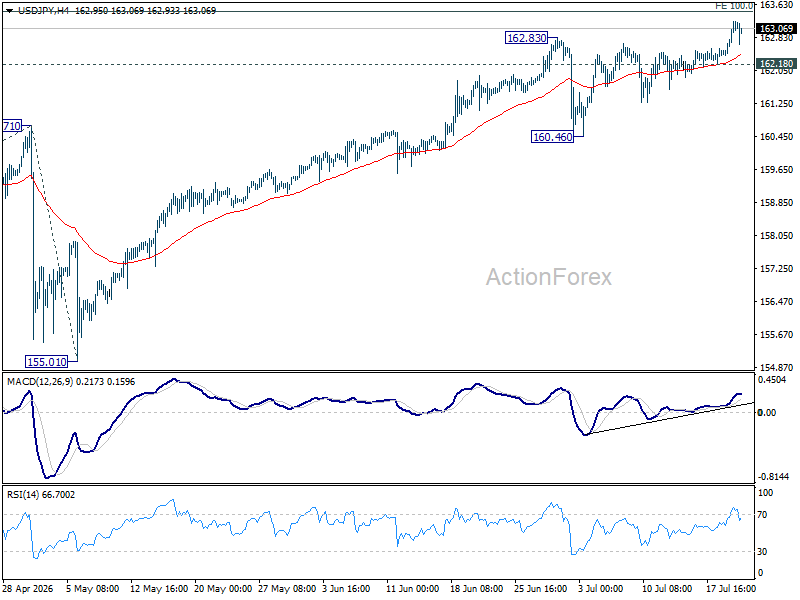
In the bigger picture, rise from 139.87 (2025 low) is seen as another rising leg of the long term up trend. Next target is 61.8% projection of 139.87 to 159.44 from 152.25 at 164.34. Firm break break there will target 100% projection at 171.82. For now, outlook will remain bullish as long as 155.01 support holds, even in case of deep pullback.
GBP/USD Daily Outlook
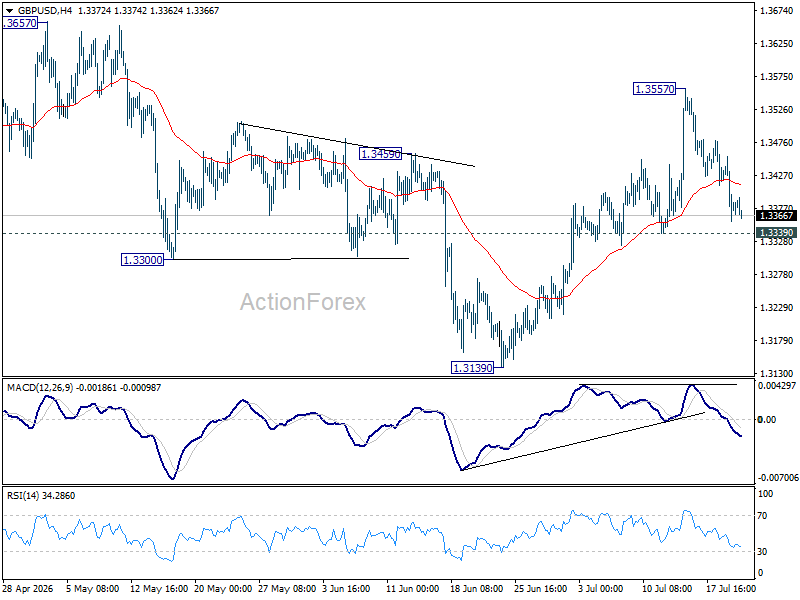
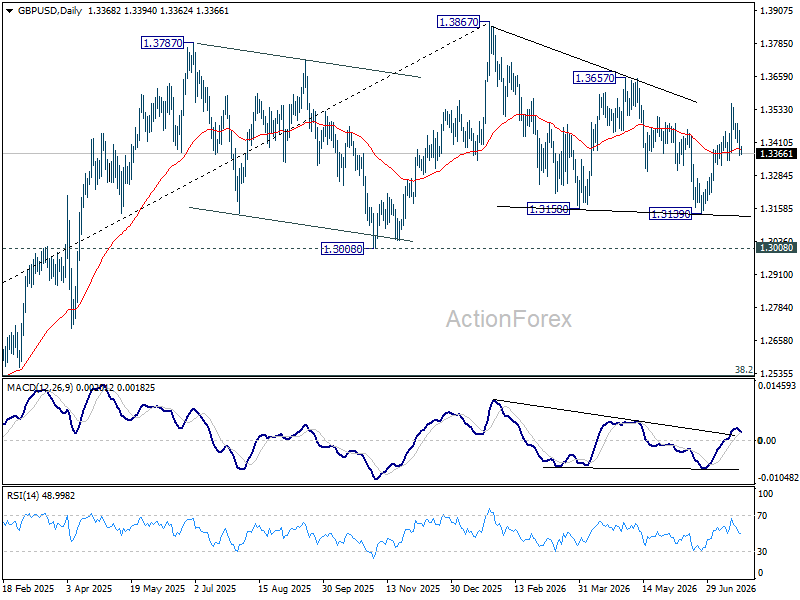
No change in GBP/USD's outlook and intraday bias remains neutral. Some consolidations could be seen below 1.3557, but further rally is expected as long as 1.3339 support holds. Above 1.3557 will target 1.3657 first. Firm break there will bring retest of 1.3867 high. However, break of 1.3339 support will dampen this bullish view and bring deeper fall back to 1.3139 instead.
In the bigger picture, price actions from 1.3867 are a corrective pattern within the broader up trend from 1.0351 (2022 low). With 1.3008 support intact, medium term bullishness is maintained and break of 1.3867 is in favor for a later stage, towards 1.4248 key resistance (2021 high). However, firm break of 1.3008 will at least bring deeper fall to 38.2% retracement of 1.0351 to 1.3867 at 1.2524, with increased risk of bearish reversal.
USD/CHF Daily Outlook
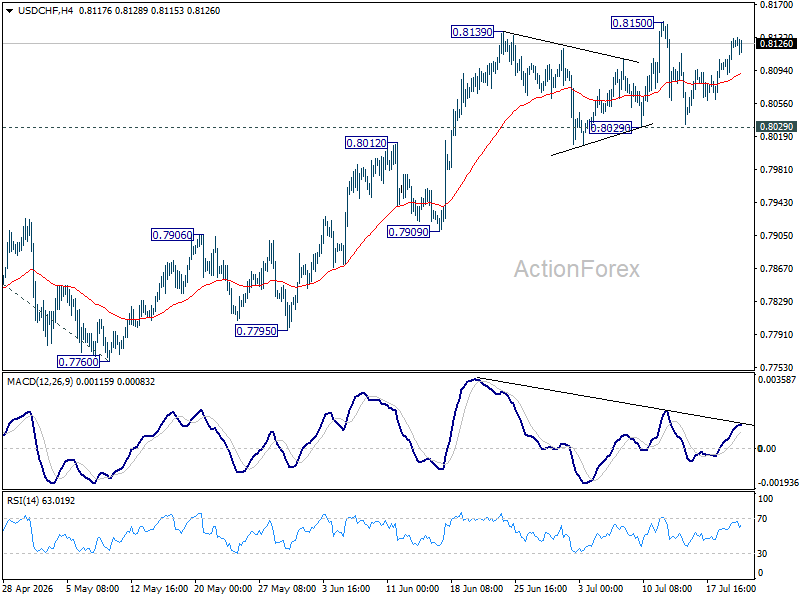
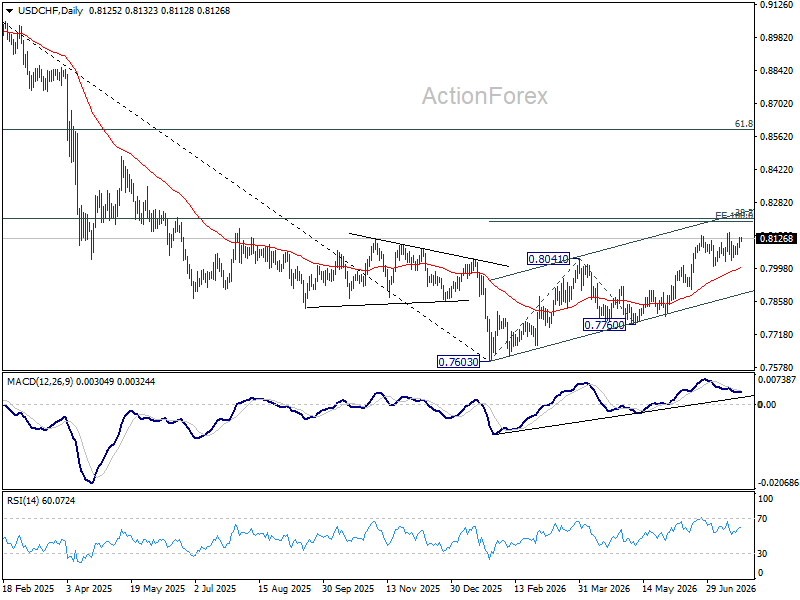
Range trading continues in USD/CHF and intraday bias remains neutral for the moment. Further rally is in favor as long as 0.8029 support holds. Above 0.8150 will target 100% projection 0.7603 to 0.8041 from 0.7600 at 0.8198 next. However, firm break of 0.8029 will turn bias back to the downside for 0.7909 support and below.
In the bigger picture, while a medium term bottom was formed at 0.7603, it's still early to call for bullish trend reversal. As long as 38.2% retracement of 0.9200 (2025 high) to 0.7603 at 0.8213 holds, the larger down trend could still continue through 0.7603 at a later stage. However, firm break of 0.7603 will argue that the trend has reversed and turn focus to 0.8332 support turned resistance (2023 low) for confirmation.
AUD/USD Daily Report
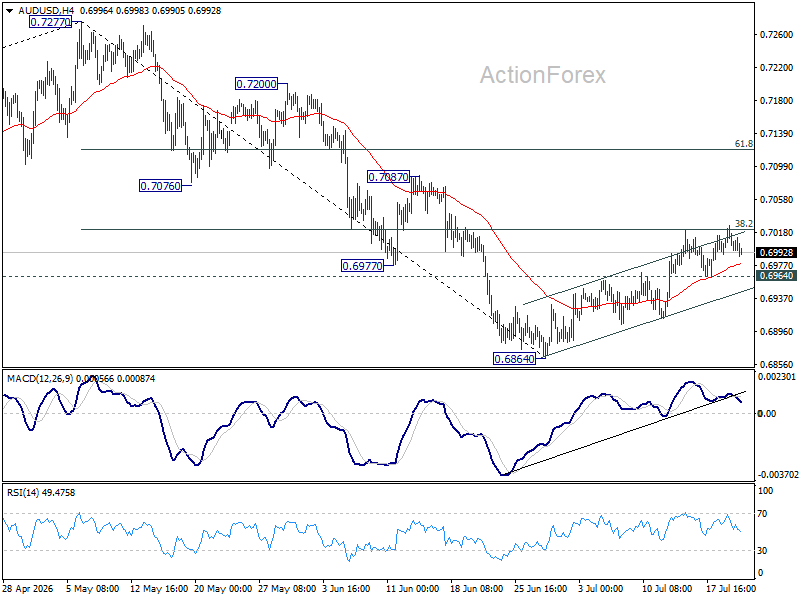
Intraday bias in AUD/USD remains neutral with focus on 38.2% retracement of 0.7277 to 0.6864 at 0.7022. Decisive break there will suggest that fall from 0.7277 has completed and 0.6864, and target 61.8% retracement at 0.7119 next. Nevertheless, rejection by 0.7022 will maintain near term bearishness. Break of 0.6964 will bring retest of 0.6864 low.
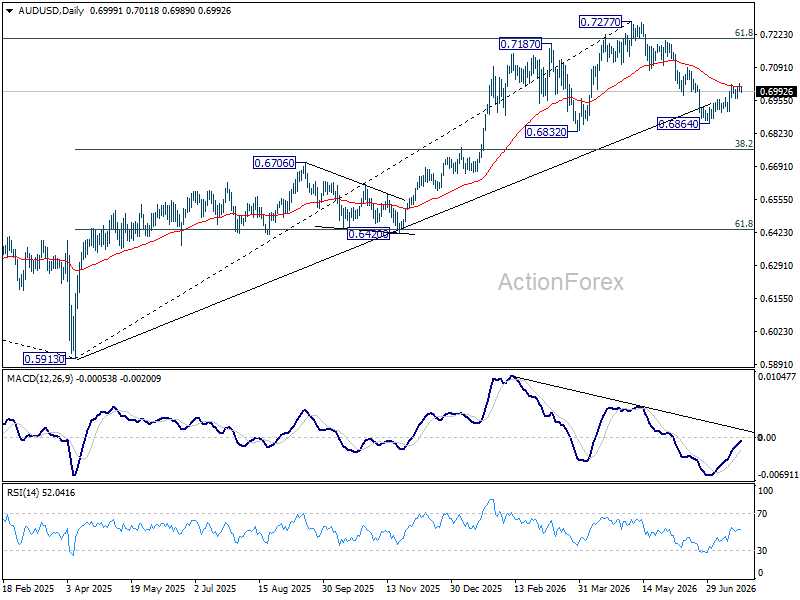
In the bigger picture, considering bearish divergence condition in D MACD, a medium term top could be formed at 0.7277 after failing to sustain above 61.8% retracement of 0.8006 (2021 high) to 0.5913 (2024 low) at 0.7206. Deeper fall could be seen to 38.2% retracement of 0.5913 to 0.7277 at 0.6756 as a correction. But strong support should be seen there to bring rebound. Consolidations would continue below 0.7277 for a while.
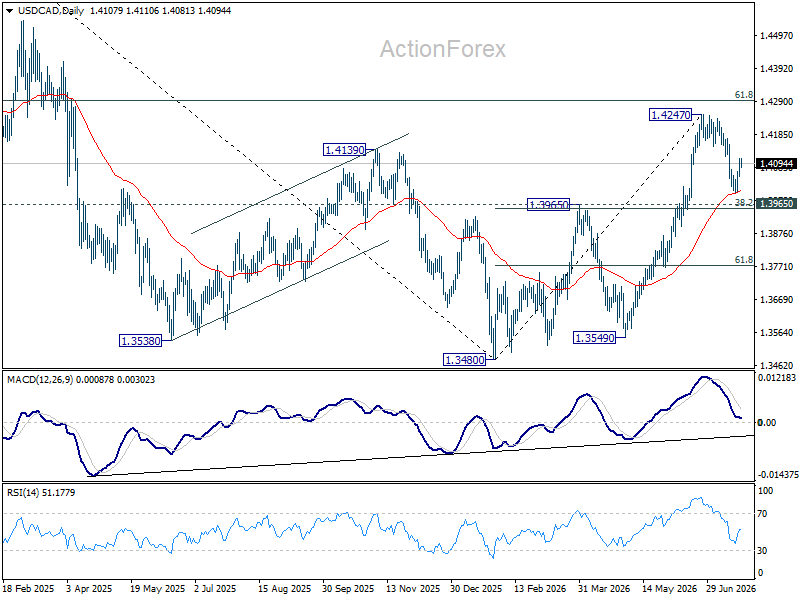
USD/CAD Daily Outlook
Intraday bias in USD/CAD remains neutral at this point. On the upside, firm break of 1.4115 will suggest that pullback from 1.4247 has completed, ahead of 38.2% retracement of 1.3480 to 1.4247 at 1.3954. Retest of 1.4247 should be seen next. For now, outlook will remain bullish as long as 1.3954 holds, in case of another dip.
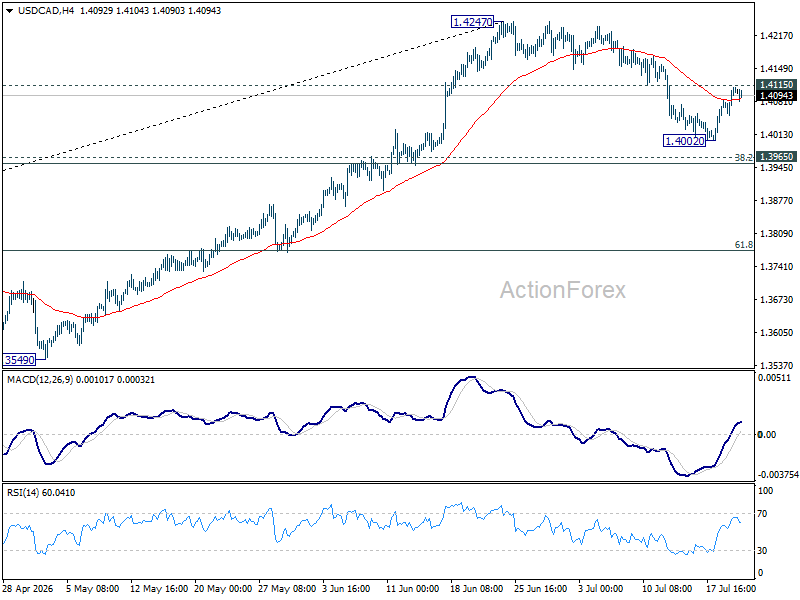
In the bigger picture, current development suggests that fall from 1.4791 has completed as a three wave correction to 1.3480. It's still early to judge if rise from there a corrective bounce, or resumption of the larger up trend from 1.2005 (2021 low). But in either case, retest of 1.4791 high should be seen next.
GBP/JPY Daily Outlook
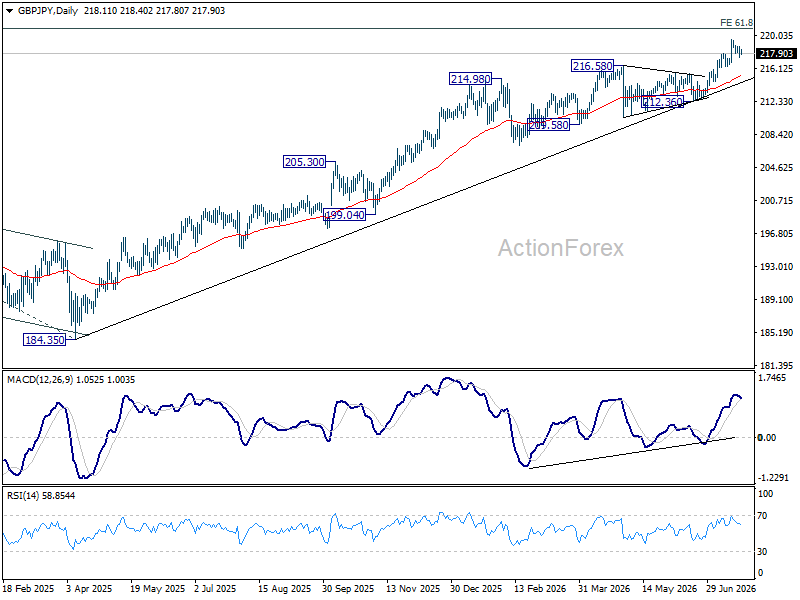
Intraday bias in GBP/JPY remains neutral for consolidations below 219.56. Downside of pullback should be contained by 216.39 support to bring rebound. On the upside, above 219.56 will extend larger up trend and target 220.90 fibonacci projection level next.
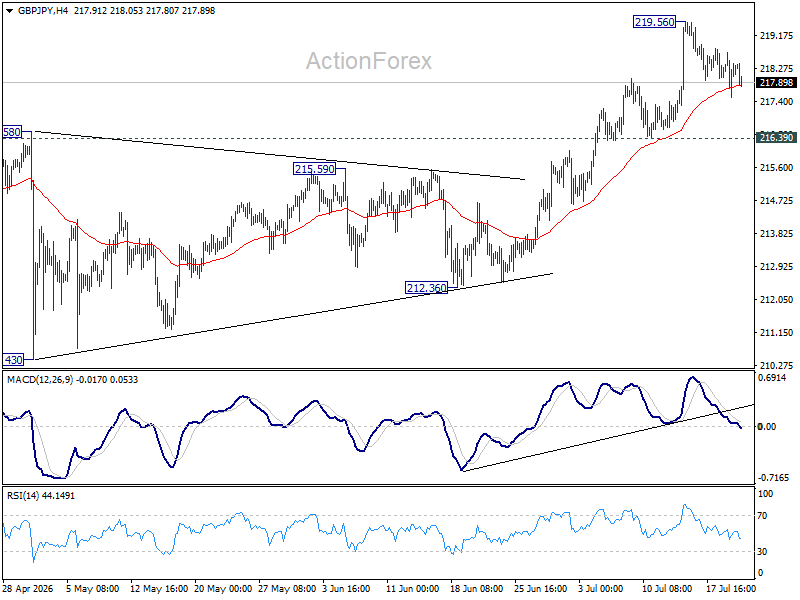
In the bigger picture, the long term up trend is in progress. Next target is 61.8% projection of 148.93 (2022 low) to 208.09 (2024 high) from 184.35 at 220.90. For now, outlook will remain bullish as long as 55 W EMA (now at 208.64) holds, in case of pullback.