

Sample Category Title
GBP/JPY Daily Outlook
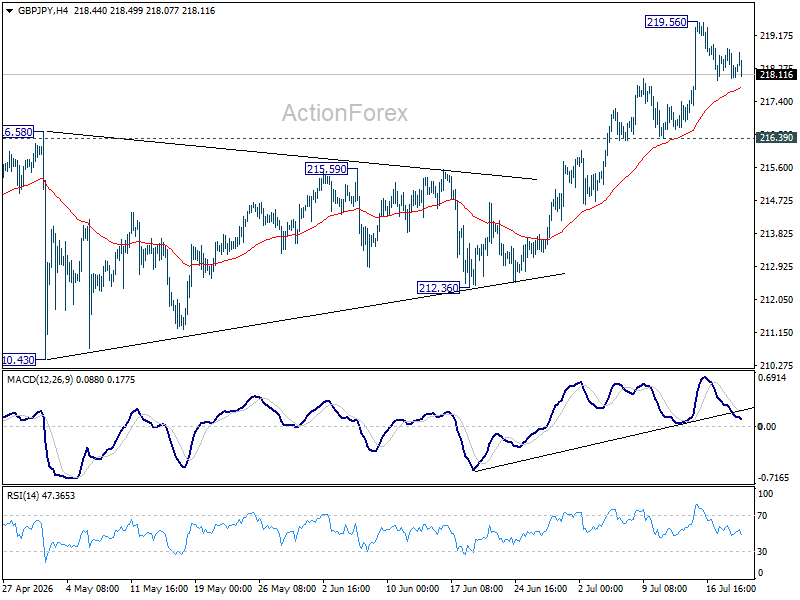
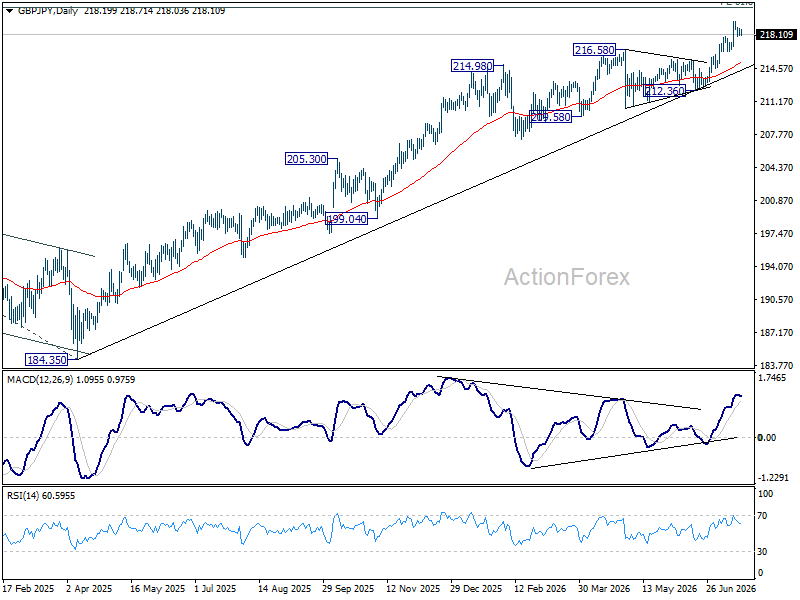
GBP/JPY is staying in consolidations below 219.56 and intraday bias stays neutral. Downside should be contained by 216.39 support to bring rebound. On the upside, above 219.56 will extend larger up trend and target 220.90 fibonacci projection level next.
In the bigger picture, the long term up trend is in progress. Next target is 61.8% projection of 148.93 (2022 low) to 208.09 (2024 high) from 184.35 at 220.90. For now, outlook will remain bullish as long as 55 W EMA (now at 208.64) holds, in case of pullback.
EUR/JPY Daily Outlook
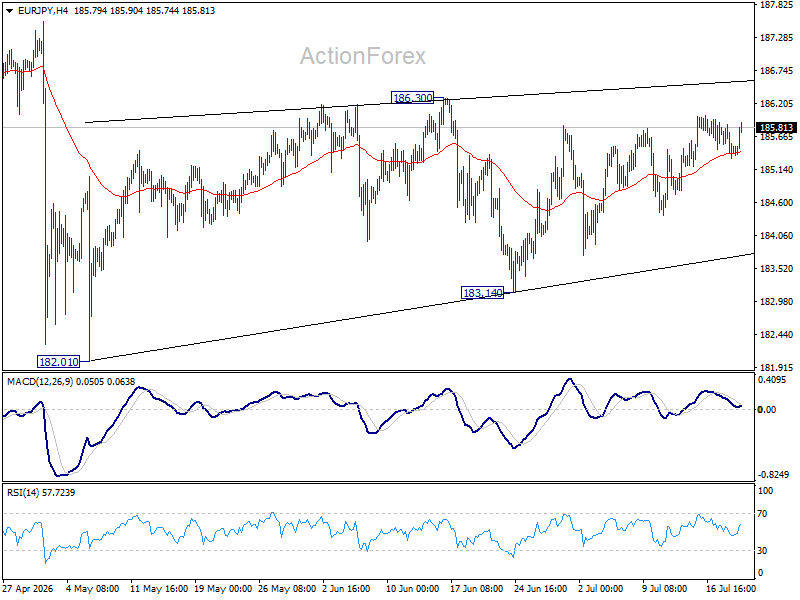
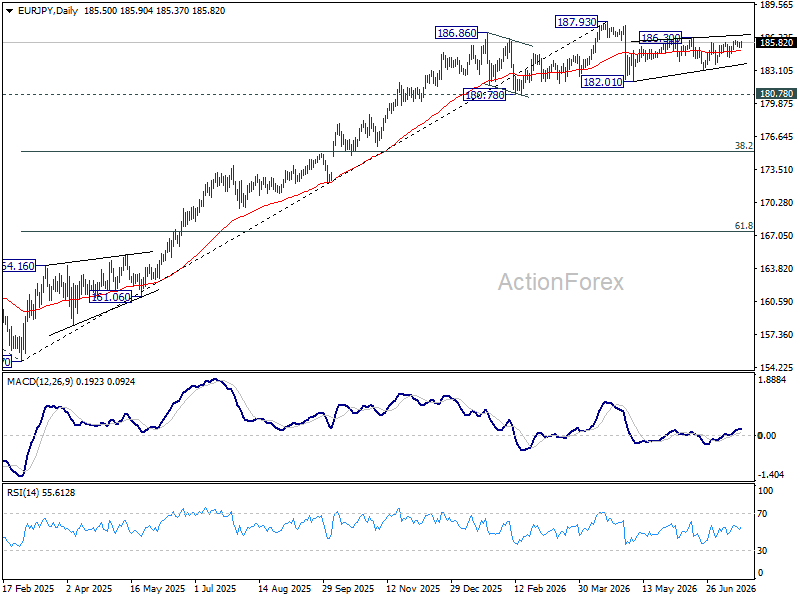
EUR/JPY is staying in sideway trading and intraday bias remains neutral. While the price actions from 182.10 are looking corrective, stronger rebound cannot be ruled out. On the upside, firm break of 186.30 will resume the rebound from 182.10 towards 187.93 high. On the downside, break of 183.14 will bring deeper fall to retest 182.10.
In the bigger picture, uptrend from 114.42 (2020 low) is still expected to resume at a later stage to 78.6% projection of 124.37 (2022 low) to 175.41 (2025 high) from 154.77 at 194.88. However, sustained break of 55 W EMA (now at 180.15) will argue that it's already in a medium term down trend to 175.41 resistance turned support and below.
EUR/GBP Daily Outlook
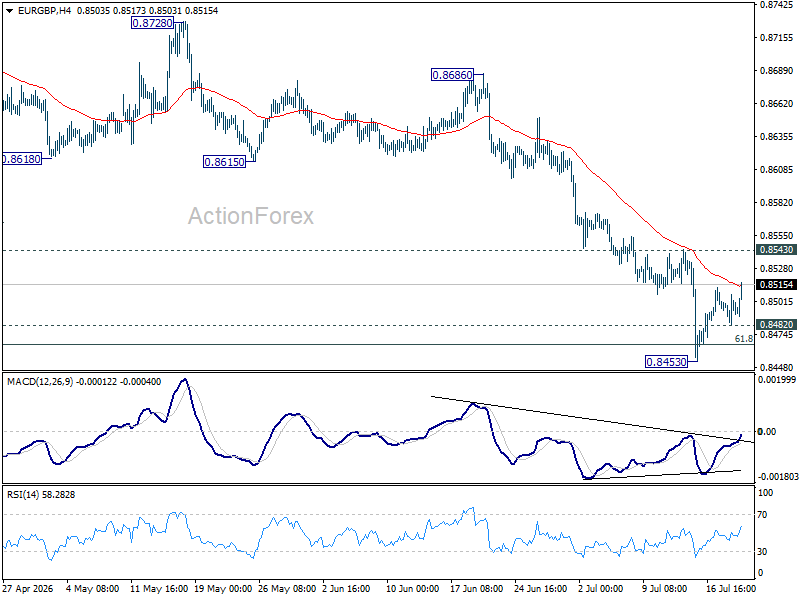
Intraday bias in EUR/GBP stays neutral at this point. Further decline is expected as long as 0.8543 resistance holds. Below 0.8482 minor support will bring retest of 0.8453 first. Firm break there and sustained trading below 61.8% retracement of 0.8221 to 0.8863 at 0.8466, will extend the decline from 0.8863 to retest 0.8221 low. However, decisive break of 0.8543 will bring stronger rebound to 55 D EMA (now at 0.8595).
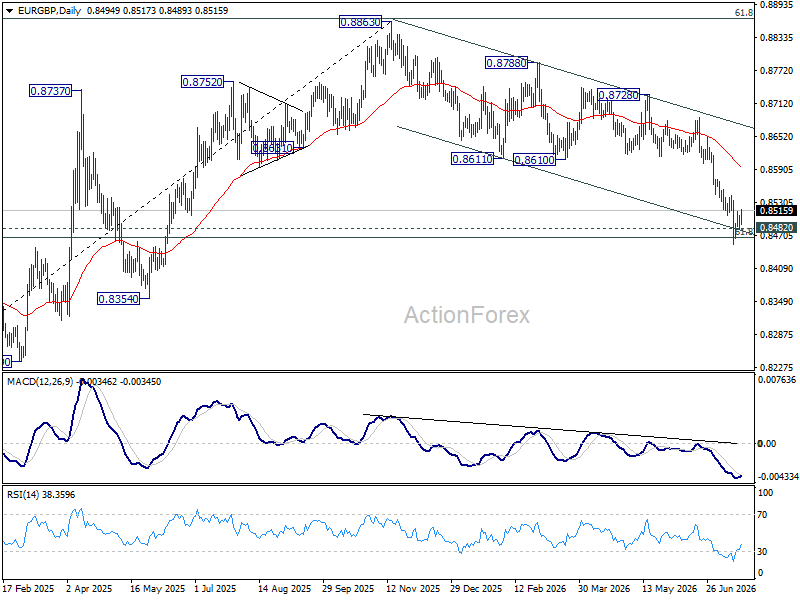
In the bigger picture, current development suggests that rise from 0.8221 (2024 low) has completed at 0.8863, just ahead of 38.2% retracement of 0.9267 (2025 high) to 0.8221 at 0.8867. Deeper fall would be seen back to 0.8221. For now, outlook will be neutral at best as long as 0.8610 support turned resistance hold.
EUR/AUD Daily Outlook
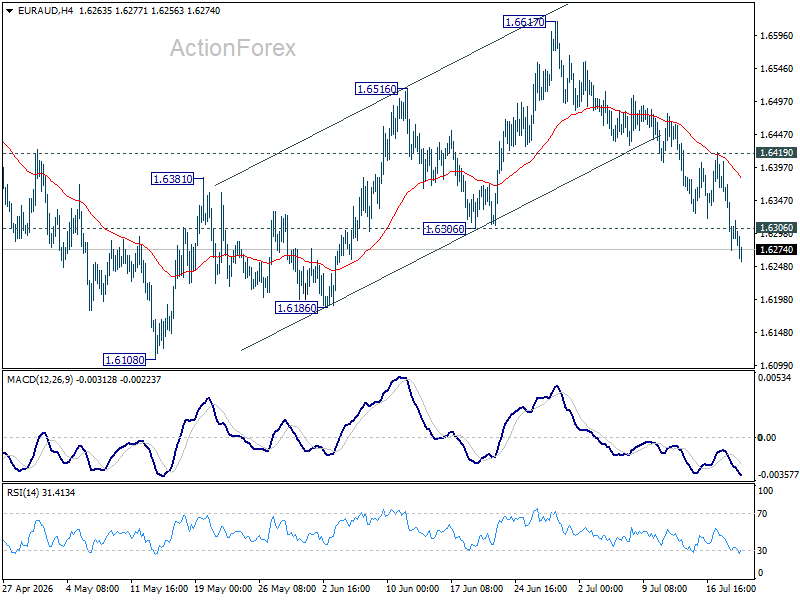
EUR/AUD's extended decline and break of 1.6306 support suggests that rebound from 1.6108 has already completed at 1.6617. Intraday bias is now on the downside for retesting 1.6108 low first. Firm break there will resume larger down trend. For now, risk will stay on the downside as long as 1.6419 resistance holds, in case of recovery.
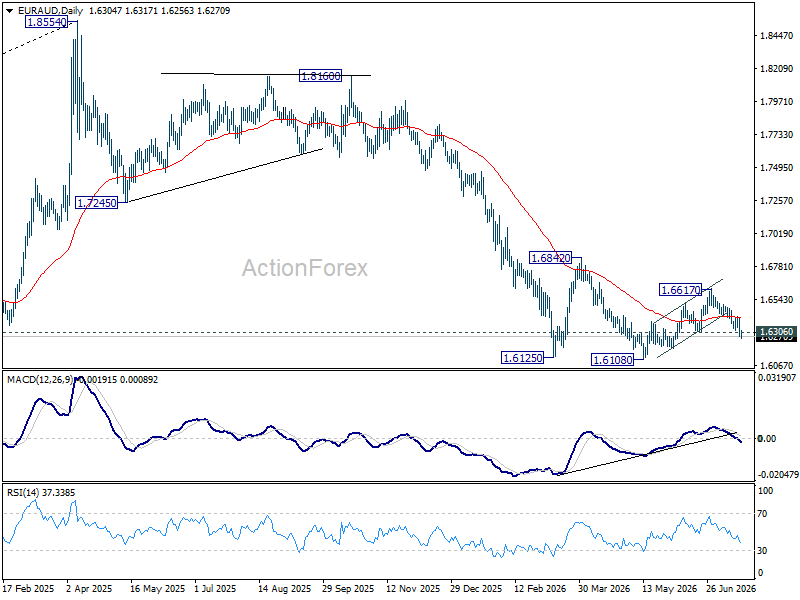
In the bigger picture, outlook will stay bearish as long as 1.6842 resistance holds. Fall from 1.8554 (2025 high) is expected to continue to 61.8% retracement of 1.4281 to 1.8554 at 1.5913. Decisive break there will pave the way back to 1.4281 (2022 low). However, firm break of 1.6842 should confirm medium term bottoming, and bring stronger rally.
EUR/CHF Daily Outlook
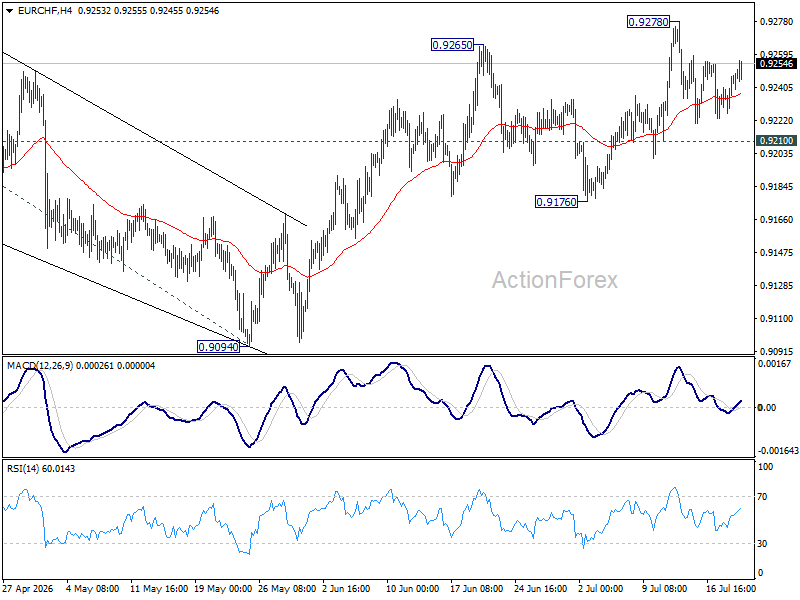
EUR/CHF recovered today but stays in range below 0.9278. Intraday bias remains neutral for consolidations. After all, with 0.9210 support intact, further rally is still in favor. On the upside, break 0.9278 will resume the rise from 0.8979 to 100% projection of 0.8979 to 0.9264 from 0.9094 at 0.9379. However, decisive break of 0.9210 support will turn bias back to 0.9176 support instead.
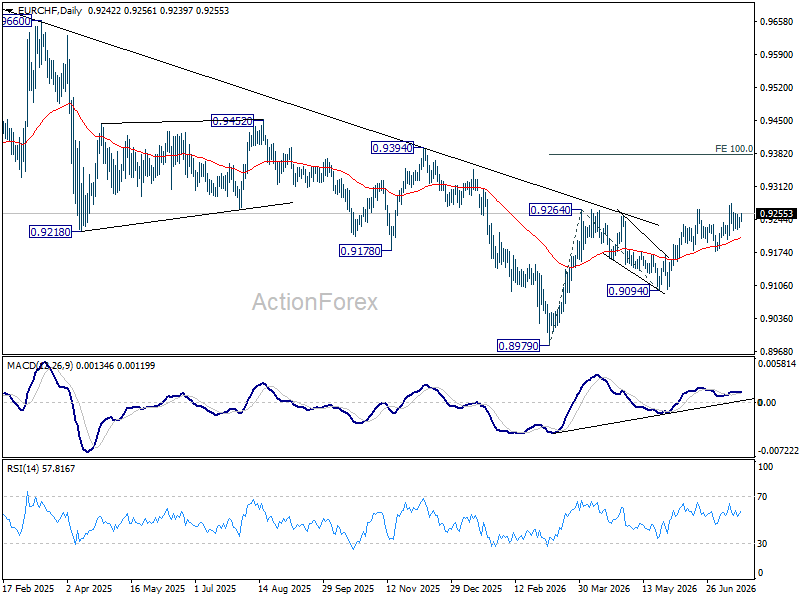
In the bigger picture, the break of medium term falling trend line resistance indicates that 0.8979 is already a medium term bottom. Considering bullish convergence condition in W MACD, rise from there should at least be reversing the fall from 0.9928, with prospect of developing into a medium term up trend. Firm break of 0.9394 resistance will add more credence to this case. For now risk will remain on the upside as long as 0.9094 support holds, in case of retreat.
Bitcoin Wave Analysis
Bitcoin: ⬆️ Buy
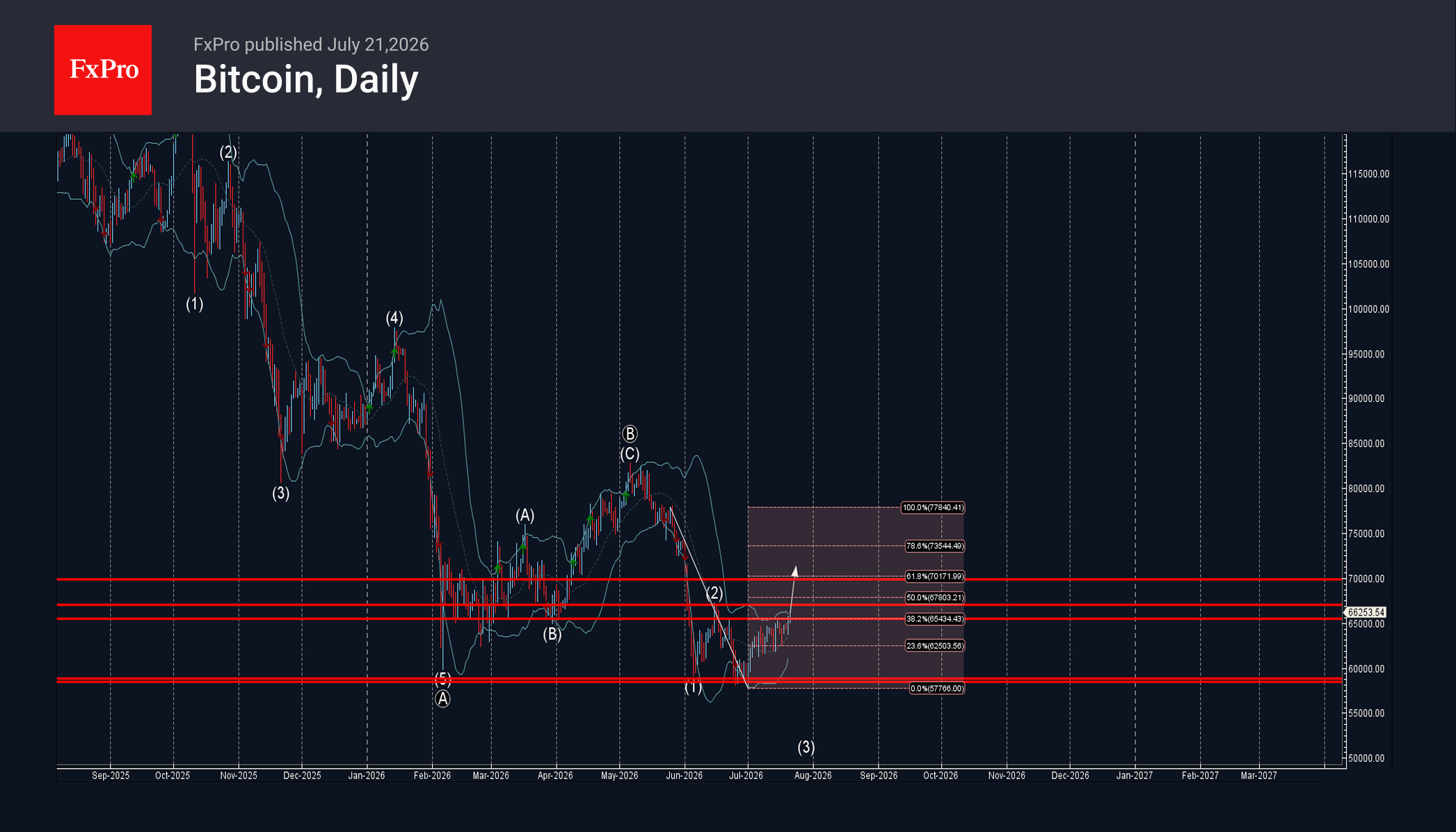
– Bitcoin broke resistance level 65500.00
– Likely to rise to resistance level 70000.00
Bitcoin cryptocurrency recently broke above the resistance level 65500.00 (which has been reversing the price from June) intersecting with 38.2 Fibonacci correction of the downward impulse from May.
The breakout of the resistance level 65500.00 should accelerate the active minor ABC correction 2.
Given the improved sentiment seen across the crypto markets today, Bitcoin cryptocurrency can be expected to rise to the next resistance level 70000.00.
Platinum Wave Analysis
Platinum: ⬆️ Buy
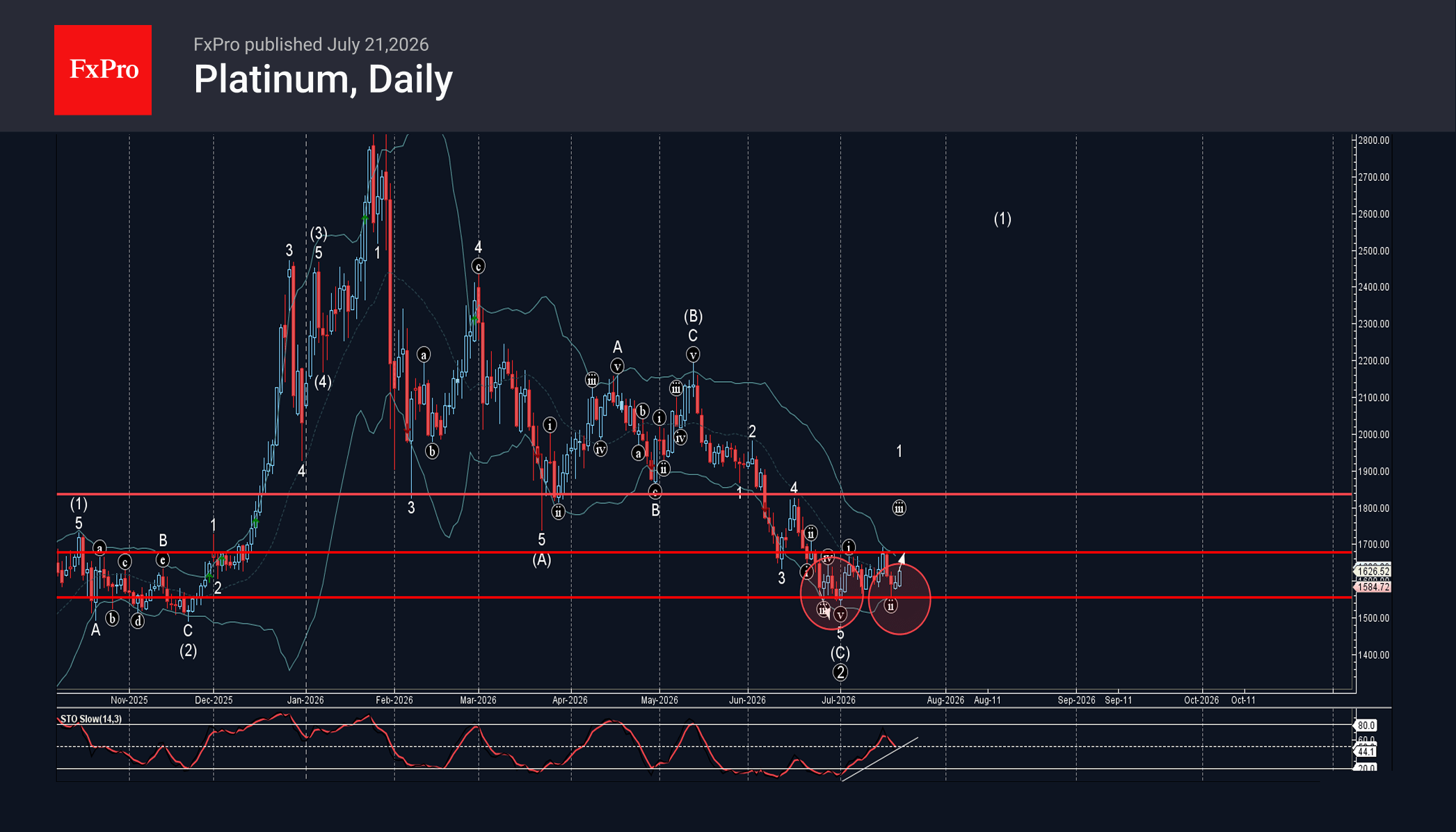
– Platinum reversed from key support level 1555.00
– Likely to rise to resistance level 1680.00
Platinum recently reversed up from the key support level 1555.00 (which stopped the previous waves iii and 5) intersecting with the lower daily Bollinger Band.
The upward reversal from the support level 1555.00 started the active minor impulse wave iii – that belongs to higher impulse waves 1 and (1).
Given the strength of the support level 1555.00 and the bullish divergence on the daily Stochastic, Platinum can be expected to rise to the next resistance level 1680.00.
Crude Oil: No Room for Error
- The Saudi Arabian export stop is a worry for the oil market.
- Rising Brent prices are increasing the chances of Fed rate hikes, supporting the USD.
The US dollar has reached weekly highs, driven by rising demand for safe-haven assets and higher yields on US Treasury bonds. Investors are demanding a higher risk premium amid the conflict in the Middle East. Brent’s rally towards $91 per barrel is increasing the risk of accelerating inflation and pushing the Fed towards tighter monetary policy.
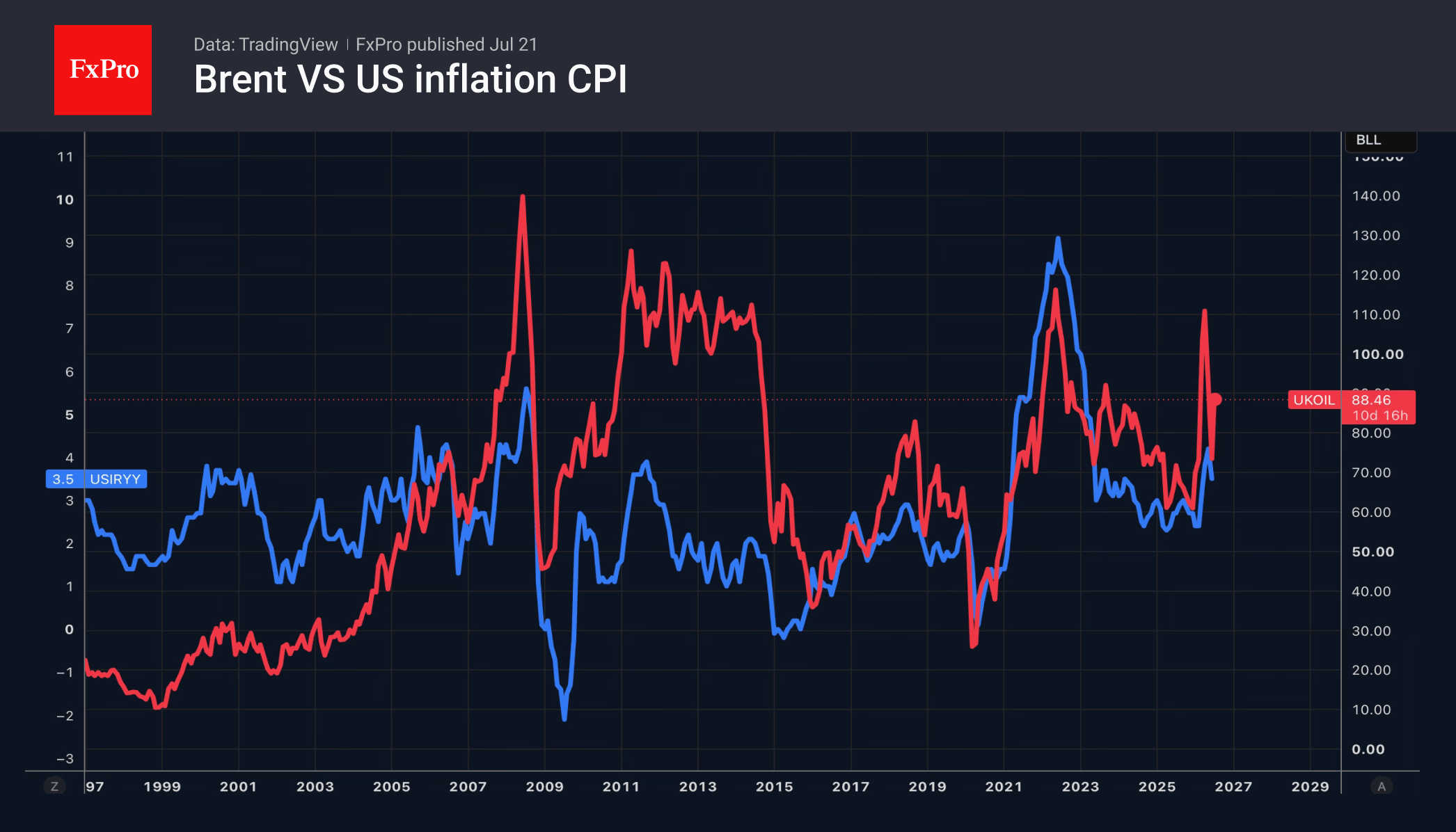
One factor holding back the oil rally was the possibility that Saudi Arabia could find a workaround through the Red Sea. Threats by the Yemeni Houthis to block the Bab el-Mandeb Strait have heightened fears that Brent could rise further. Goldman Sachs sees the price reaching $120 per barrel if the conflict in the Middle East drags on, although it does not consider this scenario the base case.
According to Rystad Energy’s estimates, 2.5 million BPD of Saudi Arabia’s exports are at risk, pushing prices higher. Morgan Stanley warns that there is no room for error, as global oil stocks, excluding China, are at record lows.
The situation continues to escalate. Meanwhile, rumours from Reuters that mediators have conveyed a proposal to Iran for a 10-day ceasefire, aimed at returning to the terms of the deal concluded in June, have provided a breath of fresh air for financial markets. Hopes for de-escalation in the Middle East have led to a retreat in the US dollar. However, the gulf between the opposing sides is so wide that there is little hope of lasting peace in the region.
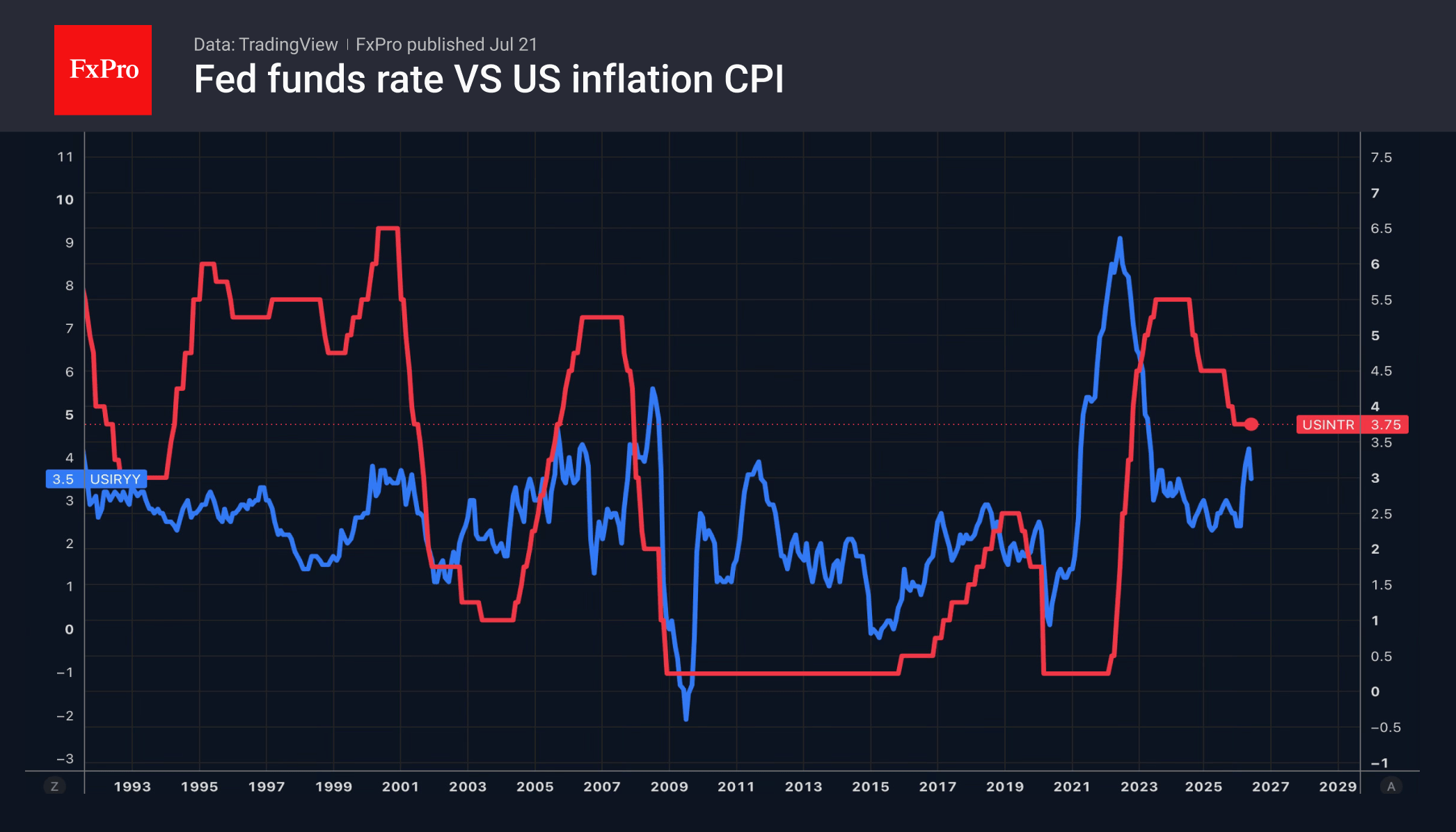
Higher oil prices are increasing the risk of a resurgence in US inflation and may force the Fed to tighten monetary policy. Bank of America forecasts three hikes later this year, in September, October and December. A 50-basis-point rise in the federal funds rate is already partly priced into financial markets. More aggressive measures are required for the Fed to bring inflation back to its 2% target.
Against this backdrop, the medium-term outlook for EURUSD appears bearish, although the ECB meeting may offer short-term support for the euro. A rise in the deposit rate is not expected, but Christine Lagarde may adopt more hawkish rhetoric.
The FxPro Analyst Team
GBP/CHF: Trendline or Rsi — Which One Is Lying?
Sterling enters this week on firmer footing, with political uncertainty fading fast after Andy Burnham's confirmation as Labour leader eased investor concerns over the succession to Keir Starmer. Markets reacted further to reports pointing to Shabana Mahmood as the frontrunner for Chancellor, viewed as the more fiscally disciplined choice. On the policy front, the Bank of England remains firmly in tightening mode, with markets fully pricing a rate hike by year-end, reinforced by renewed Middle East tensions pushing oil to one-month highs and stoking fresh inflation risks.
The Swiss franc, meanwhile, continues to play its familiar dual role. Domestically, the picture argues for weakness—the SNB holds its policy rate at zero, inflation sits near zero, and growth remains subdued after Bern trimmed its 2026 GDP forecast due to elevated US tariffs. Yet globally, the franc keeps drawing so-called safe-haven demand from the same conflict fueling GBP's hawkish repricing, with the SNB explicitly flagging renewed willingness to intervene against excessive appreciation.
Technical Analysis
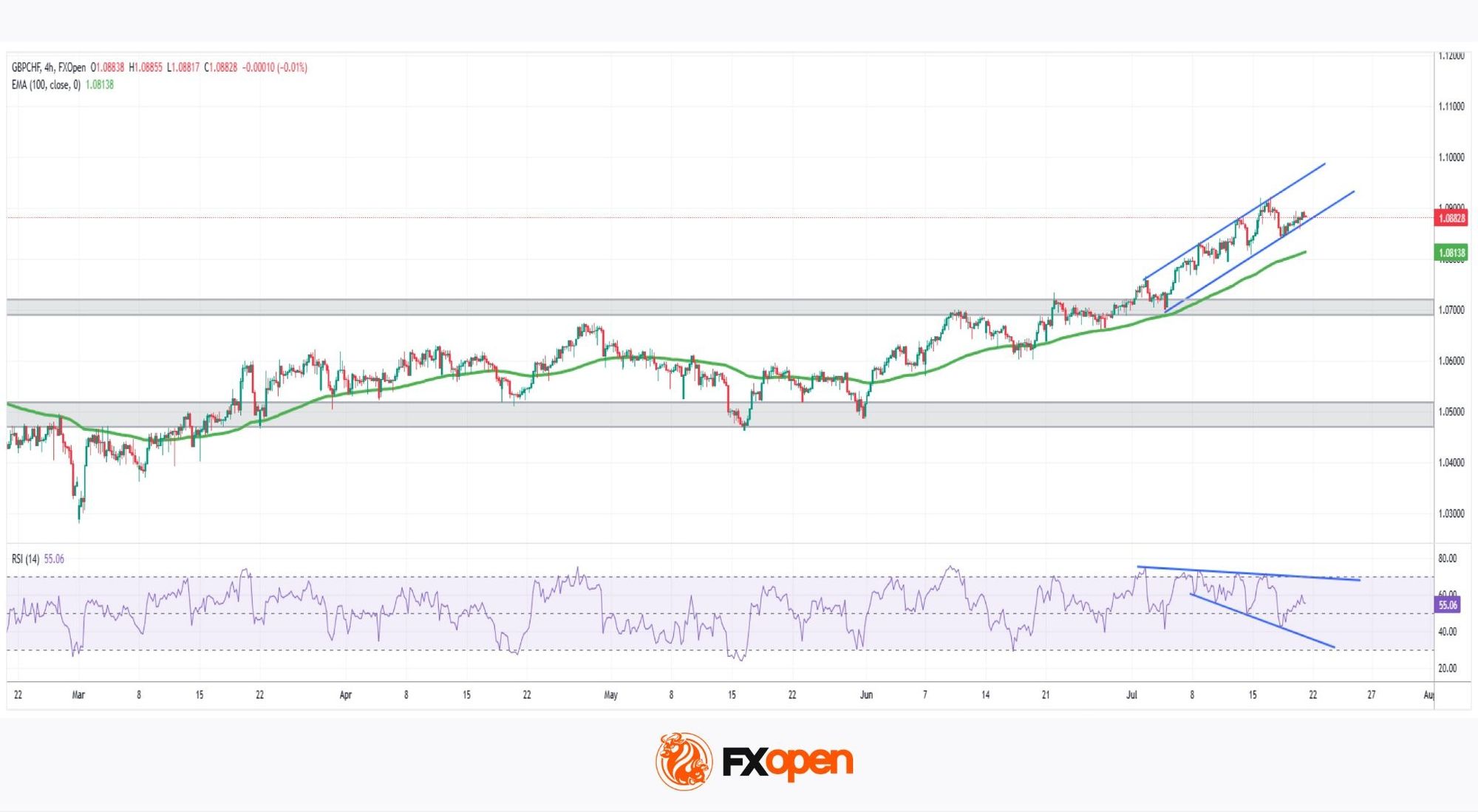
As the 4-hour chart of GBP/CHF shows, price broke decisively higher in early July after nearly three months of consolidation, a move fueled by these same political and macro drivers. The breakout has since evolved into a clear uptrend, though price action is now showing early signs of exhaustion beneath the surface.
Bullish Scenario
Having broken above 1.0700, price has held firmly above this level, forming a consistent pattern of higher highs and higher lows within an ascending parallel channel. The 100-period EMA sits comfortably below price, reinforcing the case that buyers remain in control, ready to defend any dip toward the channel's lower boundary or the moving average.
Bearish Scenario
Not everything lines up with this bullish picture, however. The RSI is forming lower highs and lower lows even as price prints higher highs, creating a persistent bearish divergence that hints at fading momentum. However, sellers would need a confirmed break below the ascending trendline and the 100-period EMA to gain real conviction—a breakdown that could send price back to retest the pivotal 1.0700 zone, and potentially back into the broader 1.0500–1.0700 range.
So which signal is telling the truth: the rising channel and supportive EMA, or the quiet warning building in the RSI?
Trade over 50 forex markets 24 hours a day with FXOpen. Take advantage of low commissions, deep liquidity, and spreads from 0.0 pips (additional fees may apply). Open your FXOpen account now or learn more about trading forex with FXOpen.
This article represents the opinion of the Companies operating under the FXOpen brand only. It is not to be construed as an offer, solicitation, or recommendation with respect to products and services provided by the Companies operating under the FXOpen brand, nor is it to be considered financial advice.
Bitcoin Has Broken Through $66K and Is Surging Higher
Market Overview
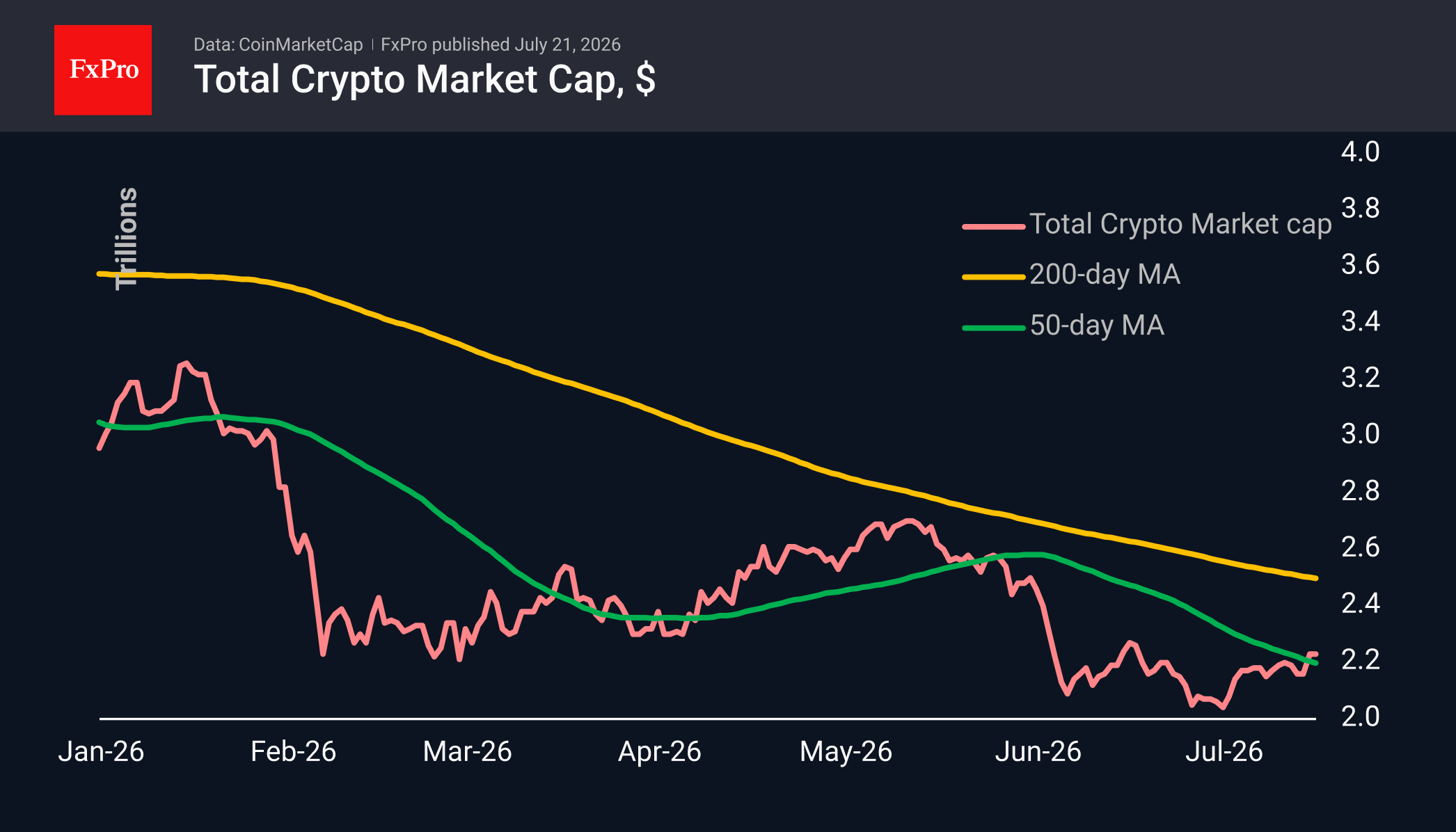
The crypto market capitalisation has risen to $2.25T, gaining 2.7% over the past 24 hours and climbing to levels last seen over a month ago. This is a promising attempt to resume growth following a period of consolidation, and it is worth closely monitoring market dynamics near the previous local highs of $2.27T, as a sustained upward trend would pave the way for May’s $2.70T highs. Among the most actively traded coins, the top performers over the past day were Cardano (+9%), Uniswap (+8.7%) and Polkadot (+6.9%). The worst-performing coins are also in positive territory, albeit more modestly: Tron +0.1%, Litecoin and Dash both up 1.7%.
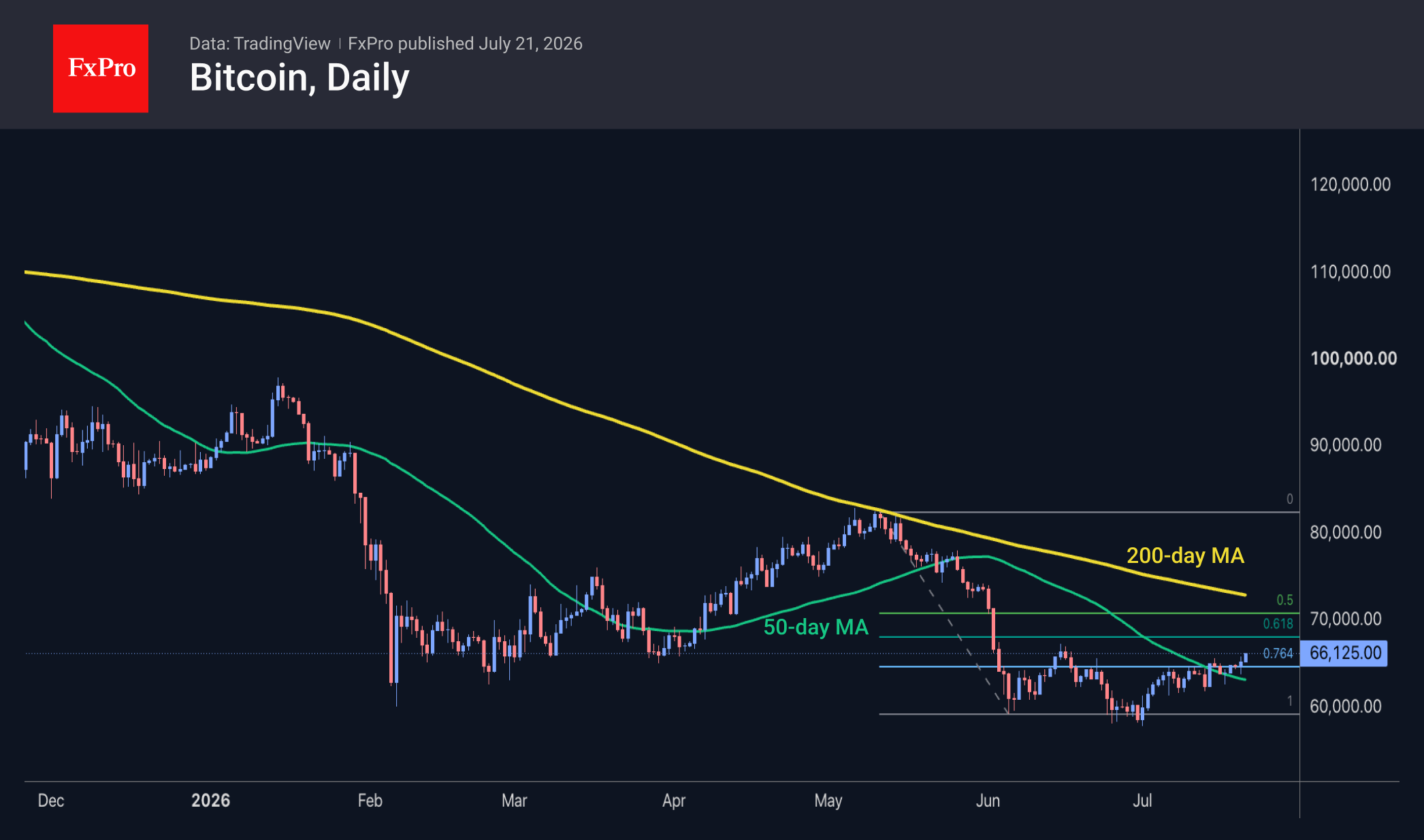
Bitcoin has gained 3% over the past day, trading above $66K and approaching the highs seen in the first half of May. At current levels, the leading cryptocurrency is attempting to break out from below a former strong support level that acted as resistance last month. Slightly higher, approaching $68K, lies the 61.8% retracement zone from the May–June sell-off. The ability to consolidate above this level would be a further confirmatory signal of an upside trend reversal.
News Background
Large Bitcoin whales have been building up their positions over the last two months, while medium-sized wallets have been selling. This divergence in behaviour could be a ‘constructive signal’ for BTC in the medium term, according to CryptoQuant.
Investors are withdrawing stablecoins from exchanges, depriving the market of growth fuel and preventing Bitcoin from breaking out of its protracted consolidation. Stablecoin outflows from Binance and Bybit reached $2.3 billion over the month, according to analyst Darkfost.
The bankrupt crypto exchange FTX has announced a new phase of payouts for 31 July. Those affected by the trading platform’s collapse will receive around $900 million. The upcoming phase will be the fifth tranche of the company’s bankruptcy proceedings, with the total amount paid to creditors now reaching $10 billion.
The developers of the Cardano blockchain have successfully activated the Van Rossem hard fork on the mainnet. The update is designed to reduce the cost of executing new Plutus smart contracts and prepare the blockchain for future upgrades.
BitMine purchased an additional 7,430 ETH last week, bringing the total amount of Ethereum in its reserves to 5.78 million ETH. BitMine’s reserves exceed 4.8% of the total Ethereum supply. Furthermore, BitMine repurchased 5.5 million ordinary shares, valued at $4 billion, as part of its previously announced buyback programme.
The FxPro Analyst Team