Sample Category Title
German ZEW Sentiment Jumps to 26.3 as Recovery Hopes Strengthen
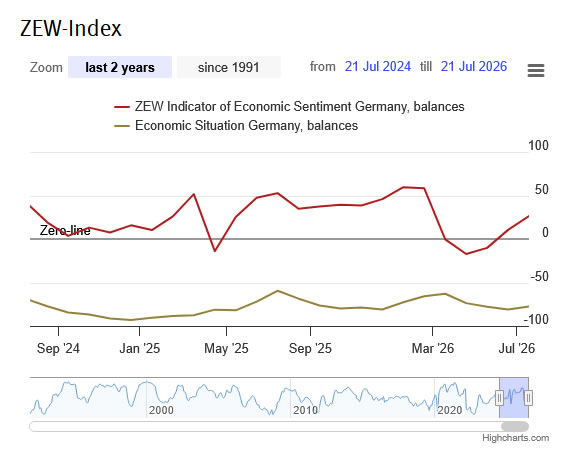
Investor confidence in Germany improved markedly in July, with the ZEW Indicator of Economic Sentiment rising to 26.3 from 10.5, the highest level since February, and well above expectations of 15.1. The assessment of current economic conditions also improved, albeit more modestly, with the Current Situation Index rising to -77.6 from -81.0. The gains suggest investors are becoming increasingly optimistic that Germany's recovery is gaining traction, even though the economy continues to operate from a weak starting point.
According to ZEW President Achim Wambach, the improving outlook reflects the positive impact of recent economic reforms, with export-oriented industries and domestic demand both showing sustained growth. Sectoral details reinforced that picture. Expectations improved sharply for mechanical engineering and domestic demand, while construction rebounded strongly after weakening in June. The chemical, pharmaceutical and metal industries also recorded broad-based improvements despite remaining in negative territory. The automotive sector was the notable exception, with sentiment deteriorating further to -46.6, highlighting persistent challenges facing one of Germany's key industries.
The survey also underscored that optimism remains tempered by geopolitical uncertainty. Wambach warned that developments in the Iran conflict and elevated oil prices continue to pose significant risks to Germany's recovery prospects.
Confidence across the Eurozone strengthened as well, with the Economic Sentiment Index rising to 23.4 from 9.5, while the Current Situation Index improved to -37.7. Together, the results point to a broad-based improvement in investor expectations across the region, although both Germany and the Eurozone continue to face fragile current economic conditions and external risks.
Economic Data
| Indicator | Actual | Expected | Previous |
|---|---|---|---|
| Germany ZEW Economic Sentiment (Jul) | 26.3 | 15.1 | 10.5 |
| Germany ZEW Current Situation (Jul) | -77.6 | -77.8 | -81.0 |
| Eurozone ZEW Economic Sentiment (Jul) | 23.4 | 11.2 | 9.5 |
| Eurozone ZEW Current Situation (Jul) | -37.7 | — | -43.4 |
-
Market Takeaways
- German investor confidence surged, with the ZEW Economic Sentiment Index jumping to 26.3, well above expectations.
- The improvement suggests investors are increasingly optimistic that Germany's recovery is gaining traction, helped by stronger exports and firmer domestic demand.
- Germany's Current Situation Index improved to -77.6, though it remains deeply negative, indicating current economic conditions are still weak.
- Sectoral improvements were broad-based, led by mechanical engineering, domestic demand and construction, while the automotive sector remained a notable laggard.
- Eurozone sentiment strengthened alongside Germany, pointing to a broader improvement in regional growth expectations.
- Geopolitical uncertainty, particularly surrounding the Iran conflict and higher oil prices, continues to pose the main downside risk to the recovery outlook.
AUD/USD Breaks Higher, but Jobs Data Will Decide Whether Rally Lasts
AUD/USD has broken to its highest level in four weeks, but the rally still lacks a convincing domestic foundation. The Australian Dollar has benefited from a favorable global backdrop as risk appetite improved across Asia, the Dollar weakened broadly, and copper prices surged on worsening supply disruptions in Chile. Additional support came from New Zealand, where stronger-than-expected inflation data lifted the Kiwi and added momentum to antipodean currencies more generally.
Those tailwinds, however, are largely external. Whether the Aussie can extend its gains will depend far more on Australia's labor market report due on Thursday. Employment has shown little net progress over the past two months, following a -40.7k decline in April and a 40.3k rebound in May, raising questions about whether tighter monetary policy, higher energy prices and geopolitical uncertainty are beginning to cool hiring. Consensus forecasts call for employment to rise by 15k in June while the unemployment rate is expected to remain at 4.4%.
The labor market data could also prove decisive for interest rate expectations. Investors currently see only about a one-in-five chance that the Reserve Bank of Australia will deliver a fourth rate hike this year in August. That leaves employment data with considerable scope to shift market pricing.
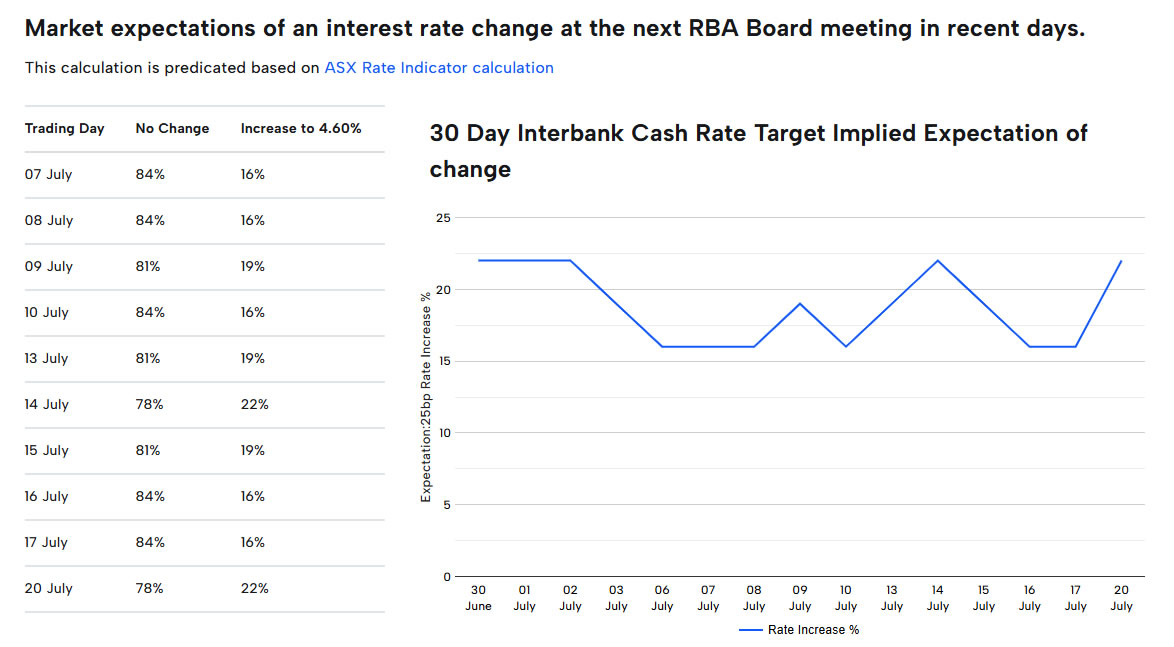
A disappointing report would strengthen the case that policy tightening is gaining traction and further reduce expectations for an August increase. On the other hand, another solid employment gain would reinforce the resilience of the economy and reopen the debate over additional tightening.
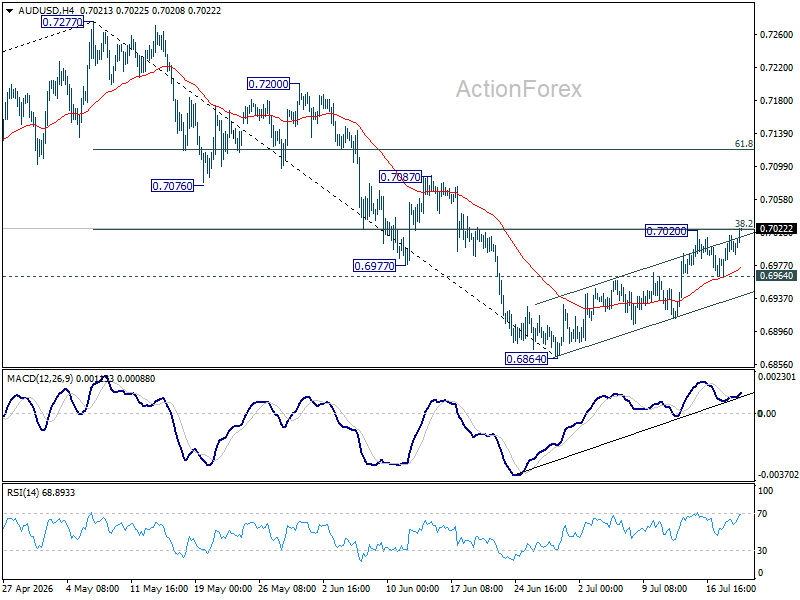
Technically, AUD/USD's breach of 0.7020 temporary top suggests that rebound from 0.6864 is resuming. Firm break of 38.2% retracement of 0.7277 to 0.6864 at 0.7022 will argue that whole decline form 0.7277 has already completed, and pave the way to 61.8% retracement at 0.7119 and possibly above.
However, rejection by 0.7022, followed by break of 0.6964 support will argue that the rebound has completed as a correction. And in this case, fall from 0.7277 could be ready to resume through 0.6864 low.
GBP/USD Falls After Cabinet Changes
GBP/USD fell to 1.3437 on Tuesday as investors assessed the appointment of Andy Burnham as the new Prime Minister of the UK and the outlook for monetary policy.
Burnham succeeded Keir Starmer without a contest, becoming the country's seventh prime minister in the past decade and the second since the Labour Party returned to power in 2024.
The new head of government reaffirmed his commitment to current fiscal rules but indicated he would consider raising the tax-free personal allowance, which has remained frozen in recent years.
Attention is now turning to the appointment of the Chancellor of the Exchequer. According to media reports, Shabana Mahmood is considered the leading candidate.
Additional pressure on the pound is coming from elevated oil prices, which are increasing inflationary risks and reinforcing expectations that the Bank of England will keep interest rates higher for longer.
Technical Analysis
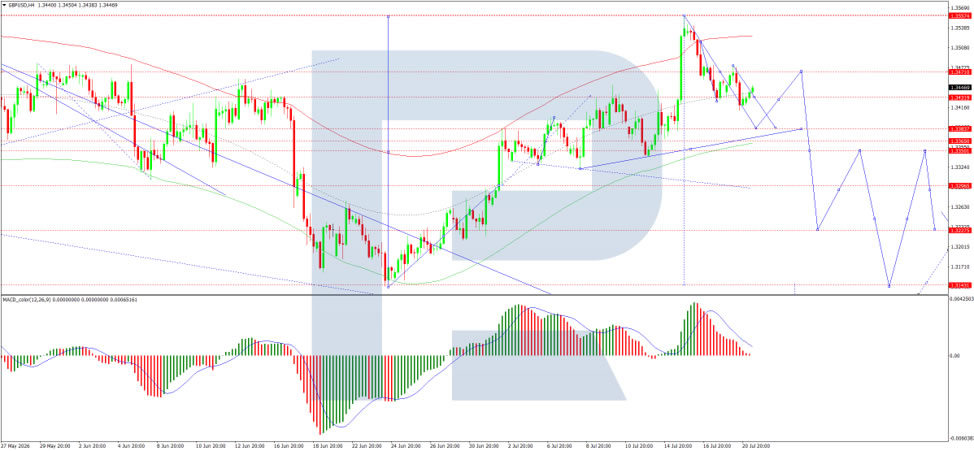
On the H4 GBP/USD chart, the market is moving lower towards 1.3380. A wide consolidation range is forming around the 1.3468 level. An upside breakout from this range would open the way for a move towards 1.3520, while a downside breakout would suggest a decline towards 1.3380, with scope for the trend to extend to 1.3222. The MACD indicator supports this scenario, with its signal line above zero and pointing firmly downwards, reflecting continued bearish momentum.
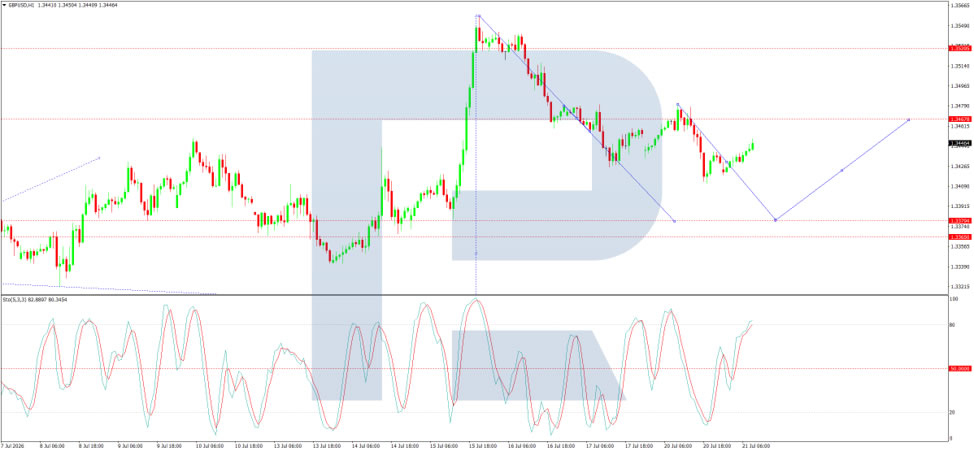
On the H1 chart, the market has formed a compact consolidation range around the 1.3468 level, currently extending down to 1.3414. A move higher towards 1.3455 is expected, followed by a decline to 1.3380. The Stochastic oscillator confirms this scenario, with its signal line below 80 and pointing downwards towards 20, indicating increasing short-term downside pressure.
Conclusion
Sterling has retreated as markets digest the transition of power to Prime Minister Andy Burnham, who has reaffirmed fiscal discipline while signalling a possible increase in the tax-free allowance. Investors are now focused on the appointment of the new Chancellor, with Shabana Mahmood reportedly the frontrunner. Meanwhile, elevated oil prices continue to stoke inflation risks, reinforcing expectations that the Bank of England will maintain higher interest rates for longer. Technically, the pound appears poised for further downside towards 1.3380, with the broader outlook dependent on upcoming fiscal announcements and the trajectory of global energy prices.
Silver Attempts to Break Out of Its Range
Silver continues to balance between its dual role as an industrial metal and so-called refuge asset, and this combination largely explains the lack of a clear trend in recent weeks. Shifting expectations for central bank interest rates can influence the appeal of a non-yielding asset such as silver, while the structural supply deficit remains supported by growing investment demand, offsetting more subdued industrial consumption. These opposing forces help explain why silver prices continue to trade within a broad range, with the market still lacking a decisive catalyst for a sustained directional move.
XAG/USD: Technical Picture
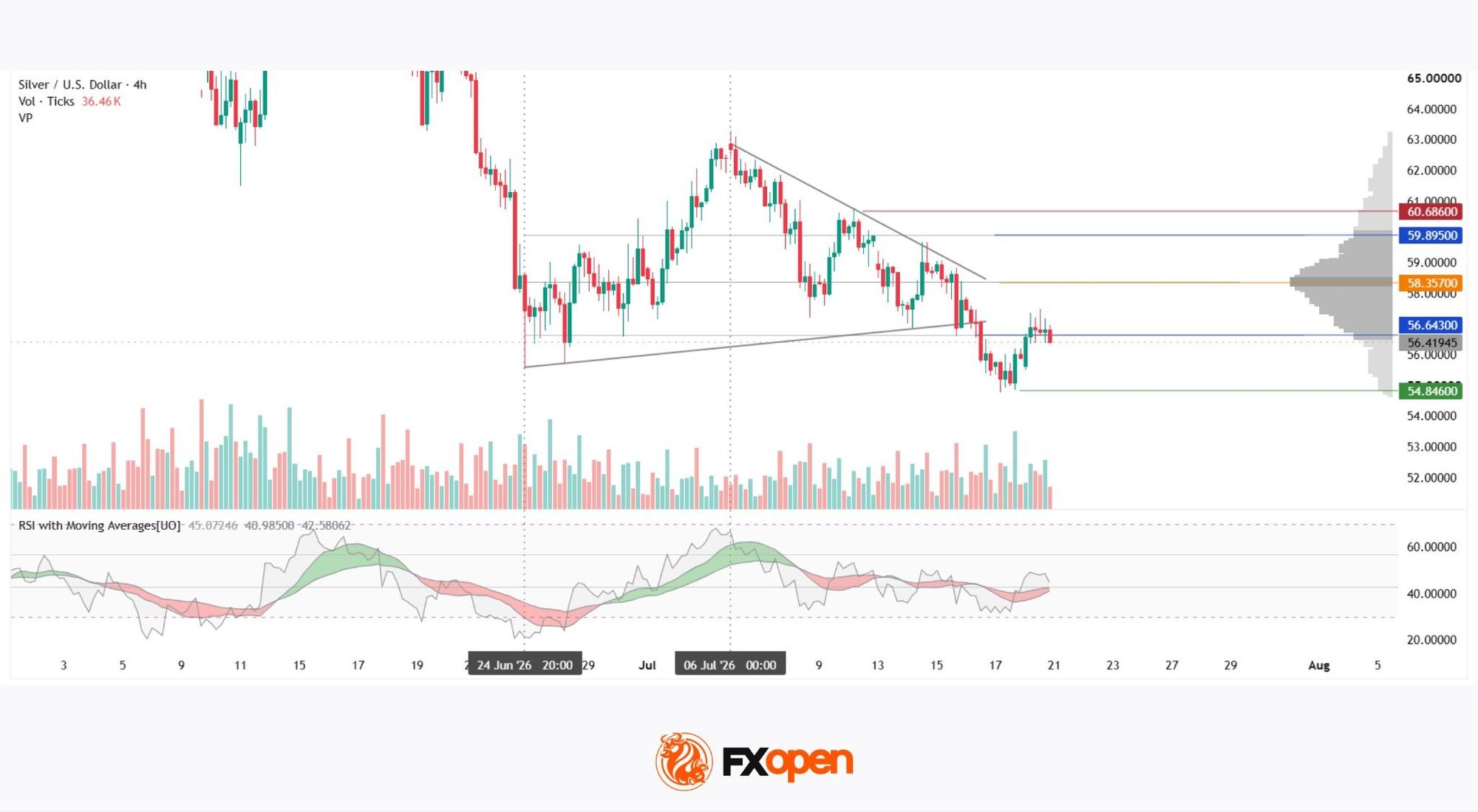
On the four-hour chart, silver (XAG/USD) is trading within a structure resembling a triangle. The descending trendline connects the swing highs formed after the peak near $63.000, while the ascending trendline links the series of higher lows from the $56 area. Their convergence coincides with the current high-volume area of the market profile.
Following an attempted breakout, the price is now testing the lower boundary of the profile at $56.643 from below. If this level continues to act as resistance, the next notable support could be found near $54.846.
Should the price move back into the range, the Point of Control (POC) at $58.357 and the upper boundary of the profile at $59.895 could become the primary upside reference levels, followed by the red resistance level at $60.686.
At the same time, vertical volume has not shown the decline in trading activity that is typically associated with a triangle pattern as the range narrows. The RSI + MAs indicator currently shows readings of 45, 40, and 42. The moving averages remain red, are pointing higher, and are positioned just below the neutral zone, while the RSI line itself has yet to break out of that neutral range.
Summary
The attempted breakout from the triangle has so far failed to gain momentum, with the price returning to the market profile boundary. Meanwhile, the RSI + MAs indicator does not yet confirm either a bullish or bearish scenario. The Federal Reserve meeting on 28–29 July could become the next major catalyst, potentially determining the market's next directional move.
Start trading commodity CFDs with tight spreads (additional fees may apply). Open your trading account now or learn more about trading commodity CFDs with FXOpen.
This article represents the opinion of the Companies operating under the FXOpen brand only. It is not to be construed as an offer, solicitation, or recommendation with respect to products and services provided by the Companies operating under the FXOpen brand, nor is it to be considered financial advice.
UK Wage Growth Holds Steady as Payroll Employment Continues to Weaken
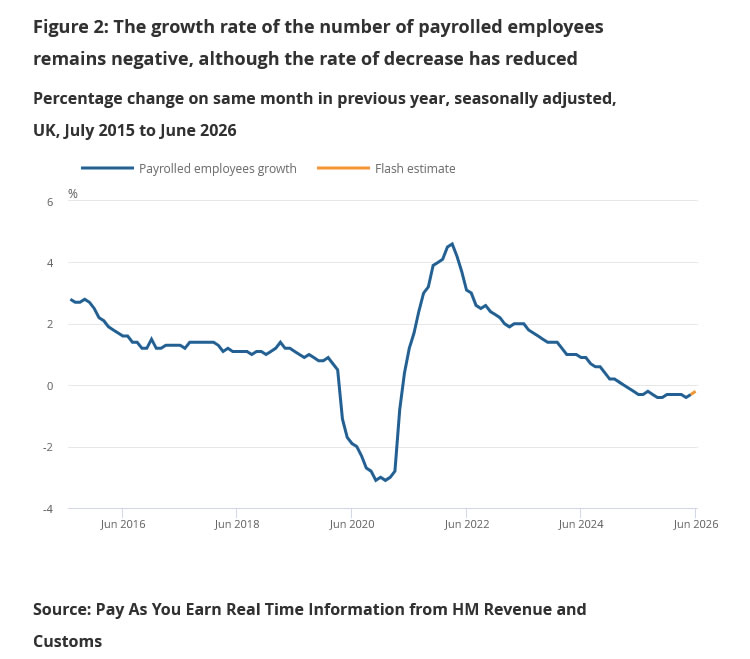
The UK's labour market showed further signs of gradual cooling in June, with payroll employment continuing to edge lower while wage growth remained broadly stable. Early estimates showed the number of payrolled employees fell by -4,000 from May and was down -71,000, or 0.2%, from a year earlier. Median monthly pay growth eased to 4.3% year-on-year from 4.6% in May, suggesting wage pressures are continuing to moderate alongside softer hiring conditions.
The broader labour market data for the three months to May painted a similar picture. Average regular earnings excluding bonuses held at 3.4% year-on-year for a third consecutive period, extending the marked slowdown from the 5.9% pace recorded in early 2025 and reaching the weakest growth since late 2020. Total earnings, including bonuses, rose 4.3%.
Meanwhile, the employment rate edged up to 75.1% over the quarter, while the unemployment rate slipped to 4.9% from the previous three-month period, indicating that labour market conditions remain relatively resilient despite slower wage growth.
Overall, continued moderation in pay growth should provide reassurance to the Bank of England that domestically generated inflation pressures are easing, although wage growth remains above levels fully consistent with the 2% inflation target.
Labour Market Data
| Indicator | Actual | Expected | Previous |
|---|---|---|---|
| Claimant Count Change (Jun) | 6.7K | 29.4K | 31.2K |
| ILO Unemployment Rate (3M/May) | 4.9% | 4.9% | 4.9% |
| Average Earnings ex Bonus (3M/Y May) | 3.4% | 3.4% | 3.4% |
| Average Earnings incl Bonus (3M/Y May) | 4.3% | 4.5% | 4.4% |
Market Takeaways
- The labour market continued to cool, but there were no signs of a sharp deterioration.
- Payroll employment declined by 71,000 year-on-year, while June payrolls were broadly unchanged from May (-4,000).
- Median monthly pay growth eased to 4.3% y/y in June from 4.6%, reinforcing the trend of moderating wage inflation.
- Regular wage growth held at 3.4% for a third consecutive period, the slowest pace since late 2020.
- Claimant count rose by 6.7K, well below expectations of 29.4K, suggesting layoffs remain relatively contained.
AUDUSD: Scenario for a Possible Continuation Move Higher
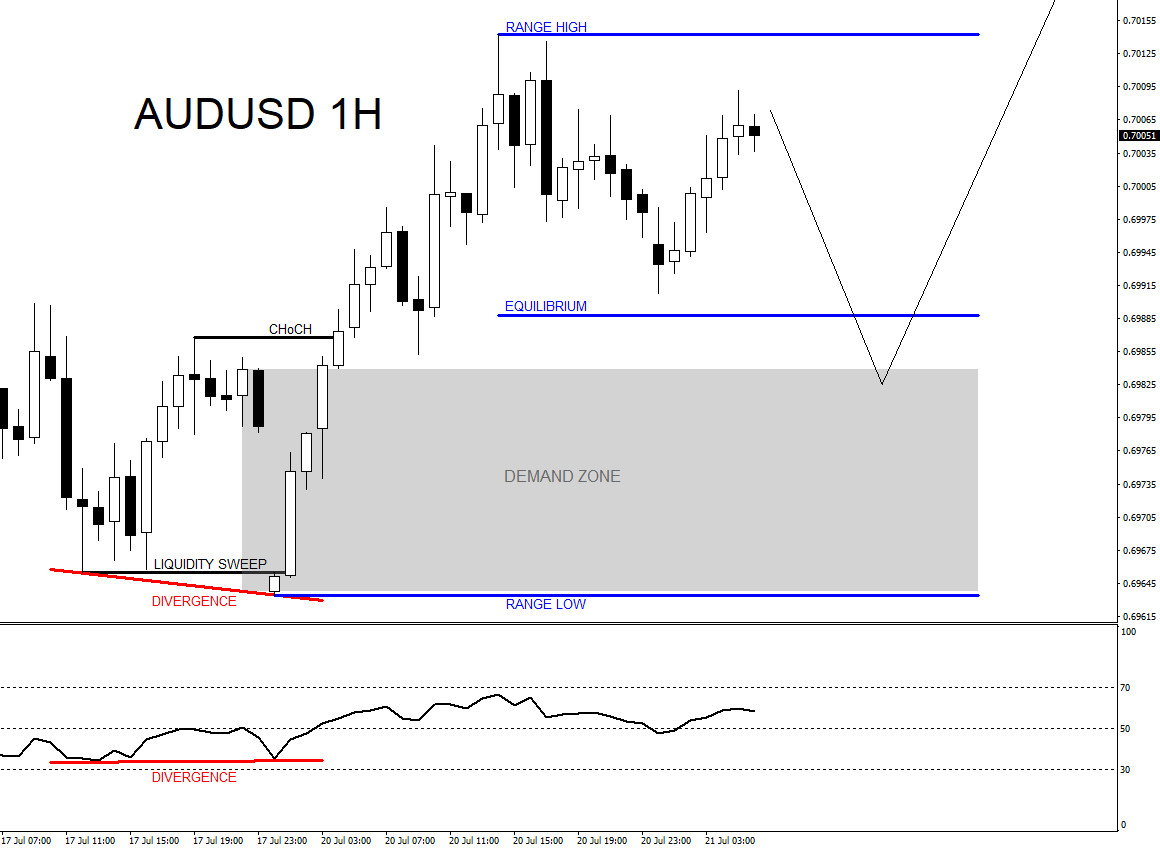
AUDUSD Possible Bullish Scenario:
- Watch for price to get below the equilibrium level first.
- Wait for price to tap demand zone.
- Watch for a bullish shift and bullish reversal signs in the demand zone.
- Wait for all above to play out first then plan the sell entry, stops and targets with confidence.
If price continues higher above the range high without tapping below the equilibrium level or demand zone then trade setup is cancelled.
AUDUSD 1 Hour Chart July 20 2026
 A trader should always have multiple strategies all lined up before entering a trade. Never trade off one simple strategy. When multiple strategies all line up it allows a trader to see a clearer trade setup. We at EWF never say we are always right. No market service provider can forecast markets with 100% accuracy. Only thing we at EWF 100%, is that we are RIGHT more than we are WRONG.
Of course, like any strategy/technique, there will be times when the strategy/technique fails so proper money/risk management should always be used on every trade. Hope you enjoyed this article and follow me on social media for updates and questions> @AidanFX
At Elliottwave-Forecast we cover 78 instruments (Forex, Commodities, Indices, Cryptos, Stocks and ETFs) in 4 different time frames and we offer 5 Live Session Webinars everyday. We do Daily Technical Videos, Elliott Wave Trade Setup Videos and we have a 24 Hour Chat Room. Our clients are always in the loop for the next market move.
USD/CAD Climbs as Trump Expands Tariffs Beyond USMCA Protections
The latest US tariffs on Canadian goods may be relatively modest in size, but the market reaction suggests investors are focusing on something bigger than the immediate trade impact. USD/CAD advanced after US President Donald Trump signed three proclamations imposing 50% tariffs on about $20 billion of Canadian exports, including alcohol, dairy products, motor vehicles, cement, hockey equipment and electrical machinery. The measures will take effect in roughly 30 days and, notably, apply regardless of compliance with the US-Mexico-Canada Agreement (USMCA, known as CUSMA in Canada), while exempting energy, potash, critical minerals and products already subject to Section 232 duties.
The significance lies less in the sectors affected than in what the latest move says about US trade policy. Since early 2025, Washington has repeatedly expanded tariffs on Canadian goods using different legal authorities rather than relying on the framework established by USMCA. Each new measure reinforces the perception that the agreement is providing less practical protection against unilateral trade actions. As a result, markets are increasingly treating US-Canada trade friction as a structural issue rather than a series of isolated disputes, adding another headwind to Canada's economic outlook just as uncertainty surrounding the formal USMCA review continues to build.
Canada's response has so far stopped short of matching Washington's escalation. Prime Minister Mark Carney reiterated his preference for negotiations and emphasized strengthening Canada's domestic economy, while Ontario Premier Doug Ford urged Ottawa to retaliate "tariff for tariff, dollar for dollar." Whether the federal government adopts a more confrontational stance will likely determine how far trade tensions escalate. For now, the new tariffs represent another obstacle for the Canadian Dollar, particularly if investors begin pricing a more prolonged drag on growth.
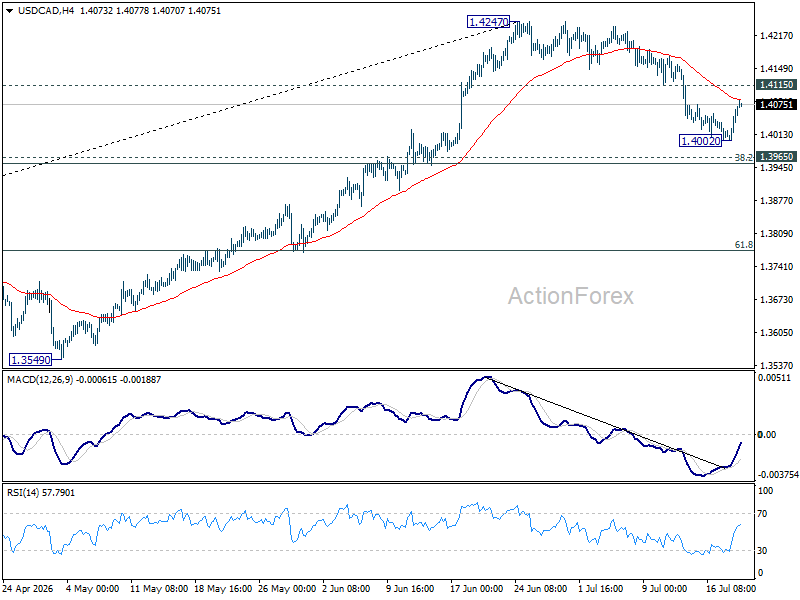
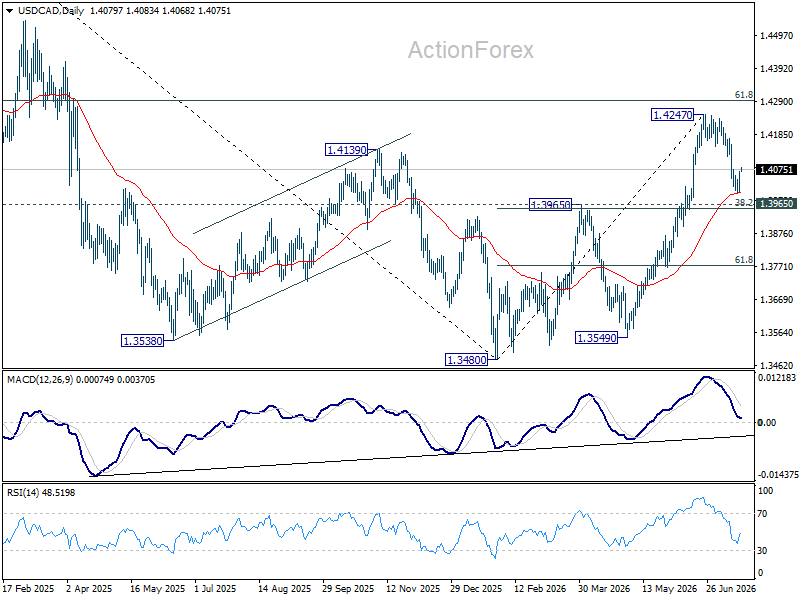
Technically, USD/CAD is also sending a constructive signal for Dollar bulls. The rebound from 1.4002 followed successful tests of both 55 D EMA (now at 1.4002) and 1.3965 cluster support (38.2% retracement of 1.3480 to 1.4247 at 1.3954), suggesting the decline from 1.4247 was corrective rather than the start of a broader reversal. Firm break above 1.4115 minor resistance would strengthen the case that the broader uptrend from the 2026 low at 1.3480 is resuming, bringing another challenge of the 1.4247 high into view.
AUD/USD Marches Higher as Bulls Target the Next Breakout
Key Highlights
- AUD/USD started a steady increase above 0.6950 and 0.6975.
- A key bullish trend line is forming with support at 0.6950 on the 4-hour chart.
- Gold prices declined and might dip below $3,950.
- USD/JPY could gain bullish momentum if it settles above 162.70.
AUD/USD Technical Analysis
The Aussie Dollar started a fresh increase from 0.6865 against the US Dollar. AUD/USD climbed above 0.6900 and 0.6950 to enter a positive zone.
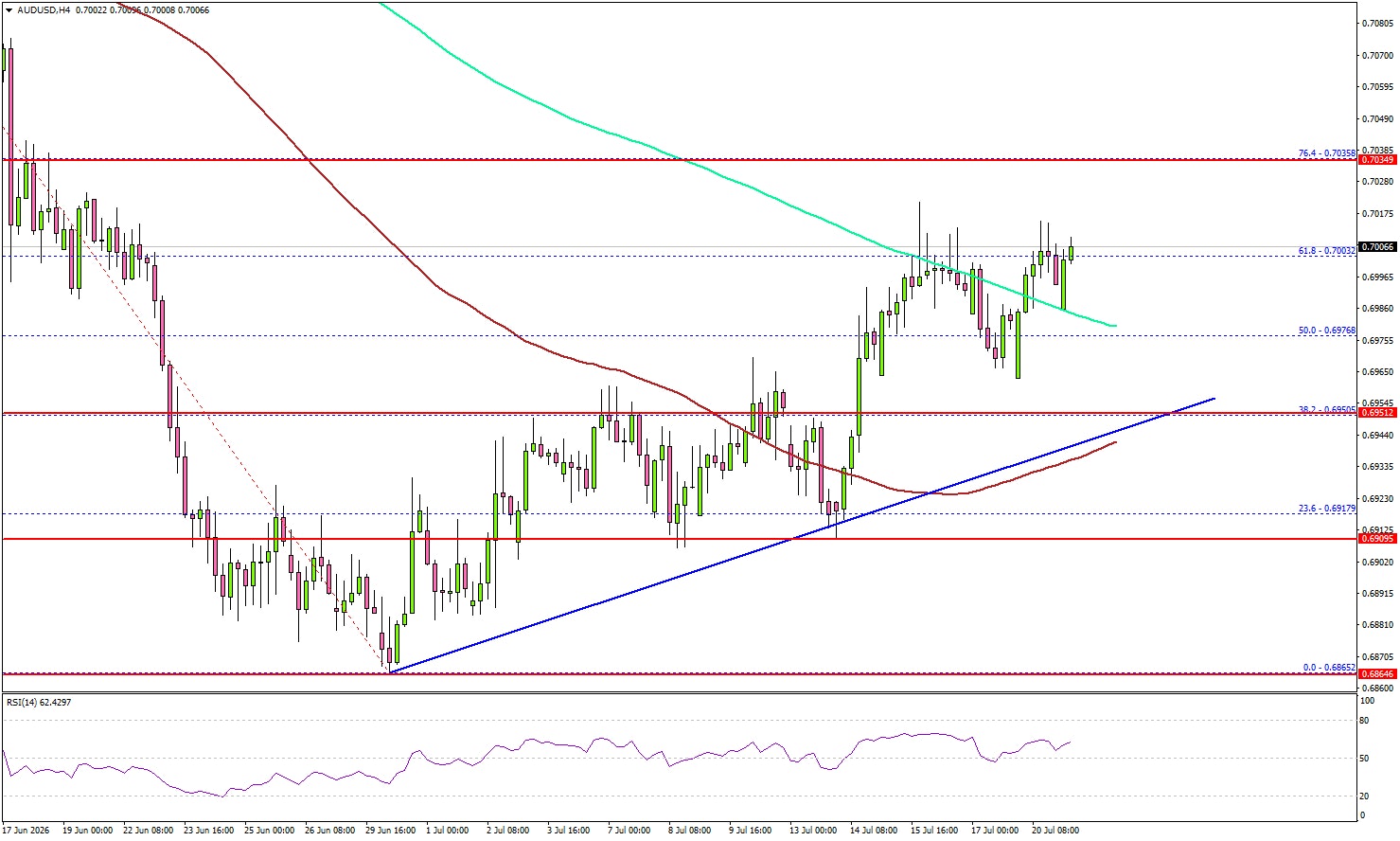
Looking at the 4-hour chart, the pair cleared many hurdles near the 50% Fibonacci retracement level of the downward move from the 0.7088 swing high to the 0.6865 low. The pair also settled above the 100 simple moving average (red, 4-hour) and the 200 simple moving average (green, 4-hour).
On the upside, the pair could face resistance near the 76.4% Fibonacci retracement level at 0.7035. The next major resistance might be 0.7050. A close above 0.7050 could start a steady increase.
In the stated case, the bulls could aim for a move to 0.7120. Any more gains might open the doors for a test of 0.7200. If there is a downside correction, the pair might find bids near 0.6965.
The first major support could be near 0.6950. There is also a key bullish trend line forming with support at 0.6950. A downside break and close below 0.6950 might send the pair toward 0.6910. Any more losses could open the doors for a test of 0.6865.
Looking at Gold, the bears remained in action below $4,150, and they might even target a move below $3,950.
Upcoming Key Economic Events:
- US ADP Employment Change 4-week Average - Forecast 18K, versus 19.75K previous.
New Zealand CPI Hits 4.1% as Fuel Costs Reinforce RBNZ Challenge
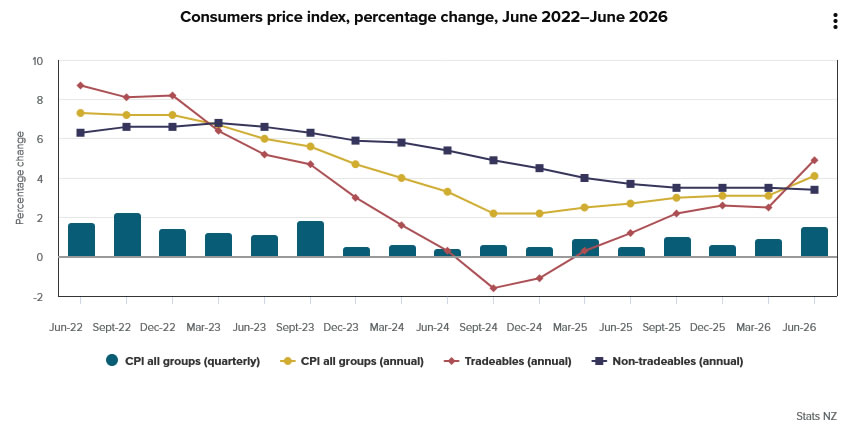
New Zealand's consumer prices rose 1.5% qoq in the second quarter, lifting annual inflation to 4.1% from 3.1%, in line with market expectations. The acceleration was driven overwhelmingly by energy-related costs, with petrol prices surging 20.1% over the quarter and contributing nearly half of the quarterly increase in the Consumer Price Index. Prices for other vehicle fuels and lubricants climbed 47.7%, while higher housing construction costs also added to inflation. Offsetting factors included lower fruit prices and a decline in domestic accommodation costs, but these were insufficient to counter the sharp rise in fuel-related expenses.
The breakdown suggests imported inflation remains the dominant driver of current price pressures. Annual tradeable inflation accelerated to 4.9%, reflecting the impact of higher global energy prices, with petrol and other vehicle fuels accounting for the majority of the increase.
By contrast, non-tradeable inflation stood at 3.4%, well below the headline rate. Domestic inflation pressures were led by higher electricity prices and local authority rates, while declines in dairy products and real estate services helped contain broader price growth.
The divergence between tradeable and non-tradeable inflation indicates that the latest acceleration is being driven primarily by external cost shocks rather than a broad-based resurgence in domestic demand.
For the Reserve Bank of New Zealand, the report is unlikely to settle the policy debate. The headline reading exceeded the RBNZ's own 3.9% projection, but the details suggest much of the upside came from fuel prices rather than a widespread reacceleration in underlying inflation. Even so, policymakers are likely to remain cautious given the renewed rise in global oil prices following the escalation in the Middle East. If elevated energy costs begin feeding more broadly into domestic prices over coming quarters, the case for additional policy tightening would strengthen.
Economic Data
| Indicator | Actual | Expected | Previous |
|---|---|---|---|
| CPI Q/Q | 1.5% | 1.5% | 0.9% |
| CPI Y/Y | 4.1% | 4.0% | 3.1% |
| Tradeable Inflation Y/Y | 4.9% | — | 2.5% |
| Non-tradeable Inflation Y/Y | 3.4% | — | 3.5% |
Market Takeaways
- Headline inflation accelerated to 4.1% yoy, slightly above expectations and above the RBNZ's 3.9% forecast.
- The increase was overwhelmingly driven by fuel-related prices, with petrol and other vehicle fuels contributing more than half of the quarterly rise in CPI.
- Tradeable inflation (4.9%) outpaced non-tradeable inflation (3.4%), indicating imported cost pressures was the dominant driver.
- Domestic inflation pressures were more moderate, led mainly by electricity prices and local authority rates rather than broad-based demand.
- The report keeps the RBNZ on alert, but the policy outlook will depend on whether higher energy costs begin feeding into wages and broader domestic inflation over coming quarters.
First Impressions: NZ Consumer Prices, June Quarter 2026
Consumer prices rose 1.5% in the June quarter. That saw the annual inflation rate rise to 4.1%. The result was in line with our forecast but slightly above the RBNZ's July assumption.
Consumers Price Index, June quarter 2026 – key stats
Headline inflation
- Quarterly change: +1.5% (prev: +0.9%)
- Westpac forecast: +1.5%
- Market median: +1.5%, range +1.3% to +2.0%
- Annual change: +4.1% (prev: +3.1%)
- Westpac forecast: +4.1%, RBNZ: +3.9%, Market: +4.0%
Non-tradables
- Quarterly change: +0.6% (prev: +1.1%)
- Westpac forecast: +0.6%
- Annual change: +3.4% (prev: +3.5%)
Tradables
- Quarterly change: +2.7% (prev: +0.7%)
- Westpac forecast: +2.6%
- Annual change: +4.9% (prev: +2.5%)
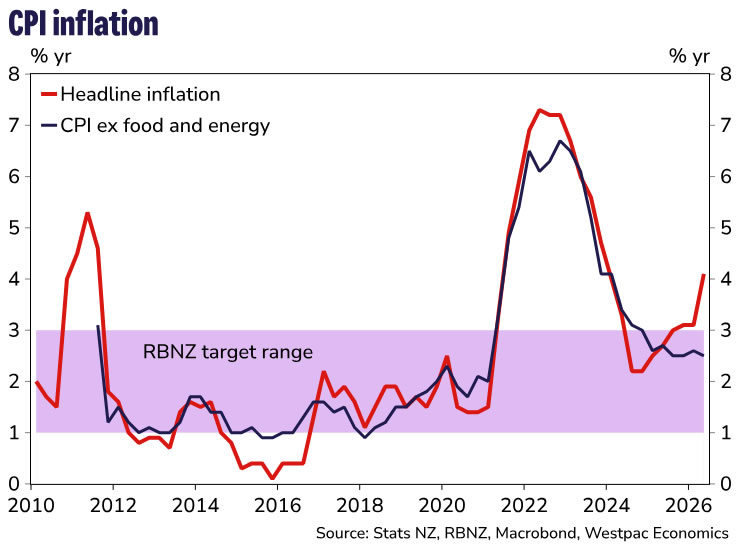
Consumer prices rose 1.5% in the June quarter. That saw the annual inflation rate rising to 4.1% – up from 3.1% in the year to March and the highest level in two years. The result was in line with our forecast.
The result was slightly above the RBNZ's updated July forecast for 3.9% annual inflation. However, much of that surprise is likely related to volatile items like holiday accommodation. Consequently, today's result will not be a major surprise to the RBNZ.
Much of the rise in inflation has been due to increases in global oil prices. Under the surface, core inflation has been softening, but it remains above the RBNZ's 2% target midpoint. That's despite the downturn in economic growth and softness in the labour market.
With core inflation softening, the result was not as worrying as the RBNZ might have feared. But inflation is still high. We continue to expect further OCR hikes at the September and December meetings.
What contributed to inflation in the June quarter?
The main driver of June's spike in consumer prices was the sharp rise in fuel prices since the start of the Middle East war. While prices have dropped back in recent weeks, petrol prices rose 20% over the June quarter and diesel prices were up an eye-watering 47% (together, those costs account for around 4% of the CPI).
Recent months have also seen further large increases in household energy prices (3% of the CPI). Electricity prices rose 4% over the June quarter and are up 12% over the past year. That was slightly lower than the 12.5% rise in the year to March. But before that the last time we saw increases this large was 1989.
Also adding to inflation has been the 0.4% rise in food prices over the quarter (18% of the CPI).
Notably, the June quarter also saw a 1.6% rise in the cost of a newly built home following very muted gains over the past year. Construction firms have reported increases in building costs in recent months, with at least some of that stemming from the increase in global oil prices. That's flowed through to higher transport costs, as well as higher costs for materials like PVC piping.
On the downside, rents were up just 0.1% over the quarter and have risen only 0.5% over the past year. That's the weakest annual rise in rents in more than two decades. With abundant supply and low population growth, average housing rents have shown no growth since late last year, and regions like Wellington have seen outright falls. We expect housing rental growth will remain muted for some time.
Annual and core inflation
The annual inflation rate rose to 4.1% in the June quarter, up from 3.1% in the year to March and the highest level in two years.
Looking under the surface, prices in the domestically oriented non-tradables group rose 0.6% over the quarter (as expected). That saw annual non-tradables inflation edging down just slightly to 3.4%, down from 3.5% last quarter.
While there continues to be firmness in administered prices (like household energy and local council rates), inflation in other domestic prices has been easing. In part, that's due to the softness in housing rents. However, the cooling in domestic prices has been more widespread, with non-tradables excluding housing and utilities costs (which also omits rates) slowing to 3.2% yr, down from 3.5% in the year to March.
On the imported front, tradables prices rose by 2.7% over the June quarter, just slightly more than expected. Tradables prices were up 4.9% over the past year. That's up sharply from the 2.5% rise in the year to March.
Higher fuel costs have been a significant driver of the rise in imported inflation. However, the lower New Zealand dollar is also playing an important role, with the NZD trade-weighted exchange rate down almost 4% over the past year. Excluding food and fuel costs, tradables prices were up 1.9% over the past year – the largest rise since 2023. Furthermore, with significant increases in operating costs in the wake of the Middle East war, imported inflation pressures are set to remain firm over the coming months.
While fuel prices did push inflation sharply higher over the past few months, a key focus for the RBNZ is what's been happening to other prices in the economy. In particular, are we seeing signs of a broader pick-up in inflation pressures?
At this stage, underlying inflation pressures are still looking relatively contained. That was reflected in most of the measures of core inflation, which generally eased slightly over the past few months. (Note: core inflation measures smooth through the quarter-to-quarter swings in inflation and track the underlying trend in prices). In terms of specifics, we saw:
- CPI ex-fuel inflation: +2.9% yr (vs +3.2% previously)
- CPI ex-fuel and food: +2.9% yr (vs +3.0% previously)
- CPI ex-fuel, food and household energy: +2.5% yr (vs +2.6% previously)
- 30% trimmed mean: +2.6% (vs +2.3% previously)
Stats NZ also helpfully provide a measure of inflation excluding food, household energy, vehicle fuels (which still covers two-thirds of the inflation basket). This group rose 2% over the past year, vs 1.9% in the year to March. It's been running around those levels for a year now.
While measures of core inflation are tracking within the RBNZ's target band, they're not 'low'. Despite a sharp slowdown in economic growth and softness in the labour market, the various measures of core inflation have lingered above the 2% midpoint of the RBNZ's target range for an extended period. However, the RBNZ will likely take some comfort from the fact that core inflation is still relatively well contained despite many firms reporting increases in operating costs in recent months.
Outlook
While oil prices have pulled back from their initial highs, ongoing geopolitical tensions could keep them elevated for some time. Consistent with those developments, we expect that headline inflation will linger above 3% through the latter part of the year.
Under the surface, while core inflation has been contained, it has lingered above 2% for some time. Furthermore, recent business surveys point to the risk of a broadening in pricing pressures.
Overall, today's result wasn't as worrying as it could have been, with limited signs of widespread spillover from high oil prices. But inflation is still high. We continue to expect that the RBNZ will deliver further increases in the OCR through the back part of the year. However, the pace of those increases remains dependent on the strength of economic conditions more generally. We think that hikes are most likely at the RBNZ's September and December policy meetings.