

Sample Category Title
EUR/AUD Daily Outlook
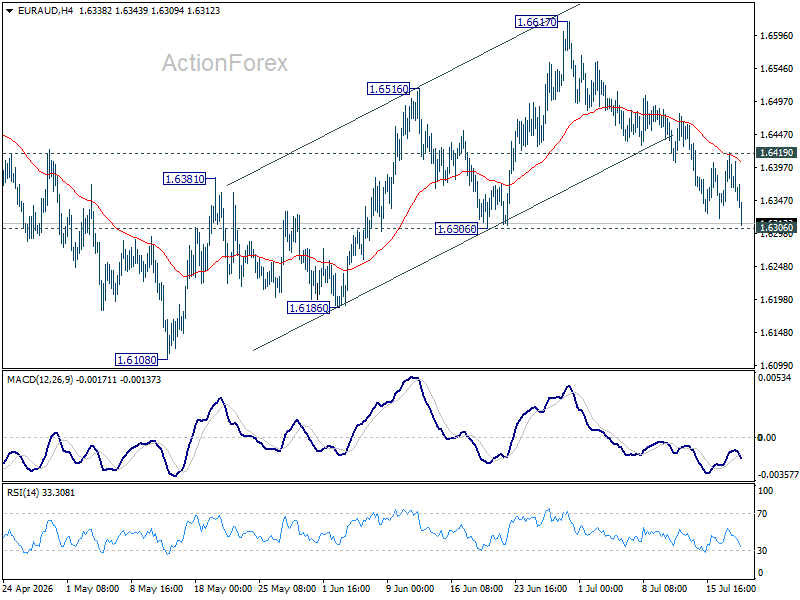
Immediate focus is back on 1.6306 support as EUR/AUD's fall from 1.6617 resumes today. Decisive break there will argue that the rebound from 1.6108 has already completed. Intraday bias will be back to the downside for retest this low. On the upside, above 1.6419 will turn bias to the upside for retesting 1.6617 instead.
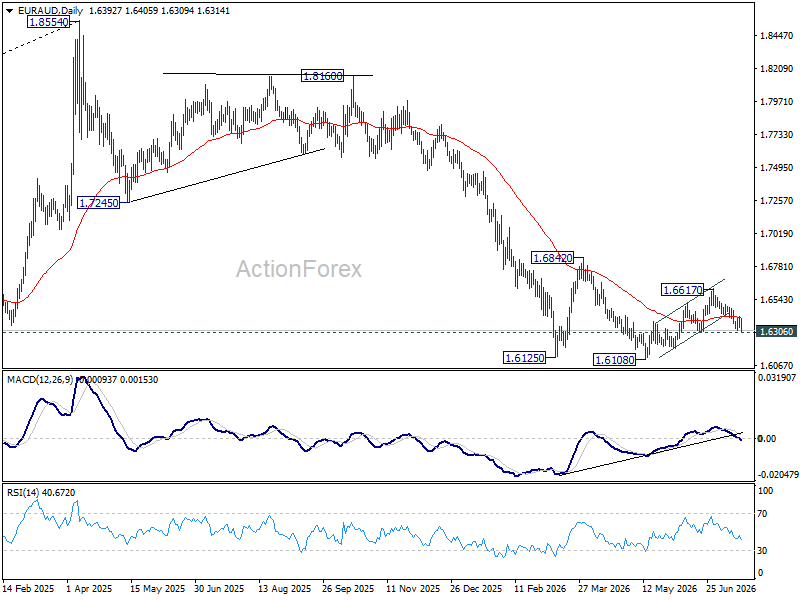
In the bigger picture, outlook will stay bearish as long as 1.6842 resistance holds. Fall from 1.8554 (2025 high) is expected to continue to 61.8% retracement of 1.4281 to 1.8554 at 1.5913. Decisive break there will pave the way back to 1.4281 (2022 low). However, firm break of 1.6842 should confirm medium term bottoming, and bring stronger rally.
EUR/CHF Daily Outlook
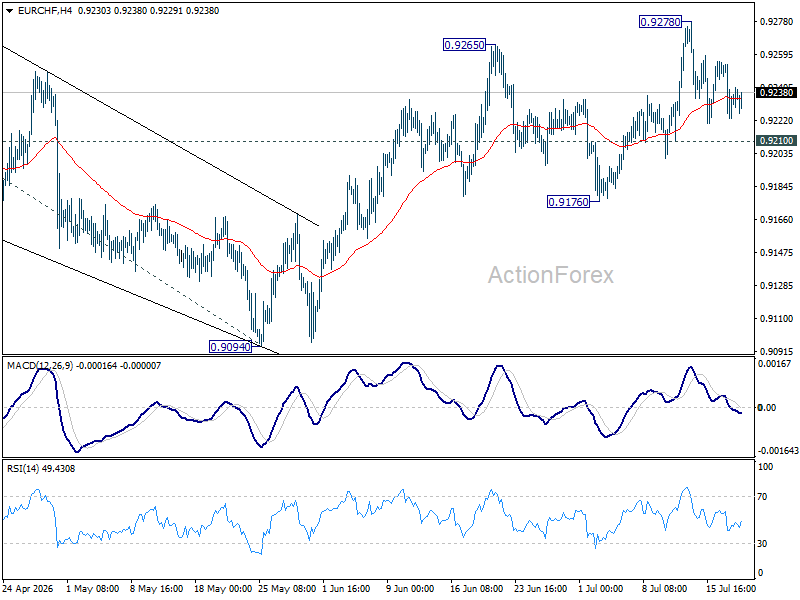
EUR/CHF is still extending consolidations from 0.9278 and intraday bias remains neutral. With 0.9210 support intact, further rally is still in favor. On the upside, break 0.9278 will resume the rise from 0.8979 to 100% projection of 0.8979 to 0.9264 from 0.9094 at 0.9379. However, decisive break of 0.9210 support will turn bias back to 0.9176 support instead.
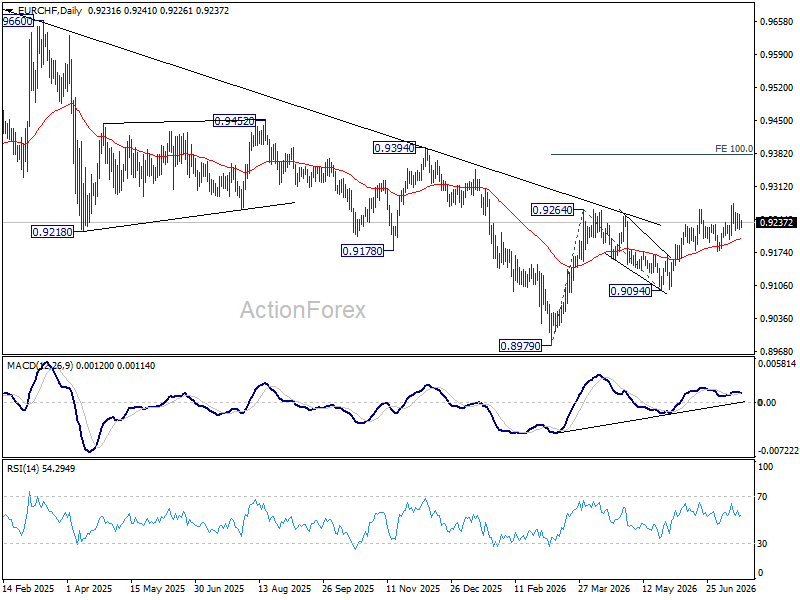
In the bigger picture, the break of medium term falling trend line resistance indicates that 0.8979 is already a medium term bottom. Considering bullish convergence condition in W MACD, rise from there should at least be reversing the fall from 0.9928, with prospect of developing into a medium term up trend. Firm break of 0.9394 resistance will add more credence to this case. For now risk will remain on the upside as long as 0.9094 support holds, in case of retreat.
Bitcoin Is Struggling Against a Glass Ceiling at $65K
Market Overview
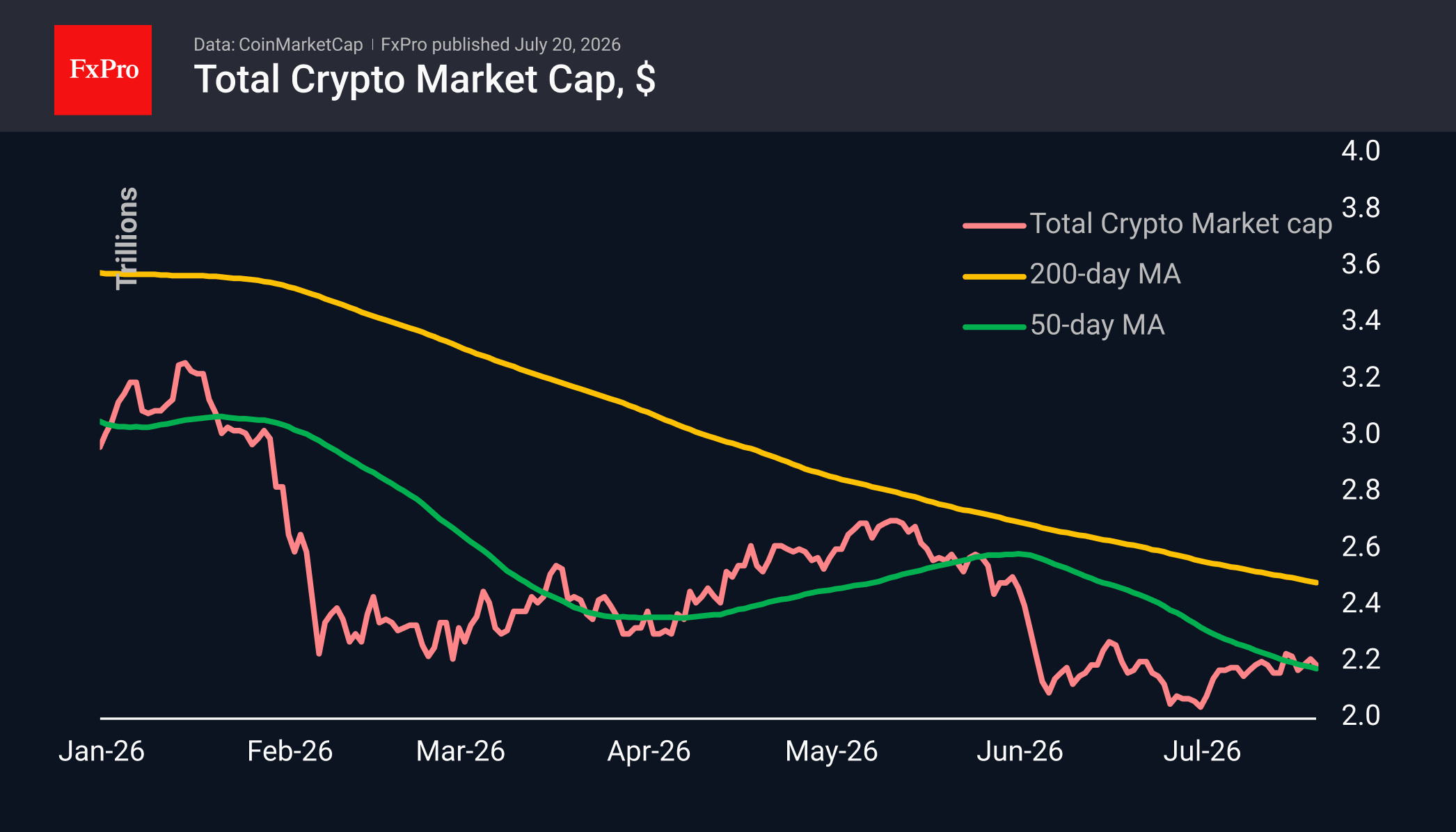
The crypto market remains relatively stable around the $2.20T mark. This is a respectable performance, particularly given the weakness in key stock indices and the downward trend in gold. Market capitalisation is hovering around its 50-day moving average, reflecting the ongoing struggle to shift the trend to a bullish one. Top-tier coins are falling, with Solana, Chainlink and SushiSwap showing the best performance over the last 24 hours by holding their prices steady. The sharpest declines were seen in Zcash (-5.3%), Filecoin (-4.6%) and OfficialTrump (-1.6%).
The sentiment index has risen to 29, continuing to climb within the ‘fear’ zone and reaching a new local high not seen since late May. We would remind readers, however, that a return to neutral territory is normal for this index, and it is premature to speak of the end of the bear market until the index has firmly established itself above 50.
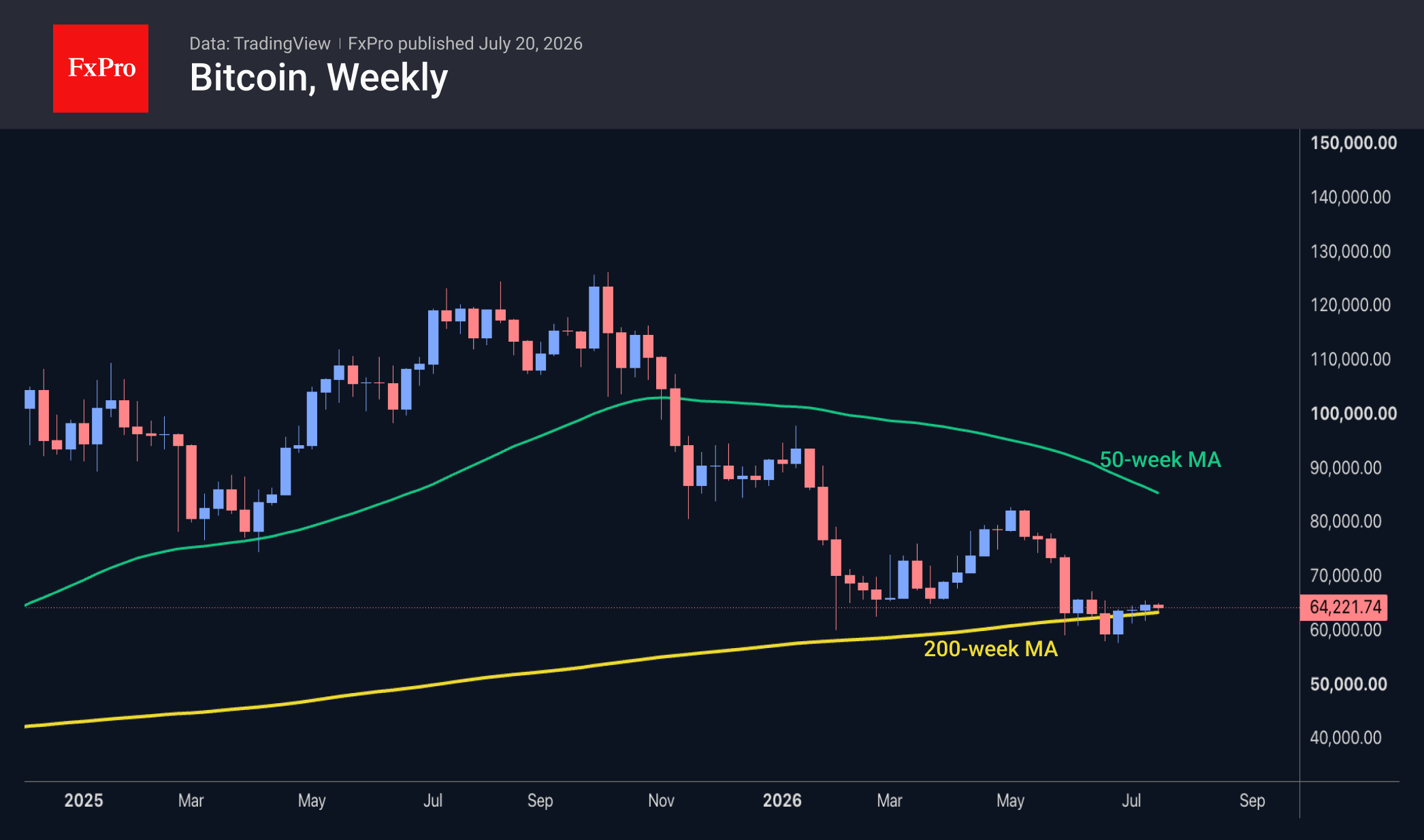
Bitcoin is testing a glass ceiling near $65K, without yet saturating sellers and avoiding significant pullbacks. At the end of last week, the price returned to the area above the 50-day moving average and remains anchored near the 200-week moving average, which is itself trending upwards. This is a good sign that the systematic sell-off is coming to an end and will be followed by stabilisation. Although there are risks of a deeper decline due to external factors, the exhaustion of internal drivers of the downtrend and outperformance relative to equities are significant positives that were lacking at the start of the year.
News Background
A modest inflow into US spot Bitcoin ETFs has continued for a second week after eight weeks of significant outflows, totalling $75.7 million.
Weekly inflows into spot Ethereum ETFs in the US have also continued for a second week following eight weeks of outflows, totalling $105.4 million.
According to Coinglass, the Coinbase Bitcoin Premium Index has been in negative territory for 60 consecutive days — an all-time record. The indicator is often used to gauge the sentiment of US retail investors: the lower it is, the weaker the interest in the asset.
Payment giant Visa has unveiled the VSP stablecoin platform for transactions involving ‘stablecoins’, designed for banks and fintech companies. The platform supports the issuance, redemption, custody and transfer of assets within a single interface.
The ECB warns that the growing use of stablecoins could lead to a decline in retail bank deposits. Banks are already losing commission income and payment data due to the spread of such services.
The FxPro Analyst Team
USD/JPY Poised to Continue Gains as Expensive Oil and Lack of Support Weigh on Yen
USD/JPY opens the week at 162.36 on Monday. The Japanese yen remains near its lowest level since 1996. Pressure on the currency is being exerted by a strengthening US dollar and a sharp rise in oil prices amid escalating conflict in the Middle East.
The US military launched new airstrikes on Iran following the deaths of three American troops. Tehran has stated that the ceasefire has effectively ceased to operate. Over the weekend, Iranian forces intercepted four vessels passing through the Strait of Hormuz.
Japan is heavily dependent on oil supplies from the Middle East, making it particularly vulnerable to regional disruptions and rising energy costs. Expensive oil worsens the country's trade balance and intensifies pressure on the yen.
Investors have yet to see decisive action from Tokyo to support the currency. Data on foreign exchange interventions will be released at the end of the month, which may reveal whether Japanese authorities were behind the yen's abrupt-though brief-strengthening in recent weeks.
Technical Analysis
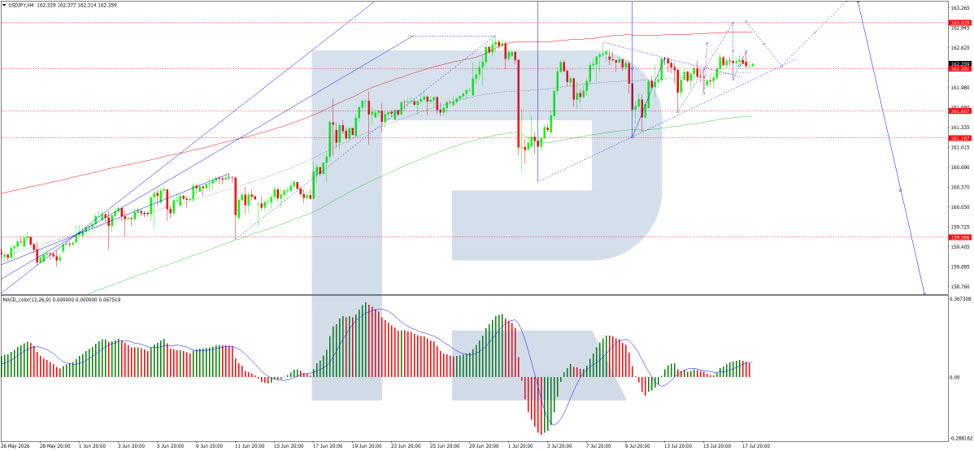
On the H4 USD/JPY chart, the market is forming a consolidation range around the 162.58 level, currently extending up to 162.58 and down to 162.28. A rise to the 163.00 level is expected today, with the prospect of the trend continuing to 163.50. Technically, this scenario is confirmed by the MACD indicator, whose signal line is above the zero level and pointing strictly upwards.
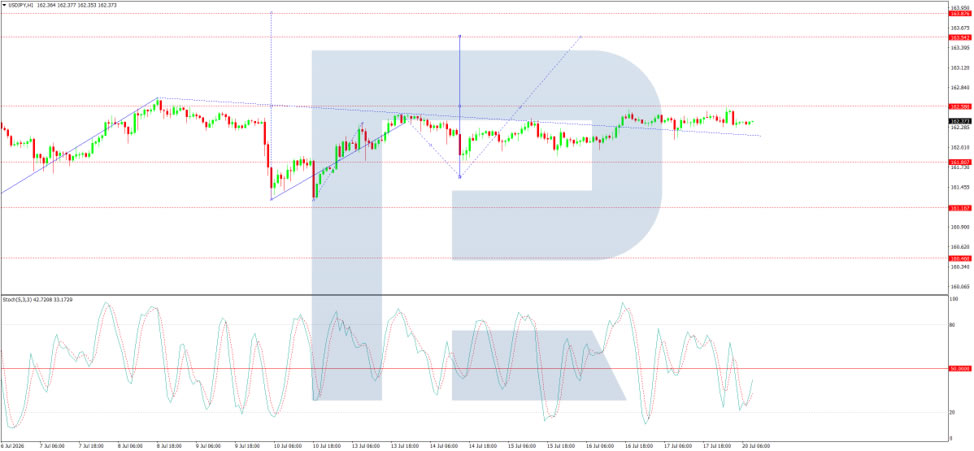
On the H1 chart, USD/JPY has completed a downward wave structure to the 162.28 level. A wave extension to 162.00 cannot be ruled out. Thereafter, the start of a growth wave to at least 163.00 is expected. A breakout above this level would open potential for a continuation of the growth wave to 163.50. Technically, this scenario is confirmed by the Stochastic oscillator, whose signal line is below the 50 level and pointing strictly upwards to 80, indicating short-term upward momentum.
Conclusion
USD/JPY remains elevated as the yen stays near multi-decade lows, weighed down by a strong dollar, surging oil prices, and escalating Middle East tensions. US airstrikes on Iran and Tehran's interception of vessels in the Strait of Hormuz have heightened geopolitical risks, leaving Japan-a major oil importer-particularly exposed to energy price shocks. Expensive oil worsens Japan's trade balance and adds to the yen's downward pressure. Markets are also awaiting end-of-month intervention data to see if Japanese authorities have been active in supporting the currency. Technically, the pair appears poised for further gains towards 163.00 and potentially 163.50, though intervention risks remain a wildcard for yen bulls.
Silver Bears Miss Their Chance as Oil Rally Fails to Extend Selling
Silver briefly slipped below the key $55 level on Friday but quickly regained its footing as the new week began, despite Brent crude gapping above $90 following another escalation in the US-Iran conflict. The lack of additional selling is notable. Throughout last week, higher oil prices fueled expectations of renewed inflation pressure, lifting Treasury yields and the Dollar while weighing on precious metals. Yet even after another round of geopolitical deterioration over the weekend, silver failed to attract fresh downside momentum, suggesting much of the bearish repricing had already taken place.
Why didn't silver extend its decline?
The answer lies in how markets interpreted the latest developments. Brent had already surged more than 17% last week, its biggest weekly gain since April, meaning investors had substantially priced in the risk of a prolonged disruption to Middle East oil supplies. The weekend headlines largely reinforced that narrative rather than introducing a fresh shock. At the same time, Brent itself struggled to build on its initial break above $90 during Asian trading, helping stabilize broader inflation expectations. As oil retreated back below $90, silver recovered further, indicating that bearish conviction is beginning to fade even though macro conditions remain challenging.
Can diplomacy prevent another wave of selling?
There are still reasons for markets to avoid pricing the most disruptive outcome. Iranian Foreign Ministry spokesman Esmail Baghaei said negotiations with the US could continue if they serve Iran's national interests, adding that intermediaries have continued exchanging messages despite the latest US strikes and military casualties. Those comments keep diplomacy alive and support the view that the Strait of Hormuz blockade could ultimately prove temporary rather than permanent. However, the path remains highly uncertain. If negotiations fail to produce visible progress over the coming days and Brent resumes its advance toward $100, markets would likely rebuild inflation expectations once again, lifting yields and the Dollar while exposing silver to another round of selling pressure.
What does the technical outlook suggest?
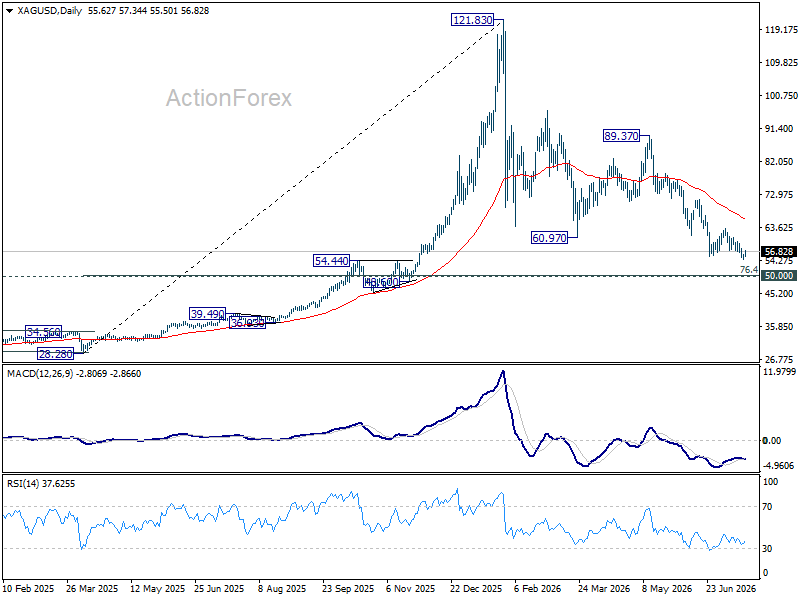
Technically, the broader near-term outlook remains bearish as long as resistance at 59.66 caps rebounds. Following the break of 55.59 support, the decline from 121.83 is still expected to extend toward the psychological 50 level, which sits close to 76.4% retracement of 28.28 to 121.83 at 50.35.
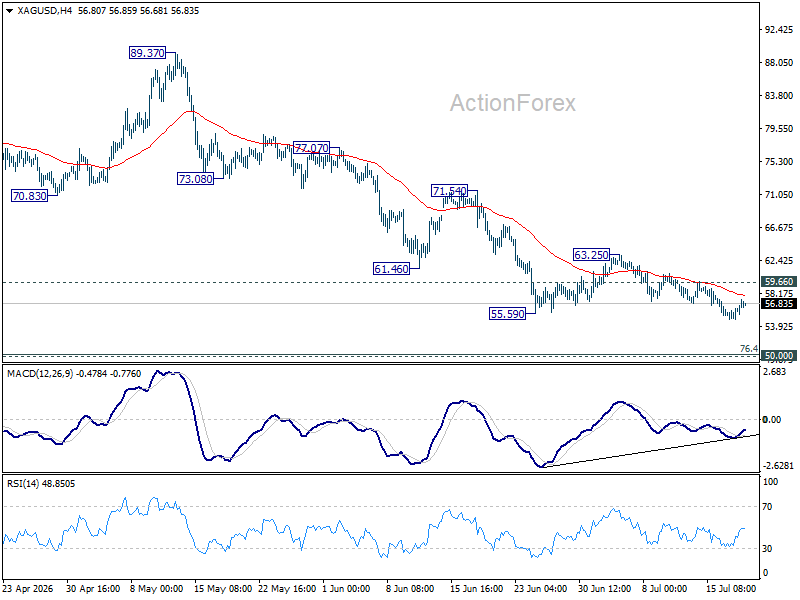
Nevertheless, downside momentum is beginning to show signs of exhaustion. Bullish convergence on the 4H MACD suggests sellers are losing control despite the latest geopolitical headlines. A firm break above 59.66 would confirm short-term bottoming and open the way for a stronger recovery toward 63.25, with scope to extend further to the 55 D EMA, now at 65.76. Such a move would likely coincide with a clearer path toward de-escalation in the Middle East and renewed easing in oil prices.
NASDAQ 100: Is This the Correction Traders Have Been Waiting for?
The Nasdaq 100 (US Tech 100 Mini on FXOpen) remains caught between two opposing forces: cooling inflation on one side, and persistent geopolitical instability on the other. On 14 July, June's CPI print came in softer than expected, easing near-term Fed tightening bets and triggering a broad rebound across tech stocks, particularly semiconductors, which had been under heavy pressure.
That relief, however, has been repeatedly tested by renewed US-Iran hostilities, which pushed oil prices higher and lifted US Treasury yields, weighing on rate-sensitive growth names throughout the week. Every attempt at recovery has coincided with a brief easing of tensions, only for fresh escalations to reintroduce volatility days later.
Beneath the surface, semiconductors remain the index's clearest fault line: even as broader sentiment improves, doubts over the sustainability of AI-driven valuations continue to trigger selective selling in the sector. Meanwhile, SpaceX's addition to the index on 8 July has added a steady stream of passive buying, while the start of earnings season has kept investors' attention split between fundamentals and geopolitics.
Technical Analysis of the Nasdaq 100
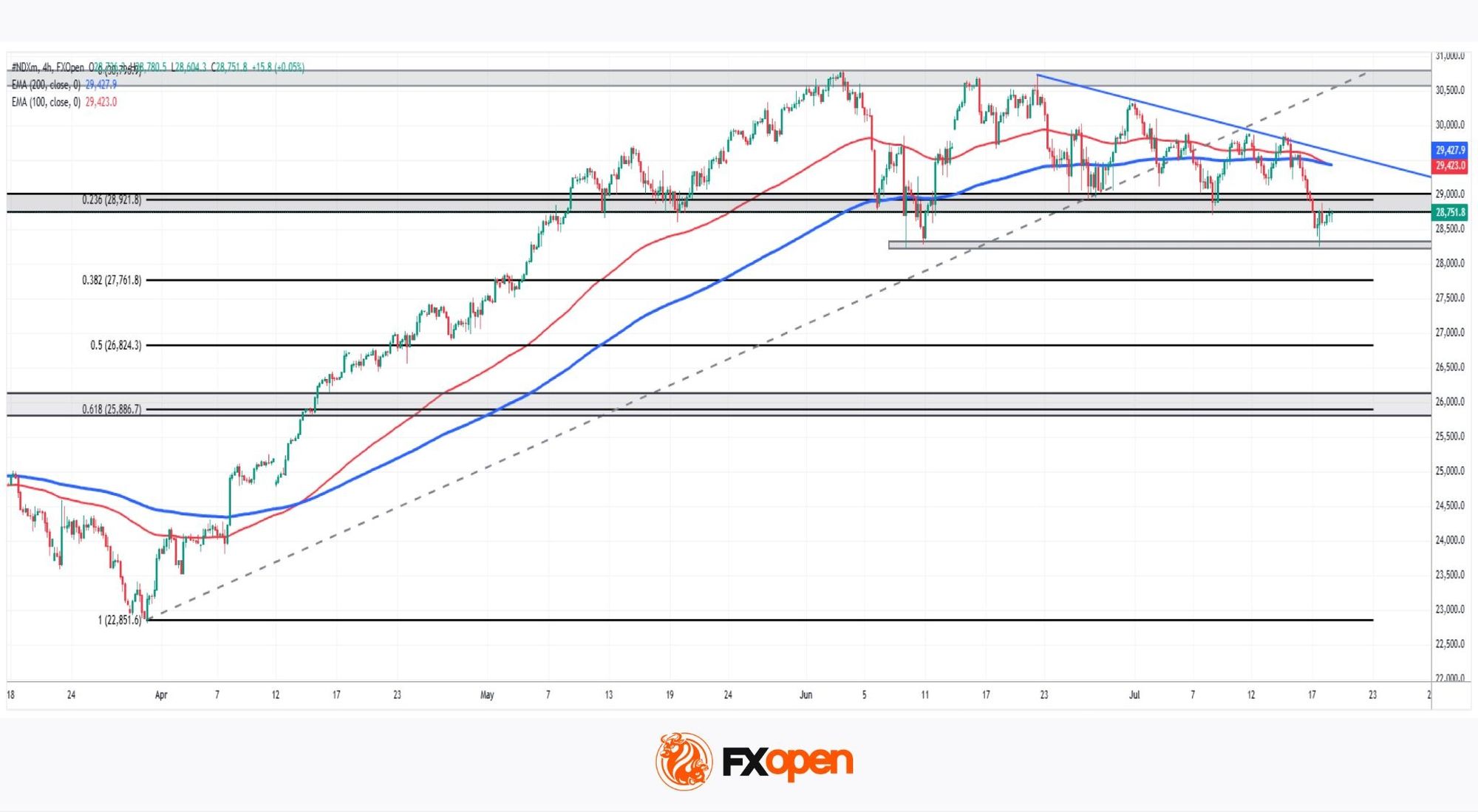
As the chart shows, after testing the 30,000 zone on three separate occasions, the Nasdaq 100 (US Tech 100 Mini on FXOpen) has struggled to build fresh momentum, entering a consolidation phase with a bearish tilt. This is clearly visible in the descending trendline that has been respected for roughly a month, alongside the index's inability to print higher highs.
Bullish Scenario
As with other risk assets, geopolitics remains the primary driver of the index's true direction. Should tensions stay contained rather than escalate further, the Nasdaq has room to extend its recovery. Technically, price finds itself at a decisive juncture: after bouncing from the 28,200-28,300 zone, which had already acted as a floor in early June, the index now faces its first real test at the 28,800-29,000 area. This zone, a former support level now turned resistance, is the key level to watch. A confirmed breakout above it could signal renewed strength and reopen the path back into the broader 29,000-30,000 consolidation range.
Bearish Scenario
With geopolitical risk still running high, sentiment toward risk assets remains fragile. Technically, the Nasdaq 100 (US Tech 100 Mini on FXOpen) appears to have broken down from the two-month consolidation range, losing the 29,000 support in the process. The formation of the descending trendline reflects the index's failure to generate higher highs, a clear sign of underlying weakness. Adding to this picture, the 100- and 200-period EMAs on the 4H chart are now crossing—the same signal that preceded April's strong bullish reversal, this time playing out in the opposite direction.
The 29,000 resistance now holds the key to the next move. Can the Nasdaq 100 (US Tech 100 Mini on FXOpen) reclaim its footing, or is this only the beginning of the correction traders have been waiting for?
Trade global index CFDs with zero commission and tight spreads (additional fees may apply). Open your FXOpen account now or learn more about trading index CFDs with FXOpen.
This article represents the opinion of the Companies operating under the FXOpen brand only. It is not to be construed as an offer, solicitation, or recommendation with respect to products and services provided by the Companies operating under the FXOpen brand, nor is it to be considered financial advice.
ECB SAFE Survey: Loan Conditions Tighten While Inflation Expectations Hold Steady
Euro area firms reported tighter borrowing conditions in the second quarter, even as inflation expectations remained broadly stable and cost pressures continued to ease, according to the ECB's latest Survey on the Access to Finance of Enterprises (SAFE). A net 42% of firms reported higher bank loan interest rates, up sharply from 26% in the previous quarter, while increases in fees, commissions and collateral requirements also persisted, although non-interest financing costs and collateral demands moderated somewhat.
Despite the tighter pricing environment, financing conditions showed little sign of deteriorating materially. Firms reported only a modest increase in demand for bank loans, while overall loan availability remained broadly unchanged. However, the aggregate figures masked a divergence between large companies, which reported improved access to credit, and SMEs, which experienced a further deterioration. At the same time, firms continued to lower their expectations for selling prices, non-labour input costs and wage growth over the next 12 months, while inflation expectations remained well anchored at 3.0% over one and three years, with the five-year expectation edging only slightly higher to 3.1%.
The survey reinforces the ECB's view that restrictive monetary policy continues to restrain financing conditions without triggering a broad credit squeeze. Although geopolitical tensions in the Middle East have prompted many firms to diversify suppliers, improve energy efficiency and build inventories, relatively few have reduced business activity. Meanwhile, investment in artificial intelligence is expected to be financed primarily through internal funds rather than external borrowing, suggesting that higher financing costs are encouraging firms to preserve balance-sheet flexibility. Overall, the findings point to gradually easing inflation pressures alongside resilient corporate activity, supporting the ECB's data-dependent approach to policy while leaving room to maintain a cautious stance.
Data Summary
| Item | Current | Previous |
|---|---|---|
| Bank loan interest rates (net reporting increase) | 42% | 26% |
| Other financing costs (net) | 31% | 37% |
| Collateral requirements (net) | 10% | 14% |
| Financing needs for bank loans (net) | 2% | 0% |
| Bank loan availability (net) | -1% | -3% |
| Bank loan financing gap | 3% | 2% |
| Selling price expectations | 3.2% | 3.5% |
| Non-labour input cost expectations | 5.2% | 5.8% |
| Wage expectations | 2.5% | 2.8% |
| Inflation expectations (1-year) | 3.0% | 3.0% |
| Inflation expectations (3-year) | 3.0% | 3.0% |
| Inflation expectations (5-year) | 3.1% | 3.0% |
Market Takeaways
- Firms reported a sharp increase in bank loan interest rates, highlighting that ECB's restrictive policy is still feeding through to borrowing costs.
- Credit availability remained broadly stable overall, although SMEs continued to face tighter financing conditions than large firms.
- Selling price, wage and input cost expectations all moderated further, reinforcing the broader disinflation trend.
- Inflation expectations remained well anchored across all horizons, with only a marginal uptick in five-year expectations.
- The surve suggests financing conditions remain restrictive while inflation pressures continue to ease.
XRP/USD: Symmetrical Triangle Forms as Trading Volume Fades
On 6 July, Ripple received a full Crypto-Asset Service Provider (CASP) licence under the Markets in Crypto-Assets (MiCA) regulation from Luxembourg's financial regulator, the CSSF. The approval allows the company to offer regulated crypto payment services across all 30 countries of the European Economic Area (EEA). The market reaction was relatively muted, with XRP showing little upside, as the decision appears to have been largely priced in following the preliminary approval announced in June. Another factor to watch is the progress of US digital asset market structure legislation, which may now be delayed until late July or early August and could influence institutional demand for the token.
Technical Picture
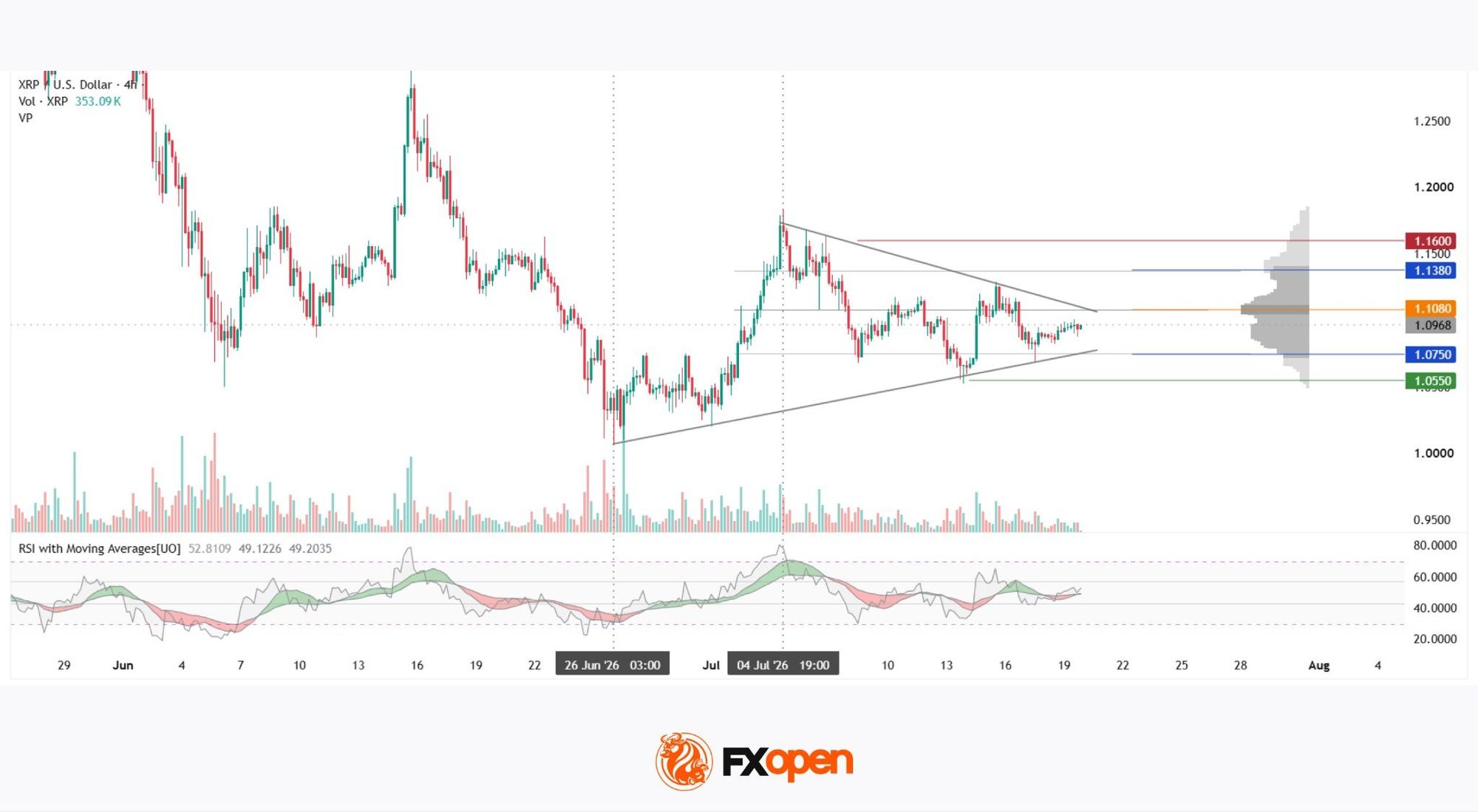
On the four-hour chart, XRP/USD recorded an unusually large spike in vertical volume on 26 June, followed by a bullish reversal that has since developed into a pattern resembling a symmetrical triangle.
The pair is currently consolidating within the current market profile, trading between the lower boundary at $1.0750 and the Point of Control (POC) at $1.1080. If the price breaks below the lower edge of the profile, the next notable support level could be found around $1.0550.
On the upside, a move above the upper boundary of the profile at $1.1380 could bring the $1.1600 area into focus as the next significant resistance zone.
As the triangle continues to develop, vertical trading volume has gradually declined, a pattern that often precedes a stronger directional move. Meanwhile, the RSI + MAs indicator remains neutral, with readings of 52, 49, and 49, showing no clear advantage for either buyers or sellers. The indicator lines are clustered closely together near the midpoint of the neutral zone.
Key Takeaways
The combination of declining volume and neutral RSI + MAs readings suggests that the market is consolidating within the triangle rather than preparing for an immediate breakout. While Ripple's regulatory progress in Europe strengthens the token's longer-term outlook, its impact on the current technical structure remains limited.
FXOpen offers the world's most popular cryptocurrency CFDs*, including Bitcoin and Ethereum. Floating spreads, 1:2 leverage — at your service (additional fees may apply). Open your trading account now or learn more about crypto CFD trading with FXOpen.
*Important: At FXOpen UK, Cryptocurrency trading via CFDs is only available to our Professional clients. They are not available for trading by Retail clients. To find out more information about how this may affect you, please get in touch with our team.
This article represents the opinion of the Companies operating under the FXOpen brand only. It is not to be construed as an offer, solicitation, or recommendation with respect to products and services provided by the Companies operating under the FXOpen brand, nor is it to be considered financial advice.
Brent Oil Above $90: Is $100 Next if Hormuz Blockade Persists?
Brent crude began the week with a gap higher, breaking above the key $90 psychological level as markets reacted to another round of deteriorating developments in the US-Iran conflict. Reports of US fatalities, a strike on a Kuwaiti energy facility, Iran's declaration that the ceasefire was no longer valid, and renewed claims that the Strait of Hormuz had been closed all reinforced expectations that the crisis will remain unresolved in the near term. Yet despite the significant geopolitical backdrop and technically important breakout, buying momentum in Asian trading has been relatively restrained.
Why hasn't Brent rallied more aggressively?
The muted follow-through suggests much of the weekend escalation had already been priced in. Brent surged more than 17% last week, marking its strongest weekly gain since April, as markets steadily increased the probability of renewed supply disruptions. The latest headlines largely validated those concerns rather than introducing an entirely new shock. For now, investors still appear to regard a reopening of the Strait of Hormuz as the most likely outcome, limiting the urgency to chase prices significantly higher immediately after the weekend gap.
What could push Brent to $100?
The answer depends on time rather than headlines. During the brief period following June's interim agreement, when sanctions were eased and the blockade lifted, Iran was exporting an estimated 2.2 million barrels per day. That supply is now being withdrawn again as the blockade returns. Every additional day that shipping remains disrupted increases the likelihood that markets shift from treating the crisis as a negotiating tactic to viewing it as a genuine physical supply disruption. Under that scenario, Brent could accelerate rapidly toward the $100 mark as traders begin pricing tighter global balances rather than merely geopolitical risk.
Why is this crisis potentially more serious than the one in March?
Unlike the March-April escalation, when releases from strategic petroleum reserves helped cushion the impact of supply fears, today's market has much less spare buffer. Some estimates suggest that if current disruptions persist, meaningful physical shortages could emerge within around ten weeks. That would force consuming nations, in particular in Asia, to compete for increasingly scarce barrels, fundamentally changing the pricing dynamic from a geopolitical risk premium to one driven by actual supply deficits. In that environment, a retest of this year's highs would no longer be an extreme scenario.
What does the technical picture suggest?
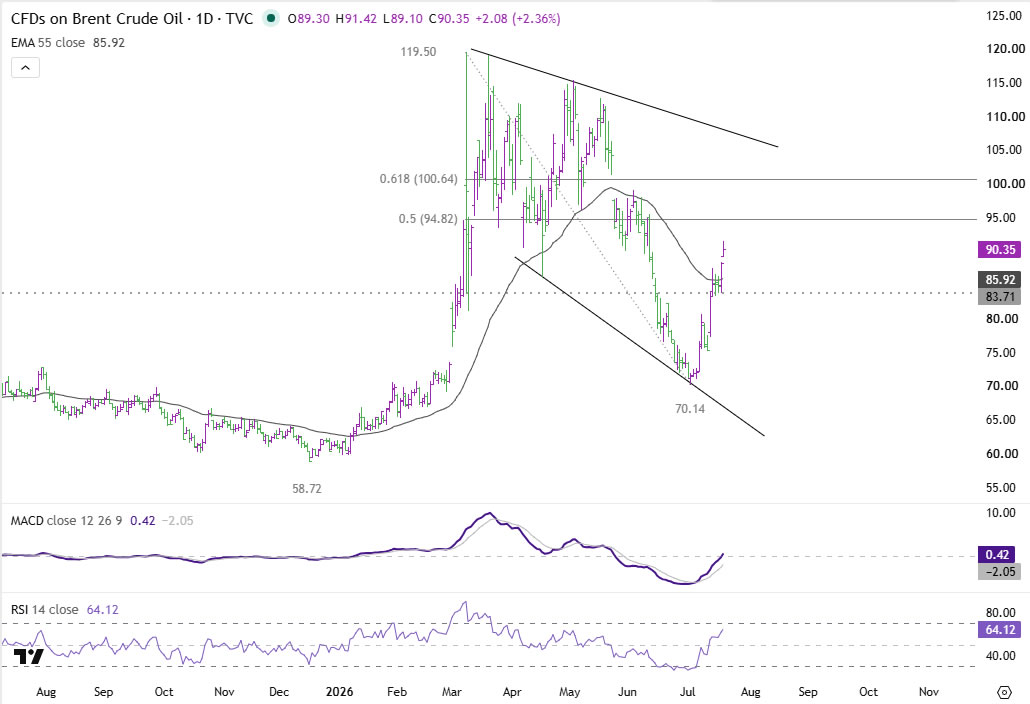
Technically, Brent's solid break above the 38.2 retracement of 119.50 to 70.14 at 89.00 strengthens the case that the advance from 70.14 is evolving into a bullish trend reversal rather than merely a corrective rebound. More importantly, the decline from 119.50 to 70.14 itself unfolded as a well-defined three-wave corrective structure, suggesting the broader long-term uptrend has not yet been completed.
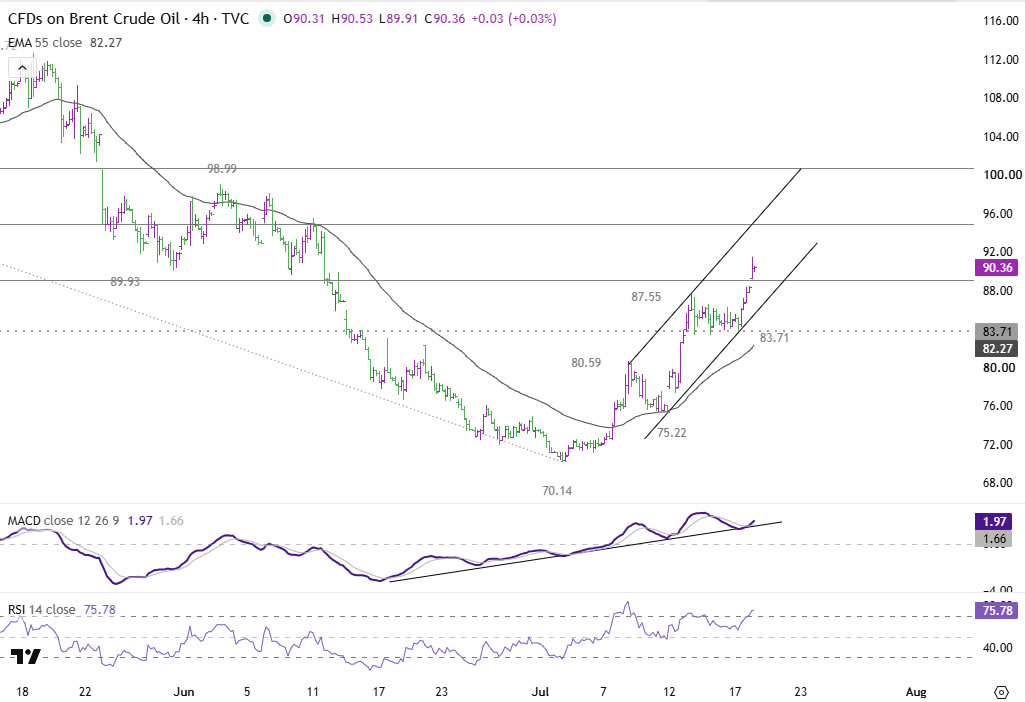
As long as support at 83.71 holds, further gains remain favored. The next major test comes around 95, where the 50% retracement at 94.82 converges with the ceiling of the near-term rising channel. A decisive break of that resistance would likely signal that markets are abandoning their base case of near-term normalization and instead pricing a prolonged disruption to Gulf supply. That would open the way through 61.8% retracement at 100.64 and for a retest of the March high at 119.50.
EUR/USD Struggles Below 1.1500—Can Buyers Break Through?
Key Highlights
- EUR/USD is facing key hurdles near 1.1500.
- A rising channel is forming with support at 1.1400 on the 4-hour chart.
- GBP/USD jumped to 1.3560 before there was a pullback.
- WTI Crude Oil prices climbed further and traded above $84.00.
EUR/USD Technical Analysis
The Euro remained supported above 1.1365 against the US Dollar. EUR/USD climbed above 1.1440 but failed to settle above 1.1480 and 1.1500.
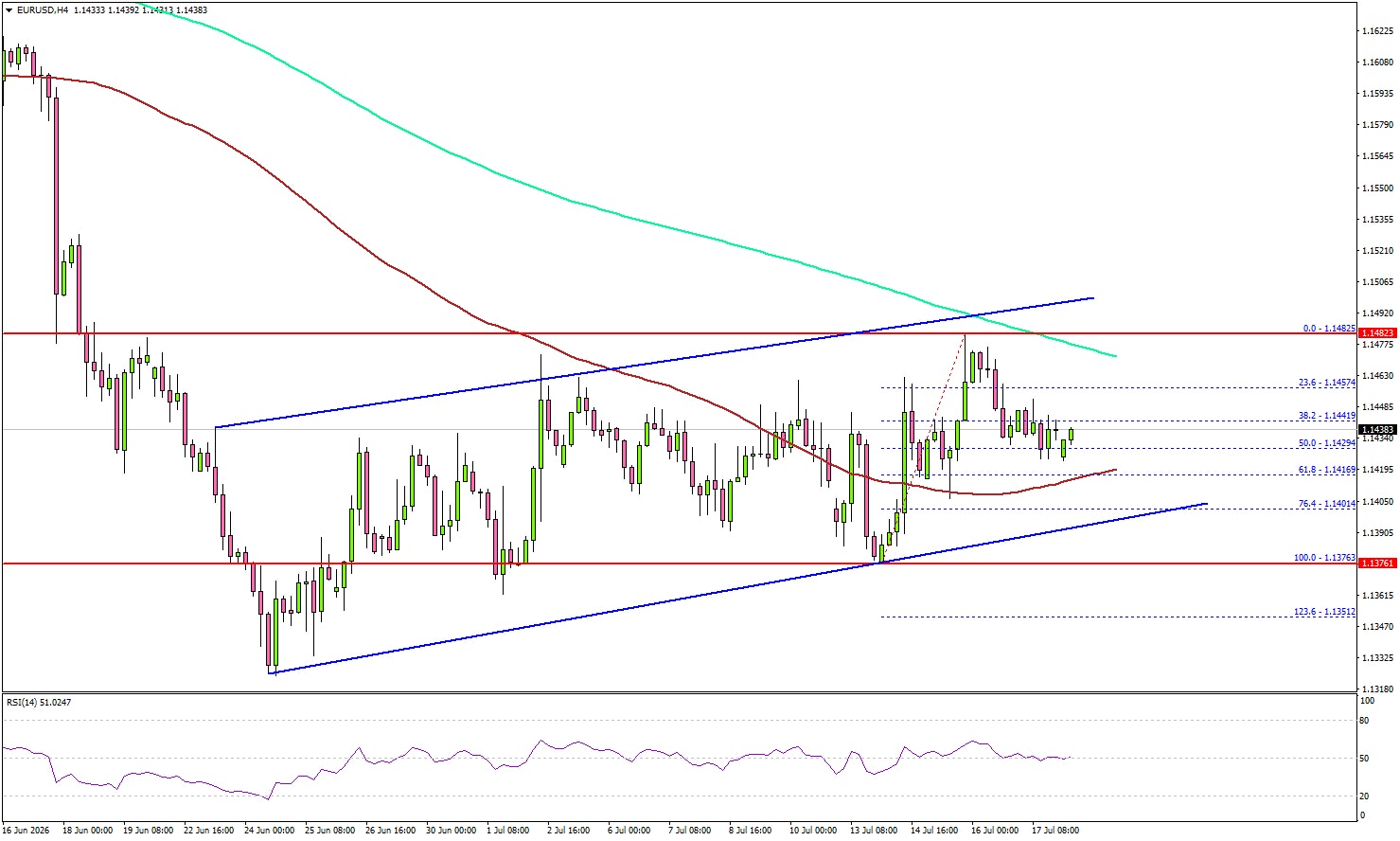
Looking at the 4-hour chart, the pair traded as high as 1.1482 and recently started a downside correction. There was a move toward the 50% Fibonacci retracement level of the upward move from the 1.1376 swing low to the 1.1482 high.
The pair seems to be stuck below the 100 simple moving average (red, 4-hour) and the 200 simple moving average (green, 4-hour). On the upside, the pair could face strong resistance at 1.1480. The next major resistance might be 1.1500.
A close above 1.1500 could start a steady increase. In the stated case, the bulls could aim for a move to 1.1620. If the bears remain in action, the pair might struggle to clear 1.1480.
On the downside, the pair might find support near 1.1400. There is also a rising channel forming with support at 1.1400. The first major support could be near 1.1375. A downside break and close below 1.1375 might send the pair toward 1.1320. Any more losses could open the doors for a test of 1.1250.
Looking at GBP/USD, the pair gained pace for a move above 1.3500, tested 1.3560, and recently saw a short-term downside correction.
Upcoming Key Economic Events:
- German Buba Monthly Report.
- Euro Zone Construction Output for May 2026 (YoY) – Forecast +0.1%, versus +0.6% previous.