Sample Category Title
ECB SAFE Survey: Loan Conditions Tighten While Inflation Expectations Hold Steady
Euro area firms reported tighter borrowing conditions in the second quarter, even as inflation expectations remained broadly stable and cost pressures continued to ease, according to the ECB's latest Survey on the Access to Finance of Enterprises (SAFE). A net 42% of firms reported higher bank loan interest rates, up sharply from 26% in the previous quarter, while increases in fees, commissions and collateral requirements also persisted, although non-interest financing costs and collateral demands moderated somewhat.
Despite the tighter pricing environment, financing conditions showed little sign of deteriorating materially. Firms reported only a modest increase in demand for bank loans, while overall loan availability remained broadly unchanged. However, the aggregate figures masked a divergence between large companies, which reported improved access to credit, and SMEs, which experienced a further deterioration. At the same time, firms continued to lower their expectations for selling prices, non-labour input costs and wage growth over the next 12 months, while inflation expectations remained well anchored at 3.0% over one and three years, with the five-year expectation edging only slightly higher to 3.1%.
The survey reinforces the ECB's view that restrictive monetary policy continues to restrain financing conditions without triggering a broad credit squeeze. Although geopolitical tensions in the Middle East have prompted many firms to diversify suppliers, improve energy efficiency and build inventories, relatively few have reduced business activity. Meanwhile, investment in artificial intelligence is expected to be financed primarily through internal funds rather than external borrowing, suggesting that higher financing costs are encouraging firms to preserve balance-sheet flexibility. Overall, the findings point to gradually easing inflation pressures alongside resilient corporate activity, supporting the ECB's data-dependent approach to policy while leaving room to maintain a cautious stance.
Data Summary
| Item | Current | Previous |
|---|---|---|
| Bank loan interest rates (net reporting increase) | 42% | 26% |
| Other financing costs (net) | 31% | 37% |
| Collateral requirements (net) | 10% | 14% |
| Financing needs for bank loans (net) | 2% | 0% |
| Bank loan availability (net) | -1% | -3% |
| Bank loan financing gap | 3% | 2% |
| Selling price expectations | 3.2% | 3.5% |
| Non-labour input cost expectations | 5.2% | 5.8% |
| Wage expectations | 2.5% | 2.8% |
| Inflation expectations (1-year) | 3.0% | 3.0% |
| Inflation expectations (3-year) | 3.0% | 3.0% |
| Inflation expectations (5-year) | 3.1% | 3.0% |
Market Takeaways
- Firms reported a sharp increase in bank loan interest rates, highlighting that ECB's restrictive policy is still feeding through to borrowing costs.
- Credit availability remained broadly stable overall, although SMEs continued to face tighter financing conditions than large firms.
- Selling price, wage and input cost expectations all moderated further, reinforcing the broader disinflation trend.
- Inflation expectations remained well anchored across all horizons, with only a marginal uptick in five-year expectations.
- The surve suggests financing conditions remain restrictive while inflation pressures continue to ease.
XRP/USD: Symmetrical Triangle Forms as Trading Volume Fades
On 6 July, Ripple received a full Crypto-Asset Service Provider (CASP) licence under the Markets in Crypto-Assets (MiCA) regulation from Luxembourg's financial regulator, the CSSF. The approval allows the company to offer regulated crypto payment services across all 30 countries of the European Economic Area (EEA). The market reaction was relatively muted, with XRP showing little upside, as the decision appears to have been largely priced in following the preliminary approval announced in June. Another factor to watch is the progress of US digital asset market structure legislation, which may now be delayed until late July or early August and could influence institutional demand for the token.
Technical Picture
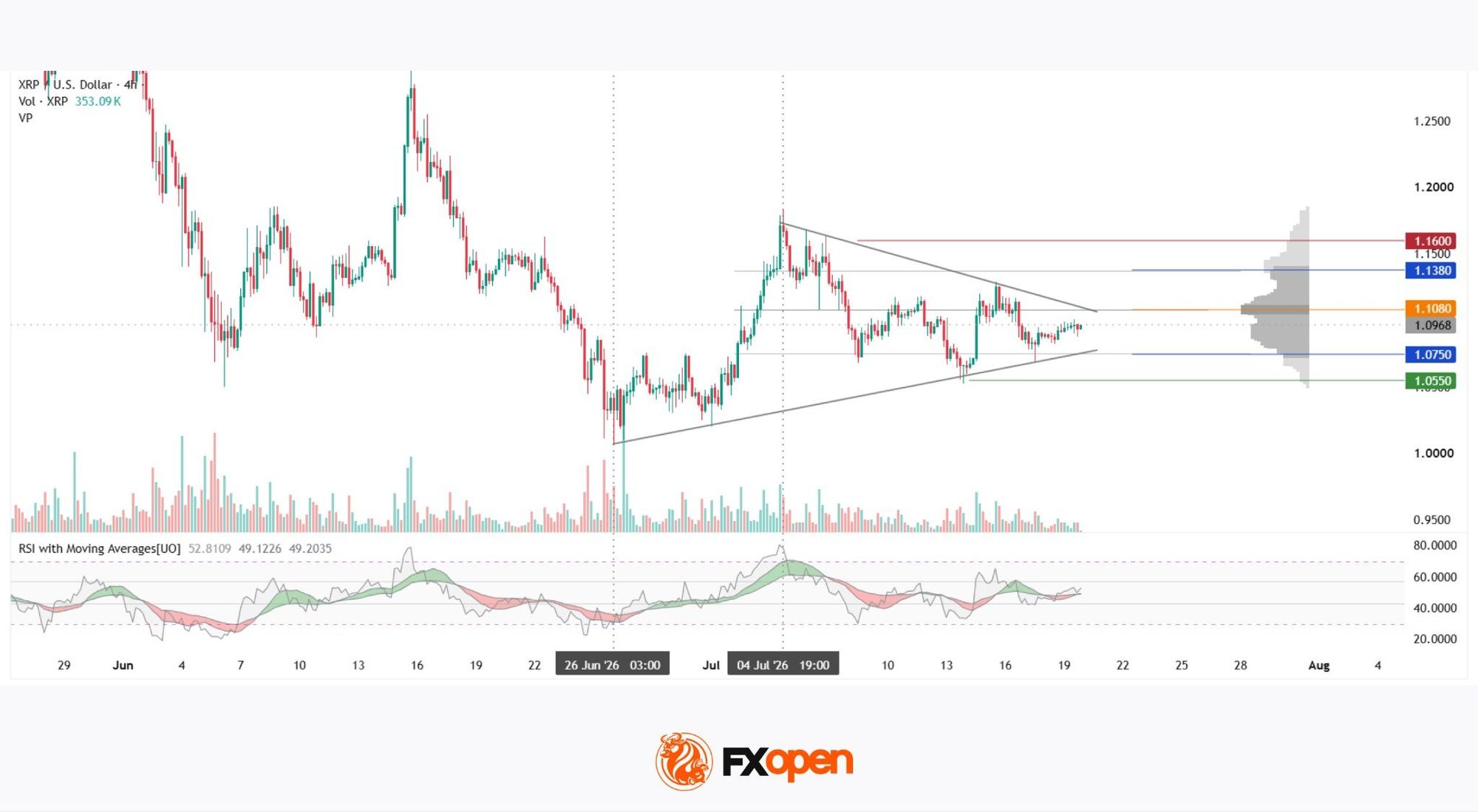
On the four-hour chart, XRP/USD recorded an unusually large spike in vertical volume on 26 June, followed by a bullish reversal that has since developed into a pattern resembling a symmetrical triangle.
The pair is currently consolidating within the current market profile, trading between the lower boundary at $1.0750 and the Point of Control (POC) at $1.1080. If the price breaks below the lower edge of the profile, the next notable support level could be found around $1.0550.
On the upside, a move above the upper boundary of the profile at $1.1380 could bring the $1.1600 area into focus as the next significant resistance zone.
As the triangle continues to develop, vertical trading volume has gradually declined, a pattern that often precedes a stronger directional move. Meanwhile, the RSI + MAs indicator remains neutral, with readings of 52, 49, and 49, showing no clear advantage for either buyers or sellers. The indicator lines are clustered closely together near the midpoint of the neutral zone.
Key Takeaways
The combination of declining volume and neutral RSI + MAs readings suggests that the market is consolidating within the triangle rather than preparing for an immediate breakout. While Ripple's regulatory progress in Europe strengthens the token's longer-term outlook, its impact on the current technical structure remains limited.
FXOpen offers the world's most popular cryptocurrency CFDs*, including Bitcoin and Ethereum. Floating spreads, 1:2 leverage — at your service (additional fees may apply). Open your trading account now or learn more about crypto CFD trading with FXOpen.
*Important: At FXOpen UK, Cryptocurrency trading via CFDs is only available to our Professional clients. They are not available for trading by Retail clients. To find out more information about how this may affect you, please get in touch with our team.
This article represents the opinion of the Companies operating under the FXOpen brand only. It is not to be construed as an offer, solicitation, or recommendation with respect to products and services provided by the Companies operating under the FXOpen brand, nor is it to be considered financial advice.
Brent Oil Above $90: Is $100 Next if Hormuz Blockade Persists?
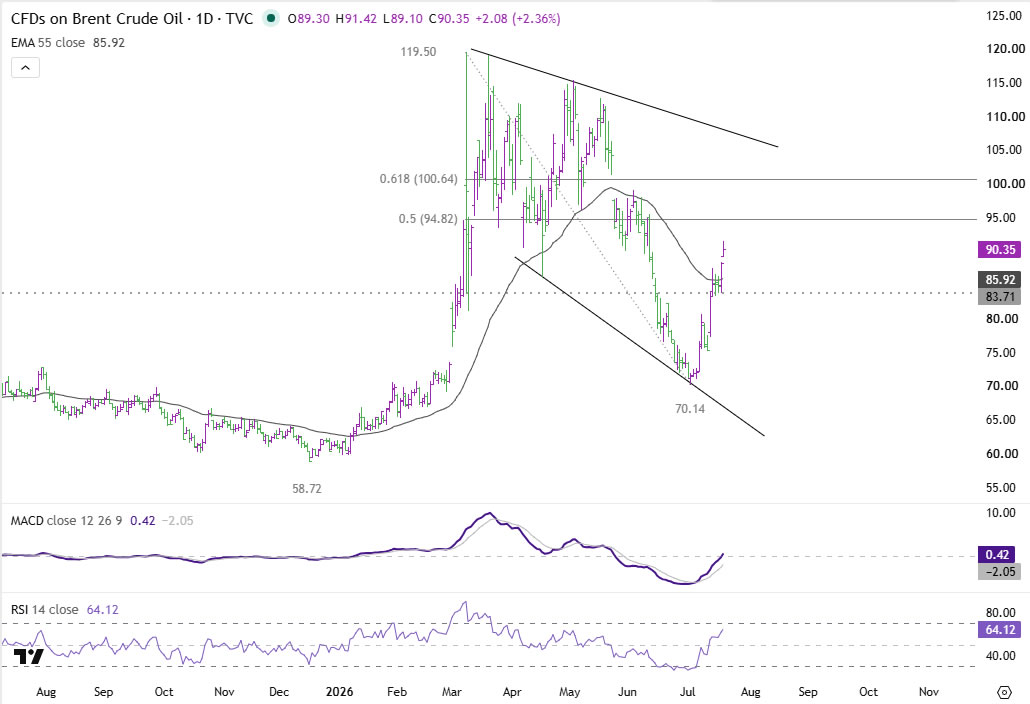
Brent crude began the week with a gap higher, breaking above the key $90 psychological level as markets reacted to another round of deteriorating developments in the US-Iran conflict. Reports of US fatalities, a strike on a Kuwaiti energy facility, Iran's declaration that the ceasefire was no longer valid, and renewed claims that the Strait of Hormuz had been closed all reinforced expectations that the crisis will remain unresolved in the near term. Yet despite the significant geopolitical backdrop and technically important breakout, buying momentum in Asian trading has been relatively restrained.
Why hasn't Brent rallied more aggressively?
The muted follow-through suggests much of the weekend escalation had already been priced in. Brent surged more than 17% last week, marking its strongest weekly gain since April, as markets steadily increased the probability of renewed supply disruptions. The latest headlines largely validated those concerns rather than introducing an entirely new shock. For now, investors still appear to regard a reopening of the Strait of Hormuz as the most likely outcome, limiting the urgency to chase prices significantly higher immediately after the weekend gap.
What could push Brent to $100?
The answer depends on time rather than headlines. During the brief period following June's interim agreement, when sanctions were eased and the blockade lifted, Iran was exporting an estimated 2.2 million barrels per day. That supply is now being withdrawn again as the blockade returns. Every additional day that shipping remains disrupted increases the likelihood that markets shift from treating the crisis as a negotiating tactic to viewing it as a genuine physical supply disruption. Under that scenario, Brent could accelerate rapidly toward the $100 mark as traders begin pricing tighter global balances rather than merely geopolitical risk.
Why is this crisis potentially more serious than the one in March?
Unlike the March-April escalation, when releases from strategic petroleum reserves helped cushion the impact of supply fears, today's market has much less spare buffer. Some estimates suggest that if current disruptions persist, meaningful physical shortages could emerge within around ten weeks. That would force consuming nations, in particular in Asia, to compete for increasingly scarce barrels, fundamentally changing the pricing dynamic from a geopolitical risk premium to one driven by actual supply deficits. In that environment, a retest of this year's highs would no longer be an extreme scenario.
What does the technical picture suggest?
Technically, Brent's solid break above the 38.2 retracement of 119.50 to 70.14 at 89.00 strengthens the case that the advance from 70.14 is evolving into a bullish trend reversal rather than merely a corrective rebound. More importantly, the decline from 119.50 to 70.14 itself unfolded as a well-defined three-wave corrective structure, suggesting the broader long-term uptrend has not yet been completed.
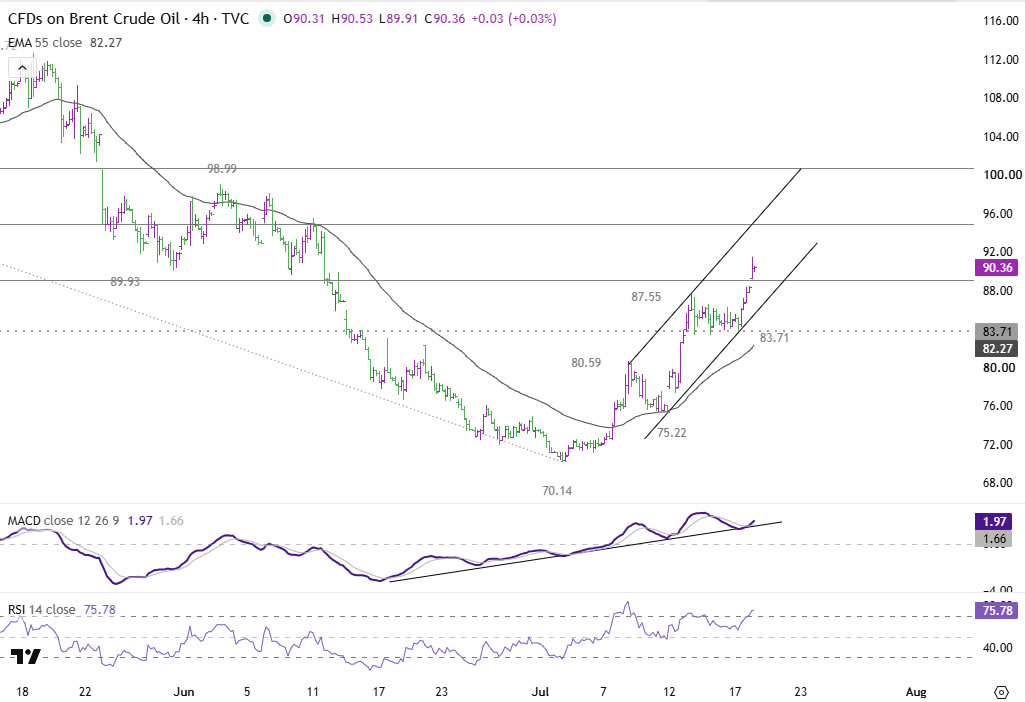
As long as support at 83.71 holds, further gains remain favored. The next major test comes around 95, where the 50% retracement at 94.82 converges with the ceiling of the near-term rising channel. A decisive break of that resistance would likely signal that markets are abandoning their base case of near-term normalization and instead pricing a prolonged disruption to Gulf supply. That would open the way through 61.8% retracement at 100.64 and for a retest of the March high at 119.50.
EUR/USD Struggles Below 1.1500—Can Buyers Break Through?
Key Highlights
- EUR/USD is facing key hurdles near 1.1500.
- A rising channel is forming with support at 1.1400 on the 4-hour chart.
- GBP/USD jumped to 1.3560 before there was a pullback.
- WTI Crude Oil prices climbed further and traded above $84.00.
EUR/USD Technical Analysis
The Euro remained supported above 1.1365 against the US Dollar. EUR/USD climbed above 1.1440 but failed to settle above 1.1480 and 1.1500.
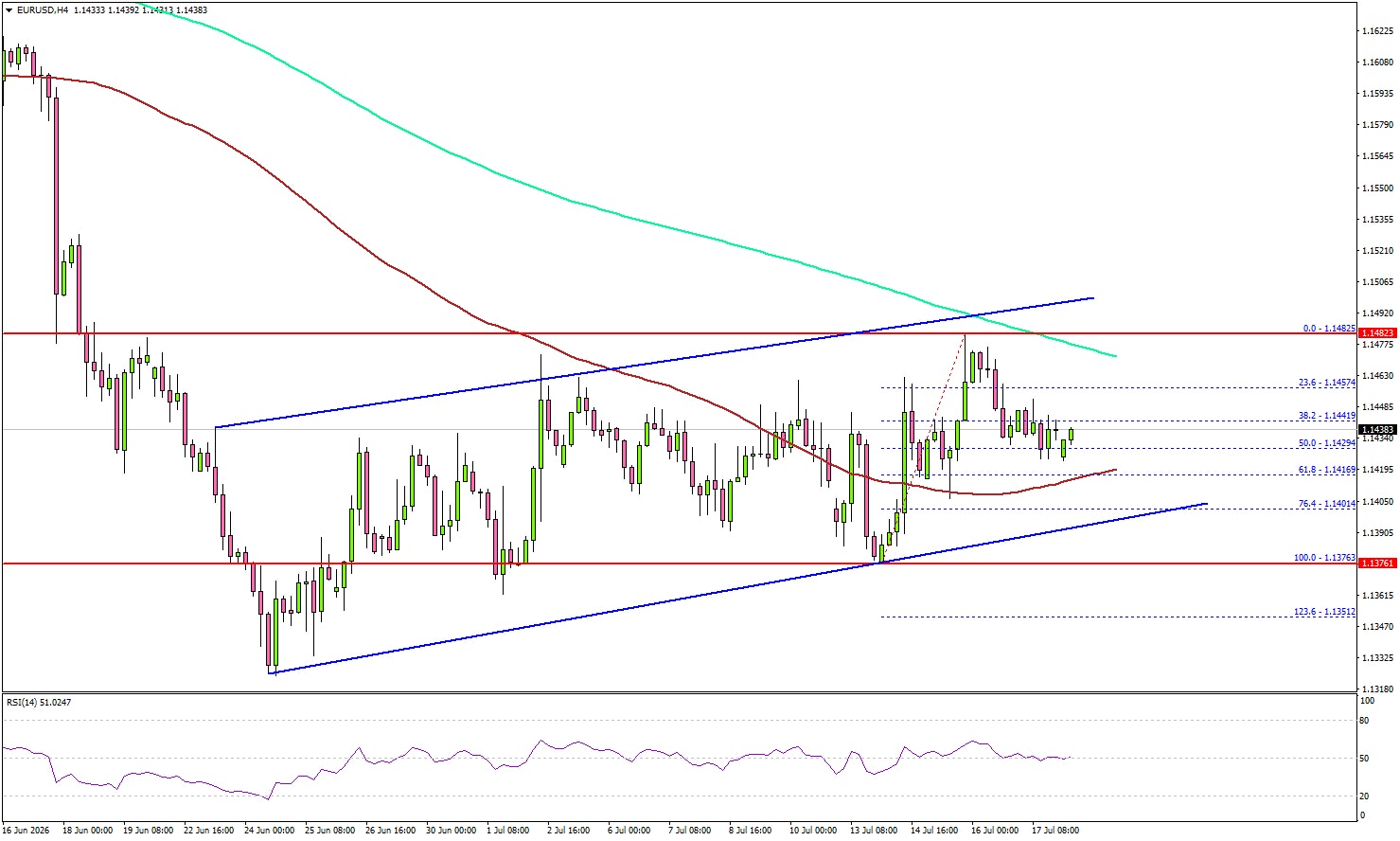
Looking at the 4-hour chart, the pair traded as high as 1.1482 and recently started a downside correction. There was a move toward the 50% Fibonacci retracement level of the upward move from the 1.1376 swing low to the 1.1482 high.
The pair seems to be stuck below the 100 simple moving average (red, 4-hour) and the 200 simple moving average (green, 4-hour). On the upside, the pair could face strong resistance at 1.1480. The next major resistance might be 1.1500.
A close above 1.1500 could start a steady increase. In the stated case, the bulls could aim for a move to 1.1620. If the bears remain in action, the pair might struggle to clear 1.1480.
On the downside, the pair might find support near 1.1400. There is also a rising channel forming with support at 1.1400. The first major support could be near 1.1375. A downside break and close below 1.1375 might send the pair toward 1.1320. Any more losses could open the doors for a test of 1.1250.
Looking at GBP/USD, the pair gained pace for a move above 1.3500, tested 1.3560, and recently saw a short-term downside correction.
Upcoming Key Economic Events:
- German Buba Monthly Report.
- Euro Zone Construction Output for May 2026 (YoY) – Forecast +0.1%, versus +0.6% previous.
PBOC Holds Loan Prime Rates Steady, Keeps Easing Option Open as Growth Slows
The People's Bank of China left its benchmark lending rates unchanged for a 14th consecutive month today, in line with market expectations, as policymakers balanced slowing domestic growth against heightened external uncertainty. The one-year Loan Prime Rate (LPR), the benchmark for most corporate and household loans, was held at a record low of 3.0%. The five-year LPR, the reference rate for mortgages, remained at 3.5%.
The decision comes after China's Q2 GDP growth slowed to its weakest pace since Q4 2022, while the conflict in the Middle East has added another source of uncertainty to the external environment. Even so, policymakers appear comfortable maintaining a wait-and-see stance, supported by continued resilience in exports and strong performance in high-tech industries. Rather than broad-based monetary easing, the PBOC is expected to continue relying on targeted structural tools to channel financing toward priority sectors and sustain economic momentum.
Looking ahead, the policy outlook remains tilted toward measured easing if conditions deteriorate. Domestic demand continues to require stronger support, and if external headwinds intensify while inflation stays subdued, the central bank could still deliver a modest policy rate cut later this year, paving the way for a corresponding reduction in the Loan Prime Rates.
New Zealand Exports Surge 25% Y/Y, Imports Up 28% Y/Y in June, Leaving Trade Balance Near Flat
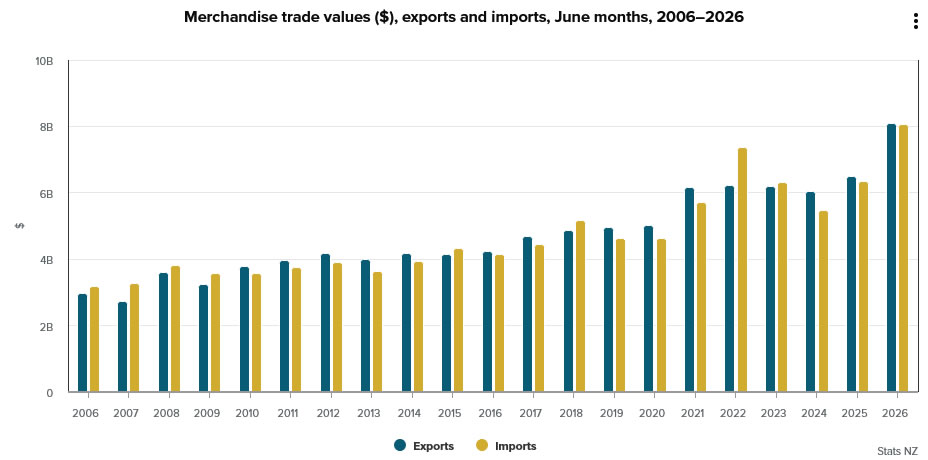
New Zealand's goods trade surplus narrowed sharply to NZD 23M in June, down from a revised NZD 577M in May, as imports slightly outpaced exports during the month. Compared with a year earlier, however, trade activity remained robust. Goods exports rose 25% y/y to NZD 8.1B, while imports climbed 28% y/y to the same level, highlighting strong flows on both sides of the ledger.
Export growth remained broad-based across New Zealand's major trading partners. Shipments to China increased 24% y/y, led by preparations of milk, cereals, flour and starch as well as meat exports. Exports to the US surged 43% on strong demand for meat and dairy products. Exports to Australia, the EU and Japan also posted solid gains, underscoring resilient overseas demand despite ongoing global uncertainty.
On the import side, purchases from China, the EU, Australia and South Korea all recorded strong increases, with higher imports of machinery, vehicles and petroleum products pointing to healthy domestic demand and business investment.
The data suggest external demand remains supportive, but the equally strong rise in imports indicates domestic activity is also holding up well. That combination is broadly consistent with an economy continuing to recover.
Data Summary
| Indicator | Actual | Expected | Previous |
|---|---|---|---|
| Trade Balance | NZD 23M | NZD 250M | NZD 577M |
| Exports (YoY) | +25% | — | — |
| Imports (YoY) | +28% | — | — |
| Goods Exports | NZD 8.1B | — | — |
| Goods Imports | NZD 8.1B | — | — |
Market Takeaways
- Trade surplus narrowed sharply to NZD 23M from a revised NZD 577M in May, well below expectations of NZD 250M.
- Export growth remained robust, driven by strong demand from China, the US, Australia, the EU and Japan.
- Imports rose even faster than exports, pointing to resilient domestic demand and business investment.
- The data are broadly neutral for NZD, as strong trade volumes were offset by a much smaller monthly surplus.
- RBNZ policy is unlikely to be affected materially, with inflation and domestic activity continuing to dominate the policy outlook.
WTI Crude Oil Surges on U.S.–Iran Tensions as Stocks Fall
Renewed tensions between the U.S. and Iran pushed WTI crude oil sharply higher as traders worried about possible disruptions in the Strait of Hormuz. Higher oil prices also weakened the Japanese yen, helping USD/JPY move higher.
U.S. and Japanese stocks fell as investors became more concerned about high valuations in AI companies. The release of Kimi K3, a new open-source model from Moonshot AI, added to these concerns because its performance was close to leading models from Anthropic and OpenAI.
U.S. inflation data was much weaker than expected, reducing expectations of a near-term Fed rate hike. Retail sales were close to forecasts, while consumer sentiment improved as inflation expectations fell. In Japan, the government’s new economic plan also stressed that the Bank of Japan’s independence should be protected.
Markets This Week
U.S. Stocks
The Dow Jones struggled last week, falling around 1% as investors worried that technology stocks had risen too far and higher crude oil prices could weaken market sentiment. The index closed below its 10-day moving average, which has now turned lower and suggests further weakness may follow after the strong gains since April. As market conditions change, selling into strength or trading the short-term range may be a better strategy. Resistance levels are at 53,000, 53,500 and 54,000. Support is seen at 52,000, 51,000, 50,000, 49,500 and 49,000.
Japanese Stocks
The Nikkei 225 fell more than 6% last week, its largest weekly point decline on record. Concerns about high valuations in AI-related companies and the negative impact of higher WTI crude oil prices encouraged further selling. Despite falling nearly 10% in July, the index remains more than 23% higher in 2026, suggesting further losses are possible. Selling into strength near resistance at the 10-day moving average may therefore be the better short- and medium-term strategy. Resistance is seen at 66,500, 67,500, 69,000, 70,000, 71,000 and 72,000, while support is at 63,000, 62,300 and 60,000.
USD/JPY
USD/JPY had a quiet week, testing recent highs despite weaker-than-expected U.S. inflation data. Higher WTI crude oil prices and the lack of Bank of Japan intervention encouraged light buying as traders continued to benefit from higher U.S. interest rates. The pair remains in a slight uptrend, but with strong resistance near 163, range trading may be the better strategy this week. Resistance is at 162.50, 163.00 and 165.00, while support is seen at 161.00, 160.50, 160.00, 159.00, 158.00, 157.00, 156.00, 155.50 and 155.00.
Gold
Gold came under pressure last week as higher crude oil prices increased inflation concerns. However, weaker-than-expected U.S. inflation data encouraged buying and helped prices remain above their yearly lows. With reports of central bank demand below the market, buying on weakness may be the better strategy this week. Resistance is at $4,100, $4,200, $4,300, $4,400 and $4,500, while support is at $3,950, $3,900, and $3,800.
Crude Oil
WTI crude oil rose more than 10% last week as renewed tensions between the U.S. and Iran increased concerns about reduced oil supplies. A lack of progress in recent negotiations also raised fears that the conflict could continue longer than expected. The market now looks slightly overbought, so selling after any positive developments in the negotiations may be the better strategy this week. Resistance is at $85, $90, $95 and $100, while support is at $75.00, $67.50, $65, and $60.
Bitcoin
Bitcoin had a quiet week as the market tested resistance near $65,000 and sentiment continued to improve. Buying on weakness while looking for a break above resistance may be the better strategy this week. Resistance is at $65,000, $75,000, $80,000, $85,000, and $90,000, while support is at $60,000, $55,000 and $50,000.
This Week’s Focus
- Monday: U.S. Leading Index
- Tuesday: U.K. Unemployment Rate, E.U. ZEW Economic Sentiment, U.S. ADP Employment Change Weekly
- Wednesday: Japan Trade Balance, U.K. CPI and PPI Input
- Thursday: Australia Unemployment Rate, E.U. ECB Interest Rate Decision and Consumer Confidence
- Friday: Australia S&P Global Manufacturing & Services PMI, Japan National Core CPI and S&P Global Services PMI, U.K. Retail Sales and S&P Global Manufacturing PMI, E.U. HCOB Eurozone Manufacturing PMI, U.S. Building Permits, S&P Global Manufacturing PMI and New Home Sales
There are few major economic data releases this week, so the ECB interest rate decision will be the main focus. Rates are expected to remain unchanged, but the ECB may provide guidance on the timing of future rate increases. Developments in the Middle East will also remain important, along with any efforts by Japanese authorities to limit further yen weakness.
USDCAD Wave Analysis
USDCAD: ⬇️ Sell
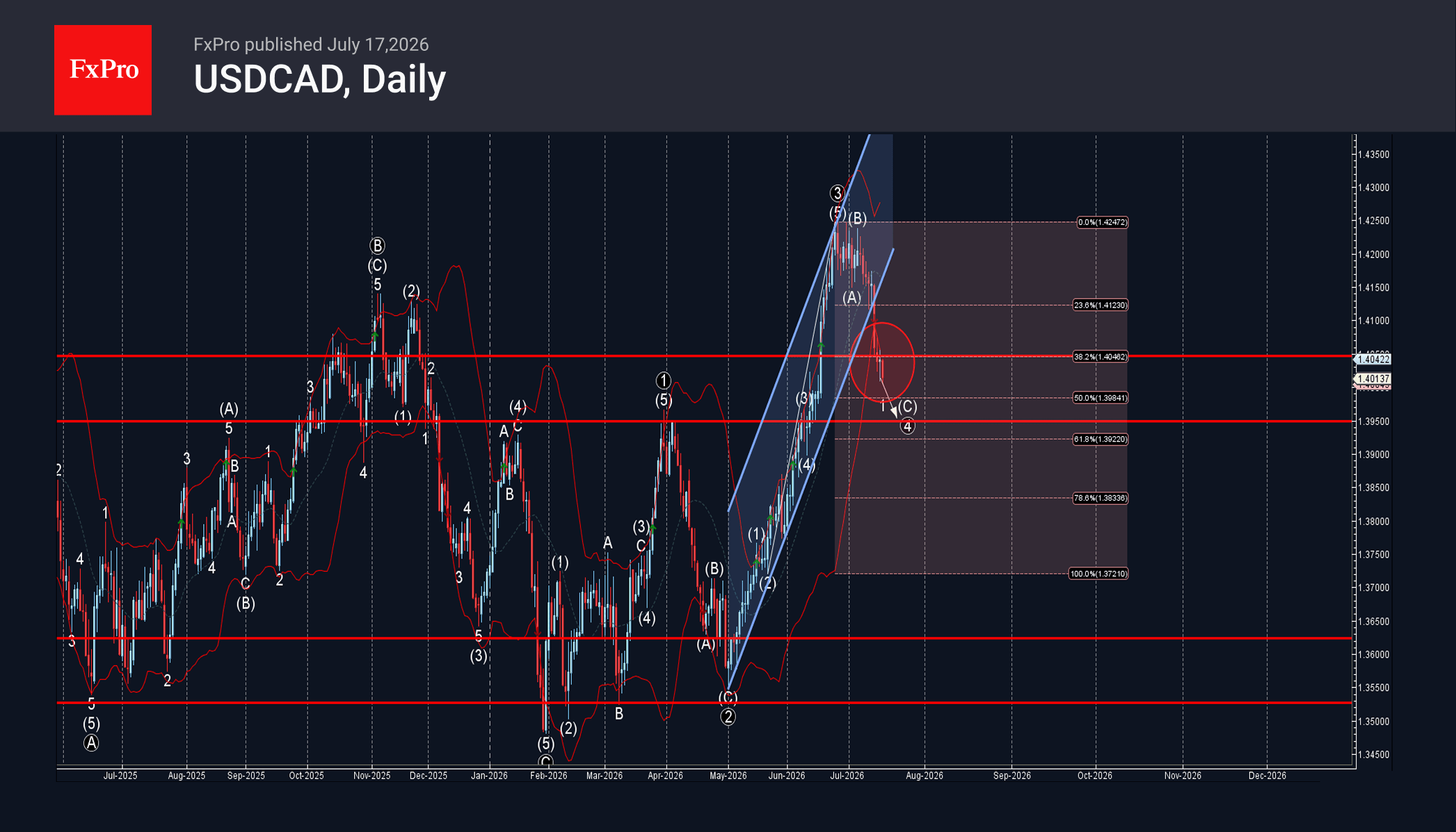
– USDCAD broke support zone
– Likely to fall to support level 1.3550
USDCAD currency pair recently broke the support zone between the key support level 1.4050, support trendline of the daily up channel from May and the 38.2% Fibonacci correction of the upward impulse from May.
The breakout of this support zone accelerated the active downward impulse wave (C) from the start of July.
USDCAD currency pair can be expected to fall to the next support level 1.3550 (target for the completion of the active impulse wave (C)).
Eco Data 7/20/26
| GMT | Ccy | Events | Act | Cons | Prev | Rev |
|---|---|---|---|---|---|---|
| 22:45 | NZD | Trade Balance (NZD) Jun | 23M | 250M | 800M | 577M |
| 01:00 | CNY | 1-Y Loan Prime Rate | 3.00% | 3.00% | 3.00% | |
| 01:00 | CNY | 5-Y Loan Prime Rate | 3.50% | 3.50% | 3.50% | |
| 06:00 | EUR | Germany PPI M/M Jun | -0.30% | -0.20% | 0.30% | |
| 06:00 | EUR | Germany PPI Y/Y Jun | 1.80% | 2.20% | ||
| 12:30 | CAD | CPI M/M Jun | -0.40% | -0.20% | 1.00% | |
| 12:30 | CAD | CPI Y/Y Jun | 2.80% | 2.90% | 3.20% | |
| 12:30 | CAD | CPI Median Y/Y Jun | 1.90% | 2.10% | 2.10% | |
| 12:30 | CAD | CPI Trimmed Y/Y Jun | 1.80% | 2.00% | 2.00% | |
| 12:30 | CAD | CPI Common Y/Y Jun | 2.60% | 2.50% | 2.70% |
| 22:45 | NZD |
| Trade Balance (NZD) Jun | |
| Actual | 23M |
| Consensus | 250M |
| Previous | 800M |
| Revised | 577M |
| 01:00 | CNY |
| 1-Y Loan Prime Rate | |
| Actual | 3.00% |
| Consensus | 3.00% |
| Previous | 3.00% |
| 01:00 | CNY |
| 5-Y Loan Prime Rate | |
| Actual | 3.50% |
| Consensus | 3.50% |
| Previous | 3.50% |
| 06:00 | EUR |
| Germany PPI M/M Jun | |
| Actual | -0.30% |
| Consensus | -0.20% |
| Previous | 0.30% |
| 06:00 | EUR |
| Germany PPI Y/Y Jun | |
| Actual | 1.80% |
| Consensus | |
| Previous | 2.20% |
| 12:30 | CAD |
| CPI M/M Jun | |
| Actual | -0.40% |
| Consensus | -0.20% |
| Previous | 1.00% |
| 12:30 | CAD |
| CPI Y/Y Jun | |
| Actual | 2.80% |
| Consensus | 2.90% |
| Previous | 3.20% |
| 12:30 | CAD |
| CPI Median Y/Y Jun | |
| Actual | 1.90% |
| Consensus | 2.10% |
| Previous | 2.10% |
| 12:30 | CAD |
| CPI Trimmed Y/Y Jun | |
| Actual | 1.80% |
| Consensus | 2.00% |
| Previous | 2.00% |
| 12:30 | CAD |
| CPI Common Y/Y Jun | |
| Actual | 2.60% |
| Consensus | 2.50% |
| Previous | 2.70% |
Dollar Caught Between Yesterday’s Disinflation and Tomorrow’s US-Iran Escalation
The Dollar ended the week without establishing a clear direction, despite a genuine shift in the US inflation picture. June CPI and PPI both surprised meaningfully to the downside, reinforcing the view that price pressures had begun to ease more broadly. Yet instead of extending lower, the Greenback stabilized as investors questioned whether the disinflation story would remain intact beyond a single month.
That hesitation reflected the week's second—and ultimately more forward-looking—development. A renewed escalation in the US-Iran conflict sent oil prices sharply higher, with Brent closing above $88 and WTI reclaiming the $80 level. Because June's softer inflation was driven in large part by falling energy prices, the rebound in crude immediately raised the prospect that much of that progress could unwind over the next one or two inflation reports. In other words, markets shifted their focus from what inflation had done to what it was likely to do next.
The result was a market caught between conflicting forces. Softer inflation reduced the urgency for further Fed tightening, but higher oil prices simultaneously revived the risk that inflation could accelerate again, preventing rate-hike expectations from fading. That crosscurrent was reflected in currency performance. New Zealand Dollar led gains for the week, followed by Canadian Dollar and Sterling, while Yen finished as the weakest major currency. Dollar settled near the middle of the rankings, a fitting reflection of a market still weighing yesterday's disinflation against tomorrow's inflation risk.
Soft CPI and PPI Shifted the Fed Outlook—Temporarily
June's inflation reports provided one of the strongest pieces of evidence yet that US price pressures were moderating. Headline CPI declined -0.4% mom after rising 0.5% mom in May, pulling the annual rate down from 4.2% yoy to 3.5% yoy, comfortably below market expectations. Core CPI was unchanged on the month, slowing from 2.9% yoy to 2.6% yoy on an annual basis. At the wholesale level, PPI fell -0.3% mom, its largest monthly decline in more than six years, reinforcing the view that pipeline inflation pressures were easing.
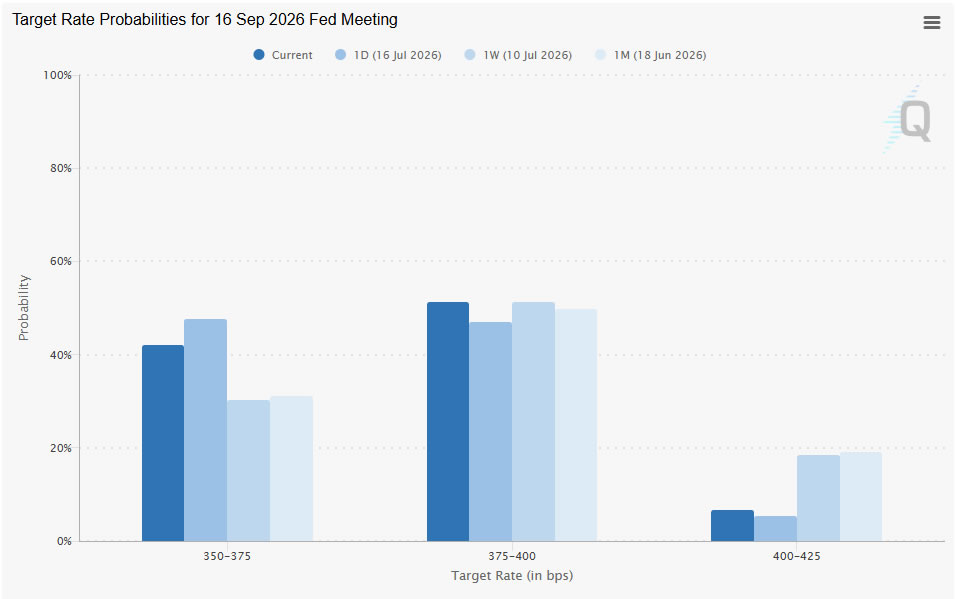
The breadth of the slowdown suggested this was more than a one-off statistical fluctuation. After months of sticky inflation, back-to-back downside surprises in both consumer and producer prices prompted investors to reassess the urgency for additional Fed tightening. Fed funds futures reacted swiftly, with the implied probability of a September rate hike dropping from around 70% a week earlier to about 58% immediately after the data.
However, the composition of the inflation slowdown offered an important caveat. Lower gasoline prices accounted for a significant share of the improvement in both CPI and PPI, reflecting a period when tensions in the Middle East briefly eased and oil prices retreated. As energy markets reversed later in the week, investors quickly recognized that June's encouraging inflation data rested on a foundation that was already beginning to shift. The result was a disinflation story that looked genuine, but also increasingly fragile.
WTI Above $80 Changes the Inflation Narrative
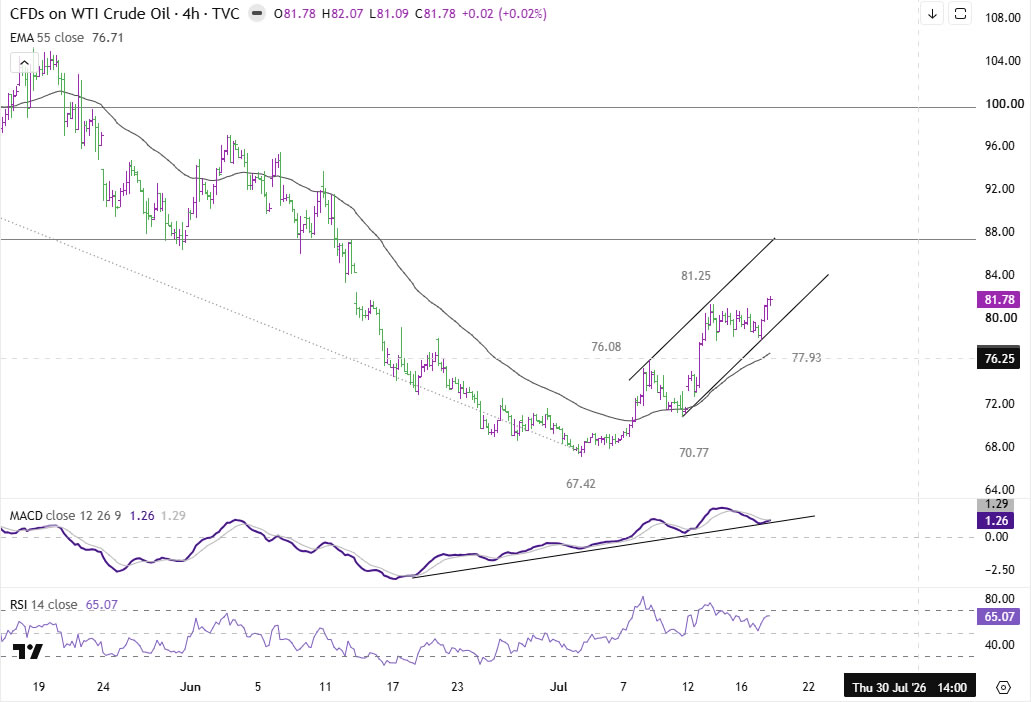
The week's defining market development may ultimately prove to be not the softer inflation data, but crude oil's decisive rebound. As the US-Iran conflict intensified, concerns over energy supplies escalated sharply. The conflict expanded beyond previous tit-for-tat exchanges, with strikes targeting bridges, rail infrastructure, telecommunications facilities and an airport inside Iran, while Iranian retaliation spread across Kuwait, Bahrain, Qatar, Oman and a US military position in Syria. Against that backdrop, WTI settled above USD 80 and Brent closed above USD 88, recording their strongest weekly gains since April.
The significance of WTI reclaiming USD 80 lies in what it means for the inflation outlook. June's disinflation surprise was driven in large part by lower energy prices following a temporary easing in Middle East tensions earlier in the month. Now that crude has retraced those losses, the energy component is likely to move in the opposite direction over coming months. Markets are therefore beginning to question whether June's encouraging CPI and PPI readings will prove to be the low point rather than the start of a sustained moderation in inflation.
This changing outlook also explains why expectations for another Fed rate hike did not continue falling despite the softer data. Investors have become less focused on what June inflation showed and more concerned about what July and August inflation might look like if oil prices remain elevated. With crude now acting as a renewed source of inflation risk, energy markets—not last month's economic data—have become the primary driver of Fed repricing and, by extension, the Dollar's direction.
Fed Keeps the Door Open to Further Tightening
Federal Reserve officials broadly maintained a cautious, hawkish-leaning tone throughout the week, even as June's inflation reports came in softer than expected. Testifying before Congress, Chair Kevin Warsh rejected any suggestion that the Fed's job was complete, arguing that inflation remained too high despite recent progress. He also reiterated that monetary policy was "not particularly restrictive," reinforcing the view that the Committee still sees scope to tighten further if inflation risks intensify.
Governor Christopher Waller echoed that stance. Ahead of the inflation releases, he indicated that another rate hike could be warranted in the near term if CPI and PPI surprised on the upside. While the actual data reduced the immediate case for further tightening, his comments illustrated that the Fed remains highly sensitive to any renewed inflation pressure. Dallas Fed President Lorie Logan stood out as the week's most hawkish voice, becoming the first Fed official to publicly support another interest rate increase since Warsh became chair.
The overall message from the Fed changed little despite the encouraging inflation data. Policymakers acknowledged the improvement but showed no willingness to signal that rate hikes were off the table. Instead, the Committee appears content to let incoming data—and increasingly, developments in energy markets—guide its next move. With Fed rhetoric offering few surprises, markets have become more focused on whether higher oil prices will eventually force policymakers back toward a more aggressive stance.
Technical Outlook: Dollar Awaits Confirmation from Oil and Yields
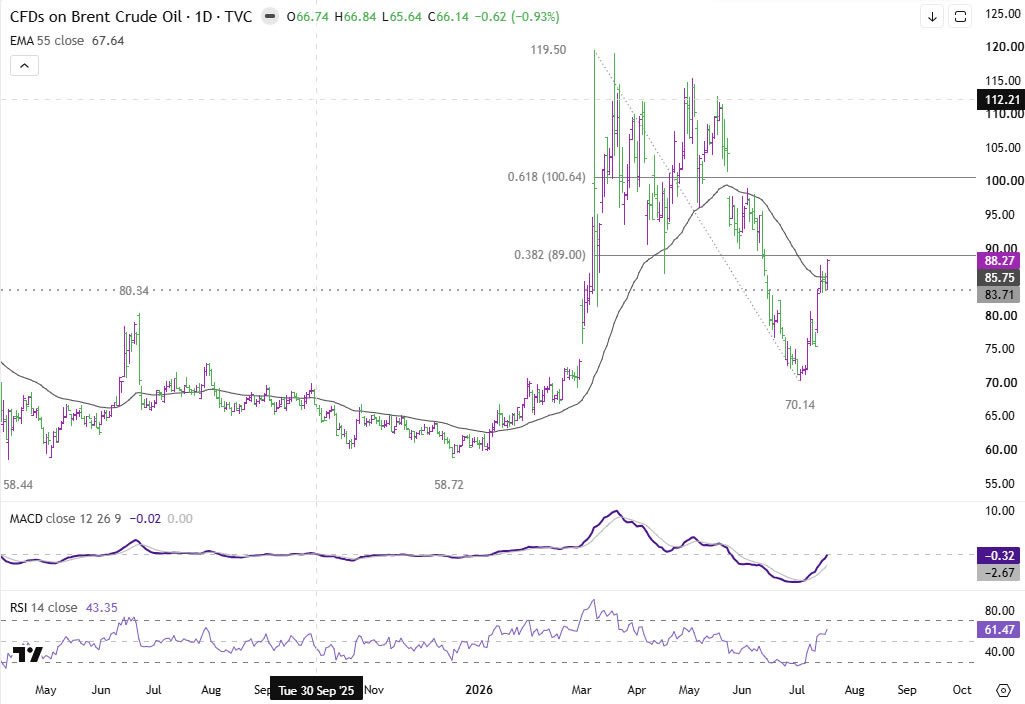
Brent crude remains the market's leading indicator. The advance from 70.14 has taken on the characteristics of a five-wave impulsive rally, pointing to a potential bullish trend reversal. The close above 55 D EMA (now at 85.75) strengthens that interpretation. The next critical test lies at the 38.2% retracement of 119.50 to 70.14 at 89.00, an area that also coincides with the important 90 psychological level.
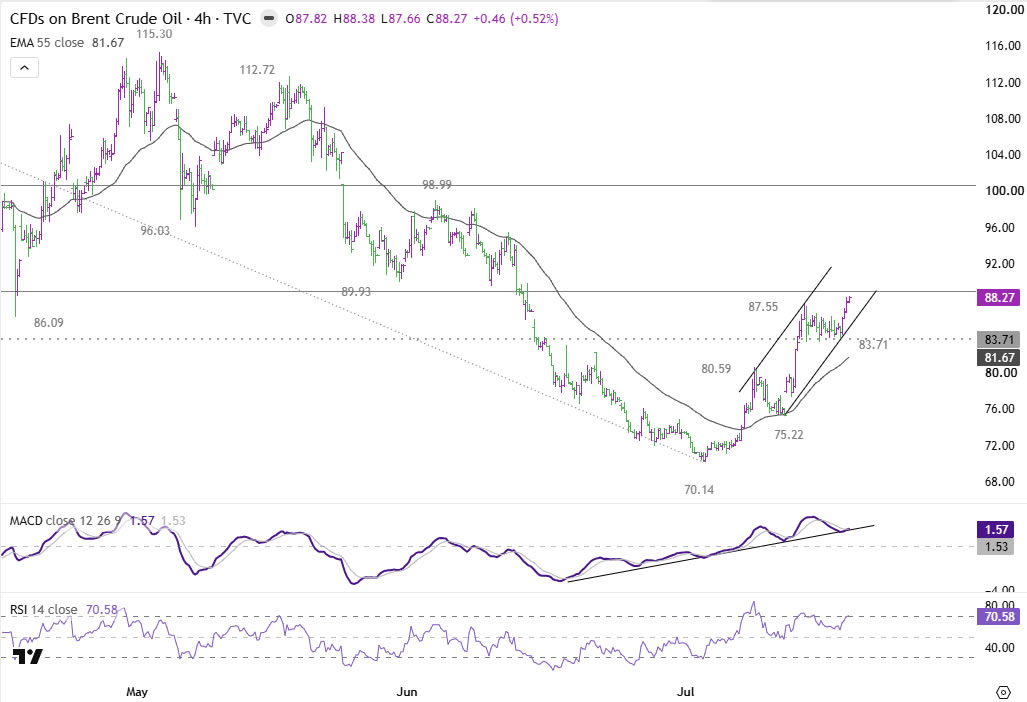
Decisive break above this 89/90 zone would argue that Brent is already reversing whole fall from 119.50. That would pave the way to 61.8% retracement at 100.64, which is close to 100 psychological level. Failure to overcome 89-90, followed by a break below 83.71, would instead argue that the recent rally was merely a corrective rebound, and has completed.
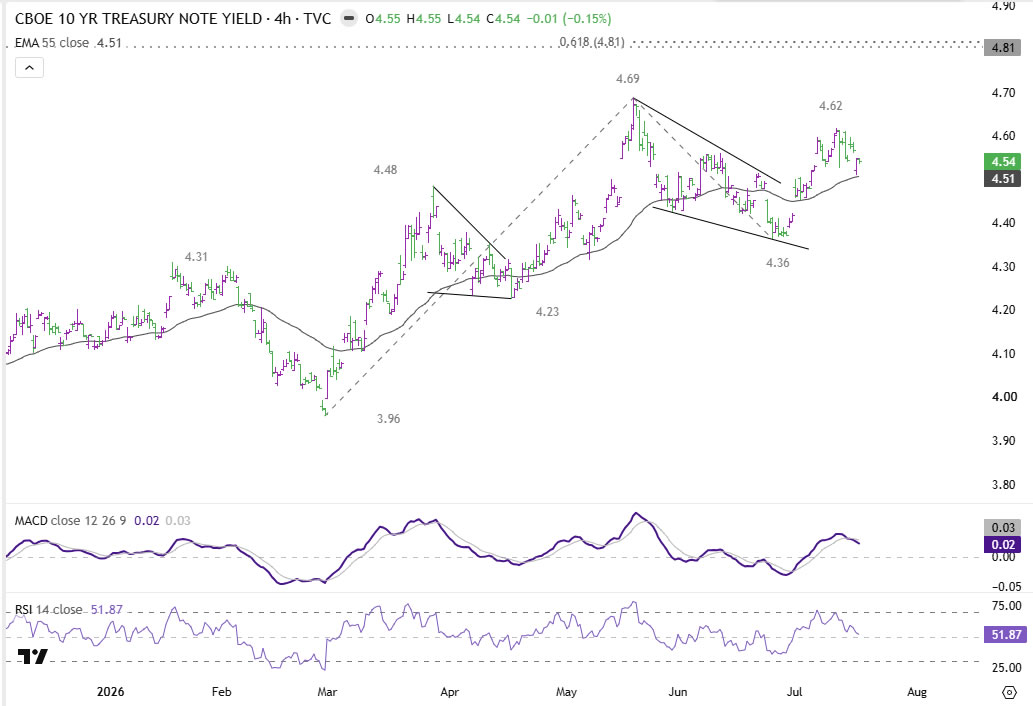
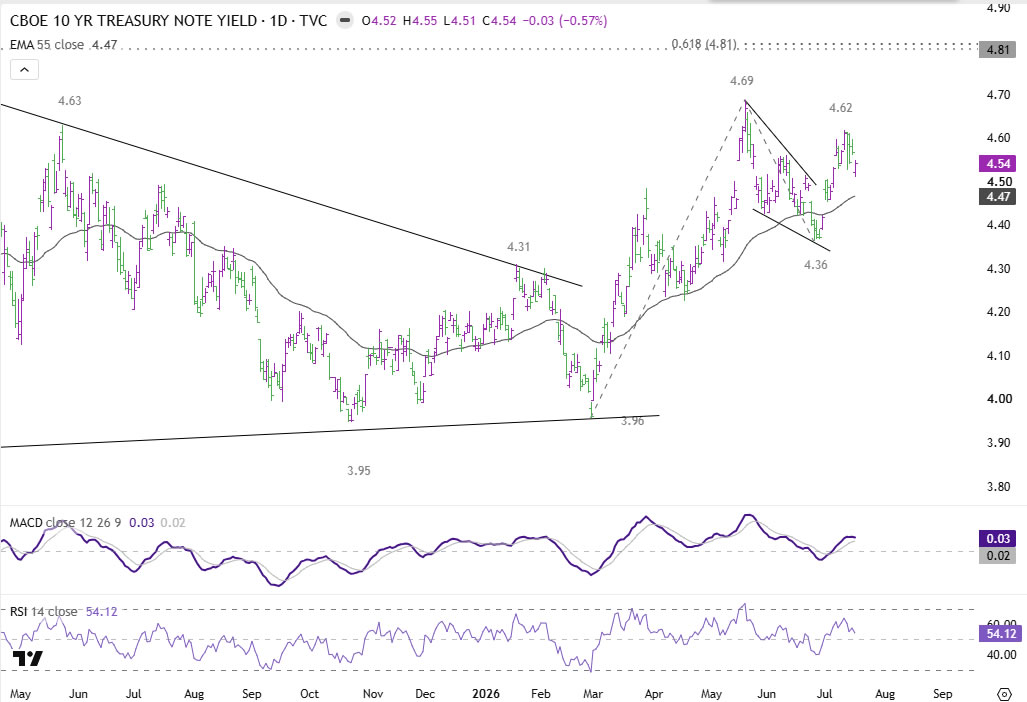
US 10-year yield dipped to 4.51 but quickly recovered after drawing support from 55 4H EMA (now at 4.51). No change in the outlook that correction from 4.69 has completed at 4.36, and rise from 3.96 is resuming. above 4.62 resistance will affirm this bullish case, and target a retest on 4.62 high.
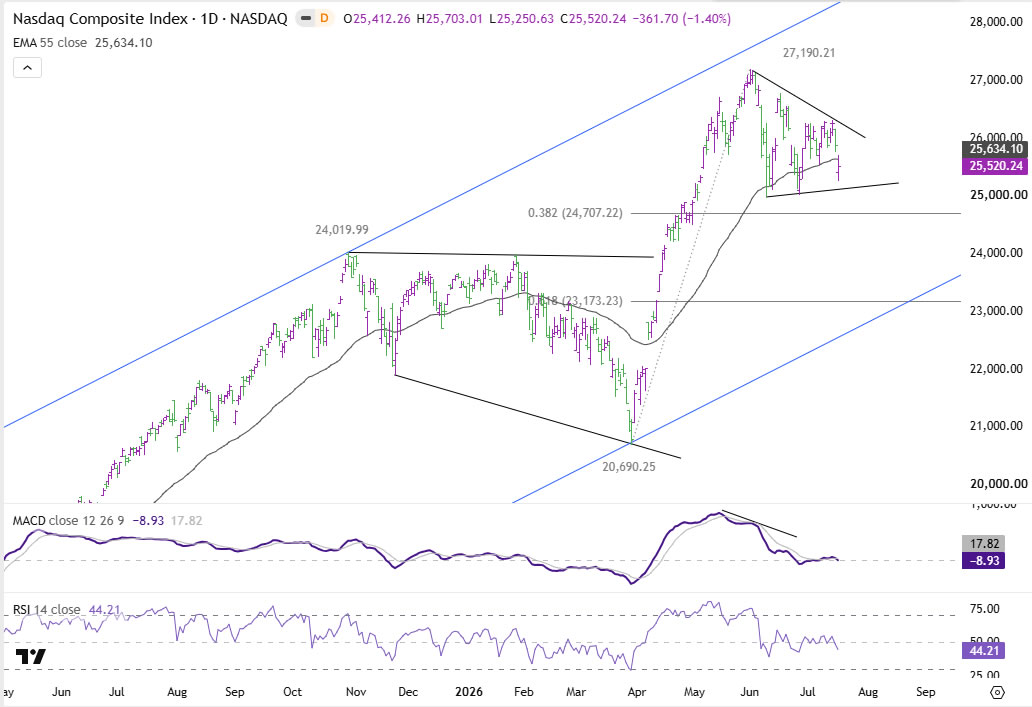
NASDAQ's selloff on Friday and break of 55 D EMA (now at 25634.10) suggests that consolidation pattern from 27190.21 is extending with another falling leg. Strong support should be seen around 38.2% retracement of 20690.25 to 27190.23 at 24707.22 to contain downside to bring rebound. However, firm break of this fibonacci level support will argue that it's not just in a near term correction, but could be in a larger scale one and risk deeper selloff to 61.8% retracement at 23173.23.
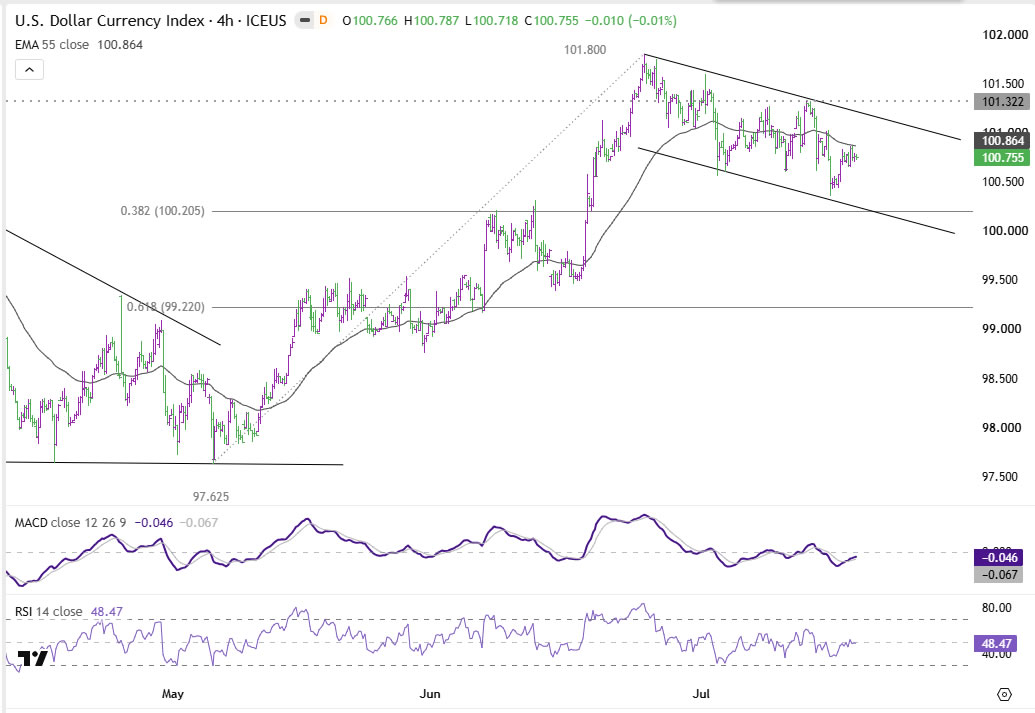
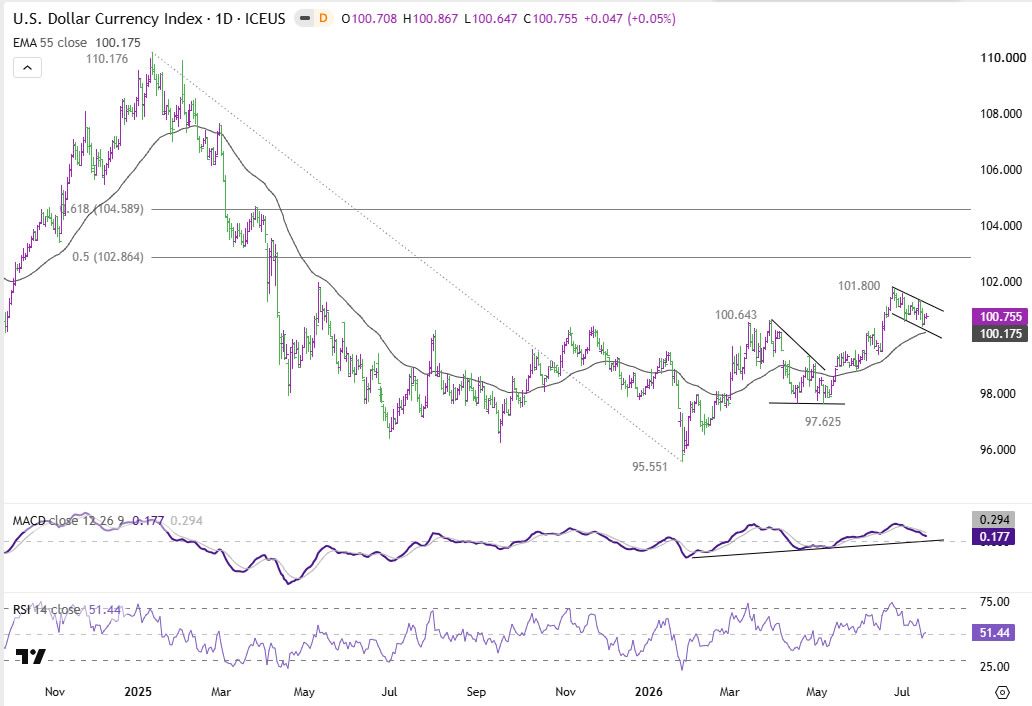
Dollar Index's correction from 101.80 extended lower last week but holds above 38.2% retracement of 97.62 to 101.80 at 100.20, as well as 55 D EMA (now at 100.17). Further rally is still expected. Above 101.32 minor resistance will bring retest of 101.80 first. Firm break there will extend whole rise from 95.55 to 50% retracement 110.17 to 95.55 at 102.86. However, sustained break of 55 D EMA will bring deeper decline back to 97.62 support, and raise the chance of near term bearish reversal.
Outlook: Gulf Developments Likely to Dictate Dollar's Next Move
The Dollar enters the new week still searching for a decisive catalyst. If the US-Iran conflict continues to intensify, Brent is likely to challenge or break above the $90 threshold, reinforcing expectations that the recent disinflation trend could prove short-lived. Such an outcome would probably lift Treasury yields, strengthen pricing for another Fed rate hike later this year, and provide fresh support for the Dollar.
On the other hand, any meaningful de-escalation that allows oil prices to retrace would revive confidence that inflation is returning to a downward path, encouraging markets to pare back tightening expectations and reopening the door to broader Dollar weakness.
At this stage, the escalation scenario appears marginally more likely. The increasingly coordinated nature of recent military operations and Iran's widening retaliation suggest the conflict is entering a more dangerous phase than earlier exchanges. Even so, investors have learned over recent weeks that geopolitical developments can change abruptly. The Dollar therefore remains at a crossroads, with its next major move likely to be determined less by Fed rhetoric or scheduled data releases than by whether oil continues to rewrite the inflation outlook.
EUR/USD Weekly Outlook
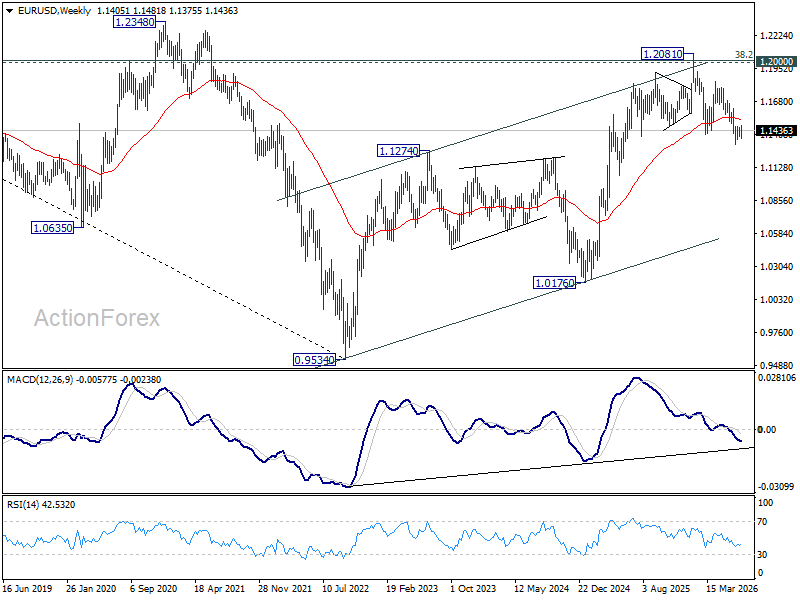
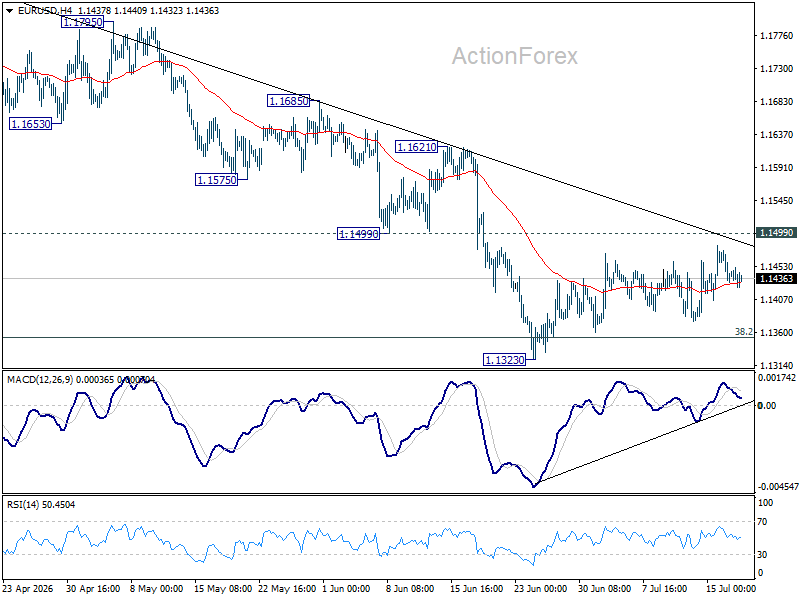
EUR/USD extended the consolidations pattern above 1.1323 last week and outlook is unchanged. Initial bias remains neutral this week, and with 1.1499 support turned resistance intact, further decline is expected. On the downside, break of 1.1323 will resume the fall from 1.2081 to 100% projection of 1.2081 to 1.1408 from 1.1848 at 1.1175. However, decisive break of 1.1499 will turn bias back to the upside for 1.1621 resistance.
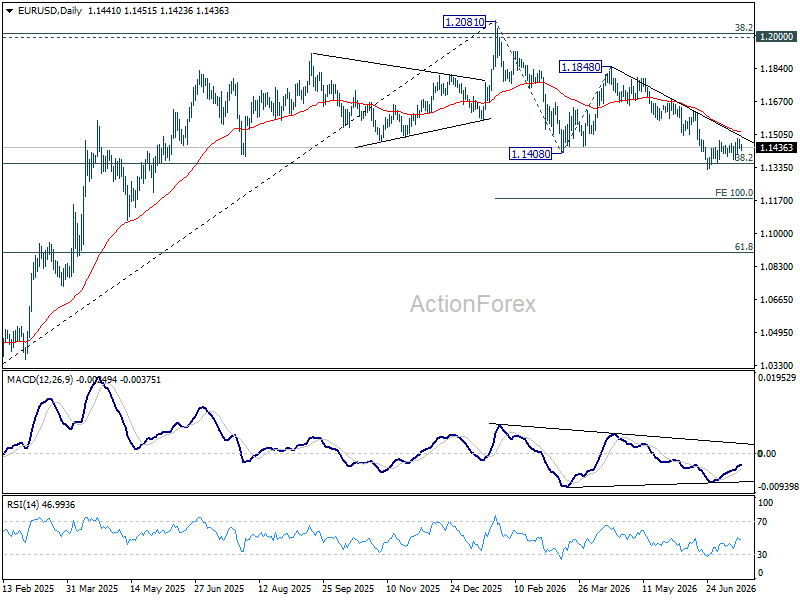
In the bigger picture, focus is back on 38.2% retracement of 1.0176 to 1.2081 at 1.1353. Decisive break there will revive the case of medium term bearish trend reversal after rejection by 1.2 key cluster resistance level. Further fall should be seen to 61.8% retracement at 1.0904. Nevertheless, strong rebound from 1.1353, followed by break of 1.1621 resistance, will retain medium term bullishness.
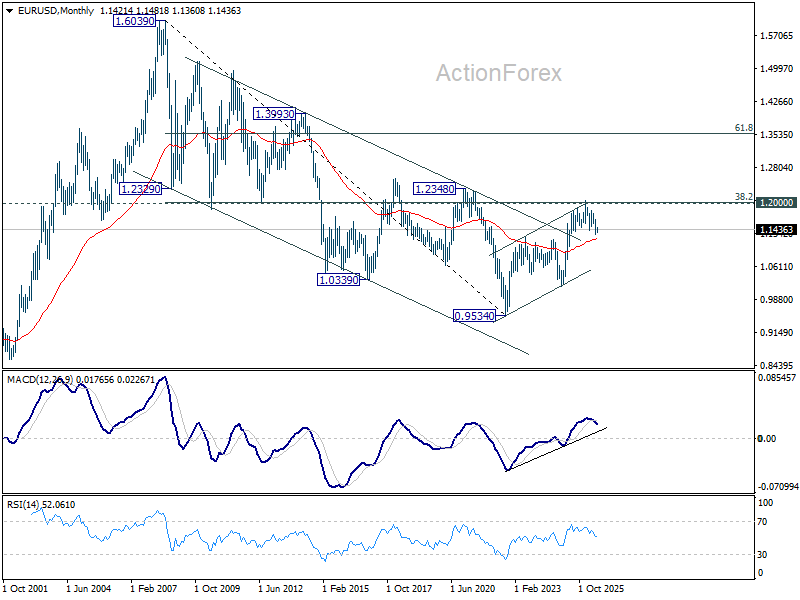
In the long term picture, 38.2% retracement of 1.6039 to 0.9534 at 1.2019, which is close to 1.2000 psychological level is the key for the outlook. Rejection by this level will keep the multi decade down trend from 1.6039 (2008 high) intact, and keep outlook neutral at best. However, decisive break of 1.2000/19, will suggest long term bullish trend reversal, and target 61.8% retracement at 1.3554.