Sample Category Title
USD/CAD Daily Outlook
Daily Pivots: (S1) 1.3867; (P) 1.3882; (R1) 1.3899; More...
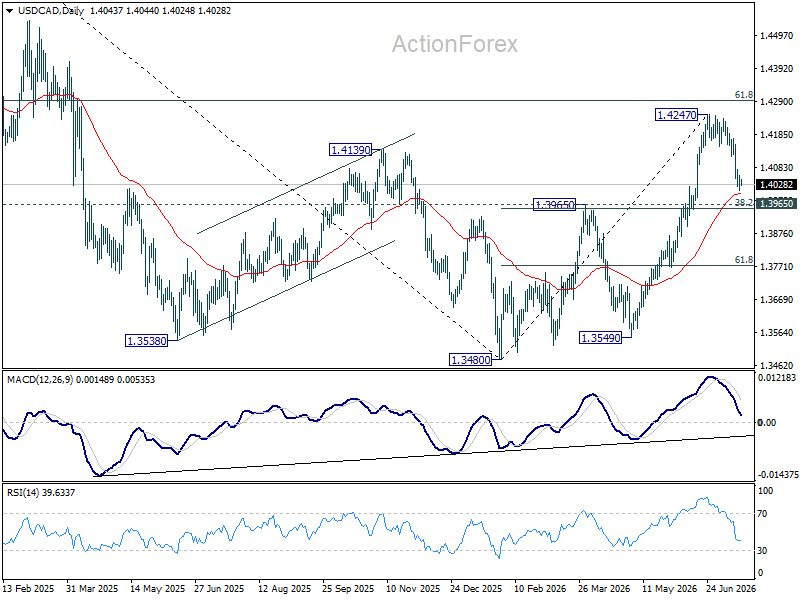
USD/CAD is extending consolidations below 1.3917 temporary top and intraday bias remains neutral. In case of another dip, downside should be contained by 1.3789 support to bring rebound. Rise from 1.3641 is seen as the third leg of the corrective pattern from 1.3538. Above 1.3917 will target 1.4139 first. Break there will target 100% projection of 1.3538 to 1.4139 from 1.3641 at 1.4242.
In the bigger picture, price actions from 1.4791 are seen as a corrective pattern to the whole up trend from 1.2005 (2021 low). Deeper fall could be seen as the pattern extends, and break of 1.3538 will target 61.8% retracement of 1.2005 to 1.4791 at 1.3069. For now, medium term outlook will be neutral until there are signs that the correction has completed.
EUR/CHF Daily Outlook
Daily Pivots: (S1) 0.9299; (P) 0.9325; (R1) 0.9341; More....
EURCHF retreated sharply after hitting 0.9347 and intraday bias is turned neutral again. On the upside, break of 0.9347 will resume the rebound from 0.9268 to retest 0.9394 high. However, break of 0.9294 will bring deeper fall through 0.9268 instead.
In the bigger picture, persistent bullish convergence condition in W MACD is a medium term bullish sign. Firm break of 0.9394 resistance should bring sustained trading above 55 W EMA (now at 0.9362). That should indicate medium term bottoming at 0.9178. Further break of 0.9452 resistance will bring stronger medium term rally towards 0.9928 resistance next, even still as a corrective bounce. Nevertheless, rejection by 55 W EMA will retain bearishness for another fall through 0.9178 at a later stage.
EUR/GBP Daily Outlook
Daily Pivots: (S1) 0.8652; (P) 0.8665; (R1) 0.8672; More…
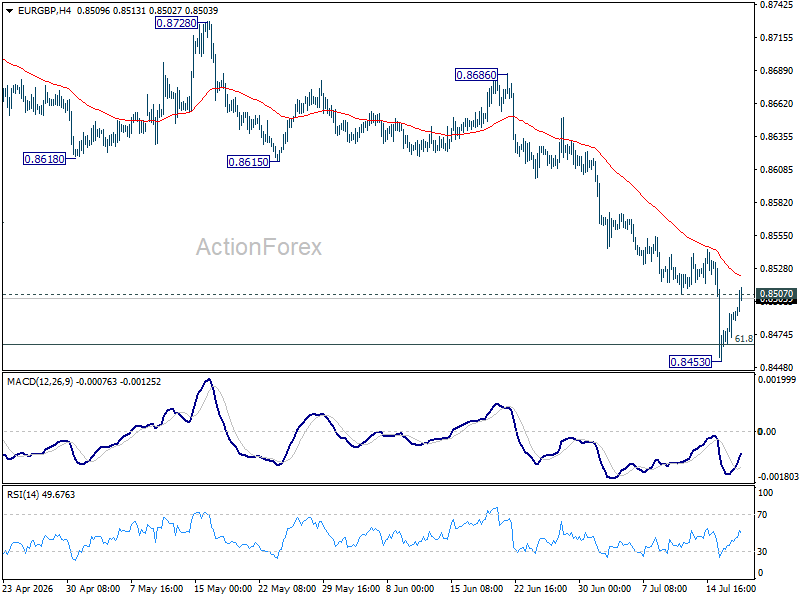
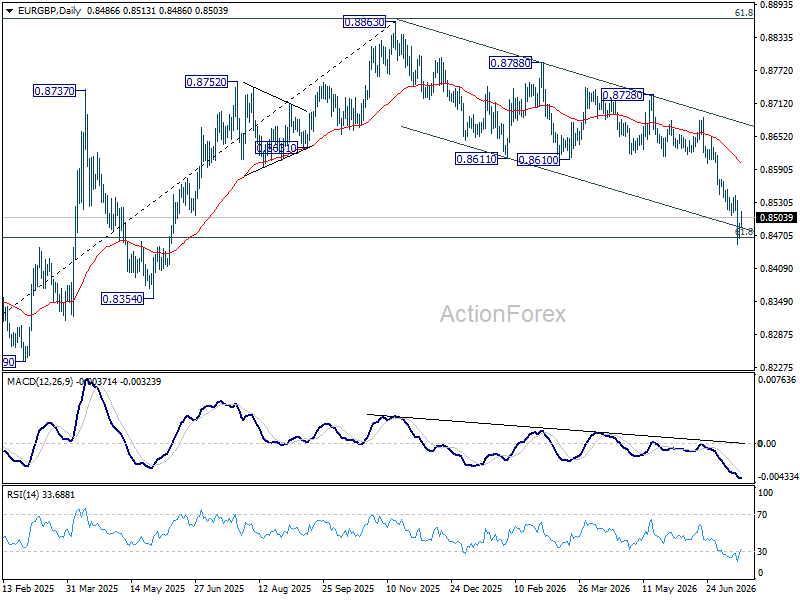
Intraday bias in EUR/GBP stays neutral and more consolidations could be seen above 0.8643. Further decline is expected and decisive break of 0.8631 cluster support (38.2% retracement of 0.8221 to 0.8663 at 0.8618) will pave the way to 61.8% retracement at 0.8466. However, break of 0.8691 resistance will turn bias to the upside, for stronger rebound to 55 D EMA (now at 0.8719) first.
In the bigger picture, rise from 0.8221 medium term bottom (2024 low) is seen as a corrective move. Upside should be limited by 61.8% retracement of 0.9267 to 0.8221 at 0.8867. Sustained trading below 55 W EMA (now at 0.8622) should confirm that this corrective bounce has completed. In this case, deeper fall would be seen back to 0.8201/21 key support zone. However, decisive break of 0.8867 will suggest that EUR/GBP is already reversing whole decline from 0.9267 (2022 high). That should pave the way back to 0.9267.
EUR/AUD Daily Outlook
Daily Pivots: (S1) 1.7384; (P) 1.7421; (R1) 1.7462; More...+
Intraday bias in EUR/AUD remains neutral as consolidations continue above 1.7287. Risk will stay on the downside as long as 1.7477 support turned resistance holds. Current decline is seen as the third leg of the corrective pattern from 1.8554. Below 1.7287 will target 1.7245 support, and then 1.6922 fibonacci level. Nevertheless, firm break of 1.7477 will indicate short term bottoming, and bring stronger rebound back to 55 D EMA (now at 1.7604).
In the bigger picture, the break of 55 W EMA (now at 1.7468) argues that fall from 1.8554 medium term top is already correcting whole up trend from 1.4281 (2022 low). Deeper decline is in favor to 38.2% retracement of 1.4281 to 1.8554 at 1.6922, and possibly below. Risk will stay on the downside as long as 1.8160 resistance holds, in case of strong rebound.
EUR/JPY Daily Outlook
Daily Pivots: (S1) 184.02; (P) 184.79; (R1) 185.30; More...
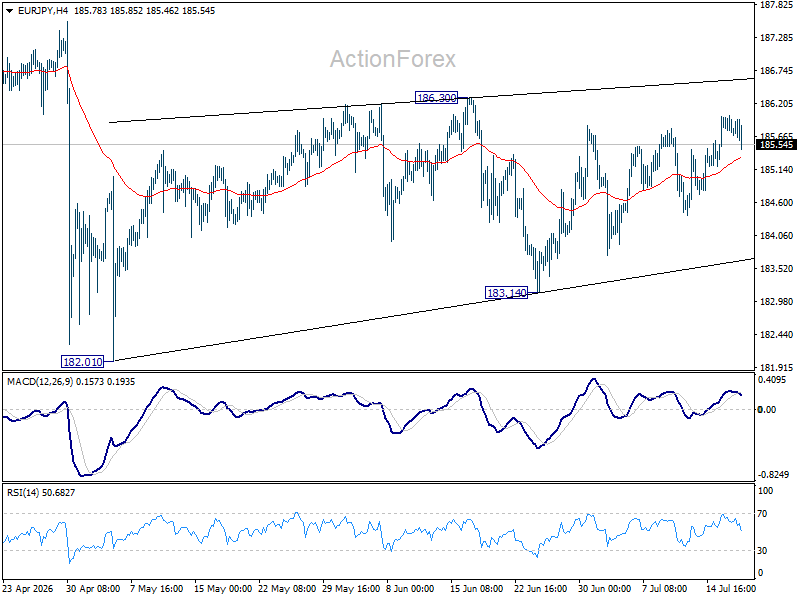
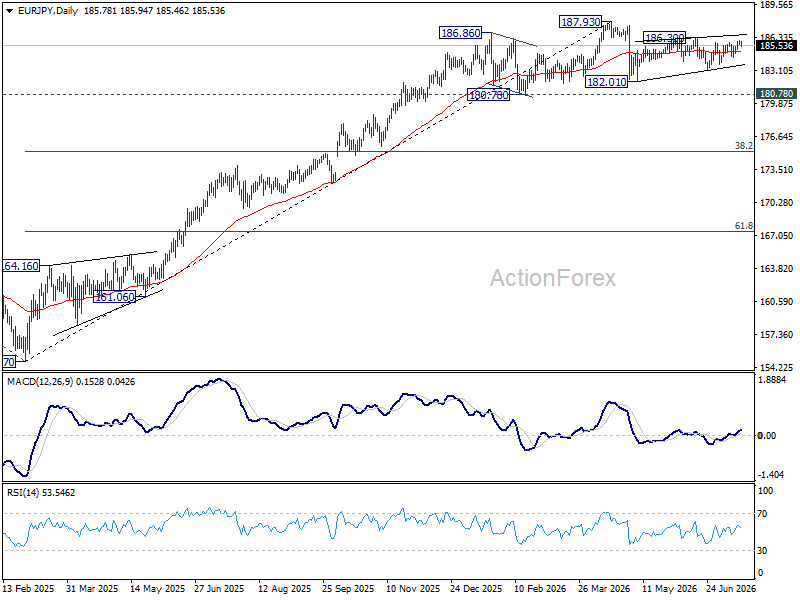
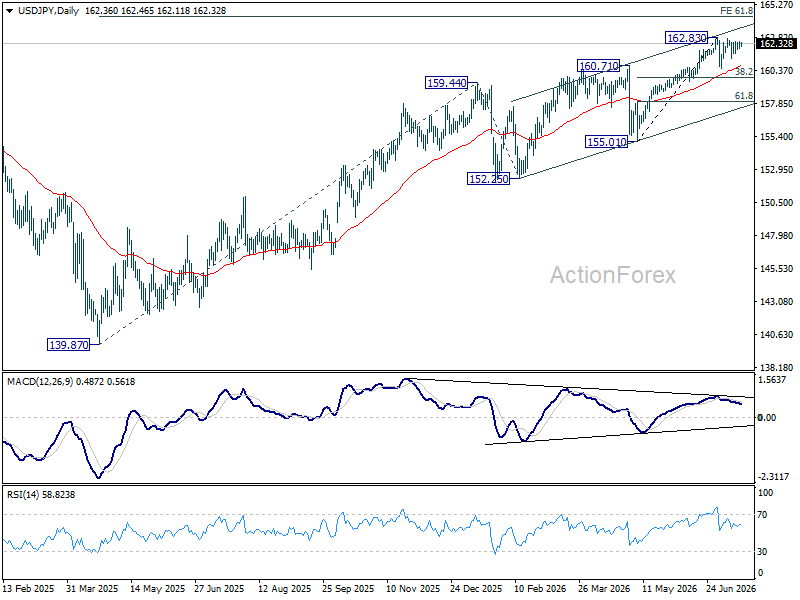
Intraday bias in EUR/JPY remains neutral and more consolidations could be seen below 185.55 temporary top. Further rally is expected with 182.60 support intact. Above 185.55 will resume larger up trend to is 186.31 fibonacci level. Firm break there will pave the way to 138.2% projection of 151.06 to 173.87 from 172.24 at 189.94. However, considering bearish divergence condition in 4H MACD, firm break of 182.60 will confirm short term topping, and turn bias back to the downside for deeper pullback.
In the bigger picture, up trend from 114.42 (2020 low) is in progress and should target 61.8% projection of 124.37 (2021 low) to 175.41 (2024 high) from 154.77 (2025 low) at 186.31. Firm break there will target 78.6% projection at 194.88. Outlook will remain bullish as long as 175.41 resistance turned support holds, even in case of deep pullback.
GBP/JPY Daily Outlook
Daily Pivots: (S1) 212.37; (P) 213.25; (R1) 213.93; More...
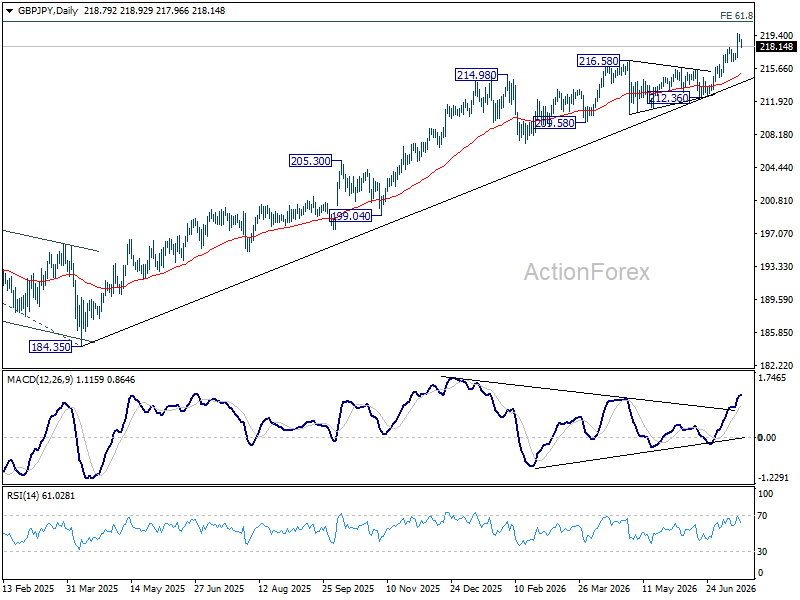
A temporary top was formed at 214.27 with current retreat. Intraday bias in GBP/JPY is turned neutral first for consolidations. Downside should be contained by 210.28 support to bring another rally. Break of 214.27 will resume larger up trend to 100% projection of 184.35 to 205.30 from 199.04 at 219.99 next. Nevertheless, considering bearish divergence condition in 4H MACD, firm break of 210.28 will confirm short term topping, and turn bias to the downside for deeper pullback.
In the bigger picture, up trend from 123.94 (2020 low) is in progress. Next target is 61.8% projection of 148.93 (2022 low) to 208.09 (2024 high) from 184.35 at 220.90. On the downside, break of 205.30 resistance turned support is needed to indicate medium term topping. Otherwise, outlook will stay bullish even in case of deep pullback.
Markets Breathe Easier After Trump Signals Restraint on Iran
Early market nervousness over a potential escalation in the Middle East eased as investors reassessed the likelihood of near-term US military intervention in Iran. Initial risk-off moves faded quickly, helping stabilize broader sentiment. A key factor was messaging from US President Donald Trump, who signaled that Washington may not intervene militarily in Iran, at least for now. His comments helped temper fears of an immediate escalation and reduced demand for safe havens. Gold retreated from its record highs, while WTI crude oil slipped back toward the 60 level as the immediate geopolitical risk premium was partially unwound.
Tensions remain elevated, however. Iran’s leadership is grappling with its worst domestic unrest in decades, and Tehran has threatened US military bases in the region in an attempt to deter American involvement. At the White House, Trump struck a cautious tone. He cited reports from “very important sources” suggesting that killings in Iran’s crackdown were subsiding. While Trump did not rule out military action outright, he said the administration would “watch what the process is,” noting that the US had received what he described as a “very good statement” from Iran.
Separately, Trump sought to talk down concerns over his standoff with Fed Chair Jerome Powell, saying he had “no plan” to fire Powell. Asked whether the investigation into Powell could change that stance, Trump said the administration was in a “holding pattern” and that it was “too soon” to decide. Trump also offered no new clarity on succession planning at the Fed, as he was inclined to nominate either former Fed Governor Kevin Warsh or National Economic Council Director Kevin Hassett when Powell’s term ends. Announcement is expected "over the next couple of weeks."
On trade, Trump unveiled a new tariff mechanism targeting NVIDIA and Advanced Micro Devices, designed to enforce a 25% cut of AI chip sales to China. The move follows December’s decision to allow Nvidia’s H200 chips to be shipped to China, reversing an outright ban but attaching a revenue-sharing requirement. The tariff applies to AI chips imported into the US and then transshipped globally, including Nvidia’s H200 and AMD’s MI325X. The move highlights the administration’s preference for deal-based, transactional trade enforcement.
In FX markets this week, Sterling is the top performer so far, though stronger-than-expected UK GDP has failed to add fresh momentum. Kiwi and Loonie follow, largely stabilizing after recent losses. Yen remains pinned at the bottom despite a brief bounce on intensified verbal intervention, while Aussie and Euro lag. Dollar and Swiss Franc sit in the middle of the pack.
In Asia, Nikkei fell -0.42%. Hong Kong HSI fell -0.28%. China Shanghai SSE fell -0.33%. Singapore Strait Times is up 0.20%. Japan 10-year JGB yield fell -0.018 to 2.169. Overnight, DOW fell -0.09%. S&P 500 fell -0.53%. NASASQ fell -1.00%. 10-year yield fell -0.031 to 4.140.
UK GDP beats with 0.3% mom growth in November, services lead
UK economic output surprised to the upside in November, offering a modest boost to the growth outlook late in the year. GDP rose 0.3% mom, beating expectations for flat growth, with strength concentrated in services and production.
Services output increased 0.3% mom, while production jumped 1.1% mom, offsetting a sharp -1.3% mom decline in construction activity. The data points to improving momentum in consumer- and business-facing sectors, even as construction continues to struggle.
Over the three months to November, GDP edged up 0.1%. Services grew 0.2%, while production slipped -0.1% due largely to weaker motor vehicle manufacturing, and construction fell -1.1%. On a year-on-year basis, GDP expanded 1.3%, led by services growth of 1.4%. Production rose 0.4% and construction rose 0.7%.
Fed’s Beige Book signals steady jobs, moderating price pressures
The latest Beige Book from the Fed showed US economic activity improving modestly, with eight of twelve Districts reporting growth at a "slight to modest pace". Three Districts saw no change and one reported a modest decline, marking a better backdrop than recent cycles where stagnation dominated.
Consumer spending firmed modestly, supported by the holiday shopping season, while business activity presented a mixed picture. Manufacturing remained uneven, with five Districts reporting growth and six citing contraction.
Labor market conditions were "mostly unchanged". Eight Districts reported flat hiring, though multiple contacts noted increased use of temporary workers as firms seek flexibility amid uncertainty. Wage growth continued at a "moderate pace", with several businesses saying wage pressures have normalized.
Price pressures remained elevated, rising at a moderate pace across most Districts. Tariff-related cost increases were a common theme, and while firms expect "some moderation in price growth ahead", many anticipate prices will stay high as they pass through accumulated cost increases.
GBP/JPY Daily Outlook
Daily Pivots: (S1) 212.37; (P) 213.25; (R1) 213.93; More...
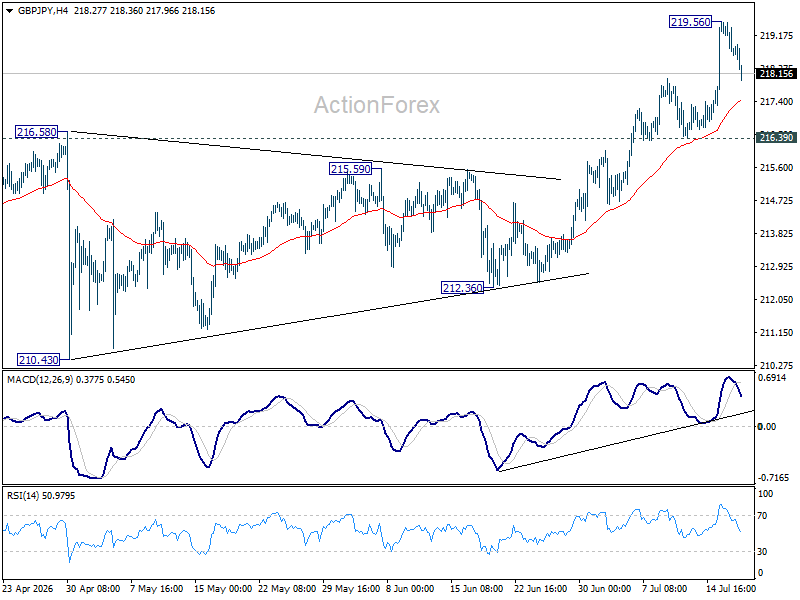
A temporary top was formed at 214.27 with current retreat. Intraday bias in GBP/JPY is turned neutral first for consolidations. Downside should be contained by 210.28 support to bring another rally. Break of 214.27 will resume larger up trend to 100% projection of 184.35 to 205.30 from 199.04 at 219.99 next. Nevertheless, considering bearish divergence condition in 4H MACD, firm break of 210.28 will confirm short term topping, and turn bias to the downside for deeper pullback.
In the bigger picture, up trend from 123.94 (2020 low) is in progress. Next target is 61.8% projection of 148.93 (2022 low) to 208.09 (2024 high) from 184.35 at 220.90. On the downside, break of 205.30 resistance turned support is needed to indicate medium term topping. Otherwise, outlook will stay bullish even in case of deep pullback.
Market Indecisiveness Gradually Morphed into a Mild Risk-Off
Markets
Market indecisiveness gradually morphed into a mild risk-off yesterday. Profit taking on big tech stocks pushed the Nasdaq 1% lower. Mixed results from major US banks also didn’t help sentiment. Still losses in the likes of the Dow (-0.09%) or the Eurostoxx 50 (-0.41%) were more modest. The US Supreme Court again didn’t give an opinion in the Trump tariff case. The modest risk-off correction for once triggered a traditional rally and bull flattening on core bond markets. US yields declined by 2.3 bps (2-y) to 5.2 bps (30-y). German yields eased between 1.7 bps (2-y) and 3.3 bps (10-y). US eco data were not to blame. Both November producer price inflation (0.2% M/M; 3% Y/Y) and retail sales (headline +0.6% M/M) printed on the stronger side of expectations, but had no noticeable impact on trading. The rebound in bonds mainly occurred later. DXY closed marginally softer at 99.05. However, in a context with little eco news and geopolitical topics dominating the headlines it is difficult for the euro to make progress (EUR/USD close 1.164). Don’t call it a buy-the-rumour, sell-the-fact reaction yet, but after touching the weakest level against the dollar since July 2024 (USD/JPY 159.45), pressure on the yen eased slightly. LDP officials confirmed that PM Takaichi will announce snap elections soon. The Ministry of Finance warned on unidirectional yen moves that are not in line with fundamentals. Question is whether such a soft/hidden suggestion on potential interventions will already be a game-changer for the yen, with a period of political uncertainty still ahead in the run-up to the elections.
Overnight some comments/measures from President Trump eased the recent rally in oil and metals. Oil (Brent $64.4/b) declined after Trump suggested that an attack on Iran might not occur anytime soon. The correction in metals to some extent might be simply profit talking, but was supported by a statement that the US will look for bilateral agreements to secure the supply of critical minerals. The US might also implement a price floor to defend domestic production. Markets see this as the US backing away from imposing tariffs. Asian equities this morning show a mixed picture. US futures gain marginally. The dollar remains well bid overall (DXY 99.15). The yen struggles to extend yesterday’s rebound (USD/JPY 158.6). The eco calendar contains some second tier US and European eco data including Philly Fed Business outlook, jobless claims and the Empire manufacturing survey. In Europe, Germany will published a first (general) estimate of the 2025 GDP growth. We doubt that these data will have a lasting impact. We look out whether the decline in yields is able to continue as first support levels are coming closer (e.g 4.78% area for the 30-y US yield, 2.80% area for German 10-y yield). On FX markets, the dollar holds to upper hand. A break of EUR/USD below the 1.1620/15 area suggests further downside. At the time of finishing this report, UK November production (1.1% M/M and 2.3% Y/Y) and monthly GDP data (0.3%) printed on the better side of expectations. Sterling recently outperformed the euro, with the 0.8650 support area now coming with reach.
News & Views
The Polish central bank kept the policy rate at 4% yesterday. The move was widely expected. The NBP lowered the policy rate last year a cumulative 175 bps. The (short) policy statement noted that annual GDP growth in Q4 would probably be in line with Q3’s more than decent 3.8%. Inflation meanwhile, dropped to 2.4% last month, effectively settling below the central bank’s 2.5% +/-1 ppt target. Core inflation, however, is estimated to have been close to November’s 2.7% after being more than 3% for much of 2025. Against this backdrop that the NBP decided to hold a 4% rate Polish swap rates rose by 4 bps at the front end after the decision, which had more to do with stretched positioning (2-yr swap hit a four-year low in recently). The zloty finished unchanged around EUR/PLN 4.21. Further NBP rate cuts are likely nonetheless with money markets assuming the trough in the cycle at 3.5% by mid-2026.
Policy rates in South Korea held steady at 2.5% after this morning’s CB meeting. The fifth straight hold is considered a hawkish one, with the Bank of Korea (BoK) scrapping a reference to further potential cuts. It shifted instead to a neutral stance in which it “will make its policy decisions, amid supporting a recovery in economic growth, while closely monitoring changes in domestic and external policy conditions.” 5 out of 6 members saw a “high chance” of holding settings steady over the next three months. The change in its monetary stance comes as growth remains resilient, inflation slightly above target but especially as financial stability concerns, tied to the housing market and currency, grow. Even after the decision, the won remains under pressure. USD/KRW rises to 1470.3, just shy of a 17-year lows seen in April last year around 1490. The weak won also drew attention from the US with secretary Bessent just yesterday commenting that the depreciation is not in line with fundamentals..
UK GDP beats with 0.3% mom growth in November, services lead
UK economic output surprised to the upside in November, offering a modest boost to the growth outlook late in the year. GDP rose 0.3% mom, beating expectations for flat growth, with strength concentrated in services and production.
Services output increased 0.3% mom, while production jumped 1.1% mom, offsetting a sharp -1.3% mom decline in construction activity. The data points to improving momentum in consumer- and business-facing sectors, even as construction continues to struggle.
Over the three months to November, GDP edged up 0.1%. Services grew 0.2%, while production slipped -0.1% due largely to weaker motor vehicle manufacturing, and construction fell -1.1%. On a year-on-year basis, GDP expanded 1.3%, led by services growth of 1.4%. Production rose 0.4% and construction rose 0.7%.
Bitcoin (BTC/USD) Price Rally: $100K Target in Sight as Institutional Buying Surges
- Bitcoin is up 5.59% for the week, driven by institutional consolidation, cooling U.S. inflation, and anticipation of the Digital Asset Market CLARITY Act.
- MicroStrategy significantly grew its holdings by purchasing 13,627 BTC for $1.25 billion.
The Digital Asset Market CLARITY Act aims to clarify regulation by establishing distinct oversight for digital commodities (CFTC) and centralized assets (SEC) - Near-term technical levels point to key support at $95,000 and $92,000, with major resistance at the $100,000 psychological barrier.
Bitcoin has demonstrated a robust recovery as the world's largest cryptocurrency by market cap has transitioned from a period of speculative volatility into a phase of institutional consolidation and regulatory formalization.
The recent Bitcoin rally has come about as a result of converging factors which include a cooling inflationary environment in the United States, and the imminent arrival of a definitive federal regulatory framework via the Digital Asset Market CLARITY Act.
Bitcoin is up around 5.59% for the week at the time of writing.
Source: TradingView
Institutional Treasury Integration and Corporate Accumulation
One of the key factors behind the recent rally is the scale of treasury participation. Many public companies have followed MicroStrategy’s lead, using Bitcoin as a standard tool to protect their wealth from inflation.
The MicroStrategy Strategy
In early January 2026, MicroStrategy (MSTR) significantly grew its holdings:
- The Purchase: They bought 13,627 Bitcoin for about $1.25 billion (at roughly $91,519 per coin).
- The Total: This brought their total stash to 687,410 BTC.
- The Funding: To pay for this, the company sold roughly $1.13 billion in new stock and raised another $119 million through specialized "preferred" shares.
Long-Term Stability
This isn't just a gamble; it's a calculated financial plan. On January 12, Director Carl Rickertsen showed personal confidence by investing nearly $780,000 of his own money into company shares.
Furthermore, MicroStrategy is keeping $2.25 billion in cash on hand to pay its bills and dividends, proving they are prepared for the long haul rather than just betting on price spikes.
This trend is mirrored by the performance of US spot Bitcoin ETFs, which recorded $697$ million in net inflows on January 5 alone, the highest single-day gain in over three months. These inflows, primarily driven by BlackRock’s IBIT and Fidelity, suggest that institutional allocators are utilizing ETFs as a "liquidity floor," effectively absorbing sell pressure from retail participants.
Legislative Catalysts: The Digital Asset Market CLARITY Act
Add to this a potential legislative catalyst in the form of a new bill called the Digital Asset Market CLARITY Act. This bill aims to stop the confusion between government agencies and create clear rules for the industry.
Ending the Turf War
The bill draws a "bright line" to decide who regulates what:
- The CFTC: Will oversee "digital commodities" (assets that are decentralized and not controlled by one person).
- The SEC: Will oversee assets that still rely on a central company, though with simpler rules than traditional stocks.
The Fight Over Stablecoins
The biggest argument in the Senate right now is about stablecoin interest:
- The Ban: Banks are worried that if people can earn high interest on stablecoins, they will pull their money out of traditional bank accounts. Because of this, the bill currently bans paying interest just for holding a stablecoin.
- The Exceptions: Companies can still offer rewards if the user is actually doing something, like "staking" or using the coin for transactions.
- The Pushback: Major companies like Coinbase hate these restrictions. They argue the rules are unfair and might force crypto businesses to leave the US.
What Comes Next for Bitcoin Prices?
Bitcoin is currently in a steady transition phase as the heavy selling seen at the end of 2025 begins to fade.
Long-term investors are holding onto their coins more firmly, and institutional buying has stabilized, suggesting the market has successfully absorbed recent price pressure.
While the recent climb toward $96,000 was driven more by technical trading maneuvers than a massive wave of new buyers, the overall setup for the first quarter of 2026 looks promising.
Given that there is less "sell pressure" and trading remains thin, even a small increase in new demand could trigger a significant price jump. If steady buying from spot markets and ETFs continues, this quiet period could be the foundation for the next major leg up.
Technical Analysis - BTC/USD
Looking at structure though (on the H4 chart), and price has just printed a higher high before dropping in the Asian session.
This could partly be down to profit taking and market participants eyeing consolidation ahead of the next major move.
The move lower has led the period-14 RSI to leave overbought territory with a retest of the neutral 50 level now a possibility.
Immediate support may be found at 95000 before the 92000 breakout level and 100-day MA resting at 91042 comes into play.
A move higher here will have to navigate its way beyond the 100000 and then gain acceptance above this psychological barrier. Beyond that market participants may eye the 103647 and 105000 handles as points of interest.
Bitcoin (BTC/USD) Four-Hour Chart, January 15, 2026
Source: TradingView.com (click to enlarge)