

Sample Category Title
EUR/CHF Daily Outlook
Daily Pivots: (S1) 0.9300; (P) 0.9319; (R1) 0.9331; More....
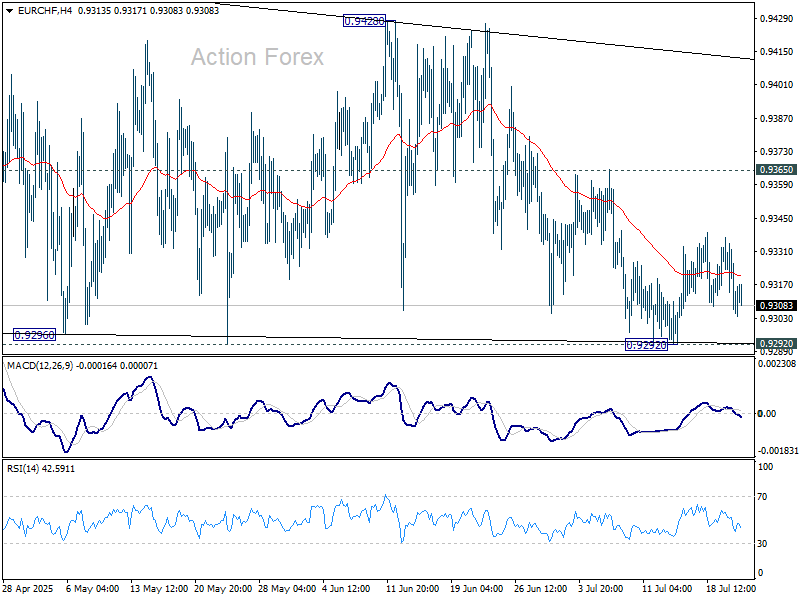
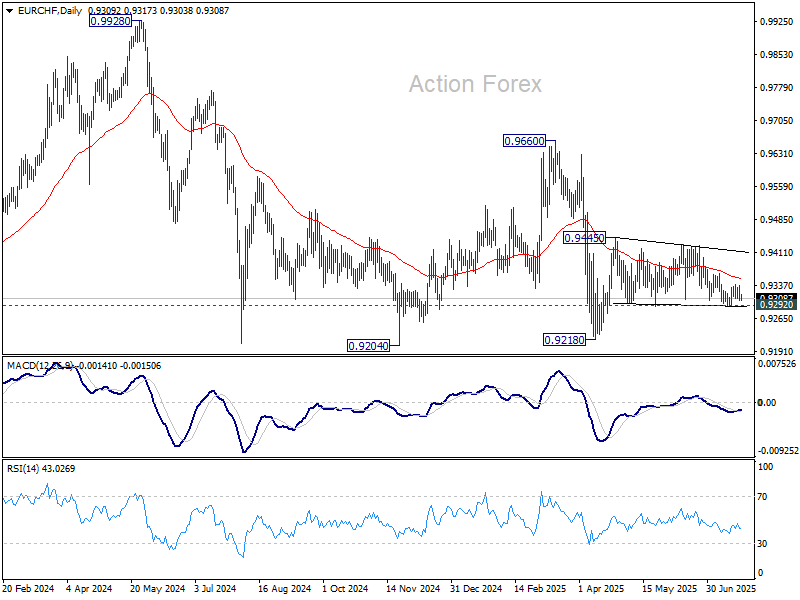
EUR/CHF is still bounded in sideway trading and intraday bias remains neutral. On the upside, firm break of 0.9365 resistance will be the first sign that corrective pattern from 0.9445 has already completed. Further rise should then be seen to 0.9428/45 resistance zone. Firm break there will resume the rebound from 0.9218 low. However, firm break of 0.9292 will bring retest of 0.9218 instead.
In the bigger picture, while downside momentum has been diminishing as seen in W MACD, there is no sign of bottoming yet. EUR/CHF is still staying below 55 W EMA (now at 0.9424) and well inside long term falling channel. Outlook will stay bearish as long as 0.9660 resistance holds. Break of 0.9204 (2024 low) will confirm resumption of down trend from 1.2004 (2018 high).
Trump Announced a Trade Deal With Japan With 15% Tariff
Markets
In a session devoid of key data markets yesterday kept a cautious bias awaiting news from trade talks between the US and its major trading partners ahead of the August 1 deadline. Recent indications suggested that the ‘final’ tariff level from those negotiations might be higher than the 10% rate that some (e.g. the EU) hoped for. The US trade deal with the Philippines (19%) announced confirmed this pattern. At the same time, US Treasury Secretary Bessent showed optimism on negotiations with China as he announced a new round of talks next week in Stockholm. He suggested that an extension of current truce was likely. Interest rate markets didn’t show a clear pattern. In the end both US (2-3 bps) and German yields (1-2.5 bps) again ceded modest ground. US equities finished little changed. The Eurostoxx50 underperformed probably as investors pondered the potential impact of a less favourable trade deal. The dollar on Monday changed course after a guarded comeback earlier this month and this continued yesterday. DXY dropped from 97.86 to close near 97.40. EUR/USD regained the 1.17 barrier (close 1.1754). Even the yen gained against the US currency (USD/JPY close 146.63) even as political and budgetary uncertainty remains elevated as the Japanese government lost its majority in this weekend’s Upper House election.
This morning, president Trump announced a trade deal with Japan with a 15% tariff on US imports from country, including the key automobile sector. The deal also includes a $550 bln fund for (Japanese) investments in the US. The agreement also stipulates Japan buying US products including Boeing aircrafts, rice and agricultural products, amongst others. In a first reaction, the Nikkei index jumps 3.75 %, probably as an important factor of uncertainty has been removed. US equity futures show modest gains. The dollar gains marginally on this broader risk-on (DXY 97.55; EUR/USD 1.173). The yen underperforms (USD/JPY 147.15). However, aside from the trade deal other factors are still in play for Japanese markets. Political (and budgetary) uncertainty remains elevated. Press reports this morning suggest that PM Ishiba will soon announce to resign. In this respect, a poor 40-y Japanese bond auction this morning lifts Japanese yields across the curve (10-y +8.0 bps to 1.6%; 40-y + 9.0 bps to 3.465%). Later today, the eco calendar is extremely thin. Markets will tried to find out whether the deal with Japan provides a template for the outcome of the US-EU trade negotiations (15%? 20%?). Despite the risk-on this morning, we also still keep a close eye at the long end of the yields curves outside Japan, with US 20y bond tap ($13 bln) later today.
News & Views
The Hungarian central bank maintained the policy rate at 6.5% yesterday. “A careful and patient approach to monetary policy remains necessary due to risks to the inflation environment as well as trade policy and geopolitical tensions”, it said. The tight monetary conditions are necessary to bring inflation back to target while preserving the current relative constructive attitude vs the Hungarian forint. Inflation rose to 4.6% in June and a core measure came in at 4.4%. Both are well above the 3% +1 ppt upper bound of the MNB in spite of government efforts. The MNB noted strong corporate repricings in areas outside those affected by the Orban administration’s profit-margin caps. Inflation is expected to remain above the tolerance range throughout the year while only reaching the 3% mid-point in early 2027 amid buoyant consumption, volatile commodity prices and strong wage dynamics. Economic growth should accelerate next year, starting from a gradual recovery in the second half of this year as strong consumption dynamics get complemented with a faster expansion of exports.
The IMF in its annual External Sector Report said that global current account balances have widened sharply in 2024, reversing a trend of narrowing that was under way since 2008-2009. This widening was due largely to increased excess balances in the three biggest economies: the US deficit widened by $228bn (to $1.13tn) while Chinese and Euro area surpluses expanded $161bn (to $424bn) and $198bn (to $461bn) respectively. IMF chief economist Gourinchas said such large surpluses or deficits stemmed from domestic distortions (eg. overly loose fiscal policy or insufficient safety nets that prompt precautionary savings). Addressing these imbalances required policy changes at home, not tariffs, he added. China should focus on boosting consumption, Europe should spend more on infrastructure and the US needed to reduce large public deficits.
EUR/USD Daily Outlook
Daily Pivots: (S1) 1.1702; (P) 1.1731; (R1) 1.1784; More...
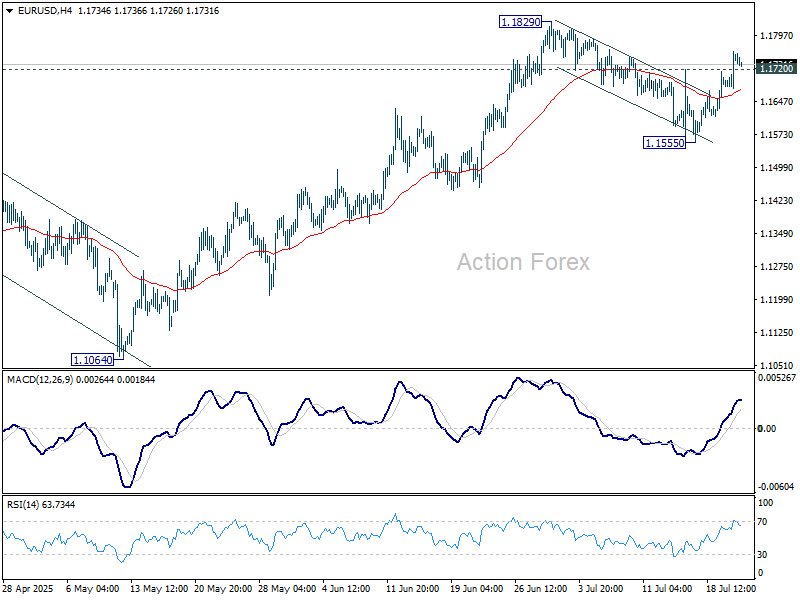
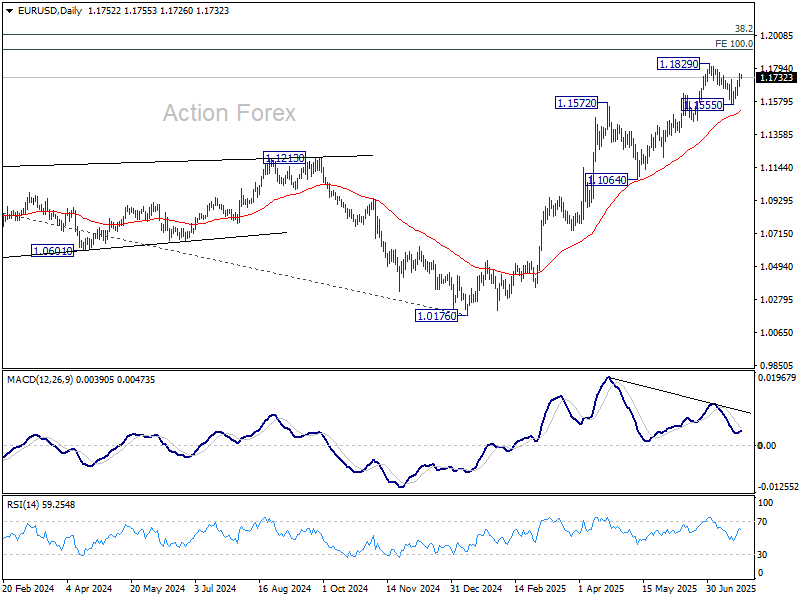
EUR/USD's break of 1.1720 minor resistance suggests that correction fro 1.1829 has completed at 1.1555, well ahead of 55 D EMA. Intraday bias is back on the upside for retesting 1.1829 first. Firm break there will resume whole rally from 1.0176. For now, risk will stay on the upside as long as 1.1555 support holds, in case of retreat.
In the bigger picture, rise from 0.9534 long term bottom could be correcting the multi-decade downtrend or the start of a long term up trend. In either case, further rise should be seen to 100% projection of 0.9534 to 1.1274 from 1.0176 at 1.1916. This will remain the favored case as long as 1.1604 support holds.
USD/JPY Daily Outlook
Daily Pivots: (S1) 145.99; (P) 146.96; (R1) 147.62; More...
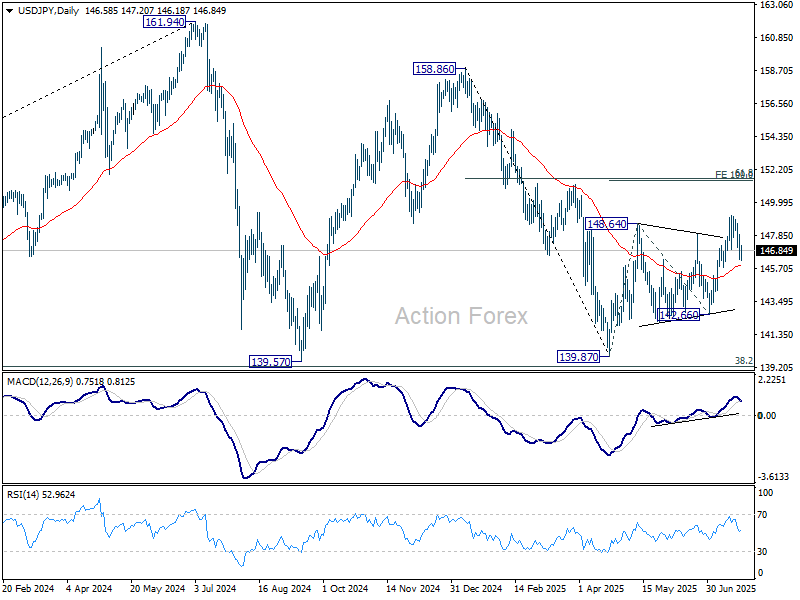
Intraday bias in USD/JPY stays neutral for the moment. Further rally is expected as long as 55 D EMA (now at 145.91) holds. On the upside, break of 149.17 will target 100% projection of 139.87 to 148.64 from 142.66 at 151.43. That is close to 61.8% retracement of 158.86 to 139.87 at 151.22. However, sustained trading below 55 D EMA will argue that the whole rebound from 139.87 might have completed and target 142.66 support for confirmation.
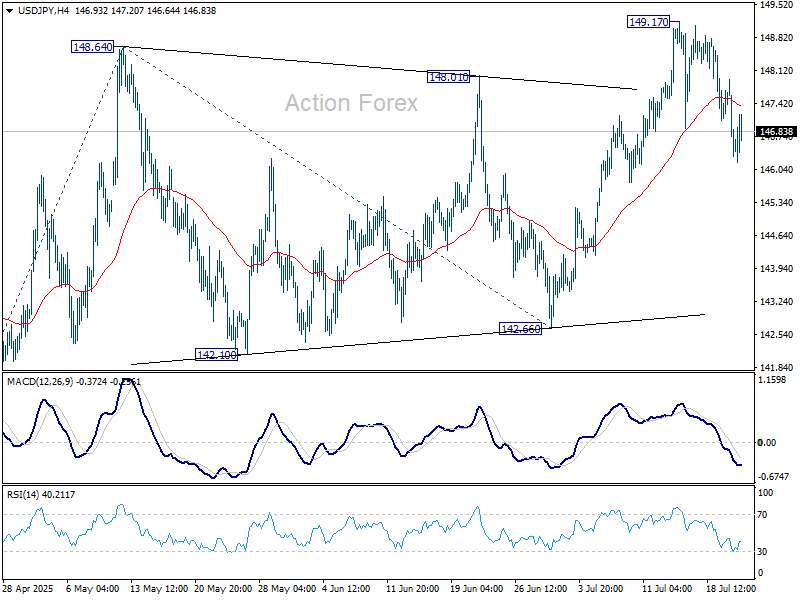
In the bigger picture, price actions from 161.94 (2024 high) are seen as a corrective pattern to rise from 102.58 (2021 low). There is no clear sign that the pattern has completed yet. But still, strong support is expected from 38.2% retracement of 102.58 to 161.94 at 139.26 to bring rebound. in case of another fall.
GBP/USD Daily Outlook
Daily Pivots: (S1) 1.3486; (P) 1.3510; (R1) 1.3558; More...
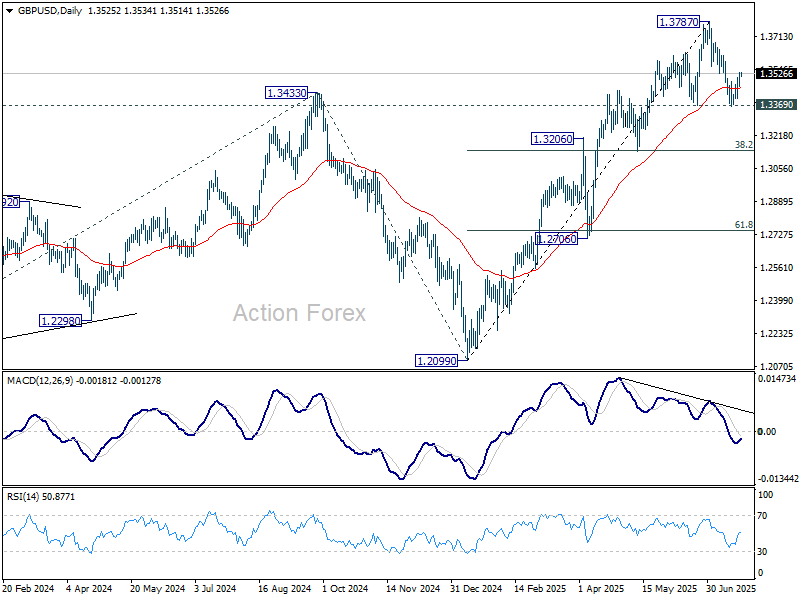
Intraday bias in GBP/USD remains neutral at this point. On the upside, firm break of 1.3561 support turned resistance will argue that correction from 1.3787 has already completed after hitting 1.3369 support. Intraday bias will be back on the upside for retesting 1.3787. Nevertheless, firm break of 1.3363/9 will bring deeper correction to 1.3138 cluster support (38.2% retracement of 1.2099 to 1.3787 at 1.3142).
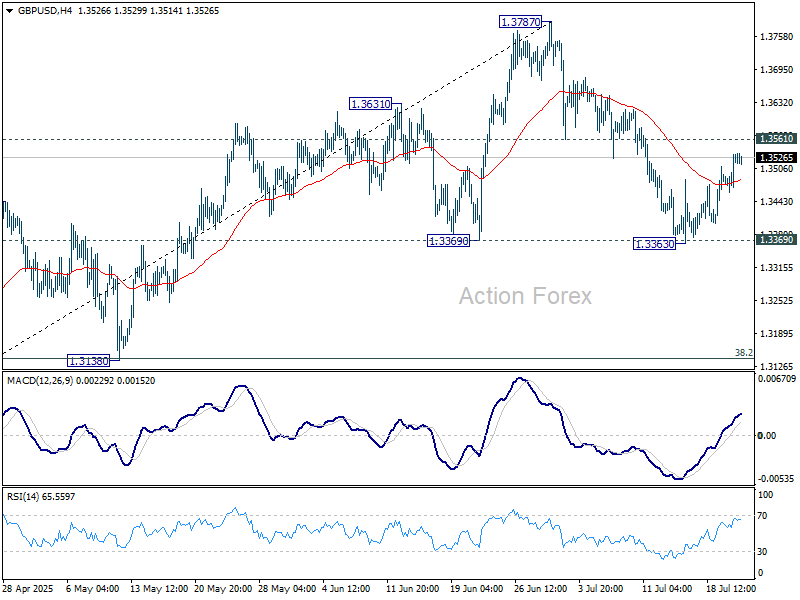
In the bigger picture, up trend from 1.3051 (2022 low) is in progress. Next medium term target is 61.8% projection of 1.0351 to 1.3433 from 1.2099 at 1.4004. Outlook will now stay bullish as long as 55 W EMA (now at 1.3017) holds, even in case of deep pullback.
USD/CHF Daily Outlook
Daily Pivots: (S1) 0.7897; (P) 0.7945; (R1) 0.7969; More….
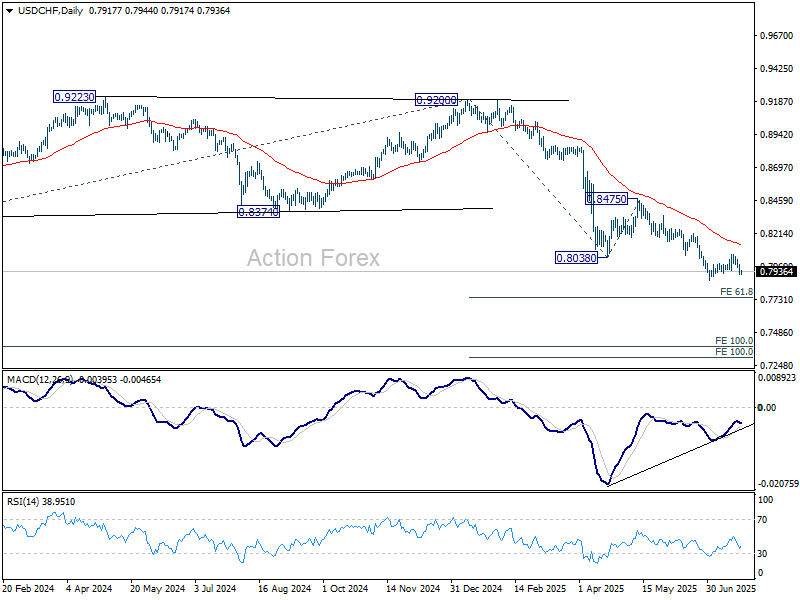
USD/CHF's break of 0.7946 minor support suggests that corrective recovery from 0.7871 has already completed at 0.8064, after rejection by 0.8054 support turned resistance. Intraday bias is back on the downside for retesting 0.7871 first. Firm break there will resume larger down trend. For now, risk will stay on the downside as long as 0.8063 resistance holds, in case of recovery.
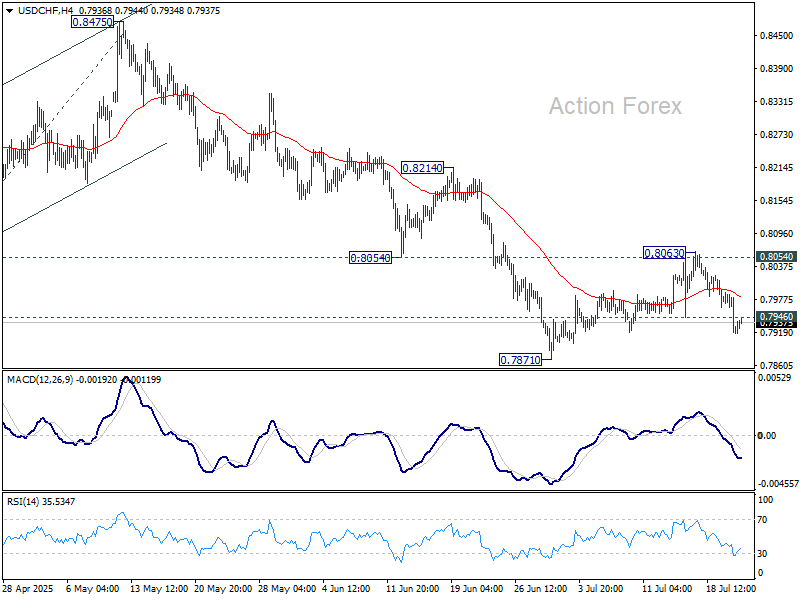
In the bigger picture, long term down trend from 1.0342 (2017 high) is still in progress. Next target is 100% projection of 1.0146 (2022 high) to 0.8332 from 0.9200 at 0.7382. In any case, outlook will stay bearish as long as 0.8475 resistance holds.
AUD/USD Daily Report
Daily Pivots: (S1) 0.6521; (P) 0.6539; (R1) 0.6575; More...
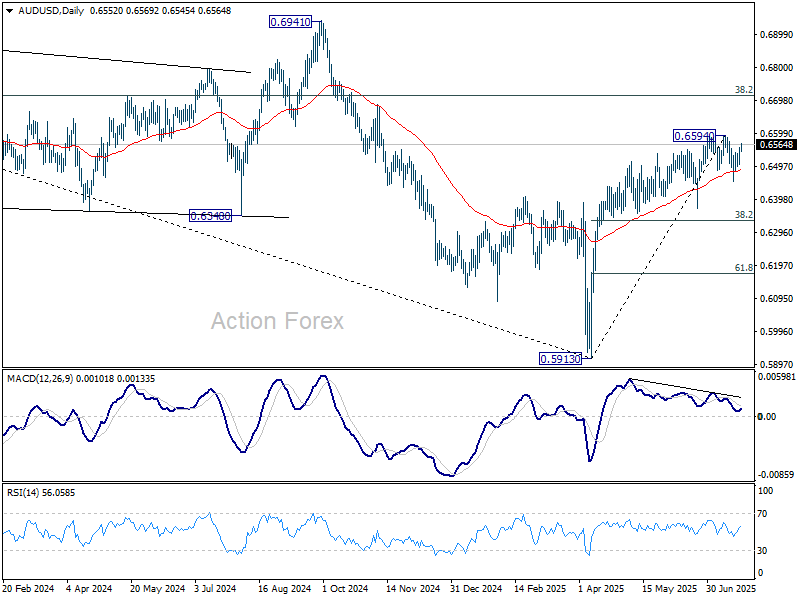
AUD/USD's rebound continues today but stays below 0.6594 resistance. Intraday bias remains neutral at this point. On the downside, break of 0.6453 will extend the correction from 0.6594 to 38.2% retracement of 0.5913 to 0.6594 at 0.6334. Nevertheless, firm break of 0.6593 will resume the rally from 0.5913 and target 0.6713 fibonacci level.
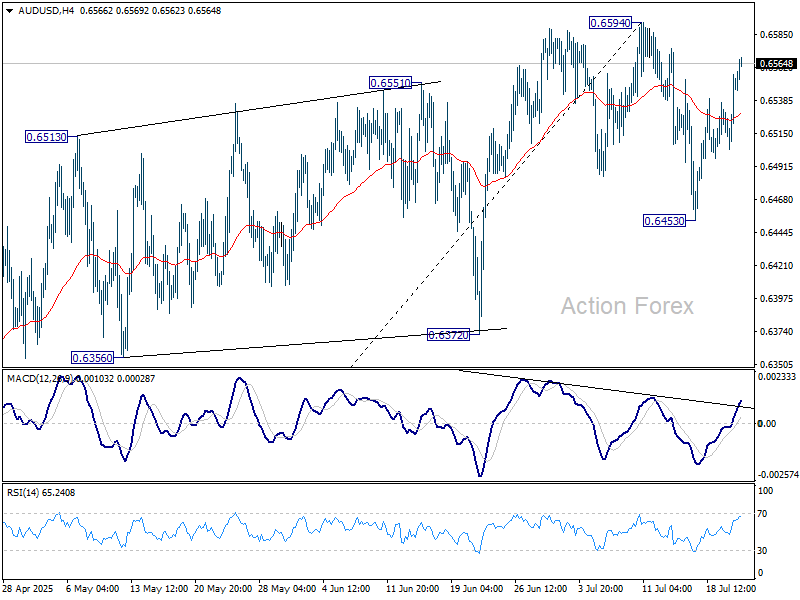
In the bigger picture, there is no clear sign that down trend from 0.8006 (2021 high) has completed. Rebound from 0.5913 is seen as a corrective move. While stronger rally cannot be ruled out, outlook will remain bearish as long as 38.2% retracement of 0.8006 to 0.5913 at 0.6713 holds. Nevertheless, considering bullish convergence condition in W MACD, even in case of another fall through 0.5913, downside should be contained above 0.5506 (2020 low).
Elliott Wave View: Nasdaq Futures (NQ_F) Poised To Extend Higher
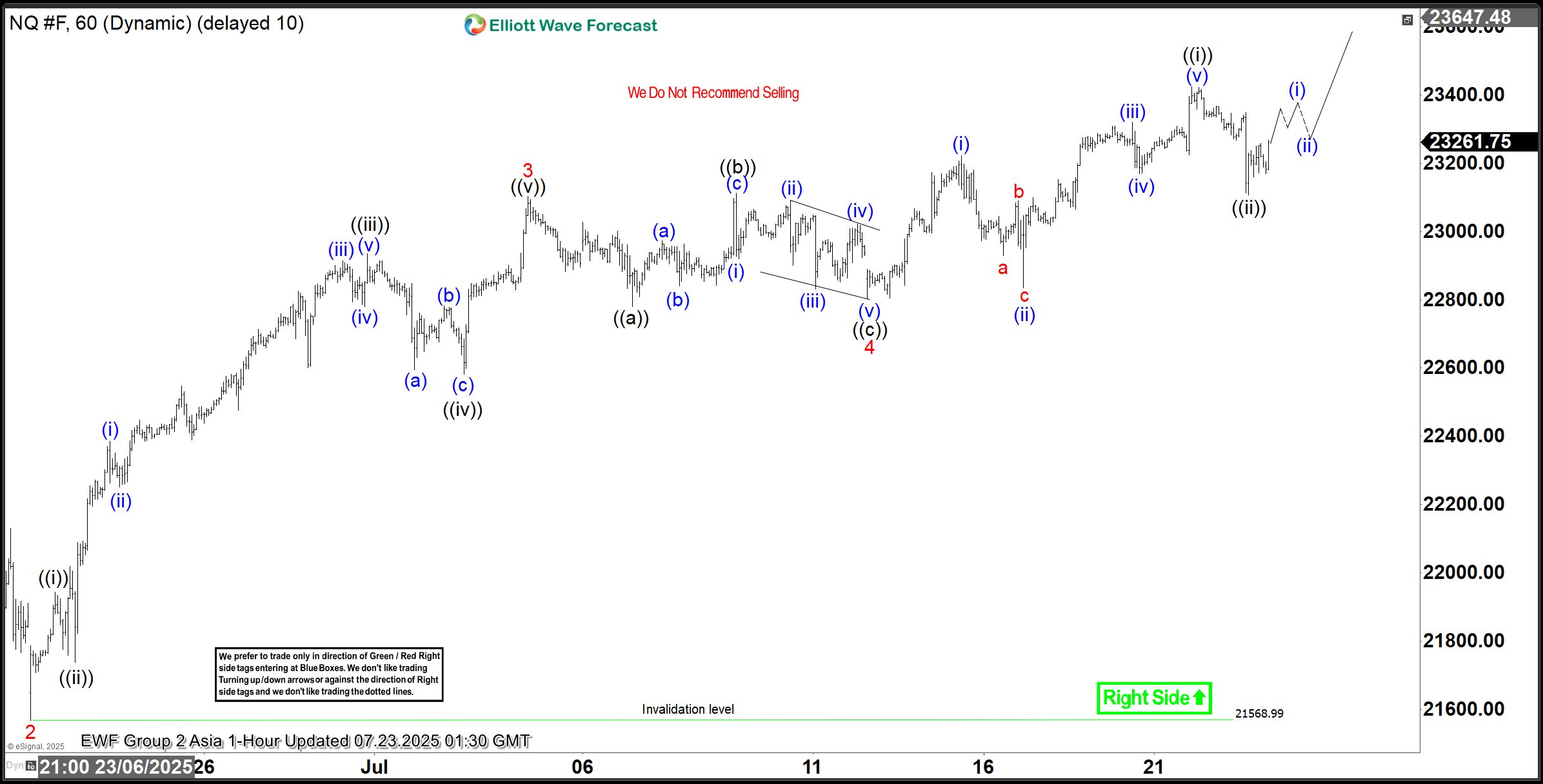
The Nasdaq Futures (NQ_F) favors higher in bullish impulse sequence from April-2025 low. It already broke above December-2024 high & expect short term pullback in 3, 7 or 11 swings to remain supported. Impulse sequence unfolds in 5, 9, 13, 17, 21….. swings count. It ended daily corrective pullback in double correction at 16460 low of 4.07.2025 low. On daily, it should rally extend in to 28864 – 26152 area to finish April cycle before next pullback start. Above there, it favors rally in (3) of ((1)). It placed (1) of ((1)) at 21858.75 high, (2) at 21071.50 low as shallow connector & favoring upside in 5 of (3) against 7.13.2025 low. Every pullback after 4.21.2025 low was shallow & unfolded in 3, 7 or 11 swings calling for more upside as long as it stays above 5.30.2025 low. Within (3), it ended 1 at 22222 high, 2 at 21566.75 low, 3 at 23102.50 high, 4 at 22803 low & favors upside in 5 of (3). Wave 4 as flat correction ended in 7.13.2025 low of 22803 low.
Below 3 of (3) high, it placed ((a)) at 22779.75 low, ((b)) at 23112 high & ((c)) at 22803 low as flat connector against 6.22.2025 low. Above there, it ended ((i)) at 23424.75 high as diagonal & ((ii)) at 23108 low in 3 swing pullback. Above there, it should continue rally in ((iii)) of 5, which will confirm above 23424.75 high to avoid double correction. Within ((i)), it placed (i) at 23222.75 high, (ii) at 22835.5 low, (iii) at 23320.75 high, (iv) at 23169.50 low & (v) at 23424.75 high. Currently, it favors two more highs in 5 of (3) in to 23493.5 – 23934.5 area, above 7.13.2025 low. Based on swing sequence, it already have enough number of swings in (3) to call the cycle completed. But as long as it stays above price trendline, passing through 2 & 4, it should continue upside in to extreme area. We like to buy the next pullback in 3, 7 or 11 swings at extreme area for intraday rally. It favors upside in April-2025 cycle & expected to remain supported in (4) & later in ((2)) pullback as next buying opportunity.
Nasdaq Futures (NQ_F) – 60-Minute Elliott Wave Technical Chart:
Nasdaq Futures (NQ_F) Elliott Wave Technical Video:
https://www.youtube.com/watch?v=Yf6Fe_9tLNc
USD/CAD Daily Outlook
Daily Pivots: (S1) 1.3574; (P) 1.3635; (R1) 1.3667; More...
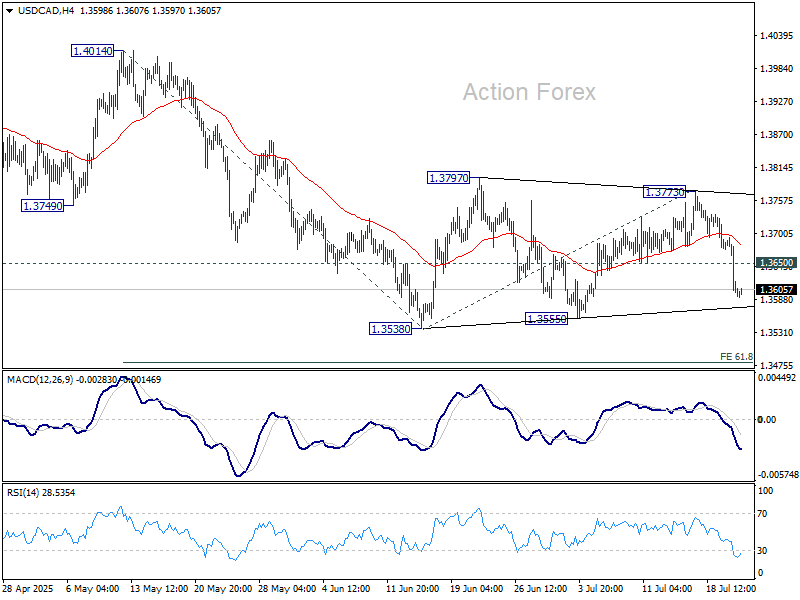
USD/CAD's break of 1.3650 minor support argues that corrective pattern from 1.3538 has completed with three waves to 1.3773. Intraday bias is back on the downside for retesting 1.3538/55 support zone. Decisive break there will resume larger decline from 1.4791. On the upside, however, break of 1.3650 will delay the bearish case and bring more sideway trading.
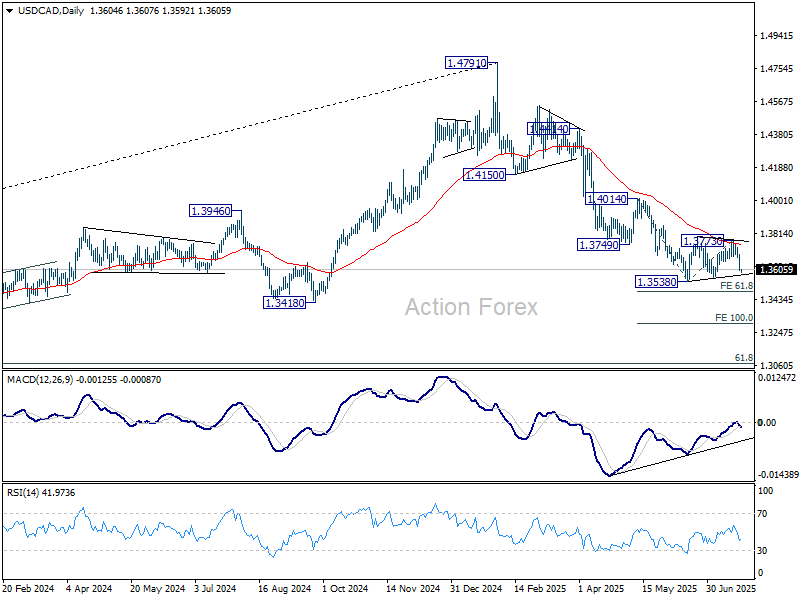
In the bigger picture, price actions from 1.4791 medium term top could either be a correction to rise from 1.2005 (2021 low), or trend reversal. In either case, further decline is expected as long as 1.4014 resistance holds. Next target is 61.8% retracement of 1.2005 (2021 low) to 1.4791 at 1.3069.
Markets Cheer US–Japan Tariff Relief, Ignore Japanese Political Turmoil
Yen slumped across the board in Asia as risk appetite surged following the announcement of a long-anticipated trade agreement between Japan and the US. The deal, which sets a 15% tariff on Japanese goods, down from the previously threatened 25%, sparked a sharp rally in Japanese equities, particularly auto stocks, which major names jumped at least 10%.
While many see the terms as more a reprieve than a win for Japan, the removal of worst-case scenarios provided a relief boost for investor sentiment. The rally extended beyond Tokyo, with South Korean automakers Hyundai and Kia also gaining on optimism that broader regional de-escalation may follow.
Meanwhile, markets appear unfazed by the deepening political crisis in Japan. Prime Minister Shigeru Ishiba’s ruling LDP lost its majority in both houses after the elections over the weekend. Speculation is swirling over his possible resignation by August. Still, the trade breakthrough is clearly dominating market focus.
In currency markets, risk-sensitive currencies lead gains, with Kiwi, Aussie, and Loonie outperforming. Yen sits firmly at the bottom, followed by Swiss Franc and Euro. Dollar and Sterling were more mixed.
In parallel, US Treasury Secretary Scott Bessent signaled progress toward extending the current tariff truce with China, set to expire August 12. He confirmed upcoming meetings with Chinese counterparts in Stockholm next week and hinted a formal extension could be arranged as early as Monday or Tuesday.
The current 90-day tariff pause has kept broader tensions in check, and any confirmation of an extension could support sentiment further. However, gaps remain on structural issues, particularly on state subsidies and tech regulation. Still, investors welcomed signs that both sides are looking to preserve momentum.
Also the US and Indonesia formally announced a framework deal under which Jakarta will remove most tariffs on US imports. In return, the US will impose a 19% tariff on Indonesian goods—lower than the 32% previously threatened under Trump’s sweeping “liberation day” plan. Both countries are expected to finalize the agreement in coming weeks.
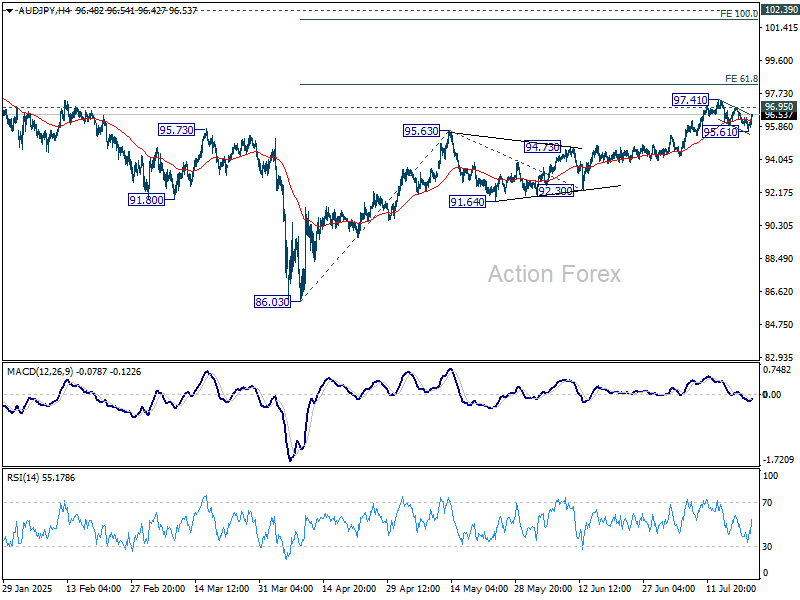
Technically, with today's extended rebound, focus is on 96.95 resistance in AUD/JPY. Firm break there will suggest that correction from 97.41 has completed at 95.61. Larger rally from 86.03 should then be ready to resume to 61.8% projection of 86.03 to 95.63 from 92.30 at 98.23. Sustained break there will pave the way to 100% projection at 101.90.
In Asia, at the time of writing, Nikkei is up 3.64%. Hong Kong HSI is up 1.40%. China Shanghai SSE is up 0.79%. Singapore Strait Times is up 0.46%. Japan 10-year JGB yield is up 0.075 at 1.582. Overnight, DOW rose 0.40%. S&P 500 rose 0.06%. NASDAQ fell -0.39%. 10-year yield fell -0.036 to 4.336.
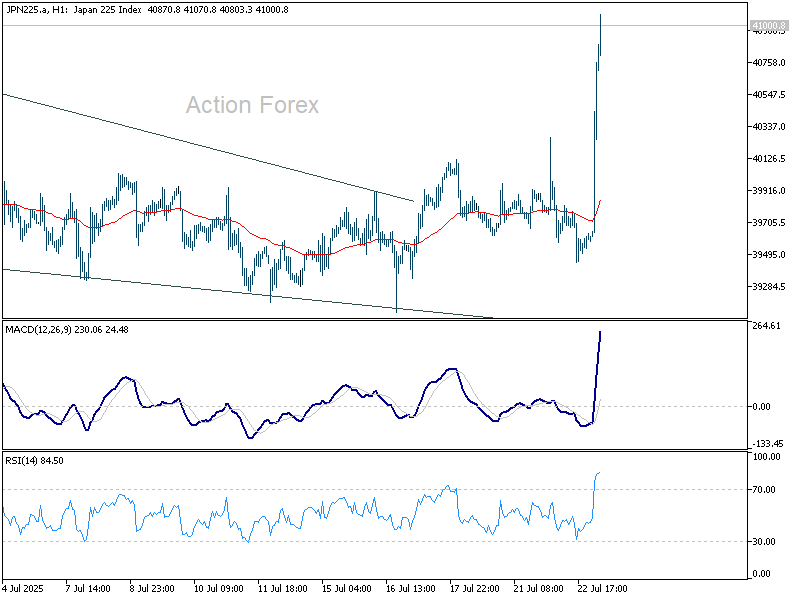
Nikkei soars Past 41k on landmark US-Japan trade deal
Nikkei jumped today, breaking above the 41k level for the first time in a year after the US and Japan confirmed a long-anticipated trade deal. Investor sentiment was buoyed by the breakthrough, which reduces the threat of harsher tariffs that were set to take effect on August 1.
The agreement, publicly confirmed by both US President Donald Trump and Japanese Prime Minister Shigeru Ishiba, includes a 15% blanket tariff on Japanese imports—down from the initially threatened 25%. Japan’s chief negotiator Ryosei Akazawa called the outcome “#Mission Accomplished” in a social media post.
Trump hailed the deal as “perhaps the largest Deal ever made,” claiming Japan will invest USD 550B into the US and that Americans would receive “90% of the Profits.” Under the terms of the agreement, Japan will further open its markets to US goods, including cars, trucks, rice, and agricultural products. On the other hand, Ishiba indicated that the auto tariff rate will drop to 15% from the current 25% imposed globally.
BoJ's Uchida see moderate growth and temporarily sluggish inflation
BoJ Deputy Governor Shinichi Uchida said in a speech today that Japan's economy is likely to "moderate" amid slowing global growth, with underlying inflation remaining "sluggish temporarily". He added that downside risks dominate the outlook, particularly due to high uncertainty surrounding global trade policy and its spillover effects on both domestic and external demand.
Still, Uchida maintained that if the Bank's baseline outlook holds, gradual rate hikes will continue. With real interest rates deeply negative, the BoJ is positioned to adjust its accommodative stance, but only as long as the economic and inflation path improves as expected.
He also highlighted the crosscurrents in Japan’s inflation profile—cost-push pressures from food remain elevated, while demand-side forces are weak. How businesses adjust wages and prices in response to these forces will be central to determining the sustainability of price growth.
Australia Westpac leading index falls to 0.03%, signals weak H2
Australia’s Westpac Leading Index slipped from 0.11% to just 0.03% in May, continuing a six-month slide that points to weakening momentum heading into the second half of 2025. The index, which provides a guide to economic activity three to nine months ahead, has lost altitude from 0.33% in December, with five of eight components dragging—particularly commodity prices, consumer sentiment, and hours worked.
Westpac noted that the shift from modestly above-trend growth to an “around trend” signal marks a clear step-down in economic momentum. The bank now expects the economy to expand by only 1.7% in 2025, a slight pickup from 1.3% in 2024, but still well below historical averages.
With the RBA set to meet on August 11–12, the Leading Index adds to the case for renewed policy easing. Westpac sees the June quarter CPI, due next week, as the key swing factor. A benign reading would likely clear the way for a 25bp cut in August, followed by another in November and two further cuts in H1 2026 as the central bank gradually loosens policy amid persistent growth headwinds.
USD/CAD Daily Outlook
Daily Pivots: (S1) 1.3574; (P) 1.3635; (R1) 1.3667; More...
USD/CAD's break of 1.3650 minor support argues that corrective pattern from 1.3538 has completed with three waves to 1.3773. Intraday bias is back on the downside for retesting 1.3538/55 support zone. Decisive break there will resume larger decline from 1.4791. On the upside, however, break of 1.3650 will delay the bearish case and bring more sideway trading.
In the bigger picture, price actions from 1.4791 medium term top could either be a correction to rise from 1.2005 (2021 low), or trend reversal. In either case, further decline is expected as long as 1.4014 resistance holds. Next target is 61.8% retracement of 1.2005 (2021 low) to 1.4791 at 1.3069.