Sample Category Title
Fed Rate Cuts are Still Coming Despite Strong US GDP data
The US economic cycle will continue as the US consumer remains strong and inflation continues struggle. The US economy continues to grow at a solid pace and the better than expected data should give the US dollar a little momentum as investors price in less Fed rate cuts in the short-term. Next week’s argument for a 50-basis rate cut has gone in up in smoke, not because of the strong US data, but because both the measure of overall inflation and core prices posted significant gains.
This Fed easing cycle is looking just like the one in the 90s and we should primarily focus on the overall trend with inflation and that is not going anywhere anytime soon. Powell and company will likely do everything they can to avoid becoming Japan and we could start seeing markets price in a full percentage point of rate cuts over the next year.
EUR
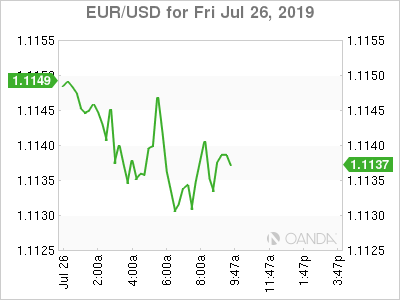
Today’s German import price data solidifies deflationary pressures are hitting the eurozone’s largest economy. With exports also continuing their downward trend, we could be in for much weaker German data in the third quarter than what was initially expected.
The ECB Survey of Professional Forecasters lowered inflation expectations to the surprise of no one. Deflationary and recessionary concerns will remain the fuel to the ECB’s fire in delivering a firework’s display of easing in September.
The markets are still processing Mario Draghi’s press conference, but the general conclusion is that September will see a plethora of steps taken by the ECB that will coincide with new stimulus coming from the Americas. The eurozone outlook is getting worse and worse so we could still see the euro stuck in a frustrating range as ECB efforts will only be countered by the Fed’s start to an easing cycle.
Oil
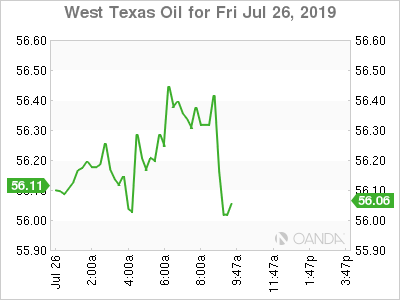
Energy prices remained near session highs following the release of US GDP, as the US consumer continues to spend and business investment slides. The US economy is strong and more importantly for energy prices, so is the US consumer. Demand outlooks will slowly start to improve as we will see a lot of a lot of the doomsday scenarios disappear. Fresh stimulus from the Fed and eventually the ECB will do a lot to bolster up demand from two key regions in the world and that should start to provide strong support for energy prices.
Gold
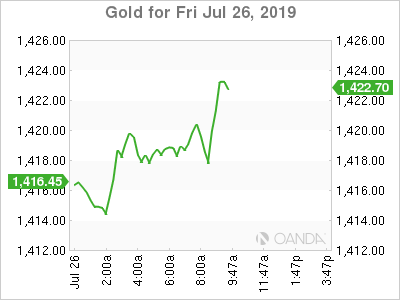
Gold prices pulled back after the advance reading for second quarter GDP topped estimates. Gold however should see buyers emerge as the Fed is coming with rate cuts because inflation risks are too high. Fed officials are looking at negative rates in Europe and Japan and they can afford several cuts to avoid deflationary pressures. Inflation is going nowhere and the yellow metal should still benefit despite upside surprises to US economic data.
Solid US GDP Report Comes with a Few Wrinkles
- US GDP +2.2% in Q2; slightly above expectations
- Consumer spending grew at its fastest pace since 2017
- Business fixed investment edged lower
As expected, today’s GDP report was the opposite of Q1 with stronger domestic spending growth but a drag from trade and inventories that held headline growth to 2.1%. Any concerns about the health of the US consumer should be dispelled by today’s release—consumer spending was up more than 4% in Q2, making up for softer gains in the prior two quarters. Along with a solid add from government spending (after a partial federal government shutdown weighed on activity in the prior two quarters), domestic demand grew at a healthy 3.5% pace. Net exports and inventories combined to subtract 1.5 percentage points from growth after adding 1.3 ppts in the first quarter—more or less a wash over the first half of the year.
We argued that today’s report wouldn’t explain why the Fed is set to lower rates next week. But there are a few data points here that policymakers can point to as justifying a pre-emptive move. Business fixed investment declined in Q2 for the first time in three years—a sign that trade tensions and slowing global growth are generating uncertainty for businesses. And the core PCE deflator, the key price measure from today’s report, was up an annualized 1.8% in Q2—below 2% for a fourth consecutive quarter. The Fed sounds increasingly frustrated with inflation falling short of its target, so expect these numbers to be pointed to next Wednesday.
USD/JPY Mid-Day Outlook
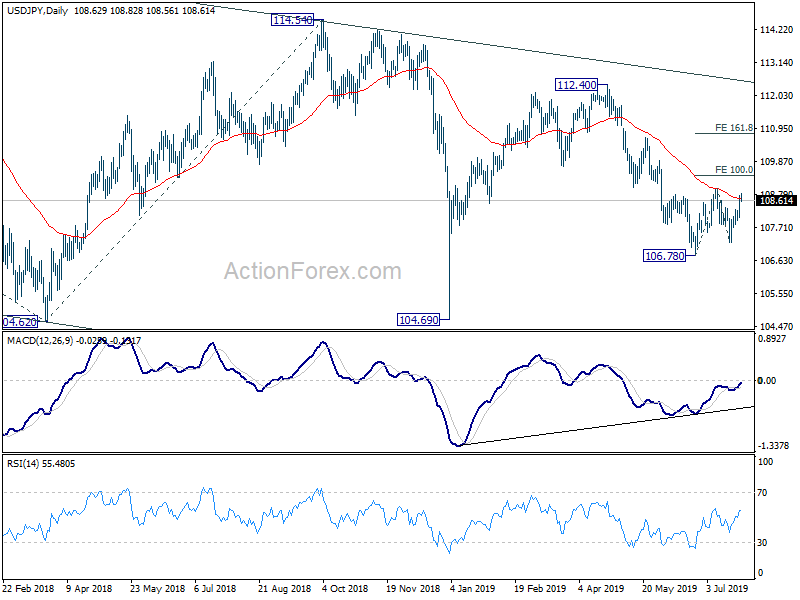
Daily Pivots: (S1) 108.21; (P) 108.48; (R1) 108.91; More...
No change in USD/JPY's outlook and intraday bias remains on the upside. Break of 108.99 will target 100% projection of 106.78 to 108.99 from 107.21 at 109.42 and then 161.8% projection at 110.78. On the downside, below 107.93 minor support will turn bias back to the downside instead.
In the bigger picture, decline from 118.65 (Dec. 2016) is still in progress, with the pair staying inside long term falling channel. Break of 104.62 will target 100% projection of 118.65 to 104.62 from 114.54 at 100.51. For now, we'd expect strong support above 98.97 (2016 low) to contain downside to bring rebound. In any case, break of 112.40 is needed to the first serious sign of medium term bullishness. Otherwise, further decline will remain in favor in case of rebound.
USD/CHF Mid-Day Outlook
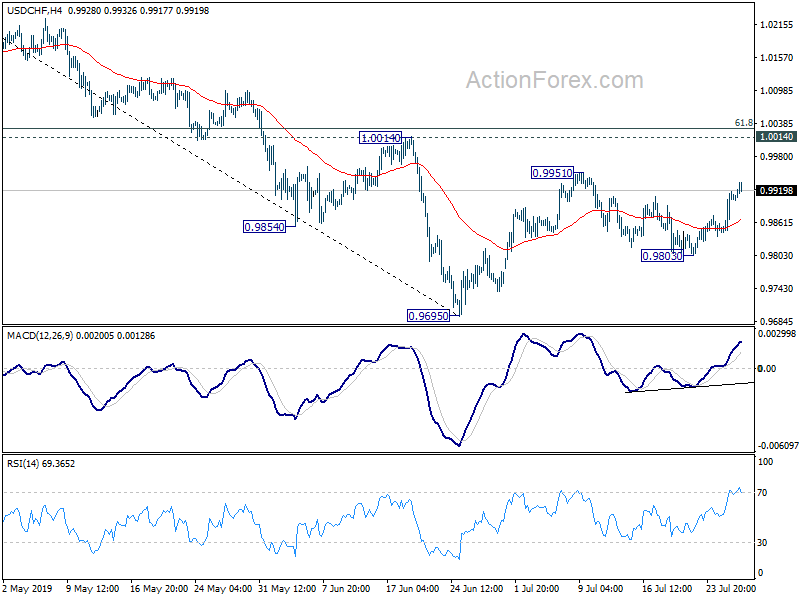
Daily Pivots: (S1) 0.9863; (P) 0.9890; (R1) 0.9937; More...
Intraday bias in USD/CHF remains on the upside for the moment. Rise from 0.9695 is likely in progress. Break of 0.9951 resistance will confirm and target 1.0014 resistance next. On the downside, break of 0.9803 will turn bias to the downside for 0.9695 instead.
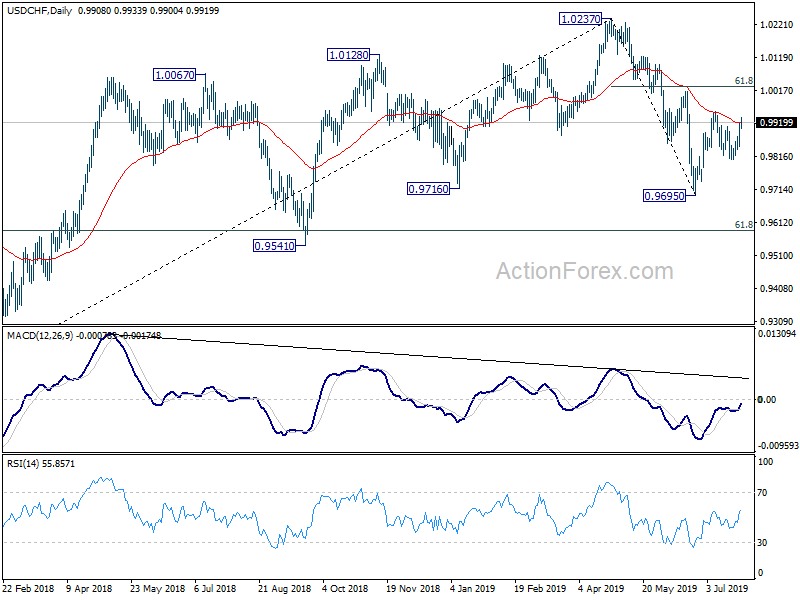
In the bigger picture, up trend from 0.9186 (2018 low) should have completed at 1.0237 already. Deeper decline would be seen to 61.8% retracement of 0.9186 to 1.0237 at 0.9587 and below. For now, USD/CHF is seen as in long term range pattern between 0.9186 and 1.0342. Hence, we'd pay attention to bottoming signal below 0.9587. However, sustained break of 1.0014 will revive medium term bullishness and turn focus back to 1.0237 high.
GBP/USD Mid-Day Outlook
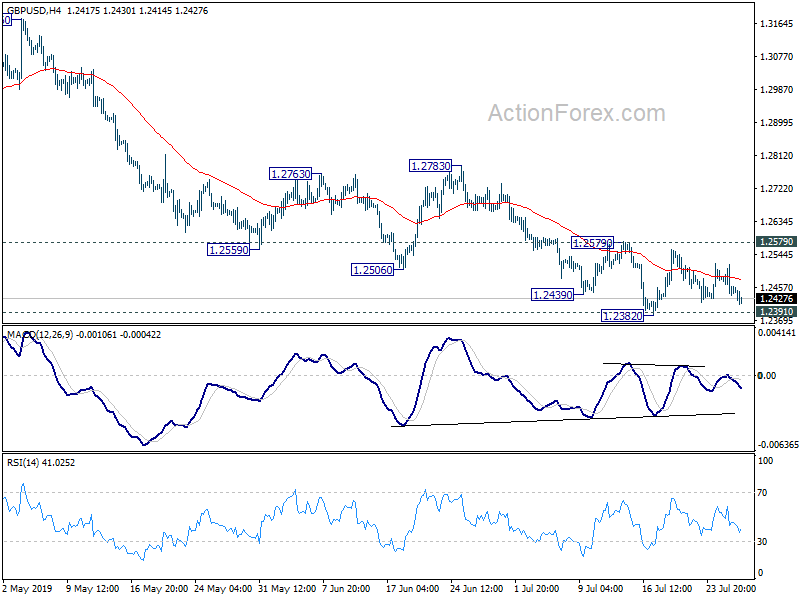
Daily Pivots: (S1) 1.2422; (P) 1.2470; (R1) 1.2503; More....
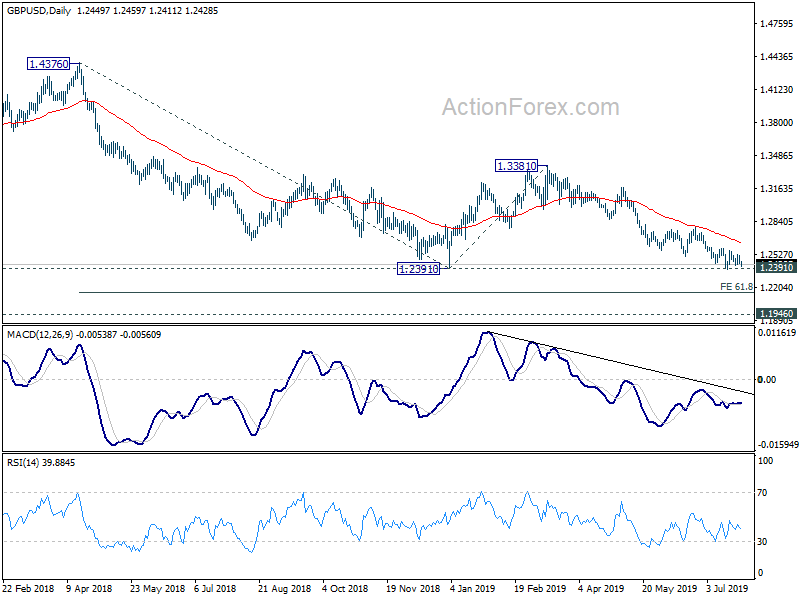
GBP/USD is staying in range of 1.2381/2579 and intraday bias remains neutral first. With 1.2579 resistance intact, further decline is in favor. On the downside, sustained break of 1.2391 key support will resume larger down trend for 61.8% projection of 1.4376 to 1.2391 from 1.3381 at 1.2154 next. Though, break of 1.2579 will indicate short term bottoming and bring stronger rebound back to 1.2783 resistance. In this case, consolidation from 1.2391 would extend with another rise, towards 1.3381 resistance, before completion.
In the bigger picture, down trend from 1.4376 (2018 high) is still in progress. Break of 1.2391 would target a test on 1.1946 long term bottom (2016 low). For now, we don't expect a firm break there yet. Hence, focus will be on bottoming signal as it approaches 1.1946. In any case, medium term outlook will stay bearish as long as 1.3381 resistance holds, in case of strong rebound.
EUR/USD Mid-Day Outlook
Daily Pivots: (S1) 1.1103; (P) 1.1145; (R1) 1.1190; More...
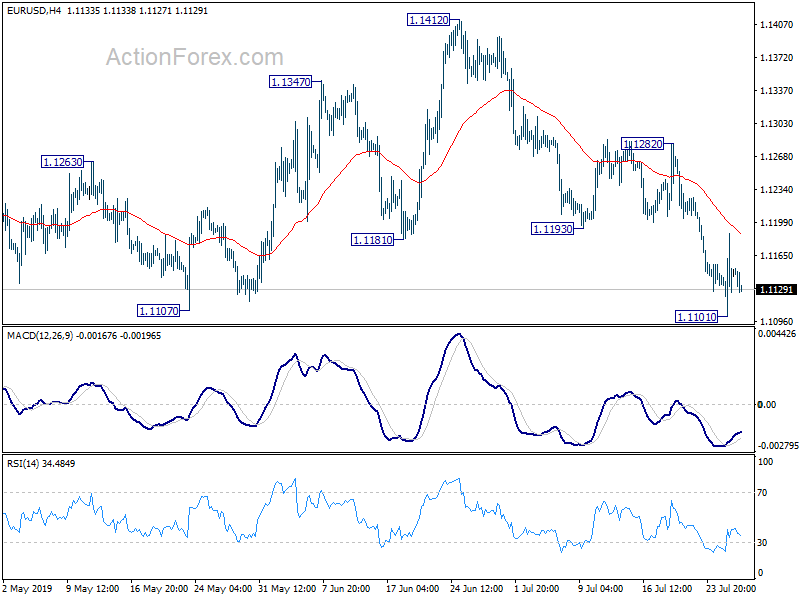
EUR/USD is staying in range above 1.1101 and intraday bias remains neutral first. As long as 1.1282 resistance holds, further decline is expected. Sustained break of 1.1107 low will resume larger down trend from 1.2555. Though, firm break of 1.1282 will bring stronger rise to 1.1412 resistance.
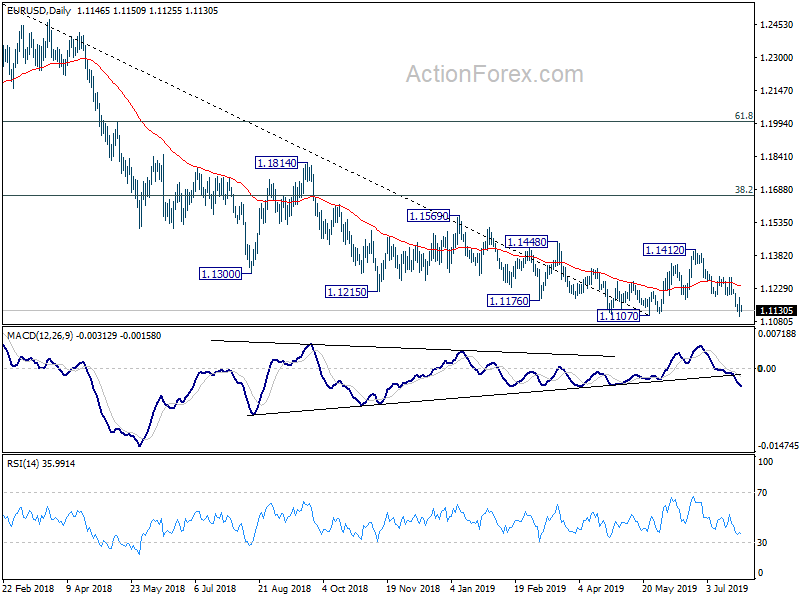
In the bigger picture, on the one hand, 1.1107 is seen as a medium term bottom on bullish convergence condition in weekly MACD. On the other hand, rejection by 55 week EMA retains medium term bearishness. Outlook stays neutral for now. On the downside, break of 1.1107 will resume the down trend from 1.2555 (2018 high) to 78.6% retracement of 1.0339 to 1.2555 at 1.0813. Meanwhile, break of 1.1412 will resume the rebound to 38.2% retracement of 1.2555 to 1.1107 at 1.1660.
Dollar Jumps on Strong Q2 GDP, Yet to Break Key Resistance
Dollar rises notably in early US session after stronger than expected US GDP data. The solid data rises further question on whether Fed would really cut interest rate next week. Even so, a -50bps cut is basically out of question. The greenback is followed by Yen and the Euro. On the other hand, Australian Dollar is the weakest one, followed by New Zealand Dollar., and the Sterling.
Technically, 0.9951 resistance in USD/CHF, 108.99 resistance in USD/JPY and 0.6910 support in AUD/USD will be watched for further Dollar strength. Though, the most important levels will be 1.1107 low in EUR/USD and 1.2391 low in GBP/USD. These two levels are the most important for the greenback to overcome.
In Europe, currently, FTSE is up 0.61%. DAX is up 0.21%. CAC is up 0.50%. German 10-year yield is down -0.010 at -0.371. Earlier in Asia, Nikkei dropped -0.45%. Hong Kong HSI dropped -0.69%. China Shanghai SSE rose 0.24%. Singapore Strait Times dropped -0.52%. Japan 10-year JGB yield rose 0.0008 to -0.149.
US GDP grew 2.1% in Q2, above expectation of 1.8%
US GDP grew 2.1% annualized in Q2, better than expectation of 1.8%. GDP price index rose 2.4% qoq, below expectation of 4.0% qoq.
There were contributions from GDP growth from personal consumption expenditures (PCE), federal government spending, and state and local government spending. They were partly offset by negative contributions from private inventory investment, exports, nonresidential fixed investment and residential fixed investment. Imports, which are a subtraction in the calculation of GDP, increased.
Deceleration in growth reflected downturns in inventory investment, exports, and nonresidential fixed investment. These downturns were partly offset by accelerations in PCE and federal government spending.
ECB SPF: Inflation forecast from 2019 to 2021 revised down by -0.1%
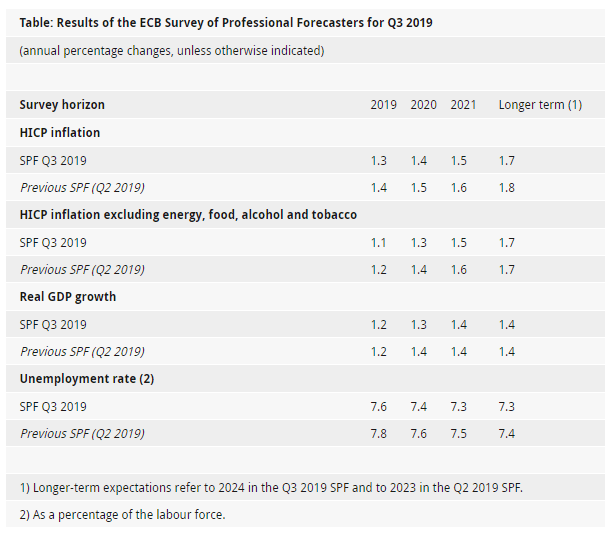
According to Q3 ECB Survey of Professional Forecasters, average forecast for HICP inflation is 1.3% for 2019, 1.4% for 2020 and 1.5% for 2021. There were downward revisions of -0.1% for each of those years comparing with Q2 forecast. Average long-term inflation expectation was lowered from 1.8% to 1.7%.
Growth is projected to average 1.2% in 2019, 1.3% in 2020 and 1.4% in 2021. There was no change in expectation of 2019 and 2021. But 2020 figure was revised down by -0.1%. Average longer-term expectations for real GDP growth were unchanged at 1.4%.
Ireland Coveney: Johnson deliberately set UK on collision course with EU
UK Prime Minister Boris Johnson's spokesman said Johnson spoke with French President Emmnauel Macron on Thursday night. Discussions moved on to Brexit that Johnson "will be setting out the same message which he delivered in the House of Commons". That is, "the withdrawal agreement has been rejected three times by the House of Commons, it's not going to pass, so that means reopening the withdrawal agreement and securing the abolition of the backstop."
Referring to Johnson's statements in House, Ireland's Foreign Minister, Simon Coveney, said they are "very unhelpful" tot he Brexit process. Coveney said Johnson "seems to have made a deliberate decision to set Britain on a collision course with the European Union and with Ireland in relation to the Brexit negotiations." And, "the approach that the British prime minister seems to now be taking is not going to be the basis of an agreement, and that's worrying for everybody."
French State Minister for European affairs Amelie de Montchalin said Macron will hold discussion with Johnson in the coming week and "What is still to negotiate is the future relationship… We have to create a working relationship and not get into games, gestures and provocations."
Japan said to remove South Korea from trade whitelist
Kyodo news reported that, as trade frictions intensified, Japan is going to remove South Korea from the white list of countries that gives the latter preferential treatment in trade. The announcement could be made as soon as on August 2, and change could take effect after 21 days.
Japan is reported to have cited "significantly undermined" trust between the two countries and "certain issues" with South Korea's export controls and regulations. After the move, products and technology that could be diverted to military use would need to obtain approval from Ministry of Economy before exporting to South Korea.
Asked about the plan, Chief Cabinet Secretary Yoshihide Suga told a news conference that nothing had been decided on the time frame. There are currently 27 countries on Japan's white list including the United States, Britain, Germany, Australia, New Zealand and Argentina.
Suggested reading:
MOFCOM: Trade frictions cannot stop US enthusiasm for Chinese market
China's Assistance Commerce Minister Ren Hongbin said that US companies are keen to participate in the second China International Import Expo (CIIE), to be held on Nov. 5-10 in Shanghai. He expects the number of US participants to exceed last year's. He added, "for the United States, even through there are some bilateral trade frictions, it cannot stop U.S. firms from attaching importance to the Chinese market and their great enthusiasm for the Chinese market."
Vice Commerce Minister Wang Bingnan also said China will further lower import tariffs and open up its market to foreign firms. He added, "the purpose of our holding of the import expo is not simply expanding imports, but putting more emphasis on improving import structures while keeping export growth steady."
Separately, US trade delegation, led by Trade Representative Robert Lighthizer and Treasury Secretary Steven Mnuchin, will arrive in Shanghai next week, for the first face-to-face meeting since Trump-Xi summit in Japan.
EUR/USD Mid-Day Outlook
Daily Pivots: (S1) 1.1103; (P) 1.1145; (R1) 1.1190; More...
EUR/USD is staying in range above 1.1101 and intraday bias remains neutral first. As long as 1.1282 resistance holds, further decline is expected. Sustained break of 1.1107 low will resume larger down trend from 1.2555. Though, firm break of 1.1282 will bring stronger rise to 1.1412 resistance.
In the bigger picture, on the one hand, 1.1107 is seen as a medium term bottom on bullish convergence condition in weekly MACD. On the other hand, rejection by 55 week EMA retains medium term bearishness. Outlook stays neutral for now. On the downside, break of 1.1107 will resume the down trend from 1.2555 (2018 high) to 78.6% retracement of 1.0339 to 1.2555 at 1.0813. Meanwhile, break of 1.1412 will resume the rebound to 38.2% retracement of 1.2555 to 1.1107 at 1.1660.
Economic Indicators Update
| GMT | Ccy | Events | Actual | Forecast | Previous | Revised |
|---|---|---|---|---|---|---|
| 23:30 | JPY | Tokyo CPI Core Y/Y Jul | 0.90% | 0.80% | 0.90% | |
| 06:00 | EUR | German Import Price Index M/M Jun | -1.40% | -0.80% | -0.10% | |
| 12:30 | USD | GDP Annualized Q2 A | 2.10% | 1.80% | 3.10% | |
| 12:30 | USD | GDP Price Index Q/Q Q2 | 2.40% | 4.00% | 0.90% |
US GDP grew 2.1% in Q2, above expectation of 1.8%
US GDP grew 2.1% annualized in Q2, better than expectation of 1.8%. GDP price index rose 2.4% qoq, below expectation of 4.0% qoq.
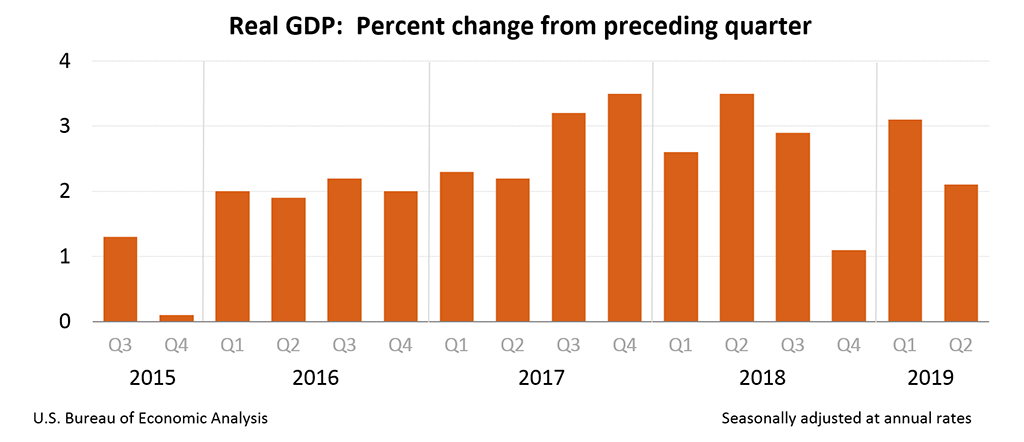
There were contributions from GDP growth from personal consumption expenditures (PCE), federal government spending, and state and local government spending. They were partly offset by negative contributions from private inventory investment, exports, nonresidential fixed investment and residential fixed investment. Imports, which are a subtraction in the calculation of GDP, increased.
Deceleration in growth reflected downturns in inventory investment, exports, and nonresidential fixed investment. These downturns were partly offset by accelerations in PCE and federal government spending.
Europe Update – ECB, US, USD, Gold, Oil, Bitcoin
US GDP to see us out this week
It seems the heat isn’t the only thing that’s taken it out of investors on the final day of the week as markets show signs of fatigue following a busy few days.
The killer blow came from Mario Draghi on Thursday who wasn’t his usual dovish self, or more accurately, failed to live up to the high level of expectation that the market has set. I fear this is going to be a recurring theme as central banks try to appease markets while at the same time trying not to be pushed into easing at a faster rate than they’re comfortable with.
Investors appear to have got this impression yesterday as well, with there being plenty of suggestions that we could see a repeat from the Fed next Wednesday. Investors have been very stubborn with the Fed and refuse to accept what is right in front of them. There have been repeated efforts to pare back expectations but they’re still falling on deaf ears a little, with markets pricing in an 18% chance of a 50 basis point cut.
This number could rise as well today if we get a bad second quarter GDP reading. It seems investors are quite pleased to see weaker data at the moment as it further builds the case for aggressive rate cutting. I can’t see today’s GDP release changing much though, unless it’s a really shocking number, for example one that opens up the possibility of recession in three months time.
Central banks building a bullish case for gold
It’s clear that traders will be paying close attention to the GDP release today and that means we could see some big moves in the dollar, especially if we see a decent miss or beat given how jittery traders are at the moment. The dollar has recovered strongly recently as traders have pared back expectations but that could change quickly, traders are all too keen for more cuts.
This has taken some of the shine off gold but it hasn’t fallen too far which suggests there’s more at play here than just the dollar. With central banks around the world exploring additional easing and the ECB looking at bond buying again, gold is becoming increasingly attractive compared to the growing list of debt yielding negative returns. It came as low as $1,410 yesterday but has once again found support at a higher level than it did previously, possibly a bullish signal for the yellow metal.
Oil steady even as news keeps flowing
Oil looks a little lost at the moment as it continues to hover around the mid-point of the range it’s traded in since early June. There’s no shortage of factors driving price at the moment, be it downbeat global growth outlook, record US output, tensions in the Persian Gulf, outages in the Gulf of Mexico to name just a few. But all of this has contributed to the stagnation rather than spur volatility with traders perhaps thinking everything is now reasonably priced in.
Bitcoin taking a break after weeks of intense scrutiny
Bitcoin is trading back below $10,000 after settling down a little over the last week or so. Cryptocurrencies have been very much back in the headlines in recent months and bitcoin has definitely been one of the big winners of this. It’s also come under increased scrutiny from officials that are quite hostile to the prospect of something that aims to usurp the US dollar. It’s been much quieter over the last week though which has brought a little calm back to price action. I doubt that will last.
ECB SPF: Inflation forecast from 2019 to 2021 revised down by -0.1%
According to Q3 ECB Survey of Professional Forecasters, average forecast for HICP inflation is 1.3% for 2019, 1.4% for 2020 and 1.5% for 2021. There were downward revisions of -0.1% for each of those years comparing with Q2 forecast. Average long-term inflation expectation was lowered from 1.8% to 1.7%.
Growth is projected to average 1.2% in 2019, 1.3% in 2020 and 1.4% in 2021. There was no change in expectation of 2019 and 2021. But 2020 figure was revised down by -0.1%. Average longer-term expectations for real GDP growth were unchanged at 1.4%.