Sample Category Title
The Weekly Bottom Line: Searching for the Signal Amidst A Lot Of Noise
Canadian Highlights
- Next Monday’s federal election will be the show stealer. The Liberals are ahead in the polls, and if they do indeed prevail, we could see more government spending than what we baked into our forecast.
- Even with a potential government stimulus boost, the economy is still likely poised to sour in the coming months. We expect that will lead the Bank of Canada to trim its policy rate.
- February was a soft month for consumer retail spending. March looks to have been a firmer month, but we’re retaining our view that consumption is headed for a slowdown.
U.S. Highlights
- Trade tensions between the world’s two largest economies simmered this week, with the U.S. administration hinting that the tariffs on China would likely be lowered in the very near future.
- But President Trump appeared frustrated with the lack of progress among other countries, and threatened to reimpose the reciprocal tariffs in the coming weeks if trade deals weren’t signed.
- Amidst all the uncertainty, the housing recovery appears to be on hold. Existing home sales declined to a six-month low in March.
Canada – Election Anticipation
Some optimism returned to Canadian financial markets this week. Equities breathed a sigh of relief, with the TSX on track to rise about 2.5% on the week. President Trump signaled a de-escalation of the U.S. trade war with China and assured that he would retain Federal Reserve chief Powell, despite disagreeing with his stance on monetary policy (to put it lightly). Bond yields were also slightly higher at time of writing, although the Canadian dollar dipped a touch on the back of some upward movement in the USD. It wasn’t completely smooth sailing, however, with the U.S. President warning that the 25% tariff in place on cars imported from Canada could go up. He also re-iterated some of his grievances with his northern neighbour when questioned about the upcoming Canadian election.
This week also offered a pulse-check on the state of the Canadian consumer via the February retail spending report, and the results were less than encouraging. Retail sales volumes declined 0.4% month-on-month, pulled down by weakness in new vehicle purchases (which continued to pullback after surging in the back half of last year) and housing-related sales (mirroring the weakness in the housing market). Some of the drop in overall sales volumes may have been weather-related given major winter storms that took place that month. Still, it marked the second straight monthly decline (Chart 1). Statcan’s flash estimate showed a 0.7% m/m rebound in March, but given all of the headwinds facing the consumer, we still expect spending growth to cool moving forward.
All eyes are on next Monday’s federal election. It’s a two-horse race between the Liberals and Conservatives, with both parties releasing their costed platforms this week. Net new stimulus measures in the Liberal plans amount to an average of about 1% of GDP over the forecast horizon, driven by spending and abetted by tax cuts. In contrast, tax reductions are the name of the game for the Conservatives, with relief pledged for household incomes, housing, and seniors to name a few. On the opposite side of the ledger, the Conservatives are pledging to scale back spending slightly, instead leaning on a bevy of tax cuts to support the economy and, ultimately, grow revenues. The Liberal plan sees the deficit averaging about 1.7% of GDP over the next several years. It’s lower under the Conservative plan, but the party included a projected boost to revenues from the anticipated lift to economic growth from their new measures, which is something the Liberals largely didn’t do.
As of now, polling and betting markets are leaning towards a Liberal victory. If that occurs, there is some upside risk to our assumption that fiscal stimulus across all levels of government would amount to 1% of GDP. All else equal, a larger-than-expected dose of government stimulus could offer a boost to the economy. However, a large chunk of new spending in the Liberal plan is capital investment, and so could take longer to have an impact on the economy as projects take time to get up and running. More importantly, the economy is likely to sour in short order, with next week’s GDP report set to show that growth softened in February and Canada’s labour market already displaying signs of cooling (Chart 2). As such, the Bank of Canada remains on course to trim their policy rate in the coming months.
U.S. – Searching for the Signal Amidst A Lot Of Noise
Disentangling the signal from the noise on U.S. trade matters is becoming an increasingly difficult task. This week, President Trump and U.S. Treasury Secretary Scott Bessent both called out the tariffs on China as being “too high”. At 145%, Bessent said trade with China becomes “unsustainable” and that he expects the current situation to de-escalate in the “very near future”. China appears open to negotiations and even went as far as exempting some U.S. goods from its retaliatory tariffs. The abrupt U-turn in the administration’s tone alongside President Trump’s assurance that he will not remove Fed Chair Powell, helped to fuel a mid-week rally in U.S. equities, with the S&P 500 ending the week up 3.5%. But investors remained skeptical of whether the move to de-escalate was the beginning of a broader pivot or simply backpedaling on the overly punitive levies imposed on China given the significant economic repercussions.
Despite claims of over 90 countries having offered to negotiate trade terms, President Trump appears to be growing frustrated with the lack of progress made on reaching deals. He even went as far threatening to re-impose the “reciprocal” tariffs on some countries over the coming weeks if trade deals weren’t signed.
But even if there’s a big push on trade negotiations over the coming weeks, at least some economic damage has already been done. In the April release of the Federal Reserve’s Beige Book, several districts noted a considerable worsening in the economic outlook amid heightened uncertainty stemming from tariffs. Spending on both business and leisure travel were down, with some districts seeing an outright decline in international visitors. On inflation, many businesses noted that they’re already seeing input costs rise and that they expect to pass-on at least some of the additional costs to consumers. But this may not be possible for some consumer-facing sectors, who are already reporting more tepid demand.
Estimates done by Reuters suggest that of the S&P 500 companies who have already reported quarterly earnings, over 90% have mentioned tariff risks in their earnings transcripts. This is more than double what was mentioned the prior quarter and underscores how today’s uncertainty is touching nearly all industries. This does not bode well for capital spending.
The housing recovery is also looking to be on hold. Existing home sales declined 5.9% m/m in March, falling to a six-month low of 4.0 million units (Chart 1). With mortgage rates again within spitting distance of 7%, and households increasingly worried about employment prospects, we’re likely to see a further pullback in sales activity over the coming months. Construction activity was also sharply lower in March, amid elevated trade uncertainty and higher input costs. Homebuilder confidence for April remained soft, suggesting little rebound in near future.
Our current tracking for first quarter real GDP (released April 30th) suggests economic growth grew by just 0.3% annualized after expanding by an above trend pace of 2.9% through the second half of 2024 (Chart 2). But the GDP release will play second fiddle to next week’s more timely April jobs report. Expectations are that the economy added 130k jobs in April, a meaningful stepdown from March’s 228k pace.
Weekly Economic & Financial Commentary: Fed Remains in a Holding Pattern
Summary
United States: Holding the Line
- Hard economic data broadly remain resilient and continue to hold the line, even as sentiment and survey data show trade-policy-induced uncertainty is a foremost concern. Regional purchasing manager indexes and the Beige Book were weighed down by the uncertain outlook, while durable goods orders came in stronger than expected.
- Next week: Q1 GDP (Wed.), ISM Manufacturing Index (Thu.), Employment (Fri.)
International: European Sentiment Underwhelms Amid Heightened Uncertainty
- Compared to recent weeks' headlines and market turbulence, this was somewhat of a lighter week in terms of international economic data. To start, we got the April Eurozone PMIs this week, and the results were generally underwhelming, contributing at the margin to our view that the risks are tilted toward more European Central Bank easing than we currently forecast. The United Kingdom PMIs were notably soft, possibly signaling lackluster growth prospects for the economy.
- Next week: China PMIs (Wed.), Eurozone PMIs (Wed.), Bank of Japan Policy Rate (Thu.)
Interest Rate Watch: Fed Remains in a Holding Pattern
- The tone from this week's Fedspeak maintained the majority opinion the FOMC held at its March meeting—a desire to hold rates steady on account of above-target inflation and elevated uncertainty. It appears most officials are comfortable waiting to assess the comprehensive impact of pending policy shifts before making further adjustments to the federal funds rate.
Topic of the Week: Déjà Vu
- President Trump suggested that tariffs on China may be reduced if the two nations reach a fair deal. Although it’s hard to know exactly what such a deal might look like, U.S.-China Phase One and Phase Two trade agreement negotiations during the president’s first term offer some insight. Our expectation is that U.S. tariffs on China will be brought down from their current extraordinary levels but will remain elevated above historical norms.
Canada’s Elections Put North American GDP Data in Focus
With Canadians heading to the polls on Monday, we’re watching February’s gross domestic product report on Wednesday, including an early estimate for March, for clues on what type of economy the next government inherits as tariff headwinds continue to build.
We expect a flat reading for February GDP—broadly in line with Statistics Canada’s early estimate a month ago that showed output was “essentially unchanged,” which is a sharp slowing from a 0.4% increase in January and ending a two month run of per-capita increases.
This cooling is expected to be broad-based across sectors, but also reflects a 6% drop in non-conventional oil extraction. Home resales also pulled back more than 7% as a drop in consumer confidence coupled with severe winter weather in parts of the country caused potential buyers to delay purchases. Meanwhile, manufacturing output likely held largely steady and retail sale volumes fared better than feared given plunging consumer confidence.
The preliminary estimate for March GDP could look softer. Employment declined by 33,000 in March—the largest decline in three years—and, the unemployment rate ticked higher. The advance estimate of March retail sales was higher (+0.7%), likely boosted in part by a rush to buy vehicles ahead of auto tariffs in April. But the early estimate of March manufacturing sales was down 1.9%, potentially reflecting the early impact of tariffs imposed in early in the month.
In the United States, we expect GDP edged outright lower in Q1—in part due to a pull-back in net trade as imports surged ahead of new tariffs, but consumer spending growth also slowed sharply, potentially to a rate below 1% for the first time since 2020.
Tariffs represent a significant risk to the U.S. economy, but it is likely too early to see a significant pullback in labour markets. Jobless claims remain low and early indicators of hiring demand from online job postings are not flagging a sharp decline into early April. We expect payroll employment rose by 138,000 in March with the unemployment rate ticking up to 4.3%.
Week ahead data watch
Week Ahead: US GDP, Inflation and Jobs in Focus Amid Tariff Mess – BoJ Meets
- Barrage of US data to shed light on US economy as tariff war heats up.
- GDP, PCE inflation and nonfarm payrolls reports to headline the week.
- Bank of Japan to hold rates but may downgrade growth outlook.
- Eurozone and Australian CPI also on the agenda, Canadians go to the polls.
Trump continues to sow tariff confusion
There was finally some relief for financial markets in the past week when US President Trump offered investors a rare glimmer of hope that there is light at the end of the trade war tunnel. However, it didn’t take long for the light to start dimming again as the trade conflict took another complicated turn after it became apparent that the Trump administration’s climbdown in the standoff against China isn’t as big as previously anticipated.
Trump’s carrot-and-stick approach in his bid to get China onto the negotiating table isn’t proving very effective, particularly when the carrot is much smaller than the stick. For Beijing, the trade war has escalated to a level where national pride is at stake, hence, it is not blinking as easily as Trump assumed it would. This is already posing a problem for the White House, which has signalled that the Trump administration is willing to lower the exorbitant 145% tariff rate within two-three weeks if there is a deal.
But according to Chinese officials, the two sides have not even started talks, casting doubt on Trump’s negotiating tactic. Furthermore, other concessions, for example on auto tariffs for US car manufacturers, are far from a done deal, with Trump even threatening to raise them for auto imports from Canada.
All this is only worsening the uncertainty for US businesses rather than offering some clarity. So, although the acknowledgement by the White House that it is keeping an eye on the market turbulence and Trump is keen to reach trade agreements with America’s main trading partners is a positive sign, it does little in terms of easing the immediate fears about the country’s economic prospects.
Dollar and Wall Street on recession watch
Those concerns will either be fuelled or reduced in the coming week, as there’s a flurry of top-tier economic releases on the way. Kicking things off on Tuesday are the consumer confidence index for April and JOLTS job openings for March. On Wednesday, the advance estimate for GDP growth will be monitored very closely amid some predictions that the US economy contracted in the first quarter.
The Atlanta Fed’s GDPNow model is estimating an annualized drop of 2.2% in GDP, but analysts according to a Reuters poll are forecasting growth of 0.4%, down sharply from the Q4 pace of 2.4%.
The ADP employment survey is also out on Wednesday, along with the latest PCE inflation and consumption numbers. The all-important core PCE price index is expected to have risen by 0.1% month-on-month in March to give an annual figure of 2.5%, which would be a decrease from the prior 2.8%.
Personal consumption is forecast to have maintained month-on-month growth of 0.4%, suggesting that US households continue to spend at a healthy clip.
Other data on Wednesday will include the Chicago PMI as well as pending home sales. On Thursday, the Challenger Layoffs for April might attract some attention but the bigger focus that day will be the ISM manufacturing PMI. The index is expected to have declined in April from 49.0 to 47.9, with investors also likely to track the direction of the employment and prices sub-indices.
The real highlight, however, will be Friday’s nonfarm payrolls report, amid the intense speculation about how soon the Fed will cut rates. Jobs growth is projected to have slowed from 228k in March to 130k in April, with the unemployment rate staying unchanged at 4.2%. Average earnings probably grew by 0.3% in April.
A disappointing NFP print, combined with a soft core PCE reading could bolster expectations of a 25-basis-point rate cut in June as opposed to July, though bets for the May meeting would likely remain very low. For the US dollar, a worrying set of data would almost certainly be negative, but on Wall Street, stocks could rise if increased rate cut hopes are not overshadowed by recession fears.
BoJ to keep rates steady as outlook deteriorates
The Bank of Japan is not anticipated to announce any changes to its monetary policy settings when it meets on Thursday, as policymakers take time to assess the impact of Donald Trump’s tariffs on the Japanese economy before deciding whether to hike interest rates again.
Inflation in Japan edged up to 3.2% y/y in March as per the core CPI measure and the BoJ remains confident that the recent wage growth momentum is now becoming more sustainable. However, the downside risks to growth have increased markedly since February when Trump unleashed the first of many waves of tariffs, with Japan not being spared from the universal 10% levies, nor the sectoral tariffs on steel and autos.
The BoJ is therefore expected to lower its growth forecasts in its latest quarterly Outlook Report. The question is whether the Bank will also cut its inflation projections or keep them more or less unchanged. Policymakers don’t think at this stage that tariffs pose a significant danger to their inflation goal so they will probably keep the door to future rate hikes wide open.
If Governor Ueda goes a step further and explicitly signals that further rate hikes are likely in the coming months, this could boost the yen, which is enjoying strong safe-haven demand lately.
In terms of data, the preliminary industrial output for March is due on Wednesday, to be followed by some jobs stats on Friday.
Euro looks to flash GDP and CPI as uptrend stalls
The flash PMI numbers for April painted a grim picture for the Eurozone economy as businesses were hit by a new round of duties. With the impact of the US tariffs on global trade only now being felt, investors will probably ignore the preliminary GDP figures for the first quarter that are out on Wednesday.
Even if the euro area notched up impressive growth in the first three months of the year, this is unlikely to dampen rate cut expectations for the European Central Bank as inflation is falling and growth forecasts are being downgraded. ECB policymakers have already slashed rates by a total of 175 bps and have strongly hinted that they’re not done yet.
If Friday’s flash CPI data shows that inflationary pressures continue to subside, the ECB will have little reason to pause. The headline rate of CPI moderated to 2.2% y/y in March and is forecast to ease further to 2.0% in April.
The euro could come under some pressure if the CPI prints are on the soft side, but the primary driver in the FX domain will be the US dollar, and specifically, sentiment towards Trump’s trade policies. Fresh efforts by the White House to defuse tensions could spur another bounce in the US dollar, setting back the euro’s uptrend.
Australian CPI may not alter RBA bets
Inflation will also be in the spotlight in Australia where the quarterly CPI readings will be published on Wednesday. The Reserve Bank of Australia has only cut rates once during this cycle amid slow progress in getting inflation under control.
The monthly measure dipped from 2.5% to 2.4% y/y in February in a huge relief after rising for three consecutive months. The quarterly figure covering the first three months of 2025 is expected to inch lower too. But for the RBA, the underlying gauges of CPI might be more important. If they extend their decline in Q1 and the monthly rate also falls, there would be nothing stopping the RBA from cutting rates in May.
However, this may not necessarily trigger much reaction in the Australian dollar, as a 25-bps rate cut is already fully priced in for May and for almost every other meeting in the remainder of the year.
Aussie traders will also be watching the manufacturing PMIs out of China for any signs that the steep US levies are hurting the world’s second largest economy. Both the official and Caixin manufacturing PMIs are due on Wednesday.
Canadians to likely pick Carney as next PM
Canadians will be voting in a general election on Monday after former Bank of England and Bank of Canada governor Mark Carney called a snap vote following Justin Trudeau’s resignation. Carney’s Liberal party was all set to lose the election until Trump’s trade tirade reinvigorated the party among voters.
Trudeau’s and Carney’s handling of Trump’s threats to Canada’s economy as well as its sovereignty appear to have earned them plaudits, pushing the Liberals ahead of the Conservatives, who were poised for victory before the trade war escalation.
There’s still room for surprises, however, as the Liberals may fail to win a majority, and with their current coalition partners, the New Democratic Party, expected to lose most of its seats, a hung parliament may not go down well with Canada’s stock market and the local dollar.
But should the Liberals secure a majority, the Canadian dollar could gain slightly, although it’s likely to benefit more from a shock Conservative win, as they’ve pledged bigger tax cuts.
Weekly Focus – Cautious Optimism
Early, yet still uncertain rumours of de-escalating tariffs between the US and China sparked a cautious rebound in markets' risk appetite. Sources story from the Wall Street Journal suggested that the White House was considering cutting the tariff rate to 50-65% from the current 145%. US Treasury Secretary Scott Bessent affirmed that the current tariffs against China are 'unsustainable' but also that any reductions would have to be agreed mutually. China's foreign ministry denied that the two countries are currently in any negotiations, even if the door for talks is still open. In any case, US equities, Treasuries and the USD recovered ground after the broad-based sell-off over recent weeks.
Markets also found comfort in sources suggesting that Trump decided not to fire Fed Chair Powell after Bessent and Commerce Secretary Howard Lutnick cautioned him against such a move. The FOMC is set to enter a blackout tomorrow ahead of its May meeting, where consensus expects rates to remain on hold. Cleveland Fed's Beth Hammack echoed many of her colleagues yesterday when she said policymakers 'need to be patient' when setting rates in the near-term. FOMC's influential member Christopher Waller was more dovish, as he believed any price increases from tariffs would remain transitory and that the risk of unemployment from tighter profit margins was on the rise. We still expect the Fed to continue cutting rates quarterly from June onwards and until 3.00-3.25%.
While the April flash PMIs were not particularly strong, they were also not as weak as one could have feared based on the recent tariff uncertainty. Notably, the manufacturing indices increased modestly across both the euro area and the US, while the decline in composite indices was mostly due to weaker growth in services activity.
This week we also lifted our 12M EUR/USD forecast all the way to 1.22 in our latest FX Forecast Update - Gravitational forces have shifted for USD - not for Scandies, 23 April. We first shifted the profile higher in early April after Trump's 'Liberation Day' and overall, the past month has marked a profound turnaround in our earlier bullish view on the USD, which we maintained ever since early 2022. In our view, the seismic shift in US politics and the weakening structural growth outlook point towards further USD depreciation not just in the near-term but also looking further ahead.
Next week comes with a lengthy list of key data releases. We think the euro area flash HICP for April will show inflation slowing down to 2.1% y/y (Mar. 2.2%) solely due to lower energy prices. Core inflation will likely remain steady at 2.4%. PMI data from China is due for release on Wednesday, and we look for a modest decline amid the trade war. Bank of Japan will likely maintain its monetary policy unchanged on Thursday, even if domestic factors still point towards further rate hikes at the coming meetings.
We think the US April Jobs Report will show nonfarm payrolls growth slowing down to 130k (Mar. +228k). Tightening labour supply due to slowing immigration will constrain employment growth even if latest weekly data on jobless claims and job postings has remained surprisingly stable despite the tariff uncertainty. We also think US Q1 GDP will contract by -0.1% q/q AR due to front-loading of imports but emphasize that underlying demand has so far remained stronger than the weak headline figure suggests.
Gold Probes Again Through Key Supports But Initial Signals Still Need Confirmation
Gold price fell on Friday after recovery attempts previous day failed to regain pivotal barriers at $3371 (broken Fibo 23.6% of $2956/$3500) and $3400 (psychological) and signal that corrective phase off new all-time high is over.
Fresh weakness probes again through lower triggers at $3300 (psychological) and $3292 (Fibo 38.2% of $2956/$3500) with weekly close below here to generate fresh bearish signal and open way for deeper correction.
The metal is on track for weekly closing in red after two weeks of strong rally, with long upper shadow on weekly candle pointing to growing offers.
Gold is also on track for the fourth consecutive monthly gain, although long shadows of monthly candle signal indecision among investors as favorable fundamentals which strongly fueled safe-haven demand, started to change.
The yellow metal’s price was quickly deflated by easing trade tensions between the US and China, following the latest much softer tones from the US President Donald Trump, when he sidelined the story with enormous tariffs and signaled that talks between two countries already started.
However, the news are still conflicting as China denied all from Trump’s statement that keeps the overall situation heated.
Expect bearish signal on firm break and weekly close below $3292 Fibo level that would open way for deeper correction of the latest $2956/$3500 bull-leg and expose targets at $3228 (daily Kijun-sen / 50% retracement) and $3200 (psychological).
Conversely, repeated failure to take out $3300/$3292 triggers would add to scenario of prolonged consolidation and potential basing, although the latter would require bounce above $3371 for confirmation.
Daily studies are still predominantly bullish (strong positive momentum / Tenkan / Kijun-sen in bullish setup), but initial reversal signal may be developing on weekly chart (red weekly candle with long upper shadow / fading bullish momentum / RSI turned south in deep overbought territory).
Expect clearer direction signal on break of either key level ($3300/$3400).
Res: 3307; 3346; 3371; 3400.
Sup: 3260; 3245; 3228; 3200.
Sunset Market Commentary
Markets
No dominant market moving story or headlines to guide broader markets today. President Trump’s communication on next steps in the developing (or non-developing) trade negotiations with trading partners are not unequivocal and subject to debate. In an interview with Time, the US President indicates that he expects to conclude trade deals with partners in the next three to four weeks. That of course tells little about the concrete outcome. Communication on talks with China is even more complicated. Chinese officials are denying quotes from the US President that the US and China are engaged in talks on trade. This morning, market saw some positives in headlines that China is considering to exempt some (crucial) goods from the 125% tariff on imports from the US. Question remains whether this is de-escalation or just outright self-interest. The China Politbureau further preparing emergency plans also at least is an ambiguous signal. In the end, market take a cautious wait-and-see approach. The EuroStoxx 50 adds a decent 0.8%. US Indices open little changed. On European interest rate markets the debate on the room and timing of additional ECB easing continues. ECB Holzmann, a notable hawk with the MPC, indicated next policy steps are completely open, but acknowledged that the net impact of tariffs so far is rather disinflationary. However, European interest rate markets have already gone (very? too?) far in anticipating further ECB easing. A 25 bps June cut is fully discounted and with the cycle low seen between 1.50% and 1.75% next year, markets already seen ECB policy in ‘supportive’ territory. Despite these ‘perceived dovish’ comments, German yields today even add between 3.5 bps (2-y) and 1.0 bp (30-y). US yields are easing further. However, contrary to yesterday’s bull steeping on also soft interpretated Fed comments, easing today mainly occurred at the long end of the curve (30-y -5.5 bps, 2-y -0.5 bp). Especially LT yields are testing first support levels (e.g. 4.70/66% for the the30-y, 4.25% area for the 10-y). The fact that the decline is mainly driven by real yields might suggest some easing of underlying stress, at least short-term.
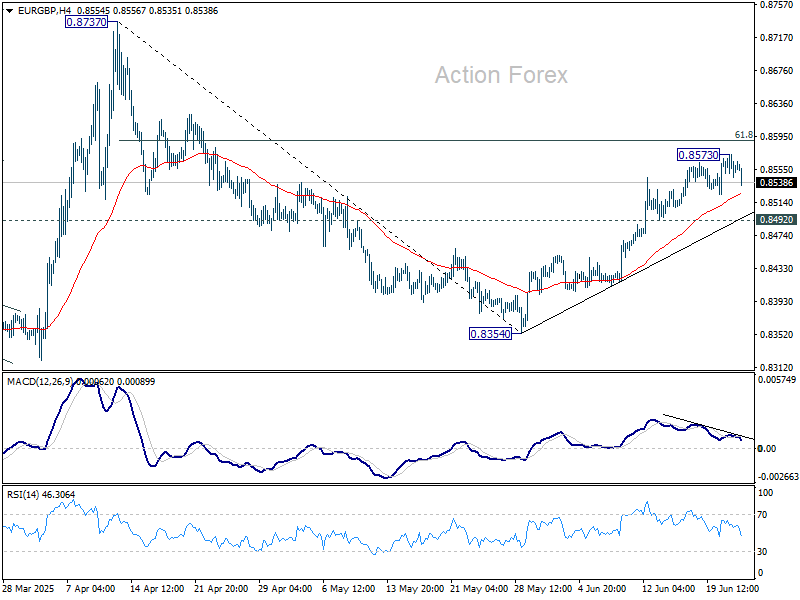
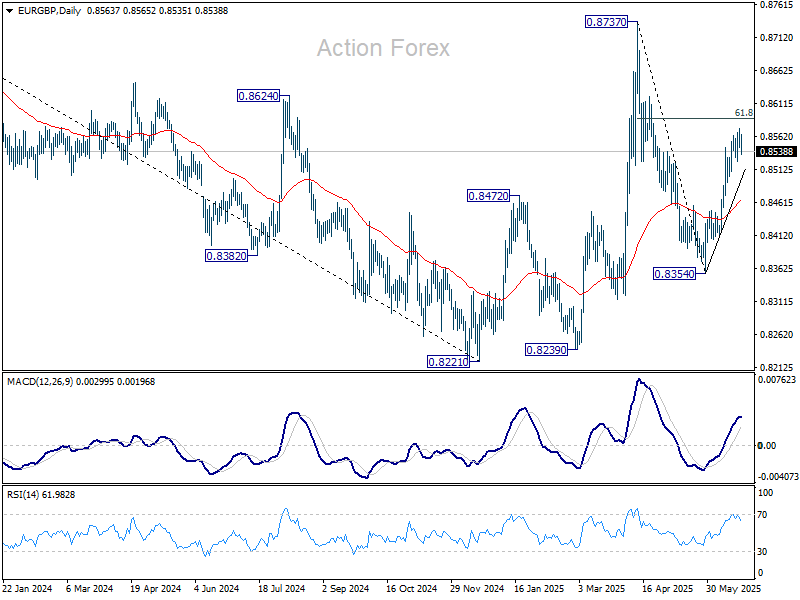
FX markets showed mostly technical trading in the major USD cross rates. DXY is going nowhere in the upper half of the 99 big figure (99.65). Idem for EUR/USD with the pair holding in the 1.13 big figure. At 1.1345, the week low of 1.1308 still isn’t ‘safe’. The dollar also tries to build some ST bottoming against the yen (USD/JPY 143.5 vs correction low just below 140 earlier this week). A more neural risk sentiment and a third consecutive month of ‘remarkably’ solid UK retail sales (March 0.4% M/M vs -0.4% expected and after a strong 0.7% in February) also slightly supported sterling. EUR/GBP is testing recent ST lows near 0.852. For now, we also still mainly see this a technical correction. Next support comes in at 0.8404 (50% retracement Dec 2024 low/April top) and at 0.8474 (previous range top).
News & Views
The US and India earlier this week agreed on The Terms of Reference for a Bilateral Trade Agreement, which both countries aim to conclude by the end of 2025. News agency Bloomberg today cites sources suggesting that 19 categories are under discussion including enhanced market access for US agricultural products and Indian labor-intensive exports, provisions to facilitate smoother e-commerce transactions and address data storage regulations but also collaboration on energy and critical minerals. Other so-called “chapters” covered in the trade deal are corruption and rules of origin and strengthening defense trade collaboration. Agreeing on a deal could significantly impact tariffs in both directions, with India lowering historically high agricultural taxes and the US lowering the steep 26% tariffs announced on “Liberation Day”. India and the US have pledged to boost bilateral trade to $500bn by 2030 from $127.6bn last year.
French business confidence more or less stabilized in April (96 from 97). Details showed a rebound in manufacturing (99 from 96) and services (98 from 97) while sentiment deteriorated in building construction (97 from 98) and has strongly retreated in retail trade (95 from 100). The latter is mainly due to a weakening general business outlook and lower ordering intentions. An employment climate indicator increased slightly, from 96 to 97 mainly due to the increase in the balance on future workforce size in services (including temporary work agencies).
Canada: Retail Sales Decline for the Second Consecutive Month amid Tariff Storm
Retail sales contracted by 0.4% month-on-month (m/m) in February, in line with the Statistics Canada's advanced estimate.
After adjusting for inflation, the volume of retail sales posted a 0.4% m/m decline.
The biggest drag came from motor vehicle and parts dealers, where sales fell 2.6% m/m, building on January's weakness. Ex-autos, sales were flat.
Receipts at gas stations and fuel vendors rose 0.3% m/m in nominal terms and 0.8% m/m in volumes terms, suggesting the increase was demand-driven.
Excluding auto sales and receipts at gas stations, core retail sales increased 0.5% m/m in February, driven primarily by a 2.5% increase at food and beverage stores. This may reflect an last minute bump in demand prior to the expiration of to the HST/GST holiday mid-February.
Gains were partially offset by a sharp contraction in furniture & home furnishings stores (-4.4% m/m), which continue to struggle amid a collapse in home sales.
E-commerce sales fell 0.3% m/m in February.
Statistics Canada's advanced estimate for March points to a 0.7% m/m rebound.
Key Implications
Retail sales remained sluggish in February, weighed down by weaker car sales, but March data point to a bounce back, likely driven by Canadians pulling forward major purchases and stockpiling non-discretionary items ahead of incoming tariffs.
Even so, March's rebound is expected to be short-lived. Consumers remain wary and may curb spending further until there is more certainty around employment, income prospects and inflation. The Bank of Canada's latest consumer survey suggests that the negative sentiment in response to tariff-related fears has surpassed even that experienced during the pandemic, leading households to revise down their overall spending plans. We've penciled in a +2% (annualized) growth rate in consumer spending for Q1, with a contraction in the following quarters.
EUR/USD Mid-Day Outlook
Daily Pivots: (S1) 1.1337; (P) 1.1367; (R1) 1.1420; More...
Intraday bias in EUR/USD stays mildly on the downside at this point. Pullback from 1.1572 short term top could extend lower. But downside should be contained by 38.2% retracement of 1.0176 to 1.1572 at 1.1039. On the upside, break of 1.1572 will resume larger up trend.
In the bigger picture, rise from 0.9534 long term bottom could be correcting the multi-decade downtrend or the start of a long term up trend. In either case, further rise should be seen to 100% projection of 0.9534 to 1.1274 from 1.0176 at 1.1916. This will now remain the favored case as long as 55 W EMA (now at 1.0776) holds.
GBP/USD Mid-Day Outlook
Daily Pivots: (S1) 1.3277; (P) 1.3313; (R1) 1.3375; More...
Intraday bias in GBP/USD is turned neutral with 4H MACD crossed above signal line. Pullback from 1.3422 short term top could still extend lower. But downside should be contained by 38.2% retracement of 1.2099 to 1.3422 at 1.2917. On the upside, firm break of 1.3433 will resume larger up trend.
In the bigger picture, price actions from 1.3433 are seen as a corrective pattern to the up trend from 1.3051 (2022 low). Rise from 1.2099 could be the second leg. Overall, GBP/USD should target 1.4248 key resistance (2021 high) on break of 1.3433 at a later stage.