

Sample Category Title
Euro Trading Stronger Ahead Of Key Economic Releases In The Eurozone
For the 24 hours to 23:00 GMT, the EUR declined 0.10% against the USD and closed at 1.1217 on Friday.
Data showed that Germany’s retail sales unexpectedly climbed by 4.7% on a yearly basis in February, suggesting that household consumption would be one of the growth driver this year. Retail sales recorded a rise of 2.6% in the previous month. Additionally, the region’s unemployment rate declined to 4.9% in March, hitting its lowest rate since the German reunification in 1990 and in line with market forecast. In the previous month, jobless rate had recorded a rate of 5.0%.
In the US, data showed that personal income rose by 0.2% in February, after falling 0.1% in the previous month. However, market participants had expected personal income to climb 0.3%. Also, personal spending climbed 0.1% in February, undershooting market consensus for a rise of 0.3%. In the previous month, personal spending had recorded a revised drop of 0.6%. Additionally, the Chicago Purchasing Managers’ Index (PMI) fell to 58.7 in March, more than market forecast for a fall to 61.0. The Chicago PMI had recorded a level of 64.7 in the previous month. New home sales advanced 4.9% to an annual rate of 667.0K in February, compared to a revised level of 636.0K. Economists had expected new home sales to increase by about 2.1%. The final Reuters/Michigan consumer sentiment index rose more than initially estimated to 98.4 in March, following a reading of 93.8 in the previous month. Both preliminary figures and market expectations had indicated an increase to a level of 97.8.
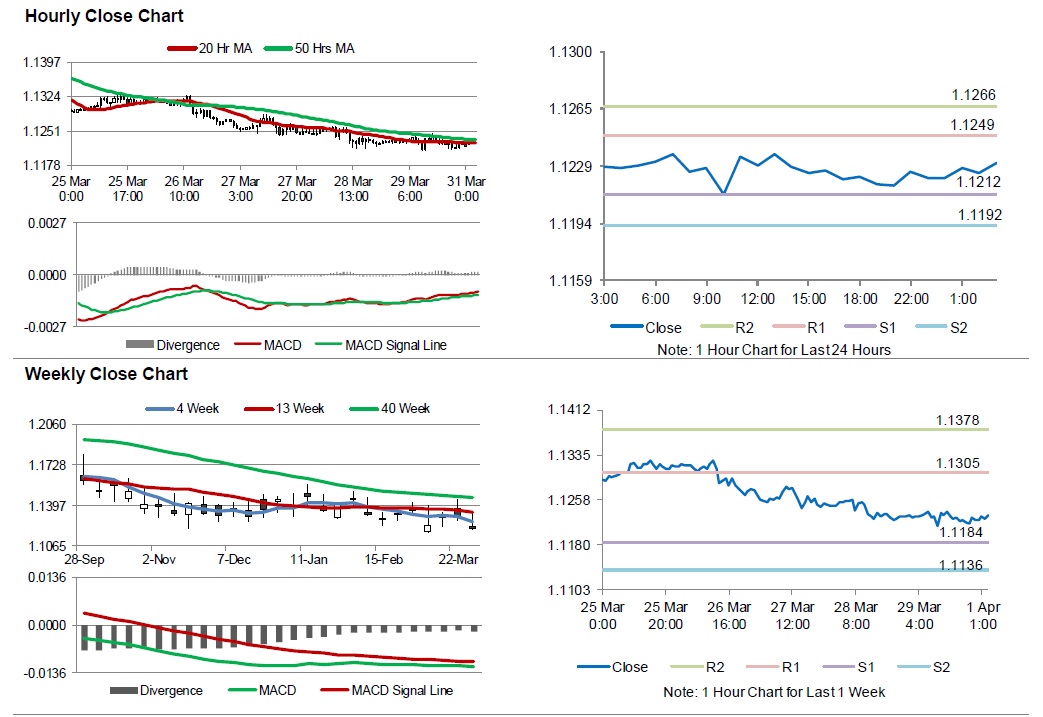
In the Asian session, at GMT0300, the pair is trading at 1.1231, with the EUR trading 0.12% higher against the USD from Friday’s close.
The pair is expected to find support at 1.1212, and a fall through could take it to the next support level of 1.1192. The pair is expected to find its first resistance at 1.1249, and a rise through could take it to the next resistance level of 1.1266.
Looking ahead, investors would keep an eye on the Euro-zone’s consumer price index for March and unemployment rate for February along with the manufacturing PMI for March, slated to release across the euro bloc in a few hours. Later in the day, the US advance retail sales and construction spending, both for February, will keep traders on their toes. Additionally, the nation’s Markit manufacturing PMI and the ISM manufacturing PMI, both for March, will pique significant amount of investor attention.
The currency pair is showing convergence with its 20 Hr and 50 Hr moving averages.
Sterling Reverses Its Losses In The Morning Session
For the 24 hours to 23:00 GMT, the GBP declined 0.25% against the USD and closed at 1.3023 on Friday, after the British Parliament, for the third time, rejected Prime Minister Theresa May’s Brexit deal.
On the macro front, UK’s gross domestic product (GDP) rose 0.2% on a quarterly basis in the fourth quarter of 2018, in line with market forecast and confirming the preliminary print. The GDP had recorded a rise of 0.6% in the previous quarter. Additionally, Nationwide house price index climbed 0.7% on an annual basis in March, beating market expectations for a rise of 0.6% and notching its highest level in four months. The house price index had recorded a gain of 0.4% in the prior month. Further, net consumer credit recorded a rise of £1.1 billion in February, higher than market expectations for a rise of £0.9 billion. Net consumer credit had risen by a revised £1.2 billion in the previous month.
On the other hand, the nation’s mortgage approvals for house purchase fell to a level of 64.3K in February, more than market expectations for a fall to a level of 65.0K. Mortgage approvals had recorded a revised level of 66.7K in the previous month.
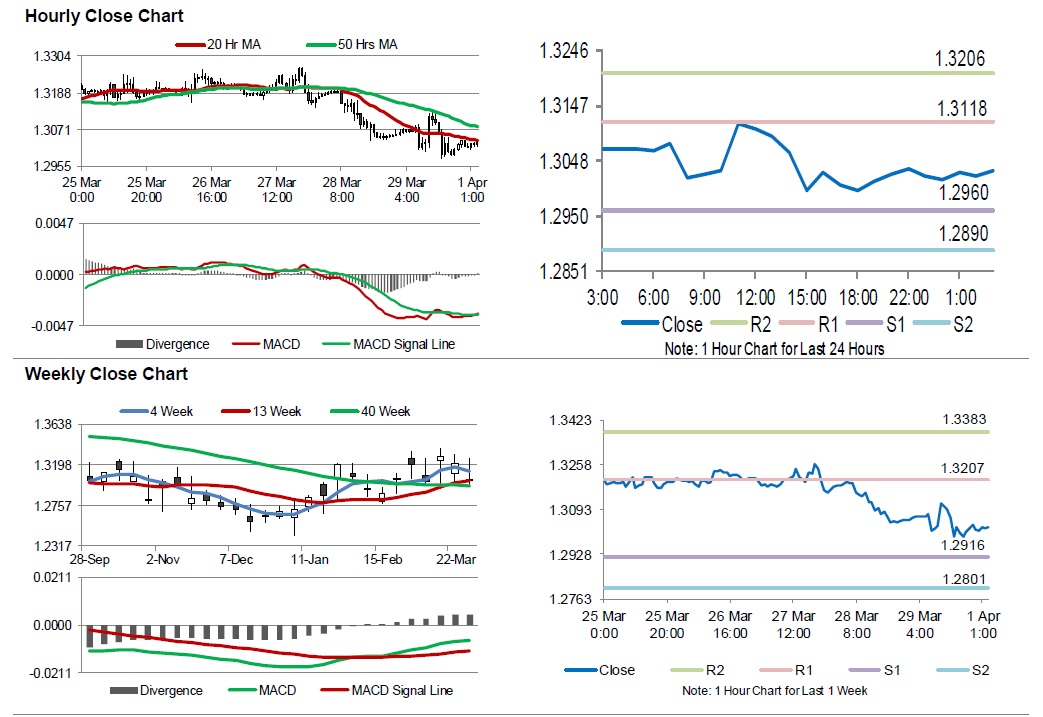
In the Asian session, at GMT0300, the pair is trading at 1.3030, with the GBP trading 0.05% higher against the USD from Friday’s close.
The pair is expected to find support at 1.2960, and a fall through could take it to the next support level of 1.2890. The pair is expected to find its first resistance at 1.3118, and a rise through could take it to the next resistance level of 1.3206.
Moving ahead, investors would keep a close watch on UK’s manufacturing PMI for March, slated to release in a few hours.
The currency pair is showing convergence with its 20 Hr moving average and trading below its 50 Hr moving average.
Japanese Yen Extends Its Losses In The Morning Session
For the 24 hours to 23:00 GMT, the USD rose 0.14% against the JPY and closed at 110.82 on Friday.
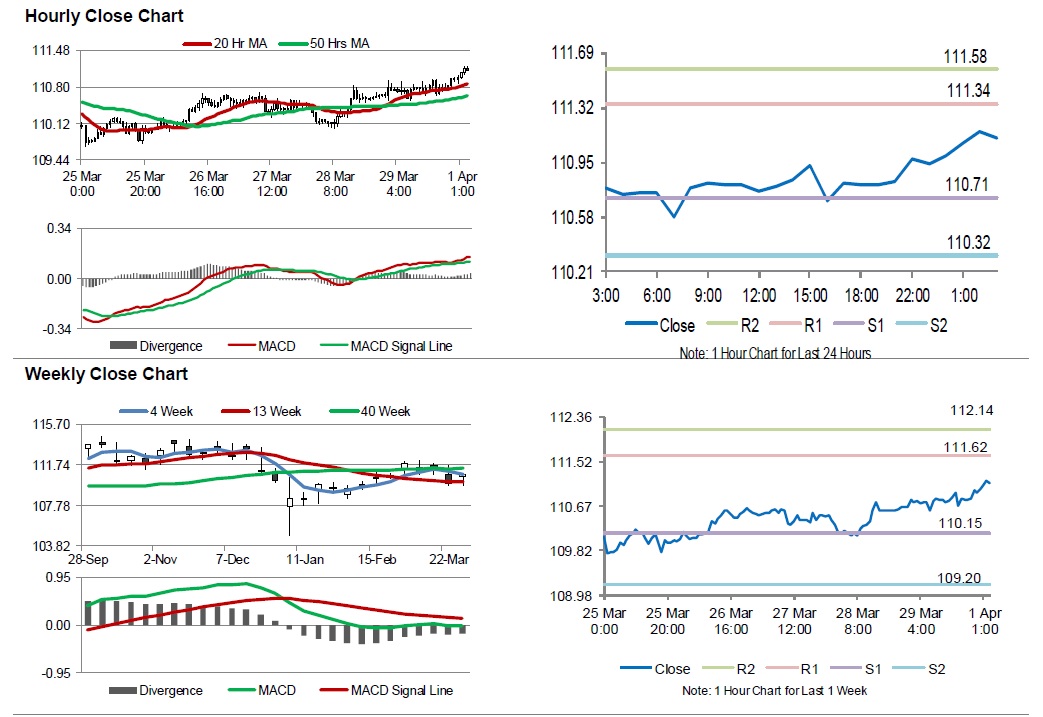
In the Asian session, at GMT0300, the pair is trading at 111.11, with the USD trading 0.26% higher against the JPY from Friday’s close.
Overnight data showed that in Japan, the final Nikkei manufacturing PMI advanced to a level of 49.2 in March, following a level of 48.9 in the previous month. The preliminary figures had indicated an unchanged reading.
The pair is expected to find support at 110.71, and a fall through could take it to the next support level of 110.32. The pair is expected to find its first resistance at 111.34, and a rise through could take it to the next resistance level of 111.58.
Amid no major economic releases in Japan today, investor sentiment would be determined by global macroeconomic news for further direction.
The currency pair is trading above its 20 Hr and 50 Hr moving averages.
Switzerland’s KOF Leading Indicator Climbed In March
For the 24 hours to 23:00 GMT, the USD rose 0.09% against the CHF and closed at 0.9957 on Friday.
On the data front, Switzerland's KOF leading indicator advanced to 97.4 in March, surpassing market expectations for a rise to 93.9 and compared to a revised level of 93.0 in the previous month.
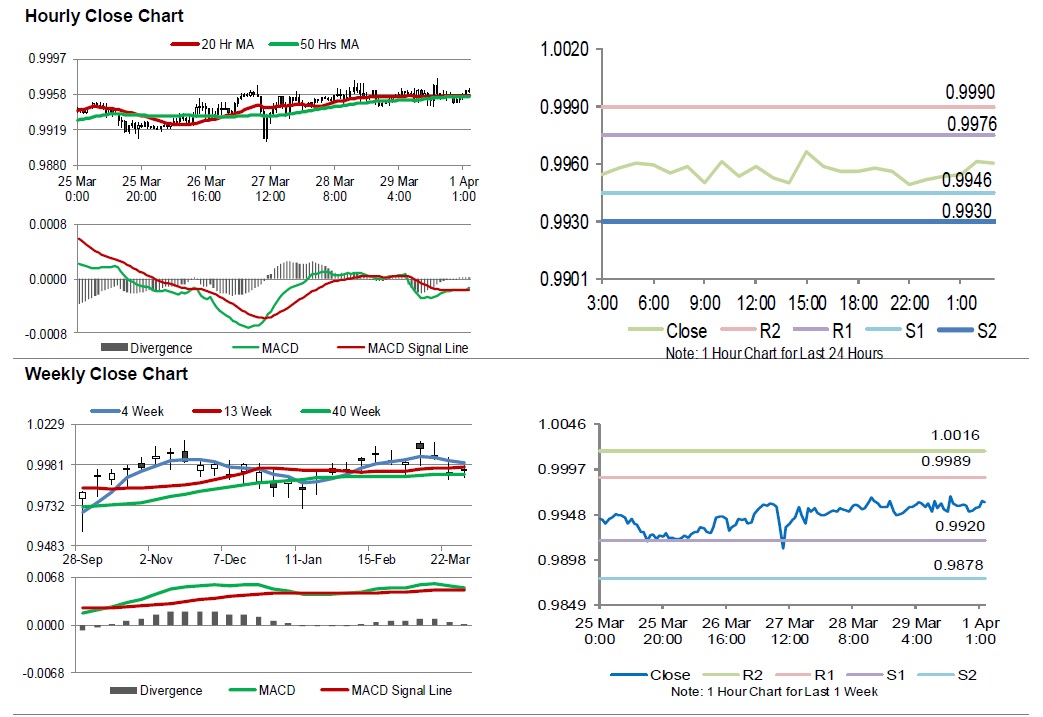
In the Asian session, at GMT0300, the pair is trading at 0.9961, with the USD trading marginally higher against the CHF from Friday's close.
The pair is expected to find support at 0.9946, and a fall through could take it to the next support level of 0.9930. The pair is expected to find its first resistance at 0.9976, and a rise through could take it to the next resistance level of 0.9990.
Trading trend in the Swiss Franc today, is expected to be determined by Switzerland's real retail sales for February and the manufacturing PMI for March, slated to release in a few hours.
The currency pair is trading above its 20 Hr and 50 Hr moving averages.
Loonie Trading On A Stronger Footing This Morning
For the 24 hours to 23:00 GMT, the USD declined 0.54% against the CAD and closed at 1.3363 on Friday.
The Canadian dollar rose against the US dollar, following stronger than expected growth in Canada’s gross domestic product (GDP).
In economic news, Canada’s GDP climbed more than market consensus by 0.3% on a monthly basis in January, amid growth in construction and manufacturing sectors. In the previous month, GDP had recorded a drop of 0.1%.
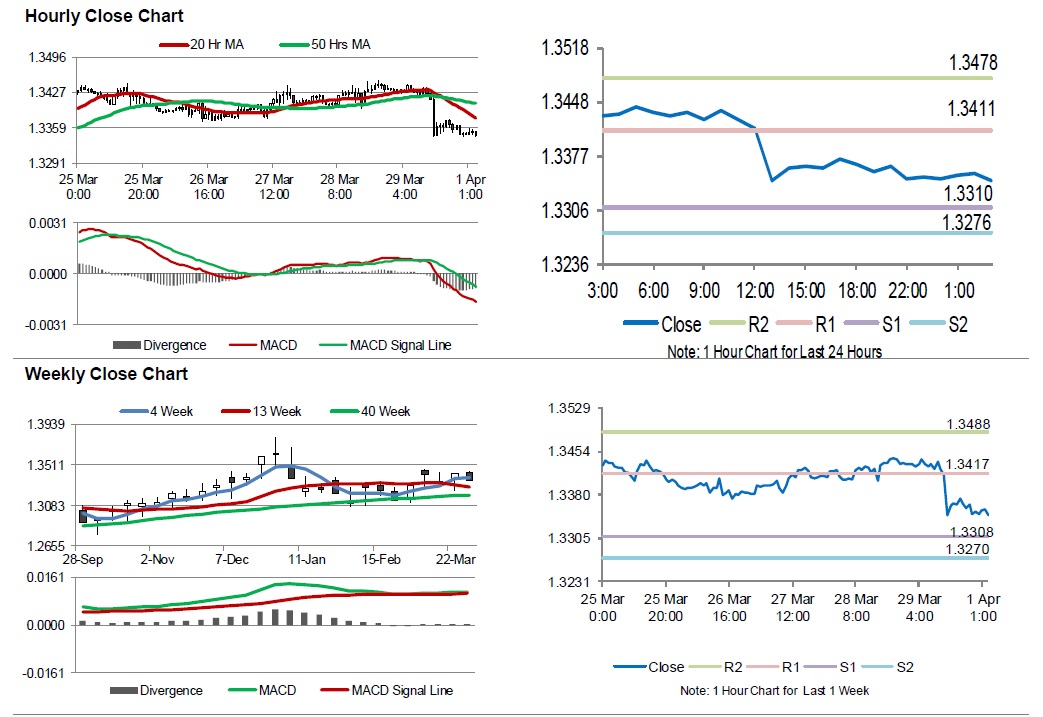
In the Asian session, at GMT0300, the pair is trading at 1.3345, with the USD trading 0.13% lower against the CAD from Friday’s close.
The pair is expected to find support at 1.3310, and a fall through could take it to the next support level of 1.3276. The pair is expected to find its first resistance at 1.3411, and a rise through could take it to the next resistance level of 1.3478.
Looking forward, investors would keep a close watch on Canada’s leading indicator for February and the RBC manufacturing PMI for March, scheduled to release later in the day.
The currency pair is trading below its 20 Hr and 50 Hr moving averages.
Aussie Trading Higher Ahead Of RBA’s Key Rate Decision
For the 24 hours to 23:00 GMT, the AUD rose 0.32% against the USD and closed at 0.7100 on Friday.
LME Copper prices rose 1.6% or $100.0/MT to $6485.0/MT. Aluminium prices climbed 0.2% or $3.5/MT to $1900.0/MT.
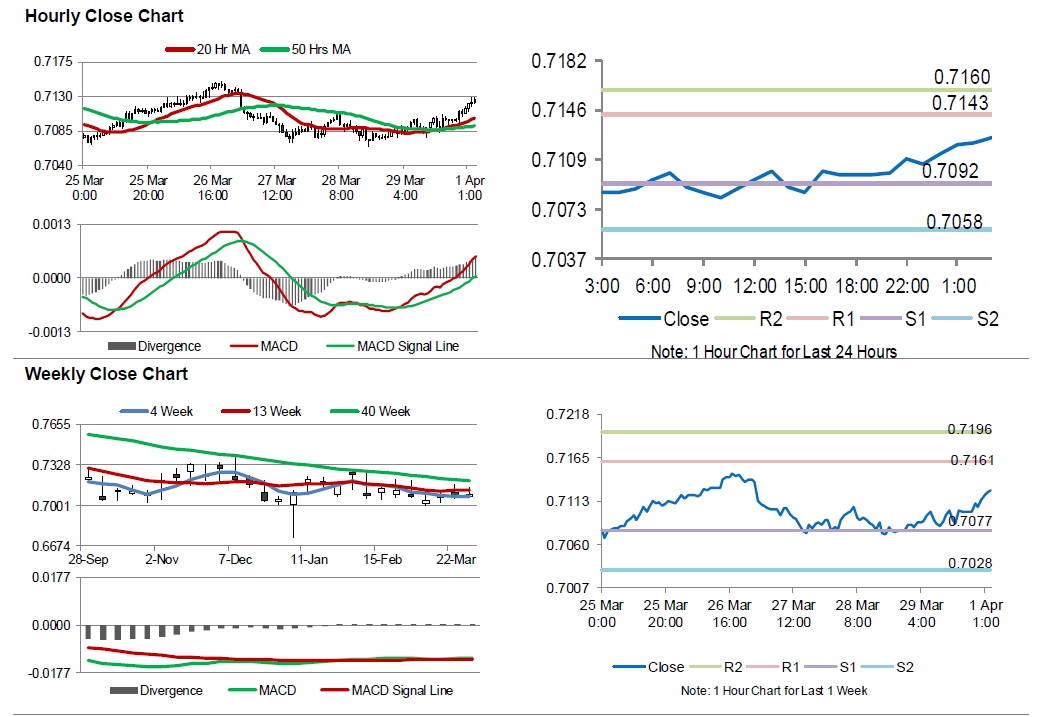
In the Asian session, at GMT0300, the pair is trading at 0.7125, with the AUD trading 0.35% higher against the USD from Friday's close.
Earlier in the session, data showed that Australia's AiG performance of manufacturing index declined for the third consecutive month to a level of 51.0 in March, following a reading of 54.0 in the previous month. Meanwhile, the nation's CBA manufacturing PMI dropped to a level of 52.0 in March, confirming the preliminary print. In the prior month, the PMI had recorded a level of 52.9.
Overnight data indicated that Australia's NAB business confidence recorded a flat reading in March, compared to a reading of 2.0 in February. Meanwhile, business conditions rose to 7.0 in March, following a reading of 4.0 in the previous month.
The pair is expected to find support at 0.7092, and a fall through could take it to the next support level of 0.7058. The pair is expected to find its first resistance at 0.7143, and a rise through could take it to the next resistance level of 0.7160.
Moving ahead, investors would focus on Australia's building approvals data for February, slated to release overnight. Additionally, the Reserve Bank of Australia's interest rate decision, slated to release early morning tomorrow, will garner significant amount of investor attention.
The currency pair is trading above its 20 Hr and 50 Hr moving averages.
Gold: Yellow Metal Trading Flat In The Asian Session
For the 24 hours to 23:00 GMT, Gold rose 0.15% against the USD and closed at USD1297.60 per ounce on Friday.
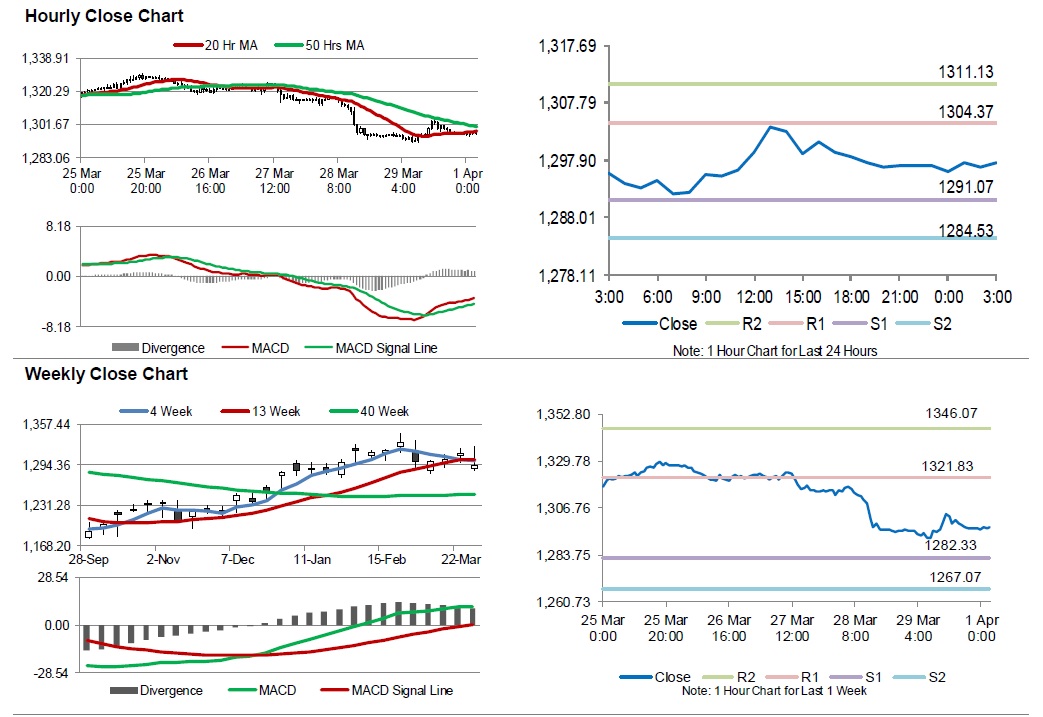
In the Asian session, at GMT0300, the pair is trading at USD1297.60, with gold trading flat against the USD from Friday’s close.
The pair is expected to find support at 1291.07, and a fall through could take it to the next support level of 1284.53. The pair is expected to find its first resistance at 1304.37, and a rise through could take it to the next resistance level of 1311.13.
The yellow metal is showing convergence with its 20 Hr moving average and trading below its and 50 Hr moving average.
Silver: White Metal Trading Higher In The Morning Session
For the 24 hours to 23:00 GMT, Silver rose 0.67% against the USD and closed at USD15.1 per ounce on Friday, tracking gains in gold prices.
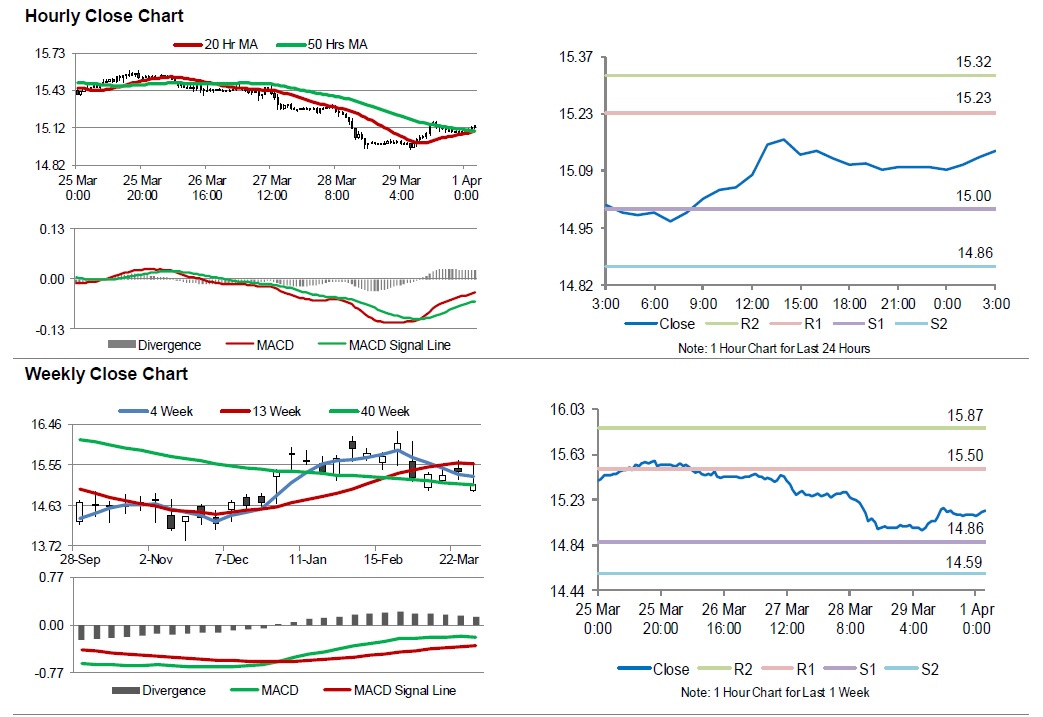
In the Asian session, at GMT0300, the pair is trading at USD15.14, with silver trading 0.30% higher against the USD from Friday’s close.
The pair is expected to find support at 15.00, and a fall through could take it to the next support level of 14.86. The pair is expected to find its first resistance at 15.23, and a rise through could take it to the next resistance level of 15.32.
The white metal is trading above its 20 Hr and 50 Hr moving averages.
AUD/USD Daily Outlook
Daily Pivots: (S1) 0.7077; (P) 0.7091; (R1) 0.7110; More...
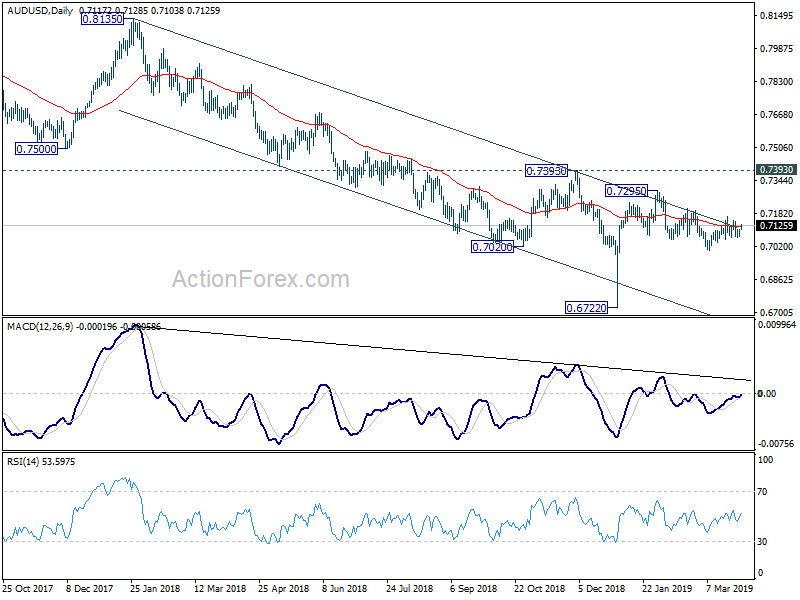
AUD/USD rebounds strongly today but stays in range below 0.7168. Intraday bias remains neutral first. On the upside, break of 0.7168 will resume the rise from 0.7003 and turn bias to the upside for 0.7295 resistance. Break will extend the whole rebound from 0.6722 to 0.7393 key resistance level. On the downside, though, break of 0.7056 minor support will turn bias to the downside for 0.7003 first. Break will resume the whole decline from 0.7295.
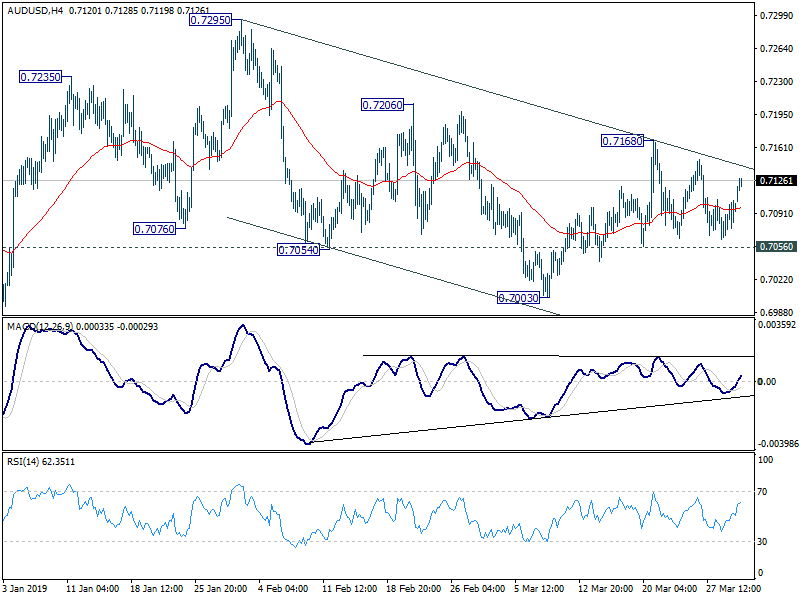
In the bigger picture, as long as 0.7393 resistance holds, we'd treat fall from 0.8135 as resuming long term down trend from 1.1079 (2011 high). Decisive break of 0.6826 (2016 low) will confirm this bearish view and resume the down trend to 0.6008 (2008 low). However, firm break of 0.7393 will argue that fall from 0.8135 has completed. And corrective pattern from 0.6826 has started the third leg, targeting 0.8135 again.
China Manufacturing PMIs Back in Expansion, Asian Stocks and Australian Dollar Lifted
Stock markets staged a strong rally in Asian session as lifted by better than expected manufacturing data from China. Both official and Caixin PMI manufactured climbed back into expansionary region, suggests that the worst could be over. Australian Dollar jumps broadly following generally positive risk sentiments, followed by New Zealand Dollar. Sterling also recovers as markets await what's next on Brexit. Yen and Swiss Franc are the weakest naturally, followed by Dollar.
Technically, despite today's rally, AUD/USD and AUD/JPY are still held in recently established range. Thus, bias in the two pairs remain neutral. Though, EUR/AUD broke 1.5780 support and is heading to 1.5721 low. Break will resume larger decline from 1.6765 flash crash top. USD/JPY's break of 110.95 minor resistance suggests that pull back from 112.13 has completed already and further rise is in favor to retest this resistance. GBP/USD and EUR/USD are both losing downside momentum and there are prospects of some recovery ahead.
In other markets, Nikkei closed up 1.43%. Hong Kong HSI is up 1.43%. China Shanghai SSE is up 2.52%. Singapore Strait Times is up 1.05%. Japan 10-year JGB yield is up 0.018 at -0.073, still negative though.
China Caixin PMI manufacturing rose to 50.8, employment expands again after five years
China Caixin PMI manufacturing rose to 50.8 in March, up from 49.9 and beat expectation of 50.0. The reading is back in expansionary region and is the highest since July 2018. Markit noted that production and total new work both increase at quicker rates. Also, employment expands for first time in over five years.
Dr. Zhengsheng Zhong, Director of Macroeconomic Analysis at CEBM Group said the reading indicates "a notable improvement in the manufacturing industry." "Overall, with a more relaxed financing environment, government efforts to bail out the private sector and positive progress in Sino-U.S. trade talks, the situation across the manufacturing sector recovered in March. The employment situation improved greatly."
China official PMI manufacturing rose to 50.5, economy still in a critical period of stabilization
Released over the weekend, official China PMI manufacturing rose to 50.5 in March, up from 49.2 and beat expectation of 49.6. That's firstly the largest monthly rise since 2012. Secondly, it's also the highest level in six months. The improvement from February's 3-yer low suggests stabilization in the slowdown in the sector. PMI non-manufacturing rose to 54.8, up from 54.3, and beat expectation of 54.5 too.
In the release, it's noted the improvement stemmed from post Chinese New Year production recovery and effect of growth stabilization policies. However, overall recovery in market demand is still not apparent. Export orders rebounded while expectations also improved. The positive signals from Sino-US trade negotiations have begun to take effect.
But overall, the statement noted that the current economy is still in a "critical period of stabilization and recovery". And, it is necessary to "further consolidate and enhance confidence recovery, and to restore market demand and stabilize economic growth.
Japan Tankan large manufacturing dropped to 12, lowest since 2017, large fall since 2012
Japan Tankan large manufacturing index dropped to 12 in Q1, down from 19 and even missed expectation of 13. That's also the lowest level since March 2017. The quarterly decline was sharpest since 2012. Large non-manufacturing index dropped to 21, down from 24 and missed expectation of 22. It's also the lowest level since March 2017.
Large manufacturing outlook also dropped to 8 down from 15 and missed expectation of 13. Large non-manufacturing outlook was unchanged at 20, matched expectations. All industry capex rose 1.2% in Q1, suggesting large firms expect to increase capital expenditure by a mere 1.2% in the year that begins in April. It's sharply lower than prior 14.3% but beat expectation of 0.8%.
The overall set of numbers are weak, suggesting worsening outlook and deeper slowdown in the Japanese economy. Down the road, if the trend continues, BoJ might be force to re-evaluate its own monetary policy.
Japan PMI manufacturing finalized at 48.9, worst quarterly performance since 2016
Japan PMI manufacturing was finalized at 49.2 in March, up[ from February's 48.9, signalling slowdown continues. Markets noted that demand remains sluggish, pulling output lower. Firms push resources to clearing backlogs due to lack of new work. And business confidence remains among lowest on record.
Joe Hayes, Economist at IHS Markit, said: "The final manufacturing PMI print of Q1 for Japan points to the worst quarterly performance in the sector since Q2 2016... The economic backdrop for the manufacturing sector in Japan remains fiercely challenging. Asian goods producers face headwinds from slowing growth in Europe and China, while global trade risks are yet to be mitigated by a breakthrough in US-Sino relations."
Australia NAB business conditions improved, but confidence dropped
Australia NAB Business Conditions rose 3 pts to 7 in March, beat expectation of 2.On the positive side, employment index rose 2 pts to 7. It remains "well above average, suggesting that for now, survey indicators of labour demand remain favourable." Trading and profitability also rebounded.
However, Business Confidence dropped -2 pts to 0, missed expectation of 4. It also "continued the below average run. "Other forward looking indicators – capacity utilisation and forward orders – showed some improvement but remain at or below average. Also, it's noted that "overall survey measures of prices and inflation remain weak."
AiG Performance of Manufacturing index dropped -3 pts to 51 in March, indicating slower pace of expansion. Some respondents attributed the down trend since mid-2018 to "general slowing in the economy". Some said their customers are "delaying orders" until after Federal election. Also, downturn in housing construction also affect demand.
TD securities inflation accelerated to 0.4% mom in March.
Heavy weight data ahead to indicate how serious are recession risks
Global slowdown and recession fear was a major theme back in March. This week's set of important growth and confidence indicators will reveal whether there was already a turnaround, or weakness would be carried over Q2.
Data from the US catch most attention with retail sales, ISM indices, durables goods and employment featured. In particular, following the terrible 20k NFP growth in February, markets are eager to see strong rebound in March, and possibly upward revision in February's number. Meanwhile, UK PMIs, Eurozone CPI, German production, Canada employment, Australia retail sales and China PMIs will catch a lot on attentions too.
RBA rate decision will also be a focus. While the central bank is generally expected to cut interest rates twice this year, April is probably a month to early to turn dovish. RBA will likely wait for more Q1 data, as well as May economic projections before making the shift. ECB will also release March monetary policy accounts. They should reveal more about policymakers' views on outlook, after recent downgrade.
Here are some highlights for the week.
- Monday: Japan Tankan survey, PMI manufacturing final; Australia NAB business confidence; China Caixin PMI manufacturing; Swiss retail sales, PMI manufacturing; Eurozone PMI manufacturing final, CPI flash, unemployment rate; UK PMI manufacturing; US retail sales, ISM manufacturing, business inventories, construction spending; Canada PMI manufacturing
- Tuesday: Japan monetary base; RBA rate decision, Australia budget release; Swiss CPI; UK PMI construction; Eurozone PPI; US durable goods orders
- Wednesday: UK BRC shop price; Australia retail sales, trade balance; China Caixin PMI services; Eurozone PMI services final, retail sales; UK PMI services; US ADP employment, ISM non-manufacturing
- Thursday: Germany factory orders; ECB monetary policy accounts; US Challenger job cuts, jobless claims: Canada Ivey PMI
- Friday: Japan labor cash earnings, household spending, leading indicators; Germany industrial production; Swiss Foreign currency reserves; Canada employment; US non-farm payrolls
AUD/USD Daily Outlook
Daily Pivots: (S1) 0.7077; (P) 0.7091; (R1) 0.7110; More...
AUD/USD rebounds strongly today but stays in range below 0.7168. Intraday bias remains neutral first. On the upside, break of 0.7168 will resume the rise from 0.7003 and turn bias to the upside for 0.7295 resistance. Break will extend the whole rebound from 0.6722 to 0.7393 key resistance level. On the downside, though, break of 0.7056 minor support will turn bias to the downside for 0.7003 first. Break will resume the whole decline from 0.7295.
In the bigger picture, as long as 0.7393 resistance holds, we'd treat fall from 0.8135 as resuming long term down trend from 1.1079 (2011 high). Decisive break of 0.6826 (2016 low) will confirm this bearish view and resume the down trend to 0.6008 (2008 low). However, firm break of 0.7393 will argue that fall from 0.8135 has completed. And corrective pattern from 0.6826 has started the third leg, targeting 0.8135 again.
Economic Indicators Update
| GMT | Ccy | Events | Actual | Forecast | Previous | Revised |
|---|---|---|---|---|---|---|
| 21:30 | AUD | AiG Performance of Manufacturing Index Mar | 51 | 54 | ||
| 23:50 | JPY | Tankan Large Manufacturing Index Q1 | 12 | 13 | 19 | |
| 23:50 | JPY | Tankan Large Manufacturers Outlook Q1 | 8 | 13 | 15 | |
| 23:50 | JPY | Tankan Large Non-Manufacturing Index Q1 | 21 | 22 | 24 | |
| 23:50 | JPY | Tankan Non-Manufacturing Outlook Q1 | 20 | 20 | 20 | |
| 23:50 | JPY | Tankan Large All Industry Capex Q1 | 1.20% | 0.80% | 14.30% | |
| 23:50 | JPY | Tankan Small Manufacturing Index Q1 | 6 | 10 | 14 | |
| 23:50 | JPY | Tankan Small Manufacturing Outlook Q1 | -2 | 6 | 8 | |
| 23:50 | JPY | Tankan Small Non-Manufacturing Index Q1 | 12 | 9 | 11 | |
| 23:50 | JPY | Tankan Small Non-Manufacturing Outlook Q1 | 5 | 5 | 5 | |
| 0:00 | AUD | TD Securities Inflation M/M Mar | 0.40% | 0.10% | ||
| 0:30 | AUD | NAB Business Conditions Mar | 7 | 2 | 4 | |
| 0:30 | AUD | NAB Business Confidence Mar | 0 | 4 | 2 | |
| 0:30 | JPY | PMI Manufacturing Mar F | 49.2 | 48.9 | ||
| 1:45 | CNY | Caixin PMI Manufacturing Mar | 50.8 | 50 | 49.9 | |
| 5:30 | AUD | Commodity Index AUD Mar | 129.7 | |||
| 6:30 | CHF | Retail Sales Real Y/Y Feb | -0.40% | |||
| 7:30 | CHF | PMI Manufacturing Mar | 53.5 | 55.4 | ||
| 7:45 | EUR | Italy Manufacturing PMI Mar | 47.5 | 47.7 | ||
| 7:50 | EUR | France Manufacturing PMI Mar F | 49.9 | 49.8 | ||
| 7:55 | EUR | Germany Manufacturing PMI Mar F | 44.7 | 44.7 | ||
| 8:00 | EUR | Eurozone Manufacturing PMI Mar F | 47.7 | 47.6 | ||
| 8:30 | GBP | PMI Manufacturing Mar | 51.2 | 52 | ||
| 9:00 | EUR | Eurozone Unemployment Rate Feb | 7.80% | 7.80% | ||
| 9:00 | EUR | Eurozone CPI Estimate Y/Y Mar | 1.50% | 1.50% | ||
| 9:00 | EUR | Eurozone CPI Core Y/Y Mar A | 1.00% | 1.00% | ||
| 12:30 | USD | Retail Sales Advance M/M Feb | 0.30% | 0.20% | ||
| 12:30 | USD | Retail Sales Ex Auto M/M Feb | 0.40% | 0.90% | ||
| 13:30 | CAD | Manufacturing PMI Mar | 52.6 | |||
| 13:45 | USD | Manufacturing PMI Mar F | 52.5 | 52.5 | ||
| 14:00 | USD | ISM Manufacturing Mar | 54.3 | 54.2 | ||
| 14:00 | USD | ISM Prices Paid Mar | 49.4 | |||
| 14:00 | USD | ISM Employment Mar | 52.3 | |||
| 14:00 | USD | Construction Spending M/M Feb | -0.10% | 1.30% | ||
| 14:00 | USD | Business Inventories Jan | 0.40% | 0.60% |